 STUDIES ON SOIL STRESS VIA COMPUTER SIMULATION: IMPACT OF TIRE INFLATION PRESSURE
ABSTRACT
Soil compaction configures a major threat to soil structural quality. Mitigating compaction induced by agricultural machinery involves knowing the state of stress transmission in the soil which in turn is affected by tire inflation pressure. Hence, this study evaluated the impact of three tire inflation pressure levels from a sugarcane harvesting truck on soil stress propagation. Using the 'PredComp' computational model and machine and tire parameters, simulations were performed for 70, 100 and 130% of the recommended inflation pressure which corresponded, respectively, to pressures of 350, 500, and 650 kPa. Size of contact area decreased as the inflation pressure increased, yielding values of 0.13 m2, 0.12 m2 and 0.11 m2; whereas the maximum stress levels in the center of the tires increased by 465, 623 and 784 kPa to 70, 100 and 130% of inflation pressure, respectively. The propagated stress levels at layers 10 or 30 cm deep were −5% to 70% of the inflation pressure and +5% to 130% of the inflation pressure in relation to the reference (100%). Our simulations indicate that the increase in inflation pressure can increase the stress levels at the tire-soil interface thereby increasing the mechanical stresses propagated is the topsoil and subsoil by approximately 5%, which increases the risk of compaction if the stress levels exceed soil load-bearing capacity.
agricultural traffic; soil tension; agricultural tires
INTRODUCTION
Compaction of agricultural soils constitutes a major threat to soil quality for plant growth, and for soil and water conservation in cultivated systems (Keller et al., 2019). Soil compaction can be defined as the reduction in pore space with a consequent increase in bulk density (Torres et al., 2024). Increased bulk density due to compacted layers can reduce water and air flow and increase the resistance to penetration of the soil. Such changes in these physical parameters could make the environment unfavorable for root development, consequently reducing root biomass.
Machinery high mass and the frequency of operations during soil tillage, cultivation and harvesting (Keller et al., 2019) make compaction a reality in the field (Lima et al., 2020; Horn et al., 2024). In modern agriculture, soil compaction has as its core source the traffic of agricultural machinery (Shaheb et al., 2021). Compaction induced by machinery traffic impacts both surface and deeper layers. It occurs during tire-soil contact with consequent stress propagation across the soil (ten Damme et al., 2024). Once the stresses reach subsoil, subsoil compaction becomes a persistent and difficult to reverse process (Berisso et al., 2012). Mechanical intervention and mobilization is usually necessary for recovering deep compacted layers (subsoiling), requiring high-power equipment and high energy demands. Consequently, the rupture of compacted layers can disaggregate the soil and thus reduce wet aggregate stability (Weidhuner et al., 2021).
In sugarcane cultivation, harvesting can be mechanized and semi-mechanized. In mechanized harvesting, conducted without burning, the harvesting machines consist of a harvester and a transshipment, the latter of which can be pulled by tractors or trucks. This type of harvest predominates in south and southeast Brazil. In semi-mechanized harvesting, cutting is done by hand and loading is mechanized. Trucks enter the cultivation area to be loaded by loaders and collect the stalks. Traffic is totally random, and the trucks travel with the high mass of harvested stalks. From a compaction perspective, both systems use machines that are loaded with plant material from the harvest, increasing the weight of the machines, propagated stress levels and the risk of compaction. Jimenez et al. (2021) reported that for some vehicles used in semi-mechanized sugarcane harvesting, the vertical tension in the contact area can reach 700 kPa, whereas Esteban et al. (2024) reported tensions on the topsoil below the center line of tractor trailer tires of 279 kPa in mechanized harvesting.
Tire inflation pressure determines the machine traction and balance in the tire-soil interaction; however, inflation pressure is one of the main parameters responsible for soil compaction (ten Damme et al., 2021). Generally, the higher the inflation pressure, the greater the compaction. This is because the tire-soil contact area is reduced as inflation pressure increases, concentrating pressure on the contact surface (Keller, 2005). This pressure is transferred towards the ground as stress propagation, in stress isobars below the contact area known as stress bulges. Once they reach the different layers of the soil, the stress levels can cause deformation depending on soil load-bearing capacity (Esteban et al., 2024). If the acting stress levels are lower than the load-bearing capacity, the soil deforms elastically and recovers its deformed volume after the applied load is relieved. However, if the acting stress levels are higher than the load-bearing capacity, the soil can undergo plastic deformation. In this case, after unloading the soil does not recover its initial volume and compaction occurs permanently (Esteban et al., 2024).
Inflation pressure can deform the tire, which in turn, in contact with the ground, causes changes in the contact area. Contact area can be directly measured in situ using tire-to-soil contact markers (Marques Filho et al., 2024). In addition to field methods, which examine the tire-soil contact area, computational methods through simulations allows to evaluate the impact of varying tire inflation pressure on stress propagation in the soil (Schjønning et al., 2008; Lima et al., 2021). These models are experimentally obtained via field tests, examining the impact of inflation pressure on the shape of the contact area and stress distribution over the contact area. Based on the experimental data, mathematical models are proposed to predict the shape of the contact area in terms of geometry, size, and stress levels.
Methods and evaluations of contact area measurement are usually reported in experimental results. However, the use of computer models that address the process of describing the contact area and stress levels at the tire-soil interface is still scarce. Hence, this study evaluated the impact of three tire inflation pressure levels from a sugarcane harvesting truck on soil stress propagation.
MATERIAL AND METHODS
The study was conducted using the 'PredComp' soil compaction model (Lima et al., 2021). PredComp is described by Lima et al. (2021) and is capable of simulating contact area, stress propagation and soil deformation. The model is based on the equations of Keller (2005) for describing the contact area and Söhne (1953) for describing the stress propagation in the soil. For simulation, machine and tire parameters are required as input to the contact area model: 1) inflation pressure, 2) recommended inflation pressure, 3) tire width, 4) tire diameter and 5) wheel load.
According to Keller (2005), the shape of the contact area can be described by a super-ellipsoid (Equation 1), in which a and b are the halves of the axes in the x and y direction, respectively, and n governs the shape of the super-ellipsoid.
In the tire-soil contact area, considering the super-ellipsoid, x is the length of the area in the direction of traffic—calculated according to an analytical equation (described below), and y is the tire width (obtained from the manufacturer’s catalog). Tire-soil contact area can thus take on a circular, ellipsoidal or rectangular geometric shape, depending on the tire input parameters. Size of the contact area (m2), based on the ellipse that describes the contact area (Equation 1) can then be calculated according to [eq. (2)], in which CA is the contact area:
According to Keller (2005), parameter n, which shapes the super-ellipsoid and the contact area, can be calculated empirically (obtained experimentally) according to [eq. (3)], defined as a function of tire width (TWidth) and tire diameter (Tdiameter):
The length of the contact area (CAlength), which defines x in [eq. (1)], can also be calculated analytically as a function of the tire diameter (Tdiameter), the recommended inflation pressure (TIPR) and the inflation pressure at the time of traffic (TIP) (Equation 4). Width of the contact area (CAWidth) is assumed to be the width of the tire.
Once the contact area is described in shape and size, the stress distribution promoted by tire-soil contact over the contact area can be calculated. According to Keller (2005), the maximum stress (σmax) over the contact area can be calculated according to [eq. (5)] (in which Wload is the load per wheel, supplied as input to the model):
Stress distribution is calculated using mathematical functions based on σmax. Two functions, which distribute the stresses in the matrix that forms the contact area, are used: one in the x-direction and one in the y-direction. According to Keller (2005), the distribution along the width of the tire can be calculated using [eq. (6)]:
In which:
C is a parameter numerically in the model,
w(x) is the contact width at position x (e.g., for x = 0, w(x) = TWidth = CAWidth; Lima et al., 2021). δ is given empirically by Keller (2005) and can be calculated according to [eq. (7)].
Stress distribution in the y-direction is given by [eq. (8)]. In it, σ𝓍 = 0,y is the stress under the transverse axis of the tire contact area, l(y) is the contact length at position y (for y = 0, l(y)=CAlength) and α is a parameter (order of the power function) restricted to 1 ≤ α ≤ 16. α is calculated under the condition that the load on the modeled wheel must be close to the load on the measured wheel (i.e., the input Wload). In the PredComp model (Lima et al., 2021), the numerical and analytical calculations of the contact area are performed computationally in the R software.
Stress propagation was estimated based on vertical stress, as described by Söhne (1953). Söhne (1953) used the studies of Boussinesq (1885) and Fröhlich (1934) to formulate a stress propagation model applied to agricultural tires (Equation 9),
in which,
σr is the propagated radial stress;
P is the point load; ξ is the concentration factor, and
θ is the angle between the normal load vector and the desired point. Calculation of vertical stress (σz) towards the ground is therefore based on σr, calculated according to [eq. (10)].
Further details of the calculation procedure according to Söhne (1953) can be found in Lima et al. (2021). PredComp is available for free at: https://appsoilphysics.shinyapps.io/PredComp/. In the model, contact area and stress propagation can be calculated according to the procedure described here.
Study simulations were conducted on a sugarcane transport truck (Mercedes Benz LS 2638), with dimensions 11 R22 152/149, described by Jimenez et al. (2021), whose input data was as follows: inflation pressure (IP) = 500 kPa; recommended inflation pressure (recommended IP) = 500 kPa; tire width = 28 cm; tire diameter = 114 cm; and wheel load = 2100 kg. Simulations were performed for 70, 100 and 130% of the recommended IP which corresponded, respectively, to pressures of 350, 500, and 650 kPa. Figure 1 presents the distribution of tire dimensions.

To compare the results of vertical stress transmission (σv) in the soil with the soil load-bearing capacity, we used the preconsolidation stress estimation model (σp) presented by Severiano et al. (2013) to calculate the risk of compaction. Preconsolidation stress was calculated for a Latosol (Oxisol) in a scenario with 70% clay and -10 kPa matric potential (close to field capacity) using [eq. (11)]. Risk of compaction was considered to exist for the condition σv > σp.
In which:
σp is the preconsolidation stress in kPa;
|ψm| is the matric potential, in kPa.
Results were examined by means of the contact area and bulb stresses applied to the soil up to a depth of 50 cm, as well as percentage variations in the stresses propagated in the topsoil (10 cm) and subsoil (30 cm). Both the Keller model (2005) and the Söhne model (1953) are available in the 'PredComp' computer model (Lima et al., 2021), which was used to perform the simulations.
RESULTS AND DISCUSSION
The simulations revealed that the tire-soil contact area decreased with increasing inflation pressure. Contact area sizes were 0.13 m2, 0.12 m2 and 0.11 m2, for 70, 100 and 130% of the recommended inflation pressure. That is, contact area reduced as inflation pressure increased, thereby increasing the concentration of contact stresses due to the reduction of area and maintaining the tire load of the scenarios evaluated (2100 kg). Figure 2 shows the larger contact area and stress relief at 70% of the recommended pressure.

Contact area and stress distribution (σ) over the tire-soil contact area for 70 (350 kPa), 100 (500 kPa) and 130 % (650 kPa) of the recommended inflation pressure.TIP: tire inflation pressure.
Tire is an elastic material whose shape depends on the stiffness induced by inflation pressure (Diserens et al., 2011). This elasticity inducing deformation and expansion of the contact area can be observed for the 70% inflation pressure scenario. As the contact area increases due to reduction in inflation pressure, stress distribution over the contact area also reduces (Figure 2) with relief of the stresses distributed in the tire-soil interface. Similar results were reported by Alkhalifa et al. (2024), who investigated the effect of changes in inflation pressure on artificial soils-tire interaction. The authors found that reducing tire inflation pressure by 37% resulted in 26% (vertical load of 6 kN) and 39% (vertical load of 8 kN) longer contact lengths.
Increases in tire inflation pressure resulted in stress concentration at the tire-soil interface (Figure 2). For 130% of the recommended inflation pressure scenario, stress concentrated in the center of the tire-soil contact approaching 800 kPa. Stress levels in the center of the tire for the recommended inflation pressure was approximately 600 kPa, whereas for 70% of the recommended pressure, the maximum stress detected in the center of the tire was close to 450 kPa. Results indicate a concentration twice the maximum distributed stress in the tire-soil contact from 70 to 130% of the inflation pressure. Despite this concentration, this stress is not uniform throughout the contact area as also described by Keller (2005), Schjønning et al. (2008), and Golanbari et al. (2024), who report stress peaks distributed mainly in the center of the tire, indicating the non-uniformity of contact stresses.
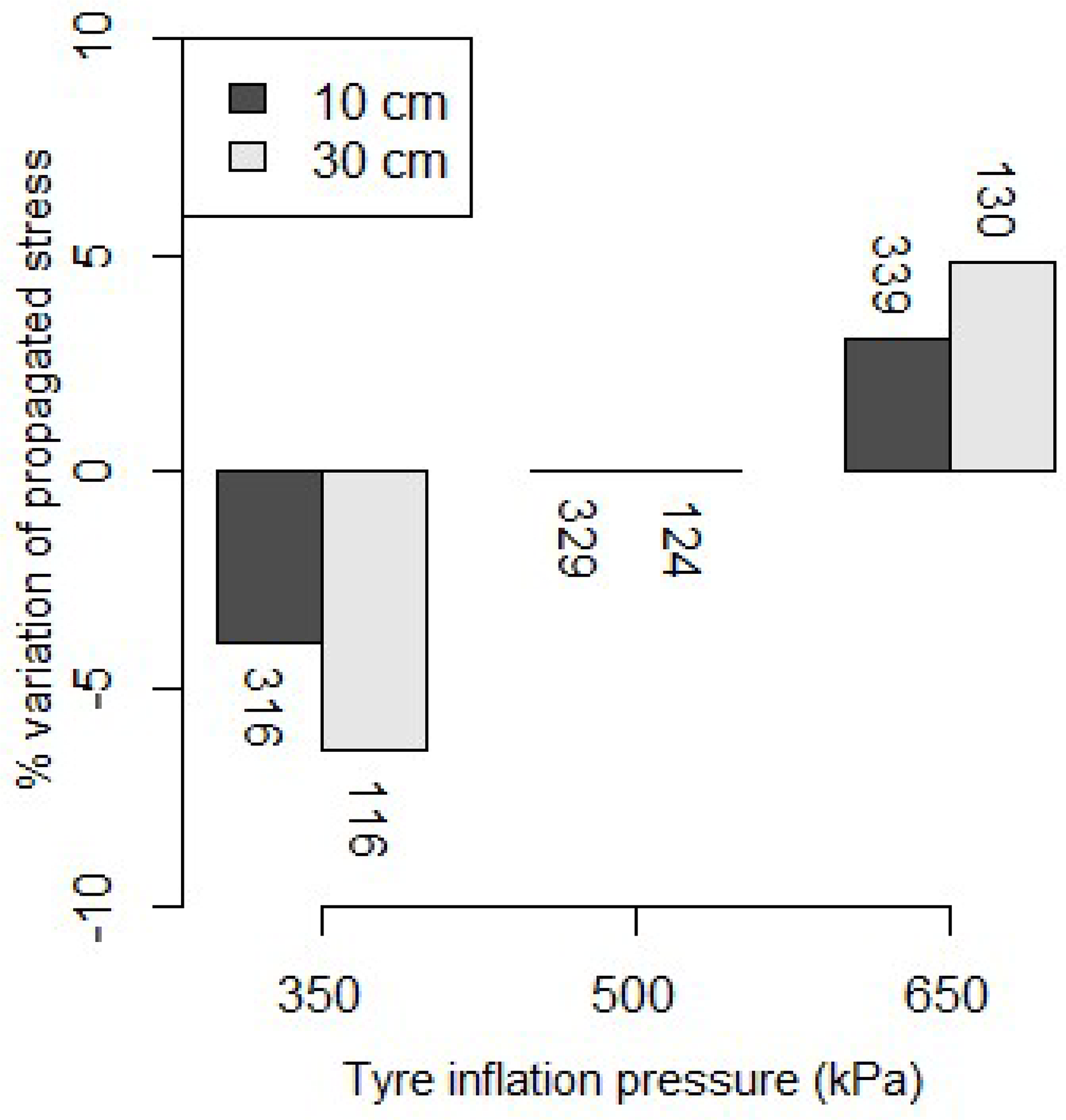
Figure 3 shows the propagation of vertical stresses in the soil profile from the contact area. Estimates from the soil compaction model for the propagation of stresses under traffic at the recommended inflation pressure (100%) indicate that the stress near the topsoil (10 cm deep) was approximately 350 kPa, reaching a depth of 30 cm with stresses of approximately 125 kPa. At 350 kPa inflation pressure (70% of the recommended), the pressure near the topsoil dropped to 315 kPa, reaching a 30 cm of depth at a tension of 115 kPa (Figure 3).

Propagation of vertical stresses (σv) in the soil for 70 (350 kPa), 100 (500 kPa) and 130 % (650 kPa) of the recommended inflation pressure. TIP: tire inflation pressure.
When the simulated inflation pressure was 130% of the recommended pressure (650 kPa), the vertical stress levels reached 340 kPa in the first 10 cm of depth, registering 130 kPa at 30 cm (Figure 3). Propagated stress levels at the 10 and 30 cm depth layers were −5% and 5% for 70 and 130% of the recommended inflation pressure (Figure 4). This points to a 10% increase in the stress levels reaching the ground from 70 to 130% of the inflation pressure.

Percentage variations of vertical stresses propagated at the 10 and 30 cm layers for inflation pressure levels of 70, 100 and 130% of the recommended inflation pressure.
Simulation results show that the increase in inflation pressure caused an increase in stresses on the topsoil, with higher levels of stress in the 30 cm layer. Soil compaction occurs when stress levels exceed its load-bearing capacity (Schjønning et al., 2024) and is more difficult to remedy at depth (> 30 cm) (Torres et al., 2024). Increased topsoil concentration can cause compaction in the first few centimeters of the soil, where the greatest concentration of roots predominates. Although sugarcane roots can reach a depth of 4 m, the greatest root density concentrates in the first 30 cm (Laclau & Laclau, 2009). Compaction in this surface zone could therefore limit the expansion of the root system.
In sugarcane plantations, soil preparation is a practice prior to planting, using tillage to reduce soil resistance. Tillage is still performed conventionally using ploughs and harrows that reach from 20 (Luz et al., 2022) to 40 cm (Oliveira et al., 2022), but with an average depth of 30 cm. For the recommended inflation pressure (100%) and below this recommendation (70%), the stress levels did not exceed 100 kPa for the layer below 30 cm, whereas for inflation pressure above the recommended, stress values above 100 kPa were observed up to 30 cm, considered the topsoil limit (Salonen et al., 2023). Thus, higher stress levels reached layers beyond the action of ploughs and harrows, and subsoil compaction below 30 cm could occur in this scenario.
Under these conditions, high-energy-demand implements such as subsoilers (Wang et al., 2020) should be used to decompact deep layers (> 30 cm). Our results show that reducing tire inflation pressure is an effective measure to prevent compaction, corroborating observations by Holthusen et al. (2018). However, the reduction in inflation pressure should be analyzed in conjunction with the vehicle traffic performance.
Soil load-bearing capacity models reported by Severiano et al. (2013) for latosols indicate that at a -10 kPa matric potential, which can be considered very close to field capacity, soils with a textural variation of 15 to 70% clay did not show a load-bearing capacity greater than 100 kPa. Hence, values of mechanical stress levels propagated from the sugarcane truck could exceed the load-bearing capacity of these soils, and thus reducing the inflation pressure could be an alternative for reducing subsoil compaction.
A risk of compaction assessment using the prediction model suggested by Severiano et al. (2013) for soils with 70% clay and a -10 kPa matric potential showed that, under these conditions, the load-bearing capacity would be 88 kPa (Figure 5). Figure 5 shows the soil profile areas below the tire-soil contact where the stresses exceeded 88 kPa (red color) for the three inflation pressure scenarios. For the 350 kPa scenario, the risk of compaction reaches the 30 cm depth limit. For the 130 % inflation pressure scenario, the vertical stresses exceed the load-bearing capacity beyond 30 cm, indicating the compaction potential of increased inflation pressure.

Risk of compaction for a soil with 70% clay at a matric potential -10 kPa simulated according with pedotransfer function provides by Severiano et al. (2013) for 70 (350 kPa), 100 (500 kPa) and 130 % (650 kPa) of the recommended inflation pressure. TIP: tire inflation pressure. Red zone indicates ‘risk of compaction,’ while green zone indicates ‘no risk of compaction.’ Compaction risk based on the assumption vertical stress (σv) > precompression stress (σp).
Stress propagation in the soil is naturally greater at the topsoil, and reduces with increasing soil depth (Calleja-Huerta et al., 2023). In the topsoil, stresses exceeding the load-bearing capacity can cause compaction and thus reduce pore volume. Damaging effects on soil functionality can be expected in this layer, especially for water infiltration and soil aeration. The topsoil concentrates organic matter and is a habitat for decomposer organisms (Reichert et al., 2009). Reduction in soil aeration under these conditions implies changes in the soil microbiota, which can affect the rate of organic matter decomposition and induce the emission of greenhouse gases (Alves et al., 2022). Our results showed that increasing the inflation pressure increased the concentration of vertical stresses in the topsoil and subsoil.
Additionally, subsoil compaction, normally considered to be that which occurs below the arable layer (~ 30 cm), has a persistent effect (Torres et al., 2024). Detecting and remediating these compacted layers can be costly, since subsoiling is an energy-intensive operation (Brus & van den Akker, 2018). In the computer simulations, the increase in inflation pressure resulted in an increase in the stress level that reached the 30 cm layer. In other words, the risk of compaction increased with increasing tire inflation pressure, but can be predicted with computer modeling.
In sugarcane areas, machine traffic occurs successively for 5-6 years of cultivation before replanting. This indicates that compaction can accumulate until the next time the soil is tilled, if transport machines such as trucks (simulated in this study) and/or transshipment exceed soil load-bearing capacity. Soil tillage with only plowing and harrowing followed by furrowing might not be enough to break up compacted layers that form in the subsoil below 30 cm, as in the scenario observed for 130 % of the inflation pressure. Thus, inflation pressure could be controlled and simulated to avoid subsoil compaction, acting as a traffic control tool.
According to Esteban et al. (2019), controlled traffic can provide soil physical properties that are more favorable to plant growth, expressed by lower soil density and greater soil macroporosity in the planting row. Luz et al. (2022) reported that uncontrolled traffic, without knowledge of the stress levels or traffic routes, caused a 12% reduction in the soil quality index. These results suggest that controlled traffic farming can be a strategy to reduce the physical restrictions of the soil for root growth in sugarcane areas.
CONCLUSIONS
Propagated stress levels at the 10 and 30 cm depth layers were −5% and 5% for 70 and 130% of the recommended inflation pressure. These computer simulations indicate that the increase in inflation pressure can increase the stress levels at the tire-soil interface, thereby increasing the stresses propagated in the topsoil and subsoil. Consequently, implements with high energy demand are needed for decompaction which increases soil tillage costs.
REFERENCES
-
Alkhalifa, N., Tekeste, M.Z., Jjagwe, P., & Way, T.R. (2024). Effects of vertical load and inflation pressure on tire-soil interaction on artificial soil. Journal of Terramechanics, 112, 19-34. https://doi.org/10.1016/j.jterra.2023.11.002
» https://doi.org/10.1016/j.jterra.2023.11.002 -
Alves, K.J., Pylro, V.S., Nakayama, C.R., Vital, V.G., Taketani, R.G., Santos, D.G., Rodrigues, J.L.M., Tsai, S.M., & Andreote, F.D. (2022). Methanogenic communities and methane emissions from enrichments of Brazilian Amazonia soils under land-use change. Microbiological Research, 265, 127178. https://doi.org/10.1016/j.micres.2022.127178
» https://doi.org/10.1016/j.micres.2022.127178 -
Berisso, F.E., Schjønning, P., Keller, T., Lamandé, M., Etana, A., de Jonge, L.W., & Forkman., J (2012). Persistent effects of subsoil compaction on pore size distribution and gas transport in a loamy soil. Soil and Tillage Research, 122, 42-51. https://doi.org/10.1016/j.still.2012.02.005
» https://doi.org/10.1016/j.still.2012.02.005 - Boussinesq, J. (1885). Application des potentiels à l'étude de l'équilibre et du mouvement des solides élastiques. Paris: Gautiher-Villars, 30 p.
-
Brus, D.J., & van den Akker, J.J. (2018). How serious a problem is subsoil compaction in the Netherlands? A survey based on probability sampling. Soil, 4, 37-45. https://doi.org/10.5194/soil-4-37-2018
» https://doi.org/10.5194/soil-4-37-2018 -
Calleja-Huerta, A., Lamandé, M., Green, O., & Munkholm, L.J. (2023). Vertical and horizontal stresses from a lightweight autonomous field robot during repeated wheeling. Soil and Tillage Research, 233, 105790. https://doi.org/10.1016/j.still.2023.105790
» https://doi.org/10.1016/j.still.2023.105790 -
Diserens, E., Défossez, P., Duboisset, A., Alaoui, A. (2011). Prediction of the contact area of agricultural traction tires on firm soil. Biosystems Engineering, 110(2), 73-82. https://doi.org/10.1016/j.biosystemseng.2011.06.008
» https://doi.org/10.1016/j.biosystemseng.2011.06.008 -
Esteban, D.A.A., de Souza, Z.M., Tormena, C.A., dos Santos Gomes, M.G., Parra, J.A.S., Júnnyor, W.D.S.G., & de Moraes, M.T. (2024). Risk assessment of soil compaction due to machinery traffic used in infield transportation of sugarcane during mechanized harvesting. Soil and Tillage Research, 244, 106206. https://doi.org/10.1016/j.still.2024.106206
» https://doi.org/10.1016/j.still.2024.106206 -
Esteban, D.A.A., de Souza, Z.M., Tormena, C.A., Lovera, L.H., de Souza, Lima, E., de Oliveira, I. N., & de Paula, Ribeiro, N. (2019). Soil compaction, root system and productivity of sugarcane under different row spacing and controlled traffic at harvest. Soil and Tillage Research, 187, 60-71. https://doi.org/10.1016/j.still.2018.11.015
» https://doi.org/10.1016/j.still.2018.11.015 - Fröhlich, O.K. (1934). Druckverteilung im Baugrunde. Springer Verlag, Wien, 178 p.
-
Golanbari, B., Mardani, A., Farhadi, N., Reina, G. (2024). Machine learning applications in off-road vehicles interaction with terrain: An overview. Journal of Terramechanics, 116, 101003. https://doi.org/10.1016/j.jterra.2024.101003
» https://doi.org/10.1016/j.jterra.2024.101003 -
Holthusen, D., Brandt, A.A., Reichert, J.M., & Horn, R. (2018). Soil porosity, permeability and static and dynamic strength parameters under native forest/grassland compared to no-tillage cropping. Soil and Tillage Research, 177, 113-124. https://doi.org/10.1016/j.still.2017.12.003
» https://doi.org/10.1016/j.still.2017.12.003 -
Horn, R., Mordhorst., A, & Fleige, H. (2024). The impact of arable soil management on physical functions–The ratio of air capacity and air permeability or hydraulic conductivity as a document of harmful soil compaction. Soil and Tillage Research, 244, 106221. https://doi.org/10.1016/j.still.2024.106221
» https://doi.org/10.1016/j.still.2024.106221 -
Jimenez, K.J., Rolim, M.M., Gomes, I.F., Lima, R.P., Berrio, L.L., & Ortiz, P.F.S. (2021). Numerical analysis applied to the study of soil stress and compaction due to mechanised sugarcane harvest. Soil & Tillage Research, 206, 104847. https://doi.org/10.1016/j.still.2020.104847
» https://doi.org/10.1016/j.still.2020.104847 -
Keller, T. (2005). A model for the prediction of the contact area and the distribution of vertical stress below agricultural tires from readily available tire parameters. Biosystems Engineering, 92, 85-96. https://doi.org/10.1016/j.biosystemseng.2005.05.012
» https://doi.org/10.1016/j.biosystemseng.2005.05.012 -
Keller, T., Sandin, M., Colombi, T., Horn, R., Or, D. (2019). Historical increase in agricultural machinery weights enhanced soil stress levels and adversely affected soil functioning. Soil and Tillage Research, 194, 104293. https://doi.org/10.1016/j.still.2019.104293
» https://doi.org/10.1016/j.still.2019.104293 -
Laclau, P.B., & Laclau, J.P. (2009). Growth of the whole root system for a plant crop of sugarcane under rainfed and irrigated environments in Brazil. Field Crops Research, 114, 351-360. https://doi.org/10.1016/j.fcr.2009.09.004
» https://doi.org/10.1016/j.fcr.2009.09.004 -
Lima, R.P., da Silva, A.R., & da Silva, Á.P. (2021). soilphysics: An R package for simulation of soil compaction induced by agricultural field traffic. Soil and Tillage Research, 206, 104824. https://doi.org/10.1016/j.still.2020.104824
» https://doi.org/10.1016/j.still.2020.104824 -
Lima, R.P., Rolim, M.M., Dantas, D.D.C., da Silva, A.R., & Mendonça, E.A. (2020). Compressive properties and least limiting water range of plough layer and plough pan in sugarcane fields. Soil Use and Management, 37, 533-544. https://doi.org/10.1111/sum.12601
» https://doi.org/10.1111/sum.12601 -
Luz, F.B.D., Castioni, G.A.F., Tormena, C.A., Freitas, R.D.S., Carvalho, J.L.N., & Cherubin, M.R. (2022). Soil tillage and machinery traffic influence soil water availability and air fluxes in sugarcane fields. Soil & Tillage Research, 223, 1-9. https://doi.org/10.1016/j.still.2022.105459
» https://doi.org/10.1016/j.still.2022.105459 -
Marques Filho, A.C., Martins, M.B., de Medeiros, S.D.S., Santana, L.S., Lopes, A.G.C., & Lanças, K.P. (2024) Wheel-Ground interaction test for sugarcane cargo transshipments. Sugar Tech, 1-8. https://doi.org/10.1007/s12355-024-01403-2
» https://doi.org/10.1007/s12355-024-01403-2 -
Oliveira, I.N., de Souza, Z.M., Bolonhezi, D., Totti, M.C.V., de Moraes, M.T., Lovera, L.H., Lima, E.S., Esteban, D.A.A., & Oliveira, C. F. (2022). Tillage systems impact on soil physical attributes, sugarcane yield and root system propagated by pre-sprouted seedlings. Soil and Tillage Research, 223, 105460. https://doi.org/10.1016/j.still.2022.105460
» https://doi.org/10.1016/j.still.2022.105460 -
Reichert, J.M., Suzuki, L.E.A.S., Reinert, D.J., Horn, R., & Håkansson, I. (2009) Reference bulk density and critical degree-of-compactness for no-till crop production in subtropical highly weathered soils. Soil and Tillage Research, 102(2), 242-254. https://doi.org/10.1016/j.still.2008.07.002
» https://doi.org/10.1016/j.still.2008.07.002 -
Salonen, A. R., Soinne, H., Creamer, R., Lemola, R., Ruoho, N., Uhlgren, O., Heinonsalo, J. (2023). Assessing the effect of arable management practices on carbon storage and fractions after 24 years in boreal conditions of Finland. Geoderma Regional, 34, e00678. https://doi.org/10.1016/j.geodrs.2023.e00678
» https://doi.org/10.1016/j.geodrs.2023.e00678 -
Schjønning, P., Lamandé, M., Tøgersen, F.A., Arvidsson, J., & Keller, T. (2008) Modelling effects of tire inflation pressure on the stress distribution near the soil–tire interface. Biosystems Engineering, 99(1), 119-133. https://doi.org/10.1016/j.biosystemseng.2007.08.005
» https://doi.org/10.1016/j.biosystemseng.2007.08.005 -
Schjønning, P. (2024). Interpretation of uniaxial, confined compression test data for agricultural topsoils. Soil and Tillage Research, 235, 105866. https://doi.org/10.1016/j.still.2023.105866
» https://doi.org/10.1016/j.still.2023.105866 -
Severiano, E.C, de Oliveira, G.C., Junior, M.S.D.S., Curi, N., de Pinho, Costa. K.A., & Carducci, C.E. (2013). Preconsolidation pressure, soil water retention characteristics, and texture of Latosols in the Brazilian Cerrado. Soil Research, 51(3), 193-202. https://doi.org/10.1071/SR12366
» https://doi.org/10.1071/SR12366 -
Shaheb, M.R., Venkatesh, R., & Shearer, S.A. (2021). A review on the effect of soil compaction and its management for sustainable crop production. Journal of Biosystems Engineering, 46, 417-439. https://doi.org/10.1007/s42853-021-00117-7
» https://doi.org/10.1007/s42853-021-00117-7 - Söhne, W. (1953). Druckverteilung im Boden und Bodenverformung unter Schlepperreifen. [Pressure distribution in the soil and soil deformation under tractor tires]. Grundlagen der Landtechnik, 5, 49-63.
-
ten Damme, L., Calleja-Huerta, A., Munkholm, L.J., Schjønning, P., Keller, T., & Lamandé, M. (2024). Traction modifies the contact area and the vertical and horizontal stress distributions beneath the tire. Soil and Tillage Research, 244, 106214. https://doi.org/10.1016/j.still.2024.106214
» https://doi.org/10.1016/j.still.2024.106214 -
ten Damme L., Schjønning, P., Munkholm, L.J., Green, O., Nielsen, S.K., & Lamandé, M. (2021). Soil structure response to field traffic: Effects of traction and repeated wheeling. Soil and Tillage Research, 213, 105128. https://doi.org/10.1016/j.still.2021.105128
» https://doi.org/10.1016/j.still.2021.105128 -
Torres, L.C., Nemes, A., ten Damme, L., & Keller, T. (2024). Current limitations and future research needs for predicting soil precompression stress: A synthesis of available data. Soil and Tillage Research, 244, 106225. https://doi.org/10.1016/j.still.2024.106225
» https://doi.org/10.1016/j.still.2024.106225 -
Wang, Y., Zhang, D., Yang, L., Cui, T., Zhang, W., Qi, B., & Zhong, X. (2020). Field performance of an electric-hydraulic control system for vibrating subsoiler with flexible tines. Computers and Electronics in Agriculture, 172, 105377. https://doi.org/10.1016/j.compag.2020.105377
» https://doi.org/10.1016/j.compag.2020.105377 -
Weidhuner, A., Hanauer, A., Krausz, R., Crittenden, S.J., Gage, K., & Sadeghpour, A. (2021). Tillage impacts on soil aggregation and aggregate-associated carbon and nitrogen after 49 years. Soil and Tillage Research, 208, 104878. https://doi.org/10.1016/j.still.2020.104878
» https://doi.org/10.1016/j.still.2020.104878
Edited by
-
Area Editor:
Welington Gonzaga do Vale