 DOES TRAFFIC CONTROL IN AGRICULTURAL AREAS AFFECT SOYBEAN ROOT DEVELOPMENT?
ABSTRACT
Root development contributes to the performance of soybean crops and the achievement of high yields, and the use of techniques that promote this development is essential, such as controlled traffic farming, which confines soil compaction to permanent traffic lanes. This study evaluated areas with and without controlled agricultural machinery traffic and its effect on soybean root development. The experiment was conducted at the Mato Grosso do Sul State University, in Cassilândia, MS, Brazil. The split-plot design with six replications was used. The treatments included areas with controlled traffic (CT) and without controlled traffic (WCT) of machinery, as well as the use of Urochloa (signal grass), pearl millet, a cover crop mix (Urochloa + pearl millet), and spontaneous species for cover formation. Soybean was sown, and at full flowering, the root system was evaluated by collecting monoliths, which were later scanned and processed using SAFIRA software for each treatment. The areas with controlled traffic and Urochloa cover presented greater soybean root length, reaching 130 cm in the planting row and 175 cm between rows. The greatest root development was observed in the controlled traffic areas.
KEYWORDS
precision agriculture; root; Glycine max L
INTRODUCTION
Soybean cultivation is essential for both Brazilian and global agribusiness, as it is a major source of oil and protein for human and animal nutrition (Klein & Luna, 2023). Consequently, recent increases in soybean grain yield can be attributed to agronomic improvement, such as soil management and restoration, as well as sustainable techniques like adopting soil cover crops (Battisti et al., 2018).
The no-tillage system is an option that has been adopted and explored to support agronomic practices, as it enhances the efficiency of agricultural systems by improving water infiltration rates, reducing soil erosion losses, increasing aggregate stability, promoting biological activity, moderating soil environmental conditions (including temperature), reducing weed populations, and lowering greenhouse gas emissions (Hussein et al., 2021a).
Random traffic of heavy agricultural machinery in a field is common and can cause structural changes in the soil that lead to compaction, even in areas under no-tillage systems. This, in turn, reduces the grain yield of major crops (Pittelkow et al., 2015) due to the soil compaction potential, which restricts root development and may be even more critical under dry environmental conditions (Moraes et al., 2020; Hussein et al., 2021b).
One consequence of compaction is reduced plant root growth caused by increased mechanical resistance and decreased soil aeration, ultimately lowering crop yields (Colombi & Keller, 2019). However, confining machinery to permanent traffic lanes limits the effects of compaction to the wheel tracks, allowing greater root development in the no-traffic zones (Bulgakov et al., 2022).
The root system is the entryway for plant nutrients and water absorption and provides the foundation for organic matter synthesis. Thus, the presence of roots at greater soil depths can ensure improved water and nutrient availability for plants, as it expands the exploration area of the root system, allowing access to water and nutrients stored in deeper soil layers (Chalise et al., 2019; Silva et al., 2022).
Moreover, plant roots play a significant role in soil structure dynamics through bioturbation, carbon input, and water uptake (Vogel et al., 2018). Therefore, increased root growth will contribute to yield recovery and the structural and functional restoration of compacted soil (Colombi & Keller, 2019).
Therefore, studying root characterization helps scientifically assess yields and guide the precise implementation of agronomic measures, due to the strong connection between root traits and crop yield (Suo et al., 2024). In this context, the objective of this study was to evaluate the effect of controlled agricultural machinery traffic on soybean root development.
MATERIAL AND METHODS
The experiment was conducted at the Mato Grosso do Sul State University – Cassilândia University Unit (UEMS/UUC), in Cassilândia, MS, Brazil, located at 19°05′50″ S latitude, 51°05′64″ W longitude, and 550 meters of altitude. According to the Köppen classification, the region's climate is tropical wet (Aw-type), characterized by a rainy summer and a dry winter (winter precipitation below 60 mm), with an average annual rainfall of 1,520 mm and an average temperature of 24.1 °C.
The soil in the experimental area was classified as Neossolo Quartzarênico (Santos et al., 2018), with the chemical and physical properties presented in Tables 1 and 2, respectively.
The split-plot design with six replications was used (Figure 1). The treatments consisted of areas with controlled traffic (CT) and without controlled traffic of machinery (WCT) combined with the use of Urochloa (signal grass), pearl millet, a cover crop mix (Urochloa + pearl millet), and spontaneous species for cover formation.
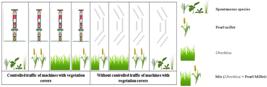
In the areas with controlled traffic (CT), wheel tracks were predefined, and during all mechanized operations, the machinery wheels passed over the same location and in the same direction of travel. Machinery traffic occurred randomly across the experimental area in the treatment without controlled traffic (WCT).
The predominant spontaneous species in the area were tropical spiderwort (Commelina benghalensis) and sourgrass (Digitaria insularis). For the establishment of cover crops, Urochloa ruziziensis (Congo signal grass) was sown at a seed rate of 10 kg ha⁻1, and pearl millet (Pennisetum glaucum, cultivar BRS 1501) at 25 kg ha⁻1, along with a mix (U ruziziensis + pearl millet) sown at 50% of the recommended rate for each species.
The desiccation of cover crops for straw formation was carried out when they reached physiological maturity, using glyphosate at a spray volume of 200 L ha⁻1, applied with a boom sprayer mounted on the tractor three-point hitch, following the same procedure for spontaneous species. With the straw established in each treatment, soybean sowing was performed during the spring/summer season to assess the effects of controlled traffic.
Soybean sowing was carried out on November 10, 2023, using the cultivar TMG 1180 RR at a seeding rate of 15 seeds per meter, aiming for a plant population of 300,000 ha⁻1 with a row spacing of 0.50 m. A basal application of 100 kg ha⁻1 of P₂O₅ was performed, and 30 days after emergence, 50 kg ha⁻1 of K₂O was applied as topdressing across all treatments.
The phytosanitary management of the experimental plots was carried out following procedures commonly adopted in commercial fields, including pest and disease monitoring, chemical weed control, and applications of insecticides and fungicides.
Variables related to soybean root development were analyzed when the crop reached full flowering (R2 stage). In both treatments (CT and WCT), monoliths of 100 cm3 were collected from the soybean planting row and interrow. In the laboratory, root system length and diameter measurements were carried out. The roots were placed on 1 mm mesh sieves for root parameter determinations, washed under running water, and photographed and processed using the SAFIRA software (Jorge & Rodrigues, 2008), yielding root length and diameter variables for all treatments.
The results obtained were subjected to analysis of variance, and the means were compared using the Tukey test at a 5% significance level. Data analyses were performed using Minitab 16 software.
RESULTS AND DISCUSSION
Root length was greater under Urochloa cover in the controlled traffic treatment (136 cm) compared to the other cover crops in the soybean planting row (Figure 2a). This result can be attributed to the aggressive root system of the cover crop (Urochloa), which created more favorable conditions for soybean root development.

Grasses belonging to the genus Urochloa (syn. Brachiaria) have dense and deep root systems, optimizing soil conditions (Ferreira et al., 2021), as observed in the results of this study. The roots of Urochloa create vertical biopores, which facilitate the exploration of subsequent crops, such as soybean, enabling them to access resources in deeper soil layers (Athmann et al., 2013; Kautz et al., 2013).
In the system without controlled traffic, the lowest root length value was observed under the mixed cover crop (23 cm), as the random traffic of agricultural machinery likely caused wheel compaction in the soybean planting row, adversely affecting root development (Figure 2a).
Soil compaction can restrict the growth and development of crop roots, especially dicotyledons such as soybean, which have a taproot system (Arvidsson & Håkansson, 2014).
In addition, random machinery traffic can intensify this process, highlighting its detrimental effects on the crop, since the presence of roots at greater soil depths can ensure better water and nutrient conditions for plants by expanding the exploration area of the root system, thus providing access to water and nutrients stored in deeper soil layers (Chalise et al., 2019; Silva et al., 2022).
In the interrow of the controlled traffic treatment, Urochloa resulted in the greatest root length (176 cm), differing from the no-controlled-traffic system, which had an average of 60 cm. For the other cover crops, the type of traffic did not show statistical differences, nor were differences observed among the cover crops themselves (Figure 2b).
The greater soybean root length under Urochloa cover may have created favorable soil conditions that promoted root growth laterally to the planting row. This is because the concentration of traffic lanes results in higher soil compaction within the wheel tracks; however, lateral to these tracks, conditions were more favorable for root development due to lower compaction. A similar pattern was observed with the other cover crops in the controlled traffic areas compared to the no-controlled-traffic system. Although no statistical difference was detected, there was a trend toward greater root growth under controlled traffic, as compaction is confined to specific locations.
According to Calonego & Rosolem (2010), fine roots are intensified along the lateral axes when roots encounter compacted soil. Moreover, a high number of lateral and adventitious roots increases the soil volume that plants can explore and contributes to better growth under low soil oxygen concentration and high penetration resistance (Colombi & Walter, 2017; Fukao & Bailey-Serres, 2004), as the increased compaction tends to reduce the total root length (Correa et al., 2019), as observed in this study in the areas without controlled machinery traffic.
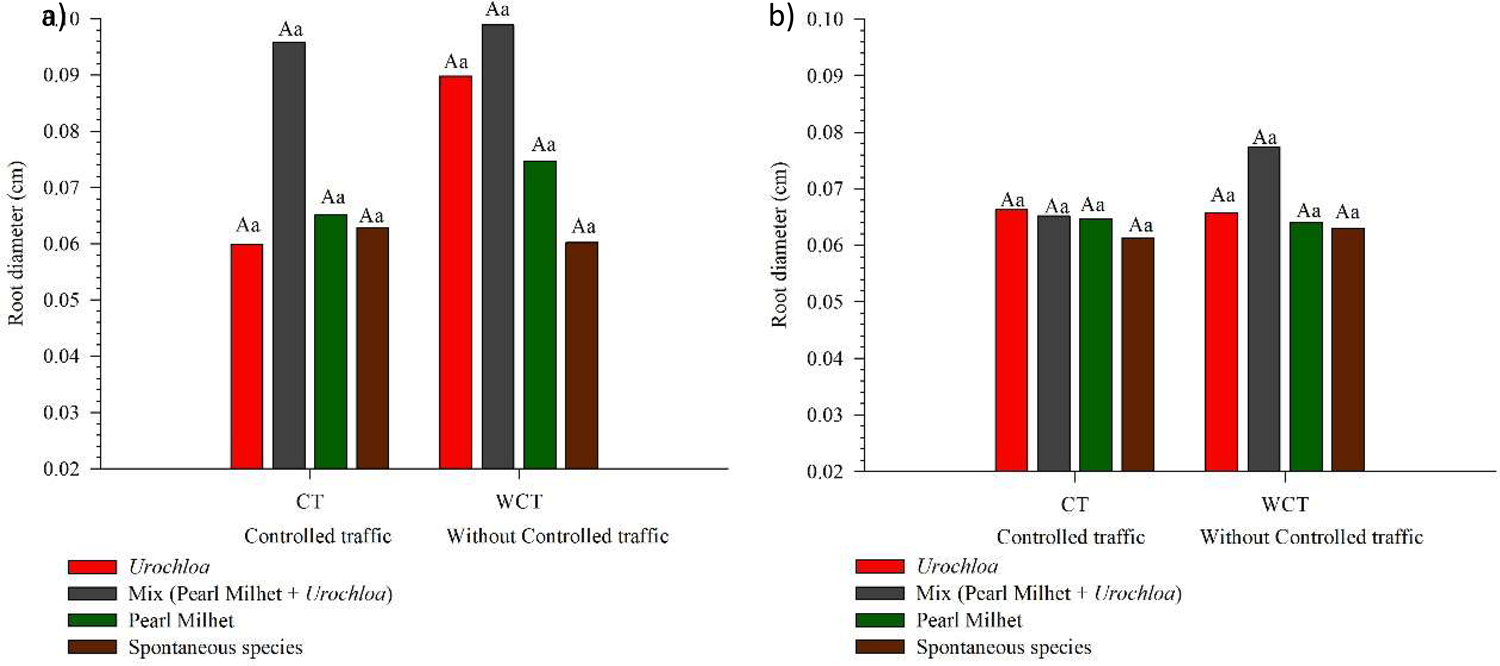
In Figure 3, no statistical differences were observed for root diameter between traffic types or soil cover treatments in the planting row and interrow. Although no statistical difference was detected, a larger root diameter was observed in the no-controlled-traffic treatment across the cover crops. This result may be related to greater compaction in the area due to the random passage of agricultural machinery, which hinders deep root development and, consequently, promotes thickening and increased root diameter to penetrate the compacted layer. Other studies, such as those by Schneider et al. (2021), Jacobsen et al. (2021), and Vanhees et al. (2021), support this hypothesis.

Another factor contributing to these results may be related to the soil characteristics at the experimental site, which had a higher level of macropores. This condition does not promote an increase in root diameter, as macroporosity is directly related to root development (Hudek et al., 2022; Zhang et al., 2022).
In addition, the use of cover crops is employed as a strategy for biological soil decompaction, creating better conditions for the root development of the subsequent crop. As these plants decompose, they leave root channels in the soil (biopores), guiding the deep growth of soybean roots (Wendel et al., 2022; Silva et al., 2025) and reducing the need for root thickening.
Several studies have shown that roots with larger diameters can penetrate compacted soil more effectively and alleviate soil compaction (Correa et al., 2019). On the other hand, an increase in root diameter could raise soil density (Kolb et al., 2017), negatively affecting porosity, reducing soil conductivity and water-holding capacity (Tubeileh et al., 2003).
However, during crop growth, root expansion brings soil particles closer together, enhancing soil structure and porosity (Tisdall, 2020). Plant roots occupy the soil macroporosity, providing stability to aggregates and, as they decompose, generate organic compounds that release substances which cement macroaggregates, thereby improving water infiltration and retention in the soil (Poirier et al., 2018; Bai et al., 2021).
CONCLUSIONS
Areas with controlled traffic and Urochloa cover promoted a 27% increase in root length compared to areas without controlled traffic in the planting row.
The adoption of controlled traffic farming did not influence root diameter.
ACKNOWLEDGMENTS
To the Agrisus Foundation, State University of Mato Grosso do Sul (UEMS), and the Graduate Program in Agronomy – Sustainability in Agriculture.
REFERENCES
-
Arvidsson, J., Håkansson, I. (2014). Response of different crops to soil compactionShort-term effects in Swedish field experiments. Soil and Tillage Research, 138, 56-63. https://doi.org/10.1016/j.still.2013.12.006
» https://doi.org/10.1016/j.still.2013.12.006 -
Athmann, M., Kautz, T., Pude, R., Köpke, U. (2013). Root growth in biopores-evaluation with in situ endoscopy. Plant Soil, 371, 179-190. https://doi.org/10.1007/s11104-013-1673-5
» https://doi.org/10.1007/s11104-013-1673-5 -
Bai, T., Wang, P., Ye, C., Hu, S. (2021). Form of nitrogen input dominates N effects on root growth and soil aggregation: A meta-analysis. Soil Biology and Biochemistry, 157, e - 108251. https://doi.org/10.1016/j.soilbio.2021.108251
» https://doi.org/10.1016/j.soilbio.2021.108251 -
Battisti, R., Sentelhas, P.C., Pascoalino, J.A.L. (2018). Soybean Yield Gap in the Areas of Yield Contest in Brazil. International Journal of Plant Production, 12,159 - 168. https://doi.org/10.1007/s42106-018-0016-0
» https://doi.org/10.1007/s42106-018-0016-0 -
Bulgakov, V., Pascuzzi, S., Nadykto, V., Adamchuk, V., Kaminskiy, V., Kyurchev, V., & Santoro, F. (2022). Effects of Tractor and Soil Parameters on the Depth of the Permanent Traffic Lanes in Controlled Traffic Farming Systems. Applied Sciences, 12(13), e-6620. https://doi.org/10.3390/app12136620
» https://doi.org/10.3390/app12136620 -
Calonego, J.C., Rosolem, C.A. (2010). Soybean root growth and yield in rotation with cover crops under chiseling and no-till. European Journal of Agronomy, 33(3), 242-249. https://doi.org/10.1016/j.eja.2010.06.002
» https://doi.org/10.1016/j.eja.2010.06.002 -
Chalise, K.S., Singh, S., Wegner, B.R., Kumar, S., Pérez-Gutiérrez, J.D., Osborne, S.L., Nleya, T., Guzman, J., Rohila, J.S. (2019). Cover crops and returning residue impact on soil organic carbon, bulk density, penetration resistance, water retention, infiltration, and soybean yield. Agronomy Journal, 111(1), 99-108. https://doi.org/10.2134/agronj2018.03.0213
» https://doi.org/10.2134/agronj2018.03.0213 -
Colombi, T., Keller, T. (2019). Developing Strategies to Recover Crop Productivity after Soil Compaction-A Plant Eco-Physiological Perspective. Soil Tillage Research, 191, 156 - 161. https://doi.org/10.1016/j.still.2019.04.008
» https://doi.org/10.1016/j.still.2019.04.008 -
Colombi, T., Walter, A. (2017). Genetic diversity under soil compaction in wheat: root number as a promising trait for early plant vigor. Frontiers in Plant Science, 8, 1–14. https://doi.org/10.3389/fpls.2017.00420
» https://doi.org/10.3389/fpls.2017.00420 -
Correa, J., Postma, J.A., Watt, M., Wojciechowski, T. (2019). Soil compaction and the architectural plasticity of root systems. Journal of Experimental Botany, 70, 6019-6034. https://doi.org/10.1093/jxb/erz383
» https://doi.org/10.1093/jxb/erz383 -
Ferreira, C.J.B., Tormena, C.A., Severiano, E.C., Zotarelli, L., & Júnior, E.B. (2021). Soil compaction influences soil physical quality and soybean yield under long-term no-tillage. Archives of Agronomy and Soil Science, 67(3), 383 - 396. https://doi.org/10.1080/03650340.2020.1733535
» https://doi.org/10.1080/03650340.2020.1733535 -
Fukao, T., Bailey-Serres, J. (2004). Plant responses to hypoxia - Is survival a balancing act? Trends in Plant Science, 9, 449 - 456. https://doi.org/10.1016/j.tplants.2004.07.005
» https://doi.org/10.1016/j.tplants.2004.07.005 -
Hudek, C., Putinica, C., Otten, W., De Baets, S. (2022). Functional root trait-based classification of cover crops to improve soil physical properties. European Journal of Soil Science, 73(1), e13147. https://doi.org/10.1111/ejss.13147
» https://doi.org/10.1111/ejss.13147 -
Hussein, M.A., Antille, D.L., Kodur, S., Chen, G., & Tullberg, J.N. (2021b). Controlled traffic farming effects on productivity of grain sorghum, rainfall and fertiliser nitrogen use efficiency. Journal of Agriculture and Food Research, 3, e-100111. https://doi.org/10.1016/j.jafr.2021.100111
» https://doi.org/10.1016/j.jafr.2021.100111 -
Hussein, M.A., Antille, D.L., Kodur, S., Chen, G., Tullberg, J.N. (2021a). Controlled traffic farming delivers improved agronomic performance of wheat as a result of enhanced rainfall and fertiliser nitrogen use efficiency. Acta Agriculture Scandinavica Section B - Soil & Plant Science, 71(5), 377-398. https://doi.org/10.1080/09064710.2021.1903984
» https://doi.org/10.1080/09064710.2021.1903984 -
Jacobsen, A.G., Jervis, G., Xu, J., Topping, J.F., Lindsey, K. (2021). Root growth responses to mechanical impedance are regulated by a network of ROS, ethylene and auxin signalling in Arabidopsis. New Phytologist, 231, 225 - 242. https://doi.org/10.1111/nph.17180
» https://doi.org/10.1111/nph.17180 - Jorge, L., & Rodrigues, A. (2008). Safira: Sistema de análise de fibras e raízes (Boletim de pesquisa e desenvolvimento, 24 p.). São Carlos: Embrapa Instrumentação.
-
Kautz, T., Perkons, U., Athmann, M., Pude, R., Köpke, U. (2013). Barley roots are not constrained to large-sized biopores in the subsoil of a deep Haplic Luvisol. Biology and Fertility of Soils, 49, 959-963. https://doi.org/10.1007/s00374-013-0783-9
» https://doi.org/10.1007/s00374-013-0783-9 - Klein HS, Luna FV (2023) Soybeans. In Brazilian Crops in the Global Market: The Emergence of Brazil as a World Agribusiness Exporter Since 1950 (pp. 79-106). Springer Nature: Cham, Switzerland.
-
Kolb, E., Legué, V., Bogeat-Triboulot, M.B. (2017). Physical root-soil interactions. Physical Biology, 14, e-065004. https://doi.org/10.1088/1478-3975/aa90dd
» https://doi.org/10.1088/1478-3975/aa90dd -
Moraes, M.T., Debiasi, H., Franchini, J.C., Mastroberti, A.A., Levien, R., Leitner, D., Schnepf, A. (2020). Soil compaction impacts soybean root growth in an Oxisol from subtropical Brazil. Soil and Tillage Research, 200, e - 104611. https://doi.org/10.1016/j.still.2020.104611
» https://doi.org/10.1016/j.still.2020.104611 -
Pittelkow, C.M., Linquist, B.A., Lundy, M.E., Liang, X., Van Groenigen, K.J., Lee, J., Van Gestel, N., Six, J., Venterea, R.T., Van Kessel, C. (2015). When does no-till yield more? A global meta-analysis. Field Crops Research, 183, 156 - 168. https://doi.org/10.1016/j.fcr.2015.07.020
» https://doi.org/10.1016/j.fcr.2015.07.020 -
Poirier, V., Roumet, C., Munson, A.L. (2018). The root of the matter: Linking root traits and soil organic matter stabilization processes. Soil Biology and Biochemistry, 120, 246 - 259. https://doi.org/10.1016/j.soilbio.2018.02.016
» https://doi.org/10.1016/j.soilbio.2018.02.016 - Santos, H. G., Jacomine, P. K. T., Anjos, L. H. C., Oliveira, V. Á., Lumbreras, J. F., Coelho, M. R., Almeida, J. Á., Filho, J. C. A., Oliveira, J. B., & Cunha, T. J. F. (2018). Sistema brasileiro de classificação de solos (5ª ed.). Rio de Janeiro: Embrapa Solos. ISBN 978-85-7035-198-2
-
Schneider, H.M., Strock, C.F., Hanlon, M.T., Vanhees, D.J., Perkins, A.C., Ajmera, I.B., Sidhu, J.S., Mooney, S.J., Brown, K.M., Lynch, J.P. (2021). Multiseriate cortical sclerenchyma enhance root penetration in compacted soils. Agricultural Sciences, 118, e2012087118. https://doi.org/10.1073/pnas.2012087118
» https://doi.org/10.1073/pnas.2012087118 -
Silva, G.F., Calonego, J.C., Luperini, B.C.O., Chamma, L., Alves, E.R., Rodrigues, A.S., Putti, F.F., Da Silva, V.M., De Almeida Silva, M. (2022). Soil- plant relationships in soybean cultivated under conventional tillage and long-term no-tillage. Agronomy Basel, 12(3), 697. https://doi.org/10.3390/agronomy12030697
» https://doi.org/10.3390/agronomy12030697 -
Silva, G.F., Luperini, B.C.O., Barcelos, J.P.dQ., Putti, F.F., Mooney, S.J., Calonego, J.C. (2025). Mechanical Chiseling Versus Root Bio-Tillage on Soil Physical Quality and Soybean Yield in a Long-Term No-Till System. Agronomy, 15(5), 1249. https://doi.org/10.3390/agronomy15051249
» https://doi.org/10.3390/agronomy15051249 -
Suo, R., Wang, M., Zhao, T. (2024). Contribution of Photosynthetic, Root and Phenotypic Traits to Soybean Plant Height. Sustainability, 16(7), 2886. https://doi.org/10.3390/su16072886
» https://doi.org/10.3390/su16072886 - Tisdall, J. M. (2020). Formation of soil aggregates and accumulation of soil organic matter. In M. R. Carter & B. A. Stewart (Eds.), Structure and organic matter storage in agricultural soils (pp. 57-96). Boca Raton, FL: CRC Press.
-
Tubeileh, A., Groleau-Renaud, V., Plantureux, S., Guckert, A. (2003). Effect of soil compaction on photosynthesis and carbon partitioning within a maize-soil system. Soil and Tillage Research, 71, 151-161. https://doi.org/10.1016/S0167-1987 (03)00061-8
» https://doi.org/10.1016/S0167-1987 (03)00061-8 -
Vanhees, D.J., Loades, K.W., Bengough, A.G., Mooney, S.J., Lynch, J.P. (2021). The ability of maize roots to grow through compacted soil is not dependent on the amount of roots formed. Field Crops Research, 264, 108013. https://doi.org/10.1016/j.fcr.2020.108013
» https://doi.org/10.1016/j.fcr.2020.108013 -
Vogel, H.J., Bartke, S., Daedlow, K., Helming, K., Kögel-Knabner, I., Lang, B., Rabot, E., Russell, D., Stößel, B., Weller, U., Wiesmeier, M., Wollschläger, U. (2018). A systemic approach for modeling soil functions. Soil, 4, 83-92. https://doi.org/10.5194/soil-4-83-2018
» https://doi.org/10.5194/soil-4-83-2018 -
Wendel, A.S., Bauke, S.L., Amelung, W., Knief, C. (2022). Root-rhizosphere-soil interactions in biopores. Plant and Soil, 475, 253-277. https://doi.org/10.1007/s1104-022-05406-41
» https://doi.org/10.1007/s1104-022-05406-41 -
Zhang, Y., Jia, A., Zhao, W., Kang, J., Wang, C., Kang, W., Tian, Z. (2022). Soil macroporosity and water flow in the root zone of oases in hyper-arid regions. European Journal of Soil Science, 73(2), e12335. https://doi.org/10.1111/ejss.13235
» https://doi.org/10.1111/ejss.13235