
 Semiotic practices in Knowledge Organization
Objective: To observe the fundamentals of French semiotics, known as semiotic practices, in order to analyze its theoretical properties so that the characteristics of language in its application as a resource for constructing meaning and signification can be highlighted, with the intention of demonstrating how life forms promote the adjustment of concepts in the analysis of conduct inherent to the domains of use and production.
Methods: This methodology is qualitative in nature, exploratory, bibliographic, and interdisciplinary. Databases such as Brapci, Dialnet, Google Scholar, and Scopus were consulted, in addition to books specializing in semiotic practices. Works published in English, Spanish, French, and Portuguese were retrieved.
Results: Semiotic practices facilitate the process of representing representation, since the core of the process is life forms, and consequently the manifestation of discursive ethos. Therefore, although the choice of descriptors and the elaboration of informational objects are pragmatic in nature, the process gains objective orientations and allows for dialogue and discussion about different possibilities, working on an internal connection between predictability and innovation.
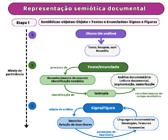
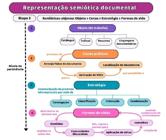
Conclusions: This research proposes a treatment model based on semiotic practices, a theoretical methodology of French semiotics, which understands each symbolic stage as semiotic objects. This allows for the demonstration of the inherent meaning of immanence in expression at each stage, thus highlighting that domains and their discourses are reflections of life forms, which are manifested through discursive ethos.
KEYWORDS:
Documentary Analysis; Information Representation; French Semiotics; Information Processing; Semiotic Practices
 Thumbnail
 Thumbnail
 Fonte: elaborado pelos autores.
 Fonte: elaborado pelos autores.