 Demographic dimensions of wage disparities: a stochastic frontier approach to labor market in São Paulo City (Brazil)
Abstract
This study investigates wage disparities for 6.34 million workers from São Paulo city (Brazil) during the years 2018 to 2020 using Stochastic Frontier methods to estimate changes in the underpayment levels across demographic dimensions. The results indicate that closing the underpayment gap has the potential to yield an average salary increase of 1.12 times, with a range spanning from 1.02 to 4.82 times within the sample. Additionally, the results underscore lower levels of underpayment among white and male workers, while migrant workers and those with reported disabilities tend to experience higher levels of underpayment. Furthermore, the study unveils a trend of decreasing potential wages over time, marked by a sharp -19.34% reduction in 2020, primarily attributed to the impact of the COVID-19 outbreak. Simultaneously, there is a notable reduction in the average underpayment, with a substantial decline occurring in 2019. In conclusion, this research advances the existing literature by utilizing Stochastic Frontier models to assess underpayment and provides valuable insights into the intricate dynamics of wage disparities - a critical issue that plays a pivotal role in fostering socioeconomic development.
Keywords:
Underpayment; Stochastic frontier; Demography
Resumo
Este estudo investiga disparidades salariais para 6,34 milhões de trabalhadores da cidade de São Paulo (Brasil) durante os anos de 2018 a 2020, utilizando métodos de Fronteira Estocástica para estimar mudanças nos níveis de sub-remuneração em diferentes dimensões demográficas. Os resultados indicam que reduzir a lacuna de sub-remuneração tem o potencial de resultar em um aumento salarial médio de 1,12 vezes, com uma variação de 1,02 a 5,65 vezes dentro da amostra. Além disso, os resultados destacam níveis mais baixos de sub-remuneração entre trabalhadores brancos e do sexo masculino, enquanto trabalhadores migrantes e aqueles com deficiências relatadas tendem a vivenciar níveis mais altos de sub-remuneração. Além disso, o estudo revela uma tendência de diminuição dos salários potenciais ao longo do tempo, marcada por uma redução acentuada de -19,34% em 2020, principalmente atribuída ao impacto do surto de COVID-19. Simultaneamente, há uma redução notável na média de sub-remuneração, com uma diminuição substancial ocorrendo em 2019. Em conclusão, esta pesquisa avança a literatura existente ao utilizar modelos de Fronteira Estocástica para avaliar a sub-remuneração e fornece insights valiosos sobre as dinâmicas intricadas das disparidades salariais - uma questão crítica que desempenha um papel fundamental no desenvolvimento socioeconômico.
Palavras-Chave:
Sub-remuneração; Fronteira estocástica; Demografia
1. Introduction
When employers and employees engage in wage negotiations within labor markets, the results can deviate from the optimal levels since asymmetric information can inhibit the competitive outcome. Labor productivity is inherently uncertain, influenced by both market conditions and individual effort. Consequently, employers and employees establish contracts related to workload and wages, introducing rigidity in labor prices. Job searching is costly, as it is to monitor the marginal productivity of each worker. These frictions cause the labor market to deviate from the outcome expected in perfect competition and, therefore, wages tend to be different from the marginal product of labor. These issues have been assessed using stochastic frontier methods. For instance, Hofler and Murphy (1992) estimated the extent of underpayment in the U.S. economy using data from 1983. Their findings indicated that workers’ wages fell short of their potential wages by approximately 10%. The study investigated six hypotheses, revealing that underpayment was influenced by various factors: (i.) Demographic features, including age, gender, and race; (ii.) Market competition, with competitive markets generally exhibiting lower levels of underpayment; (iii.) Education level, suggesting that highly educated workers experience lower underpayment; (iv.) Urban workers tend to experience less underpayment; (v.) Wealthier workers face lower underpayment, likely due to higher non-labor income and reservation wages; (vi.) Workers with longer tenure in their jobs tend to exhibit lower levels of underpayment.
Collective bargaining is also important in determining workers’ wage levels. Arbache (1999) highlights the positive impact of unionization on the wages of semi-skilled male workers in Brazil, noting that unionized workers experience less wage dispersion compared to their non-unionized counterparts. Similarly, Firpo et al. (2018) observe that de-unionization processes in the United States have led to increased wage inequality due to heightened wage dispersion. Lagos (2019) indicates that negotiations between unions and firms often result in gains in amenities, such as corporate benefits and gym discounts at the expense of wage increases. This trend has been influenced by labor court decisions in the country, which have allowed union-company agreements to prioritize amenities. The outcomes of these negotiations are heavily dependent on the bargaining power of the unions involved. Stronger unions with greater member adherence are generally more successful in resisting employer pressure to focus on benefits, thus securing better wage gains. Regarding gender wage gaps, Casale and Posel (2011) results suggest that wage discrepancies between men and women are more pronounced among unionized workers compared to non-unionized workers, even though this is largely due to the specific sectors where unions are concentrated. In sectors that include a wide range of high-skilled occupations, women often occupy lower-paid positions within the unionized workforce, such as nurses and teachers. Conversely, low-skilled workers experience a smaller gender pay gap and face fewer incentives to unionize.
The reasons for this disparity vary depending on each country’s historical development and civil rights context. Studies on discrimination and economics date back to the seminal work of Becker (1957) and, specifically for gender biases, Goldin (1995) presents compelling evidence indicating that women’s participation in the labor force followed a U-shaped curve during the course of economic development. Pager and Shepherd (2008) provide valuable insights into the origins of racism, examining the sociological and psychological factors that contribute to discrimination. These harmful preconceptions become significant barriers to their professional advancement and opportunities. Implementing effective racial equality programs proves to be a challenging endeavor due to the complex nature of the issue and various societal factors that can hinder the outcomes of these programs, thereby limiting progress toward true equality. In Brazil, the full integration of female and black populations into the labor market has been an ongoing challenge despite the existence of several laws prohibiting discrimination and promoting the inclusion of physically and ethnically diverse groups (e.g., Brasil (1995), Brasil (2015)).
Silveira and Siqueira (2021) research presents evidence of discrimination against black men and white women in Brazil, with an inter-sectional impact on black women. Drawing on data from public surveys, the authors unveil a distinct wage advantage favoring white male workers, who are over- represented in higher-paying job roles. Black men, on the other hand, experience some positive salary discrimination in specific occupations, indicating that they still benefit from the gender pay gap observed among white men. However, this positive wage discrimination does not persist when examining positions within the same occupation. This trend exhibits a remarkable surge in older cohorts. Turning attention to women, the gender pay gap appears more severe, particularly for black women, who predominantly occupy low wage positions and earn an average of 30% less than white male workers. Arias et al. (2004) found that the educational levels of black fathers exert less influence on their sons’ wages compared to white fathers. These results indicate the pressing need for addressing systemic inequalities and fairness in the Brazilian labor market and society as a whole.
Pacheco et al. (2023) analysis reveals that, in Paraná State, women consistently earned a lower average hourly salary compared to men from 2012 to 2019, even though women held higher qualifications. In consonance, Dobner et al. (2022) find evidence of income discrimination in favor of men across all labor market sectors analyzed for the Rio Grande do Sul State from 2012 to 2018. Furthermore, Freguglia and Procópio (2013) indicate that individuals who migrate from other cities to work in São Paulo tend to earn lower wages compared to local workers. Yet, the author found that migrants from the Northeastern region are the best-paid among migrants. In cities like São Paulo, the presence of migrant workers significantly impacts the labor market dynamics, which aggregate a diverse array of skilled job opportunities while simultaneously experiencing high demand for non- specialized labor. Throughout its history, São Paulo has been a major destination for migrant workers from various regions of Brazil.
Numerous investigations have delved into the determinants of wage disparities and their unique ramifications on diverse demographic groups. However, the challenge of mitigating these historical and contemporary disparities persists. For instance, O’Reilly et al. (2015) presents a cross-national study encompassing multiple European countries, the United Kingdom, and Australia. This study reveals a persistent gender wage gap, despite considerable reductions since the 1970s, even in the wake of the implementation of equal pay legislation. Historically, Brazil has grappled with some of the most pronounced earnings inequalities in the world (Ramos and Vieira, 2001), and there is evidence of an increasing gap between high-skilled and low-skilled jobs during the 1990 decade with a small reverse in this trend by 2009 (Pecora and Menezes-Filho, 2014). Similarly, Madalozzo (2010) indicated that, despite substantial progress in diminishing the gender wage gap in Brazil since the 1970s, it exhibited relative stability throughout the 2000s.
Araújo and Ribeiro (2001) conducted an in-depth analysis of household data from the PNAD survey in Brazil, revealing that productivity accounts for a negligible proportion of the wage disparities between genders. Meanwhile, Anderson et al. (2002) research illustrates the multifaceted impacts of the wage penalty associated with motherhood. These impacts are contingent upon education levels, family size, and race. Significantly, this penalty is often linked to the duration of absences from the workforce. It is noteworthy that women with college-level education, regardless of their racial background, tend to experience minimal or no adverse consequences with the arrival of their first child. However, substantial wage effects emerge when they have a second child.
Previous research has consistently indicated a distinct gender-specific pattern within the Brazilian labor market. Male workers tend to cluster in higher positions within firms, which are accompanied by more favorable remuneration, in contrast to their female counterparts (Camargo and Serrano, 1983). In a study centered on the São Paulo City Metropolitan Area, Cacciamali and Freitas (2001) found evidence of a gender-based wage gap across five selected industry sectors. Furthermore, research by Cavalieri and Fernandes (1998) unveiled gender and race-based disparities within the labor markets of Brazilian Metropolitan Areas, as evidenced by data drawn from the PNAD survey of 1989. Expanding our focus to the United States, Cohen and Huffman (2007) discovered that in the industry sector, pay disparities are narrower in sectors where women hold higher managerial roles, compared to male-dominated sectors. Additionally, Winslow-Bowe (2009) observed that black women in the United States make more substantial contributions to their households’ budgets compared to their white and Hispanic counterparts. However, the advent of motherhood significantly reduces women’s contributions to the overall family income, primarily due to reduced labor force participation during the early years of a child’s life.
Giuberti and Menezes-Filho (2005) argued that in the United States, the gender wage gap may be attributed to differences in age returns, given that the skill levels between male and female workers are generally equivalent. However, in Brazil, a similar effect is observed even though female workers, on average, possess higher skills. Kleinjans et al. (2017) suggests that a notable portion of female labor market discrimination in Denmark can be traced to occupational segregation, where men predominantly occupy higher-paying positions. Similarly, Meireles and da Silva (2019) employs a probit model and publicly available micro-data of Brazilian workers, unveiling that white men are more likely to secure well remunerated positions compared to their female and non-white counterparts, while gender-based wage disparities tend to be more pronounced than racial disparities in this context. Furthermore, Dobner et al. (2022) conducted an Oaxaca-Blinder and Ñopo decomposition analysis and found that wage differentials between genders cannot be attributed to disparities in productivity, as women often exhibit higher levels of productivity than their male counterparts. Concerning internal migration within Brazil, da Silva Filho (2020) highlighted that migrants face diminished likelihood of employment compared to native workers. Among those who do secure employment, access to social protection services is less assured.
Therefore, this study aims to investigate the levels of underpayment among formal workers in São Paulo city using data at the individual level from 2018 to 2020. The main inquiry is to investigate how large are these inefficiencies and whether these frictions have different magnitudes among demographic groups. Investigating these questions is important to provide policy guidance toward better labor market regulation, which may disentangle productivity bottlenecks to increase economic growth and promote socioeconomic development.
2. Methodology
2.1. Stochastic Wages Frontier
This paper proposes the use of Stochastic Frontier models to gauge the wage gap prevailing in labor markets. According to Kumbhakar and Lai (2022), SF models prove versatile and applicable to scenarios wherein there exists a theoretical maximum (or minimum) value to estimate, while access is limited to its underestimated (or overestimated) counterpart. For a given economic sector, employers and employees undergo a bargaining process to settle wages, which is expected to be a function of workers’ abilities. Following (Mincer, 1975), one would expect highly skilled workers, as denoted by their educational qualifications and experience, to exhibit greater productivity and consequently earn higher wages.
However, production activities and bargaining processes may not operate efficiently. Productivity, therefore, can be seen here as an unobserved variable, expressed only through the inefficiencies present in the stochastic frontier model. Thus, SF models offer the means to empirically investigate and quantitatively measure these inefficiencies. In other words, models of this type aim to specifically estimate hidden events based on their determining variables. In ideal conditions of perfect competition, labor markets 4 establish real wages (𝑤𝐿) at levels equivalent to the marginal productivity of labor (𝑀𝑃𝐿). Nonetheless, labor markets are characterized by information asymmetry and the implementation of labor contracts that introduce rigidity in wage adjustments. These constraints can lead to disparities between potential and actual salaries. Consequently, it is foreseeable that 𝑤𝐿 ≠ 𝑀𝑃𝐿, at least in the short term, making SF models appropriate tools for measuring these discrepancies in pay levels.
Moreover, firms wielding market power can yield non-zero profits, leading to 𝑤𝑖 ≠ 𝑓𝑖(𝑥𝑖; 𝛽), where 𝑓𝑖(𝑥𝑖; 𝛽) is the marginal productivity of labor. Nevertheless, it is important to note that, while some workers might bargain salaries exceeding their marginal productivity, such a scenario cannot persist across all workers in the long run, as it would ultimately lead to unsustainable profit losses. On the other hand, rigidity in labor contracts offers nominal wage stability to workers, but at the expense of paying less than their marginal productivity. In this context, it is expected to find 𝑤𝐿 ≤ 𝑀𝑃𝐿 across the broader economy.
Therefore, we may extend a Stochastic Wage Frontier methodology to estimate wage inefficiencies through the labor markets. Considering the standard SF models in Kumbhakar and Lovell (2000) and drawing inspiration in the modeling strategy from Hofler and Murphy (1992), Hofler and Murphy (1994) and Ogloblin and Brock (2005), we can define the stochastic wage frontier (SWF) as:
where: 𝑤𝑖𝑡 represents the wages earned by a worker i in time t, 𝑋′𝑖𝑡 is the vector of worker attributes and market conditions that define the marginal product of labor. 𝑢(𝑍𝑖𝑡) is the underpayment term that captures the gap between the potential wages and actual wages (that is, we assume 𝑢 ≥ 0). 𝑍??𝑡 are exogenous variables that affect the underpayment level, i.e., contribute to reducing (𝑢′(𝑍 ) < 0) or increase (𝑢′(𝑍 ) < 0) the gap between actual and potential wages. Note that the underpayment component captures any disturbances in the production process itself in addition to any exogenous factors that increase frictions in the labor market and cause 𝑤 ≠ 𝑀𝑃𝐿. Also, w i will be maximum .
In a perfectly competitive labor market, 𝑤 = 𝑀𝑃𝐿 would be observed. This implies that demographic variables (such as race, gender, and disability) would not significantly influence wages, allowing wages to reflect their true potential, which is solely determined by work-related characteristics (such as experience and qualifications). In the presence of underpayment, wages are lower than the marginal productivity of labor. If exogenous factors affect all demographic groups homogeneously, demographic variables will not yield meaningful coefficients to explain different underpayment levels. Otherwise, significant demographic variables indicate heterogeneity in underpayment, linking these disparities to structural factors outside the labor market. Thus, this is an empirical question for which Stochastic Frontier Methods provide the theoretical framework to conduct the tests.
2.2. Data
We gathered data from 6,343,303 Brazilian workers in São Paulo City from 2018 to 2020 through the RAIS database (RAIS, 2023). RAIS is an annual survey encompasses a range of variables, including gender, race1, educational attainment, work experience, and wages, among other distinctive factors. It is officially released by Brazil’s Ministry of Labor and is derived from employer submissions, making it specific to the formal labor market. It’s important to note that the informal labor sector in Brazil constitutes a significant portion of the workforce. According to IBGE (2023), informal employment accounts for approximately 39% of the total labor force. Nonetheless, data with the same level of detail is not available for the informal labor market. Therefore, findings from studies utilizing data from the formal labor market can offer valuable insights into the broader context of informal labor markets. The schooling level in the RAIS (2023) is presented as a categorical variable. In this paper, we attributed a scalar number to represent the increasing levels of schooling in the empirical model. The schooling levels are: “Illiterate” = 1; “Incomplete Primary” = 2; “Primary School” = 3; “Incomplete Secondary” = 4; “Secondary School” = 5; “Incomplete High School” = 6; “High School” = 7; “Incomplete College” = 8; “College” = 9; “MSc.” = 10; “Ph.D.” = 11. Regarding the demographic characteristics (e.g., gender and race), we build binary variables for white and black workers while combining the remaining categories into a baseline reference group. Furthermore, we consider a binary variable for workers with reported disabilities2 and a binary variable to identify workers born outside the city of São Paulo. Experience is a measure of total employment time, meaning the sum of years and months that a given employee spent employed during his or her career.
Finally, RAIS (2023) provides information about the sectoral allocation for each worker. We adopt the aggregation in 17 sectors: (A) Agriculture, Livestock, Forestry Production, Fishing, and Aquaculture; (B) Extractive Industry; (C) Processing Industry; (D) Gas and Electricity; (E) Water, Sewage, Waste Management, and Decontamination; (F) Construction; (G) Trade and Repairs for Cars and Motorcycles; (H) Logistics, Storage, and Mail; (I) Accommodation and Food Services; (J) Information and Communication; (K) Financial and Insurance Activities and Related Services; (L) Housing Activities; (M) Professionals, Scientific, and Technological Activities; (N) Management Activities and Related Services; (O) Public Administration, Defense, and Social Security; (P) Education; and, (Q) Human Health and Social Services. The selected variables used in the empirical model are summarized in Table 1 3.
Although this paper does not focus specifically on the effects of the Covid-19 pandemic on the labor market, the inclusion of the year 2020 delivers additional results. Several changes from this period might affect the estimates of underpayment if unobserved: the pandemic itself may have had heterogeneous effects across different demographic groups; the mobility restrictions have led to considerable changes in the dynamics and culture of work; and economic sectors have reacted differently, in some cases offering remote work or opting to lay off employees. It is therefore possible that demographic characteristics, as estimated here, are associated with heterogeneous outcomes due to the pandemic shock. However, the existence of underpayment heterogeneity across demographic groups can be statistically tested as well as the average “overall effect” of the sanitary measures on the labor market’s underpayment levels.
Therefore, the result of the model should be interpreted as the difference between an individual’s optimum salary, given their professional characteristics, and the one actually observed, as described in this section. This difference is considered throughout this model to be the result of underpayment. However, considering the limitation present in the RAIS (2023) data, several idiosyncratic characteristics that would be essential for a more accurate estimation of the potential salary of individuals, such as specific skills, training, certifications, proficiency in other languages are not included in the model. The absence of these variables might lead to overestimated inefficiencies and further studies are needed to refine the estimates of the underpayment levels. Nonetheless, the results obtained from the empirical model presented in this paper are sufficient to empirically test the existence or non-existence of underpayment heterogeneity across demographic groups.
Unfortunately, some relevant information such as workers’ marital status, parental status, housing conditions, and other pertinent factors are not available in RAIS (2023) and it is important to keep it in mind when interpreting the underpayment levels estimated in this paper. Moreover, even though we have data from 2018 to 2020, it is not possible to track workers over time, which prevents the use of standard panel models.
2.3. Empirical Model
The Stochastic Wage Frontier (SWF) model in this paper incorporates human capital variables as crucial determinants of labor productivity (or potential wages) and follows the Translog functional form4. Additionally, binary controls are introduced to account for variations across different economic sectors, each potentially characterized by distinct levels of labor productivity determined by market conditions. Subsequently, demographic variables are integrated into the model as determinants of wage underpayment. In essence, it is postulated that demographic variables themselves do not directly alter potential salaries; rather, they are associated with labor market frictions that contribute to the widening wage gap.
The empirical model (2) is:
where,
𝑤𝑖𝑡 is the observed wage of worker i in time t;
𝑆𝑐ℎ𝑜𝑜𝑙𝑖𝑡 is the schooling level of worker i in time t;
𝐸𝑥𝑝𝑒𝑟𝑖𝑒𝑛𝑐𝑒𝑖𝑡 corresponds to how long the worker i is working at the same firm in time t;
𝐴𝑔𝑒𝑖𝑡 is the age of worker i in time t;
𝑇𝑖𝑚𝑒𝑡 are the group of binary variables that captures changes in average wages from 2018 to 2020;
𝑆𝑗 are the group of binary variables that indicates in which sector worker i in time t is employed;
𝛽, 𝛾 and 𝛿 are coefficients to be estimated;
𝑣𝑖𝑡 is the classical error term with zero mean and constant variance, and;
𝑢(𝑍𝑖𝑡) is the one-sided underpayment term with exogenous determinants 𝑍𝑖𝑡.
It is possible to estimate the empirical model with the exogenous z-variables in a single step using pooled models and ML methods under the assumption of 𝑢𝑖𝑡 ∼ 𝑁+ (0, 𝜎2 𝑢 (𝑍𝑖𝑡)) and 𝑣𝑖𝑡 ∼ 𝑁 (0, 𝜎2 𝑣 ) (Kumbhakar et al., 2015). In both models, 𝑍𝑖𝑡 represents the vector of binary demographic variables for demographic characteristics (gender and race) and time.
The payment efficiency 𝑃𝐸𝑖 = 𝑒𝑥𝑝(−𝑢𝑖) is an index between 0 and 1 for each worker i, where 𝑃𝐸 = 0 denotes a worker completely underpaid and 𝑃𝐸 = 1 indicates a worker perfectly remunerated. The stochastic frontier models were estimated following the codes provided by Kumbhakar et al. (2015). While alternative distributional assumptions can be considered for the underpayment term, we opt for the half-normal distribution for two primary reasons: (i.) the half- normal distribution offers computational simplicity and facilitates convergence in empirical estimations; (ii.) it aligns with the behavioral assumptions of profit maximization and utility maximization. This implies that actual wages are expected to gradually approach potential wages over time as uncertainties related to labor productivity diminish.
3. Results and Discussion
Regarding the frontier (potential wages), the model results indicate that age, experience, and schooling are positively correlated with potential wages in both models (Table 3). Specifically, the model identifies increasing returns associated with experience and schooling while indicating diminishing returns associated with age. Furthermore, the model reveals positive returns stemming from the interactions among age, experience, and schooling. The presence of quadratic effects related to age suggests that wages increase up to a certain threshold. This aligns with findings by ( Van Ours and Stoeldraijer, 2010), who identified a bell-shaped relationship between age and productivity, indicating that workers’ productivity peaks between the ages of 30 and 45, while it is notably lower for employees younger or older than that range. This reflects diminishing returns in wages for older workers. Conversely, the impact of increasing work experience aligns with the trends observed for the schooling variable, indicating positive and escalating effects on potential wages.
We found significant results for differences in underpayment across demographic groups. Han and Budig (2019) attributes the gender pay gap to the existence of gendered jobs, i.e. positions in the market that are tied to a specific gender. This differentiation between typically male and female jobs means that women choose to invest in accumulating skills in positions where female success is already linked. Similarly, Costa Dias et al. (2020) indicates that two-thirds of the gender pay gap among workers with higher education can be explained by the time out of the workforce that women face when they become mothers. In addition, motherhood has long-lasting effects on women’s career progression, as they have fewer hours available compared to their male counterparts, leading to the persistence of the gap. However, for the UK, the authors found a downward trend in the gender pay gap between 1993 and 2018. For Brazilian workers, Castro (2019) finds that maternity expands the wage gap between male and female workers by up to 4%.
Besides discrimination, wage differences between races can also stem from differences in occupation, with an over-representation of black workers in lower-paid sectors (Wilson and Roscigno, 2016), and these effects may change with the size of the labor market. In larger cities, white workers experience higher wage gains than black workers (Ananat et al., 2018). This evidence is explained by the race- isolated way that networks are constituted, creating clusters of race-specific information. In addition, Chattopadhyay and Bianchi (2021) indicate that black people are more likely to lose their jobs during periods of recession. In times of economic crisis, the wage gap between white and black people grows. Black people also find lower salaries when they re-enter the job market, further increasing the underpayment levels.
In essence, these results underscore the influential role of human capital enhancement through increased education, age, and experience as pivotal determinants of wage potential. The strong correlation between schooling and potential wages is expected and consistent with the specialized literature, especially in Brazil where access to superior education is still limited. According to OECD (2022), only 21% of Brazilians between 25 and 34 years old have graduated from universities. On the other hand, wages have been on a downward trend over time, with a significant drop seen in 2020 due to the COVID-19 outbreak. The average reduction of -19.34% can be attributed to the high and rising unemployment rates during this period when unemployment rates went from 13.1% in the first quarter of 2018 to 14.6% in the last quarter of 2020 (IBGE, 2023).
Results indicate differences in potential wages according to each economic sector. This trend is noticeable in three areas: Accommodation and Food Services (I), Financial and Insurance Activities and Related Services (K), and Human Health and Social Services (Q). These fields concentrate on prestigious careers that usually concentrate on higher payments (Magnusson, 2016). On the other hand, Public Administration, Defense, and Social Security (Q), Education (P), and Management Activities and Related Services (N) appear as the less wage-efficient fields.
The results also reveal the role of demographic factors in the observed underpayment. White workers and male workers experience significantly less underpayment than their respective counterparts. Also, workers with disabilities and migrant workers face higher levels of underpayment. Additionally, underpayment levels have diminished over time. The Labor Law Reforms in 2017 (Brasil, 2017) and 2019 (Brasil, 2019) may have played a role in this gap closure trend, although it is unclear whether it was positive or negative since the evidence is still sparse. For instance, Corbi et al. (2022) alludes to the positive effects regarding employment when compared to the pre-Reform scenario. Nonetheless, the COVID-19 pandemic in 2020 had strong effects on employment levels when workplace restrictions limited the functioning of several jobs.
It is crucial to underscore that access to higher education in Brazil exhibits substantial disparities along class and racial lines. Carvalhaes and Ribeiro (2019) contends that the white population not only enjoys more extensive access to higher education but is also over-represented in fields considered more prestigious, such as Law, Medicine, and Engineering. However, the study does not identify significant gender-based differences in access, even though career choices may be correlated with an individual’s gender. Moreover, women constitute the majority of students in higher education in Brazil, particularly in fields like Health and Education, where female undergraduate students account for 76.6% and 72.7%, respectively (Barros and Mourão, 2018).
Moving to the estimated efficiency scores, the average PE (standard deviation) is 0.9003 (0.7325), ranging from a minimum of 0.1769 to a maximum of 0.9774, respectively. In this sense, the gap closure (i.e., the complete elimination of underpayment) would lead to wages 1.1191 times higher, with multipliers ranging from 1.0232 to 5.6519. Regarding race and gender results, underpayment is lower among white and male workers which is a direct result of the empirical model (Figure 1). In other words, their counterparts are the demographic group that can benefit the most from closing the gap and earning their potential wages (Figure 2). Migrant workers and those with reported disabilities (PwD) also have higher underpayment levels: while migrants and PwD workers have average multipliers of 1.2733 and 1.2237, non-migrant and non-PwD workers have average multipliers of 1.1154 and 1.1175.


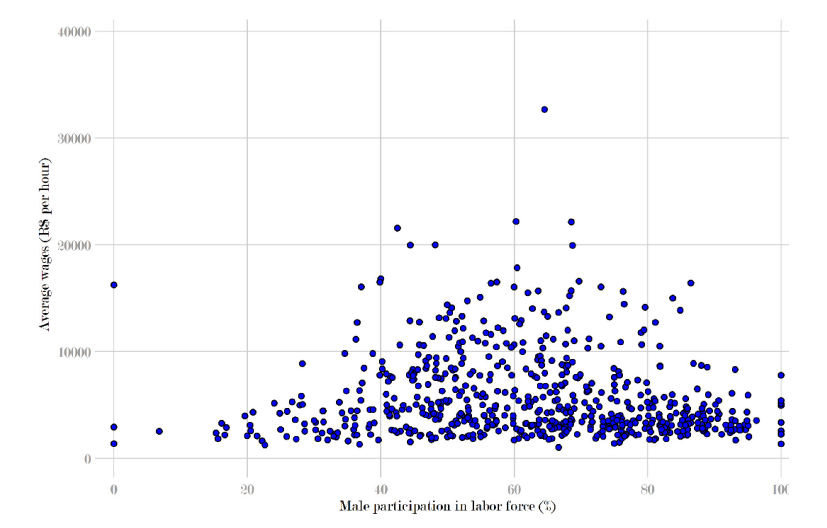
Figure 3 illustrates the differences in average wages according to the prevalence of male workers in each sampled economic sub-sector. There is a roughly bell-shaped curve, where higher wages concentrate in sectors slightly skewed towards the male majority. Figure 4 indicates an asymmetric prevalence of white male formal workers in São Paulo, which suggests that non-male and non-white may represent the majority in informal markets. Concerning migrant workers, although they exhibit higher underpayment, they may benefit from migrating to São Paulo when compared to the average salaries they could earn in their previous location (Cheng and Wang, 2013). Even so, migrant workers may find it hard to maximize their wages in regard to their set of abilities, especially due to the lack of a proper network, as pointed out by Law and Peng (2008). In the same direction, workers with reported disabilities face higher levels of underpayment. Since 1991, Brazil has had laws promoting job openings to disabled workers, through quotas and monetary penalties. These programs have presented consistent developments in further integrating these workers (Montenegro et al., 2012). However, the results from the SWF model suggest that further efforts are needed to promote the wage gap closure.


Figure 5 indicates that male workers tend to obtain jobs where wages are closer to their optimal levels. In other words, the results suggest that female workers face larger inefficiencies in wage earnings. The gender bias in the labor force detailed in Figure 4 is particularly pronounced in technical-oriented fields where men dominate, such as fabrication and engineering-centered sectors, while women tend to favor caring positions such as nursing, child care, and early education.
Although gender-biased job selection has shown signs of improvement in recent years, it persists subtly and is internalized. Notably, in highly technical fields like software engineering, women are underrepresented in technical and leadership roles (Wang and Redmiles, 2019). Nonetheless, women are perceived to be more successful in female-oriented positions and female candidates are more likely to be hired in these stereotypical female professions (Snipes et al., 1998). Botassio and Vaz (2023) suggests that women tend to seek more flexible working hours and avoid restrictive occupations to better balance domestic responsibilities with their careers since the role of women in households often is the major determinant of their career decisions.
Similarly, white workers are considerably more represented in managerial positions than their counterparts. Gouvêa (2022) points out that boards of stock companies in Brazil are predominantly, if not entirely, composed of white individuals and white workers are significantly more likely to access these managerial positions, perpetuating racial inequalities and limiting career growth for non-white populations. These gender and racial asymmetries result in pronounced wage inefficiencies, as depicted in Figure 5 and Figure 6, with a more robust correlation between underpayment and gender participation.
It is essential to acknowledge that the inefficiencies identified by our model do not exclusively stem from direct discrimination. Even among individuals with comparable idiosyncratic traits such as race, gender, work experience, and education, subtle distinctions like language proficiency can result in variations in compensation. Also, occupation choice plays an important role in wage disparities and may be a consequence of structural biases in society that are not captured explicitly in the empirical model. These nuanced skills and choices, often challenging to quantify using available databases, may be reflected as wage inefficiencies within the framework of stochastic frontier models.


Furthermore, the model does not capture mismatches between educational specialization and career decisions. Factors such as the persistently high unemployment rates in Brazil may compel highly skilled professionals to deviate towards less specialized or gig economy-related positions, as documented in previous research (Lameiras and Vasconcelos, 2018). These shifts in career trajectories can further contribute to the observed phenomenon of underpayment. Further work may also contribute to the literature by decomposing the effects of the Covid- 19 pandemic specifically for each economic sector and demographic group, capturing the heterogeneity regarding job relations and how it affected different gender and race groups.
Additional results may also focus, through the use of different datasets, on specific occupation disparities between groups, providing further details on job decisions and better explaining intra-industry discriminatory factors, even testing stochastic frontier models for specific job positions. Other inquiries on this topic can also incorporate specific urban dynamics into the wage inefficiencies analysis, studying the effects of city design and urban segregation on payment disparities. Nonetheless, the disparities in underpayment captured by the empirical model prompt questions about the demographic determinants of acquiring additional skills or experiencing mismatches in career decisions and educational pursuits. As a result, our findings serve to heighten awareness of labor market frictions associated with different demographic groups when they are in search of employment opportunities.
4. Conclusions
This paper examined the level of underpayment of various groups of workers in the city of São Paulo during the period from 2018 to 2020 using Stochastic Frontier models to detect econometric evidence of labor market frictions arising from imperfect information and demographic biases. The empirical results reveal that underpayment tends to be more pronounced among non-male and non-white workers. We hypothesize that these inefficiencies are not solely attributed to race and gender biases in hiring processes but also stem from the numerous decisions female employees encounter while balancing personal and professional demands, even though this reason itself may be indicative of gender biases in society as a whole. Additionally, there is evidence for reducing average wages from 2018 to 2020, while underpayment also reduced from 2018 to 2020. It is unclear whether these results come from labor market reforms (which could provide better wage settings and reduce underpayment) or increasing unemployment due to the economic crisis which intensifies competition for limited job vacancies pushing the wages frontier downward. Addressing this question in future studies will contribute to understanding the dynamics of underpayment in the São Paulo labor market and generate insights about other Brazilian metropolitan areas.
References
- Ananat, E., F. Shihe, and S. L. Ross. 2018. Race-specific urban wage premia and the black-white wage gap. Journal of Urban Economics 108, 141-153.
- Anderson, D. J., M. Binder, and K. Krause. 2002. The motherhood wage penalty: Which mothers pay it and why? American Economic Review 92(2), 354-358.
- Araújo, V. F. and E. P. Ribeiro. 2001. Diferenciais de salários por gênero no Brasil: uma análise regional. Repositório institucional da Universidade Federal do Rio Grande do Sul, Programa de Pós-Graduação em Economia.
- Arbache, J. S. (1999). Do unions always decrease wage dispersion? the case of Brazilian manufacturing. Journal of labor Research 20(3), 425-436.
- Arias, O., G. Yamada, and L. Tejerina. 2004. Education, family background and racial earnings inequality in Brazil. International Journal of Manpower 25(3/4), 355-374.
- Barros, S. C. V. and L. Mourão. 2018. Panorama da participção feminina na educação superior, no mer- cado de trabalho e na sociedade. Psicologia & Sociedade 30.
- Becker, G. 1957. The Economics of Discrimination. The University of Chicago Press.
- Botassio, D. C. and D. V. Vaz. 2023. Occupational Feminization and Pay: The Case of Brazil. Brazilian Review of Econometrics 42(1).
- Brasil. 1995. LEI Nº 9.029, DE 13 DE ABRIL DE 1995 - Proíbe a exigência de atestados de gravidez e esterilização, e outras práticas discriminatórias, para efeitos admissionais ou de permanência da relação jurídica de trabalho, e dá outras providências.
- Brasil. 2015. LEI Nº 13.146, DE 06 DE JULHO DE 2015 - Institui a Lei Brasileira de Inclusão da Pessoa com Deficiência (Estatuto da Pessoa com Deficiência).
- Brasil. 2017. LEI Nº 13.467, DE 13 DE JULHO DE 2017 - Altera a Consolidação das Leis do Trabalho (CLT), aprovada pelo Decreto-Lei nº 5.452, de 1º de maio de 1943, e as Leis n º 6.019, de 3 de janeiro de 1974, 8.036, de 11 de maio de 1990, e 8.212, de 24 de julho de 1991, a fim de adequar a legislação às novas relações de trabalho.
- Brasil. 2019. LEI Nº 13.874, DE 20 DE SETEMBRO DE 2019 - Institui a Declaração de Direitos de Liberdade Econômica.
- Cacciamali, M. C. and P. S. d. Freitas. 2001. Do Capital humano ao salário-eficiência: uma aplicação para analisar os diferenciais de salários em cinco ramos manufatureiros da grande São Paulo. Pesquisa e Planejamento Econômico - PPE 22(2), 343-386.
- Camargo, J. M. and F. Serrano. 1983. Os dois mercados: homens e mulheres na indústria brasileira. Texto para discussão Pontifícia Universidade Católica do Rio de Janeiro (PUC-Rio), Departamento de Economia, Rio de Janeiro 46.
- Carvalhaes, F. and C. A. Ribeiro. 2019. Estratificação horizontal da educação superior no Brasil: Desigualdades de classe, gênero e raça em um contexto de expansão educacional. Tempo social 31, 195-233.
- Casale, D. and D. Posel. 2011. Unions and the gender wage gap in South Africa. Journal of African Economies 20(1), 27-59.
- Castro, M. G. A. d. 2019. Número de filhos e a relação com a discriminação salarial por gênero no mercado de trabalho brasileiro.
- Cavalieri, C. H. and R. Fernandes. 1998. Diferenciais de salários por gênero e cor: uma comparação entre as regiões metropolitanas brasileiras. Brazilian Journal of Political Economy 18(1), 162-180.
- Chattopadhyay, S. and E. C. Bianchi. 2021. Does the black/white wage gap widen during recessions? Work and Occupations 48(3), 247-284.
- Cheng, Z. and H. Wang. 2013. Do neighbourhoods have effects on wages? A study of migrant workers in urban China. Habitat International 38, 222-231.
- Cohen, P. N. and M. L. Huffman. 2007. Working for the woman? Female managers and the gender wage gap. American Sociological Review 72(5), 681-704.
-
Corbi, R. B., R. Narita, R. Ferreira, and D. Souza. 2022. Job Search and Employment: Evidence from a Labor Reform in Brazil. 2022. SSRN. Available at SSRN: https://ssrn.com/abstract=4121304 or http://dx.doi.org/10.2139/ssrn.4121304
» https://ssrn.com/abstract=4121304 or http://dx.doi.org/10.2139/ssrn.4121304 - Costa Dias, M., R. Joyce, and F. Parodi. 2020. The gender pay gap in the UK: children and experience in work. Oxford Review of Economic Policy 36(4), 855-881.
- da Silva Filho, L. A. 2020. Migração e inserção socioeconômica nos municípios brasileiros-2000/2010. Economia e Desenvolvimento 32.
- Dobner, L. O., R. R. Gonçalves, and R. M. Pereira. 2022. Análise setorial dos diferenciais de rendimen- tos entre os gêneros no Rio Grande do Sul: Uma abordagem paramétrica e não-paramétrica. Revista Brasileira de Estudos Regionais e Urbanos 16(2), 214-238.
- Firpo, S. P., N. M. Fortin, and T. Lemieux. 2018. Decomposing wage distributions using recentered influence function regressions. Econometrics 6(2), 28.
-
Freguglia, R. and T. S. Procópio. 2013. Efeitos da mudança de emprego e da migração interestadual sobre os salários no Brasil formal: evidências a partir de dados em painel. Pesquisa e Planejamento Econômico (PPE) 42(2), 255-278. Available at: http://repositorio.ipea.gov.br/handle/11058/3331
» http://repositorio.ipea.gov.br/handle/11058/3331 - Giuberti, A. C. and N. Menezes-Filho. 2005. Discriminação de rendimentos por gênero: uma com- paração entre o Brasil e os Estados Unidos. Economia Aplicada 9(3), 369-384.
- Goldin, C. 1995. The U-Shaped Female Labor Force Function in Economic Development and Economic History. In Schultz TP Investment in Women’s Human Capital and Economic Development, pp. 61-90. University of Chicago Press.
- Gouvêa, C. P. 2022. Governança Corporativa e Diversidade Racial no Brasil: um Retrato das Companhias Abertas. Available at SSRN 4077326.
- Han, J. and M. Budig. 2019. Gender Pay Gap. Oxford University Press.
- Hofler, R. A. and K. J. Murphy. 1992. Underpaid and Overworked: Measuring the effect of imperfect information on wages. Economic Inquiry, 511-529.
- Hofler, R. A. and K. J. Murphy. 1994. Estimating Reservation Wages of Employed Workers Using a Stochastic Frontier. Southern Economic Journal 60(4), 961-976.
-
IBGE. 2023. Com taxa de 8,8%, desemprego cresce no primeiro trimestre de 2023. Instituto Brasileiro de Geografia e Estatística. https://agenciadenoticias.ibge.gov.br/agencia-noticias/2012-agencia-de- noticias/noticias/36780-com-taxa-de-8-8-desemprego-cresce-no-primeiro-trimestre-de-2023
» https://agenciadenoticias.ibge.gov.br/agencia-noticias/2012-agencia-de- noticias/noticias/36780-com-taxa-de-8-8-desemprego-cresce-no-primeiro-trimestre-de-2023 -
Kleinjans, K. J., K. F. Krassel, and A. Dukes. 2017. Occupational prestige and the gender wage gap. Kyklos 70(4), 565-593. https://doi.org/10.1111/kykl.12149
» https://doi.org/10.1111/kykl.12149 - Kumbhakar, S. and C. A. K. Lovell. 2000. Stochastic Frontier Analysis. Cambridge: Cambridge University Press.
- Kumbhakar, S., H.-J. Wang, and A. Horncastle. 2015. A Practitioner’s Guide to Stochastic Frontier Analysis Using Stata. Cambridge: Cambridge University Press.
- Kumbhakar, S. C. and H.-P. Lai. 2022. Recent Advances in the Panel Stochastic Frontier Models: Heterogeneity, Endogeneity and Dependence. International Journal of Empirical Economics 01(01).
- Lagos, L. 2019. Labor market institutions and the composition of firm compensation: Evidence from brazilian collective bargaining. Job Market Paper.
- Lameiras, M. A. P. and L. S. Vasconcelos. 2018. A evolução da população ocupada com nível superior no mercado de trabalho. Carta de Conjuntura IPEA 41.
- Law, P.-L. and Y. Peng. 2008. Mobile networks: Migrant workers in southern China. Handbook of Mobile Communication Studies, 55-64.
- Madalozzo, R. 2010. Occupational segregation and the gender wage gap in Brazil: an empirical analysis. Economia Aplicada 14(2), 147-168.
- Magnusson, C. 2016. The gender wage gap in highly prestigious occupations: a case study of Swedish medical doctors. Work, employment and society 30(1), 40-58.
- Meireles, D. C. and J. L. M. da Silva. 2019. Diferenciais de rendimentos por gênero e raça no mercado de trabalho brasileiro. Revista Gênero 20(1), 73-5.
- Mincer, J. 1975. Education, Experience, and the Distribution of Earnings and Employment: An Overview. In Education, Income, and Human Behavior, pp. 71-94. NBER - National Bureau of Eco- nomic Research.
- Montenegro, A. V., A. C. R. Tupinambá, R. L. Feitosa, R. M. D. Ávila, R. L. Lima, and J. L. Palhano. 2012. Programa RINEPE e IMBA: promoção da qualidade de vida do trabalhador PcD em empresas cearenses.
-
OECD. 2022. Education at a Glance 2022. https://www.oecd.org/education/education-at-a-glance/.
» https://www.oecd.org/education/education-at-a-glance - Ogloblin, C. and G. Brock. 2005. Wage determination in urban Russia: Underpayment and the gender differential. Economic Systems 29(3), 325-343.
- O’Reilly, J., M. Smith, S. Deakin, and B. Burchell. 2015. Equal Pay as a Moving Target: International perspectives on forty-years of addressing the gender pay gap. Cambridge Journal of Economics 39(2), 299-317.
- Pacheco, J. P., G. M. Mendes, and G. M. Moura. 2023. Análise da Diferença Salarial entre Homens e Mulheres no Paraná em 2012 e 2019. Revista Brasileira de Estudos Regionais e Urbanos 16(4), 591-615.
- Pager, D. and H. Shepherd. 2008. The Sociology of Discrimination: Racial Discrimination in Employment, Housing, Credit, and Consumer Markets. Annual Review of Sociology.
- Pecora, A. R. and N. Menezes-Filho. 2014. O papel da oferta e da demanda por qualificação na evolução do diferencial de salários por nível educacional no Brasil. Estudos Econômicos (São Paulo) 44(2), 205-240.
-
RAIS. 2023. Ministério do Trabalho e Emprego. Relação Anual de Informações Sociais. Available at: http://www.rais.gov.br/sitio/index.jsf
» http://www.rais.gov.br/sitio/index.jsf - Ramos, L. and M. L. Vieira. 2001. Determinantes da desigualdade de rendimentos no Brasil nos anos 90: discriminação, segmentação e heterogeneidade dos trabalha-dores. IPEA Textos para Discussão Nº 803.
- Silveira, L. S. and N. L. Siqueira. 2021. Segregação ocupacional e diferenciais de renda por gênero e raça no Brasil: uma análise de grupos etários. Revista Brasileira de Estudos de População.
- Snipes, R. L., S. L. Oswald, and S. B. Caudill. 1998. Sex-role stereotyping, gender biases, and job selection: The use of ordinal logit in analyzing Likert scale data. Employee Responsibilities and Rights Journal 11, 81-97.
- Van Ours, J. C. and L. Stoeldraijer. 2010. Age, wage and productivity. CentER Discussion Paper Series No. 2010-12.
- Wang, Y. and D. Redmiles. 2019. Implicit gender biases in professional software development: An empirical study. 2019 IEEE/ACM 41st International Conference on Software Engineering: Software Engineering in Society (ICSE-SEIS), 1-10.
- Wilson, G. and V. J. Roscigno. 2016. Public sector reform and racial occupational mobility. Work and Occupations 43(3), 259-293.
- Winslow-Bowe, S. 2009. Husbands’ and wives’ relative earnings: Exploring variation by race, human capital, labor supply, and life stage. Journal of Family Issues 30(10), 1405-1432.
-
1
We adopt the official racial profile naming from RAIS (2023). For instance, it includes indigenous, white, black, Asian (referring to individuals of Japanese, Chinese, Korean, or other related ethnic backgrounds), and “pardo” (a broad term encompassing mixed-race individuals).
-
2
Listed disabilities include physical, hearing, visual, and intellectual impairments.
-
3
Presented monetary values in 2022 levels (IPCA index).
-
4
We tested the empirical results for both Cobb-Douglas (CD) and Translog (TL) functional forms. Both models provided a good fit for the frontier and underpayment variables. Log-likelihood tests rejected the null hypothesis of 𝜎𝑢 = 0 in both CD and TL models, favoring the adoption of SF models (𝑝 − 𝑣𝑎𝑙𝑢𝑒 < 0.001). Also, another Log-likelihood test rejected the CD model in comparison to the Translog specification (p − value < 0.001). Therefore, we proceed to present and interpret only the results from the TL model.
Edited by
-
EDITOR-CHEFE
Dante Mendes Aldrighi https://orcid.org/0000-0003-2285-5694Professor - Department of Economics University of São Paulo (USP)Tássia de Souza Cruz https://orcid.org/0000-0003-1627-9467