 Myopericytoma of the thoracic spine in a pregnant woman: a case report on the management of a rare neoplasm
ABSTRACT
Myopericytomas are perivascular myoid neoplasms that rarely exhibit malignant characteristics. They usually arise in the dermis or subcutaneous tissue and exceptionally involve deep soft tissues, with spinal localization being rare. We report the case of a previously healthy 32-year-old pregnant woman who presented with pain in the interscapular region and progressive loss of lower limb strength. Magnetic resonance imaging revealed a solid neoplastic mass at the T3 level, with spinal canal invasion and spinal cord signal abnormalities. The pregnancy was terminated, followed by lesion embolization, decompressive laminectomy, and local radiotherapy. The patient completely recovered from her neurological symptoms. Thoracic spine myopericytomas are rare and have been poorly reported in the literature. No studies have described the aforementioned neoplasm in a pregnant patient. We report this case because of its peculiarity, evolution, and outcome.
Keywords:
Myopericytoma; Spinal neoplasms; Metastasis neoplasms; Vascular tissue neoplasm; Pregnancy; Radiotherapy
INTRODUCTION
Myopericytoma is a distinct perivascular myoid neoplasm that shares a morphological spectrum with myofibromas. They rarely exhibit malignant characteristics and arise in the dermis or subcutaneous tissue, occasionally involving the deep soft tissues.(1) Localization in the spine is rare, with only a few cases reported in the literature—the first of which was documented in 2003.(2-7) Specifically, only three cases have been reported in the thoracic spine.(3,5,7) Myopericytomas can affect individuals of any age; however, they are most commonly seen in adults. Mutations in the platelet-derived growth factor receptor beta gene appear to represent a common pathogenesis of myopericytoma.(1,8) Histologically, they are non-encapsulated, well-circumscribed nodular or lobular lesions composed of cytologically bland, oval to fusiform myoid tumor cells, with characteristic multilayered concentric growth around small vessels. Immunohistochemically, myopericytomas express smooth muscle actin and h-caldesmon and are only focally positive for desmin and/or CD34.(1) Because of their rarity, there are few reports on their management, with resection followed by radiotherapy described in two cases.(3,5)
CASE REPORT
A 32-year-old white woman, who was 34 weeks and five days pregnant and previously healthy, started experiencing pain in the interscapular region associated with progressive weakness in the lower limbs and paresthesia below the xiphoid process. After three weeks, the patient became paraplegic. Physical examination revealed deep reflexes in the lower limbs, cutaneous-plantar reflex in extension, and clonus. Magnetic resonance imaging (MRI) was performed without paramagnetic contrast because of pregnancy. The scan revealed a solid neoplastic mass at the T3 level, with diffuse vertebral body infiltration, spinal canal invasion, and extraosseous paravertebral and foraminal extension, resulting in spinal cord compression (Figure 1).

Magnetic resonance imaging of the thoracic spine. Solid neoplastic mass at the T3 level, with diffuse vertebral body infiltration, vertebral canal invasion, and extraosseous paravertebral and foraminal extension, resulting in spinal cord compression
Because of spinal cord compression and evidence of a neoplastic lesion, corticosteroid therapy was initiated for fetal lung maturation to terminate the pregnancy for subsequent local therapy.
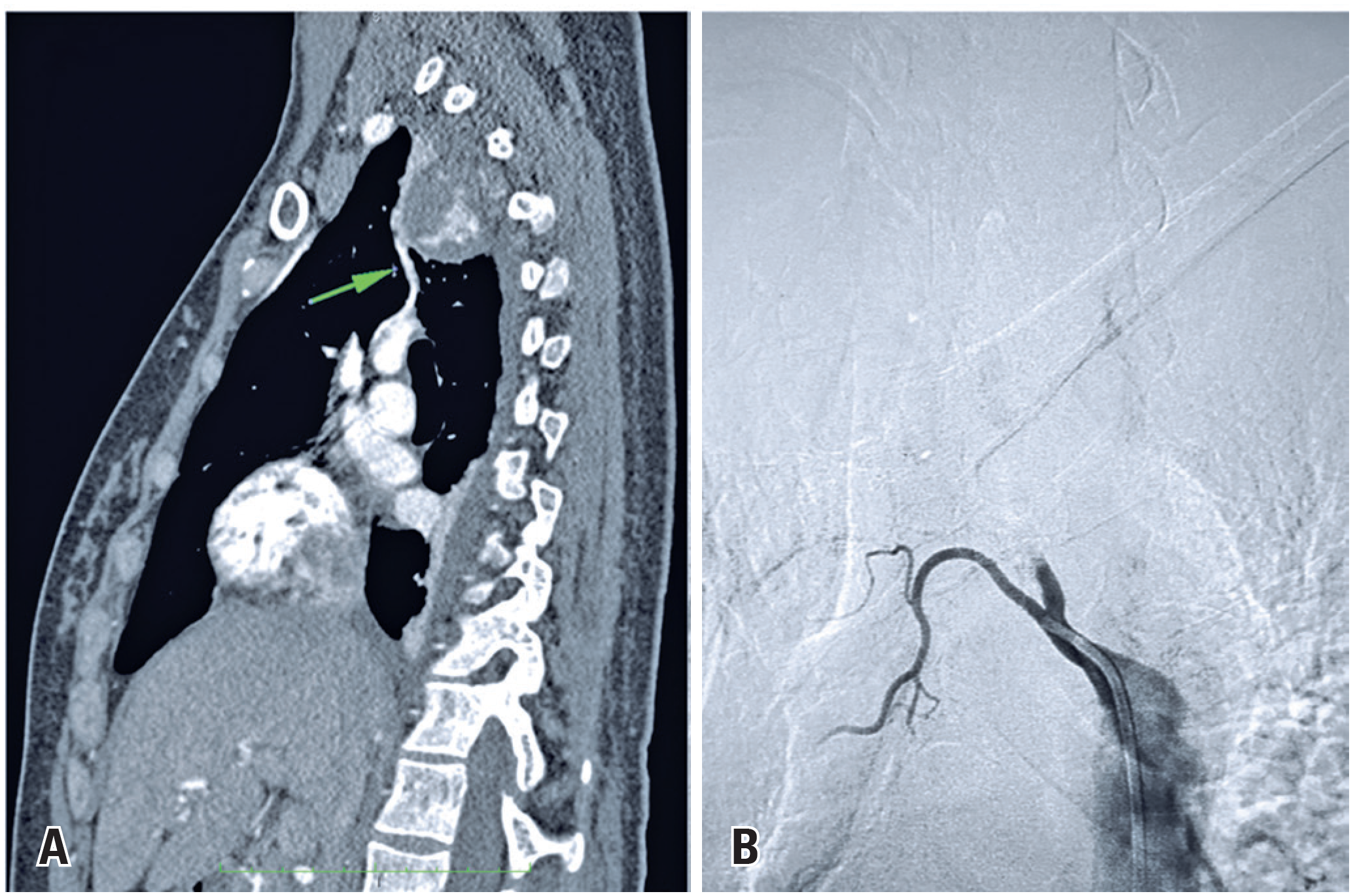
The baby was delivered through caesarean section on the 7th day of corticosteroid therapy, and the patient was transferred to our unit on the 5th day of puerperium. The patient underwent staging with computed tomography scans of the chest and abdomen and bone scintigraphy that revealed a single localized skeletal lesion. Subsequently, endovascular embolization of the lesion was performed (Figure 2). On the 4th day of admission, decompressive laminectomy was performed on the 3rd and 4th thoracic vertebrae without instrumentation, and the excised material was sent for anatomopathological examination. By the 2nd postoperative day, the patient exhibited partial enhancement of paresthesia and motor condition (grade 3/5 strength).

Endovascular embolization. The green arrow on the computed tomography scan demonstrates the vessel nourishing the neoplastic mass (A). After embolization, the flow to the tumor mass is interrupted (B)
Pathological examination revealed a cancellous bone infiltrated by a histologically benign neoplasm composed of spindle cells and myxoid tissue with abundant capillary blood vessels. The immunohistochemical findings were compatible with benign myopericytoma, revealing smooth muscle actin positivity in the perivascular region, CD34 positivity only in the vessels, and negativity in neoplastic cells (Figure 3).
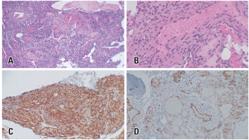
Histology slides. The cancellous bone infiltrated by a histologically benign neoplasm composed of spindle cells and myxoid tissue with abundant capillary blood vessels (A and B). Immunohistochemical analysis revealing positivity for smooth muscle actin markers in the perivascular region (C) and CD34 only in the vessels (D)
The patient underwent local radiotherapy starting 21 days after surgery, with a total dose of 4500 cGy over 25 sessions of 180 cGy each, and started physiotherapy rehabilitation. Her neurological condition progressively enhanced; she regained the ability to walk with support during radiotherapy and was assessed monthly on an outpatient basis. Imaging tests were performed every three months. All MRI scans revealed a solid neoplastic mass at the T3 level—that remained stable in shape, signal, and size, with diffuse infiltration of the vertebral body and posterior elements, resulting in partial collapse. Additionally, altered bone marrow signaling indicating liposubstitution was observed in the vertebral bodies from C7 to T6, related to radiotherapy (Figure 4). At the last assessment, after five years of follow-up, the patient had no motor and/or sensory deficits.

Late magnetic resonance imaging of the thoracic spine. A post-radiotherapy control study with actinic liposubstitution of the vertebral bone marrow and a slight reduction in the solid neoplastic mass at T3 compared with that of the initial examination, and a compressive effect on the spinal cord
The study was approved by the Research Ethics Committee of Hospital de Clínicas, Universidade Federal do Triângulo Mineiro (CAAE: 77650624.9.0000.8667; #6.685.965).
DISCUSSION
The study presents rare cases of paraplegia during pregnancy, with causes, such as vertebral tuberculosis,(9,10) ruptured arteriovenous malformation,(11) spontaneous spinal epidural hematoma,(12,13) Guillain-Barre syndrome,(14) and neoplasms.(15-17) Among neoplasms, ependymomas,(15) gestational choriocarcinomas,(16) and spinal meningiomas(17) have been identified as causes of paraplegia in pregnant women. In contrast, myopericytoma has not been identified as a potential cause.
Myopericytoma is a rare soft tissue tumor with a predilection for the distal extremities. It is commonly observed in the skin and subcutaneous tissues, with a benign course.(18) It occurs across a wide age range—beginning from the second decade of life, with a consistently reported male predilection. It usually presents as single or multiple subcutaneous nodules on the extremities, with rare cases of multicentricity.(3) Myopericytoma affecting the skeletal system is rare, with only three reported cases affecting the axial skeleton—all located in the thoracic spine at the T3,(5) T5/T6,(7) and T8(3) vertebrae. In this report, we describe the case of a 32-year-old pregnant woman diagnosed with myopericytoma at the T3 level, presenting with neurological symptoms, making this case unique.
In the aforementioned cases, the patients underwent surgery, and tissue samples were sent for histopathological examination. The findings revealed concentric perivascular proliferation of round-to-spindle-shaped cells with myoid differentiation, compatible with the diagnosis of myopericytoma. Immunohistochemistry revealed a pattern consistent with that of myopericytoma.(3,5,7) Therefore, it is a benign tumor; however, rare cases of malignant myopericytoma have been reported.(19)
In one of the reported cases, tumor embolization was performed before surgery.(7) In this case, angiotomography revealed a large vessel nourishing the tumor mass; therefore, prior embolization was performed.
In the previously described two cases, radiotherapy was used as an adjuvant to surgical treatment at a total dose of 4500 cGy.(3,5) The current case followed the same postoperative radiotherapy protocol; however, in the previously mentioned cases, the resected tumor volume was considered larger than that of the present case—that underwent only decompressive laminectomy.
In this case, the pregnancy was terminated because of the severity of the neurological symptoms and gestational age, which ensured the safety of the newborn. We emphasize that multidisciplinary discussions are essential, and each case should be approached individually.
Therefore, we conclude that myopericytoma cases of the thoracic spine with compressive symptoms can achieve favorable outcomes, even in peculiar situations, such as those described above, based on the therapy used.
REFERENCES
- 1 World Health Organization (WHO). WHO Classification of Tumours. Geneva: WHO; 2020. pp. 182-5.
- 2 Holling M, Wildförster U, Verheggen R, Müller K, Stummer W, Jeibmann A. Myopericytoma: A Series of 5 Cases Affecting the Nervous System. World Neurosurg. 2015;84(5):1493.e5-8.
- 3 Agrawal N, Nag K. Myopericytoma of the thoracic spine: a case report and review of literature. Spine J. 2013;13(11):e23-7.
- 4 Yang JC, Venteicher AS, Koch MJ, Stapleton CJ, Friedman GN, Venteicher EM, et al. Myopericytoma at the Craniocervical Junction: Clinicopathological Report and Review of a Rare Perivascular Neoplasm. Neurosurgery. 2019;85(2):E360-5.
- 5 Cox DP, Giltman L. Myopericytoma of the thoracic spine: a case report. Spine. 2003;28(2):E30-2.
- 6 Kulcsár Z, Veres R, Hanzély Z, Berentei Z, Marosfoi M, Nyáry I, et al. Rare angioproliferative tumors mimicking aggressive spinal hemangioma with epidural expansion. Ideggyogy Sz. 2012;65(1-2):42-7.
- 7 Brunschweiler B, Guedj N, Lenoir T, Faillot T, Rillardon L, Guigui P. Oncogenous osteomalacia and myopericytoma of the thoracic spine: a case report. Spine. 2009;34(23):E857-60.
- 8 Hung YP, Fletcher CD. Myopericytomatosis: Clinicopathologic Analysis of 11 Cases With Molecular Identification of Recurrent PDGFRB Alterations in Myopericytomatosis and Myopericytoma. Am J Surg Pathol. 2017; 41(8):1034-44.
- 9 Yadav A, Singh A, Aggarwal K. A case of acute-onset paraplegia due to spinal tuberculosis in term pregnancy. Obstet Med. 2023;16(4):242-4.
- 10 Srivastava S, Raj A, Agarwal R, Bhosale S, Marathe N. Management dilemma of tuberculous paraplegia in pregnancy - A case report and review of literature. Surg Neurol Int. 2020;11:470.
- 11 Thiele CE. Ruptured Spinal Arteriovenous Malformation: A Rare Cause of Paraplegia in Pregnancy. Case Rep Obstet Gynecol. 2018;2018:6096483.
- 12 Yilmaz MC, Aydin K. Spontaneous Spinal Epidural Hematoma During Pregnancy: A Case Report. Cureus. 2024;16(11):e72971.
- 13 Krishnan P, Kartikueyan R. Spontaneous spinal epidural hematoma: a rare cause of paraplegia in pregnancy. Neurol India. 2014;62(2):205-7.
- 14 Swonger RM, Syros A, Finch L, Moore J, Lauture A, Soto Rincon A, et al. Guillain-Barre Syndrome With Concomitant Severe Preeclampsia: A Case Report. Cureus. 2023;15(6):e40796.
- 15 Bitterman J, Donovan J, Lam M. Diagnosis and rehabilitation of a pregnant woman with spinal cord disorder due to spinal cord tumor. Spinal Cord Ser Cases. 2019;5(1):8.
- 16 Ishiguro T, Serikawa T, Yahata T, Enomoto T. Gestational choriocarcinoma: rare spinal metastasis during a viable pregnancy. J Obstet Gynaecol Res. 2017;43(2):421-4.
- 17 Antolínez Ayala VE, García Arias MD, Bautista Vargas SE, Báez Cárdenas LM, Castellanos Peñaranda C. Paraplegia due to spinal meningioma during the third trimester of pregnancy: case report and literature review. Spinal Cord Ser Cases. 2021;7(1):31.
- 18 Tan MW, Wei Tay AY, Tang PY, Chew KY, Nicholas Yeo EM. Myopericytoma: A Review of Twenty-Three Cases Over Twelve Years and a Case Report of a Rare Neoplasm. Am J Dermatopathol. 2022;44(9):623-31.
- 19 Eubanks BN, Hall JR, Hall KH, Buck SP, Wohltmann WE. Malignant myopericytoma: case report and review of the literature. J Cutan Pathol. 2023;50(1):39-42.
Edited by
-
Associate Editor:
Kenneth Gollob Hospital Israelita Albert Einstein, São Paulo, SP, Brazil ORCID: https://orcid.org/0000-0003-4184-3867