 Morphometric Characterization and Germination Potential of Frangula sphaerosperma Seeds
Abstract
This study explores the propagation of Frangula sphaerosperma, a species relevant for ecological restoration, by characterizing its seed and biometric traits (length, width, and shape indices) and evaluating germination at 20, 25, 30 and 35 °C. Germination percentage, germination speed index, average germination time, and seedling normality (defined by the presence of essential structures, such as well-formed roots and expanded leaves) were assessed. Seed traits were obtained using image-based measurements with ImageJ®. Seeds showed low moisture content (10.8%) and were classified as small and circular, with a thousand-seed weight of 20.04 g, corresponding to 49,888 seeds kg-1. Germination was similar between 20 and 30 °C (27.3- 33.8%); however, 25 °C optimized seedling quality, providing the highest percentage of normal seedlings (12%) and the shortest average germination time (11 days). Temperatures above 30 °C reduced germination and seedling formation, indicating sensitivity to heat stress and supporting nursery production at 25 °C.
Keywords:
Seedlings establishment; Biometry; Native species; Ecological restoration
1. INTRODUCTION
Seed germination and early seedling establishment are critical stages for the success of ecological restoration programs based on native species (Oldfield et al., 2019; Dalziell et al., 2022). Previous studies have investigated factors influencing germination, such as temperature, substrate, and evaluation time, demonstrating their effects on germination performance and seedling quality (Brasil, 2009; Silva et al., 2023). In addition, biometric analyses have been used to identify phenotypic variations related to environmental conditions and seed performance (Souza & Cavalcante, 2019; Chowdhury et al., 2023). However, despite the use of native species in restoration, information on their seed traits and early developmental stages remains limited, restricting the practical application of these species (Silva et al., 2023; Walter et al., 2024).
The Rhamnaceae family, comprising approximately 55 genera and 950 species worldwide (Richardson et al., 2004) plays an ecologically important role in various biomes. Within this family lies the genus Frangula, traditionally included in the genus Rhamnus but more recently recognized as a distinct clade based on molecular and morphological evidence (Bolmgren & Oxelman, 2004). The species, Frangula sphaerosperma (Sw.) Kartesz & Gandhi, originally described as Rhamnus sphaerosperma and commonly known as “fruto-do-pombo,” has a wide geographic distribution, occurring from Mexico to Argentina, including Brazil (Royal Botanic Gardens, 2023). Its reclassification reflects the presence of unique characteristics, such as pentamerous flowers and unmarked fruits, which distinguish it from Rhamnus stricto sensu (Bolmgren & Oxelman, 2004).
These morphological traits are associated with specific reproductive strategies, such as zoochory and high diaspore production, and contribute to the dispersal capacity and ecological adaptability that are fundamental to species selection for restoration. Furthermore, F. sphaerosperma is frequent in humid, rocky, and anthropized areas (Medeiros & Zanon, 1998), demonstrating adaptability to different ecological conditions. Based on these ecological and reproductive characteristics, the species holds functional value for restoration initiatives, particularly in degraded or marginal sites where soil stabilization and rapid cover are required.
Species of Rhamnus and Frangula exhibit distinct germination strategies and ecological adaptations, yet both offer considerable potential for ecological restoration. For instance, Melese & Legas (2024) observed that certain Rhamnus species have potential for slope restoration due to their deep root systems, which provide high soil anchoring and resistance in unstable environments. In Frangula, key traits described by Pool (2013), such as indehiscent pyrenes, specific seed coat structures, and a wide variation in plant habit (ranging from shrubs to canopy trees) must be considered for practical application. These morphological features determine critical propagation needs and define functional roles, such as providing rapid ground cover (Dalziell et al., 2022), structuring forest canopies, or stabilizing soils in specific ecological niches. Therefore, these functional morphological differences are not merely taxonomic details but essential criteria for selecting species based on targeted restoration goals (Souza & Engel, 2024).
Despite these advances, germination information on Frangula sphaerosperma remains scarce. Therefore, to the best of our knowledge, this is the first study to integrate seed morphological and biometrical characterization with germination performance across different temperatures for Frangula sphaerosperma. The results obtained aim to support conservation actions for the species and promote its use in degraded area recovery projects, contributing to ecological restoration and sustainable biodiversity management.
2. MATERIAL AND METHODS
2.1. Fruit collection and seed storage
To ensure genetic variability, mature fruits of Frangula sphaerosperma were collected in December 2023 from 10 reproductively mature mother trees located randomly throughout the Urban Forest Remnant, Capão do Tigre, located at the Jardim Botânico Campus of the Universidade Federal do Paraná (UFPR), Curitiba, Brazil. A minimum distance of 50 meters between mother trees was maintained to avoid kinship. Following extraction and processing, seeds were air-dried for 12 hours at room temperature and subsequently stored at 5 °C for 120 days in the Forest Seed Laboratory (LASF).
2.2. Physical analyses
The thousand-seed weight (TSW) was determined according to the Rules for Seed Analysis (RAS) (Brasil, 2009), measuring the mass of eight independent replicates of 100 seeds using a precision balance (0.0001 g), the mean was used to extrapolate the TSW and the number of seeds per kilogram. Seed moisture content was determined by the gravimetric oven-drying method at 105 ± 3 °C for 24 h. The results were calculated based on the fresh and dry masses (Brasil, 2009).
2.3. Biometry
Seed biometry was conducted through digital image analysis using ImageJ® software (Schneider et al., 2012). A total of 900 seeds were analyzed, divided into three independent replicates of 300 seeds each. For each replicate, seeds were randomly selected from the seed lot, evenly arranged on a matte white background, and photographed using a digital camera positioned 50 cm above the samples, with a millimeter-scale ruler included for calibration.
Images were processed individually in ImageJ® by converting them to 8-bit grayscale, calibrating the scale using the reference ruler, and applying a threshold adjustment to enhance contrast between seeds and background. The software was then used to obtain individual seed measurements of area (mm²), perimeter (mm), length (mm), width (mm), circularity (0.0-1.0), aspect ratio, roundness (0.0-1.0), and solidity (0.0-1.0). All measurements were exported to Excel® format for further analysis (Felix et al., 2021).
2.4. Germination
Germination tests were conducted using blotting paper as substrate, which was previously sterilized in an oven at 120 °C for 2 h and moistened with distilled water at a ratio of 2.5 times its dry weight (Brasil, 2009). For each temperature treatment, eight replicates of 50 seeds were used, following a completely randomized design. Seeds were evenly distributed on the substrate in transparent Gerbox® boxes, which were sealed with plastic film to maintain constant moisture levels.
The experimental units were placed in Mangelsdorf® germinators under constant light provided by cool-white fluorescent lamps (20W), with four constant temperature treatments: 20 °C, 25 °C, 30 °C, and 35 °C. Germination was monitored daily up to the 24th day, when germination reached stability. Seeds showing radicle protrusion of at least 2 mm were considered germinated. At the end of the evaluation period, the following parameters were determined according to the Rules for Seed Analysis (Brasil, 2009): germination percentage, percentage of normal seedlings (displaying all essential structures, including a developed primary root and expanded cotyledons), and percentage of abnormal seedlings (showing necrosis or stunted growth). The Germination Speed Index (GSI) and Average Germination Time (AGT) were calculated following the formulas proposed by Maguire (1962) and Labouriau (1983), respectively.
2.5. Morphological analyses
For morphological description and illustration, ten fruits and ten seeds were randomly selected from a homogenized lot to represent the typical characteristics of the species. They were subjected to transverse and longitudinal sections using a scalpel blade, with observations conducted under a Leica DMS300 digital microscope. Fruit characterization followed standardized botanical terminology, considering pericarp texture, consistency, pubescence, luster, shape, number of seeds per fruit, and dehiscence type. Seed morphology included the visual inspection of external structures (seed coat, micropyle, hilum, and raphe) and internal structures (embryo, cotyledons, and endosperm), following Cosmo et al. (2010) with the aid of a stereomicroscope.
The first five seedlings to reach complete normal development were selected to ensure the description reflected vigorous and representative individuals. Seedling morphology was based on Wheeler et al., 1989, evaluating cotyledons and eophylls for shape, symmetry, apex, base, margins, and venation patterns. The morphological description of seedlings was performed using individuals obtained from the germination tests described previously. Evaluation occurred once the first pair of true leaves (eophylls) emerged.
2.6. Statistical analysis
Statistical analyses were performed using the R programming language, version 4.4.1 (R Core Team, 2023). Data normality and homogeneity of variances were strictly assessed using the Shapiro-Wilk and Levene’s tests, respectively, both at a 5% significance level. Germination percentage, Germination Speed Index (GSI), and Average Germination Time (AGT) that met the parametric assumptions were subjected to one-way Analysis of Variance (ANOVA). When significant differences were detected, means were compared using Tukey’s multiple comparison test at a 5% significance level.
Data for the percentages of normal and abnormal seedlings did not meet the assumptions of normality and were therefore analyzed using the non-parametric Kruskal-Wallis test. For these variables, when significant differences were found, the Dunn’s post hoc test with Bonferroni correction was applied at a 5% significance level to identify differences between treatments (Kruskal & Wallis, 1952; Dunn, 1964).
3. RESULTS AND DISCUSSION
3.1. Physical and biometric analyses
The morphometric study of Frangula sphaerosperma revealed seed traits consistent with its ecological strategy for zoochorous dispersal. The thousand-seed weight was 20.04 g (± 0.03 g, coefficient of variation = 1.4%), with an average moisture content of 10.8% (± 0.2%), resulting in an estimate of 49,888 seeds per kilogram. These physical attributes, particularly the low moisture content, are typical of orthodox seeds, suggesting potential for ex situ conservation through conventional storage (Offord et al., 2004). Digital seed analysis employing ImageJ, indicated mean length and width of 4.28 mm each, perimeter of 14.09 mm, and surface area of 13.98 mm². Shape indices, such as circularity (0.89) and solidity (0.95), indicate regular contours, close to ideal circular form (Table 1).
The comparison with Rhamnidium elaeocarpum highlights marked differences in reproductive strategies (Table 1). While F. sphaerosperma produces small (4.28 ± 0.37 mm) and light seeds, R. elaeocarpum develops significantly larger diaspores (7.67 ± 0.60 mm) and thicker ones (3.49 ± 0.33 mm), with an estimated volume of 22.92 mm³ (Silva et al., 2015). This morphological distinction reflects a clear seed size-number trade-off. Small and regular seeds, such as those of F. sphaerosperma, favor mass production (49,888 seeds/kg) and broaden dispersal range through small-bodied dispersers, as reduced dimensions and high circularity are known to facilitate ingestion and gut passage by a wider diversity of avian frugivores (Westoby et al., 1996; Silva et al., 2015; Bracho-Estévanez et al., 2024). Conversely, large seeds with greater reserves might provide a competitive advantage for initial establishment in environments with low light or high competition, such as riparian forests, due to the higher metabolic supply available for early seedling growth (Kidson & Westoby, 2000). However, it is important to note that these dispersal strategies are context-dependent and may vary according to local environmental conditions and faunal composition.
In the context of ecological restoration, the attributes of F. sphaerosperma (small seed size, high circularity, and high seed density) enhance diaspore flow and functional connectivity among remnants. These traits are consistent with the ‘small-seed advantage,’ where reduced dimensions and spherical shapes (circularity = 0.89) facilitate ingestion and long-distance transport by a wider range of avian frugivores, particularly in fragmented landscapes that rely on animal dispersers for forest reassembly (Bracho-Estévanez et al., 2024). In contrast, R. elaeocarpum may contribute with higher establishment vigor in areas with intense competition or environmental stress, as larger seeds typically possess greater metabolic reserves to support early seedling growth under resource-limited conditions (Westoby et al., 1996; Kidson and Westoby, 2000). Thus, integrating species with contrasting dispersal (R-strategy) and establishment (K-strategy) traits may optimize restoration projects by ensuring both colonizing potential and long-term persistence in degraded areas (Dalziell et al., 2022).
3.2. Morphological analyses
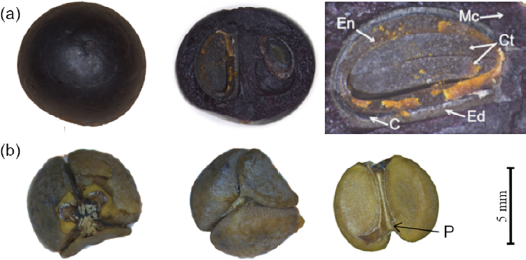
The fruits of F. sphaerosperma observed in the present study are spherical, with a smooth and shiny surface, green when immature, turning red to purple at maturity. The pericarp is fleshy and contains three pyrenes, each with a coriaceous endocarp enclosing a seed, thus characterizing the fruit as a nuculanium drupe. The diaspores (endocarp + seed) remain attached by the placenta, whose coloration is similar to that of the endocarp. After processing, the endocarp remained adhered to the seed coat, forming a pyrene. These characteristics are consistent with the descriptions provided by Santos et al., 2014.
In contrast, R. elaeocarpum produces monospermic berry-type fruits, with a purple epicarp when ripe (Silva et al., 2015). Differences in fruit morphology may be associated with specific adaptations to dispersal mechanisms and habitat conditions. For better structural visualization, longitudinal and transverse sections of F. sphaerosperma fruits were performed, allowing the observation of different structures. In longitudinal section, the seed coat, endosperm, cotyledons, and endocarp can be identified. Within the pyrenes, the clustered arrangement of the seeds and the placenta connecting them to the fruit can be observed, can be observed. These structures are illustrated in Figure 1.

Morphological structures of the fruits of Frangula sphaerosperma. (a) Whole fruit, longitudinal section showing endosperm, cotyledons, seed coat, and endocarp; (b) Clustered pyrenes, in superior, lateral, and longitudinal views, showing the placenta. En - Endosperm; Mc - Mesocarp; Ct - Cotyledons; C - Coat; Ed - Endocarp; P - Placenta.
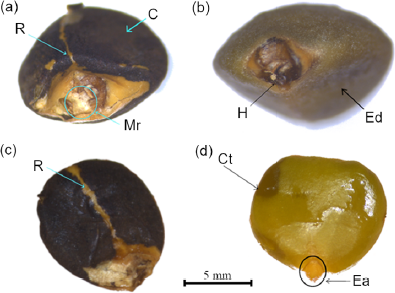
After removal of the endocarp, the seed coat exhibits a dark brown coloration, with a yellowish raphe running longitudinally along the seed. The hilum, more visible in the presence of the endocarp, was clearly preserved. The micropyle was not directly observed, but the micropylar region was identified as a whitish area with higher tissue porosity. Internally, the cotyledons displayed greenish coloration and a fleshy consistency. As illustrated in Figure 2, the hypocotyl-radicle axis is short, and the embryo occupies the entire extension of the seed.
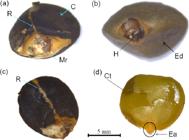
Morphological structures of the seed of Frangula sphaerosperma. Details of seed parts: (a) Raphe, seed coat and micropylar region; (b) Hilum and endocarp; (c) Raphe; (d) Cotyledon and embryonic axis. R - Raphe; C - Coat; Mr - Micropylar region; H - Hilum; Ed - Endocarp; Ct - Cotyledon; Ea - Embryonic axis.
In contrast, Silva et al., 2015, when studying seeds of Rhamnidium elaeocarpum, described them as exalbuminous, cream-colored, with a rough seed coat and an endosperm rich in starch and lipids. These differences in seed morphology may be related to the distinct strategies of dispersal and establishment discussed herein.
Frangula sphaerosperma exhibits epigeal germination and seedlings with symmetric, foliaceous cotyledons, obovate in shape, with a truncate apex, obtuse base, entire margins, and no visible venation. In turn, the leaves are symmetric and ovate, with an acute apex, obtuse base, serrated margins, and simple craspedodromous venation. The results obtained contrast with those of Silva et al., (2015), who reported hypogeal germination for Rhamnidium elaeocarpum.
3.3. Germination and seedling formation
Although germination percentage is widely used to assess seed performance, it does not fully represent the potential for seedling production in forest species. Indices related to germination dynamics, such as the Germination Speed Index (GSI) and Average Germination Time (AGT), as well as the proportion of normal seedlings, are also relevant for evaluating seed quality (Maguire, 1962; Labouriau, 1983). Faster germination reduces the period of exposure to unfavorable environmental conditions, and a higher proportion of normal seedlings indicates greater potential to produce viable individuals. Therefore, when germination percentages are similar among treatments, those that result in higher GSI, lower AGT, and a greater proportion of normal seedlings are more suitable for nursery production and subsequent field establishment (Carvalho et al., 2024).
In this context, temperature conditions had a significant influence on the germination process of Frangula sphaerosperma (Table 2). The best performances were observed between 20-30 °C, with germination rates ranging from 27.25% to 33.75%, without significant differences within this range. In all tested temperatures the germination percentage was relatively low, higher values were observed at 20 and 30 °C compared to 35 °C. At 25 °C, the percentage did not differ statistically from 20 and 30°; however, The Average Germination Time was the shortest, followed by 20, 30, and 35 °C, respectively. It is evident from the results that 35 °C is the least favorable condition for the germination of the species among the tested temperatures.
From a restoration perspective, the identification of an optimal germination range between 20 and 30 °C has direct implications for seed handling and propagation strategies. In subtropical regions of southern Brazil, such temperatures typically occur during spring and early summer, indicating that seed sowing or nursery propagation should be scheduled within this seasonal window to maximize germination efficiency and seedling quality (Aou-ouad et al., 2014; Carvalho et al., 2024; Walter et al., 2024).
Compared with studies on related species, notable differences in thermal responses were observed. While F. sphaerosperma showed relatively high germination rates up to 30 °C (33.00%), Rhamnus ludovici-salvatoris had a lower optimal temperature (10-20 °C), with a drastic decline at 15-25 °C (4%) (Aou-ouad et al., 2014). Conversely, results for Rhamnus catharticus (Tylkowski, 2007) corroborate our findings, showing best rates between 20-30 °C, suggesting that thermal tolerance during germination varies considerably among species within the genus.
Average Germination Time (AGT) responses reinforce the germination thermal sensitivity, with a longer time required for higher temperatures (30 and 35 °C). A significantly lower GSI (Germination Speed Index) was observed at 35 °C when compared to the other temperatures. A similar pattern was observed by Aou-ouad et al., (2014) for R. ludovici-salvatoris, albeit on different time scales. This suggests that delayed germination under suboptimal temperatures is a conserved response within the genus, regardless of the specific thermal ranges of each species.
The wider thermal tolerance of F. sphaerosperma (up to 30 °C) contrasts with the sensitivity of R. ludovici-salvatoris, indicating different adaptive strategies. While F. sphaerosperma may have an advantage in environments with greater seasonal variation, R. ludovici-salvatoris is better adapted to cooler, more stable climates. The results for F. sphaerosperma indicate greater phenotypic plasticity regarding germination temperature compared to other Mediterranean Rhamnaceae. This characteristic, combined with the ability to produce viable seedlings across a broad thermal range, may contribute to its persistence in environments subject to climatic variations, representing a valuable attribute for degraded area recovery programs. These differences highlight the importance of considering species-specific traits in restoration projects, particularly under climate change scenarios where average temperatures are expected to rise (Pörtner et al., 2022)
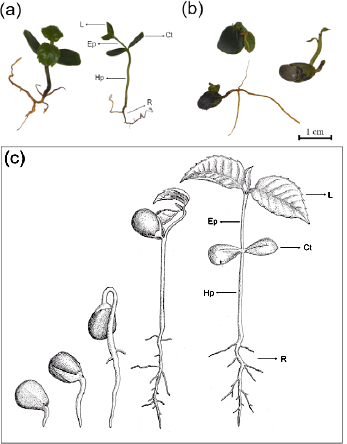
Regarding seedling development, the proportion of normal seedlings was the highest at 25 °C (12.00%) and lowest at 30 °C (6.63%). In contrast, the incidence of abnormal seedlings increased with rising temperature, and no normal seedling was identified at 35 °C. Normal seedlings exhibited proper root and leaf development, with expanded leaves and well-formed roots (Figure 3-a), whereas abnormal seedlings showed foliar and root deformities, compromising growth (Figure 3-b). These results indicate that elevated temperatures may limit not only germination but also early seedling establishment. The relatively low proportion of normal seedlings observed across treatments suggests that direct sowing may not be the most efficient restoration strategy for F. sphaerosperma in regions where the temperature is higher. Instead, seedling production should preferably be conducted in regions where the natural climatic conditions are favorable for germination, particularly around 25 °C. Producing seedlings under these conditions allows germination and early development to occur within the species’ ecological requirements, which might improve germination dynamics (Aou-ouad et al., 2014; Silva et al., 2015) prior to field distribution.
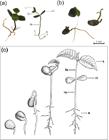
(a) Normal seedlings with proper root and leaf development; leaves are expanded, and roots are well-formed, indicating healthy growth. (b) Abnormal seedlings exhibiting foliar and root deformities typical of inadequate development. (c) Graphical representation of normal seedling development. L - Leaves; Ep - Epicotyl; Ct - Cotyledons; Hp - Hypocotyl; R - Root.
In the 25 °C treatment, the highest percentage of normal seedlings (12.00%) and the lowest proportion of abnormal seedlings (0.88%) were observed, totaling 12.88% seedlings. Although germination (27.25%) was slightly lower than at 20 °C (33.75%) and 30 °C (33.00%) (Table 2), this temperature favored initial development with fewer abnormalities. In the 30 °C treatment, normal seedlings accounted for 6.63% and abnormal seedlings 2.38%, totaling 9.01%. Despite high germination (33.00%), early development was lower than that observed in 20 °C and 25 °C, possibly due to thermal stress affecting proper seedling structure formation. The 35 °C treatment showed the poorest performance, with no normal or abnormal seedlings (0%), the lowest germination (15.75%), the lowest GSI (0.54), and the highest AGT (14.65 days) (Table 2).
Moreover, the higher proportion of normal seedlings at 25 °C compared to 20 °C suggests that, even with a slightly lower germination (Table 2), this temperature range may be more suitable for initial seedling development. This pattern is consistent with observations by Aou-ouad et al. (2014), in which R. alaternus showed higher seedling emergence at moderate temperatures, even without maximum germination. The results demonstrate that F. sphaerosperma shows the highest germination efficiency between 20-30 °C, with 25 °C emerging as the optimal temperature by balancing satisfactory germination (27.25%), speed (AGT = 11.17 days), and seedling quality (12.00% normal). Temperatures above 30 °C drastically compromise all parameters, preventing establishment at 35 °C. This thermal plasticity, higher than that of Mediterranean species, suggests adaptation to seasonal environments, reinforcing the species’ potential for ecological restoration under global warming scenarios. However, its critical limit near 30 °C requires caution in site selection for reintroduction.
In this context, the results indicate that Frangula sphaerosperma presents favorable traits for ecological restoration, particularly under moderate thermal conditions. However, the transition from laboratory germination to successful field establishment requires additional steps. Future studies should evaluate seedling performance under field conditions, including survival, growth rates, and responses to water availability and shading. In addition, experimental trials comparing direct seeding and transplanting approaches would be essential to determine the most effective restoration strategy for the species. Such integrative assessments will allow the incorporation of F. sphaerosperma into restoration programs with greater predictability and success.
4. CONCLUSION
The biometric and morphological characterization of Frangula sphaerosperma seeds revealed small, light, and regular seeds (TWS of 20.04 g; 49,888 seeds/kg; circularity 0.89), associated with nuculanium-type drupes containing three pyrenes. The embryo occupies the entire seed and gives rise to seedlings with epigeal germination and foliaceous cotyledons. These attributes indicate high production of diaspores, favoring manipulation by small frugivores, dispersal across different microhabitats, and the potential use of the species in conservation and ecological restoration strategies.
Thermal conditions significantly influenced the germination and early development of Frangula sphaerosperma. Temperatures between 20-30 °C promoted higher germination rates, with 25 °C standing out by combining the shortest Average Germination Time with the highest proportion of normal seedlings, suggesting it to be the most balanced condition for species establishment. In contrast, temperatures of 35 °C drastically limited germination and prevented seedling formation, demonstrating sensitivity to heat. Overall, the species showed acceptable germination performance under moderate temperatures (20-30 °C) and moderate thermal plasticity, reinforcing its potential for restoration programs in environments with moderate temperature variation. Moreover, the successful establishment of the species in restoration contexts may also depend on additional environmental factors, such as soil type, moisture availability, and biotic interactions, which should be considered when extrapolating these findings to field conditions.
DATA AVAILABILITY
The entire dataset supporting the findings of this study is available within the manuscript.
REFERENCES
-
Amsberry LK, Steffen JE. Do contrastingly colored unripe fruits of the neotropical tree ardisia nigropunctata attract avian seed dispersers? Biotropica. 2008; 40:575-80. https://doi.org/10.1111/j.1744-7429.2008.00421.x
» https://doi.org/10.1111/j.1744-7429.2008.00421.x -
Aou-ouad H, Medrano H, Lamarti A, Gulías J. Seed germination at different temperatures and seedling emergence at different depths of Rhamnus spp. Central European Journal of Biology 2014; 9:569-78. https://doi.org/10.2478/s11535-014-0291-4
» https://doi.org/10.2478/s11535-014-0291-4 -
Bolmgren K, Oxelman B. Generic limits in Rhamnus L. s.l. (Rhamnaceae) inferred from nuclear and chloroplast DNA sequence phylogenies. Taxon 2004; 53:383-90. https://doi.org/10.2307/4135616
» https://doi.org/10.2307/4135616 -
Bracho-Estévanez CA, Cuadrado M, Sánchez I, Onrubia A, González-Varo JP. Plant traits determine seed retention times in frugivorous birds: Implications for long-distance seed dispersal. Functional Ecology 2024; 38:2247-60. https://doi.org/10.1111/1365-2435.14642
» https://doi.org/10.1111/1365-2435.14642 - Brasil. Ministério da Agricultura, Pecuária e Abastecimento. Secretaria de Defesa Agropecuária. Regras para análise de sementes. Brasília: MAPA/ACS, 2009. 395 p. ISBN 978-85-99851-70-8.
-
Carvalho TF, Barroso PD, Carvalho ER, Faria JMR, José AC. Effect of treatment with thiamethoxam and cyantraniliprole on the germination and storage of forest tree seeds. Journal of Seed Science 2024;46. https://doi.org/10.1590/2317-1545v46279811
» https://doi.org/10.1590/2317-1545v46279811 -
Chowdhury MIH, Mehedi Hasan Rakib, Chinmoy Das. Intra and interspecific relation of tree species aspects of seed biometry, phenology, seed dispersion, and germination. Journal of Agriculture Sustainability and Environment 2023; 2:57-69. https://doi.org/10.56556/jase.v2i2.877
» https://doi.org/10.56556/jase.v2i2.877 -
Cosmo NL, Nogueira AC, Lima JG de, Kuniyoshi YS. Morfologia de fruto, semente e plântula de Sebastiania commersoniana, Euphorbiaceae. Floresta 2010;40. https://doi.org/10.5380/rf.v40i2.17837
» https://doi.org/10.5380/rf.v40i2.17837 -
Dalziell EL, Lewandrowski W, Commander LE, Elliott CP, Erickson TE, Tudor EP, et al. Seed traits inform the germination niche for biodiverse ecological restoration. Seed Science and Technology 2022; 50:103-24. https://doi.org/10.15258/sst.2022.50.1.s.06
» https://doi.org/10.15258/sst.2022.50.1.s.06 -
Dunn OJ. Multiple Comparisons Using Rank Sums. Technometrics 1964; 6:241-52. https://doi.org/10.1080/00401706.1964.10490181
» https://doi.org/10.1080/00401706.1964.10490181 -
Felix FC, Mocelim FL, Torres SB, Kratz D, Ribeiro R, Nogueira AC. Thousand-seed weight determination in forest species by image analysis. Journal of Seed Science 2021;43. https://doi.org/10.1590/2317-1545v43254684
» https://doi.org/10.1590/2317-1545v43254684 -
Kidson R, Westoby M. Seed mass and seedling dimensions in relation to seedling establishment. Oecologia 2000; 125:11-7. https://doi.org/10.1007/PL00008882
» https://doi.org/10.1007/PL00008882 -
Kruskal WH, Wallis WA. Use of ranks in one-criterion variance analysis. Journal of the American Statistical Association 1952; 47:583-621. https://doi.org/10.1080/01621459.1952.10483441
» https://doi.org/10.1080/01621459.1952.10483441 - Labouriau LG. A germinação das sementes. Washington: Secretaria-Geral da Organização dos Estados Americanos (OEA), 1983. 174 p. (Série de Biologia. Monografia, 24).
-
Maguire JD. Speed of germination-aid in selection and evaluation for seedling emergence and vigor. Crop Science 1962; 2: 176-177. https://doi.org/10.2135/cropsci1962.0011183X000200020033x
» https://doi.org/10.2135/cropsci1962.0011183X000200020033x -
Medeiros AC de S, Zanon A. Conservação de sementes de fruto-de-pombo (Rhamnus sphaerosperma Swartz). Boletim de Pesquisa Florestal 1998:29-39. Available from: https://www.embrapa.br/busca-de-publicacoes/-/publicacao/282183/conservacao-de-sementes-de-fruto-de-pombo-rhamnus-sphaerosperma-swartz
» https://www.embrapa.br/busca-de-publicacoes/-/publicacao/282183/conservacao-de-sementes-de-fruto-de-pombo-rhamnus-sphaerosperma-swartz -
Melese DT, Legas AT. Rhamnus prinoides and Psidium guajava tree species for hill slope rehabilitation. Environmental Earth Sciences 2024; 83:255. https://doi.org/10.1007/s12665-024-11545-x
» https://doi.org/10.1007/s12665-024-11545-x -
Offord CA, McKensy ML, Cuneo PV. Critical review of threatened species collections in the New South Wales Seedbank: implications for ex situ conservation of biodiversity. Pacific Conservation Biology 2004; 10:221-36. https://doi.org/10.1071/PC040221
» https://doi.org/10.1071/PC040221 - Oldfield SF, Havens K, Olwell P, Shaw N. Seeds of Restoration Success. Springer; 2019.
-
Barcelos AO, Perônico C, Eutrópio FJ. Color and odor of artificial fruit used to signal potential dispersers in the Atlantic forest in Brazil. Revista de Biologia Tropical 2012; 60:295-931. Available from http://www.scielo.sa.cr/scielo.php?script=sci_arttext&pid=S0034-77442012000200032&lng=en&nrm=iso
» http://www.scielo.sa.cr/scielo.php?script=sci_arttext&pid=S0034-77442012000200032&lng=en&nrm=iso -
Pool A. New species, combinations, and lectotypifications in Neotropical and northern Mexican Frangula (Rhamnaceae). Novon (St Louis) 2013; 22:447-67. https://doi.org/10.3417/2013009
» https://doi.org/10.3417/2013009 -
Pörtner H-O, Roberts DC, Tignor M, Poloczanska ES, Mintenbeck K, Alegría A, et al. Climate Change 2022: Impacts, Adaptation and Vulnerability. Cambridge, UK; New York, NY, USA: Cambridge University Press; 2022. https://doi.org/10.1017/9781009325844
» https://doi.org/10.1017/9781009325844 - R Core Team. R: A Language and Environment for Statistical Computing 2023.
-
Richardson JE, Chatrou LW, Mols JB, Erkens RHJ, Pirie MD. Historical biogeography of two cosmopolitan families of flowering plants: Annonaceae and Rhamnaceae. Philosophical Transactions of the Royal Society B: Biological Sciences 2004; 359:1495-508. https://doi.org/10.1098/rstb.2004.1537
» https://doi.org/10.1098/rstb.2004.1537 - Royal Botanic Gardens K. Frangula sphaerosperma (Sw.) Kartesz & Gandhi. Plants of the World Online 2023.
-
Santos SR dos, Marchiori JNC, Canto-Dorow TS do, Denardi L. Estudo anatômico do lenho e descrição botânica de Rhamnus sphaerosperma Swartz (Rhamnaceae). Balduinia 2014; 0:16-26. https://doi.org/10.5902/2358198014043
» https://doi.org/10.5902/2358198014043 -
Schneider CA, Rasband WS, Eliceiri KW. NIH Image to ImageJ: 25 years of image analysis. Nature Methods 2012; 9:671-5. https://doi.org/10.1038/nmeth.2089
» https://doi.org/10.1038/nmeth.2089 -
Silva LA da, Sales J de F, Guimarães RM, Oliveira JA, Vasconcelos Filho SC. Aspectos morfológicos de frutos, sementes e plântulas de Rhamnidium elaeocarpum Reissek. Semina Ciencias Agrarias 2015; 36:1179-90. https://doi.org/10.5433/1679-0359.2015v36n3p1179
» https://doi.org/10.5433/1679-0359.2015v36n3p1179 -
Silva S dos S, Cerqueira ILO, Gonçalves MEVB dos S, Nehme TM, Santos DLL, Esteves G. Cultivation of seedlings of Solanum melongena L. for their use as a bioassay. Acta Biologica Brasiliensia 2023; 6:15-26. Available from: https://seer.uftm.edu.br/revistaeletronica/index.php/acbioabras/article/view/7257
» https://seer.uftm.edu.br/revistaeletronica/index.php/acbioabras/article/view/7257 -
Souza DC, Engel VL. Seed functional traits as predictors of seedling establishment success in Brazilian tropical forest restoration. Biotropica 2024; 56:e13355. https://doi.org/10.1111/btp.13355
» https://doi.org/10.1111/btp.13355 -
Souza DD de, Cavalcante NB. Biometria de frutos e sementes de Jatropha mollissima (Pohl) Baill. (Euphorbiaceae). Acta Biológica Catarinense 2019; 6:115-22. https://doi.org/10.21726/abc.v6i2.225
» https://doi.org/10.21726/abc.v6i2.225 -
Tuthill JE, Ortega YK, Pearson DE. Seed Size, Seed Dispersal Traits, and Plant Dispersion Patterns for Native and Introduced Grassland Plants. Plants 2023;12. https://doi.org/10.3390/plants12051032
» https://doi.org/10.3390/plants12051032 -
Tylkowski T. Seed storage, germination and seedling emergence in Rhamnus catharticus. Dendrobiology 2007; 58:67-72. Available from: https://rngr.net/publications/fnn/2008-summer/new-nursery-literature/seed-storage-germination-and-seedling-emergence-in
» https://rngr.net/publications/fnn/2008-summer/new-nursery-literature/seed-storage-germination-and-seedling-emergence-in -
Walter LS, Felix FC, Nogueira AC, Pifano DS, Silva MA da, Kratz D. Seed and seedling morphological characterization of Jatropha mollissima (Pohl) Baill. (Euphorbiaceae): a potential species with multiple uses. Revista Ceres 2024;71. https://doi.org/10.1590/0034-737X2024710009
» https://doi.org/10.1590/0034-737X2024710009 -
Westoby M, Leishman M, Lord J. Comparative ecology of seed size and dispersal. Philosophical Transactions of the Royal Society B: Biological Sciences 1996; 351:1309-18. https://doi.org/10.1098/rstb.1996.0114
» https://doi.org/10.1098/rstb.1996.0114 - Wheeler EA, Baas P, Gasson PE. IAWA list of microscopic features for hardwood identification. vol. 10. IAWA Leiden; 1989.
Edited by
-
Associate editor:
Geângelo Calvi http://orcid.org/0000-0002-8631-2325