 Soil Organic Carbon Stock in a Relict Temperate Forest Regosol Dominated by Pseudotsuga menziesii
Abstract
Soils, together with forest biomass, are essential carbon reservoirs that play a key role in mitigating climate change. This study estimated soil organic carbon stock in a Regosol under a relict Pseudotsuga menziesii forest in Ejido Chinatú, Guadalupe y Calvo, Chihuahua, Mexico. Samples were collected at five depths (0-5, 5-15, 15-30, 30-60, and 60-80 cm), and organic carbon was determined using the modified Walkley and Black method. Carbon concentration decreased with depth, from 60.2 g kg⁻¹ at 0-5 cm to 24.9 g kg⁻¹ at 15-30 cm, while bulk density increased to 0.51 Mg m⁻³ at 60-80 cm. The total organic carbon stock (0-80 cm) was 100.48 Mg ha⁻¹, with the 30-60 cm layer contributing 34.21 Mg ha⁻¹. These findings highlight the importance of considering the entire soil profile when developing conservation and sustainable management strategies for temperate forests.
Keywords:
Bulk density; soil profile; carbon pools; soils; organic matter
1. INTRODUCTION AND OBJECTIVES
Forest soil is defined as a complex natural body that supports forest vegetation, composed of weathered minerals, organic matter, water, and air. Its formation results from the interaction between climate, topography, parent material, and organisms, whose biological activity and contribution of litter generate organic horizons and porous structures that regulate nutrient cycling and carbon storage (Brady & Weil, 2017; FAO, 2025).
One of the greatest importance of soil lies in its role as a major carbon reservoir (SOC), representing the largest terrestrial storage in eSOCystems-three times greater than that in the atmosphere and twice that stored in vegetation. Moreover, it plays a fundamental role in soil quality, contributing to plant development, water regulation, and nutrient balance (Friedlingsten et al., 2020; Mayer et al., 2020; Radočaj et al., 2024).
Soils, together with forest biomass, constitute key carbon sinks that significantly contribute to climate change mitigation. In particular, tropical forests store about 32% of their carbon in soils, while in temperate and boreal forests this proportion rises to 60%. Globally, temperate forests cover 25% of the total forested area, 8% of the continental surface, and account for 13.7% of net primary productivity. It is estimated that these eSOCystems store around 175 Pg of carbon in aboveground biomass and 262 Pg in soils (Haynes et al., 2005; Pan et al., 2011).
Soil organic carbon (SOC) in temperate forests of Mexico varies according to soil type, ranging from 50 to 100 Mg ha⁻¹ in Regosols (Vela et al., 2012). Factors such as dominant species, successional stage, and soil age influence this variation. However, the complexity of carbon distribution and the lack of detailed edaphic data make it difficult to identify the key factors influencing carbon sequestration (Galicia et al., 2016).
The soil organic carbon (SOC) cycle still presents uncertainties regarding its dynamics, interactions with other biogeochemical cycles, and long-term sequestration potential. Accurate measurement and monitoring of these reserves are fundamental to advancing understanding and practical application. Proper SOC management is key not only for climate change mitigation but also for improving food security, although challenges remain in predicting its response to human activity (FAO, 2017).
In this context, the development of science-based management strategies and the promotion of sustainable practices are considered key components for maintaining and enhancing soil organic carbon (SOC) reserves in forest ecosystems. The present study aims to estimate the organic carbon reservoir in a Regosol soil within a temperate forest of the Ejido Chinatú, municipality of Guadalupe y Calvo, Chihuahua, Mexico. This forest is dominated by Pseudotsuga menziesii, with the presence of Abies durangensis and Picea chihuahuana, classified as an old-growth or overmature relict forest with High Conservation Values (Galván-Moreno, 2016). It is excluded from forest harvesting, reinforcing its role as a carbon reservoir and as a refuge for threatened species, highlighting its importance for climate change mitigation.
2. MATERIALS AND METHODS
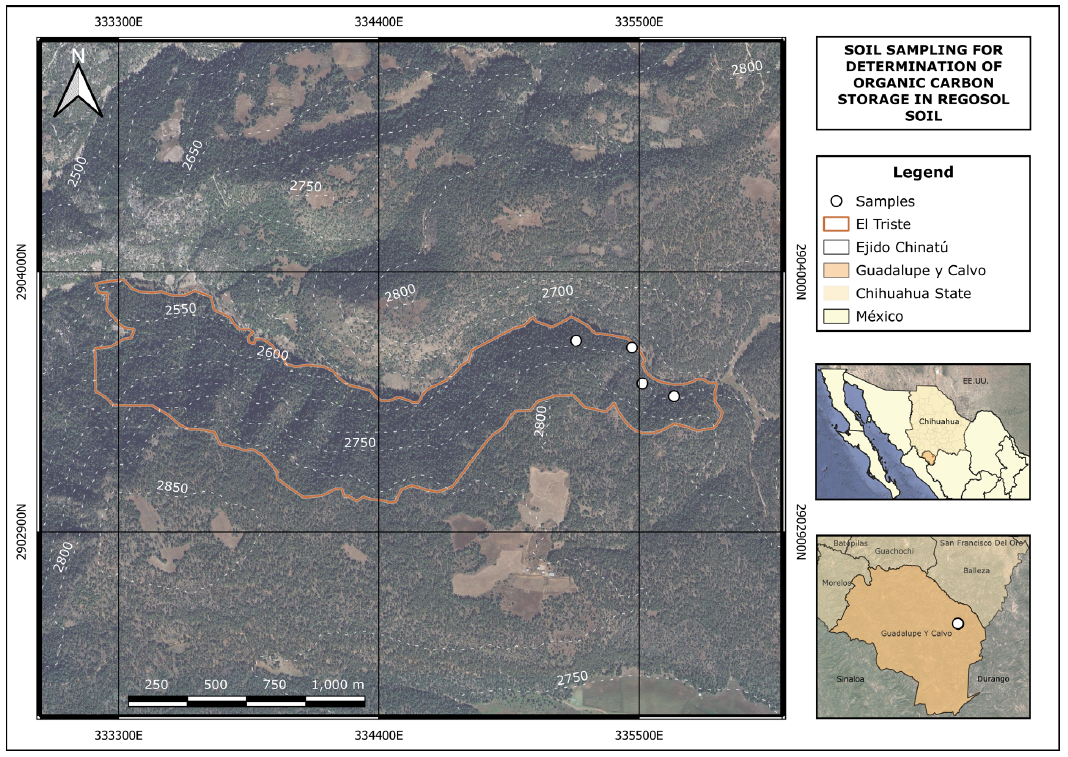
The study was conducted in a mixed forest dominated by Pseudotsuga menziesii, Pinus arizonica Engelm., and Quercus tuberculata Liebm., located in the site known as “El Triste,” within the Ejido Chinatú, municipality of Guadalupe y Calvo, in southwestern Chihuahua, Mexico. The study area is located between UTM coordinates 333,185 m E and 335,813 m E, and 2,903,053 m N and 2,903,978 m N (Zone 13N, WGS84) (Figure 1), covering a surface area of 80.46 ha, with elevations ranging from 2,530 to 2,830 m. It is part of the Río Fuerte hydrological region, within the Sierra Tarahumara physiographic province, specifically the Gran Meseta and Cañones Chihuahuenses subprovince. The predominant soils are Lithosols, and to a lesser extent, Regosols. The climate is temperate sub-humid, with a mean annual temperature of 13.7 °C and a mean annual precipitation of 1,126.8 mm (Chávez, 2009).
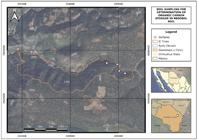
The forest stand is classified as an old-growth relict temperate forest and is currently excluded from silvicultural management and timber harvesting. No recent anthropogenic disturbances have been recorded in the study area, allowing it to function as a long-term soil carbon reservoir under near-natural ecological conditions.
2.1. Soil sampling
Sampling was carried out in January 2024. Four independent soil profiles were established in representative areas of the Pseudotsuga menziesii-dominated forest, selected to capture spatial variability within the study site. Each soil profile was excavated to a depth of 80 cm. The following depth intervals were defined: 0-5, 5-15, 15-30, 30-60, and 60-80 cm. At each depth within each profile, one composite soil sample of approximately 1.5 kg was collected, resulting in a total of 20 composite samples (4 profiles × 5 depths). The samples were transported to the laboratory of the Faculty of Agricultural and Forestry Sciences (FCAyF) at the Autonomous University of Chihuahua (UACH), where they were air-dried, sieved through a 2 mm mesh, and stored for subsequent chemical analysis.
2.2. Bulk density
To determine bulk density, defined as the mass per unit volume of soil and expressed in Mg m⁻³, four undisturbed samples were collected at each depth using metal cylinders of known diameter and height (3.74 × 5 cm). The extraction of undisturbed samples followed the standard procedure: the metallic cylinder was gently driven into the soil using a mallet, avoiding direct hits to the center, and then carefully removed with a small shovel. Excess soil from the upper and lower edges was trimmed off to ensure a uniform sample volume.
Each sample was placed in a thick paper bag, labeled, and transported to the laboratory, where it was oven-dried at 105 °C in a forced-air oven for 24-48 hours or until a constant dry weight was reached. Finally, bulk density was calculated using the following equation (1) (Yáñez-Díaz et al., 2019; Rodríguez et al., 2024):
(1)
Where:
BD = bulk density (Mg m-3)
P = oven-dry mass of the soil sample (Mg)
VC = cylinder volume (cm3)
2.3. Soil organic carbon content (g kg⁻¹)
Soil organic carbon concentration (g kg⁻¹) was determined from soil organic matter using the modified Walkley and Black method (Cantú & Yáñez, 2018). In this procedure, soil samples are oxidized with a standardized potassium dichromate solution, and soil organic carbon is estimated using the Van Bemmelen conversion factor (0.58), which assumes that organic matter contains approximately 58% carbon. Although this factor represents a generalized approximation and may vary depending on soil type, humification degree, and depth, it has been widely applied in temperate forest soils with similar ecological conditions (Cantú et al., 2022; Zhu et al., 2010). Therefore, its use in this study allows for comparability with previous research conducted in forest ecosystems.
2.4. Soil Organic Carbon Stock (Mg ha-1)
The soil organic carbon (SOC) stock was calculated by combining organic carbon concentration, bulk density, and soil depth data. The following equation (2), proposed by González et al. (2008) and Luna et al. (2024), was used to estimate SOC stocks (Mg ha⁻¹):
Where:
SOC = soil organic carbon stock (Mg ha⁻¹)
C = soil organic carbon concentration (g kg⁻¹)
BD = bulk density (Mg m⁻³)
P = thickness of the soil layer (m)
The factor 10 accounts for unit conversions required to express the results on a hectare basis. Finally, the cumulative SOC stock (Mg ha⁻¹) was obtained by summing all depth intervals across the 0-80 cm soil profile analyzed.
2.5. Statistical analysis
Data from soil organic carbon concentration (g kg⁻¹), SOC stock (Mg ha⁻¹), and bulk density (Mg m⁻³) were tested for normality using the Shapiro-Wilk test and for homogeneity of variances using Levene’s test.
Based on these assumptions, one-way analysis of variance (ANOVA) (P ≤ 0.05) was performed to evaluate significant differences in soil organic carbon concentration, SOC stock, and bulk density among soil depth intervals. When significant differences were detected, Tukey’s post hoc test (P ≤ 0.05) was applied to compare mean values.
All statistical analyses were performed using IBM SPSS Statistics, version 22 (2013).
3. RESULTS
3.1. Soil organic carbon concentration (g kg⁻¹)
The Shapiro-Wilk normality test for soil organic carbon concentration (g kg⁻¹) showed no significant deviation from normality (W = 0.91549, p = 0.08115), indicating that the data follow a normal distribution (Table 1).
Levene’s test confirmed homogeneity of variances among soil depths (F = 1.1401, p = 0.3754).
One-way ANOVA revealed significant differences in soil organic carbon concentration among the evaluated soil depths (F(4,15) = 7.079, p = 0.00207).
Tukey’s post hoc test indicated that carbon concentrations at depths of 15-30 cm, 30-60 cm, and 60-80 cm were significantly lower than those at 0-5 cm (p < 0.05). No significant differences were detected among the remaining depth intervals (p > 0.05) (Table 1).
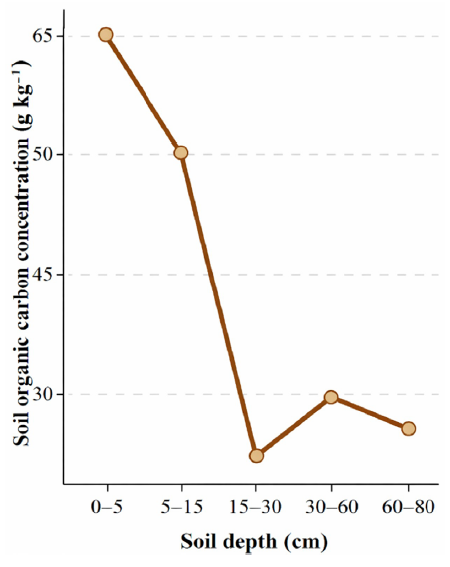
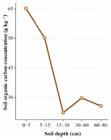
Specifically, soil organic carbon concentrations (g kg⁻¹) showed marked variation with depth. In the surface layer (0-5 cm), the highest concentration was recorded at 60.2 g kg⁻¹. As depth increased, carbon concentrations decreased to 50.3 g kg⁻¹ in the 5-15 cm layer and reached the lowest value of 24.9 g kg⁻¹ at 15-30 cm. However, a slight increase was observed at 30-60 cm (29.7 g kg⁻¹), followed by a small decrease to 26.7 g kg⁻¹ in the 60-80 cm layer (Figure 2).
3.2. Bulk density variation along the soil profile
The statistical analysis of bulk density (BD) as a function of depth indicated that the data followed a normal distribution (Shapiro-Wilk, W = 0.95908, p = 0.5257) and met the homogeneity of variances assumption (Levene’s test, F = 0.4586, p = 0.7649).
One-way ANOVA revealed no significant differences in bulk density among the analyzed soil depths (F(4,15) = 1.605, p = 0.224) (Table 2). Therefore, post hoc comparisons were not performed. These results indicate that bulk density remained statistically stable throughout the evaluated soil profile.
In particular, BD showed a gradual increase with depth, ranging from 0.34 Mg m⁻³ in the 0-5 cm layer to 0.51 Mg m⁻³ at 60-80 cm, with an overall mean of 0.39 Mg m⁻³. In the upper 30 cm, BD remained relatively stable (0.34-0.35 Mg m⁻³), whereas deeper layers (30-60 cm and 60-80 cm) exhibited a more noticeable increase.
3.3. Distribution of soil organic carbon stock (SOC) along the profile
The Shapiro-Wilk test indicated no significant deviation from normality (W = 0.94719, p = 0.3265), and Levene’s test confirmed homogeneity of variances among soil depth intervals (F = 0.9793, p = 0.4481). One-way ANOVA revealed significant differences in SOC stock among soil depths (F(4,15) = 4.95, p = 0.00956) (Table 3).
According to Tukey’s post hoc test, the 30-60 cm layer exhibited significantly higher SOC stock compared to the 0-5 cm (p = 0.0103) and 15-30 cm layers (p = 0.0275). No significant differences were detected among the remaining depth intervals (p > 0.05).
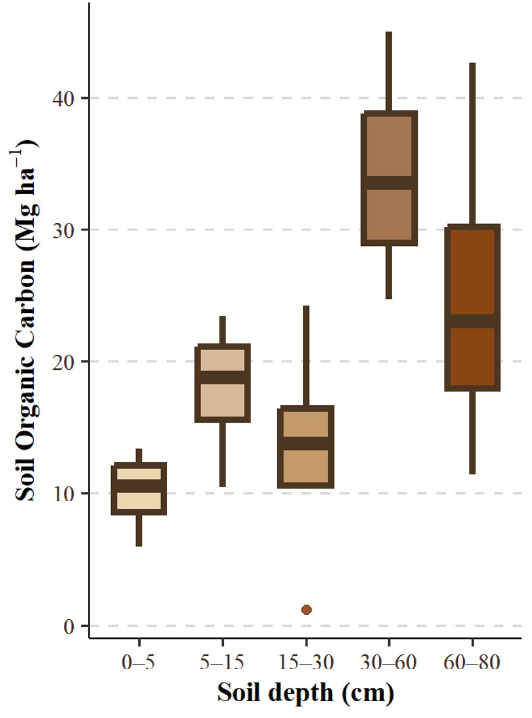
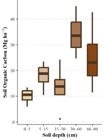
The vertical distribution of SOC stock showed marked variation within the soil profile. The highest contribution was observed in the 30-60 cm layer (34.21 Mg ha⁻¹), followed by the 60-80 cm layer (25.05 Mg ha⁻¹). In contrast, the upper layers stored comparatively lower amounts: 10.10 Mg ha⁻¹ at 0-5 cm, 17.88 Mg ha⁻¹ at 5-15 cm, and 13.24 Mg ha⁻¹ at 15-30 cm (Figure 3). The cumulative SOC stock for the entire 0-80 cm soil profile was 100.48 Mg ha⁻¹.
4. DISCUSSION
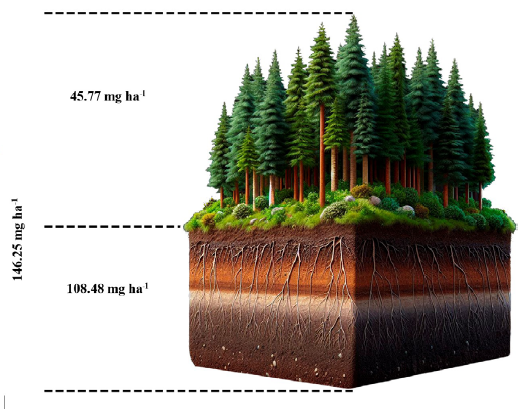
At the national level, studies on carbon storage in temperate forests have mainly focused on aboveground biomass. In this sense, García et al. (2021) reported an average carbon stock of 45.2 Mg ha⁻¹ in the same forest, which represents less than half of the soil organic carbon reported here. This finding supports previous evidence indicating that forest soils are the main carbon reservoir within forest ecosystems (Luna et al., 2022) (Figure 4). These findings highlight the fundamental role of forest soils as long-term carbon sinks contributing to climate change mitigation.
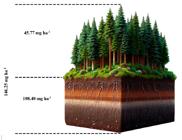
Illustrative soil profile with temperate forest vegetation dominated by Pseudotsuga menziesii.
Trettin & Jurgensen (2002) andVargas et al. (2023) indicate that soil organic carbon concentration (g kg⁻¹) varies according to soil development stage and organic matter inputs. In the present study, the average soil organic carbon concentration was 38.3 g kg⁻¹, which is comparable to values reported by Yáñez et al. (2023) (32.2 g kg⁻¹) for Regosols in pine forests.
The vertical distribution of soil organic carbon concentration showed a clear surface enrichment pattern, with the highest values in the 0-5 cm layer and a progressive decline with depth. This pattern is consistent with temperate forest soils in Mexico, where carbon concentration is strongly influenced by litter deposition and fine-root turnover in surface mineral horizons (Galicia et al., 2016). Similar vertical trends have been reported in mixed coniferous forests in Oaxaca and Durango, where reduced organic inputs and increased mineral stabilization processes explain lower concentrations at deeper layers (Acosta-Mireles et al., 2022; Vargas et al., 2023).
However, in contrast to carbon concentration, SOC stock (Mg ha⁻¹) showed its highest contribution in the 30-60 cm layer. This apparent discrepancy is explained by the combined effect of soil depth and bulk density, which increased with depth. Thus, although concentration declines downward, the greater thickness and higher bulk density of subsurface layers result in larger carbon stocks. This highlights the importance of evaluating the entire soil profile rather than focusing solely on surface horizons when estimating carbon sequestration potential.
Bulk density increased gradually with depth, showing an inverse relationship with organic matter concentration. This trend is characteristic of forest soils, where surface horizons typically exhibit lower bulk density due to higher organic inputs and biological activity, whereas subsurface layers are denser and more mineral-dominated (Brady & Weil, 2017). The values obtained in this study are consistent with structural conditions commonly reported for forested Regosols.
Comparative data from different temperate forests (Table 4) show that the concentrations observed in the Pseudotsuga forest fall within the documented range for similar ecosystems in Mexico and other regions. Although SOC concentration in the 15-30 cm layer was lower than some reported values, the overall vertical pattern remains consistent with temperate forest soils developed on young or weakly developed substrates.
In general, the Pseudotsuga forest evaluated here demonstrates considerable potential for carbon sequestration, particularly when the full soil profile is considered. Carbon inputs derived from litterfall and woody debris (Luna et al., 2022), together with root-derived carbon contributions, play a central role in sustaining soil carbon pools. Root biomass and associated belowground processes are widely recognized as major contributors to soil carbon stabilization in forest ecosystems (Hétier et al., 1986; Luna et al., 2024).
Carbon sequestration capacity may be significantly altered by land-use change or disturbance, as modifications in vegetation structure and root dynamics can disrupt belowground carbon inputs (Bejar et al., 2024). In contrast, forest ecosystems under conservation and without recent silvicultural disturbance such as the study area tend to exhibit more stable SOC dynamics, favoring long-term carbon retention.
5. CONCLUSIONS
The Regosol under Pseudotsuga menziesii forest exhibited a clear vertical differentiation of soil organic carbon. Carbon concentration (g kg⁻¹) showed a surface-enrichment pattern, with the highest values recorded in the 0-5 cm layer and a progressive decline with depth. In contrast, soil organic carbon stock (Mg ha⁻¹) reached its maximum in the 30-60 cm layer, demonstrating the combined influence of soil depth and increasing bulk density on carbon accumulation. The cumulative SOC stock for the 0-80 cm profile (100.48 Mg ha⁻¹) exceeds reported aboveground biomass carbon values for similar temperate forests, confirming that soil represents the dominant carbon reservoir in this ecosystem. These findings emphasize the importance of evaluating the entire soil profile rather than limiting assessments to surface horizons. The observed vertical distribution reflects the interaction between organic inputs, root dynamics, mineral stabilization processes, and soil structural properties typical of forested Regosols. Furthermore, the conservation status of the study area, without recent silvicultural or anthropogenic disturbance, likely contributes to the stability and long-term retention of soil carbon. Overall, protected temperate forests such as this Pseudotsuga ecosystem play a critical role in climate change mitigation. Accurate carbon sequestration assessments and sustainable management strategies must incorporate full-profile soil analyses to properly quantify and preserve belowground carbon stocks.
DATA AVAILABILITY
The dataset supporting the findings of this study has been deposited in SciELO Data at https://doi.org/10.48331/SCIELODATA.U2KYBW. The raw data is restricted to monitor its scientific reuse and foster academic collaborations. Full access is available upon reasonable request to the corresponding author (Ana Marissa de la Fuente Solís) through the platform.
REFERENCES
-
Bejar SJ, Cantú SI, Luna EO. Respiración de un Andosol bajo diferentes usos de suelo: Respiration of an Andosol under different land uses. e-CUCBA 2024; 22:46-53. https://doi.org/10.32870/e-cucba.vi22.346
» https://doi.org/10.32870/e-cucba.vi22.346 -
Cantú SI, Yáñez MI. Efecto del cambio de uso de suelo en el contenido del carbono orgánico y nitrógeno del suelo. Revista Mexicana de Ciencias Forestales 2018; 9(45):122-151. https://doi.org/10.29298/rmcf.v9i45.138
» https://doi.org/10.29298/rmcf.v9i45.138 -
Cantú, SI., & Luna REO. Reservorio de Nitrógeno y relación C: N de un Umbrisol bajo manejo forestal en Durango, México. Revista mexicana de ciencias forestales 2022; 13(72), 82-111. https://doi.org/10.29298/rmcf.v13i72.1055
» https://doi.org/10.29298/rmcf.v13i72.1055 - Chávez N. Estudio regional forestal de la Unidad de Manejo Forestal No. 0808 “Guadalupe y Calvo, Chihuahua”. Asociación Regional de Silvicultores de Guadalupe y Calvo A.C.; 2009. FAO. Carbono Orgánico del Suelo: el potencial oculto. Organización de las Naciones Unidas para la Alimentación y Agricultura; 2017. FAO. Definiciones de suelo.
-
Organización de las Naciones Unidas para la Alimentación y la Agricultura; 2025. Disponible en: https://www.fao.org/soils-portal/about/definiciones/es/
» https://www.fao.org/soils-portal/about/definiciones/es/ -
Friedlingstein P, O’Sullivan M, Jones MW, Andrew RM, Hauck J, Olsen A, Zaehle S. Global carbon budget 2020. Earth System Science Data 2020; 12:1-3. https://doi.org/10.5194/essd-11-1783-2019
» https://doi.org/10.5194/essd-11-1783-2019 -
Gairola S, Sharma CM, Ghildiyal SK, Gairola S. Chemical properties of soils in relation to forest composition in moist temperate valley slopes of Garhwal Himalaya, India. Environmentalist 2012; 32:512-523. https://doi.org/10.1007/s10669-012-9420-7
» https://doi.org/10.1007/s10669-012-9420-7 - Galicia L, Gamboa CAM, Cram S, Chávez VB, Peña R, Saynes V, Siebe C. Stocks and dynamics of soil organic carbon in temperate forests of Mexico. Terra Latinoamericana 2016; 34(1):1-29.
- Galván-Moreno R. Manual para la identificación de Altos Valores de Conservación en bosques templados de México. PNUD-CONAFOR; 2016.
-
García GSA, Alanís-Rodríguez E, Aguirre-Calderón OA, Treviño-Garza EJ, Graciano-Ávila G. Contenido de carbono y estructura horizontal de un bosque templado en Guadalupe y Calvo, Chihuahua. Revista Mexicana de Ciencias Forestales 2021; 12(63):48-70. http://dx.doi.org/10.29298/rmcf.v12i63.800
» http://dx.doi.org/10.29298/rmcf.v12i63.800 - González L, Etchevers JD, Hidalgo C. Carbon in hillsides soil: factors that must be considered to determine its change over time. Agrociencia 2008; 42(7):741-751.
-
Haynes RJ. Labile organic matter fractions as central components of the quality of agricultural soils: an overview. Advances in Agronomy 2005; 5:221-268. https://doi.org/10.1016/S0065-2113(04)85005-3
» https://doi.org/10.1016/S0065-2113(04)85005-3 - Hétier JM, Andreux F, Schouller E, Marol C. Organic matter inputs to soil after growth of carbon-14-nitrogen-15 labeled maize. Soil Science Society of America Journal 1986; 50(1):76-80.
-
INEGI. Geografía y Medio Ambiente. INEGI; 2025. Disponible en: https://www.inegi.org.mx/temas/edafologia/#mapas
» https://www.inegi.org.mx/temas/edafologia/#mapas -
Islas-López Y, Acevedo-Sandoval O, Cruz-Chávez E, Prieto-García F, Rodríguez-Laguna R. Formas de carbono en suelos del Parque Nacional El Chico, Hidalgo, México. Revista Iberoamericana de Ciencias 2014; 1(4):147-157. https://doi.org/10.21829/myb.2013.192341
» https://doi.org/10.21829/myb.2013.192341 -
Luna REO, Cantú SI, Bejar PS. Soil organic carbon changes in an Umbrisol under different silvicultural treatments in a temperate forest in northwestern Mexico. Journal of Sustainable Forestry 2022; 42(4):368-383. https://doi.org/10.1080/10549811.2022.2043904
» https://doi.org/10.1080/10549811.2022.2043904 -
Luna REO, Hernández FJ, Cantú SI, Bejar PSJ, Domínguez GTG. Sequence of Soil Organic Carbon through the Silvicultural Development Method (MDS) in temperate forests of Durango, Mexico. Egyptian Journal of Soil Science 2024; 64(3):731-738. https://doi.org/10.21608/ejss.2024.271685.1729
» https://doi.org/10.21608/ejss.2024.271685.1729 -
Martínez RA, Cantú I, Yáñez MI, González H, Béjar SJ. Carbon and nitrogen stock in a Cambisol soil under two land uses in Linares, Nuevo León, Mexico. Revista Mexicana de Ciencias Forestales 2023; 14(79):4-30. https://doi.org/10.29298/rmcf.v14i78.1339
» https://doi.org/10.29298/rmcf.v14i78.1339 -
Mayer M, Prescott CE, Abaker WE, Augusto L, Céccilon L, Ferreira GW, Vesterdal L. Influence of forest management activities on soil organic carbon stocks: A knowledge synthesis. Forest Ecology and Management 2020; 466:118127. https://doi.org/10.1016/j.foreco.2020.118127
» https://doi.org/10.1016/j.foreco.2020.118127 -
Pan Y, Birdsey RA, Fang J, Houghton R, Kauppi PE, Kurz WA, Hayes D. A large and persistent carbon sink in the world’s forests. Science 2011; 333(6045):988-993. https://doi.org/10.1126/science.1201609
» https://doi.org/10.1126/science.1201609 -
Radočaj D, Gašparović M, Jurišić M. Open remote sensing data in digital soil organic carbon mapping: a review. Agriculture 2024; 14(7):1005. https://doi.org/10.3390/agriculture1407100
» https://doi.org/10.3390/agriculture1407100 - Ramachandran A, Jayakumar S, Haroon RM, Bhaskaran A, Arockiasamy DI. Carbon sequestration: estimation of carbon stock in natural forests using geospatial technology in the Eastern Ghats of Tamil Nadu, India. Current Science 2007; 92:323-331.
-
Rodríguez I, Luna EO, Aguirre CE, Bejar SJ, Álvarez DO. Evaluación de las propiedades físicas e hidrológicas de un Vertisol con diferentes usos de suelo. Revista Mexicana de Ciencias Forestales 2024; 15(84):105-131. https://doi.org/10.29298/rmcf.v15i84.1463
» https://doi.org/10.29298/rmcf.v15i84.1463 -
Tivet F, Moraes-Sá JC, Borszowskei PR, Letourmy P, Briedis C, Ferreira AO, Burkner-dos-Santos TM, Inagaki JM. Soil carbon inventory by wet oxidation and dry combustion methods. Soil Science Society of America Journal 2012; 76(3):1048-1059. https://doi.org/10.2136/sssaj2011.0328
» https://doi.org/10.2136/sssaj2011.0328 -
Trettin CC, Jurgensen MF. Carbon cycling in wetland forest soils. In: The potential of US forest soils to sequester carbon. CRC Press; 2002:311-331. http://dx.doi.org/10.1201/9781420032277-19
» http://dx.doi.org/10.1201/9781420032277-19 -
Vargas LB, Amezcua RM, López MJO, Cueto WJA, Cobos FC, Nájera JAL, Aguirre CCG. Estimación de los almacenes de carbono orgánico en el suelo en tres tipos de bosque templado en Durango, México. Botanical Sciences 2023; 101(1):90-101. https://doi.org/10.17129/botsci.3094
» https://doi.org/10.17129/botsci.3094 - Vela CG, López-Blanco J, Rodríguez-Gamiño MDL. Niveles de carbono orgánico total en el suelo de conservación del Distrito Federal, centro de México. Investigaciones Geográficas 2012; 77:18-30.
-
Weil RR & Brady NC. The nature and properties of soils (Fifteenth edition). Pearson 2017. https://fama.us.es/discovery/fulldisplay/alma991012435499704987/34CBUA_US:VU1
» https://fama.us.es/discovery/fulldisplay/alma991012435499704987/34CBUA_US:VU1 -
Yáñez-Díaz MI, Cantú-Silva I, González-Rodríguez H, Sánchez-Castillo L. Effects of land use change and seasonal variation in the hydrophysical properties in Vertisols in northeastern Mexico. Soil Use and Management 2019; 35(3):378-387. https://doi.org/10.1111/sum.12500
» https://doi.org/10.1111/sum.12500 -
Yáñez MI, Cantú SI, Garza OF. Efecto en las propiedades fisicoquímicas de un Regosol con cambios de uso de suelo. Revista Mexicana de Ciencias Forestales 2023; 14(79):58-79. https://doi.org/10.29298/rmcf.v14i79.1359
» https://doi.org/10.29298/rmcf.v14i79.1359 -
Zhu, B, Wang, X, Fang J, Piao S, Shen H, Zhao S, & Peng C. Altitudinal changes in carbon storage of temperate forests on Mt Changbai, Northeast China. Journal of plant research 2010; 123(4), 439-452. https://doi.org/10.1007/s10265-009-0301-1
» https://doi.org/10.1007/s10265-009-0301-1
Edited by
-
Associate editor:
Marcos Gervásio Pereira: http://orcid.org/0000-0002-1402-3612