 Reference values for characterizing the posture of schoolchildren using photogrammetry
Abstract
Introduction Few studies describe growth-related pos-tural adaptations up to adolescence, possibly due to the lack of reference values for this population.
Objective To establish reference values for static postural assess-ment using photogrammetry in the sagittal plane for healthy children and adolescents, focusing on the head, shoulder, spine, pelvis, and knee segments.
Methods A total of 492 schoolchildren from Rio Grande do Sul state, Brazil, of both sexes and aged 7 to 17 years, were assessed through anamnesis and static postural evalua-tion. Photographs were analyzed using DIPA© software, which provided postural variables (in degrees): head posture, shoulder posture, and cervical, thoracic, and lum-bar curvature angles, and pelvic and knee alignment. Descriptive statistics and factorial ANOVA for indepen-dent multivariable analysis were performed.
Results Biological maturation level did not influence any of the postural variables. Reference values for head posture and cervical spine angle were 43.7º – 56.6º and 30.8º – 50.6º, respectively, across all age groups. The remaining postural variables were affected differently depending on sex and age group.
Conclusion This study provides reference values for sagittal plane posture in children and adolescents, based on means and standard devia-tions (corresponding to the 15th and 85th percentiles) of postural variables, which may support future assess-ments using photogrammetry in this population.
Posture; Photogrammetry; Reference values; Students
Resumo
Introdução Poucos são os estudos que descrevem as adap-tações de crescimento relacionadas à postura corporal até a adolescência, talvez pela inexistência de valores de referência para esse público.
Objetivo Descrever valores de referência para o método fotogramétrico da postura corporal estática no plano sagital, para crianças e adolescentes saudáveis, para os segmentos cabeça, ombro, coluna vertebral pelve e joelho.
Métodos Foram avaliados 492 escolares gaúchos de ambos os sexos, entre 7 e 17 anos, por anamnese e avaliação postural estática. As fotografias foram analisadas no software DIPA©, que forneceu as variáveis posturais (em graus): postura da ca-beça, postura do ombro, ângulo das curvaturas cervical, torácica e lombar, postura da pelve e do joelho. Realizou-se es- tatística descritiva e ANOVA com delineamento fatorial independente para multivariáveis.
Resultados O nível de matura-ção biológica não influenciou nenhuma das variáveis postu-rais. Para a postura da cabeça e da coluna cervical, os valores de referência são 43,7º - 56,6º e 30,8º - 50,6º, respectivamente, abrangendo todas as faixas etárias. As demais variáveis pos-turais foram diferentemente influenciadas pelo sexo e faixa etária.
Conclusão O estudo apresenta valores de referência para a postura no plano sagital de crianças e adolescentes a partir da média e desvio-padrão (nos percentis 15% e 85%) das variáveis posturais, os quais poderão subsidiar futuras avaliações com o método fotogrametria nesse público.
Postura; Fotogrametria; Valores de referência; Estudantes
Introduction
It is widely recognized that standing sagittal posture evolves with growth.1 Just as early childhood is a sensitive period for the development of sagittal pos-tural patterns, the adolescent growth spurt is a critical period for the evolution of the musculoskeletal system and axial growth.2 Nevertheless, knowledge of the postural behavior of pre-pubescent children, a phase during which both sexes are relatively homogeneous in terms of sexual and skeletal maturity,3,4 may help ex- plain later differences, particularly in relation to sex, age group, and peak growth velocity (PGV) or biological maturation.5 These issues highlight the importance of understanding postural behavior across different growth phases.
In this context, to the best of our knowledge, there are limitations in the existing evidence aiming to de-monstrate these growth-related adaptations in body posture. This is believed to be related to the absence of studies presenting reference values for postural as-sessments based on the body surface, as in the case of photogrammetry. It is understood that establishing reference values for photogrammetric postural assess-ments increases the chances of early identification of postural changes and, consequently, can contribute to improving preventive intervention strategies.
Given the above, the aim of this study was to des-cribe reference values for static body posture in the sagittal plane, using the photogrammetric method, in healthy children and adolescents, focusing on the head, shoulder, spinal column, pelvis, and knee segments. The hypothesis is that these reference values vary according to sex, age group, and biological maturation level.
Methods
This is an epidemiological, cross-sectional study conducted with schoolchildren (aged 7 to 17 years) of both sexes, enrolled from the 1st year of elementary school to the 3rd year of high school in public schools in the state of Rio Grande do Sul, Brazil. The study was approved by the Research Ethics Committee of the Federal University of Rio Grande do Sul (CAAE: 66854917.9.0000.5347) and followed the Strengthening the Reporting of Observational Studies in Epidemiology (STROBE) guidelines.6
Sample definition
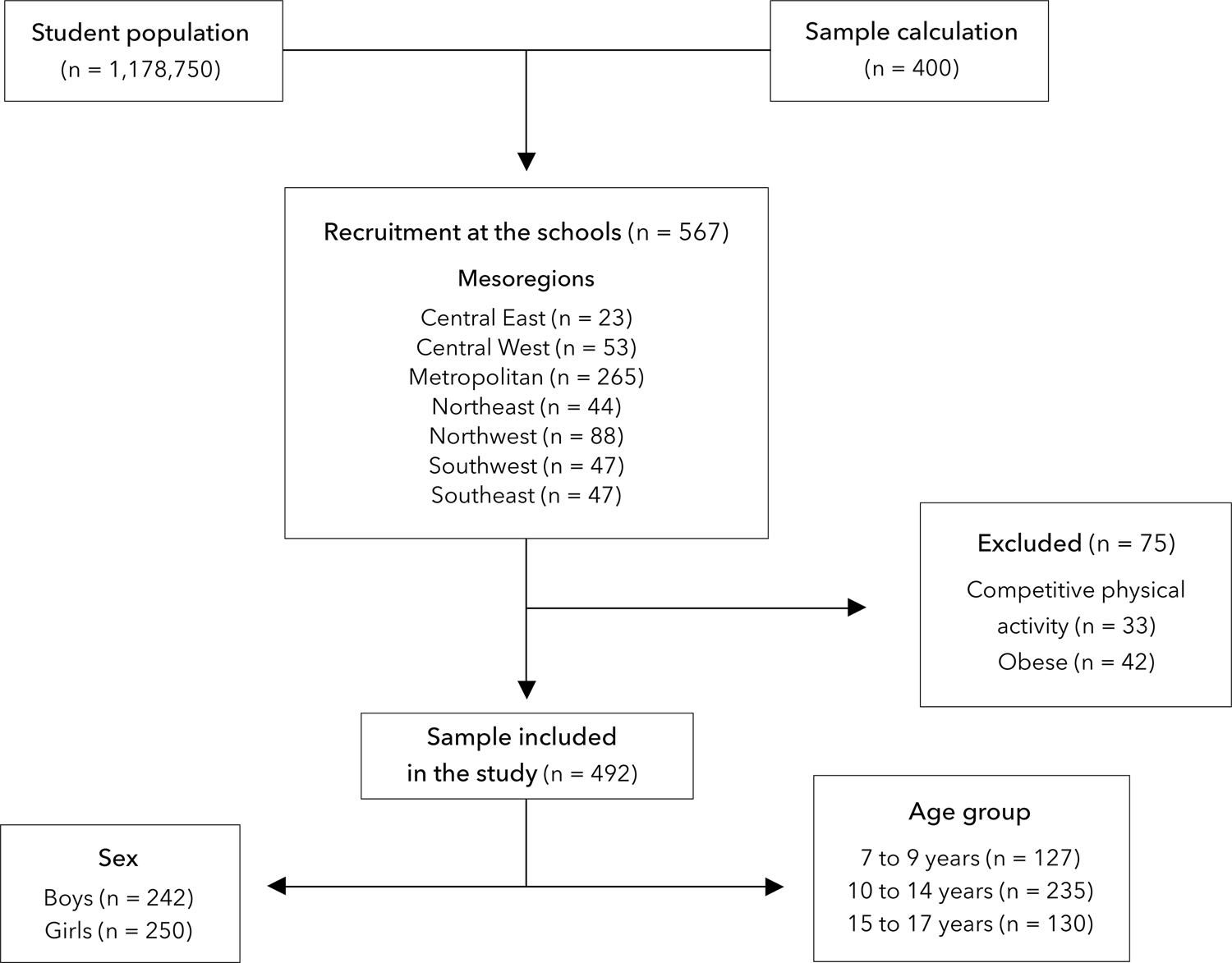
Sample size was calculated using G*Power soft-ware, applying the F-test family with an effect size of 0.25, alpha error of 0.05, statistical power of 0.95, 10 degrees of freedom (based on possible combinations of the factors sex, age group, and biological maturation level), and seven groups (representing the number of postural variables analyzed). This resulted in a minimum sample size of 400 individuals. Based on the population distribution of students enrolled in the public education system of Rio Grande do Sul,7 the sample was stratified by mesoregion and age group and equally divided by sex. To compensate for possible losses, refusals, and stratification requirements, the minimum sample size was adjusted to 466 participants.
Invitations were sent to ten schools in different cities across all mesoregions of Rio Grande do Sul. Seven schools agreed to participate and were located in the following cities: São João do Polêsine (Central-Western mesoregion), Teutônia (Central-Eastern), Porto Alegre (Metropolitan), Nova Prata (Northeast), Casca (Northwest), Pelotas (Southeast), and Itaqui (Southwest).
Students were recruited directly at the seven participating schools, through printed invitations delivered to school administrators. Each school was responsi-ble for forwarding the invitation to the parents or guardians of the children and adolescents, between May and November 2017. All students were invited to participate, but only those whose legal guardians signed the informed consent form were included in the study. Exclusion criteria were participation in com-petitive sports activities, obesity (body mass index > 30), and neuromusculoskeletal disorders.
Data collection
All assessments were conducted by a team of healthcare professionals, including graduates and/or undergraduates in physiotherapy, physical education, and/or chiropractic, with experience in research involv-ing children and adolescents. The team received 20 hours of training on the assessment procedures.
The assessment took place at the physical facilities of each participating school and consisted of: (1) anam-nesis (sex, date of birth, participation or not in compe-titive physical activity, standing and seated body mass and height); biological maturation level was determined based on PGV8 analysis; and (2) static postural assess-ment in the sagittal plane.8 Each student was assigned a numerical identification code, which was used in all assessment procedures.
Postural assessment was performed using the photogrammetry technique, following the protocol of the Digital Image-based Postural Assessment (DIPA©) soft-ware, which exhibits intra and interrater reproducibi-lity.9 Prior to image acquisition, the anatomical points of interest were identified by spherical or rod-shaped markers (for vertebral spinous processes). Two spherical markers were placed on a plumb line, one meter apart, to serve as a metric reference for image calibra-tion. Photographs were taken using a digital camera (Sony® DSC-W510, 12.1 megapixels) mounted on a height-adjustable tripod. The photographs were ana-lyzed and digitized using DIPA© software (version 3.3) by one of the researchers after data collection was completed. The pos-tural variables generated by the software were head position, shoulder posture, cervical, thoracic, and lumbar curvature angles, pelvis position, and knee posture. These postural variables were ta-bulated in Microsoft® Office Excel (version 2016) by a professional who did not participate in the assessments.
Data analysis/treatment
Statistical analyses were performed using SPSS software (version 20.0), with a significance level of 0.05 for all tests. Initially, descriptive exploratory analyses were conducted to characterize the sample, in-cluding means and standard deviations (SD). To assess the influence of sex (male and female), age group (7 to 9, 10 to 14, and 15 to 17 years), and biologi-cal maturation level (pre-PGV, during PGV, and post-PGV), on each postural variable, factorial ANOVA inde-pendent multivariate variables (α = 0.05) was applied. The assumption of equal variances was verified using Levene´s test, and the respective effect sizes (r) were cal-culated (small: r = 0.100 to 0.300; medium: r > 0.300 to 0.500; large: r > 0.500).10 Furthermore, Bonferroni´s post hoc test was applied to identify significant differences.
Once the influencing factors for each postural vari-able were established, descriptive statistics (mean, SD, minimum, maximum, confidence intervals, and percen- tiles) were used to determine reference values. The 15th and 85th percentiles were considered, with the lower limit approximating the mean minus one SD, corres-ponding to the 15th percentile, and the upper limit the mean plus one SD, corresponding to the 85th percentile. This approach aligns with the World Health Organization criteria related to child and adolescent growth and development.11
Results
A total of 567 schoolchildren were assessed, but only 492 (mean weight: 46.1 ± 15.3 kg; mean height: 153.8 ± 16.7 cm) were included in the analyses after ap-plying the exclusion criteria (Figure 1). Inferential analyses were performed to determine whether factors sex, age group, and biological maturation level influenced each of the postural variables analyzed, and to describe reference values based on the influences observed, as presented in Table 1.

Overall, the biological maturation level did not in-fluence any of the postural variables, whereas sex and age group showed varied but small effect sizes.
For head position, a statistically significant difference was found in the overall model. However, no significant differences were observed when analyzing the factors independently or through their interactions. Nonethe-less, the Bonferroni post hoc analysis indicated signi-ficant differences between the age groups: 7–9 vs. 10–14 years: p = 0.001; 7–9 vs. 15–17 years: p = 0.002; and 10–14 vs. 15–17 years: p < 0.001 As such, head position was stratified only by age group to establish reference values. For shoulder posture, the overall model also showed a statistically significant difference. Sig-nificant differences related were found between 7–9 vs. 10–14 years: p = 0.001 and 7–9 vs. 15–17 years: p < 0.001. No significant difference was observed be-tween 10–14 and 15–17 years (p = 0.083). Therefore, the reference values for shoulder posture were also proposed based solely on age group (Table 2).
The cervical curvature angle was not influenced by any of the analyzed factors (sex, age group, and biological maturation level), indicating no need to specify distinct reference values based on these factors. There-fore, the reference range for the cervical curvature angle is 30.8° to 50.6° (mean ± SD: 40.7 ± 9.9°; minimum: 17°; maximum: 66°; 95% CI: 39.8°- 41.6°; percentiles: 10 = 28°; 15 = 31°; 20 = 33°; 50 = 40°; 80 = 49°; 85 = 51°; 90 = 54°; normative value: 30.8º - 50.6º).
By contrast, the dorsal curvature angle was influ-enced by sex (boys versus girls: p < 0.001) and age group (7 to 9 years versus 10 to 14 years: p < 0.001; 7 to 9 years versus 15 to 17 years: p = 0.598; 10 to 14 years versus 15 to 17 years: p = 0.006), showing an interaction between them (p = 0.049). Thus, reference values for the dorsal curvature angle were established accounting for this influence (Table 3). Similarly, knee pos- ture showed a statistically significant difference in the overall model and an interaction between sex and age group (p = 0.019), so its re-ference values reflect both factors (Table 3). The variables lumbar curvature angle and pelvic position were influenced only by sex; accor-dingly, their reference values are presented separately for boys and girls (p < 0.001) (Table 4).
Discussion
Initially, it was believed that determining reference values for static sagittal plane body posture in children and adolescents, using photogrammetry, would require accounting for factors such as sex, age group, and biological maturation level. The results of the present study partially support this hypothesis, demonstrating that only sex and age group appear to have some effect on postural variables.
It is important to remember that the pubertal growth spurt occurs earlier in girls, lasting from ages 9 to 13, with a peak at age 11. In boys, it occurs from ages 11 to 15, peaking at age 13.12 In both sexes, growth may continue at a reduced rate for a few more years.12,13 However, these aspects do not seem to have a direct effect on sagittal plane body posture, according to the findings of the present study. This contrasts with Schlösser et al.,1 who used radiographs to assess spi-nopelvic alignment in boys (n = 57) and girls (n = 99) aged 7 to 18, both before and after the adolescent growth spurt, and observed differences between these periods.
Although age group showed a minimal effect on head position (r = 0.04), there was a statistically signifi-cant difference in the mean values between the 7 to 9 years and 10 to 14 years age groups compared to the 15 to 17 years group. There was a slight decrease from 7 to 9 years (reference value: 44 - 54.6º) to 10 to 14 years (reference value: 43.7 - 54.1º), followed by a noticeable and slight increase when comparing these age groups with 15 to 17 years (reference value: 46.4 - 56.6º). The influence of age group, coupled with the absence of sex-related interference, is consistent with previous literature.4,14
The reference values for head position in the adult population, as proposed by Cureton Jr.,15 range from 50º to 60º. More recently, Pivotto et al.16 compared photogrammetric findings, using those reference va- lues, with radiographic results and observed a strong correlation between the two methods. In the present study, values ranged from a minimum of 43.7º to a maximum of 56.6º, covering all age groups. The dif-ference between findings may indicate that postural changes occur after the age of 17, given that the adult reference values are slightly higher, highlighting the influence of age group as a contributing factor. It is important to note that the range proposed here aligns with those commonly reported in studies involv-ing healthy children and adolescents.17,18
Although the effect size of age group on shoulder posture is small (r = 0.13), it is statistically significant. Mean values appear to gradually increase with age, suggesting a trend toward a more protracted shoulder posture over time (reference values: 7 to 9 years = 52.7 – 76.3º, 10 to 14 years = 57.3 – 81.1º, and 15 to 17 years = 58.9 – 85.9º). Currently, there is no esta-blished on normal shoulder posture ranges in either photogrammetry or radiography. However, studies conducted with healthy children and adolescents have found mean values similar to those proposed in the present study.18,19
As children grow, there is a greater postural dis-placement of segments (head and shoulder) from the vertical reference. This is likely due to changes in body proportions and compensatory movements aimed at maintaining balance,12,13,30 which corroborates the observations in this study. It is also known that during childhood and adolescence, a period of significant growth, many psychological, emotional, and social transformations occur. These are crucial for individual de-velopment21 and can sometimes lead to the adoption of more “closed-off” postures. This could potentially ex-plain the findings related to shoulder posture, although more research is needed for complete elucidation.18
Additionally, a possible association exists between medial shoulder rotation and scapular abduction, which might contribute to postural tendencies like shoulder protraction.12 This association suggests the involvement of other anatomical structures and planes of assessment not captured by the photogrammetric images acquired solely in the sagittal plane in this study. This could be a limitation, indicating a need for caution when extrapolating our findings and highlighting the need for studies investigating more comprehensive me-thods to assess this postural variable.
With respect to the spinal column, each region ap-pears to be influenced differently. It is important to note that changes in the curvatures of one spinal re- gion tend to lead to compensatory changes in adja-cent or distant regions. The gold standard for spinal assessment is the Cobb angle measured from radio-graphic images.22 Although radiography was not used in this study, the angular values for spinal curvatures provided by DIPA© software have confirmed validity against this gold standard, with a measurement error of less than 1°.23
In a recent systematic review, reference values for dorsal curvature angle assessed via radiographs were proposed, suggesting an increase in curvature with age.24 This finding resembles the results observed in the present study; however, the reference values proposed by Furlanetto et al.22 cover a range of approxi-mately 10º, which differs substantially from the appro-ximately 20º range found in this study between the upper and lower limits. With respect to the lumbar curvature angle, values from both studies are similar, although the systematic review24 summarized data con-sidering age group as a factor, which we observed to have no influence.
The evaluated factors showed no statistically signi-ficant effects on the cervical curvature angle, which therefore has generalized reference values for chil-dren and adolescents (reference values: 30.8 – 50.6º). The angular stability of this curvature during growth has been described in the literature,21 since it is the first spinal curvature to stabilize.25Conversely, the dorsal curvature angle appears to be influenced by a small but statistically significant interaction effect be-tween age group and sex (r = 0.120). For both sexes, angular variation follows a similar pattern, with an in-crease from the 7 to 9-year group (reference values: boys = 33.2 – 50.4º; girls = 26.1 – 45.3º) to the 10 to 14-year group (boys = 36.8 – 52.8º; girls = 33.8 – 52.2º).
When comparing to the 15 to 17-year group, a decrease is observed (reference value: boys = 34.0 – 52.8º; girls = 27.4 – 46.0º), with mean values returning close to those seen in the 7 to 9-year group. Mean values were consistently higher in boys, which contrasts with radiographic findings by Cil et al.,26 who reported the opposite trend across age groups.
Our findings corroborate those of Poussa et al.,27who studied spinal posture development in a cohort of 1,060 individuals aged 11 to 22 years. Using a pan-tograph for assessment, they found that thoracic ky-phosis was more prominent in males at all ages, with a progressive increase over time, a trend that diver-ges from the findings of the present study.27 Nevertheless, other studies have observed similar behavior to that reported here regarding the influence of sex and age group on this variable.2,28
Sex also has a small but statistically significant effect on the lumbar curvature angle (r = 0.130). Girls (re-ference value: 35.9 - 44.1º) exhibit larger angles and angular variations than boys (reference value: 34.9 - 41.9º). This aligns with observations by Poussa et al.,27 Dolphens et al.,2 and Grabara et al.25 The last authors, however, also noted an influence of age group.25 The same behavior is observed in the pelvis, supporting existing literature that indicates a direct relationship between these two segments.29
In relation to pelvic position, there is a small but statistically significant effect of sex (r = 0.170), with girls showing a larger angular value (reference value: 9.8 - 19.6º) than boys (reference value: 7.8 - 17.4º), which aligns with findings in the literature.30 However, an ef-fect of age group was expected, since pelvic anteversion is typically observed in children up to 9 years old, with the pelvis tending to adopt smaller angles there-after.19,30Although no statistically significant influence of age group was observed, a qualitative analysis of the average values reveals they are indeed slightly higher up to 9 years (7 to 9 years = 14.4 ± 5.0º; 10 to 14 years = 13.7 ± 5.0º; 15 to 17 years = 12.9 ± 4.8º).
Knee posture appears to be subject to a statistically significant, albeit small, effect of both sex and age group (r = 0.13) While this subtle effect was not identified in the post hoc analyses, average values suggest distinct patterns by sex in relation to age group. In boys, there appears to be a decrease with age followed by an in-crease, while among girls, the opposite occurs: an in-crease followed by a decrease. For this variable, caution is advised in interpreting the results of the current study, given that femoral positioning (rotations) may affect the anatomical point markings in the sagittal plane, poten-tially leading to inaccurate measurements.
When comparing infants (30 to 60º), children (25 to 30º), and adults 12 to 15º), Ishida and Kuwajim31 observed variations in the femoral neck anteversion angle on radiographs. Internal femoral rotation may increase the prominence of greater trochanter of the femur, while also altering the orientation of the lateral femoral con-dyle and malleolus, potentially generating smaller an-gles that falsely suggest knee flexion. This highlights the need for cautious interpretation, since photogram-metric assessments, regardless of the software used, are limited to a single plane (sagittal) and do not account for transverse rotations.
With regard to factors that appear to influence body posture, some authors suggest that body mass index (BMI) may be the most consistent determinant of sagittal posture development. It is believed that adiposity causes plastic deformation of spinopelvic structures in early life stages, enabling the tracking of specific sagittal patterns throughout life.3,5 However, caution is nec-essary when performing assessments via body surface measurements, since tissue thickness, from palpation to image analysis, can influence results and compromise data quality and extrapolation.
Considering evidence from the literature indicating that identifying changes in spinal shape, height, and bo-dy mass may reflect phenotypic shifts over time, there is support for the idea that reference values should be updated periodically, as posture continuously evolves.25,32 Therefore, it is suggested that future studies compare the reference values proposed here with those from individuals with BMI values outside the normal range established in the literature, to verify the true influence of this factor. The present study, however, was limited to proposing reference values for individuals with nor-mal BMI.
In terms of the internal validity of the study, which relates to the quality of its planning and execution, including data collection and analysis, all feasible inter-vening factors were controlled. To minimize potential errors and/or biases during the study, the assessment team underwent rigorous training, a validated and re-producible photogrammetry technique was used, ima-ges were coded for anonymity, and data were tabulated by a researcher not belonging to the assessment team. Additionally, sample eligibility was controlled for BMI limits and competitive physical activity.
In regard to external validity, the representativeness of the sample is noteworthy, both in size, which adhered to a pre-established calculation (reflecting the care ta-ken during study planning), and in its recruitment from the general population. These aspects make it possi-ble to generalize the findings of this study to the Rio Grande do Sul population; that is, the proposed refe-rence values can be considered valid for children and adolescents in the state. However, caution should be exercised when applying them to the entire Southern region of Brazil, and even more so for Brazil as a whole. This is because the regional and cultural influence on postural variables was not investigated, which is a limi-tation of this study and a suggestion for future research.
Conclusion
Given the established understanding of factors in-fluencing each postural variable individually, it can be concluded that the mean values and their standard deviations (within the range defined by the 15th and 85th percentiles), can serve as reference values for the state of Rio Grande do Sul. These values can support any postural assessment software that uses the same assessment protocol. By establishing these reference values, we aim to provide a stronger scientific basis for both research and clinical practice, thereby contributing to the early identification of postural changes in children and adolescents.
Acknowledgments
The authors thank the Coordination for the Impro-vement of Higher Education Personnel (CAPES) for the doctoral scholarship awarded under the Academic Excellence Program (PROEX).
References
-
1 Schlösser TP, Vincken KL, Rogers K, Castelein RM, Shah SA. Natural sagittal spino-pelvic alignment in boys and girls before, at and after the adolescent growth spurt. Eur Spine J. 2015;24(6):1158-67. https://doi.org/10.1007/s00586-014-3536-z
» https://doi.org/10.1007/s00586-014-3536-z -
2 Dolphens M, Cagnie B, Vleeming A, Vanderstraeten G, Danneels L. Gender differences in sagittal standing alignment before pubertal peak growth: the importance of subclassifi-cation and implications for spinopelvic loading. J Anat. 2013; 223(6):629-40. https://doi.org/10.1111/joa.12119
» https://doi.org/10.1111/joa.12119 -
3 Araújo FA, Severo M, Alegrete N, Howe LD, Lucas R. Defining patterns of sagittal standing posture in girls and boys of school age. Phys Ther. 2017;97(2):258-67. https://doi.org/10. 2522/ptj.20150712
» https://doi.org/10. 2522/ptj.20150712 -
4 Dolphens M, Cagnie B, Coorevits P, Vanderstraeten G, Cardon G, D´hooge R, et al. Sagittal standing posture and its association with spinal pain: a school-based epidemiological study of 1196 Flemish adolescents before age at peak height velocity. Spine (Phila Pa 1976). 2012;37(19):1657-66. https://doi.org/ 10.1097/brs.0b013e3182408053
» https://doi.org/ -
5 Miranda APOC, Penha PJ, Pereira LG, Pessoa WC, João SMA. Posture of adolescent and the relationship with body mass index, sex, and physical activity. Child Obes. 2021;18(5):342-9. https://doi.org/10.1089/chi.2021.0191
» https://doi.org/10.1089/chi.2021.0191 -
6 Von Elm E, Altman DG, Egger M, Pocock SJ, Gøtzsche PC, Vandenbroucke JP. Strengthening the reporting of observa-tional studies in epidemiology (STROBE) statement: guidelines for reporting observational studies. BMJ. 2007;335(7624): 806-8. https://doi.org/10.1136/bmj.39335.541782.ad
» https://doi.org/10.1136/bmj.39335.541782.ad -
7 Instituto Brasileiro de Geografia e Estatística (IBGE). Panorama da frequência escolar no Rio Grande do Sul por me-sorregião e faixa etária: Censo Demográfico 2010. Tabelas SIDRA 3544/3989. 2010 [cited 2025 Jan 29]. Available from: https://sidra.ibge.gov.br/
» https://sidra.ibge.gov.br/ -
8 Mirwald RL, Baxter-Jones ADG, Bailey DA, Beunen GP. An assessment of maturity from anthropometric measurements. Med Sci Sports Exerc. 2002;34(4):689-94. https://doi.org/10. 1097/00005768-200204000-00020
» https://doi.org/10. 1097/00005768-200204000-00020 -
9 Furlanetto TS, Candotti CT, Comerlato T, Loss JF. Validat-ing a postural evaluation method developed using a Digital Image-based Postural Assessment (DIPA) software. Comput Methods Programs Biomed. 2012;108(1):203-12. https://doi.org/10.1016/j.cmpb.2012.03.012
» https://doi.org/10.1016/j.cmpb.2012.03.012 - 10 Cohen J. Statistical power analysis for the behavioral sci-ences. 2nd ed. Hillsdale, NJ: Lawrence Erlbaum Associates; 1988.
-
11 World Health Organization. Growth reference 5-19 years. Geneva: WHO; 2007. [cited 2025 Jan 29]. Available from: https://tinyurl.com/52n8mwes
» https://tinyurl.com/52n8mwes - 12 Gallahue DL, Ozmun JC. Compreendendo o desenvolvi-mento motor: bebês, crianças, adolescentes e adultos. 3 ed. São Paulo: Phorte; 2005.
- 13 Asher C. Variações de postura na criança. São Paulo: Manole; 1976.
-
14 Lafond D, Descarreaux M, Normand MC, Harrison DE. Postural development in school children: a cross-sectional study. Chiropr Osteopat. 2007;15:1. https://doi.org/10.1186/1 746-1340-15-1
» https://doi.org/10.1186/1 746-1340-15-1 -
15 Cureton Jr TK. Bodily posture as an indicator of fitness. Res Q Am Assoc Health Phys Educ Recreation. 1941;12(Suppl 2): 348-67. https://doi.org/10.1080/10671188.1941.10624690
» https://doi.org/10.1080/10671188.1941.10624690 -
16 Pivotto LR, Schmit EFD, Raupp EG, Santos A, Vieira A, Candotti CT. Frontal-Mental Line Inclination Test for assessment of cervical curvature: validation and applicability. Fisioter Mov. 2019;32:e00320. https://doi.org/10.1590/1980-5918.032.AO09
» https://doi.org/10.1590/1980-5918.032.AO09 -
17 Hazar Z, Karabicak GO, Tiftikci U. Reliability of photogra-phic posture analysis of adolescents. J Phys Ther Sci. 2015; 27(10):3123-6. https://doi.org/10.1589/jpts.27.3123
» https://doi.org/10.1589/jpts.27.3123 -
18 Ruivo RM, Pezarat-Correia P, Carita AI. Intrarater and inter-rater reliability of photographic measurement of upper-body standing posture of adolescents. J Manipulative Physiol Ther. 2015;38(1):74-80. https://doi.org/10.1016/j.jmpt.2014.10.009
» https://doi.org/10.1016/j.jmpt.2014.10.009 -
19 Batistão MV, Carnaz L, Barbosa LF, Motta GC, Sato TO. Posture and musculoskeletal pain in eutrophic, overweighted, and obese students: a cross-sectional study. Motriz. 2014;20 (2):192-9. https://doi.org/10.1590/S1980-65742014000200009
» https://doi.org/10.1590/S1980-65742014000200009 - 20 Camargo MZ. Alinhamento postural da coluna no plano sagital de crianças eutróficas e acima do peso em fase pré-escolar e escolar: estudo longitudinal [tese]. Londrina: Unive-sidade Estadual de Londrina; 2018.
-
21 Detsch C, Candotti CT. A incidência de desvios posturais em meninas de 6 a 17 anos da cidade de Novo Hamburgo. Movimento. 2001;7(15):43-56. https://doi.org/10.22456/1982-8918. 2622
» https://doi.org/10.22456/1982-8918. 2622 -
22 Zaina F, Donzelli S, Lusini M, Negrini S. How to measure kyphosis in everyday clinical practice: a reliability study on different methods. Stud Health Technol Inform. 2012;176:264-7. https://doi.org/10.3233/978-1-61499-067-3-264
» https://doi.org/10.3233/978-1-61499-067-3-264 -
23 Furlanetto TS, Oliveira EBC, Candotti CT, Vieira A, Mesquita PV, Navarro IJRL, et al. Development and validation of predic-tion equations for spinal curve angles based on skin surface measurements. J Manipulative Physiol Ther. 2017;40(9):692-9. https://doi.org/10.1016/j.jmpt.2017.06.015
» https://doi.org/10.1016/j.jmpt.2017.06.015 -
24 Furlanetto TS, Sedrez JA, Candotti CT, Loss JF. Reference values for Cobb angles when evaluating the spine in the sagit-tal plane: a systematic review with meta-analysis. Motricidade. 2018;14(2-3):115-28. https://lume.ufrgs.br/handle/10183/187 361
» https://lume.ufrgs.br/handle/10183/187 361 -
25 Grabara M, Bieniec A, Nawrocka A. Spinal curvatures of children and adolescents - A cross-sectional study. Biomed Hum Kinet. 2017;9(1):69-74. https://doi.org/10.1515/bhk-201 7-0011
» https://doi.org/10.1515/bhk-201 7-0011 -
26 Cil A, Yazici M, Uzumcugil A, Kandemir U, Alanay A, Alanay Y, et al. The evolution of sagittal segmental alignment of the spine during childhood. Spine (Phila Pa 1976). 2005;30(1):93-100. https://doi.org/10.1097/01.brs.0000149074.21550.32
» https://doi.org/10.1097/01.brs.0000149074.21550.32 -
27 Poussa MS, Heliövaara M, Seitsamo JT, Könönen H, Hurmerinta KA, Nissinen MJ. Development of spinal posture in a cohort of children from the age of 11 to 22 years. Eur Spine J. 2005;14(8):738-42. https://doi.org/10.1007/s00586-0 04-0701-9
» https://doi.org/10.1007/s00586-0 04-0701-9 -
28 Drzal-Grabiec J, Snela S, Truszczynska A. The development of anterior-posterior spinal curvature in children aged 7-12 years. Biomed Hum Kinet. 2016;8:72-82. https://doi.org/10.15 15/bhk-2016-0011
» https://doi.org/10.15 -
29 Beresoski CM, Camargo MZ, Siqueira CPCM, Vieira DBALP, Cibinello FU, Andraus RAC, et al. Characterization of lumbar angle, pelvic sagittal balance and flexibility in preschoolers. Man Ther Posturol Rehabil J. 2016;14:358. https://doi.org/10. 17784/mtprehabjournal.2016.14.358
» https://doi.org/10. 17784/mtprehabjournal.2016.14.358 -
30 Detsch C, Luz AMH, Candotti CT, Oliveira DS, Lazaron F, Guimarães LK, et al. Prevalência de alterações posturais em escolares do ensino médio em uma cidade no Sul do Brasil. Rev Panam Salud Publica. 2007;21(4):231-8. https://www.scielo sp.org/pdf/rpsp/2007.v21n4/231-238
» https://www.scielo - 31 Ishida A, Kuwajima SS. Desenvolvimento postural dos membros inferiores na criança. In: Barros Filho TEP, Lench O, editors. Exame físico em ortopedia. 2 ed. São Paulo: Sarvier; 2001. p. 301-8.
-
32 Mrozkowiak M, Walicka-Cuprys K, Magon G. Comparison of spinal curvatures in the sagittal plane, as well as body height and mass in polish children and adolescents examined in the late 1950s and in the early 2000s. Med Sci Monit. 2018;24: CLR4489-500. https://doi.org/10.12659/MSM.907134
» https://doi.org/10.12659/MSM.907134
Edited by
-
Associate editor:
Ana Paula Cunha Loureiro