 Effects of a physical exercise program using exergames on gross motor development in children with autism spectrum disorder
Abstract
Introduction: Autism spectrum disorder (ASD) is classified in the literature as a disorder of human neurodevelopment and present in a unique way in each individual. It can alter various behaviors related to communication, speech, social interaction, repetitive movements, and fine and gross motor coordination. In this sense, various functional impairments are observed in people with the disorder. Because of these functional deficiencies, much research has been done on the motor functions and conditions of these individuals, given the detrimental impact that deficits in motor coordination and executive functions have on independence and the development of social skills, as well as their direct impact on health conditions and physical and mental integrity.
Objective: To assess the gross motor development of children diagnosed with ASD before and after a period of therapeutic physiotherapy intervention using exergames as a tool.
Methods: The study included nine prepubertal males between the ages of 7 and 10 who underwent a 12-week intervention with two weekly half-hour sessions of exergames.
Results: A significant difference was observed in overall performance on the Global Motor Quotient and in subtests assessing object control and locomotor performance.
Conclusion: The intervention using exergames as a therapeutic tool was the main factor responsible for improving the gross motor development of the children diagnosed with ASD.
Keywords:
Autism spectrum disorder; Exergaming; Child development
Resumo
Introdução: O transtorno do espectro do autismo (TEA) é classificado como um transtorno do neurodesenvolvimento humano e se apresenta de maneira particular em cada indivíduo, podendo alterar comportamentos diversos que envolvem a comunicação, a fala, a interação social, as movimentações repetitivas e a coordenação motora fina e ampla. Neste sentido, prejuízos funcionais diversos são observados em pessoas com o transtorno. Por conta destas deficiências funcionais, muito tem se pesquisado sobre as funções e condições motoras destes indivíduos, visto o impacto prejudicial que os déficits na coordenação motora e funções executivas têm sobre a independência e desenvolvimento de habilidades sociais, além de afetar diretamente condições de saúde e integridade física e mental.
Objetivo: Avaliar o desenvolvimento motor grosso de crianças diagnosticadas com TEA antes e após um período de intervenção terapêutica de fisioterapia, utilizando como ferramenta exergames.
Métodos: Foram incluídos no estudo nove indivíduos do sexo masculino, prépuberes, com idade entre 7 e 10 anos, que passaram por uma intervenção de 12 semanas, realizando duas sessões semanais de meia hora com exergames.
Resultados: Observou-se diferença significativa no desempenho geral do quociente motor global e nos subtestes que avaliaram o controle de objetos e o desempenho locomotor.
Conclusão: A intervenção com exergames como instrumento terapêutico foi uma colaboradora diferencial para a melhora do desenvolvimento motor grosso de crianças diagnosticadas com TEA.
Palavras-chave:
Transtorno do espectro do autism; Jogos eletrônicos de movimento; Desenvolvimento infantil
Introduction
Autism spectrum disorder (ASD) is considered by the International Classification of Diseases and Related Health Problems of the World Health Organization (WHO) in its tenth edition and by the Diagnostic and Statistical Manual of Mental Disorders in its fifth edition (DSM-5) as a neurodevelopmental disorder that presents heterogeneously in each individual. Its characteristics are alterations in verbal and non-verbal communication, reduced social interaction, repetitive movements and stereotypes.1
It should be noted that the number of ASD cases has increased significantly over the years. According to the Center for Disease Control's Autism and Developmental Disabilities Monitoring, the incidence of ASD was 1:150 newborns in 2000. In 2008, however, the incidence was 1:88.2 In 2016, the National Health Center for Health Statistics indicated that this ratio was 1:36 live births.3
Recent studies have shown that 85% of children with ASD have perceived deficits between the neonatal period and adulthood. The impairments are varied and skills such as orthostatism - maintaining standing posture, fine and gross motor coordination, and static and dynamic balance can be affected by the disorder.4 These deficits impact all processes of independence and functionality during the stages of human development.5,6
Physical inactivity is considered a risk factor for systemic diseases such as obesity and hypertension, and contributes to intellectual impairment in children with ASD, with anxiety and depression being very common diagnoses in this population.7 The motor repertoire limitations associated with generalized hypotonia also contribute to these pathological psychiatric conditions by impeding childhood postural adaptations, gait, and functional performance, and by interfering with play activities and age-related experiences.8
In this sense, motor performance and physical activity studies have been conducted and are gaining prominence in the literature to understand the influence of physical exercise for this population, and to answer questions regarding the effects of this approach on improving and expanding the motor repertoire in ASD. It is believed that exercise and motor intervention may be responsible for enhancing neurogenesis and thus improving executive functions during daily activities.8,9
Engaging children with ASD in systematized activities, i.e., those in which the therapist directs – guides the exercises (based on the child's kinetic-functional requirements), is one of the main challenges in treating this population during intervention. For this reason, alternative ways of working with children as protagonists during the tasks, combining their interests with the therapeutic plan itself, become a possibility for achieving more satisfactory results.10 In this sense, the contemporary context brings technology as an ally.
After all, the use of screens is a current reality and, therefore, a conscious and functional orientation is necessary regarding child development. Along with this technological advance, the use of video games has become increasingly popular as a form of therapeutic work both in the context of physical rehabilitation for adult patients and also for children, seen as a form of reinforcing intervention that allows children to perform physical activity in a playful and interactive way.11 Some of the most popular models, including the Xbox Kinect and Nintendo Switch, stand out for their practicality and value, and the most commonly used games are adventure, sports, and dance.12
The benefits of this type of intervention include sensory feedback, skill training with speed gradients, and task-directed ranges of motion adaptations.13 Although there are no standardized protocols for the practice of video game therapy due to variables such as difficulty level and the like, the literature shows that exergames can improve the physical fitness of players.10 Motor intervention through interactive media still has limitations in terms of usage protocols, but it is an alternative that can be positive for general motor coordination and other skills.14
In light of the above, the purpose of this article was to evaluate the gross motor development of children diagnosed with ASD before and after a period of physiotherapeutic intervention using exergames.
Methods
The inclusion criteria for participation in the research were children between the ages of 7 and 10 years old (8.40 ± 1.07), male or female, with a final medical diagnosis of ASD, who could be at any of the three levels of support according to the DSM-5, who were prepubertal, who could perform the physical tests of the Test of Gross Motor Development - 2 (TGMD-2), who had passed the evaluation of the Childhood Autism Rating Scale (CARS) instrument, and who were allowed to play active video games (exergames).
The exclusion criteria were children who were unable to perform the physical tests of the TGMD-2, who were classified as pubertal, who did not participate in at least 60% of the exercise sessions with exergames, or who had any cardiac or musculoskeletal problems that could lead to complications during the study and compromise their physical integrity.
Initially, 25 individuals were authorized by their guardians to participate in the study. Of these participants, three were female and could not be included because they had already reached puberty, which could affect the test results due to the growth process. Another 13 scored a total of zero in all the skills required by the motor test, due to limitations in understanding the guidelines for performing what was required and due to deficiencies in the motor prerequisites for performing the motor tasks, making it impossible to compare data after the intervention period. For these reasons, they were unable to undergo the exergames protocol.
At the end of the selection process, a total of nine prepubertal males between the ages of 7 and 10 years were enrolled in the study, who were able to perform the requirements of the TGMD-2 tests and were assessed using the CARS. After the selection process, the physiotherapeutic intervention protocol with exergames began.
The project was approved by the Research Ethics Committee of the School of Physical Education and Sport at the University of São Paulo (n. 5.633.341).
Data collection
The participants and their guardians were informed verbally and in writing about the procedures they would be subjected to through a free and informed consent form, through which the guardians authorized the students' participation in the study. They were followed for a period of 90 days, during which the participants underwent two weekly half-hour sessions of physiotherapeutic intervention using exergames as a tool.
Assessment instruments
Childhood Autism Rating Scale
CARS, the first instrument used, is a screening scale for signs and their intensity in people with ASD, available and validated for the Brazilian population. It was originally designed to screen for classic autism and therefore has some limitations due to the heterogeneous nature of the cases. It is important to point out that the CARS is not an instrument for clinical diagnosis, but it is suitable for analyzing possible impairments that the child may present, suggesting an accurate assessment for diagnosis by a physician. It has 15 items and can screen and differentiate children with ASD in terms of their developmental impairment scores, which can vary from 15 to 60 points. CARS assesses verbal communication, non-verbal communication, personal relationships, imitation, emotional response, use of objects, response to change, visual response, auditory response, response to and use of taste, smell and touch, body use, fear or nervousness, activity level, level and consistency of intellectual response, and general impressions. The scores for these domains range from 1, indicating borderline typicality, to 4, indicating severe autistic symptoms.15
Test of Gross Motor Development
After the classification of the level of support based on the CARS, the participants' gross motor skills were analyzed using the TGMD-2, in the version validated for Brazil, in order to assess possible motor delays in the study population. This instrument covers the age range from 3 to 10 years and includes 12 motor skills divided into two domains of evaluative subtests: locomotor performance, which includes the motor skills of running, hopping, galloping, leaping, horizontal jumping, and sliding; and object control performance, which includes striking a stationary ball, stationary dribbling, catching, kicking, overhand throwing, and underhand rolling. All these activities were analyzed individually, as was performance on the subtests, which was quantified by the ratio of the scores on the above skills to the chronological age of the participants. TGMD-2 also assessed the Gross Motor Quotient (GMQ), which is one of the most important points of this study, as it allows the interpretation of the participants' general motor skills in numerical terms.
During the application, the recommendations of the manual were used, which indicated that a precise verbal command should be given, followed by a prior demonstration of the movement required of the participant. After all participants were evaluated, the scores were analyzed and compared.16 The instruments were applied in the pre-intervention period and reapplied at the end of the protocol.
Physical exercise program with exergames (protocol)
The physical exercise program with exergames lasted half an hour per session, with the first five to ten minutes being a period of preparation and behavioral engagement, if necessary, and the remaining 20 to 25 minutes being the main part (physical exercises with exergames). The protocol was carried out twice a week, on alternate days, for 12 weeks, with the first and last weeks devoted to the application and reapplication of the TGMD-2, and the middle ten weeks to the exercises themselves. Both the pre-intervention test with the exergames and the post-intervention test were administered in a single session on a single day. All children in the study continued their therapeutic activities according to their weekly routines, which included occupational therapy, speech therapy and psychology support, without changing their routines. They did not perform physical exercises with exergames elsewhere.
The classes consisted of two students per time slot. The children were paired for each console, and there was randomization in all the pre-sessions so that they weren't always the same pairs.
The room consisted of an Xbox 360 console equipped with the Kinect motion sensor. The Xbox 360 console was equipped with a pre-established game called Adventure, which offered the following activities: rapids, space bubbles, spills, bounce room, and reflex summit. In these games, the participants had a variety of motor demands, including jumping, lateral, frontal and backward movements, squats, and various movements of reaching in different directions and heights with the upper limbs. During the first session, the therapist demonstrated how to play each of the proposed games and then let the participants play and adapt to what had been demonstrated. Beginning with the second session, the therapist provided the necessary support based on the participants' individual behavioral frame-works and switched from one game to another throughout the session, reducing the demonstrations and instructional or manual assistance based on the pairs' progressive familiarity and learning of each game.
The exergames physical exercise program sessions were always coordinated and led by the same physiotherapist experienced in treating children diagnosed with ASD.
Statistical treatment
The data were tabulated in a Microsoft Excel spreadsheet, version 2013, and then statistically analyzed using the Statistical Package for Social Science (SPSS) software.
Based on the normality test (Shapiro-Wilk), non-parametric statistical tests (Wilcoxon) and Spearman's correlation were used according to the distribution of the data, with a significance level of p ≤ 0.05.
Results
The medians of the GMQ, the locomotor subtest, the object control subtest, and standard deviation of the group of participants are shown in Table 1. Based on the data analyzed, it was possible to determine that there were statistically significant differences when comparing the pre- and post-intervention median scores for the GMQ (p ≤ 0.0277), object control subtest (p ≤ 0.0180), and locomotor subtest (p ≤ 0.0277).
Median (M), standard deviation (SD), and p-value for the Gross Motor Quotient (GMQ), locomotor subtest, and object control subtest for the group of participants before and after the exergames intervention
Table 2 shows the medians for each skill required by the TGMD-2. Although there are values that differ between the medians of the participants' performance, showing a tendency to improve in all the skills required to perform the test, in none of them it was possible to identify significant differences in the improvement of the motor performance of the group.
Median values of the group of participants in the Test of Gross Motor Development - 2 (TGMD-2) skills pre- and post-intervention with the use of exergames
Table 3 presents data that may indicate important pathways and variables for the study. All of these data were collected during the weeks of intervention and are relevant to the results of this study.
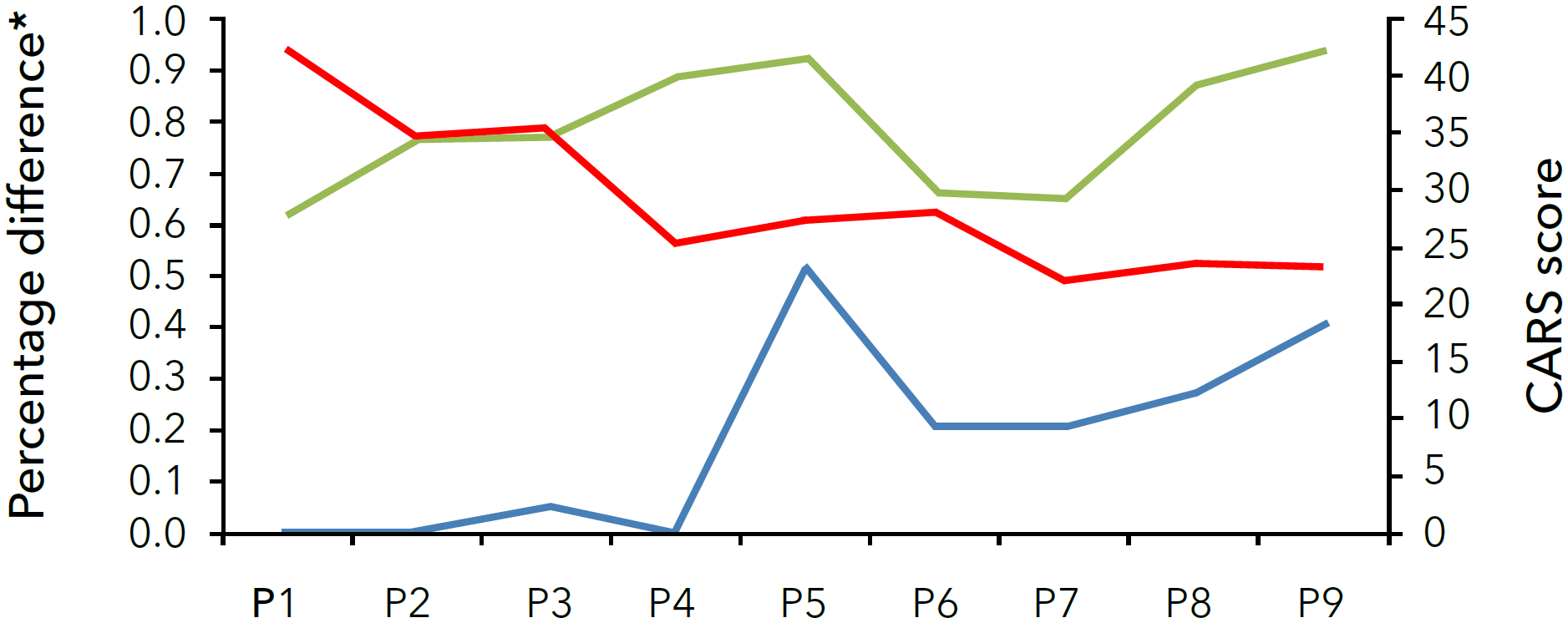
Percentage difference pre vs. post protocol with exergames, working days offered, percentage of participants attending on working days, and Childhood Autism Rating Scale (CARS) score
As can be seen in Table 3, the nine participants did not have the same number of working days to complete the protocol, although they all completed the 12 weeks of the intervention. This behavior is due to the fact that the groups were formed over the course of a year, and the provision of holidays, optional days off, and extra activities implied more, or fewer days offered according to the months of the year in which they were selected for the study. Figure 1 reinforces the data presented in Table 3, and its analysis indicates that children who scored lower on the CARS performed better on the GMQ, showing a moderate inverse proportional correlation (r = −0.55). Another important factor that seems to have influenced the participants' results is the frequency of protocol attendance, which, together with the lower CARS score, may have been an important combination for the results obtained in this study.

Percentage difference pre- vs. post-protocol with exergames, working days offered, percentile of participants' attendance on working days, and Childhood Autism Rating Scale (CARS) score
Discussion
The main finding of this study was to verify the increase in the GMQ score of the group of participants diagnosed with ASD obtained through an intervention protocol using exergames. Regarding the participants' overall motor performance, the locomotor and object control subtests also showed a significant improvement in their scores.
The protocol was completed with the pre-established suggestions of two weekly sessions of 30 minutes each, and there were no complications. In terms of overall performance, all participants were behaviorally engaged, available, and very receptive to the games.
During the study, participants who understood the purpose of the games felt challenged by the scores they achieved, enjoyed seeing themselves in the photos taken by the device on the console, and felt competitively stimulated. This supports research in recent years that has shown virtual reality therapeutic intervention to be an interactive, playful, and potentially less boring medium for children with ASD, especially for individuals who have a conceptual foundation in gaming.14
Participants who scored higher on the CARS, i.e. who may have greater impairments within the autistic spectrum, performed less satisfactorily on the score provided by the TGMD-2 and, qualitatively, it was observed during sessions that they copied their peers during the game. However, when they played alone, they showed less understanding of the game and what was required of them. This fact reinforces the study by Kaur et al.,6 which evaluated children with ASD, their level of support, and their intelligence quotient (IQ) level, and the authors concluded that children with ASD with a lower IQ and higher level of support would have lower motor performance than children with ASD with a higher IQ and lower level of support.
Similar to the present study, Hilton et al.,17 who examined executive function performance in children with ASD using the Makoto Training Arena (a type of exergame), observed general gains in motor performance, including improvements in agility and protective response. Bowling et al.7 also found promising results for improving motor skills in their study sample. Participants in their intervention group were diagnosed with depression, anxiety disorder, attention deficit hyper-activity disorder, and ASD.7 This sample received an adaptation of Game Squad, a game originally designed for children with obesity, combined with virtual health coaching interventions. The results of this study indicate an improvement in sleep and motor skills for the selected participants.
The main challenges identified by systematic reviews relate to the difficulty of randomized clinical trials in standardizing the dosage and frequency of their work.14 Although there are gaps in this line of studies and the literature still presents insufficient data on the effectiveness of therapeutic intervention using exergames in autistic children, this panorama is promising, encourages research and reinforces the need to develop effective techniques for the habilitation and improvement of motor functions in this population.12
An important point to note is the need to study the relationship between the "literacy" factor and its influences during the use of virtual reality, because according to the unstructured observations of the therapist who conducted the study, during the intervention process, the children who were able to read the instructions projected on the television screen moved better within the function directed by the games than the children who were unable to read while participating in the activities offered by the exergames. Another important factor that seems to have influenced the participants' motor performance is their diagnosis. In other words, their medical reports do not identify other comorbidities, analyze levels of impairment, and assess IQ or degrees of comprehension, motor imitation, or even interpretation of information. Therefore, because the spectrum is so broad, it was important to analyze individual impairments through this screening of factors that might differentiate each participant, based on the CARS, in order to compare them to themselves after the treatment.
From the analysis of some individual results, it is considered important to highlight the performance of participants 1, 2, 3, and 4 individually (Figure 1).
The data presented by participant 1 reinforces the finding that a higher level of impairment may have been a differentiating factor for the effectiveness of the exergames treatment, as his CARS score is the highest of all participants and he had no change in his percentile of improvement in the post-test.
Regarding participants 2 and 3, we observed that the CARS score does indeed seem to overlap with the protocol attendance variable, as they both scored above 34 on the CARS and they attended more than 75% of the sessions, unlike participant 1, who attended 61.5%. In this sense, even though there is a higher frequency of protocol attendance, higher levels of impairment caused by ASD seem to be more detrimental to gains and improvements in gross motor development when using exergames as a therapeutic intervention.
Participant 4 was the case that showed no relationship between CARS score and performance improvement; despite having a high attendance percentage during the exergames intervention period and a low score on the CARS, he maintained the score he achieved in the pre-test. It was not possible to explain this fact with the data presented in this study. It is important to emphasize that the fact that there was no change in the percentage in the post-test does not mean that the score achieved by participant 4 was low; there was just no individual change in his score through the virtual reality intervention in this study.
This study draws attention to the results after the intervention period, especially considering the heterogeneity mentioned above, as it presents promising data for a better understanding of what is meant by motor intervention for people with ASD. In this study, CARS appears as a numerical differentiator of impairments, which indicates barriers to the effectiveness of treatments using physical exercise (exergames) for this population. In this way, it was possible to gain a clearer understanding of the importance of tools and evaluation criteria that can better identify profiles of children for physical exercise programs using virtual reality for the population with ASD.
Conclusion
Based on the analysis of the data, it was possible to conclude that there was an improvement in the GMQ of the participants after the intervention protocol with exergames. The locomotor and object control subtests also showed significant improvement after the exergames program. Males with lower scores on the CARS, and therefore with fewer impairments according to this instrument, responded better to the motor stimulation provided by the exergames. Although a larger number of participants are needed, it seems reasonable to suggest through this study that exergames are tools that can promote improvements in gross motor development in children with ASD with less impairment as measured by the CARS.
Data availability statement
Research data is not available.
References
-
1 Genovese A, Butler MG. Clinical assessment, genetics, and treatment approaches in autism spectrum disorder (ASD). Int J Mol Sci. 2020;21(13):4726. https://doi.org/10.3390/ijms21134726
» https://doi.org/10.3390/ijms21134726 -
2 Christensen DL, Baio J, Braun KVN, Bilder D, Charles J, Constantino JN, et al. Prevalence and characteristics of autism spectrum disorder among children aged 8 years — Autism and developmental disabilities monitoring network, 11 sites, United States, 2012. Centers for Disease Control and Prevention (CDC). MMWR Surveill Summ. 2016;65(3):1-23. https://doi.org/10.15585/mmwr.ss6503a1
» https://doi.org/10.15585/mmwr.ss6503a1 -
3 Zablotsky B, Black LI, Maenner MJ, Schieve LA, Danielson ML, Bitsko RH, et al. Prevalence and trends of developmental disabilities among children in the United States: 2009–2017. Pediatrics. 2019;144(4):e20190811. https://doi.org/10.1542/peds.2019-0811
» https://doi.org/10.1542/peds.2019-0811 -
4 Srinivasan SM, Kaur M, Park IK, Gifford TD, Marsh KL, Bhat AN. The effects of rhythm and robotic interventions on the imitation/praxis, interpersonal synchrony, and motor performance of children with autism spectrum disorder (ASD): A pilot randomized controlled trial. Autism Res Treat. 2015;2015:736516. https://doi.org/10.1155/2015/736516
» https://doi.org/10.1155/2015/736516 -
5 Johnson CP, Myers SM. Identification and evaluation of children with autism spectrum disorders. Pediatrics. 2007;120 (5):1183-215. https://doi.org/10.1542/peds.2007-2361
» https://doi.org/10.1542/peds.2007-2361 -
6 Kaur M, Srinivasan SM, Bhat AN. Comparing motor performance, praxis, coordination, and interpersonal synchrony between children with and without Autism Spectrum Disorder (ASD). Res Dev Disabil. 2018;72:79-95. https://doi.org/10.1016/j.ridd.2017.10.025
» https://doi.org/10.1016/j.ridd.2017.10.025 -
7 Bowling AB, Slavet J, Hendrick C, Beyl R, Nauta P, Augustyn M, et al. The adaptive GameSquad Xbox-based physical activity and health coaching intervention for youth with neurodevelopmental and psychiatric diagnoses: Pilot fea-sibility study. JMIR Form Res. 2021;5(5):e24566. https://doi.org/10.2196/24566
» https://doi.org/10.2196/24566 -
8 Kozlowski KF, Lopata C, Donnelly JP, Thomeer ML, Rodgers JD, Seymour C. Feasibility and associated physical performance outcomes of a high-intensity exercise program for children with autism. Res Q Exerc Sport. 2021;92(3):289-300. https://doi.org/10.1080/02701367.2020.1726272
» https://doi.org/10.1080/02701367.2020.1726272 -
9 Anderson-Hanley C, Tureck K, Schneiderman RL. Autism and exergaming: effects on repetitive behaviors and cognition. Psychol Res Behav Manag. 2011;4:129-37. https://doi.org/10.2147/PRBM.S24016
» https://doi.org/10.2147/PRBM.S24016 -
10 Fang Q, Aiken CA, Fang C, Pan Z. Effects of exergaming on physical and cognitive functions in individuals with autism spectrum disorder: A systematic review. Games Health J. 2019; 8(2):74-84. https://doi.org/10.1089/g4h.2018.0032
» https://doi.org/10.1089/g4h.2018.0032 -
11 Weiss PL, Rand D, Katz N, Kizony R. Video capture virtual reality as a flexible and effective rehabilitation tool. J Neuroeng Rehabil. 2004;1(1):12. https://doi.org/10.1186/1743-0003-1-12
» https://doi.org/10.1186/1743-0003-1-12 -
12 Lima JL, Axt G, Teixeira DS, Monteiro D, Cid L, Yamamoto T, et al. Exergames for children and adolescents with autism spectrum disorder: an overview. Clin Pract Epidemiol Ment Health. 2020;16:1-6. https://doi.org/10.2174/1745017902016010001
» https://doi.org/10.2174/1745017902016010001 -
13 Salem Y, Gropack SJ, Coffin D, Godwin EM. Effectiveness of a low-cost virtual reality system for children with developmental delay: a preliminary randomised single-blind controlled trial. Physiotherapy. 2012;98(3):189-95. https://doi.org/10.1016/j.physio.2012.06.003
» https://doi.org/10.1016/j.physio.2012.06.003 -
14 Hocking DR, Farhat H, Gavrila R, Caeyenberghs K, Shields N. Do active video games improve motor function in people with developmental disabilities? A meta-analysis of randomized controlled trials. Arch Phys Med Rehabil. 2019;100(4):769-81. https://doi.org/10.1016/j.apmr.2018.10.021
» https://doi.org/10.1016/j.apmr.2018.10.021 -
15 Pereira A, Riesgo RS, Wagner MB. Autismo infantil: tradução e validação da Childhood Autism Rating Scale para uso no Brasil. J Pediatr (Rio J). 2008;84(6):487-94. https://doi.org/10.1590/S0021-75572008000700004
» https://doi.org/10.1590/S0021-75572008000700004 -
16 Valentini NC. Validity and reliability of the TGMD-2 for Brazilian children. J Mot Behav. 2012;44(4):275-80. https://doi.org/10.1080/00222895.2012.700967
» https://doi.org/10.1080/00222895.2012.700967 -
17 Hilton CL, Cumpata K, Klohr C, Gaetke S, Artner A, Johnson H, et al. Effects of exergaming on executive function and motor skills in children with autism spectrum disorder: A pilot study. Am J Occup Ther. 2014;68(1):57-65. https://doi.org/10.5014/ajot.2014.008664
» https://doi.org/10.5014/ajot.2014.008664