|
STRENGTH AND PLYOMETRIC EXERCISE
|
| Cumps et al. (2008)20 |
N=129; Age (mean)=23.3-27 years; Gender=64M / 65F |
Intervention group: The program was performed twice a week for approximately 20 minutes in addition to the normal training routine. |
Prevalence/incidence of self-reported anterior knee pain |
| Month 1: Isometric strength in OKC |
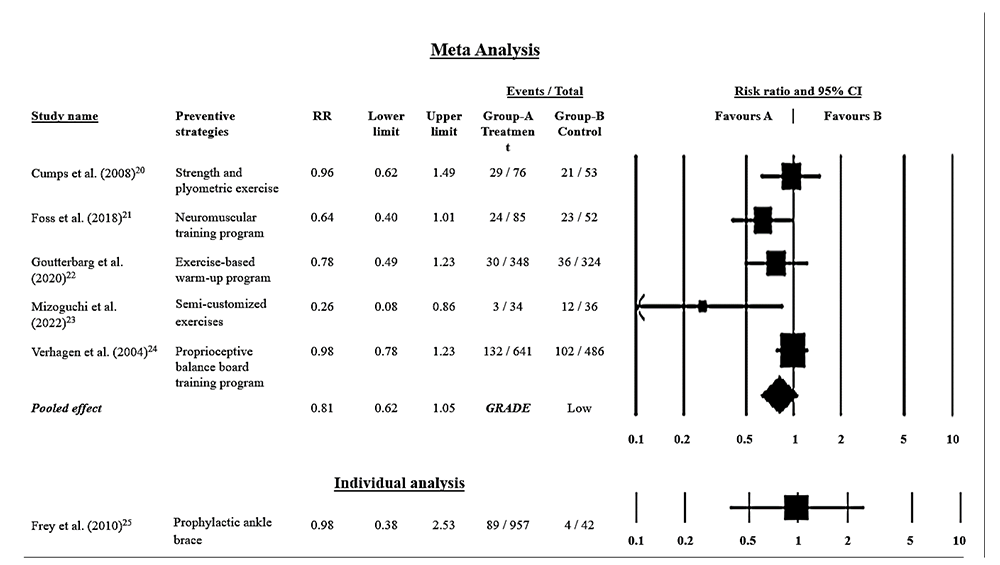
Total injuries: 50 (IG: 29; CG:21) |
| Month 2: Isometric strength in CKC |
Time loss: NR |
| Month 3: Sports specific skills and plyometrics |
Adherence/ acceptability: Of the initial 232 athletes, 103 withdrew (IG: 26; CG: 14), totaling 129 athletes. |
| Month 4: Eccentric load exercise. |
Follow-up: 4 months |
| n=76; gender=33F / 43M; age=mean age in years (range) 25.4 (6.3) |
|
| Control group: No intervention. Only the normal training routine. |
|
| n=53; gender=21M / 32F; age=mean age in years (range) 24.9 (5.7) |
|
|
NEUROMUSCULAR TRAINING PROGRAM
|
| Foss et al. (2018)21 |
N=137; Age=NR; Gender=NR |
Intervention group: The program consisted of exercises focused on the trunk and lower extremity. The sessions lasted 20 to 25 minutes and were held three times a week. With the beginning of the competition, the time was reduced to 10 to 15 minutes, twice a week. |
Incidence/prevalence of injuries |
| n=85; gender=NR; age=NR |
Total injuries: 47 (IG: 24; CG: 23) |
| Control group: Sham - It consisted of resisted running using elastic bands. |
Time loss: NR |
| n=52; gender=NR; age=NR |
Adherence/acceptability: NR |
| |
Follow-up: Followed by a season. |
|
EXERCISE-BASED WARM-UP PROGRAM
|
| Gouttebarg et al. (2020)22 |
N= 672 players; Age= ≥ 18 years; Gender=210M / 462F. |
Intervention group: Program (VolleyVeilig) consisted of 5 types of exercises (preparatory cardiovascular warm-up; core stability exercises; exercises aimed at preventing knee injuries, shoulder injuries and ankle injuries), each practiced for 2 to 5 minutes. |
Incidence/prevalence of injuries (acute and overuse) |
| n= 348 players; gender=132M / 216F; age (mean)=30 ± 11. |
Total injuries: 66 (IG: 30; CG: 36) |
| Details of the program were made available to the group via the website (https://www.volleyveilig.nl/). |
Time loss: |
| Control group: No intervention. Only usual warm-up and volleyball activities. |
IG: 3,217 days of lost time in volleyball; |
| n= 324 players; gender=78M / 246F; age (mean)=27 ± 10 |
CG: 2,934 days of lost time in volleyball; |
| |
Both groups had a mean severity of 1 day of lost time (range: 117). |
| |
Adherence/acceptability: |
| |
- Loss in follow up: 3 intervention group teams did not complete the follow up and there was a loss of 82 players. In the control group, there was a loss of 41 players. |
| |
Follow-up: Followed by a season |
|
SEMI-CUSTOMIZED EXERCISES
|
| Mizoguchi et al. (2022)23 |
N= 70 players; Age=NR; Gender=40M / 30F |
Intervention group: The intervention program was based on 9 physical function tests, as well as 1 or 2 exercises, which could be: (A) Trunk stabilization exercises. (B) Spinal flexibility exercises. (C) Jack-knife stretching. (D) Trunk rotation exercises (on all fours). (E) Iliopsoas stretching. (F) Quadriceps stretching. (G) Gastrocnemius stretching. |
Incidence/prevalence of injuries. |
| n=34 players; gender=22M / 12 F; age (means)=15.5 ± 0.5 |
Total injuries: 15 (IG: 3; CG: 12) |
| Control group: No intervention |
Times loss: NR |
| n=36 players; gender=18M / 18F; age (mean)=15.8 ± 0.8 |
Adherence/acceptability |
| |
IG: There was no loss |
| |
CG: There was no loss |
| |
Follow-up: 4 weeks |
|
PROPRIOCEPTIVE BALANCE BOARD TRAINING PROGRAM
|
| Verhagen et al. (2004)24 |
N=1.127 players; Age=NR; Gender=483M / 644F |
Intervention group: The program provided the trainer each week with 4 prescribed exercises: 1 exercise without any material; 1 exercise with a ball only; 1 exercise with a balance board only, and 1 exercise with a ball and a balance board. Each exercise was performed on both ankles, with a total duration of approximately five minutes for each exercise. |
Incidence/prevalence of injuries. |
| n=641 players; gender=286M / 355F; age (mean)=24.4 (2.8) |
Total injuries: 234 (IG: 132; CG: 102) |
| Control group: No intervention. Only normal training routine. |
Time loss (mean, SD): |
| n=486 players; gender=197M / 289F; age (mean)=24.2 (2.5) |
Acute injuries: IC: 4.6 (5.7) / CG: 4.0 (3.8) |
| |
Overuse injuries: IC: 3.1 (5.1) / CG: 4.0 (6.2). |
| |
Adherence/acceptability: 249 players in intervention group teams did not complete the follow up and in the control group, there was a loss of 193 players. |
| |
Follow-up: 9 months |
|
PROPHYLACTIC ANKLE BRACE
|
| Frey et al. (2010)25 |
N= 999; Age=NR; Gender=407M / 592F |
Intervention group: The players were instructed to wear the brace on the dominant ankle during all practices and games. |
Incidence of dominant ankle injury. |
| (n=957; gender=NR; age=NR) |
Total reported injuries: 93 (IG: 89; CG: 4) |
| Control group: No intervention - without bracing |
Time loss: NR |
| n=42; gender=NR; age=NR |
Adherence/acceptability: NR |
| |
Follow-up: Followed by a season |

 Prevención de las lesiones musculoesqueléticas en atletas de voleibol: una revisión sistemática de ensayos controlados aleatorizados
 Thumbnail
 Thumbnail