Variation in stem cutting propagation success among genotypes of feijoa (Feijoa sellowiana)
Abstract
Feijoa (Feijoa sellowiana) is a native species from southern Brazil and northeastern Uruguay, valued for its aromatic and edible fruit. The establishment of commercial orchards has been constrained by the limited rooting ability of selected cultivars, creating a major bottleneck for large-scale propagation. This study assessed the rooting performance of semi-hardwood stem cuttings from 49 plant selections and 11 commercial cultivars over two consecutive years (2023 and 2024). A randomized complete block design with five replicates was used. Each experimental unit consisted of ten semi-hardwood cuttings, 120–150 mm in length, collected in autumn from adult plants. Cuttings were placed in containers with a substrate composed of two-thirds perlite and one-third vermiculite, maintained in a greenhouse under intermittent misting for five months, without application of exogenous hormones. Rooting percentages across genotypes ranged from 7% to 85%, while callus formation varied between 6% and 85%. The average number of roots per rooted cutting ranged from three to twenty. Among commercial cultivars, rooting rates ranged from 28% to 52%. The results revealed wide variability in rooting ability among genotypes. Eighteen of the sixty genotypes exhibited rooting percentages above 50%, representing promising candidates for cultivar release or as parental material for breeding programs aimed at improving rooting ability.
Index terms
native fruit species; rooting; feijoa breeding; Myrtaceae
Resumo
A goiabeira-serrana (Feijoa sellowiana) é uma espécie nativa do sul do Brasil e do nordeste do Uruguai, muito apreciada por seus frutos comestíveis. A implantação de pomares comerciais tem apresentado dificuldades, pois as cultivares selecionadas por suas características agronômicas e pela qualidade dos frutos apresentam limitações no enraizamento, sendo a produção em larga escala de mudas um gargalo importante. Neste estudo, avaliou-se o enraizamento de estacas de 49 genótipos selecionados de goiabeira-serrana e 11 cultivares comerciais, por dois anos consecutivos (2023 e 2024). Foi realizado um experimento com cinco blocos casualizados, sendo a unidade experimental composta por 10 estacas semilenhosas de 120 a 150 mm de comprimento, mantidas em recipientes com substrato composto por 2/3 de perlita e 1/3 de vermiculita, em estufa com nebulização intermitente, durante cinco meses. Não foi realizada aplicação exógena de hormônios. A porcentagem de estacas enraizadas nos dois anos do estudo variou entre 7% e 85% entre os genótipos, a formação de calo variou de 6% a 85%, e o número médio de raízes por estaca variou entre 3 e 20. As cultivares comerciais apresentaram entre 28% e 52% deestacas enraizadas. 18 dos 60 genótipos selecionados apresentaram porcentagens de enraizamento superiores a 50%. Esses genótipos poderão ser utilizados diretamente como futuras cultivares ou como parentais em cruzamentos dirigidos, dependendo da avaliação global da expressão de outras características de importância produtiva e comercial.
Termos para indexação
frutíferas nativas; enraizamento; melhoramento genético de goiabeira-serrana; Myrtaceae
Introduction
Vegetative propagation is a natural mechanism of plant dispersal that enables the multiplication of a genotype while preserving its genetic identity. At the commercial level, various vegetative propagation or cloning techniques have been developed and are widely used, particularly in the multiplication of allogamous species where the use of sexual seeds is not suitable, as it does not retain the selected genotype and results in heterogeneous progeny. In perennial species such as fruit trees, cloning ensures the maintenance of quality traits of selected genotypes within breeding programs through the production of genetically identical plants (HARTMANN; KESTER, 1998).
These clones allow for the establishment of uniform commercial orchards that facilitate agronomic management and supply the market with homogeneous, high-quality fruit. Several vegetative propagation techniques are employed in fruit crops, including grafting, layering, cuttings, stooling, and micropropagation. Among them, propagation by stem cuttings is widely used due to its relative simplicity, low cost, and minimal space requirements, without the need for extensive infrastructure (AK et al., 2021). However, the rooting success rate of cuttings is highly variable, as it is a complex process involving the formation of adventitious roots from stem cells, a process not naturally occurring in these tissues. A large number of genes are involved in this process, making the genotype a major determinant of rooting success (ALMEIDA et al., 2017; BANNOUD; BELLINI, 2021).
In addition to genetic factors, several additional internal as well as external conditions influence rooting. Additional internal factors include the hormonal and nutritional balance in the cuttings, its degree of juvenility, as well as the mother plant’s phytosanitary and phenological state. External factors include substrate type, humidity levels, temperature, light quality, among others (ALVAREZ ARGUDÍN, 1996; HARTMANN; KESTER, 1998; ALMEIDA et al., 2017).
Feijoa, Feijoa sellowiana (O. Berg) O. Berg, previously placed in the genus Acca, has been reclassified back into Feijoa because phylogenetic analyses demonstrated that A. sellowiana is not closely related to the type species of the genus Acca (A. lanuginosa and A. macrostema), but instead forms a distinct lineage within the subtribe Pimentinae (LUCAS et al., 2019). It is a native fruit tree from Uruguay and southern Brazil which, although still underutilized, has gained popularity in recent years due to its high nutritional value (ROSERO et al., 2020). This growing interest has led several national and international institutions to include feijoa in their breeding programs, resulting in the development of several commercial cultivars in Uruguay (CABRERA et al., 2018, 2023), Brazil (SANTOS, 2018), Colombia (QUINTERO, 2003), New Zealand (THORP; BIELESKI, 2002), among others.
Similarly to other fruit-bearing plants, feijoa requires vegetative propagation to maintain desirable traits in commercial cultivation.
However, the rate of adventitious root formation shows considerable variability, primarily due to genetic factors (ROSS et al., 2017, 2021). In this context, the limited efficiency of vegetative propagation has been identified as a major bottleneck for the expansion of planted area with elite cultivars, as it restricts the large-scale production of planting material by commercial nurseries.
This constraint reduces plant availability and delays the adoption of improved genotypes by growers. Evaluating the range of rooting capacity among plant selections of a fruit tree breeding programs, followed by selection of genotypes that combine favorable agronomic traits with easy-to-root traits would significantly reduce the effort and complexity of commercial multiplication.
This, in turn, would accelerate the adoption of feijoa as a viable option for fruit growers in Uruguay.
The objective of this study was to evaluate the rooting capacity of 49 feijoa selections currently under evaluation in the feijoa breeding program led by the Instituto Nacional de Investigación Agropecuaria (INIA) and the Facultad de Agronomía (Fagro) of the Universidad de la República (Udelar). For comparison, 11 feijoa cultivars from Uruguay (4) and New Zealand (7) were also included in this study. The information generated will support the development of future commercial cultivars with enhanced rooting capacity and guide targeted breeding efforts aimed at incorporating this trait into the domestication and improvement pipelines of the species.
Materials and methods
The rooting capacity of 60 feijoa (Feijoa sellowiana) genotypes based on stem cuttings was evaluated. Forty-nine of 60 genotypes corresponded to feijoa selections from the feijoa breeding program in Uruguay, carried out by Instituto Nacional de Investigación Agropecuaria (INIA) and the Facultad de Agronomía (Fagro) of the Universidad de la República (Udelar).
These selections were chosen based on productivity, fruit size, and flavor, non-overlapping harvest dates, fruit shapes, and internal and external fruit color, among others. The remaining 11 genotypes corresponded with commercial cultivars: four developed by INIA-Fagro: INIA-Fagro Isleña, INIA-Fagro Cerrillana, INIA-Fagro Artillera, and INIAFagro Armonía as described by Cabrera et al. (2018, 2023). The other seven cultivars originated in New Zealand: Anatoki, Apollo, Kaiteri, Kakapo, Kakariki, Unique, Triumph (THORP; BIELESKI, 2002) for which, agronomic performance was recently described for the first time under growing conditions of Uruguay (RODRÍGUEZ et al., 2021).
The feijoa plants were maintained at INIA Native fruit tree introduction and evaluation garden, located at INIA-Las Brujas Wilson Ferreira Aldunate Experimental Station (Canelones, Uruguay; latitude 34°40’02” S, longitude 56°20’26” W, altitude 22 m a.s.l.).
The soil type is Brunosol, and plants are arranged in raised rows with a spacing of 4 m between rows and 2.5 m between plants, with localized drip irrigation. The average plant age is 10-years-old. Weed management and fertilization are performed following Uruguay’s integrated production standards for traditional fruit trees (MGAP, 2021). Inter-row areas are kept under grass cover, with mowing as needed, along with two annual herbicide applications in the rows. Organic fertilizers (chicken manure, 10 t ha-1) are applied every three years, supplemented with chemical fertigation using potassium nitrate in autumn (pre-harvest) and foliar applications of macro and micronutrients in spring. Plants are trained in a vase system with three or four leaders, and annual pruning is performed in winter.
Cuttings were collected in autumn, immediately after harvest, when donor plants were in a post-harvest vegetative stage, using mature semi-hardwood shoots from the current season’s growth. To standardize sampling with respect to the position of origin within the plant, cuttings were taken, whenever possible, from all cardinal orientations of the canopy and from portions of the canopy located more than 1 m above ground level.
The experiment was conducted using a randomized complete block design with five replications. Each experimental unit consisted of 10 semi-hardwood cuttings measuring 120 to 150 mm in length (three internodes) and approximately 5 mm in diameter, retaining only the two upper leaves without trimming. The rooting substrate consisted of a mixture of 2/3 perlite and 1/3 vermiculite. The study aimed to simulate conditions that could be easily replicated by fruit tree nursery growers in Uruguay.
Although these conditions do not represent optimal rooting conditions, they reflect a realistic management scenario. Cuttings were maintained in a greenhouse under intermittent misting (8 seconds every 12 minutes, from 9:00 a.m. to 6:00 p.m. daily), with relative humidity above 80%, without external heat, hot beds, or air temperature control (Figure 1).

Simplified diagram of the process of rooting semi-hardwood cuttings of feijoa at INIA Las Brujas, Canelones, Uruguay.
However, during the experimental period, the mean temperature recorded inside the greenhouse was 20 °C. Under these conditions, the trial required a period of five months from installation to evaluation.
The first-year trial was established on May 5, 2023, and was repeated in a second year on April 25, 2024, under the same conditions described in the previous one. At the end of each period, the number of rooted/ unrooted cuttings (yes/no), callus formation (yes/no), and the number of roots per rooted cutting were recorded for each genotype.
The response variables “rooted cutting” and “presence of callus” follow a binomial distribution; therefore, the following model was adjusted for rooting and callus formation data:
Y ~ Binomial(10, p)
ln(p / (1 - p)) = μ + Gi + Aj + (G × A)ij + Bk
i = 1, 2, ..., 60; j = 1, 2; k = 1, 2, 3, 4, 5
Where:
Y = number of rooted cuttings out of 10 / number of cuttings with callus out of 10
p = probability that a cutting in block k, of genotype i and year j, has roots / callus μ = overall mean
Gi = effect of the i-th genotype (Fixed effect) Ai = effect of the j-th year (Random effect) (G × A)ij = effect of genotype i in year j (Random interaction) Bk = effect of the k-th block (Random effect)
For the number of roots per cutting, which follows a Poisson distribution, the following model was adjusted:
Y ~ Poisson(λ)
ln(λ) = μ + Gi + Aj + (G × A)ij + Bk
i = 1, 2, ..., 60; j = 1, 2; k = 1, 2, 3, 4, 5
Where:
Y = number of roots per rooted cutting μ = overall mean Gi = effect of the i-th genotype (Fixed effect) Aj = effect of the j-th year (Random effect) (G × A)ij = effect of genotype i in year j (Random interaction) Bk = effect of the k-th block (Random effect)
Data analyses were performed using R statistical software version 4.4.1 (R CORE TEAM, 2024). For the binary variables “rooted cuttings” and “cuttings with callus,” a generalized linear mixed model (GLMM) was fitted using the glmmTMB function from the glmmTMB package. The model included genotype as a fixed effect, and year, block, and the genotype × year interaction as random effects to account for the structural variability of the experiment. A beta-binomial distribution with logit link was used, correcting for overdispersion and zero-inflation.
For the number of roots per cutting, the same function was used with a negative binomial distribution (to correct for overdispersion of the Poisson family) and a log link function. An analysis of variance was conducted to test the following null hypotheses: H01: All genotypes have the same probability of rooting; H02: All genotypes have the same probability of callus formation; H03: All genotypes form the same number of roots. A significant level of 0.05 was used for all analyses.
To evaluate the association between callus formation and root presence in cuttings for each genotype, 2×2 contingency tables were constructed including the binary variables presence/absence of callus and presence/absence of root, analyzed using chi-squared tests. Additionally, the phi coefficient (ϕ) was calculated in each analysis as a measure of the strength of association p-values less than 0.05 were considered statistically significant.
Results
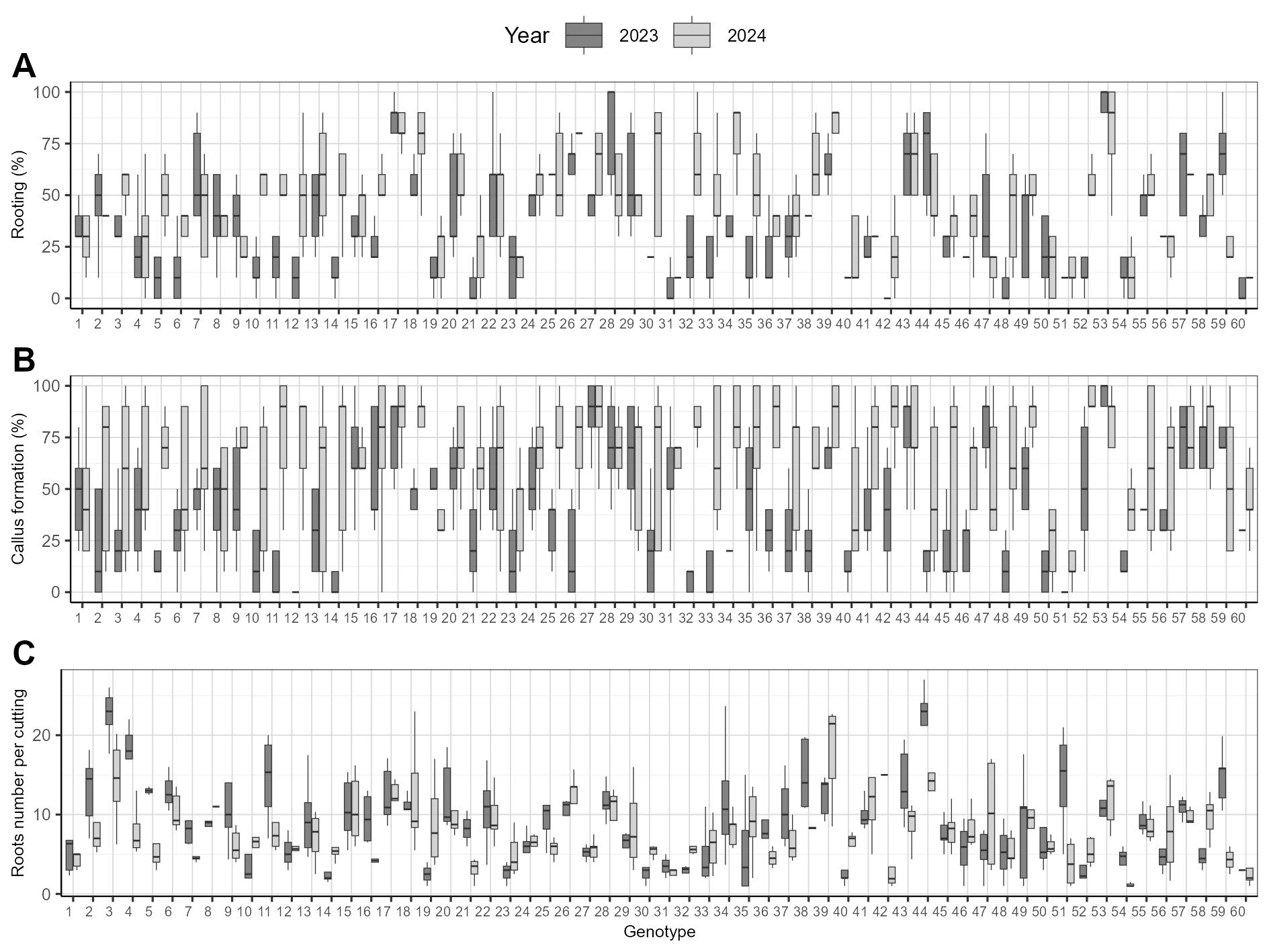
The average rooting percentage per genotype ranged from 7% to 85%, with an overall mean of 40% across the entire experiment (Figure 2A). The average callus formation per genotype ranged from 6% to 85%, with an overall mean of 51% across all genotypes (Figure 2B). In terms of the number of roots per cutting, the averages per genotype ranged from 3 to 20, with an overall mean of 9 (Figure 2C).
After fitting the models and verifying the assumptions, a deviance analysis was performed using Wald tests, which showed a significant effect of the genotype factor on all three evaluated variables: root formation (χ2 = 322, df = 59, p = 7.1×10-38), callus formation (χ2 = 200, df = 59, p = 3.3×10⁻¹⁷), and number of roots (χ2 = 413, df = 59, p = 1.7×10-54). These findings indicated that the null hypothesis can be rejected and suggested that the genotype factor significantly influenced all the analyzed variables.

Boxplots depicting rooting percentage (A), percentage of cuttings with callus (B), and number of roots per cutting (C) of 60 genotypes of feijoa (Feijoa sellowiana). Data is shown separately for the years 2023 and 2024.
The marginal and conditional R2 values for the fitted models are shown in Table 1. The marginal R2 represents the proportion of variance explained by fixed effects, while the conditional R2 reflects the total proportion of variance explained by the model, including both fixed and random effects. For the rooting response variable, the model explains 91% of the total variability, of which genotype, as a fixed effect, explains 74%, suggesting that, for this variable, the genotype component is a relevant predictive factor. Random effects contributed an additional 17%, with the variance associated with blocks being practically negligible(0.01).
Conversely, dissimilar results for either the relevance of random factors or the explanatory power of the fitted models were observed for the other two variables.
Regarding callus formation, the marginal R2 reached 43%, while the conditional R2 was 88%, indicating a considerable contribution of random effects, particularly year, with a variance of 0.37. Finally, for the number of roots per cutting, the marginal R2 was 27% and the conditional R2 was 31%, reflecting a lower explanatory capacity of the model for this variable.
When ranking genotypes according to rooting probability, three groups were identified: group 1 with the lowest rooting probability (less than 0.25); group 2 with rooting probability from 0.25 to 0.5; and group 3 with high rooting probability (greater than 0.5) (Figure 3). Group 1 included 11 genotypes, group 2 included 31 genotypes, and group 3 included the remaining 18.

Adjusted means and standard errors for the rooting probability of semi-hardwood cuttings from the 60 feijoa (Feijoa sellowiana) genotypes INIA Las Brujas, Canelones, Uruguay. Data are from two years of trials (2023 and 2024).
Regarding the rooting probability of the 11 cultivars from both Uruguay and New Zealand, all of them showed values higher than 0.25, whereas cultivar Unique (genotype 13) excelled with a rooting probability higher than 0.50, and was then the only cultivar placed in group 3.
The remaining 18 easy-to root selections from group 3 may be considered as either cultivar candidates or as parents in future targeted crosses. Among them, genotypes 53 (LB166) and 17 (LB606) stood out, with rooting probabilities above 0.75 and annual coefficients of variation of 8% and 0%, respectively (Figure 3). At the opposite end, genotypes 60 (LB89), 31 (LB143), and 42 (LB238) showed the lowest rooting probabilities, with values below 0.10, representing clear, difficult-to-root variants (Figure 3).
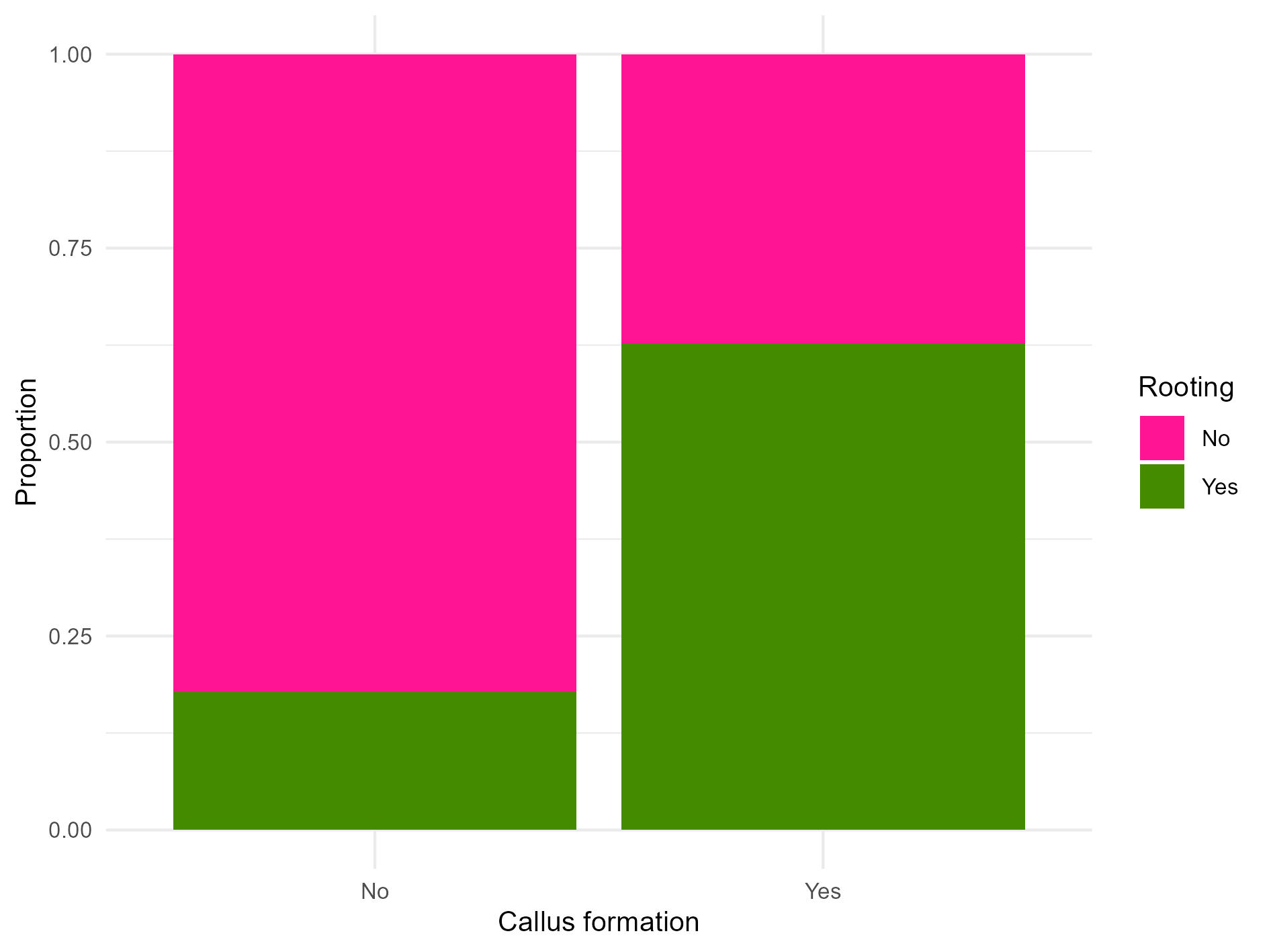
In order to analyze the patterns of association between the formation of root and callus, as recorded after a 5 month period, and across genotypes, we estimated the phi coefficient and implemented a contingency analysis. The estimated phi coefficient (ϕ) for the experiment was 0.46, indicating a moderate positive association. A value of 0 indicates total independence between the variables, while a value of 1 indicates a perfect association. In turn, for the contingency analysis, chi-square test (χ2 = 1249.7, p < 2.2e−16) confirmed a statistically significant association between these two variables.
Figure 4 shows that the proportion of rooted cuttings was higher when callus formation occurred, since 63% of the cuttings that formed callus also formed roots.
However, 18% of the cuttings that did not form a callus still developed roots, indicating that callus formation is not required in all cases for root formation.
When examining the degree of association between callus formation and adventitious root formation by genotype (Figure 5), three groups of genotypes could be distinguished: 18 genotypes with strong association (ϕ ≥ 0.5), 27 genotypes with moderate association (0.3 ≤ ϕ < 0.5), and 12 genotypes with weak association (ϕ < 0.3). In addition, except for a few cases, most of the genotypes showed significant associations between callus and root formation, regardless of the level of these association.

Proportion of rooted/unrooted semi-hardwood cuttings of 60 feijoa (Feijoa sellowiana) genotypes, according to occurrence of callus formation, after five months rooting period, INIA Las Brujas (Canelones, Uruguay).

Degree of association between the variables callus and root formation based on the phi coefficient (?) for semi-hardwood cuttings of 60 feijoa (Feijoa sellowiana) genotypes. ns: the association is not significant.
Discussion
Adventitious root formation is a complex developmental process affected by both endogenous and environmental factors.
The plant genotype makeup, one of the endogenous factors affecting rooting formation is currently the focus of intensive research. In fact, based on natural genetic variability, the individuals within a single plant species, can exhibit variable capacity to produce adventitious roots, even under controlled experimental conditions (PANETSOS et al., 1994; LEGUÉ et al., 2014; VILASBOA et al., 2019). In agreement with previous report in feijoa (ROSS et al., 2017, 2021), our study found a highly significant effect of feijoa genotype on the rooting capacity of semi-hardwood stem cuttings, expressed as the rooting probability, percentage of callus formation and number of roots per cutting. Notably, the variable rooting probability explained the highest percentage of variation, with low year-toyear variation. Moreover, the range of rooting capacity reported in the present study, was much larger than that reported by Silva et al. (2023), probably indicating that the feijoa accessions included in our study exhibited a more extensive genetic variability for this trait.
A large number of genes may be responsible for the adventitious root formation (ALMEIDA et al., 2017). In Arabidopsis thaliana, many genes have been involved in adventitious root production, including genes related to gibberellin biosynthesis, auxin homeostasis, xylem differentiation, and genes encoding ribosomal proteins (IBÁÑEZ et al., 2019).
In tree species, the challenges associated with adventitious root formation, as well as the multitude of factors involved have also been extensively documented (DÍAZ-SALA, 2021). Specifically in feijoa, genes involved in auxin homeostasis, such as AsPIN1 and AsTIR1, and the regulatory gene AsSHR, were suggested to play a role in the initiation of rhizogenesis (ROSS et al., 2024). The set of genes involved could be generating differential patterns in protein concentration and anatomical changes at the base of the cutting.
Ross et al. (2021) concluded that the low rooting capacity observed in certain feijoa genotypes may be related to the occurrence of a precocious juvenile-to-adult phase transition at stem tissues, coupled with a rapid development of periderm. These authors also showed that, as long as the tissues were still responsive, the low rooting capacity can be reversed with the application of exogenous auxins, thereby improving rooting in difficult-to-root genotypes. According to Silva et al. (2023), the rooting difficulty exhibited by feijoa might be associated with the rapid oxidation frequently observed at the base of the cuttings, caused by the high concentration of phenolic compounds that may affect the in situ availability of auxin, a rooting-related hormone. Moreover, these authors showed that this limitation can be mitigated through the use of treatment with antioxidants such as polyvinylpyrrolidone(PVP).
The formation of adventitious roots encompasses a sequence of distinct processes typically divided into four stages: (i) activation, when cells acquire competence to perceive external signals; (ii) induction, during which root primordia begin to form and cells initiate division; (iii) primordium formation, where the already structured primordium develops differentiating tissues; and (iv) growth, in which the primordium elongates, roots emerge, and vascular connections become established (LEGUÉ et al., 2014).
Some authors extend this view by describing how, in the early stages, cellular proliferation associated with the xylem gives rise to a seemingly disorganized mass called callus. Only a subset of these callus cells are specified as “root founder cells,” from which root primordia originate (BUSTILLO-AVENDAÑO et al., 2018). However, the functional relationship between callus formation and adventitious rhizogenesis remains fully unresolved.
In our data, we found a positive and highly significant association between callus formation and adventitious root formation (ϕ = 0.46; χ2 = 1249.7; p < 2.2 × 10⁻¹⁶).
Conversely, Singh and Ansari (2014) studied vegetative propagation through air layering, and they reported exactly the opposite: a negative correlation, suggesting that callus formation could inhibit root development by competing for the plant’s available resources. The same authors argued that callus formation represents a wound-healing mechanism prioritized by the plant, but not necessarily directly linked to rhizogenesis; the simultaneous occurrence of both processes may instead reflect their regulation by the same environmental factors.
Indeed, anatomical observations in Eucalyptusspecies have documented the emergence of adventitious roots from specific callus cells (ELIYAHU et al., 2020). This pathway, known as indirect organogenesis in contrast to direct organogenesis, where roots differentiate directly from cambial cells (KHANAM et al., 2022), can lead to reduced survival rates during acclimatization, since roots formed via the indirect route generally lack proper vascular connections with the rest of the plant (SALAZAR et al.,2005).
In our study, 18% of the cuttings developed roots without callus formation, and in three genotypes, no significant relationship was found between callus formation and rooting. This indicates that the adventitious rooting model proposed by Bustillo- Avendaño et al. (2018), which includes an intermediate callus formation stage, does not apply universally to all feijoa genotypes and is strongly dependent on the environmental conditions during propagation.
In certain Populus species, callus induction may precede root primordium differentiation, while in other cases, root primordia arise from vascular cells without a clearly defined intermediate callus stage (LEGUÉ et al., 2014; BANNOUD;BELLINI, 2021). We observed that the frequency of callus formation (%) varied widely among feijoa genotypes, as also reported for other species (BANNOUD; BELLINI, 2021; COSTA et al., 2024).
Some of our genotypes showed as little as 6% of cuttings with calluses, while others reached up to 85%. The fitted statistical model explained 88% of the observed variability in callus formation, of which 43% was attributed to the genotype effect, and the remainder to random variables, particularly year (σ2 = 0.37).
Some previous studies did not observe callus formation in feijoa cuttings after 28 days under controlled conditions (28 °C, 60% relative humidity) (ROSS et al., 2021), nor in Eucalyptus (BRYANT;TRUEMAN, 2015). However, Silva et al. (2023) also did not detect callus formation before 60 days, but after that period, callus development ranged from 7.5% to 50%, depending on treatments involving different doses and application methods of IBA and PVP. The conditions of our study, which aimed to simulate commercial nursery practices without strict control of optimal temperature and humidity thresholds, extended the time required (up to five months) for root formation and may, in some cases, have favored callus development.
Ross et al. (2021) found no effect of exogenous auxin application on callus formation, whereas Sánchez et al. (2009) reported that IBA concentration affected callus formation in guava (Psidium guajava), even completely inhibiting it at 6000 mg L-1.
Conversely, in Eucalyptus camaldulensis, callogenesis increased significantly when cuttings were exposed to exogenous auxins, although responses varied depending on genotype and the type of auxin used (COSTA et al., 2024).
This genotype- and environment-dependent variability reinforces the notion that the relationship between callogenesis and adventitious rhizogenesis is complex and not always linear. Moreover, callus formation is not necessarily a sign of successful rooting; even roots that do form may not be physiologically functional.
Although the number of roots per cutting showed significant differences between genotypes consistent with previous reports (ROSS et al., 2021) this variable accounted for the lowest explanatory power in the adjusted models, with marginal and conditional R2 values of 0.27 and 0.31, respectively.
This suggests that both the fixed and random effects included in the model explain only a limited proportion of the observed variability. The low variance attributable to year, block, and the genotype- year interaction may indicate that other sources of variation were not taken into account, such as individual differences between cuttings related to size, position on the branch, or basal diameter, since these factors may affect the level of nutrient available in the cutting (SCHWAMBACH et al., 2005). Nonetheless, from a practical perspective, the main objective of vegetative propagation is to ensure that the cutting generates at least one functional root. However, a greater number of roots could offer important advantages in terms of post-transplant survival, field establishment, and vigor during the first years of growth (HARTMANN; KESTER, 1998).
Zhang et al. (2011) argue that propagation by seeds or grafting may promote better long-term field performance in feijoa, especially regarding vegetative growth.
However, seed propagation does not guarantee the genetic uniformity desired in commercial production systems, and grafting should be evaluated against cutting propagation, considering aspects such as the simplicity of the methods and plant performance after transplanting. According to Wang et al. (2025), grafting in feijoa has shown promising results. It is likely that genotypes differ in their response to each propagation method, suggesting that management practices should be adjusted according to the cultivar used.
In this study, we showed that the effect of feijoa genotypes accounted for most of the variance (74%) of the rooting probability, indicating high heritability, as has also been recently reported for other species (ZHANG et al., 2026). This result has important implications for breeding programs, as it suggests that adventitious rooting capacity can be considered a selectable trait.
In clonal crops and perennial woody species, the success of vegetative propagation is closely linked to the efficiency of genotype fixation and the large-scale multiplication of superior individuals. Therefore, the identification of genotypes with high rooting capacity not only facilitates nursery propagation but also reduces production costs and increases the feasibility of implementing improved cultivars (HARTMANN; KESTER, 1998; BANNOUD; BELLINI, 2021).
From a breeding perspective, incorporating rooting capacity as a selection criterion could accelerate the development of elite cultivars that combine desirable agronomic traits with ease of clonal propagation.
This approach has been widely adopted in forest tree breeding programs, where rooting ability is considered a key trait for the operational deployment of selected genotypes (LEAKEY, 2014; BANNOUD; BELLINI, 2021). Similarly, in fruit crops, compatibility between breeding and propagation methods is essential to ensure that selected genotypes can be efficiently transferred from breeding programs to commercial production systems.
In this context, the high variability observed among feijoa genotypes represents an opportunity to identify and exploit easy-toroot germplasm, as those genotypes with higher rooting probability (greater than 0.50) could be candidates for direct release as cultivars or as parental material in breeding schemes aimed at combining rooting capacity with fruit quality and productivity traits. Ultimately, the success of a breeding program in clonally propagated species depends not only on the identification of superior genotypes, but also on their ability to be efficiently propagated at a large scale.
This study contributes to the development of simple and commercially viable strategies for excised-based propagation of genetically identical plants (clones), facilitating the establishment of commercial orchards of future feijoa cultivars. It also raises new research questions for feijoa, regarding the nature of the association between callus and root formation that warrant further research.
Conclusions
Vegetative propagation of Feijoa sellowiana using semi-hardwood cuttings is feasible, enabling the multiplication of genetically identical plants (clones) and facilitating the establishment of commercial orchards. The strong effect of genotype on rooting probability indicates that this trait could be incorporated into breeding programs, although its expression is also influenced by environmental conditions.
Furthermore, the results show that adventitious rooting is a complex process in which callus formation is not consistently associated with successful root development, suggesting the existence of different rhizogenesis pathways depending on the genotype.
The observed variability represents an opportunity to identify and exploit easy-toroot germplasm for cultivar development, facilitating nursery propagation and the implementation of production systems based on selected genotypes. Consequently, incorporating rooting capacity into breeding strategies could contribute to the development of elite cultivars that combine propagation efficiency with desirable agronomic and fruit quality traits. These findings highlight the importance of integrating vegetative propagation traits into breeding programs for fruit species such as Feijoa sellowiana.
Data Availability:
References
- AK, B.E.; HATIPOGLU, I.H.; DIKMETAS, B. Propagation of fruit trees. In: PAKYÜREK, M. (ed.). Recent headways in pomology Ankara: Iksad Publications, 2021. v.1, p.55-92.
-
ALMEIDA, M.R.; AUMOND, M.; DA COSTA, C.T.; SCHWAMBACH, J.; RUEDELL, C.M.; CORREA, L.R.; FETT-NETO, A.G. Environmental control of adventitious rooting in Eucalyptus and Populus cuttings. Trees, Berlin, v.31, p.1377-90, 2017. https://doi.org/10.1007/s00468-017-1550-6
» https://doi.org/10.1007/s00468-017-1550-6 - ALVAREZ ARGUDÍN, J. Propagación vegetativa de los árboles frutales Montevideo: Hemisferio Sur, 1996. 217 p.
-
BANNOUD, F.; BELLINI, C. Adventitious rooting in Populus species: update and perspectives. Frontiers in Plant Science, Lausanne, v.12, p.668837, 2021. https://doi.org/10.3389/fpls.2021.668837
» https://doi.org/10.3389/fpls.2021.668837 -
BRYANT, P.H.; TRUEEMAN, S.J. Stem anatomy and adventitious root formation in cuttings of angophora, corymbia and eucalyptus. Forests, Basel, v.6, n.4, p.1227-38, 2015. https://doi.org/10.3390/f6041227
» https://doi.org/10.3390/f6041227 -
BUSTILLO-AVENDAÑO, E.; IBÁÑEZ, S.; SANZ, O.; BARROS, J.A.S.; GUDE, I.; PERIANEZ-RODRIGUEZ, J.; MICOL, J.L.; DEL POZO, J.C.; MORENO-RISUENO, M.A.; PÉREZ-PÉREZ, J.M. Regulation of hormonal control, cell reprogramming, and patterning during de novo root organogenesis. Plant Physiology, New York, v.176, n.2, p.1709-27, 2018. https://doi.org/10.1104/pp.17.00980
» https://doi.org/10.1104/pp.17.00980 - CABRERA, D.; VIGNALE, B.; MACHADO, G.; RODRÍGUEZ, P.; ZOPPOLO, R.; NEBEL, J.P. Primeras selecciones registradas de guayabo del país en Uruguay. Revista INIA, Montevideo, n.52, p.29–32, 2018.
- CABRERA, D.; VIGNALE, B.; RODRÍGUEZ, P.; LUIZZI, D.; DINI, M. 'Inia fagro armonía': nuevo cultivar de guayabo del país para Uruguay. Revista INIA, Montevideo, n.75, p.71-6, 2023.
-
COSTA, L.J.; SILVEIRA, G.V. dos S.; SILVA, C.; SCATOLINO, M.V.; ARAÚJO, P.C.D. Cutting of Eucalyptus camaldulensis tree aiming vegetative rescue of selected genotypes in semiarid conditions. Revista Árvore, Viçosa, MG, v.48, e-4821, 2024. https://doi.org/10.53661/1806-9088202448263769
» https://doi.org/10.53661/1806-9088202448263769 -
DÍAZ-SALA, C. Adventitious root formation in tree species. Plants, Basel, v.10, n.3, p.486, 2021. https://doi.org/10.3390/plants10030486
» https://doi.org/10.3390/plants10030486 -
ELIYAHU, A.; DUMAN, Z.; SHERF, S.; GENIN, O.; CINNAMON, Y.; ABU-ABIED, M.; WEINSTAIN, R.; DAGF, A.; SADOT, E. Vegetative propagation of elite Eucalyptus clones as food source for honeybees (Apis mellifera); adventitious roots versus callus formation. Israel Journal of Plant Sciences, Jerusalem, v.67, n.1-2, p.83-97, 2020. https://doi.org/10.1163/22238980-20191112
» https://doi.org/10.1163/22238980-20191112 - HARTMANN, H.T.; KESTER, D.E. Propagación de plantas: principios y prácticas. 2.ed. Mexico: Continental, 1998.
-
IBÁÑEZ, S.; RUIZ-CANO, H.; FERNÁNDEZ, M.A.; SÁNCHEZ-GARCÍA, A.B.; VILLANOVA, J.; MICOL, J.L.; PÉREZ-PÉREZ, J.M. A network-guided genetic approach to identify novel regulators of adventitious root formation in Arabidopsis thaliana. Frontiers in Plant Science, Lausanne, v.10, n.461, 2019. https://doi.org/10.3389/fpls.2019.00461
» https://doi.org/10.3389/fpls.2019.00461 -
KHANAM, M.N.; ANIS, M.; JAVED, S.B.; MOTTAGHIPISHEH, J.; CSUPOR, D. Adventitious root culture—an alternative strategy for secondary metabolite production: a review. Agronomy, Madison, v.12, n.5, e-1178, 2022. https://doi.org/10.3390/agronomy12051178
» https://doi.org/10.3390/agronomy12051178 - LEAKEY, R.R.B. Plant cloning: macropropagation. In: VAN ALFEN, N. (ed.). Encyclopedia of agriculture and food systems San Diego: Elsevier, 2014. v.4, p.349-59. https://doi.org/10.1016/B978-0-444-52512-3.00223-0
-
LEGUÉ, V.; RIGAL, A.; BHALERAO, R. P. Adventitious root formation in tree species: involvement of transcription factors. Physiologia Plantarum, Oxford, v.151, n.2, p.192-8, 2014. https://doi.org/10.1111/ppl.12197
» https://doi.org/10.1111/ppl.12197 -
LUCAS, E.; HOLST, B.; SOBRAL, M.; MAZINE, F. F.; NIC LUGHADHA, E.; PROENÇA, C. E. B.; COSTA, I. R.; VASCONCELOS, T. N. C. A new subtribal classification of tribe Myrteae (Myrtaceae). Systematic Botany, Tallahassee, v.44, n.3, p.560-9, 2019. https://doi.org/10.1600/036364419X15620113920608
» https://doi.org/10.1600/036364419X15620113920608 -
MGAP – MINISTERIO DE GANADERÍA, AGRICULTURA Y PESCA. DGSA – DIRECCIÓN GENERAL DE SERVICIOS AGRÍCOLAS. Norma para la producción integrada de manzano: actualización 2020. 2021. Disponível em: https://www.gub.uy/ministerio-ganaderia-agriculturapesca/comunicacion/publicaciones/norma-para-produccion-integradamanzano-actualizacion-2020 Acesso em: 14 ago. 2025.
» https://www.gub.uy/ministerio-ganaderia-agriculturapesca/comunicacion/publicaciones/norma-para-produccion-integradamanzano-actualizacion-2020 -
PANETSOS, K. P.; SCALTSOYIANNES, A.; ALIZOTI, P. Effect of genotype and cutting type on the vegetative propagation of the pine hybrid (Pinus brutia (Ten) × Pinus halepensis (Mill)). Annales des Sciences Forestières, San Francisco, v.51, p.175-82, 1994. https://doi.org/10.1051/forest:19940208
» https://doi.org/10.1051/forest:19940208 - QUINTERO, C. O. Selección de cultivares, manejo del cultivo y regulación de cosechas de feijoa. In: FISCHER, G.; MIRANDA LASPRILLA, D.; CAYÓN SALINAS, G.; MAZORRA AGUDELO, M. (org.). Cultivo, poscosecha y exportación de la feijoa Bogotá: Produmedios, 2003. p.49–70.
-
R CORE TEAM. R: a language and environment for statistical computing. Vienna: R Foundation for Statistical Computing, 2024. Disponível: https://www.r-project.org/ Acesso em: 10 abr 2024.
» https://www.r-project.org/ - RODRÍGUEZ, P.; ZOPPOLO, R.; CABRERA, D. Evaluación de cultivares de guayabo del país -Acca sellowiana (Berg) Burret- introducidos desde Nueva Zelanda. Revista INIA, Montevideo, n.65, p.56–59, 2021.
-
ROSERO, L.; HERNÁNDEZ, D.; ORTÍZ, D. Propiedades fisicoquímicas y nutricionales en la pre y poscosecha de la guayaba feijoa (Acca sellowiana). Hashtag, Dundee, v.1, n.16, v.32–43, 2020. https://doi.org/10.52143/2346139X.810
» https://doi.org/10.52143/2346139X.810 -
ROSS, S.; PECHI, E.; SPERONI, G.; VIGNALE, B.; SPERANZA, P.; CASTILLO, A.; CABRERA, D. In vitro rooting of Acca sellowiana microshoots. Acta Horticulturae, The Hague, v.1155, p.537-41, 2017. https://doi.org/10.17660/ActaHortic.2017.1155.79
» https://doi.org/10.17660/ActaHortic.2017.1155.79 -
ROSS, S.; RODRÍGUEZ-DECUADRO, S.; PÉREZ, G.; SCALTRITTI, J. P.; BORSANI, O.; SPERANZA, P. Validation and expression analysis of candidate genes for adventitious rooting, in micro-cuttings of Acca sellowiana (Myrtaceae). Acta Physiologiae Plantarum, Heidelberg, v.46, 2024. https://doi.org/10.1007/s11738-024-03682-4
» https://doi.org/10.1007/s11738-024-03682-4 -
ROSS, S.; SPERONI, G.; SOUZA-PÉREZ, M.; ÁVILA, N.; PIETRO, F.; GONZÁLEZ, A. M.; SPERANZA, P. Stem-cutting anatomy and biochemical responses associated with competence for adventitious root differentiation in Acca sellowiana (Myrtaceae). Trees, Berlin, v.35, p.1221-32, 2021. https://doi.org/10.1007/s00468-021-02110-1
» https://doi.org/10.1007/s00468-021-02110-1 -
SALAZAR, R.; VARGAS, T.E.; DE GARCIA, E.; OROPEZA, M. Micropropagación y organogénesis de Aster ericoides cultivar "Monte Cassino". Interciências, Caracas, v.30, e-5. 2005. Disponível em: https://ve.scielo.org/scielo.php?script=sci_arttextepid=S0378-18442005000500010 Acesso em: 20 ago. 2025
» https://ve.scielo.org/scielo.php?script=sci_arttextepid=S0378-18442005000500010 - SÁNCHEZ URDANETA, A.B.; SUÁREZ, E.; GONZÁLEZ, M.R.; AMAYA, Y.; COLMENARES, C.B.; ORTEGA, J. Efecto del ácido indolbutírico sobre el enraizamiento de acodos aéreos de guayabo (Psidium guajava L.) en el municipio Baralt, Venezuela: evaluación preliminar. Revista UDO Agrícola, Cumaná, v.9, n.1, p.113–120, 2009.
- SANTOS, K.L. dos; CIOTTA, M.N.; DONAZZOLO, J.; BORSUK, L.J.; NODARI, R.O. Domesticação da espécie. In: TAGLIARI, P.S. (org.). A cultura da goiabeira-serrana Florianópolis: EPAGRI, 2018. p.41–57.
-
SCHWAMBACH, J.; FADANELLI, C.; FETT-NETO, A. G. Mineral nutrition and adventitious rooting in microcuttings of Eucalyptus globulus. Tree Physiology, Oxford, v.25, p.487-94, 2005. https://doi.org/10.1093/treephys/25.4.487
» https://doi.org/10.1093/treephys/25.4.487 -
SILVA, J. C. da; SILVA TOGNON, L. da; MARTINS, Y. G.; SANTOS, K. L. dos; PICOLOTTO, L.; ARAÚJO, L.; LENCINA, K.H. Enraizamento de estacas de Feijoa sellowiana com uso de antioxidante. Agropecuária Catarinense, Florianópolis, v.36, n.2, p.42-7, 2023. https://doi.org/10.52945/rac.v36i2.1601
» https://doi.org/10.52945/rac.v36i2.1601 -
SINGH, S.; ANSARI, S.A. Callus formation impedes adventitious rhizogenesis in air layers of broadleaved tree species. Annals of Forest Research, Ilfov, v.57, n.1, p.47–54, 2014. https://doi.org/10.15287/afr.2014.189
» https://doi.org/10.15287/afr.2014.189 - THORP, G.; BIELESKI, R. Feijoas: origins, cultivation and uses. Auckland: HortResearch, 2002. 87 p.
-
VILASBOA, J.; COSTA, C.T. da; FETT-NETO, A.G. Rooting of eucalypt cuttings as a problem-solving oriented model in plant biology. Progress in Biophysics and Molecular Biology, Oxford, v.146, p.85-97, 2019. https://doi.org/10.1016/j.pbiomolbio.2018.12.007
» https://doi.org/10.1016/j.pbiomolbio.2018.12.007 -
WANG, H.D.; XIONG, Y.F.; PENG, L.; WANG, Y.X.; ZHANG, G.Q.; HUANG, R.H. Research on grafting propagation of feijoa. Global Agronomy Research Journal, Jingmen, v.2, n.3, p.1–3, 2025. https://doi.org/10.54660/GARJ.2025.2.3.01-03
» https://doi.org/10.54660/GARJ.2025.2.3.01-03 - ZHANG, M.; WANG, D.; SHAO-XIONG, R.; LI-ZHANG, F. Study on growth characteristics of young feijoa trees in different propagation methods. Botany Research Journal, Faisalabad, v.4, n.3, p.26-8, 2011.
-
ZHANG, X.; SUN, W.; SU, J.; LI, Y.; JIANG, J.; GUAN, Z.; CHEN, F.; FANG, W.; ZHANG, F. Elucidation of the genetic basis underlying rooting ability in vegetatively propagated chrysanthemum. Horticulture Research, London, v.13, n.2, 2026. https://doi.org/10.1093/hr/uhaf289
» https://doi.org/10.1093/hr/uhaf289