
 Continuous foliar nitrogen application induces a trade-off between vegetative growth and reproductive quality in passion fruit
Abstract:
Unscientific application of nitrogen (N) has attracted global concerns and the trade-offs effect associated with continuous foliar N on growth, yield, and fruit quality in passion fruit (Passiflora edulis Sims) remain unclear. A completely randomized design was used, with five treatments and 30 plants per treatment. Seedlings were treated with foliar sprays of water (Control, CK), low-concentration (0.1%) urea (UL) and high-concentration (0.5%) urea (UH), low-concentration compound water-soluble fertilizer (WFL) and high-concentration compound water-soluble fertilizer (WFH) on the 15th, 30th and 45th day post-planting. Data were subjected to one-way ANOVA. Where significant differences were detected, mean values were further compared using Duncan’s multiple range test. It was found that UL increased height by 35.63% compared to CK but caused thin and weak stems via internode elongation, compromising architecture. However, UL increased stomatal aperture, net photosynthetic rate (Pn), stomatal conductance (Gs), and electron transfer rate (ETR). Notably, key N-assimilation enzymes-asparagine synthase (AS), glutamate dehydrogenase (GDH), NADH-dependent glutamate synthase (NADH-GOGAT), and glutamine synthetase (GS)-peaked under UL, but UH significantly inhibited them. Interestingly, phosphorus content showed a significant positive correlation (p < 0.05) with all enzyme activities, highlighting its critical role in N assimilation. Moreover, high-concentration treatments (UH and WFH) adversely affected the yield and fruit quality, which reduced yield by 15.69-22.59%, diminished fruit size, lowered fruit antioxidants (flavonoids and total phenols) compared to CK. In conclusion, low-concentration urea (0.1%) optimized the growth-yield balance, but a comprehensive strategy incorporates growth regulators, water management, supplementary lighting, and micro-fertilizers is necessary to achieve quality compensation.
Index terms
Passion fruit; flavonoids; photosynthetic traits; principal component analysis; stomatal morphology
Resumo:
A aplicação não científica de nitrogênio tem gerado preocupações globais, e os efeitos compensatórios associados à aplicação contínua de nitrogênio foliar sobre o crescimento, produtividade e qualidade dos frutos do maracujá (Passiflora edulisSims)permanecem pouco claros. Foi utilizado um delineamento inteiramente casualizado, com cinco tratamentos e 30 plantas por tratamento. Mudas foram tratadas com pulverizações foliares de água (controle, CK), ureia em concentrações baixa (0,1%) e alta (0,5%) (UL,UH), e fertilizante composto hidrossolúvel (WFL, WFH) aos 15, 30 e 45 dias após o plantio. Realizou-se ANOVA unifatorial; diante de diferenças significativas, as médias foram comparadas pelo teste de Duncan. UL aumentou a altura em 35,63% em comparação com CK, mas causou caules finos e fracos devido ao alongamento dos entrenós, comprometendo a arquitetura da planta. No entanto, UL aumentou a abertura estomática, a fotossínteselíquida (Pn), a condutância (Gs) e a taxa de transferência de elétrons (ETR). Notavelmente, as principais enzimas de assimilação de nitrogênio - asparagina sintetase (AS), glutamato desidrogenase(GDH), NADH-glutamato sintase (NADH-GOGAT) e glutamina sintetase (GS) -atingiram o pico sob UL, enquanto UH as inibiu significativamente. Curiosamente, o teorde fósforo apresentou uma correlação positiva significativa (p < 0,05) com todas asatividades enzimáticas, destacando seu papel crítico na assimilação de nitrogênio. Além disso, tratamentos com alto teor de nitrogênio (UH, WFH) afetaram negativamente o rendimento e a qualidade dos frutos, reduzindo o rendimento em 15,69–22,59%, diminuindo o tamanho dos frutos e reduzindo antioxidantes (flavonoides, fenóis totais) em comparaçãocom CK. Em conclusão, a ureia em baixa concentração (0,1%) otimizou o equilíbrio entre crescimento e rendimento, mas uma estratégia abrangente que incorpore reguladores decrescimento, manejo hídrico, iluminação suplementar e microfertilizantes é necessária para alcançar uma compensação de qualidade.
Termos para indexação
Maracujá; flavonoides; características fotossintéticas; análise de componentes principais,; morfologia estomática
Introduction
The genus Passiflora L. comprises approximately 520 species, predominantly native to the tropical and subtropical regions of the Americas (LIU et al., 2022b). These species serve dual purposes as fruits and resources for ornamental horticulture, food processing, and pharmaceuticals (ARAYA et al., 2017).
Among them, the edible Passiflora, commonly known as passion fruit, is extensively cultivated in Brazil, Colombia, Australia, East Asia, and Southeast Asia. In China, the cultivation area of passion fruit surpassed 70,000 hectares in 2024, yielding over 1.02 million tons annually, making the country one of the major global producers and consumers (GIOPPATO et al., 2019). It has been recognized that passion fruit is rich in bioactive compounds with antioxidant properties, including carotenoids (β-carotene and lutein), polyphenols (gallic acid, resveratrol, and neochlorogenic acid), and flavonoids. It became a best-selling fruit with both edible and medicinal value. Therefore, its global consumption has been growing at a rate of 15-20% annually (ZHAO et al., 2023).
However, the yield of passion fruit is generally low China, especially in Guizhou, chronic soil N deficiency severely limits yields of passion fruit. The total soil N averages 0.1%, which is significantly below the 0.25% in Corvallis region (PHILLIPS et al., 2022). In this context, while traditional soil fertilization can partially alleviate N constraints, it suffers from issues such as low utilization efficiency and high environmental risks.
Therefore, exploring efficient N supplementation strategies is particularly important.As a direct and rapid nutrient delivery method, foliar fertilization can effectively avoid soil fixation and leaching, improve N use efficiency, and offers a highly promising technical approach to enhancing the N nutrition status in Guizhou’s passion fruit production areas.
N is often referred to as the “element of life” due to its essential role as a constituent of proteins, nucleic acids, phospholipids, chlorophyll, rubisco, and various other organic compounds. It plays an indispensable and irreplaceable role in the growth and development of plants. The primary forms of N absorbed by plants include ammonium (NH4+), nitrate (NO3-), and organic N (e.g., urea and small-molecule amino acids).
Through evolutionary adaptation, species have developed distinct preferences for specific N forms. For instance, ammonium N has been shown to inhibit root development in Creeping Bentgrass (GLINSKI et al., 1990), while simultaneously promoting the growth of moso bamboo (Phyllostachys edulis) seedlings (ZOU et al., 2020). Additionally, the growth of citrus is constrained by the ratio of nitrate to ammonium N (BOARETTO, et al., 2024).
Most terrestrial plants primarily absorb N through two mechanisms. The first is root absorption, where ionized N or small-molecular amino acids enter the xylem of vascular bundles via extracellular or symplastic pathways. These nutrients are then transported to the aerial parts of the plant through the combined actions of transpiration tension and root pressure. The second mechanism involves the absorption of N through leaves and stems, independent of root systems. N can enter the plant through stomata, pores, or cuticle openings and can be utilized for plant metabolism by reaching the cytoplasmic membrane via extracellular filaments in the cell wall. Generally, root absorption serves as the primary source of N for plants. Nevertheless, roots are particularly vulnerable during the seedling stage.
While root absorption is the primary pathway for N uptake, root systems-particularly during the seedling stage-are vulnerable to low temperatures and insufficient soil moisture, which limit nutrient absorption efficiency (CHEN et al., 2018). Foliar application can bypass these limitations by delivering N directly through stomata and cuticular pores (GHOLAMI et al., 2011).
Urea is a highly efficient N fertilizer, with an annual global sales volume of approximately 180 million tons. Over 90% of this is utilized in agricultural production, accounting for more than 50% of total N fertilizer usage.
The application of urea or compound water- soluble fertilizers, primarily composed of urea, through foliar spraying offers low dosage, ease of absorption, rapid efficiency, and cost-effectiveness. This method is commonly employed by Chinese growers to accelerate the growth of passion fruit seedlings.
Research has demonstrated that the addition of N can increase crop yields by over 71%, which is significant for alleviating global famine and enhancing food security (JU et al., 2009). However, the widespread application of N fertilizers contributes not only to environmental issues such as soil acidification and water eutrophication but also leads to adverse effects on plants, including overgrowth, reduced resistance, inhibition of the absorption of other essential elements, toxicity to leaves and roots, delayed flowering, and poor fruit development.
These consequences have attracted global attention due to their adverse impact on crop yield and quality (WANG et al., 2021).
Despite the widespread use of foliar N fertilizers, the trade-off effects associated with continuous foliar N application on the balance between vegetative growth and reproductive quality in passion fruit remain poorly understood. Therefore, this study aimed to evaluate the effects of continuous foliar application of different N sources (urea and compound water-soluble fertilizer) at two N concentrations (0.1% and 0.5%) on agronomic traits, photosynthetic parameters, N assimilation enzyme activities, elemental content, yield, and fruit quality in passion fruit (Passiflora edulis Sims). The findings will provide a scientific basis for optimizing N management strategies to balance vegetative growth and reproductive outcomes in passion fruit production.
Materials and Methods
Experimental site
This experiment was conducted in a greenhouse of the Plant Germplasm Resources Conservation Center at the Guizhou Academy of Sciences (26°58’N, 106°82’E), at an elevation of 1051 m above sea level.
The site consisted of five plots, with each measuring 50 m × 4 m, and separated by 0.6 m-wide cement corridors. During the experimental period, environmental conditions were recorded daily and maintained at 25–32°C with 55–65% humidity. Soil analysis of the 0–20 cm-thick layer of the topsoil revealed the following traits: pH 6.5- 6.9, total N 2.42 g·kg-1, hydrolyzed N 124.64 mg·kg-1, total phosphorus (P) 1.25 g·kg-1, total potassium (K) 12.86 g·kg-1, available K 781.50 mg·kg-1, cation exchange capacity 24.57 cmol(+)·kg-1, and organic matter content of 6.01%. In mid-February of 2022, the entire garden was rotary-tilled to a depth exceeding 30 cm. Cow manure (9,750 kg·ha- 1; ≥ 45% organic matter) and compound fertilizer (495 kg·ha-1; N:P:K = 15:15:15) were applied to the central planting zone (1 m wide) within the plots. Following secondary tilling and thorough mixing, black ground cover cloth was laid to suppress weed growth.
Plant materials and treatments
The plant material was grafted seedlings of passion fruit ‘Tainong No.1’, which has a purple fruit skin. The rootstock employed was yellow passion fruit (Passiflora edulis f. flavicarpa), recognized for its resistance to stem base rot. These seedlings were sown in mid-July of 2021 and grafted in early December of the same year. Uniform seedlings, selected in late March of 2022 (with heights exceeding 40 cm and stem thickness greater than 0.3 cm above the 2 cm-long graft union), were transplanted at a spacing of 1.6 m. A trellis system was constructed using steel pipes placed at 4 m intervals, with galvanized iron wires (4-mm-diameter) utilized for support.
The experiment was arranged in a completely randomized design (CRD). The individual plant served as the experimental unit, with treatments applied independently to each plant. Five treatments were established: control (CK, sprayed with water), low-concentration urea (UL, 0.1%), high-concentration urea (UH, 0.5%), low-concentration compound water-soluble fertilizer (WFL, 0.1%), and high-concentration compound water-soluble fertilizer (WFH, 0.5%). The N sources used were urea (Guizhou Chitianhua Group Co., Ltd.; total N ≥ 46%; granule size: 0.85-2.8 mm) and a compound water-soluble fertilizer (Shenzhen Dugao Biotechnology Co., Ltd.; product code: 66356802017; total N ≥ 25%).
Working solutions were prepared by diluting the fertilizers in water at specific mass ratios to achieve the designated concentrations.
A total of 150 plants were used, with 30 plants per treatment (5 treatments × 30 plants). To ensure spatial independence and minimize positional bias, all 150 plants were randomly arranged within the greenhouse using a random number generator prior to the start of the experiment.
Treatments were spatially interspersed rather than grouped into blocks or plots, ensuring that plants receiving the same treatment were not clustered together.
Plant positions were maintained throughout the study period. The first foliar application was administered on the 15th day after planting, followed by subsequent applications every 15 days, for a total of three applications (on the 15th, 30th, and 45th days after planting). All plants and the control were uniformly sprayed using atomizers until droplets began to run off from the leaves.
Growth and morphology
In each plot, ten uniformly growing plants were tagged. Plant height (PH, cm; measured from soil level to the apical meristem) and stem thickness (ST, mm; measured 2 cm above the graft union) were recorded at 15, 30, 45, and 60 days post-transplanting. At the 60th day, internode length (IL, cm), leaf longitudinal diameter (LLD, cm), and leaf transverse diameter (LTD, cm) were measured for stem segments located 60-120 cm above ground level. Subsequently, twenty mature leaves were randomly sampled from each treatment group. Among them, fifteen leaves were rinsed with distilled water, blew dry, and weighed to determine fresh weight (FW, g·leaf-1) using an electronic balance.
These leaves were then oven-dried at 65°C for 72 hours to ascertain dry weight (DW, g·leaf-1) and calculate moisture content (MC, %). The remaining five leaves were utilized for stomatal analysis. Specifically, the lower epidermal peels, devoid of mesophyll, were mounted in water on glass slides. After a 10-minute equilibration at room temperature, stomata were examined at 400× magnification using an optical microscope and imaging system. Next, the stomatal polar diameter (SPD, μm) and stomatal equatorial diameter (SED, μm) were measured across 15 fields. Stomatal density (STD, N·mm-2) and stomatal functionality (SF, SF = SPD/ SED) were subsequently calculated (LIMA et al., 2020).
Nutritional assessment
Dried leaf samples were analyzed for macronutrients [carbon (C), N, P, K, calcium (Ca), magnesium (Mg), and sodium (Na)] and micronutrients [ iron(Fe), copper (Cu), and zinc (Zn)]. For each treatment group, three composite samples were prepared, with each consisting of leaves from five distinct plants. The samples were mechanically pulverized and sieved through a 100- mesh screen. Total N was quantified via automated Kjeldahl digestion (LIU et al., 2022b) and organic carbon content was determined by dry combustion (PENG et al., 2009). Concentrations of P, K, Ca, Mg, Na, Fe, Cu, and Zn were measured by inductively coupled plasma-optical emission spectrometry (ICP-OES) following acid digestion (PIEKARSKI-BARCHIK et al., 2021).
N metabolism enzyme activity
The enzymes of asparagine synthase (AS), glutamine synthetase (GS), glutamate dehydrogenase (GDH), and NADH-dependent glutamate synthase (NADH-GOGAT) has been investigated in this study. Mature leaves (leaves at the mean height of 150 cm) were collected from 15 plants in each treatment group at 60 day post-planting.
The samples were pooled into three biological replicates, with five plants per replicate, flash-frozen in liquid N, pulverized, and subsequently stored at -80°C. Enzyme activities were quantified using micro-colorimetric assays by kits from Suzhou Keming Biotechnology Co., Ltd (Cat# AS-2-H, GS- 2-Y, GDH-2-Y, and GOGAT-2-Y), according to the manufacturer’s protocols. Activity units were defined as follows: AS = 1 nmol NH₃·min-1 g-1 FW, GS = 1 μmol γ-glutamyl hydroxamate·h-1 (g·FW)-1 mL-1 of reaction volume, and GDH/NADH-GOGAT = 1 nmol NADH·min-1 g-1 FW.
Photosynthetic pigments and parameter
At 60 day post-planting, six individual plants were randomly selected between 16:00 and 17:00, as the methodology outlined by Teng et al. (TENG et al., 2024). The net photosynthetic rate (Pn), intercellular carbon dioxide concentration (Ci), transpiration rate (E), stomatal conductance (Gs), water use efficiency (WUE), electron transfer rate (ETR), non-photochemical quenching (NPQ), and photochemical quenching coefficient (qP) were measured at a distance of 1.2 m plant leaves using a LI-6800 portable photosynthesis system. Chlorophyll analysis was conducted following the protocol established by (WANG et al., 2015).
Leaf samples were homogenized in 95% ethanol, filtered, and absorbance was measured at 665, 649, and 470 nm. The calculations for chlorophyll a (Chl a), chlorophyll b (Chl b), carotenoid (Car), and total chlorophyll content (Chl) were performed as follows:
(1) Chl a (mg·L-1) = 13.95 A665 - 6.88 A649
(2) Chl b (mg·L-1) = 24.96 A649 - 7.32 A665
(3) Car (mg·L-1) = (1000 A470 - 2.05 Chl a - 114.8 Chl b) / 245
(4) Chl (mg·g-1 FW) = (C × V × DF × 10-3) / m
Where C represents the pigment content obtained by summing Chl a, Chl b, and Car. V denotes the volume of the extraction solution (mL). DF indicates the dilution factor and m represents the sample mass (g).
Fruit yield and quality
In mid-September, ten individual plants were randomly selected from each treatment group, and the number of fruits per plant (N) was recorded. Concurrently, thirty commercially ripe fruits were harvested under every treatment for quality analysis.
The single fruit weight (SFW, g) was measured using an analytical balance. Yield per plant (Y, kg·plant-1) was calculated using the Equation: Y = N × SFW × 10-3. The fruit longitudinal diameter (FLD, mm) and fruit equatorial diameter (FED, mm) were assessed using digital calipers. Subsequently, the edible parts, including seeds, fruit sacs, and pulp, were extracted to calculate the edible rate (ED, %), and then they were ground and mixed for intrinsic quality analysis.
The total flavonoid content (TF, mg·g-1) was determined using the aluminum nitrate colorimetric method (SONG et al., 2005), with a standard curve represented by y = 2.5693x + 0.0017 and an R2 value of 0.9983.
The total phenolic content (TP, mg·g-1) was assessed using the folin-phenol colorimetric method (LI et al., 2008), with a standard curve of y = 109.9239x - 0.7827 and an R2 value of 0.9985. The total free amino acids (TFA, mg·g-1) were quantified using the ninhydrin colorimetric method (WANG et al., 1998), which had a standard curve of y = 28.4208x + 0.0740 and an R² value of 0.9994.
Finally, the total organic acid content (TOC, %) was determined using the acid-base titration method (CAO et al., 2013).
Statistical analysis
All data were presented as mean ± standard deviation. Proportional data (e.g., percentages) underwent arcsine square root transformation prior to analysis. Normality and homogeneity of variance were verified using the Shapiro-Wilk test and Levene’s test, respectively. A one-way ANOVA model with treatment as a fixed effect was employed to assess differences among groups. When ANOVA revealed significant differences at α = 0.05, Duncan’s multiple range test was applied for post hoc multiple comparisons.
Pearson correlation coefficients were calculated to evaluate linear relationships between variables. Principal component analysis (PCA) was conducted using Origin 2025 (OriginLab Corporation), with the first two principal components (PC1 and PC2) extracted to interpret data variation.
Results
Plant height and stem thickness
Foliar N applications commenced 15th day post-planting. Initial measurements confirmed material homogeneity, indicating no significant differences in plant height (PH) and stem thickness (ST) among the treatments.
Both growth parameters exhibited a progressive increase with the duration of treatment. Notably, foliar urea significantly enhanced PH (p < 0.05), resulting in increased of 35.6%, 20.4%, and 22.8% compared to the control (CK), 0.1% compound water foliar (WFL), and 0.5% compound water foliar (WFH) treatments, respectively (Figure 1A).
Although all N treatments increased ST relative to CK, the differences observed at 60th day post-planting were not statistically significant (Figure 1B). It is important to note that while urea accelerated vertical growth, its repeated application during the seedling stage may compromise the formation of a vigorous plant architecture.

The effects of continuous foliar N application on passion fruit plant height (A) and stem thickness (B) during the seedling stage. Treatments of CK (water control), WFL (0.1% compound water-soluble fertilizer), WFH (0.5% compound water-soluble fertilizer), UL (0.1% urea), and UH (0.5% urea) were applied at 15th, 30th, and 45th day post-planting. Data represent mean ± SD (n = 10) and lowercase letters denote significant differences among treatments (Duncan’s test, p < 0.05).
Internode, leaf and stomatal morphology
Internode lengths (IL) ranged from 11.03 to 12.33 cm across treatments at 60th day post-planting. Continuous foliar N application significantly increased IL (p < 0.05), with urea treatments [UL (9.2%) and UH (11.8%)] showing the greatest increases compared to CK (Figure 2A). Leaf longitudinal diameter (LLD) varied from 20.13 to 25.86 cm, while transverse diameter (LTD) ranged from 25.06 to 30.12 cm.
N application promoted leaf expansion, with WFH achieving the maximum LLD (28.5% greater than CK) and UL achieving the maximum LTD (20.4% greater than CK). All treatments consistently exhibited greater LTD than LLD (Figure 2B-C).
Simultaneously, Leaf fresh weight (FW) ranged from 11.87 to 14.24 g·leaf-1, and dry weight (DW) ranged from 2.42 to 3.01 g·leaf-1, both of which peaked under UH treatment. FW under all treatments expect for UH showed no significant differences from that under CK, whereas DW differed significantly among all treatments except WFL (Figure 2D-E). Notably, while N application altered leaf size, leaf moisture content remained statistically invariant across treatments (Figure 2F).

The internode length and leaf morphology of passion fruit seedlings after continuous foliar N application. Treatments of CK (water control), WFL (0.1% compound water-soluble fertilizer), WFH (0.5% compound water-soluble fertilizer), UL (0.1% urea), and UH (0.5% urea) were applied at 15th, 30th, and 45th day post-planting. Data (collected at 60 days) represent mean ± SD (n = 15). Lowercase letters indicate significant differences among treatments (Duncan’s test, p < 0.05).
Microscopic examination revealed complex stomatal structures comprising paired guard cells with irregular distribution patterns (Figure 3A). Stomatal density ranged from 258 to 273 mm-2 across treatments.
Although foliar N application increased STD compared to CK, the differences remained non-significant (p > 0.05). Urea treatments have enhanced guard cell dimensions, with UH exhibiting the greatest polar density (SPD) and equatorial density (SED).
Stomatal functionality (SF) values ranged from 1.11 to 1.17, with low-concentration urea (UL) maintaining the lowest SF (Figure 3B-E), suggesting enhanced gas exchange and nutrient uptake efficiency.
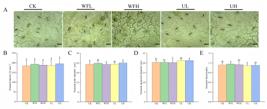
The influence of continuous N application during the seedling stage on the stomata of passion fruit leaves. Treatments of CK (water control), WFL (0.1% compound water-soluble fertilizer), WFH (0.5% compound water-soluble fertilizer), UL (0.1% urea), and UH (0.5% urea) were applied at 15, 30, and 45 day post-planting. Data were obtained from 15 fields of the microscope and represented mean ± SD. Lowercase letters indicate significant differences among treatments (Duncan’s test, p < 0.05) and bar = 20 µm.
Nutrient content of leaves
Continuous foliar N application during the seedling stage significantly altered the macro- and micronutrient profiles in passion fruit leveals. All treatments substantially suppressed Na and Fe accumulation compared to CK (p < 0.05), with the exception of UL (Table 1). Na concentrations in the WFL, WFH, UL, and UH treatment groups were only 34.09%, 33.33%, 37.88%, and 31.82% of CK, respectively. Overall, compound water- soluble fertilizers (WFL and WFH) outperformed urea in enhancing K and Zn concentrations. Conversely, UH significantly elevated C, N, and Cu content. Notably, UL uniquely increased Mg and P concentrations compared to other treatments, indicating a synergistic effect that potentially enhances photosynthetic efficiency and flower bud differentiation.
Contents of macro- and micronutrients in passion fruit leaves after continuous N application during the seedling stage. Treatments of CK (water control), WFL (0.1% compound water-soluble fertilizer), WFH (0.5% compound water-soluble fertilizer), UL (0.1% urea), and UH (0.5% urea) were applied at 15th, 30th, and 45th day post-planting. Data (collected at 60 days) represent mean ± SD (n = 3). Lowercase letters indicate significant differences among treatments (Duncan’s test, p < 0.05).
N metabolism enzyme activity
This study measured the activities of key N metabolism enzymes, including AS, GDH, NADH-GOGAT, and GS. The results indicated that foliar N application differentially induced the activity of these four enzymes, which exhibited a higher activity in the UL compared to other treatments (Figure 4).
Regarding the types of N application, WFH was found to be more effective in enhancing N metabolism enzyme activity. In contrast, UH showed significant inhibitory effects on enzyme activity (excepting for AS), of which GDH, NADH-GOGAT, and GS decreased by 62.95%, 63.89%, and 25.33%, respectively, compared to UL treatment group.

The effects of continuous N application during the seedling stage on asparagine synthase (AS), glutamate dehydrogenase (GDH), NADP-dependent glutamate synthase (NADP-GOGAT), and glutamine synthetase (GS) activity in passion fruit leaves. Treatments of CK (water control), WFL (0.1% compound water-soluble fertilizer), WFH (0.5% compound water-soluble fertilizer), UL (0.1% urea), and UH (0.5% urea) were applied at 15th, 30th, and 45th day post-planting. Data (collected at 60 days) represent mean ± SD (n = 3). Lowercase letters indicate significant differences among treatments (Duncan’s test, p < 0.05).
Pigment contents and photosynthetic traits
Chloroplast pigment content in passion fruit leaves ranged from 2.29 to 2.95 mg·g-1 (Figure 5A). Foliar N application significantly raised pigment content in WFL, UL, and UH by 27.23%, 29.08%, and 27.23%, respectively, compared to CK. The dominant pigment Chl a exhibited concentrations 2.45-fold and 4.64-fold higher than Chl b and Car, respectively (Figure 5B-D).
Although foliar N application significantly increased Chl a content, UH yielded significantly lower levels than WFL, WFH, and UL (p < 0.05). This suggests that excessive N may cause phytotoxicity and inhibition.
The types of N fertilizer significantly influenced Chl b accumulation. Among them, the compound water-soluble fertilizer (WFL and WFH) increased Chl b content by more than 1.89-fold compared to CK. Meanwhile, Car exhibited a similar response pattern to Chl b, with a 20.63% reduction between UH and control.
Continuous foliar N application significantly enhanced various leaf photosynthetic parameters, including E, Pn, Gs, Ci, ETR, and qP (Figure 5E-L). Compared to the control, E was elevated by 3.74-fold (WFL), 3.39-fold (WFH), 2.86-fold (UL), and 4.00-fold (UH), Pn increased by 23.43% (WFL), 19.53% (WFH), 33.98% (UL), and 20.70% (UH), and Gs, Ci, ETR, and qP exhibited increases of over 120%, 10.47%, 28.27%, and 41.38%, respectively.
In contrast, WUE was significantly reduced, reaching only 53.22% of the control on average.
Overall, continuous foliar N application, especially UL, enhanced most photosynthetic parameters (except for WUE), demonstrating high values for E, Pn, ETR, and qP, and promoting the formation of photosynthetic products and leaf development.

he effect of continuous foliar N application during seedling stage on pigment content and photosynthetic traits of passion fruit leaves. Treatments of CK (water control), WFL (0.1% compound water-soluble fertilizer), WFH (0.5% compound water-soluble fertilizer), UL (0.1% urea), and UH (0.5% urea) were applied at 15th, 30th, and 45th day post-planting. Data (collected at 60th day) represent mean ± SD (n = 3 for pigment content,and n = 6 for photosynthetic traits). Lowercase letters indicate significant differences among treatments (Duncan’s test, p < 0.05).
Fruit yield and quality
The yield ranged from 3.70 to 4.90 kg per plant. Low-concentration N treatments (WFL and UL) caused an insignificant difference in yield compared to CK (Figure 6A). In contrast, high-concentration treatments (WFH and UH) resulted in a significant reduction in yield (p < 0.05). This decline may be attributed to significant reductions in SFW, FLD, and FED.
Compared to CK, WFH and UH decreased SFW by 22.47% and 24.28%, FLD by 9.60% and 9.44%, and FTD by 10.02% and 11.13%, respectively (Figure 6B-D). While WFL and UL also showed reductions in SFW, FLD, and FED compared to CK, these differences were not statistically significant. Additionally, foliar N application adversely affected the ER of fruit, in which WFH and UH caused decreases by 9.95% (p < 0.05) and 6.86% (n.s.), respectively, when compared to CK (Figure 6E).

Yield and fruit quality of passion fruit under continuous N application during seedling stage. The treatments applied were CK (water control), WFL (0.1% compound water-soluble fertilizer), WFH (0.5% compound water-soluble fertilizer), UL (0.1% urea), and UH (0.5% urea), administered on the 15th, 30th, and 45th days post-planting. The data are presented as mean ± SD, with lowercase letters indicating significant differences among treatments, as determined by Duncan’s test (p < 0.05).
Continuous foliar N application during the passion fruit seedling stage inhibited flavonoid accumulation in fruits. Compared to CK, flavonoid content decreased by 19.00% (WFL), 30.40% (WFH), 13.40% (UL), and 8.53% (UH), with only WFH showing a significant reduction (p < 0.05) (Figure 6F). TP content ranged from 17.0 to 21.76 mg·g-1 across the four treatments, mirroring the flavonoid trend (CK > UH> UL> WFL > WFH) (Figure 6G). Both of WFL and WFH exhibited significant reductions of total phenolics versus CK (p < 0.05). Collectively, continuous foliar N application suppressed the accumulation of antioxidant components (flavonoids and TP) in passion fruit. WFH significantly increased the total free amino acid content, while UH led to a significant decrease (Figure 6H).
Furthermore, all treatments altered the organic acid content in fruits. Notably, WFL and UL produced increases of 18.06% and 8.12%, respectively, compared to CK (Figure 6I).
Principal component analysis
Principal component analysis (PCA) was performed based on agronomic, nutritional, photosynthetic, and productive traits. The PCA for agronomic traits indicated that PC1 (37.2%) and PC2 (19.1%) together accounted for 56.3% of the total variance (Figure 7A).
The loading of PC1 was predominantly influenced by internode length, leaf dry weight, plant height, stem thickness, and stomatal diameter. Conversely, PC2 primarily represented leaf moisture content, fresh weight, and parameters related to stomatal function. Besides, significant positive correlations were observed between internode length and plant height, as well as between leaf dry weight and stomatal diameter.
The PCA for nutritional traits demonstrated that all samples fell within 95% confidence ellipses (Figure 7B). CK exhibited greater dispersion compared to N treatments, while WFL, WFH, and UH clustered closely together. PC1 (48.5%) and PC2 (31.0%) accounted for 79.5% of the variance. PC1 was heavily loaded with all chemical elements except P, while PC2 was primarily influenced by P and N metabolism enzymes (GDH, GS, GOGAT, AS). Importantly, P concentration showed a positive correlation with all four enzyme activities (p < 0.05), indicating that P facilitates N assimilation.
The PCA of photosynthetic traits indicated that PC1 accounted for 63.0% of the variance, while PC2 accounted for 15.3%, together explaining 78.3% of the total variance (Figure 7C). All parameters except of WUE, displayed positive loadings on PC1, primarily driven by E, G, qP, and Chl b. PC2 was predominantly characterized by Car and NPQ.
The PCA for productive traits showed that PC1 accounted for 47.1% of the variance and PC2 for 25.4%, collectively explaining 72.5% (Figure 7D). PC1 was primarily influenced by fruit appearance traits, including SFW, FLD, and FED, all of which exhibited significant positive intercorrelations (p <0.05). In contrast, PC2 was predominantly associated with TP, TF, and yield. Notably, TP and TF demonstrated a positive correlation with each other, while both showed a negative correlation with TFA and TOA (p < 0.05).

Biplot of agronomic (A), nutritional (B), photosynthetic (C) and productive (D) traits in PC1 and PC2 of passion fruit treated by two folia N fertilizers and two concentrations (0.1% and 0.5%) continuously in seeding.
Discussion
This study demonstrates that foliar N application during the passion fruit seedling stage significantly regulates morphogenesis, physiological metabolism, yield, and fruit quality. The observed effects exhibit a notable interaction characterized by a ‘concentration-morphology-function’. Urea and compound water-soluble fertilizer, as primary N sources, promoted vegetative growth and enhanced photosynthetic capacity while profoundly influencing N metabolism flux, mineral element balance, and fruit secondary metabolite accumulation.
This ultimately created a complex interplay between yield and quality.Foliar N application induced differentiated morphogenesis, exhibiting a dual regulatory effect. It significantly enhanced plant height, with UL increasing height by 35.63% compared to CK at 60th day post-planting.
This rapid growth can be attributed to urea’s small molecular size, which facilitates efficient foliar penetration and absorption (NESTBY et al., 2005). However, the increase in plant height was accompanied by significant internode elongation, suggesting a risk of excessive vegetative growth that may compromise mechanical tissue development of stem and increase lodging susceptibility (ZHANG et al., 2023). Strikingly, while stem thickness increased across all treatments, no significant differences were observed between N types or concentrations.
This uniformity in lateral growth regulation during the seedling stage may result from insufficient nutrient and hormone accumulation for cambium cell activation (YE et al., 2021).
Continuous foliar N application significantly promoted plant elongation and increased leaf longitudinal and transverse diameters by 28.46% and 20.41%, respectively (Figure. 2B-C). This effect likely arises from N-enhanced carbon assimilation via increased Rubisco activity, resulting in expanded leaf area (HU et al., 2025). However, UH treatment did not significantly affect leaf fresh weight, but it resulted in a significantly lower dry weight compared to UL (Figure 2D-E). This suggests that excessive N may inhibit carbohydrate allocation to structural components (e.g., cell walls), potentially due to the high metabolic costs associated with N absorption, assimilation, and transport, which consume substantial energy (ATP) and reductants (NADPH) (RENUKA, 2024; ZHANG et al., 2023).
Stomata are critical for gas and water exchange and serve as a primary entry point for foliar N, which are regulated by complex environmental conditions (e.g., light, temperature, nutrient levels, etc.). Urea treatment, particularly UH, significantly increased both stomatal longitudinal and transverse diameters without altering stomatal density. This enlargement may involve urea-induced increases in guard cell turgor pressure, as the osmotically active molecule directly enters guard cells, promoting stomatal opening. Furthermore, ULmaintained high stomatal functionality, a mechanism that may be distinct from NH4+ mediated opening in Arabidopsis and possibly involves specific transporters such as DUR3 and TIP (BEIER et al., 2021).
Foliar N has significantly modulated key metabolism enzyme activities, exhibiting distinct concentration-dependent responses.
As reported by Li et, al.2008, root-applied N upregulates N-metabolism genes and enhances the activities of NR, GS, and NADH-GOGAT (Li et al., 2024), but foliar application displayed acute sensitivity to N concentration. UL markedly activated the N-assimilation pathway, significantly elevating the activities of AS, GDH, NADH-GOGAT, and GS compared to the control.
Conversely,UH strongly inhibited enzyme activity, reducing GDH, NADH-GOGAT, and GS activities by 63%, 64%, and 25% relative to UL, respectively. This suppression likely results from NH₄+ accumulation due to excessive urea hydrolysis, which induces cellular acid stress and imposes negative feedback on the GS/GOGAT cycle (HACHIYA et al., 2021; HU et al., 2025b). Furthermore, passion fruit seedlings exhibited fertilizer-type specificity, as WFH outperformed urea in promoting enzyme activity. Its balanced composition (nitrate-N, K, Zn) of compound water fertilizer may mitigate NH4+ toxicity by competitively inhibiting ammonium transport proteins (XIAO et al., 2023).
Photosynthetic responses directly influence the morphogenesis of passion fruit.
Foliar N enhances photosynthetic capacity primarily through pigment accumulation, which improves light harvesting (CHEN et al., 2024). All treatments increased photosynthetic pigments, with UL and WFL exhibiting the most pronounced effects. In addition, the stable Chl a/b ratio (2.45) indicated preserved photosystem integrity under low-concentration treatments. Stomatal functionality was concurrently enhanced, and UH increased guard cell size, while UL maintained a high stomatal aperture, facilitating CO2 diffusion and hydraulic conductance.
This comprehensive optimization elevated the Pn by 19.5–34.0%, Gs by 120%, and both the ETR and qP, collectively boosting C assimilation. However, WUE decreased sharply by 46.8%, indicating a disproportionate increase in transpiration relative to C gain. UL outperformed other treatments in Pn and ETR, demonstrating superior photosynthetic regulation, consistent with reports that low-concentration urea enhances Gs and photosynthetic efficiency in Ocimum basilicum (JAHANBANI et al., 2024).
N critically regulates the yield and quality formation of passion fruit through diverse physiological and biochemical pathways (ASIS, 2025; RAKHA et al., 2024). It has demonstrated that foliar N management can achieve a balance between yield and quality. Low-concentration treatments (WFL and UL) maintained yields comparable to CK, whereas high-concentration applications (WFH and UH) significantly reduced yield by 22-24%. This reduction primarily stems from decreased SFW and diminished longitudinal and transverse diameters, consistent with N-inhibited photoassimilate partitioning to fruits observed in blackberry (YANG et al., 2023). Furthermore, WFH and UH reduced the fruit edible rate by 6.86-9.95%, substantially compromising commercial value through simultaneous yield and quality losses.
Continuous foliar N application during the seedling stage of passion fruit significantly reduced the functional components of the fruit, resulting in a decrease of flavonoids by 8.5–30.4% (Figure 6F). This reduction may be attributed to growth dilution effect or direct suppression of phenylpropanoid metabolism (GU et al., 2025). As essential antioxidants that scavenge reactive oxygen species (ROS) (CAVAIUOLO et al., 2013), the depletion of flavonoids as essential antioxidants compromises the plant’s resilience to stress and diminishes its medicinal value in traditional applications (DU et al., 2024).
Additionally, it reduces documented health benefits, including vasodilation, endothelial function improvement, and lifespan extension in mice (MANUEL et al., 2019; XU, et al., 2021). The application of N also modulated flavor compounds differentially, especially WFL treatment increased organic acids by 18.1%, enhancing flavor complexity, whereas UH treatment suppressed the accumulation of free amino acids. This inhibition may impair protein synthesis, growth vigor, stress adaptation, and N use efficiency (QIANG et al., 2025). Therefore, in case that functional components drive product value, it is necessary to stringently N inputs during the seedling stage require stringent regulation to balance agronomic and phytochemical objectives.
PCA of agronomic, nutritional, photosynthetic, and productive traits revealed a synergistic effect of continuous N application on the vegetative growth and quality formation of passion fruit. Significant positive correlations were observed between internode length and plant height, as well as between leaf dry weight and stomatal diameter(Figure 7A).
These findings indicate that plants adapt to environmental changes through coordinated nutrient growth and gas exchange capacity.
Furthermore, the positive correlation between P concentration and N metabolism enzyme activity, such as GDH and GS, suggests that P may serve as a regulatory signal for N assimilation. Critically, P deficiency likely limits ATP synthesis, suppressing both GS activity and ribulose-1,5-bisphosphate carboxylase/oxygenase (Rubisco) regeneration, thereby inhibiting NH4+ assimilation and carbon fixation. Additionally, photosynthetic parameters, including net Pn, Gs, ETR, and qP, exhibited strong covariation on principal component 1 (PC1), excluding WUE. This indicates an integrated regulation of carbon gain through both stomatal and non-stomatal (biochemical) mechanisms (JIAO et al., 2024).
In summary, low-concentration urea (0.1%) effectively enhances photosynthesis and sustains passion fruit yield. However, its application results in excessive internode elongation and reduced WUE, necessitating the development of mitigation strategies.
Additionally, the adverse impact of N fertilizer on the functional components of fruit requires careful assessment. Future research should prioritize strategies for N reduction during the critical transition phase from vegetative to reproductive growth.
The application of chemical regulators such as mepiquat chloride or chlormequat chloride is expected to alleviate competition between vegetative and reproductive organs for water and assimilates (CHENG et al., 2025).
Furthermore, these regulators may be combined with pre-harvest light regulation or selenium/zinc micro-fertilizers to counteract the inhibitory effects of N on flavonoid synthesis (ISMAIL et al., 2025; YANG, et al., 2019). All integrated approach aims to achieve compensatory improvements in fruit quality, and address the triple paradox of simultaneously enhancing photosynthetic efficiency, optimizing plant architecture, and maintaining overall quality.
Ultimately, it will contribute to the advancement of high-quality passion fruit cultivation techniques.
Conclusions
This study systematically analyzed the potential impacts of continuous foliar N application during the seedling stage on the growth, nutritional status, photosynthesis, and productive traits of passion fruit.
The findings indicated that a low-concentration urea solution (0.1%) optimally enhanced photosynthetic efficiency and maintaind yield. This enhancement is primarily achieved by increasing guard cell size, improving stomatal function, activating key N metabolism enzymes, and boosting the Pn and ETR, thereby supporting robust vegetative growth and biomass accumulation.
However, foliar N application presents a dual trade-off between growth and quality, particularly as high-concentration treatments (0.5%) significantly inhibited SFW (decrease > 22%) and functional components (flavonoid loss > 30.40%). To address this challenge, a combined strategy could be implemented that involves 0.1% urea along with growth regulators, optimized water management, light supplementation, and micronutrient addition. This approach aims to activate the synthesis pathways of functional components (e.g., flavonoids) and synergistically improve both the yield and quality of passion fruit.
Acknowledgements
This study was supported by the Guizhou Provincial Basic Research Program (Natural Science) under grant numbers QKHJC-[2024]QN374, QKHFQ[2024] 004-1 and QKHFQ[2024] 004-2, as well as the National Key R and D Projects of China (2021YFD1100303) in post-subsidy project.
Data Availability:
Supported by
References
-
ARAYA, S.; MARTINS, A.M.; JUNQUEIRA, N.T.V.; COSTA, A.M.; FALEIRO, F.G.; FERREIRA, M.E. Microsatellite marker development by partial sequencing of the sour passion fruit genome (Passiflora edulis Sims). BMC Genomics, London, v.18, p.549, 2017. https://doi.org/10.1186/s12864-017-3881-5
» https://doi.org/10.1186/s12864-017-3881-5 -
ASIS, C.A.; TILBROOK, J.; ANSON, D.; NISCIOLI, A.; GUINTO, D.; BRISTOW, M.; ROWLINGS, D. Nitrogen level impacting fruit yield and quality of mango in northern tropical Australia. Sustainability, Basel, v.17, p.80, 2025. https://doi.org/10.3390/su17010080
» https://doi.org/10.3390/su17010080 -
BEIER, M.P.; KOJIMA, S. The function of high-affinity urea transporters in nitrogen-deficient conditions. Physiologia Plantarum, Lund, v.171, p.802-8, 2021. https://doi.org/10.1111/ppl.13303
» https://doi.org/10.1111/ppl.13303 -
BOARETTO, R.M.; HIPPLER, F.W.R.; DOVIS, V.L.; BERNARDI, L.G.P.; BORTOLOTI, G.A.; QUAGGIO, J.A.; MATTOS JUNIOR, D. Nitrogen fertilizer use by citrus trees is affected by varying nitrate and ammonium ratios. Revista Brasileira de Fruticultura, Jaboticabal, v.46, e-218, 2024. https://doi.org/10.1590/0100-29452024218
» https://doi.org/10.1590/0100-29452024218 - CAO, J.K.; JIANG, W.B.; ZHAO, Y.M. Guidance for physiological and biochemical experiments of fruits and vegetables after harvest Beijing: China Light Industry Press, 2013. p.84-7.
-
CAVAIUOLO, M.; COCETTA, G.; FERRANTE, A. The antioxidants changes in ornamental flowers during development and senescence. Antioxidants, Basel, v.2, p.132-55, 2013. https://doi.org/10.3390/antiox2030132
» https://doi.org/10.3390/antiox2030132 -
CHEN, L.; FEI, L.; LIU, L.; WANG, Z.; ZHONG, Y. Effects of soil initial water content on transport characteristics of free infiltration water and nitrogen under film hole irrigation with muddy water. Journal of Soil and Water Conservation, Beijing, v.32, p.58-66, 2018. https://doi.org/10.13870/j.cnki.stbcxb.2018.02.009
» https://doi.org/10.13870/j.cnki.stbcxb.2018.02.009 -
CHEN, L.H.; XU, M.; CHENG, Z.; YANG, L.T. Effects of nitrogen deficiency on the photosynthesis, chlorophyll a fluorescence, antioxidant system, and sulfur compounds in Oryza sativa. International Journal of Molecular Sciences, Basel, v.25, p.10409, 2024. https://doi.org/10.3390/ijms251910409
» https://doi.org/10.3390/ijms251910409 -
CHENG, D.; HE, S.; LI, L.; TONG, X.; GU, H.; SUN, X.; LI, M.; CHEN, J. Effects of mepiquat chloride and chlormequat chloride on the growth and fruit quality of ‘Shine Muscat’ grapevines. Agriculture, Basel, v.15, p.1267, 2025. https://doi.org/10.3390/agriculture15121267
» https://doi.org/10.3390/agriculture15121267 -
DU, Y.; MA, H.; LIU, Y.; GONG, R.; LAN, Y.; ZHAO, J.; LIU, G.; LU, Y.; WANG, S.; JIA, H.; LI, N.; ZHANG, R.; WANG, J.; SUN, G. Major quality regulation network of flavonoid synthesis governing the bioactivity of black wolfberry. New Phytologist, London, v.242, p.558-75, 2024. https://doi.org/10.1111/nph.19602
» https://doi.org/10.1111/nph.19602 -
GHOLAMI, A.; AKHLAGHI, S.; SHAHSAVANI, S.; FARROKHI, N. Effects of urea foliar application on grain yield and quality of winter wheat. Communications in Soil Science and Plant Analysis, Philadelphia, v.42, p.719-27, 2011. https://doi.org/10.1080/00103624.2011.550377
» https://doi.org/10.1080/00103624.2011.550377 -
GIOPPATO, H. A.; SILVA, M. B. D.; CARRARA, S.; PALERMO, B. R. Z.; MORAES, T. D. S.; DORNELAS, M. C. Genomic and transcriptomic approaches to understand Passiflora physiology and to contribute to passion fruit breeding. Theoretical and Experimental Plant Physiology, Londrina, v.31, p.173-81, 2019. https://doi.org/10.1007/s40626-018-0134-1
» https://doi.org/10.1007/s40626-018-0134-1 - GLINSKI, D.S.; MILLS, H.A.; KARNOK, K.J.; CARROW, R.N. Nitrogen form influences root growth of sodded creeping bent-grass. HortScience, Alexandria, v.25, p.932-3, 1990.
-
GU, W.; FENG, Y.; LIU, C.; SHI, X.; HAN, L.; LIU, C.; ZHOU, Y. Transcriptomic and metabolomic unraveling of nitrogen use efficiency in sorghum: the quest for molecular adaptations to low-nitrogen stress. Plant Growth Regulation, Dordrecht, v.105, p.687-706, 2025. https://doi.org/10.1007/s10725-025-01296-5
» https://doi.org/10.1007/s10725-025-01296-5 -
HACHIYA, T.; INABA, J.; WAKAZAKI, M.; SATO, M.; TOYOOKA, K.; MIYAGI, A.; KAWAI-YAMADA, M.; SUGIURA, D.; NAKAGAWA, T.; KIBA, T.; GOJON, A.; SAKAKIBARA, H. Excessive ammonium assimilation by plastidic glutamine synthetase causes ammonium toxicity in Arabidopsis thaliana. Nature Communications, London, v.12, p.4944, 2021. https://doi.org/10.1038/s41467-021-25238-7
» https://doi.org/10.1038/s41467-021-25238-7 -
HU, W.; ZHANG, S.; HUANG, W.; CHANG, H.; LI, Y.; GU, C.; DAI, J.; YANG, L.; LIAO, X.; QIN, L. Nitrogen-driven changes in leaf anatomy affect the coupling between leaf mass per area and photosynthesis. Journal of Experimental Botany, Oxford, v.76, p.8, 2025a. https://doi.org/10.1093/jxb/eraf108
» https://doi.org/10.1093/jxb/eraf108 -
HU, Z.; CHEN, S.; WEI, C.; JIN, Y.; ZHAO, L.; LIU, Y.; GAO, Y.; FANG, Y.; ZHANG, Y.; YI, Z.; WANG, S.; ZHAO, H. Plastidic glutamine synthetase (GS2) enhances nitrogen assimilation and protein production in duckweed using urea nitrogen source. International Journal of Biological Macromolecules, Amsterdam, v.307, e.141701, 2025b. https://doi.org/10.1016/j.ijbiomac
» https://doi.org/10.1016/j.ijbiomac -
ISMAIL, M.S.; NAWAZ, F.; SHEHZAD, M.A. Contributions of nitrogen metabolic enzymes in storage protein assimilation and mineral accumulation regulated by nitrogen and selenium in Triticum aestivum L. Plant Physiology and Biochemistry, Paris, v.221, e.109597, 2025. https://doi.org/10.1016/j.plaphy.2025.109597
» https://doi.org/10.1016/j.plaphy.2025.109597 -
JAHANBANI, S.; MUMIVAND, H.; ZAHEDI, B.; ARGENTO, S. Foliar application of urea and amino acids regulates growth, photosynthesis, pigments, antioxidant activity, and the essential oil content and composition of basil (Ocimum basilicum L.). Agronomy, Basel, v.14, p.2950, 2024. https://doi.org/10.3390/agronomy14122950
» https://doi.org/10.3390/agronomy14122950 -
JIAO, Q.; BAI, H.; ZADA, A.; HU, X. Intrinsic signaling pathways and key regulatory factors of stomatal development. Journal of Plant Biology, Seoul, v.67, p.185-94, 2024. https://doi.org/10.1007/s12374-024-09427-7
» https://doi.org/10.1007/s12374-024-09427-7 -
JU, X. T.; XING, G. X.; CHEN, X. P.; ZHANG, S. L.; ZHANG, L. J.; LIU, X. J.; CUI, Z. L.; YIN, B.; CHRISTIE, P.; ZHU, Z. L.; ZHANG, F. S. Reducing environmental risk by improving N management in intensive Chinese agricultural systems. Proceedings of the National Academy of Sciences of the United States of America, Washington, v.106, p.3041-6, 2009. https://doi.org/10.1073/pnas.0813417106
» https://doi.org/10.1073/pnas.0813417106 -
LI, G.; GUO, X.; SUN, W.; HOU, L.; WANG, G.; TIAN, R.; WANG, X.; QU, C.; ZHAO, C. Nitrogen application in pod zone improves yield and quality of two peanut cultivars by modulating nitrogen accumulation and metabolism. BMC Plant Biology, London, v.24, p.48, 2024. https://doi.org/10.1186/s12870-024-04725-1
» https://doi.org/10.1186/s12870-024-04725-1 -
LI, J.; NIE, J.; LI, H.; XU, G.; WANG, X.; WU, Y.; WANG, Z. On determination conditions for total polyphenols in fruits and its derived products by Folin-phenol methods. Journal of Fruit Science, Zhengzhou, v.25, p.126-31, 2008. https://doi.org/10.13925/j.cnki.gsxb.2008.01.002
» https://doi.org/10.13925/j.cnki.gsxb.2008.01.002 -
LIMA, L. K. D. S.; JESUS, O. N. DE; SOARES, T. L.; SANTOS, I. S. D.; OLIVEIRA, E. J. DE; FILHO, M. A. C. Growth, physiological, anatomical and nutritional responses of two phenotypically distinct passion fruit species (Passiflora L.) and their hybrid under saline conditions. Scientia Horticulturae, Amsterdam, v.263, e.109037, 2020. https://doi.org/10.1016/j.scienta.2019.109037
» https://doi.org/10.1016/j.scienta.2019.109037 -
LIU, Y.; YUAN, J.; ZHANG, D.; DENG, K.; CHAI, G.; HUANG, Y.; MA, S.; QIN, Y.; WANG, L. Genome-wide identification and characterization of the SBP gene family in passion fruit (Passiflora edulis Sims). International Journal of Molecular Sciences, Basel, v.23, p.14153, 2022b. https://doi.org/10.3390/ijms232214153
» https://doi.org/10.3390/ijms232214153 -
MANUEL, S.; MIGUEL, R.; MANUEL, G. G.; JUAN, T.; FRANCISCO, P. V.; JUAN, D. Cardiovascular effects of flavonoids. Current Medicinal Chemistry, Hilversum, v.26, p.6991-7034, 2019. https://doi.org/10.2174/0929867326666181220094721
» https://doi.org/10.2174/0929867326666181220094721 -
NESTBY, R.; TAGLIAVINI, M. Foliar uptake and partitioning of urea-N by strawberry plants as affected by timing of supply and plant N status. The Journal of Horticultural Science and Biotechnology, Ashford, v.80, p.272-5, 2005. httsp:// doi.org/10.1080/14620316.2005.11511928
» httsp:// doi.org/10.1080/14620316.2005.11511928 -
PENG, Y.; CHEN, Q.; WANG, C. Determination of organic carbon in different organs of rubber trees by using oven-heating method. Chinese Journal of Tropical Agriculture, Haikou, v.29, p.13-6, 2009. https://doi.org/10.3969/j.issn.1009-2196.2009.10.003
» https://doi.org/10.3969/j.issn.1009-2196.2009.10.003 -
PHILLIPS, C. L.; MEYER, K. M.; GARCIA-JARAMILLO, M.; WEIDMAN, C. S.; STEWART, C. E.; WANZEK, T.; GRUSAK, M. A.; WATTS, D. W.; NOVAK, J.; TRIPPE, K. M. Towards predicting biochar impacts on plant-available soil nitrogen content. Biochar, Singapore, v.4, p.9, 2022. https://doi.org/10.1007/s42773-022-00137-2
» https://doi.org/10.1007/s42773-022-00137-2 -
PIEKARSKI-BARCHIK, P.; ÁVILA, S.; FERREIRA, S. M. R.; SANTOS, N. C. S.; MARQUES, F. A.; SANTOS, M. P. D.; GRASSI, M. T.; MIGUEL, M. D.; MIGUEL, O. G. Mineral content, antioxidant activity and essential oil of Allophylus edulis (A. St.-Hil., A. Juss. and Cambess.) Radlk. leaves: plant from South American biodiversity. Chemistry and Biodiversity, Weinheim, v.18, e.2100257, 2021. https://doi.org/10.1002/cbdv.202100257
» https://doi.org/10.1002/cbdv.202100257 -
QIANG, Q.; ZHANG, Z.; LI, X.; LI, C.; MAO, M.; DING, X.; ZHANG, J.; LI, S.; LAI, Z.; YANG, J.; CAO, P.; YE, W.; WANG, S.; YANG, J. The amino acid permease SlAAP6 contributes to tomato growth and salt tolerance by mediating branched-chain amino acid transport. Horticulture Research, Oxford, v.12, n.286, 2025. https://doi.org/10.1093/hr/uhae286
» https://doi.org/10.1093/hr/uhae286 -
RAKHA, A. M.; EISA, R. A.; ABOURAYYA, M. S.; KASEEM, N. E.; MAHMOUD, T. S. M. Effects of different sources of nitrogen fertilizer on the yield and fruit quality of Persian lime under Nubaria conditions. Erwerbs-Obstbau, Berlin, v.66, p.1929-35, 2024. https://doi.org/10.1007/s10341-024-01158-w
» https://doi.org/10.1007/s10341-024-01158-w -
RENUKA, K. Small protein, big effects: ENOD93 alters mitochondrial ATP production to favor nitrogen assimilation in plants. The Plant Cell, Oxford, v.36, p.4678-9, 2024. https://doi.org/10.1093/plcell/koae247
» https://doi.org/10.1093/plcell/koae247 -
SHAHRAJABIAN, M.H.; SUN, W.; CHENG, Q. Foliar application of nutrients on medicinal and aromatic plants, the sustainable approaches for higher and better production. Beni-Suef University Journal of Basic and Applied Sciences, Beni Suef, v.11, p.26, 2022. https://doi.org/10.1186/s43088-022-00210-6
» https://doi.org/10.1186/s43088-022-00210-6 -
SONG, Y.; WANG, Y.; MAO, Y. Determination of total flavonoid in Asparagus officinalis Linn by spectrophotometry. Chemical Analysis and Meterage, Beijing, v.14, p.52-3, 2005. https://doi.org/10.3969/j.issn.1008-6145.2005.04.020
» https://doi.org/10.3969/j.issn.1008-6145.2005.04.020 -
TENG, Y.; WANG, Y.; LI, J.; ZHANG, X.; CHEN, C.; ZHANG, S.; LONG, X. Effect of rain shelter and light supplement on yield, fruit quality and photosynthetic characteristics of passion fruit. Journal of Fruit Science, Zhengzhou, v.41, p.1170-1180, 2024. https://doi.org/10.13925/j.cnki.gsxb.20230564
» https://doi.org/10.13925/j.cnki.gsxb.20230564 -
WANG, F.; GE, S.; XU, X.; XING, Y.; JIANG, Y. Multiomics analysis reveals new insights into the apple fruit quality decline under high nitrogen conditions. Journal of Agricultural and Food Chemistry, Washington, v.69, p.5559-72, 2021. https://doi.org/10.1021/acs.jafc.1c01548
» https://doi.org/10.1021/acs.jafc.1c01548 -
WANG, W. Improving the method for determining the total dissociative amino acid in fresh fruit tissue. Journal of Beijing Agricultural College, Beijing, v.13, p.9-13, 1998. https://doi.org/10.13473/j.cnki.issn.1002-3186.1998.03.002
» https://doi.org/10.13473/j.cnki.issn.1002-3186.1998.03.002 - WANG, X.; HUANG, J. Principles and techniques of plant physiological biochemical experiment 3. ed. Beijing: Higher Education Press, 2015. p.131-3.
-
XIAO, C.; FANG, Y.; WANG, S.; HE, K. The alleviation of ammonium toxicity in plants. Journal of Integrative Plant Biology, Beijing, v.65, p.1362-8, 2023. https://doi.org/10.1111/jipb.13467
» https://doi.org/10.1111/jipb.13467 -
XU, Q.; FU, Q.; LI, Z.; LIU, H.; WANG, Y.; LIN, X.; HE, R.; ZHANG, X.; JU, Z.; CAMPISI, J.; KIRKLAND, J.L.; SUN, Y. The flavonoid procyanidin C1 has senotherapeutic activity and increases lifespan in mice. Nature Metabolism, London, v.3, p.1706-26, 2021. https://doi.org/10.1038/s42255-021-00491-8
» https://doi.org/10.1038/s42255-021-00491-8 -
YANG, Q.; PAN, J.; SHEN, G.; GUO, B. Yellow light promotes the growth and accumulation of bioactive flavonoids in Epimedium pseudowushanense. Journal of Photochemistry and Photobiology B: Biology, Lausanne, v.197, e.111550, 2019. https://doi.org/10.1016/j.jphotobiol.2019.111550
» https://doi.org/10.1016/j.jphotobiol.2019.111550 -
YANG, Y.; HUANG, Z.; WU, Y.; WU, W.; LYU, L.; LI, W. Effects of nitrogen application level on the physiological characteristics, yield and fruit quality of blackberry. Scientia Horticulturae, Amsterdam, v.313, e.111915, 2023. https://doi.org/10.1016/j.scienta.2023.111915
» https://doi.org/10.1016/j.scienta.2023.111915 -
YE, L.; WANG, X.; LYU, M.; SILIGATO, R.; ESWARAN, G.; VAINIO, L.; BLOMSTER, T.; ZHANG, J.; MAHONEN, A.P. Cytokinins initiate secondary growth in the Arabidopsis root through a set of LBD genes. Current Biology, London, v.31, p.3365-73, 2021. https://doi.org/10.1016/j.cub.2021.05.036
» https://doi.org/10.1016/j.cub.2021.05.036 -
ZHANG, G. X.; ZHAO, D. H.; FAN, H. Z.; LIU, S. J.; LIAO, Y. C.; HAN, J. Combining controlled-release urea and normal urea with appropriate nitrogen application rate to reduce wheat stem lodging risk and increase grain yield and yield stability. Journal of Integrative Agriculture, Beijing, v.22, p.3006-21, 2023. https://doi.org/10.1016/j.jia.2023.02.039
» https://doi.org/10.1016/j.jia.2023.02.039 -
ZHANG, W.; ZHANG, T.; ZHANG, J.; LEI, W.; ZHAO, L.; WANG, S.; SHI, M.; WEI, M. Low nitrogen stress promotes root nitrogen uptake and assimilation in strawberry: contribution of hormone networks. Horticulturae, Basel, v.9, p.249, 2023. https://doi.org/10.3390/horticulturae9020249
» https://doi.org/10.3390/horticulturae9020249 -
ZHAO, L.; WU, L.; LI, L.; ZHU, J.; CHEN, X.; ZHANG, S.; LI, L.; YAN, J. K. Physicochemical, structural, and rheological characteristics of pectic polysaccharides from fresh passion fruit (Passiflora edulis f. flavicarpa L.) peel. Food Hydrocolloids, Amsterdam, v.136, e.108301, 2023. https://doi.org/10.1016/j.foodhyd.2022.108301
» https://doi.org/10.1016/j.foodhyd.2022.108301 -
ZOU, N.; HUANG, L.; CHEN, H.; HUANG, X.; SONG, Q.; YANG, Q.; WANG, T. Nitrogen form plays an important role in the growth of moso bamboo (Phyllostachys edulis) seedlings. PeerJ, London, v.8, e.9938, 2020. https://doi.org/10.7717/peerj.9938
» https://doi.org/10.7717/peerj.9938


