Obesity in young adults: The differentiated impact of LEP, LEPR, and FTO gene variants
Abstract
Obesity is a global public health issue, increasingly affecting young adults. Its association with other diseases highlights the urgency of developing prevention strategies. Genetic factors play a significant role in susceptibility to obesity, making the identification of risk-associated variants essential for prevention strategies. Therefore, this study aimed to analyze LEP, LEPR, and FTO variants as potential genetic risk factors for obesity in Brazilians aged 18-35 years. The participants were classified with, or without obesity/overweight. Genotyping was performed by ASO-PCR, RFLP, and DNA sequencing. A questionnaire was applied to collect anthropometric data, and personal and family medical history. Preliminary analyses indicated that obesity was significantly associated with individuals over 25 years of age; therefore, to specifically investigate early-onset obesity, the primary genetic association analyses were restricted to the 18-25 age group. A significant association was found between the LEP rs7799039 variant and BMI ≥ 25 Kg/m², and LEP rs17151919 was strongly associated with BMI ≥ 30 Kg/m² in this age group. These findings underscore the importance of identifying genetic variants that increase the risk of obesity in young adults and suggest contributing to the development of more effective and personalized prevention strategies, integrating knowledge from genetics, medicine, and nutrition.
Keywords:
Early-onset obesity; genetic predisposition to disease; genetic polymorphism; leptin
Introduction
Polymorphisms in Leptin (LEP, HGNC:6553), Leptin receptor (LEPR, HGNC:6554) and FTO alpha-ketoglutarate dependent dioxygenase (FTO, HGNC:24678) genes have been associated with obesity in different populations (Legry et al., 2009; Carlos et al., 2013; de Oliveira et al., 2013; da Dasgupta et al., 2015; Fonseca et al., 2019; Yaghootkar et al., 2020; Piwonska et al., 2022; Saqlain et al., 2022; Park and Choi, 2023). However, studies of some of these variants have often presented divergent results, mainly regarding the association of LEP variants: rs2167270 and rs7799039, and LEPR variants: rs1137101, rs1137100, and rs1805094 with the body mass index (BMI), and serum leptin levels (de Oliveira et al., 2013; Dasgupta et al., 2015; Duan et al., 2020; Garavito et al., 2020; Ponasenko et al., 2022; Saqlain et al., 2022; El Fessikh et al., 2023; Park and Choi, 2023). In contrast, an in silico analysis has suggested that LEPR variants may compromise leptin receptor function, a finding that corroborates the positive associations observed between obesity and these variants (El Fessikh et al., 2023).
In contrast, studies of FTO variants suggest that they have a more robust association with increased risk for the development of obesity, even though their effects have been recognized as indirect, since FTO intronic variants were associated with the higher expression of the IRX3 (Iroquois-class homeobox 3) gene. This gene is expressed in hypothalamic pro-opiomelanocortin neurons (POMC), and changes in their expression levels affect body adiposity, and energy expenditure (Smemo et al., 2014; Schneeberger, 2019).
It is well known that common multifactorial obesity is associated with several genetic, epigenetic, and environmental risk factors (Diels et al., 2020). These diverse causal variables make obesity difficult to treat in a unique way and require a comprehensive analysis to understand the proportion of genetics and environmental effects and their individual impacts, in order to develop better strategies for its prevention and treatment. In this context, the various gene-nutrient interactions show that personalized nutrition is also a fundamental component of precision health (Kiani et al., 2022).
Another current concern regarding obesity is its increasing prevalence among young adults in recent years. In the Brazilian population aged 18 to 24, the prevalence of obesity showed a significant increase, from 9% in 2022 to 17.1% in 2023 (COVITEL, 2023). High prevalence of obesity in young adults has also been reported in other populations. In 2022, a study in the English population revealed that 11% of men and 17% of women aged 16 to 24 years presented obesity (NHS, 2024), while a study in the US population reported that 27.1% of men and 33.3% of women aged 20 to 24 presented obesity, in 2021 (Ng et al., 2024). These numbers are alarming, and estimates indicate that they will continue to grow among individuals up to 36 years of age in the coming years (De Pauw et al., 2022). Studies conducted with England, USA and Austria populations have indicated that the weight gain is greatest in the 20s and begins to decrease over 10 or 15 years (Peter et al., 2014; Dutton et al., 2016; Katsoulis et al., 2021). In this context, it is important to highlight that weight gain from early adulthood to middle age may be associated with higher risks of serious chronic diseases and a lower probability of healthy aging, reinforcing the importance of prevention and early treatment of obesity in younger individuals (Zheng et al., 2017). Thus, for a more accurate analysis, it is essential to study groups by specific age range, considering the context and the condition to be studied (Geifman et al., 2013).
Therefore, the objective of this work was to investigate the distinct contribution of variants in the LEP, LEPR, and FTO genes to the risk of obesity in young adults, considering the particularities of this group, such as lifestyle habits, and physiological and behavioral characteristics, which differentiate them from other age groups. In addition, the study also searches to identify additional risk factors such as personal and family history of health problems, that could contribute to predicting the increased risk of weight gain in early adulthood.
Subjects and Methods
Study design, sample, and data collection
This study was designed as an observational case-control study. Biological samples of peripheral blood or saliva were collected from volunteers aged 18 to 35 years, mostly students from Federal University of the State of Rio de Janeiro (UNIRIO), residing in Rio de Janeiro, from 2018 to 2023. The exclusion factors for participation in the study were: i) not having Brazilian nationality; ii) age under 18 or over 35 years; iii) pregnancy; iv) known genetic syndrome. The individuals were divided into two groups according to their body mass index (BMI). For participants aged 18 to 19 years, BMI was converted to a Z-score using the World Health Organization (WHO) growth reference data for 5-19 years (de Onis et al., 2007) to account for age and sex differences. Classification was as follows: “with obesity” (BMI ≥ 30 kg/m², or BMI Z-score ≥ 2) and “without obesity” (BMI < 30 kg/m², or BMI Z-score < 2). Also, additional analyses included the groups: “with overweight or obesity” (BMI ≥ 25 kg/m², or BMI Z-score from 1 to 1.99) and “without overweight or obesity” (BMI < 25 kg/m², or BMI Z-score < 1). The BMI and BMI Z-score of the individuals was classified according to World Health Organization (WHO).
Anthropometric data (weight and height) were directly measured in 54% of the volunteers (n=95), confirming their self-reported measurements by filling out a questionnaire, while the remaining 46% (n=81) provided self-reported data. For the self-reported group, the validity of the data was supported by the strong correlation observed in the measured subgroup (r > 0.90), consistent with previous validation studies (Gorber et al., 2007; Fayyaz et al., 2024). However, some participants reported significant weight loss through diet and/or medical treatments prior to their participation in the study. Consequently, the highest self-reported weight achieved by the participants within the study age range (18-35 years) was utilized for association analyses. This approach aimed to minimize the potential misclassification of genetically predisposed individuals who may have undergone significant weight loss prior to enrollment. The current weight of 18-year-old participants was considered to calculate their highest BMI, since the highest BMI values reached before the age of 18 years were not considered in the study.
In addition to demographic and anthropometric information, a structured questionnaire was administered to all 176 eligible participants. The questionnaire collected data on history of childhood overweight/obesity and perception of satiety, which was assessed by the question “How would you define your satiety after a standard meal?” (categorized as “Long satiety”, “Short satiety”, or “Low satiety”). Participants also self-reported whether they or their direct family members (parents, siblings, and grandparents) had received a medical diagnosis of vitamin D deficiency, anxiety, depression, thyroid disorder, hypertension, hypercholesterolemia, hyperinsulinemia, and type 2 diabetes mellitus.
Molecular analyses
DNA from blood and saliva samples was extracted by commercial kits, following the manufacturers protocol.
The identification of the variants LEP rs2167270, LEP rs17151914, LEP rs17151919, LEPR rs1137100, LEPR rs1805094, and FTO rs9939609 was performed by Polymerase Chain Reaction with allele-specific oligonucleotide (ASO-PCR), and LEP rs7799039 and LEPR rs1137101 variants were identified using Restriction Fragment Length Polymorphism (RFLP), with the endonucleases FastDigest HhaI and FastDigest MspI (Thermo Scientific, MA, USA), respectively. Target sequences were amplified by PCR using primers designed for this study (Table 1). ASO-PCR test’s standardization was done with DNA samples of genotypes already known by sequencing. After all samples genotyping, part of the results was also confirmed by sequencing at the Technological Platforms Network of the Oswaldo Cruz Foundation (FIOCRUZ), revealing 100% test sensitivity and specificity.
The PCR protocols followed the recommendations of GoTaq® G2 Hot Start Colorless Master Mix (Promega, WI, USA) and Go Taq® G2 Hot Start Polymerase (Promega, WI, USA) respective manufacturers, using 0.4 μM of each primer, in 25 μL total volume.
Statistical analysis
In the descriptive analyses in relation to the usual BMI categories, Mann-Whitney U tests were used to compare continuous numerical variables, and Chi-square tests were used for categorical and clinical demographic variables. In the genetic association analyses, the genotypic and allelic frequencies of each variant were determined by direct counting, and the chi-square test was used to evaluate the deviation from the Hardy-Weinberg equilibrium. The homozygous genotypes of the highest frequency allele in our sample were compared with the other genotypes, including the allele with the lowest frequency (carriers), to better observe the differences caused by the variation. The protection/risk estimate is presented as adjusted odds ratios (aORs) with 95% confidence intervals (CI95%) for each variant and estimated using unconditional logistic regression models. The haplotype frequencies were estimated by maximum likelihood, and the phase uncertainty was included in statistical models applied for association analyses. The most frequent haplotypes of the observed markers of LEP, LEPR, and FTO genes were considered references for the haplotype analyses. Phenotypic traits, e.g., Sex, Race, and Age, were included as confounding factors in the modeling of all other genetic analyses to eliminate possible sampling biases. The analyses were performed in the R software, version 4.1.2, with the libraries ‘genetics’ and its dependencies. A post-hoc power analysis was conducted using the G*Power software (Faul et al., 2007) to validate the study’s robustness.
The research was approved by the Research Ethics Committee - UNIRIO - CEP / HUGG (CAAE: 55438116.1.0000.5258) in accordance with ethical standards, ensuring the well-being of the participants. Informed consent was obtained from all the participants.
Results
Because of the age limit, only 176 of the 206 volunteers were eligible to the study. Demographic and BMI analyses revealed that the majority of participants were women, self-identified as White, between 19 and 25 years of age, and presented a BMI below 29.9 kg/m² (Table 2).
The association analysis between age and obesity revealed that the age group between 26 and 35 years were significantly associated with BMI ≥ 30 kg/m² (aOR: 3.4; 95% CI 1.52-7.62; p = 0.005), and also with BMI ≥ 25 kg/m² (aOR: 2.76; 95% CI 1.23-6.2; p = 0.027) (Table 3). Thus, the association analysis with overweight and obesity was conducted considering only the individuals who achieved their highest weight throughout life when aged 18 to 25 years (n= 140), aiming to observe whether these individuals would present a distinct impact of genetic factors on the development of early obesity, since this group was at a lower time exposure to otherwise risk factors. Additional analyses, including the satiety perception and medical history of participants, were also performed considering individuals who self-declared their maximum weight between 18 and 25 years. Table 4 presents the characterization of the sample, considering the Body Mass Index classification of the participants (with or without obesity). No participants reported having been diagnosed with type 2 diabetes, and only one participant with overweight declared having been diagnosed with hyperinsulinemia.
The comparison between the allele/genotype frequencies and obesity, overweight/obesity, and other variables was performed for all variants, since none of them showed a deviation of allele frequency from the Hardy-Weinberg equilibrium. The allele frequencies observed in the study presented values between allele frequencies of European and African populations according to the ALFA Project (ALFA: Allele Frequency Aggregator, using NCBI:dbSNP access, 2025) (Phan et al., 2025), except for LEPR rs1805094 variant, which presented a higher frequency of the minor allele (MAF (C): 0.230) in comparison to these populations (European MAF (C): 0.149 and African MAF (C): 0.059). However, all allele frequencies were similar to those reported by the Online Archive of Brazilian Mutations - AbraOM (Naslavsky et al., 2022).
Considering the sample size of the 18-25 age group (n=140), the range of minor allele frequencies (MAF) observed in our population - varying from approximately 0.05 for the rarest variant (LEP rs17151919) to 0.37 for the most frequent (LEP rs7799039) - and the reported effect sizes (Odds Ratios > 2.0), the statistical power ranged from 82% to >99% ($\alpha$ = 0.05). This confirms that the sample was sufficiently powered to detect the significant associations reported, particularly for variants with moderate-to-high frequencies or large effect sizes.
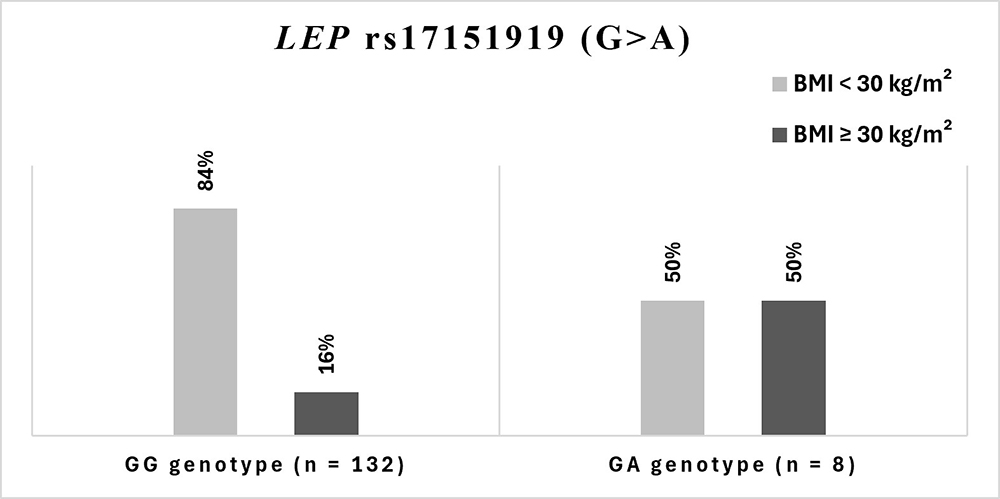
The allele/genotype analysis revealed a strongly positive association between the rs17151919 variant of the LEP gene and obesity in young adults, showing a ninefold increased risk of individuals carrying the lower frequency allele (A) of developing obesity when compared to non-carriers (aOR: 9.02; 95% CI 1.79-45.49; p = 0.007) (Table 5). Half of the GA genotype carriers presented obesity between 18 and 25 years of age (Figure 1).
In addition, individuals carrying the alternative allele (A) of the LEP rs7799039 showed a 2.2-fold increased risk to present BMI ≥ 25 kg/m² (overweight or obesity) (aOR: 2.18; 95% CI 1.07-4.42; p = 0.0308), while the presence of the homozygous genotype for the alternative allele (AA) also suggests a 3.8-fold increased risk of BMI ≥ 30 kg/m² (obesity) in young adults (aOR: 3.85; 95% CI 0.95-15.54; p = 0.058) (Table 5).
Carriers of the LEP rs17151919 GG and GA genotypes, with and without obesity, aged between 18 to 25 years.
In contrast, the FTO rs9939609 variant was not significantly associated with an increased risk of obesity or overweight in individuals 18 to 25 years of age, differing from results commonly found in FTO studies.
The haplotypes analysis also revealed a very expressive result regarding the association of LEP variants and obesity (Table 6). The haplotype GACA of LEP (rs7799039 (G>A); rs2167270 (G>A); rs17151914 (C>T); rs17151919 (G>A)), which contains the alternative alleles of LEP rs2167270 and rs17151919, revealed a 12.7-fold increased risk of carriers of this haplotype aged between 18 and 25 years presenting a BMI above 30 kg/m² when compared to the most frequent haplotype presented by the individuals studied (aOR: 12.67; 95% CI 2.25-71.45; p = 0.004).
Another LEP haplotype, AGCG (rs7799039 (G>A); rs2167270 (G>A); rs17151914 (C>T); rs17151919 (G>A)), which contains only the alternative allele of the variant rs7799039, also revealed a significant association to obesity, showing 2.5-fold increased risk of carriers of this haplotype aged 18-25 years having a BMI above 30 kg/m² (aOR: 2.5; 95% CI 1.1-5.73; p = 0.0284) and 1.9-fold increased risk of having a BMI above 25 kg/m² (aOR: 1.93; 95% CI 1.07-3.47; p = 0.0291).
Furthermore, the following conditions were strongly associated with BMI ≥ 30 kg/m² in individuals aged 18 to 25 years old: having been a child with overweight or obesity (aOR: 4.45; 95% CI 1.76-11.27; p = 0.003); presenting short satiety (aOR: 3.46; 95% CI 1.19-10.07; p = 0.045); having vitamin D deficiency (aOR: 3.03; 95% CI 1.18-7.76; p = 0.021); self-report of having anxiety (aOR: 3.94; 95% CI 1.49-10.38; p = 0.005); self-report of having depression (aOR: 3.76; 95% CI 1.32-10.68; p = 0.012), and presenting a family history of diabetes type 2 (aOR: 6.38; 95% CI 2.32-17.51; p = 0.0003) (Table 4). According to these results, it is worth emphasizing the high odds ratios presented in all associations found.
Discussion
Allele and genotype analyses of the LEP gene revealed a strongly significant association between the LEP rs17151919 variant and individuals aged 18 to 25 years with obesity. However, it is important to note that the 95% confidence interval for this association was wide (1.79-45.49), reflecting the low frequency of the minor A allele in our sample and indicating lower precision in the effect size estimate. Despite this limitation, the magnitude of the association is consistent with other studies that identified a link between the LEP rs17151919 A-allele and higher BMI in individuals aged 18 to 30 years (Friedlander et al., 2010) and significantly decreased leptin secretion in vitro (Yaghootkar et al., 2020). In addition, the alternative alleles of LEP rs2167270 and rs17151919 seem to be in linkage disequilibrium, and the combined effect of their alternative alleles present in the LEP GACA haplotype (rs7799039 (G>A); rs2167270 (G>A); rs17151914 (C>T); rs17151919 (G>A)) showed an even stronger association with BMI, indicating a 12.7-fold increased risk of obesity (BMI above 30 kg/m²) in the young adults studied. According to some studies, the A allele of LEP rs2167270 was associated with increased plasma leptin levels (Fourati et al., 2013; Duan et al., 2020), which also suggests an increased expression of the linked rs17151919 risk allele in carriers of the GACA haplotype, and consequently, an increase in its deleterious impact.
In relation to LEP rs7799039 variant, the literature data presents conflicting results about the association between this variant, obesity, and related phenotypes. A study performed in Taiwan observed that carriers of this population’s minor allele (G-allele) were significantly associated with higher leptin levels in individuals with obesity and females (Duan et al., 2020). On the other hand, another study performed in Mongolian individuals with metabolic syndrome identified that carriers of AA genotype of LEP rs7799039 presented higher BMI when compared to GA and GG genotype carriers (BMI ≥ 36.5 ± 2.49) (Dagdan et al., 2018), corroborating our findings that showed a 2.2-fold increased risk of overweight or obesity associated to carriers of the A-allele and suggested a 3.8-fold increased risk of obesity associated to carriers of AA genotype. Moreover, an in vitro study showed that carriers of genotype AA presented leptin mRNA levels 60% higher in adipose tissue cells than GA/GG, and that mRNA levels remained higher even after adjusting for BMI. In addition, serum leptin levels were approximately 50% higher in AA than in GA/GG genotype carriers (Hoffstedt et al., 2002). Thus, based on these findings, the A-allele suggests increasing leptin levels, with a potentiated effect on homozygous carriers, which could lead to earlier hyperleptinemia and leptin resistance in young adults. This condition could reduce the feeling of satiety and increase food consumption in a differentiated way in individuals with the genotype of risk.
In respect to contradictory findings in Taiwan population (Duan et al., 2020), it is important to note that, unlike the Brazilian population, the G-allele of LEP rs7799039 is the allele of minor frequency in Taiwanese population (MAF (G): 0.276), while the A-allele is the allele of minor frequency in the European (MAF (A): 0.348), African (MAF (A): 0.037), and Brazilian populations (MAF (A): 0.368) (Naslavsky et al., 2022; Phan et al., 2025). Therefore, the very distinct allele frequency of LEP rs7799039 and the different genetic profiles would probably explain the distinct effects of this genetic variant on obesity development observed among the different populations. In this context, a study performed in Brazilians from different regions of the country analyzed autosomal biparental markers revealing very elevated levels of genetic admixture between European, Amerindian, and African, with predominant European ancestry, in all regions studied (Pena et al., 2020). Therefore, it is important to emphasize that Brazilians present a heterogeneous ancestry, which results in genetic variant frequencies commonly closer to those observed in Europeans, Amerindian, and Africans than in other populations.
Corroborating the association of LEP rs7799039 A-allele and higher BMI, the haplotype analyses of individuals aged 18 to 25 years with obesity also revealed that carriers of the LEP AGCG haplotype, which contains the alternative A-allele of LEP rs7799039, show a 2.5-fold increased risk of obesity and a 1.9-fold increased risk of being an individual with overweight or obesity. However, the alternative allele of this variant seems to be in linkage disequilibrium with the reference G-allele of LEP rs2167270, which makes it impossible to perform a combined analysis of its effects, where both alternative alleles are present. Therefore, the results of the present study suggest that the A-allele of LEP rs7799039 has a dominant effect on overweight/obesity expression and an additive effect on obesity expression in young adults. Nevertheless, in view of the divergences found in literature, further studies are needed to clarify the role of this variant in weight gain, its interaction with variants of other genes, and its differentiated effect in individuals of different age groups.
Regarding the lack of association between LEPR variants and obesity in young adults, our finding aligns with a study performed in Australian women that evaluated longitudinal changes in body composition. The study revealed a small effect on body mass, and that the effects of LEPR variants on adiposity only become apparent after several years (de Silva et al., 2001). These findings suggest that the impact of LEPR variants is proportionally lower than other genetic risk factors for the development of obesity, presenting a significant contribution to this phenotype only in the long term.
Interestingly, the FTO rs9939609 variant showed no association with obesity in young adults, corroborating a study with Brazilian adolescents aged 18 to 19 years (Rodrigues et al., 2020).
At the transcriptional level, Berulava and Horsthemke (2010) observed that even in heterozygous individuals, the expression of the FTO rs9939609 alternative allele (A) is higher than the expression of the ancestral allele (T), which corroborates the effect of the risk allele on obesity. Previously, Fischer et al. (2009) had reported that the inactivation of the FTO gene expresses a protective effect against obesity, revealing that the increased levels of FTO expression, such as that observed in carriers of the FTO rs9939609 A-allele, would be the cause of this association with obesity phenotype.
Data from the literature show that the FTO rs9939609 and even other variants located in FTO intronic regions may be associated with obesity due to their interaction with the promoter region of the IRX3 gene, which is expressed in hypothalamic pro-opiomelanocortin neurons (POMC). Changes in its expression levels affect body adiposity, and energy expenditure that is associated with the regulation of body mass. These findings may explain the strong association of variants in the intron of FTO with obesity (Smemo et al., 2014; Schneeberger, 2019).
Therefore, a possible explanation for the differentiated impact of LEP and FTO variants in individuals from different age groups could be the distinct metabolic pathways involved in the pathogenesis of obesity, suggesting an earlier effect of LEP rs17151919 probably due to the greater impact of lower levels of leptin specifically on early-onset obesity. In contrast, a possible later effect of FTO rs9939609 suggests an initial association with changes in the regulation of body mass, favoring adiposity, and subsequently leading to increased risk for hyperleptinemia, leptin resistance, and obesity. However, in either case, the effects of genetic risk factors tend to be progressively enhanced throughout life due to the action of additional risk factors, such as sedentary lifestyle, stress and diet rich in foods with high energy density and low nutritional value, resulting in greater impacts on the development of obesity later in life.
Concerning some limitations of the study, the reliance on self-reported anthropometric data for a portion of the sample, while validated against a subgroup, may introduce recall bias. Furthermore, a larger number of participants and their serum leptin data would certainly improve the chances of identifying variants with smaller impacts and contribute to better understanding of the variant’s effects.
Lastly, this study also showed that young adults present significant association between higher risk of obesity and the perception of short satiety, anxiety, depression, vitamin D deficiency and family history of type 2 diabetes, emphasizing important risk factors for early-onset obesity and suggesting more careful medical and nutritional monitoring in these cases.
In conclusion, this study identified important biomarkers for predicting the higher risk of developing overweight and obesity in young adults, suggesting a differentiated impact of these genetic variants in this age group. The twofold increased risk of developing overweight and obesity associated with the alternative allele of the LEP rs7799039 variant underscores the potential utility of this variant as a predictive biomarker for weight gain in young adults, particularly given its high frequency in the study population and others globally. Despite the lower frequency of the LEP rs17151919 minor allele (ranging from 1% to 10% in different populations, according to ALFA project), the ninefold increased risk of obesity associated with the alternative allele of this variant also suggests its high relevance for the prediction of early-onset obesity. Therefore, the risk factors associated with the expression of overweight and obesity identified in this study contribute to broadening our understanding of this complex condition, in addition to highlighting important genetic tools for obesity prevention, and treatment strategies based on precision medicine and personalized nutrition.
Acknowledgments
We would like to thank the young undergraduate and postgraduate students who volunteered to participate in this study, for their invaluable contributions. This study was financed in part by the Coordenação de Aperfeiçoamento de Pessoal de Nível Superior - Brasil (CAPES) - including Finance Code 001; Universidade Federal do Estado do Rio de Janeiro - Brasil (UNIRIO) - Finance Code 3390.20; Fundação Carlos Chagas Filho de Amparo à Pesquisa do Estado do Rio de Janeiro - Brasil (FAPERJ) - E-26/210.188/2021; E-26/211.064/2021; and Conselho Nacional de Desenvolvimento Científico e Tecnológico - Brasil (CNPq).
References
- Berulava T and Horsthemke B (2010) The obesity-associated SNPs in intron 1 of the FTO gene affect primary transcript levels. Eur J Hum Genet 18:1054-1056.
- Carlos FF, Silva-Nunes J, Flores O, Brito M, Doria G, Veiga L and Baptista PV (2013) Association of FTO and PPARG polymorphisms with obesity in Portuguese women. Diabetes Metab Syndr Obes 6:241-245.
- da Fonseca ACP, Abreu GM, Zembrzuski VM, Campos Junior M, Carneiro JRI, Nogueira Neto JF, Cabello GMK and Cabello PH (2019) The association of the fat mass and obesity-associated gene (FTO) rs9939609 polymorphism and the severe obesity in a Brazilian population. Diabetes Metab Syndr Obes 12:667-684.
- Dagdan B, Chuluun-Erdene A, Sengeragchaa O, Malchinkhuu M and Janlav M (2018) Leptin Gene G2548A Polymorphism among Mongolians with Metabolic Syndrome. Med Sci (Basel) 7:3.
- Dasgupta S, Salman M, Siddalingaiah LB, Lakshmi GL, Xaviour D and Sreenath J (2015) Genetic variants in leptin: Determinants of obesity and leptin levels in South Indian population. Adipocyte 4:135-140.
- de Oliveira R, Cerda A, Genvigir FD, Sampaio MF, Armaganijan D, Bernik MMS, Dorea EL, Hirata MH, Hinuy HM and Hirata RDC (2013) Leptin receptor gene polymorphisms are associated with adiposity and metabolic alterations in Brazilian individuals. Arq Bras Endocrinol Metabol 57:677-684.
- de Onis M, Onyango AW, Borghi E, Siyam A, Nishida C and Siekmann J (2007) Development of a WHO growth reference for school-aged children and adolescents. Bull World Health Organ 85:660-667.
- De Pauw R, Claessens M, Gorasso V, Drieskens S, Faes C and Devleesschauwer B (2022) Past, present, and future trends of overweight and obesity in Belgium using Bayesian age-period-cohort models. BMC Public Health 22:1309.
- de Silva AM, Walder KR, Boyko EJ, Whitecross KF, Nicholson G, Kotowicz M, Pasco J and Collier GR (2001) Genetic variation and obesity in Australian women: A prospective study. Obes Res 9:733-740.
- Diels S, Vanden Berghe W and Van Hul W (2020) Insights into the multifactorial causation of obesity by integrated genetic and epigenetic analysis. Obes Rev 21:e13019.
- Duan DM, Jhang JY, Wu S, Teng MS, Hsu LA and Ko YL (2020) Modification effect of sex and obesity on the correlation of LEP polymorphisms with leptin levels in Taiwanese obese women. Mol Genet Genomic Med 8:e1113.
- Dutton GR, Kim Y, Jacobs DR Jr, Li X, Loria CM, Reis JP, Carnethon M, Durant NH, Gordon-Larsen P and Shikany JM (2016) 25-year weight gain in a racially balanced sample of U.S. adults: The CARDIA study. Obesity (Silver Spring) 24:1962-1968.
- El Fessikh M, Elkarhat Z, Flatters D, Camproux AC, Belghiti H, Guerinech H, Bakri Y, Dakka N and El Baghdadi J (2023) Association study of leptin receptor polymorphisms in women with obesity and their impact on protein domains: A case-control study and in silico analyses. J Biomol Struct Dyn 41:6546-6558.
- Faul F, Erdfelder E, Lang AG and Buchner A (2007) G*Power 3: A flexible statistical power analysis program for the social, behavioral, and biomedical sciences. Behav Res Methods 39:175-191.
- Fayyaz K, Bataineh MF, Ali HI, Al-Nawaiseh AM, Al-Rifai’ RH and Shahbaz HM (2024) Validity of measured vs. self-reported weight and height and practical considerations for enhancing reliability in clinical and epidemiological studies: A systematic review. Nutrients. 16:1704.
- Fischer J, Koch L, Emmerling C, Vierkotten J, Peters T, Bruning JC and Ruther U (2009) Inactivation of the Fto gene protects from obesity. Nature 458:894-898.
- Fourati M, Mnif M, Kharrat N, Charfi N, Kammoun M, Fendri N, Sessi S, Abid M, Rebai A and Fakhfakh F (2013) Association between Leptin gene polymorphisms and plasma leptin level in three consanguineous families with obesity. Gene 527:75-81.
- Friedlander Y, Li G, Fornage M, Williams OD, Lewis CE, Schreiner P, Pletcher MJ, Enquobahrie D, Williams M and Siscovick DS (2010) Candidate molecular pathway genes related to appetite regulatory neural network, adipocyte homeostasis and obesity: Results from the CARDIA Study. Ann Hum Genet 74:387-398.
- Garavito P, Mosquera-Heredia MI, Fang L, Payares F, Ruiz M, Arias I, Tuesca R, Navarro E and Silvera-Redondo C (2020) Polymorphisms of leptin-melanocortin system genes associated with obesity in an adult population from Barranquilla. Biomedica 40:257-269.
- Geifman N, Cohen R and Rubin E (2013) Redefining meaningful age groups in the context of disease. Age (Dordr) 35:2357-2366.
- Gorber SC, Tremblay M, Moher D and Gorber B (2007) A comparison of direct vs. self-report measures for assessing height, weight and body mass index: A systematic review. Obes Rev 8:307-326.
- Hoffstedt J, Eriksson P, Mottagui-Tabar S and Arner P (2002) A polymorphism in the leptin promoter region (-2548 G/A) influences gene expression and adipose tissue secretion of leptin. Horm Metab Res 34:355-359.
- Katsoulis M, Lai AG, Diaz-Ordaz K, Gomes M, Pasea L, Banerjee A, Denaxas S, Tsilidis K, Lagiou P, Misirli G et al (2021) Identifying adults at high-risk for change in weight and BMI in England: A longitudinal, large-scale, population-based cohort study using electronic health records. Lancet Diabetes Endocrinol 9:681-694.
- Kiani AK, Bonetti G, Donato K, Kaftalli J, Herbst KL, Stuppia L, Fioretti F, Nodari S, Perrone M, Chiurazzi P et al (2022) Polymorphisms, diet and nutrigenomics. J Prev Med Hyg 63:E125-E141 .
- Legry V, Cottel D, Ferrieres J, Arveiler D, Andrieux N, Bingham A, Wagner A, Ruidavets JB, Ducimetiere P, Amouyel P et al (2009) Effect of an FTO polymorphism on fat mass, obesity, and type 2 diabetes mellitus in the French MONICA Study. Metabolism 58:971-975.
- Naslavsky MS, Scliar MO, Yamamoto GL, Wang JYT, Zverinova S, Karp T, Nunes K, Ceroni JRM, de Carvalho DL, da Silva Simões CE et al (2022) Whole-genome sequencing of 1,171 elderly admixed individuals from Brazil. Nature Communications 13:1004.
- Ng M, Dai X, Cogen RM, Abdelmasseh M, Abdollahi A, Abdullahi A, Aboagye RG, Abukhadijah HJ, Adeyeoluwa TE, Afolabi AA et al (2024) National-level and state-level prevalence of overweight and obesity among children, adolescents, and adults in the USA, 1990-2021, and forecasts up to 2050. Lancet 404:2278-2298.
- Park HG and Choi JH (2023) Genetic variant rs9939609 in FTO is associated with body composition and obesity risk in Korean females. BMJ Open Diabetes Res Care 11:e003649.
- Pena SDJ, Santos FR and Tarazona-Santos E (2020) Genetic admixture in Brazil. Am J Med Genet C Semin Med Genet 184:928-938.
- Peter RS, Fromm E, Klenk J, Concin H and Nagel G (2014) Change in height, weight, and body mass index: Longitudinal data from Austria. Am J Hum Biol 26:690-696.
- Phan L, Zhang H, Wang Q, Villamarin R, Hefferon T, Ramanathan A and Kattman B (2025) The evolution of dbSNP: 25 years of impact in genomic research. Nucleic Acids Res 53:D925-D931.
- Piwonska AM, Cicha-Mikolajczyk A, Sobczyk-Kopciol A, Piwonski J, Drygas W, Kwasniewska M, Pajak A, Zdrojewski T, Tykarski A, Kozakiewicz K et al (2022) Independent association of FTO rs9939609 polymorphism with overweight and obesity in Polish adults. Results from the representative population-based WOBASZ study. J Physiol Pharmacol 73:395-402.
- Ponasenko A, Sinitsky M, Minina V, Vesnina A, Khutornaya M, Prosekov A and Barbarash O (2022) Immune response and lipid metabolism gene polymorphisms are associated with the risk of obesity in middle-aged and elderly patients. J Pers Med 12:238.
- Rodrigues LDS, Santos AMD, Lima MIS, Simões VMF and Pereira SR (2020) Association between the FTO gene polymorphism and obesity in Brazilian adolescents from the Northeast region. J Pediatr 96:630-637.
- Saqlain M, Khalid M, Fiaz M, Saeed S, Mehmood Raja A, Mobeen Zafar M, Fatima T, Bosco Pesquero J, Maglio C, Valadi H et al (2022) Risk variants of obesity associated genes demonstrate BMI raising effect in a large cohort. PLoS One 17:e0274904.
- Schneeberger M (2019) Irx3, a new leader on obesity genetics. EBioMedicine 39:19-20.
- Smemo S, Tena JJ, Kim KH, Gamazon ER, Sakabe NJ, Gómez-Marín C, Aneas I, Credidio FL, Sobreira DR, Wasserman NF et al (2014) Obesity-associated variants within FTO form long-range functional connections with IRX3. Nature 507:371-375.
- Yaghootkar H, Zhang Y, Spracklen CN, Karaderi T, Huang LO, Bradfield J, Schurmann C, Fine RS, Preuss MH, Kutalik Z et al (2020) Genetic studies of leptin concentrations implicate leptin in the regulation of early adiposity. Diabetes 69:2806-2818.
- Zheng Y, Manson JE, Yuan C, Liang MH, Grodstein F, Stampfer MJ, Willett WC and Hu FB (2017) Associations of weight gain from early to middle adulthood with major health outcomes later in life. JAMA 318:255-269.
Internet Resources
-
COVITEL 2023 (2023) Universidade Federal de Pelotas, Vital Strategies Brasil, Inquérito telefônico de fatores de risco para doenças crônicas não transmissíveis em tempos de pandemia - Alimentação, excesso de peso e obesidade, COVITEL 2023 (2023) Universidade Federal de Pelotas, Vital Strategies Brasil, Inquérito telefônico de fatores de risco para doenças crônicas não transmissíveis em tempos de pandemia - Alimentação, excesso de peso e obesidade, https://www12.senado.leg.br/noticias/arquivos/2024/08/30/relatorio_covitel_2023.pdf (accessed 31 october 2025).
» https://www12.senado.leg.br/noticias/arquivos/2024/08/30/relatorio_covitel_2023.pdf -
NHS - England Digital (2024) Adult overweight and obesity. Overweight and obesity, by age and sex, Health Survey for England, 2022 Part 2. https://digital.nhs.uk/data-and-information/publications/statistical/health-survey-for-england/2022-part-2/adult-overweight-and-obesity (accessed 31 october 2025).
» https://digital.nhs.uk/data-and-information/publications/statistical/health-survey-for-england/2022-part-2/adult-overweight-and-obesity -
NCBI - National Center for Biotechnology Information, dbSNP, Single Nucleotide Polymorphism Database, U.S. National Library of Medicine, National Library of Medicine, https://www.ncbi.nlm.nih.gov/snp/ (accessed 31 october 2025).
» https://www.ncbi.nlm.nih.gov/snp/
The entire dataset supporting the results of this study was published in the article itself.