
 MATHLIBRAS’ JOURNEY: the evolution of the project’s video lesson scripts
ABSTRACT
The text presents an analysis of the changes made to the scripts of MathLibras videos, which aim to create accessible and bilingual teaching material for teaching mathematics to Deaf students, with Libras as the first language and Portuguese, in the form of captions, as the second language. The work focused on the analysis of four videos, which allowed for self-reflection, in which similarities and differences were examined, and how the changes enabled a greater reach of the project, both in terms of channel subscribers and practical application at the partner school. This analysis supported a new script model that was shorter, more direct, and focused on practice and solving exercises using everyday objects.
Keywords
scripts; video; Education of the Deaf; Libras; Mathematics Education
RESUMO
O texto apresenta uma análise sobre as modificações realizadas nos roteiros dos vídeos do MathLibras, que têm o objetivo de criar material didático acessível e bilíngue para o ensino matemático de alunos surdos, sendo a Libras a primeira língua e o Português na legenda como segunda. O trabalho teve como foco a análise de quatro vídeos, os quais possibilitaram uma autorreflexão, na qual foram verificadas semelhanças e divergências, e como as mudanças possibilitaram um alcance maior do projeto, tanto em inscritos no canal quanto na aplicação prática na escola parceira. Essa análise fundamentou um novo modelo de roteiro, mais curto, direto e voltado para a prática e resolução de exercícios com o uso de objetos do cotidiano.
Palavras-chave
roteiro; vídeo; Educação de Surdos; Libras; Educação Matemática
RESUMEN
El texto presenta un análisis de las modificaciones realizadas a los guiones de video de MathLibras, que tienen como objetivo crear material didáctico accesible y bilingüe para la enseñanza de matemática para estudiantes sordos, siendo Libras el primer idioma y el portugués en los subtítulos como segunda. El trabajo se centró en el análisis de cuatro vídeos, que permitieron la autorreflexión, en los que se comprobaron similitudes y divergencias, y cómo los cambios permitieron un mayor alcance del proyecto, tanto en suscriptores del canal como en la aplicación práctica en la escuela colaboradora. Este análisis fundó un nuevo modelo de guión, más corto, más directo y centrado en la práctica y resolución de ejercicios utilizando objetos cotidianos.
Palabras clave
guión; video; Educación para Sordos; Libras; Educación Matemática
Introduction
MathLibras is a research and extension project that has been ongoing since 2017. It is part of the Department of Mathematics Education of the Institute of Physics and Mathematics in partnership with the Libras Area of the Center for Languages and Communication. Furthermore, the project is developed in partnership with the Graduate Program in Languages (PPGL) and the Graduate Program in Mathematics Education (PPGEMAT). It also has a partnership with the Interpreters Section. All these partnerships are within the Federal University of Pelotas (UFPel), in Pelotas, Rio Grande do Sul. The project has two undergraduate research scholarship holders, both undergraduate students from the Cinema and Audiovisual degrees, who are responsible for capturing and editing all the material produced by the project.
The project was created to meet the demand for accessible didactic materials to Deaf people, considering the already existing difficulties that students face in Mathematics. According to the Basic Education Assessment System (SAEB) of the National Institute of Educational Studies and Research Anísio Teixeira (INEP), in 2021, only 37% of 5th grade students completed this stage with a proficient or advanced understanding of Mathematics. Throughout their education, the data worsen, as 85% of 9th grade students in Mathematics leave school with a basic or insufficient understanding of the subject and, if we consider High School, the percentage rises to 95%.
Therefore, the objective of the project is to assist in the construction of the mathematical knowledge of Deaf students, as well as to contribute to the training of teachers, proposing the production of bilingual didactic material with a focus on video lessons of Mathematics in Brazilian Sign Language (Libras) as a first language (L1) (Moura, 2014), as well as captions and audio in Portuguese, as a second language (L2).
The material developed is available on the MathLibras YouTube channel, allowing wide access to the population, and can be incorporated into the planning of classes in schools all over Brazil. In the context of Pelotas, the video lessons are also shown at the Special School of Bilingual Education Professor Alfredo Dub, a partner of the project. The exhibition of the videos in the school is held from prior scheduling for different classes of Early Childhood Education and Elementary School, so that students can watch, evaluate, and validate the productions.
In 2024, MathLibras has completed seven years of existence and has already undergone numerous changes in its production. It is currently in the fifth phase of the project. Figure 1 presents the phases of the project.

In this article, four video lesson scripts will be analyzed, having as object of study and comparison the scripts of videos V01 – Why Classify? (2018) – Phase 1, V12 – Sum 7 (2019) – Phase 2, V27 – A garden for Sara (2022) – Phase 4 and V34 – Let’s Compare? (2023) – Phase 5. The videos were chosen because they refer to the four different phases of the audiovisual material production. It should be noted that phase 3 was not analyzed because due to the COVID-19 pandemic the recordings were suspended and the project was then focused on analyzing what had been already produced in previous phases.
The encoding in the nomenclature of each video is composed of the letter V, which is a reduction of the word video, followed by the number that distinguishes each video, provided at the time of publication, from the arrangement in sequence, for example, V01 is the first video published, and V34 is the thirty-fourth.
Script
It is important to first introduce the concept of a script. Then, subsequently to situate the concept of script concerning an educational work aimed at teaching Deaf students. And finally analyze the evolution of the script within the scope of the project.
The script is the basis for any audiovisual work, as it constitutes the structuring of the idea through words that will come to life with the image. The script can be described as “the written, detailed and organized transcription of the development of the entire program1” (FERRÉS, 1996, p. 95). It contains the main information regarding the theme of the narrative, the actions, the speeches, and the indications of the elements that will appear on the screen, facilitating the planning of the production. “[...] such planning is essential because the necessary criterion for the construction of each detail, for the conception of each scene, of each shot, can only come from that idea of origin, previously existing in the consciousness – the theme2” (JOHANN, 2013, s./p.).
This concept applies to scripts in the educational scope, that is, the script of a video lesson, for example, serves as a guide for the recording, in addition to presenting the content that will be debated in order to address a topic in a more playful and didactic way, thus stimulating the consumers’ learning. There are some aspects to be considered when constructing the script of an educational video, from the technical-aesthetic part, related to onscreen elements such as lighting, character, choice of framing, positioning, and setting, among others, which are already defined in the script stage for better visualization during filming and post-production (GOMES, 2010).
In teaching aimed at Deaf students, the script, in general , can take into account the principles of Visual Grammar (ROSADO; TAVEIRA, 2022), which assist in the composition of the elements on the screen and serve as a guide in the recording. There are seven relevant elements, which are: signing actor (responsible for the utterance in sign language), voicing actor (uses speech, is the one that produces the audio in Portuguese), body of text (all the information written in the video, such as title or any other text that is necessary for the proposal of that specific video), image (illustration, animation, etc.), captions in written oral language, scenery or artificial background, and, finally, PIP (Picture-in-Picture), which is a smaller overlapping video.
In MathLibras the standard structure for all videos is based on the Visual Grammar, where a fixed camera is used, with a signing actress positioned at the center, facing forward, using chroma-key3, which will be replaced during editing with an artificial background according to the script. Furthermore, there is the inclusion of elements, such as numbers, texts, animations, the characters Levi and Sara4, among other scene objects, which are on the side, on the left and/or on the right.
The captions are optional. The audience can enable them if they wish to. PIP is in the seven initial videos of the channel (Phase 1), in which the voicing actor also appears; however, this structure has fallen into disuse, both to reduce the amount of information on the screen, and to focus on Libras. We use a formal , objective and engaging language, using the imperative, inviting the public to engage in connection with the elements that appear on the screen.
The objective of the video is clear: to inform, motivate, illustrate, sensitize, consolidate the content, facilitate understanding, apply the content in various situations, and reinforce the content (GOMES, 2010). For this to occur, the video lesson script needs to present the content, use an example to facilitate viewing, propose an exercise for the viewer to practice, and indicate where they can find more information on the subject. All of this considering the target audience profile, that is, for which education level a particular topic is planned, and whenever possible, enhancing it with playful visual elements that capture the viewer’s attention. “The video contributes with new possibilities to the educational environment, but at the same time, it is shaped by this environment5” (FERRÉS, 1996, p. 40), which makes planning essential .
When it comes to an educational video aimed at the Deaf community, the script has an additional stage, the gloss. Gloss (glosa, in Portuguese) is a word notation system with the grammatical structure of Libras (SOUZA, 2020); that is, after the script is written in Portuguese, it is converted into a textual structure that transitions between the original language and Libras, serving as a guide for the interpreter’s signing.
The project MathLibras has videos for the different levels of Basic Education, both for Early Childhood Education and also for more advanced content, such as fractions, destined to children starting from the 4th year of Elementary Education (BRASIL, 2018). It is worth noting the concern of the project to create productions that, from the script, are planned with a focus on linguistic accessibility and the cultural specificities of Deaf people, thus having, at all stages, the collaboration of Deaf teachers for discussion and validation.
Thus, the MathLibras scripts will be discussed below, using a comparative analysis to present data on the basic structuring and on their evolution. The analysis will be based on the first video of the project (2018), another from the following year (2019), and two more from years after the pause caused by the COVID-19 pandemic, which are from 2022 and 2023, all with titles already mentioned.
Methodology
The following analysis will be qualitative and comparative, in which we will correlate the similarities and differences in the elements found in the scripts that originated the videos V01 – Why Classify? V12 – Sum 7, V27 – A garden for Sara and V34 – Let’s Compare. The choice of videos that would compose the analysis followed a few criteria, such as the fact that each one was published in different years and had a visual and narrative structure that diverged from each other.
For FACHIN (2001), the comparative method involves the analysis of phenomena or events, seeking to explain them from the similarities and differences they present. It allows us to examine concrete data and, from them, identify patterns and distinctions between both general and abstract elements, indirectly facilitating investigations.
The comparison will follow this order: theme, structure, and duration.
Theme
V01 – Why Classify? (2018) is the first video available on the project’s YouTube channel. It is composed of a collection of four videos that address the concept of classification, one of the primordial foundations when constructing knowledge about the concept of numbers. Classification is the act of grouping elements based on a common criterion, which can be physical characteristics, such as color, shape, size, etc. (PIAGET, 1971).
The idea of starting the channel with a collection that addressed classification with a more teacher-centered approach comes from the fact that this is a basic concept in mathematics and that there are no specific classes to address it with students. In the video, the audience discovers that this knowledge is introduced gradually, with the integration of exercises, which extends the demand for the video to different school years.
On the other hand, V12 – Sum 7 (2019) has a more narrative story, helping to construct knowledge about addition. In this video, Sara goes to visit her grandfather’s farm, and there she comes across an orchard where she harvests oranges to make fruit juice. There is a staggering of actions; at first, she harvests four oranges, but the jar of juice is not yet filled, then she harvests two more, and again it is not yet filled, then finally she harvests another orange. When the jar is full, Sara drinks the juice. The challenge presented asks the viewer what the total number of harvested oranges is.
The question focuses on the student’s perception, and the existence of the character Sara in the challenge generates more identification with the viewer, as it presents similar characteristics to the target audience, such as age group. Furthermore, the elements used, in this case, the oranges, are easily accessible as an element known to students.
Regarding the theme, V27 – A garden for Sara (2022) presents Sara’s walking in a garden, where she is enchanted by the yellow flowers, desiring to plant more flowers of this color. She then seeks help from her mother, who teaches her how to plant and gives her a pack of seeds. However, after planting, Sara returns home without watering and is advised by her mother, who makes her return to the garden to water the plants. After a few days, three fresh flowers sprout. The video concludes by proposing an activity for the viewer, which involves figuring out how many yellow flowers the garden has in total by the end of the story.
The objective of video V27 was to work on notions of counting and addition, which are aimed at teaching basic mathematics to children. For better understanding and to capture the viewer’s interest, the script included several visual cues of the garden, contrasting different flower colors and creating a complete narrative situation with a beginning, middle, and end to Sara’s journey in her gardening adventure.
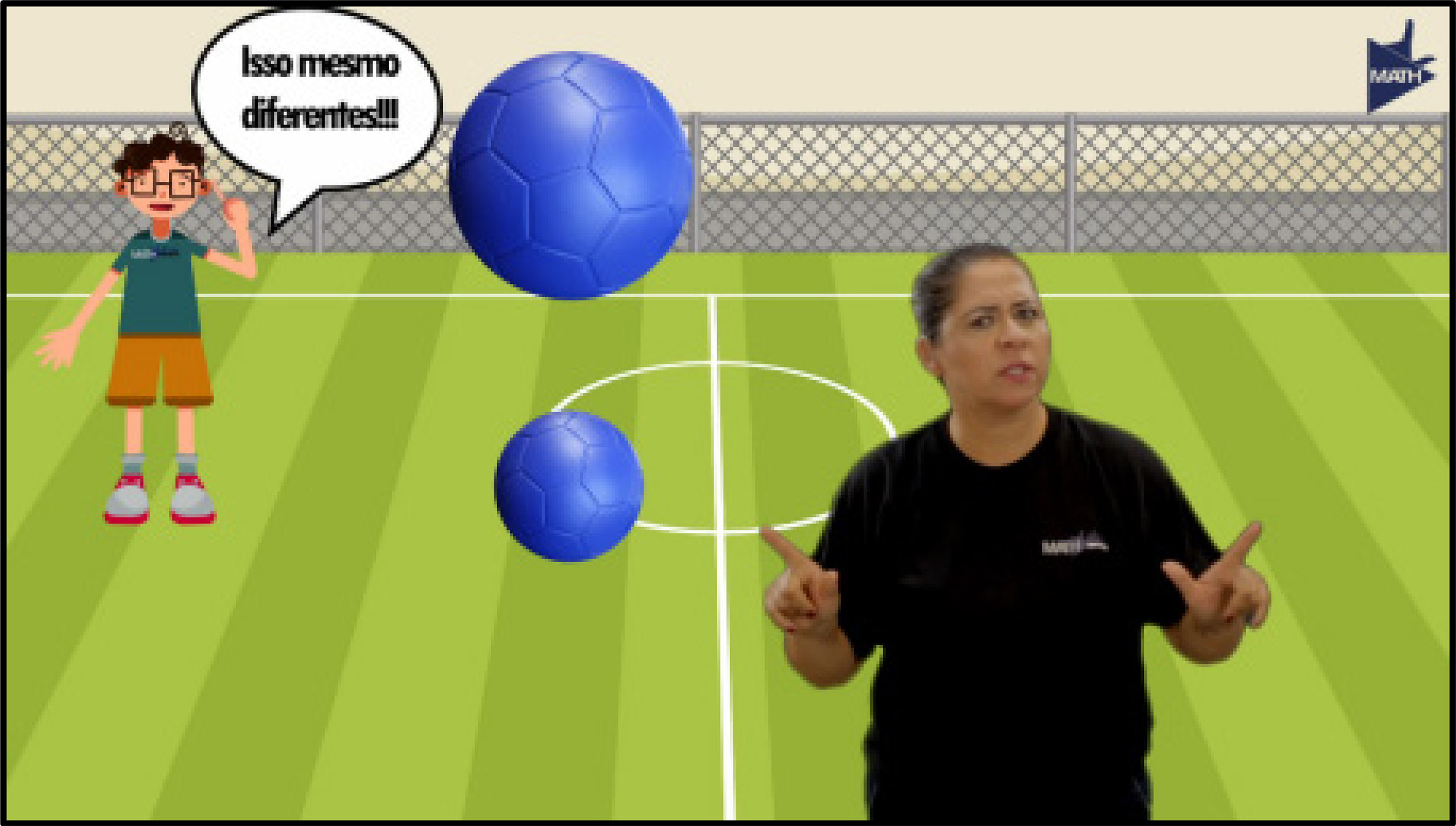
On the other hand, V34 – Let’s Compare (2023) presents a more simplified story, in which the signing actress brings two balls for Levi to compare, considering their size and color. The purpose was to exemplify how comparison can be visualized daily with objects that are part of children’s daily lives. It should be noted that the comparison content is important for children in Early Childhood Education since it is one of the bases for constructing the concept of numbers (RAMOS, 2009).
Structure
Considering their structure, V01 differs from the other videos by presenting a PIP, which is the video superimposed onto the other. In this video, we see the voicing actress on screen simultaneously with the signing actress, who translates what the voicing actress says into Libras, as shown in Figure 2.

It is emphasized that classification is a skill that the teacher gradually helps the child to develop throughout the school period. The use of everyday objects makes it easier for children to observe in their daily lives the possibility of classifying objects according to their need or criteria.
Finally, a farewell message is presented, along with the three different classification levels the student might be in: figurative, non-figurative, and operational. These will be the topics of the next three videos in the collection. In a nutshell, the structure was: presentation, concept, example, introduction to the next video, and farewell.
The V12 starts with a presentation of the MathLibras project, establishing a connection with the viewer by acknowledging that they are watching the video and asking if they enjoy the content. After the title, the signing actor appears, asking which fruit is the one that appears on the screen, in this case, an orange, as shown in Figure 3, and immediately the actor says he really likes orange juice. This is already an introduction to the main element of the challenge, and as usual, it already establishes a link between Sara and the audience, inferring that they both like oranges.

In the sequence, Sara goes to her grandfather’s farm and walks through the orchard, where she sees an orange tree, and her grandfather gives her a basket to pick four fruits to make the juice she wants. It is possible, at this moment, to establish a parallel with the hero’s journey, an artifice used in the characterization of classical narratives. Thus, the hero’s journey is characterized by 17 steps, which are divided into three acts: departure, initiation, and return (VALENTIM; SANTOS, 2021).
The departure, in the case of the video, is the presentation of Sara’s status quo, and her frequent trips to her grandfather’s farm to fulfill her craving for orange juice. When her grandfather encourages her to pick the oranges, the first conflict appears: the need to take action, marking the initiation. This phase extends through all her trips back and forth until she gathers enough oranges to fill the juice jar. The return is when she fulfills the craving pointed out at the beginning, in other words, when she finally drinks the juice.
The video ends by asking the audience about the total amount of oranges harvested. This challenge is the moment when the purpose of the class, to illustrate the sum, is put into practice. Finally, the farewell message and the invitation to subscribe to the channel are presented. Therefore, the structure of the V12 is presentation, illustrative narrative, challenge, resolution, and farewell.
In V27, the script follows this structure: in the first part, there is a greeting to the viewer, an introduction to the project, and Sara’s story in the garden. It includes a description of the setting, a turning point where Sara becomes fascinated by the yellow flower, the stimulus for her journey as she sets out to learn how to plant more flowers, her encounter with another character who guides her to achieve her goal, the introduction of a new obstacle—forgetting to water the plants, the resolution of the obstacle, and finally, the yellow flowers blooming, as illustrated in Figure 4, marking the conclusion of Sara’s journey.

Next, the challenge is proposed, followed by a recap of key elements from the story that will help solve the challenge. This includes the introduction of the mathematical operation and the solution to the addition. In the final minutes, there is a congratulatory message for successfully completing the challenge, a promotion of other videos, an invitation to follow the channel, a farewell message, and credits. In summary, the structure of the V27 is presentation, illustrative narrative, challenge, resolution, and farewell.
The V34 has a more simplified structure that includes the greeting, presentation of the project, and the content covered, which in this the case is comparison. The insertion of Levi into the story serves as the observer of the object to be compared, making the statement, as illustrated in Figure 5, and reaffirming the similarities and differences between the objects. Finally, the promotion of other videos on the channel is presented, along with a prompt to continue watching the channel, followed by the farewell and the credits. In summary, the structure of the V34 is presentation, conceptualization, challenge, resolution, and farewell.

Duration
The last aspect to be compared is duration. The V01 has 210 seconds, with an increase of 79.5%, and the V12 has 377 seconds. Concerning the last video, with a decrease of 16.4%, V27 has 315 seconds, and V34 has 139.2 seconds, which is approximately 44.2% of the duration of V27. After detailing the aspects that were compared in both scripts, we now proceed to the presentation of the results.
Results and discussion
At the outset, it is important to explain the reasons for the changes from one script to another, including: a) the discontinuation of the PIP; b) the focus on the student; c) the average viewing duration, a private data set provided by YouTube that allows the channel to assess how the audience is engaging with the published content, which in the case of MathLibras is 115 seconds6; d) the results from showing the videos at Alfredo Dub School, which made the team realize the need for more focused videos that concentrate on presenting the topic, challenge, and resolution; e) the understanding that longer videos tend to increase the chances of distraction and lower comprehension among children regarding the material presented.
The PIP was discontinued so that Libras would be the central focus of the visual presentation. The presence of two people on the screen facilitates dispersion and does not direct the look. Furthermore, the addition of animations and screen elements resulted in visual pollution. From the PIP approach, only the audio was kept, as all the following videos have narration in Portuguese.
All videos are aimed at both Deaf students and teachers. The teachers can use the videos in their classes and even have them as a reference to elaborate activities with students. However, unlike V01, which was more focused on the teacher, all other videos have language and a focus on direct communication with the students. This change was introduced from the lack of didactic material that would create a link, proximity, and even a certain identification with Deaf children directly in Libras.
The project has always been aware of the statistics provided by YouTube to the channel, monitoring the changes with each video posted. When it was noticed that the average duration was shorter than the length of most videos, the conclusion was reached that the content needed to be more direct. After all, a beautifully crafted video full of narrative embellishments wouldn’t be effective if the audience didn’t watch it to the end and only viewed parts of the challenges.
As a result, the scripts began to shorten the narrative arcs, focusing more on a streamlined development of the challenge and explaining the concept being addressed. If necessary, the concept would be recapped in another video. Thus, the videos were reconnected through collections, where one video explains the concept, followed by others with practical exercises related to that content. Therefore, teachers can work on the concept in the classroom and playfully use the channel’s exercise videos, as shown in Figure 6.

On July 7, 2023, a screening of the V34 video was conducted – Let’s Compare? in different student groups at Alfredo Dub School, a partner of the project, which includes students from Early Childhood Education to the final years of Elementary School. In total, ten children participated, and they were divided into different groups for the display of the video. The activity was conducted by the MathLibras team and supervised by the teachers and the school coordinator, who assisted in communicating and interacting with students.
The video was shown without the initial seconds, which shows the presentation of the project, and without the endings, which bring the farewell messages and credits. Thus, only the content about comparison was displayed. The coordinator presented the lesson proposal and asked questions about the concepts shown in the video, as well as the response to the question posed by the signing actress, which was to analyze what was similar and what was different when comparing two balls of the same color but of different sizes.
The objective of this activity was to ascertain whether the changes made so far in the project scripts, which originated the V34, brought the desired results. It was a form of practical and in-person validation since although YouTube provides statistics, it doesn’t compare to the observations that can be made directly from the reactions of the target audience watching the video lessons and commenting (signing) on what they were able to understand, as well as potential issues.
The exhibition and debate activity with the different groups made it possible to infer that the shorter duration and focus on the challenge facilitated students’ understanding. This is especially true if the object used in the example by the signing actress is something from the school routine, as the teacher can bring it for the student to touch and see the similarities and differences in its physical form when compared. In the case of the V34, the object was the ball, illustrated in Figure 7.

Regarding the theme, a similarity is identified in the content’s difficulty level, considering its introductory nature in teaching Mathematics. In both of them, animation elements are used to establish a more playful connection with the audience. The differences are that the two videos involve the addition operation, while the other two bring notions of classification and comparison between objects, concepts linked to the construction of the concept of numbers (LORENZATO, 2006). V01 has a structure more focused on the definition of a concept; V12 and V27 have a structure resembling a children’s story, with a more developed narrative and with Sara’s character truly functioning as the agent of action. In the V34, Levi is a passive agent, just observing what is said, not presenting any dramatic development. The focus is more on the observation of objects than on the character arc or concept.
The scripts of videos V12 and V27 are closer to what is seen in the cinematic context, where the main character has a goal and navigates obstacles to achieve it. The mathematical explanation is presented at the end of the video, using elements that were incorporated into the action. On the other hand, V34 uses a structure more focused on the exercises, with a succinct approach to the theme, prompting the viewer to analyze the objects on the screen. Finally, V01 is more of an introductory conversation with an action example directed towards the teacher.
The changes observed in the narrative elaboration from V01 to V34 are the result of data obtained from empirical experiences, such as practical applications, and also from quantitative data, which were the statistics provided by the storage and display platform. The impact can be felt in the duration of V34 when compared to V27, which had a 55.8% reduction. This was due to the removal of the entire “story” section present in both V27 and V12. The available time was then focused on working with the theoretical concept, bringing V34 closer to the average viewing duration indicated by YouTube. When the V34 was displayed at Alfredo Dub School, it was noticed that the children were able to concentrate more.
With this, a general change was initiated in the scripts of the MathLibras videos in 2023, which adopted a more succinct structure, with a greeting, content presentation, exercise proposal, resolution, and invitation to follow the channel. The first and last items have become standard for all videos. In addition, a challenge-only video scheme was also adopted, restricting a more developed narrative, arc, and character journey.
Although the format that is currently adopted affects most of the videos, the project plans to resume producing video lessons, which will be part of a separate playlist with longer videos to also reach audiences looking for more complex scripts and more developed concepts. Additionally, there will be an extension of the channel, which will feature literary adaptations with stories that involve mathematical concepts.
Finally, the channel lacked a glossary of the mathematical terms presented in the videos, the term signs, which are the signs “used in specificity context of languages, in relation to scientific or technical terminology7” (FRIEDRICH; LEBEDEFF, 2022, p. 401). It is important to highlight that there is a specific terminology for the area of Mathematics, which can be found in glossaries or dictionaries of Libras. However, sometimes, due to a lack of knowledge of this terminology, they are “combined” between teachers and students or between Libras translators, interpreters, and students. According to Friedrich and Lebedeff (2022), these “combinations” are the result of the discussion and choice of a provisional sign for a concept or technical term. Additionally, since Libras is a living language with many linguistic variations, it was decided in 2023 to provide the first batch of videos with a glossary of terms, which will be constantly updated based on terminological demands.
Conclusions
The structure of a project script, regardless of the content that is being addressed, needs to maintain a basic model of greeting and closing. In its development, the script can adopt a more concise, objective, and practical structure without undermining the playful and engaging character that can be represented by the animation of objects and interaction with the characters and/or signing actors, as seen with the moving balls in V34.
The MathLibras project is constantly evolving, with seven years of history, and it self-regulates with the information and data received, whether through YouTube statistics or the results of applications and practical experiences conducted at the partner school, Alfredo Dub. Additionally, the project adapts to the specific needs of each content to make it didactically easier to reach the target audience and fulfill the objective of MathLibras, which aims to democratize access to quality mathematical education in Libras.
The project offers video lessons about different concepts, contents, and mathematical operations in Libras with captions and narration in Portuguese, written and reviewed by a multiple team, composed of Deaf and hearing teachers, interpreters, MA students, PhD students, and academics from different undergraduate courses. Its content is aimed at both Deaf and hearing students, and also for teachers who can use it as teaching material for their classes.
The MathLibras channel has 2,866 subscribers8 and features playlists covering topics such as classification, comparison, addition, subtraction, multiplication, Golden Material, and a vast repertoire of fractions and their types, as well as a list of challenges and glossaries. The project’s goal for the coming years is to expand mathematical themes and develop, in some videos, a more literary path based on ongoing negotiations with a publisher of children’s books.
The work of MathLibras, as well as other projects that produce accessible didactic material, is essential in our current education system due to the precariousness of assistance support to the Deaf community. In relation to mathematical education, which already carries a degree of difficulty in learning when it comes to children in Early Childhood Education and the early years of Elementary School, the issue of literacy in Libras is added. This is because, unlike hearing children who are exposed to Portuguese at home, many Deaf children will have their first contact with sign language in school (QUADROS, 2019).
Finally, MathLibras seeks to produce the videos in a contextualized manner, presenting in the video lesson scripts a reflection of the teaching-learning process of Deaf students during their journey. Thus, the project aims to provide quality educational material that is designed with the Deaf student in mind from the very beginning. Throughout all stages of production, it undergoes validation by Deaf teachers. Additionally, in its interaction with the audience, there is a concern to assess whether the content was understood and to determine the new directions the project should take.
-
Double-Blind System
-
Funding
CNPq
-
How to cite:
Grützmann, T. P.; Lebedeff, T. B.; & Gomes, G. H. P. (2025). The Mathlibras journey - the evolution of the project’s video lesson scripts]. INTERCOM - Brazilian Journal of Communication Sciences, 48, e2025103. https://doi.org/10.1590/1809-58442025103en.
-
Image Credits
The credits for the images and figures used in this article belong to the authors.
-
Article submitted to similarity systems
-
1
Original: “é a transcrição escrita, detalhada e pormenorizada do desenvolvimento de todo o programa”.
-
2
Original: “[...] tal planejamento é fundamental porque o critério necessário para a construção de cada detalhe, para a concepção de cada cena, de cada plano, só pode vir daquela ideia de origem, previamente existente na consciência – o tema”.
-
3
Chroma-key is a technique used in audiovisual based on the identification of a color that makes up the image, called “key color”, in which green is commonly used because its channel is easier to identify. After identification, a mask is created, and it determines the pixels that remain and those that are replaced by another from a background image (BERGH; LALIOTI, 1999 apud SANCHES, 2007, p. 54-55). 4 Levi and Sara are exclusive characters created by the project due to the search for an identification link with the viewer since they belong to the same age group as the students.
-
4
Levi and Sara are exclusive characters created by the project due to the search for an identification link with the viewer since they belong to the same age group as the students.
-
5
Original: “O vídeo contribui com novas possibilidades ao meio escolar, porém ao mesmo tempo é configurado por este meio”.
-
6
Data from December 9, 2023.
-
7
Original: “utilizados no contexto das linguagens de especialidade, com relação à terminologia científica ou técnica”.
-
8
Data extracted on October 23, 2024.
References
- BRASIL. Ministério da Educação. Base Nacional Comum Curricular Brasília, DF, 2018.
- FACHIN, O. Fundamentos de metodologia São Paulo: Saraiva. 2001.
- FERRÉS, J. Vídeo e educação 2. ed. Porto Alegre, RS: Artes Médicas, 1996.
- FRIEDRICH, Márcio; LEBEDEFF, Tatiana. Glossário de Administração em Libras: discussão sobre coleta, registro e publicização de sinaistermos. Entrepalavras, Fortaleza, v. 11, n. esp., p. 397-414, mar. 2022.
-
GOMES, L. F. Vídeos didáticos: uma proposta de critérios para análise. Travessias, Cascavel, v. 2, n. 3, p. e3128, 2010. Disponível em: https://e-revista.unioeste.br/index.php/travessias/article/view/3128 Acesso em: 27 jan. 2024.
» https://e-revista.unioeste.br/index.php/travessias/article/view/3128 -
JOHANN, A. O Roteiro Cinematográfico: um ser em simbiose. Nov. 2013. Disponível em: https://www.rua.ufscar.br/oroteiro-cinematografico-um-ser-em-simbiose/ Acesso em: 20 jul. 2023. Online.
» https://www.rua.ufscar.br/oroteiro-cinematografico-um-ser-em-simbiose/ - LORENZATO, S. Educação infantil e percepção matemática Campinas, SP: Autores Associados, 2006.
-
MATHLIBRAS V01 - Classificar pra quê? - Vídeo 1 (Legenda opcional). Duração: 3min29s. 2018. Disponível em: https:// www.youtube.com/watch?v=GpxSgsKYvC4&t=5s. Acesso em: 27 jan. 2024.
» https:// www.youtube.com/watch?v=GpxSgsKYvC4&t=5s -
MATHLIBRAS V12 - Soma 7 (Legendado opcional). Duração: 6min16s. 2019. Disponível em: https://www.youtube.com/ watch?v=upaiEjNl-1s Acesso em: 27 jan. 2024.
» https://www.youtube.com/ watch?v=upaiEjNl-1s -
MATHLIBRAS V27 - Um jardim para Sara - SOMA 9 (Legenda opcional). Duração: 5min25s. 2022. Disponível em: https://www.youtube.com/watch?v=El5sj7U-Nnw Acesso em: 27 jan. 2024.
» https://www.youtube.com/watch?v=El5sj7U-Nnw -
MATHTLIBRAS V34 - Vamos Comparar? (Legenda Opcional). Duração: 2min32s. 2023. Disponível em: https://www. youtube.com/watch?v=9FgYiv7CDUo Acesso em: 27 jan. 2024.
» https://www. youtube.com/watch?v=9FgYiv7CDUo - MOURA, M. C. Surdez e linguagem. In: LACERDA, C. B. F.; SANTOS, L. F. Tenho um aluno surdo, e agora? Introdução à Libras e educação de surdos. São Carlos, SP: EdUFSCar, 2014. Cap. 1. p. 13-26.
- PIAGET, J. The child’s conception of movement and Speed New York, Basic Books, 1971.
- QUADROS, R. M. Libras São Paulo, SP: Parábola, 2019.
- RAMOS, L. F. Conversas sobre números, ações e operações: uma proposta criativa para o ensino da matemática nos primeiros anos. São Paulo: Ática, 2009.
-
ROSADO, L. A. da S.; TAVEIRA, C. Gramática visual para os vídeos digitais em línguas de sinais. [recurso eletrônico] — Rio de Janeiro: INES, 2022. Disponível em: https://www.gov.br/ines/pt-br/central-de-conteudos/publicacoes-1/e-bookgramatica-visual-para-videos-digitais-em-linguas-de-sinais/baixe-aqui-o-e-book
» https://www.gov.br/ines/pt-br/central-de-conteudos/publicacoes-1/e-bookgramatica-visual-para-videos-digitais-em-linguas-de-sinais/baixe-aqui-o-e-book -
SANCHES, S. R. R. A utilização da técnica de chroma-key para composição de cenas em ambientes de realidade misturada 2007. 150 f. Dissertação (Mestrado em Ciência da Computação) - Centro Universitário Eurípides de Marília, Fundação de Ensino Eurípides Soares da Rocha, Marília, 2007. Disponível em: https://aberto.univem.edu.br/bitstream/handle/11077/337/E7%E3o+da+T%E9cnica+de+Chromakey+para+Composi%E7%E3o+de+Cenas+em+Ambientes+de+Realidade+Misturada.pdf?sequence=1
» https://aberto.univem.edu.br/bitstream/handle/11077/337/E7%E3o+da+T%E9cnica+de+Chromakey+para+Composi%E7%E3o+de+Cenas+em+Ambientes+de+Realidade+Misturada.pdf?sequence=1 - SOUZA, F. de L. Tradução comentada com uso de glosas do artigo: “O Intérprete de Libras e a Inclusão Social do Surdo”. 2020. Trabalho de Conclusão de Curso (Graduação em Letras-Libras) – Universidade Federal de Santa Catarina, Florianópolis, 2020.
-
VALENTIM, K. C.; SANTOS, F. A fórmula da Jornada do Herói e a narrativa oriental de Fullmetal Alchemist Brotherhood. In: Anais do 44º Congresso Brasileiro de Ciências da Comunicação da Intercom – Sociedade Brasileira de Estudos Interdisciplinares da Comunicação, virtual, 2021. Acesso em: 20 ago. 2023. Disponível em: https://www.portalintercom.org.br/anais/nacional2021/resumos/dt4-fs/kimberly-costa-valentim.pdf
» https://www.portalintercom.org.br/anais/nacional2021/resumos/dt4-fs/kimberly-costa-valentim.pdf
Edited by
-
Editors-in-Chief:
Dr. Marialva BarbosaFederal University of Rio de Janeiro, UFRJDr. Sonia Virginia MoreiraState University of Rio de Janeiro, UERJ
-
Executive Editors:
Dr. Jorge C. Felz FerreiraFederal University of Juiz de Fora, UFJFDr. Ana Paula Goulart de AndradeFederal Rural University of Rio de Janeiro, UFRRJ
-
Associate Editor:
Dr. Sandro Torres de AzevedoFederal University of Rio de Janeiro, UFRJ

 Source: Produced by the authors, 2024
 Source:
 Source:
  Source:
  Source:
 Source:
 Source:MathLibras Archive, 2023