 Chemical Compounds from Ocotea neesiana (Miq.) Kosterm Demolition Wood and Their Effect on the Growth of Xanthomonas citri subsp. citri
Abstract
Citrus canker is a bacterial disease that is caused by Xanthomonas citri subsp. citri (Xcc) and affects all commercially important Citrus species. In this paper, we report a phytochemical study of Ocotea neesiana demolition wood, and the antibacterial potential of its compounds against Xcc. Chromatographic fractionation of the methanolic extract led to the purification of the compounds α-cadinol (1), apiol (2) and dillapiole (3) mixture, eusiderin A (4), rel-(7S,8R,l’R,3’S,4’S)-4’-hydroxy-5,3’,5’-trimethoxy-3,4-methylenedioxy-2’-oxo-D1,3,5,5’,8’-8.1’,7.3’-neolignan (5), rel-(7S,8R,l’R,3’S,4’R)-4’-hydroxy-5,3’,5’-trimethoxy-3,4-methylenedioxy-2’-oxo-D1,3,5,5’,8’-8.1’,7.3’ neolignan (6), 16-methylesteritol A (7) and catechin (8). Compounds 6 and 7 are reported for the first time. The sesquiterpene α-cadinol and the diterpene 16-methylesteritol A exhibited antibacterial potential against Xanthomonas citri subsp. citri. Minimum inhibitory concentration (MIC) and minimum bactericidal concentration (MBC) of 50 and 250 µg mL-1, respectively, were obtained. The results generate knowledge about the chemical and biological potential of Ocotea neesiana and add value to demolition wood residues.
Keywords:
Lauraceae; “louro-aritu”; sesquiterpene; neolignan; isoryanodane diterpene
Introduction
Citrus canker is a bacterial disease of citriculture that is caused by Xanthomonas citri subsp. citri (Xcc; syn. X. campestris pv. citri and X. axonopodis pv. citri)1-4 and results in defoliation of plants, premature fruit drop and reduced agricultural productivity, among other consequences. This disease is of Asian origin and is distributed throughout subtropical and tropical countries, including Brazil, which is the largest orange producer of the World.4,5-7 Control strategies for this pest involve eradication and management, with chemical control being one of the most common methods in managing citrus canker. Thus, the application of copper-based bactericides has proven to be effective in reducing the incidence of the disease;8,9 however, prolonged exposure to copper can cause changes in agricultural soil10 and the development of strains resistant to this metal.11-13 Xcc bacteria produce an extracellular matrix and grow in the form of biofilms to withstand the stresses during epiphytic growth. Therefore, molecules that affect the extracellular matrix or disrupt the biofilm structure may, in principle, be useful for controlling citrus canker.14
Studies have shown the potential of small molecules of natural origin against X. citri, such as monoterpenes and sesquiterpenes that are predominant in the essential oils of the leaves of Citrus aurantium (limonene and geranyl acetate), Citrus aurantifolia (linalool and linalyl acetate)15 and Schinus molle (spathulenol, β-caryophyllene and caryophyllene oxide),16 in addition to the volatile constituents of the hexane extract of Pterodon pubescens seeds.17 Some experiments involved purified compounds such as sesquiterpenes (spathulenol) from Schinus molle16 and phenolics such as hesperitin, (E)-4-hydroxycinnamic acid and (E)-ferulic acid isolated from the peel of Newhall navel oranges,18 in addition to commercially available flavonoids.19
This study evaluated the compounds of Ocotea neesiana (Miq.) Kosterm demolition wood, known in the Amazon as “louro-aritu”, which has previously been studied regarding its volatile composition.20 Our study, which is related to the non-volatile constituents of this wood, was stimulated by the chemical variety and antimicrobial potential of the genus Ocotea,21,22 but with few reports for its use against X. citri.
Experimental
General experimental procedures
Nuclear magnetic resonance (NMR) was acquired on a Bruker Fourier 300 MHz UltraShield, Bruker AVANCE-400 MHz and AVANCE III-500 MHz. Chemical shifts (d) were expressed in ppm and coupling constants (J) in hertz. High-resolution electrospray ionization-mass spectrometry (HRESI-MS) data were obtained on a Bruker Daltonics MicroTOF-Q-II mass spectrometer and high-resolution mass spectrometry (HRMS) was performed using a UHPLC-QTOF/HRMS Infinity II 1290-Agilent®-6545 system, both using a positive ion analysis mode. Optical rotations were measured with a polarimeter (Unipol L1000, Schmidt+Haensch). Column chromatography (CC) was performed in silica gel 60 (Merck 70-230 and 230 400 mesh, Sigma-Aldrich, Gallen Switzerland), Sephadex LH-20 (Sigma-Aldrich, Schnelldorf, Germany) and microcrystalline cellulose (Merck, Darmstadt, Germany). Preparative thin-layer chromatography (PLC) was carried out using silica gel 60 F-254 (1.0 mm) and a 20 × 20 cm glass support (Merck, Darmstadt, Germany), which were visualized using UV light (254 and 365 nm). Deuterium solvent was purchased from Merck, (Darmstadt, Germany).
Acquisition and identification of wood residues
Samples of the demolition wood came from the roof (approximately 45 years old) of a building at the National Institute for Amazonian Research (INPA, 3°05’44.1”S; 59°59’ 15.1”W) during its renovation (INPA document No. 608/2009). Larger residues were utilized in the Laboratório de Tecnologia da Madeira (LTM) for evaluating wood properties, and the resulting residues from these activities were subjected to phytochemical studies in the Laboratory of Chemistry of Natural Products. Species identification was confirmed based on its macroscopic anatomy, in addition to comparison with samples available in the xylotheque (XIL-8459) at INPA.
Extraction and isolation
The wood residues of O. neesiana were divided into smaller pieces and ground in an electric mill. The powder (1.220 g) was subjected to extractions with cold maceration with hexane followed by methanol for a period of 7 days for each solvent, at room temperature. After this step, the resulting solutions underwent a filtration process and were concentrated under vacuum using a rotary evaporator, resulting in the hexane and methanolic extracts.
The methanol extract (19.9 g) was fractionated over silica gel in the column (70-230 mesh; 35.0 × 4.5 cm) and eluted with hexane-EtOAc (0-100%) and EtOAc:MeOH (10%) to yield twenty five fractions. The fractions 7 (302.9 mg) and 8 (185.4 mg) provided compounds 1 and β-sitosterol, respectively. The fractions 5, 9, 13 and 14 were subjected to chromatographic procedures. Fr. 5 (40.0 mg) was subjected to a preparative plate on silica gel and eluted with CH2Cl2 to give the mixture 2 and 3 (12.7 mg). Fr. 9 (498.3 mg) was fractionated in a Sephadex LH 20 (column h (height) × diameter (Φ) = 39.5 × 2.7 cm) and eluted with methanol to provide 4 (127.7 mg). Fr. 13 (2,108.6 mg) presented a precipitate that was treated with MeOH to give 5 (95.8 mg) and the mother liquor was subjected to a preparative plate on silica gel and eluted with CH2Cl2 MeOH (2%) to give 6 (8.1 mg). Fr. 14 (431.9 mg) was fractionated in a Sephadex LH-20 column and eluted with methanol. Subfraction 4 was fractionated over silica gel in a column (230-400 mesh; h × Φ =39.3 × 2.3 cm) and eluted with CH2Cl2-MeOH (3%), and presented a precipitate that was treated with MeOH to provide compound 7 (26.8 mg). Subfraction 12 was fractionated in silica gel CC (230-400 mesh; 20.5 × 0.8 cm) and eluted with CH2Cl2-MeOH (2%) to give 8 (3.4 mg).
Physical and spectral data for compounds 1-8
α-Cadinol (1)
Yellow oil; 1H NMR (300 MHz, CDCl3) d 0.78 (d, 3H, J 6.9 Hz, H-13), 0.93 (d, 3H, J 6.9 Hz, H-12), 1.11 (s, 3H, H-14), 1.15 (m, 1H, H-8), 1.24 (m, 1H, H-1), 1.26 (m, 1H, H-2), 1.44 (m, 1H, H-9), 1.59 (m, 1H, H-8), 1.68 (s, 3H, H-15), 1.74 (m, 1H, H-6), 1.81 (m, 1H, H-9), 1.98 (m, 2H, H-3), 2.02 (m, 1H, H-2), 2.17 (m, 1H, H-11), 5.50 (s, 1H, H-5); 13C NMR (75 MHz, CDCl3) d 15.1 (C-13), 20.7 (C 14), 21.5 (C-12), 21.9 (C-8), 22.6 (C-2), 23.8 (C-15), 25.9 (C 11), 30.9 (C-3), 39.8 (C-6), 42.1, (C-9), 46.6 (C-7), 49.9 (C-1), 72.4 (C- 10), 122.3 (C-5), 134.9 (C-4).
Apiol (2) and dillapiole (3)
Colorless oil; 1H NMR (300 MHz, CDCl3) d 3.32 (dt, 4H, J 6.5 Hz, 1.5, H-7, 2, 3), 3.76 (s, OCH3-2, 2), 3.86 (s, OCH3-6, 3), 3.88 (s, OCH3-5, 3), 4.02 (s, OCH3-5, 2), 5.05 (m, H-9, 2, 3), 5.89 (sl, CH2O2, 2), 5.94 (m, 2H, H-8, 2, 3), 5.96 (sl, CH2O2, 3), 6.31 (s, H-2, 3), 6.36 (s, H-6, 2); 13C NMR (75 MHz, CDCl3) d 33.9 (C-7; 2), 34.1 (C-7; 3), 56.9 (OCH3-6; 3), 60.0 (OCH3-5; 3), 60.2 (OCH3-5; 2), 61.3 (OCH3-2; 2), 101.1 (CH2O2; 2), 101.5 (CH2O2; 3), 102.8 (C-6; 2), 108.2 (C-2; 3), 115.4 (C-9; 3), 115.6 (C-9; 4), 125.8 (C-1; 3), 126.1 (C-1; 2), 135.2 (C-4; 3), 135.9 (C-4; 2), 136.3 (C-5; 3), 137.4 (C-8; 2, 3), 137.6 (C-5; 2), 138.7 (C-3; 3), 139.1 (C-6; 3), 144.6 (C-3; 2), 144.3 (C-2; 2).
Eusiderin A (4)
Colorless oil; 1H NMR (300 MHz, CDCl3) d 1.28 (d, 3H, J 6.4 Hz, H-9), 3.32 (d, 2H, J 6.7 Hz, H-7’), 3.86 (s, OCH3 4), 3.89 (s, OCH3-3 and OCH3-5), 3.90 (s, OCH3 5’), 4.11 (m, 1H, H-8), 4.58 (d, 1H J 7.9 Hz, H-7), 5.10 (m, 2H, H-9’), 5.95 (m, 1H, H-8’), 6.39 (d, 1H, J 1.8 Hz, H-6‘), 6.50 (d, 1H, J 1.8 Hz, H-2’), 6.58 (s, 2H, H-2 and H-6); 13C NMR (75 MHz, CDCl3) d 17.3 (C-9), 40.0 (C 7’), 56.1 (OCH3 5’), 56.2 (OCH3-3 and 5), 60.9 (OCH3-4), 74.1 (C-8), 81.1 (C-7), 104.4 (C-2 and C-6), 104.6 (C-6’), 109.6 (C-2’), 131.3 (C-4’), 132.4 (C-1), 132.5 (C-1’), 137.3 (C-8’), 138.4 (C-4), 144.3 (C-3’), 148.6 (C-5’), 153.5 (C-3 and C-5), 155.9 (C-9’).
rel-(7S,8R,l’R,3’S,4’S)-4’-Hydroxy-5,3’,5’-trimethoxy-3,4 methylenedioxy-2’-oxo-D1,3,5,5’,8’-8.1’,7.3’-neolignan (5)
White solid; 1H NMR (300 MHz, acetone-d6) d 0.96 (d, 3H, J 6.5 Hz, H-9), 1.94 (dd, 1H, J 8.9 Hz, 6.5, H-8), 2.32 (m, H-7’), 2.63 (d, 1H, J 8.9, H-7), 2.84 (s, OMe-3’), 3.60 (s, OMe-5’), 3.86 (s, OMe-5), 4.34 (d, 1H, J 4.6 Hz, OH), 4.61 (d, 1H, J 1.6 Hz, H-6’), 4.71 (dd, 1H J 4.6 Hz, 1.6; H-4’), 5.07 (m, H-9’), 5.94 (d, 2H, J 1.0 Hz, CH2O2), 5.96 (d, 2H, J 1.0, CH2O2), 5.96 (m, 1H, H-8’), 6.37 (s br, H-2), 6.55 (s br, H-6); 13C NMR (75 MHz, acetone-d6) d 11.6 (C-9), 35.2 (C-7’), 48.7 (C-8), 48.9 (C-1’), 50.1 (MeO-3’), 52.6 (C-7), 54.8 (MeO-5’), 56.1 (MeO-5), 77.8 (C-4’), 83.3 (C 3’), 99.2 (C-6’), 101.1 (CH2O2), 103.3 (C 2), 109.9 (C 6), 116.9 (C-9’), 133.9 (C-1), 134.0 (C 4), 134.6 (C 8’), 143.1 (C-5), 148.7 (C-3), 155.7 (C-5’), 208.9 (C-2’).
rel-(7S,8R,l’R,3’S,4’R)-4’-Hydroxy-5,3’,5’-trimethoxy-3,4 methylenedioxy-2’-oxo-D1,3,5,5’,8’-8.1’,7.3’-neolignan (6)
White amorphous solid; 1H NMR (500 MHz, CD3OD) d 0.94 (d, 1H, J 6.6 Hz, H-9), 2.14 (dd, 1H, J 8.8 Hz, 6.6, H-8), 2.41 (m, 2H, H-7’), 3.19 (s, OCH3-3’), 3.29 (d, 1H, J 8.8 Hz, H-7), 3.86 (s, OCH3-5), 3.64 (s, OMe-5’), 4.56 (s, 1H, H-6’), 4.65 (s, 1H, H-4’), 5.90 (d, 2H, J 0.9 Hz, H-9’), 5.93 (m, 1H, H-8’), 6.31 (d,1H, J 1.3, H-2), 6.41 (d,1H, J 1.3 Hz, H-6); 13C NMR (125 MHz, CD3OD) d 11.4 (C 9), 35.1 (C-7’), 45.9 (C-8), 48.8 (C-7), 49.6 (C-1’), 52.8 (OMe 3’), 54.4 (OMe-5’), 55.9 (OMe-5), 76.1 (C 4’), 85.7 (C-3’), 98.1 (C-6’), 100.7 (CH2O2), 103.1 (C-2), 109.7 (C 6), 117.1 (C-9’), 133.8 (C-1), 133.9 (C-8’), 134.5 (C 4), 143.0 (C-5), 148.7 (C-3),155.3 (C-5’), 209.9 (C-2’); HRMS (ESI) m/z, 403.1756 [M + 1]+ (calcd. m/z 403.1757).
16-Methylesteritol A (7)
White crystalline solid; [α]D25 +24.0 (c 0.23, MeOH); 1H NMR (400 MHz, CD3OD) d 0.91 (d, 3H, J 6.5 Hz, H-20), 1.04 (d, 3H, J 7.0 Hz, H-15), 1.06 (d, 3H, J 6.5 Hz, H-19), 1.28 (s, 3H, H-17), 1.61 (m, 2H, H-3α, H-4β), 1.82 (d, J 14.8 Hz, H-10β), 1.87 (m, 2H, H-3β, H-18), 1.94 (dd, 1H, J 8.1 Hz, 1.4, H-1), 2.29 (dd, 1H, J 14.8 Hz, 1.6, H-10α), 2.45 (m, 1H, H-2), 2.56 (m, 1H, H-4α), 2.58 (m, 1H, H-8), 3.70 (s, OCH3), 3.73 (sl, 1H, H-14), 3.74 (d, 1H, J 1.4 Hz, H-6); 13C NMR (100 MHz, CD3OD) d 8.8 (C-17), 14.5 (C-15), 16.8 (C-20), 17.3 (C-19), 33.1 (C-3), 33.5 (C-18), 34.4 (C-2), 35.9 (C-4), 39.2 (C-10), 50.6 (C-OCH3), 52.9 (C-8), 53.0 (C-1), 54.3 (C-9), 61.3 (C-12), 74.6 (C-6), 80.8 (C-14), 82.1 (C-13), 86.4 (C-5), 88.8 (C-7), 104.8 (C-11), 174.4 (C-16); HRMS (ESI) m/z, 435.2018 [M + Na]+ (calcd. m/z 435.1995).
Catechin (8)
Orange amorphous solid; 1H NMR (400 MHz, CD3OD) d 2.50 (dd, 1H, J 16.2 Hz, 8.1, H-4β), 2.85 (dd, 1H, J 16.2 Hz, 5.5, H-4α), 3.97 (m, 1H, H-3), 4.56 (d, 1H, J 7.6 Hz, H-2), 5.85 (d, 1H, J 2.3 Hz, H-6), 5.92 (d, 1H, J 2.3 Hz, H-8), 6.71 (dd, 1H, J 8.1 Hz, 2.0, H-2’), 6.75 (d, J 8.1 Hz, H-3’), 6.83 (d, 1H, J 2.0, H-6’); 13C NMR (100 MHz, CD3OD) d 27.1 (C-4), 67.4 (C-3), 81.4 (C-2), 94.0 (C-6), 94.8 (C-8), 99.4 (C-10), 113.8 (C-6’), 114.6 (C-3’), 118.6 (C-2’), 130.8 (C-1’), 144.9 and 144.8 (C-4’ and 5’), 155.5 (C-9), 156.2 (C-5), 156.4 (C-7).
In vitro antibacterial assay
The antibacterial activity of compounds 1, 4, 5 and 7 was measured by a slight modification of the microplate microdilution method.23 The compounds and the positive control (copper sulfate) were dissolved in dimethyl sulfoxide (DMSO) and then diluted with nutrient broth (NB). A bacterial suspension of 5 × 10⁵ colony forming units (CFU) was prepared and inoculated into the 96-well plate. Initially, serial dilutions were prepared in each well to make the final concentrations of 2.000 to 0.98 μg mL 1. The plates were then incubated at 28 ºC for 72 h, then revealed with a resazurin aqueous solution (30 μL; 0.02% m/v, Sigma Aldrich, St. Louis, MO, USA) to determine the minimum inhibitory concentration (MIC) of each compound. The experiments were performed in triplicate.
To determine the minimum bactericidal concentration (MBC),24 20 μL were taken from each well of the MIC essay and was cultured on the surface of the NB medium and incubated for 72 h at 28 ºC. The complete absence of bacterial growth was considered to be the MBC. Resazurin solution was used as the visualization reagent. The experiments were performed in triplicate.
Results and Discussion
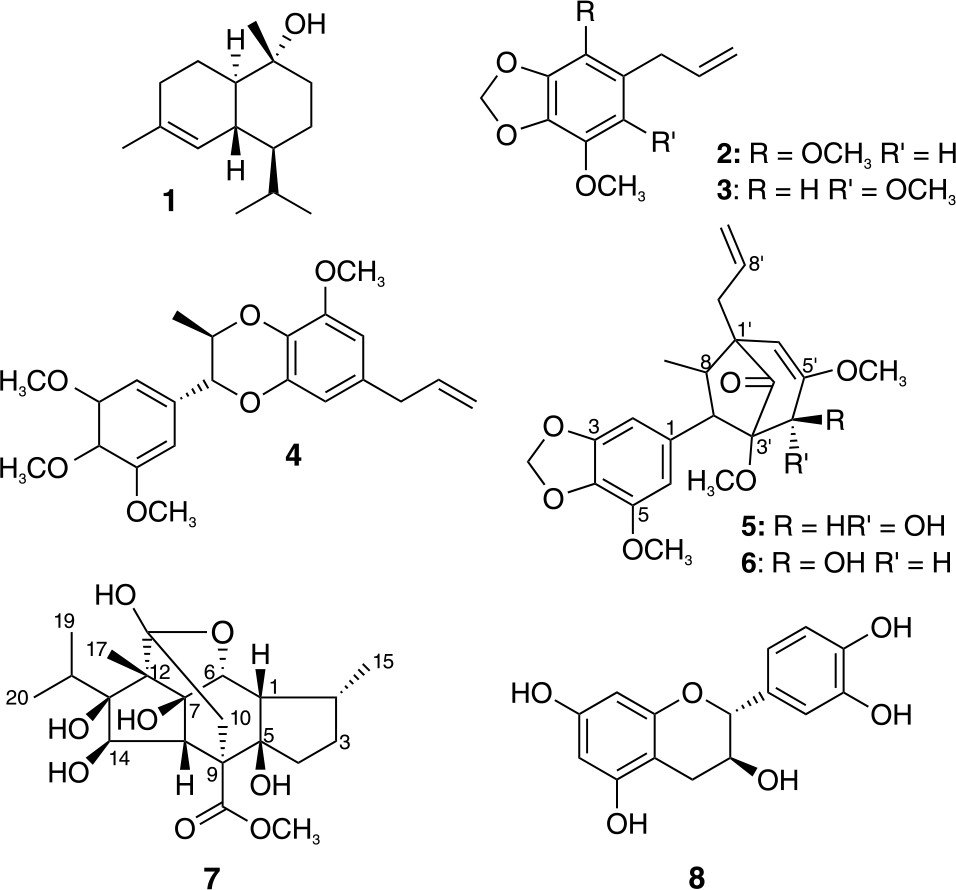
Phytochemical analysis of the methanol extract resulted in the isolation and structural elucidation of two new compounds (6 and 7), in addition to known compounds (Figure 1), whose NMR data were compared with the literature as α-cadinol (1),25 apiol (2) and dillapiole (3) mixture,26 eusiderin A (4),27 rel-(7S,8R,l’R,3’S,4’S)-4’-hydroxy-5,3’,5’-trimethoxy-3,4-methylenedioxy-2’-oxo-D1,3,5,5’,8’-8.1’, 7.3’-neolignan (5),28,29 and catechin 8.30,31 The NMR assignments were confirmed using heteronuclear single quantum coherence (HSQC) and heteronuclear multiple bond correlation (HMBC) experiments. The sesquiterpene α-cadinol (1) was found to be predominant, constituting approximately 3.6% of the methanol extract.
The 1H and 13C NMR of bicyclic[3,2,1]octane neolignan (6) have a similar signal pattern with that of 5 but differ in the configuration at C-4’. The endo-hydroxyl at C-4’of 6 explains the relative deprotection of H-7 (d 3.29) and protection of C-7 by the γ-effect. The 13C NMR spectra showed signals which are typical for the C-4’ region such as 52.6 (C-7), 77.8 (C-4’) and 83.3 (C-3) of neolignan 5; 48.8 (C-7), 76.1 (C-4’) and 85.7 (C-3) of 6. The 8.1’, 7.3’-neolignan, with hydroxyl endo-orientated at C-4’, was previously identified in the aromatic ring containing the oxygenation pattern 3,4-methylenedioxyphenyl32 instead of 5-methoxy-3,4-methylenedioxyphenyl, which we identified in this article for the first time (spectra in Supplementary Information (SI) section). Ocotea is one of the Lauraceae genera most investigated with regard to phytochemistry whose major secondary compounds were shown to be phenylpropanoid derived of the several types of neolignans33 including 1,4-benzodioxane as compound 4 and bicyclic[3,2,1]octane (5 and 6) types.
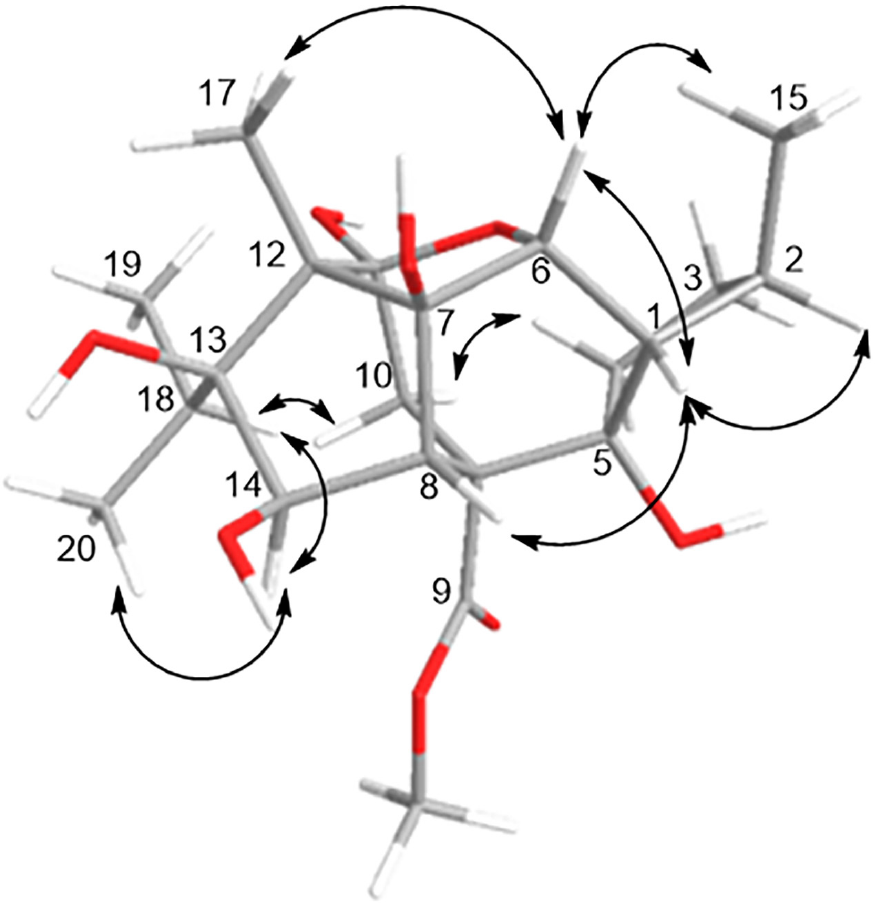
The analysis of 1H and 13C NMR spectroscopic data showed that compound 7 exhibits the characteristic features of isoryanodane diterpenes; however, it lacks a methyl group at position 16 as in the case of itol A, which is replaced by a methyl group. The 13C NMR spectrum exhibited a characteristic ester carbonyl signal at d 174.4, which in the HMBC experiments correlated with the signals of hydrogen at d 2.58 (H-8) and 1.82 (H-10β). The structure of compound 7 was elucidated in this article for first time as 16-methylesteritol A. The relative stereochemistry of 7 was determined on the basis of the results of nuclear Overhauser effect spectroscopy (NOESY) spectrum, depicted on a three-dimensional structure model (Figure 2). The observed NOESY correlations between H-8 (d 2.58) and H-1 (d 1.94) indicated that they were in the same side and defined as β-orientation. Correlations between signal at d 3.73 (H-14) with signal at d 0.91 (H-20) and 1.87 (H-18) suggested H-14 to be α, whereas OH-14 to be in β-orientation. These data together with the values of the coupling constants indicated that the stereochemistry of compound 7 is similar to that of itol A.33
Isoryanodane diterpenes constitute a specific group within an uncommon class.34-36 (spectra in the SI section).
In vitro antibacterial activity
Here, sesquiterpene 1, diterpene 7 and neolignans of the benzodioxane and bicyclic[3,2,1]octane types 4-6 were evaluated for the first time for their antibacterial activities. The MIC and MBC were determined and are shown in Table 1. The MIC and MBC values were identical for the compounds tested, suggesting effective bactericidal action. The result indicates that the same concentration capable of inhibiting bacterial growth is also sufficient to eliminate 99.9% of viable cells.24 Thus, even if the bacteria are later in favorable conditions, growth will not resume, confirming the lethal effect of the compound on the microorganism.
The terpenes (α-cadinol and 16-methylesteritol A) exhibited antibacterial activity at 50 and 250 μg mL-1 against Xcc in vitro. It was found that α-cadinol exhibited a significantly stronger inhibitory activity than the positive control, copper sulfate (MIC = 250 μg mL-1) with an MIC of 50 μg mL-1. Neolignans with different skeletons did not exhibit antibacterial activity, this being the first report of an assay against Xcc with compounds of this class.
In the literature, there are few reports about the antibacterial effects of isolated compounds against the Xcc bacterium. da Silva et al.16 provides information to justify that the anti-Xanthomonas citri activity of essential oil may be related to the sesquitepenes spathulenol, β-caryophyllene and caryophyllene oxide. Pure spathulenol also exhibits activity against X. citri citri (MIC 100 µg mL 1). We used pure α-cadinol in the antibacterial assay, and this sesquiterpene is normally identified as a component of essential oils. There are few known studies on the antibacterial activity mechanism of small molecules such as terpenes of essential oils, but an important characteristic is their hydrophobicity, which allows them to partition into the lipids of the bacterial cell membrane and mitochondria, disrupting the structures and making them more permeable.37 Sesquiterpenes with cadinane skeleton types are considered as good candidates to be antibacterial, thus the C-10 hydroxyl group and the double bonds on C-4 and C-5 may contribute for the antibacterial the activity.38
Conclusions
In the phytochemical investigation of Ocotea neesiana demolition wood, known and new compounds from different classes were identified, including neolignans characteristic of Lauraceae species. It was surprising how these were conserved in wood that had been used for approximately 45 years; thus, the compounds found probably contributed to the preservation of the wood since no damage caused by xylophagous organisms was detected. The sesquiterpene α-cadinol and the diterpene 16-methylesteritol A exhibited antibacterial potential against Xanthomonas citri subsp. citri. Understanding the mechanism of action of these compounds on pathogenic bacteria will allow the rational use and development of alternative methods of controlling plant pathogens.
Supplementary Information
Supplementary information is available free of charge at http://jbcs.sbq.org.br as PDF file.
Data Availability Statement
Data supporting the findings of this study are available in the text.
Acknowledgments
The authors are grateful to Fundação de Amparo à Pesquisa Estado do Amazonas (FAPEAM) for the scholarship granted to Jennifer Araújo de Oliveira Lima (Call 2021-2022 - POSGRAD) and Maria da Paz Lima (Call No. 013/2022- Produtividade - CT&I).
References
-
1 Euzéby, J.; Int. J. Syst. Evol. Microbiol. 2007, 57, 893. [Crossref]
» Crossref -
2 Young, J. M.; Dye, D. W.; Bradbury, J. F.; Panagopoulos, C. G.; Robbs, C. F. N. Z.; J. Agric. Res. 1978, 21, 153. [Crossref]
» Crossref -
3 Vauterin, L.; Yang, P.; Swings, J.; Int. J. Syst. Bacteriol. 1996, 46, 298. [Crossref]
» Crossref -
4 Ference, C. M.; Gochez, A. M.; Behlau, F.; Wang, N.; Graham, J. H.; Jones, J. B.; Mol. Plant Pathol. 2018, 19,1302. [Crossref]
» Crossref -
5 Behlau, F.; Belasque Jr., J.; Cancro Cítrico: A Doença e seu Controle, 1st ed.; Fundecitrus: Araraquara, Brazil, 2014. [Crossref]
» Crossref -
6 Lanza, F. E.; Marti, W.; Silva, G. J.; Behlau, F.; Phytopathology 2019, 109, 44. [Crossref]
» Crossref -
7 United States Department of Agriculture (USDA) Citrus: World Markets and Trade, 2024, https://www.fas.usda.gov/sites/default/files/2024-07/citrus.pdf, accessed in July 2025.
» https://www.fas.usda.gov/sites/default/files/2024-07/citrus.pdf -
8 Behlau, F.; Manual de Cancro Cítrico: Medidas Essenciais de Controle, 4th ed.; Fundecitrus: Araraquara, Brazil, 2019. [Link] accessed in July 2025
» Link -
9 Gottwald, T. R.; Graham, J. H.; Schubert, T. S.; Plant Health Prog 2002, 3, 1. [Crossref]
» Crossref -
10 Shaw, J. L. A.; Ernakovich, J. G.; Judya, J. D.; Farrell, M.; Whatmuff, M.; Kirby, J.; Environ. Pollut 2020, 263, 114411. [Crossref]
» Crossref -
11 Osiro, D.; Franco, R. W. A.; Colnago, L. A.; J. Braz. Chem. Soc 2011, 22, 1339. [Crossref]
» Crossref -
12 Behlau, F.; Canteros, B. I.; Minsavage, G.V.; Jones, J. B.; Graham, J. H.; Appl. Environ. Microbiol 2011, 77, 4089. [Crossref]
» Crossref -
13 Richard, D.; Tribot, N.; Boyer, C.; Terville, M.; Boyer, K.; Javegny, S.; Roux-Cuvelier, M.; Pruvost, O.; Moreau, A.; Chabirand, A.; Vernière, C.; Plant Dis. 2017, 101, 503. [Crossref]
» Crossref -
14 Li, J.; Wang, N.; Phytopathology 2013, 104, 134. [Crossref]
» Crossref -
15 Mirzaei-Najafgholi, H.; Tarighi, S.; Golmohammadi, M.; Taheri, P.; Molecules 2017, 22, 591. [Crossref]
» Crossref -
16 da Silva, R. R.; Fernandes, C. C.; Gonçalves, D. S.; Martins, C. H. G.; Miranda, M. L. D.; Nat. Prod. Res. 2024, 38, 3476. [Crossref]
» Crossref -
17 dos Santos, J. G.; Fernandes, C. C.; Silva, N. B. S.; Calefi, G. G.; Martins, C. H. G.; Volpini, G. A.; Crotti, A. E. M.; Ribeiro, A. B.; Esperandim, T. R.; Tavares, D. C.; Batalini, C.; Miranda, M. L. D.; Nat. Prod. Res 2023, 39, 1428. [Crossref]
» Crossref -
18 Liang, Y.; Zhang, L.; Lai, C.; Ouyang, Z.; Zhang, J.; Nat. Prod. Res 2023, 37, 2060. [Crossref]
» Crossref -
19 Li, A.-P.; He, Y.-H.; Zhang, S.-Y.; Shi, Y.-P.; Pestic. Biochem. Physiol. 2022, 188, 105221. [Crossref]
» Crossref -
20 Alcântara, J. M.; do Nascimento, C. C.; Marques, M. O. M.; Facanali, R.; De Freitas, J. A.; Lima, M. P.; Rev. Res. 2019, 8, 7434. [Crossref]
» Crossref -
21 Zanin, S. M. W.; Lordello, A. L. L.; Quim. Nova 2007, 30, 92. [Crossref]
» Crossref -
22 Salleh, W. M. N. H. W.; Ahmad, F.; J. Appl. Pharm. Sci. 2017, 7, 204. [Crossref]
» Crossref - 23 Clinical and Laboratory Standards Institute (CLSI); Approved Standard NCCLS Document M7-A6: Methods for Dilution Antimicrobial Susceptibility Tests for Bacteria that Grow Aerobically, 6th ed.; CLSI: USA, 2003.
-
24 Albuquerque, R. N. O.; Martins, C. H. G.; de Souza, J. H.; Sacramento, V. M.; de Oliveira, D. A.; de Melo-Júnior, A. F.; Menezes, E. V. L.; Souza, F.; Royo, V. A.; An. Biol 2023, 45, 33. [Crossref]
» Crossref -
25 Miranda, M. L. D.; Garceza, F. R.; Abot, A. R.; Garcez, W. S.; Quim. Nova 2014, 37, 473. [Crossref]
» Crossref -
26 de Almeida, R. R. P.; Souto, R. N. P.; Bastos, C. N.; Silva, M. H. L.; Maia, J. G. S. Chem. Biodiversity 2009, 6, 1427. [Crossref]
» Crossref -
27 Pilkington, L. I.; Barker, D.; J. Org. Chem 2012, 77, 8156. [Crossref]
» Crossref -
28 Funasaki, M.; Lordello, A. L. L.; Viana, A. M.; Santa-Catarina, C.; Floh, E. I. S.; Yoshida, M.; Kato, M. J.; J. Braz. Chem. Soc. 2009, 20, 853. [Crossref]
» Crossref -
29 Guilhon, G. M. S. P.; Conserva, L. M.; Maia, J. G. S.; Yoshida, M.; Gottlieb, O. R.; Phytochemistry 1992, 31, 2847. [Crossref]
» Crossref -
30 Burger, M. C. M.; Matos, A. P.; Cunha, G. O. S.; Bernardo, A. R.; Menezes, A. C. S.; Vieira, P. C.; Fernandes, J. B.; Da Silva, M. F. G. F.; Rev. Virtual Quim. 2021, 13, 953. [Crossref]
» Crossref -
31 Ayres, M. C. C.; Chaves, M. H.; Rinaldo, D.; Vilegas, W.; Vieira Jr., G. M.; Quim. Nova 2009, 32, 1509. [Crossref]
» Crossref -
32 Lordello, A. L. L.; Yoshida, M.; Phytochemistry 1997, 46, 741. [Crossref]
» Crossref -
33 Chai, X.-Y.; Bai, C.-C.; Shi, H.-M.; Xu, Z.-R.; Ren, H.-Y.; Li, F.-F.; Lu, Y.-N.; Song, Y.-L.; Tu, P.-F.; Tetrahedron 2008, 64, 5743. [Crossref]
» Crossref -
34 Zeng, J.; Xue, Y.; Shu, P.; Qian, H.; Sa, R.; Xiang, M.; Li, X.-N.; Luo, Z.; Yao, G.; Zhang, Y.; J. Nat. Prod. 2014, 77, 1948. [Crossref]
» Crossref -
35 Zhou, L.; Zheng, G.; Li, H.; Gao, B.; Guoruoluo, Y.; Tang, W.; Yao, G.; Zhang, Y.; Phytochemistry 2022, 196, 113077. [Crossref]
» Crossref -
36 Fraga, B. M.; González-Coloma, A.; Gutiérrez, C.; Terrero, D.; J. Nat. Prod. 1997, 60, 880. [Crossref]
» Crossref -
37 Sikkema, J.; De Bont, J. A. M.; Poolman, B.; Microbiol. Rev. 1995, 59, 201. [Crossref]
» Crossref -
38 Hang-Ying, L.; Wen-Qian, Y.; Xin-Zhu, Z.; Fei, S.; Tong, S.; Hui-Ying, G.; Jie, Z.; Li-Ming, Z.; Biomolecules 2022, 12, 1271. [Crossref]
» Crossref
Edited by
-
Editor handled this article:
Hector Henrique F. Koolen (Associate)