 Argyrotrienone A and B, Novel Crotofolane and Isocrotofolane-Type Diterpenes, Isolated from Croton argyrophylloides (Euphorbiaceae)
Abstract
Croton L. (Euphorbiaceae) comprises species found in tropical and subtropical regions and is known for its rich phytochemical diversity, particularly its terpenoids, which exhibit cytotoxic, antimicrobial, and antioxidant activities. Croton argyrophylloides is a species found in the Caatinga biome and occurs throughout all states of Northeastern Brazil. This study investigates the chemical diversity of compounds isolated from C. argyrophylloides from hexane (1-4) and dichloromethane/ methanol (5-13) extracts of the aerial parts. Structural characterization was performed using nuclear magnetic resonance (NMR) techniques (1H, 13C, and 2D), comparison with data from the literature, along with high-resolution electrospray ionization mass spectrometry (HR-MS), infrared (IR), and electronic circular dichroism (ECD) for the new compounds. Phytochemical investigation led to the structural elucidation of thirteen compounds (1-13), including two new diterpenes: a crotofolane-type skeleton, argyrotrienone A (3), and a rare isocrotofolane-type carbon skeleton, argyrotrienone B (4). These findings expand the structural diversity of diterpenes and highlight the phytochemical potential of Croton species as a valuable source of novel natural products.
Keywords:
Caatinga biome; Brazilian flora; “marmeleiro prateado”; diterpenoids; NMR spectroscopy
Introduction
The Euphorbiaceae family consists of monoecious, succulent, and cactus-like herbs, shrubs, and trees, and is one of the largest plant families, comprising approximately 300 genera and 8,000 species distributed worldwide.1,2 In traditional medicine, some species of this family have been used to treat sore throats, heart conditions, rheumatoid arthritis, pharyngitis, stomachaches, joint pain, headaches, snake bites, and cancer.3,4
The genus Croton L. belongs to the subfamily Crotonoideae, it is the second-largest genus in this family, comprising 1,300 species found in tropical and subtropical regions throughout the world.5-8 In Brazil, it is found in the Northeast region, where there are more than 300 species, 68 of which occur mainly in the Caatinga (semi-arid vegetation).6,9,10 Species of the genus Croton have antimicrobial, larvicidal, antioxidant, antileishmania, antiparkinsonian, and antidiabetic potential.11-15
The species Croton argyrophylloides Müll. Arg. (synonym of Croton tricolor Klotzsch ex Baill., Oxydectes argyrophylloides Müll. Arg. Kuntze and Oxydectes tricolor Klotzsch ex Baill)7 popularly known as “marmeleiro prateado” or “sacatinga”, it is a plant from the Caatinga biome found in the Northeast region of Brazil.11,16
The bark of C. argyrophylloides has been used in folk medicine as an infusion for the treatment of gastrointestinal disorders, diabetes, inflammation, venereal diseases, back pain, poisoning, headaches, infectious diseases including tuberculosis, malaria, hypercholesterolemia, hypertension, and ulcers.12,13,17,18
The chemical composition of the species C. argyrophylloides showed the predominant presence of diterpenoids, which are cyclized from the precursor geranylgeranyl diphosphate (GGPP) and can be found as clerodanes, tiglianes, abietanes, kauranes, labdanes, jatropholanes, lathyranes, and crotofolanes.8,19
This study aimed to elucidate the compounds present in the aerial parts of C. argyrophylloides, focusing on the isolation and characterization of metabolites that contribute to the chemical knowledge of Caatinga plant species from the semi-arid region of Paraíba. As a result, thirteen compounds were characterized, eleven of which were derivatives of phenolic compounds, including three phenolic acid derivatives (1, 2, and 8), four phenylpropanoid derivatives (5, 6, 7, and 11), three compounds with a flavonoid skeleton (9, 12, and 13), and one compound from the coumarin class (10), as well as two new diterpenes, one of the crotofolane type (3) and isocrotofolane (4), a rarely occurring carbon skeleton.
Experimental
Plant material
In April 2022, in the city of Maturéia (7°11’10”S, 37°25’53”W), Paraíba, Brazil, leaves and branches of the species C. argyrophylloides were collected. The plant material was authenticated by Professor Maria de Fátima Agra, Federal University of Paraíba (UFPB), and the specimen deposited in the Lauro Pires Xavier Herbarium (JPB), code JPB 68577. The study was registered under code A7BC1C2 in the National System for the Management of Genetic Heritage and Associated Traditional Knowledge (SisGen).
MPLC, HPLC, NMR, HR-MS (ESI), IR and ECD
Medium-pressure liquid chromatography (MPLC) (using a C-660 fraction collector, Buchi) with a flow rate of 15.0 mL min–1 at a pressure of 40 bar, observing wavelengths at 225, 254 and 320 nm, using silica gel 60 (with dimensions between 0.060 and 0.200 mm) as the stationary phase and eluted in a gradient system of increasing polarity composed of hexene/dichloromethane (Hex/DCM) (100:00; 90:10; 80:20; 70:30; 60:40; 50:50; 40:60; 30:70; 20:80; 10:90; 00:100), dichloromethane/ethyl acetate (DCM/EtOAc) (100:00; 75:25; 50:50; 25:75; 00:100), ethyl acetate/ methanol (EtOAc/MeOH) (100:00; 99:01; 95:05; 75:25; 50:50; 25:75), and methanol 100% (MeOH).
Classical chromatography (CC), using silica gel (with dimensions between 0.060 and 0.200 mm) eluted in a gradient system of increasing polarity composed of Hex/DCM (100:00; 95:05; 90:10; 80:20; 85:15; 70:30; 60:40; 50:50; 40:60; 30:70; 20:80; 10:90; 00:100), DCM/EtOAc (100:00; 90:10; 80:20; 00:100), and MeOH 100%.
The sub-fractions were analyzed using a high-performance liquid chromatography (HPLC) system, which included an LC-20AT (Shimadzu) paired with a diode array detector (HPLC-DAD, SPD- M20A, Shimadzu), controller (CBM-20A, Shimadzu), and degasser (DGU-20A, Shimadzu). The column used was a Shim-pack GIST C18 analytical with dimensions of 250 × 4.6 mm and a particle size of 5 µm. The mobile phase consisted of water acidified with formic acid (0.1% v/v) and acetonitrile delivering 10 μL of sample injection volume at a flow rate of 0.6 mL min–1. The sub-fractions were purified using a HPLC system, which included an LC-20AR (Shimadzu) paired with a diode array detector (SPD-M20A, Shimadzu) and a controller (CBM-20A, Shimadzu). The column used was a Shim-pack GIST C18 semi-preparative with dimensions of 250 × 20 mm and a particle size of 5 µm. During the separation and isolation of compounds (1-13), water acidified with formic acid (0.1% v/v) (A) and acetonitrile (B) were used as the mobile phase, delivering 100-200 μL of sample injection volume at a flow rate of 8.0 mL min–1.
1D and 2D nuclear magnetic resonance (NMR) spectra were obtained at frequencies of 400 MHz to 1H and 100 MHz to 13C (using a Ascend spectrometer, Bruker) and 500 MHz to 1H and 125 MHz to 13C (using a Avance Neo spectrometer, Bruker). The solvents used for these analyses included methanol-d4 and chloroform-d. Chemical shifts for 1H and 13C were calibrated against the residual chloroform-d signal (δ 7.26, 77.0 ppm, respectively) and residual methanol-d4 signal (δ 3.30, 49.0 ppm, respectively). Chemical shifts (δ) were expressed in ppm.
The high-resolution electrospray ionization mass spectrometry HR-MS (ESI), (MicroTOF II, Bruker) in positive mode using 8 μg mL–1 with direct injection. The mobile phase consisted of a solution of 0.1% v/v formic acid/water (solvent A) and acetonitrile (solvent B), 1:1 (B). The injections were performed using a Shimadzu liquid chromatograph (Prominence) equipped with LC-20AD and SIL-20A autoinjector.
Attenuated total reflection infrared (IR) spectroscopy were recorded using an (IRSpirit FTIR spectrophotometer, Shimadzu). The compounds were analyzed at wavelengths ranging from 400 to 4,000 cm–1. Optical rotations were measured with chloroform (using a model P-2000 polarimeter, Jasco). The experimental electronic circular dichroism (ECD) spectrum was recorded with a Jasco J-1100 sepectrometer (Jasco) in the 200-400 nm region using the following parameters: bandwidth 1 nm; response 1 s; scanning speed 100 nm min–1; 3 accumulations; room temperature (25 ºC); sample in acetonitrile solution; 0.1 cm cell path length; concentration 0.5 mg mL–1.
Extraction, fractionation and isolation
The aerial parts were dried and pulverized (2.660 kg), and were initially subjected to extraction using hexane (9 L) for 48 h (EHCa) and then with a mixture of dichloromethane and methanol (1:1, v/v) (5 L, 2×, 5 days) (EDMCa). The solutions were evaporated under reduced pressure to obtain the hexane extracts (EHCa = 20 g) and dichloromethane and methanol (1:1, v/v) extracts (EDMCa = 180 g).
The EHCa (15 g) was fractionated by MPLC using silica gel eluted in a gradient system of increasing polarity composed of Hex/DCM (100:00; 90:10; 80:20; 70:30; 60:40; 50:50; 40:60; 30:70; 20:80; 10:90; 00:100), DCM/EtOAc (100:00; 75:25; 50:50; 25:75; 00:100), EtOAc/MeOH (100:00; 99:01; 95:05; 75:25; 50:50; 25:75), and MeOH 100% to afford forty-one fractions (F1-F41).
Fraction F8 (227.5 mg) was chromatographed by preparative HPLC grade, with an elution profile of 0.0-60.0 min (50-100% B), observing the wavelength at 254 nm; injection volume of 200 μL and flow rate of 8 mL min–1; to provide the compounds 1 (0.4 mg, tR = 22 min) and 2 (52 mg, tR = 26 min).
Fraction F25 (200 mg) was chromatographed by preparative HPLC grade, with an elution profile of 0.0-40.00 min (50-80% B), observing the wavelength at 240 nm; injection volume of 100 μL and flow rate of 8 mL min–1; to provide the compound 3 (7 mg, tR = 10 min).
Fraction F28 (59.9 mg) was chromatographed by preparative HPLC grade, with an elution profile of 0.0-90.00 min (50-80% B), observing the wavelength at 240 nm; injection volume of 100 μL and flow rate of 8 mL min–1; to provide the compound 4 (15 mg, tR = 30 min).
Subsequently, the EDMCa (15 g) was fractionated by MPLC using silica gel eluted in a gradient system of increasing polarity composed of Hex/DCM (100:00; 90:10; 80:20; 70:30; 60:40; 50:50; 40:60; 30:70; 20:80; 10:90; 00:100), DCM/EtOAc (100:00; 90:10; 75:25; 50:50; 25:75; 00:100), EtOAc/MeOH (100:00; 90:10; 75:25; 50:50; 25:75), and MeOH 100% to afford forty-three fractions (F1-F43).
The F4 fraction (185 mg) was subjected to chromatographic column using silica gel eluted in a gradient system of increasing polarity composed of Hex/DCM (100:00; 95:05; 90:10; 80:20; 85:15; 70:30; 60:40; 50:50; 40:60; 30:70; 20:80; 10:90; 00:100), DCM/EtOAc (100:00; 90:10; 80:20; 00:100), and MeOH 100% to afford seventeen sub-fractions (SF1-SF17), to provide the compound 5 (SF5, 12 mg, Hex/DCM 85:15). Fraction F11 (160 mg) showed a precipitate, and a mixture was obtained from which compounds 6 and 7 (76 mg) were isolated.
The F18 fraction (143.5 mg) was chromatographed by preparative HPLC grade, with an elution profile of 0.0-60.00 min (70-100% B), observing the wavelength at 254 nm; injection volume of 100 μL and flow rate of 8 mL min–1; to supply the compounds 8 (11 mg, tR = 11 min) and 9 (9 mg, tR = 15 min).
Fraction F23 (35.7 mg) was chromatographed by preparative HPLC grade, with an elution profile of 0.0-70.00 min (35-60% B), observing the wavelength at 254 nm; injection volume of 100 μL and flow rate of 8 mL min–1; to provide the compound 10 (2 mg, tR = 15 min).
Fraction F28 (32 mg) was chromatographed by preparative HPLC grade, with an elution profile of 0.0-60.00 min (20-80% B), observing the wavelength at 240 nm; injection volume of 100 μL and flow rate of 8 mL min–1; to supply the compounds 11 (5 mg, tR = 15 min) and 12 (3 mg, tR = 33 min).
The F30 fraction (65 mg) was chromatographed by preparative HPLC grade, with an elution profile of 0.0-60.00 min (30-100% B), observing the wavelength at 254 nm; injection volume of 100 μL and flow rate of 8 mL min–1; to provide the compound 13 (9 mg, tR = 22 min).
ECD calculations: randomized conformational searches were performed using the Monte Carlo algorithm along with the Merck molecular force field (MMFF) in Spartan’14 software suite (1.1.0).20 For compound 3, 10 conformers within a relative free energy window of 10 kcal mol–1 were selected for geometry optimization calculations in gas phase, employing the B3LYP/6-31G(d) level of theory. Vibrational frequency calculations were performed at the same level of theory to confirm that stationary points correspond to minima on the potential energy surface. Subsequently, 5 conformers with relative energies up to 3 kcal mol–1, which correspond to more than 99% of the total Boltzmann distribution (see Figure S37, Supplementary Information (SI) section), were selected for the ECD simulations. For compound 4, 19 conformers within a relative free energy window of 10 kcal mol–1 were selected for geometry optimization calculations in gas phase, employing the B3LYP/6-31G(d) level of theory. Vibrational frequency calculations were performed at the same level of theory to confirm that stationary points correspond to minimum on the potential energy surface. Subsequently, 9 conformers with relative energies up to 3 kcal mol–1, which correspond to more than 99% of the total Boltzmann distribution (see Figure S64, SI section), were selected for the ECD simulations. For both compounds, these calculations were conducted at a time-dependent density functional theory (TD-DFT) level (CAM-B3LYP/TZVP) to calculate the excitation energies (in nm) and rotatory strengths R in the dipole velocity form for the first 30 singlet → singlet electronic transitions. The polarizable continuous model with integral equation formalism (IEF-PCM)21 method was applied to implicitly simulate acetonitrile as the solvent. The final ECD spectra were generated based on Boltzmann statistics of the selected conformers and plotted using Origin 8 software (2023).22 All quantum-mechanical calculations were performed using the Gaussian 16 software package (C.01).23
Physico-chemical constants of compounds 3 and 4
Argyrotrienone A (2,5-dimethyl-10-methylene-6-(prop-1-en-2-yl)-2,3,4,5,5a,6,8,9,10,10a-decahydrocyclohepta[e] indene-1,7-dione) (3)
Yellowish-green colored oil; [α] D19 –185.6° (c 0.001, chloroform); UV (acetonitrile) λmax 238 nm; in the IR spectrum (Figure S36, SI section), absorption bands for carbonyl groups (νmax 1700, 1657 cm–1), of hydroxy (νmax 3406 cm–1) and a conjugated double bond (νmax 1645 cm–1) were observed; 1H and 13C NMR (see Table 1); HRMS-ESI(+) (Figure S11, SI section) m/z, calculated for [C20H26O2 + H]+: 299.2006, found: 299.2006 and Δ = –0.1 ppm, which corresponds to eight degrees of unsaturation.
Argyrotrienone B (2-(2,5-dimethyl-1,10-dimethylene-1,2,3,4,5,5a,8,9,10,10a-decahydrocyclohepta[e]inden-7-yl) propan-2-ol) (4)
Yellowish-green colored oil, [α]D19 –64.2° (c 0.001, chloroform); UV (acetonitrile) λmax238 nm; in the IR spectrum (Figure S63, SI section), absorption bands for carbonyl groups (νmax 1700 cm–1), of hydroxy (νmax 3426 cm–1) and a conjugated double bond (νmax 1648 cm–1) were observed; 1H and 13C NMR (see Table 2); HRMS-ESI(+) (Figure S38, SI section) m/z, calculated for [C20H28O2 + Na]+: 323.1987, found: 323.1978 and Δ = 0.3 ppm which corresponds to seven degrees of unsaturation.
Results and Discussion
Compound 3, isolated in the form of yellowish-green colored oil, [α] 19 –185.6° (c 0.001, chloroform); UV-Vis (CH3CN, 238 nm); in the IR spectrum (Figure S36, SI section), absorption bands for carbonyl groups (νmax 1700, 1657 cm–1), of hydroxy (νmax 3406 cm–1) and a conjugated double bond (νmax 1645 cm–1) were observed. HRMS-ESI (Figure S11, SI section) m/z, calculated for [C20H26O2 + H]+: 299.2006, found: 299.2006 and Δ = –0.1 ppm. 13C broadband (BB) (Figures S17-S19, SI section), distortionless enhancement by polarization transfer with 135-degrees pulse (DEPT 135) NMR (Figures S20-S21, SI section) and heteronuclear single-quantum correlation (HSQC) (Figures S30-S33, SI section) spectra showed the presence of 20 carbon signs including three methyl carbons (δC 23.6, CH3-17; δC 17.1, CH3-19; δC 20.3, CH3-20); six methylenes carbons (δC 38.6, CH2-3; δC 37.5, CH2-5; δC 38.3, CH2-10; δC 36.7, CH2-11; δC 114.2, CH2-16; including the presence of exocyclic olefinic carbon δC 108.9, CH2-18); five methines carbons sp3 (δC 40.1, CH-2; δC 37.7, CH-6; δC 48.6, CH-7; δC 69.6, CH-8; δC 42.7, CH-13); six atoms for non-hydrogenated carbons (δC 171.4, C-4; δC 152.7, C-12; δC 139.1, C-14; δC 142.2, C-15), including the presence of two carbonyls (δC 209.3, C-1; δC 211.4, C-9). This information, combined with data from the 1H NMR spectrum revealed the presence of an exocyclic double bond H-18a (δH 4.80) and H-18b (δH 4.43), two methines hydrogen H-7 (δH 1.94) and H-8 (δH 2.94), two methines hydrogens H-16a (δH 5.12) and H-16b (δH 5.11). In addition, the presence of three methyl in H-17 (δH 1.78), H-19 (δH 1.13) and H-20 (δH 0.94), compatible with a diterpene skeleton.
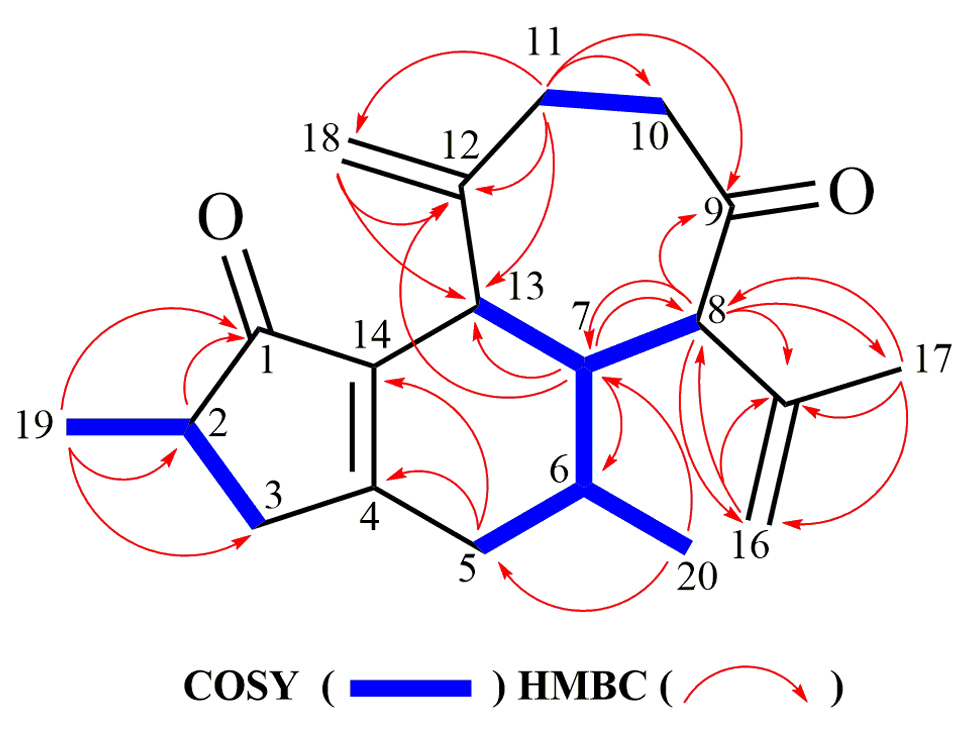
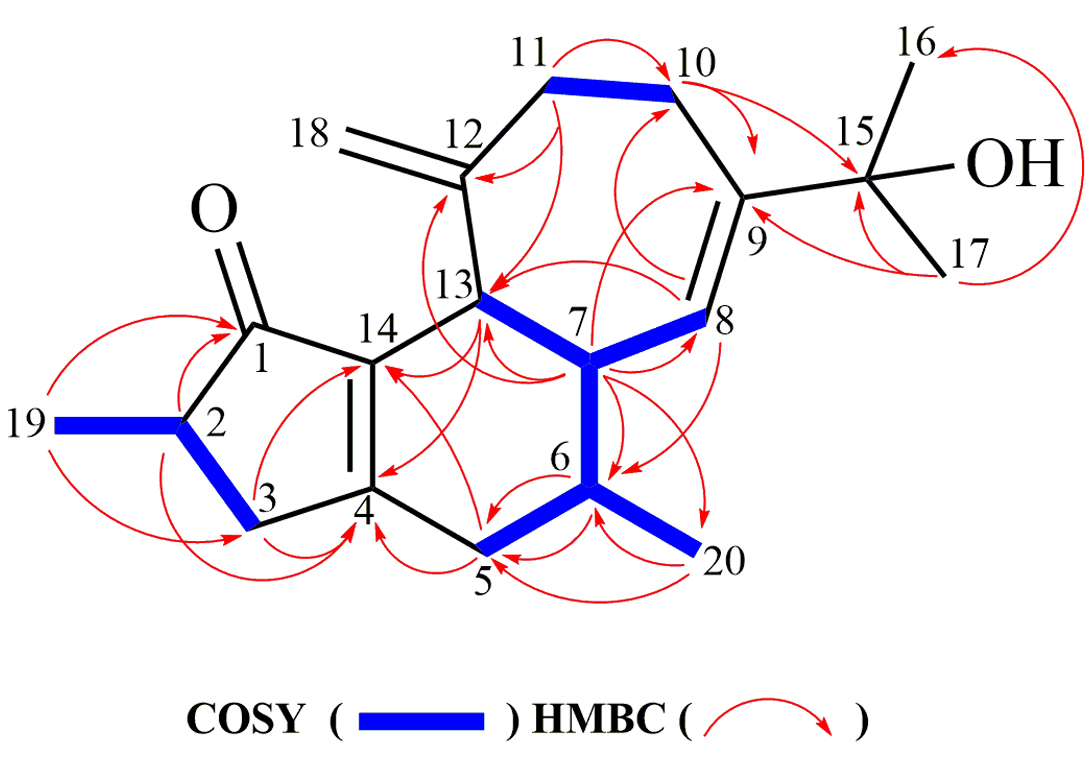
Using 1H-1H correlation spectroscopy (COSY) (Figures S22-S23, SI section), allowed the identification of vicinal correlations evidenced by contour maps H-19/H-2 and H-2/H-3/H-19, enabling the location of the methyl group and the definition of the coupled proton sequence. Additionally, the correlations observed between H-5/H-6/H-7/H-8/H-13 confirmed the fusion of the seven-membered ring to the six-membered ring, together with heteronuclear multiple-bond correlations (HMBC) (Figure 1) of three methyl groups located at C-17, C-19, and C-20 were assigned based on HMBC correlations of the proton signals of the methyl groups H-17 (δH 1.78) with C-8 (δC 69.6), C-15 (δC 142.2) and C-16 (δC 114.2); H-19 (δH 1.13) with C-1 (δC 209.3), C-2 (δC 40.1) and C-3 (δC 38.6); H-20 (δH 0.94) with C-5 (δC 37.5) and C-7 (δC 48.6), respectively (Figures S24-S29, SI section). In addition to the presence of the unsaturated alpha-beta carbonyl system of the five-membered ring, it was possible to observe the HMBC between H-5 (δH 2.24) with C-4 (δC 171.4) and C-14 (δC 139.1) (Figures S24-S29, SI section).
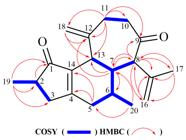
 ) and HMBC (
 ) correlations for compound
 The presence of the exocyclic olefinic proton at C-18 was corroborated by HMBC correlations of the olefinic proton H-18 (δH 4.80 and 4.43) with C-11 (δC 36.7), C-12 (δC 152.7) and C-13 (δC 42.7), respectively, besides the H-8 (δH 2.94) with C-7 (δC 48.6), C-9 (δC 211.4), C-15 (δC 142.2), C-16 (δC 114.2) and C-17 (δC 23.6).
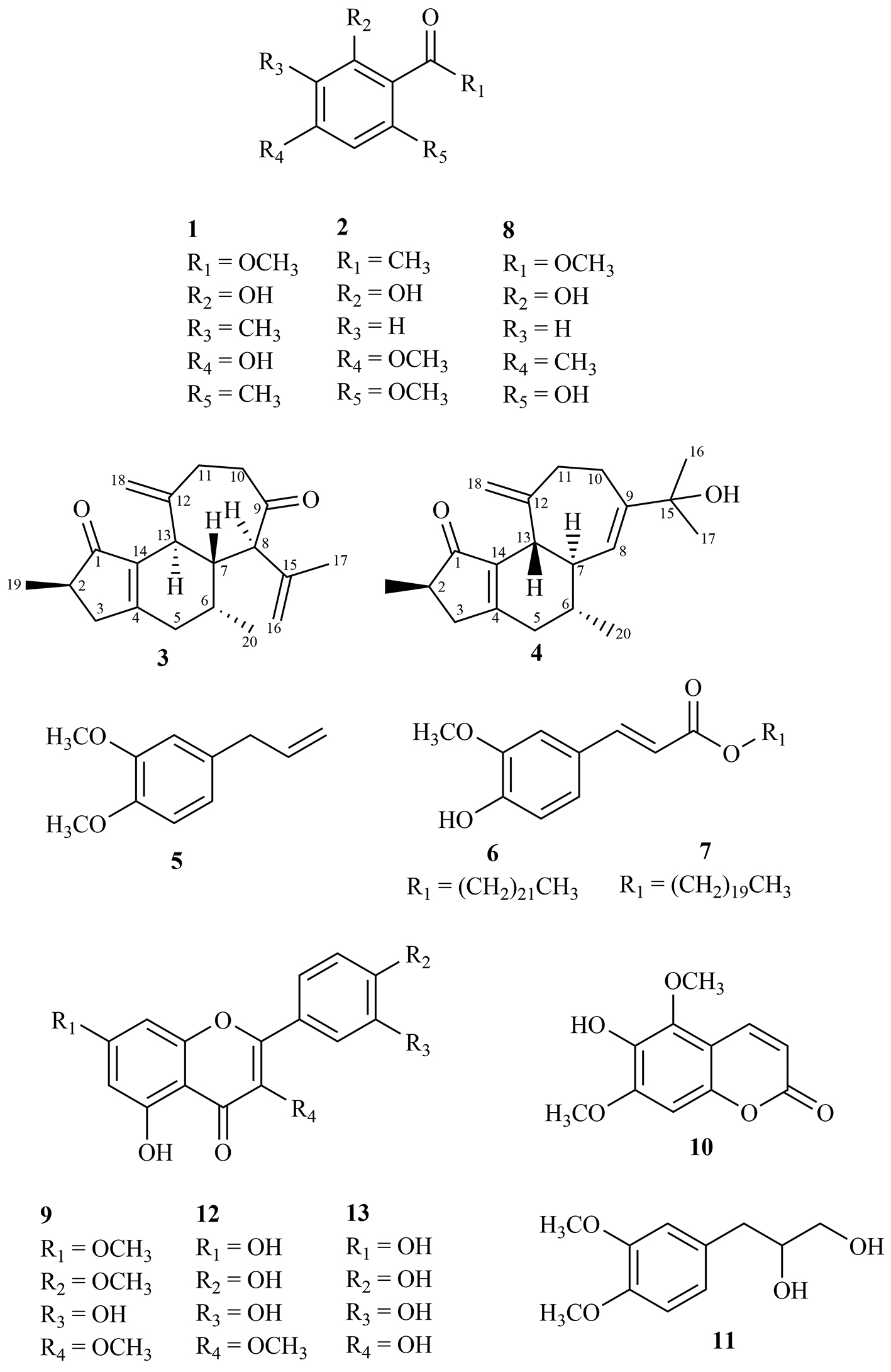
These sets of correlations allowed the determination of the chemical bond of the structure, making it possible, therefore, to classify it as a crotofolan-type diterpene. The structure was elucidated based on 1H and 13C NMR data (Figures S12-S35, SI section) as shown in Table 1 and Figure 2.
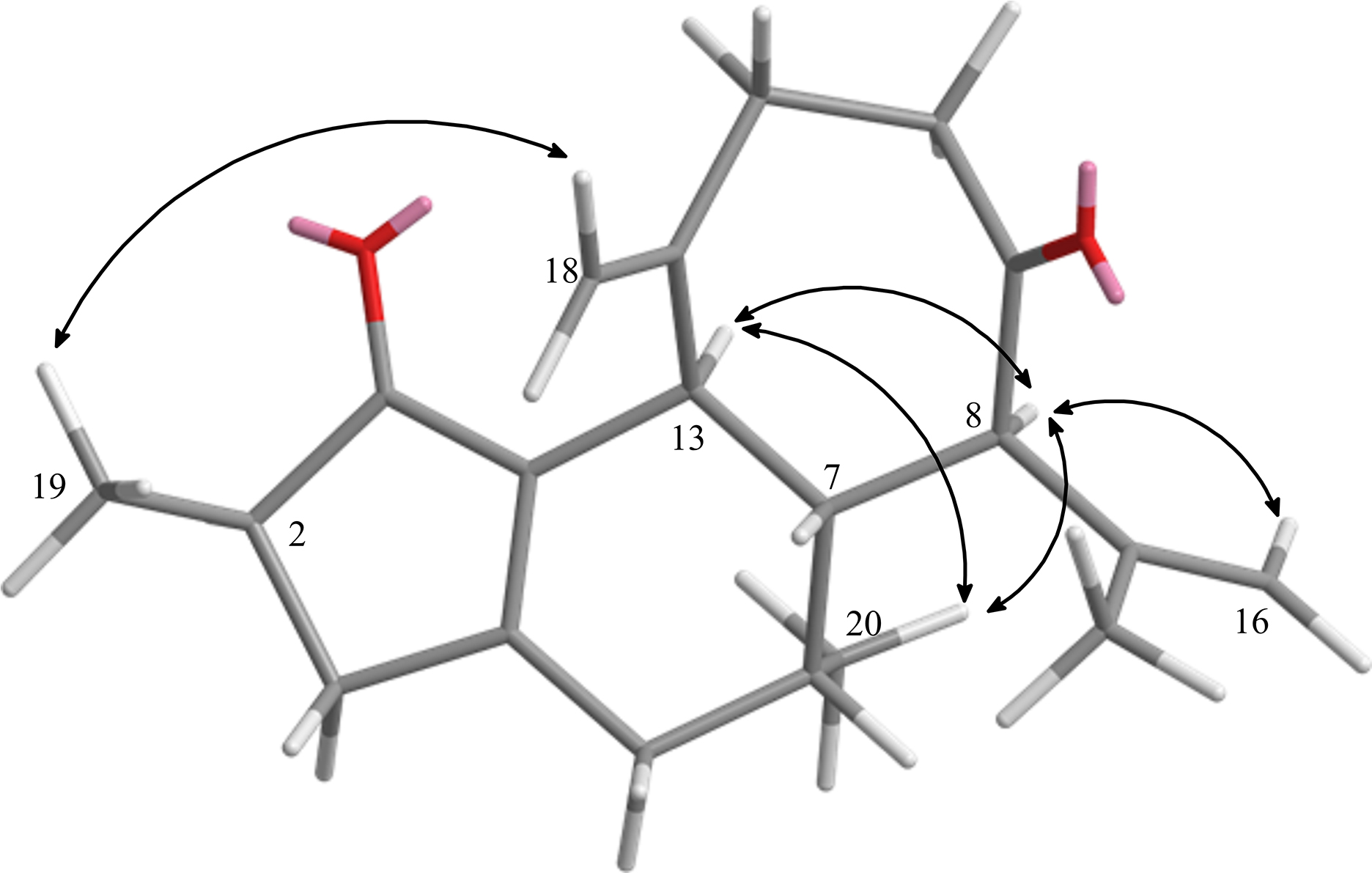
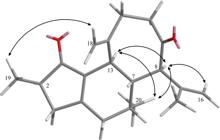
The relative stereochemistry of compound 3 was established as (2S, 6S, 7S, 8S, 13S) based on nuclear Overhauser effect spectroscopy (NOESY) spectrum analysis (Figures S34-S35, SI). The location of the methyl group at C-19 was corroborated by the NOE correlation observed between H-19/H-18. Additionally, NOE correlations between H-13/H-8/H-20 and H-8/H-16/H-20 provided relevant evidence for establishing the relative arrangement of these protons, indicating that they are oriented on the same side of the molecular plane. On the other hand, the absence of NOE correlations between H-7 and the aforementioned protons suggests that it is oriented on the opposite side, supporting the proposed stereochemistry (Figure 3).
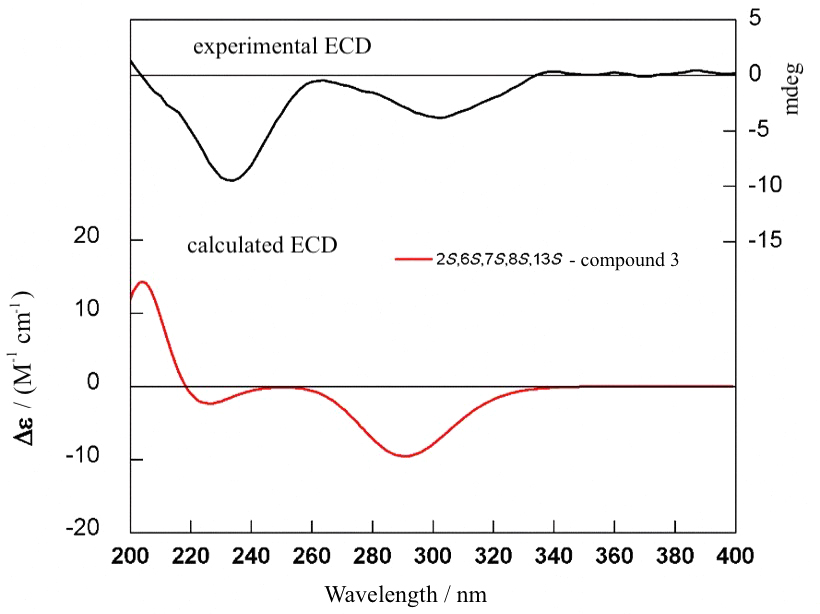
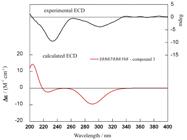
Next, using the proper relative configuration, we focused on the determination of the absolute configuration of compound 3 by means of chiroptical spectroscopy (Figure S37, SI section). As widely known in the literature,24 electronic circular dichroism, in combination with quantum-mechanical simulations of the respective spectra, has been considered as one of the most powerful methodologies for stereochemical analysis of natural products. Thus, to unequivocal determination of the absolute stereochemistry of compound 3, it was employed a combination of the experimental ECD spectrum with the corresponding one, computed by quantum chemical methods. The experimental ECD spectrum (top panel of Figure 4) in the 190-400 nm region, measured in acetonitrile (ACN), yielded a negative π–π* (ca. 220 nm) and negative n–π* (ca. 280 nm) cotton effects, which were perfectly reproduced in the final Boltzmann weighted theoretical ECD spectra, obtained by the average of the 5 lowest-energy conformers identified for compound 3 at the CAM-B3LYP/PCM(ACN)/TZVP level (botton panel of Figure 4). Range-separated hybrid functionals such as CAM-B3LYP, combined with the basis sets TZVP were selected due to their better performance in ECD calculations.24 Therefore, as shown in Figure 4, based on the good agreement between the theoretical and experimental spectra, the absolute configuration of compound 3 was unambiguously assigned as (2S, 6S, 7S, 8S, 13S). Thus, based on this information the compound 3 was identified as the argyrotrienone A (2,5-dimethyl-10-methylene-6-(prop-1-en-2-yl)-2,3,4,5,5a,6,8,9,10,10a-decahydrocyclohepta[e]indene-1,7-dione). This is the first report of this structure in the literature.
Compound 4, isolated in the form of yellowish-green colored oil, [α] 19 –64.2° (c 0.001, chloroform); UV-Vis (CH3CN, 238 nm); in the IR spectrum (Figure S63, SI section), absorption bands for carbonyl groups (νmax 1700 cm–1), of hydroxy (νmax 3426 cm–1) and a conjugated double bond (νmax 1648 cm–1) were observed. HRMS-ESI (Figure S38, SI section) m/z, calculated for [C20H28O2 + Na]+: 323.1987, found: 323.1978 and Δ = 0.3 ppm. 13C (BB) (Figures S43-S45, SI section), DEPT 135 NMR (Figures S46-S47, SI section) and HSQC (Figures S57-S59, SI section) spectra showed the presence of 20 carbon signs including four methyl carbons (δC 28.5, CH3-16; δC 28.5, CH3-17; δC 17.6, CH3-19; δC 20.1, CH3-20); five methylenes carbons (δC 38.9, CH2-3; δC 36.7, CH2-5; δC 29.9, CH2-10; δC 38.3, CH2-11); including the presence of exocyclic olefinic carbon (δC 106.6, CH2-18); five methines carbons sp3 (δC 40.0, CH-2; δC 34.2, CH-6; δC 48.1, CH-7; δC 128.8, CH-8; δC 44.2, CH-13); six non-hydrogenated carbons (δC 172.4, C-4; δC 149.4, C-9; δC 153.7, C-12; δC 138.2, C-14; δC 73.8, C-15), including the presence of a carbonyl (δC 210.0, C-1). This information, combined with data from the 1H NMR spectrum revealed the presence of an exocyclic double bond H-18a (δH 4.15) and H-18b (δH 4.59), two methylenes hydrogen, H-7 (δH 1.83) and H-8 (δH 5.81). In addition, the presence of four methyl H-16 (δH 1.36), H-17 (δH 1.33), H-19 (δH 1.17) and H-20 (δH 1.00), (Figures S39-S42, SI section) compatible with a diterpene skeleton.
The COSY spectrum (Figures S48-S50, section SI) of compound 4 showed spectroscopic patterns similar to those observed for compound 3. Together with HMBC (Figures S52-S56, SI section) (Figure 5) of four methyl groups located at C-16, C-17, C-19, C-20 were assigned based on HMBC correlations of the methyl proton signals H-16 (δH 1.36) with C-9 (δC 149.4), C-15 (δC 73.8) and C-17 (δC 28.5); H-19 (δH 1.17) with C-1 (δC 210.0), C-3 (δC 38.9); H-20 (δH 1.00) with C-5 (δC 36.7); C-6 (δC 34.2) and C-7 (δC 48.1); H-17 (δH 1.33) with C-9 (δC 149.4), C-15 (δC 73.8) and C-16 (δC 28.5) locating the isopropyl group (Figures S51-S55, SI section). In addition to the presence of the unsaturated alpha-beta carbonyl system of the five-membered ring, it was possible to observe HMBC between H-5 (δH 2.27 and δH 2.10) with C-4 (δC 172.4) and C-14 (δC 138.2) (Figures S51-S55, SI section).
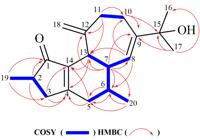
The presence of the olefinic proton at C-18 was supported by the HMBC correlations of the olefinic proton H-18 (δH 4.15 and 4.59) with C-11 (δC 38.3), C-12 (δC 153.2) and C-13 (δC 44.2), respectively, besides the H-8 (δH 5.81) with C-7 (δC 48.1), C-9 (δC 149.4), C-15 (δC 73.8) and C-17 (δC 28.5). These sets of correlations allowed the determination of the chemical bond between the ring groups, thus permitting its classification as a rare isocrotofolane-type diterpene (Figures S39-S42, SI section).
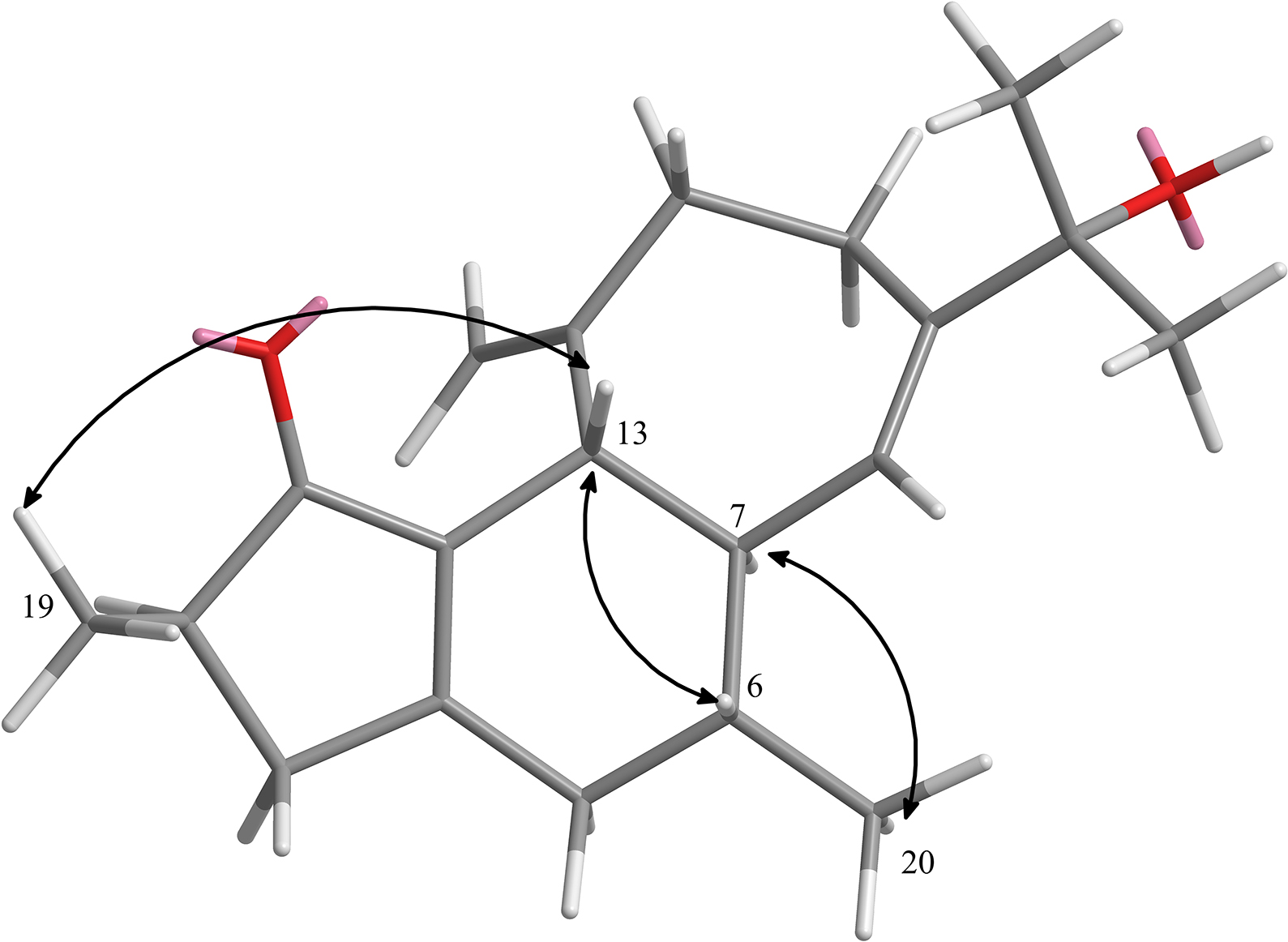
The relative stereochemistry of 4 was established as (2R, 6R, 7R, 13S) based on the analysis of the nuclear NOESY spectrum (Figures S60-S62, SI section). The location of the methyl group at C-19 was corroborated by the NOE correlation observed between H-19/H-13. Additionally, NOE correlations between H-13/H-6, H-8/H-16 and H-7/H-20 (Figure 6) provided relevant evidence for establishing the relative arrangement of these protons, indicating that they are oriented on the same side of the molecular plane. Finally, it was possible to observe an axial-axial coupling between H-13 and H-7, J 7.0 Hz.
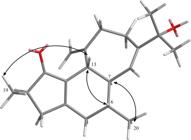
Based on information from the literature,25,26 it was possible to propose the relative stereochemistry of H-19.
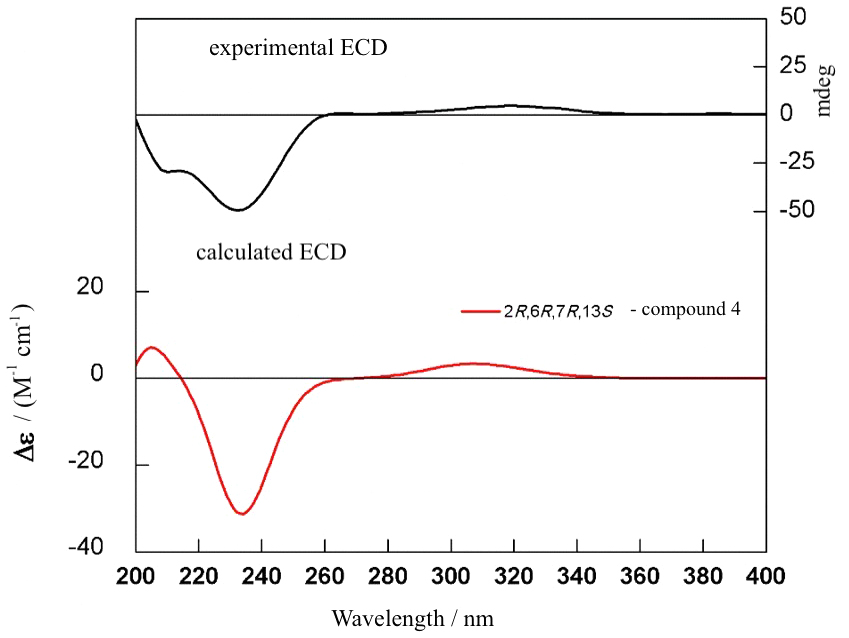
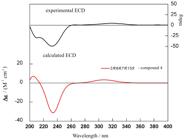
Next, using the proper relative configuration of compound 4, we focused on the determination of the absolute configuration by means of a combination of the experimental and theoretical ECD spectra. The experimental ECD spectrum (Figure S64, SI section) (top panel of Figure 7) in the 190-400 nm region, measured in ACN, yielded a negative π–π* (ca. 220 nm) and positive n–π* (ca. 300 nm) cotton effects, which once again were perfectly reproduced in the final Boltzmann weighted theoretical ECD spectra, obtained by the average of the 9 lowest-energy conformers identified for compound 4 at the CAM-B3LYP/PCM(ACN)/TZVP level (botton panel of Figure 7). Therefore, as shown in Figure 7, based on the good agreement between the theoretical and experimental spectra, the absolute configuration of compound 4 was unambiguously assigned as (2R, 6R, 7R, 13S). Thus this compound 4 was identified as the argyrotrienone B (2-(2,5-dimethyl-1,10-dimethylene-1,2,3,4,5,5a,8,9,10,10a-decahydrocyclohepta[e]inden-7-yl)propan-2-ol), a new diterpene with a rare carbons; this is the first report of the absolute stereochemistry of this rare diterpene carbon skeleton.
The possible biosynthetic pathway is postulated in (Figure S65, SI section), whose proposed precursor is GGPP. Crotofolane is a diterpene biosynthesized from cembrane via casbane and lathyrane through cross-ring cyclization. The structure is characterized by tricyclicity, starting from GGPP with the enzyme casbene synthase (CBS) and then proceeding via cembrane with the formation of the intermediate to form cyclopropane in the casbane nucleus, followed by ring closure between C-6 and C-10, with enzyme oxidation to form the lathyrane pathway (with a 5/11/3 ring system), followed by further oxidation and transannular closure to form jatropholane (with a traditional 5/6/7/3 ring system, with a fused structure of five-, six-, and seven-membered rings as the basic skeleton). The final step is the opening of the cyclopropane ring in jatropholane, which can occur in two possible cleavages: the first cleavage between the C-9 and C-15 bonds forms crotofolane. The second cleavage between the C-8 and C-15 bonds can lead to the formation of a new skeleton, called isocrotofolane.25-30
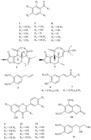
Thirteen compounds were isolated from the EHCa and EDMCa extracts of C. argyrophylloides and identified as: atraric acid31-33 (1) (Figures S1-S5, SI section); xanthoxylin (2)34-36 (Figures S6-S10, SI section); and methyl 2,6-dihydroxy-4-methylbenzoate (8)37 (Figures S94-S103, SI section). Two diterpenes, one of the crotofolane type, the argyrotrienone A (3) (Figures S11-S37, SI section) and another belonging to the rare isocrotofolane skeleton, the argyrotrienone B (4) (Figures S38-S65, SI section), both first reported in the genus Croton. Four derivatives of the phenylpropanoid class, methyleugenol (5)38 (Figures S66-S76, SI section); a mixture of ferulic acid derivatives, docosyl trans-ferulate (6),39 trans-eicosyl ferulate (7)39 (Figures S77-S93, SI section) and 3-(3,4-dimethoxyphenyl)-1,2-propanediol (11)40 (Figures S130-S146, SI section). Three flavonoids, ayanin (9)41 (Figures S104-S117, SI section), 3-methylquercetin (12)42 (Figures S147-S158, SI section) and quercetin (13)43,44 (Figures S159-S167, SI section). A compound of the coumarin class, fraxinol (10)45 (Figures S118-S129, SI section) as shown in Figure 2. The chemical structures of compounds (1-13) were determined using 1H, 13C, and 2D NMR and comparison with literature data. The two new diterpenes (3 and 4) were characterized using NMR, HRESIMS, IR, ECD, and comparison with data from the literature (SI section).
Conclusions
In conclusion, phytochemical research on the plant C. argyrophylloides revealed two new diterpenes, one of the crotofolane type, argyrotrienone A (3), and another of the isocrotofolane type, argyrotrienone B (4), a rarely occurring skeleton and first time with this structural characterization. In addition, through this study, it was possible to isolate and identify a total of 11 known compounds, of which 5 were reported for the first time in the Croton genus, (methyleugenol, docosyl trans-ferulate, trans-eicosyl ferulate, methyl 2,6-dihydroxy-4-methylbenzoate and 3-(3,4-dimethoxyphenyl)-1,2-propanediol), and 6 compounds reported for the first time in the species (atraric acid, xanthoxylin, ayanin, 3-methylquercetin, quercetin and fraxinol). The chemical characterization presented expands existing knowledge about the chemistry of the species C. argyrophylloides and strengthens and consolidates the importance of the genus as a significant source of specialized metabolites, reinforcing its potential for future investigations.
Supplementary Information
Supplementary information (1D and 2D NMR spectra, HRMS-ESI and IR) is available free of charge at http://jbcs.sbq.org.br as PDF file.
Supplementary PDF
Data Availability Statement
Authors are responsible for the accuracy and completeness of all references.
Acknowledgments
The authors are grateful to the Brazilian agencies: CAPES (Finance code 001), CNPq, FAPESQ-PB (2350/2022), FAPERJ (E-26/210-313/2022), Rede Norte-Nordeste de Fitoterápicos (INCT RENNOFITO 465536/2014-0) and INCT iCEIS (406264/2022-8) for the financial support. We also thank the Laboratório Multiusuário de Caracterização e Análises (LMCA/UFPB), Núcleo Avançado de Computação de Alto Desempenho (NACAD/UFRJ), Coordenação dos Programas de Pós-Graduação de Engenharia (COPPE/UFRJ) for their support.
References
-
1 Yadav, N. K.; Yadav, R.; Chin. J. Integr. Med. 2024, 30, 181. [Crossref]
» Crossref -
2 Islam, M. S.; Ara, H.; Ahmad, K. I.; Uddin, M. M.; Univers. J. Pharm. Res. 2019, 4, 45. [Crossref]
» Crossref -
3 Sun, M.; Zeng, W.; Zhao, Z.; J. Ethnopharmacol. 2024, 320, 117352. [Crossref]
» Crossref -
4 Zhang, Z.-Y.; Li, Y.; Yu, J.-H.; Zhao, J.-X.; Yue, J.-M.; Phytochemistry 2024, 223, 114138. [Crossref]
» Crossref -
5 Wang, M.-J.; Wang, M.; Zhan, X.-Q.; Liu, L.; Wu, Q.; An, F.-L.; Lu, Y.-B.; Guo, L.-L.; Zhang, Z.-X.; Fei, D.-Q.; Fitoterapia 2023, 164, 105350. [Crossref]
» Crossref -
6 da Silva, A. S.; de Melo e Silva, K.; Clementino Neto, J.; Costa, V. C. O.; Pessôa, H. L. F.; Tavares, J. F.; da Silva, M. S.; Cavalcante, F. A.; Pharmacognosy Res. 2016, 8, 202. [Crossref]
» Crossref -
7 Moremi, M. P.; Makolo, F.; Viljoen, A. M.; Kamatou, G. P.; J. Ethnopharmacol. 2021, 280, 114416. [Crossref]
» Crossref -
8 Xu, W.-H.; Liu, W.-Y.; Liang, Q.; Molecules 2018, 23, 2333. [Crossref]
» Crossref -
9 da Costa Filho, L. O.; Silva, M. H. M.; de Almeida-Cortez, J. S.; da Silva, S. I.; de Oliveira, A. F. M.; Biochem. Syst. Ecol. 2012, 41, 13. [Crossref]
» Crossref -
10 Miranda, F. M.; do Nascimento Jr., B. B.; Aguiar, R. M.; Pereira, R. S.; Teixeira, A. O.; de Oliveira, D. M.; Lima, E. O.; Oigman, S. S.; Rezende, C. M.; Froldi, G.; J. Essent. Oil Res. 2019, 31, 223. [Crossref]
» Crossref -
11 Neri, T. S.; Silva, K. W. L.; Maior, L. P. S.; Oliveira-Silva, S. K.; Azevedo, P. V. M.; Gomes, D. C. S.; Souza, M. A.; Pavão, J. M. S. J.; Costa, J. G.; Cunha, A. L.; Ferreira Jr., G. C.; Matos-Rocha, T. J.; Santos, A. F.; Fonseca, S. A.; Braz. J. Biol. 2023, 83, e236649. [Crossref]
» Crossref -
12 Alves-Santos, T. R.; de Siqueira, R. J. B.; Duarte, G. P.; Lahlou, S.; Evidence-Based Complement. Altern. Med. 2016, 2016, 4106502. [Crossref]
» Crossref -
13 Aguiar, L. A.; Porto, R. S.; Lahlou, S.; Ceccatto, V. M.; Barbosa, R.; Lemos, T. L. G.; dos Santos, H. S.; Souza, A. N. C.; Magalhães, P. J. C.; Zin, W. A.; Leal-Cardoso, J. H.; J. Pharm. Pharmacol. 2012, 64, 1155. [Crossref]
» Crossref -
14 Bastos, R. C.; Vasconcelos, C. F. M.; Paiva, M. B.; Reis, T. D. S.; Souza, R. B.; Santos, H. S.; Bandeira, P. N.; Aguiar, L. M. V.; Cunha, R. M. S.; Free Radic. Res. 2022, 56, 760. [Crossref]
» Crossref -
15 Morais, S.; Cossolosso, D.; Silva, A.; de Moraes, M.; Teixeira, M.; Campello, C.; Bonilla, O.; de Paula, V.; Vila-Nova, N.; J. Braz. Chem. Soc. 2019, 30, 2404. [Crossref]
» Crossref -
16 Souza, Z. N.; Córdula, C. R.; Cavalcanti, I. M. F.; Fitoterapia 2024, 172, 105752. [Crossref]
» Crossref -
17 Alves, J. A. B.; Nunes, M. S.; Fakhouri, R.; Martins-Filho, P. R. S.; Ribeiro, M. C. O.; Vasconcellos, A. C.; Santos, P. O.; Marchioro, M.; Trindade, R. C.; Frazão, G. G. S.; Vaez, A. C.; Tako, K. V.; Int. Arch. Med. 2016, 9, 1. [Crossref]
» Crossref -
18 Silva, A. A. S.; Morais, S. M.; Martins, C. G.; Vieira-Araújo, F. M.; Rev. Eletron. Farm. 2016, 13, 165. [Crossref]
» Crossref -
19 Wang, H.-B.; Wang, X.-Y.; Liu, L.-P.; Qin, G.-W.; Kang, T.-G.; Chem. Rev. 2015, 115, 2975. [Crossref]
» Crossref - 20 WaveFunction, Inc.; Spartan’14, version 1.1.0; Wavefunction, Inc., Irvine, USA, 2014.
-
21 Cancès, E.; Mennucci, B.; Tomasi, J.; J. Chem. Phys. 1997, 107, 3032. [Crossref]
» Crossref - 22 Origin Pro, version 2023; OriginLab Corporation, Northampton, MA, USA, 2023.
- 23 Frisch, M. J.; Trucks, G. W.; Schlegel, H. B.; Scuseria, G. E.; Robb, M. A.; Cheeseman, J. R.; Scalmani, G.; Barone, V.; Petersson, G. A.; Nakatsuji, H.; Gaussian 16, Revision C.01; Gaussian, Inc.: Wallingford, CT, USA, 2016.
- 24 Santos Jr., F. M.; Borges Jr., J. M.; Absolute Configuration from Chiroptical Spectroscopy; Wiley: Hoboken, NJ, USA, 2023.
-
25 Kawakami, S.; Matsunami, K.; Otsuka, H.; Inagaki, M.; Takeda, Y.; Kawahata, M.; Yamaguchi, K.; Chem. Pharm. Bull. 2015, 63, 1047. [Crossref]
» Crossref -
26 Kawakami, S.; Otsuka, H.; J. Nat. Med. 2023, 77, 421. [Crossref]
» Crossref - 27 Fattahian, M.; Ghanadian, M.; Ali, Z.; Khan, I. A.; Jatrophane and Rearranged Jatrophane-Type Diterpenes: Biogenesis, Structure, Isolation, Biological Activity and SARs (1984–2019); Springer Netherlands: Dordrecht, Netherlands, 2020.
- 28 Dewick, P. M.; Medicinal Natural Products: A Biosynthetic Approach; Wiley: Chichester, UK, 2009.
-
29 Wong, J.; Rond, T.; D’Espaux, L.; van der Horst, C.; Dev, I.; Rios-Solis, L.; Kirby, J.; Scheller, H.; Keasling, J.; Metab. Eng. 2018, 45, 142. [Crossref]
» Crossref -
30 Burke, B. A.; Chan, W. R.; Pascoe, K. O.; Blount, J. F.; Manchand, P. S.; Tetrahedron Lett. 1979, 20, 3345. [Crossref]
» Crossref -
31 Tala, M. F.; Tan, N.-H.; Ndontsa, B. L.; Tane, P.; Biochem. Syst. Ecol. 2013, 51, 138. [Crossref]
» Crossref -
32 Gormann, R.; Kaloga, M.; Li, X.-C.; Ferreira, D.; Bergenthal, D.; Kolodziej, H.; Phytochemistry 2003, 64, 583. [Crossref]
» Crossref -
33 Ahad, A. M.; Goto, Y.; Kiuchi, F.; Tsuda, Y.; Kondo, K.; Sato, T.; Chem. Pharm. Bull. 1991, 39, 1043. [Crossref]
» Crossref -
34 Soares, M. G.; Felippe, A. P. V.; Guimarães, E. F.; Kato, M. J.; Ellena, J.; Doriguetto, A. C.; J. Braz. Chem. Soc. 2006, 17, 1205. [Crossref]
» Crossref -
35 Aguiar, F. L. L.; Morais, S. M.; Santos, H. S.; Albuquerque, M. R. J. R.; Bandeira, P. N.; de Brito, E. H. S.; Rocha, M. F. G.; Fontenelle, R. O. S.; J. Med. Plants Res. 2016, 10, 216. [Crossref]
» Crossref -
36 Santos, H. S.; Mesquita, F. M. R.; Lemos, T. L. G.; Monte, F. J. Q.; Braz-Filho, R.; Quim. Nova 2008, 31, 601. [Crossref]
» Crossref -
37 Tatipamula, V. B.; Polimati, H.; Gopaiah, K. V.; Babu, A. K.; Vantaku, S.; Rao, P. R.; Killari, K. N.; Indian J. Pharm. Sci. 2020, 82, 379. [Crossref]
» Crossref -
38 Cao, G.; Yang, X.; J. Chin. Pharm. Sci. 2014, 23, 311. [Crossref]
» Crossref -
39 Liu, H.; Jin, Y.-S.; Song, Y.; Yang, X.-N.; Yang, X.-W.; Geng, D.-S.; Chen, H.-S.; J. Asian Nat. Prod. Res. 2010, 12, 286. [Crossref]
» Crossref -
40 Paulin, E. K.; Leung, E.; Pilkington, L. I.; Barker, D.; Int. J. Mol. Sci. 2023, 24, 1167. [Crossref]
» Crossref -
41 Lima, S. G.; Citó, A. M. G. L.; Lopes, J. A. D.; Neto, J. M. M.; Chaves, M. H.; Silveira, E. R.; Rev. Latinoam. Quim. 2010, 38, 133. [Crossref]
» Crossref -
42 Sousa, G. R.; Teles, N. R. L.; Silva, C. V. A.; Aragão, M. C.; Cardoso, D. B. O. S.; Gadelha, F. A. A. F.; Piuvezam, M. R.; Tavares, J. F.; Silva, M. S.; Barbosa Filho, J. M.; ACS Omega 2025, 10, 13645. [Crossref]
» Crossref -
43 Oh, G.-Y.; Lee, Y.-S.; Jeon, T.-I.; Ham, K.-S.; Moon, J.-H.; Cho, J.-Y.; Korean J. Food Preserv. 2021, 28, 489. [Crossref]
» Crossref -
44 Dall’Acqua, S.; Miolo, G.; Innocenti, G.; Caffieri, S.; Molecules 2012, 17, 8898. [Crossref]
» Crossref -
45 Maes, D.; Riveiro, M. E.; Shayo, C.; Davio, C.; Debenedetti, S.; Kimpe, N. D.; Tetrahedron 2008, 64, 4438. [Crossref]
» Crossref
Edited by
-
Editor handled this article:
Hector H. F. Koolen (Associate)