 From Protection to Pollution: The Impact of Mask Use on Micro(nano)plastic Release
Abstract
This study presents a bibliographic review compiling data on global masks consumption during the coronavirus disease 2019 (COVID-19) pandemic, disposal practices, the release of microplastic and nanoplastic (MNPs) from masks, and their environmental consequences. Global demand for masks increased dramatically compared to pre-pandemic levels, with estimates ranging from 21 billion to 2,555 billion single-use masks per month, underscoring the essential role of personal protective equipment (PPE) in infection control. Asia was identified as the largest consumer and generator of mask waste, followed by the Americas (North and South). This study also demonstrates that disposable masks release MNPs into different environmental matrices, with ultraviolet radiation (UV) and mechanical stress acting as drivers of this process. However, the reviewed studies employed several measurement units, making comparisons challenging hindering direct comparisons, a challenge that highlights the need for standardized methodologies and units. Polypropylene was the predominant constituent of the released particles, as expected due to its widespread use in mask manufacturing. This review also emphasizes the adverse effects of discarded masks on biota and the documented impacts of MNPs released during simulated weathering on model organisms. Overall, there is an urgent need for research focused on standardizing units, improving exposure realism, and strengthening waste-management strategies during health crises. Such efforts are essential to balance infection control with minimizing the environmental burden of single-use plastics and to inform future pandemic preparedness and policy.
Keywords:
microplastic and nanoplastic; disposable masks; polypropylene; environmental degradation; waste management strategies
1. Introduction
The widespread production and use of plastics revolutionized the modern world, with current annual worldwide production equivalent to the sum of production from 1950 to 1975.1 It is estimated that if current production and consumption trends are maintained, in 2050, there will be around 12,000 million metric tons (Mt) of plastic waste in landfills or in the natural environment.2,3 Moreover, in 2018, only 9% of the 9,000 Mt of plastic produced around the world was recycled.2 Therefore, this is one of the biggest environmental problems of the last decades. Because of this, the presence of macroplastics (> 25 mm) and mesoplastics (5-25 mm) in the environment has attracted the attention of researchers and the wider population.4-6 However, plastic waste in the environment can degrade or decompose by biological degradation, physical weathering and abrasion, and solar radiation, generating small particles including microplastics (MPs, between 1 µm and 5 mm) and nanoplastics (NPs, < 1 µm).5,7 These particles may be difficult to observe with the naked eye but should be better studied due to their possible impacts on the environment and human health.5,7
The presence of plastic debris has been reported in different water bodies worldwide, including oceans,8-12 rivers, lakes, and estuaries,13-18 as well as in the atmosphere,7,19-22 and soils.23-25 In biota, this material has been found, for example, in the stomach and intestine of Norwegian crayfish, in zebrafish, in Brazilian commercial fish, in mussels, crabs, seabirds, and in the human tissues, such as lung.26-33 Therefore, plastics are ubiquitous environmental contaminants.34-36
On the other hand, plastics have also played a crucial role in safeguarding human health, most recently through their use in personal protection equipment (PPE). In 2020, with the onset of the coronavirus disease 2019 (COVID-19) pandemic, global demand for PPE, especially masks, rose sharply, following recommendations from the World Health Organization (WHO) for infection control.37-42 According to the organization, PPE was extensively adopted both in healthcare settings and by the general public to prevent and reduce infection risks and contain transmission of severe acute respiratory syndrome coronavirus 2 (SARS CoV 2).43,44 While this measure was essential for controlling the pandemic, it also led to a marked increase in plastic waste, as most widely used masks are disposable and manufactured from plastic-based materials.40,45,46 However, even without the recent advances, masks and respirators are effective in reducing the transmission of respiratory infections, such as COVID-19, when used consistently and properly.43 Therefore, PPE was widely used during the COVID-19 pandemic.
Although the emergency phase of the COVID-19 pandemic is over, the waste generated, especially single-use plastics, remains present in the environment, with potential long-term impacts on environmental and human health. Thus, this review investigates the use and disposal of masks worldwide, and the resulting increase in the amount of plastic waste generated, together with the associated release of MNPs from masks, in order to estimate the extent of environmental exposure. The composition and amount of MNPs produced, the experimental degradation conditions and the analytical techniques used in the reported studies are evaluated. Information is also presented regarding the manufacturing process of masks and respirators, the primary materials used, and their environmental impacts. The integrated information should be used to formulate recommendations for future research and science-based policy-making for future pandemics related to mask use and waste management.
2. Search Strategy and Selection Criteria
This review used the following databases: Scopus, Web of Science, Science Direct, and Pubmed. The common search terms for all sections were “mask*” or/and “respirator*”. For more specific searches, the additional search terms included were “microplastic*” or/and “nanoplastic*”, in addition to “COVID” and terms related to “release”, “source”, “emission”, “disposal”, “discard*”, “degradat*”. Since the objective was related to the SARS CoV-2 pandemic, only articles published between 2019 and 2024 were included in sections 3.2 and 3.3. For these sections, all the article titles and abstracts were analyzed, and refinements were made. In total, 219 references were returned using the keywords in section 3.2, with 96 being selected and described. In section 3.3, 542 references were returned, with 36 being selected and described. This occurred because studies were excluded if they were literature or systematic reviews without new data or estimates, theses, dissertations, or if they merely cited other articles on the topic of the review. Figure 1 summarizes the methodological procedures described in this section.

3. Masks, Microplastics, and Environmental Implications
3.1. Structure and composition of masks and respirators
Disposable masks (surgical/medical masks) and respirators are typically made of non-woven polypropylene (PP) fibers, although polystyrene (PS), polyethylene (PE), and polycarbonate (PC) can be used.44,47 PP has a low density and weight compared to other synthetic fabrics, as well as low cost, ability to filter dry particles, high chemical resistance and higher yield than other materials, making it a good choice for mask production.47,48 PS can also be used to produce fabrics with thermal stability, high tensile strength, and easy dying and printing, that make it suitable for a wide range of products.47,48 Similar to PP, PE has good chemical resistance, low weight, and is hydrophobic, moreover, it is available in different densities: high, low, and linear low.47 However, PE has lower mechanical resistance, so the use of PP is still favored.47 Polyamides (PA), such as nylon 6, rapidly absorb water molecules, have a high melting point, and form light fibers, making PA attractive for the manufacture of masks, although a high energy input is required to reach the melting point.47 Other materials such as cotton, chitosan, polyurethane (PU), natural fibers, and other porous materials can also be used.47 Cotton has been the material most commonly used in fabric masks.49 In a recent study, cotton and chiffon were shown to provide good protection against viral transmission if they had a tight weave.49 Pei et al.50 showed that some household materials also have the potential to be used in masks, including kitchen towels, bedsheets, T-shirts, and coffee filters.50 In these cases, multi-layer structures are essential for good protection.50 Alternative masks made from paper products were also discussed; however, the inherent high respiratory resistance of these materials may be exacerbated by moisture from exhaled air, leading to a significant reduction in their effective wear time.50 It should be noted that disposable masks (surgical/medical masks) and respirators are referred to as masks in this article, while cloth, cotton, etc. are fully specified.
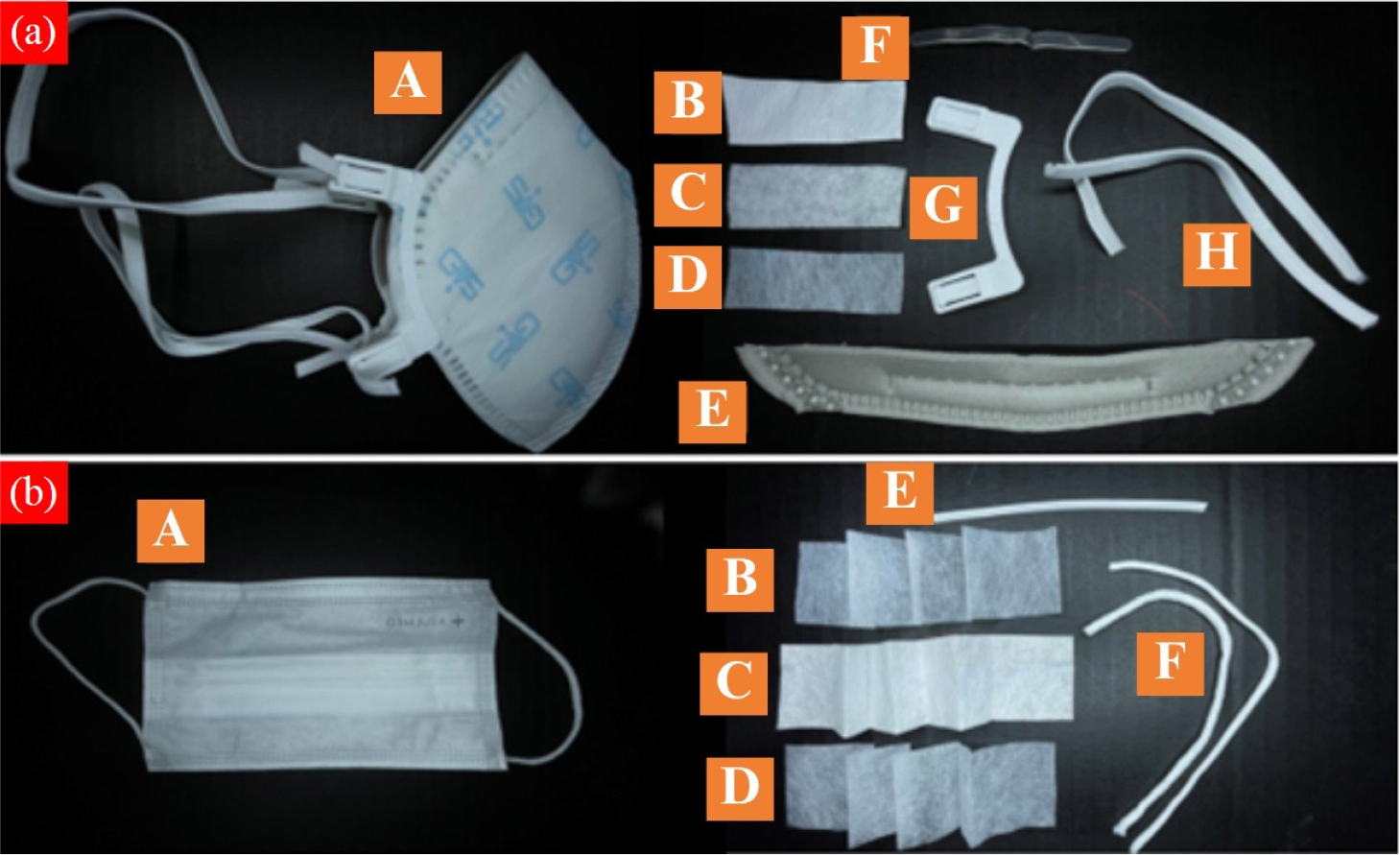
Masks can have a single layer composed of thick fibers, while 3-layer masks may contain microfibers and nanofibers (Figure 2).51 In 3-layer masks and respirators, the inner and outer layers are made of PP non-woven, which, due to their hydrophobic properties, can minimize the absorption of moisture and airborne droplets, avoiding changes in filtration efficiency during use. The intermediate layers are composed of PP non-woven and modacrylics (polyacrylonitrile, co-monomers, and organic and inorganic additives), which are responsible for the shape, rigidity, and thickness.52-55 Respirators made from higher molecular weight materials provide better sealing and filtration efficiency, compared to surgical masks. N95 respirators, for example, offer one of the highest levels of protection, since they are designed to remove at least 95% of airborne particles.56 This higher filtration efficiency is due to the length of the fibers and the pore diameter. Reusable masks have the longest fiber length, followed by surgical masks and N95 respirators.51 On the other hand, reusable masks have the largest pore diameter and N95 respirators the smallest.51

Three-layer masks: (a) (A) PFF-2 mask, (B) inner layer, (C) middle layer, (D) outer layer, (E) nose foam, (F) seam, (G) elastic clip, (H) elastic earloop; (b) (A) surgical mask, (B) inner layer, (C) middle layer, (D) outer layer, (E) seam, (F) elastic earloop.
As already mentioned, recent advances to improve the efficiency of masks and respirators, driven by the COVID-19 pandemic, have focused on the use of nanotechnology to develop filters. This includes the use of nanofibers, such as polyimide/polyvinylidene fluoride and cellulose nanofibers, together with changes in the composition of filters, for example employing materials with antimicrobial properties: silver and TiO2 nanoparticles. The use of nanofibers increases the surface area, while their functionalization with chemicals can deactivate contaminants, helping to reduce the inhalation of respiratory pathogens.
3.2. Use and disposal of masks during the COVID-19 pandemic
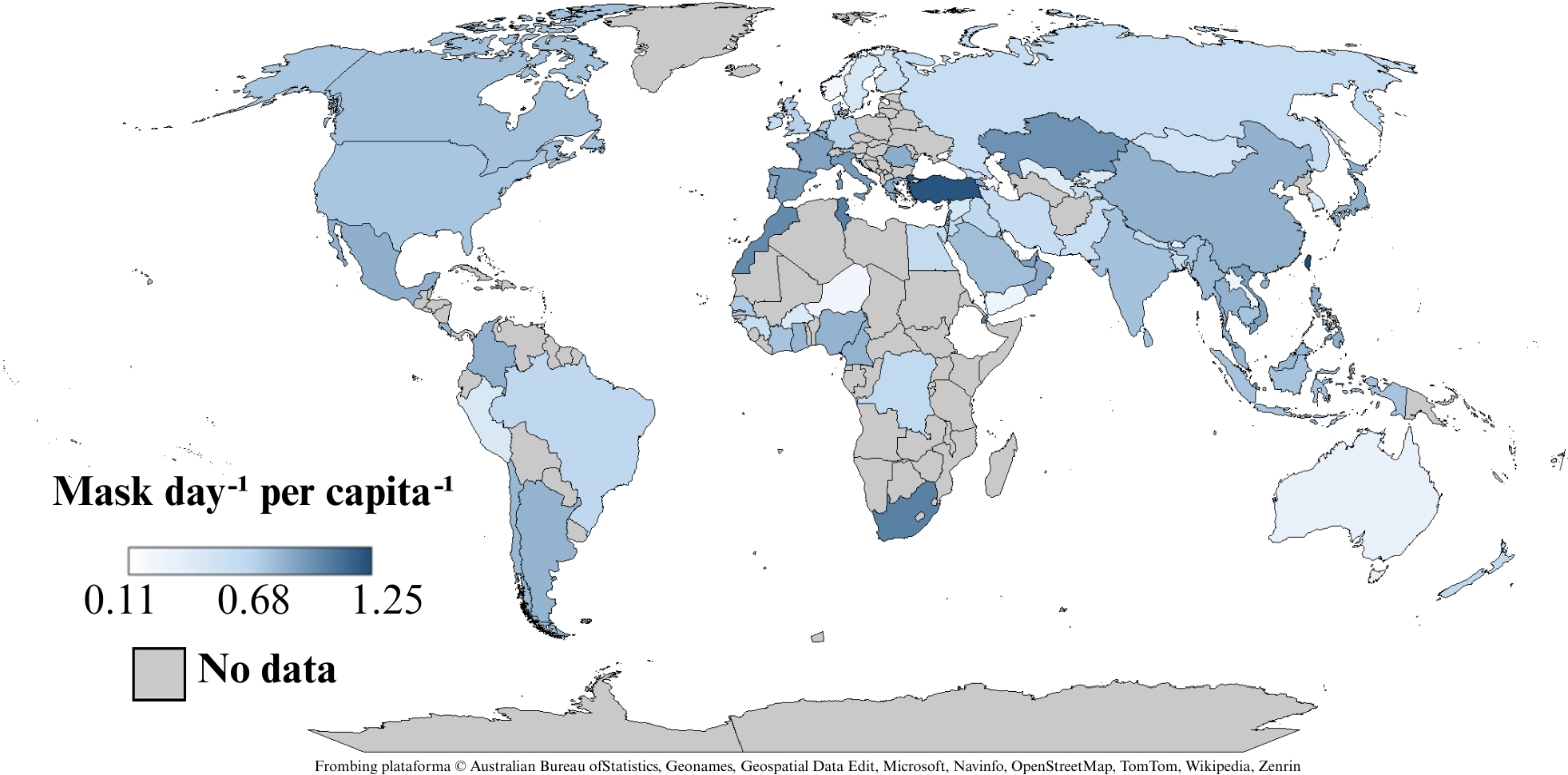
In the early months of the COVID-19 pandemic, the World Health Organization estimated a global demand of 89 million and 129 billion masks per month for healthcare professionals and the general population, respectively; considering a consumption similar to that of Italy, which was the first country outside China to have very significant cases (and deaths) associated with COVID, in early 2020.40 Subsequently, based on consumption patterns or mask production data, the estimated values ranged between 21 and 2,555 billion masks per month (0.28 million to 1,200 million masks per day, or 0.11 to 1.25 masks per day per capita; Figure 3 and Table S1, Supplementary Information (SI) section) for the world’s population.41,57-59 This wide range was due to the use of different simulation scenarios, and should be interpreted as indicative, since estimation methods vary and uncertainties remain high, but nonetheless serves to demonstrate the number of masks used during the height of the COVID-19 pandemic. Even for the minimum scenario, the amount is higher than the values seen in previous years; for example, in China an increase of 370% was observed.57

Estimated per capita mask consumption (masks day-1 per capita-1) across countries during the COVID-19 pandemic. Countries with available data are shaded according to the color scale, while those without data are shown in gray.
The high use of masks can be attributed to public policies for mask distribution and incentives or laws for their use. For example, in Germany, the Federal Ministry of Health distributed 290 million masks up to December 25, 2020; in Italy, 1,040 million masks were distributed up to November 12, 2020; in the UK, 7,800 million PPEs were distributed between March and November 2020; and in England alone, 2,300 million PPEs were distributed between February and July 2020, the same as the amount distributed throughout the year 2019.41,60
Disposable masks were essential in mitigating viral transmission during the COVID-19 pandemic. However, their production and end-of-life require proper management to avoid environmental releases, without detracting from their protective function.61 The current production process, including transport, is estimated to generate about 100 g CO2-eq for each mask and to consume approximately 400 J of energy.62,63 Furthermore, mask production and use are estimated to generate between 500 and 100,000 tons of plastic waste per month, assuming that the average mask contains 2.5 g of PP and only 1% of masks are improperly discarded (potentially ending up in open dumps, waterways, or being openly burned).41,57,58,62,64-67 This improper disposal can lead to the release of MNPs as masks undergo environmental degradation. It is important to emphasize that masks do not inherently become MNPs; but possess the potential to release them progressively as they undergo aging and fragmentation in the environment. On the other hand, commercial waste volumes declined during the pandemic.40 Therefore, lockdowns created contrasting waste dynamics, with household packaging and PPE waste increasing while commercial waste volumes decreased.40
The global use and disposal of masks have differed according to region, with the Asian region estimated to have accounted for more than 50% of total daily mask consumption (based on the high usage of masks by the general public before the pandemic, and the severity of the outbreaks there), followed by America (North and South America), Africa, Europe, and Oceania. The same order was observed for discarded masks, although America has become the major source of global medical waste, while Asia occupies the third position.59,68
China, the most populous nation (> 1.4 billion inhabitants), and India, the world’s second most populous nation (> 1.3 billion inhabitants), were the largest producers and users of masks. Based on the available data, the production of masks in China in 2018 and 2019 was about 15 million per day. However, in February and early March 2020, 116 million disposable masks were produced every day, reaching 200 million per day in June 2020, and 450 million per day subsequently.57,69,70 China was also the largest consumer, with an estimated maximum of approximately 1.2 billion masks per day (around 0.84 units per capita).71 In India, the number of masks used per day during the pandemic was estimated to be between approximately 400 million and 1,100 million units (0.28 to 0.77 units per capita).71-74 An estimated 850 tons of biomedical waste were generated per day during the pandemic period, compared to 557 tons generated per day in 2017.75
Other Asian countries with large quantities of masks used daily and high generation of medical waste include South Korea, Japan, Saudi Arabia, Turkey, Indonesia, the Philippines, and Pakistan, among others.41,59,71,76-84 A complete list of the references described in Section 3.2, reporting the use, disposal, and generation of medical waste worldwide, is provided in Table S2 (SI section).
These generation and improper disposal of PPE, especially masks, in several places around the world, resulted in densities of PPE ranging from 6.3 × 10⁻³ PPE m-2 along Cox’s Bazar beach (Bangladesh) to 1.1 PPE m-2 in Puerto Princesa (the Philippines),67,85 and from (8.28 ± 4.21) × 10-5 masks m-2 in the Qing River, a freshwater environment in China to 1.83 × 10⁻⁴ masks m-2 at Kish Island, in the Persian Gulf.86,87 Several other studies88-93 conducted in the Asian continent have also reported the presence of PPE and masks in the environment.
Africa, the second most populated continent in the world (1.46 billion inhabitants in 2020), consumed between 411 and 951 million masks daily (0.28 to 0.65 units per day per capita), or more than 368 tons of masks.59,72,94 It was estimated that 12 billion medical and fabric masks were discarded monthly, resulting in around 105,000 tons of masks being disposed of into the environment on the African continent.95 Countries including Nigeria (15%), Ethiopia (8.6%), and Egypt (7.6%) were the main contributors to the generation of plastic waste.95 Countries such as the Democratic Republic of Congo, Morocco, Algeria, and South Africa should also be highlighted as significant consumers of masks and, consequently, as notable contributors to plastic waste generation.41,72,76,79,96-98
Overall, studies have reported the presence of PPE primarily in locations with recreational, touristic, and commercial activities, such as those conducted on tourist beaches in Morocco,99,100 in the Tana River in Ethiopia,101 urban beaches in Kenya,102,103 and various locations in Egypt,102 and Ghana,104 with densities ranging from 0 to 2.88 × 10⁻⁴ PPE m-2.
In Latin America, several studies59,72,94 have estimated the number of disposable masks used daily, based on population, acceptance of mask use, and masks used per capita. It was estimated that between 380 and 592 million disposable masks (0.57 to 0.89 units per capita) were used daily during the height of the COVID-19 pandemic, generating between 218 and 1,776 tons of waste per day. Brazil is the most populous country in Latin America, with a population of around 212 million inhabitants. It is estimated that between 107 and 144 million masks were used per day in the country; and during the acute phase, the mass of medical waste generated daily reached about 15 million tons per day, with around 13,000 tons being managed inappropriately.67,71,72,74,76,105 It is important to note that these pressures extended beyond the acute phase of the pandemic, with municipal solid waste generation reaching 77.1 Mtons in 2022 (93% of which was collected, leaving more than 5 Mtons unmanaged).106 Healthcare waste also exceeded 300,000 tons, reflecting the transition of services from COVID-19 hospitalizations to elective procedures.106 Moreover, selective collection covered only 14.7% of the urban population, evidencing structural gaps in segregation and recycling capacity.106,107 However, among the state capitals and some cities with more than 1 million inhabitants, the generation of solid waste decreased, which was attributed to the reduction of commercial activities, as a result of social isolation.107 In São Paulo, municipal solid waste generation fell from approximately 20,000 to 16,000 tons day-1 during the first months of the pandemic (20% reduction), with commercial and central districts showing a decline from 1,200 to 900 tons day-1 (25% reduction), while residential areas increased from 9,000 to over 11,000 tons day-1 (22% increase), evidencing a shift of waste production from business sectors to households.107
With the restrictions imposed by governments aimed at reducing SARS-CoV-2 transmission, such as social distancing measures and travel limitations, reductions in pollutant emissions from industrial activities and the transport sector have also been reported in several regions worldwide. These reductions were documented in both urban and rural areas of the Netherlands, as well as in Germany, China, India, and in Brazilian locations including cities in São Paulo State and the city of Rio de Janeiro.108
In Mexico, the second most populous country in Latin America, the overall number of used masks was similar (109 million masks per day) to that in Brazil, leading to the daily discarding of more than 81 million items. In Peru it was estimated that almost 15 million masks were used per day, generating 75 tons of plastic waste daily.109 Other countries on the continent, such as Argentina, Chile, Colombia, and Costa Rica, also reported a higher daily use of masks.67,71,79 The majority of studies reporting the presence of PPE and/or face masks in the environment were conducted in Peru. In the country, PPE was found on various beaches (recreational, fishing, and natural reserves),110 coastal areas,111 and, most notably, in several environmental protection areas.112 Other studies have reported the presence of PPE items on various beaches in Argentina,111 along the Chilean coast,113 in Santos Bay, Brazil,114 and in Mexico City, the capital of Mexico.115
In North America, the range of disposable masks used daily was similar to that of South America, with estimates ranging from 244 to 781 million masks per day (0.64 to 2.06 units per day per capita).59,72,94 The United States of America was the largest consumer of PPE on the American continent, and the third largest consumer of masks on the planet, with an estimated daily consumption of between 218 and 256 million masks.41,72,76,116 Data collected by Shams et al.117 showed that demand for N95 respirators jumped from 50 million per year to 140 million per year during the 90-day peak-use period in 2020.117 In Canada, the daily consumption of masks was much lower, at around 30 million units, caused by lower population density.41,76
On the European continent, over the first few months of 2020, after the start of the COVID-19 pandemic, daily mask use of between 445 and 890 million units was estimated (0.60 to 1.20 units per day per capita).59,72,94 The calculated total weight of masks used per day on the continent was 353 tons.59,94 Between the beginning of 2020 and the end of September of the same year, 98 million euros were spent in pharmacies on PPE, while in September 2020, 13 million units per day of surgical masks were purchased at pharmacies.118 In Russia, the most populous country in Europe, it was estimated that 86 million masks were used daily, while in Germany, daily mask usage reached almost 57 million units.71,72 Other major consumers of masks were the United Kingdom, Italy, France, Ukraine, Romania, the Netherlands, Belgium, Portugal, and Greece.64,71,72,74,76,119-121
In Oceania, which has a population of almost 43 million inhabitants, it was estimated that 46.3 million masks were used per day (0.93 units per day per capita), with 139 tons discarded daily.122 Data collected by Asim et al.94 indicated the daily use of 45.4 million masks. Using a different approach, Benson et al.72 estimated the daily disposal of around 22.7 million masks, resulting in 8,769 tons of plastic waste. In Australia, in 2020, mask use was estimated at between 5.16 million and 81.2 million units per day, corresponding to waste generation of more than 20 tons per day, or 7,540 tons per year.41,71 Only 53% of this waste went to landfill with the rest being illegal plastic waste dumped in open landfills, “waterways” and “soil ways”.41 In New Zealand, a study71 indicated the daily use of 33.8 million masks.
These figures illustrate and quantify the unprecedented demand observed during the peak periods of the pandemic. However, the potential environmental impacts are largely determined by disposal practices and the capacity of waste management systems, underscoring the need for robust collection, segregation, and treatment infrastructures. In other words, for exposure assessments, the critical factor is the pathway through which these products entered municipal and healthcare waste streams, which varied across regions depending on infrastructure and policy responses. In countries with limited selective collection and segregation, PPE was generally managed through conventional municipal or standard healthcare waste streams, often in the absence of dedicated programs.
3.3. Release of microplastics and nanoplastics from masks (simulated conditions)
Several investigations have demonstrated the release of MNPs from masks (Table S3, SI section). A total of 29 studies87,123-150 replicated aquatic environments, using ultrapure and deionized water, as well as natural or simulated seawater. Six articles129,135,137,151-153 considered emissions into the air, while two articles154,155 considered release into soil/sediment, and four articles150,151,156,157 explored other forms of release. The concentrations of MNPs released from masks using different conditions and environmental matrices are presented in Table 1. In these studies, the most used physical-chemical MNPs characterization and quantification techniques were optical microscopy and Fourier transform infrared spectroscopy (Table 2).
Concentrations of microplastics and nanoplastics (MNPs) released from masks using different conditions and environmental matrices
Summary of techniques used to study MNPs release from masks and their frequencies (percentage of studies using the technique, relative to the total number of studies)
Exposure to ultraviolet light (UV) was widely used in degradation studies and the main type of radiation employed in the reviewed investigations. In studies123,139,145 that utilized intermittent UV irradiation to evaluate the release of MNPs from masks, a common feature was the use of light/dark cycles during the experiments, which were conducted in either natural or artificial seawater under agitation. However, the specific light/dark cycles varied, with cycles of 8/16 h, 12/12 h, and 2/10 h being employed. The concentrations of released MNPs ranged from 0.33 ± 0.24 to 571.4 ± 235.3 (Table 1). Many of the reviewed studies also employed continuous exposure to UV radiation, under which the release of MNPs occurred over a much broader range, from 0.14 to 8.0 × 10⁸ items h-1 mask-1 (Table 1). In general, these experiments were carried out in ultrapure water. The reported durations of UV radiation exposure varied from 8 h to 28 days.125,127,132,133 Some studies125,127 were carried out at a controlled temperature of 25 °C. Additionally, there are reports146,148,153,154 of the use of sand or glass beads to mimic the physical abrasion of masks. It should be noted that, the values were reported in different units in the articles, which makes comparison difficult (Table 1).
In other studies, masks were subjected to natural light exposure by placing them in external locations, such as terraces128,137,138 and a laboratory balcony.143 The experiments investigating mask degradation due to natural light were generally carried out under conditions of friction and/or natural weathering, in an aqueous medium (seawater, freshwater or distilled water).128,137,138,143 In such scenarios, the synergistic action of solar radiation, thermal fluctuations, and mechanical abrasion accelerates polymer degradation and increases particle release. This process contrasts with conditions involving the absence of mechanical stress. In general, masks that underwent physical abrasion processes after exposure to natural radiation released more microplastics (3.05 × 10⁶ items h-1 mask-1) when compared to the results obtained with masks weathered under agitation in freshwater (217 items h-1 mask-1)128 (Table 1).
De-la-Torre et al.143 reported MPs releases of 38.8 ± 11.6 items mask-1 in seawater (1.04 ± 0.04 items h-1 mask 1) and 46.3 ± 10.5 items mask-1 (1.50 ± 0.04 items h-1 mask-1) in distilled water.143 This behavior was not expected, as other studies149,150 have found the opposite. Several other studies used natural weathering processes. Overall, the studies showed that previous rubbing led to the release of greater quantities of MNPs.
Other studies also evaluated the release of microplastics without the use of degradation by radiation but with the use of different agitation conditions. Sullivan et al.124 and Delgado-Gallardo et al.126 studied the release of MNPs in water, but under mild agitation, without the use of degradation by UV irradiation. Although all the masks analyzed released MNPs (fibers), the exact concentrations were not specified. In the work by Wang et al.,87 using manual mild shaking three times in 24 h, the releases were 31.33 ± 0.57 items mask-1 (1.31 ± 0.02 items h-1 mask-1) for KN95 masks and 50.33 ± 18.50 items mask-1 (2.10 ± 0.77 items h-1 mask-1) for disposable masks.87 The release of MNPs in water, under continuous agitation, was studied elsewhere, with the values obtained varying widely (Table 1).128,131,132,136,138,141,142,144,145,147,149 It can be seen that in these studies, continuous agitation was more common than intermittent agitation.
Other methods used were weathering without UV irradiation, under agitation in the presence of sand149 or metal balls,129,135 as well as clothes-washing processes,148 and a blender process.146 The effects of parameters such as pH, acidity, incubation time, and time of use have also been analyzed.134 The concentrations of MPs released ranged from 21.5 ± 7.5 to 88,356 ± 5,988 items h-1 mask-1 and are presented in Table 1. In general, higher concentrations of MNPs were determined when a blender or metal balls and stirring were used,150,158 and lower concentrations were observed when washing machines were used.129,134,148,149 This happens due to a combination of physical factors, such as time, temperature, frequency, and intensity of force, as well as the type of material being processed.
Emissions of MNPs from masks to the atmosphere have also been studied. Meier et al.129 performed two simulations using a Sheffield head, one to simulate typical daily mechanical friction conditions (respiratory airflow of 14.2 L min-1) and another to simulate conditions during physical activity (respiratory airflow of 30 L min-1).129 For the first simulation, particle release ranged between 6 ± 1 and 25 ± 7 items g-1 (18 ± 3 to 75 ± 21 items h-1 mask-1), with increases of between 1.5 and 12.5 times when mechanical friction was performed (Table 2). The 30 L min-1 respiratory flow released (0.3 to 10 µm) 63 ± 25 particles g-1 (23.6 ± 9.4 items h-1 mask-1) to 242 ± 132 particles g-1 (90.8 ± 49.5 items h-1 mask-1). Studies with similar conditions obtained comparable results (Table 1). Torre et al.,151 Bhangare et al.152 and Li et al.153 used simulated breathing with seven different types of masks. The results obtained by the authors suggest that the releases of fiber-like MPs after 720 h were higher than the blank for all the masks, except the N95 type. This demonstrated that some types of masks minimized the inhalation of particles, compared to not wearing a mask, while other types increased particulate inhalation. This work also investigated the release of MPs from masks submitted to different disinfection processes (UV irradiation, alcohol, air blower, washing, and sunlight). For masks without disinfection treatment and subjected to simulated use for 720 h, the release of spherical MPs continuously decreased following a high initial burst, compared to the unused masks, while the fiber-like MPs increased, except for the N95 type mask. Two other studies137,150 analyzed the emission of MNPs into the atmosphere and the releases increased using friction and higher times.
Idowu et al.154 studied another environmental compartment, inserting whole masks into bottles containing soil. In these experiments, masks were placed in 2 L glass beakers half-filled with garden soil. After 14 weeks, the MPs (> 500 µm) concentrations were similar for bottles containing masks and those without masks (blank control). However, in the 60th week, the concentrations of MPs were 85.32 ± 14.51 items (8.5 ± 1.4 × 10⁻³ items h-1) for the control (particles deposited from the atmosphere), and 3,686 ± 173.88 items mask-1 ((3.7 ± 0.2) × 10-1 items h-1 mask-1) for the bottles containing masks. Mentari et al.155 adopted a similar methodology, but the reactors containing the masks were watered daily with 0.2 L of water for 45 days. The water resulting from the watering process was collected, extracted, and analyzed, and the measured releases ranged from 3 ± 0 to 4.5 ± 0.5 items mL-1.
Four other studies investigated the release of MNPs. Simulations for butane gun incineration resulted in concentrations of around 11 × 109 items cm-2 mask-1 (2.1 × 10¹⁵ items h-1 mask-1) for NPs (< 1 µm), 12 × 106 items cm-2 mask-1 (2.3 × 10¹² items h-1 mask-1) for MPs (1-100 µm), and between 1 and 10 items cm-2 mask-1 (1.9 × 10¹⁵ and 1.9 × 10⁶ items h-1 mask-1) for particles in the millimeter range (> 1 mm). However, despite the estimation of the release of items per hour per mask, calculated from the use of a flame for 3 s, the material would be rapidly degraded due to the high temperature.157 It should be noted that nanoparticle concentrations were the highest. Therefore, these emissions could not be detected in the others studies due to the analytical approaches applied, which did not have sufficient resolution to detect NPs. Spennemann156 used a lawnmower that was passed over surgical masks placed on a lawn, generating numerous fragments from the three layers of the masks, but the exact MNPs concentrations were not provided. The release of 1.94 items cm-2 (305.5 items mask-1) of mask was reported by Torre et al.,151 who used adhesive tape that was placed on the outer layer of a surgical mask and was then peeled off. Batasheva et al.150 exposed masks to dark/light cycles of UV irradiation (7.5/16.5 h, for a total of 192 h). The surface was analyzed and, although the released concentration was not stated, MNPs were observed by nanoparticle analysis, optical microscopy, and atomic force spectroscopy.
Exposure to UV light is also widely used in disinfection processes,159,160 as well as other methods such as the use of autoclaving and alcohol.140 Among the disinfection processes tested, UV exposure (30 min) was the greatest generator of MPs (> 1 µm); followed by autoclaving for 30 min at 121 °C and 15 atm; exposure to steam from a household electric cooker for 30 min; and application of alcohol (70%) for 30 min (Table 1).140 On the other hand, the generation of NPs (< 1 µm) was greater using disinfection with alcohol; followed by UV irradiation; steam; and autoclaving (Table 1).140
Regardless of the matrix tested or the disinfection processes, PP was the polymer most commonly detected, as expected given that this material is widely used in the manufacture of masks and respirators.39 PP was found in 34 studies, followed by PA (8 studies), natural fibers (5 studies), and PE (5 studies) (Figure 4, Table S4, SI section).

Polymers determined in the MNPs released from face masks, and their number of occurrences in the literature reviewed herein.
Analysis of the sizes of the particles released has revealed wide variations (Table S3). Nanometric particles were observed in 7 studies,124,126,130,140,144,146,150 while micrometric and millimetric particles were detected in 26 studies.123-127,129,132-143,145-147,149,151,154-156 Micrometric particles were the most common, followed by particles larger than 1,000 µm. All the studies that reported the presence of NPs were performed with aquatic media, using techniques such as scanning electron microscopy, energy-dispersive X-ray spectroscopy, atomic force microscopy, and laser-based particle size analysis. As highlighted previously, in the studies reporting only MPs (> 1 µm), in most cases the analytical approaches applied did not have sufficient resolution to detect NPs, meaning that they are likely present in the samples but could not be detected using the approaches applied.
3.4. Environmental impacts of discarded face masks and released MNPs
In recent years, studies42,130 have demonstrated that masks and respirators, as well as the MNPs released from them, may cause adverse effects on the environment and biota. Some of these studies will be briefly described here as examples.
One of the first fatal cases related to the COVID-19 pandemic was documented when a fish died wrapped (physical effect) in a latex glove, in the Netherlands.161 In another study,161 in Canada, an American robin (a migratory bird) died after becoming entangled in a mask. In Italy, a wild duck and other birds were seen with a mask around the neck. Gallo Neto et al.162 reports the Magellanic penguin found with a protective mask in its stomach on the coast of São Paulo (Brazil), while Wang et al.163 documents long-tailed macaques interacting with discarded masks in Malaysia. Three species of seagull that fed in a landfill were studied for the evaluation of ingested debris, with 59% of the debris having a plastic origin.158
The three soil invertebrates Porcellio scaber (woodlouse), Tenebrio molitor larvae (mealworms), and Enchytraeus crypticus (annelid worm) were exposed to PP MPs from masks.164 Although the particles did not affect their survival, it was found that the concentration (0.06, 0.50 and 1.50% m/m) of MPs influenced the total energy available and the immune response.164 In a study165 with the annelid species Lumbriculus variegatus (blackworm), the animals showed decreased vitality and metabolic alteration when they were exposed to fragments generated from disposable masks and nitrile gloves. In this study,165 the MNP concentrations ranged from 0.22 to 0.50% of dry sediment to represent a higher particle concentration while remaining environmentally realistic. In other work,142 individuals of the marine copepod species Tigriopus japonicus were exposed to PP particles (0, 1, 10, and 100 MPs mL-1 in artificial seawater) released from surgical masks, which resulted in a significant decline in their fertility rate.
4. Current Knowledge Gaps and Limitations
This study has some limitations that should be considered when interpreting the results and directing future research. First, the methodological heterogeneity observed in the reviewed studies (including variations in the intensity and duration of UV radiation exposure, agitation and friction regimes, disinfection methods, and the type of simulated environmental matrix) makes it difficult to directly compare studies and consolidate quantitative trends. This diversity of approaches also impacts the extrapolation of data to environmental scenarios, highlighting the need for standardization of experimental protocols that incorporate environmentally representative conditions. In addition, the lack of standardization in units of measurement is a significant limitation, as the results of the articles analyzed were reported in different ways, requiring conversions and increasing uncertainty in comparisons. Another important limitation is the analytical challenge of detecting nanoplastics. In most studies, the analytical techniques employed lack of the resolution required for their accurate quantification, likely resulting in an underestimation of the total number of particles released.
Environmental representativeness is also limited, as most tests were performed under controlled laboratory conditions (artificial radiation and absence of climatic variation, for example), which do not fully reflect aging and external degradation in the environment. At the same time, there is unequal geographical representativeness, with lowand middle-income countries, where consumption of disposable masks was high and waste management is often poor, being underrepresented.
From an ecotoxicological perspective, many tests used MNPs concentrations higher than those estimated to occur in the environment, limiting the reliability of risk assessments. There is also a notable scarcity of studies that simultaneously evaluate particle release and toxicity within the same environmental context, hindering the ability to correlate emission rates with potential adverse effects on biota.
Therefore, overcoming these limitations requires coordinated efforts to standardize methodologies and units of measurement, increase analytical resolution, and incorporate experimental conditions that more realistically reflect the environment. Similarly, it is essential to expand geographical representativeness and promote studies that simultaneously integrate the quantification of MNPs release and the assessment of their ecotoxicological impacts. Overcoming these gaps will allow the construction of a more robust and comparable scientific evidence base, strengthening environmental risk assessment and supporting more effective public policies and waste management strategies in the face of future health crises.
5. Conclusions and Future Perspectives
Masks and respirators were essential in mitigating viral transmission during the COVID-19 pandemic; however, their large-scale use posed significant challenges for waste-management systems. Moreover, their polymeric composition, mainly polypropylene, can lead to the release of microplastics and nanoplastics into different environmental compartments. Laboratory studies consistently showed that factors such as UV exposure, mechanical stress, agitation, and disinfection processes can increase MNPs release. In addition, although effect concentrations observed in experimental settings often exceed predicted environmental levels by a small margin, the findings highlight the risk of long-term accumulation and ecological impacts, particularly in contexts of inadequate waste management.
Two key lessons emerge from this review. First, methodological standardization is urgently needed, particularly in the choice of units, and experimental conditions, to enable direct comparability between studies and to strengthen predicted environmental concentration (PEC) and predicted no-effect concentration (PNEC) assessments. Second, sustainable responses to future health crises demand the integration of effective waste-management strategies with public awareness initiatives, ensuring that the protection of human health is achieved while minimizing the environmental burden of single-use plastics. Future research should explore the balance between protective efficiency, material innovation, and environmental safety, thereby providing evidence to guide policy decisions and technological development for both routine healthcare and emergency scenarios.
The authors used generative AI only to improve the manuscript’s language and readability, under strict human supervision. All content was reviewed and edited to ensure accuracy and intended meaning, with final validation done by the authors.
Supplementary Information
Supplementary Information
Acknowledgments
The authors are grateful for the financial support provided by the São Paulo State Research Foundation (FAPESP, grants Nos. 2018/04820 6; 2021/10187-7; 2022/03087-9; 2023/07601 1; 2023/06768-0, 2023/14823-0), INCTAA (CNPq, grant No. 465768/2018-8; FAPESP, grant No. 2014/50951-4), Horizon 2020 research and innovation project NanoSolveIT (Grant Agreement No. 814572), and the Horizon Europe project MACRAMÉ (Grant Agreement No. 101092686) including the Innovate UK support for UoB participation in MACRAMÉ (Grant No. 10066165). Student grants were provided by CAPES to J. S. Carvalho (CAPES, finance code 001), CNPq to A. S. de Moraes, and I. T. de Miranda, and FAPESP to G. B. dos Santos (No. 2023/07601-1), and G. M. Ferraz (No. 2023/06768-0).
Data Availability Statement
Data will be made available on request.
References
-
1 Oceaneye; Plastic Consumption [Link] accessed in October 2025
» Link -
2 United Nations Environment Programme (UNEP); The State of Plastics: World Environment Day Outlook 2018 [Link] accessed in October 2025
» Link -
3 Geyer, R.; Jambeck, J. R.; Law, K. L.; Sci. Adv. 2017, 3, e1700782. [Crossref]
» Crossref -
4 Hartmann, N. B.; Hüffer, T.; Thompson, R. C.; Hassellöv, M.; Verschoor, A.; Daugaard, A. E.; Rist, S.; Karlsson, T.; Brennholt, N.; Cole, M.; Herrling, M. P.; Hess, M. C.; Ivleva, N. P.; Lusher, A. L.; Wagner, M.; Environ. Sci. Technol. 2019, 53, 1039. [Crossref]
» Crossref -
5 Allen, S.; Allen, D.; Karbalaei, S.; Maselli, V.; Walker, T. R.; J. Hazard. Mater. Adv. 2022, 6, 100057. [Crossref]
» Crossref -
6 Lam, C.-S.; Ramanathan, S.; Carbery, M.; Gray, K.; Vanka, K. S.; Maurin, C.; Bush, R.; Palanisami, T.; Water, Air, Soil Pollut. 2018, 229, 345. [Crossref]
» Crossref -
7 Chen, G.; Feng, Q.; Wang, J.; Sci. Total Environ. 2020, 703, 135504. [Crossref]
» Crossref -
8 Pattiaratchi, C.; van der Mheen, M.; Schlundt, C.; Narayanaswamy, B. E.; Sura, A.; Hajbane, S.; White, R.; Kumar, N.; Fernandes, M.; Wijeratne, S.; Ocean Sci. 2022, 18, 1. [Crossref]
» Crossref -
9 Bergmann, M.; Collard, F.; Fabres, J.; Gabrielsen, G. W.; Provencher, J. F.; Rochman, C. M.; van Sebille, E.; Tekman, M. B.; Nat. Rev. Earth Environ. 2022, 3, 323. [Crossref]
» Crossref -
10 Pabortsava, K.; Lampitt, R. S.; Nat. Commun. 2020, 11, 4073. [Crossref]
» Crossref -
11 Egger, M.; Schilt, B.; Wolter, H.; Mani, T.; de Vries, R.; Zettler, E.; Niemann, H.; Sci. Rep. 2022, 12, 13465. [Crossref]
» Crossref -
12 Shim, W. J.; Kim, S.-K.; Lee, J.; Eo, S.; Kim, J.-S.; Sun, C.; Environ. Pollut. 2022, 311, 119911. [Crossref]
» Crossref -
13 Leal Filho, W.; Dedeoglu, C.; Dinis, M. A. P.; Salvia, A. L.; Barbir, J.; Voronova, V.; Abubakar, I. R.; Iital, A.; Pachel, K.; Huthoff, F.; Sharifi, A.; Yang, P. J.; Klavins, M.; Emanche, V. O.; Land 2022, 11, 1117. [Crossref]
» Crossref -
14 Rezania, S.; Park, J.; Din, M. F. M.; Taib, S. M.; Talaiekhozani, A.; Yadav, K. K.; Kamyab, H.; Mar. Pollut. Bull. 2018, 133, 191. [Crossref]
» Crossref -
15 Xu, S.; Ma, J.; Ji, R.; Pan, K.; Miao, A.-J.; Sci. Total Environ. 2020, 703, 134699. [Crossref]
» Crossref -
16 Peng, L.; Fu, D.; Qi, H.; Lan, C. Q.; Yu, H.; Ge, C.; Sci. Total Environ. 2020, 698, 134254. [Crossref]
» Crossref -
17 Ajith, N.; Arumugam, S.; Parthasarathy, S.; Manupoori, S.; Janakiraman, S.; Environ. Sci. Pollut. Res. 2020, 27, 25970. [Crossref]
» Crossref -
18 Bhuyan, M. S.; S., V.; S., S.; Szabo, S.; Hossain, M. M.; Rashed Un-Nabi, M.; R., P. C.; P., J. M.; Islam, M. S.; Reg. Stud. Mar. Sci. 2021, 41, 101539. [Crossref]
» Crossref -
19 Zhang, Y.; Kang, S.; Allen, S.; Allen, D.; Gao, T.; Sillanpää, M.; Earth-Sci. Rev. 2020, 203, 103118. [Crossref]
» Crossref -
20 Mbachu, O.; Jenkins, G.; Pratt, C.; Kaparaju, P.; Water, Air, Soil Pollut. 2020, 231, 85. [Crossref]
» Crossref -
21 Ferraz, G. M.; de Moraes, A. S.; dos Santos, G. B.; de Miranda, I. T.; Zucolotto, V.; Urban, R. C.; Chemosphere 2024, 369, 143886. [Crossref]
» Crossref -
22 Xu, L.; Li, J.; Yang, S.; Li, Z.; Liu, Y.; Zhao, Y.; Liu, D.; Targino, A. C.; Zheng, Z.; Yu, M.; Xu, P.; Sun, Y.; Li, W.; Environ. Sci.: Atmos. 2024, 4, 1161. [Crossref]
» Crossref -
23 Xu, B.; Liu, F.; Cryder, Z.; Huang, D.; Lu, Z.; He, Y.; Wang, H.; Lu, Z.; Brookes, P. C.; Tang, C.; Gan, J.; Xu, J.; Crit. Rev. Environ. Sci. Technol. 2020, 50, 2175. [Crossref]
» Crossref -
24 Liong, R. M. Y.; Hadibarata, T.; Yuniarto, A.; Tang, K. H. D.; Khamidun, M. H.; Water, Air, Soil Pollut. 2021, 232, 342. [Crossref]
» Crossref -
25 Matsuguma, Y.; Takada, H.; Kumata, H.; Kanke, H.; Sakurai, S.; Suzuki, T.; Itoh, M.; Okazaki, Y.; Boonyatumanond, R.; Zakaria, M. P.; Weerts, S.; Newman, B.; Arch. Environ. Contam. Toxicol. 2017, 73, 230. [Crossref]
» Crossref -
26 Neto, J. G. B.; Rodrigues, F. L.; Ortega, I.; Rodrigues, L. S.; Lacerda, A. L. F.; Coletto, J. L.; Kessler, F.; Cardoso, L. G.; Madureira, L.; Proietti, M. C.; Environ. Pollut. 2020, 267, 115508. [Crossref]
» Crossref -
27 Pegado, T. S. S.; Schmid, K.; Winemiller, K. O.; Chelazzi, D.; Cincinelli, A.; Dei, L.; Giarrizzo, T.; Mar. Pollut. Bull. 2018, 133, 814. [Crossref]
» Crossref -
28 Farrell, P.; Nelson, K.; Environ. Pollut. 2013, 177, 1. [Crossref]
» Crossref -
29 Cau, A.; Avio, C. G.; Dessì, C.; Moccia, D.; Pusceddu, A.; Regoli, F.; Cannas, R.; Follesa, M. C.; Environ. Sci. Technol. 2020, 54, 4886. [Crossref]
» Crossref -
30 Qu, X.; Su, L.; Li, H.; Liang, M.; Shi, H.; Sci. Total Environ. 2018, 621, 679. [Crossref]
» Crossref -
31 Lu, Y.; Zhang, Y.; Deng, Y.; Jiang, W.; Zhao, Y.; Geng, J.; Ding, L.; Ren, H.; Environ. Sci. Technol. 2016, 50, 4054. [Crossref]
» Crossref -
32 Cartraud, A. E.; Le Corre, M.; Turquet, J.; Tourmetz, J.; Mar. Pollut. Bull. 2019, 140, 308. [Crossref]
» Crossref -
33 Amato-Lourenço, L. F.; Carvalho-Oliveira, R.; Ribeiro Júnior, G.; Galvão, L. S.; Ando, R. A.; Mauad, T.; J. Hazard. Mater. 2021, 416, 126124. [Crossref]
» Crossref -
34 Li, W. C.; Tse, H. F.; Fok, L.; Sci. Total Environ. 2016, 566-567, 333. [Crossref]
» Crossref -
35 Behera, J. K.; Mishra, P.; Jena, A. K.; Bhattacharya, M.; Behera, B.; Environ. Sci. Pollut. Res. 2024, 31, 54147. [Crossref]
» Crossref -
36 Sodré, F. F.; Arowojolu, I. M.; Canela, M. C.; Ferreira, R. S.; Fernandes, A. N.; Montagner, C. C.; Vidal, C.; Dias, M. A.; Abate, G.; Silva, L. C.; Grassi, M. T.; Bertoldi, C.; Fadini, P. S.; Urban, R. C.; Ferraz, G. M.; Schio, N. S.; Waldman, W. R.; Chemosphere 2023, 340, 139813. [Crossref]
» Crossref -
37 Ardusso, M.; Forero-López, A. D.; Buzzi, N. S.; Spetter, C. V.; Fernández-Severini, M. D.; Sci. Total Environ. 2021, 763, 144365. [Crossref]
» Crossref -
38 Ebner, N.; Iacovidou, E.; Sustainable Prod. Consumption 2021, 28, 726. [Crossref]
» Crossref -
39 Chua, M. H.; Cheng, W.; Goh, S. S.; Kong, J.; Li, B.; Lim, J. Y. C.; Mao, L.; Wang, S.; Xue, K.; Yang, L.; Ye, E.; Zhang, K.; Cheong, W. C. D.; Tan, B. H.; Li, Z.; Tan, B. H.; Loh, X. J.; Research 2020, 2020, 7286735. [Crossref]
» Crossref -
40 Prata, J. C.; Silva, A. L. P.; Walker, T. R.; Duarte, A. C.; Rocha Santos, T.; Environ. Sci. Technol. 2020, 54, 7760. [Crossref]
» Crossref -
41 Silva, A. L. P.; Prata, J. C.; Duarte, A. C.; Barcelò, D.; Rocha Santos, T.; Chem. Eng. J. 2021, 426, 131201. [Crossref]
» Crossref -
42 Aragaw, T. A.; Mar. Pollut. Bull. 2020, 159, 111517. [Crossref]
» Crossref -
43 ASHRAE; Coronavirus (COVID-19) Response Resources from ASHRAE and Others [Link] accessed in October 2025
» Link -
44 Cohen, H. J.; Birkner, J. S.; Clin. Chest Med. 2012, 33, 783. [Crossref]
» Crossref -
45 Silva, A. L. P.; Prata, J. C.; Walker, T. R.; Duarte, A. C.; Ouyang, W.; Barcelò, D.; Rocha-Santos, T.; Chem. Eng. J. 2021, 405, 126683. [Crossref]
» Crossref -
46 Cordova, M. R.; Nurhati, I. S.; Riani, E.; Nurhasanah; Iswari, M. Y.; Chemosphere 2021, 268, 129360. [Crossref]
» Crossref -
47 Ogbuoji, E. A.; Zaky, A. M.; Escobar, I. C.; Polymers 2021, 13, 1998. [Crossref]
» Crossref -
48 Midha, V. K.; Dakuri, A.; J. Text. Eng. Fashion Technol. 2017, 1, 126. [Crossref]
» Crossref -
49 Konda, A.; Prakash, A.; Moss, G. A.; Schmoldt, M.; Grant, G. D.; Guha, S.; ACS Nano 2020, 14, 6339. [Crossref]
» Crossref -
50 Pei, C.; Ou, Q.; Kim, S. C.; Chen, S.-C.; Pui, D. Y. H.; Aerosol Air Qual. Res. 2020, 20, 2581. [Crossref]
» Crossref -
51 Du, W.; Iacoviello, F.; Fernandez, T.; Loureiro, R.; Brett, D. J. L.; Shearing, P. R.; Commun. Mater. 2021, 2, 69. [Crossref]
» Crossref -
52 O’Dowd, K.; Nair, K. M.; Forouzandeh, P.; Mathew, S.; Grant, J.; Moran, R.; Bartlett, J.; Bird, J.; Pillai, S. C.; Materials 2020, 13, 3363. [Crossref]
» Crossref -
53 Zhou, S.; Lukula, S.; Chiossone, C.; Nims, R. W.; Suchmann, D. B.; Ijaz, M. K.; J. Thorac. Dis. 2018, 10, 2059. [Crossref]
» Crossref -
54 Babaahmadi, V.; Amid, H.; Naeimirad, M.; Ramakrishna, S.; Sci. Total Environ. 2021, 798, 149233. [Crossref]
» Crossref -
55 Stackhouse, C. A.; Yan, S.; Wang, L.; Kisslinger, K.; Tappero, R.; Head, A. R.; Tallman, K. R.; Takeuchi, E. S.; Bock, D. C.; Takeuchi, K. J.; Marschilok, A. C.; ACS Appl. Mater. Interfaces 2021, 13, 47996. [Crossref]
» Crossref -
56 World Health Organization (WHO); Rational Use of Personal Protective Equipment for Coronavirus Disease (COVID-19) and Considerations During Severe Shortages; 2020. [Link] accessed in October 2025
» Link -
57 Chen, Z.; Zhang, W.; Yang, H.; Min, K.; Jiang, J.; Lu, D.; Huang, X.; Qu, G.; Liu, Q.; Jiang, G.; Environ. Sci.: Processes Impacts 2022, 24, 649. [Crossref]
» Crossref -
58 Li, B.; Huang, Y.; Guo, D.; Liu, Y.; Liu, Z.; Han, J.-C.; Zhao, J.; Zhu, X.; Huang, Y.; Wang, Z.; Xing, B.; Sci. Total Environ. 2022, 825, 153880. [Crossref]
» Crossref -
59 Hantoko, D.; Li, X.; Pariatamby, A.; Yoshikawa, K.; Horttanainen, M.; Yan, M.; J. Environ. Manage. 2021, 286, 112140. [Crossref]
» Crossref -
60 Zhang, E. J.; Aitchison, L. P.; Phillips, N.; Shaban, R. Z.; Kam, A. W.; BMJ 2021, 372, n109. [Crossref]
» Crossref -
61 Ganesapillai, M.; Mondal, B.; Sarkar, I.; Sinha, A.; Ray, S. S.; Kwon, Y.-N.; Nakamura, K.; Govardhan, K.; Environ. Technol. Innov. 2022, 28, 102837. [Crossref]
» Crossref -
62 Luhar, I.; Luhar, S.; Abdullah, M. M. A. B.; J. Compos. Sci. 2022, 6, 271. [Crossref]
» Crossref -
63 Türkmen, B. A.; Environ. Sci. Pollut. Res. 2022, 29, 25496. [Crossref]
» Crossref -
64 Almulhim, A. I.; Ahmad, I.; Sarkar, S.; Chavali, M.; Rem. J. 2021, 31, 111. [Crossref]
» Crossref -
65 Peng, Y.; Wu, P.; Schartup, A. T.; Zhang, Y.; Proc. Natl. Acad. Sci. U. S. A. 2021, 118, e2111530118. [Crossref]
» Crossref -
66 Ngoc, S.-M. V.; Nguyen, M.-A.; Nguyen, T.-L.; Thi, H. V.; Dao, T. L.; Bui, T. M. P.; Hoang, V. T.; Chu, D.-T.; Case Stud. Chem. Environ. Eng. 2022, 6, 100245. [Crossref]
» Crossref -
67 Mvovo, I.; Magagula, H. B.; Environ. Syst. Decis. 2022, 42, 328. [Crossref]
» Crossref -
68 Yang, S.; Cheng, Y.; Liu, T.; Huang, S.; Yin, L.; Pu, Y.; Liang, G.; Environ. Chem. Lett. 2022, 20, 2951. [Crossref]
» Crossref -
69 Tabatabaei, M.; Hosseinzadeh-Bandbafha, H.; Yang, Y.; Aghbashlo, M.; Lam, S. S.; Montgomery, H.; Peng, W.; J. Cleaner Prod. 2021, 313, 127880. [Crossref]
» Crossref -
70 Zhao, H.; Liu, H.; Wei, G.; Zhang, N.; Qiao, H.; Gong, Y.; Yu, X.; Zhou, J.; Wu, Y.; Sci. Total Environ. 2022, 810, 152302. [Crossref]
» Crossref -
71 Kutralam-Muniasamy, G.; Pérez-Guevara, F.; Shruti, V. C.; J. Hazard. Mater. 2022, 422, 126945. [Crossref]
» Crossref -
72 Benson, N. U.; Bassey, D. E.; Palanisami, T.; Heliyon 2021, 7, e06343. [Crossref]
» Crossref -
73 Adhlakha, B.; Sethi, P.; J. Clin. Diagn. Res. 2021, 15, LI01. [Crossref]
» Crossref -
74 Kuppusamy, P. P.; Bhatia, A.; Verma, A.; Shah, N. R.; Pratyush, P.; Shanmugarajan, V.; Kim, S. C.; Poongavanam, G. K.; Duraisamy, S.; Environ. Sci. Pollut. Res. 2022, 29, 55528. [Crossref]
» Crossref -
75 Bhar, A.; Biswas, R. K.; Choudhury, A. K.; Proc. Indian Natl. Sci. Acad. 2022, 88, 117. [Crossref]
» Crossref -
76 Ahuja, S.; Arora, S.; Curr. Sci. 2021, 121, 1281. [Crossref]
» Crossref -
77 Lee, S.; Kim, B.; Ji, S.; Jang, Y.-C.; Lee, E.; Park, M.; Kim, S.; Sim, Y.; Kim, D.; Han, S.; J. Korea Soc. Waste Manage. 2021, 38, 281. [Crossref]
» Crossref -
78 Ali, S. A.; Parvin, F.; Waste Manage. Res. 2022, 40, 1356. [Crossref]
» Crossref -
79 Mohana, A. A.; Islam, M. M.; Rahman, M.; Pramanik, S. K.; Haque, N.; Gao, L.; Pramanik, B. K.; Chemosphere 2023, 311, 137014. [Crossref]
» Crossref -
80 Abbasi, S. A.; Khalil, A. B.; Arslan, M.; Saudi J. Biol. Sci. 2020, 27, 3181. [Crossref]
» Crossref -
81 Sangkham, S.; Case Stud. Chem. Environ. Eng. 2020, 2, 100052. [Crossref]
» Crossref -
82 Akarsu, C.; Madenli, Ö.; Deveci, E. Ü.; Environ. Sci. Pollut. Res. 2021, 28, 47517. [Crossref]
» Crossref -
83 Zhao, C.; Ting, Z.; You, Z.; Kim, H.; Shah, K. J.; Water 2022, 14, 2403. [Crossref]
» Crossref -
84 Barayang, L. P. C.; Cruz, I. C. A.; de Vera, K. J. G.; Inumerable, J. C. F.; Alam, Z. F.; Biomed. Pharmacol. J. 2022, 15, 1573. [Crossref]
» Crossref -
85 Rakib, M. R. J.; De-la-Torre, G. E.; Pizarro-Ortega, C. I.; Dioses-Salinas, D. C.; Al-Nahian, S.; Mar. Pollut. Bull. 2021, 169, 112497. [Crossref]
» Crossref -
86 Mohamadi, S.; Madadi, R.; Rakib, M. R. J.; De-la-Torre, G. E.; Idris, A. M.; Sci. Total Environ. 2023, 854, 158678. [Crossref]
» Crossref -
87 Wang, F.; Wu, H.; Li, J.; Liu, J.; Xu, Q.; An, L.; J. Environ. Manage. 2022, 319, 115741. [Crossref]
» Crossref -
88 Tesfaldet, Y. T.; Ndeh, N. T.; Sci. Total Environ. 2022, 814, 152859. [Crossref]
» Crossref -
89 Singh, N.; Tang, Y.; Ogunseitan, O. A.; Environ. Sci. Technol. 2020, 54, 8500. [Crossref]
» Crossref -
90 Abedin, M. J.; Khandaker, M. U.; Uddin, M. R.; Karim, M. R.; Ahamad, M. S. U.; Islam, M. A.; Arif, A. M.; Sulieman, A.; Idris, A. M.; Environ. Sci. Pollut. Res. 2022, 29, 27521. [Crossref]
» Crossref -
91 Akhbarizadeh, R.; Dobaradaran, S.; Nabipour, I.; Tangestani, M.; Abedi, D.; Javanfekr, F.; Jeddi, F.; Zendehboodi, A.; Mar. Pollut. Bull. 2021, 168, 112386. [Crossref]
» Crossref -
92 Tesfaldet, Y. T.; Ndeh, N. T.; Budnard, J.; Treeson, P.; Sci. Total Environ. 2022, 806, 150952. [Crossref]
» Crossref -
93 Hatami, T.; Rakib, M. R. J.; Madadi, R.; De-la-Torre, G. E.; Idris, A. M.; Sci. Total Environ. 2022, 824, 153771. [Crossref]
» Crossref -
94 Asim, N.; Badiei, M.; Sopian, K.; Environ. Technol. Innov. 2021, 23, 101797. [Crossref]
» Crossref -
95 Benson, N. U.; Fred-Ahmadu, O. H.; Bassey, D. E.; Atayero, A. A.; J. Environ. Chem. Eng. 2021, 9, 105222. [Crossref]
» Crossref -
96 Nzediegwu, C.; Chang, S. X.; Resour., Conserv. Recycl. 2020, 161, 104947. [Crossref]
» Crossref -
97 Adusei-Gyamfi, J.; Boateng, K. S.; Sulemana, A.; Hogarh, J. N.; Environ. Challenges 2022, 6, 100442. [Crossref]
» Crossref -
98 Mejjad, N.; Cherif, E. K.; Rodero, A.; Krawczyk, D. A.; El Kharraz, J.; Moumen, A.; Laqbaqbi, M.; Fekri, A.; Int. J. Environ. Res. Public Health 2021, 18, 4382. [Crossref]
» Crossref -
99 Mghili, B.; Analla, M.; Aksissou, M.; Mar. Pollut. Bull. 2022, 174, 113181. [Crossref]
» Crossref -
100 Haddad, M. B.; De-la-Torre, G. E.; Abelouah, M. R.; Hajji, S.; Alla, A. A.; Sci. Total Environ. 2021, 798, 149282. [Crossref]
» Crossref -
101 Aragaw, T. A.; De-la-Torre, G. E.; Teshager, A. A.; Sci. Total Environ. 2022, 820, 153261. [Crossref]
» Crossref -
102 Hassan, I. A.; Younis, A.; Al Ghamdi, M. A.; Almazroui, M.; Basahi, J. M.; El-Sheekh, M. M.; Abouelkhair, E. K.; Haiba, N. S.; Alhussaini, M. S.; Hajjar, D.; Wahab, M. M. A.; El Maghraby, D. M.; Sci. Total Environ. 2022, 810, 152046. [Crossref]
» Crossref -
103 Okuku, E.; Kiteresi, L.; Owato, G.; Otieno, K.; Mwalugha, C.; Mbuche, M.; Gwada, B.; Nelson, A.; Chepkemboi, P.; Achieng, Q.; Wanjeri, V.; Ndwiga, J.; Mulupi, L.; Omire, J.; Mar. Pollut. Bull. 2021, 162, 111840. [Crossref]
» Crossref -
104 Amuah, E. E. Y.; Agyemang, E. P.; Dankwa, P.; Fei-Baffoe, B.; Kazapoe, R. W.; Douti, N. B.; Resour., Conserv. Recycl. Adv. 2022, 13, 200062. [Crossref]
» Crossref -
105 Requena-Sanchez, N.; Carbonel-Ramos, D.; Campodónico, L. F. D.; J. Mater. Cycles Waste Manage. 2022, 24, 200. [Crossref]
» Crossref -
106 Associação Brasileira de Resíduos e Meio Ambiente (ABREMA); Panorama dos Resíduos Sólidos no Brasil 2023 [Link] accessed in October 2025
» Link -
107 Urban, R. C.; Nakada, L. Y. K.; Sci. Total Environ. 2021, 755, 142471. [Crossref]
» Crossref -
108 Carvalho, J. S.; Ferraz, G. M.; Betim, H. L. I.; do Nascimento, R. K. S.; Scaramboni, C.; Urban, R. C.; J. Braz. Chem. Soc. 2024, 35, e-20230110. [Crossref]
» Crossref -
109 Torres, F. G.; De-la-Torre, G. E.; Sci. Total Environ. 2021, 786, 147628. [Crossref]
» Crossref -
110 De-la-Torre, G. E.; Rakib, M. R. J.; Pizarro-Ortega, C. I.; Dioses-Salinas, D. C.; Sci. Total Environ. 2021, 774, 145774. [Crossref]
» Crossref -
111 De-la-Torre, G. E.; Dioses-Salinas, D. C.; Pizarro-Ortega, C. I.; Fernández Severini, M. D.; Forero López, A. D.; Mansilla, R.; Ayala, F.; Castillo, L. M. J.; Castillo-Paico, E.; Torres, D. A.; Mendoza-Castilla, L. M.; Meza-Chuquizuta, C.; Vizcarra, J. K.; Mejía, M.; Gala, J. J. V.; Ninaja, E. A. S.; Calisaya, D. L. S.; Flores-Miranda, W. E.; Rosillo, J. L. E.; Espinoza Morriberón, D.; Gonzales, K. N.; Torres, F. G.; Rimondino, G. N.; Ben Haddad, M.; Dobaradaran, S.; Aragaw, T. A.; Santillán, L.; J. Hazard. Mater. 2022, 426, 128070. [Crossref]
» Crossref -
112 Dioses-Salinas, D. C.; Pizarro-Ortega, C. I.; Dobaradaran, S.; Ben-Haddad, M.; De-la-Torre, G. E.; Sci. Total Environ. 2022, 847, 157636. [Crossref]
» Crossref -
113 Thiel, M.; de Veer, D.; Espinoza-Fuenzalida, N. L.; Espinoza, C.; Gallardo, C.; Hinojosa, I. A.; Kiessling, T.; Rojas, J.; Sanchez, A.; Sotomayor, F.; Vasquez, N.; Villablanca, R.; Sci. Total Environ. 2021, 786, 147486. [Crossref]
» Crossref -
114 Ribeiro, V. V.; De-la-Torre, G. E.; Castro, Í. B.; Mar. Pollut. Bull. 2022, 177, 113522. [Crossref]
» Crossref -
115 Kutralam-Muniasamy, G.; Shruti, V. C.; Sci. Total Environ. 2022, 821, 153424. [Crossref]
» Crossref -
116 Shukla, S.; Khan, R.; Saxena, A.; Sekar, S.; Chemosphere 2022, 302, 134805. [Crossref]
» Crossref -
117 Shams, M.; Alam, I.; Mahbub, M. S.; Environ. Adv. 2021, 5, 100119. [Crossref]
» Crossref -
118 Giungato, P.; Rana, R. L.; Nitti, N.; Cavallari, C.; Tricase, C.; Sustainability 2021, 13, 6296. [Crossref]
» Crossref -
119 Shanmugam, V.; Babu, K.; Garrison, T. F.; Capezza, A. J.; Olsson, R. T.; Ramakrishna, S.; Hedenqvist, M. S.; Singha, S.; Bartoli, M.; Giorcelli, M.; Sas, G.; Försth, M.; Das, O.; Restás, Á.; Berto, F.; J. Appl. Polym. Sci. 2021, 138, 50658. [Crossref]
» Crossref -
120 Ragazzi, M.; Rada, E. C.; Schiavon, M.; Sci. Total Environ. 2020, 745, 141159. [Crossref]
» Crossref -
121 Hasan, N. A.; Heal, R. D.; Bashar, A.; Haque, M. M.; Environ. Challenges 2021, 4, 100126. [Crossref]
» Crossref -
122 Sabol, G.; Kiš, D.; Kalambura, S.; Teh. Vjesn. 2022, 29, 1782. [Crossref]
» Crossref -
123 Chen, C.; Yu, G.; Wang, B.; Li, F.; Liu, H.; Zhang, W.; J. Hazard. Mater. 2023, 441, 129816. [Crossref]
» Crossref -
124 Sullivan, G. L.; Delgado-Gallardo, J.; Watson, T. M.; Sarp, S.; Water Res. 2021, 196, 117033. [Crossref]
» Crossref -
125 Ma, M.; Xu, D.; Zhao, J.; Gao, B.; J. Hazard. Mater. 2023, 443, 130146. [Crossref]
» Crossref -
126 Delgado-Gallardo, J.; Sullivan, G. L.; Tokaryk, M.; Russell, J. E.; Davies, G. R.; Johns, K. V.; Hunter, A. P.; Watson, T. M.; Sarp, S.; ACS EST Water 2022, 2, 527. [Crossref]
» Crossref -
127 Wang, Z.; An, C.; Chen, X.; Lee, K.; Zhang, B.; Feng, Q.; J. Hazard. Mater. 2021, 417, 126036. [Crossref]
» Crossref -
128 Rathinamoorthy, R.; Balasaraswathi, S. R.; Sci. Total Environ. 2022, 816, 151562. [Crossref]
» Crossref -
129 Meier, P.; Zabara, M.; Hirsch, C.; Gogos, A.; Tscherrig, D.; Richner, G.; Nowack, B.; Wick, P.; Environ. Int. 2022, 167, 107364. [Crossref]
» Crossref -
130 Ma, J.; Chen, F.; Xu, H.; Jiang, H.; Liu, J.; Li, P.; Chen, C. C.; Pan, K.; Environ. Pollut. 2021, 288, 117748. [Crossref]
» Crossref -
131 Dissanayake, J.; Torres-Quiroz, C.; Mahato, J.; Park, J.; Int. J. Environ. Res. Public Health 2021, 18, 7068. [Crossref]
» Crossref -
132 Pikuda, O.; Lapointe, M.; Alimi, O. S.; Berk, D.; Tufenkji, N.; J. Hazard. Mater. 2022, 438, 129408. [Crossref]
» Crossref -
133 Liu, C.; Li, S.; Ma, Q.; Liu, L.; Wang, Y.; Chen, J.; Zhu, L.; Zhong, H.; Pol. J. Environ. Stud. 2022, 31, 4197. [Crossref]
» Crossref -
134 Jiang, H.; Su, J.; Zhang, Y.; Bian, K.; Wang, Z.; Wang, H.; Wang, C.; Chemosphere 2022, 309, 136748. [Crossref]
» Crossref -
135 Kwon, S.; Zambrano, M. C.; Venditti, R. A.; Frazier, R.; Zambrano, F.; Gonzalez, R. W.; Pawlak, J. J.; Environ. Sci. Pollut. Res. 2022, 29, 60584. [Crossref]
» Crossref -
136 Zuri, G.; Oró-Nolla, B.; Torres-Agulló, A.; Karanasiau, A.; Lacorte, S.; Molecules 2022, 27, 6859. [Crossref]
» Crossref -
137 Rathinamoorthy, R.; Balasaraswathi, S. R.; Environ. Res. 2022, 214, 114106. [Crossref]
» Crossref -
138 Shen, M.; Zeng, Z.; Song, B.; Yi, H.; Hu, T.; Zhang, Y.; Zeng, G.; Xiao, R.; Sci. Total Environ. 2021, 790, 148130. [Crossref]
» Crossref -
139 Sendra, M.; Rodriguez-Romero, A.; Yeste, M. P.; Blasco, J.; Tovar-Sánchez, A.; Sci. Total Environ. 2022, 841, 156611. [Crossref]
» Crossref -
140 Liang, H.; Wang, N.; Liu, D.; Ge, W.; Song, N.; Wang, F.; Chai, C.; Mar. Pollut. Bull. 2022, 184, 114184. [Crossref]
» Crossref -
141 Liang, H.; Ji, Y.; Ge, W.; Wu, J.; Song, N.; Yin, Z.; Chai, C.; Sci. Total Environ. 2022, 816, 151650. [Crossref]
» Crossref -
142 Sun, J.; Yang, S.; Zhou, G.-J.; Zhang, K.; Lu, Y.; Jin, Q.; Lam, P. K. S.; Leung, K. M. Y.; He, Y.; Environ. Sci. Technol. Lett. 2021, 8, 1065. [Crossref]
» Crossref -
143 De-la-Torre, G. E.; Dioses-Salinas, D. C.; Dobaradaran, S.; Spitz, J.; Nabipour, I.; Keshtkar, M.; Akhbarizadeh, R.; Tangestani, M.; Abedi, D.; Javanfekr, F.; Environ. Res. 2022, 215, 114337. [Crossref]
» Crossref -
144 Erjavec, A.; Plohl, O.; Zemljič, L. F.; Valh, J. V.; Sustainability 2022, 14, 12625. [Crossref]
» Crossref -
145 Saliu, F.; Veronelli, M.; Raguso, C.; Barana, D.; Galli, P.; Lasagni, M.; Environ. Adv. 2021, 4, 100042. [Crossref]
» Crossref -
146 Morgana, S.; Casentini, B.; Amalfitano, S.; J. Hazard. Mater. 2021, 419, 126507. [Crossref]
» Crossref -
147 Chen, X.; Chen, X.; Liu, Q.; Zhao, Q.; Xiong, X.; Wu, C.; Environ. Pollut. 2021, 285, 117485. [Crossref]
» Crossref -
148 De Felice, B.; Antenucci, S.; Ortenzi, M. A.; Parolini, M.; Sci. Total Environ. 2022, 806, 150495. [Crossref]
» Crossref -
149 Wu, P.; Li, J.; Lu, X.; Tang, Y.; Cai, Z.; Sci. Total Environ. 2022, 806, 150458. [Crossref]
» Crossref -
150 Batasheva, S.; Akhatova, F.; Abubakirov, N.; Fakhrullin, R.; Sci. Total Environ. 2023, 854, 158574. [Crossref]
» Crossref -
151 Torre, M.; Kafritsa, M. E.; Anastasopoulou, A.; Mar. Pollut. Bull. 2022, 181, 113883. [Crossref]
» Crossref -
152 Bhangare, R. C.; Tiwari, M.; Ajmal, P. Y.; Rathod, T. D.; Sahu, S. K.; Environ. Sci. Pollut. Res. 2023, 30, 35258. [Crossref]
» Crossref -
153 Li, L.; Zhao, X.; Li, Z.; Song, K.; J. Hazard. Mater. 2021, 411, 124955. [Crossref]
» Crossref -
154 Idowu, G. A.; Olalemi, A. O.; Aiyesanmi, A. F.; Environ. Res. 2023, 217, 114956. [Crossref]
» Crossref -
155 Mentari, A. E.; Khoironi, A.; Hadiyanto; IOP Conf. Ser.: Earth Environ. Sci. 2022, 1098, 012016. [Crossref]
» Crossref -
156 Spennemann, D. H. R.; Sustainability 2022, 14, 207. [Crossref]
» Crossref -
157 Luo, Y.; Naidu, R.; Zhang, X.; Fang, C.; J. Hazard. Mater. 2022, 439, 129621. [Crossref]
» Crossref -
158 Seif, S.; Provencher, J. F.; Avery-Gomm, S.; Daoust, P.-Y.; Mallory, M. L.; Smith, P. A.; Arch. Environ. Contam. Toxicol. 2018, 74, 349. [Crossref]
» Crossref -
159 Mackenzie, D.; Engineering 2020, 6, 593. [Crossref]
» Crossref -
160 Zhao, Z.; Zhang, Z.; Lanzarini-Lopes, M.; Sinha, S.; Rho, H.; Herckes, P.; Westerhoff, P.; Environ. Sci. Technol. Lett. 2020, 7, 600. [Crossref]
» Crossref -
161 Hiemstra, A.-F.; Rambonnet, L.; Gravendeel, B.; Schilthuizen, M.; Anim. Biol. 2021, 71, 215. [Crossref]
» Crossref -
162 Gallo Neto, H.; Silva Jr., R. C.; Araújo, B. R.; Vieira, J. P.; Fillmann, G.; Mar. Pollut. Bull 2021, 166, 112232. [Crossref]
» Crossref -
163 Wang, W. L.; Ammar, A.; Jabar, A.; Tan, T. C.; Sci. Total Environ. 2023, 887, 164055. [Crossref]
» Crossref -
164 Kokalj, A. J.; Dolar, A.; Drobne, D.; Škrlep, L.; Škapin, A. S.; Marolt, G.; Nagode, A.; van Gestel, C. A. M.; J. Hazard. Mater. 2022, 438, 129440. [Crossref]
» Crossref -
165 Chomiak, K. M.; Eddingsaas, N. C.; Tyler, A. C.; ACS EST Water 2023, 3, 51. [Crossref]
» Crossref
Edited by
-
Editor handled this article:
Andrea R. Chaves (Executive)