 Using NBS Entirely: One-Pot Tandem Synthesis of N-Arylsuccinimides from Activated Arenes under Microwave Irradiation
Abstract
N-Bromosuccinimide (NBS) is a versatile brominating reagent. It is used not only in radical bromination but also in electrophilic addition and electrophilic substitution reactions. NBS can be used to obtain aryl bromides, which are useful for further functionalization, such as coupling reactions for C/N/O/S-aryl bond formation. However, the succinimide group of NBS is poorly explored and is often treated as a waste. In this work, it is proposed the full use of NBS, both for bromination of arenes and for the incorporation of the succinimide group in a one-pot fashion. Using low-cost reagents such as Cu2O and K3PO4, N-arylsuccinimides were obtained in moderate to good yields directly from non-halogenated aromatics. It was observed that microwave irradiation was crucial to circumvent the low nucleophilicity of succinimide.
Keywords:
N-arylsuccinimides; Ullmann reaction; imidation; NBS
Introduction
Bromination is an important transformation in organic synthesis. The change of a C-H to a C-Br bond allows an increase in reactivity towards nucleophiles (substitution), bases (elimination) and metals (Grignard reagents, organometallics, cross-coupling reactions).1 Given that elemental bromine is hazardous, toxic, often non-selective, and requires special precautions, N-bromosuccinimide (NBS) is a preferred, selective, and mild substitute for bromination.2 As a member of the N-halosuccinimides (NXS) family, NBS is not only used for allylic and benzylic bromination but also it is used as a mild, selective electrophilic brominating agent, enabling regioselective bromination of highly activated aromatics.3 Although NBS is generally safer to handle than molecular bromine, its application on large scale requires careful safety precautions.4
Despite the wide applicability of NBS, the succinimide group is frequently treated only as a carrier for the single bromine atom. Even though is a water-soluble and easily removed by liquid-liquid extraction, the NBS has a low atom economy. Because of this, and considering the biological potential of succinimide derivatives,5 some groups demonstrated the succinimide part of NBS can be used as a nucleophile. For instance, the imidation of α-bromo (di)ketones.6,7
Furthermore, imidation of aromatics leading to N-arylsuccinimides is still challenging. Although the synthesis of N-arylsuccinimides can be easily carried out from anilines,8,9 there are no reports of obtaining these compounds directly from non-functionalized aromatic systems. To date, Baran and co-workers10 developed a methodology for obtaining N-(hetero)arylsuccinimides from (hetero)arenes. However, this methodology, in addition to requiring several reagents, also requires the formation of a specific reagent separately.
Alternatively, the Ullmann-Goldberg reaction allows the coupling of imides with only aryl halides mediated by copper or copper salts.11 Although, this is a reaction known for its harsh conditions (excess amount of metal, high temperatures, long reaction times), currently catalytic conditions12 and the use of greener methods, such as microwave irradiation13 are available, which it is still considered a very attractive reaction.
In this work, we present a synthetic methodology that takes advantage of both parts of NBS, through a one-pot sequence of bromination followed by succinimidation using copper in a single reaction flask, leading to N-(hetero)arylsuccinimides.
Results and Discussion
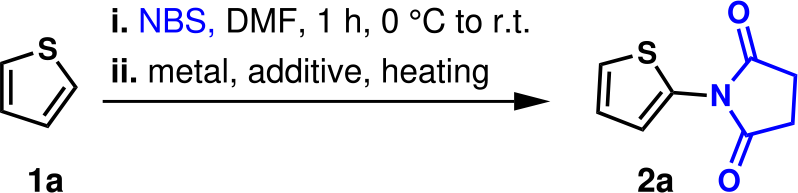
Initially, we investigated the possibility of obtaining the compound 2,2’-bithiophene directly from thiophene through two consecutive reactions (bromination followed by Ullmann reaction). Advantageously, N,N dimethylformamide (DMF) showed to be a suitable solvent for NBS bromination (Table S1, see Supplementary Information (SI) section). When thiophene was reacted in the presence of NBS in DMF at room temperature followed addition of copper powder under reflux, we obtained small amount of a compound that was much less nonpolar than the desired diarene. Nuclear magnetic resonance (NMR) and mass spectrometry (MS) analysis indicated the formation of 1-(thiophen-2-yl)pyrrolidine-2,5-dione (2a), an Ullmann-coupling product between the intermediate 2-bromothiophene and succinimide (Scheme 1).

Although the compound 2a is registered (CAS 98554 76 8), only one report about its synthesis was found.14 On the other hand, the “deprotected” 2-aminothiophene presents several applications in medicinal chemistry.15 Therefore, we consider this compound interesting from a synthetic point of view and several conditions were investigated to increase the yield (see Table 1).
As expected, higher temperature (150 ºC in sealed tube under microwave radiation) led to an increase in the isolated yield and lower reaction time (Table 1, entry 2). Next, different copper(I) salts were tested and only Cu2O11 in substoichiometric quantities gave similar results. The use of base also increased the isolated yield. In this case, using K3PO4 combined with Cu2O in DMF we obtained 2a in 35% isolated yield. Although copper(I) iodide (CuI) gave similar results, we decided to choose Cu2O. Unlike its corresponding halides, Cu2O has lower cost and does not exhibit sensitivity to air or light.16
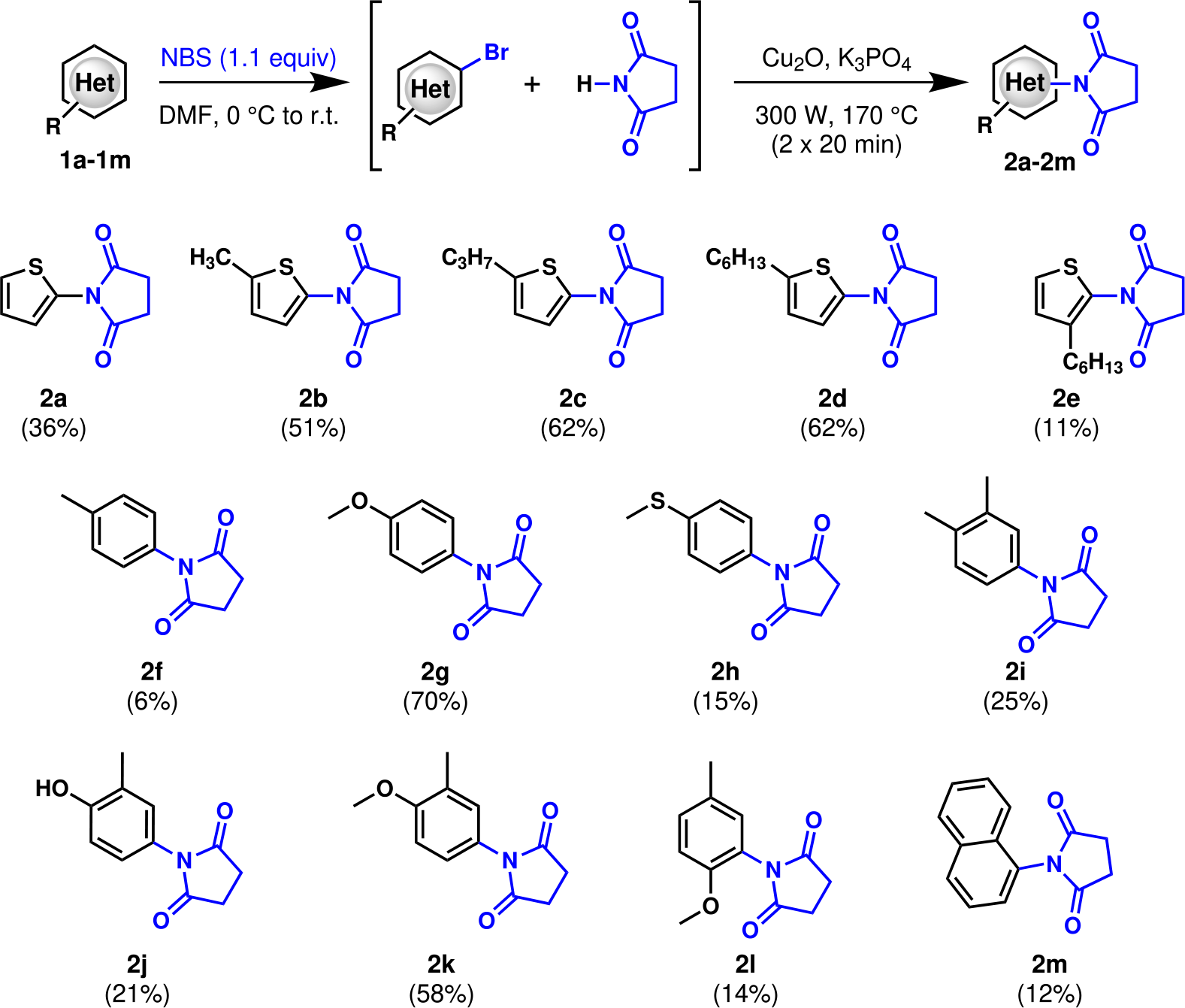
Even with this reasonable yield, we envisioned that the reactivity of the aromatic compound also plays a significant role in the reaction. We decided to explore other substituted thiophenes and different arenes with these optimized conditions. The results are summarized in Figure 1.
In all 34 aromatics tested (see SI section), we obtained the respective succinimidation products (2a-2m) in 13 substrates, with isolated yields ranging from poor to good. We obtained yields above 50% for monosubstituted thiophenes at 2-position (2b, 2c and 2d) and for anisole (2g), and 2-methylanisole (2k). In the case of substituted thiophenes, we believe that the increased reactivity and regioselectivity of the alkyl group at C2 favors electrophilic bromination at C5, and consequently, the coupling with the succinimide group became more evident. The same analogy applies to anisole derivatives. The increased reactivity due to the methoxy group favored bromination at the para position, and consequently, succinimidation occurred satisfactorily. Although the electrophilic bromination of compounds 1a-1m proceeded smoothly in all cases, the Ullmann reaction, on the other hand, varied significantly. Thioanisole (2h) and ortho-cresol (2j) gave lower yields probably due to lower reactivity (thiomethoxy vs. methoxy group) and the acidic character of phenol group. In the case of 3-hexylthiophene (2e) and 4-methylanisole (2l), the coupling with the succinimide can be affected by the steric hindrance or the oxygen atom in ortho position. Naphthalene 2m also provided a low yield (12%), suggesting a sterically hindered aryl halide for the coupling reaction (peri-interactions).
Despite the low yields obtained in some compounds, we must also consider the bromine atom as leaving group (iodine is commonly a better leaving group) and the low nucleophilicity of succinimide compared to the amines commonly used in Ullmann-type amination reactions. In comparison with the Baran methodology,10 this present method uses low cost and readily available reagents, and meets some principles of green chemistry, mainly regarding atom economy and the use of microwaves.
We noticed that the arenes that did not lead to the formation of the bromation product obviously compromised the formation of the imidation product. Future work will involve an investigation of imidation involving commercial bromoarenes and comparison with their respective iodides, in addition to the use of copper ligands, commonly applied by Hartwig protocols.17
Conclusions
In summary, this study demonstrates the dual utility of NBS for the tandem bromination and one-pot functionalization of arenes. By utilizing cost-effective reagents (Cu2O and K3PO4) alongside microwave irradiation, we successfully overcame the inherent low nucleofilicity of succinimide to produce N-arylsuccinimides directly from non-halogenated precursors. This methodology simplifies the synthetic process and reduces costs, providing more efficient and sustainable framework for the direct functionalization of aromatic compounds via an Ullmann-type reaction.
Experimental
Materials and reagents
Aromatic compounds (thiophene ≥ 99% CAS (110 02 1), anisole 99% CAS (100-66-3), 2-methylthiophene 98% CAS (554-14-3), 2-propylthiophene 97% CAS (1551 27 5), 2-hexylthiophene 97% CAS (18794 77 9), 3-hexylthiophene ≥ 99% CAS (1693-86-3), o-cresol ≥ 99% CAS (95-48-7), thioanisole ≥ 99% CAS (100-68-5), o-xylene 99% CAS (95-47-6), toluene 99.8% CAS (108 88-3)), N-bromosuccinimide 99% CAS (128-08-5) and N,N-dimethylformamide ≥ 99.8% CAS (68-12-2) were purchased from Sigma-Aldrich and JT Baker (HPLC grade, USA). Ethyl acetate (99.5%) and hexane (98.5%) were obtained from Synth (reagent grade, Diadema-Brazil); all the reagents and solvents were used without further purification. Flash column chromatography was performed using silica gel 60 Å (35-70 µm) from Fluka Analytical. Analytical thin-layer chromatography (TLC) was performed with aluminum-backed silica plates coated with a 0.25 mm thickness of silica gel 60 F254 (Merck-Germany), exposure to vanillin or potassium permanganate solution, or iodine vapor.
Instrumentation
The microwave reactions were performed in a Discover® CEM Microwave Reactor at 300 W, maximum temperature of 170 ºC in open vessel mode (Federal University of ABC). Nuclear magnetic resonance spectra were recorded on a Varian 500 spectrometer (from Federal University of ABC) at 500 MHz for 1H and 125 MHz for 13C NMR. The 1H NMR chemical shifts (d) are reported in ppm relative to the tetramethylsilane (TMS) peak and 13C NMR chemical shifts (d) are reported in ppm relative to CDCl3. The coupling constants (J) are given in hertz (Hz). Low resolution mass spectra (LRMS) were recorded on a Varian 4000 ion trap gas chromatography-mass spectrometry (GC-MS), operating at 70 eV. Chromatographic conditions were: injector temperature 250 °C, helium 6.0 as carrier gas, front inlet pressure 60.7 kPa, column flow 1.1 mL min-1 and split ratio 1:20. Oven temperature program included initial temperature of 60 °C, temperature rate of 10 °C min-1 and final temperature of 270 °C. Mass spectrometry conditions were: flow rate 4.0 mL min-1, inlet pressure 648.1 kPa and source temperature 180 °C. from Federal University of ABC. Bromination reactions were monitored by gas chromatography (GC) using a Varian 450 GC from Federal University of ABC. High resolution mass spectra (HRMS) were obtained from Water Micromass Q-Tof micro, using electrospray ionization (ESI) in positive mode from Federal University of ABC. Fourier-transformed infrared spectroscopy (FTIR) attenuated total reflectance (ATR) analyses were performed using a PerkinElmer Spectrum Two FTIR Spectrometer from Federal University of ABC. The melting point analyses were made on EZ-Melt SRS-Stanford Research Systems from Federal University of ABC.
General procedure for the synthesis of N-arylsuccinimides
In an “Ace” type Teflon thread pressure tube, the aromatic compound (2 mmol), N,N-dimethylformamide (DMF, 2 mL) and N-bromosuccinimide (1.1 eq, 2.2 mmol) were added at 0 ºC. The mixture was stirred until the consumption of the starting material (by TLC or gas chromatography (GC)). Then, Cu2O (1.4 mmol, 200 mg) and K3PO4 (0.94 mmol, 200 mg) were added. The tube was capped and then subjected to two cycles of microwave radiation for 20 min at a fixed temperature of 170 ºC (maximum power of 300 W). The mixture was cooled and diluted with ethyl acetate (70 mL) and filtered through a sintered glass funnel containing a short pad of silica gel. The filtrated solution was extracted with H2O (2 × 20 mL) and saturated NaCl solution (10 mL). The organic layer was dried over anhydrous sodium sulfate, filtered and concentrated under reduced pressure. Compounds 2a, 2b, 2c, 2d, 2e, 2h, 2j, 2l were purified by flash column chromatography with silica using mixture of hexane/ethyl acetate. For the compounds 2f, 2g, 2i, 2k, 2m the purification was made by dissolving the crude product with minimum amount of ethyl acetate following by precipitation of desired product by addition of hexane.
1-(2-Thienyl)-2,5-pyrrolidinedione (CAS 98554-76-8) (2a)
Brown solid (130 mg, 36%); Rf = 0.59 (ethyl acetate/hexane 1:1); mp = 145-150 °C; FTIR (ATR) ν / cm-1 3120, 2921, 1712, 1245, 697; 1H NMR (500 MHz, CDCl3) d 7.56 (d, J 3.5 Hz, 1H), 7.22 (d, J 5.0 Hz, 1H), 7.03 (m, 1H), 2.91 (s, 4H); 13C NMR (125 MHz, CDCl3) d 174.5, 124.9, 122.2, 120.6, 110.0, 28.0; LRMS (EI) m/z 181 ([M]+, 100), 153 (28), 125 (16), 99 (48); HRMS (ESI) m/z, calcd. for [C8H7NO2S + H]+: 182.02703, found: 182.02657.
1-(5-Methylthiophen-2-yl)pyrrolidine-2,5-dione (2b)
Brown solid (200 mg, 51%); Rf = 0.55 (ethyl acetate/hexane 1:1); mp = 93-99 °C; FTIR (ATR) ν / cm-1 2922, 2852, 1706, 1131, 802, 642; 1H NMR (500 MHz, CDCl3) d 7.21 (d, J 3.5 Hz, 1H), 6.65 (dd, J 1.0, 3.5 Hz, 1H), 2.85 (s, 4H), 2,46 (d, J 1.0 Hz, 3H); 13C NMR (125 MHz, CDCl3) d 174.7, 137.0, 129.1, 122.9, 121.4, 27.9, 15.0; LRMS (EI) m/z 195 ([M]+,100), 167 (24), 113 (52), 80 (21); HRMS (ESI) m/z, calcd. for [C9H9NO2S + H]+: 196.04268, found: 196.04225.
1-(5-Propylthiophen-2-yl)pyrrolidine-2,5-dione (2c)
Brown solid (278 mg, 62%); Rf = 0.61 (ethyl acetate/hexane 1:1); mp = 49-52 °C; FTIR (ATR) ν / cm-1 3132, 2956, 2870, 1697, 1139, 795, 649; 1H NMR (500 MHz, CDCl3) d 7.25 (d, J 4.0 Hz, 1H), 6.68 (d, J 4.0 Hz, 1H), 2.87 (s, 4H), 2.76 (t, J 7.5 Hz, 2H), 1.71 (sext, J 7.5 Hz, 2H), 0.98 (t, J 7.5 Hz, 3H); 13C NMR (125 MHz, CDCl3) d 174.7, 142.8, 129.1, 121.9, 121.1, 31.9, 27.9, 24.6, 13.6; LRMS (EI) m/z 223 ([M+], 29), 194 (100), 112 (45); HRMS (ESI) m/z, calcd. for [C11H13NO2S + H]+: 224.07398, found: 224.07363.
1-(5-Hexylthiophen-2-yl)pyrrolidine-2,5-dione (2d)
Brown solid (332 mg, 62%); Rf = 0.65 (ethyl acetate/hexane 1:1); mp = 59-62 °C; FTIR (ATR) ν / cm-1 2925, 2855, 1702, 1137, 653; 1H NMR (500 MHz, CDCl3) d 7.25 (d, J 3.5 Hz, 1H), 6.67 (d, J 4.0 Hz, 1H), 2.86 (s, 4H), 2.78 (t, J 7.5 Hz, 2H), 1.67 (quint, J 7.5 Hz, 2H), 1.3 (m, 6H), 0.89 (t, J 7 Hz, 3H); 13C NMR (125 MHz, CDCl3) d 174.712, 143.087, 129.101, 121.791, 121.100, 31.496, 31.395, 29.920, 28.731, 27.989, 22.517, 14.002; LRMS (EI) m/z, 265 ([M+], 17), 194 (100), 112 (27); HRMS (ESI) m/z, calcd. for [C14H19NO2S + H]+: 266.12093, found: 266.12050.
1-(3-Hexylthiophen-2-yl)pyrrolidine-2,5-dione (2e)
Orange oil (56 mg, 11%); Rf = 0.26 (ethyl acetate/hexane 1:9); FTIR (ATR) ν / cm-1 2928, 2857, 1716, 1367, 1165, 652; 1H NMR (500 MHz, CDCl3) d 7.29 (d, J 5.5 Hz, 1H), 6.94 (d, J 5.5 Hz, 1H), 2.90 (s, 4H), 2.32 (t, J 8.0 Hz, 2H), 1.54 (quint, J 8.0 Hz, 2H), 1.27 (m, 6H), 0.87 (t, J 7 Hz, 3H); 13C NMR (125 MHz, CDCl3) d 175.6, 140.7, 127.5, 124.8, 31.4, 29.4, 28.9, 28.3, 27.7, 22.4, 13.9; LRMS (EI) m/z, 265 ([M+], 2), 194 (32), 166 (100), 138 (25), 112 (26), 98 (23); HRMS (ESI) m/z, calcd. for [C14H19NO2S + Na]+: 288.1029, found: 288.1040.
1-(o-Tolyl)pyrrolidine-2,5-dione (CAS 2314-79-6) (2f)
Brown solid (6 mg, 6%); Rf = 0.52 (ethyl acetate/hexane 1:1); mp = 153-155 °C; FTIR (ATR) ν / cm-1 3041, 2934, 1700, 1174, 664; 1H NMR (500 MHz, CDCl3) d 7.28 (d, J 8.5 Hz, 2H), 7.15 (d, J 8.5 Hz, 2H), 2.86 (s, 4H), 2.38 (s, 3H); 13C NMR (125 MHz, CDCl3) d 176.3, 138.7, 129.8, 129.2, 126.2, 28.4, 21.1; LRMS (EI) m/z 189 ([M+], 100), 161 (24), 133 (43), 106 (38); HRMS (ESI) m/z, calcd. for [C11H11NO2 + Na]+: 212.0682, found: 212.0689. Spectral data in accordance to the literature.18
1-(2-Methoxyphenyl)pyrrolidine-2,5-dione (CAS 2314-80-9) (2g)
Yellow solid (300 mg, 70%); Rf = 0.78 (ethyl acetate/hexane 1:9); mp = 160-163 °C; FTIR (ATR) ν / cm-1 2916, 2841, 1700, 1506, 1173, 667; 1H NMR (500 MHz, CDCl3) d 7.18 (d, J 9.0 Hz, 2H), 6.97 (d, J 9.0 Hz, 2H), 3.81 (s, 3H), 2.84 (s, 4H); 13C NMR (125 MHz, CDCl3) d 176.4, 159.5, 127.6, 124.5, 114.5, 55.4, 28.3; LRMS (EI) m/z 205 ([M+], 100), 177 (18), 162 (19), 123 (24), 108 (25); HRMS (ESI) m/z, calcd. for [C11H11NO3 + H]+: 206.0812, found: 206.0814. Spectral data in accordance to the literature.19
1-(2-(Methylthio)phenyl)pyrrolidine-2,5-dione (CAS 1645290-67-0) (2h)
Yellow solid (68 mg, 15%); Rf = 0.84 (ethyl acetate/hexane 1:4); mp = 155-158 °C; FTIR (ATR) ν / cm-1 2930, 697, 1176, 667; 1H NMR (500 MHz, CDCl3) d 7.32 (d, J 8.5 Hz, 2H), 7.19 (d, J 8.5 Hz, 2H), 2.851 (s, 4H), 2.481 (s, 3H); 13C NMR (125 MHz, CDCl3) d 176.1, 139.6, 128.7, 126.8, 126.7, 28.3, 15.6; LRMS (EI) m/z 221 ([M+], 100), 193 (10), 139 (24), 124 (19); HRMS (ESI) m/z, calcd. for [C11H11NO2S + Na]+: 244.0403, found: 244.0409.
1-(3,4-Dimethylphenyl)pyrrolidine-2,5-dione (CAS 351995 84-1) (2i)
Brown solid (105 mg, 25%); Rf = 0.47 (ethyl acetate/hexane 1:1); mp = 142-148 °C; FTIR (ATR) ν / cm-1 2920, 1700, 1182, 665; 1H NMR (500 MHz, CDCl3) d 7.24 (d, J 8.5 Hz, 1H), 7.02 (d, J 2.0 Hz, 1H), 6.99 (dd, J 8.5, 2.0 Hz, 1H), 2.87 (s, 4H), 2.28 (d, J 2.0 Hz, 6H); 13C NMR (125 MHz, CDCl3) d 176.1, 137.5, 130.0, 129.1, 127.2, 123.6, 28.1, 19.5, 19.2; LRMS (EI) m/z 203 ([M+], 100), 160 (57), 147 (31), 132 (22), 120 (28); HRMS (ESI) m/z, calcd. for [C12H13NO2 + Na]+: 226.0838, found: 226.0847.
1-(4-Hydroxy-3-methylphenyl)-2,5-pyrrolidinedione (CAS 214910-18-6) (2j)
Brown solid (90 mg, 21%); Rf = 0.41 (ethyl acetate/hexane 2:1); mp = 171-176 °C; FTIR (ATR) ν / cm-1 3391, 2923, 1687, 1176, 665; 1H NMR (500 MHz, DMSO-d6) d 9.51 (s, 1H), 6.85 (s, 1H), 6.78 (s, 2H), 2.66 (s, 4H), 2.06 (s, 3H); 13C NMR (125 MHz, DMSO-d6) d 177.1, 155.1, 129.1, 125.4, 124.2, 123.5, 114.4, 28.2, 15.7; LRMS (EI) m/z 205 ([M+], 100), 177 (21), 149 (29), 123 (41); HRMS (ESI) m/z, calcd. for [C11H11NO3 + Na]+: 228.0631, found: 228.0630.
1-(2-Methoxy-5-methylphenyl)pyrrolidine-2,5-dione (CAS 1587660-50-1) (2k)
Brown solid (240 mg, 58%); Rf = 0.44 (ethyl acetate/hexane 2:1); mp = 132-135 °C; FTIR (ATR) ν / cm-1 2959, 1700, 1189, 662; 1H NMR (500 MHz, CDCl3) d 7.05 (dd, J 8.5, 2.0 Hz, 1H), 7.02 (d, J 2.0 Hz, 1H), 6.89 (d, J 8.5 Hz, 1H), 3.85 (s, 3H), 2.87 (s, 4H), 2.23 (s, 3H); 13C NMR (125 MHz, CDCl3) d 176.3, 157.5, 128.3, 127.6, 124.7, 123.6, 109.9, 55.2, 28.0, 15.9;0 LRMS (EI) m/z 219([M+], 100), 176 (44), 136 (24), 122 (48); HRMS (ESI) m/z, calcd. for [C12H13NO3 + Na]+: 242.0788, found: 242.0790.
1-(5-Methoxy-2-methylphenyl)pyrrolidine-2,5-dione (CAS 199465-15-1) (2l)
Brown solid (60 mg, 14%); Rf = 0.47 (ethyl acetate/hexanes 2:1); 1H NMR (500 MHz, CDCl3) d 7.20 (dd, J 1.5, 8.5 Hz, 1H), 6.92 (d, J 8.5 Hz, 2H), 3.78 (s, 4H), 2.31 (s, 3H), 0.01 (s, 3H); 13C NMR (125 MHz, CDCl3) d 176.3, 152.4, 131.2, 130.5, 129.5, 112.1, 55.9, 28.6, 20.3; LRMS (EI) m/z 219([M+], 100), 201 (50), 173 (25), 148 (21), 122 (33); HRMS (ESI) m/z, calcd. for [C12H13NO3 + Na]+: 242.0788, found: 242.0786.
1-(Naphthalen-1-yl)pyrrolidine-2,5-dione (CAS 69971-89-7) (2m)
Orange solid (58 mg, 12%); Rf = 0.44 (ethyl acetate/hexane 2:1). mp = 144-149 °C; FTIR (ATR) ν / cm-1 3053, 1700, 1402, 1179, 769; 1H NMR (500 MHz, CDCl3) d 7.95 (m, 2H), 7.54 (m, 3H), 7.34 (d, J 7 Hz, 1H), 3.06 (m, 3H), 1.56 (s, 1H), 0.01 (s, 1H); 13C NMR (125 MHz, CDCl3) d 176.2, 134.1, 129.8, 128.4, 126.9, 126.3, 126.0, 125.1, 121.1, 28.5; LRMS (EI) m/z 225 ([M+], 100), 197 (43), 169 (42), 143 (45); HRMS (ESI) m/z, calcd. for [C14H11NO2 + Na]+: 248.0682, found: 248.0686. Spectral data in accordance with the literature.20
Supplementary Information
Supplementary information (mass spectra, FTIR spectra, 1H and 13C NMR spectra) is available free of charge at http://jbcs.sbq.org.br as PDF file.
Supplementary PDF
Acknowledgments
This study was financed in part by the CAPES (Finance Code 001) and FAPESP (grant No. 2021/13573-5 and 2017/18007-2). The authors thank Lucas Melo Bosquetti (UFABC) and Marcos Accioly Pereira Junior (UNIFESP) for HRMS analysis.
Data Availability Statement
Raw NMR (Varian) and LRMS (.SMS) data files can be requested from the corresponding author.
References
-
1 Saikia, I.; Borah, A. J.; Phukan, P.; Chem. Rev. 2016, 116, 6837. [Crossref]
» Crossref -
2 Tanemura, K.; Tetrahedron Lett. 2025, 155, 155419. [Crossref]
» Crossref -
3 Lorpaiboon, W.; Bovonsombat, P.; Org. Biomol. Chem. 2021, 19, 7518. [Crossref]
» Crossref -
4 Gonçalves, E. M.; Pereira, N. L.; Estanislau, F.; Carvalho, P. S.; Org. Process Res. Dev. 2023, 27, 1975. [Crossref]
» Crossref -
5 Zhao, Z.; Yue, J.; Ji, X.; Nian, M.; Kang, K.; Qiao, H.; Zheng, X.; Bioorg. Chem. 2021, 108, 104557. [Crossref]
» Crossref -
6 Wei, Y.; Lin, S.; Liang, F.; Org. Lett. 2012, 14, 4202. [Crossref]
» Crossref -
7 Zou, L. H.; Li, Y. C.; Li, P. G.; Zhou, J.; Wu, Z.; Eur. J. Org. Chem. 2018, 2018, 5639. [Crossref]
» Crossref -
8 Rad-Moghadam, K.; Kheyrkhah, L.; Synth. Commun. 2009, 39, 2108. [Crossref]
» Crossref -
9 Bozdoğan, B.; Erşatır, M.; Demirkol, O.; Akbaşlar, D.; Giray, E. S.; Synth. Commun. 2017, 47, 217. [Crossref]
» Crossref -
10 Foo, K.; Sella, E.; Thomé, I.; Eastgate, M. D.; Baran, P. S.; J. Am. Chem. Soc. 2014, 136, 5279. [Crossref]
» Crossref -
11 Yamamoto, T.; Kurata, Y.; Can. J. Chem. 1983, 61, 86. [Crossref]
» Crossref -
12 Sperotto, E.; van Klink, G. P. M.; van Koten, G.; de Vries, J. G.; Dalton Trans. 2010, 39, 10338. [Crossref]
» Crossref -
13 Yashwantrao, G.; Saha, S.; Tetrahedron 2021, 97, 132406. [Crossref]
» Crossref -
14 Cymerman-Craig, J.; Vaughan, G. N.; Warburton, W. K.; J. Chem. Soc. 1956, 4114. [Crossref]
» Crossref -
15 Duvauchelle, V.; Meffre, P.; Benfodda, Z.; Eur. J. Med. Chem. 2022, 238, 114502. [Crossref]
» Crossref -
16 Cristau, H.-J.; Cellier, P. P.; Spindler, J.-F.; Taillefer, M.; Chem. Eur. J. 2004, 10, 5607. [Crossref]
» Crossref -
17 Tye, J. W.; Weng, Z.; Johns, A. M.; Incarvito, C. D.; Hartwig, J. F.; J. Am. Chem. Soc. 2008, 130, 9971. [Crossref]
» Crossref -
18 Haval, K. P.; Mhaske, S. B.; Argade, N. P.; Tetrahedron 2006, 62, 937. [Crossref]
» Crossref -
19 Ali, M. A.; Moromi, S. K.; Touchy, A. S.; Shimizu, K. I.; ChemCatChem 2016, 8, 891. [Crossref]
» Crossref -
20 Le, Z. G.; Chen, Z. C.; Hu, Y.; Zheng, Q. G.; Synthesis 2004, 995. [Crossref]
» Crossref
Edited by
-
Editor handled this article:
Brenno A. D. Neto (in Chief)