 Synergistic Alginate/Iota-Carrageenan Hybrid Microspheres as Cu2+ Catalytic Platforms for Recyclable Paal-Knorr Reactions
Abstract
The development of sustainable heterogeneous catalysts remains a significant challenge in green chemistry, particularly for reactions that are traditionally carried out under homogeneous conditions. In this context, we hypothesized that hybrid hydrogels formed by alginate (Alg) and iota-carrageenan (ι-CAR) could provide a complementary set of carboxylate and sulfate functional groups capable of efficiently immobilizing Cu2+ ions and generating an active, reusable catalytic platform. To test this concept, Alg/ι-CAR microspheres were prepared by Ca2+ ionotropic gelation followed by Cu2+ ion exchange, and their structural, morphological, and thermal properties were thoroughly characterized. The Fourier transform infrared (FTIR), thermogravimetric analysis (TGA/DTG), X-ray diffraction (XRD), scanning electron microscopy with an energy-dispersive X-ray (SEM/EDX), and porosity analyses confirmed the successful incorporation of Cu2+ and revealed increased surface roughness and porosity after ion exchange, supporting the initial hypothesis of enhanced metal coordination within the hybrid matrix. The resulting Alg/ι-CAR-Cu2+ microspheres showed high catalytic activity in the Paal-Knorr synthesis of pyrroles, reaching 78% yield under mild conditions, and remained effective for up to three reuse cycles before gradual deactivation caused by partial Cu2+ leaching and surface densification. These findings demonstrate that the synergistic interactions between Alg and ι-CAR create a robust and efficient support for Cu2+ immobilization, highlighting the potential of biopolymer-based hybrid materials as sustainable heterogeneous catalysts for organic synthesis.
Keywords:
biopolymers; ion-exchange; sustainable catalysis; Paal-Knorr condensation; N-heterocycle synthesis
Introduction
Catalysis plays a central role in modern chemical and industrial processes, enabling efficient, selective, and sustainable chemical transformations.1 More than 80% of industrial chemical operations involve catalytic steps, underscoring their relevance in pharmaceutical and fine chemical industries and materials science.2,3 The demand for environmentally benign transformations has encouraged the development of heterogeneous catalytic systems in which metal complexes are immobilized on solid supports, including polymers and oxides,4,5 to address separation and recyclability limitations typical of homogeneous catalysis.6
Among potential support materials, polysaccharides are notable due to their renewable origin, biodegradability, and the presence of functional groups capable of coordinating metal ions.7 Polysaccharides such as alginate, carrageenans, cellulose, and chitosan have been studied both as catalyst supports and,8,9 in some cases, as catalysts themselves.10 Hydrated three-dimensional matrices, such as polysaccharide-based hydrogels, offer additional advantages, including high water content, tunable porosity, and facile functionalization, which support their use in reusable heterogeneous catalytic systems.11,12
Alginate and carrageenans are anionic polysaccharides of particular interest. Sodium alginate (Alg) is composed of β-D-mannuronic (M) and α-L-guluronic (G) units arranged in blocks, with carboxylate groups that readily coordinate divalent cations.13 Carrageenans are sulfated polysaccharides composed of alternating β-D-galactose and 3,6-anhydro-α-D-galactose units, with κ-, ι-, and λ-forms differing in sulfate content and distribution.14 κ-Carrageenan forms rigid gels with K,15 while ι-carrageenan (ι-CAR), which contains two sulfate groups per disaccharide, forms soft and elastic gels with divalent cations; λ-carrageenan does not form gels due to its higher degree of sulfation. These structural features favor ionic interactions with divalent metals, as reported previously.16 Despite this potential, ι-CAR remains considerably less explored as a catalyst support compared to κ-carrageenan.14 Moreover, the combination of Alg (carboxylate-rich) and ι-CAR (sulfate-rich) results in hybrid matrices offering a complementary set of anionic groups. Such properties are expected to improve the coordination environment of transition-metal ions, potentially enhancing their stability and dispersion within the polymeric network.
Pyrroles constitute an important class of heterocycles with applications in pharmaceutical, agrochemical, and materials chemistry, owing to their diverse biological activities.3,17 In addition, pyrrole derivatives act as intermediates, corrosion inhibitors, and functional materials.18 The Paal-Knorr reaction, reported independently by Paal (1884) and Knorr (1885), remains a widely applied route for pyrrole synthesis and involves the condensation of 1,4-dicarbonyl compounds with primary amines.3 Traditional protocols often require strong acids, toxic solvents, long reaction times, or elevated temperatures, which restrict their sustainability and scalability.3,17 As a result, several catalytic approaches have been developed to improve efficiency and environmental compatibility.19
Transition-metal catalysts have contributed significantly to advances in Paal-Knorr chemistry, with homogeneous and heterogeneous systems being reported.20 Although homogeneous catalysts are often efficient, they typically present challenges in terms of recovery and reuse, while heterogeneous metal-based catalysts offer advantages such as easier separation and recyclability.20 Copper (Cu) has received particular attention due to its cost-effectiveness, natural abundance, and versatile reactivity relative to noble metals.21 Nevertheless, only a limited number of coppersupported heterogeneous catalysts for the Paal-Knorr reaction have been described, highlighting a relevant gap in the literature.18
In this work, we describe the preparation of hybrid alginate/iota-carrageenan microspheres (Alg/ι-CAR) for Cu2+ immobilization. The materials were obtained by Ca2+induced ionic gelation followed by Cu2+ ion exchange and evaluated as heterogeneous catalysts in the Paal-Knorr synthesis of pyrroles. To the best of our knowledge, this is the first report employing Alg/ι-CAR hybrid matrices for copper-based Paal-Knorr catalysis. We hypothesize that the complementary carboxylate-sulfate environment enhances Cu2+ coordination within the polymeric network, improving catalytic activity and recyclability. This system aligns with ongoing efforts to integrate sustainable biopolymers with transition-metal catalysis for greener heterocycle synthesis.
Experimental
Materials and reagents
Sodium alginate (Alg) extracted from brown seaweed (medium viscosity, M/G ratio of 1.56 and molar mass ranging from 80 to 120 kDa according to the manufacturer) was purchased from Sigma-Aldrich (USA). Iota-carrageenan (ι-CAR) (molar mass ranging from 230 to 520 kDa) was purchased from Sigma-Aldrich (USA). Calcium chloride (CaCl2, PA), copper(II) chloride dihydrate (CuCl2.2H2O, PA), dimethyl sulfoxide (DMSO, PA), ethanol (PA), 1,5-diketones, and anilines were purchased from Synth (Brazil). All chemicals were used as received without previous purification.
Methods
Preparation of alginate/iota-carrageenan-Ca2+ microspheres (Alg/ι-CAR-Ca2+)
Alginate/iota-carrageenan microspheres crosslinked with Ca2+ ions were prepared by the ionotropic gelation method using CaCl2 as the crosslinking agent.22 Briefly, Alg (750 mg) and ι-CAR (250 mg) were dissolved in distilled water (50 mL) under magnetic stirring at 50 °C for 24 h, yielding a 2.0% (m/v) polymer solution. This solution was then transferred to a Pasteur pipette and added dropwise into an aqueous CaCl2 solution (2% m/v, 50 mL) under gentle agitation. Upon contact, spherical Alg/ι-CAR-Ca2+ microspheres formed instantaneously and were allowed to mature in the CaCl2 solution at room temperature (r.t.) for 4 h. The resulting microspheres were collected by filtration, thoroughly washed with distilled water (ca. 500 mL) to remove excess Ca2+ ions, and dried at room temperature until a constant weight was achieved.
Preparation of alginate/iota-carrageenan-Cu2+ microspheres (Alg/ι-CAR-Cu2+)
Alg/ι-CAR-Cu2+ microspheres were obtained by ion-exchange of Ca2+ with Cu2+. For this, dried Alg/ιCAR-Ca2+ microspheres (ca. 600 mg) were immersed in an aqueous CuCl2+ solution (0.01 mol L-1, 25 mL, pH ca.7) at r.t. for 4 h under gentle agitation (100 rpm) to promote ion exchange between Ca2+ and Cu2+. After this period, the Alg/ι-CAR-Cu2+ microspheres were collected, thoroughly washed with distilled water (ca. 500 mL), and oven-dried at 40 °C for 48 h. The amount of Cu2+ retained in the microspheres was quantified by flame atomic absorption spectroscopy (FAAS, Shimadzu, Japan) through analysis of the residual CuCl2 solution after ion exchange and following the operating conditions described by Souza et al.22 The Cu2+ content (in mg g-1) incorporated into the microspheres was then calculated by mass balance, according to equation 1:
where C0 and Cf refer to the initial and final concentrations of Cu2+ in the stock solution respectively (i.e., before and after the ion-exchange process, measured both in the stock solution and in the water used to rinse the microspheres), V is the volume of the CuCl2 solution, and m is the dry mass of the microspheres. This procedure was carried out in triplicate. In addition, the concentrations of Ca2+ ions retained in the Alg/ι-CAR-Ca2+ microspheres and those leached during the ion-exchange process were quantified using a similar protocol.
Characterization techniques and experiments
Fourier transform infrared (FTIR) spectra were recorded using a Shimadzu IR-Affinity-1 spectrometer (Japan) over the 4000-400 cm-1 range, with a resolution of 4 cm-1. Before measurement, samples were finely ground with spectroscopic-grade KBr and pressed into transparent disks. Thermogravimetric analysis (TGA) was conducted on a Shimadzu TGA-50 instrument, under a nitrogen atmosphere (50 mL min-1), at a heating rate of 10 °C min-1 from 25 to 700 °C, to assess the thermal stability of the materials. X-ray diffraction (XRD) patterns were recorded from powder samples using a Bruker D6 Phaser diffractometer (Germany) equipped with a Cu-Kα radiation source at 40 kV and 15 mA. XRD patterns were obtained in a scanning range of 5-50° with a scanning rate of 1° min-1. Scanning electron microscopy (SEM) images were captured with a Jeol JSM-6610LV microscope (USA) operating at 15 kV, equipped with an energy-dispersive X-ray (EDX) detector for elemental analysis. Samples were sputter-coated with gold before imaging to improve conductivity.
The pH of the point of zero charge (pHPZC) of the microspheres was determined in aqueous solutions of varying initial pH (2-12), adjusted with HCl or NaOH (0.1 mol L-1) using a pHmeter. Microsphere samples (ca. 20 mg) were added to 10 mL of each solution and stirred (150 rpm) at r.t. for 24 h. Final pH values were measured, and ∆pH (i.e., pHfinal - pHinitial) was plotted versus the pHinitial. The pHPZC was identified as the pH where ∆pH = 0, respectively.
Total porosity of the microspheres was measured using the liquid displacement method23 with acetone, which penetrates the pores without altering morphology. A known volume of acetone (8 mL) was placed in a graduated cylinder, and the hydrogel sample was immersed for 24 h at r.t. Total porosity (ɛ, in percentage) was calculated using equation 2:
where V1 is the initial solvent volume, V2 is the displaced volume, and V3 is the final volume. Measurements were performed in triplicate.
Stability in different solvents
The stability of Alg/ι-CAR-Ca2+ and Alg/ι-CAR-Cu2+ microspheres exposed to different solvents was evaluated by a gravimetric method, based on weight variation measurements. In a typical experiment, 100 mg of each microsphere sample (wi) were immersed in 15 mL of a selected solvent (distilled water, dimethyl sulfoxide, or ethanol) at 75 °C for 24 h under continuous magnetic stirring (250 rpm). These conditions were selected to mimic potential application environments. After treatment, the samples were recovered, oven-dried at 50 °C to constant weight and weighed again (wf). The weight variation (∆w, in percentage) was determined according to equation 3:
General procedure for the Paal-Knorr synthesis of pyrrole derivatives
In a reaction vial, 0.25 mmol (0.0185 g) of 2,5-hexanedione and 0.25 mmol (0.0159 g) of aniline were dissolved in ethanol, followed by the addition of 15 mg of dry Alg/ι-CAR-Cu2+ microspheres (containing 0.60 mg of Cu2+, 9.5 µmol) as a catalyst. The reaction mixture was stirred at 50 °C for 2 h under open-air conditions. Upon completion, the catalyst was removed by simple filtration, and the crude product was purified by silica gel column chromatography. The resulting pyrrole compounds were characterized by nuclear magnetic resonance (NMR) spectroscopy (1H at 400 MHz and 13C at 100 MHz) using a Bruker Avance DPX 400 spectrometer (UK) (Figures S7-S12, Supplementary Information (SI) section). Spectra were acquired in CDCl3 with tetramethylsilane (TMS) as the internal standard. Full spectral data of the synthesized products are provided in the SI section. For comparison purposes, parallel reactions were also performed using CuCl2 (1.58 mg of Cu2+, 25 µmol) as a homogeneous catalyst and Alg/ι-CAR-Ca2+ microspheres (15 mg) as a heterogeneous control.
To evaluate the recyclability of the catalyst, the recovered Alg/ι-CAR-Cu2+ microspheres were dried under vacuum, weighed, and reused directly in subsequent catalytic runs. After each cycle, the amounts of reagents were adjusted according to the measured catalyst mass to maintain a constant reactants-to-catalyst ratio across all runs.
Results and Discussion
Characterization of the microspheres
The concentrations of Ca2+ and Cu2+ ions in the microspheres were determined by FAAS. The Ca2+-crosslinked materials exhibited a high Ca2+ content (552 mg g-1), consistent with values reported for alginate/κ-carrageenan microspheres under similar gelation conditions,24 particularly when the alginate fraction predominates. This behavior is attributed to the strong affinity of Ca2+ for the G-blocks of Alg, which form cooperative “egg-box” junction zones.25 In the present hybrid system, sulfate groups from ι-CAR may also contribute to Ca2+ retention through nonspecific electrostatic interactions, while hydrogen bonding between the two polysaccharides provides secondary stabilization of the Alg/ι-CAR network.26
Upon immersion of Alg/ι-CAR-Ca2+ microspheres in CuCl2 solution, partial ion exchange occurred, leading to the replacement of Ca2+ by Cu2+, as expected for divalentdivalent competitive binding processes. FAAS analysis indicated a Cu2+ content of 40 mg g-1, accompanied by the leaching of approximately 158 mg g-1 of Ca2+. The difference between the amount of Cu2+ incorporated and the amount of Ca2+ released reflects the distinct interaction profiles of these metals with polysaccharide matrices. Although Ca2+ exhibits high affinity toward Alg,25 the competitive exchange is influenced by parameters such as ionic radius, hydration energy, and preferred coordination geometry.27 These results align with those reported by Souza et al.,22 though a more extensive ion exchange was observed here. The presence of ι-CAR likely contributes to this enhanced exchange, as its sulfate groups have a stronger affinity for Cu2+ than for Ca2+.28 This observation supports the initial hypothesis that combining Alg and ι-CAR improves Cu2+ immobilization by providing a complementary set of anionic binding sites.
Notably, direct gelation of Alg/ι-CAR solutions in CuCl2 was not feasible. Preliminary tests led to mechanically fragile materials prone to fragmentation, likely due to rapid, heterogeneous ionic crosslinking and excessive charge neutralization. Such limitations would compromise handling and hinder catalytic application. Conversely, the ion-exchange strategy produced robust microspheres with Cu2+ effectively integrated into the polymeric matrix. An additional advantage of this approach is the possibility of controlling Cu2+ loading by adjusting ion-exchange parameters such as concentration, contact time, and solution pH. Kinetic studies could provide further insight into exchange dynamics and support the rational design of materials with optimized catalytic metal content.
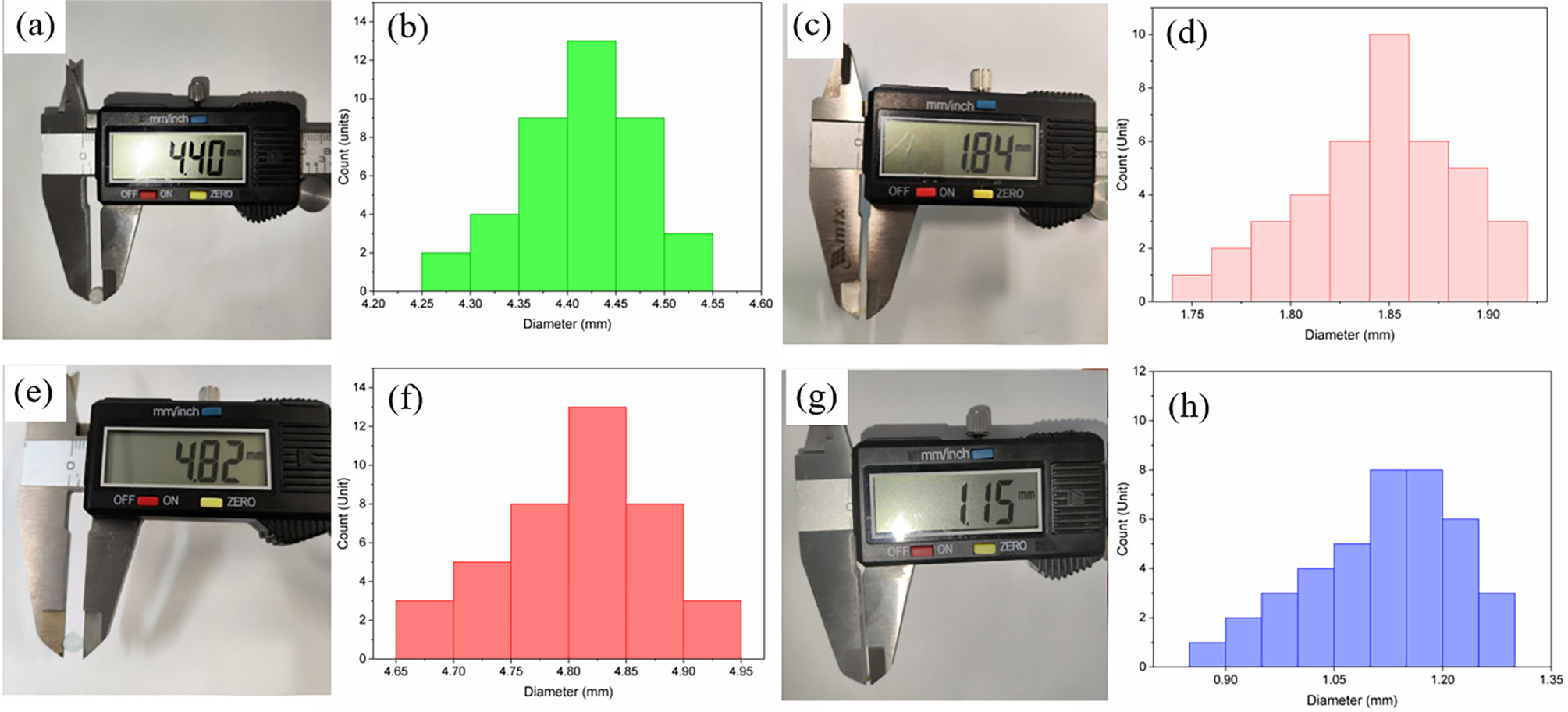
Photographs of swollen and dried Alg/ι-CAR-Ca2+ and Alg/ι-CAR-Cu2+ microspheres are shown in Figure 1. The Ca2+-crosslinked microspheres (Figures 1a and 1b) exhibited the characteristic whitish appearance of polysaccharide hydrogels, while the Cu2+-containing microspheres (Figures 1c and 1d) displayed a greenish coloration consistent with Cu2+ coordination. A pronounced difference was observed between the swollen and dried states for both formulations. For the Ca2+-crosslinked microspheres, swelling produced a 2.39-fold increase in diameter (139% increase). In contrast, the Cu2+-incorporated microspheres exhibited markedly higher swelling, corresponding to a 74.19-fold increase in diameter (319% increase).
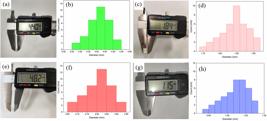
Swollen microspheres Alg/ι-CAR-Ca2+ (a); size distribution histograms swollen microspheres Alg/ι-CAR-Ca2+ (b); dry microspheres Alg/ι-CAR-Ca2+ (c); size distribution histograms dry microspheres Alg/ι-CAR-Ca2+ (d); swollen microspheres Alg/ι-CAR-Cu2+ (e); size distribution histograms swollen microspheres Alg/ι-CAR-Cu2+ (f); dry microspheres Alg/ι-CAR-Cu2+ (g) and size distribution histograms dry microspheres Alg/ι-CAR-Cu2+ (h).
These results correlate well with the FAAS analysis: the substantial Ca2+ leaching during ion exchange reduced the cross-linking density of the hybrid matrix, particularly within the Alg domains, resulting in a greater swelling capacity. The decrease in ionic crosslinking points enabled hydrophilic groups (hydroxyl, carboxylate, and sulfate) to interact more extensively with water, leading to higher water uptake. Similar swelling enhancement following partial decrosslinking has been reported for alginate and carrageenan hydrogels subjected to ionexchange conditions.29 Upon drying, the less crosslinked Alg/ι-CAR-Cu2+ network underwent stronger chain contraction and entanglement, yielding smaller final diameters relative to their swollen forms. This behavior is characteristic of polysaccharide networks with reduced junction-zone density.30
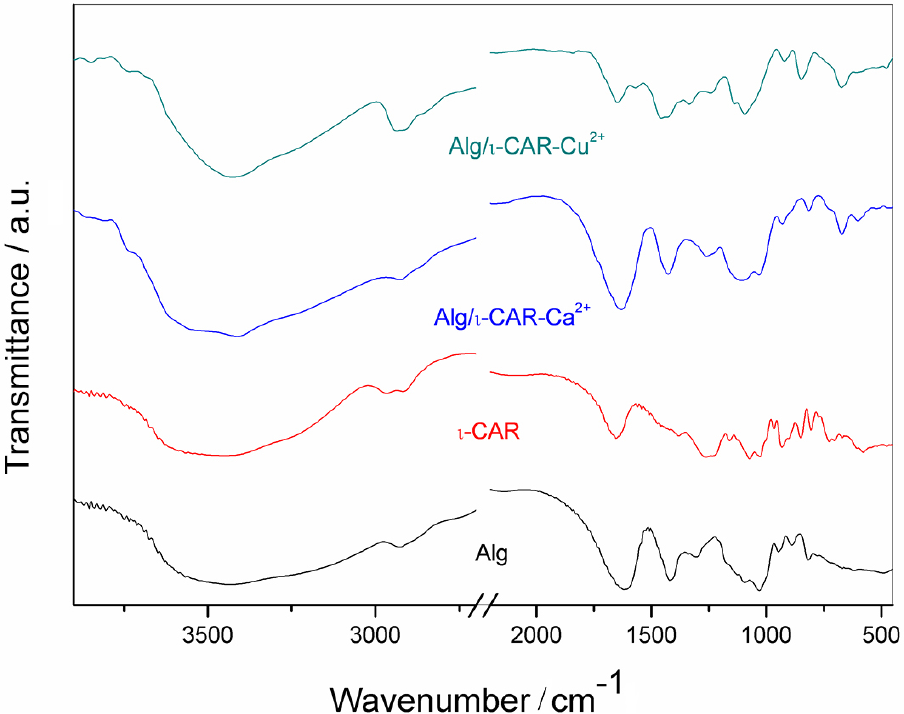
To characterize the synthesized microspheres, the precursor polysaccharides Alg and ι-CAR were initially examined by FTIR spectroscopy (Figure 2). In the Alg spectrum, the broadband centered at 3430 cm-1 corresponds to the O-H stretching of hydroxyl groups, while the band at 2920 cm-1 arises from C-H stretching. The intense bands at approximately 1600 and 1415 cm-1 are assigned to the asymmetric and symmetric C=O stretching of the carboxylate groups, respectively, confirming the presence of uronic acid residues (mannuronic and guluronic units) typical of Alg. In the spectral region between 1100 and 1030 cm-1, a strong absorption band is observed, associated with the stretching vibrations of C-O-C (glycosidic linkages) and C-O bonds characteristic of polysaccharides.31 Finally, the band at 890 cm-1 is attributed to the out-of-plane deformation of C1-H, indicative of β-D-mannuronate units in Alg.
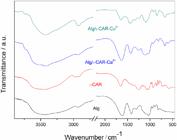
FTIR (KBr) spectra of pure Alg (black) and ι-CAR (red) and Alg/ι-CAR-Ca2+ (blue), Alg/ι-CAR-Cu2+ (green) microspheres.
In the FTIR spectrum of ι-CAR, a broadband at 3420 cm-1 corresponds to the O-H stretching of hydroxyl groups, while the band at 2925 cm-1 is assigned to C-H stretching. The band at 1640 cm-1, attributable to the deformation vibration of absorbed water in hydrophilic polysaccharides,32 is characteristic of carrageenans due to their high moisture-retention capacity. The strong band in the 1250-1220 cm-1 region corresponds to the asymmetric stretching of S=O in esterified sulfate groups, confirming the presence of sulfate substituents in the ι-CAR backbone. In the 1070-1030 cm-1 region, bands related to C-O-C and C-O stretching vibrations, as well as glycosidic linkages, are noticed. The bands at 930 and 845 cm-1 are characteristic of ι-CAR and arise from vibrations of the 3,6-anhydrogalactose ring and out-of-plane C-O-S deformation, respectively, associated with the axial position of sulfate groups at C4 of the galactose residue.32
To compare the structural features of the prepared microspheres, FTIR spectra of Alg/ι-CAR-Ca2+ and Alg/ι-CAR-Cu2+ microspheres were analyzed. As seen in Figure 2, both materials exhibited the principal bands of the precursor polysaccharides at approximately 3426, 2354, 1641, 1436, 1252, 1099, and 837 cm-1. These bands correspond to O-H stretching, C-H stretching, symmetric -COO- stretching, asymmetric and symmetric C-O-C stretching, and C-H deformation of β-mannuronic residues, respectively, in agreement with reference spectra for Alg and carrageenans.32 The preservation of these vibrational modes confirms the structural integrity of the polysaccharide matrices after ionic crosslinking and ion-exchange process. Notably, after the ion-exchange process replacing Ca2+ with Cu2+, the intensity of the band at 1641 cm-1 (asymmetric stretching of -COO-) was substantially reduced compared to other bands in the same spectrum. This effect suggests stronger coordination between Cu2+ ions and the carboxylate moieties of Alg and ι-CAR compared to Ca2+, driven by the higher ligand-field stabilization and coordination versatility of Cu2+.33 In parallel, the bands ascribed to O-H and -COO- stretching shift to lower wavenumbers in the Alg/ι-CAR-Cu2+ spectrum, supporting the formation of stronger electrostatic and coordinative interactions between Cu2+ and the polysaccharide chains. Such spectral behavior has been previously reported for Cu2+-alginate systems, in which partially ionic and partially coordinate bonds are established via carboxylate and hydroxyl functionalities.22,29 These interactions likely contribute to the enhanced immobilization and stabilization of Cu2+ within the matrix.
Moreover, changes in the 1000-1200 cm-1 region, particularly associated with C-O and S=O stretching, indicate the participation of ι-CAR sulfate groups in Cu2+ complexation.34 This result is consistent with reports describing the affinity of divalent transition-metal cations for sulfated polysaccharides.35 The involvement of both carboxylate and sulfate groups supports the formation of a more compact and reorganized polymeric network upon incorporation of Cu2+, reflecting the enhanced crosslinking strength and coordination geometry imposed by this cation. For catalytic applications, such structural modifications are relevant. The efficient coordination of Cu2+ within the Alg/ι-CAR matrix can generate accessible and stable catalytic sites, improving metal dispersion and facilitating interactions with organic substrates. As previously shown for polysaccharide-based Cu2+ catalysts,22 these coordinated environments enhance catalytic performance by stabilizing active species and promoting electron transfer. Therefore, the FTIR spectral changes corroborate the potential of Alg/ ι-CAR-Cu2+ microspheres as sustainable heterogeneous catalysts, evidencing a polymeric network in which metal coordination is finely tuned to enhance catalytic activity, stability, and substrate accessibility. Notably, the simultaneous presence of carboxylate and sulfate functionalities within the Alg/ι-CAR matrix creates coordination environments that are not attainable with either polysaccharide alone under comparable conditions.
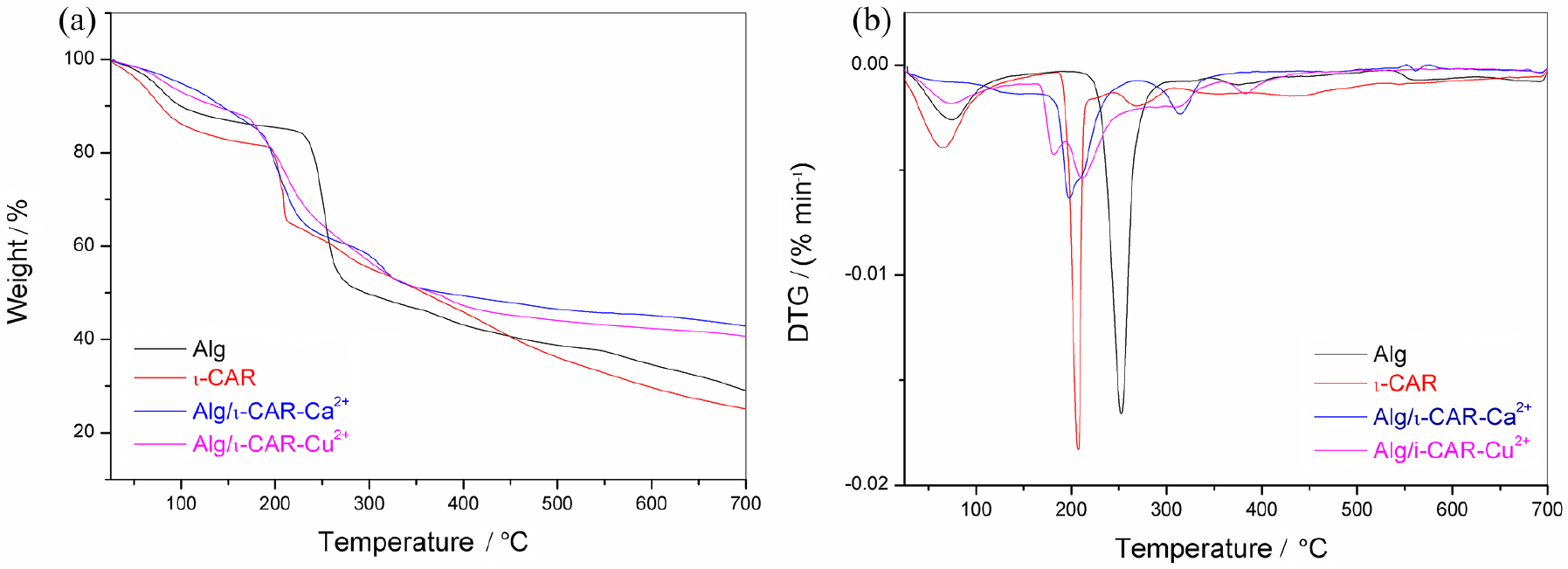
The thermogravimetric analysis (TGA/DTG) curves presented in Figures 3a and 3b highlight the thermal behavior of pure Alg, ι-CAR, and Alg/ι-CAR microspheres containing either Ca2+ or Cu2+ ions. As noticed from the TGA curves (Figure 3a), all samples exhibit an initial weight loss between approximately 30 and 150 °C, associated with the release of physically adsorbed water. This behavior is typical of hydrophilic polysaccharides and is consistent with the FTIR data, which revealed broad O-H stretching bands indicative of extensive hydrogen bonding and water retention. In sequence, a second, more pronounced weight loss stage is observed between 180 and 300 °C, corresponding to the thermal degradation of the polysaccharide backbones. This region includes cleavage of glycosidic linkages and decomposition of uronic acid (Alg) and sulfated galactan (ι-CAR) units, in agreement with literature reports for similar systems.36 Specifically, the Alg sample exhibits a maximum degradation peak near 240 °C (DTG curve, Figure 3b), confirming its relatively high thermal stability within this temperature range. In contrast, ι-CAR presents a slightly lower temperature peak (ca. 220 °C), reflecting its intrinsically lower thermal stability, likely due to the presence of sulfate groups, which generally decrease thermal resistance in sulfated polysaccharides.37
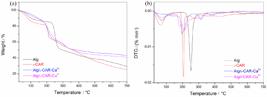
(a) TGA and (b) DTG curves of pure Alg, ι-CAR and Alg/ι-CAR-Ca2+ and Alg/ι-CAR-Cu2+ microspheres.
The Alg/ι-CAR-Ca2+ microspheres display a degradation profile comparable to that of pure Alg, indicating that Ca2+ crosslinking does not significantly compromise thermal resistance. This observation is consistent with FAAS analysis, which revealed a high Ca2+ content (552 mg g-1), corroborating the formation of a densely crosslinked network that stabilizes the polymer chains. Additionally, FTIR results showed preserved -COO- and -OSO3- vibrational bands, supporting the maintenance of strong ionic interactions within the hybrid gel. Conversely, the Alg/ι-CAR-Cu2+ microspheres exhibit more substantial weight loss in the 180-300 °C interval, with the main degradation peak shifted to slightly lower temperatures compared to pure Alg (Figure 3b). This shift can be attributed to the partial decrosslinking that occurs during the ion-exchange process, as evidenced by the significant Ca2+ leaching and lower Cu2+ incorporation detected by FAAS. FTIR analysis also revealed reduced intensity of the -COO- asymmetric stretch and shifts in O-H and C=O bands, indicating the formation of new coordination environments involving Cu2+ and carboxylate/ sulfate groups. These structural modifications decrease the overall crosslinking density, making the network more susceptible to thermal degradation.
Despite this decrease in the degradation onset temperature, the Cu2+-containing microspheres remain thermally stable up to approximately 200 °C. This stability range is adequate for most Cu-mediated organic transformations performed under mild conditions, such as “click” reactions, aerobic oxidations, and Cu2+-promoted condensations, which typically occur below 150 °C.38,39 Thus, the thermal profile supports the suitability of these materials for catalytic applications under conventional laboratory conditions. Moreover, as verified, the Alg/ι-CAR-Cu2+ microspheres do not undergo rapid degradation upon heating, confirming that the polymeric network remains structurally intact after ion exchange. This stability is essential to prevent Cu2+ leaching during catalysis and enable catalyst recyclability. Such a feature is an advantage supported by the well-documented performance of Alg-based heterogeneous catalysts.40
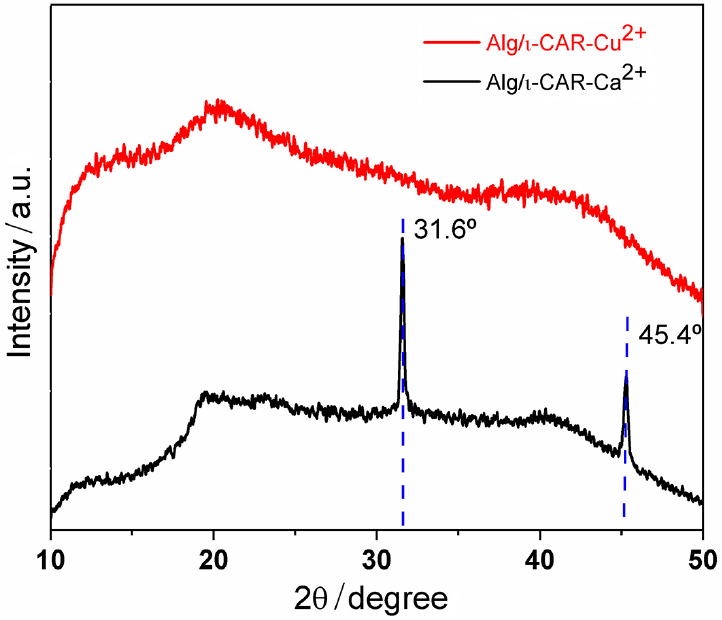
Figure 4 presents the XRD patterns obtained to evaluate the structural organization of the Alg/ι-CAR matrices upon crosslinking with Ca2+ and Cu2+ ions. In the diffractograms of both microspheres, a broad halo is observed in the 2θ range of approximately 18-20°, which is characteristic of poorly ordered polysaccharide-based structures and indicates the predominantly amorphous nature of the Alg/ι-CAR matrices. Nonetheless, the diffractogram of the Ca2+-crosslinked microspheres displays two weak diffraction peaks at approximately 2θ = 31.6° and 45.4°, suggesting that the ionic crosslinking with Ca2+ induces a subtle increase in structural ordering within the polymeric network. This partial organization is consistent with the formation of more uniform junction zones between the polysaccharide chains, as reported elsewhere.22,28
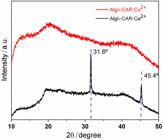
In contrast, the microspheres prepared with partial substitution of Ca2+ by Cu2+ show no discernible diffraction peaks, reinforcing the interpretation that incorporation of Cu2+ disrupts the ordering induced by Ca2+. This behavior aligns with the FAAS results, which demonstrated significant differences in the uptake and distribution of Ca2+ and Cu2+ within the matrices, indicating distinct crosslinking environments for the two ions. The FTIR spectra further support this conclusion, showing more pronounced coordination-related shifts for Ca2+, while the vibrational features associated with Cu2+ incorporation suggest a less organized binding environment. These structural trends also correlate with the TGA/DTG profiles. The Ca2+-crosslinked samples exhibited slightly more defined thermal decomposition events, consistent with a more cohesive and partially ordered network. Conversely, the Cu2+-containing microspheres displayed broader and less resolved degradation peaks, in agreement with the amorphous character observed by XRD.
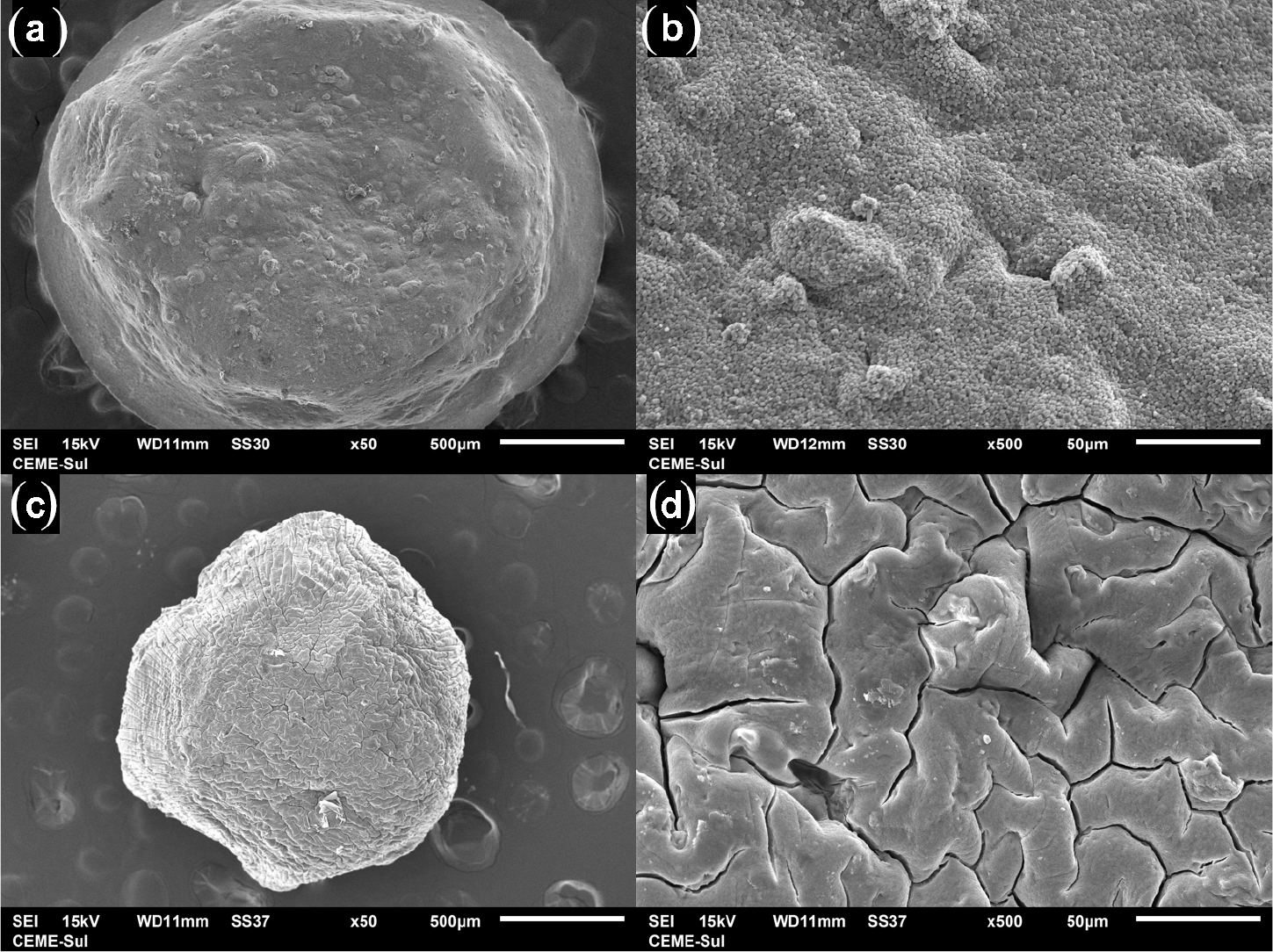
The morphological evaluation of the surface regions of the microspheres was performed using SEM images. The SEM images are presented in Figure 5 for the Alg/ι-CAR-Ca2+ (Figures 5a and 5b) and Alg/ι-CAR-Cu2+ (Figures 5c and 5d) samples, respectively. In Figure 5a, at low magnification, the Alg/ι-CAR-Ca2+ microspheres show a well-defined spherical morphology and a relatively homogeneous surface. This spherical and compact shape is characteristic of the efficient crosslinking between the alginate carboxyl groups and Ca2+ ions, consistent with the well-known “egg-box” model. At higher magnification, a rougher surface becomes apparent, with aggregated microspheres and small porosity features. These observations agree with the relatively low total porosity determined by the liquid-displacement method (22.3 ± 1.3%), indicating the formation of a dense and cohesive polymer network stabilized by Ca2+ junction zones.
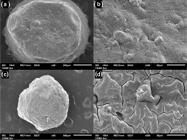
Figures 5c and 5d show the SEM images obtained from the Alg/ι-CAR-Cu2+ microspheres. At low magnification, a spherical shape is still observed, but the surface is more irregular, suggesting that ion exchange with Cu2+ affected the integrity and packing of the polymer matrix. At higher magnification, the presence of fissures, cracks, and extended porous regions becomes evident. These morphological changes indicate that the partial replacement of Ca2+ by Cu2+ introduces internal stresses due to the stronger and more localized coordination of Cu2+ ions with the functional groups of the biopolymers. In addition, the concentric-like rings observed at 1000× suggest a diffusioncontrolled ion-exchange mechanism,41 reinforcing the progressive and heterogeneous incorporation of Cu2+ ions into the microspheres.
The pronounced roughness, presence of cracks, and increased exposure of internal domains in the Cu2+-exchanged microspheres are consistent with the high total porosity measured for this material (68.3 ± 0.9%). This considerable porosity increase correlates with structural changes detected by FTIR (altered coordination environment), FAAS (confirmation of Cu incorporation), and the earlier degradation events observed in TGA/DTG analysis, which together indicate significant rearrangement and loosening of the polymer matrix upon Cu2+ binding. From a functional perspective, the highly porous and irregular microstructure observed after ion exchange is advantageous for heterogeneous catalysis. The apparent increment in the surface area and exposure of Cu2+ active sites can enhance the interaction with organic substrates, potentially improving catalytic activity.42
To investigate the presence and distribution of Cu2+ ions on the surface of the Alg/ι-CAR-Cu2+ microspheres, EDX analysis was performed (Figures S1-S2, SI section). The spectra revealed the predominant presence of O and C elements, consistent with the expected composition of the polysaccharide-based matrix. Signals corresponding to other elements, including Na, Ca, and K were also detected, reflecting the natural salt content of Alg and ι-CAR, as well as residual CaCl2 from the initial crosslinking step. In addition, a well-defined Cu peak was detected, representing 13.65 (percentage weight) and 5.93 (percentage atomic), confirming the successful incorporation of Cu2+ ions into the microspheres after the ion-exchanging process. This result agrees with FAAS quantification, which demonstrated effective ion exchange between Ca2+ and Cu2+. The presence of S is attributable to the sulfate groups characteristic of ι-CAR, whereas Cl likely originates from residual salts. The Au signal is explained by the sputter-coating used to prepare the sample for SEM/EDX analysis.
In short, the elemental distribution observed by EDX reinforces the morphological observations obtained by SEM. The high Cu content, combined with the fractured and highly porous structure of the Cu2+-exchanged microspheres, supports the hypothesis of extensive reorganization of the polymer network upon ion exchange. This is consistent with the modifications inferred from FTIR analysis, which indicated stronger, more localized interactions of Cu2+ with functional groups, and with the earlier thermal degradation event observed in TGA/DTG, which reflects the altered coordination environment within the matrix.
The point of zero charge (pHPZC) was determined to identify the pH at which the microsphere surface exhibits a net neutral charge. For this analysis, solutions of different initial pH values were contacted with the solid material for 24 h, and the final pH was measured. The pHPZC corresponds to the region where the difference between the initial and final pH approaches zero (Figure S6, SI section).43 Based on the obtained data, the pHPZC of both microspheres lies between pH 5.5 and 6.0. Below this pH range, the final pH values increase, indicating proton adsorption and the prevalence of positively charged surface groups. Conversely, at initial pH values above the pHPZC, the final pH decreases, reflecting surface deprotonation and the acquisition of negative charge. This behavior indicates that the Cu2+-exchanged microspheres exhibit acid-base buffering capacity, consistent with the presence of functional groups such as -COOH/-COO-, -OH and -OSO3- capable of reversible proton exchange.
The shift of the pHPZC to slightly acidic values is particularly relevant when compared with Ca2+-crosslinked Alg systems reported in the literature,44 which generally exhibit pHPZC values closer to neutrality. The incorporation of Cu2+ modifies the charge distribution on the surface because Cu2+ binds more strongly and more locally to carboxylate and sulfate groups, as evidenced by FTIR band shifts. Such interactions reduce the availability of free negatively charged sites (-COO- and -OSO3-), thereby lowering the pH at which the net surface charge becomes zero. In parallel, SEM imaging showed that Cu2+ exchange generates a more porous and fractured microstructure, increasing the overall surface area and exposing additional coordination sites. These structural changes are likely to contribute to the broader acid-base response observed in Figure S6.
From an application viewpoint, the pHPZC between 5.5 and 6.0 is advantageous for catalytic processes. At pH values above the PZC, the microsphere surface becomes negatively charged, enhancing the interaction with positively charged species or electrophilic intermediates. Conversely, under more acidic conditions, protonated sites may facilitate coordination with nucleophilic substrates or promote acid-catalyzed transformations. Therefore, the surface charge behavior, modulated by Cu2+ incorporation, directly influences the reactivity and selectivity of the material as a heterogeneous catalyst.
To assess the suitability of the microspheres for application as heterogeneous catalysts in organic synthesis, their stability in different reaction media was evaluated. Three solvents commonly used in catalytic processes were selected: ethanol (EtOH), water (H2O), and dimethyl sulfoxide (DMSO). Examining the data depicted in Table 1, the microspheres exhibited high stability in EtOH and DMSO, showing minimal weight variation even after prolonged exposure. This behavior is consistent with the strong ionic interactions within the Alg/ι-CAR network, particularly for the Cu2+-exchanged samples, whose enhanced coordination environment was previously confirmed by FTIR band shifts and EDX elemental analysis.
Weight variation (∆w) of the prepared microspheres after exposure to different solvents for 24 h at 50 ºC
In contrast, a more pronounced weight loss was observed in aqueous medium for both Alg/ι-CAR-Ca2+ and Alg/ι-CAR-Cu2+ microspheres. This behavior can be attributed to the intrinsic solubility and hydrophilicity of Alg and ι-CAR, which readily absorb water and undergo significant swelling. The expansion of the hydrated polymer network disrupts intraand intermolecular interactions, weakening the crosslinked architecture. SEM analysis corroborated this interpretation, as the Ca2+ microspheres showed more homogeneous but less porous structures, while the Cu2+ systems exhibited a fractured and highly porous morphology, features that may facilitate deeper solvent penetration. The TGA/DTG analysis also supports this result since the Cu2+-exchanged microspheres display earlier thermal degradation due to their modified coordination environment, suggesting a more flexible polymer network that may be more susceptible to structural relaxation in aqueous media.
The better stability in EtOH and DMSO compared with H2O is consistent with the reduced swelling capacity of the polysaccharide-based network in less polar or aprotic solvents (Table 1).45 Under these conditions, the ionic crosslinking (particularly the strong and localized coordination of Cu2+) is preserved, maintaining the integrity of the microspheres. This stability is essential for heterogeneous catalysis, where structural preservation during reaction is a fundamental requirement for recyclability and prevention of metal leaching. Taken together, the solvent-stability study demonstrates that Alg/ι-CAR-Cu2+ microspheres retain their structural integrity under typical organic reaction conditions, especially in EtOH and DMSO. These two solvents are frequently employed in Cu-catalyzed transformations as demonstrated in the literature.46 Although partial degradation occurs in aqueous media, this behavior is consistent with the hydrophilic nature of the biopolymers and the swelling processes previously evidenced by morphological, thermal, and surface analyses. These findings reinforce the potential of the Cu2+-exchanged microspheres as sustainable and robust heterogeneous catalysts for reactions performed in non-aqueous or moderately polar solvent systems.
Catalytic application of Alg/ι-CAR-Cu2+ microspheres in the synthesis of pyrrole derivatives (3a-3c)
The Paal-Knorr reaction is a classical and versatile route for the synthesis of substituted pyrroles through the acid-catalyzed cyclocondensation of 1,4-dicarbonyl compounds with primary amines.47 Although traditionally promoted by Brønsted or Lewis acids, numerous studies have demonstrated that transition-metal ions (particularly Cu2+ species) can significantly enhance the reaction efficiency by activating the carbonyl groups toward nucleophilic attack.48 Cu2+ salts and copper-based heterogeneous systems have been reported as effective Lewis acids for promoting PaalKnorr transformations under mild conditions,49 offering advantages such as improved activation of diketones, shorter reaction times, and, in some cases, reusability of the catalytic material. Moreover, Cu2+ catalysts have been successfully incorporated into solid supports or porous matrices,50 where the immobilized metal centers facilitate carbonyl activation while allowing easy separation from the reaction medium. These features make Cu-based heterogeneous catalysts attractive for sustainable pyrrole synthesis.
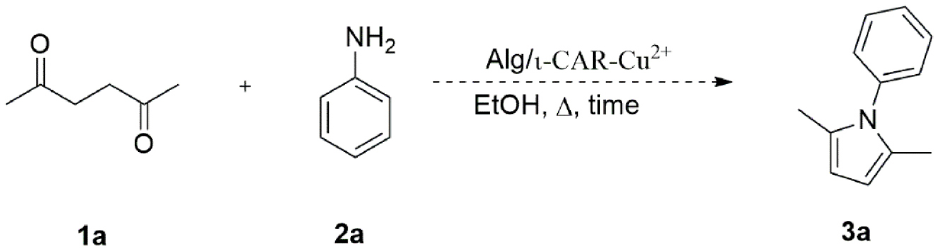
Motivated by these precedents and considering the ability of Cu2+ ions to interact strongly with anionic polysaccharides, we evaluated the catalytic performance of Alg/ι-CAR microspheres ionically crosslinked with Cu2+. To verify the catalytic efficiency of the synthesized hybrid material, Paal-Knorr reactions were performed using 2,5-hexanedione (0.25 mmol, 1a) and aniline (0.25 mmol, 2a) in ethanol (1 mL). In the first experiment, the reaction was conducted at r.t. for 2 h using 15 mg of Alg/ι-CAR-Cu2+ microspheres (Table 2), affording the corresponding pyrrole 3a in 52% yield after purification (entry 1). When the reaction temperature increased to 50 °C, the yield improved significantly, reaching 78% after 2 h (Table 2, entry 2). In contrast, the Cu-free analogue Alg/ι-CAR-Ca2+ (15 mg) promoted the reaction poorly, giving only 19% yield of 3a (entry 3), which confirms the essential role of Cu2+ in mediating the cyclocondensation.
When CuCl2 (homogeneous catalyst) was employed under analogous conditions (Table 2, entry 4), the reaction yield was comparable to that obtained with the Alg/ι-CAR-Cu2+ microspheres, confirming that the catalytic activity of the hybrid material indeed arises from the immobilized Cu2+ ions. This result reinforces the premise that the polysaccharide-based matrix does not inhibit the Lewis-acid behavior of the metal but instead provides a stabilizing and dispersive environment for the active centers. Despite the similar performance, the hybrid catalyst offers a clear advantage over its homogeneous counterpart: the microspheres can be rapidly separated from the reaction medium and reused, reducing metal contamination, simplifying purification, and aligning the system with the principles of green chemistry.51,52 This is because one of the main limitations of reactions catalyzed by copper salts is the presence of a significant amount of toxic, colored, and expensive copper complexes in the final products, which hinders their removal. However, immobilizing Cu2+ ions in an Alg/ι-CAR-Cu2+ matrix gives the material a heterogeneous character that allows for catalyst recovery and reuse, maintaining high structural integrity throughout multiple reaction cycles. The strong Cu2+ polysaccharide interaction can also result in low leaching of these ions, minimizing copper transfer to the reaction medium and reducing contamination of the final product.53
Finally, the control experiment (Table 2, entry 5) carried out in the absence of any catalyst resulted in only a trace formation of the pyrrole derivative 3a, demonstrating that spontaneous cyclization is negligible under the tested conditions and confirming the essential role of Cu2+ sites (whether free or immobilized) in promoting the Paal-Knorr reaction.
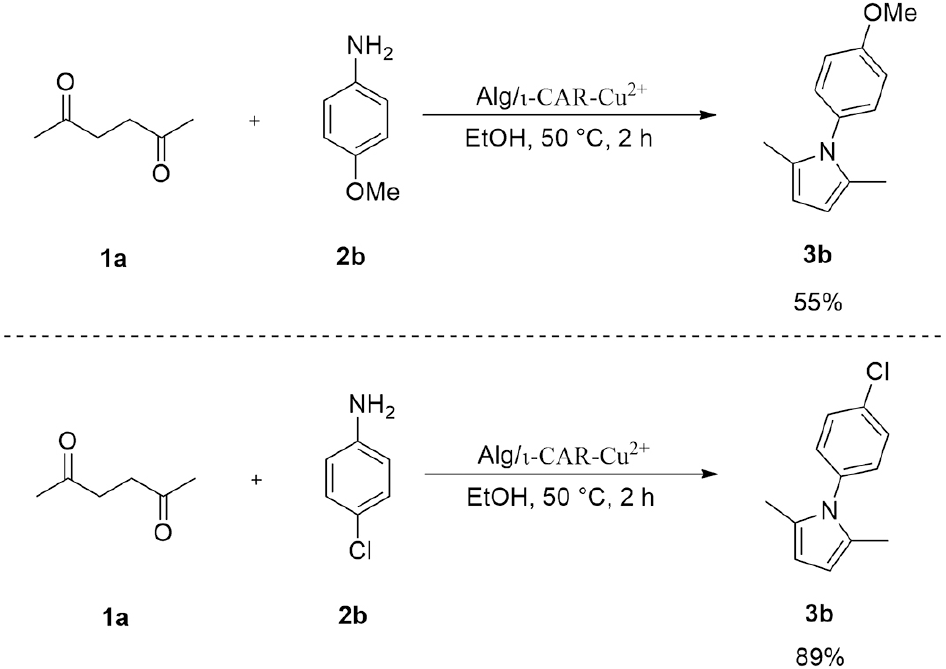
To evaluate the substrate scope and probe the sensitivity of the catalytic system to electronic effects in the aromatic amine, two aniline derivatives were tested (Scheme 1). These findings indicate that the Alg/ι-CAR-Cu2+ system tolerates different electronic environments and remains catalytically competent across substrates with varying reactivity.
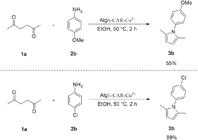
Synthesis of pyrrole derivatives (3b and 3c) catalyzed by Cu2+-containing microspheres from anilines containing donor and withdrawing groups.
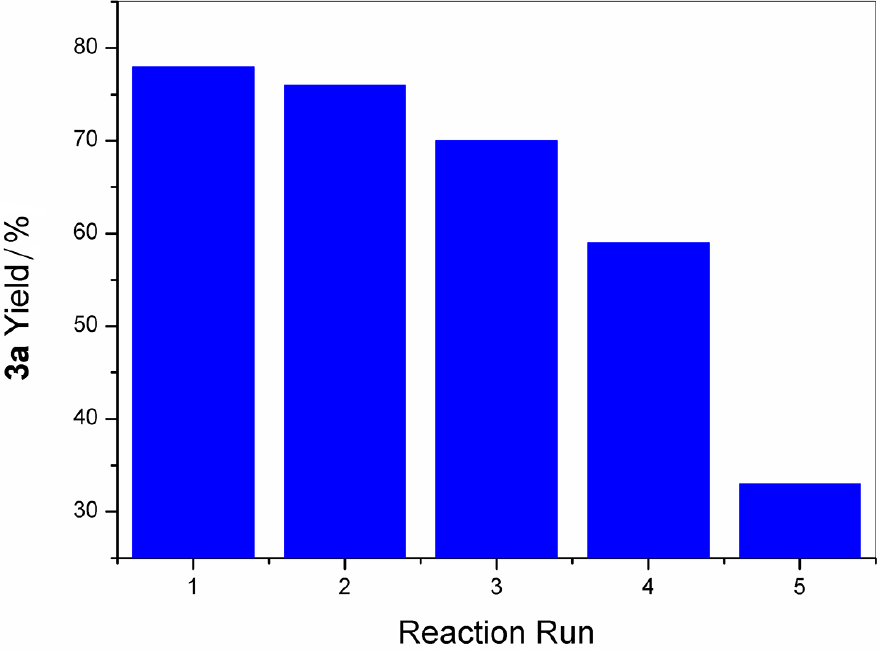
After establishing that the Alg/ι-CAR-Cu2+ microspheres were catalytically efficient in the Paal-Knorr reaction, their reusability was investigated over five consecutive cycles in the reaction between 1a and 2a to form 3a (Figure 6). In the first use, the catalyst delivered its highest performance (ca. 78% yield of 3a). A slight decrease was observed in the second cycle ca. 76% yield), indicating minimal deactivation and suggesting that the structural and chemical integrity of the material remained largely preserved after the first reuse. In the third cycle, the yield declined to approximately 70%, marking the onset of a more evident decrease in catalytic activity. However, from the fourth cycle onward, the loss of activity became more pronounced, with yields dropping to approximately 59 and 45% in the fourth and fifth cycles, respectively. Overall, the catalyst retained good activity for the first three cycles but exhibited an accumulated loss of ca. 33% after the fifth reuse. This decrease is directly associated with significant Cu2+ leaching after the third cycle, as quantitatively confirmed by FAAS (Table S1, SI section) and supported by EDX analysis. Such behavior highlights an intrinsic limitation of ionically immobilized Cu2+ species in highly hydrated polysaccharide matrices under repeated catalytic use.
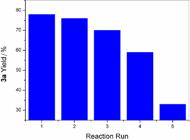
Despite this decline, the catalyst demonstrated robust performance during the first three cycles, maintaining yields above 70% (Table S1). Such behavior confirms the hybrid material as a promising heterogeneous catalyst, combining operational simplicity, reduced metal contamination, and satisfactory recyclability, thus aligning well with principles of green and sustainable catalysis.
This progressive deactivation is consistent with the partial leaching of Cu2+ species, as indicated by complementary EDX and FAAS analyses, which revealed a reduction in copper content after reuse (Figure S3, SI section). The decline also correlates with the increased surface fragility and microstructural alterations seen in the post-reaction SEM images (Figure S4, SI section), as well as the slight shift in thermal degradation profiles in the TGA/DTG curves (Figure S5, SI section). Both analyses suggested a gradual disruption of the ionic interactions that stabilize Cu2+ within the Alg/ι-CAR matrix. Moreover, this observation reinforces that catalyst deactivation arises primarily from progressive Cu2+ loss rather than from collapse of the polysaccharide framework itself.
Images obtained by SEM from the catalyst after reuse provide the first indications of structural changes occurring during the reaction cycles. After five catalytic runs, the microspheres exhibit a smoother and more compact surface compared to the fresh material, with a noticeable reduction in surface roughness and fewer fissures or textural irregularities. This morphological densification likely decreases the effective surface area and limits substratecatalyst contact.54 Additionally, the more uniform and compacted morphology suggests restricted accessibility to the Cu2+ active sites, a condition that is consistent with the progressive decrease in catalytic performance observed after the third reuse.
Thermogravimetric analyses corroborate the microstructural modifications detected by SEM. Comparison of the TGA curves before and after five catalytic cycles (Figure S5, SI section) shows that the general thermal decomposition profiles remain essentially unchanged, indicating that the bulk Alg/ι-CAR polymeric framework retains its integrity. Nevertheless, a slight displacement of the main degradation events to lower temperatures (200-400 °C) is observed for the reused catalyst, suggesting a reduction in crosslinking density. This behavior agrees with partial Cu2+ leaching and with the possible retention of organic residues from the Paal-Knorr reaction, both of which can weaken the ionic interactions responsible for stabilizing the Alg/ι-CAR network. In addition, the DTG curves (Figure S5) further reinforce these interpretations. The reused microspheres exhibit less intense peaks and lower onset temperatures for thermal decomposition, indicating that lower energy is required to disrupt polymer-metal interactions. Although such alterations do not compromise the overall thermal stability of the material, they align well with the observed decline in catalytic efficiency across multiple cycles.
Proposed mechanism
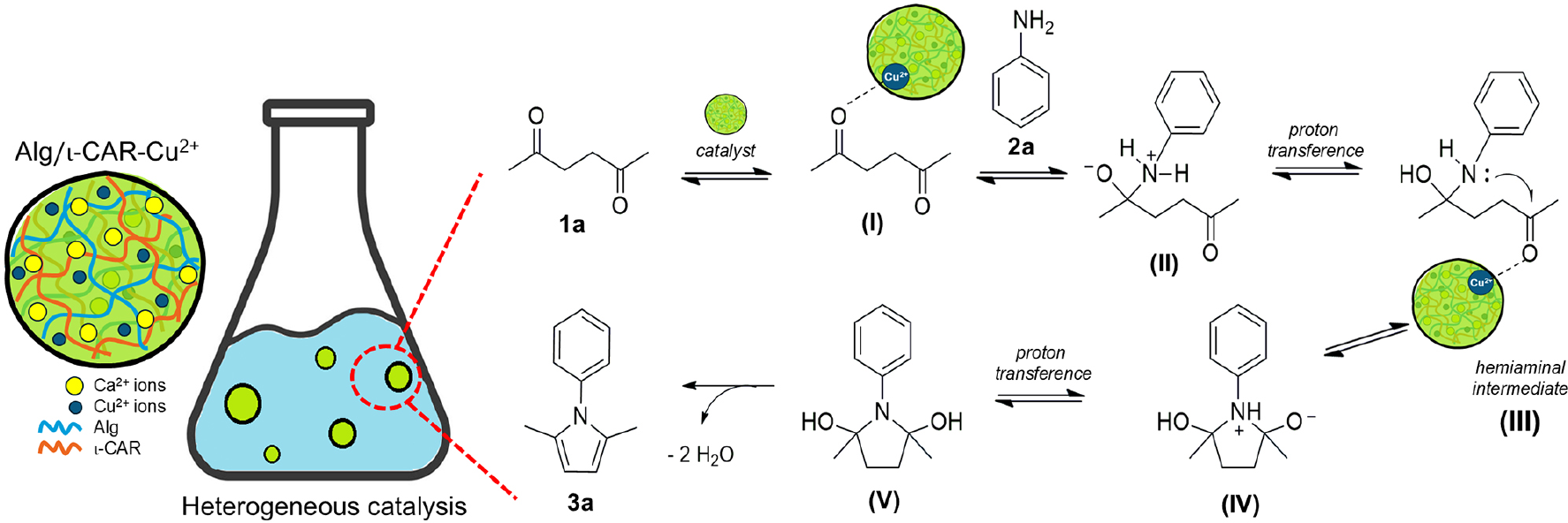
The catalytic mechanism of the Paal-Knorr reaction mediated by the Alg/ι-CAR-Cu2+ microspheres can be understood as a Lewis acid-driven process in which the immobilized Cu ions play a central role in activating the 1,4-diketone and guiding its transformation into the corresponding pyrrole (Scheme 2). Initially, coordination of the carbonyl oxygen atoms to Cu2+ increases the electrophilicity of the carbonyl carbons, thereby facilitating nucleophilic attack by the aromatic amine.55 This activation occurs primarily at accessible regions of the microspheres, consistent with their heterogeneous nature and with the partial surface exposure of Cu2+ evidenced by EDX and catalytic performance data.
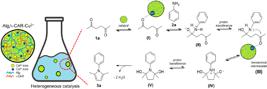
Once activated, the aromatic amine attacks one of the copper-coordinated carbonyl groups to form a hemiaminal intermediate.56 Because both carbonyl groups of the 1,4-diketone can interact with the catalytic center, the nitrogen can then attack the second carbonyl carbon, leading to the formation of a cyclic dihemiaminal. This step is likely assisted by the Alg/ι-CAR matrix, whose hydrogen-bonding network and ionic environment help stabilize charged or partially charged intermediates and keep them in proximity to the active sites.57
Following cyclization, a sequence of intramolecular proton shifts reorganizes the electron density within the emerging heterocyclic ring, preparing the system for aromatization. Cu2+ ions may facilitate these rearrangements indirectly by stabilizing developing positive charges or by assisting in internal proton transfers.58 The final transformation involves dehydration of the intermediate, which produces the aromatic pyrrole ring. This step is promoted both by the Lewis acidity of the copper centers, capable of polarizing the C-O bond, and by the microenvironment provided by the Alg/ι-CAR matrix, which can contribute mild acidity and support protonshuttling processes that favor water elimination.59
Overall, the mechanism outlined in Scheme 2 aligns with classical proposals for Lewis acid-mediated PaalKnorr reactions47 but with important contributions from the Alg/ι-CAR support, which aids in substrate adsorption, stabilizes key intermediates, and modulates the microenvironment around the catalytic sites. The progressive decrease in reaction yield after multiple reuse cycles is consistent with mechanistic requirements: partial Cu2+ leaching and surface densification reduce the number and accessibility of active sites necessary for diketone activation, thus limiting the efficiency of the initial and rate-determining steps of the catalytic cycle.
Conclusions
In this study, we set out to investigate whether hybrid Alg/ι-CAR microspheres could serve as an effective and sustainable platform for Cu2+ immobilization and subsequent application in heterogeneous catalysis. The results obtained from structural, thermal, morphological, and catalytic evaluations clearly support this hypothesis. The Alg/ι-CAR matrix provided a complementary environment of carboxylate and sulfate groups capable of binding Cu2+ ions while maintaining the overall integrity of the polymeric network. Incorporation of Cu2+ led to pronounced increases in porosity and surface heterogeneity. These features are directly associated with the high catalytic activity observed in the Paal-Knorr reaction.
As demonstrated, the Cu2+-containing microspheres promoted the synthesis of pyrrole derivatives under mild conditions with yields comparable to those obtained using homogeneous Cu2+ salt, yet with the advantage of facile separation and reduced metal contamination. The catalyst maintained high catalytic performance over the first three reuse cycles, after which a gradual decline was observed due to partial Cu2+ leaching. Although this behavior limits long-term reuse, the system remains attractive from a sustainability perspective due to the renewable nature of the biopolymer support, the mild operating conditions, facile catalyst recovery, and effective catalytic performance within a defined number of reuse cycles. The catalyst maintained high activity over the first three cycles, while the subsequent decline in performance was convincingly correlated with partial Cu2+ leaching, reduced crosslinking density, and surface densification, as evidenced by FAAS, SEM, and TGA/DTG analyses. These results demonstrate that catalyst deactivation does not originate from degradation of the bulk polysaccharide framework but rather from the progressive loss and decreased accessibility of Cu2+ active sites.
Overall, this work highlights the potential of Alg/ι-CAR-based hydrogels as renewable, versatile, and efficient supports for transition-metal catalysis. The insights gained here open opportunities for extending this platform to other metal ions and reaction classes, as well as for tailoring the physicochemical properties of the microspheres through controlled ion-exchange strategies. By demonstrating a robust link between structure, coordination environment, and catalytic behavior, this study reinforces the relevance of biopolymer-based materials in advancing greener and more sustainable catalytic technologies.
Supplementary Information
Supplementary information is available free of charge at http://jbcs.sbq.org.br as file.
Acknowledgments
The authors gratefully acknowledge the financial support provided by FAPESC, CAPES-Finance Code 001. FAPERGS, grant number 21/2551-0002094-6, CNPq (PQ 304431/2021-4; Universal 422645/2021-4, 405655/2023-1 and 409101/2023-0). The authors would like to dedicate this work to the memory of our colleague and friend João M. Anghinoni, whose contributions and enthusiasm greatly enriched this study. Thank you, João.
Data Availability Statement
All the data supporting the article are available in the text.
References
-
1 Abbas, A.; Cross, M.; Duan, X.; Jeschke, S.; Konarova, M.; Huber, G. W.; Lee, A. F.; Lovell, E. C.; Lim, J. Y. C.; Polyzos, A.; Richards, R.; Wilson, K.; One Earth 2024, 7, 738. [Crossref]
» Crossref -
2 Mallesham, B.; Raikwar, D.; Shee, D. In Advanced Functional Solid Catalysts for Biomass Valorization; Hussain, C. M.; Sudarsanam, P., eds.; Elsevier: 2020, ch. 1. [Crossref]
» Crossref -
3 Cho, H.; Madden, R.; Nisanci, B.; Török, B.; Green Chem. 2015, 17, 1088. [Crossref]
» Crossref -
4 Miyahara, S.-i.; Sato, K.; Kawano, Y.; Imamura, K.; Ogura, Y.; Tsujimaru, K.; Nagaoka, K.; Catal. Today 2021, 376, 36. [Crossrefx]
» Crossref -
5 Sruthi, P. R.; Roopak, R.; Anas, S.; ChemistrySelect 2023, 8, e202204374. [Crossref]
» Crossref -
6 Morgan, K.; Goguet, A.; Hardacre, C.; ACS Catal. 2015, 5, 3430. [Crossref]
» Crossref -
7 de Souza, J. F.; Gularte, M. S.; Quadrado, R. F. N.; Biajoli, A. F. P.; Fajardo, A. R.; Catal. Rev. 2023, 65, 52. [Crossref]
» Crossref -
8 Landge, V. K.; Hakke, V. S.; Kakunuri, M.; Babu, G. U. B.; Boczkaj, G.; Sonawane, S. H.; React. Chem. Eng. 2022, 7, 641. [Crossref]
» Crossref -
9 Khan, S. B.; Ahmad, S.; Kamal, T.; Asiri, A. M.; Bakhsh, E. M.; Int. J. Biol. Macromol. 2020, 164, 1087. [Crossref]
» Crossref -
10 Blödorn, G. B.; Mota, H. P.; Fajardo, A. R.; Alves, D.; Tetrahedron 2025, 187, 134916. [Crossref]
» Crossref -
11 Zharmagambetova, A. K.; Talgatov, E. T.; Auyezkhanova, A. S.; Bukharbayeva, F. U.; Jumekeyeva, A. I.; Catalysts 2023, 13, 1403. [Crossref]
» Crossref -
12 Souza, J. F.; Costa, G. P.; Luque, R.; Alves, D.; Fajardo, A. R.; Catal. Sci. Technol. 2019, 9, 136. [Crossref]
» Crossref -
13 Abdelkrim, S.; Mokhtar, A.; Hachemaoui, M.; Boukoussa, B.; Sardi, A.; Asli, B.; Rahmani, R.; Djelad, A.; Sassi, M.; Abboud, M.; J. Inorg. Organomet. Polym. Mater. 2025, 35, 231. [Crossref]
» Crossref -
14 Campo, V. L.; Kawano, D. F.; da Silva, D. B.; Carvalho, I.; Carbohydr. Polym. 2009, 77, 167. [Crossref]
» Crossref -
15 Takemasa, M.; Chiba, A.; Date, M.; Macromolecules 2001, 34, 7427. [Crossref]
» Crossref -
16 Luo, C.; Wang, R.; Gu, Y.; Liu, X.; Zhu, J.; Food Hydrocoll. 2025, 166, 111279. [Crossref]
» Crossref -
17 Amarnath, V.; Amarnath, K.; J. Org. Chem. 1995, 60, 301. [Crossref]
» Crossref -
18 Kaur, R.; Sharma, P.; Lata, S.; Bharwal, A.; Abbot, V.; Bioorg. Med. Chem. 2025, 129, 118295. [Crossref]
» Crossref -
19 Shao, B.; Chen, X.; Xu, Y. T.; Li, G. Q.; Zhong, J. P.; Meng, T.; Zhang, Z.; Huang, F. P.; Huang, J.; J. Catal. 2022, 413, 168. [Crossref]
» Crossref -
20 Subba Reddy, B. V.; Dey, S. K.; Yadav, J. S.; Sridhar, B.; Tetrahedron Lett. 2012, 53, 3676. [Crossref]
» Crossref -
21 Saini, P.; Sonika; Singh, G.; Kaur, G.; Singh, J.; Singh, H.; Mol. Catal. 2021, 504, 111432. [Crossref]
» Crossref -
22 Souza, J. F.; de Aquino, T. F. B.; Nascimento, J. E. R.; Jacob, R. G.; Fajardo, A. R.; Catal. Sci. Technol. 2020, 10, 3918. [Crossref]
» Crossref -
23 Anisha, B. S.; Sankar, D.; Mohandas, A.; Chennazhi, K. P.; Nair, S. V.; Jayakumar, R.; Carbohydr. Polym. 2013, 92, 1470. [Crossref]
» Crossref -
24 Paşcalau, V.; Popescu, V.; Popescu, G. L.; Dudescu, M. C.; Borodi, G.; Dinescu, A.; Perhaiţa, I.; Paul, M.; J. Alloys Compd. 2012, 536, S418. [Crossref]
» Crossref -
25 Ručigaj, A.; Golobič, J.; Kopač, T.; Chem. Eng. J. Adv. 2024, 20, 100678. [Crossref]
» Crossref -
26 Yan, J. N.; Han, Y. T.; Liu, X. Y.; Du, Y. N.; Wu, H. T.; Eur. Polym. J. 2022, 177, 111470. [Crossref]
» Crossref -
27 Zhang, X.; Lin, X.; He, Y.; Chen, Y.; Luo, X.; Shang, R.; Int. J. Biol. Macromol. 2019, 124, 418. [Crossref]
» Crossref -
28 Pan, Y.; Wang, W.; Liu, L.; Ge, H.; Song, L.; Hu, Y.; Carbohydr. Polym. 2017, 170, 133. [Crossref]
» Crossref -
29 Bahsis, L.; Ablouh, E.-H.; Anane, H.; Taourirte, M.; Julve, M.; Stiriba, S.-E.; RSC Adv. 2020, 10, 32821. [Crossref]
» Crossref -
30 Li, Z.; Lin, Z.; Aggregate 2021, 2, e21. [Crossref]
» Crossref -
31 Nörnberg, A. B.; Gehrke, V. R.; Mota, H. P.; Camargo, E. R.; Fajardo, A. R.; Colloids Surf., A 2019, 583, 123970. [Crossref]
» Crossref -
32 Ghani, N. A. A.; Othaman, R.; Ahmad, A.; Anuar, F. H.; Hassan, N. H.; Arabian J. Chem. 2019, 12, 370. [Crossref]
» Crossref -
33 Gupta, S.; Webster, T. J.; Sinha, A.; J. Mater. Sci. Mater. Med. 2011, 22, 1763. [Crossref]
» Crossref -
34 Chavez-Baldovino, E.; Malca-Reyes, C. A.; Masso, R.; Feng, P.; Camacho, A.; Sarmiento, J.; Borrero Negrón, J. I.; Pagán-Torres, Y. J.; Díaz-Vázquez, L. M.; ACS Omega 2023, 8, 20642. [Crossref]
» Crossref -
35 Emmerichs, N.; Wingender, J.; Flemming, H. C.; Mayer, C.; Int. J. Biol. Macromol. 2004, 34, 73. [Crossref]
» Crossref -
36 Alfinaikh, R. S.; Alamry, K. A.; Hussein, M. A.; RSC Adv. 2025, 15, 4708. [Crossref]
» Crossref -
37 Chen, K.; Zhang, H.; Int. J. Biol. Macromol. 2019, 136, 936. [Crossref]
» Crossref -
38 Peglow, T. J.; da Costa, G. P.; Duarte, L. F. B.; Silva, M. S.; Barcellos, T.; Perin, G.; Alves, D.; J. Org. Chem. 2019, 84, 5471. [Crossref]
» Crossref -
39 Mittal, A.; Kumari, S.; Parmanand; Yadav, D.; Sharma, S. K.; Appl. Organomet. Chem. 2020, 34, e5362. [Crossref]
» Crossref -
40 Ramšak, A.; Gazvoda, M.; Plazl, I.; Ambrožič, R.; Front. Chem. Eng. 2024, 6-2024 [Crossref]
» Crossref -
41 Rui Rodrigues, J.; Lagoa, R.; J. Carbohydr. Chem. 2006, 25, 219. [Crossref]
» Crossref -
42 Rivera-Torrente, M.; Mandemaker, L. D. B.; Filez, M.; Delen, G.; Seoane, B.; Meirer, F.; Weckhuysen, B. M.; Chem. Soc. Rev. 2020, 49, 6694. [Crossref]
» Crossref -
43 Yu, F.; Cui, T.; Yang, C.; Dai, X.; Ma, J.; Chemosphere 2019, 237, 124417. [Crossref]
» Crossref -
44 Russo, R.; Malinconico, M.; Santagata, G.; Biomacromolecules 2007, 8, 3193. [Crossref]
» Crossref -
45 Rajender Reddy, K.; Rajgopal, K.; Lakshmi Kantam, M.; Catal. Lett. 2007, 114, 36. [Crossref]
» Crossref -
46 Hammond, C.; Green Chem. 2017, 19, 2711. [Crossref]
» Crossref -
47 Alvi, S.; Hasan, A.; Ali, R.; Polycycl. Aromat. Compd. 2024, 44, 3558. [Crossref]
» Crossref -
48 Amina, B.; Redouane, B.; Curr. Top. Med. Chem. 2025, 25, 461. [Crossref]
» Crossref -
49 Gajengi, A. L.; Fernandes, C. S.; Bhanage, B. M.; Mol. Catal. 2018, 451, 13. [Crossref]
» Crossref -
50 Joseph, P.; Kundu, P. K.; Synth. Commun. 2024, 54, 1974. [Crossref]
» Crossref -
51 Zhang, G.; Lang, R.; Wang, W.; Lv, H.; Zhao, L.; Xia, C.; Li, F.; Adv. Synth. Catal. 2015, 357, 917. [Crossref]
» Crossref -
52 Collinson, J.-M.; Wilton-Ely, J. D. E. T.; Díez-González, S.; Chem. Commun. 2013, 49, 11358. [Crossref]
» Crossref -
53 Dervaux, B.; Du Prez, F. E.; Chem. Sci. 2012, 3, 959. [Crossref]
» Crossref -
54 Wang, X.; Wu, C.; Sun, Y.; Yao, X.; Tetrahedron Lett. 2017, 58, 3164. [Crossref]
» Crossref -
55 Mothana, B.; Boyd, R. J.; J. Mol. Struct.: THEOCHEM 2007, 811, 97. [Crossref]
» Crossref -
56 Murakishi, M.; Nakanishi, S.; Sogawa, H.; Sanda, F.; RSC Adv. 2025, 15, 30865. [Crossref]
» Crossref -
57 Oliveira, D. H.; Aquino, T. B.; Nascimento, J. E. R.; Perin, G.; Jacob, R. G.; Alves, D.; Adv. Synth. Catal. 2015, 357, 4041. [Crossref]
» Crossref -
58 Zhang, L.; Feng, J.; Wu, L.; Ma, X.; Song, X.; Jia, S.; Tan, X.; Jin, X.; Zhu, Q.; Kang, X.; Ma, J.; Qian, Q.; Zheng, L.; Sun, X.; Han, B.; J. Am. Chem. Soc. 2023, 145, 21945. [Crossref]
» Crossref -
59 Zhang, L.; Feng, J.; Wu, L.; Ma, X.; Song, X.; Jia, S.; Tan, X.; Jin, X.; Zhu, Q.; Kang, X.; Ma, J.; Qian, Q.; Zheng, L.; Sun, X.; Han, B.; J. Am. Chem. Soc. 2023, 145, 21945. [Crossref]
» Crossref
Edited by
-
Editor handled this article:
Juliano Alves Bonacin (Associate)