 Antibiotic Modulation and Efflux Pump Inhibition by Piperine-Derived Esters and Thiazole Analogs in Multidrug-Resistant Staphylococcus aureus
Abstract
This article presents the design, synthesis, and biological evaluation of two series of piperine-based derivatives: benzyl piperate esters (12a-12d) and thiazole-acetamide hybrids (17a-17d). Scalable, low-cost synthetic routes afforded the target compounds in moderate to good yields (31-70%). Structural characterization was achieved by infrared spectroscopy (IR), one-dimensional nuclear magnetic resonance (NMR) and high-resolution mass spectrometry (HRMS). In silico absorption, distribution, metabolism, excretion, and pharmacokinetics (ADME) analysis indicated that the compounds are largely consistent with Lipinski’s and Veber’s criteria. Antibacterial activity was evaluated against clinically relevant Gram-positive and Gram-negative bacteria, including Staphylococcus aureus, Escherichia coli, and Pseudomonas aeruginosa. When analyzed on a molar basis, the compounds exhibited moderate intrinsic antibacterial activity, with minimum inhibitory concentrations typically in the hundreds to low thousands of micromolar range. In particular, para bromo derivatives and the meta-nitro thiazole displayed the lowest against S. aureus and selected E. coli strains. Mechanistic studies performed in multidrug-resistant S. aureus strains overexpressing NorA (nonoperating room anesthesia) or MsrA (methionine sulfoxide reductase A) efflux pumps demonstrated that the bromoand nitro-thiazole derivatives significantly reduced the minimum inhibitory concentration (MIC) of norfloxacin in NorA-expressing strains and in MsrA-expressing strains, consistent with the possibility of inhibiting the efflux pump.
Keywords:
piperine-based esters; thiazole hybrids; antimicrobial resistance; efflux pump inhibition
Introduction
The global escalation of antimicrobial resistance (AMR) remains one of the most critical threats to public health, significantly undermining the efficacy of existing antibiotics and increasing morbidity and mortality rates worldwide.1,2 The misuse and overuse of antibiotics, coupled with genetic adaptability of microorganisms, have facilitated the emergence of multidrug-resistant bacterial strains that challenge current therapeutic options.3 Consequently, the identification of new chemical scaffolds and alternative strategies capable of complementing or restoring antibiotic activity has become a priority in medicinal chemistry and pharmaceutical research.
Natural products and their synthetic or semi-synthetic derivatives continue to represent an important source of structurally diverse bioactive compounds, owing to their chemical complexity, biological relevance, and evolutionary optimization.4 Among these, piperine, a natural amide predominantly isolated from Piper nigrum L. (black pepper) and Piper longum L. (long pepper), has attracted attention due to its versatile pharmacological profile and chemically accessible framework.5,6 Piperine is classified as an alkaloid-type alkamide (C17H19NO3) and features a conjugated amide-alkene system that allows π-electron delocalization across aromatic and olefinic moieties, conferring distinctive physicochemical and biological properties.7,8
The conjugated backbone and moderate lipophilicity of piperine favor membrane permeability,6 while its aromatic rings and heteroatoms provide potential sites for π-π stacking and hydrogen-bond interactions with biological targets.8 These attributes make piperine an attractive lead scaffold for structural modification, enabling the rational design of derivatives with altered electronic, steric, and lipophilic profiles.9,10 Structural variations introduced through electron-withdrawing substituents (e.g., -NO2, -Cl) or electron-donating groups (e.g., -OCH3, -CH3, isopropyl) can modulate molecular reactivity, polarity, and interaction patterns, potentially influencing biological behavior.11 Such modifications have been associated with altered interactions with microbial enzymes,12 deoxyribonucleic acid (DNA) gyrase,13,14 and membrane-associated transport systems, including efflux pumps,15,16 which play a central role in bacterial resistance mechanisms.17,18
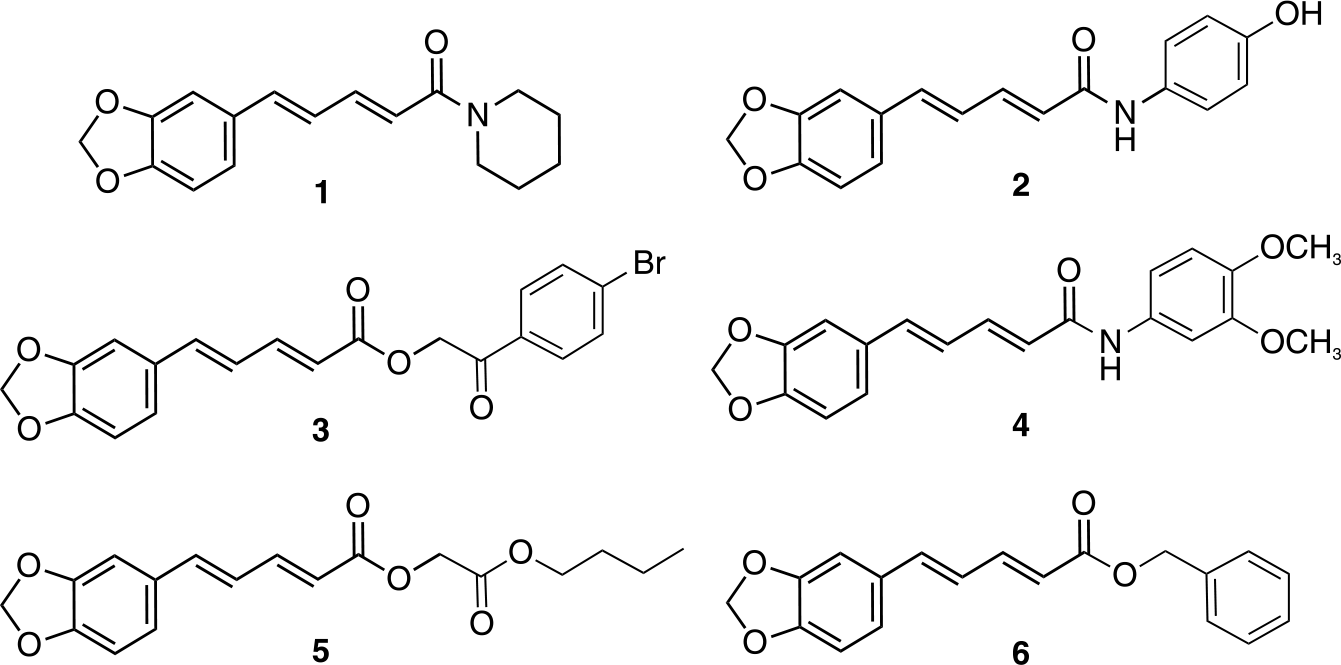
Previous studies have reported a broad spectrum of biological activities for piperine and its derivatives (Figure 1), including anti-inflammatory,6 antioxidant,8 larvicidal,19 antifungal,20 antiparasitic,18,21,22 antimicrobial,9,17,23 and monoamine oxidase inhibitory effects.24 Notably, some reports suggest that piperine-based compounds may act as chemosensitizers, enhancing the activity of conventional antimicrobial agents or interfering with resistance-associated pathways.23 However, despite this growing body of literature, systematic investigations focusing on piperine-derived esters and heterocyclic analogues as modulators of antibiotic activity, particularly against multidrug-resistant strains, remain limited.25 In many cases, the reported antimicrobial effects are moderate, reinforcing the need to interpret such compounds as starting points for further structural optimization rather than as fully developed therapeutic agents.

Piperine (1) and piperine derivatives have antioxidant (2), antifungal (3), antiparasitic (4), antimicrobial (5) and monoamineoxidase inhibitors (6) activities.
Although piperine and its derivatives have shown a broad spectrum of biological activities, it is important to emphasize that most reported antimicrobial effects remain moderate when compared to clinically used antibiotics. In this sense, piperine-based derivatives should not be regarded as final drug candidates, but rather as valuable lead-like scaffolds for further medicinal chemistry optimization. Their structural simplicity, synthetic accessibility, and chemical versatility allow systematic modulation of electronic properties, linker length, heterocyclic incorporation, and lipophilicity. Such features make these compounds particularly suitable as starting points for the rational development of more potent analogues, either by improving intrinsic antimicrobial activity or by enhancing their ability to modulate antibiotic resistance mechanisms, such as efflux pump inhibition.
In this context, the present study describes the design and synthesis of new piperine-derived compounds incorporating ester functionalities and thiazole-based heterocyclic motifs, chosen to explore the influence of electronic and steric modifications on biological behavior. The antibacterial activity of these derivatives was evaluated against representative Gram-positive and Gram-negative bacterial strains, including multidrug-resistant Staphylococcus aureus phenotypes. In addition, their potential to modulate the activity of selected antibiotics, such as amikacin, gentamicin, ciprofloxacin, and norfloxacin, was investigated, aiming to identify structural features that may contribute to efflux pump inhibition or antibiotic potentiation.26
Experimental
Chemistry
All common reagents were purchased from commercial suppliers (Sigma-Aldrich, São Paulo, Brazil) and used without further purification. The purification of the compounds was performed by recrystallization in a mixture of N,N-dimethylformamide (DMF)/water. Melting points were measured using Microquímica equipment, model MQAPF-301. 1H and 13C nuclear magnetic resonance (NMR) spectra were recorded at the Laboratório Multiusuário de Caracterização e Análise (LMCA-UFPB) on Bruker Avance Ultrashield™ spectrometers operating at 400 and 500 MHz for 1H and at 101 and 126 MHz for 13C, respectively. Deuterated chloroform (CDCl3) and deuterated dimethyl sulfoxide (DMSO-d6) were used as solvents, and tetramethylsilane (TMS) was employed as the internal reference. Chemical shifts (d) are expressed in parts per million (ppm), and coupling constants (J) in hertz (Hz). Infrared (IR) spectra were obtained at the Laboratório de Síntese Orgânica Medicinal (LASOM-UFPB) using a Shimadzu IRPrestige-21 FTIR spectrometer, employing KBr pellets, and absorption bands are reported in cm-1.
High-resolution mass spectrometry (HRMS) and accurate mass measurements were conducted at the Laboratório Multiusuário de Caracterização e Análises (LMCA-UFPB) to confirm the molecular formulas of the synthesized derivatives. Mass values are reported as m/z (relative intensity), together with the corresponding calculated exact masses for confirmation of elemental composition. HRMS analyses were performed using an HPLC-ESI-TOF system, consisting of a Shimadzu high-performance liquid chromatograph (Kyoto, Japan) coupled to a micrOTOF-II mass spectrometer (Bruker, Billerica, USA) equipped with an electrospray ionization (ESI) source, as well as a Q-TOF mass spectrometer (Shimadzu), depending on the compound analyzed. Measurements were conducted predominantly in the positive ionization mode, and ions were detected as protonated or adducted species ([M + H]+ or [M + Na]+).
For the Q-TOF mass spectrometer (Shimadzu) ([M + H]+), chromatographic separation was achieved on a Waters Acquity BEH column (150 × 2.1 mm, 1.7 μm) maintained at 40 °C, using water (A) and acetonitrile (B), both containing 0.1% formic acid, under a linear gradient from 2 to 95% B over 15 min, at a flow rate of 0.4 mL min-1 and injection volume of 5 μL. Mass spectrometric detection was carried out using an electrospray ionization (ESI) source operating in positive and negative modes over an m/z range of 370-410. Source temperature was set to 120 °C, desolvation temperature to 350 °C, desolvation gas flow to 500 L h-1, and capillary voltage to 2.6 kV (ESI-) or 3.2 kV (ESI+). For the micrOTOF-II system ([M + Na]+), ESI operating conditions were set as follows: capillary voltage of 4.5 kV (negative mode when applicable), end-plate offset of -500 V, nebulizer pressure of 4.0 bar, and dry nitrogen gas flow of 8 L min-1 at 200 °C. The high mass resolution and accuracy of the HRMS instruments enabled precise molecular weight determination and provided strong support for structural assignments.
All spectroscopic and spectrometric data are consistent with the proposed structures and are provided in full, including spectra, in the Supplementary Information (SI) section.
Piperine extraction (7)
Two hundred grams of black pepper were finely ground and subjected to extraction with 1000 mL of 95% ethanol using a Soxhlet apparatus for 2 h. The resulting extract was filtered and concentrated under reduced pressure. The crude residue was treated with 200 mL of a 10% ethanolic potassium hydroxide solution, and the formed precipitate was separated by filtration. To the filtrate, a small volume of water was added until turbidity appeared, after which the mixture was allowed to stand overnight. The resulting yellow crystalline solid was collected and washed with cold water, affording 7.0 g of purified piperine; mp 126-128 °C (lit:20 126-128 °C); IR (KBr) ν / cm-1 3066, 3034, 3008, 2939, 2918, 2862, 1633, 1612, 1583, 1490, 1251, 1134, 997, 846, 804; 1H NMR (400 MHz, CDCl3) d 7.40 (ddd, 1H, J 14.7, 7.8, 2.4 Hz, =C-H), 6.97 (d, 1H, J 1.7 Hz, C-HAr), 6.88 (dd, 1H, J 8.1, 1.7 Hz, C-HAr), 6.77 (d, 1H, J 8.0 Hz, C-HAr), 6.73 (m, 2H, =C-H and C-HAr), 6.43 (d, 1H, J 14.6 Hz, =C-H), 5.96 (s, 2H, O-CH2-O), 3.58 (d, 4H, J 41.7 Hz, CH2), 1.66 (dd, 2H, J 11.3, 6.2 Hz, CH2), 1.58 (dt, 4H, J 11.0, 5.4 Hz, CH2); 13C NMR (126 MHz, CDCl3) d 165.5, 148.3, 148.2, 142.5, 138.3, 131.1, 125.5, 122.6, 120.2, 108.6, 105.8, 101.4, 24.8.
Potassium piperate (8)
A reflux reaction was carried out at reflux (70-80 °C) for approximately 20 h, using 4 g (15.4 mmol) of pure piperine and 40 mL of a 20% ethanolic KOH solution in a 100 mL round-bottom flask. Upon completion, the reaction mixture was filtered, and the solid was washed with ethanol and dried. Yield: 92%; brown granular solid; mp > 270 °C; IR (KBr) ν / cm-1 3021, 2912, 1628, 1608, 1550, 1499, 1450, 1387, 1252, 1197, 1036, 996, 927, 858, 804, 743, 715; 1H NMR (400 MHz, D2O) d 7.05 (dd, 1H, J 15.5, 9.6 Hz, =C-H), 6.86 (d, 1H, J 1.6 Hz, HAr), 6.82 (dd, 1H, J 8.2, 1.6 Hz, HAr), 6.73 (d, 1H, J 8.0 Hz, HAr), 6.67-6.53 (m, 2H, =C-H), 5.92 (d, 1H, J 15.2 Hz, =C-H), 5.88 (s, 2H, O-CH2-O); 13C NMR (101 MHz, D2O) d 175.9, 147.5, 147.4, 141.5, 137.6, 131.0, 126.5, 125.3, 122.5, 108.5, 105.7, 101.3.
General procedure esters
Benzyl alcohols (10a-10d)
A solution of the substituted benzaldehyde (20 mmol) in ethanol (20 mL) was treated with sodium borohydride (NaBH4, 24 mmol), which was added portionwise under stirring at room temperature. The resulting suspension was stirred until completion of the reaction, as monitored by thin-layer chromatography. Subsequently, a saturated aqueous ammonium chloride solution (10 mL) was carefully added to quench the reaction. The mixture was then extracted with dichloromethane (3 × 10 mL). The combined organic layers were dried over anhydrous sodium sulfate, filtered, and concentrated under reduced pressure to afford the corresponding benzyl alcohol as a colorless liquid (1.8 g, 83.3% yield), which was used in the subsequent step without further purification. The same procedure was applied to the preparation of the other substituted benzyl alcohols.
Benzyl alcohol (10a)
Commercial benzyl alcohol was used without the need for further purification.27
4-Methylbenzyl alcohol (10b)
Yield: 90%; white solid; mp 56-58 ºC (lit.:28 59-62 ºC); IR (KBr) ν / cm-1 3348, 3268, 3021, 2918, 2854, 1516, 1444, 1413, 1344, 1306, 1203, 1011, 835, 804, 741; NMR 1H (400 MHz, DMSO) d 7.20 (d, 2H, J 8.1 Hz, HAr), 7.12 (d, 2H, J 7.8 Hz, HAr), 5.09 (t, 1H, J 5.7 Hz, OH), 4.45 (d, 2H, J 5.7 Hz, CH2), 2.28 (s, 3H, CH3); NMR 13C (101 MHz, DMSO) d 139.5, 135.6, 128.6, 126.5, 62.8, 20.7. The spectral data are in agreement with the literature.27
4-Bromobenzyl alcohol (10c)
Yield: 89%; white solid; mp 76-77 ºC (lit.:29 75-80 ºC); IR (KBr) ν / cm-1 3337, 3262, 3044, 2918, 2852, 1591, 1484, 1447, 1401, 1344, 1203, 1068, 1005, 827, 789; 1H NMR (500 MHz, CDCl3) d 7.47 (d, 2H, J 8.5 Hz, HAr), 7.23 (d, 2H, J 8.5 Hz, HAr), 4.63 (s, 2H, CH2), 1.92 (s, 1H, OH); 13C NMR (126 MHz, CDCl3) d 139.9, 131.7, 128.7, 121.6, 64.7. The spectral data are in agreement with the literature.27
3-Nitrobenzyl alcohol (10d)
Yield: 94%; brown liquid; IR (KBr) ν / cm-1 3340, 3093, 2932, 2872, 1522, 1482, 1347, 1203, 1091, 1039, 890, 804; 1H NMR (400 MHz, CDCl3) d 8.21 (s, 1H, HAr), 8.10 (m, 1H, HAr), 7.67 (dd, 1H, J 7.6, 0.7 Hz, HAr), 7.51 (t, 1H, J 7.9 Hz, HAr), 4.79 (d, 2H, J 1.9 Hz, CH2), 2.50 (s, 1H, OH); 13C NMR (101 MHz, CDCl3) d 148.5, 143.0, 132.8, 129.5, 122.5, 121.6, 64.0. Spectroscopic data are consistent with literature.30
Benzyl chlorides (11a-11d)
Thionyl chloride (8.66 mmol) was slowly added to a solution of compound 10a-10d (4.34 mmol) in dichloromethane (10 mL) cooled to 0 °C in an ice bath. After addition, the mixture was stirred at room temperature for 2 h. The reaction mixture was concentrated to yield a colorless liquid corresponding to substituted benzyl chlorides, which was used in the next step without purification.
Preparation of final compounds (12a-12d)
Dimethylformamide (10 mL) was added to a mixture of potassium piperate (compound 8) (0.86 mmol) and compound 11a-11d (0.713 mmol) in a 50 mL round-bottom flask. The reaction mixture was heated to 80 °C and stirred until the alkyl halide was completely consumed (monitored by thin-layer chromatography (TLC)), and complete consumption of the alkyl halide was observed after 1 h for all derivatives (compounds 12a-12d). After completion, the reaction was cooled, ice water was added, and the mixture was extracted with ethyl acetate (3 × 20 mL), washed with brine (3 × 25 mL), and dried over anhydrous sodium sulfate. The solvent was evaporated under reduced pressure, yielding a precipitate that was recrystallized from ethanol/water (8:2).
Benzyl piperate (12a)
Yield: 60%; orange solid; mp 50-52 °C; IR (KBr) ν / cm-1 3032, 2993, 2962, 2904, 1705, 1620, 1600, 1489, 1442, 1381, 1253, 1199, 1033, 991, 921, 856, 810, 748; 1H NMR (500 MHz, CDCl3) d 7.46 (dd, 1H, J 15.2, 10.9 Hz), 7.42-7.31 (m, 5H), 6.99 (d, 1H J 1.6 Hz), 6.91 (dd, 1H, J 8.1, 1.6 Hz), 6.81 (d, 1H, J 15.6 Hz), 6.79 (d, 1H, J 8.1 Hz), 6.70 (dd, 1H, J 15.4, 10.9 Hz), 6.02-5.97 (m, 3H), 5.22 (s, 2H); 13C NMR (126 MHz, CDCl3) d 167.1, 148.7, 148.4, 145.4, 140.6, 136.3, 130.6, 128.7, 128.3, 128.3, 124.6, 123.1, 120.1, 108.7, 106.0, 101.5, 66.3; HRMS (ESI) m/z, calcd. for [C19H16O4 + Na]+: 331.0946, found: 331.0941.
4-Methylbenzyl piperate (12b)
Yield: 45%; orange solid; mp 78-80 °C; IR (KBr) ν / cm-1 3007, 2952, 2903, 1700, 1608, 1487, 1444, 1375, 1324, 1249, 1237, 1168, 1125, 1036, 996, 930, 847, 801, 755; 1H NMR (500 MHz, CDCl3) d 8.26 (s, 1H), 8.18 (dd, 1H, J 8.2, 1.3 Hz), 7.71 (d, 1H, J 7.6 Hz), 7.55 (t, 1H, J 7.9 Hz), 7.47 (dd, 1H, J 15.2, 11.0 Hz), 6.99 (d, 1H, J 1.5 Hz), 6.91 (dd, 1H, J 8.1, 1.5 Hz), 6.84 (d, 1H, J 15.5 Hz), 6.78 (d, 1H, J 8.0 Hz), 6.71 (dd, 1H, J 15.4, 11.0 Hz), 6.00 (d, 1H, J 15.3 Hz), 5.98 (s, 2H), 5.29 (s, 2H); 13C NMR (126 MHz, CDCl3) d 166.7, 148.9, 148.5, 148.4, 146.2, 141.21, 138.5, 134.0, 130.5, 129.7, 124.3, 123.3, 123.2, 122.9, 119.2, 108.7, 106.0, 101.6, 64.7; HRMS (ESI) m/z, calcd. for [C20H18O4 + Na] +: 345.1103, found: 345.1097.
4-Bromobenzyl piperate (12c)
Yield: 70%; orange solid; mp 98-100 °C; IR (KBr) ν / cm-1 3010, 2949, 2912, 2895, 1720, 1622, 1487, 1447, 1393, 1349, 1249, 1214, 1171, 1120, 1065, 1033, 970, 924, 884, 850, 807, 778; 1H NMR (500 MHz, CDCl3) d 7.50 (d, 2H, J 8.4 Hz), 7.45 (dd, 1H, J 15.2, 10.9 Hz), 7.27 (d, 2H, J 8.4 Hz), 6.99 (d, 1H, J 1.6 Hz), 6.91 (dd, 1H, J 8.1, 1.5 Hz), 6.82 (d, 1H, J 15.5 Hz), 6.79 (d, 1H, J 8.0 Hz), 6.70 (dd, 1H, J 15.4, 11.0 Hz), 6.00-5.93 (m, 3H), 5.15 (s, 2H); 13C NMR (126 MHz, CDCl3) d 166.9, 148.8, 148.4, 145.7, 140.8, 135.4, 131.8, 130.6, 130.0, 124.5, 123.2, 122.3, 119.8, 108.7, 106.0, 101.5, 65.4; HRMS (ESI) m/z, calcd. for [C19H15O4Br M + H] +: 387.0232, found: 387.0218.
3-Nitrobenzyl piperate (12d)
Yield: 67%; orange solid; mp 144-146 °C; IR (KBr) ν / cm-1 3074, 3020, 2997, 2920, 1701, 1620, 1600, 1535, 1504, 1489, 1450, 1373, 1350, 1261, 1207, 1153, 1126, 1049, 1029, 1002, 921, 887, 856, 802, 729; 1H NMR (500 MHz, CDCl3) d 8.26 (s, 1H), 8.18 (dd, 1H, J 8.2, 1.3 Hz), 7.71 (d, 1H, J 7.6 Hz), 7.55 (t, 1H, J 7.9 Hz), 7.47 (dd, 1H, J 15.2, 11.0 Hz), 6.99 (d, 1H, J 1.5 Hz), 6.91 (dd, 1H, J 8.1, 1.5 Hz), 6.84 (d, 1H, J 15.5 Hz), 6.78 (d, 1H, J 8.0 Hz), 6.71 (dd, 1H, J 15.4, 11.0 Hz), 6.00 (d, 1H, J 15.3 Hz), 5.98 (s, 2H), 5.29 (s, 2H); 13C NMR (126 MHz, CDCl3) d 66.7, 148.9, 148.5, 148.4, 146.2, 141.2, 138.5, 134.0, 130.5, 129.7, 124.3, 123.3, 123.2, 122.9, 119.2, 108.7, 106.0, 101.6, 64.7; HRMS (ESI) m/z, calcd. for [C19H15NO6 + Na]+: 376.0797, found: 376.1155.
General procedure heterocyclic
Bromoacetophenones (14a-14d)
The substituted acetophenone (compounds 13a-13d) (25 mmol) was dissolved in dichloromethane (50 mL) and cooled in a 100 mL round-bottom flask. A solution of bromine (27.5 mmol) in dichloromethane (5 mL) was then added slowly under stirring. The reaction mixture was stirred for 24 h at room temperature and subsequently extracted. The mixture was successively washed with saturated sodium bicarbonate solution (3 × 100 mL) and saturated sodium chloride solution (2 × 50 mL), dried over anhydrous sodium sulfate, filtered, and concentrated under reduced pressure. The resulting solid was purified by recrystallization from ethanol.
2-Bromo-1-phenylethanone (14a)
Yield: 88%; white solid; mp 46-48 °C (lit.:31 48 51 °C); 1H NMR (400 MHz, CDCl3) d 7.99 (dd, 2H, J 8.4, 1.3 Hz, ArH), 7.63-7.59 (m, 1H, ArH), 7.49 (t, 2H, J 7.7 Hz, ArH), 4.46 (s, 2H, CH3); 13C NMR (101 MHz, CDCl3) d 191.4, 134.1, 129.0, 129.0, 31.0. Data in agreement with literature.32
2-Bromo-1-(4-methylphenyl)ethanone (14b)
Yield: 63%; white solid; mp 44-46 °C (lit.:32 47-48 °C); 1H NMR (400 MHz, CDCl3) d 7.89 (d, J 8.3 Hz, 2H, ArH), 7.29 (d, J 8.6 Hz, 2H, ArH), 4.43 (s, 2H, CH3), 2.43 (s, 3H, CH3); 13C NMR (101 MHz, CDCl3) d 191.10, 145.16, 131.62, 129.69, 129.20, 31.06, 21.89. Data in agreement with literature.32
2-Bromo-1-(4-bromophenyl)ethanone (14c)
Yield: 97%; white solid; mp 98-100°C (lit.:33 107 111 °C); 1H NMR (500 MHz, CDCl3) d 7.85 (d, J 8.5 Hz, 2H, ArH), 7.64 (d, J 8.5 Hz, 2H, ArH), 4.40 (s, 2H, CH2); 13C NMR (126 MHz, CDCl3) d 190.54, 132.80, 132.38, 130.57, 129.45, 30.44. Data in agreement with literature.33
2-Bromo-1-(3-nitrophenyl)ethanone (14d)
Yield: 72%; beige solid; mp 96-98 °C (lit.:34 90-94 °C); 1H NMR (400 MHz, CDCl3) d 8.82 (t, J 2.1 Hz, 1H, ArH), 8.48 (ddd, J 8.2, 2.3, 1.1 Hz, 1H, ArH), 8.33 (ddd, J 7.8, 1.7, 1.1 Hz, 1H, ArH), 7.74 (t, J 8.2 Hz, 1H, ArH), 4.49 (s, 2H, CH2); 13C NMR (101 MHz, CDCl3) d 189.39, 135.16, 134.48, 130.23, 128.15, 123.86, 29.95. Data consistent with literature.34
2-Amino-4-arylthiazoles (15a-15d)
Ethanol (30 mL) was added to a 50 mL round-bottom flask containing a mixture of thiourea (12 mmol) and compounds 14a-14d (10 mmol). The reaction mixture was stirred at 75 °C for 12 h. After cooling to room temperature, the solvent was removed under reduced pressure. The crude residue was treated with saturated sodium bicarbonate, added dropwise to adjust the pH to 9. The precipitate was filtered, washed with distilled water, dried, and recrystallized from the appropriate solvent.
4-Phenylthiazol-2-amine (15a)
Yield: 66%; pale-yellow solid after recrystallization from EtOH/H2O (6:4); mp 153-155 °C (lit.:35 149 151 °C); IR (KBr) ν / cm-1 3435, 3248, 1596, 1513, 1482, 1438, 1329, 1306, 1283, 1200, 1036, 1019, 910, 844, 772; 1H NMR (400 MHz, DMSO-d6) d 7.78 (dd, 2H, J 8.2, 1.1 Hz, HAr), 7.35 (t, 1H, J 7.6 Hz, HAr), 7.27-7.21 (m, 2H, HAr), 7.02 (s, 2H, NH2), 6.98 (s, 1H, HAr); 13C NMR (101 MHz, DMSO-d6) d 168.4, 149.96, 135.0, 128.6, 127.3, 125.7, 101.7.
4-(p-Tolyl)thiazol-2-amine (15b)
Yield: 82%; white solid after recrystallization from EtOH/H2O (7:3); mp 143-144 °C (lit.:36 132-136 °C); IR (KBr) ν / cm-1 3380, 3262, 3119, 2955, 2843, 1622, 1568, 1510, 1189, 910, 858, 818, 738; 1H NMR (400 MHz, DMSO-d6) d 7.60 (d, 2H, J 8.2 Hz, HAr), 7.29 (d, 2H, J 8.0 Hz, HAr), 7.15 (s, 1H, HAr), 2.32 (s, 3H, CH3); 13C NMR (100 MHz, DMSO-d6) d 170.3, 139.8, 139.3, 129.7, 126.4, 125.8, 102.0, 99.7, 21.0.
4-(4-Bromophenyl)thiazol-2-amine (15c)
Yield: 65%; yellow solid after recrystallization from EtOH/H2O (7:3); mp 186-188 °C (lit.:35 184-186 °C); IR (KBr) ν / cm-1 3426, 3280, 3076, 1631, 1530, 1470, 1393, 1329, 1194, 1065, 1033, 1002, 821, 726; 1H NMR (500 MHz, DMSO-d6) d 7.73 (d, 2H, J 8.6 Hz, HAr), 7.53 (d, 2H, J 8.6 Hz, HAr), 7.06 (s, 2H, NH2), 7.05 (s, 1H, HAr); 13C NMR (125 MHz, DMSO-d6) d 168.5, 148.7, 134.2, 131.5, 127.7, 120.2, 102.6.
4-(3-Nitrophenyl)thiazol-2-amine (15d)
Yield: 63%; orange solid after recrystallization from EtOH/DMF (9:1); mp 124-126 °C (lit.:35 122-124 °C); IR (KBr) ν / cm-1 3124, 1631, 1582, 1533, 1513, 1470, 1341, 1200, 1045, 936, 873, 798; 1H NMR (500 MHz, DMSO-d6) d 8.60-8.58 (m, 1H, HAr), 8.21 (d, 1H, J 8.1 Hz, HAr), 8.09 (ddd, 1H, J 8.1, 2.3, 0.7 Hz, HAr), 7.64 (t, 1H, J 8.0 Hz, HAr), 7.30 (s, 1H, HAr), 7.20 (s, 2H, NH2); 13C NMR (126 MHz, DMSO-d6) d 168.8, 148.3, 147.5, 136.5, 131.6, 130.2, 121.8, 120.0, 104.4.
N-(Arylthiazol-2-yl)-2-chloroacetamides (16a-16d)
A solution of chloroacetyl chloride (6.6 mmol) in dichloromethane (2 mL) was added dropwise to a mixture of the compounds 15a-15d (3.0 mmol) and triethylamine (4.0 mmol) in dichloromethane (20 mL) cooled to 0 °C (ice bath) in a 50 mL round-bottom flask. The reaction was kept at 0 °C for 1 h and then stirred at room temperature for 20 h. The solvent was removed under reduced pressure, and the precipitate was washed with saturated sodium bicarbonate (2 × 50 mL) and distilled water. The solid was filtered, dried, and recrystallized from ethanol.
2-Chloro-N-(4-phenylthiazol-2-yl)acetamide (16a)
Yield: 71%; yellow solid; mp 157-159 °C (lit.:37 160 °C); 1H NMR (400 MHz, DMSO-d6) d 12.64 (s, 1H, NH), 7.90 (dd, 2H, J 8.4, 1.3 Hz, ArH), 7.67 (s, 1H, ArH), 7.45-7.41 (m, 2H, ArH), 7.35-7.30 (m, 1H, ArH), 4.42 (s, 2H, CH2); 13C NMR (101 MHz, DMSO-d6) d 165.1, 157.4, 149.1, 134.1, 128.8, 127.9, 125.7, 108.6, 42.3. Data consistent with literature.37
2-Chloro-N-(4-(p-tolyl)thiazol-2-yl)acetamide (16b)
Yield: 42%; white solid; mp 165-167 °C (lit.:38 154 157 °C); 1H NMR (400 MHz, CDCl3) d 7.69 (d, 2H, J 8.1 Hz, ArH), 7.23 (d, 2H, J 7.9 Hz, ArH), 7.12 (s, 1H, ArH), 4.09 (s, 2H, CH2), 2.38 (s, 3H, CH3); 13C NMR (101 MHz, CDCl3) d 164.5, 157.7, 149.7, 138.6, 130.9, 129.7, 126.2, 107.7, 42.0, 21.4. Data consistent with literature.38
N-(4-(4-Bromophenyl)thiazol-2-yl)-2-chloroacetamide (16c)
Yield: 69.7%; beige solid; mp 200-202 °C (lit.:39 206 °C); 1H NMR (500 MHz, DMSO-d6) d 12.66 (s, 1H, NH), 7.84 (d, 2H, J 8.6 Hz, ArH), 7.74 (s, 1H, ArH), 7.62 (d, 2H, J 8.6 Hz, ArH), 4.41 (s, 2H, CH2); 13C NMR (126 MHz, DMSO-d6) d 165.3, 157.7, 147.9, 133.3, 131.7, 127.7, 121.0, 109.5, 42.3. Data consistent with literature.39
2-Chloro-N-(4-(3-nitrophenyl)thiazol-2-yl)acetamide (16d)
Yield: 47%; beige solid; mp 220-222 °C (lit.:40 216 °C); 1H NMR (400 MHz, DMSO-d6) d 12.74 (s, 1H, NH), 8.71-8.70 (m, 1H, ArH), 8.33 (ddd, 1H, J 7.8, 1.6, 1.0 Hz, ArH), 8.16 (ddd, 1H, J 8.2, 2.4, 0.9 Hz, ArH), 7.98 (s, 1H, ArH), 7.72 (t, 1H, J 8.0 Hz, ArH), 4.43 (s, 2H, CH2); 13C NMR (101 MHz, DMSO-d6) d 165.3, 157.9, 148.3, 146.6, 135.6, 131.7, 130.4, 122.4, 120.1, 111.1, 42.3. Data consistent with literature.40
Preparation of final compounds (17a-17d)
For the synthesis of the heterocyclic piperine derivatives (17a-17d), potassium piperate (8) was reacted with the corresponding N-(arylthiazol-2-yl)-2 chloroacetamides (16a-16d) in dimethylformamide (DMF) at 80 °C under magnetic stirring. Reaction progress was monitored by TLC, and the reaction times varied depending on the electronic nature of the substituent on the aromatic ring. Complete conversion was achieved after 90 min for the unsubstituted derivative (17a), 120 min for the methyl-substituted derivative (17b), and 150 min for the halogenated and nitro-substituted derivatives (17c and 17d). After completion of the reaction, the mixture was cooled, ice-cold water was added, and the formed solid was separated by vacuum filtration and washed with distilled water. The crude product was recrystallized from a DMF/water mixture (8:2).
2-oxo-2-((4-Phenylthiazol-2-yl)amino) piperate (17a)
Yield: 42%; orange solid; mp 227-229 °C; IR (KBr) ν / cm-1 3205, 3082, 2997, 1681, 1616, 1566, 1489, 1446, 1427, 1307, 1253, 1188, 1153, 1080, 1037, 999, 968, 929, 852, 810; 1H NMR (400 MHz, DMSO) d 12.47 (s, 1H), 7.90 (dd, 2H, J 8.3, 1.2 Hz), 7.63 (s, 1H), 7.51-7.41 (m, 3H), 7.36-7.30 (m, 1H), 7.25 (d, 1H, J 1.6 Hz), 7.07-7.02 (m, 3H), 6.93 (d, 1H, J 8.0 Hz), 6.13 (d, 1H, J 15.2 Hz), 6.06 (s, 2H), 4.90 (s, 2H); 13C NMR (101 MHz, DMSO) d 166.1, 165.7, 157.2, 148.9, 148.3, 147.9, 146.1, 141.0, 134.1, 130.3, 128.6,127.7, 125.6, 1243, 123.3, 118.7, 108.4, 108.2, 105.8, 101.3, 61.8; HRMS (ESI) m/z, calcd. for [C23H18N2O5S + H]+: 435.1015, found: 435.0998.
2-oxo-2-((4-(p-Tolyl)thiazol-2-yl)amino)ethyl piperate (17b)
Yield: 31%; brown solid; mp 229-230 °C; IR (KBr) ν / cm-1 3205, 3082, 2997, 2897, 1681, 1566, 1489, 1446, 1427, 1307, 1253, 1188, 1153, 1080, 1037, 999, 968, 929, 852, 810, 775; 1H NMR (400 MHz, DMSO) d 12.44 (s, 1H), 7.78 (d, 2H, J 8.2 Hz), 7.54 (s, 1H), 7.46 (ddd, 1H, J 15.3, 8.2, 2.1 Hz), 7.26-7.22 (m, 3H), 7.06-7.03 (m, 3H), 6.93 (d, 1H, J 8.0 Hz), 6.12 (d, 1H, J 15.2 Hz), 6.06 (s, 2H), 4.89 (s, 2H), 2.33 (s, 3H); 13C NMR (100 MHz, DMSO) d 166.1, 165.7, 157.2, 149.0, 148.3, 148.0, 146.2, 141.1, 137.1, 131.5, 130.3, 129.2, 125.6, 124.5, 123.3, 118.7, 108.5, 107.3, 105.8, 101.3, 61.8, 20.7; HRMS (ESI) m/z, calcd. for [C24H20N2O5S + H]+: 449.1171, found: 449.1153.
2-((4-(4-Bromophenyl)thiazol-2-yl)amino)-2-oxoethyl piperate (17c)
Yield: 47%; beige solid; mp 233-235 °C; IR (KBr) ν / cm-1 3190, 3078, 3001, 2897, 1674, 1597, 1570, 1496, 1438, 1396, 1315, 1261, 1192, 1072, 1037, 1002, 925, 860, 829, 806, 740; 1H NMR (500 MHz, DMSO) d 12.49 (s, 1H), 7.84 (d, 2H, J 8.5 Hz), 7.70 (s, 1H), 7.62 (d, 2H J 8.5 Hz), 7.53 -7.41 (m, 1H), 7.24 (d, 2H, J 1.3 Hz), 7.09-7.00 (m, 3H), 6.93 (d, 1H, J 8.0 Hz), 6.12 (d, J 15.2 Hz, 1H), 6.05 (s, 2H), 4.89 (s, 2H); 13C NMR (126 MHz, DMSO) d 166.2, 165.7, 157.5, 148.3, 147.9, 147.7, 146.2, 141.1, 133.3, 131.6, 130.3, 127.6, 124.5, 123.3, 120.8, 118.7, 109.0, 108.5, 105.8, 101.3, 61.8; HRMS (ESI) m/z, calcd. for [C23H17BrN2O5S + H]+: 513.0120, found: 513.0099.
2-((4-(3-Nitrophenyl)thiazol-2-yl)amino)-2-oxoethyl piperate (17d)
Yield: 63%; yellow solid; mp 225-227 °C; IR (KBr) ν / cm-1 3293, 2905, 1699, 1599, 1549, 1508, 1443, 1371, 1347, 1288, 1252, 1169, 1128, 1045, 997, 932, 836; 1H NMR (400 MHz, DMSO-d6) d12.67 (s, 1H, NH), 8.73 (m, 1H), 8.35 (ddd, 1H, J 7.8, 1.6, 1.0 Hz), 8.18 (ddd, 1H, J 8.2, 2.4, 0.9 Hz), 7.97 (s, 1H), 7.74 (t, 1H, J 8.0 Hz), 7.46 (ddd, 1H, J 15.2, 7.3, 3.0 Hz), 7.26 (d, 1H, J 1.6 Hz), 7.05 (m, 3H), 6.94 (d, 1H, J 8.0 Hz), 6.13 (d, 1H, J 15.2 Hz), 6.06 (s, 2H), 4.90 (s, 2H); 13C NMR (101 MHz, DMSO-d6) d 166.5, 165.8, 157.8, 148.4, 148.4, 148.1, 146.5, 146.4, 141.3, 135.7, 131.8, 130.4, 130.4, 124.6, 123.5, 122.4, 120.1, 118.7, 110.9, 108.6, 105.8, 101.5, 61.9; HRMS (ESI) m/z, calcd. for ([C23H17N3O7S + H]+: 480.0865, found: 480.0847.
Drug-like character evaluation
The present in silico study was based on Lipinski and Veber rules to evaluate the drug-like character of piperine derivatives (compounds 12a-12d and 17a-17d). The prediction of pharmacokinetic parameters was carried out through the open access electronic site SwissADME and OSIRIS Property Explorer.41,42 Lipophilicity was deduced from the log P consensus value (average of five methods).
Antimicrobial evaluation
Test substances
The biological activity assays were conducted collaboratively at two research facilities: the Laboratory of Microbiology and Molecular Biology (LMBM) of the Universidade Regional do Cariri (URCA) and the Department of Pharmaceutical Sciences (DCF), Health Sciences Center (CCS) of the Federal University of Paraíba (UFPB). Both laboratories followed standardized microbiological protocols to ensure methodological consistency and reliability in the evaluation of the antibacterial potential of the synthesized compounds.
For antibacterial assays, the synthesized compounds were prepared as emulsions using 5% dimethyl sulfoxide (DMSO) and 2% Tween 80 (Sigma-Aldrich, São Paulo, Brazil). The final volume was completed with sterile distilled water to reach the desired test concentrations. All stock solutions were freshly prepared immediately before use to avoid degradation.
Culture media
The culture medium used for maintaining bacterial strains and performing biological tests was Mueller-Hinton Broth (MHB) (Difco Laboratories Ltd., Detroit, USA), prepared according to the manufacturer’s instructions and adjusted to pH 7.2. For solid maintenance cultures, Mueller-Hinton Agar (MHA) was used.
Bacterial strains, culture media, and drugs
The antibacterial activity of the synthesized compounds was evaluated against reference strains of clinical importance, including S. aureus ATCC 25923 (Gram positive), E. coli ATCC 25226, and P. aeruginosa ATCC 25853 (Gram negative). The S. aureus strains used in this study included the wild-type S. aureus ATCC 25923 as a reference strain, and S. aureus 1199B and K2068 to evaluate the antibacterial and efflux pump inhibitory effects. The 1199B and K2068 strains overexpress the NorA (nonoperating room anesthesia) or MsrA (methionine sulfoxide reductase A) efflux pumps, respectively, which are associated with macrolide and fluoroquinolone resistance phenotypes. The bacterial strains were kindly provided by Laboratory of Microbiology and Molecular Biology - LMBM/URCA and maintained at 4 °C in Brain Heart Infusion (BHI) agar (Sigma-Aldrich, St. Louis, MO, USA).
Before testing, cultures were subcultured in BHI broth and incubated for 24 h at 37 °C to ensure active growth. The culture medium used for all assays was BHI, prepared according to the manufacturer’s instructions.
The test substances consisted of the synthesized piperine-based esters and thiazole derivatives. Norfloxacin (NOR) and gentamicin (GEN) were used as standard antibiotics (Sigma-Aldrich, St. Louis, MO, USA), while carbonyl cyanide m-chlorophenylhydrazone (CCCP; Sigma-Aldrich, St. Louis, MO, USA) served as a positive control for efflux pump inhibition.
Ethidium bromide (EtBr; Sigma-Aldrich, St. Louis, MO, USA) was employed as the substrate to evaluate efflux activity. Stock solutions of the antibiotics were prepared in 5% (v/v) aqueous DMSO, and CCCP was dissolved in a methanol/water solution (1:1, v/v). The synthesized compounds were solubilized in water containing 2% methanol and 3% Tween 80. All solutions were stored at -20 °C and were tested at concentrations that showed no toxicity to the bacterial strains.
The test solutions were prepared using a solvent system composed of Tween 80, DMSO, and sterile distilled water. The final concentrations of the solvents in the assays were 3.0% (v/v) Tween 80 and 7.2% (v/v) DMSO. Control experiments containing the same concentrations of Tween 80 and DMSO, in the absence of the tested compounds, were performed and showed no inhibitory effect on bacterial growth, confirming that the observed antimicrobial and modulatory activities were exclusively associated with the compounds under investigation. Control assays containing the highest concentrations of DMSO and Tween 80 used in the tests were performed and showed no inhibitory effect on bacterial growth.
Determination of minimum inhibitory concentration (MIC)
The antibacterial activity of the synthesized compounds was determined by the broth microdilution method in 96-well microplates, following the protocol described by Coutinho et al.43 and Clinical and Laboratory Standards Institute (CLSI).44
Initially, 100 μL of double-strength BHI broth were distributed into each well of a sterile 96-well plate. Then, 10 μL of serially twofold-diluted test compound were added to obtain final concentrations ranging from 512 to 0.5 μg mL-1. A bacterial inoculum standardized to the 0.5 McFarland scale (ca. 105 colony forming units (CFU) mL-1) was prepared in sterile saline, and 100 μL were added to each well, resulting in a final volume of 200 μL per well. Control wells included: (i) medium only (sterility control), (ii) medium + inoculum (growth control), and (iii) antibiotic-only wells as positive controls. The plates were incubated at 37 °C for 24 h.
After incubation, 20 μL of resazurin (0.01%) were added to each well, and color changes were visually assessed after 1 h. Wells that remained blue indicated complete growth inhibition, while pink or purple coloration indicated bacterial growth. The MIC was defined as the lowest concentration of compound that prevented visible color change. All assays were performed in triplicate.
Antibiotic modulation assay
The modulatory effect of the synthesized compounds on antibiotic activity was evaluated following the method described by Coutinho et al.43 Each compound was tested at a subinhibitory concentration (MIC/8) to ensure that observed effects resulted from modulation rather than direct antibacterial action.
In 96-well microplates, 100 μL of each compound solution (MIC/8) were combined with serial dilutions of antibiotics (gentamicin and amikacin). Control wells contained antibiotics alone. After 24 h of incubation at 37 °C, 20 μL of resazurin were added to assess bacterial viability.
A reduction in the MIC of the antibiotic in the presence of the compound, compared to the control, was considered indicative of synergistic or modulatory activity. All assays were conducted in triplicate.
Efflux pump inhibition assay
The potential of the synthesized compounds to inhibit efflux pumps was evaluated through their ability to potentiate the activity of antibiotics and ethidium bromide. The assay was performed as described by Coutinho et al.,43 using S. aureus 1199B (MsrA) and S. aureus K2068 (NorA) strains.
Each compound and the positive control (CCCP) were tested at subinhibitory concentrations (MIC/8). For this purpose, stock mixtures were prepared in microtubes containing 150 μL of bacterial inoculum (0.5 McFarland), 188 μL of the test compound (MIC/8), and 1162 μL of 10% BHI broth, resulting in a total volume of 1.5 mL. The negative control consisted of inoculum (150 μL) and BHI broth (1350 μL) only.
Aliquots of 100 μL from each mixture were transferred to 96-well microplates, followed by serial twofold dilutions of the target antibiotic (norfloxacin for K2068 and gentamicin for 1199B) or EtBr (from 512 to 0.5 μg mL-1). The final well served as the growth control. Plates were incubated for 24 h at 37 °C, after which 20 μL of resazurin (0.01%) were added, and color change was evaluated after 1 h.
A reduction in the MIC of the antibiotic or EtBr in the presence of the compound, compared to the control, was interpreted as an indication of efflux pump inhibition. All experiments were performed in triplicate, and results were expressed as the arithmetic mean of three independent assays.
Results and Discussion
Chemistry
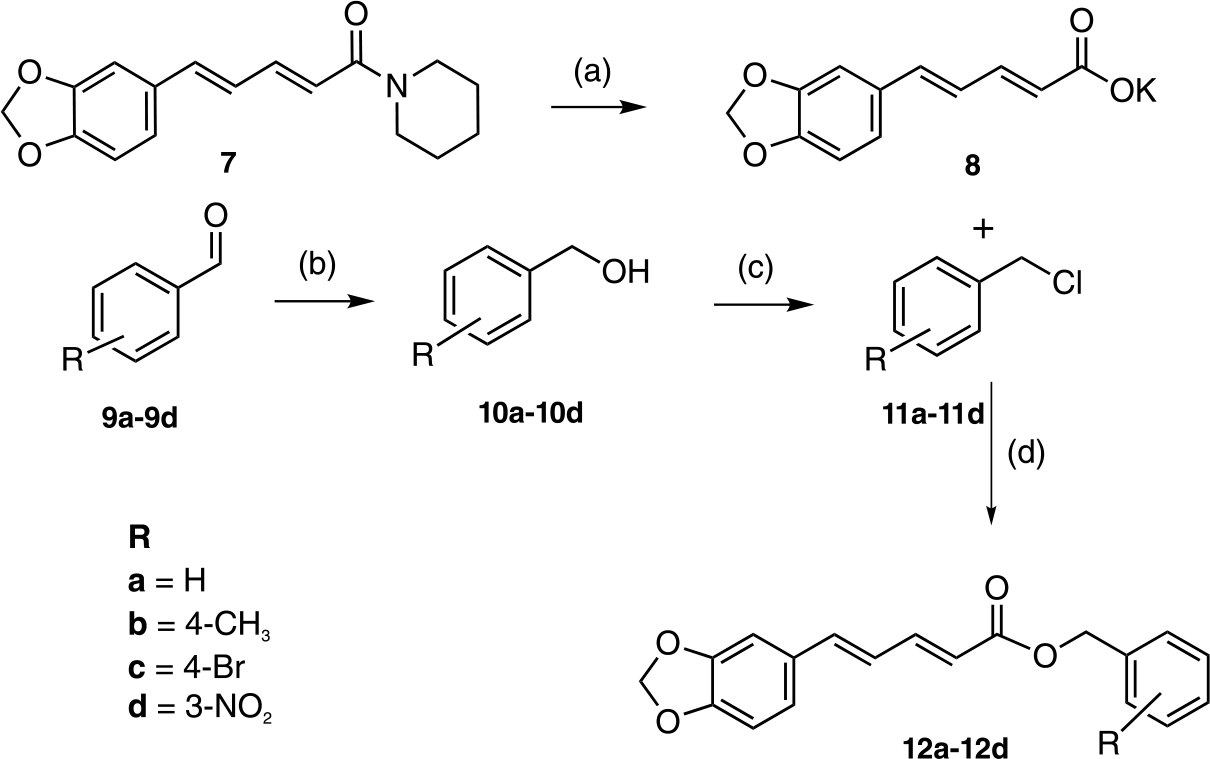
Substituted benzyl chlorides were first prepared as key intermediates for the synthesis of the piperine-derived esters. These compounds were obtained via halogenation of substituted benzyl alcohols using thionyl chloride (SOCl2) in dichloromethane (CH2Cl2) under magnetic stirring at room temperature for 3 h, providing yields ranging from 44 to 72% (shown in Scheme 1).
Synthetic route for the preparation of piperine-derived esters (compounds 12a-12d). Reagents and conditions: (a) 20% alcoholic KOH solution, 20 h, reflux; yield 92% (b) NaBH4, CH3OH, rt (room temperature), 1 h, yield 83-94%; (c) SOCl2, CH2Cl2, rt, 20 h, yield 44-70%; (d) DMF, 80 °C, 1 h, yield 45-70%.
All substituted benzyl chlorides (compounds 11a-11d) were obtained as colorless liquids at room temperature, consistent with their commercial physical state. The final ester derivatives (compounds 12a-12d) were synthesized according to a nucleophilic substitution reaction adapted from Trindade et al.9 A mixture of potassium piperate (compound 8) and the substituted benzyl chlorides was refluxed in DMF at 80 °C for 1 h. Upon completion, the reaction mixtures were cooled, ice-cold water was added, and the crude precipitate was filtered and recrystallized from ethanol (EtOH) to provide the final piperine-based esters in yields ranging from 38 to 68%.
Structural elucidation of all synthesized compounds was confirmed by IR, 1H, and 13C NMR spectroscopy. The IR spectra consistently showed characteristic absorptions of ester C=O stretching near 1700 cm-1, aromatic C=C bands between 1620-1500 cm-1, and C-O stretching around 1250 cm-1, confirming successful esterification. In the 1H NMR spectra, all compounds displayed signals corresponding to trans-olefinic protons (J 15 Hz), aromatic multiplets between d 7.0-7.5 ppm, and a singlet for the methylenedioxy group around d 5.9 ppm. The benzylic methylene protons appeared between d 5.0-5.2 ppm, indicating formation of the ester linkage. In the 13C NMR spectra, the carbonyl carbons were observed around d 167 ppm, with aromatic carbons between d 110-150 ppm and the methylenedioxy carbon near d 101 ppm. Altogether, the spectroscopic data were consistent with the proposed structures for both ester and heterocyclic series and aligned with literature reports.9,17,18
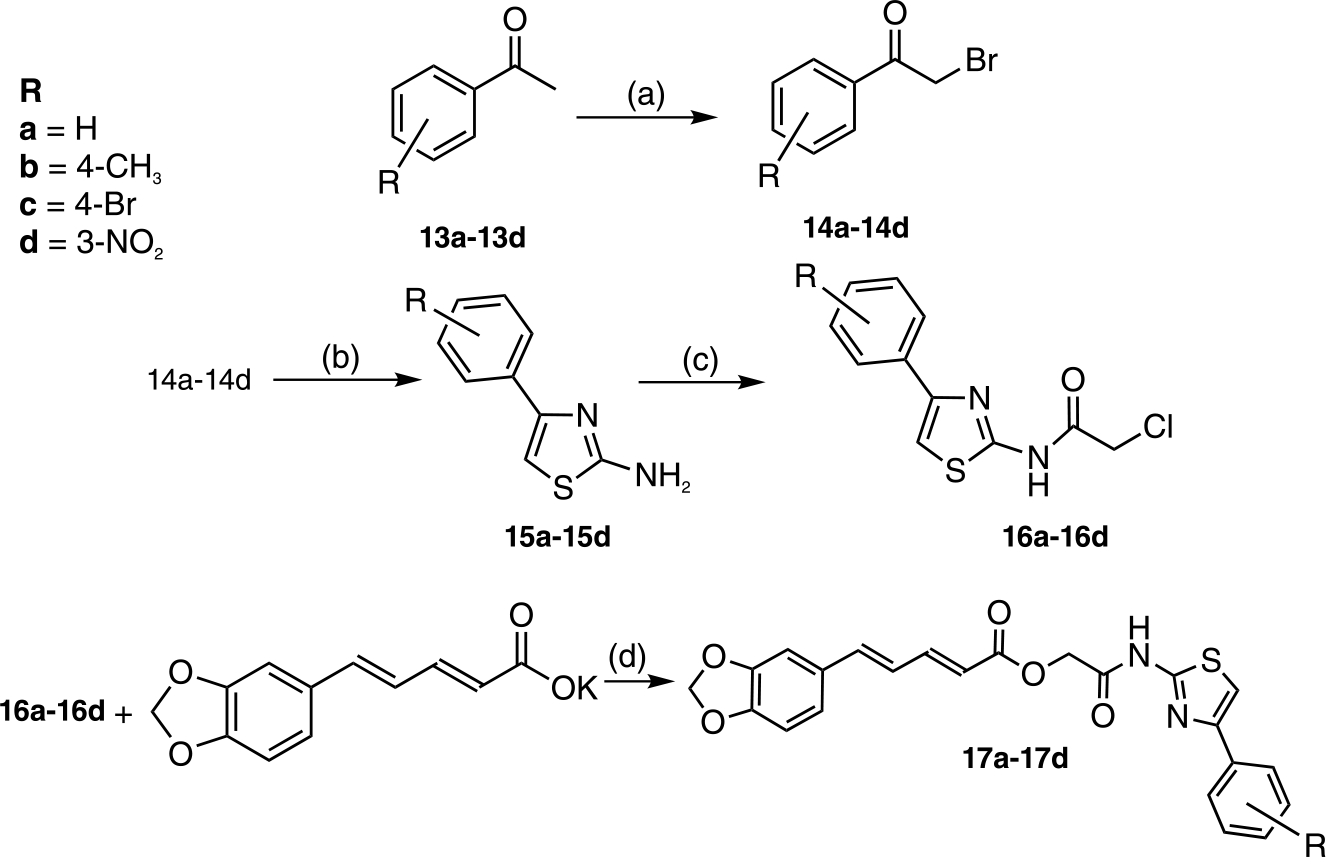
The heterocyclic piperine derivatives (compounds 17a-17d) were synthesized through a four-step sequence starting from substituted acetophenones, as shown in Scheme 2. In the first step, aryl acyl bromides (compounds 14a-14d) were obtained via α-bromination of substituted acetophenones (compounds 13a-13d) using bromine in dichloromethane at room temperature, following the procedure described by Souza Jr. et al.,20 affording yields between 63 and 97% (shown in Scheme 2).
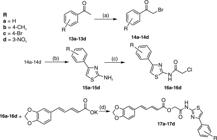
General synthetic route to heterocyclic piperine derivatives (compounds 17a-17d). Reagents and conditions: (a) Br2, CH2Cl2, 0 °C, rt, 24 h, yield 63-97%; (b) thiourea, ethanol, reflux, 20 h, yield 63-88%; (c) ClCH2COCl, Et3N, CH2Cl2, 0 °C, rt, 20 h, yield 42-71%; (d) DMF, 80 °C, 1.5-2.5 h, yield 31-63%.
In the second step, the 2-amino-4-(aryl)-1,3-thiazoles (compounds 15a-15d) were prepared through a modified Hantzsch condensation of the α-bromoacetophenones with thiourea in ethanol at 75 °C for 12 h.45 Yielding solid products in 63-90% yield. The third step involved acylation of the obtained thiazoles with 2-chloroacetyl chloride to produce the intermediates N-(arylthiazol-2 yl)-2-chloroacetamides (compounds 16a-16d) in 42-71% yield. The acylation was carried out at room temperature under basic conditions using triethylamine as a base, and the products were isolated as crystalline solids after recrystallization.
Finally, the target heterocyclic piperine derivatives (compounds 17a-14d) were synthesized by nucleophilic substitution between potassium piperate and the N-(arylthiazol-2-yl)-2-chloroacetamides, following the methodology of Trindade et al.9 The reaction was performed in DMF at 80 °C for 90-150 min depending on the substituent, yielding the final compounds solids with yields ranging from 31 to 63%.
All compounds were characterized by IR, 1H and 13C NMR spectroscopy, which confirmed the expected structural features. In the IR spectra, characteristic absorptions were observed for the ester and amide carbonyl groups at approximately 1700 and 1650 cm-1, respectively, together with a broad N-H stretching band near 3200 cm-1 and C-O/C-N stretching vibrations in the 1300-1000 cm-1 region. Additional C-S-C and C-N bands confirmed the presence of the thiazole ring. In the 1H NMR spectra, all compounds displayed two characteristic singlets: one at d 4.9 ppm corresponding to the methylene protons linking the piperate and heterocyclic moieties, and another at d 12.6 ppm attributed to the amide N-H proton. The aromatic and olefinic protons resonated in the range d 7.5-6.2 ppm, consistent with the piperine framework. In the 13C NMR spectra, signals at d 165-167 ppm were assigned to the ester carbonyl carbon, and those between d 157 148 ppm to the C=N and C-S carbons of the thiazole ring. A distinct resonance at d 61.8 ppm confirmed the presence of the methylene carbon (C-CH2-O) acting as the linkage between the piperate portion and the heterocyclic ring system.46
Drug-like character evaluation
To develop novel molecules with pharmacological potential, in addition to the synthetic steps, it is necessary to carry out theoretical studies that allow the evaluation of important characteristics such as permeability, selectivity, and toxicity. For this purpose, the pharmacokinetic parameters absorption, distribution, metabolism, and excretion (ADME) are used, which can be predicted through in silico studies based on calculations of physicochemical properties such as lipophilicity (log P) and water solubility (log S).47,48
For a compound to be considered a drug, its physicochemical properties and pharmacokinetic parameters must be similar to those of existing compounds. Among these studies, it is worth highlighting the one carried out by Lipinski et al.,49 who proposed the so-called Rule of Five, a set of parameters that reflect the most common structural characteristics of orally active drugs. In this study, the physicochemical and pharmacokinetic parameters of the synthesized compounds were predicted using SwissADME,42 as summarized in Table 1.
Physicochemical properties and ADME prediction for piperine derivatives (compounds 12a-12d and 17a-17d)
All synthesized molecules (compounds 12a-12d and 17a-17d) exhibited favorable physicochemical and ADME characteristics, meeting the criteria established by Lipinski49 and Veber, suggesting good oral bioavailability. The compounds displayed molecular weights between 308.33 and 513.36 g mol-1, low numbers of hydrogen bond donors (0-1) and acceptors (4-8), and number of rotatable bonds (TPSA) values below or close to 140 Å2, all of which support high membrane permeability.48 Predicted intestinal absorption ranged from 60 to 95%, confirming adequate drug-like behavior for both ester and heterocyclic derivatives.
Regarding lipophilicity and solubility, all compounds showed moderate log P values (3.01-4.59) and log S values between -4.42 and -6.62, typical of molecules with good permeability but limited aqueous solubility. In general, electron-donating substituents (-CH3) increased hydrophobicity, while electron-withdrawing groups (-NO2, -Br) enhanced polarity and interaction with biological targets. This polarity-lipophilicity balance likely contributes to the observed antimicrobial behavior, as more polar compounds may interact more effectively with bacterial or fungal membranes.
Most compounds were predicted to act as CYP1A2 and CYP2C19 inhibitors, consistent with their aromatic and heteroaromatic frameworks that favor π-π interactions within the hydrophobic cavities of the enzyme. Exceptions such as compound 17b (methyl) and compound 17d (nitro) illustrate how small electronic and steric changes can alter enzyme recognition, influencing metabolic stability. Altogether, the in silico results suggest that moderately lipophilic piperine-derived scaffolds combine suitable pharmacokinetic properties with potential biological activity, providing a rational basis for the antimicrobial and modulatory effects observed experimentally.
Biological study
Antibacterial activity
The in vitro antimicrobial activity of the synthesized compounds was evaluated against a panel of Gram-positive and Gram-negative bacteria. Chloramphenicol was used as reference antibiotic standards (Table 2).
MIC for piperine derivatives (compounds 12a-12d, 17a-17d) using chloramphenicol as reference antibiotic standards
According to Table 2, all evaluated compounds exhibited variable degrees of antibacterial activity depending on the nature of the substituent (R’) and the bacterial strain tested. When the results are analyzed on a molar basis (µM), a more reliable structure-activity relationship (SAR) emerges, particularly considering the significant molecular weight differences between the ester (compounds 12a-12d) and heterocyclic (compounds 17a-17d) series.
Among the piperine-derived esters (compounds 12a-12d), the brominated derivative compound 12c (R’ = 4-Br) demonstrated the most favorable inhibitory profile within this series. Compound 12c inhibited S. aureus strains with MIC values of approximately 330.6 µM and P. aeruginosa with a MIC of 330.6 µM, while showing moderate activity against E. coli strains (ca. 660 µM). In contrast, the unsubstituted compound 12a (R’ = H) and the methyl-substituted analogue compound 12b (R’ = CH3) exhibited markedly weaker activity, with MIC values generally exceeding 1660.6-3321.1 µM, indicating substantially reduced potency. These results suggest that halogen substitution plays a key role in enhancing antibacterial performance, likely by improving membrane permeability and modulating electronic interactions with bacterial targets.
The nitro-substituted ester compound 12d (R’ = 3-NO2) displayed selective activity primarily against Gram positive S. aureus strains, with MIC values around 1933.0 2898.1 µM, while remaining largely inactive against Gram-negative bacteria. This behavior supports the notion that strongly electron-withdrawing groups may influence bacterial redox balance or intracellular pathways, but excessive polarity can limit penetration through the outer membrane of Gram-negative species.51
For the heterocyclic thiazole-acetamide derivatives (compounds 17a-17d), the introduction of the heterocyclic scaffold significantly altered biological behavior. In this series, the nitro-substituted compound 17d (R’ = 3-NO2) exhibited the most consistent antibacterial activity, inhibiting multiple S. aureus, E. coli, and P. aeruginosa strains with MIC values around 267.0 µM. The brominated analogue compound 17c (R’ = 4-Br) also showed improved activity relative to other heterocyclic derivatives, particularly against S. aureus ATCC 25923 (498.7 µM). In contrast, the unsubstituted and methylated analogues compounds 17a-17b were essentially inactive, with MIC values exceeding 2000 µM.
Heterocycles such as thiazole, which contain sulfur and nitrogen atoms within an aromatic π-electron system, possess delocalized lone pairs that confer high electronic density and versatile reactivity.52 This electronic arrangement enhances the ability of such compounds to engage in π-π stacking, hydrogen bonding, and coordination interactions with microbial enzymes and membrane-associated proteins. Consequently, the combination of a thiazole core with electron-withdrawing substituents, as observed for compounds 17c and 17d, appears to be particularly favorable for antibacterial activity.53
According to Souza et al.,54 the antimicrobial activity of glycolic amides and related analogues is strongly influenced by the electronic nature of aromatic substituents, with electron-withdrawing groups leading to lower MIC values and improved potency against S. aureus and E. coli. A similar trend is observed in the present study when MIC values are compared in molar units: the brominated and nitro-substituted heterocyclic derivatives (compounds 17c and 17d) displayed the lowest MIC values (ca. 267.0 498.7 µM), whereas unsubstituted or methylated derivatives remained weakly active or inactive.
Although lipophilicity is often considered a key determinant of antimicrobial activity, the present results corroborate previous observations that lipophilicity alone is insufficient to ensure potency or efflux pump modulation.55 Instead, a delicate balance between lipophilicity and electronic effects appears to govern antibacterial efficacy. Electron-withdrawing substituents can enhance polarity-driven interactions, such as electrostatic and hydrogen-bonding contacts with bacterial targets or efflux transporters, particularly in heterocyclic systems like the thiazole-acetamide derivatives studied here.
When compared with analogous piperine-derived amides previously reported by Trindade et al.,9 a notable structural difference in the present ester series (compounds 12a-12d) is the nature of the linker connecting the piperic core to the aromatic moiety. Piperine-based amides containing extended aliphatic spacers did not exhibit antibacterial activity at comparable concentrations, whereas the esterified analogues described here demonstrated measurable activity, even if moderate. This suggests that esterification may favor a more suitable balance between polarity and lipophilicity, facilitating membrane permeation and target interaction.
It is important to emphasize that, although all synthesized compounds were less potent than the reference antibiotic chloramphenicol (MIC ca. 396.1-792.3 µM, depending on the strain), the nitroand halogen-substituted derivatives (compounds 12c, 17c, and 17d) consistently outperformed other members of their respective series when evaluated on a molar basis. These findings support the conclusion that the present compounds should be regarded as moderately active molecules that serve as promising starting points for further structural optimization, rather than fully optimized antibacterial agents. Together with their favorable in silico ADME profiles, the results highlight nitroand halogenated piperine hybrids as valuable scaffolds for the rational development of new antimicrobial and resistance-modulating agents.
Antibiotic modulation assay
In addition to evaluating the intrinsic antimicrobial activity, the synthesized compounds were assessed for their ability to modulate the action of conventional antibiotics, specifically amikacin and gentamicin, against S. aureus (ATCC 25923), E. coli (ATCC 25226), and P. aeruginosa (ATCC 25853) strains (Tables 3 and 4). In the antibiotic modulation assays, MIC values were expressed in micromolar units (µM) based on the molecular weight of the antibiotic, since the tested compounds were used at fixed subinhibitory concentrations and did not vary during the assay. These assays aimed to determine whether the compounds could enhance the effectiveness of standard antibiotics by acting as adjuvants or efflux pump inhibitors.
Antibiotic modulation assay for piperine derivatives (compounds 12a-12d, 17a-17d) with amikacin
According to Table 3, when expressed in molar concentrations (µM), the combination of piperine-derived compounds with amikacin resulted in a marked reduction of the antibiotic MIC compared with the control (amikacin alone: 437.2 µM for S. aureus, 218.6 µM for E. coli, and 145.2 µM for P. aeruginosa). Among the ester derivatives, the nitro-substituted compound 12d (R = 3-NO2) showed the most pronounced modulatory effect against S. aureus, reducing the effective concentration of amikacin to 54.6 µM, which corresponds to an almost eight-fold enhancement relative to the antibiotic alone. Relevant potentiation was also observed against E. coli and P. aeruginosa, with MIC values reduced to approximately 109.5 and 54.6 µM, respectively, indicating that the nitro substituent contributes to improved modulation efficiency across distinct bacterial profiles.56
The brominated heterocyclic derivative compound 17c (R = 4-Br) also demonstrated significant potentiation, particularly against P. aeruginosa, where the amikacin MIC was reduced to approximately 22.2 µM, representing a marked improvement when compared with the control. In molar terms, this effect is more pronounced than that observed for most ester derivatives, suggesting that the combination of the thiazole-acetamide moiety with a halogen substituent favors synergistic interactions in Gram-negative bacteria with strong intrinsic resistance.57 In contrast, the unsubstituted (compound 17a) and methyl-substituted (compound 17b) heterocyclic derivatives showed only reductions in MIC values (approximately 218.6-292.0 µM), indicating a less efficient modulatory effect.
Overall, the analysis in molar units confirms that electron-withdrawing substituents (-NO2 and -Br) confer a clear advantage in amikacin modulation, although the magnitude of the effect depends on both the nature of the substituent and the molecular scaffold. Importantly, comparison in µM demonstrates that the observed synergy is scaffold-dependent rather than a simple consequence of molecular weight differences.58 The superior performance of compounds 12d and 17c highlights their potential role as antibiotic adjuvants, capable of enhancing aminoglycoside efficacy against multidrug-resistant Gram-positive and Gram-negative bacteria through mechanisms likely involving improved membrane interactions and interference with resistance pathways, such as efflux or enzymatic modification.
According to Table 4, in the gentamicin modulation assay against S. aureus (ATCC 25923), several piperine-derived compounds markedly enhanced the activity of the antibiotic when compared with the control (gentamicin alone, MIC = 571.9 µM). Among the ester derivatives (compounds 12a-12d), the compounds 12c (R = 4-Br) and 12d (R = 3-NO2) exhibited the most pronounced modulatory effects, reducing the MIC to approximately 286.0 µM for both derivatives. These values correspond to a clear two fold improvement in antibacterial potency on a molar basis, indicating that electron-withdrawing substituents such as bromine and nitro groups favor antibiotic potentiation, likely by enhancing compound-membrane interactions or facilitating intracellular access.
The heterocyclic derivatives (compounds 17a-17d) also demonstrated notable modulation. In particular, the compound 17a (R = 4-H) reduced the gentamicin MIC to 189.9 µM, outperforming several substituted analogues despite the absence of strong electronic substituents. Compounds 17b-17d (R = 4-CH3, 4-Br, 3-NO2) displayed MIC values in the range of 249.0-286.0 µM, comparable to those observed for the halogenated and nitro-substituted esters. These results indicate that both electronic and structural factors govern modulation efficiency: while electron-withdrawing groups contribute to enhanced molecular interactions, the thiazole-acetamide scaffold appears to play a key role in optimizing spatial orientation and binding with bacterial membrane components and intracellular targets.26
In the gentamicin modulation assay against E. coli (ATCC 25226), all tested piperine-derived compounds improved antibiotic performance relative to the control (gentamicin alone, MIC = 143.0 µM). Among the ester derivatives, compound 12c (R = 4-Br) showed the strongest synergistic effect, reducing the MIC to approximately 71.5 µM, representing a clear two-fold improvement in antibacterial potency on a molar scale. The methylated (compound 12b, 96.1 µM) and unsubstituted (compound 12a, 118.4 µM) esters also potentiated gentamicin activity, whereas the nitro-substituted compound 12d (118.4 µM) exhibited a comparable modulatory profile, suggesting a balanced contribution of electronic and steric effects in Gram-negative modulation.
Among the heterocyclic analogues, the compounds 17b (R = 4-CH3) and 17d (R = 3-NO2) showed the greatest potentiating effects, reducing the MIC to approximately 96.1 and 90.0 µM, respectively. Compounds 17a (R = 4-H) and 17c (R = 4-Br) maintained MIC values around 143.0 µM, comparable to the antibiotic control. These findings indicate that incorporation of the thiazole-acetamide moiety subtly alters the modulation profile, likely due to increased molecular rigidity and redistribution of polarity, which can affect membrane interaction and efflux pump inhibition efficiency.59
In the gentamicin modulation assay against P. aeruginosa (ATCC 25853), all piperine-derived compounds substantially enhanced antibiotic activity compared with the control (gentamicin only, MIC = 35.7 µM). Among the ester derivatives (compounds 12a-12d), the compound 12a (R = 4-H) exhibited the most pronounced potentiation, reducing the MIC to approximately 8.9 µM, corresponding to a four-fold improvement in antibacterial efficacy on a molar basis. The methylated derivative compound 12b (15.6 µM) also showed strong modulation, whereas compounds 12c (60.3 µM) and 12d (118.4 µM) displayed less pronounced effects, indicating that excessive polarity or steric bulk may partially compromise synergy in this intrinsically resistant Gram-negative strain.
For the heterocyclic derivatives (compounds 17a-17d), the compounds 17b (R = 4-CH3) and 17c (R = 4-Br) demonstrated the strongest modulation, lowering the MIC to approximately 24.6 µM and 29.0 µM, respectively. Compounds 17d (35.7 µM) and 17a (71.5 µM) exhibited more effects, comparable to or slightly weaker than the antibiotic control. These results highlight that the thiazole-acetamide heterocycle contributes positively to antibiotic potentiation, likely through improved lipophilicity and enhanced interaction with efflux transport systems, which play a central role in aminoglycoside resistance in P. aeruginosa.
Taken together, these results demonstrate that both ester and heterocyclic piperine-derived compounds are capable of synergistically enhancing gentamicin activity against P. aeruginosa and other clinically relevant bacteria when evaluated on a molar basis. The most effective derivatives combine balanced lipophilicity with moderate polarity, promoting antibiotic retention and intracellular accumulation. Such outcomes reinforce the potential of these molecules as chemosensitizing agents capable of disrupting efflux-related resistance mechanisms in highly drug-resistant Gram-negative pathogens.
Efflux pump inhibition assay
To better understand the mechanism underlying the antibacterial modulation observed in the previous assays, the heterocyclic derivatives compounds 17c (R = 4-Br) and 17d (R = 3-NO2) were selected for further evaluation of their ability to inhibit efflux pumps in multidrug-resistant (MDR) S. aureus strains, namely K2068 (NorA overexpressing) and 1199B (MsrA-overexpressing) (Table 5). Efflux pumps play a central role in bacterial multidrug resistance by actively expelling structurally diverse antibiotics and reducing their intracellular concentrations.56 Consequently, the identification of compounds capable of interfering with these transport systems represents a promising strategy to restore antibiotic susceptibility.
The selection of compounds 17c and 17d was not based solely on their intrinsic antibacterial activity, but rather on a convergent analysis of their biological profiles across multiple assays, including direct antibacterial screening, antibiotic modulation experiments, and structure-activity considerations. As shown in Table 2, both compounds exhibited measurable antibacterial activity against S. aureus strains, with compound 17c showing the lowest MIC among the heterocyclic derivatives against S. aureus ATCC 25923, and compound 17d displaying consistent inhibition across distinct S. aureus strains (ATCC 13150 and LM-258). Although these MIC values indicate intrinsic activity, they suggested that both molecules interact effectively with Gram-positive bacterial cells.
From a structural perspective, the compounds 17c and 17d represent complementary electronic extremes within the heterocyclic series. Compound 17c, bearing a para bromo substituent, combines increased lipophilicity with the thiazole-acetamide framework, favoring membrane partitioning and interaction with hydrophobic regions of efflux transporters. In contrast, compound 17d, containing a meta-nitro group, introduces enhanced polarity and hydrogen-bonding capacity, which may facilitate interactions with polar residues lining the efflux pump channel or regulatory sites. This balance between hydrophobic and polar features is frequently associated with effective efflux pump inhibition and antibiotic chemosensitization.
Although other compounds in the series, such as compound 12c or compound 12d, showed relevant modulation effects in combination assays, the choice of compounds 17c and 17d was further supported by the presence of the thiazole-acetamide moiety, a structural motif previously associated with efflux pump inhibition and resistance modulation in Gram-positive bacteria.60 Taken together, their consistent modulatory behavior, complementary physicochemical properties, and favorable performance across independent assays justified their selection as lead candidates for mechanistic evaluation of efflux pump inhibition in MDR S. aureus strains.
Both compounds exhibited weak intrinsic antibacterial activity, with MIC values of 512 µg mL-1 (ca. 998 µM) for compound 17c and 1024 µg mL-1 (ca. 2135 µM) for compound 17d, indicating that they do not act as bactericidal agents per se at low molar concentrations. However, when evaluated in combination with norfloxacin, a substantial reduction in the antibiotic MIC was observed, supporting a resistance-modulating rather than a direct antibacterial mechanism.
For S. aureus K2068 (NorA-overexpressing), the norfloxacin MIC decreased from 32 µg mL-1 (ca. 100.2 µM) in the control to 13 µg mL-1 (ca. 40.7 µM) in the presence of compound 17c and to 16 µg mL-1 (ca. 50.1 µM) with compound 17d, corresponding to an approximately twoto threefold potentiation of antibiotic activity on a molar basis.
Similarly, for the S. aureus 1199B strain (MsrA overexpressing), compound 17d reduced the norfloxacin MIC from 128 µg mL-1 (ca. 400.5 µM) to 85.3 µg mL-1 (ca. 267.0 µM), indicating a consistent modulatory effect on the MsrA-mediated efflux system. The reference efflux pump inhibitor CCCP produced reductions of comparable magnitude, decreasing the norfloxacin MIC from 32 to 16 µg mL-1 (ca. 100.2 to 50.1 µM) for K2068 and from 128 to 64 µg mL-1 (ca. 400.5 to 200.3 µM) for 1199B, thereby validating the experimental conditions and confirming the suitability of the assay to detect efflux inhibition.
Taken together, these results confirm that compounds 17c and 17d act as effective efflux pump inhibitors (EPIs), particularly against resistance mechanisms mediated by NorA and MsrA. From a structural standpoint, both molecules share a heterocyclic thiazole-acetamide core, which increases polarity and enables hydrogen-bonding interactions with residues located within transmembrane transporter channels.61 The para-bromo substituent in compound 17c enhances lipophilicity, favoring penetration into the lipid bilayer and interaction with hydrophobic regions of the efflux protein,62 whereas the meta-nitro group in compound 17d introduces a strong electron-withdrawing effect that reinforces dipole-dipole and π-π interactions within the transporter pocket.63 This complementary balance between hydrophobic and polar features likely underlies their inhibitory efficiency at micromolar concentrations.
Altogether, the data demonstrate that compounds 17c and 17d function primarily as antibiotic adjuvants capable of re-sensitizing resistant S. aureus strains to fluoroquinolone antibiotics. Their dual behavior, moderate direct antimicrobial activity combined with significant efflux pump inhibition at micromolar levels, highlights the potential of these piperine-thiazole hybrids as promising leads for the development of multifunctional antimicrobial agents designed to suppress bacterial resistance mechanisms.
Conclusions
Driven by the search for novel antimicrobial and antibiotic-modulating agents inspired by natural scaffolds, a new series of ester and heterocyclic piperine derivatives was designed and successfully synthesized in moderate to good yields (31-70%). In silico pharmacokinetic analysis showed that the compounds are largely consistent with Lipinski’s and Veber’s criteria, indicating favorable drug-like profiles in terms of lipophilicity, predicted absorption, and solubility. Although the intrinsic antibacterial activities were moderate when expressed on a molar basis, clear and reproducible structure-activity relationships emerged. In particular, brominated and nitro-substituted derivatives consistently outperformed unsubstituted and methylated analogues, highlighting the key role of electron-withdrawing substituents in enhancing membrane interaction and target engagement.
From a SAR perspective, three main trends can be identified: (i) electron-withdrawing substituents improve biological performance in both ester and heterocyclic series; (ii) introduction of the thiazole-acetamide moiety favors antibiotic modulation and efflux pump inhibition rather than direct bactericidal activity; and (iii) increases in molecular weight negatively impact intrinsic antibacterial potency when evaluated in micromolar terms. Together, these trends clearly indicate that the synthesized compounds are better positioned as starting points for structural optimization rather than as fully optimized antibacterial agents.
Beyond their direct antimicrobial effects, several derivatives acted as effective modulators of antibiotic activity, significantly potentiating gentamicin and amikacin against resistant Gram-positive and Gram-negative strains. Notably, the heterocyclic derivatives compounds 17c and 17d displayed a pronounced ability to inhibit bacterial efflux pumps, restoring the susceptibility of multidrug-resistant Staphylococcus aureus strains overexpressing NorA and MsrA to fluoroquinolone antibiotics at micromolar concentrations. This behavior underscores the relevance of the thiazole-acetamide framework as a privileged structural motif for efflux pump inhibition and resistance modulation.
Collectively, these findings reveal a dual pharmacological profile for the synthesized piperine derivatives, characterized by moderate intrinsic antibacterial activity combined with significant antibiotic-modulating and efflux-inhibitory properties. Rather than acting as standalone antibiotics, these compounds represent promising lead scaffolds and non-toxic adjuvants for future medicinal chemistry optimization. This study therefore provides a solid molecular basis for the rational development of multifunctional piperine-based hybrids aimed at overcoming bacterial resistance mechanisms.
Supplementary Information
Supplementary information (spectroscopic data, and additional biological assay tables) is available free of charge at http://jbcs.sbq.org.br as file.
Acknowledgments
The authors gratefully acknowledge the financial support provided by CAPES, grant 1192/2021, FAPESQ, and CNPq. The authors also thank the Laboratory of Microbiology and Molecular Biology (LMBM/URCA), the Department of Microbiology (DM/Estácio Faculty of Medicine of Juazeiro do Norte) and the Department of Pharmaceutical Sciences (DCF), Health Sciences Center (CCS), Federal University of Paraíba (UFPB) for providing research infrastructure and technical support.
The authors declare that artificial intelligence tools were used exclusively to assist in the organization, language revision, and clarity improvement of the manuscript text. The use of these tools did not influence the scientific content, experimental design, data analysis, or interpretation of results. All conclusions, data accuracy, and final responsibility for the manuscript content remain entirely with the authors.
Data Availability Statement
All data supporting the findings of this study are available within the article and SI section. Additional datasets generated and/or analyzed during the current study are available from the corresponding author upon reasonable request.
References
-
1 Puri, B.; Vaishya, R.; Vaish, A.; Med. J. Armed Forces India 2025, 81, 247. [Crossref]
» Crossref -
2 Sharma, S.; Chauhan, A.; Ranjan, A.; Mathkor, D. M.; Haque, S.; Ramniwas, S.; Yadav, V.; Front. Microbiol. 2024, 15, 1403168. [Crossref]
» Crossref -
3 Lorente-Torres, B.; Llano-Verdeja, J.; Castañera, P.; Ferrero, H. Á.; Fernández-Martínez, S.; Javadimarand, F.; Mourenza, Á.; Antibiotics 2024, 13, 834. [Crossref]
» Crossref -
4 Banday, A. H.; ul Azha, N.; Farooq, R.; Sheikh, S. A.; Ganie, M. A.; Parray, M. N.; Lone, M. A.; Phytochem. Lett. 2024, 59, 124. [Crossref]
» Crossref -
5 Saha, M.; Chatterjee, S.; Int. J. Pharm. Sci. Rev. Res. 2024, 15, 1036. [Crossref]
» Crossref -
6 Dhargawe, N.; Mahakalkar, S.; Mohod, B.; Raj, J. P.; Pharmacogn. Res. 2020, 12, 176. [Crossref]
» Crossref -
7 Tripathi, A. K.; Ray, A. K.; Mishra, S. K.; Beni-Suef Univ. J. Basic Appl. Sci. 2022, 11, 16. [Crossref]
» Crossref -
8 Qin, B.; Yang, K.; Cao, R.; J. Chem. 2020, 2020, 2786359. [Crossref]
» Crossref -
9 Trindade, E. O.; Souza, H. D. S.; Brandão, M. C. R.; Neto, H. D.; Lima, E. O.; Lira, B. F.; de Athayde-Filho, P. F.; Barbosa-Filho, J. M.; J. Braz. Chem. Soc. 2020, 31, 1668. [Crossref]
» Crossref -
10 Wang, X. J.; Qiao, Y.; Wang, X. S.; Zhang, S. Y.; Li, H. X.; Hao, H. H.; Liu, B.; Fitoterapia 2024, 177, 106118. [Crossref]
» Crossref -
11 Peixoto, P.; Guedes, J. F.; Rombi, E.; Fonseca, A. M.; Aguiar, C. A.; Neves, I. C.; Ind. Eng. Chem. Res. 2021, 60, 12883. [Crossref]
» Crossref -
12 Suyurdu, T. N.; Köksal, E.; Alp, C.; Hacet. J. Biol. Chem. 2025, 53, 21. [Crossref]
» Crossref -
13 Chopra, B.; Dhingra, A. K.; Prasad, D. N.; Bhardwaj, S.; Dubey, S.; Curr. Comput.-Aided Drug Des. 2020, 16, 281. [Crossref]
» Crossref -
14 Donka, S. B.; Kethineni, S.; Valaparla, B. Y.; Bheemreddy, A.; Meti, M. D.; More, U. A.; Doddaga, S.; Sci. Rep. 2025, 15, 33964. [Crossref]
» Crossref -
15 Sangwan, P. L.; Koul, J. L.; Koul, S.; Reddy, M. V.; Thota, N.; Khan, I. A.; Qazi, G. N.; Bioorg. Med. Chem. 2008, 16, 9847. [Crossref]
» Crossref -
16 Liu, Y.; Zhu, R.; Liu, X.; Li, D.; Guo, M.; Fei, B.; Li, Y.; Microb. Pathog. 2023, 185, 106397. [Crossref]
» Crossref -
17 Abd Halim, A. N.; Ngui Sing, N.; Ahad, N.; Zamakshshari, N. H.; ChemistrySelect 2025, 10, e02516. [Crossref]
» Crossref -
18 Joardar, N.; Shit, P.; Halder, S.; Debnath, U.; Saha, S.; Misra, A. K.; Babu, S. P. S.; Free Radic. Biol. Med. 2021, 169, 343. [Crossref]
» Crossref -
19 Tantawy, A. H.; Farag, S. M.; Hegazy, L.; Jiang, H.; Wang, M. Q.; Bioorg. Chem. 2020, 94, 103464. [Crossref]
» Crossref -
20 Souza Jr., J. S.; Martins, E. P. S.; Souza, H. D. S.; de Oliveira, R. F.; Alves, F. S.; Lima, E. O.; Cordeiro, L. V.; Trindade, E. O.; Lira, B. F.; Rocha, G. B.; de Athayde-Filho, P. F.; Barbosa-Filho, J. M.; J. Braz. Chem. Soc. 2021, 32, 490. [Crossref]
» Crossref -
21 Sharifi, F.; Mohamadi, N.; Afgar, A.; Oliaee, R. T.; Exp. Parasitol. 2023, 254, 108607. [Crossref]
» Crossref -
22 De Sousa, N.; Silva, P. C. G.; Souza, H. D. S.; Costa, N. A. S.; Scotti, M. T.; Scotti, L.; de Athayde-Filho, P. F.; Barbosa-Filho, J. M.; NICE.XSM-07: North-Ibero-America Congress on Exp. & Simul. Methods; Valencia, Spain-Miami, USA, 2021. [Crossref]
» Crossref -
23 Tsopmene, U. J.; Tokam Kuaté, C. R.; Kayoka-Kabongo, P. N.; Bisso, B. N.; Metopa, A.; Mofor, C. T.; Dzoyem, J. P.; Scientifica 2024, 2024, 2025557. [Crossref]
» Crossref -
24 Chavarria, D.; Cagide, F.; Pinto, M.; Gomes, L. R.; Low, J. N.; Borges, F.; J. Mol. Struct. 2019, 1182, 298. [Crossref]
» Crossref -
25 Joshi, S.; Salahuddin; Mazumder, A.; Kumar, R.; Shabana, K.; Tyagi, S.; Khurana, N.; Curr. Top. Med. Chem. 2023, 23, 2394. [Crossref]
» Crossref -
26 Fernandes, P. A. S.; de Araújo, R. S. A.; Alencar, G. G.; Gonçalves, S. A.; de Araújo, G. A.; de Sousa Rodrigues, E. Y.; Alves, D. S.; de Almeida, R. S.; Oliveira-Tintino, C. D. M.; Sidrônio, M. G. S.; Rodrigues, V. S.; Padilha, E. K. A.; da Silva, E. F.; Nayarisseri, A.; da Silva, T. G.; Coutinho, H. D. M.; Mendonça, F. J. B.; Biochimie 2025, 221, 191. [Crossref]
» Crossref -
27 Jung, T. C.; Argouarch, G.; van De Weghe, P.; Catal. Commun. 2016, 78, 52. [Crossref]
» Crossref -
28 National Center for Biotechnology Information; 4-Methylbenzyl Alcohol [Link] accessed in January 2026
» Link -
29 National Center for Biotechnology Information; 4-Bromobenzyl Alcohol [Link] accessed in January 2026
» Link -
30 Skrypai, V.; Hurley, J. J.; Adler, M. J.; Eur. J. Org. Chem. 2016, 12, 2207. [Crossref]
» Crossref - 31 Zhuravlev, O. E.; Verolainen, N. V.; Voronchikhina, L. I.; Russ. J. Gen. Chem. 2010, 80, 1025.
-
32 Jakhar, K.; Makrandi, J. K.; Green Chem. Lett. Rev. 2008, 1, 219. [Crossref]
» Crossref -
33 Safaei-Ghomi, J.; Hajipour, A. R.; Org. Prep. Proced. Int. 2011, 43, 372. [Crossref]
» Crossref -
34 Rammurthy, B.; Swamy, P.; Naresh, M.; Srujana, K.; Durgaiah, C.; Sai, G. K.; Narender, N.; New J. Chem. 2017, 41, 5825. [Crossref]
» Crossref -
35 Wolf, L.; Quoos, N.; Mayer, J. C.; Souza, D.; Sauer, A. C.; Meichtry, L.; Dornelles, L.; Tetrahedron Lett. 2016, 57, 1031. [Crossref]
» Crossref -
36 Wang, Y.; Su, N.; Ye, L.; Ren, Y.; Chen, X.; Du, Y.; Li, Z.; Yue, B.; Tsang, S. C. E.; Chen, Q.; He, H.; J. Catal. 2014, 313, 113. [Crossref]
» Crossref -
37 Gonçalves, G. K. A.; Corrêa, T.; Pinto, C. B.; Ferreira, I. M.; Ellena, J.; Sousa, F. F. O.; Porto, A. L. M.; Quintero Jimenez, D. E.; SSRN preprint 2025. [Link] accessed in January 2026
» Link -
38 Cymit Química; 2-Thiazolamine-4-(4-methylphenyl) [Link] accessed in January 2026
» Link -
39 Mandvikar, A.; Hande, S. V.; Yeole, P.; Goswami, K.; Reddy, M. V. R.; Int. J. Pharm. Sci. Res. 2016, 7, 1480. [Crossref]
» Crossref -
40 Mishra, D.; Singh, R.; Rout, C.; Int. J. ChemTech Res. 2017, 10, 365. [Crossref]
» Crossref -
41 SwissADME; SwissDrugDesign [Link] accessed in January 2026
» Link -
42 OSIRIS Property Explorer. [Link] accessed in January 2026
» Link -
43 Coutinho, H. D. M.; Lôbo, K. M.; Bezerra, D. A. C.; Lobo, I.; Indian J. Pharmacol. 2008, 40, 3. [Crossref]
» Crossref - 44 Clinical and Laboratory Standards Institute (CLSI); Methods for Dilution Antimicrobial Susceptibility Tests for Bacteria That Grow Aerobically, CLSI document M07-A11, Approved Standard 11th ed.; CLSI: Wayne, PA, USA, 2018.
-
45 Lakhan, R.; Singh, O. P.; Agric. Biol. Chem. 1984, 48, 1441. [Crossref]
» Crossref -
46 Praveen, A. S.; Yathirajan, H. S.; Narayana, B.; Sarojini, B. K.; Med. Chem. Res. 2014, 23, 259. [Crossref]
» Crossref -
47 Kesicki, E. A.; Bailey, M. A.; Ovechkina, Y.; Early, J. V.; Alling, T.; Bowman, J.; Parish, T.; PLoS One 2016, 11, e0155209. [Crossref]
» Crossref -
48 Lipinski, C.; Lombardo, F.; Dominy, B.; Feeney, P.; Adv. Drug Delivery Rev. 1997, 23, 3. [Crossref]
» Crossref -
49 Lipinski, C. A.; Lombardo, F.; Dominy, B. W.; Feeney, P. J.; Adv. Drug Delivery Rev. 2012, 64, 4. [Crossref]
» Crossref -
50 Lipinski, C. A.; Drug Discovery Today Technol. 2004, 1, 337. [Crossref]
» Crossref -
51 Zhao, Y. H.; Abraham, M. H.; Le, J.; Hersey, A.; Luscombe, C. N.; Beck, G.; Sherborne, B.; Cooper, I.; Pharm. Res. 2002, 19, 1446. [Crossref]
» Crossref -
52 Khiratkar, N. M.; Patil, R. C.; Alotaibi, B. S.; Bhat, A. R.; Fahelelbom, K. M.; Hadda, T. B.; Tataringa, G.; ChemistrySelect 2025, 10, e02553. [Crossref]
» Crossref -
53 Rusu, A.; Moga, I. M.; Uncu, L.; Hancu, G.; Pharmaceutics 2023, 15, 2554. [Crossref]
» Crossref -
54 Souza, H. D.; de Sousa, R. P. D.; Lira, B. F.; Vilela, R. F.; Borges, N. H. P. B.; de Siqueira-Junior, J. P.; Lima, E. O.; Jardim, J. U. G.; da Silva, G. A. T.; Barbosa-Filho, J. M.; de Athayde Filho, P. F.; J. Braz. Chem. Soc. 2019, 30, 188. [Crossref]
» Crossref -
55 Zloh, M.; Kaatz, G. W.; Gibbons, S.; Bioorg. Med. Chem. Lett. 2004, 14, 881. [Crossref]
» Crossref -
56 Mushtaq, A.; Buensalido, J. A. L.; DeMarco, C. E.; Sohail, R.; Lerner, S. A.; In Practical Handbook of Microbiology; Green, L. H.; Gldman, E., eds.; CRC Press: Boca Raton, USA, 2021, p. 747-776. [Crossref]
» Crossref -
57 Nunes, R. S.; Vila-Viçosa, D.; Costa, P. J.; J. Am. Chem. Soc. 2021, 143, 4253. [Crossref]
» Crossref -
58 Abidin, A. Z.; Norrrahim, M. N. F.; Shakrin, N. N. S. M.; Ibrahim, B.; Abdullah, N.; Rashid, J. I. A.; Shah, N. A. A.; Heliyon 2024, 10, e32010. [Crossref]
» Crossref -
59 Laborda, P.; Molin, S.; Johansen, H. K.; Martínez, J. L.; Hernando-Amado, S.; World J. Microbiol. Biotechnol. 2024, 40, 226. [Crossref]
» Crossref -
60 Cascioferro, S.; Parrino, B.; Carobne, D.; Schillaci, D. Giovanetti, E.; Cirrincione, G.; Diana, P.; J. Med. Chem 2020, 63, 7923. [Crossref]
» Crossref -
61 Arshad, M. F.; Alam, A.; Alshammari, A. A.; Alhazza, M. B.; Alzimam, I. M.; Alam, M. A.; Mustafa, G.; Ansari, M. S.; Alotaibi, A. M. Alotaibi, A. A.; Kumar, S.; Asdaq, S. M. B.; Imram, M.; Deb, P. K.; Venugopala, K. N.; Jomah, S.; Molecules 2022, 27, 3994. [Crossref]
» Crossref -
62 Fahr, A.; van Hoogevest, P.; May, S.; Bergstrand, N.; Leigh, M. L.; Eur. J. Pharm. Sci. 2005, 26, 251. [Crossref]
» Crossref -
63 Chen, M. C.; Chen, D. G.; Chou, P. T.; ChemPlusChem 2021, 86, 11. [Crossref]
» Crossref
Edited by
-
Editor handled this article:
Giovanni Wilson Amarante (Executive)