 Concise Enantioselective Synthesis of the Antimitotic (+)-2,3,9-Trimethoxypterocarpan via Asymmetric Transfer Hydrogenation
Abstract
(+)-2,3,9-Trimethoxypterocarpan [(+)-PTC] is a naturally occurring isoflavonoid that exhibits potent antitumor activity, putatively acting through the inhibition of kinesin-5 (Eg5), a mechanism distinct from classic tubulin-targeting agents. However, its preclinical development has been severely hampered by supply limitations, as previous synthetic routes relied on inefficient racemic strategies requiring laborious chiral resolution. Herein, we report a concise, biomimetic, and enantioselective total synthesis of (+)-PTC that overcomes these challenges. The route features a robust ligand-free Suzuki cross-coupling in PEG-400 and utilizes a ruthenium-catalyzed asymmetric transfer hydrogenation coupled with dynamic kinetic resolution (ATH-DKR) as the key stereodefining step. Optimized conditions enabled the scale-up of the key reduction with a low catalyst loading (2 mol%), delivering the pterocarpan core with high optical purity (98% ee) and excellent diastereocontrol. The synthesis was completed in just six steps with 64% overall yield, securing a sustainable supply of the bioactive enantiomer for advanced biological validation and providing divergent access to optically pure isoflavanone analogues.
Keywords:
(+)-2,3,9-trimethoxypterocarpan; asymmetric transfer hydrogenation; dynamic kinetic resolution; total synthesis; antimitotic agent; kinesin-5 (Eg5)
Introduction
Natural products remain the cornerstone of cancer chemotherapy, providing the structural basis for a significant portion of clinically approved antimitotic agents, such as taxanes and vinca alkaloids.1 Among the privileged scaffolds inspired by biodiversity, pterocarpans, isoflavonoids characterized by a tetracyclic 6a,11a-dihydro-6H-benzofuro[3,2-c]chromene ring system, have emerged as promising leads due to their potent cytotoxicity and distinct mechanisms of action. Although the (-)-enantiomer of 2,3,9-trimethoxypterocarpan was first reported2 from pea epicotyls (Pisum sativum) infected with Fusarium solani, the bioactive (+)-2,3,9-trimethoxypterocarpan [(+)-1 or (+)-PTC] was subsequently isolated from the heartwood of the Brazilian tree Platymiscium floribundum (Fabaceae).3 This enantiomer was identified as a potent antiproliferative agent against several human tumor cell lines, including leukemia (HL-60), glioblastoma (SF-295), and ovarian cancer (OVCAR-8), with half-maximal inhibitory concentration (IC50) values in the sub-micromolar range.3-5
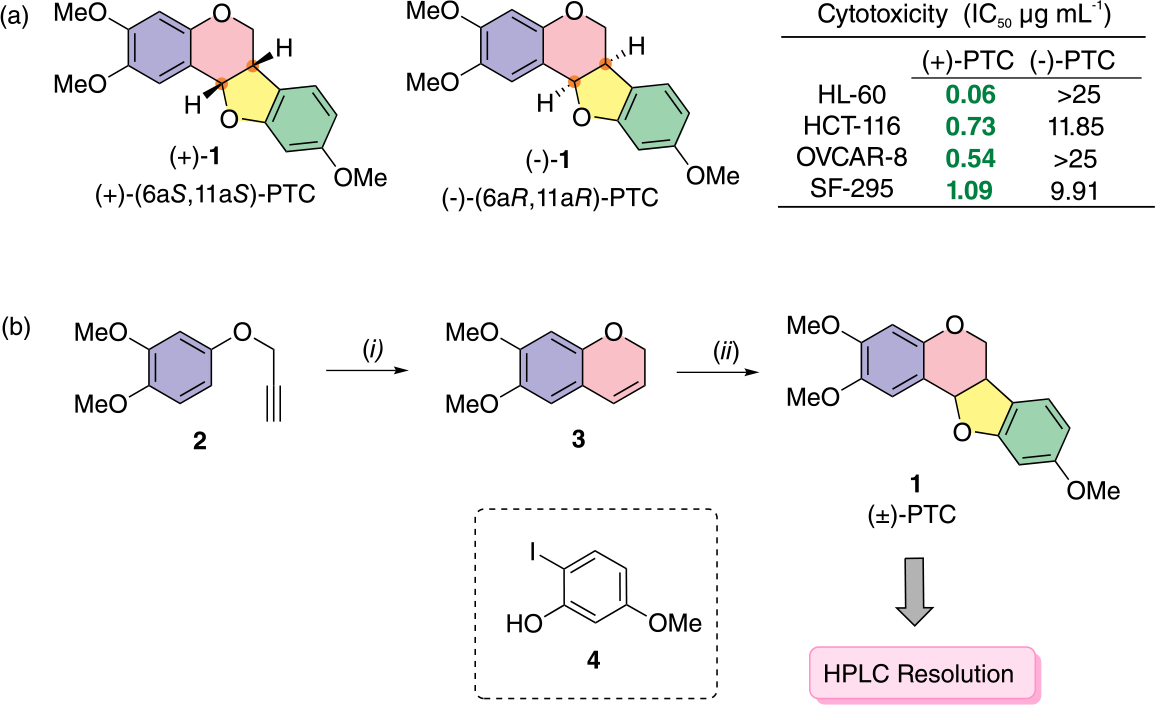
Unlike classic microtubule-targeting agents that modulate tubulin dynamics, phenotypic assays revealed that (+)-1 induces the formation of monopolar spindles (monoasters) and arrests the cell cycle in the prometaphase.6 This specific phenotype strongly suggests the inhibition of kinesin-5 (Eg5), a motor protein essential for bipolar spindle formation, distinguishing (+)-1 as a potential targeted therapy with a reduced risk of neurotoxicity compared to tubulin-binding agents.5,6 Crucially, previous studies5 established that the biological activity is strictly stereospecific: the natural (+)-(6aS,11aS) enantiomer is significantly more potent than its (-)-antipode (Scheme 1a). Consequently, the development of this compound as an active pharmaceutical ingredient (API) candidate depends entirely on access to the enantiomerically pure form.
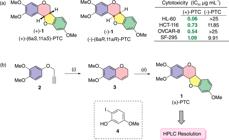
(a) Structure of (+)-PTC and comparison of the cytotoxic activity (IC50 in µg mL-1) between the enantiomers (+)-1 and (-)-1, highlighting the significant eudismic ratio; (b) previous racemic synthesis involving Au/Pd catalysis and chiral HPLC resolution.5 (i) JohnPhosAu(MeCN)SbF6 (0.64 mol%), DCM, 20 °C, 22 h; (ii) 4, Pd(OAc)2 (15 mol%), dppe (30 mol%), Ag2CO3 (2 equiv.), acetone, 65 °C, 16 h.
Despite its therapeutic promise, the supply of (+) 1 has been a critical bottleneck. Since its discovery, limited synthetic strategies have been developed to access this racemic scaffold. The earliest report, published in 1967,5 described a classical approach involving the reduction of isoflavones followed by acid-catalyzed intramolecular cyclization. More recently, modern palladium-catalyzed methods have been explored, utilizing an intermolecular Mizoroki-Heck oxyarylation involving 6,7-dimethoxy-2H chromene and 2-iodo-5-methoxyphenol as substrates.5,7 The total synthesis, developed to enable initial biological evaluations (Scheme 1b)5 employed the aryl propargyl ether 2 as the substrate for a gold(I)-catalyzed intramolecular hydroarylation to form the 2H-chromene intermediate. Although this step initially suffered from a modest yield (9%) due to competitive side reactions, alternative catalytic systems, such as Gagosz’s catalyst, have been reported to significantly improve the efficiency of this specific transformation reaching up to 97% yield.8 However, the subsequent assembly of the pterocarpan core involved a Heck-type oxy-arylation which, although effective for small-scale discovery, required high catalytic loadings (15 mol% Pd). Crucially, these previous sequences afforded 1 as a racemate, necessitating a laborious semi-preparative chiral high-performance liquid chromatography (HPLC) resolution to isolate the bioactive (+)-enantiomer (Scheme 1b).
To overcome these scalability limitations and ensure a sustainable supply of the API candidate, we report herein a concise, biomimetic, and enantioselective total synthesis of (+)-1. Our strategy features a ruthenium-catalyzed asymmetric transfer hydrogenation coupled with dynamic kinetic resolution (ATH-DKR) as the key step, affording the target molecule with high optical purity and excellent global yield suitable for advanced preclinical validation.
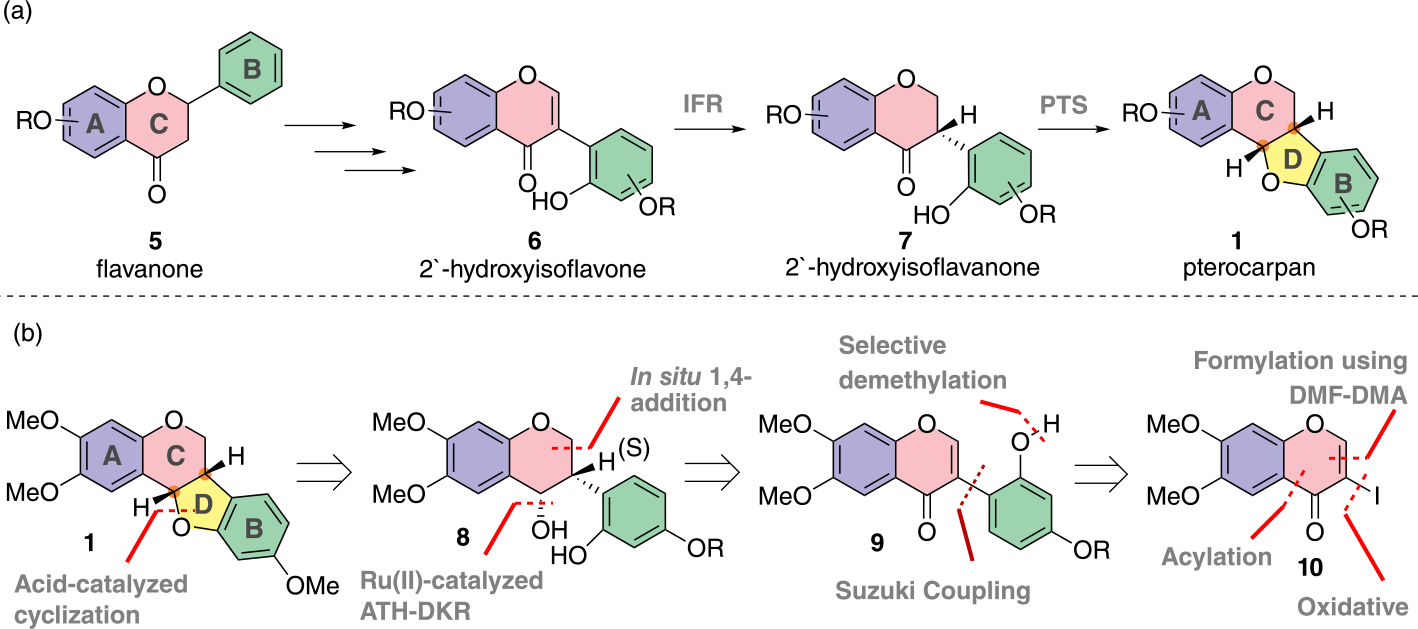
From a biosynthetic perspective (Scheme 2a), the formation of the pterocarpan core is orchestrated by specific reductases that catalyze the stereoselective reduction of the isoflavone scaffold, followed by the requisite intramolecular cyclization.9-11 Mimicking this natural reductive cyclization, we envisioned that the key intermediate 8 could be obtained biomimetically via a ruthenium-catalyzed ATH-DKR of isoflavone 9 (Scheme 2b).12-23 This strategy aligns with the elegant methodology reported by Ciesielski and Metz21 for the divergent synthesis of isoflavonoids, which constitutes the first precedent for the simultaneous reduction of the C=C and C=O bonds in 2-hydroxyisoflavones. We have specifically optimized this protocol to ensure concise access to (+)-PTC using low catalyst loading.
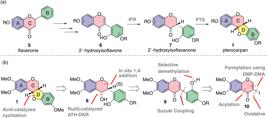
(a) Biosynthetic pathway of pterocarpans, IFR: isoflavone reductase; PTS: pterocarpan synthase; (b) biomimetic synthetic strategy used in this work.
In contrast to the biosynthetic assembly, the access to the isoflavone precursor 9 relies on a robust abiotic strategy designed for synthetic efficiency. It is obtained through selective C-2’ demethylation using a Lewis acid, originating from a ligand-free Suzuki cross-coupling in PEG-400 between the iodo-chromone 10 and commercially available 2,4-dimethoxyphenyl boronic acid. The synthesis of iodo-chromone 10 traces back to the acylation of commercial 3,4-dimethoxyphenol using boron trifluoride, followed by a one-pot formylation dimethylformamide-dimethylacetal (DMF-DMA) and oxidative cyclization sequence using molecular iodine.
Results and Discussion
The construction of the isoflavone skeleton is generally achieved through three principal methodologies: the deoxybenzoin route, the oxidative rearrangement of chalcones, and cross-coupling reactions involving chromones.24 While the deoxybenzoin approach via direct acylation of phenols with phenylacetic acids is a classic strategy, it frequently suffers from harsh reaction conditions and moderate yields, particularly for complex substrates.14 Consequently, to ensure a robust and scalable assembly of the B-ring, we selected the Suzuki cross-coupling involving 3-iodochromones. This methodology is distinguished by its operational simplicity, mild conditions, and high functional group tolerance.24
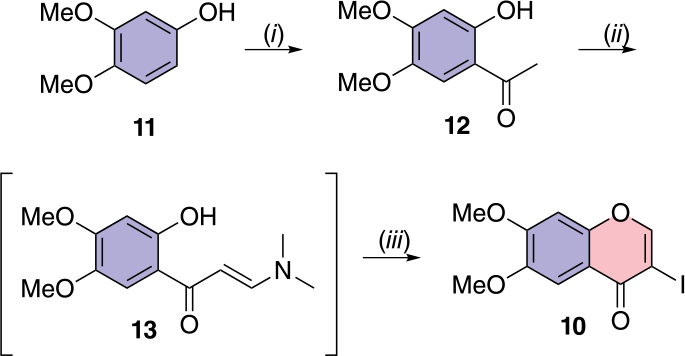
The synthesis commenced with the Friedel Crafts acylation of the commercially available 3,4-dimethoxy-phenol 11 using acetic anhydride and boron trifluoride etherate (BF3∙Et2O).25 This robust protocol furnished the acetophenone 12 in 95% yield. Subsequently, a one-pot formylation/oxidative cyclization sequence was employed to construct the chromone core.21 Reaction of 12 with DMF-DMA generated the enaminone intermediate 13 in situ, which was directly treated with molecular iodine (I2) and pyridine to afford the 3-iodochromone 10 in 93% yield (Scheme 3).
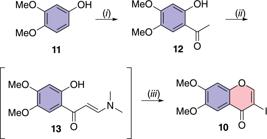
Preparation of iodo-chromone (10). (i) Acetic anhydride (5.3 equiv.), BF3·Et2O (2 equiv.), 90 °C, 1 h, 95%; (ii) DMF-DMA (1.25 equiv.), PhMe, 110 °C, 3 h; (iii) I2 (2 equiv.), pyridine (1.5 equiv.), CHCl3, r.t., 3 h, 93%.
We initially investigated classical Suzuki-Miyaura cross-coupling conditions (Table 1). Attempts employing heterogeneous catalysis with 10% Pd/C and carbonate bases (Na2CO3 or K2CO3) in aqueous mixtures of dimethoxyethane (DME) or EtOH failed to deliver the desired product even after prolonged heating (entries 1-2).26 Similarly, traditional homogeneous systems utilizing phosphine ligands, such as PPh3 in combination with Pd(dba)2 or Pd2(dba)3, proved ineffective, with no conversion observed (entries 3-4).27
To overcome this lack of reactivity, likely attributed to the steric hindrance or electronic deactivation of the 3-iodochromone scaffold, we turned our attention to ligand-free protocols. We found that the use of polyethylene glycol-400 (PEG-400) as a green reaction medium was transformative.28 The reaction of iodochromone 10 with boronic acid 14 in the presence of K2CO3 and a low catalytic loading of Pd(OAc)2 (2 mol%) in PEG-400 proceeded smoothly at 50 °C (entry 5). This protocol furnished the isoflavone 15 in quantitative yield (> 99%, ca. 0.7 g) within only 2 h, avoiding the use of phosphines and toxic organic solvents.
With the isoflavone 15 in hand, we focused on the selective cleavage of the C-2’ methoxy group to unveil the phenolic hydroxyl required for the subsequent activating group in the ATH-DKR step.14 As summarized in Table 2, we initially employed the combination of aluminum chloride and sodium iodide in refluxing acetonitrile (entry 1).14,29-31 While effective, this method proved to be the yield-limiting step of the sequence, requiring a prolonged reaction time (24 h) and affording the phenol 9 in a moderate 73% yield.
Recognizing that this bottleneck would compromise the overall efficiency of the route, we investigated the use of boron trichloride (BCl3) as a more selective and potent Lewis acid (entry 2).32,33 This modification proved to be superior in all aspects: the reaction proceeded rapidly at room temperature, reaching full conversion in just 1 h. Remarkably, this protocol increased the isolated yield to 90% and significantly simplified the downstream processing, as the pure product precipitated directly from the reaction mixture.
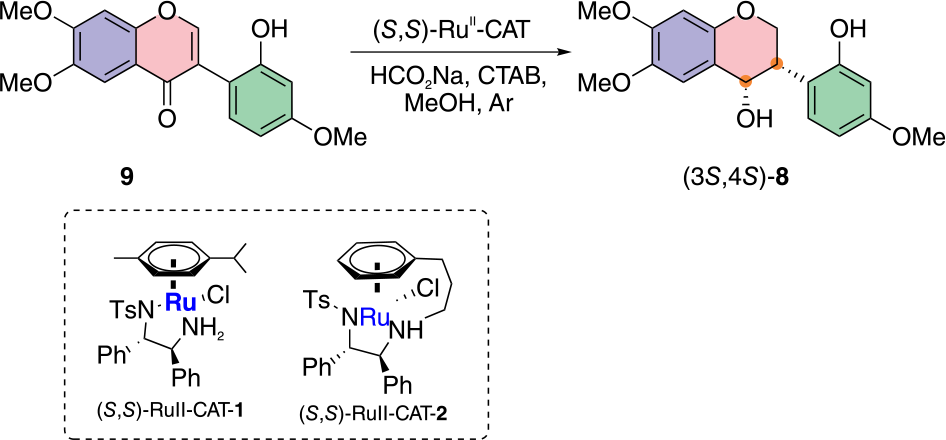
With the optimized access to isoflavone 9, we investigated the key stereoselective reduction step (Table 3). Initial screening revealed that both firstand second-generation Noyori-Ikariya catalysts were highly effective, delivering the desired cis-alcohol (3S,4S)-8 with excellent stereocontrol (diastereomeric ratio (dr) 99:1; enantiomeric excess (ee) 98%). We selected the first-generation precatalyst (S,S)-Ru-CAT-1 as the optimal choice due to its comparable performance and significantly lower cost relative to tethered complexes (entries 1-2). Consistent with previous studies14,21 on the ATH-DKR of related isoflavones, detectable amounts of the saturated ketone intermediate (derived from the initial 1,4-reduction) were not observed in the crude mixtures, suggesting that the subsequent carbonyl reduction is rapid under these conditions.
To evaluate the robustness of the method, we performed a scale-up study while simultaneously lowering the catalyst loading. The reaction was successfully scaled from 0.1 to 0.5 mmol and subsequently to 0.7 mmol, utilizing only 2 mol% of the ruthenium complex. Remarkably, this seven-fold increase in scale combined with a reduced catalytic loading did not affect the reaction outcome, maintaining high conversions, quantitative yields (> 99%), and preserving the high optical purity (98% ee) (entries 3-4). This reproducibility and efficiency are important attributes for the potential further development of this API candidate (+)-1.
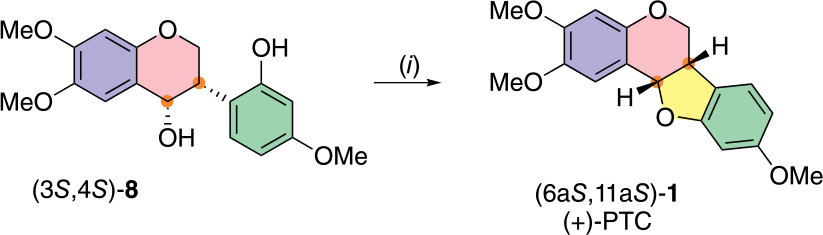
The final stage of the synthesis involved the biomimetic intramolecular cyclization of (3S,4S)-8 under acidic conditions (Scheme 4). Treatment with 37% HCl rapidly furnished the target (+)-2,3,9-trimethoxypterocarpan [(+) 1] in 82% isolated yield. Significantly, this transformation proceeded with complete retention of the optical purity established in the ATH step. In summary, this optimized route delivered (+)-PTC in an impressive 64% overall yield over just six steps from commercially available materials. This represents a breakthrough in scalability compared to previous racemic strategies, ensuring the necessary supply for advanced preclinical trials.
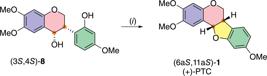
Obtention of (+)-PTC through cyclization of (3S,4S)-8. (i) 37% HCl (6 equiv.), EtOH/EtOAc (1:2), r.t., 7 min (82%, 99:1 er).
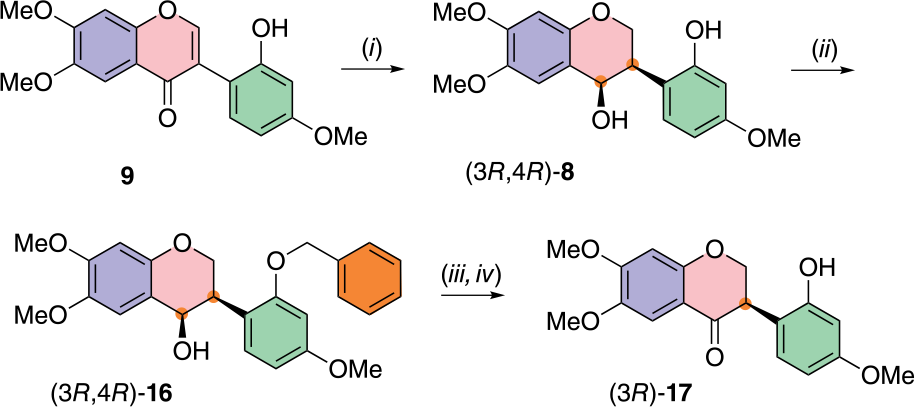
Beyond the efficient synthesis of the target pterocarpan, the developed ATH-DKR protocol offers a versatile platform for Structure-Activity Relationship (SAR) exploration. Isoflavanones are the immediate biosynthetic precursors of pterocarpans and represent a relevant class of structural analogues.9,10 Specifically, the isoflavanone 17, which shares the 2,3,9-trimethoxy substitution pattern with (+)-PTC, has not been previously isolated and constitutes a valuable probe to evaluate the pharmacophoric impact of the rigid furan ring system. To highlight the versatility of our route and enable future investigations into the eudismic ratio, critical for discarding off-target effects, we used the (R,R)-Ru-CAT-1 complex to access the antipodal series.
The reduction of isoflavone 9 proceeded with excellent stereocontrol, furnishing the cis-alcohol (3R,4R)-8 with high optical purity (99:1 er). This intermediate was subsequently advanced through a sequence of O-benzylation, mild Dess-Martin oxidation, and deprotection to deliver the isoflavanone (3R)-17 (Scheme 5).14 Notably, despite the known lability of the α-carbonyl stereocenter, the enantiomeric integrity was largely preserved in the final product (95:5 er), confirming that the stereochemical outcome is strictly catalyst-controlled.
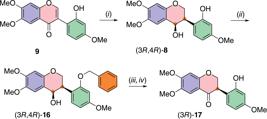
Synthesis of isoflavanone (3R)-17 using (R,R)-Ru-CAT-1. (i) (R,R)-RuII-CAT-1 (2 mol%), HCO2Na, CTAB, MeOH, 45 °C, 18 h (99%, 99:1 dr, 99:1 er); (ii) BnBr (1.2 equiv.), K2CO3 (1.5 equiv.), DMF, r.t., 12 h (90%, 98:2 er); (iii) DMP (3 equiv.), DCM, r.t., 1 h (32%, 96:4 er); (iv) BCl3, DCM, -50 °C, 20 min (38%, 95:5 er).
Conclusions
In conclusion, this work establishes a concise and enantioselective route to (+)-2,3,9-trimethoxypterocarpan [(+)-PTC], providing an efficient synthetic alternative to address the material requirements that have historically hampered the biological study of this potent antimitotic agent. By implementing a ruthenium-catalyzed ATH-DKR as the key stereodefining step, we synthesized this API candidate with high optical purity with 64% global yield, efficiently bypassing the unsustainable extraction from natural sources and the wasteful resolution of racemates.
Beyond the immediate access to (+)-PTC for advanced in vivo and toxicological validation, this work exemplifies how the application of catalytic, atom-economic methodologies can revitalize “neglected” natural scaffolds, transforming interesting phytochemicals into viable pharmaceutical candidates. Furthermore, the stereodivergent nature of this route provides a versatile platform for accessing both enantiomeric series and designing novel analogues, contributing to the potential development of next-generation chemotherapy agents targeting kinesin-5.
Experimental
Materials and reagents
All commercial reagents and solvents were purchased from Sigma-Aldrich, TCI, Oakwood Chemical, or Acros Organics and used without further purification. All reactions that required heating were performed using an oil bath. Analytical thin layer chromatography (TLC) was performed on 0.25 mm silica gel 60 F254 plates and visualized under UV light (254 or 365 nm) or by staining with vanillin/H2SO4. Flash column chromatography was performed on silica gel 60 (230-400 mesh) SilicaFlashTM. Preparative TLC was performed on 20 × 20 cm glass backed plates bearing a 0.5 mm layer of silica gel 60 F254 (15-40 μm).
Instrumentation
High-performance liquid chromatography (HPLC) analyses were carried out on a Shimadzu LC-20AT liquid chromatograph equipped with an SPD-M20A diode array detector, and retention times (tR) are expressed in minutes. All tested compounds had purity ≥ 95% determined by HPLC analysis. Nuclear magnetic resonance (NMR) spectra were recorded on Varian Unity 400 or 500 MHz instruments at 25 °C. Chemical shifts are expressed in ppm relative to TMS (Me4Si) or deuterated solvent (CDCl3, DMSO-d6, CD3OD) and the coupling constants are expressed in Hz. High-resolution mass spectra (HRMS) were obtained with a Solarix XR mass spectrometer with electrospray ionization (ESI) source coupled to Fourier transform-ion cyclotron resonance (FT-ICR) mass analyzer.
Experimental conditions
1-(2-Hydroxy-4,5-dimethoxyphenyl)ethan-1-one (12)
To a stirred mixture containing 3,4-dimethoxyphenol (11) (1 equiv., 2310 mg, 15 mmol) and acetic anhydride (5.3 equiv., 79.5 mmol, 7.5 mL), 2 equivalents of BF3·Et2O (30 mmol, 3.70 mL) were added dropwise at 0 °C. Subsequently, the reaction mixture was warmed to 90 °C and stirred for 1 h. The desired product was isolated as a dark brown solid (2807 mg, 95% yield) and used in the subsequent synthetic step without further purification. 1H NMR (400 MHz, CDCl3) δ 12.65 (s, 1H), 7.06 (s, 1H), 6.46 (s, 1H), 3.92 (s, 3H), 3.87 (s, 3H), 2.57 (s, 3H); 13C NMR (101 MHz, CDCl3) δ 202.1, 160.1, 156.8, 141.9, 111.7, 111.7, 100.6, 56.7, 56.2, 26.4. The spectroscopic data were consistent with those reported in the literature.34
3-Iodo-6,7-dimethoxy-4H-chromen-4-one (10)
To a flask containing 1-(2-hydroxy-4,5-dimethoxy-phenyl)ethan-1-one (12) (1 equiv., 980 mg, 5 mmol) dissolved in toluene (5 mL), 1.25 equivalents of DMF DMA (6.25 mmol, 0.83 mL) were added. The reaction mixture was subsequently stirred under reflux for 12 h. Following the complete consumption of the starting material, the toluene was removed by rotary evaporation, and the crude residue was redissolved in chloroform (5 mL). Pyridine (1.5 equiv., 7.5 mmol, 0.6 mL) was then introduced and stirred at ambient temperature for 10 min prior to the addition of I2 (2 equiv., 10 mmol, 2540 mg). The resulting mixture was stirred at ambient temperature for an additional 3 h. Upon completion, the mixture was transferred to a separatory funnel using dichloromethane and washed with a saturated solution of Na2S2O3. The aqueous phase was extracted with dichloromethane, and the combined organic layers were washed with saturated NaCl solution, dried over anhydrous Na2SO4, and concentrated under reduced pressure. The desired product was isolated as a light yellow solid (1538 mg, 93% yield). 1H NMR (400 MHz, CDCl3) δ 8.23 (s, 1H), 7.54 (s, 1H), 6.86 (s, 1H), 3.98 (s, 6H); 13C NMR (101 MHz, DMSO-d6) δ 171.7, 158.2, 154.5, 151.9, 147.8, 114.3, 104.0, 100.3, 86.4, 56.5, 55.8. The spectroscopic data were consistent with those reported in the literature.35
3-(2,4-Dimethoxyphenyl)-6,7-dimethoxy-4H-chromen-4 one (15)
To a reaction flask were added 3-iodo-6,7-dimethoxy-4H-chromen-4-one (10) (1 equiv., 2 mmol, 664 mg), K2CO3 (1.5 equiv., 3 mmol, 414 mg), 2,4-dimethoxyboronic acid (1.5 equiv., 3 mmol, 546 mg), Pd(OAc)2 (2 mol%, 0.04 mmol, 9 mg), and PEG-400 (5.25 mL). The resulting mixture was subsequently degassed with argon and stirred at 50 °C for 4 h. Following the reaction time, a saturated NaCl solution was introduced into the flask, and the resulting precipitate was filtered using cold distilled H2O. The collected solid was then dissolved in dichloromethane and purified by flash column chromatography using silica gel with an EtOAc/Hex 30:70 mixture as the eluent. The desired product was isolated as a yellow solid (670 mg, 98% yield). 1H NMR (400 MHz, CDCl3) δ 7.90 (s, 1H), 7.62 (s, 1H), 7.25 (d, J 9.0 Hz, 1H), 6.87 (s, 1H), 6.54-6.87 (m, 2H), 3.98 (s, 6H), 3.84 (s, 3H), 3.78 (s, 3H); 13C NMR (101 MHz, CDCl3) δ 175.5, 161.1, 158.6, 154.1, 153.5, 152.3, 147.5, 132.2, 121.8, 117.9, 113.7, 105.0, 104.5, 99.5, 99.1, 56.4, 56.3, 55.7, 55.4; HRMS (ESI) m/z, calcd. for [C19H18O6 + Na]+: 365.0996, found: 365.0991, error: -1.36 ppm.
3-(2-Hydroxy-4-methoxyphenyl)-6,7-dimethoxy-4H chromen-4-one (9)
To a flask containing 3-(2,4-dimethoxyphenyl)-6,7 dimethoxy-4H-chromen-4-one (15) (1 equiv., 0.5 mmol, 177 mg) dissolved in anhydrous dichloromethane (7.5 mL), a 1 M solution of BCl3 (1.5 equiv., 0.75 mmol, 0.75 mL) was slowly introduced. The resulting mixture was stirred at ambient temperature for 1 h. Subsequently, MeOH (16 mL) was slowly added, and the solution was concentrated by rotary evaporation until approximately 5 mL remained. Cold H2O (50 mL) was then introduced to precipitate the solid, which was collected by filtration and washed with cold H2O (300 mL). The desired product was obtained as a light yellow solid (147 mg, 90% yield). 1H NMR (400 MHz, CDCl3) δ 9.42 (s, 1H), 8.08 (s, 1H), 7.65 (s, 1H), 7.08 (d, J 8.5 Hz, 1H), 6.95 (s, 1H), 6.66 (d, J 2.6 Hz, 1H), 6.55 (dd, J 8.5, 2.6 Hz, 1H), 4.02 (s, 3H), 4.01 (s, 3H), 3.83 (s, 3H); 13C NMR (126 MHz, CDCl3) δ 178.3, 162.0, 158.0, 155.4, 154.4, 152.5, 148.4, 130.3, 124.4, 116.7, 113.1, 107.6, 104.5, 104.4, 99.3, 56.7, 56.5, 55.4; HRMS (ESI) m/z, calcd. for [C18H16O6 + Na]+: 351.0840, found: 351.0831, error: -2.56 ppm.
(3S,4S)-3-(2-Hydroxy-4-methoxyphenyl)-6,7-dimethoxy-chroman-4-ol (8)
To a reaction vial were added 3-(2-hydroxy-4-methoxy-phenyl)-6,7-dimethoxy-4H-chromen-4-one (9) (1 equiv., 0.7 mmol, 229 mg), cetyltrimethylammonium bromide (CTAB, 20 mol%, 0.14 mmol, 51 mg), HCO2Na (7 equiv., 4.9 mmol, 333 mg), (S,S)-RuCl(p-cymene)-TsDPEN (2 mol%, 0.014 mmol, 9 mg), and MeOH (2.8 mL). The mixture was then degassed under an inert argon atmosphere and stirred at 45 °C for 18 h. The reaction mixture was subsequently filtered through a pad of flash silica using EtOAc and concentrated via rotary evaporation. The desired product was obtained as a light brown viscous liquid (233 mg, 99:1 dr, 99% yield) and utilized in the next step without further purification. [α]D21 = -89.8200 (c = 0.2, EtOH). The enantiomeric ratio (1:98 er) was determined by HPLC analysis using a ChiralpakIA column, n-hexane/isopropyl alcohol 70:30, 1 mL min-1, 28 °C, tRmaj = 14.3 min, tRmin = 12.4 min, 210 nm. 1H NMR (400 MHz, CDCl3) δ 7.01 (d, J 8.4 Hz, 1H), 6.75 (s, 1H), 6.52-6.42 (m, 3H), 4.93 (s, 1H), 4.75-4.66 (m, 1H), 4.18 (dd, J 10.7, 3.5 Hz, 1H), 3.84 (d, J 7.0 Hz, 6H), 3.77 (s, 3H), 3.35 (d, J 9.6 Hz, 1H), 3.23 (s, 1H); 13C NMR (126 MHz, CDCl3) δ 159.8, 156.6, 150.0, 148.2, 142.9, 130.6, 117.0, 115.1, 112.8, 105.1, 102.7, 100.2, 66.4, 64.0, 56.3, 55.7, 55.1, 41.5; HRMS (ESI) m/z, calcd. for [C18H20O6 + Na]+: 355.1153, found: 355.1169, error: 4.50 ppm.
(3R,4R)-3-(2-Hydroxy-4-methoxyphenyl)-6,7-dimethoxy-chroman-4-ol (8)
The desired product was obtained as a light brown viscous liquid (33 mg, 99:1 dr, 99:1 er, 99% yield) and utilized in the next step without further purification. [α]D21 = +88.8200 (c = 0.2, EtOH). The enantiomeric ratio (99:1 er) was determined by HPLC analysis using a Chiralpak IA column, n-hexane/isopropyl alcohol 70:30, 1 mL min-1, 28 °C, tRmaj = 12.3 min, tRmin = 14.3 min, 210 nm.
(6aS,11aS)-2,3,9-Trimethoxy-pterocarpan (1)
To a flask containing (3S,4S)-3-(2-hydroxy-4-methoxy-phenyl)-6,7-dimethoxychroman-4-ol (8) (1 equiv., 0.5 mmol, 166 mg) were added a 1:1 mixture of EtOH/EtOAc (10 mL) and 37% HCl (6 equiv., 3 mmol, 0.28 mL). The resulting solution was stirred at ambient temperature for 7 min. Subsequently, a saturated solution of NH4Cl was introduced, and the reaction mixture was extracted with EtOAc. The combined organic fractions were then concentrated via rotary evaporation and purified by flash column chromatography using silica gel with an EtOAc/hexane 30:70 mixture as the eluent. The desired product was obtained as a white solid (128 mg, 99:1 er, 82% yield). [α]D = +153.35 (c = 1, ethanol); the enantiomeric ratio (99:1 er) was determined by HPLC analysis using a Chiralpak IA column, n-hexane/isopropyl alcohol 80:20, 1 mL min-1, 28 °C, tRmaj = 14.0 min, tRmin = 10.3 min, 292 nm. 1H NMR (400 MHz, CDCl3) δ 7.13 (d, J 8.9 Hz, 1H), 6.98 (s, 1H), 6.49 (s, 1H), 6.48-6.44 (m, 2H), 5.50 (d, J 6.7 Hz, 1H), 4.26-4.21 (m, 1H), 3.90 (s, 3H), 3.86 (s, 3H), 3.77 (s, 3H), 3.63-3.57 (m, 1H), 3.54 (ddd, J 11.1, 6.6, 4.6 Hz, 1H); 13C NMR (126 MHz, CDCl3) δ 161.3, 160.7, 150.7, 150.0, 144.4, 124.9, 119.2, 112.3, 110.8, 106.5, 100.9, 97.0, 78.9, 66.8, 56.4, 56.0, 55.6, 39.8. The spectroscopic data were consistent with those reported in the literature.2,5
(3R,4R)-3-(2-(Benzyloxy)-4-methoxyphenyl)-6,7-dimethoxy-chroman-4-ol (16)
To a mixture of (3R,4R)-3-(2-hydroxy-4-methoxy phenyl)-6,7-dimethoxychroman-4-ol (8) (0.1 mmol, 1 equiv., 33.2 mg) and K2CO3 (0.2 mmol, 27.6 mg, 2 equiv.) in DMF (0.5 mL), benzyl bromide (0.12 mmol, 14 µL, 1.2 equiv.) was added. The reaction was stirred at ambient temperature for 12 h. Subsequently, the reaction mixture was transferred to a separatory funnel, diluted with EtOAc, and washed successively with H2O (5 × 150 mL) and aqueous NaCl solution (2 × 150 mL). The organic phase was dried over anhydrous Na2SO4, filtered through cotton, and concentrated under reduced pressure. The crude product was purified by preparative thin-layer chromatography (eluent: n-hexane/EtOAc 70:30), affording the desired product as a white viscous liquid (37 mg, 90% yield). [α]D19 = +101.7800 (c = 0.2, EtOH). The enantiomeric ratio (2:98 er) was determined by HPLC analysis using a Chiralpak IA column, n-hexane/ethanol 70:30, 1 mL min-1, 28 °C, tRmaj = 26.6 min, tRmin = 23.2 min, 285 nm. 1H NMR (500 MHz, CDCl3) δ 7.39-7.28 (m, 5H), 7.05 (d, J 8.4 Hz, 1H), 6.77 (s, 1H), 6.58 (d, J 2.5 Hz, 1H), 6.52 (dd, J 8.4, 2.5 Hz, 1H), 6.45 (s, 1H), 5.09 (d, J 3.1 Hz, 2H), 4.79 (s, 1H), 4.52 (dd, J 12.0, 10.2 Hz, 1H), 4.22 (ddd, J 10.2, 3.4, 1.3 Hz, 1H), 3.85 (d, J 3.8 Hz, 6H), 3.79 (s, 3H), 3.76 (dt, J 11.9, 3.3 Hz, 1H); 13C NMR (126 MHz, CDCl3) δ 160.1, 157.5, 150.4, 148.8, 143.5, 136.8, 128.9, 128.8, 128.1, 127.3, 118.5, 114.8, 113.0, 104.7, 100.5, 100.4, 70.3, 65.5, 64.5, 56.5, 56.0, 55.5, 37.5; HRMS (ESI) m/z, calcd. for [C25H26O6 + Na]+: 445.1622, found: 445.1638, error: 3.59 ppm.
(R)-3-(2-(Benzyloxy)-4-methoxyphenyl)-6,7-dimethoxy-chroman-4-one (18)
To a solution of (3R,4R)-3-(2-(benzyloxy)-4 methoxyphenyl)-6,7-dimethoxychroman-4-ol (16) (0.1 mmol) in dichloromethane (DCM, 5 mL, 0.02 M), Dess-Martin periodinane (DMP) (0.3 mmol, 3 equiv., 127 mg) was added at 0 °C. The mixture was then stirred at ambient temperature for 1 h. Subsequently, the solution was diluted with DCM (30 mL) and washed successively (× 2) with a 1:1 mixture of saturated Na2S2O3 solution (20 mL) and saturated NaHCO3 solution (20 mL). The organic phase was dried over Na2SO4 and concentrated under reduced pressure. The crude product was purified by preparative thin-layer chromatography (eluent: n-hexane/EtOAc 70:30), affording the desired product as a yellow viscous liquid (13 mg, 4:96 er, 32% yield). The enantiomeric ratio (4:96 er) was determined by HPLC analysis using a Chiralpak IA column, n-hexane/ethanol 70:30, 1 mL min-1, 28 °C, tRmaj = 35.6 min, tRmin = 32.6 min, 230 nm. 1H NMR (500 MHz, CDCl3) δ 7.36-7.22 (m, 5H), 7.04 (d, J 8.4 Hz, 1H), 6.56 (d, J 2.4 Hz, 1H), 6.49 (dd, J 8.4, 2.4 Hz, 1H), 6.43 (s, 1H), 5.03 (s, 2H), 4.58 (t, J 11.2 Hz, 1H), 4.46 (dd, J 10.9, 5.4 Hz, 1H), 4.26 (dd, J 11.4, 5.4 Hz, 1H), 3.91 (s, 3H), 3.88 (s, 3H), 3.78 (s, 3H); 13C NMR (126 MHz, CDCl3) δ 191.7, 160.5, 158.3, 157.6, 155.9, 144.6, 136.7, 131.0, 128.6, 128.0, 127.4, 116.7, 114.2, 107.4, 105.1, 100.5, 100.1, 71.5, 70.4, 56.3, 56.3, 55.5, 47.8; HRMS (ESI) m/z, calcd. for [C25H24O6 + H]+: 421.1646, found: 421.1653, error: 1.66 ppm.
(R)-3-(2-Hydroxy-4-methoxyphenyl)-6,7-dimethoxychroman-4-one (17)
To a flask containing (R)-3-(2-(benzyloxy)-4-methoxy-phenyl)-6,7-dimethoxychroman-4-one (18) (1 equiv., 0.07 mmol, 29 mg) dissolved in anhydrous dichloromethane (10.8 mL), a 1 M solution of BCl3 (1.5 equiv., 0.105 mmol, 0.105 mL) was slowly introduced. The resulting mixture was stirred at -50 °C for 20 min. Subsequently, MeOH (3.5 mL) was slowly added, and the solution was concentrated by rotary evaporation until approximately 3 mL remained. Cold H2O (10 mL) was then introduced and the aqueous phase was extracted with EtOAc (3 × 30 mL). The organic phase was dried over Na2SO4 and concentrated under reduced pressure. The crude product was purified by preparative thin-layer chromatography (eluent: n-hexane/EtOAc 70:30), affording the desired product as a yellow viscous liquid (8 mg, 5:95 er, 38% yield). The enantiomeric ratio (5:95 er) was determined by HPLC analysis using a Chiralpak IA column, n-hexane/ethanol 70:30, 1 mL min-1, 28 °C, tRmaj = 19.8 min, tRmin = 14.3 min, 280 nm. 1H NMR (500 MHz, CD3OD) δ 7.33 (s, 1H), 6.92 (d, J 8.4 Hz, 1H), 6.58 (s, 1H), 6.41 (d, J 2.5 Hz, 1H), 6.38 (dd, J 8.4, 2.5 Hz, 1H), 4.62 (t, J 11.1 Hz, 1H), 4.45 (dd, J 10.9, 5.4 Hz, 1H), 4.16 (dd, J 11.1, 5.4 Hz, 1H), 3.89 (s, 3H), 3.82 (s, 3H), 3.73 (s, 3H); 13C NMR (126 MHz, CD3OD) δ 194.6, 161.8, 160.5, 158.1, 157.6, 146.0, 131.8, 115.8, 114.8, 108.5, 106.0, 102.6, 101.4, 72.3, 56.7, 56.7, 55.6, 49.3; HRMS (ESI) m/z, calcd. for [C18H18O6 + H]+: 331.1177, found: 331.1178, error: 0.30 ppm.
Supplementary Information
Supplementary material 1
Supplementary information (NMR spectra and HPLC chromatograms) is available free of charge at http://jbcs.sbq.org.br as PDF file.
Acknowledgments
The authors are grateful for the financial support provided by the CNPq, specifically for the Research Productivity Fellowships awarded to C. O. Pessoa (Level 1A) and P. R. R. Costa (Level SR). This study was supported by the FINEP/MCTI/FNDCT under the “More Innovation Brazil-Health-ICTs” program (Grant 0361/24) and by the INCT through the “INCT T-Bio2-Translational Biodiscovery and Biomodels” project (Grant 408566/2024-8). P.R.R.C. acknowledges funding from the FAPERJ through the “Cientista do Nosso Estado” grant (CNE - E-26/204.296/2024). J.S.F. thanks the CAPES for the scholarship (Finance Code 001). Finally, we thank the UFRJ and the Central Analítica of IPPN-UFRJ for providing access to the multiuser instrumentation facilities (LAMAR, LabCrom, LabMAS, and LabEsp) and for the technical support during the analyses. The authors used Gemini (Google) exclusively for language editing and proofreading to improve the clarity of the manuscript.
Data Availability Statement
The data supporting the findings of this study are available within the article and its SI section.
References
-
1 Newman, D. J.; Cragg, G. M.; J. Nat. Prod. 2020, 83, 770. [Crossref]
» Crossref -
2 Pueppke, S. G.; VanEtten, H. D.; J. Chem. Soc., Perkin Trans. 1 1975, 946. [Crossref]
» Crossref -
3 Falcão, M. J. C.; Pouliquem, Y. B. M.; Lima, M. A. S.; Gramosa, N. V.; Costa-Lotufo, L. V.; Militão, G. C. G.; Pessoa, C.; de Moraes, M. O.; Silveira, E. R.; J. Nat. Prod. 2005, 68, 423. [Crossref]
» Crossref -
4 Militão, G. C. G.; Dantas, I. N. F.; Pessoa, C.; Falcão, M. J. C.; Silveira, E. R.; Lima, M. A. S.; Curi, R.; Lima, T.; Moraes, M. O.; Costa-Lotufo, L. V.; Life Sci. 2006, 78, 2409. [Crossref]
» Crossref -
5 Farias, K.; da Costa, R. F.; Meira, A. S.; Diniz-Filho, J.; Bezerra, E. M.; Freire, V. N.; Guest, P.; Nikahd, M.; Ma, X.; Gardiner, M. G.; Banwell, M. G.; de Oliveira, M. C. F.; de Moraes, M. O.; Pessoa, C. Ó.; ACS Med. Chem. Lett. 2020, 11, 1274. [Crossref]
» Crossref -
6 de Farias, K. M.; Rosa-Ribeiro, R.; Souza, E. E.; Kobarg, J.; Banwell, M. G.; Vieira Neto, J. B.; Sales, S. L. A.; Costa, P. R. R.; dos Santos, R. C.; Gaspar, F. V.; Barreto Junior, A. G.; Oliveira, M. C. F.; de Moraes, M. O.; Furtado, C. L. M.; Carvalho, H. F.; Pessoa, C.; Chem. Biodiversity 2022, 19, e202200102. [Crossref]
» Crossref -
7 Kakuda, S.; Ninomiya, M.; Tanaka, K.; Koketsu, M.; ChemistrySelect 2016, 1, 4203. [Crossref]
» Crossref -
8 Lykakis, I. N.; Efe, C.; Gryparis, C.; Stratakis, M.; Eur. J. Org. Chem. 2011, 2011, 2334. [Crossref]
» Crossref -
9 Goel, A.; Kumar, A.; Raghuvanshi, A.; Chem. Rev. 2013, 113, 1614. [Crossref]
» Crossref - 10 Dewick, P. M.; Medicinal Natural Products: A Biosynthetic Approach; Wiley: Chichester, 2013.
-
11 Jiménez-González, L.; Hernández-Cervantes, C.; Álvarez-Corral, M.; Muñoz-Dorado, M.; Rodríguez-García, I.; Nat. Prod. Commun. 2011, 6, 537. [Crossref]
» Crossref -
12 Caleffi, G. S.; Demidoff, F. C.; Nájera, C.; Costa, P. R. R.; Org. Chem. Front. 2022, 9, 1165. [Crossref]
» Crossref -
13 Demidoff, F. C.; Caleffi, G. S.; Figueiredo, M.; Costa, P. R. R.; J. Org. Chem. 2022, 87, 14208. [Crossref]
» Crossref -
14 Gaspar, F. V.; Caleffi, G. S.; Costa-Júnior, P. C. T.; Costa, P. R. R.; ChemCatChem 2021, 13, 5097. [Crossref]
» Crossref -
15 Caleffi, G. S.; Brum, J. O. C.; Costa, A. T.; Domingos, J. L. O.; Costa, P. R. R.; J. Org. Chem. 2021, 86, 4849. [Crossref]
» Crossref -
16 Lemke, M.-K.; Schwab, P.; Fischer, P.; Tischer, S.; Witt, M.; Noehringer, L.; Rogachev, V.; Jäger, A.; Kataeva, O.; Fröhlich, R.; Metz, P.; Angew. Chem., Int. Ed. 2013, 52, 11651. [Crossref]
» Crossref -
17 Keßberg, A.; Metz, P.; Angew. Chem., Int. Ed. 2016, 55, 1160. [Crossref]
» Crossref -
18 Keßberg, A.; Metz, P.; Org. Lett. 2016, 18, 6500. [Crossref]
» Crossref -
19 Qin, T.; Metz, P.; Org. Lett. 2017, 19, 2981. [Crossref]
» Crossref -
20 Keßberg, A.; Lübken, T.; Metz, P.; Org. Lett. 2018, 20, 3006. [Crossref]
» Crossref -
21 Ciesielski, P.; Metz, P.; Nat. Commun. 2020, 11, 3091. [Crossref]
» Crossref -
22 Heo, M.; Lee, B.; Sishtla, K.; Fei, X.; Lee, S.; Park, S.; Yuan, Y.; Lee, S.; Kwon, S.; Lee, J.; Kim, S.; Corson, T. W.; Seo, S.-Y.; J. Org. Chem. 2019, 84, 9995. [Crossref]
» Crossref -
23 Kwon, S.; Lee, S.; Heo, M.; Lee, B.; Fei, X.; Corson, T. W.; Seo, S.-Y.; ACS Omega 2020, 5, 11043. [Crossref]
» Crossref -
24 Selepe, M. A.; Mthembu, S. T.; Sonopo, M. S.; Nat. Prod. Rep. 2025, 42, 540. [Crossref]
» Crossref -
25 Chin, M. R.; Zlotkowski, K.; Han, M.; Patel, S.; Eliasen, A. M.; Axelrod, A.; Siegel, D.; ACS Chem. Neurosci. 2015, 6, 542. [Crossref]
» Crossref -
26 Mutai, P.; Pavadai, E.; Wiid, I.; Ngwane, A.; Baker, B.; Chibale, K.; Bioorg. Med. Chem. Lett. 2015, 25, 2510. [Crossref]
» Crossref -
27 Kwesiga, G.; Greese, J.; Kelling, A.; Sperlich, E.; Schmidt, B.; J. Org. Chem. 2023, 88, 1649. [Crossref]
» Crossref -
28 Lu, Q.; Gouda, N. A.; Quan, G.; Nada, H.; Elkamhawy, A.; Lee, D.; Lee, C. H.; Cho, J.; Lee, K.; Eur. J. Med. Chem. 2022, 242, 114692. [Crossref]
» Crossref -
29 Kurosawa, K.; Araki, F.; Bull. Chem. Soc. Jpn. 1979, 52, 529. [Crossref]
» Crossref -
30 Faria, T. J.; e Silva, L. G. F.; de Souza Filho, J. D.; Chiari, E.; de Oliveira, A. B.; J. Braz. Chem. Soc. 2005, 16, 1415. [Crossref]
» Crossref -
31 Goel, A.; Kumar, A.; Hemberger, Y.; Raghuvanshi, A.; Jeet, R.; Tiwari, G.; Knauer, M.; Kureel, J.; Singh, A. K.; Gautam, A.; Trivedi, R.; Singh, D.; Bringmann, G.; Org. Biomol. Chem. 2012, 10, 9583. [Crossref]
» Crossref -
32 Asebi, N.; Nihei, K.; Tetrahedron 2019, 75, 130589. [Crossref]
» Crossref -
33 Tsukayama, M.; Kawamura, Y.; Tamaki, H.; Horie, T.; Chem. Pharm. Bull. 1991, 39, 1704. [Crossref]
» Crossref -
34 Sarkar, A.; Kankanamalage, A. C. G.; Zhang, Q.; Cheng, H.; Sivaprakasam, P.; Naglich, J.; Xie, C.; Gangwar, S.; Boger, D. L.; Med. Chem. Res. 2021, 30, 1377. [Crossref]
» Crossref -
35 Hirazawa, S.; Saito, Y.; Sagano, M.; Goto, M.; Nakagawa-Goto, K.; J. Nat. Prod. 2022, 85, 136. [Crossref]
» Crossref
Edited by
-
Editor handled this article:
Giovanni Wilson Amarante (Executive)