 Synthesis and Characterization of Sustainable Hydrochar from Banana Peels for the Removal of Iron and Manganese Ions in Aqueous Systems
Abstract
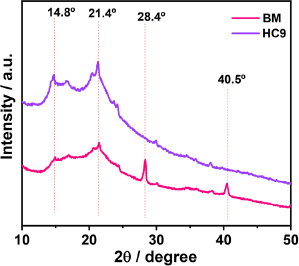
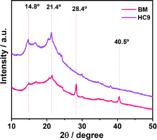
Iron and manganese are important water quality parameters, as their presence can lead to undesirable color and odor. Here, hydrochars (HCs) were synthesized from banana peels via hydrothermal carbonization to produce a sustainable adsorbent for efficient iron and manganese removal from water. A 23 factorial design with a central point was carried out to evaluate the variables: (i) activating agent (H3PO4 or NaOH), (ii) temperature (100 and 200 °C), and (iii) residence time (8 and 14 h). HC9 was performed in water at 150 °C for 11 h. Optimal performance was evaluated from Fe2+ and Mn2+ removal. Fourier transform infrared (FTIR) confirmed functional groups in all HCs, while X-ray diffraction (XRD) broad peaks between 15-30° indicated an amorphous structure. HC9 showed the best performance for the adsorption of both metals. Equilibrium was reached at 200 min, and the kinetic data were best described by the pseudo-second-order model. The adsorption data were best fitted by the Langmuir model for Fe and the Freundlich model for Mn, with maximum adsorption capacities (qmax) values of 33.18 and 19.00 mg g⁻1 for Fe and Mn, respectively. Thus, adsorption using this biochar is a promising and environmentally friendly method for removing those metals from aqueous systems.
Keywords:
hydrothermal process; adsorption; carbonization; biomass; agro-industrial waste
 Thumbnail
 Thumbnail
 Thumbnail
 Thumbnail
 Thumbnail
 Thumbnail
 Thumbnail