
 Innovative Antimicrobial Nanoemulsion with Controlled Release Properties Based on Melaleuca alternifolia Essential Oil
Abstract
Essential oils (EOs) present limitations such as volatility, low water solubility, and instability, which restrict their direct application in pharmaceutical and cosmetic formulations. This study aimed to develop and characterize a nanoemulsion (NE) based on Melaleuca alternifolia EO, overcoming these challenges. The EO was extracted by hydrodistillation (yield: 3%) and analyzed by gas chromatography-mass spectrometry (GC-MS), identifying terpinen-4-ol (47.49%), γ-terpinene (17.89%), and α-terpinene (9.35%) as major components. The NE was prepared using ultrasound and Tween 80 as a surfactant, resulting in a monomodal distribution with a mean droplet size of 60 nm, confirmed by dynamic light scattering and the Tyndall effect. Stability assessments, including thermal and centrifugation tests, revealed a robust system, with optimal performance at 5-25 °C and controlled release behavior at 50 °C. The NE demonstrated potent antimicrobial activity, with minimum inhibitory concentrations (MIC) as low as 0.0078 μg mL−1. Although not directly compared to the crude EO, the results indicate preserved and possibly enhanced antimicrobial efficacy due to encapsulation. These findings suggest that the nanoemulsion is a promising platform for pharmacosmetic applications, enabling EO delivery at low concentrations while improving physicochemical stability and biological performance.
Keywords:
tea tree; nanoemulsions; gas chromatography; antimicrobial activity; ultrasound
Introduction
The global biodiversity of plants encompasses an enormous variety of species. It is estimated that there are around 374,000 known plant species, with only a tiny percentage having been investigated for their pharmacological properties.1 Plants are present and adapted to various biomes, from tropical forests to deserts, grasslands, and tundras. The geographic distribution of plants on Earth is determined by multiple factors such as climate, altitude, latitude, and soil type, defining where plants can thrive and driving evolutionary processes.2
Essential oils (EOs) are complex chemical substances composed of volatile terpenes and phenylpropanoids produced by plants. These constituents play a crucial role in plant defense and pollinator attraction. Additionally, they are of great interest due to their numerous pharmacological,3 cosmetic,4 food,5 and agricultural6 properties. However, the volatile nature and low water solubility of EOs limit their direct application, necessitating the development of systems to enhance their stability and efficacy.
One solution involves the creation of oil-in-water (O/W) nanoemulsions using surfactants to achieve droplet sizes up to 100 nm, ensuring stability, protection of volatile compounds, solubility, bioavailability, and transport efficiency.7,8,9 Several methods are employed for producing a nanoemulsion (NEs), including high- and low-energy technologies such as microfluidics and homogenization. However, these are not readily available in the industry due to high costs and scalability issues.10
One promising alternative is using probe ultrasonicators, which offer low production costs and high energy efficiency.11
Melaleuca alternifolia (tea tree), belonging to the Myrtaceae family, is native to Australia and islands in the Indian Ocean. It is also cultivated in other parts of the world, including Brazil, albeit on a small scale.12 It grows in warm climates on clay soils and is a small tree that can reach heights of 5 to 7 meters.13
The EO of tea tree is primarily composed of monoterpenes, sesquiterpenes, and alcohols, widely known for their potent antimicrobial, antibacterial, and antiseptic properties due to the high concentration of terpinen-4-ol, its main active component.14,15 Its medicinal properties make it effective in treating various skin conditions, including acne, herpes, and fungal infections.16
Incorporating this oil into nanoemulsion systems enhances its stability and amplifies its antimicrobial properties, making it an excellent choice for the development of cosmetic and pharmaceutical products.
Essential oils have stood out for their properties, with numerous applications in the cosmetic and pharmaceutical sectors. However, their physicochemical characteristics, such as volatility, low water solubility, and complex dispersion, limit their application forms. The general objective of this study is to develop oil-in-water (O/W) nanoemulsions using tea tree essential oil as the oil phase, evaluate the stability of the formed NE, and assess its potential for cosmetic development. More specifically, the study aimed to (i) extract tea tree essential oil through hydrodistillation, (ii) characterize the obtained essential oil, (iii) investigate the preparation of NEs using ultrasound as an energy source, (iv) characterize the obtained NEs; and (v) evaluate the stability of the formed NEs.
Experimental
Plant material collection, essential oil extraction, and physicochemical characterization
The aerial parts of Melaleuca alternifolia were collected in April 2024, during the rainy season, in the city of Umuarama, latitude: −23.7641, longitude: −53.3184 (23°45’51” S, 53°19’6” W), under SisGen registration number A14B1DE. After collection, the plant material was cleaned and cut into smaller parts, approximately 4 cm, for essential oil extraction.
Essential oil extraction
The essential oil was extracted using the hydrodistillation method with a Clevenger system. 300 g of plant material and 2 L of distilled water were placed in a 3 L round-bottom volumetric flask and heated using a heating mantle (Exodo Tecnologia). The total extraction time was 2 h. After extraction, the essential oil was separated from the hydrosol using a separation funnel and left to settle for 24 h. This process was repeated four times to obtain a sufficient amount of oil for analysis.
Physicochemical characterization of the essential oil
Refractive index
To determine the refractive index of tea tree oil, a digital refractometer, Model RTD-95, brand Instrutherm, was used. Distilled water was used as the reference blank. Subsequently, a drop of the oil was placed on the prism. The measurement was performed in triplicate at room temperature.
Density
The density of the oil was measured using 2 mL calibrated centrifuge tubes (Eppendorf type) filled with distilled water at room temperature for calibration. Afterward, the tubes were filled with tea tree oil to the meniscus, and the mass was determined using an analytical balance Schimadzu, Model AUW220D.17
Gas chromatography-mass spectrometry (GC-MS)
The tea tree essential oil (EO) samples were analyzed using a gas chromatograph (Agilent 7890B) coupled to a mass spectrometer (Agilent 5977A MSD), operating with an electron source at ionization energy of 70 eV and equipped with an HP-5MS capillary column (30 m × 0.25 mm × 0.25 μm) with a stationary phase composed of 5% phenyl and 95% dimethylpolysiloxane. The injected sample volume was two μL in split mode at a ratio of 1:10, with a constant helium flow rate of 3.0 mL min−1 as the carrier gas. The injector temperature was maintained at 250 °C, and the transfer line at 260 °C.
The oven programming conditions were as follows: initial temperature of 40 °C (held for 2 min), a heating rate of 3 °C min−1 up to 250 °C (held for 10 min), followed by a heating rate of 15 °C min−1 up to 300 °C (held for 1 min). In the mass detector, the ionization chamber temperature was set at 230 °C and the quadrupole temperature at 150 °C. The mass spectrometry (MS) detection system operated in scan mode across the mass-to-charge ratio (m/z) range of 40-550, with a solvent delay of 3 min.
A mixture of linear alkanes (C7-C28) was injected under the same conditions used for the samples, and their retention indices were employed to calculate the linear retention indices (LRI) of the separated compounds. Compound identification was performed by comparing the mass spectra and LRI with the Adams Library.18
Preparation of the oil-in-water nanoemulsion
The nanoemulsion was prepared using 500 μL of tea tree EO, 0.53 g of Tween 80 (Inlab brand), and 50 mL of distilled water. The mixture was processed using a probe sonicator (Biobase, Model UCD950) with a power of 630 W, an ON pulse duration of 1 min, and an OFF pulse duration of 2 min, for a total of 37 min and 30 s.
Physicochemical characterization of the nanoemulsion
Tyndall effect
The experimental setup for observing the Tyndall effect involved analyzing the behavior of red light, λ = 635 nm, passing through a beaker containing the nanoemulsion and another containing water.19 When the beaker contained only water, the light beam was not visible, but when filled with the nanoemulsion, the passage of the light beam through the medium became observable. This phenomenon is visible because the oil droplets are dispersed within the medium and have nanometric dimensions.
Dynamic light scattering (DLS)
The dynamic light scattering (DLS) technique directs a beam of light at the sample, where the moving particles scatter the light. The equipment measures variations in the intensity of scattered light caused by the movement of particles/droplets. Smaller particles move more rapidly, and based on this motion, DLS calculates the size of the particles/droplets in the sample. To determine the formed hydrodynamic radius and size distribution of the droplets, a DLS device, model Litesizer 100, brand Anton Paar, was used. The sample was diluted in water and placed in a cuvette with four polished faces, maintained at 25 °C for the analyses.
Nanoemulsion stability tests
Centrifugation test
The freshly prepared NE was centrifuged using a Novatecnica centrifuge, model NT 805, for three cycles at 3000 rpm for 30 min per cycle. Subsequently, the occurrence or absence of phase separation was observed.
Thermal stress
Thermal stress tests were performed to evaluate the thermal behavior of the NE. A 2 mL volume of the NE was heated in a circulating water bath, brand Solab, model SL-154/10, within a temperature range of 40 to 70 °C. The temperature was increased by 5 °C every 30 min, and phase separation was monitored to assess the stability of the NE. The test followed the classifications: no alteration (NA), slightly modified (SM), modified (M), intensely modified (IM), and phase separation (PS), according to Agência Nacional de Vigilância Sanitária (ANVISA).20
Measurement of essential oil incorporation into the nanoemulsion
The qualitative and quantitative analysis of essential oil incorporation into the nanoemulsion was performed using GC-MS. A gas chromatograph (Agilent 7890B) coupled to a mass spectrometer (Agilent 5977A MSD) was employed, operating with an electron source at 70 eV ionization energy and an HP-5MS capillary column (30 m × 0.25 mm × 0.25 μm) containing a stationary phase composed of 5% phenyl and 95% dimethylpolysiloxane.
The samples were stored under three conditions (5, 25, and 50 °C) and prepared weekly for GC-MS analysis. Sample preparation followed the methodology of Flekka et al.,21 where 2 mL of the nanoemulsion (NE) was diluted in 5 mL of water and 5 mL of hexane under vigorous agitation. Subsequently, the organic phase was collected into a test tube. This process was repeated three times.
The combined 15 mL of organic phase was washed with a saturated NaCl solution to remove any remaining emulsion. The organic phase was then dried with anhydrous sodium sulfate (Na2SO4) to eliminate all moisture. The samples were stored in amber vials and analyzed using GC-MS.
Antimicrobial activity of the nanoemulsion
The antimicrobial activity of the NEs was tested against strains of microorganisms: Staphylococcus aureus ATCC 25923, Staphylococcus epidermidis ATCC 12228, Escherichia coli ATCC 1284, Listeria monocytogenes ATCC 7644, Salmonella typhi ATCC 19214 and Pseudomonas aeruginosa ATCC 27853. The methodology employed was serial microdilution in 96-well microplates. A microbial cell mass dilution was prepared from a 24-h culture for the assays. The final concentration of microbial cells was adjusted according to the McFarland 0.5 standard (1.5 × 10⁸ colony forming units (CFU) mL−1) in 0.9% sterile saline solution, and the measurement was performed using a spectrophotometer (Spectra Max Plus) at 625 nm. Subsequently, the suspension was diluted 1:10 for bacteria in Mueller Hinton Broth culture medium and added to the microplate, resulting in an inoculum of 1.5 × 10⁷ CFU mL−1.
The minimum inhibitory concentration (MIC) of the NE against each microorganism was determined using the serial microdilution technique in 96-well microplates. A standardized suspension in saline solution was prepared for each microorganism as previously described. The MIC was established according to the broth microdilution method.22 After serial dilution, 50 μL of the inoculum was added to each well and incubated at 35 °C for 24 h. The reading was performed by adding 10 μL of 2,3,5-triphenyltetrazolium chloride (Reatec®) at 1.0% to each well, then incubating the microplates at 35 °C for 10 min. According to the indicator, the MIC was defined as the lowest concentration that resulted in the inhibition of visible growth. Streptomycin (Sigma-Aldrich) was used as a positive control for bacteria. After the MIC reading, 2 μL from each well was cultured on Mueller Hinton Agar and incubated at 35 °C for 24 h to determine the minimum bactericidal concentration of the NE against the microorganisms studied.
Results and Discussion
From the extractions performed, a yield of 3% of tea tree essential oil was obtained, with an average refractive index of 1.3439 (± 1.1089) and a density of 0.9258 g cm−3 (± 0.0015). These values are similar to those reported in the literature.23 GC-MS analysis identified 30 compounds, with the main ones being terpinen-4-ol (47.49%), γ-terpinene (17.89%), and α-terpinene (9.35%), as shown in Figure 1. The results obtained by GC-MS are consistent with those reported in other studies.24 These compounds are widely discussed in various studies due to their relevance in the antimicrobial activity of tea tree essential oil. Although terpinen-4-ol is recognized as the primary agent responsible for this activity, other studies emphasize the importance of the presence of additional compounds, such as γ-terpinene and α-terpinene, in enhancing and complementing the effects of terpinen-4-ol.25

Preliminary stability tests involved three cycles of centrifugation and exposure to nine different heating temperatures. The centrifugation results indicated no signs of physical instability, suggesting that the nanoemulsions exhibit high resistance to mechanical stress.
Thermal stress tests were conducted to evaluate the behavior of the NEs under extreme temperature conditions. A slight modification in the characteristics of the NE was observed at temperatures above 40 °C, with the solution showing slight turbidity. However, the nanoemulsion regained its original transparency upon cooling, suggesting a possible thermoreversible property, reinforcing the thermal stability of the system even under adverse conditions.
The Tyndall effect (Figure 2) confirmed the presence of nanometric droplets dispersed in water within the NE. This light-scattering phenomenon occurs when colloidal particles interact with a light beam, as Tadros et al.26 described. The average hydrodynamic radius found was 60 nm, with a narrow droplet size distribution, as shown in Figure 3.

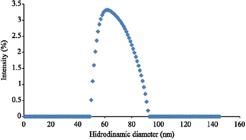
Characterization of the hydrodynamic size distribution of the nanoemulsion by dynamic light scattering (DLS).
Figures 4 and 5 show the thermal stability tests for the significant compound terpinen-4-ol conducted via GC-MS. All samples demonstrated thermodynamic stability, with controlled release of the two major EO components. However, temperatures of 5 and 25 °C performed better than 50 °C.
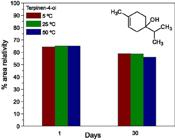
Analysis of the thermal stability of the incorporation of essential oil into the nanoemulsion by GC-MS under conditions of 5, 25 and 50 °C.
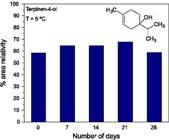
Analysis of the thermal stability of the incorporation of essential oil into the nanoemulsion by GC-MS at 5 °C.
This result can be explained by the fact that increasing the temperature leads to more significant molecular agitation and, consequently, higher velocity, causing more substantial disturbance to the system and destabilizing the NE. At 50 °C, the NE sample appeared opaque, indicating an increase in the size of EO droplets and suggesting the occurrence of coalescence.
According to the data presented in Table 1, the nanoemulsion exhibits strong and significant antimicrobial activity against all six tested organisms. The MIC values ranged from 0.0078 to 5.0 μg mL−1, depending on the microorganism tested. These findings are in agreement with previous studies27 demonstrating that Melaleuca alternifolia essential oil exhibits notable antibacterial activity, inhibits bacterial growth in both Gram-positive and Gram-negative bacteria and proves lethal to Listeria monocytogenes, Pseudomonas aeruginosa, and Escherichia coli.
Minimum inhibitory concentration (MIC) and minimum bactericidal concentration (MBC) of nanoemulsiona against six microorganisms
Previous studies, such as those by Cox et al.,14 demonstrate that terpinen-4-ol inhibits a wide range of Gram-positive and Gram-negative bacteria. It disrupts the bacterial cell membrane, leading to the loss of essential cytoplasmic components and cell death.
Conclusions
Incorporating Melaleuca alternifolia essential oil into nanoemulsions represents a technologically viable, low-cost, and promising solution to address the central problem of this research. Furthermore, the stability, controlled release of bioactive compounds, and antimicrobial efficacy against Gram-positive and Gram-negative bacteria highlight its significant potential for developing innovative applications. To ensure the safety of the application of this NE in humans or animals, future studies should include cytotoxicity testing to confirm that this formulation does not pose health risks.
Data Availability Statement
Data and materials of this study are available from the corresponding author upon request.
Acknowledgments
We thank IFPR for supporting the research/publication notice 65/2025 DPG/PROEPPI.
References
-
1 Christenhusz, M.; Byng, J. W.; Phytotaxa 2016, 261, 201. [Crossref]
» Crossref -
2 Huang, E.; Chen, Y.; Fang, M.; Global Ecol. Biogeogr. 2021, 30, 697. [Crossref]
» Crossref -
3 World Health Organization (WHO); Connecting Global Priorities: Biodiversity and Human Health: A State of Knowledge Review; WHO/CBD: Geneva, Switzerland, 2015. [Link] accessed in July 2025
» Link -
4 Infante, V. H. P.; Darvin, M. E.; Campos, P. M. B. G. M.; Photochem. Photobiol 2022, 99, 176. [Crossref]
» Crossref -
5 Borotová, P.; Galovičová, L.; Vukovic, N. L.; Vukic, M.; Tvrdá, E.; Kacaniová, M.; Plants 2022, 11, 558. [Crossref]
» Crossref -
6 Mariano, D. C.; Giebelmeier, C. G.; Albuquerque, G. D. P.; da Silva, C. R.; Okumural, R. S. In Uso de Óleo de Melaleuca alternifolia no Tratamento de Sementes de Girassol, vol. 10; Enciclopédia Biosfera, 2014. [Link] accessed in July 2025
» Link -
7 Barradas, T. N.; de Holanda e Silva, K. G.; Environ. Chem. Lett 2021, 19, 1153. [Crossref]
» Crossref -
8 Preeti; Sambhakar, S.; Malik, R.; Bhatia, S.; Al Harrasi, A.; Rani, C.; Saharan, R.; Kumar, S.; Geeta; Sehrawat, R.; Scientifica 2023, 2023, ID 6640103. [Crossref]
» Crossref -
9 Walia, N.; Anand, T.; Food Hydrocoll. Health 2022, 2, 100078. [Crossref]
» Crossref -
10 Li, X.; Qi, J.; Xie, Y.; Zhand, X.; Hu, S.; Xu, S.; Lu, Y.; Wu, W.; Int. J. Nanomed. 2013, 8, 23. [Crossref]
» Crossref -
11 McClements, D. J.; Soft Matter 2011, 7, 2297. [Crossref]
» Crossref -
12 Nepomoceno, T. A. R.; Pietrobon, A. J.; Revisão Uningá 2020, 35, eRUR3409. [Link] accessed in July 2025
» Link -
13 Zambonim, F. M.; Salerno, A. R.; Agropecuária Catarinense 2021, 22, 48. [Link] accessed in July 2025
» Link -
14 Cox, S. D.; Mann, C. M.; Markham, J. L.; J. Appl. Microbiol 2000, 88, 170. [Crossref]
» Crossref -
15 da Silva, L. L.; de Almeida, R.; Verícimo, M. A.; de Macedo, H. W.; Castro, H. C.; Braz. J. Health Rev. 2019, 2, 6011. [Crossref]
» Crossref -
16 de Groot, A. C.; Schmidt, E.; Contact Dermatitis 2016, 75, 129. [Crossref]
» Crossref -
17 Agência Nacional de Vigilância Sanitária (ANVISA); Guia de Controle de Qualidade de Produtos Cosméticos, 2nd ed.; ANVISA: Brasília, DF, 2008. [Link] accessed in July 2025
» Link - 18 Adams, R. P.; Identification of Essential Oil Components by Gas Chromatography/Mass Spectroscopy, 4.1th ed.; Allured Publishing Corporation: Carol Stream, Illinois, USA, 2017.
-
19 Ting, T. C.; Rahim, N. F. A.; Zaudin, N. A. C.; Abdullah, N. H.; Mohamad, M.; Shoparwe, N. F.; Ramle, S. F. M.; Aimi, Z.; Hamid, Z. A. A. H.; Yusof, A. H.; IOP Conf. Ser.: Earth Environ. Sci. 2020, 596, 012032. [Crossref]
» Crossref -
20 Agência Nacional de Vigilância Sanitária (ANVISA); Guia de Estabilidade de Produtos Cosméticos, Série Temáticas, Série Qualidade 1, vol. 1; ANVISA: Brasília, DF, 2004. [Crossref] accessed in July 2025
» Crossref -
21 Flekka, K.; Dimaki, V. D.; Mourelatou, E.; Avgoustakis, K.; Lamari, F. N.; Hatziantoniou, S.; Cosmetics 2024, 11, 65. [Crossref]
» Crossref - 22 Clinical and Laboratory Standards Institute (CLSI); M100-S28, Performance Standards for Antimicrobial Susceptibility Testing, 27th ed.; CLSI: Wayne, PA, USA, 2021.
-
23 Mussi, M. C. M.: Análise da Atividade Antimicrobiana dos Óleos de Copaíba (Copaifera officinalis) e da Melaleuca (Melaleuca alternifolia) sobre Fusobacterium nucleatum e Porphyromonas gingivalis: Determinação das Concentrações Inibitórias e Bactericidas Mínimas e Efeito de Concentrações Subinibitórias sobre a Agregação; MSc Dissertation, Faculdade de Odontologia de Bauru da Universidade de São Paulo, Bauru, Brazil, 2011. [Link] accessed in July 2025
» Link -
24 Silva S. R. S.; Demuner, A. J.; Barbosa, L. C. A.; Revista Brasileira de Plantas Medicinais 2003, 63, 70. [Link] accessed in July 2025
» Link -
25 Felipe, L. O.; da Silva, Jr. W. F. S.; de Araújo, K. C.; Braz. J. Microbiol 2018, 49, 212. [Crossref]
» Crossref -
26 Tadros, T.; Izquierdo, P.; Esquena, J.; Solans, C.; Adv. Colloid Interface Sci 2004, 108, 303. [Crossref]
» Crossref -
27 Zhang, X.; Guo, Y.; Guo, L.; Jiang, H.; Ji, Q.; BioMed Res. Int. 2018, 1, 2396109. [Crossref]
» Crossref
Edited by
-
Editor handled this article:
Brenno A. D. Neto (Editor-in-Chief)


