 Modulation Effects of Selected Additives on the Key Physicochemical Properties of AlCl3-EMImCl Ionic Liquid Electrolyte
Abstract
The density, viscosity, electrical conductivity, and electrochemical window of aluminum chloride-1-ethyl-3-methylimidazole chloride (AlCl3-EMImCl) ionic liquid were systematically determined across a broad temperature range. The ionic liquid was functionalized with four inorganic additives (LiCl, LiBr, NaCl, NaBr) and three organic additives (ethylene carbonate (EC), tetrahydrofuran (THF), 1,2-dichloroethane (DCE)). The results demonstrate that inorganic additives increase the density of AlCl3-EMImCl, while organic additives result in a density reduction. Among all additives, DCE and THF show the most remarkable viscosity-reducing effects. Influence of additives on electrical conductivity follows the order: DCE > THF > LiCl, LiBr > NaCl, NaBr > blank > EC. Except for LiBr and NaBr, all other investigated additives do not narrow the electrochemical window of AlCl3-EMImCl. Soft-pack battery tests further validate that THF significantly enhances coulombic efficiency without obvious capacity decay. This work provides comprehensive experimental data and useful selection references for additives, supporting the potential application of AlCl3-EMImCl electrolytes in aluminum-ion batteries.
Keywords:
AlCl3-EMImCl; additives; physicochemical properties; aluminum-ion battery
Introduction
Aluminum chloride-1-ethyl-3-methylimidazole chloride (AlCl3-EMImCl) ionic liquid has emerged as a highly competitive electrolyte candidate in electrodeposition and energy storage applications. Extensive research has focused on the electrodeposition of aluminum from AlCl3-EMImCl IL,1-5 diverse aluminum alloys, including Al-Ti, Al-Mo, Al-Zr, and Al-Mg, have been successfully synthesized using Lewis acidic AlCl3 EMImCl.6-9 Since Archer and co-workers10 first reported the use of AlCl3-EMImCl IL as an electrolyte for aluminum-ion batteries (AIBs), it has been extensively implemented in AIB systems, such as Al-graphite, Al metal sulfide, and Al-metal oxide batteries.11-18 Additives are widely acknowledged as an effective strategy to enhance deposit quality and optimize the physicochemical properties of electrolytes. Previous studies19-24 have explored various inorganic additives (e.g., alkali metal chlorides, rare earth chlorides) and organic additives (e.g., nicotinamide, nicotinic acid, methyl nicotine, 3-methyl pyridine, n-hexane, cyclohexane, acetone, tetrahydrofuran, toluene, dichloromethane).
In recent years, research on aluminum battery electrolytes has expanded to alternative systems, and increasing attention has been devoted to combining physicochemical characterization with device-level validation. Nevertheless, additive modification of chloroaluminate ionic liquids has been reported in previous literature; most studies focus on electrodeposition or single property evaluation. Systematic comparisons of multiple inorganic and organic additives on the density, viscosity, conductivity, electrochemical stability, and Walden behavior of AlCl3-EMImCl remain insufficient, especially for providing direct guidance for electrolyte optimization in practical aluminum-ion batteries. Investigating the physicochemical properties of AlCl3-EMImCl IL with additives is not only crucial for understanding the structure-property relationships of ionic liquids but also provides essential engineering data for aluminum electroplating and the development of aluminum-ion batteries.
In this work, four inorganic additives (LiCl, LiBr, NaCl, NaBr) and three organic additives (ethylene carbonate (EC), tetrahydrofuran (THF), 1,2-dichloroethane (DCE)) were selected to systematically investigate their impacts on the conductivity, viscosity, density, and electrochemical behavior of AlCl3-EMImCl IL. This study aims to provide reliable experimental data and practical reference for additive selection for AlCl3-EMImCl electrolytes, thereby supporting their further application in aluminum-ion batteries and related electrochemical systems. It should be emphasized that this work focuses on systematic experimental investigation of the physicochemical properties and electrochemical performance of AlCl3-EMImCl ionic liquid electrolytes modified by different additives, which only presents experimental data and related discussion, which will serve as a solid basis and useful reference for subsequent theoretical analysis and computational simulation studies. The reliable experimental results obtained herein can provide important verification data for force field optimization, molecular dynamics simulation, and mechanism exploration in the future.
Experimental
1-Ethyl-3-methylimidazole chloride (EMImCl, Aladdin, 99%) was vacuum-dried at 333 K for over 72 h. Alkali metal halides (LiCl, LiBr, NaCl, NaBr, Alfa Aesar, 99%) were vacuum-dried at 393 K for more than 72 h. Anhydrous aluminum chloride (AlCl3, Aladdin, 99%), ethylene carbonate (EC, Aladdin, 99%), tetrahydrofuran (THF, Aladdin, 99%), and 1,2-dichloroethane (DCE, Aladdin, 99%) were used as received without further purification.
A homogeneous AlCl3-EMImCl IL was prepared by slowly mixing AlCl3 and EMImCl at a molar ratio of 1.3, a molar ratio widely preferred for AIB applications.10-18 Subsequently, 5 mol% of the selected additive was added to the IL, and the mixture was stirred until a uniform liquid was formed. All operations were performed in an argon-filled glove box (MBRAUN MB 200B, Germany) with water and oxygen contents maintained below 0.1 ppm.
Raman spectra of AlCl3-EMImCl with various additives were recorded using an HR 800 Raman spectrometer (Horiba Jobin Yvon LabRAM) equipped with a 632.8 nm He-Ne laser. The incident power was set to 1.7 mW, and measurements were conducted at room temperature. The areas of all Raman spectral peaks were quantified using Origin software (OriginPro 2024 Education Version, OriginLab Corporation (USA), released in 2023). The trapezoidal integration method was used to integrate target peaks; each characteristic peak was integrated three times, and the average of the three results was taken as the final peak area to mitigate random errors. All Raman spectra were baseline-corrected to ensure a stable baseline, eliminating the influence of background signals (e.g., fluorescence interference, inherent instrument noise) on characteristic peaks. Peak deconvolution was performed via the “multi-peak fitting” function, with the correlation coefficient between the fitted curve and the original spectral curve ≥ 0.995 to guarantee the accuracy of deconvolution results. The random error of peak area measurement was adopted from the standard deviation of three repeated integrations, and the instrument measurement error was referenced from the manufacturer’s specification (intensity measurement error of the Raman spectrometer ≤ ± 1.0%). The combined uncertainty of intensity ratios of all characteristic peaks ranged from ± 0.02 to ± 0.05, calculated by the error propagation formula.
Densities of AlCl3-EMImCl with various additives were determined over the temperature range from 313 to 373 K using the Archimedes method. Before density measurements of the test liquids, the volume of the platinum sphere was calibrated using ethanol at 293 K, followed by secondary calibration with deionized water; the measurement error was less than 0.1%. Since the experimental temperature did not exceed 373 K, the thermal expansion coefficient of the platinum sphere could be neglected. The density of anhydrous ethanol at room temperature measured by this method deviated from the literature value by less than 1%, verifying the reliability of the method.25
Viscosities of AlCl3-EMImCl with various additives were measured over the temperature range from 313 to 373 K using the capillary viscometry method. The experimental setup mainly consisted of a glass capillary viscometer, a mechanical stirrer, and a thermostatted oil bath. The viscosity was calculated by recording the flow time of a fixed volume of liquid through the capillary under gravity. To verify the reliability of this method, the viscosity of the AlCl3-1-butyl-3-methylimidazolium chloride system was determined using the same apparatus and compared with the corresponding literature values. The measurement error was found to be within an acceptable range, demonstrating that the employed experimental method is accurate and reliable.26
Electrical conductivity of AlCl3-EMImCl with various additives was measured over the temperature range from 313 to 373 K using the capillary impedance method. The resistance was measured with an Agilent impedance analyzer at a fixed frequency of 1000 Hz and an applied voltage of 1 V. The cell constant was determined using a 0.1 mol L-1 KCl solution and further calibrated with a 1 mol L-1 KCl solution, yielding a relative error of less than 0.5%. To validate the reliability of the method, the conductivity of the AlCl3-acetamide system (molar ratio = 1.3) was measured and compared with literature data; the deviation was found to be within an acceptable range.27
Electrochemical behaviors of AlCl3-EMImCl with various additives were evaluated using cyclic voltammetry (CV) and linear sweep voltammetry (LSV) on a tungsten working electrode at room temperature. A high-purity tungsten wire (diameter (ø) 1 mm, 99.99%), an aluminum wire (ø 1 mm, 99.99%), and an aluminum sheet (10 × 15 mm, 99.99%) were used as the working electrode, reference electrode, and counter electrode, respectively. The scan rate was set to 10 mV s-1. Before use, all electrodes were polished with emery paper, cleaned with anhydrous ethanol, and dried thoroughly. Soft-pack batteries (10 × 7 cm) were assembled in an argon-filled glove box using high-purity aluminum foil (15 μm, 20 × 20 mm) as the anode, commercial graphite paper as the cathode, AlCl3 EMImCl ionic liquid as the electrolyte, and glass fiber paper as the separator. Galvanostatic charge-discharge tests and rate capability measurements were then carried out.
Results and Discussion
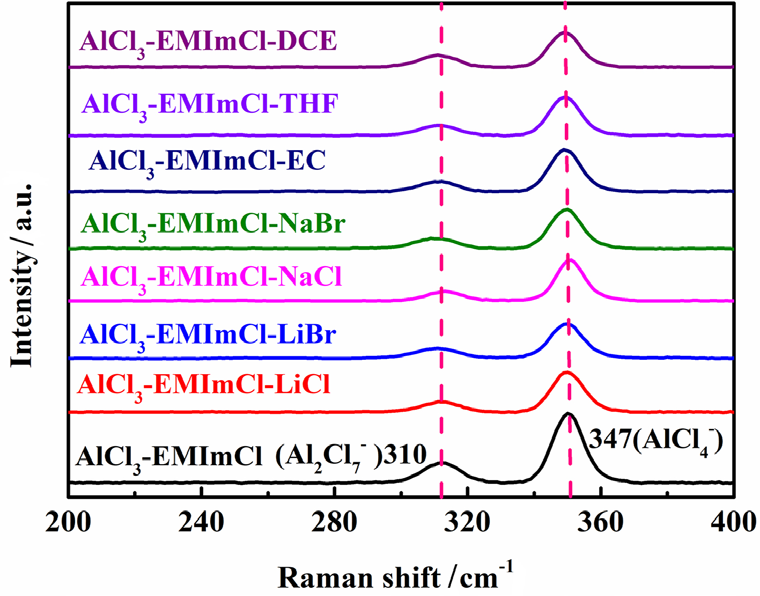
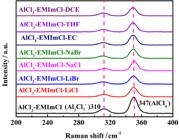
The Raman spectra of the AlCl3-EMImCl containing various additives are presented in Figure 1. All spectra exhibit two typical peaks appearing located at 347 and 310 cm-1, which are assigned to [AlCl4]- and [Al2Cl7]- complexes, respectively. The ratios of the integral area of [Al2Cl7]- peak to that of the [AlCl4]- peak (referred to as I310/I347) were used to evaluate the relative content of these two complexes in AlCl3-EMImCl. The I310/I347 ratios listed in Table 1 indicate that almost all additives cause a decrease in the relative content of [Al2Cl7]-, compared to the additive-free (blank) system. Inorganic additives are suggested to modulate the relative content of [Al2Cl7]- to [AlCl4]- through reactions described by equations 1 and 2. Given the very low equilibrium constant of equation 1,28 equation 2 may represent the dominant reaction governing speciation changes after the addition of alkali metal halides. Organic additives are proposed to interact with electrolyte components via equation 3, which might contribute to the reduction in [Al2Cl7]- species content in AlCl3-EMImCl.
The integral area ratio of [Al2Cl7]- to [AlCl4]- (I310/I347) for AlCl3-EMImCl containing various additives
All experimental density data for AlCl3-EMImCl containing various additives are listed in Table 2. The density values fit well with experimental temperature according to equation 4.
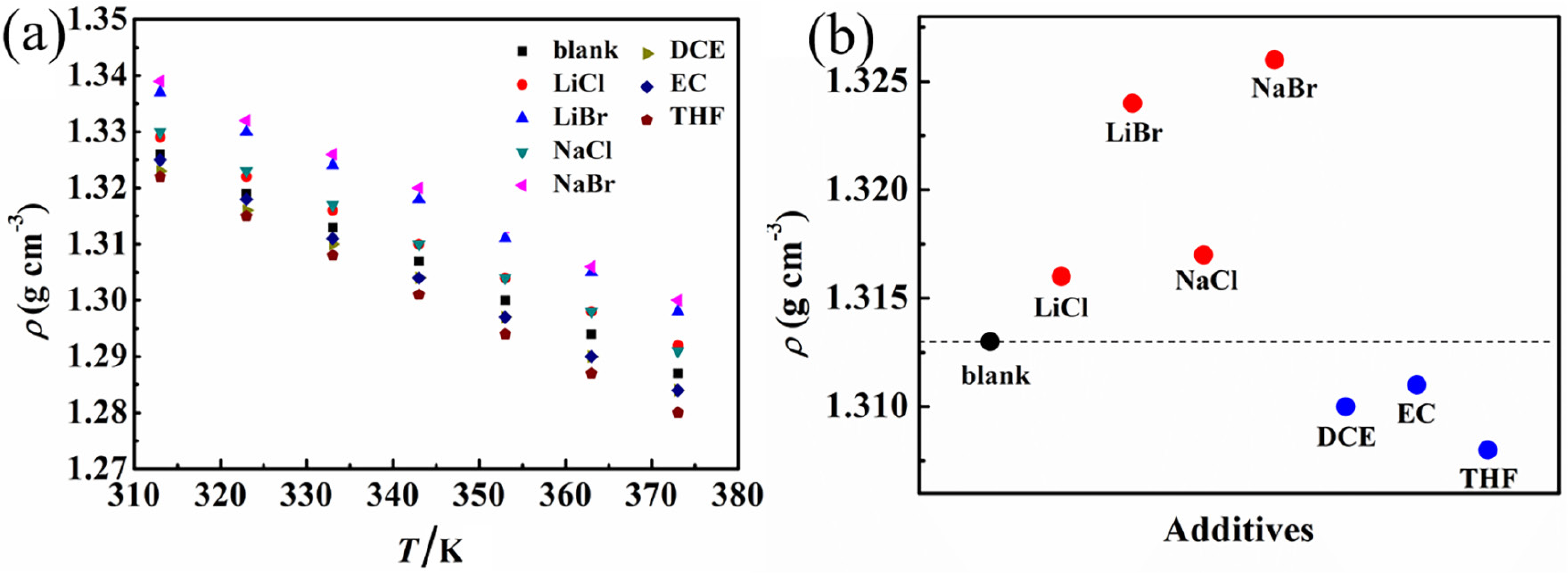
where ρ is the density, T is the experimental temperature, and a (g cm-1), b (g cm-1 K-1) are the adjustable parameters. The fitted parameters are summarized in Table 3. Figure 2a illustrates the temperature dependency of the density of AlCl3-EMImCl. Density decreases with increasing temperature, which is attributed to volume expansion at higher temperatures, resulting in a reduced number of ions per unit volume.
Least-squares fitted parameters of the equation 4 for AlCl3-EMImCl containing various additives
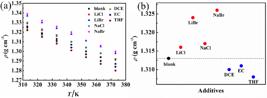
(a) Temperature dependence on the density of AlCl3-EMImCl containing various additives; (b) densities of AlCl3-EMImCl containing additives at 313 K.
Alkali metal halides have greater densities than AlCl3-EMImCl. As expected, the addition of alkali metal halides increases the density of AlCl3-EMImCl in the order of NaBr > LiBr > NaCl > LiCl (Figure 2b), suggesting that anions may have a more significant impact on density than cations. Organic additives (EC, THF, DCE) decrease the density of AlCl3-EMImCl. It is believed that the large cyclic and chain structures of organic additives occupy more space, leading to a lower number of species per unit volume. The effect of organic additives on the density follows the order of EC > DCE > THF, which is consistent with the density order of the pure organic compounds.
The viscosities of AlCl3-EMImCl containing various additives are given in Table 4. At 313 K, the viscosity of the blank AlCl3-EMImCl (12.23 mPa s) is quantitatively consistent with literature values (11.8-12.5 mPa s) for the same molar ratio system, confirming the reliability of our measurements.26,27 The viscosity values were fitted using the Arrhenius viscosity formula equation (equation 5):
where η is the viscosity, T is the experimental temperature, R is the gas constant, η0 is the pre-exponential factor (mP s), and Eη (kJ mol-1) is the viscous apparent activation energy. The best-fitted parameters are summarized in Table 5. All the studied systems exhibit viscosities in the range of 4 13 mPa s, with viscous activation energy Eη values between 14-18 kJ mol-1.
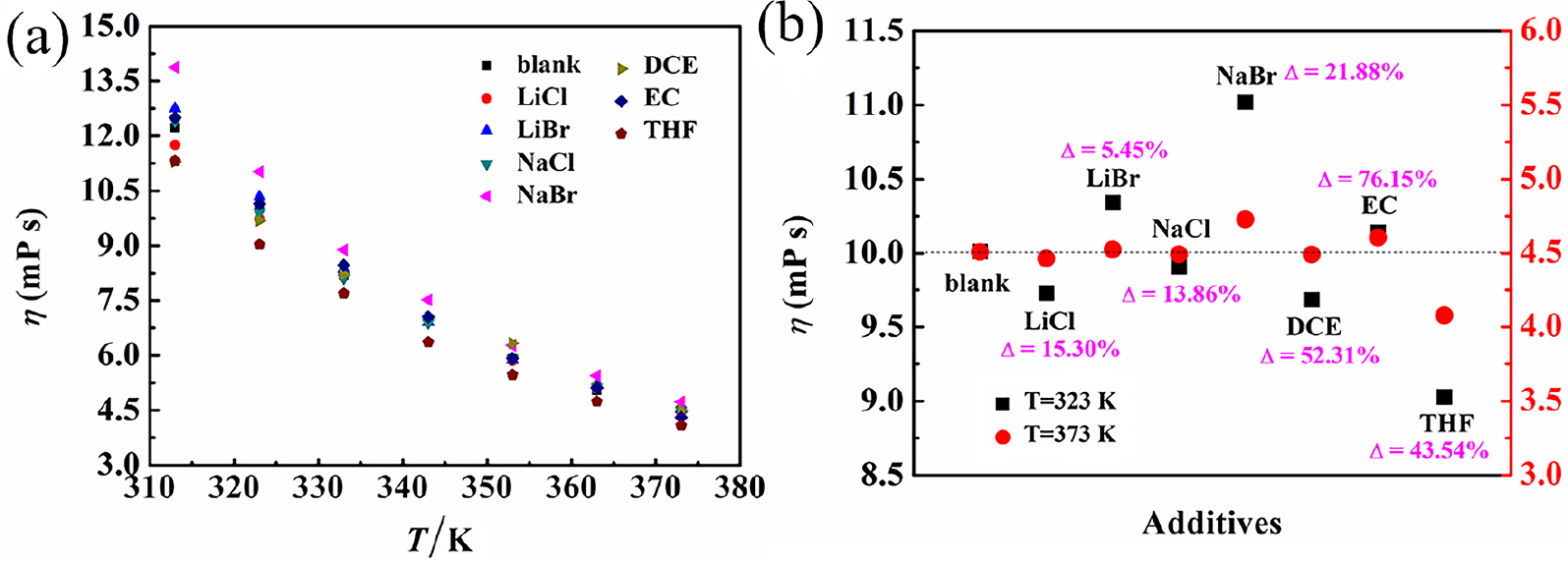
As shown in Figure 3a, the viscosity decreases with increasing temperature due to weakened hydrogen bonding and van der Waals forces. The ratios (Δ) of viscosity change induced by additives at 373 K to that at 323 K were calculated using equation 6.
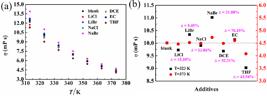
(a) Temperature dependence on the viscosity of AlCl3-EMImCl containing various additives; (b) viscosities of AlCl3-EMImCl containing additives at 323 and 373 K, respectively.
where η1 and η2 are the viscosities of AlCl3-EMImCl with and without additives at 373 K, respectively; η3 and η4 are the viscosities of AlCl3-EMImCl with and without additives at 323 K, respectively. The calculated ∆ values are presented in Figure 3b. For organic additives, the degree of viscosity change at 373 K decreases by 52.31% (THF), 76.31% (EC) and 43.54% (DCE), compared to that at 323 K. For alkali metal halides, the ratios values (∆) are below 30%, indicating that additives have a more pronounced effect on viscosity at low temperatures than at high temperatures. For inorganic additives, LiBr/NaBr increases the viscosity of the IL more significantly than LiCl/NaCl, suggesting that anions may exert a greater impact on viscosity than cations. This behavior can be tentatively interpreted as that the reduction in Coulomb force cannot offset the increase in van der Waals forces between particles.29 Compared to alkali halides, organic additives exert a more significant influence on the viscosity of AlCl3-EMImCl. Trace amounts of DCE and THF reduce viscosity, while EC increases viscosity, possibly due to enhanced cohesive forces between IL species and the three oxygen atoms in EC. It is widely reported that organic additives are believed to reduce the viscosity of AlCl3-based ILs by possibly solvating constituent ions and reducing ion aggregation.30
All experimental electrical conductivity data of AlCl3-EMImCl containing various additives are listed in Table 6. The electrical conductivity values fit well with experimental temperature according to the Arrhenius equation (equation 7):
Experimental data of the electrical conductivities for AlCl3-EMImCl containing various additives
where σ is the electrical conductivity, T is the experimental temperature, R is the gas constant, σ0 (mS cm-1) and Eσ (kJ mol-1) are the pre-exponential factor and apparent activation energy for conductivity, respectively.
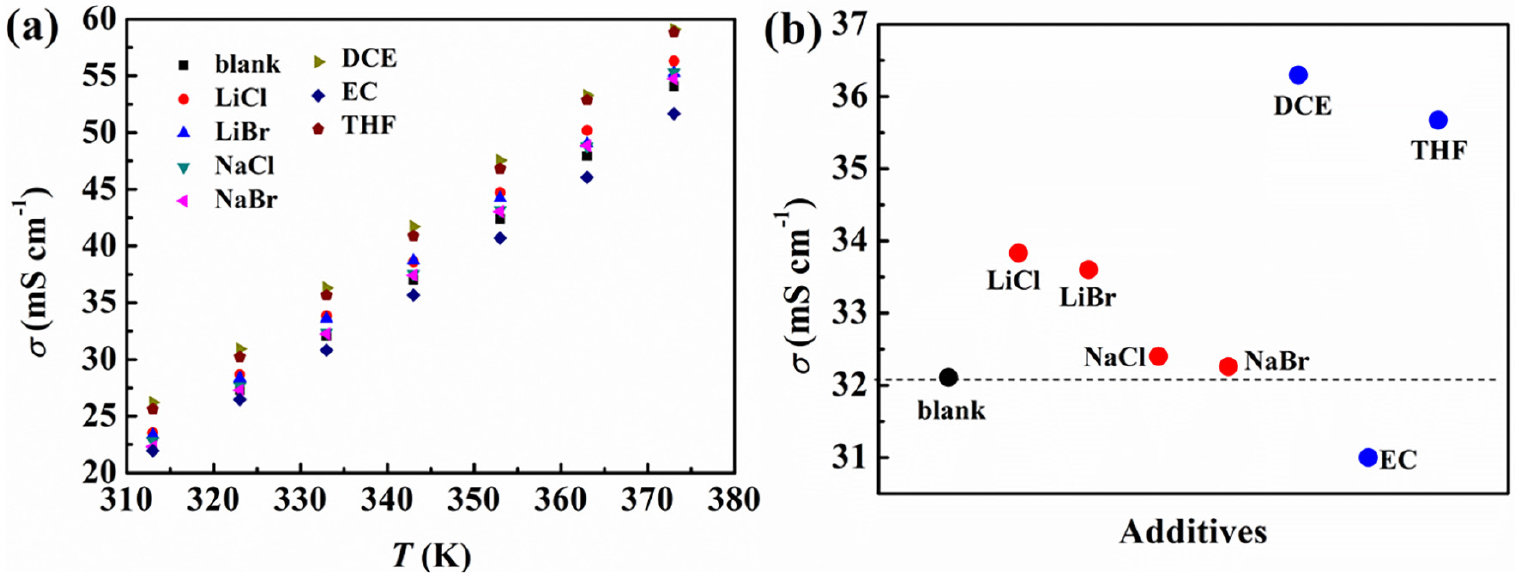
Figure 4a illustrates the temperature dependence of the specific conductivity for these systems, and the best-fitted parameters are summarized in Table 7. At 373 K, the electrical conductivity of the blank IL reaches 54.07 mS cm-1, which is comparable to or slightly higher than previously reported values (48.5-53.2 mS cm-1) for AlCl3-EMImCl IL with identical composition, indicating improved ion transport behavior in our system.25,27 The electrical conductivity of AlCl3-EMImCl with various additives increases with temperature, primarily due to the enhanced ion movement and charge migration at higher temperatures.
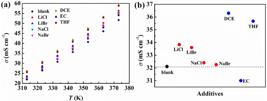
(a) Temperature dependence on the electrical conductivity of AlCl3-EMImCl containing various additives; (b) electrical conductivities of AlCl3-EMImCl containing additives at 333 K.
As shown in Figure 4b, the ionic conductivities of AlCl3-EMImCl with/without alkali metal halides follow the order: LiCl > LiBr > NaCl > NaBr > blank. Despite increasing IL viscosity, bromides enhance conductivity. It is generally accepted that the [AlCl4]- complex is more conductive in AlCl3-based IL due to its smaller volume and higher geometric symmetry compared to [Al2Cl7]-.27 Raman spectral analysis confirms that alkali metal halides increase the molar concentration of [AlCl4]- in AlCl3-EMImCl IL. Additionally, Li+ and Na+ exhibit higher migration rates in the melt due to their smaller size compared to other ions in the blank IL. These factors collectively contribute to the increased electrical conductivity of AlCl3-EMImCl after the addition of alkali metal halides. Raman analysis suggests that organic additives might increase the content of [AlC4]-, which could potentially contribute to enhanced conductivity due to the smaller complex size of [AlCl4]- compared to [Al2Cl7]-. However, only DCE and THF significantly improve electrical conductivity, while EC reduces the conductivity compared to the blank system. The negative impact of EC on conductivity is attributed to its greater viscosity, further confirming the inverse relationship between viscosity and conductivity. Thus, the enhanced ion mobility resulting from reduced viscosity is believed to be the dominant factor driving conductivity improvement for additives DCE and THF.
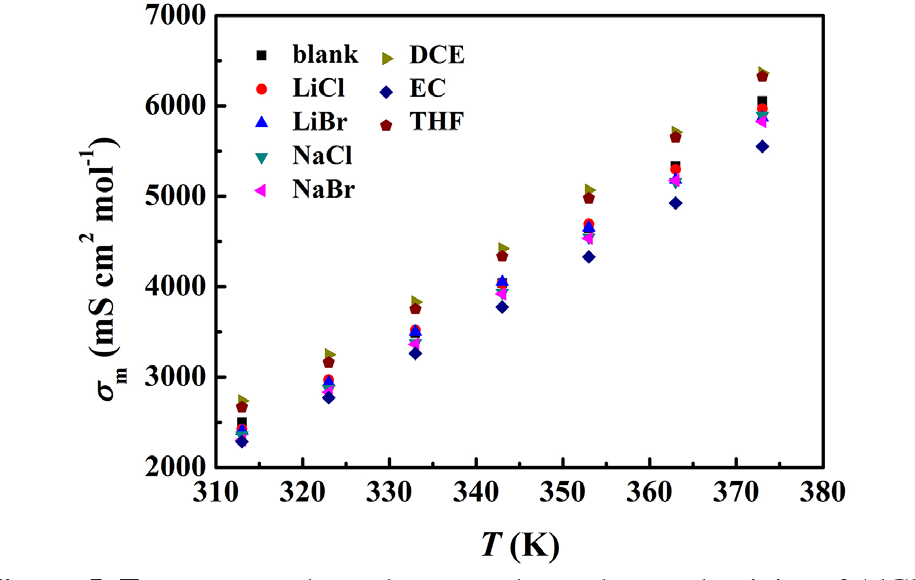
The molar conductivity (Λ) is a key parameter for evaluating ion mobility for ionic conductivity. Based on the electrical conductivity and density values, the molar conductivities of AlCl3-EMImCl containing various additions are calculated, and molar conductivity data are listed in Table 8, and the temperature dependence of Λ is shown in Figure 5. Molar conductivity increases with temperature for all systems, indicating that ion mobility is strongly temperature-dependent.
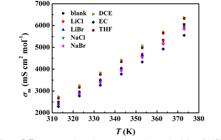
Temperature dependence on the molar conductivity of AlCl3-EMImCl containing various additives.
Molar conductivity exhibits the same trend as specific electrical conductivity, following the order of DCE > THF > LiCl, LiBr, blank > NaCl > NaBr > EC. As expected, AlCl3-EMImCl containing DCE/THF exhibits higher ion mobility than other systems, which can be reasonably interpreted as the relatively weak cation-anion interactions, resulting in lower ion packing density and higher ionic charge transfer.27 Although alkali metal halides increase conductivity, they do not significantly improve molar conductivity, indicating that the organic additives have a stronger impact on ion mobility in AlCl3-based IL than inorganic additives. In summary, additives with strong viscosity-reducing capabilities are more effective at enhancing the conductivity of AlCl3-EMImCl than those containing small-sized conductive ions.
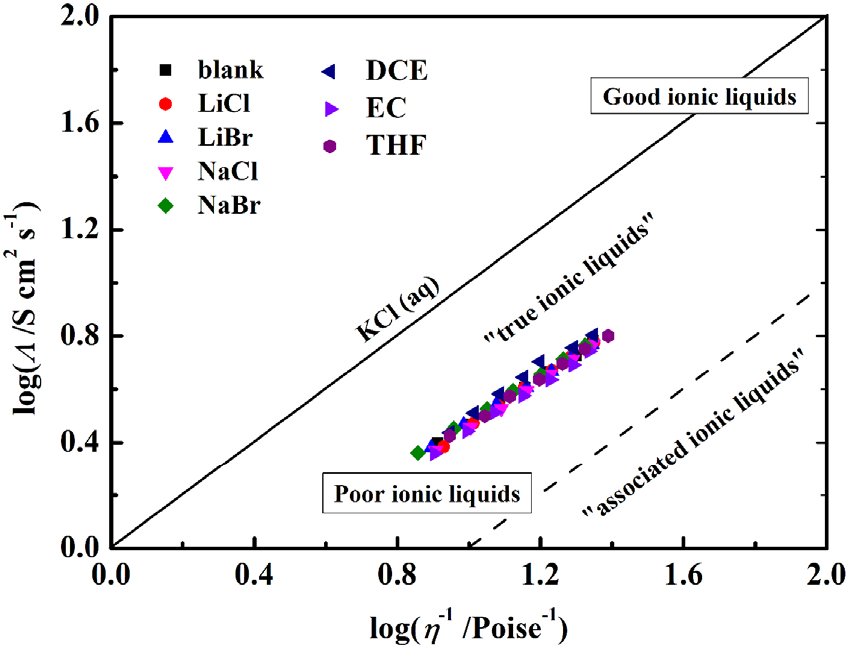
Comprehensive Walden behavior analysis for this system is rarely reported in previous studies. The relationship between molar conductivity and fluidity was described by the Walden rule:31-33
where Λ is the molar conductivity, η is the viscosity, α is a constant between zero and unity, and κ is a temperature-dependent constant. This relationship can be linearized in a log-log plot, which can be written as:31-33
In the log-log plot (Figure 6), the ideal line is defined by data for a 0.01 mol L-1 KCl aqueous solution. “Good ionic liquids” would cluster near this ideal line, while “poor ionic liquids” deviate significantly. The constant C and slope α (which reflects ion decoupling) are derived from the linear fit. A deviation was quantified by measuring the vertical distance of experimental data to the ideal line and denoting it as ∆W.34 As listed in Table 9, all ∆W values fall between 0 and 1, indicating that the prepared ILs can be classified as “true ionic liquids” with weak cation-anion interactions.35
The deviation ∆W and least-squares fitted values of equation 9 for AlCl3-EMImCl containing various additives
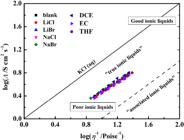
All presented data in the Walden plot show an excellent linear correlation between ILs’ conductivities and viscosities. All the fitted parameters are also listed in Table 9. The fitted slopes (0.84-0.92) and ∆W values (0.50-0.60) in this work are within the typical range for chloroaluminate ionic liquids (slope: 0.80-0.95; ∆W: 0.45-0.65), demonstrating that our electrolytes exhibit comparable ionicity and ion dissociation behavior to previously reported systems.31,34,35 However, the fitted α values are less than 1 as predicted by the ideal Walden rule. Therefore, those ILs should be categorized as “poor” ionic liquids.34 Depending on whether their behavior is close to or far from the ideal IL behavior, the “decoupling index” α follows the order: LiCl, DCE > NaCl, blank, EC > THF, NaBr, LiBr, indicating increased ion decoupling.36 The increase of ionicity is considered to entails a decreasing deviation from the ideal Walden plot.31,32 As expected, the deviation from the ideal Walden plot follows the trend: DCE, LiCl < blank, NaCl, EC < THF, LiBr, NaBr. AlCl3 EMImCl IL containing DCE/LiCl exhibits the highest ionicity, which is consistent with the specific conductivity.
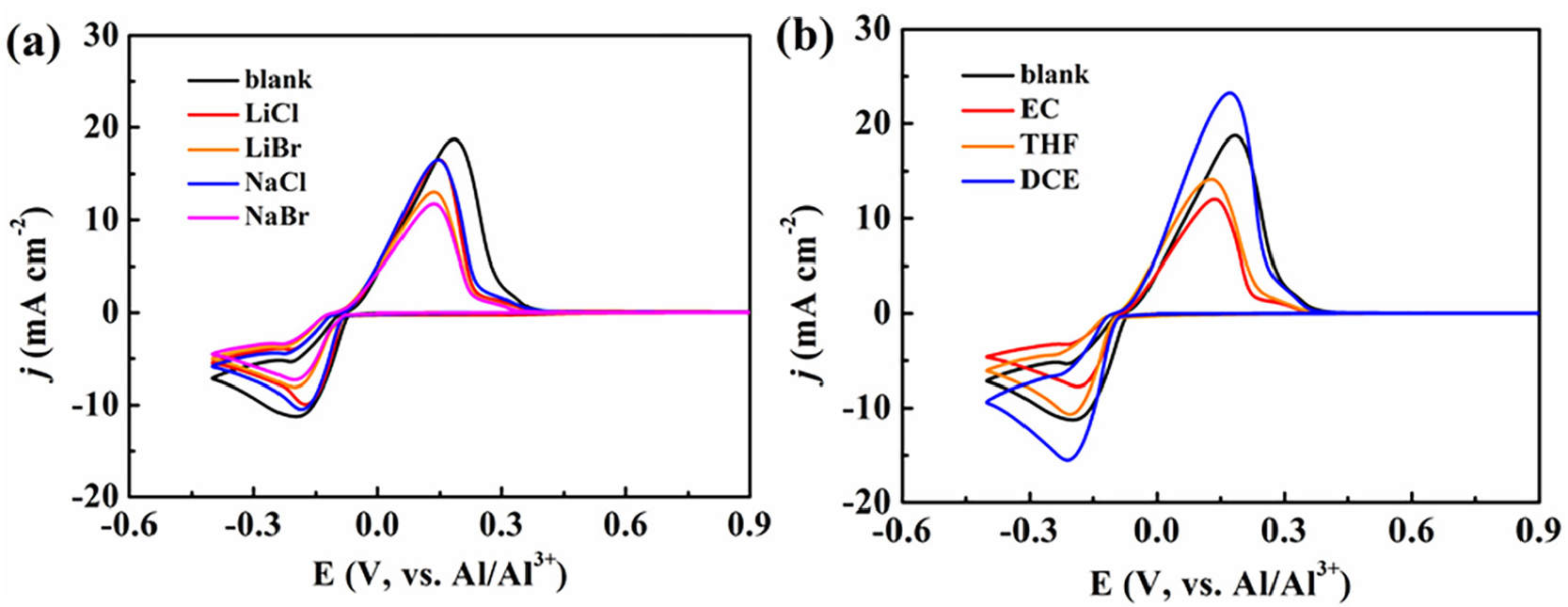
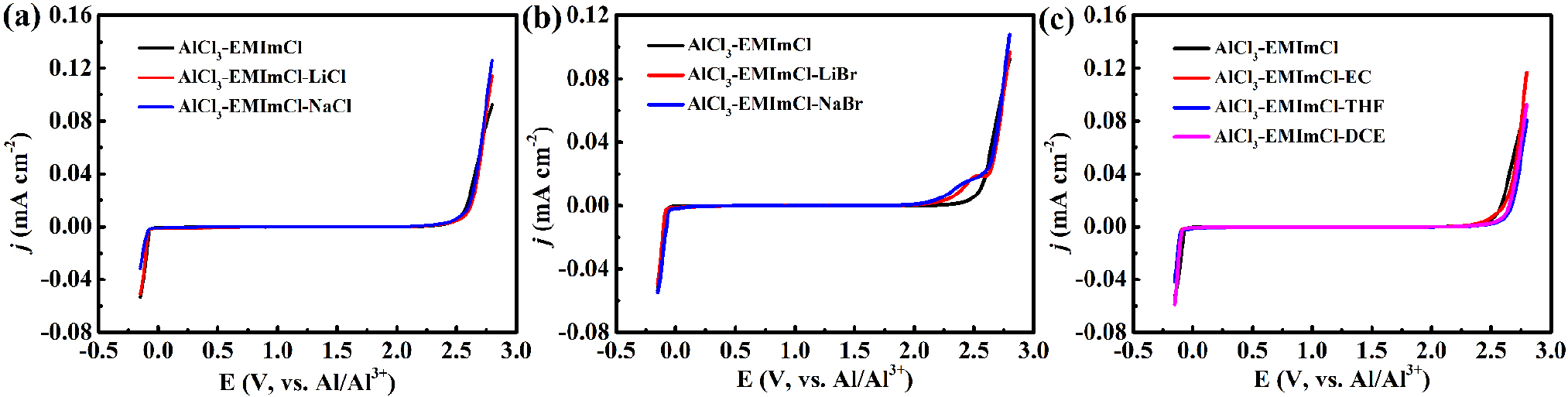
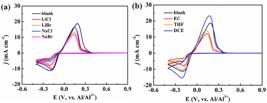
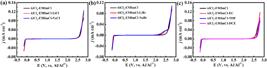
CV and LSV curves of AlCl3-EMImCl with/without various additives recorded on a tungsten electrode are shown in Figures 7-8, respectively. The onset oxidation and reduction potentials were determined from the intersection of the tangent to the rising current of the oxidation/reduction peak with the baseline of the LSV curve.37 Each sample was tested in parallel three times to assess reproducibility, with the deviation of onset potentials ≤ ± 0.05 V. The initial reduction potential (E0) and redox peak current density (ja, jc) for all systems are listed in Table 10. All CV curves show similar redox peaks corresponding to the deposition/stripping of metal aluminum. E0 moves to negative about 15 and 30 mV by alkali metal halides and organics, respectively. Additionally, ja and jc decrease after adding additives (except DCE), which is attributed to the reduced relative content of [Al2Cl7]-. These results suggest that additives do not alter the fundamental deposition/stripping mechanism of aluminum. Additives LiCl and NaCl do not affect the anodic limit potential of AlCl3 EMImCl (Figure 8a), while LiBr and NaBr decrease the anodic limit to 2.0 V (Figure 8b), indicating that the electrochemical window of AlCl3-EMImCl is narrowed by LiBr/NaBr. This narrow electrochemical window limits the application of AlCl3-EMImCl containing bromides in AIBs with a desired high operating voltage. Organic additives have no significant effect on the electrochemical window of AlCl3-EMImCl (Figure 8c).
The initial reduction potential (E0), redox peak current density (ja, jc) obtained from CVs in Figure 7
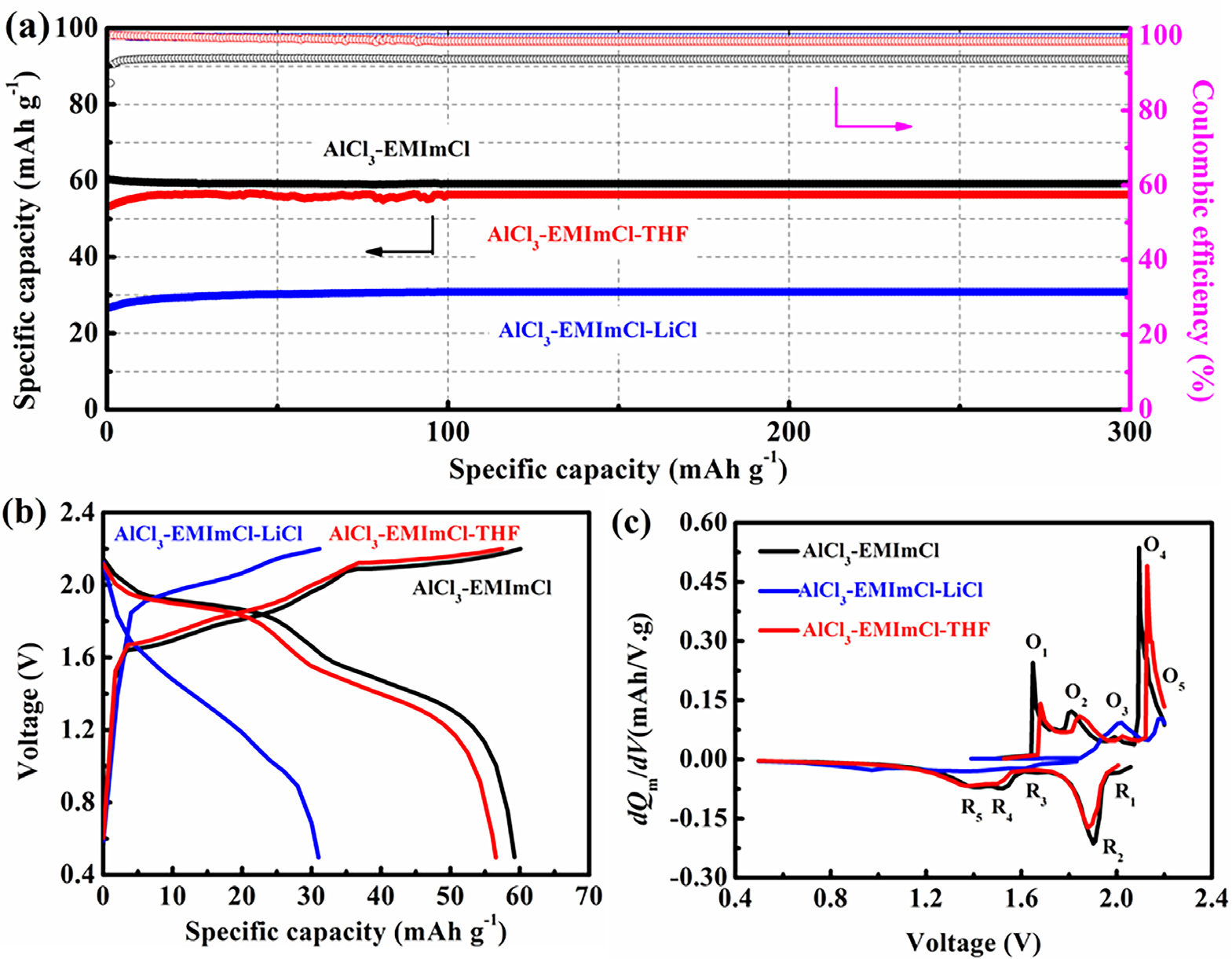
These results demonstrate that appropriate additives can effectively regulate the viscosity, conductivity, ionic mobility, and electrochemical stability of AlCl3-EMImCl ionic liquids, which are critical parameters for aluminum-ion battery electrolytes. Low viscosity and high conductivity facilitate ion migration and rate capability, while a wide electrochemical window ensures high voltage compatibility. Accordingly, DCE and THF are considered promising candidates to improve the dynamic properties of AlCl3-EMImCl electrolytes for aluminum-ion battery applications. Therefore, further investigations were conducted on the THF additive, and the effect of the alkali metal halide (LiCl) on battery performance was also studied for comparison. Soft-pack batteries were assembled using metallic aluminum as the anode and commercial graphite paper (GP) as the cathode, and galvanostatic charge-discharge tests were performed to evaluate the influences of LiCl and THF additives on the electrochemical performance of aluminum-graphite batteries.
Figure 9a shows the cycling stability of Al-GP batteries at a high rate of 4 C before and after the addition of LiCl and THF into the AlCl3-EMImCl electrolyte. The discharge capacity of the blank electrolyte (about 60 mAh g-1) at 4 C is consistent with reported values for Al-graphite batteries using AlCl3-EMImCl electrolyte under similar high-rate conditions, validating the reproducibility of our battery tests.12,13 It can be observed that during 300 cycles, the discharge specific capacity of the Al-GP battery assembled with the pristine AlCl3-EMImCl electrolyte remains stable at approximately 60 mAh g-1, with a coulombic efficiency of 94%. After introducing LiCl or THF into the AlCl3 EMImCl electrolyte, the coulombic efficiency of the Al-GP battery is significantly improved to nearly 100%. However, the discharge specific capacity of the Al|AlCl3 EMImCl THF|GP battery decreases to 58 mAh g-1, while that of the Al|AlCl3-EMImCl-LiCl|GP battery drops more markedly to around 30 mAh g-1, merely half of the capacity delivered by the Al|AlCl3-EMImCl |GP battery. From the charge-discharge profiles of the Al-GP batteries (Figure 9b), it can be seen that the addition of THF to the AlCl3-EMImCl electrolyte does not alter the charge/discharge behavior of the Al-GP battery, which still exhibits two distinct charging processes (1.6-2.05 V and 2.05 2.2 V) and two obvious discharging processes (2.0 1.8 V and 1.8 1.2 V). For the AlCl3-EMImCl-LiCl electrolyte, the onset potential of the first charging step increases from 1.6 to 1.8 V, the second charging process nearly disappears, and no obvious discharge plateaus are observed in the discharge voltage curve. The reduction in battery capacity can also be interpreted by the differential capacity curves (Figure 9c). Peaks O1-O5 and R1-R5 correspond to the intercalation/deintercalation processes of [AlCl4]- ions at different stages between graphite layers during charging/discharging.12 For the AlCl3-EMImCl-THF electrolyte, the peak intensities decrease slightly. In contrast, both the intensity and number of peaks are significantly reduced in the AlCl3-EMImCl system. These results indicate that the intercalation capability of chloroaluminate ions is weakened, thus leading to capacity decay. This phenomenon is tentatively attributed to the complexation between Li+ ions and [AlCl4]- ions in the electrolyte, which is believed to hinders the intercalation of [AlCl4]- ions into graphite interlayers.38 Consequently, the intercalation/deintercalation ability of [AlCl4]- ions between graphite interlayers is suppressed in the Al|AlCl3-EMImCl-LiCl|GP battery, resulting in a remarkable decrease in the specific capacity provided by this electrolyte system.
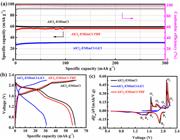
(a) Cycling stability, (b) charge and discharge curves, (c) differential capacity curves of Al-GP batteries with AlCl3-EMImCl-based electrolytes operated at a high rate of 4 C.
Combined with the effects of additives on the physicochemical properties of AlCl3-based electrolytes, it can be concluded that organic additives significantly enhance the coulombic efficiency of aluminum-graphite batteries employing AlCl3-based electrolytes, with negligible influence on battery capacity. Therefore, the performance of aluminum-graphite batteries can be further improved by rationally tuning additive components, such as optimizing additive dosage, developing binary/ternary additives, or introducing heterocyclic-containing organic compounds.
The comprehensive experimental data and clear regulation rules obtained in this work can provide important reference and verification standards for the subsequent mechanism research, theoretical calculation and molecular simulation of AlCl3-EMImCl ionic liquid electrolytes. It should be emphasized that the above conclusions are based on a limited composition range and single additive dosage, which have certain system specificity. This study is a systematic screening work based on a fixed AlCl3:EMImCl molar ratio and a single additive concentration. The present work provides comparative trends and basic data support rather than optimized formulations. Future research will focus on the optimization of the electrolyte composition and additive dosage to further correlate physicochemical properties with practical battery performance.
Conclusions
In this study, the density, viscosity, electrical conductivity, and electrochemical window of AlCl3 EMImCl ionic liquid were systematically investigated in the presence of seven additives (LiCl, LiBr, NaCl, NaBr, EC, THF, DCE) over a temperature range of 313-373 K. Inorganic additives increase the density of AlCl3-EMImCl, while organic additives cause a density decrease. DCE and THF exhibit the most significant viscosity-reducing effects among all additives. The influence of additives on electrical conductivity follows the order: DCE > THF > LiCl, LiBr > NaCl, NaBr > blank > EC. LiBr and NaBr narrow the electrochemical window of AlCl3-EMImCl, while other additives have no adverse effect on the electrochemical window. Soft-pack aluminum-graphite battery tests further demonstrate that THF significantly improves coulombic efficiency without obvious capacity fading, whereas LiCl severely suppresses the intercalation of [AlCl4]- into graphite and causes drastic capacity decay. This systematic study provides reliable experimental data and clear regulatory trends for the additive modification of AlCl3-EMImCl ionic liquids.
The results can serve as a useful reference for additive selection and the further design and application of AlCl3-EMImCl systems in aluminum-ion batteries and aluminum electrodeposition. This work only focuses on experimental characterization and performance evaluation, and the experimental data will serve as a basis for further theoretical/computational studies.
Acknowledgments
This work was financially supported by the Natural Science Foundation of Henan Province (252300420759), the Key Scientific Research Project of Colleges and Universities in Henan Province (25B480009), Henan Province Soft Science Project (262400410167), Henan Province Key Science and Technology Research (262102230097) and Henan University of Urban Construction Young Backbone Teacher Training Program (YCJQNGGJS202507, YCJQNGGJS202503).
We gratefully acknowledge the software DeepL (V 25.31) for proofreading the manuscript.
Data Availability Statement
All data are available in the text.
References
-
1 Jiang, T.; Brym, M. J. C.; Dubé, G.; Lasia, A.; Brisard, G. M.; Surf. Coat. Technol. 2006, 201, 1. [Crossref]
» Crossref -
2 Li, B.; Fan, C. H.; Chen, Y.; Lou, J. W.; Yan, L. G.; Electrochim. Acta 2011, 56, 5478. [Crossref]
» Crossref -
3 Chang, J. K.; Chen, S. Y.; Tsai, W. T.; Deng, M. J.; Sun, I. W.; Electrochem. Commun. 2007, 9, 1602. [Crossref]
» Crossref -
4 Perre, E.; Nyholm, L.; Gustafsson, T.; Taberna, P. L.; Simon, P.; Edström, K.; Electrochem. Commun. 2008, 10, 1467. [Crossref]
» Crossref -
5 Tang, J. W.; Azumi, K.; Electrochim. Acta 2011, 56, 1130. [Crossref]
» Crossref -
6 Tsuda, T.; Hussey, C. L.; Stafford, G. R.; Bonevich, J. E.; J. Electrochem. Soc. 2003, 150, C234. [Crossref]
» Crossref -
7 Tsuda, T.; Hussey, C. L.; Stafford, G. R.; J. Electrochem. Soc. 2004, 151, C379. [Crossref]
» Crossref -
8 Tsuda, T.; Hussey, C. L.; Stafford, G. R.; Kongstein, O.; J. Electrochem. Soc. 2004, 151, C447. [Crossref]
» Crossref -
9 Morimitsu, M.; Tanaka, N.; Matsunaga, M.; Chem. Lett. 2000, 29, 1028. [Crossref]
» Crossref -
10 Jayaprakash, N.; Das, S. K.; Archer, L. A.; Chem. Commun. 2011, 47, 12610. [Crossref]
» Crossref -
11 Lin, M. C.; Gong, M.; Lu, B. A.; Wu, Y. P.; Wang, D. Y.; Guan, M. Y.; Angell, M.; Chen, C. X.; Yang, J.; Hwang, B. J.; Dai, H. J.; Nature 2015, 520, 324. [Crossref]
» Crossref -
12 Yu, X. Z.; Wang, B.; Gong, D. C.; Xu, Z.; Lu, B. A.; Adv. Mater. 2017, 29, 1604118. [Crossref]
» Crossref -
13 Wang, D. Y.; Wei, C. Y.; Lin, M. C.; Pan, C. J.; Chou, H. L.; Chen, H. A.; Gong, M.; Wu, Y. P.; Yuan, C. Z.; Angell, M.; Hsieh, Y. J.; Chen, Y. H.; Wen, C. Y.; Chen, C. W.; Hwang, B. J.; Chen, C. C.; Dai, H. J.; Nat. Commun. 2017, 8, 14283. [Crossref]
» Crossref -
14 Zhang, L. Y.; Chen, L.; Luo, H.; Zhou, X. F.; Liu, Z. P.; Adv. Energy Mater. 2017, 7, 1700034. [Crossref]
» Crossref -
15 Wang, H. L.; Bai, L.; Chen, S.; Luo, X. Y.; Wu, C.; Wu, F. J.; Lu, J.; Amine, K.; ACS Appl. Mater. Inter. 2015, 7, 80. [Crossref]
» Crossref -
16 Gao, T.; Li, X. G.; Wang, X. W.; Hu, J. K.; Han, F. D.; Fan, X. L.; Suo, L. M.; Pearse, A. J.; Lee, S. B.; Rubloff, G. W.; Gaskell, K. J.; Noked, M.; Wang, C. S. A.; Angew. Chem., Int. Ed. 2016, 128, 10052. [Crossref]
» Crossref -
17 Wang, S.; Yu, Z. J.; Tu, J. G.; Wang, J. X.; Tian, D. H.; Liu, Y. J.; Jiao, S. Q.; Adv. Energy Mater. 2016, 6, 1600137. [Crossref]
» Crossref -
18 Wang, S.; Jiao, S. Q.; Wang, J. X.; Chen, H. S.; Tian, D. H.; Lei, H. P.; Fang, D. N.; ACS Nano 2017, 11, 469. [Crossref]
» Crossref -
19 Zhang, Q. Q.; Wang, Q.; Zhang, S. J.; Lu, X. M.; J. Solid State Electrochem. 2014, 18, 257. [Crossref]
» Crossref -
20 Wang, Q.; Chen, B.; Zhang, Q. Q.; Lu, X. M.; Zhang, S. J.; ChemElectroChem 2015, 2, 1794. [Crossref]
» Crossref -
21 Wang, Q.; Zhang, Q. Q.; Chen, B.; Lu, X. M.; Zhang, S. J.; J. Electrochem. Soc. 2015, 162, D320. [Crossref]
» Crossref -
22 Liu, L.; Lu, X. M.; Cai, Y. J.; Zheng, Y.; Zhang, S. J.; Aust. J. Chem. 2012, 65, 1523. [Crossref]
» Crossref -
23 Abbott, A. P.; Qiu, F. H.; Abood, H. M. A.; Alia, M. R.; Ryder, K. S.; Phys. Chem. Chem. Phys. 2010, 12, 1862. [Crossref]
» Crossref -
24 Sun, X. G.; Fang, Y. X; Jiang, X. G.; Yoshii, K.; Tsuda, T.; Dai, S.; Chem. Commun. 2016, 52, 292. [Crossref]
» Crossref -
25 Dedyukhin, A.; Kataev, A.; Redkin, A.; Zaikov, Y.; ESC Trans. 2014, 64, 151. [Crossref]
» Crossref - 26 Wasserscheid, P.; Welton, T.; Ionic Liquids in Synthesis; Wiley VCH Verlag GmbH & Co. KGaA: Weinheim, Germany, 2002.
-
27 Zheng, Y.; Dong, K.; Wang, Q.; Zhang, J. M.; Lu, X. M.; J. Chem. Eng. Data 2013, 58, 32. [Crossref]
» Crossref -
28 Geetha, S.; Trivedi, D. C.; Cheminform 2003, 19, 37. [Crossref]
» Crossref - 29 Zhang, X. C.; Ionic Liquid: from Theoretical Basis to Research Progress; Chemical Industry Press: Beijing, China, 2008.
-
30 Perry, R. L.; Jones, K. M.; Scott, W. D.; Liao, Q.; Hussey, C. L.; J. Chem. Eng. Data 1995, 40, 615. [Crossref]
» Crossref -
31 Yoshizawa, M.; Xu, W.; Angell, C. A.; J. Am. Chem. Soc. 2015, 125, 15411. [Crossref]
» Crossref -
32 Xu, W.; Cooper, E. I.; Angell, C. A.; J. Phys. Chem. B 2003, 107, 6170. [Crossref]
» Crossref -
33 MacFarlane, D. R.; Forsyth, M.; Izgorodina, E. I.; Abbott, A. P.; Annat, G.; Fraser, K.; Phys. Chem. Chem. Phys. 2009, 11, 4962. [Crossref]
» Crossref -
34 Fraser, K. J.; Izgorodina, E. I.; Forsyth, M.; Scott, J. L.; MacFarlane, D. R.; Chem. Commun. 2007, 37, 3817. [Crossref]
» Crossref -
35 García, A.; González, L. C. T.; Padmasree, K. P.; Garcia, M. G. B.; Sánchez, E. M.; J. Mol. Liq. 2013, 178, 57. [Crossref]
» Crossref -
36 Pereiro, A. B.; Araújo, J. M. M.; Martinho, S.; Alves, F.; Nunes, S.; Matias, A.; Duarte, C. M. M.; Rebelo, L. P. N.; Marrucho, I. M.; ACS Sustainable Chem. Eng. 2013, 1, 427. [Crossref]
» Crossref - 37 Bard, A. J.; Faulkner, L. R.; Electrochemical Methods: Fundamentals and Applications, 2nd ed.; John Wiley & Sons, Inc.: New York, USA, 2001.
-
38 Xu, J.; Ju, Z. W.; Cao, J. Y.; Wang, W. C.; Wang, C.; Chen, Z. D.; J. Alloy Comp. 2016, 689, 489. [Crossref]
» Crossref
Edited by
-
Editor handled this article:
Adriana Nunes Correia (Associate)