 A Concise Five-Step Synthesis of Erlotinib via Direct Schmidt Nitrilation and Microwave-Assisted Cyclization
Abstract
Erlotinib is an important tyrosine kinase inhibitor in receptors overexpressed in malignant tumors, such as lung cancer, acting directly on the epidermal growth factor receptor. Existing synthetic routes to prepare this drug typically require multiple steps, harsh conditions, or expensive reagents, which limits their scalability and sustainability. Herein, it is described an efficient and cost effective synthesis of erlotinib, comprising only five steps from 3,4-dihydroxybenzaldehyde. The approach is highlighted by a direct Schmidt nitrilation of 3,4-bis(2-methoxyethoxy)benzaldehyde under mild, transition-metal-free conditions, achieving high conversion without the need for oxime intermediates or dehydrating agents. The final cyclization, promoted via a microwave-assisted cyclization, affords erlotinib in high yield. Overall, this route combines synthetic efficiency with methodological improvements, achieving an average yield of 87% per step.
Keywords:
drug synthesis; erlotinib; Schmidt reaction; microwave
Introduction
Cancer is one of the leading causes of death and represents a significant challenge to increasing life expectancy worldwide.1 Lung cancer, an example of a highly aggressive malignant tumor, is one of the main causes of cancer-related mortality.2
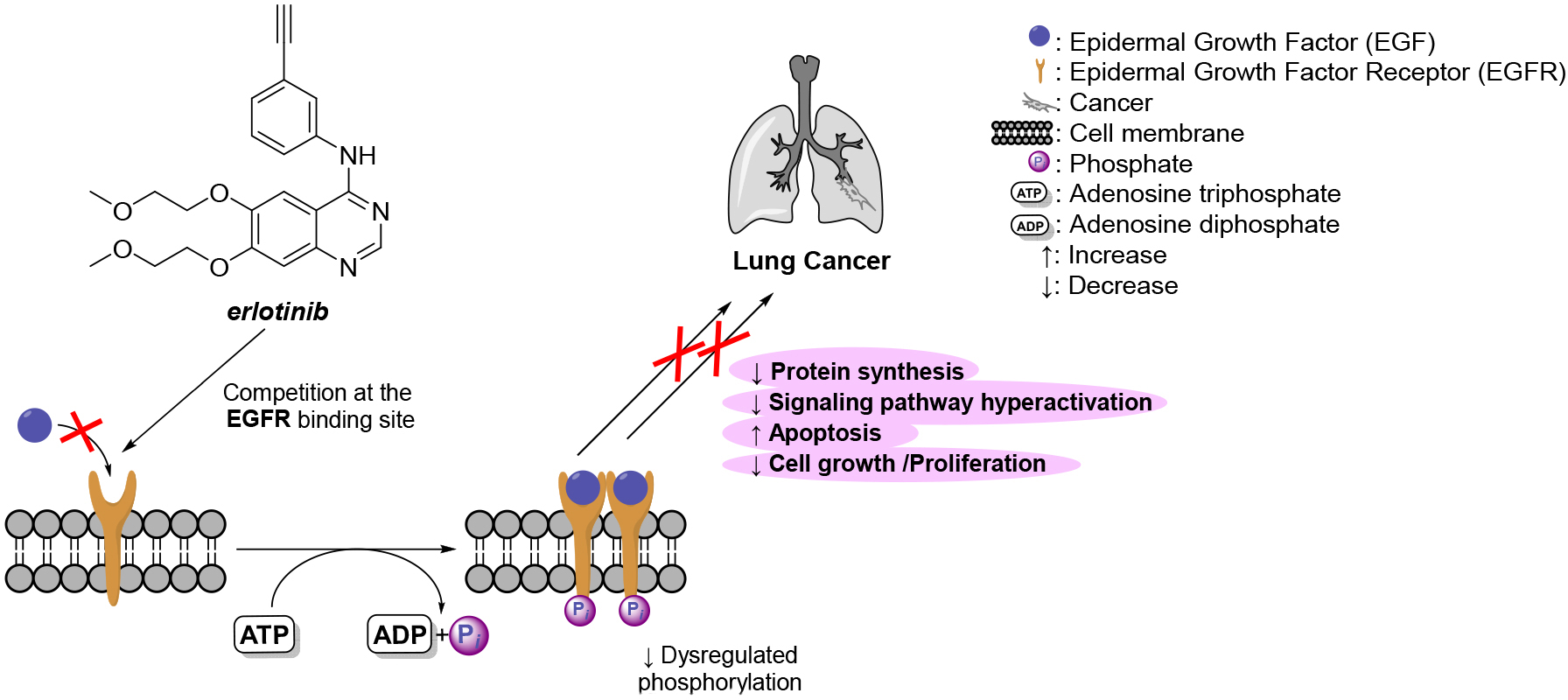
Several effective anticancer drugs possess a quinazoline core as their structural scaffold.3-7 These compounds act as selective inhibitors of receptor tyrosine kinases (RTKs), including PDGFR-β (Platelet-Derived Growth Factor Receptor Beta), VEGFR-2 (Vascular Endothelial Growth Factor Receptor 2), and EGFR (Epidermal Growth Factor Receptor), by inhibiting the catalytic activity of the receptor and consequently its phosphorylation. In this way, they compete with EGF (Epidermal Growth Factor) for the binding site, blocking downstream signaling and preventing uncontrolled cell proliferation, angiogenesis, and tumor progression.7,8 One of the main drugs used for this purpose is erlotinib, (half maximal inhibitory concentration (IC50: 1 nM)), which has gained wide market demand due to its excellent therapeutic outcomes and tolerability (Figure 1).9-13
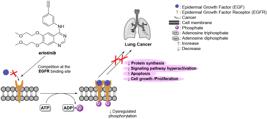
Simplified representation of Epidermal Growth Factor Receptor (EGFR) inhibition by erlotinib and its mechanism of action in lung cancer.
Numerous synthetic routes for erlotinib have been reported in the literature.9,14-17 However, these methodologies involve a high number of reaction steps, employing corrosive reagents such as SOCl2 and POCl3, in addition to expensive reducing agents such as PtO2 and Pt/C, associated with flammable gases such as H2, which are frequently used under high temperature and pressure conditions.14-16,18 Such characteristics increase the complexity of the process and also impose considerable risks to operational safety and environmental sustainability. In this context, even with the advances achieved in recent years, the development of more concise and efficient protocols for erlotinib remains a relevant challenge, representing a fundamental step toward sustainable and economical production of this important antitumor drug.
In this context, herein it is reported an efficient and low-cost five-step synthesis of erlotinib, starting from 3,4-dihydroxybenzaldehyde. The strategy combines a microwave-assisted cyclization19 with a direct nitrilation through a Schmidt-type reaction20 performed under mild, transition-metal-free conditions.18 The use of trifluoromethanesulfonic acid (TfOH) enables the direct and highly selective conversion of aldehydes into nitriles,20 overcoming previous limitations in selectivity and circumventing classical oxime-based nitrilation protocols that rely on harsh reagents.21 Overall, this concise and operationally simple route offers a simpler, more elegant, and potentially scalable access to erlotinib and related quinazoline-based antitumor agents.
Experimental
All reagents and solvents were of analytical grade or high-performance liquid chromatography (HPLC) and were used without further purification, unless necessary or stated. Flash column chromatography was performed on silica gel (40-63 μm, 230-400 mesh, 60 Å), and reaction progress was monitored by thin-layer chromatography (TLC) on silica gel 60 F254 plates, visualized under UV light (254 nm). Melting points were recorded using the melting point apparatus Buchi M-565 automated melting point meter. Nuclear magnetic resonance (NMR) spectra were recorded on a DRX-500 spectrometer, (500 MHz), using CDCl3, acetone-d6, or dimethyl sulfoxide (DMSO-d6) as deuterated solvents, with chemical shifts (δ) reported in parts per million (ppm) relative to tetramethylsilane (TMS, δ 0.00 ppm) or the residual solvent signal, so that the obtained spectra were processed using MestReNova software (version 14.0.0-2329, Mestrelab Research S.L.) and data are reported as chemical shift (multiplicity, coupling constant J in Hz, integration). High-resolution mass spectrometry (HRMS) analyses were performed on an electrospray ionization time-of-flight (ESI-TOF) mass spectrometer in positive-ion mode, with samples directly infused in a MeOH/MeCN (1:1, v/v) solution containing 0.1% formic acid at 10 μL min-1; so that the obtained spectra were acquired over the m/z range 50-1200 under typical conditions (capillary voltage ca. 4500 V, nebulizer pressure 1.0 bar, dry gas flow 8 L min-1, temperature 200 °C), externally calibrated with a sodium formate standard, and processed using Bruker Compass Data Analysis software, version 4.3; Bruker Daltonik GmbH, Bremen, Germany, 2020. Gas chromatography-mass spectrometry (GC-MS) analyses were conducted on a Shimadzu GC-2010 coupled to a Shimadzu QP2010 Ultra mass spectrometer operating in electron impact (EI, 70 eV) mode, with separation on an Agilent VF-5MS column (30 m × 0.32 mm, 0.15 μm). Reactions under microwave irradiation were carried out in sealed glass (vials, 10 or 30 mL) reactors with real-time temperature and pressure control. The equipment can operate up to 2.45 GHz and 850 W, providing uniform heating and constant magnetic stirring. All chemical structures presented in schemes, figures, orSupplementary Information (SI) section were drawn using ChemBioDraw Ultra, version 12.0.2.1076 (CambridgeSoft Corporation, Cambridge, USA, 2010).
3,4-Bis(2-methoxyethoxy)benzaldehyde (1a)9
In a two-neck round-bottom flask equipped with a reflux condenser, the following reagents were added: 3,4-dihydroxybenzaldehyde (0.5 mmol; 69.06 mg) and K2CO3 (1.0 mmol; 138.21 mg) in dimethylformamide (DMF 2.0 mL). Subsequently, 1-bromo-2-methoxyethane (1.0 mmol; 138.99 mg) was added dropwise, and the reaction mixture was heated at 80 °C under constant stirring for 22 h. After completion, the reaction mixture was diluted with 10.0 mL of H2O and extracted with ethyl acetate (3 × 10.0 mL). The organic layer was dried over MgSO4, filtered through filter paper, concentrated using reduced pressure (by rotary evaporator), and purified by column chromatography using an n-hexane/ethyl acetate (7:3) mixture, affording compound 1a as a yellowish oil (102.98 mg, 81% yield). 1H NMR (500 MHz, CDCl3) δ 9.81 (s, 1H), 7.43-7.42 (m, 2H), 6.98 (d, J 8.1 Hz, 1H), 4.23 4.18 (m, 4H), 3.80-3.77 (m, 4H), 3.44 (s, 6H); 13C NMR (126 MHz, CDCl3) δ 190.85, 154.58, 149.45, 130.54, 126.70, 112.91, 112.37, 70.98, 70.89, 68.88, 68.83, 59.39, 59.31; HRMS (ESI/Q-TOF) m/z, calcd. for [C13H18O5 + Na]+: 277.1052, found: 277.1051.
3,4-Bis(2-methoxyethoxy)benzonitrile (2a)20
In a 150 mL beaker placed in a fume hood (to minimize exposure to vapors and prevent splashing), trifluoromethanesulfonic acid (450.2 mg, 3.0 mmol) was added to a solution of 3,4-bis(2-methoxyethoxy)benzaldehyde 1a (254.3 mg, 1.0 mmol) and sodium azide (NaN3, 97.5 mg, 1.5 mmol) in acetonitrile (MeCN, 2.0 mL). The reaction mixture was stirred at room temperature until complete consumption of the starting materials, as monitored by TLC (approximately 2.0 min, according to the conditions previously established in the literature).20 The solvent was then removed under reduced pressure using rotary evaporator, and the crude residue was extracted with ethyl acetate (3 × 10.0 mL). The combined organic extracts were washed with water (3 × 5.0 mL) and dried over anhydrous MgSO4 (approx. 80.0 mg). The resulting product 2a was used directly in the subsequent step of the synthesis without further purification. GC-MS (EI, 70 eV) m/z (%): 59 (100), 251 (11).
4,5-Bis(2-methoxyethoxy)-2-nitrobenzonitrile (3a)16
In a 30.0 mL microwave reactor vial, a solution of 3,4-bis(2-methoxyethoxy)benzonitrile (2a, ca. 1.0 mmol) in dichloromethane (DCM, 15.0 mL) was added dropwise to a cooled solution containing HNO3 65% (63.01 mg, 1.0 mmol) and H2SO4 98% (490.39 mg, 5.0 mmol) under an ice bath (0 °C). The use of a 30.0 mL microwave vial appears to minimize solvent loss and ensure safe operation during the procedure. The reaction mixture was stirred continuously and gradually warmed to 25 °C over 2 h. Afterward, the cooled residue was neutralized to approximately pH ca. 7 with an aqueous Na2HCO3 solution (approx. ca. 1.14 M). The organic phase was extracted with DCM (3 × 10.0 mL), washed with H2O (3 × 5.0 mL) and dried over anhydrous MgSO4 (approx. 80.0 mg), filtered through filter paper, and concentrated using reduced pressure (by rotary evaporator). The crude product was purified by column chromatography using an n-hexane/ethyl acetate (1:1) mixture, yielding compound 3a as a light-yellow solid (269.61 mg, 91% yield). 1H NMR (500 MHz, DMSO-d6) δ 7.92 (s, 1H), 7.72 (s, 1H), 4.35 4.34 (m, 4H), 3.71-3.69 (m, 4H), 3.31 (s, 6H); 13C NMR (126 MHz, DMSO-d6) δ 152.59, 151.20, 142.21, 117.56, 115.67, 109.77, 99.55, 69.89, 69.19, 69.02, 58.26; HRMS (ESI/Q-TOF) m/z, calcd. for [C13H16N2O6 + Na]+: 319.0906, found: 319.0903.
2-Amino-4,5-bis(2-methoxyethoxy)benzonitrile (4a)16
In a 100 mL round-bottom flask, a suspension of 4,5-bis(2-methoxyethoxy)-2-nitrobenzonitrile 3a (370.34 mg, 1.25 mmol) in H2O (15.0 mL) was treated with sodium dithionite, Na2S2O4, (652.91 mg, 3.75 mmol). The reaction mixture was heated to 50 °C and stirred for 2 h 30 min. The temperature was then raised to 70 °C, and 37% HCl (1.5 mL) was slowly added over 3 h. Upon completion, the mixture was cooled to 20 °C, and the pH was adjusted to approximately ca. 10 using concentrated aqueous NaOH solution (approx. ca. 27.8 M). The residue was extracted with DCM (3 × 10.0 mL), and the organic layer was washed with water (3 × 10.0 mL) and brine (1 × 10.0 mL). The organic phase was dried over anhydrous MgSO4 (approx. 80.0 mg), filtered through filter paper, and concentrated using reduced pressure (by rotary evaporator), and purified by column chromatography using an n-hexane/ethyl acetate (1:1) mixture, affording compound 4a as a brown solid (316.22 mg, 95% yield). mp 73-75 °C (lit.17 73-77 °C); 1H NMR (500 MHz, acetone-d6) δ 6.93 (s, 1H), 6.52 (s, 1H), 5.17-5.15 (m, 2H, NH2), 4.12-4.10 (m, 2H), 4.05-4.03 (m, 2H), 3.72-3.71 (m, 2H), 3.66-3.64 (m, 2H), 3.36 (s, 3H), 3.35 (s, 3H); 13C NMR (126 MHz, acetone-d6) δ 156.16, 149.22, 141.53, 119.09, 118.66, 101.43, 86.68, 71.89, 71.41, 70.93, 69.11, 59.13, 58.99; HRMS (ESI/Q-TOF) m/z, calcd. for [C13H18N2O4 + Na]+: 289.1164, found: 289.1158.
(E)-N’-(2-Cyano-4,5-bis(2-methoxyethoxy)phenyl)-N,N-dimethylformimidamide (5a)16
To a reaction flask fitted with a condenser and a Dean Stark apparatus were added compound 4a (346,19 mg, 1.3 mmol), toluene (5.0 mL), acetic acid (350 µL), and DMF-DMA (250,24 mg, 2.1 mmol). The reaction mixture was heated to 105 °C and stirred for 3.0 h. After completion, toluene was removed using reduced pressure (by rotary evaporator), and purified by column chromatography using an n-hexane/ethyl acetate (2:3) mixture, affording compound 5a as a brown oil (363.47 mg, 87% yield). 1H NMR (500 MHz, acetone-d6) δ 7.84 (s, 1H), 7.08 (s, 1H), 6.73 (s, 1H), 4.20-4.18 (m, 2H), 4.13 4.11 (m, 2H), 3.73-3.68 (m, 4H), 3.37-3.36 (m, 6H), 3.08 (s, 3H), 3.01 (s, 3H); 13C NMR (126 MHz, acetone-d6) δ 155.02, 154.83, 152.36, 144.95, 119.41, 118.88, 105.33, 98.38, 71.83, 71.53, 70.44, 69.28, 59.14, 59.04, 40.19, 34.47; HRMS (ESI/Q-TOF) m/z, calcd. for [C16H23N3O4 + H]+: 322.1767, found: 322.1768.
N-(3-Ethynylphenyl)-6,7-bis(2-methoxyethoxy)quinazolin-4-amine (6a)16
In a microwave reactor vial, 5a (41.78 mg, 0.13 mmol) and acetic acid (0.5 mL) were combined with 3-ethynylaniline (16.75 mg, 0.143 mmol). The reaction mixture was heated at 125 °C and stirred for 2 h 40 min in a microwave reactor. After cooling to 25 °C, the reaction was quenched with cold water (50.0 mL), and the pH was adjusted to approximately 9 using concentrated NH4OH solution (approx. 14.8 M). The product was extracted with ethyl acetate (3 × 15.0 mL), washed with H2O (15.0 mL) and brine (15.0 mL), then dried over anhydrous MgSO4 (approx. 80.0 mg), filtered through filter paper, and concentrated using reduced pressure (by rotary evaporator), to afford the crude product, 6a, which was purified by column chromatography using an ethyl acetate/n-hexane (9:1) mixture, yielding compound 6a as an off-white solid (41.43 mg, 81% yield). mp 149-151 °C (lit.17 149-153 °C); 1H NMR (500 MHz, DMSO-d6) δ 10.69 (s, 1H), 8.69 (s, 1H), 8.19 (s, 1H), 7.94-7.93 (m, 1H), 7.85 7.83 (m, 1H), 7.45 (t, J 7.9 Hz, 1H), 7.33-7.30 (m, 2H), 4.35-4.26 (m, 5H), 3.78-3.77 (m, 4H), 3.36-3.35 (m, 6H); 13C NMR (500 MHz, DMSO-d6) δ 157.26, 154.82, 150.35, 148.84, 140.26, 138.32, 128.94, 127.99, 126.36, 124.09, 121.84, 107.99, 104.40, 103.83, 83.11, 80.86, 69.96, 69.85, 68.78, 68.44, 58.33; HRMS (ESI/Q-TOF) m/z, calcd. for [C22H23N3O4 + H]+: 394.1767, found: 394.1762.
Results and Discussion
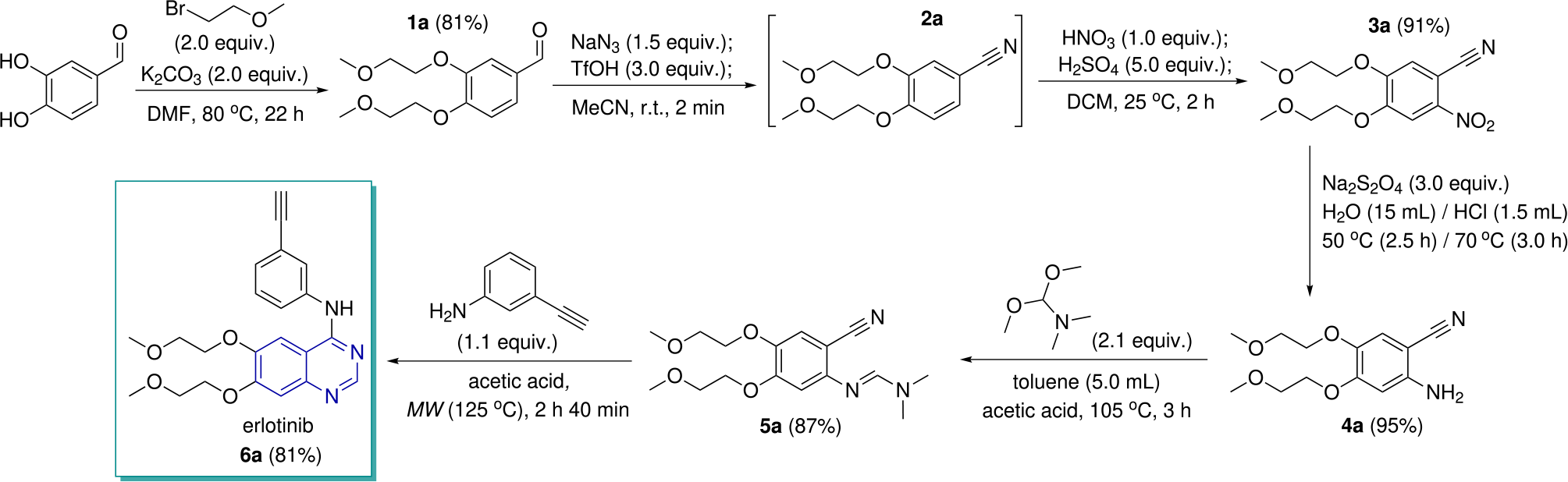
The synthesis started from 3,4-dihydroxybenzaldehyde, a more accessible and environmentally benign precursor than the anisolic derivatives typically employed in industrial routes.22 In the first step, the introduction of 1-bromo-2 methoxyethane groups was achieved via a Williamson ether synthesis, using K2CO3 in DMF, affording 3,4-bis(2 methoxyethoxy)benzaldehyde (1a) in 81% yield following a reported procedure (Scheme 1).9

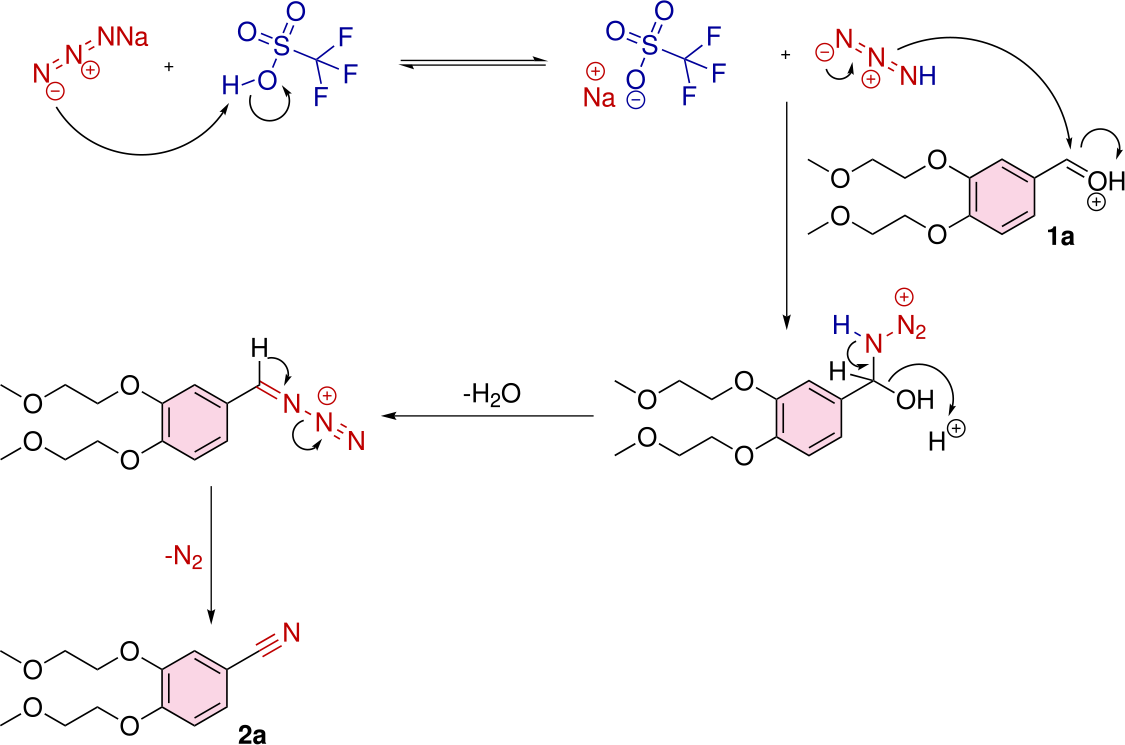
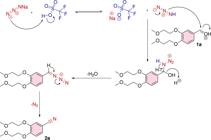
Subsequently, compound 1a was efficiently converted into 3,4-bis(2-methoxyethoxy)benzonitrile (2a) via a TfOH/NaN3-mediated Schmidt-type nitrilation reaction,20 completed in only 2 min under mild conditions (Scheme 2). In contrast to previously reported protocols,18 which rely on harsh dehydrating reagents such as SOCl2 or POCl3, the present methodology enables the direct conversion of 1a into nitrile, 2a, in a process analogous to a one pot approach, thereby minimizing purification steps and reducing waste generation. From a mechanistic perspective, protonation of 1a by trifluoroacetic acid activates the carbonyl group toward nucleophilic attack by azide, leading to the formation of an azidohydrin intermediate. Subsequent elimination of water under strongly acidic conditions, accompanied by nitrogen extrusion, furnishes nitrile 2a efficiently (Scheme 2).
Electrophilic aromatic nitration of 2a selectively afforded 4,5-bis(2-methoxyethoxy)-2-nitrobenzonitrile (3a) in 91% yield (Scheme 1).16 The observed regioselectivity results from combined electronic and steric effects of the nitrile and ether groups, effectively suppressing undesired polynitrated side products.23
The reduction of the nitro group of compound 3a using sodium dithionite (Na2S2O4) in aqueous medium at 50 °C efficiently produced 2-amino-4,5-bis(2-methoxyethoxy)benzonitrile (4a) with an excellent yield of 95% (Scheme 1). Unlike the catalytic hydrogenation reported by Jin et al.16 (Pd/C, H2), this reduction occurs without transition metals under mild conditions, avoiding toxic waste while maintaining efficiency.
Subsequent treatment of 4a with N,N-dimethyl-formamide dimethyl acetal (DMF-DMA) in toluene afforded the formamidine intermediate (E)-N’-(2 cyano- 4,5-bis(2 methoxyethoxy)phenyl)-N,N-dimethyl-formimidamide (5a), in 87% yield (Scheme 1).
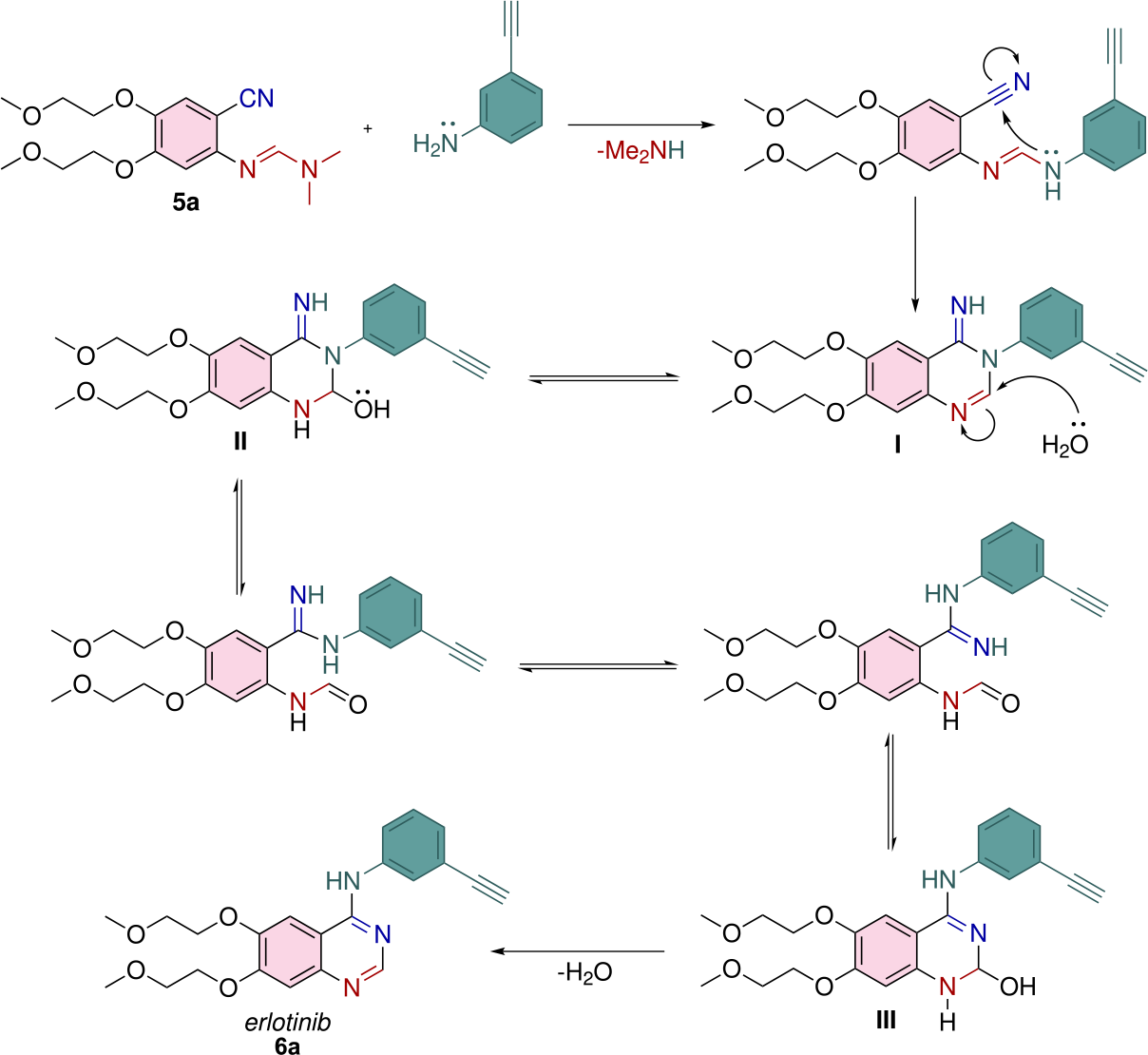
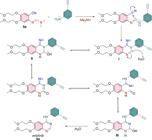
The final cyclization step to obtain erlotinib 6a, (N-(3 ethynylphenyl)-6,7-bis(2-methoxyethoxy)quinazolin-4-amine), was carried out by reacting compound 5a with 3-ethynylaniline under acidic conditions and microwave irradiation (Scheme 1). The reaction proceeds via a cyclocondensation pathway, involving the formation of imine I, followed by a transient ring opening of the pyrimidine intermediate II and subsequent rearomatization to III (Scheme 3). Remarkably, this transformation was significantly accelerated under microwave heating, affording erlotinib (6a) in 81% yield, whereas under similar conditions using conventional heating only 66% isolated yield17 was obtained. Overall, the proposed modifications resulted in a faster and more sustainable five-step route, particularly with respect to the second and final steps, providing an overall yield of 49%, and excellent average yield of 87% per step.
Conclusions
In summary, the five-step route developed for the synthesis of erlotinib constitutes a concise and efficient alternative to existing methodologies for the preparation of this drug. The incorporation of the Schmidt-type transformation as a key step simplifies the synthetic sequence by improving reaction time efficiency and eliminates the need for a pathway involving oxime formation, thereby significantly enhancing the overall process. Beyond its direct application to erlotinib, this strategy stands out as a versatile platform for the rapid assembly of quinazoline-related pharmaceuticals. Moreover, the operational simplicity and compatibility with microwave-assisted conditions further highlight the strong potential of this methodology for future scale-up studies.
-
This publication is part of the special issue “Organic Synthesis - 20th BMOS”
Supplementary Information
Supplementary information (HRMS, 1H and 13C NMR spectra for all compounds) is available free of charge at http://jbcs.sbq.org.br as PDF file.
Supplementary material 1
Acknowledgments
The authors gratefully acknowledge financial support for this work from the Brazilian agencies: (CNPq, 163350/2021-3), (FAPESP, 2022/05327-7), and (CAPES, Funding code 001).
Data Availability Statement
All data generated or analyzed during this study are included in this published article and its supplementary information. Any further information can be obtained from the corresponding author upon reasonable request.
References
-
1 Bray, F.; Laversanne, M.; Weiderpass, E.; Soerjomataram, I.; Cancer 2021, 127, 3029. [Crossref]
» Crossref -
2 Sung, H.; Ferlay, J.; Siegel, R. L.; Laversanne, M.; Soerjomataram, I.; Jemal, A.; Bray, F.; CA. Cancer J. Clin. 2021, 71, 209. [Crossref]
» Crossref -
3 Ravez, S.; Castillo-Aguilera, O.; Depreux, P.; Goossens, L.; Expert Opin. Ther. Pat. 2015, 25, 789. [Crossref]
» Crossref -
4 Banerjee, S.; Arnst, K. E.; Wang, Y.; Kumar, G.; Deng, S.; Yang, L.; Li, G. B.; Yang, J.; White, S. W.; Li, W.; Miller, D. D.; J. Med. Chem. 2018, 61, 1704. [Crossref]
» Crossref -
5 Shan, F.; Shao, Z.; Jiang, S.; Cheng, Z.; Cancer Med. 2016, 5, 3166. [Crossref]
» Crossref -
6 Khan, I.; Zaib, S.; Batool, S.; Abbas, N.; Ashraf, Z.; Iqbal, J.; Saeed, A.; Bioorg. Med. Chem. 2016, 24, 2361. [Crossref]
» Crossref -
7 Bansal, R.; Malhotra, A.; Eur. J. Med. Chem. 2021, 211, 113016. [Crossref]
» Crossref -
8 Xu, P.; Chu, J.; Li, Y.; Wang, Y.; He, Y.; Qi, C.; Chang, J.; Bioorg. Med. Chem. 2019, 27, 114938. [Crossref]
» Crossref -
9 Lüth, A.; Löwe, W.; Eur. J. Med. Chem. 2008, 43, 1478. [Crossref]
» Crossref -
10 Dowell, J.; Minna, J. D.; Kirkpatrick, P.; Nat. Rev. Drug Discovery 2005, 4, 13. [Crossref]
» Crossref -
11 Schettino, C.; Bareschino, M. A.; Ricci, V.; Ciardiello, F.; Expert Rev. Respir. Med. 2008, 2, 167. [Crossref]
» Crossref -
12 Mathew, M. P.; Tan, E.; Saeui, C. T.; Bovonratwet, P.; Liu, L.; Bhattacharya, R.; Yarema, K. J.; Bioorg. Med. Chem. Lett. 2015, 25, 1223. [Crossref]
» Crossref -
13 Cohen, M. H.; Johnson, J. R.; Chen, Y.-F.; Sridhara, R.; Pazdur, R.; Oncologist 2005, 10, 461. [Crossref]
» Crossref -
14 Barghi, L.; Aghanejad, A.; Valizadeh, H.; Barar, J.; Asgari, D.; Adv. Pharm. Bull. 2012, 2, 119. [Crossref]
» Crossref - 15 Prasad, R. J.; Rao, B. N.; Chowdary, N. V.; US pat. 007960545B2, 2011
-
16 Jin, H.; Cai, Q.; Liu, P.; Chen, Y.; Wang, D.; Zhu, W.; Xu, Y.; Qian, X.; Chinese Chem. Lett. 2024, 35, 108721. [Crossref]
» Crossref -
17 Chandregowda, V.; Rao, G. V.; Reddy, G. C.; Org. Process Res. Dev. 2007, 11, 813. [Crossref]
» Crossref -
18 Sharma, V. K.; Barde, A.; Rattan, S.; Arkivoc 2021, 2021, 150. [Crossref]
» Crossref - 19 Gilday, J. P.; Welham, M. J.; WO pat. 2005023783A1, 2005
-
20 Rokade, B. V.; Prabhu, K. R.; J. Org. Chem. 2012, 77, 5364. [Crossref]
» Crossref -
21 Mudshinge, S. R.; Potnis, C. S.; Xu, B.; Hammond, G. B.; Green Chem. 2020, 22, 4161. [Crossref]
» Crossref -
22 Knesl, P.; Röseling, D.; Jordis, U.; Molecules 2006, 11, 286. [Crossref]
» Crossref - 23 Michael, B. S.; Jerry, M.; March’s Advanced Organic Chemistry: Reactions, Mechanisms, and Structure, 6th ed.; Wiley-Interscience: New York, US, 2007.
Edited by
-
Editor handled this article:
Giovanni Wilson Amarante (Executive)