 Palladium-Catalyzed α-Arylation of Methyl Ketones Enables Modular Synthesis of 2,4,5-Trisubstituted Imidazoles
Abstract
A three-step synthesis of 2,4,5-trisubstituted imidazoles involving Pd-catalyzed α-arylation of aromatic methyl ketones, here represented by 4-acetyl pyridine, with 2-bromo-6-alkoxynaphtalenes, followed by in situ oxidation with selenium dioxide, featuring only two chromatographic purifications, provides the corresponding 1,2-diketones which underwent a Debus-Radziszewski condensation to furnish 2,4,5-trisubstitued imidazoles in moderate to good overall yields (30 examples). The methodology is particularly appropriate for the late-stage introduction of the substituent at C-2 in the imidazole ring and nicely complements previously described methods where the substituent at C-5 was incorporated at the end of the synthetic route.
Keywords:
2,4,5-trisubstituted imidazoles; Pd-catalyzed arylation; Debus-Radziszewski condensation
Introduction
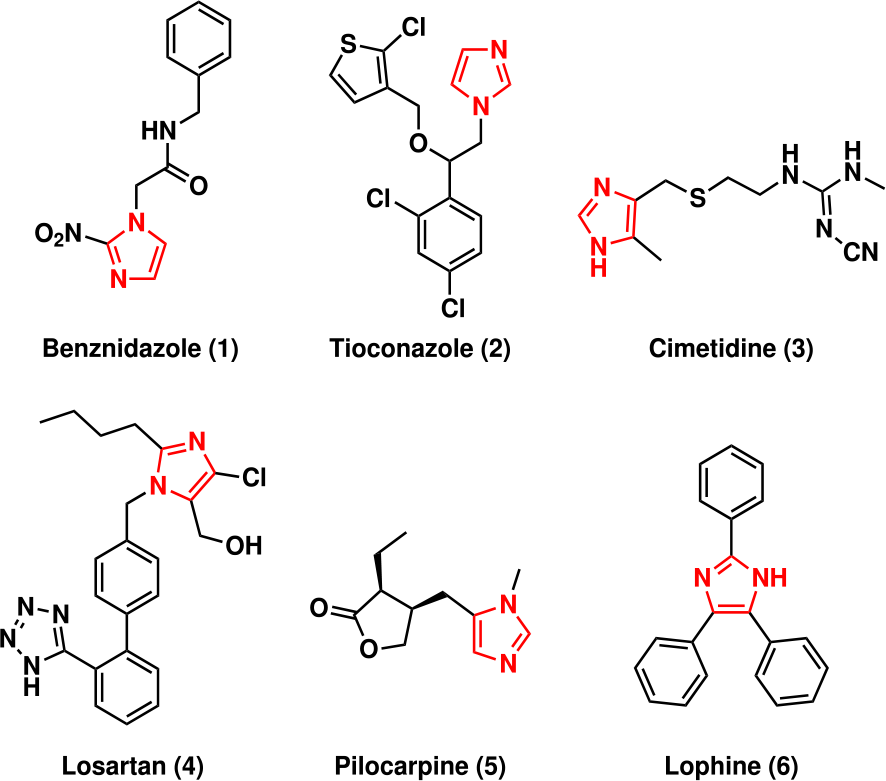
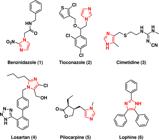
Imidazole is a well-regarded structural motif since its first synthesis by Debus in 1858, particularly in the domain of medicinal chemistry.1 Several drugs covering a range of pharmacological activities such as tripanocidal (benznidazole, 1), antifungal (tioconazole, 2), H2 blockers (cimetidine, 3), angiotensin receptor blocker (losartan, 4), muscarinic acetylcholine agonist (pilocarpine, 5), and the basic scaffold for fluorophores for bioimaging (lophine, 6), among others (Figure 1), display an imidazole ring as part of their structures.2,3 Besides their therapeutic applications,4 substituted imidazoles are also involved in functional applications such as in materials and polymer science and as ionic liquids,5-8 being also found in natural products such as histidine, histamine, purines, theophylline, and marine natural products.9
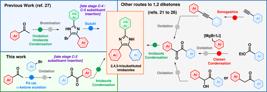
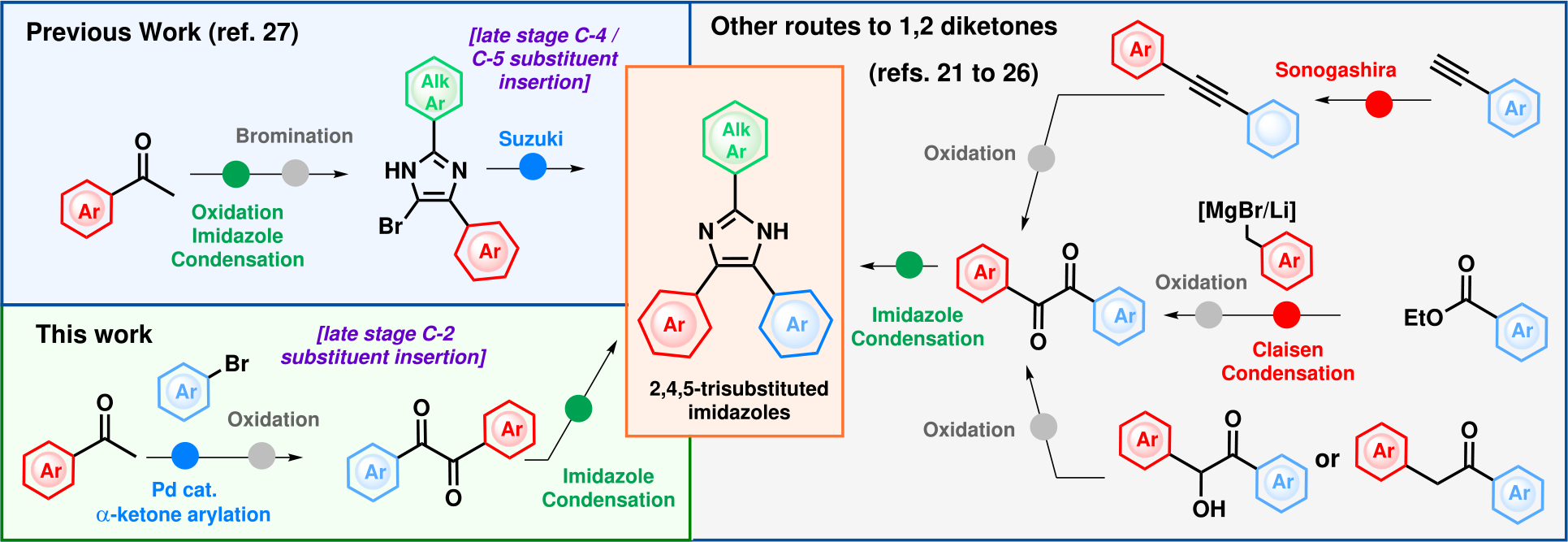
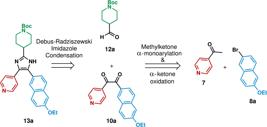
Some previous methodologies reported for the preparation of NH-2,4,5-trisubstituted imidazoles using the Debus-Radziszewski condensation and the one reported in this work.
In addition to their relevance as pharmacologically active ingredients, imidazoles play an important role in drug discovery with several representatives acting as enzyme inhibitors and chemical probes,2,10,11 especially in the context of kinase targets.12,13
Several methodologies have been developed to access differently substituted imidazoles14-16 and, among them, the Debus-Radziszewski synthesis stands out as an attractive approach: a multicomponent reaction (MCR) featuring a four-bond formation strategy, involving a 1,2-dicarbonyl compound, an aldehyde, and ammonia or a primary amine, catalyzed by a plethora of catalysts.17 Mostly, examples in the literature start with a diketo compound, such as benzil, or a hydroxyketone, such as benzoin, which in the presence of an oxidizing agent promptly undergoes reaction with an ammonium source, such as ammonium acetate or a primary amine.18 The Debus-Radziszewski condensation has found use in industrial applications, including implementations using modern technologies such as continuous flow processing, although issues such as poor selectivity, harsh reaction conditions, and low yields still remain significant limitations.19
Deng and co workers20 employed the dimethylsulfoxide-hydrobromic acid (DMSO-HBr) oxidation of methyl aryl (heteroaryl) ketones, followed by treatment of the glyoxal intermediate with aqueous ammonia to provide 2,4- and 2,5-aryloyl aryl imidazoles in combined moderate to good yields. The use of SeO2 for the oxidation of acetophenones under reflux in 1,4-dioxane was described by Kuzu et al.21 involving a two-step procedure for the synthesis of 2,4-disubstituted imidazoles while Jeena and Jayram described the one-pot, multicomponent preparation of derivatives of lophine (6) from α-benzyl arylketones which underwent benzylic oxidation in the presence of SeO2, in acetic acid at 180 °C,22 or catalytic amount of CuCl2 in the presence of molecular oxygen in DMF to generate in situ the corresponding 1,2-diketone which underwent Debus Radziszewski condensation to provide 2,4,5-triaryl imidazoles23 as well as under treatment with iodine in DMSO at 100 °C.24 Koch and co-workers25 employed the strategy via Claisen condensation, followed by SeO2 oxidation, to warrant the 1,2-diketone scaffold required for the Debus-Radziszewski condensation. Due to the harsh experimental conditions, the reports above only describe the use of ammonium acetate as the nitrogen source leading to dior trisubstituted NH imidazoles.
However, α-diketones are not usually commercially available, and their preparation process suffers from several drawbacks such as (i) high catalyst loading; (ii) harsh reaction conditions, (iii) low product yields and, (iv) tedious work-up procedures. Therefore, if readily available alkyl ketones could be employed instead of the more conventional α-diketones, it would broaden the scope of this methodology to prepare imidazoles. Previously, we have described a one-pot approach involving a sequential Kornblum oxidation, followed by Debus-Radziszewski imidazole condensation, to prepare 2,4-disubstituted imidazoles which could undergo a one-pot bromination, followed by Suzuki coupling, to produce 2,4,5-tribusbstituted imidazoles such as the kinase inhibitor GSK3037619A.26,27
Although our previously described methodology served well for the late-stage installation of the aryl moiety at C-5,27 it did not provide acceptable yields when we aimed for the late-stage installation of the aryl substituent at C-2 position of the imidazole ring. Our evolving interest on inhibitors and chemical probes for understudied kinases, led us to develop a complementary approach to the synthesis of 2,4,5-NH-imidazoles.
Experimental
Reagents, solvents and glassware
All reactions were carried out with freshly distilled solvents, using anhydrous conditions unless otherwise noted. Dichloromethane (DCM) and triethylamine (Et3N) were distilled over calcium hydride. tert-Butanol (t-BuOH) was distilled over calcium hydride and stored over 4 Å molecular sieves. Pyridine was dried over NaOH, distilled and stored over 4 Å molecular sieves. K3PO4 and K2CO3 were ground with a pestle and mortar to a fine powder and dried for at least 12 h in an oven at 200 °C. Tetrahydrofuran (THF) was distilled over metallic sodium (Na) and benzophenone. N,N Dimethylformamide (DMF) and dimethylsulfoxide (DMSO) were obtained in anhydrous grade and were used without previous treatment. The anhydrous solvents were transferred by oven-dried syringes. The sealed tubes used in the cross-coupling reactions were previously dried at 120 oC in an oven for at least 3 h. Other reagents were obtained from commercial sources and were used without prior purification. Aryl bromide 8a was prepared according to literature procedure.28 Aldehydes 12a, 12e, 12f, 12h, 12i, 12j and 12k are commercially available and were used as received.
Purification and chromatography
The reactions were monitored by thin-layer chromatography (silica gel 60 F254 in aluminum foil, Merck). Silica gel 200-400 mesh was used for flash column chromatography and was carried out using Biotage Isolera One flash column chromatography system or in open glass columns.
Spectroscopy, spectrometry and data acquisition
Nuclear magnetic ressonance (NMR) spectra were recorded on a Bruker Avance III HD 250 MHz, Bruker Avance III 400 MHz, Bruker Avance III 500 MHz or Bruker Avance III 600 MHz and processed using Topspin 4.3.0 or MestreNova 12.0.4 software. The chemical shifts are reported in parts per million (ppm) on a delta (δ) scale. The following residual solvent peaks were used as reference values for 1H NMR: CHCl3 - 7.26 ppm, CH3OH - 3.31 ppm, and (CH3)2SO - 2.50 ppm; and for 13C NMR: CDCl3 - 77.16 ppm, CD3OD - 49.00 ppm, and (CD3)2SO - 39.52 ppm. Signal multiplicity was reported as singlet (s), doublet (d), triplet (t), quartet (q), quintet (quint.), sextet (sext.), and multiplet (m). High-resolution mass spectra (HRMS) were acquired on an Orbitrap Thermo QExactive Mass Spectrometer, using electrospray ionization (ESI). Infrared (IR) spectra were recorded using a Thermo Scientific Nicolet IS5 spectrometer using Thermo Scientific ID3 or ID5 ATR, and the absorption frequencies are reported in cm-1. The melting points (MP) of the compounds were measured using the MP50 equipment (Metler Toledo) with a heating ramp starting at 40 °C and ending at 350 °C, with a heating rate of 5 °C min-1.
2-(6-Ethoxynaphthalen-2-yl)-1-(pyridin-4-yl)ethanone (9a)
An oven-dried culture tube equipped with a magnetic stirring bar was charged with 4-acetylpyridine (7, 63 mg, 0.50 mmol, 1.0 equiv.), Pd(OAc)2 (2.3 mg, 0.01 mmol, 2 mol%), Xantphos (12 mg, 0.02 mmol, 4 mol%), 2-bromo-6-ethoxynaphthalene (8a, 152 mg, 0.60 mmol, 1.2 equiv.), and K3PO4 (325 mg, 1.50 mmol, 3.0 equiv.) under nitrogen. Then, THF (1.50 mL, 0.33 M) was added, the culture tube was sealed, and the mixture was stirred at 80 ºC for 18 h. After consumption of the starting material, indicated by thin layer chromatography (TLC) analysis, the reaction mixture was cooled to room temperature, diluted with EtOAc (10 mL) and filtered through a short pad of silica gel which was washed with EtOAc (ca. 50 mL) until all the product has eluted. The filtrate was concentrated under reduced pressure, and the residue was purified by silica gel chromatography, eluted with acetone in DCM (18 cm × 20 mm, gradient elution, from 2 to 6% acetone/DCM, 2% increases, 70 mL runs, 7 mL fractions), to afford 9a (66 mg, 45%) as a yellow solid; Rf = 0.43 (50% EtOAc/hexanes, UV); 1H NMR (500 MHz, CDCl3) δ 8.79 (dd, J 4.5 and 1.5 Hz, 2H), 7.78 (dd, J 4.4 and 1.6 Hz, 2H), 7.70 (d, J 8.9 Hz, 1H), 7.67 (d, J 9.1 Hz, 1H), 7.62 (s, 1H), 7.31 (dd, J 8.4 and 1.6 Hz, 1H), 7.14 (dd, J 8.8 and 2.4 Hz, 1H), 7.10 (d, J 2.4 Hz, 1H), 4.40 (s, 2H), 4.14 (q, J 7.0 Hz, 2H), 1.47 (t, J 6.9 Hz, 3H); note: reported signals refer to the ketone tautomer in the mixture. Approximately 8:2 (ketone:enol) ratio; 13C NMR (126 MHz, CDCl3) δ 197.4, 157.3, 151.1, 142.6, 133.8, 129.6, 129.2, 129.1, 129.0, 128.4, 128.2, 127.8, 127.6, 121.7, 121.6, 119.6, 106.6, 63.6, 46.0, 14.9; note: minor peaks observed are due to the presence of the enol tautomer in the mixture; IR (thin film, ATR) νmax / cm-1 3444 (br), 2983 (w), 2931 (w), 1694 (s), 1631 (w), 1606 (m), 1556 (w), 1506 (w), 1479 (w), 1405 (m), 1396 (m), 1373 (w), 1336 (m), 1265 (s), 1215 (s), 1207 (s), 1194 (m), 1179 (m), 1162 (w), 1113 (w), 1065 (w), 1039 (m), 1012 (m), 972 (w), 952 (w), 927 (w), 893 (w), 863 (w), 848 (w), 823 (w), 810 (s), 793 (w); HRMS (ESI(+)-TOF) m/z [M + H]+ calcd. for C19H18NO2: 292.1332; found 292.1330. MP: 126.4-128.4 °C (DCM/acetone).
1-(6-Ethoxynaphthalen-2-yl)-2-(pyridin-4-yl)ethane-1,2-dione (10a)
Starting from 2-(6-ethoxynaphthalen-2-yl)-1-(pyridin-4-yl)ethanone (9a)
A culture tube was charged with 2-(6-ethoxynaphthalen-2-yl)-1-(pyridin-4-yl)ethanone (9a, 88 mg, 0.30 mmol, 1.0 equiv.) and a magnetic stirring bar under nitrogen. Then, AcOH (1.50 mL, 0.2 M) was added, followed by SeO2 (50 mg, 0.45 mmol, 1.5 equiv.) and the resulting mixture was heated to 70 °C for 3 h. After consumption of the starting material, indicated by TLC analysis, the reaction mixture was cooled to room temperature, the solution was filtered over a pad of Celite® which was washed with EtOAc (20 mL). The filtrated was concentrated under reduced pressure and dissolved in EtOAc (20 mL), washed with satd. aq. NaHCO3 (1 × 10 mL), dried over Na2SO4, filtered and concentrated under reduced pressure. The residue was purified by silica gel chromatography, eluted with EtOAc in hexanes (Biotage Isolera, SNAP KP-Sil 10 g, from 10% to 30% EtOAc/hexanes, 15 mL fractions) to afford 10a (79 mg, 86%) as a bright yellow solid.
Starting from 4-acetylpyridine (7) and 2-bromo-6-ethoxynaphthalene (8a)
An oven-dried pressure tube equipped with a magnetic stirring bar was charged with 2-bromo-6-ethoxynaphthalene (8a, 1.60 g, 6.30 mmol, 1.00 equiv.), Pd(OAc)2 (29 mg, 0.13 mmol, 2 mol%), Xantphos (150 mg, 0.252 mmol, 4 mol%), 4-acetylpyridine (7, 1.57 g, 12.6 mmol, 2.00 equiv.), and K3PO4 (4.09 g, 18.9 mmol, 3.00 equiv.) under nitrogen. Then, THF (21.0 mL, 0.3 M relative to 8a) was added, the pressure tube was sealed, and the mixture was stirred at 80 ºC for 18 h. After cooling to room temperature, the pressure tube was open and rapidly diluted with EtOAc (20 mL) and filtered through a short pad of silica gel, which was washed with EtOAc (ca. 50 100 mL) until all the product has eluted. The filtrate was concentrated under reduced pressure, and the residue was transferred to a 50 mL round-bottom flask. AcOH (31.5 mL, 0.18 M) was added, followed by addition of SeO2 (1.19 g, 10.7 mmol, 1.70 equiv.) under nitrogen. The resulting mixture was heated to 70 °C and stirred for 3 h. After consumption of the starting material, indicated by TLC analysis (50% EtOAc/hexanes v/v), the reaction mixture was cooled to room temperature, filtered over a pad of Celite® which was washed with EtOAc (60 mL). The filtrated was concentrated under reduced pressure, dissolved in EtOAc (60 mL), washed with satd. aq. NaHCO3 (1 × 30 mL), dried over Na2SO4, filtered and concentrated under reduced pressure. The residue was purified by silica gel chromatography, eluted with EtOAc in hexanes (Biotage Isolera, SNAP KP-Sil 25 g, from 10 to 30% EtOAc/hexanes, 15 mL fractions) to afford 10a (1.44 g, 75%) as a bright yellow solid; Rf = 0.52 (50% EtOAc/hexanes, UV); 1H NMR (500 MHz, CDCl3) δ 8.88 (d, J 5.6 Hz, 2H), 8.32 (s, 1H), 8.04 (dd, J 0.9 and 8.6 Hz, 1H), 7.85-7.79 (m, 4H), 7.21 (dd, J 9.0 and 2.1 Hz, 1H), 7.16 (d, J 1.8 Hz, 1H), 4.19 (q, J 7.0 Hz, 2H), 1.50 (t, J 7.1 Hz, 3H); 13C NMR (126 MHz, CDCl3) δ 193.5, 192.6, 160.5, 151.3, 139.2, 138.8, 133.8, 131.8, 128.1, 127.7, 127.7, 124.5, 122.5, 120.7, 106.8, 64.0, 14.8; IR (thin film, ATR) νmax / cm-1 1685 (m), 1650 (m), 1614 (s), 1553 (w), 1475 (m), 1409 (w), 1393 (m), 1339 (w), 1327 (w), 1277 (w), 1263 (m), 1216 (w), 1182 (s), 1145 (w), 1109 (w), 1066 (w), 1041 (m), 991 (w), 973 (w), 907 (m), 868 (m), 851 (m), 836 (w), 827 (w), 813 (m), 800 (m), 762 (m), 753 (m), 731 (w), 712 (m), 670 (s); HRMS (ESI(+)-TOF) m/z [M + H]+ calcd. for C19H16NO3: 306.1130; found 306.1130; MP 134.1-136.4 °C (EtOAc).
1-(Pyridin-4-yl)-2-(6-(2,2,2-trifluoroethoxy)naphthalen-2-yl)ethane-1,2-dione (10b)
An oven-dried 20 mL culture tube equipped with a magnetic stirring bar was charged with 8b (320 mg, 1.05 mmol, 1.00 equiv.), Pd(OAc)2 (4.8 mg, 0.021 mmol, 2 mol%), Xantphos (25 mg, 0.042 mmol, 4 mol%), 4-acetylpyridine (7, 259 mg, 2.10 mmol, 2.0 equiv.), and K3PO4 (682 mg, 3.15 mmol, 3.0 equiv.) under nitrogen. Then, THF (3.5 mL, 0.3 M) was added, the culture tube was sealed, and the mixture was stirred at 80 ºC for 18 h. After cooling to room temperature, the culture tube was open, rapidly diluted with EtOAc (18 mL) and filtered through a short pad of silica gel, which was washed with EtOAc (ca. 50-100 mL or until all the product eluted). The filtrate was concentrated under reduced pressure, and the residue was transferred to a 10 mL round-bottom flask. AcOH (5.2 mL, 0.18 M) was added, followed by addition of SeO2 (233 mg, 2.10 mmol, 2.00 equiv.) under nitrogen. The resulting mixture was heated to 70 °C and stirred for 3 h. After consumption of the starting material, indicated by TLC analysis (50% EtOAc/hexanes), the reaction mixture was cooled to room temperature, the solution was filtered over a pad of Celite® which was washed with EtOAc (60 mL). The filtrate was concentrated under reduced pressure, dissolved in EtOAc (60 mL) and partitioned into satd. aq. NaHCO3 (1 × 40 mL). The layers were separated and the aqueous layer was extracted with EtOAc (2 × 20 mL). The organic layers were combined, dried over Na2SO4, filtered and concentrated under reduced pressure. The residue was purified by silica gel chromatography, eluting with EtOAc in hexanes (Biotage Isolera, SNAP KP-Sil 25 g, stepped gradient elution from 10 to 30% EtOAc/hexanes v/v, 15 mL fractions) to afford 10b (288 mg, 76%) as a bright yellow solid; Rf = 0.45 (30% EtOAc/hexanes, UV); 1H NMR (250 MHz, CDCl3) δ 8.89 (d, J 6.0 Hz, 2H), 8.37 (s, 1H), 8.09 (dd, J 8.7 and 1.7 Hz, 1H), 7.93-7.85 (m, 2H), 7.83 (d, J 6.0 Hz, 2H), 7.30 (dd, J 9.0 and 2.5 Hz, 1H), 7.21 (d, J 2.4 Hz, 1H), 4.52 (q, J 8.0 Hz, 2H); 19F NMR (235 MHz, CDCl3) δ -73.64; 13C NMR (63 MHz, CDCl3) δ 193.2, 192.4, 158.4, 151.3, 139.1, 138.1, 133.6, 132.4, 128.7, 128.6, 128.4, 125.0, 123.2 (q, J 277.7 Hz), 122.5, 120.0, 107.7, 65.8 (q, J 36.1 Hz); IR (thin film, ATR) νmax / cm-1 1686 (w), 1661 (m), 1622 (m), 1558 (w), 1477 (w), 1409 (w), 1342 (w), 1291 (w), 1259 (s), 1216 (w), 1180 (s), 1153 (s), 1068 (w), 971 (w), 903 (w), 870 (w), 854 (w), 841 (w), 811 (w), 794 (w), 763 (w), 754 (w), 714 (w), 667 (s), 634 (w); HRMS (ESI(+)-TOF) m/z calcd. for C19H13F3NO3 360.08420; found 360.08411; MP 113.0-115.2 °C (DCM).
General procedure A for imidazole condensation
Reactions performed on a 0.10 mmol scale
A 21 mL culture tube (16 cm × 150 mm) was charged with the diketone (0.1 mmol, 1.0 equiv.), aldehyde (0.13 mmol, 0.30 mmol, 1.3, 3.0 equiv.), NH4OAc (39 mg, 0.50 mmol, 5.0 equiv.) and a magnetic stirring bar. The culture tube was sealed with a polytetrafluoroethylene (PTFE) septum screw cap under nitrogen atmosphere and t-BuOH (1.0 mL, 0.1 M) was added. The PTFE septum screw cap was changed for an unpierced one by quickly opening the culture tube. The reaction mixture was heated to 50 ºC and stirred for 1 to 24 h (depending on the substrate). After consumption of the starting material, indicated by TLC analysis [50% EtOAc:EtOH (3:1 v/v)/hexanes], the reaction mixture was cooled to room temperature and diluted with H2O:brine (1:1 v/v, 1 × 4 mL) and EtOAc (5 mL). The layers were separated and the aqueous layer was extracted with EtOAc (4 × 5 mL). The organic layers were combined, dried over Na2SO4, filtered and concentrated under reduced pressure. The residue was adsorbed on silica gel for loading and purified by silica gel column chromatography.
General procedure B for Boc deprotection
A 5 mL vial was charged with the corresponding N-Boc imidazole (1.0 equiv.) obtained in the previous step and a magnetic stirring bar. Then, DCM (1 mL, 0.1 M) was added, the solution was cooled to 0 °C in an ice-water bath and stirred for 5 min before the dropwise addition of trifluoroacetic acid (TFA) (20 equiv.). In most cases, addition of TFA led to a change to bright yellow or orange color. The reaction mixture was left to warm to room temperature and stirred for 30 min to 5 h (depending on the substrate) at room temperature. After consumption of the starting material, indicated by TLC analysis [10% MeOH:NH4OH (9:1 v/v)/DCM), the reaction mixture was quenched by the addition of 10% MeOH:NH4OH [(9:1 v/v)]/DCM (2-3 mL) and the resulting mixture was transferred to a 25 mL round-bottom flask and enough 10% MeOH:NH4OH (9:1 v/v)/DCM was added until the yellow/orange color dissipated (ca. 15-20 mL). The volatiles were removed under reduced pressure, and the residue was purified by silica gel column chromatography with the residue dissolved in 10% MeOH/DCM for column loading (adsorbed into silica or alumina).
General procedure C for sequential Boc deprotection and reductive amination
A 5 mL vial was charged with the N-Boc piperidine imidazole (1.0 equiv.) obtained in the previous step and a magnetic stirring bar. Then, DCM (1 mL, 0.1 M) was added, the solution was cooled in an ice-water bath and stirred for 5 min before the dropwise addition of TFA (20.0 equiv.). The reaction mixture was left to warm to room temperature and stirred for 1 h. After consumption of the starting material, indicated by TLC analysis [10% MeOH:NH4OH (9:1 v/v)/DCM], the volatiles were removed under reduced pressure and the residue was dissolved in MeCN (0.025 M). Then, Et3N (1.5 equiv.) was added, followed by the addition of aqueous 37% formaldehyde solution (6.9 equiv.). The reaction mixture was left to stir at room temperature for 1 h, and then, Na(OAc)3BH (2.5 equiv.) was added in one portion. The reaction mixture was left to stir at room temperature for 18 h and after consumption of the deprotected intermediate, indicated by TLC analysis [10% MeOH:NH4OH (9:1 v/v)/DCM], the reaction mixture was concentrated under reduced pressure, diluted with [10% MeOH:NH4OH (10:1 v/v)/DCM] (ca. 1 mL) and filtered through a silica gel pad (1 cm × 15 mm), which was washed with [10% MeOH:NH4OH (9:1 v/v)/DCM] until complete elution of the product (ca. 20 mL). The solvent was removed under reduced pressure, and the residue was purified by silica gel chromatography. The residue was adsorbed in silica gel or dissolved in DCM for column loading.
tert-Butyl 4-(4-(6-ethoxynaphthalen-2-yl)-5-(pyridin-4-yl)-1H-imidazol-2-yl)piperidine-1-carboxylate (13a)
General procedure A (imidazole condensation)
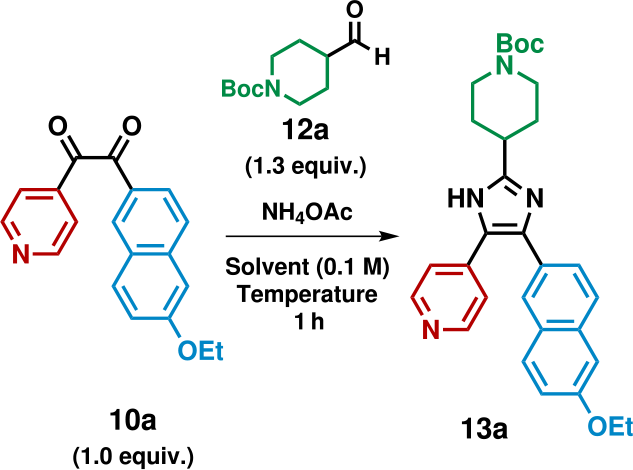
Amounts employed: 2-(6-ethoxynaphthalen-2-yl)-1-(pyridin-4-yl)ethanone (10a, 31 mg, 0.10 mmol, 1.0 equiv.); tert-butyl 4-formylpiperidine-1-carboxylate (12a, 28 mg, 0.13 mmol, 1.3 equiv.), NH4OAc (39 mg, 0.50 mmol, 5.0 equiv.); t-BuOH (1.00 mL, 0.1 M). The reaction mixture was left to stir for 1 h at 50 °C.
Purification by silica gel chromatography, eluted with EtOAc in hexanes, and then, with EtOAc:EtOH (3:1 v/v) in hexanes (Biotage Isolera, SNAP KP-Sil 10 g [from 50 to 70% EtOAc/hexanes, then, from 30 to 100% EtOAc:EtOH (3:1 v/v)/hexanes], 18 mL fractions) to afford 13a (46 mg, 92%) as a white solid; Rf = 0.40 (7% EtOH/CHCl3, UV, Dragendorff Stain); Rf = 0.31 (50% EtOAc:EtOH(3:1)/hexanes, UV, Dragendorff Stain); 1H NMR (500 MHz, CDCl3) δ 9.92 (br s, 1H), 8.42 (s, 2H), 8.04-7.62 (m, 3H), 7.58-7.29 (m, 3H), 7.22-7.08 (m, 2H), 4.16 (q, J 6.9 Hz, 2H), 4.30-4.12 (m, 2H), 2.99 (tt, J 11.6, 3.4 Hz, 1H), 2.94-2.75 (m, 2H), 2.10-1.97 (m, 2H), 1.77 (dq, J 12.2 and 3.4 Hz, 2H), 1.49 (t, J 6.9 Hz, 3H), 1.45 (s, 9H); 13C NMR (126 MHz, CDCl3) δ 157.9, 154.8, 151.3, 149.8, 142.8, 134.5, 133.5, 129.6, 128.9, 127.7, 127.1, 126.8, 121.5, 120.1, 106.6, 79.9, 63.7, 36.5, 31.1, 29.8, 28.6, 25.0, 14.9; note: due to slow relaxation, some 13C{1H} NMR signals were not identified in the spectra; specifically, the 13C{1H} NMR data for compound 13a lack one of the 24 expected signals; IR (thin film, ATR) νmax / cm-1 2975 (w), 2920 (br), 2852 (w), 1691 (s), 1629 (s), 1535 (w), 1469 (w), 1423 (s), 1392 (m), 1365 (m), 1272 (m), 1249 (m), 1232 (w), 1207 (m), 1169 (s), 1123 (m), 1043 (w), 993 (w), 931 (w), 857 (w), 832 (m); HRMS (ESI(+)-TOF) m/z [M + H]+ calcd. for C30H35N4O3: 499.2704; found 499.2717; MP 212.0 °C (dec.).
4-(5-(6-Ethoxynaphthalen-2-yl)-2-(piperidin-4-yl)-1H-imidazol-4-yl)pyridine (14a)
General procedure A (imidazole condensation)
Amounts employed: 2-(6-ethoxynaphthalen-2-yl)-1-(pyridin-4-yl)ethanone (10a, 31 mg, 0.10 mmol, 1.0 equiv.); tert-butyl 4-formylpiperidine-1-carboxylate (12a, 28 mg, 0.13 mmol, 1.3 equiv.), NH4OAc (39 mg, 0.50 mmol, 5.0 equiv.); t-BuOH (1.00 mL, 0.1 M). The reaction mixture was left to stir for 1 h at 50 °C.
Purification by silica gel chromatography, eluted with EtOAc in hexanes, and then, with EtOAc:EtOH (3:1 v/v) in hexanes (Biotage Isolera, SNAP KP-Sil 10 g [from 50 to 70% EtOAc/hexanes, then, from 30 to 100% EtOAc:EtOH (3:1 v/v)/hexanes], 18 mL fractions) to afford 13a (46 mg, 92%) as a white solid.
General procedure B (Boc deprotection)
Amounts employed: tert-butyl 4-(4-(6-ethoxy-naphthalen-2-yl)-5-(pyridin-4-yl)-1H-imidazol-2-yl)piperidine-1-carboxylate (13a, 50 mg, 0.10 mmol, 1.0 equiv.); TFA (154 µL, 2.0 mmol, 20 equiv.); DCM (1.0 mL, 0.1 M). The reaction mixture was left to stir for 1 h at room temperature.
Purification by silica gel chromatography, eluted with MeOH:NH4OH (9:1 v/v) in DCM [14 cm × 15 mm, gradient elution, from 10 to 20% MeOH:NH4OH (10:1 v/v)/DCM, 1% increases, 20 mL runs, 5 mL fractions] to afford 14a (32 mg, 80%) as a white solid; Rf = 0.08 (10% MeOH:NH4OH [9:1]/DCM); 1H NMR (500 MHz, CD3OD) δ 8.36 (dd, J 4.7 and 1.6 Hz, 2H), 7.87 (s, 1H), 7.79 (d, J 8.5 Hz, 1H), 7.74 (d, J 9.0 Hz, 1H), 7.49 (dd, J 4.8 and 1.5 Hz, 2H), 7.42 (dd, J 8.5 and 1.6 Hz, 1H), 7.26 (d, J 2.3 Hz, 1H), 7.16 (dd, J 8.9 and 2.4 Hz, 1H), 4.18 (q, J 7.0 Hz, 2H), 3.27-3.21 (m, 2H), 3.04 (tt, J 11.9 and 3.7 Hz, 1H), 2.83 (dt, J 12.5 and 2.6 Hz, 2H), 2.11-2.03 (m, 2H), 1.90 (dq, J 12.6 and 3.7 Hz, 2H), 1.47 (t, J and 7.0 Hz, 3H); 13C NMR (126 MHz, CD3OD) δ 159.1, 154.1, 150.0, 136.0, 130.5, 130.3, 128.6, 128.5, 127.8, 127.7, 123.0, 120.8, 107.6, 64.6, 46.4, 37.1, 31.7, 15.1; note: due to slow relaxation of carbon bound nitrogen some 13C NMR signals are not detected. In this case, 3 signals are missing; IR (thin film, ATR) νmax / cm-1 3199 (br), 1603 (s), 1536 (w), 1501 (w), 1469 (m), 1424 (m), 1393 (m), 1258 (m), 1209 (m), 1183 (m), 1153 (w), 1126 (w), 1042 (w), 992 (w), 961 (w), 857 (w), 833 (s), 744 (w), 691 (w), 631 (m); HRMS (ESI(+)-TOF) m/z [M + H]+ calcd. for C25H27N4O: 399.2179; found 399.2178; MP 244 °C (decomp.) (MeOH/DCM).
4-(4-(6-Ethoxynaphthalen-2-yl)-2-(1-methylpiperidin-4-yl)-1H-imidazol-5-yl)pyridine (15a)
Imidazole condensation - general procedure A
Amounts employed: 2-(6-ethoxynaphthalen-2-yl)-1-(pyridin-4-yl)ethanone (10a, 31 mg, 0.10 mmol, 1.0 equiv.); tert-butyl 4-formylpiperidine-1-carboxylate (12a, 28 mg, 0.13 mmol, 1.3 equiv.); NH4OAc (39 mg, 0.50 mmol, 5.0 equiv.); t-BuOH (1.00 mL, 0.1 M). The reaction mixture was left to stir for 1 h at 50 °C.
General procedure C (sequential Boc deprotection and reductive amination)
Amounts employed: tert-butyl 4-(4-(6-ethoxy-naphthalen-2-yl)-5-(pyridin-4-yl)-1H-imidazol-2-yl)piperidine-1-carboxylate (13a, 13 mg, 0.025 mmol, 1.0 equiv.); TFA (39 µL, 0.50 mmol, 20 equiv.); DCM (0.25 mL, 0.1 M). The reaction mixture was left to stir for 1 h at room temperature.
Amounts employed: Et3N (5.3 µL, 0.038 mmol, 1.5 equiv.), aqueous 37% (w/w) formaldehyde solution (13 µL, 0.17 mmol, 6.9 equiv.), Na(OAc)3BH (14 mg, 0.063 mmol, 2.5 equiv.) and MeCN (1 mL, 0.025 M).
Purification by silica gel chromatography, eluting with MeOH:NH4OH (10:1 v/v) in CHCl3 [3 cm × 15 mm, isocratic elution, 10% MeOH:NH4OH (10:1 v/v)/CHCl3, 20 mL run, 1 mL fractions] yielded a white solid which was triturated with Et2O:hexanes (2:8 v/v, 3 × 1 mL) to afford 15a as a white solid (7 mg, 71% yield); Rf = 0.45 [10% MeOH:NH4OH (10:1 v/v)/CHCl3, UV, Dragendorff stain]; 1H NMR (250 MHz, CD3OD) δ 8.36 (d, J 5.6 Hz, 2H), 7.87 (d, J 1.4 Hz, 1H), 7.80 (d, J 8.5 Hz, 1H), 7.74 (d, J 9.0 Hz, 1H), 7.49 (d, J 6.3 Hz, 2H), 7.42 (dd, J 8.4, 1.8 Hz, 1H), 7.26 (d, J 2.2 Hz, 1H), 7.16 (dd, J 9.0, 2.5 Hz, 1H), 4.18 (q, J 7.0 Hz, 2H), 3.05-2.99 (m, 2H), 2.87 (tt, J 12.0, 4.0 Hz, 1H), 2.34 (s, 3H), 2.19 (dt, J 11.9, 2.3 Hz, 2H), 2.09-2.03 (m, 2H), 1.96 (dq, J 12.5, 3.4 Hz, 2H), 1.47 (t, J 7.0 Hz, 3H); 13C NMR (126 MHz, CD3OD) δ 159.1, 154.1, 150.0, 136.0, 130.5, 130.3, 128.6, 128.5, 127.8, 123.0, 120.8, 107.6, 64.6, 56.4, 46.4, 36.9, 31.7, 15.1; note: due to slow relaxation of carbon bound nitrogen some 13C NMR signals are not detected. In this case, 4 signals are missing; IR (thin film, ATR) νmax / cm-1 2942 (w), 2846 (w), 2781 (w), 1629 (w), 1602 (s), 1537 (w), 1505 (w), 1471 (w), 1391 (w), 1379 (w), 1269 (m), 1208 (m), 1186 (w), 1040 (w), 1019 (w), 995 (m), 930 (w), 891 (m), 861 (m), 832 (m), 769 (w), 694 (w); HRMS (ESI(+)-TOF) m/z [M + H]+ calcd. for C26H29N4O: 413.2341; found 413.2338; MP 250 °C (dec.)
Results and Discussion
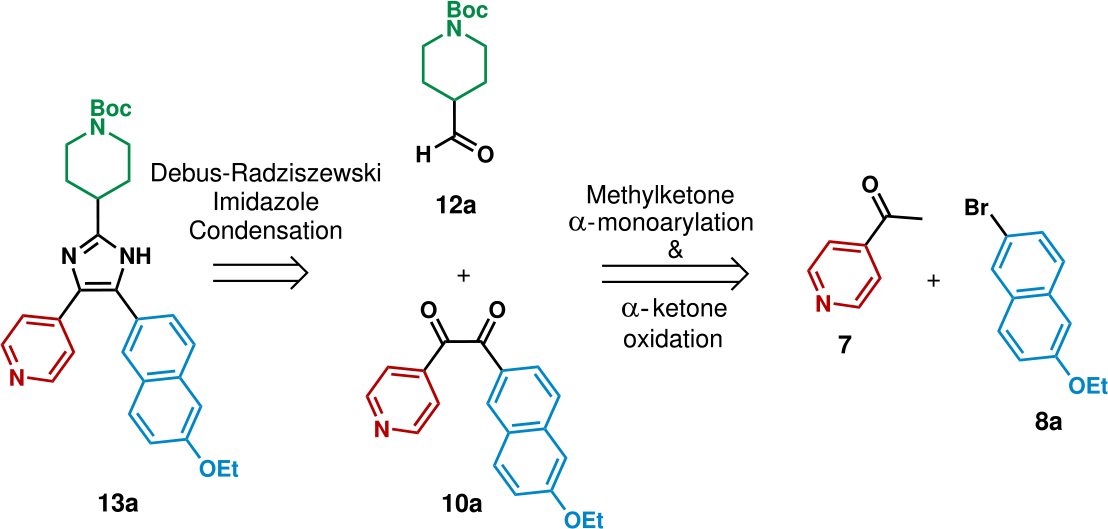
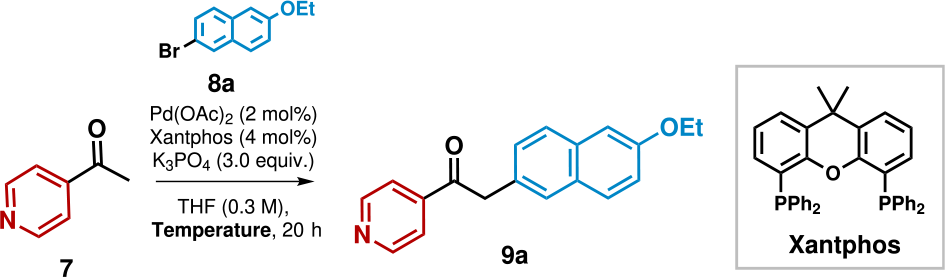
To enable expeditious library construction of the trisubstituted imidazole series to be evaluated as STK10 kinase inhibitors in structure-activity relationship (SAR) studies27 involving late stage modifications at C-2 position, we planned to use a palladium-catalyzed α-monoarylation of 4-acetyl pyridine (7) to provide the required α-methylene ketone which would, then, enter in the pipeline of α-methylene oxidation and Debus-Radziszewski imidazole condensation, as shown below. For that, the palladium-catalyzed ketone arylation, a reaction discovered by Palucki and Buchwald,29 would be key to the success in our proposal (Scheme 1).
We started our investigation with the α-monoarylation of 4-acetyl pyridine (7) with 2-bromo-6-ethoxynaphtalene (8a) but a literature search for precedents employing 7 resulted in no matches. However, Desai et al.30 reported that closely related heteroaromatic ketones could be employed in such coupling. Both palladium:ligand ratio and heteroatom ring pattern played an important role in this transformation under the conditions investigated. Moreover, Tartaggia et al.31 also reported that a very similar heteroaromatic methyl ketone could undergo α-monoarylation. Both conditions overlapped regarding the ligand (Xantphos) and base (K3PO4) selection but diverged in terms of solvent [THF:PhMe:dioxane (1:1:1, v:v:v) vs. NMP], the methyl ketone:aryl bromide molar ratio (2:1 vs. 1:1.2) and the palladium source [Pd(OAc)2 vs. Pd(acac)2].
We decided to probe Pd(OAc)2/Xantphos catalyst, K3PO4 in THF and 20 h of reaction time under different 7:8a molar ratios and temperatures. Employing the molar ratio described by Tartaggia et al.31 (7:8a = 1:1.2), we screened three different reaction temperatures to find that the reaction did not proceed at 65 °C (Table 1, entry 1) but provided complete conversion of 4-acetyl pyridine (7) and low yield of the desired coupling product 9a at 100 °C (Table 1, entry 2; 34% yield determined by 1H NMR using tetrachloroethane as internal standard). Surprisingly, the reaction run at 80 °C (Table 1, entry 3) provided the desired product in 45% isolated yield which was reasoned as due to thermal decomposition of the limiting reagent 7 above 80 °C. A slight excess of 7 (molar ratio 7:8a = 1.2:1, Table 1, entry 4) led to the desired product 9a in 64% isolated yield while increasing the catalyst load (Table 1, entry 5) provided only a minor increase in the yield (69% yield determined by 1H NMR). Further increase of the 7:8a molar ratio (Table 1, entries 6 and 7) was beneficial with the desired product being isolated in 71% yield when a 2:1 molar ratio was employed at 80 °C for 20 h (Table 1, entry 7).
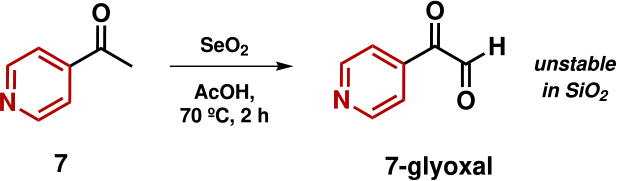
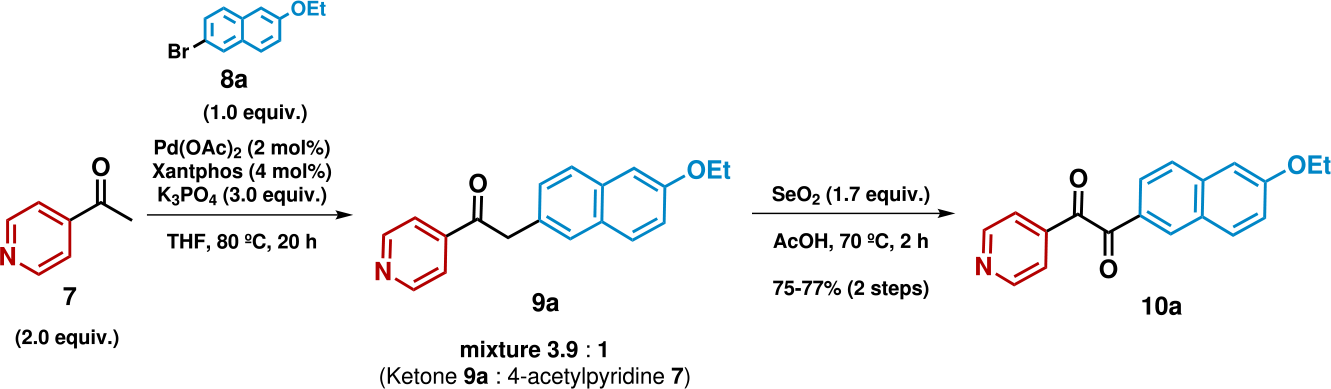
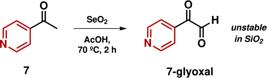
In order to prepare for the Debus-Radziszewski imidazole condensation, the α-methylene ketone synthesized above needed to be converted to the corresponding 1,2-diketone. Kornblum oxidation which had served well for the previously described preparation of 2,4-disubstituted imidazoles27 provided the corresponding imidazole in moderate yield (64%). In an attempt to improve yields, we evaluated the use of copper catalyzed aerobic oxidation32 that provided even lower yields (48%) and SeO2, in acetic acid at 80 °C, which afforded the desired 1,2-diketone 10a in 86% yield.33,34 Considering that the glyoxal intermediate formed in the SeO2 oxidation of remaining 4-acetyl pyridine (7) is expected to be unstable to silica gel column chromatography,35 we decided to implement the chromatographic separation only at the stage of the desired 1,2-diketone 10a.
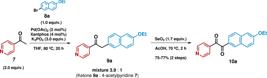
Therefore, after the α-monoarylation of 4-acetyl pyridine (7) under the optimized conditions shown in Table 1, entry 7, the crude reaction mixture, contaminated with remaining 7, was just filtered through a plug of silica gel to remove inorganic salts and polar contaminants and the crude product was treated with SeO2 in acetic acid at 70 °C, to afford the corresponding 1,2-diketone 10a in 77% overall yield over 2 steps. Under this protocol, remaining 7 was converted to the corresponding glyoxal byproduct (7-glyoxal) by SeO2, streamlining purification by silica gel column chromatography (Scheme 2). The procedure was scaled up 7-fold starting from 6.3 mmol of 4-acetyl pyridine (7) to provide 1,2-diketone 10a in 75% yield (Scheme 3).
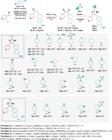
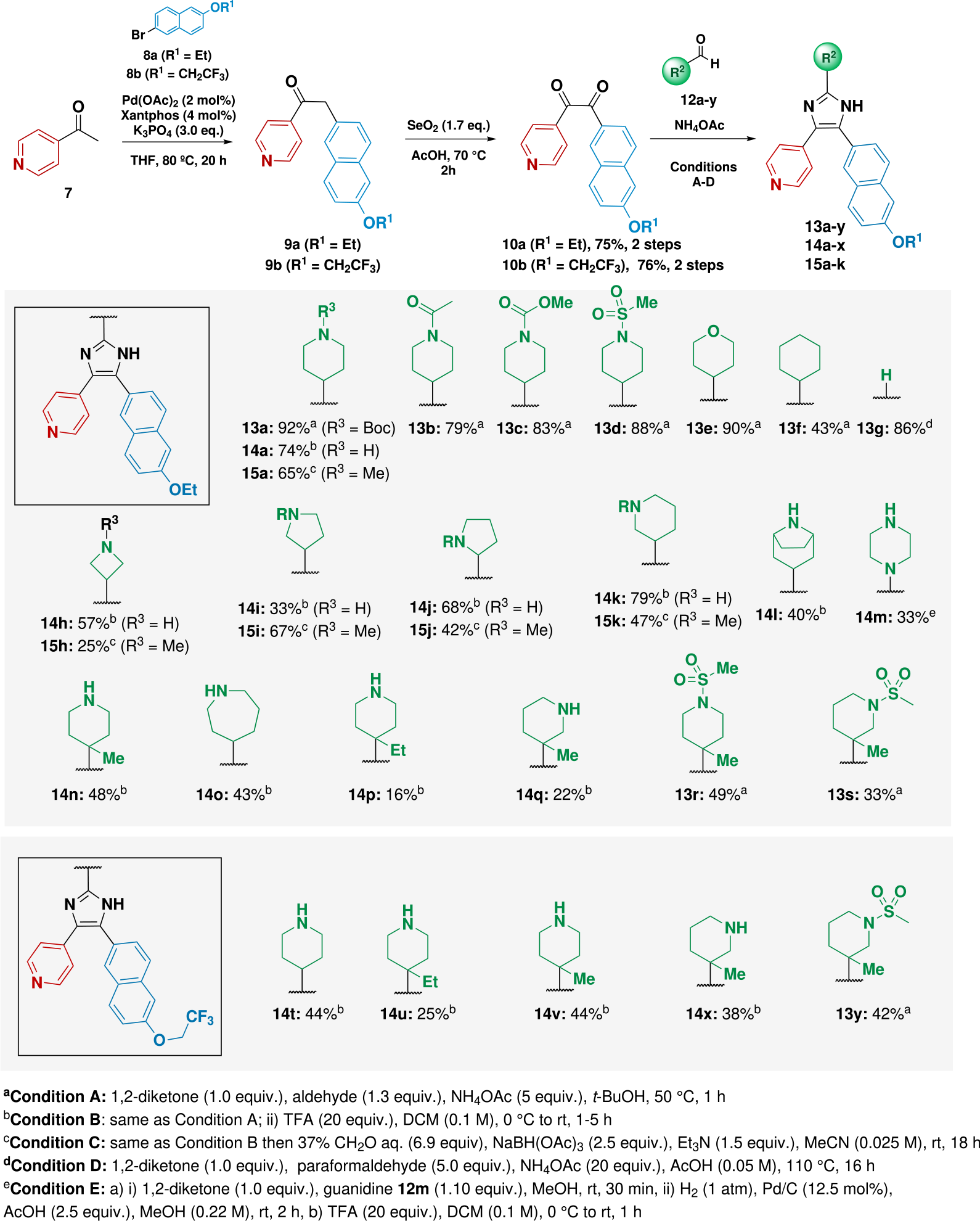
Scope of the synthesis of 2,4,5-trisubstituted imidazoles 13a-g, 13r,s, 13y, 14a, 14h-q, 14t-x, and 15a, 15h-k via the protocol involving α-arylation of methylene ketones, oxidation the corresponding diketones and Debus-Radziszewski condensation. Overall yields shown are for final products isolated according to reaction conditions A-E and purification by column chromatography.
According to literature,33,36 the formation of the corresponding 2,4,5-trisubstituted imidazole 13a from N-Boc 4-formyl piperidine (12a) could be accomplish either in MeOH or acetic acid under heating, employing NH4OAc as the ammonia source.
Employing a 1.0:1.3 molar ratio of 1,2-diketone 10a and aldehyde 12a, 15 equiv. of NH4OAc in AcOH for 1 h at 50 °C, only traces of the desired product 13a was formed (Table 2, entry 1) while at 100 °C and otherwise the same reaction conditions, a moderate yield could be isolated (60%, Table 2, entry 2). The use of alcohols as solvent provided much higher yields (76-92%, Table 2, entries 3-7) with tert-butanol performing best (Table 2, entry 5) and allowing reduction of the amount of NH4OAc without compromising the yield (Table 2, entries 6 and 7).
Optimization of the reaction conditions of the Debus Radziszewski condensation for the preparation of 2,4,5-trisubstittued imidazole 13a
The new protocol for implementation of a late-stage introduction of C-2 substituent was applied to the preparation of a series of 2,4,5-trisubstituted imidazoles as shown below.
As to the Debus-Radziszewski condensation scope, the reaction tolerates a wide range of cycloalkyl aldehydes, providing the trisubstituted imidazoles in good to excellent yields. However, when α-quaternary aldehydes were employed, a decrease in yield was observed (14n, 14p, 14q, 14u, 14v, 14x, 13r, 13s, 13y). This effect is even more pronounced when an ethyl group is present (14p and 14u). This behavior might be due to an increase in steric bulk in the aldehyde which translates into an subsituent adjacent to the imidazole ring which can slow down the imidazole condensation allowing for side reactions to occur.
Conclusions
Herein, a new approach to trisubstituted 2,4,5 NH imidazoles is described introducing the C 2 substituent at a late stage in the synthetic scheme, starting from readily available starting materials such as aryl methyl ketones and aryl bromides which provided access to 30 novel 2,4,5-trisubstituted imidazoles via a streamlined sequence which requires only two chromatographic purifications to obtain the final products. By optimizing the α arylation and oxidation steps, purification is performed solely at the stage of the diketone intermediate, exploiting the chromatographic instability of the 4-pyridyl glyoxal by-product formed from the remaining 4-acetyl pyridine (7). The subsequent Debus-Radziszewski condensation proceeds efficiently, particularly when alcohols are used as solvents, most notably tert butanol. Overall, the method affords moderate to excellent yields, except for reactions involving α tertiary aldehydes which generally provide low to moderate yields (apart from compounds 14n and 13r).
The methodology is particularly appropriate for the late-stage introduction of the substituent at C-2 in the imidazole ring and nicely complements our previously disclosed methodology where the substituents at C-4 and C-5 were incorporated at the end of the synthetic route.
Considering the vast literature on the arylation of methylene ketones,37-40 the methodology described herein should find general applications in the synthesis of 2,4,5-trisubstituted imidazoles, despite the limitation in the yields associated with the use of α-quaternary substituted aldehydes.
-
Dedicated to Professor Peter Bakusis for his contributions that have inspired generations of Brazilian chemists and for his genuine passion for Chemistry.
-
This publication is part of the special issue “Organic Synthesis - BMOS”
Supplementary Information
Supplementary Information is available free of charge at http://jbcs.sbq.org.br, as PDF file.
Supplementary PDF
Acknowledgments
The authors acknowledge financial support from FAPESP (R. A. P.: 2019/11350-9, 2025/12632-9; I. T.: 2022/00759-6, 2019/25008-0; M. A. M.: 2019/20735-1) and CNPq (I. T.: 140316/2019-1; R. A. P.: 306747/2020; M. C. R. S.: 142480/2018-5). The authors also thank IQ-UNICAMP for providing research infrastructure.
Data Availability Statement
All data are available in the text and supporting information.
References
-
1 Tolomeu, H. V.; Fraga, C. A. M.; Molecules 2023, 28, 838. [Crossref] [Link] accessed in June 2026
» Crossref» Link -
2 Hu, F.; Zhang, L.; Nandakumar, K. S.; Cheng, K.; Curr. Top. Med. Chem. 2021, 21, 2514. [Crossref] [Link] accessed in June 2026
» Crossref» Link -
3 Rani, N.; Kumar, P.; Singh, R.; de Sousa, D. P.; Sharma, P.; Curr. Drug Targets 2020, 21, 1130. [Crossref] [Link] accessed in June 2026
» Crossref» Link -
4 Zhang, L.; Peng, X. M.; Damu, G. L. V.; Geng, R. X.; Zhou, C. H.; Med. Res. Rev. 2014, 34, 340. [Crossref] [Link] accessed in June 2026
» Crossref» Link -
5 Anderson, E. B.; Long, T. E.; Polymer (Guildf). 2010, 51, 2447. [Crossref]
» Crossref -
6 Green, M. D.; Long, T. E.; Polym. Rev. 2009, 49, 291. [Crossref]
» Crossref -
7 Amarasekara, A. S.; Chem. Rev. 2016, 116, 6133. [Crossref]
» Crossref -
8 Suradkar, R. R.; Gholap, D. P.; Belambe, A. V.; Lande, M. K.; RSC Adv. 2025, 15, 35790. [Crossref]
» Crossref -
9 O’Malley, D. P.; Li, K.; Maue, M.; Zografos, A. L.; Baran, P. S.; J. Am. Chem. Soc. 2007, 129, 4762. [Crossref] [Link] accessed in June 2026
» Crossref» Link -
10 Alghamdi, S. S.; Suliman, R. S.; Almutairi, K.; Kahtani, K.; Aljatli, D.; Drug Des. Devel. Ther. 2021, 15, 3289. [Crossref] [Link] accessed in June 2026
» Crossref» Link -
11 Poyraz, S.; Yıldırım, M.; Ersatir, M.; Med. Chem. Res. 2024, 33, 839. [Crossref]
» Crossref -
12 Lee, C. F.; Holownia, A.; Bennett, J. M.; Elkins, J. M.; St. Denis, J. D.; Adachi, S.; Yudin, A. K.; Angew. Chem., Int. Ed. 2017, 56, 6264. [Crossref] [Link] accessed in June 2026
» Crossref» Link -
13 Jansa, J.; Jorda, R.; Škerlová, J.; Pachl, P.; Peřina, M.; Řezníčková, E.; Heger, T.; Gucký, T.; Řezáčová, P.; Lyčka, A.; Kryštof, V.; Eur. J. Med. Chem. 2021, 216, 113309. [Crossref] [Link] accessed in June 2026
» Crossref» Link -
14 Hieu, T. T.; Dung, V. C.; Chung, N. T.; Duc, D. X.; Curr. Org. Chem. 2023, 27, 1398. [Crossref]
» Crossref -
15 Shabalin, D. A.; Camp, J. E.; Org. Biomol. Chem. 2020, 18, 3950. [Crossref] [Link] accessed in June 2026
» Crossref» Link -
16 Kant, K.; Patel, C. K.; Banerjee, S.; Naik, P.; Atta, A. K.; Kabi, A. K.; Malakar, C. C.; Chem. Sel. 2023, 8, e202303988. [Crossref]
» Crossref -
17 Munoz, J. A. H.; Junior, J. J.; da Silva, F. M.; Curr. Org. Synth. 2014, 11, 824. [Crossref]
» Crossref -
18 Yu, X. L.; Fan, Y. H.; Zheng, X. N.; Gao, J. F.; Zhuang, L. G.; Yu, Y. L.; Xi, J. H.; Zhang, D. W.; Molecules 2023, 28, 4845. [Crossref] [Link] accessed in June 2026
» Crossref» Link -
19 Qi, Y.; Gu, C. C.; Xu, H. X.; Tao, Y. H.; Wang, X.; Org. Process Res. Dev. 2025, 29, 1654. [Crossref]
» Crossref -
20 Liu, C.; Dai, R. J.; Yao, G. W.; Deng, Y. L.; Arkivoc 2014, 2014, 146. [Crossref]
» Crossref -
21 Kuzu, B.; Tan, M.; Ekmekci, Z.; Menges, N.; J. Lumin. 2017, 192, 1096. [Crossref]
» Crossref -
22 Jeena, V.; Mazibuko, M.; Heterocycles 2017, 94, 1909. [Crossref]
» Crossref -
23 Jayram, J.; Jeena, V.; Green Chem.2017, 19, 5841. [Crossref]
» Crossref -
24 Jayram, J.; Jeena, V.; RSC Adv. 2018, 8, 37557. [Crossref]
» Crossref -
25 Heider, F.; Ansideri, F.; Tesch, R.; Pantsar, T.; Haun, U.; Döring, E.; Kudolo, M.; Poso, A.; Albrecht, W.; Laufer, S. A.; Koch, P.; Eur. J. Med. Chem. 2019, 175, 309. [Crossref] [Link] accessed in June 2026
» Crossref» Link -
26 Elkins, J. M.; Fedele, V.; Szklarz, M.; Azeez, K. R. A.; Salah, E.; Mikolajczyk, J.; Romanov, S.; Sepetov, N.; Huang, X. P.; Roth, B. L.; Al Haj Zen, A.; Fourches, D.; Muratov, E.; Tropsha, A.; Morris, J.; Teicher, B. A.; Kunkel, M.; Polley, E.; Lackey, K. E.; Atkinson, F. L.; Overington, J. P.; Bamborough, P.; Müller, S.; Price, D. J.; Willson, T. M.; Drewry, D. H.; Knapp, S.; Zuercher, W. J.; Nat. Biotechnol. 2016, 34, 95. [Crossref] [Link] accessed in June 2026
» Crossref» Link -
27 De Toledo, I.; Grigolo, T. A.; Bennett, J. M.; Elkins, J. M.; Pilli, R. A.; J. Org. Chem. 2019, 84, 14187. [Crossref] [Link] accessed in June 2026
» Crossref» Link -
28 Arakawa, Y.; Nakajima, S.; Kang, S.; Shigeta, M.; Konishi, G. I.; Watanabe, J.; J. Mater. Chem. 2012, 22, 13908. [Crossref]
» Crossref -
29 Palucki, M.; Buchwald, S. L.; J. Am. Chem. Soc. 1997, 119, 11108. [Crossref]
» Crossref -
30 Desai, L. V.; Ren, D. T.; Rosner, T.; Org. Lett. 2010, 12, 1032. [Crossref] [Link] accessed in June 2026
» Crossref» Link -
31 Tartaggia, S.; Caporale, A.; Fontana, F.; Stabile, P.; Castellin, A.; De Lucchi, O.; RSC Adv. 2013, 3, 18544. [Crossref]
» Crossref -
32 Littleson, M. M.; Campbell, A. D.; Clarke, A.; Dow, M.; Ensor, G.; Evans, M. C.; Herring, A.; Jackson, B. A.; Jackson, L. V.; Karlsson, S.; Klauber, D. J.; Legg, D. H.; Leslie, K. W.; Moravčík, Š.; Parsons, C. D.; Ronson, T. O.; Meadows, R. E.; Org. Process Res. Dev. 2019, 23, 1407. [Crossref]
» Crossref -
33 Heider, F.; Pantsar, T.; Kudolo, M.; Ansideri, F.; De Simone, A.; Pruccoli, L.; Schneider, T.; Goettert, M. I.; Tarozzi, A.; Andrisano, V.; Laufer, S. A.; Koch, P.; ACS Med. Chem. Lett. 2019, 10, 1407. [Crossref]
» Crossref -
34 Corey, E. J.; Schaefer, J. P.; J. Am. Chem. Soc. 2002, 82, 917. [Crossref]
» Crossref -
35 Cao, Z.; Liu, B.; Liu, W.; Yao, G.; Li, H.; Zou, T.; J. Chem. Res. 2011, 35, 600. [Crossref]
» Crossref -
36 Niculescu-Duvaz, D.; Niculescu-Duvaz, I.; Suijkerbuijk, B. M. J. M.; Ménard, D.; Zambon, A.; Nourry, A.; Davies, L.; Manne, H. A.; Friedlos, F.; Ogilvie, L.; Hedley, D.; Takle, A. K.; Wilson, D. M.; Pons, J. F.; Coulter, T.; Kirk, R.; Cantarino, N.; Whittaker, S.; Marais, R.; Springer, C. J.; Bioorg. Med. Chem. 2010, 18, 6934. [Crossref] [Link] accessed in June 2026
» Crossref» Link -
37 Pandey, G.; Tiwari, S. K.; Budakotia, A.; Sahani, P. K.; Org. Chem. Front. 2018, 5, 2610. [Crossref] [Link] accessed in June 2026
» Crossref» Link -
38 Hossain, M. M.; Shaikh, A. C.; Moutet, J.; Gianetti, T. L.; Nat. Synth. 2022, 1, 147. [Crossref]
» Crossref -
39 Swathy, K. J.; Saranya, P. V.; Anilkumar, G.; Appl. Organomet. Chem. 2024, 38, e7508. [Crossref]
» Crossref -
40 Fox, J. M.; Huang, X.; Chieffi, A.; Buchwald, S. L.; J. Am. Chem. Soc. 2000, 122, 1360. [Crossref]
» Crossref
Edited by
-
Editor handled this article:
Fernanda Gadini Finelli (Guest)