 Low-Energy Impact Mechanochemical Method for the Synthesis of 5-Amino-1,4-Diaryl-1H-1,2,3-Triazoles under Solvent-Free Conditions
Abstract
5-Amino-1H-1,2,3-triazoles are valuable heterocycles owing to their synthetic versatility, photophysical and biological properties. Herein, we report mechanochemical protocol for the synthesis of 5-amino-1H-1,2,3-triazoles from phenylacetonitriles and arylazides under solvent-free, low-energy milling conditions with SiO2 as a milling auxiliary. Notably, the mechanochemical process affords the desired product by simple filtration. The scope of the reaction was demonstrated with several substituted phenylacetonitriles and arylazides, affording sixteen examples of the corresponding 5-amino-1,4-diaryl-1H-1,2,3-triazoles in good yields (up to 79%). Overall, this mechanochemical method provides a simple and environmentally benign alternative for the preparation of 5-amino-1H-1,2,3-triazoles in short reaction times under mild conditions.
Keywords:
heterocycles; mechanochemistry; metal-free; aryazides; nitriles
Introduction
Nitrogen-containing heterocycles have attracted considerable attention from researchers in medicinal chemistry.1 Among them, triazoles represent an important class of N-heterocycles that exhibit a wide range of biological activities and electronic properties, with significant applications in medicinal and materials chemistry.2-5 Taylor et al.6 estimated that approximately six new ring systems are created each year, and that some of them are incorporated into the structures of new drugs. According to the authors, the triazoles are among the 100 most frequently used ring systems in small-molecule drugs listed in the Food and Drug Administration (FDA) Orange Book, ranked in descending order of frequency.
In particular, the 1H-1,2,3-triazole scaffold is a prominent structural motif found in numerous therapeutic agents and has broad applications in medicinal, agrochemical, and materials science.1,7-9 5-Amino-1H-1,2,3-triazoles, meanwhile, exhibit remarkable synthetic versatility and can serve as valuable building blocks for the preparation of diverse functional molecules. In particular, they can undergo functionalization through coupling reactions at the amino group,10,11 participate in the Dimroth rearrangement,12-14 and act as precursors for the replacement of the amino group by halogens, thereby enabling further structural diversification.15 Additionally, 5-aminotriazoles have demonstrated interesting photophysical properties16 and various biological activities, including anticoccidiostat,17,18 antitrypanosomal,19 and antiherpesvirus effects,17 as well as activity as potassium channel activators.17,20
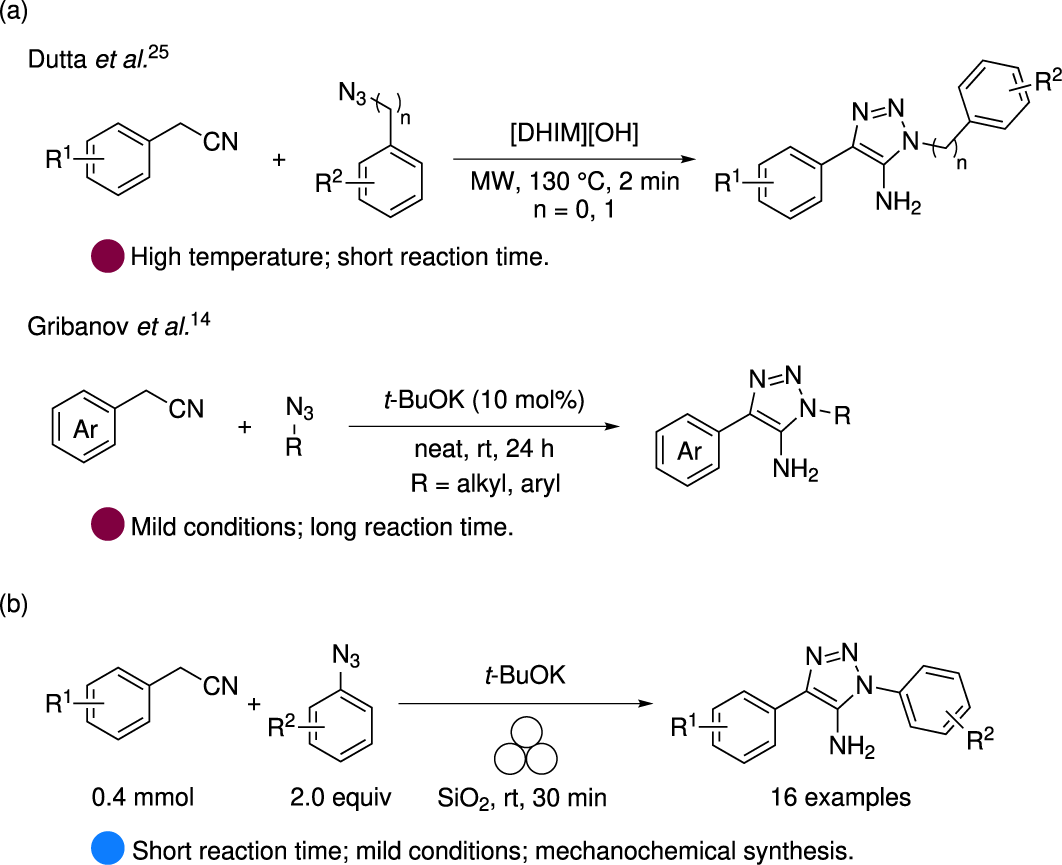
In view of the relevance of 5-amino-1H-1,2,3-triazoles, several synthetic methods have been reported for their preparation.21-23 Most available protocols rely on the Huisgen 1,3-dipolar cycloaddition reaction (DCR) between aryl or alkylazides and phenylacetonitrile derivatives.13,24 Alternative approaches aimed at more sustainable conditions have also been described, including reactions performed in ionic liquids (IL),25 as well as solvent-free protocols (Scheme 1a).14 However, these methodologies present several limitations. The conventional protocol generally requires relatively long reaction times, whereas the IL-based method under microwave irradiation proceeds rapidly, completing within only two minutes, and it requires elevated temperatures that may promote the Dimroth rearrangement.10
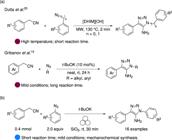
The development of new strategies for accessing triazole derivatives remains of considerable interest. In this context, mechanochemistry has emerged as a sustainable alternative, enabling reactions to be performed under solvent-free conditions or with reduced solvent consumption, often with the aid of milling auxiliaries.26 Herein, we report an alternative method that complements previously described sustainable approaches, based on a low-energy mechanochemical protocol using SiO2 as a milling auxiliary. This strategy enables reactions with a wide range of nitriles and arylazides bearing either electron-donating and electron-withdrawing substituents, and is compatible with substrates in both liquid and solid states. Notably, the mechanochemical process affords the crude mixture already pre-adsorbed on silica at the end of the reaction, enabling straightforward isolation of the desired product by simple filtration (Scheme 1b).
Experimental
Materials and methods
All mechanochemical reactions were conducted using 15 mL BMT-20-S tubes with an IKA Ultra-Turrax Tube Drive. Melting points of the substances were determined using a Thermo Scientific 9100 apparatus or a Fischer-Jones apparatus (Melting Point Apparatus) series 50200082. Infrared spectra were obtained using a Bruker FT-IR ATR spectrometer, model Alpha 2. Absorption values are expressed in wavenumbers (cm-1). Nuclear magnetic resonance (NMR) spectra were acquired on a Bruker Avance Neo spectrometer operating at 500.00 MHz (for 1H NMR) and 125.0 MHz (for 13C NMR), using dimethyl sulfoxide (DMSO-d6) as the solvent NMR spectra were typically obtained at room temperature. Chemical shift values (δ) are reported in parts per million (ppm) relative to the solvent DMSO-d6, and coupling constants (J) are reported in hertz (Hz). Signal areas were obtained by electronic integration. The multiplicities of absorption bands in the 1H NMR spectrum are described as follows: s (singlet), d (doublet), t (triplet), m (multiplet), dd (double doublet). High-resolution mass spectra (HRMS) were obtained using an Agilent 1260 Infinity II Liquid Chromatograph AB Sciex TripleTOF 5600+ Spectrometer. All solvents and reagents used were purchased from commercial sources such as Sigma-Aldrich Brazil (São Paulo, Brazil). When necessary, solvents were treated, distilled, and dried according to literature procedures. Reaction monitoring was performed by thin-layer chromatography (TLC) using silica gel 60 F254 chromatosheets (0.2 mm thickness, Merck 5554). Most substances were purified by flash column chromatography using SiliaFlash®, P60 (230-400 mesh) supplied by Merck.
General procedure for the preparation of 5-amino-1,4-diaryl-1H-1,2,3-triazole (3) via mechanochemistry
In a 15 mL BMT-20-S polypropylene tube (IKA Ultra-Turrax Tube Drive) charged with six stainless-steel balls (5 mm diameter, 0.52 g), phenylacetonitrile (1a-1e, 0.4 mmol), arylazide (2a-2q, 2.0 equiv., 0.8 mmol) and t-BuOK (1.1 equiv.) were were milled for 5 min at 300-4000 oscillations per min. After this time, 0.40 g of SiO2 (230-400 mesh) was added to the mixture. Then, the mixture was milled for an additional 30 min at 300-4000 oscillations per min. After milling, the crude mixture was subjected to column chromatography for the purification and isolation of products 3a-3e and 3g-3q.
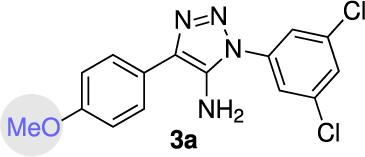
1-(3,5-Dichlorophenyl)-4-(4-methoxyphenyl)-1H-1,2,3-triazol-5-amine (3a)
Dark yellow solid (95 mg, 71%), mp 159-160 ºC; IR νmax / cm-1 3407, 3350, 3298, 3070, 2941, 2837, 1737, 1614, 1588, 1569, 1517, 1446, 1431, 1412, 1370, 1260, 1239, 1225, 1211, 1143, 1099, 1017, 997, 875, 854, 798, 759, 694, 670, 642, 627, 604; 1H NMR (500 MHz, DMSO-d6) δ 7.72 (t, J 1.5 Hz, 1H), 7.65 (d, J 2.0 Hz, 2H), 7.59 (d, J 8.5 Hz, 2H), 6.93 (d, J 8.5 Hz, 2H), 5.78 (s, 2H), 3.71 (s, 3H); 13C NMR (125 MHz, DMSO-d6) δ 161.5, 145.8, 141.6, 131.4, 129.5, 126.8, 125.0, 118.1, 114.2, 66.5; HRMS (electrospray ionization time of flight (ESI-TOF)) m/z, calcd. for C15H13Cl2N4O [M + H]+: 335.0461; found: 335.0470.
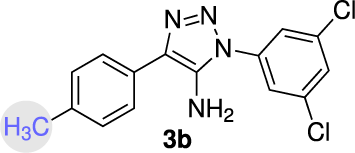
1-(3,5-Dichlorophenyl)-4-(p-tolyl)-1H-1,2,3-triazol-5-amine (3b)
Light yellow solid (82 mg, 64%), mp 158-159 ºC; IR νmax / cm-1 3429, 3350, 3237, 3083, 3021, 2923, 1623, 1581, 1519, 1424, 1390, 1318, 1275, 1237, 1095, 996, 882, 860, 820, 801, 742, 678, 665, 641; 1H NMR (500 MHz, DMSO-d6) δ 7.78 (s, 1H), 7.71 (s, 2H), 7.63 (d, J 8.0 Hz, 2H), 7.22 (d, J 8.0 Hz, 2H), 5.90 (s, 2H), 2.30 (s, 3H); 13C NMR (125 MHz, DMSO-d6) δ 139.2, 137.3, 135.4, 134.8, 129.2, 128.7, 128.4, 128.0, 125.0, 123.4, 20.7; HRMS (ESI-TOF) m/z, calcd. for C15H13Cl2N4 [M + H]+: 319.0512; found: 319.0517.
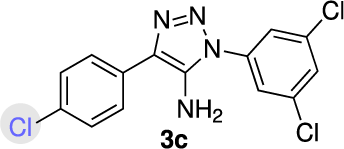
4-(4-Chlorophenyl)-1-(3,5-dichlorophenyl)-1H-1,2,3-triazol-5-amine (3c)
Light yellow solid (96 mg, 71%), mp 166-167 ºC; IR νmax / cm-1 361, 3302, 3089, 1899, 1728, 1626, 1585, 1570, 1505, 1435, 1298, 1272, 1114, 1093, 1063, 1011, 997, 854, 828, 803, 726, 702, 670, 627; 1H NMR (500 MHz, DMSO-d6) δ 7.80 (m, 3H), 7.73 (d, J 1.5 Hz, 2H), 7.48 (d, J 8.5 Hz, 2H), 6.07 (s, 2H); 13C NMR (125 MHz, DMSO-d6) δ 139.7, 137.1, 134.8, 130.6, 130.4, 128.6, 128.5, 126.6, 126.6, 123.6; HRMS (ESI-TOF) m/z, calcd. for C14H10Cl3N4 [M + H]+: 338.9966; found: 338.9984.
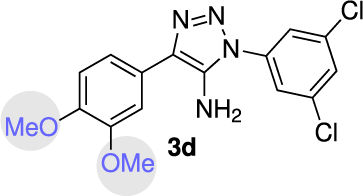
1-(3,5-Dichlorophenyl)-4-(3,4-dimethoxyphenyl)-1H-1,2,3-triazol-5-amine (3d)
Yellow solid (104 mg, 56%), mp 138-139 ºC; IR νmax / cm-1 3406, 3350, 3298, 3069, 2937, 2835, 1738, 1588, 1570, 1517, 1430, 1413, 1369, 1265, 1240, 1265, 1225, 1212, 1170, 1142, 1045, 1022, 997, 989, 873, 852, 798, 760, 695, 669, 643, 627; 1H NMR (500 MHz, DMSO-d6) δ 7.84 (s, 1H), 7.78 (s, 2H), 7.34 (s, 1H), 7.29 (d, J 8.5 Hz, 1H), 7.05 (d, J 8.5 Hz, 1H), 5.88 (s, 2H), 3.88 (s, 3H), 3.83 (s, 3H); 13C NMR (125 MHz, DMSO-d6) δ 148.9, 147.4, 140.1, 133.7, 132.3, 131.7, 130.5, 130.1, 126.3, 124.8, 117.2, 112.2, 109.0, 55.6, 55.5; HRMS (ESI-TOF) m/z, calcd. for C16H15Cl2N4O2 [M + H]+: 365.0567; found: 365.0580.
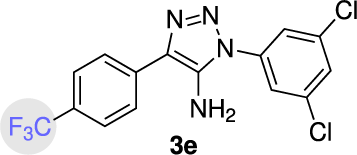
1-(3,5-Dichlorophenyl)-4-(4-(trifluoromethyl)phenyl)-1H-1,2,3-triazol-5-amine (3e)
Light yellow solid (81 mg, 54%), mp 159-160 ºC; IR νmax / cm-1 3430, 3340, 3094, 1618, 1586, 1434, 1325, 1317, 1308, 1283, 1240, 1162, 1110, 1073, 1043, 1010, 974, 886, 865, 844, 801, 716, 689, 679; 1H NMR (500 MHz, DMSO-d6) δ 8.01 (d, J 8.5 Hz, 2H), 7.83 (t, J 2.0 Hz, 1H), 7.78 (d, J 8.5 Hz, 2H), 7.75 (d, J 2.0 Hz, 2H), 6.26 (s, 2H); 13C NMR (125 MHz, DMSO-d6) δ 140.5, 136.9, 135.6, 134.8, 128.7, 127.6, 126.5, 126.2, 126.0, 125.7, 125.6-125.2 (m), 125.1, 124.8, 124.0 (d, J 30.5 Hz), 123.8-123.7 (m), 123.4 (d, J 36.5 Hz), 121.1; HRMS (ESI-TOF) m/z, calcd. for C15H10Cl2F3N4 [M + H]+: 373.0229; found 373.0245.
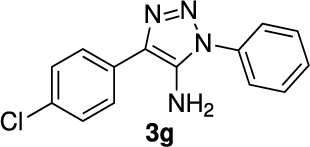
4-(4-Chlorophenyl)-1-phenyl-1H-1,2,3-triazol-5-amine (3g)13
Light yellow solid (74 mg, 68%), mp 185-186 ºC (lit. mp 188-190 °C); IR νmax / cm-1 3397, 3278, 3054, 2923, 1622, 1602, 1578, 1499, 1454, 1403, 1380, 1282, 1257, 1155, 1092, 1071, 1012, 983, 842, 832, 822, 748, 702, 694, 684, 665; 1H NMR (500 MHz, DMSO-d6) δ 7.86 (d, J 8.5 Hz, 2H), 7.71-7.62 (m, 4H), 7.60 (t, J 6.6 Hz, 1H), 7.52 (d, J 8.5 Hz, 2H), 5.84 (s, 2H); 13C NMR (125 MHz, DMSO-d6) δ 139.5, 135.2, 130.8, 130.5, 129.8, 129.1, 128.7, 126.6, 124.8; HRMS (ESI-TOF) m/z, calcd. for C14H12ClN4 [M + H]+: 271.0745; found: 271.0765.
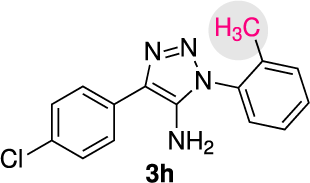
4-(4-Chlorophenyl)-1-(o-tolyl)-1H-1,2,3-triazol-5-amine (3h)
Dark yellow solid (49 mg, 43%), mp 148-149 ºC; IR νmax / cm-1 3400, 3268, 3180, 2921, 2852, 1624, 1575, 1560, 1509, 1495, 1470, 1403, 1303, 1286, 1266, 1201, 1111, 1091, 1013, 983, 838, 801, 772, 753, 730, 688, 672, 605; 1H NMR (500 MHz, DMSO-d6) δ 7.77 (d, J 8.5 Hz, 2H), 7.43-7.37 (m, 4H), 7.34 (t, J 8.0 Hz, 1H), 7.28 (d, J 8.0 Hz, 1H), 5.89 (s, 2H), 2.01 (s, 3H);13C NMR (125 MHz, DMSO-d6) δ 140.6, 136.1, 134.1, 131.7, 131.4, 130.7, 129.0, 128.2, 127.6, 126.7, 126.0, 17.5; HRMS (ESI-TOF) m/z, calcd. for C15H14ClN4 [M + H]+: 285.0902; found: 285.0918.
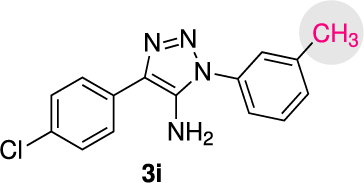
4-(4-Chlorophenyl)-1-(m-tolyl)-1H-1,2,3-triazol-5-amine (3i)
White solid (80 mg, 70%), mp 155-156 ºC. IR νmax / cm-1 3302, 3222, 2921, 2852, 1625, 1592, 1563, 1508, 1492, 1480, 1454, 1402, 1374, 1308, 1298, 1270, 1116, 1091, 1010, 983, 874, 857, 848, 827, 780, 728, 691, 681, 666, 627.; 1H NMR (500 MHz, DMSO-d6) δ 7.81 (d, J 8.5 Hz, 2H), 7.52-7.47 (m, 3H), 7.42-7.36 (m, 3H), 5.78 (s, 2H), 2.43 (s, 3H); 13C NMR (125 MHz, DMSO-d6) δ 139.5, 139.4, 135.1, 130.9, 130.5, 129.7, 129.6, 128.7, 126.6, 126.5, 125.2, 121.8, 21.0; HRMS (ESI-TOF) m/z, calcd. for C15H14ClN4 [M + H]+: 285.0902; found: 285.0921.
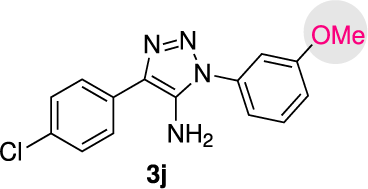
4-(4-Chlorophenyl)-1-(3-methoxyphenyl)-1H-1,2,3-triazol-5-amine (3j)
Brown solid (57 mg, 47%), mp146-147 ºC; IR νmax / cm-1 3346, 3045, 2999, 2960, 2938, 2835, 1607, 1578, 1562, 1508, 1497, 1476, 1437, 1402, 1382, 1316, 1303, 1291, 1255, 1225, 1211, 1174, 1117, 1099, 1086, 1047, 1009, 996, 982, 864, 851, 833, 821, 773, 754, 731, 692, 678, 616; 1H NMR (500 MHz, DMSO-d6) δ 7.85 (d, J 8.0 Hz, 2H), 7.57 (t, J 8.0 Hz, 1H), 7.51 (d, J 8.5 Hz, 2H), 7.20 (d, J 8.5 Hz, 2H), 7.16 (d, J 8.5, 1H), 5.87 (s, 2H), 3.89 (s, 3H); 13C NMR (125 MHz, DMSO-d6) δ 160.0, 139.4, 136.2, 130.8, 130.5, 130.4, 128.5, 126.5, 116.7, 115.0, 110.2, 55.5; HRMS (ESI-TOF) m/z, calcd. for C15H14ClN4O [M + H]+: 301.0851; found: 301.0871.
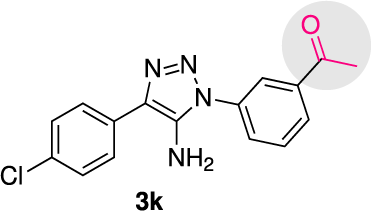
1-(3-(5-Amino-4-(4-chlorophenyl)-1H-1,2,3-triazol-1-yl)phenyl)ethan-1-one (3k)
Dark yellow solid (54 mg, 43%), mp 156-157 ºC; IR νmax / cm-1 3408, 3312, 3073, 2992, 2851, 1671, 1627, 1576, 1515, 1437, 1373, 1358, 1305, 1287, 1276, 1236, 1103, 1086, 1055, 1020, 1010, 1000, 965, 901, 844, 835, 805, 791, 765, 737, 702, 683, 677, 651, 635, 626; 1H NMR (500 MHz, DMSO-d6) δ 8.11-8.08 (m, 2H), 7.86 (d, J 8.0 Hz, 1H), 7.80 (d, J 8.5 Hz, 2H), 7.76 (t, J 8.0 Hz, 2H), 7.46 (d, J 8.5, 2H) 5.92 (s, 2H), 2.65 (s, 3H); 13C NMR (125 MHz, DMSO-d6) δ 197.3, 139.7, 138.1, 135.6, 130.7, 130.3, 129.2, 128.5, 126.8, 126.7, 124.3, 26.9; HRMS (ESI-TOF) m/z, calcd. for C16H14ClN4O [M + H]+: 313.0851; found: 313.0877.
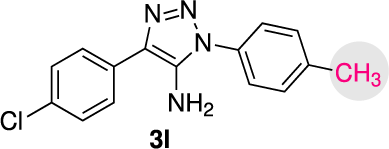
4-(4-Chlorophenyl)-1-(p-tolyl)-1H-1,2,3-triazol-5-amine (3l)
White solid (73 mg, 64%), mp 129-130 ºC; IR νmax / cm-1 3410, 3327, 3035, 2923, 2853, 1616, 1576, 1518, 1502, 1402, 1382, 1281, 1259, 1239, 1177, 1108, 1088, 1011, 982, 834, 813, 731, 663, 642, 577, 508, 491, 419; 1H NMR (500 MHz, DMSO-d6) δ 7.85 (d, J 8.5 Hz, 2H), 7.52-7.50 (m, 4H), 7.46 (d, J 8.5 Hz, 2H), 5.78 (s, 2H), 2.46 (s, 3H); 13C NMR (125 MHz, DMSO-d6) δ 139.2, 138.6, 132.6, 130.8, 130.3, 130.0, 128.4, 126.6, 126.4, 124.5, 20.6; HRMS (ESI-TOF) m/z, calcd. for C15H14ClN4 [M + H]+: 285.0902; found: 285.0910.
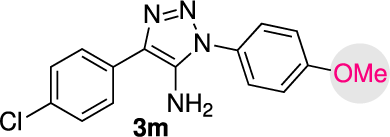
4-(4-Chlorophenyl)-1-(4-methoxyphenyl)-1H-1,2,3-triazol-5-amine (3m)27
White solid (74 mg, 62%), mp 195-197 ºC (lit. mp 221 °C, dichloromethane); IR νmax / cm-1 3403, 3284, 3011, 2937, 2840, 2044, 1911, 1614, 1590, 1504, 1464, 1438, 1402, 1313, 1280, 1254, 1240, 1225, 1184, 1171, 1114, 1090, 1046, 1026, 1009, 984, 833, 820, 800, 735, 710, 695, 647, 528, 515, 479; 1H NMR (500 MHz, DMSO-d6) δ 7.71 (d, J 8.5 Hz, 2H), 7.41-7.37 (m, 4H), 7.06 (d, J 8.5 Hz, 2H), 5.64 (s, 2H), 3.76 (s, 3H); 13C NMR (125 MHz, DMSO-d6) δ 159.6, 139.4, 130.8, 130.3, 128.4, 127.9, 126.4, 114.8, 55.5; HRMS (ESI-TOF) m/z, calcd. for C15H14ClN4O [M + H]+: 301.0851; found: 301.0852.
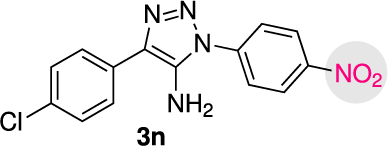
4-(4-Chlorophenyl)-1-(4-nitrophenyl)-1H-1,2,3-triazol-5-amine (3n)
Light yellow solid (19 mg, 15%), mp 150-151 ºC; IR νmax / cm-1 3112, 3086, 3063, 2945, 2912, 2852, 2449, 2262, 2249, 1944, 1804, 1741, 1667, 1607, 1599, 1509, 1492, 1454, 1417, 1405, 1339, 1270, 1213, 1183, 1115, 1108, 1012, 944, 923, 859, 830, 794, 732, 680, 662, 527, 511, 464; 1H NMR (500 MHz, DMSO-d6) δ 8.47 (d, J 8.5 Hz, 2H),7.98 (d, J 8.5 Hz, 2H),7.83 (d, J 8.5 Hz, 2H), 7.51 (d, J 8.5 Hz, 2H), 6.14 (s, 2H); 13C NMR (125 MHz, DMSO-d6) δ 146.9, 140.4, 139.8, 130.8, 130.4, 128.7, 127.1, 126.8, 126.5, 125.2; HRMS (ESI-TOF) m/z, calcd. for C14H10ClN5O2Na [M + Na]+: 338.0415; found: 338.0470.
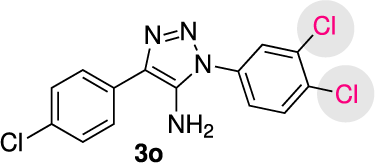
4-(4-Chlorophenyl)-1-(3,4-dichlorophenyl)-1H-1,2,3-triazol-5-amine (3o)
Light yellow solid (107 mg, 79%), mp 178-179 ºC; IR νmax / cm-1 3411, 3308, 3222, 3093, 2992, 2852, 1899, 1622, 1592, 1509, 1488, 1458, 1399, 1255, 1087, 1103, 1051, 1033, 1010, 983, 835, 819, 697, 648, 631, 610, 578, 538, 513, 493, 465, 450; 1H NMR (500 MHz, DMSO-d6) δ 7.94 (d, J 2.5 Hz, 1H), 7.88 (d, J 8.5 Hz, 1H), 7.82 (d, J 8.5 Hz, 2H), 7.65 (dd, J 8.5 and 2.5 Hz, 1H), 7.49 (d, J 8.5, 2H), 5.95 (s, 2H); 13C NMR (125 MHz, DMSO-d6) δ 139.6, 134.8, 132.0, 131.7, 131.4, 130.5, 130.4, 128.5, 126.7, 126.6, 126.5, 125.0; HRMS (ESI-TOF) m/z, calcd. for C14H10Cl3N4 [M + H]+: 338.9966; found: 338.9972.
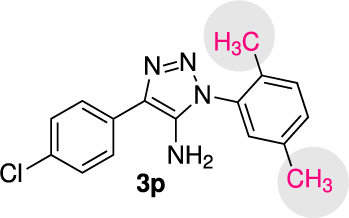
4-(4-Chlorophenyl)-1-(2,5-dimethylphenyl)-1H-1,2,3-triazol-5-amine (3p)
Grey solid (83 mg, 69%), mp 180-182 ºC; IR νmax / cm-1 3422, 3307, 3198, 3050, 2922, 2853, 1626, 1605, 1583, 1517, 1485, 1404, 1380, 1266, 1252, 1220, 1143, 1119, 1103, 1089, 1012, 990, 967, 839, 826, 727, 705, 685, 673, 583, 550, 521, 500, 488, 452, 419; 1H NMR (500 MHz, DMSO-d6) δ 7.81 (d, J 8.5 Hz, 2H), 7.44 (d, J 8.5 Hz, 2H), 7.34 (d, J 8.0 Hz, 1H), 7.30 (d, J 8.0 Hz, 1H), 5.62 (s, 2H), 2.35 (s, 3H), 2.01 (s, 3H); 13C NMR (125 MHz, DMSO-d6) δ 140.2, 136.6, 133.5, 132.3, 131.1, 131.0, 130.9, 130.2, 128.6, 128.1, 126.2, 125.5, 20.3, 16.6; HRMS (ESI-TOF) m/z, calcd. for C16H16ClN4 [M + H]+: 299.1058; found: 299.1061.
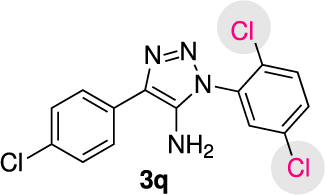
4-(4-Chlorophenyl)-1-(2,5-dichlorophenyl)-1H-1,2,3-triazol-5-amine (3q)
Light yellow solid (45 mg, 33%), mp 219-220 ºC; IR νmax / cm-1 3422, 3335, 3092, 2925, 1894, 1621, 1577, 1564, 1512, 1492, 1463, 1416, 1401, 1302, 1290, 1267, 1239, 1140, 1090, 1028, 1010, 981, 881, 828, 809, 729, 711, 704, 670, 605, 579, 516, 497, 478, 449, 409; 1H NMR (500 MHz, DMSO-d6) δ 7.88-7.7.83 (m, 2H), 7.77 (dd, J 8.5 and 2.0 Hz, 1H), 7.51 (d, J 8.5 Hz, 1H), 6.08 (s, 2H); 13C NMR (125 MHz, DMSO-d6) δ 141.0, 133.5, 132.4, 131.9, 131.8, 130.8, 130.6, 130.2, 130.1, 128.6, 126.1, 124.9; HRMS (ESI-TOF) m/z, calcd. for C14H10Cl3N4 [M + H]+: 338.9966; found: 338.9975.
Results and Discussion
The optimization of the synthesis of 5-amino-1H-1,2,3-triazole 3 has been started by treatment the mixture of 0.4 mmol of 4-methoxyphenylacetonitrile 1a and 1-azido-3,5-dichlorobenzene (2a, 2.0 equiv.) with of potassium tert-butoxide (t-BuOK, 1.5 equiv.) as the base, in a 15 mL polypropylene BMT-20-S Ultra-Turrax Tube Drive (IKA) charged with six stainless-steel balls (5 mm diameter). The silica (SiO2) was used as a milling auxiliary, due to the material becoming ingrained in the jar and preventing the spheres from moving. After stirring for 30 min, the reaction resulted in complete consumption of the starting material as monitored by TLC and the corresponding product 3a was isolated in excellent yield (75%, entry 1, Table 1).
Optimization of mechanochemical reaction for the synthesis of 5-amino-1,4-diaryl-1H-1,2,3-triazole 3a
Reducing 2a to near of stoichiometric amount, 1a was not consumed completely, resulting in the yield decreased (58%, entry 2), indicating that an excess of 2a is required to promote efficient conversion within a short reaction time. On the other hand, when the amount of base tert-butoxide was reduced, we observed a total consumption of 1a, resulting in partial recovery of 2a after column chromatography. The desired product was obtained in 71% yield (entry 3, Table 1).
Some methods reported in the literature describe the use of bases under catalytic neat conditions14 or in bulky solvent systems.13 Therefore, different bases and their stoichiometries were systematically evaluated during the reaction optimization. Then, when tert-butoxide was used in a catalytic amount, maintaining the previous conditions, the corresponding product 3a was formed in only 7% yield (entry 4, Table 1). Reproducing the reaction with 10 mol% of t-BuOK with an extended reaction time of 60 min led to a small improvement, affording the product 3a in 12% yield (entry 5). Evaluation of other bases, even in excess, under similar conditions revealed a significant decrease in efficiency. For example, when KOH was used, providing only 7% yield (entry 6, Table 1). Furthermore, no reaction was observed when K2CO3 or Cs2CO3 were employed (entries 7 and 8, Table 1).
The product 3a was obtained as dark yellow solid (mp 159-160 ºC). Analysis of the 1H NMR spectrum revealed doublets at δ 7.72 (1H) and 7.65 (2H), assigned to the 4-ClC6H3 moiety, along with two additional doublets at 7.59 and 6.93 ppm corresponding to the 4-OMeC6H4 group. A singlet at δ 5.78 was attributed to the NH2 protons. The formation of 3a was further supported by infrared spectroscopy, which exhibited two bands at 3407 and 3350 cm-1, characteristic of N–H stretching vibrations of the amino group. HRMS analysis showed an [M + H]+ ion at 335.0470, in agreement with the expected molecular composition.
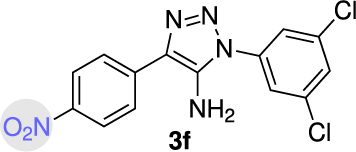
After optimization, the best condition was using the nitrile 1 with arylazide 2 in excess and 1.1 equiv. of t-BuOK, in the presence of SiO2 as milling auxiliary. Then, the scope of the reaction was explored with electron-donating and electron-withdrawing groups in phenylacetonitrile 1a-1f with 1-azido-3,5-dichlorobenzene 2a (Table 2). Important to mention, the phenylacetonitriles containing 4-OMe and 4-CH3 are liquid, while 4-Cl, 3,4-diOMe, 4-CF3 and 4-NO2 are solid. What was available and observed to work well in mechanochemical conditions, promoting good yields (54-71%, entries 1-5, Table 2), highlighting that the substrate 1b needs more time to homogenize in the jar, as it appeared moist during the first 30 min. Analyzing the reactivity of the investigated phenylacetonitriles, substrates bearing electron-donating groups (1a-1d) afforded the desired product in higher yields compared to those containing electron-withdrawing groups (1e-1f). Notably, 4-nitrophenylacetonitrile (1f), bearing a strongly electron-withdrawing nitro group, significantly affected the reactivity and failed to afford 3f under these conditions (entry 6, Table 2). This result may be attributed to the reduced reactivity of the carbanion generated upon deprotonation, caused by the nitro substituent.
To expand the scope of this reaction further, it was explored (4-chlorophenyl)acetonitrile 1c for a variety of arylazides 2 (Table 3). The arylazides were synthesized according to a procedure developed by our group.24 The choice of (4-chlorophenyl)acetonitrile 1c to explore the scope was due to it being a solid compound, easy to handle, and capable of promoting a pioneering scope. The mechanochemical condition was able to synthesize the corresponding products 3 when used arylazides 2 containing substituents at C2, C3, C4 and disubstituted groups at C3/C4 and C2/C5 positions, with electron-donating and electron-withdrawing groups, without affecting the embedded functional groups, including acetyl and nitro (entries 1-11, Table 3). Notably, the presence of an electron-withdrawing group at the para position (3n, 4-NO2, entry 8) adversely affected the reaction, resulting in a lower yield compared with products 3l (4-Me, entry 6) and 3m (4-OMe, entry 7), which bear electron-donating groups (Table 3). This behavior may be attributed to the reduced reactivity of the azide moiety caused by the electron-withdrawing substituent.
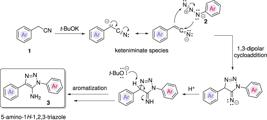
The mechanism of this reaction has been previously proposed in the literature.13,14 Thus, a plausible sequence of intermediates is proposed. The process begins with the base-promoted deprotonation of phenylacetonitrile 1, in this case using t-BuOK, generating a keteniminate species as intermediate, which subsequently undergoes a 1,3-dipolar cycloaddition reaction (DCR) with arylazide 2. The resulting adduct then proceeds through three additional steps leading to aromatization, ultimately affording the corresponding 5-aminotriazole 3 (Scheme 2).
Conclusions
In summary, we developed a mechanochemical method for the synthesis of 5-amino-1,4-diaryl-1H-1,2,3-triazoles from phenylacetonitrile derivatives and arylazides using SiO2 as a milling auxiliary, enabling efficient reactions under solvent-free, low-energy impact and short reaction times. Notably, the mechanochemical process with silica affords the desired products by simple filtration after chromatographic purification. Scope studies demonstrated that a variety of substituted phenylacetonitriles and arylazides can be successfully converted into the corresponding triazoles in low to good yields (15-79%, sixteen examples). However, strongly deactivated substrates, such as 4-nitrophenylacetonitrile (1f), were unreactive under the optimized conditions. Overall, this work provides a practical and sustainable alternative for the synthesis of 5-aminotriazoles and further highlights the potential of mechanochemistry as an efficient platform for heterocycle synthesis.
Supplementary Information
Supplementary information is available free of charge at http://jbcs.sbq.org.br as PDF file.
Supplementary PDF
Data Availability Statement
The data supporting the findings of this study are available within the article and its SI section.
Acknowledgments
This study was supported by FAPERJ (E-26/204.023/2024 and E-26/210.734/2025), CNPq (307736/2023-7 and 402952/2025-1) and CAPES (Finance Code 001). CAIQ-UnB was also acknowledged for HRMS analyses.
References
-
1 Martis, G. J.; Maiya, S.; Gaonkar, S. L.; Eur. J. Med. Chem. Rep. 2026, 16, 100315. [Crossref]
» Crossref -
2 Ferreira, V. F.; da Rocha, D. R.; da Silva, F. C.; Ferreira, P. G.; Boechat, N. A.; Magalhães J. L.; Expert Opin. Ther. Patents 2013, 23, 319. [Crossref]
» Crossref -
3 Akram, M.; Tamminana, R.; RSC Adv. 2025, 15, 46243. [Crossref]
» Crossref -
4 Alagarasan, J. K.; Ullapu, P. R.; Gedi, S.; Minnam Reddy, V. R.; Putta, R. R.; J. Heterocycl. Chem. 2025, 62, 1559. [Crossref]
» Crossref -
5 Jaiswal, S.; Bhardwaj, K.; Dwivedi, J.; Sharma, S.; Chem. Biodiversity 2025, 22, e00387. [Crossref]
» Crossref -
6 Taylor, R. D.; MacCoss, M.; Lawson, A. D. G.; J. Med. Chem. 2014, 57, 5845. [Crossref]
» Crossref -
7 Rani, A.; Singh, G.; Singh, A.; Maqbool, U.; Kaur, G.; Singh, J.; RSC Adv. 2020, 10, 5610. [Crossref]
» Crossref -
8 Singh, N.; Pandey, S. K.; Tripathi, R. P.; Carbohydr. Res. 2010, 345, 1641. [Crossref]
» Crossref -
9 Bozorov, K.; Zhao, J.; Aisa, H. A.; Bioorg. Med. Chem. 2019, 27, 3511. [Crossref]
» Crossref -
10 Gribanov, P. S.; Philippova, A. N.; Topchiy, M. A.; Minaeva, L. I.; Asachenko, A. F.; Osipov, S. N.; Molecules 2022, 27, 1999. [Crossref]
» Crossref -
11 Gribanov, P. S.; Philippova, A. N.; Topchiy, M. A.; Lypenko, D. A.; Dmitriev, A. V.; Tokarev, S. D.; Smol’yakov, A. F.; Rodionov, A. N.; Asachenko, A. F.; Osipov, S. N.; Molecules 2024, 29, 2151. [Crossref]
» Crossref -
12 Lieber, E.; Chao, T. S.; Rao, C. N. R.; J. Org. Chem. 1957, 22, 654. [Crossref]
» Crossref -
13 Krishna, P. M.; Ramachary, D. B.; Peesapati, S.; RSC Adv. 2015, 5, 62062. [Crossref]
» Crossref -
14 Gribanov, P. S.; Atoian, E. M.; Philippova, A. N.; Topchiy, M. A.; Asachenko, A. F.; Osipov, S. N.; Eur. J. Org. Chem. 2021, 2021, 1378. [Crossref]
» Crossref -
15 Worrell, B. T.; Hein, J. E.; Fokin, V. V.; Angew. Chem., Int. Ed. 2012, 51, 11791. [Crossref]
» Crossref -
16 Lakhani, D.; Sadiq, S.; Subbaiahgari, H.; Swanson, V.; Munyon, J.; Poudel, S. B.; Aiken, K. S.; Landge, S. M.; Bose, D.; Ghosh, D.; ACS Omega 2025, 10, 58925. [Crossref]
» Crossref -
17 Wang, S.; Zhang, Y.; Liu, G.; Xu, H.; Song, L.; Chen, J.; Li, J.; Zhang, Z.; Org. Chem. Front. 2021, 8, 599. [Crossref]
» Crossref -
18 Bochis, R. J.; Chabala, J. C.; Harris, E.; Peterson, L. H.; Barash, L.; Beattie, T.; Brown, J. E.; Graham, D. W.; Waksmunski, F. S.; Tischler, M.; Joshua, H.; Smith, J.; Colwell, L. F.; Wyvratt, M. J.; Fisher, M. H.; J. Med. Chem. 1991, 34, 2843. [Crossref]
» Crossref -
19 Brand, S.; Ko, E. J.; Viayna, E.; Thompson, S.; Spinks, D.; Thomas, M.; Sandberg, L.; Francisco, A. F.; Jayawardhana, S.; Smith, V. C.; Jansen, C.; De Rycker, M.; Thomas, J.; MacLean, L.; Osuna-Cabello, M.; Riley, J.; Scullion, P.; Stojanovski, L.; Simeons, F. R. C.; Epemolu, O.; Shishikura, Y.; Crouch, S. D.; Bakshi, T. S.; Nixon, C. J.; Reid, I. H.; Hill, A. P.; Underwood, T. Z.; Hindley, S. J.; Robinson, S. A.; Kelly, J. M.; Fiandor, J. M.; Wyatt, P. G.; Marco, M.; Miles, T. J.; Read, K. D.; Gilbert, I. H.; J. Med. Chem. 2017, 60, 7284. [Crossref]
» Crossref -
20 Biagi, G.; Calderone, V.; Giorgi, I.; Livi, O.; Scartoni, V.; Baragatti, B.; Martinotti, E.; Eur. J. Med. Chem. 2000, 35, 715. [Crossref]
» Crossref -
21 Abd El Latif, F. M.; Ei Rady, E. A.; Khali, M. A.; Phosphorus, Sulfur Silicon Relat. Elem. 2002, 177, 2497. [Crossref]
» Crossref -
22 Freitas, A. P.; Proença, M. F. J. R. P.; Booth, B. L.; J. Heterocycl. Chem. 1995, 32, 457. [Crossref]
» Crossref -
23 Silaichev, P. S.; Beryozkina, T. V.; Melekhin, V. V.; Filimonov, V. O.; Maslivets, A. N.; Ilkin, V. G.; Dehaen, W.; Bkulev, V. A.; Beilstein J. Org. Chem. 2024, 20, 17. [Crossref]
» Crossref -
24 Pauli, F. P.; Lima Filho, E. O.; Oliveira, G. A. R.; Lião, L. M.; Campos, V. R.; Forezi, L. S. M.; Ferreira, V. F.; da Silva, F. C.; Chem. - Asian J. 2024, 19, e202400845. [Crossref]
» Crossref -
25 Dutta, B.; Garg, A.; Phukan, P.; Kulshrestha, A.; Kumar, A.; Sarma, D.; New J. Chem. 2021, 45, 12792. [Crossref]
» Crossref -
26 Saha, S.; Pinheiro, A. B.; Chatterjee, A.; Bhutia, Z. T.; Banerjee, M.; Green Chem. 2024, 26, 5879. [Crossref]
» Crossref -
27 Kore, N.; Pazdera, P.; Curr. Org. Synth. 2018, 15, 552. [Crossref]
» Crossref
Edited by
-
Editor handled this article:
Fernanda Gadini Finelli (Guest)