
 Efficacy of D-mannose as prophylaxis of recurrent urinary tract infection: a systematic review and meta-analysis of randomized controlled trials
Abstract
Introduction: Recurrent urinary tract infections (UTIs) significantly impact the quality of life due to symptoms, effects on sexual activity, persistent pain, and recurrent antibiotic use. This systematic review and meta-analysis aimed to evaluate the efficacy of D-mannose in preventing recurrent UTIs.
Methods: In May 2024, we systematically searched PubMed, EMBASE, and the Cochrane Library for randomized controlled trials (RCTs) comparing D-mannose treatment with no intervention or standard antibiotic therapy in patients at high risk for recurrent UTI. We applied a random-effects model to pool relative risks (RR) and 95% confidence intervals (CI).
Results: We included 6 RCTs comprising 1,167 participants, of whom 534 received D-mannose and 521 (97.6%) were women. D-mannose was not associated with a reduction in recurrent UTI compared with control (RR: 0.57, 95% CI 0.29 – 1.15; p < 0.01) or antibiotics (RR: 0.39, 95% CI 0.12 – 1.25; p < 0.01). Further analyses showed that D-mannose did not improve outcomes in a subgroup of postmenopausal women.
Conclusion: In this meta-analysis of RCTs, D-mannose did not reduce the incidence of recurrent UTIs compared with control or antibiotics in high-risk patients.
Keywords:
Mannose; Antibiotic Prophylaxis; Urinary Tract Infections; Systematic Review; Meta-Analysis
Resumo
Introdução: As infecções do trato urinário (ITUs) recorrentes afetam significativamente a qualidade de vida devido aos sintomas, aos efeitos sobre a atividade sexual, à dor persistente e ao uso recorrente de antibióticos. Esta revisão sistemática e metanálise teve como objetivo avaliar a eficácia da D-manose na prevenção de ITUs recorrentes.
Métodos: Em maio de 2024, realizamos uma busca sistemática nas bases de dados PubMed, EMBASE e Cochrane Library por ensaios clínicos randomizados (ECRs) que comparassem o tratamento com D-manose à ausência de intervenção ou à terapia antibiótica padrão em pacientes com alto risco de ITU recorrente. Aplicamos um modelo de efeitos aleatórios para agrupar os riscos relativos (RR) e os intervalos de confiança (IC) de 95%.
Resultados: Incluímos 6 ECRs envolvendo 1.167 participantes, dos quais 534 receberam D-manose e 521 (97,6%) eram mulheres. A D-manose não se associou a uma redução na ITU recorrente em comparação ao grupo controle (RR: 0,57; IC 95% 0,29 – 1,15; p < 0,01) ou ao uso de antibióticos (RR: 0,39; IC 95% 0,12 – 1,25; p < 0,01). Análises adicionais demonstraram que a D-manose não melhorou os desfechos em um subgrupo de mulheres na pós-menopausa.
Conclusão: Nesta metanálise de ECRs, a D-manose não reduziu a incidência de ITUs recorrentes em comparação ao grupo controle ou ao tratamento com antibióticos em pacientes de alto risco.
Descritores:
Manose; Antibioticoprofilaxia; Infecções Urinárias; Revisão Sistemática; Metanálise
Introduction
Over 400 million patients had urinary tract infections (UTIs) in 2019, and more than 200 thousand died from the condition1. Most patients are women and often have recurrent UTIs, with more than two episodes in six months or three in one year2. UTIs have a negative impact on quality of life, and can lead to pain and avoidance of sexual relationships.
While antibiotics remain the mainstay treatment, their effectiveness can vary, and long-term use raises concerns about resistance and side effects2. Some women benefit from empathetic and knowledgeable healthcare support, which can help alleviate symptoms, but many continue to struggle despite medical interventions3. This highlights the need for broader research into alternative treatments, including non-antibiotic options like probiotics or natural remedies, and a deeper understanding of the personal and social impact of living with recurrent UTIs.
D-mannose, a naturally occurring monosaccharide, has garnered interest due to its potential role in preventing UTIs by inhibiting bacterial adhesion to the urinary tract lining4. Given the limitations of conventional treatments like antibiotics, there is a growing need to explore alternative options for recurrent UTIs. Herein, we performed a systematic review and meta-analysis to evaluate whether d-mannose can be a reliable and effective preventive measure for recurrent UTIs.
Methods
We conducted a systematic review and meta-analysis according to PRISMA (Preferred Reporting Items for Systematic Reviews and Meta-Analyses) guidelines and the Cochrane Handbook for Systematic Reviews of Interventions5,6. The protocol was prospectively registered at the OSF (Mutarelli, A; 2024, October 17. Efficacy and safety of D-mannose for recurrent urinary tract infections: A Systematic Review and Meta-analysis of RCTs. Retrieved from osf.io/wq2rt)7.
Eligibility Criteria
The inclusion criteria for this meta-analysis were as follows: (1) randomized controlled trials (RCTs); (2) comparing D-mannose with control or antibiotics for the prevention of UTI in women; (3) with a minimum follow-up period of 3 months; and (4) reporting at least one relevant outcome. The exclusion criteria were: (1) case reports, commentaries, abstracts, editorials, letters, and reviews; (2) studies combining D-mannose with multiple interventions; and (3) studies lacking relevant populations or outcomes of interest.
Search Strategy and Data Extraction
We systematically searched PubMed, Embase, and the Cochrane Library from inception to May 2024 using the following search terms: “d-mannose”, “urinary tract”, “infection, bacteriuria”, “tract infection”, “pyuria”, and “prophylaxis”. The full search string in each database is provided in the Supplement Material. Two investigators (AM and CEFV) independently screened titles, abstracts, and full texts to determine eligibility. Disagreements were resolved by consensus.
Endpoints and Subgroups
The main outcome was the efficacy of D-mannose compared with a control or antibiotics in the prophylaxis of recurrent UTIs. The control group included patients receiving either a placebo or no treatment. A second outcome was the efficacy of D-mannose compared to a control in postmenopausal women.
Quality Assessment
We assessed the quality and risk of bias in the included studies using the Cochrane Risk of Bias 2 tool (RoB-2) for randomized trials6. Two investigators (AM and CEFV) independently conducted the assessments, resolving disagreements through consensus.
Statistical Analysis
All primary analyses adhered to the intention-to-treat principle. Binary outcomes were calculated using relative risks (RRs) with corresponding 95% confidence intervals (CIs), and p-values less than 0.05 were deemed significant for treatment effects. We applied the Mantel-Haenszel method for binary outcomes and the restricted maximum likelihood (REML) method as a variance estimator. All plots were generated using random-effects models.
Heterogeneity was assessed with Cochran’s Q test and the I2 statistics, with a p-value <0.10 and I2 ≥ 25% indicative of significant heterogeneity. Sensitivity analyses were performed using leave-one-out meta-analyses to evaluate each study’s influence on the overall effect estimate. All analyses were made using R version 4.2.1 (R Foundation for Statistical Computing, Vienna, Austria)8.
Results
Study Selection and Characteristics
Our search initially identified 958 papers, which were reduced to 853 after removing duplicates. Of these, 34 studies were selected for full-text review, and six RCTs were included in the analysis (Figure 1)9,10,11,12,13,14. Thirteen studies were excluded because they used different interventions, 11 were excluded for being conference abstracts or research protocols, and four were excluded due to population overlap. Among the six RCTs, two compared D-mannose with antibiotics, two compared it with placebo or no treatment, and two involved populations using either vaginal estrogen or proanthocyanidins. The largest study enrolled 598 participants, while the smallest had 43 participants.

A total of 1,167 participants were enrolled, 534 of whom received D-mannose. Most participants (98%, or 1,142 individuals) were women. Four studies had a six-month follow-up period, one had a four-month follow-up, and one had a three-month follow-up. Further details of study characteristics are available in Table 1.
Efficacy of D-Mannose
In the pooled analysis, D-mannose was not associated with a significant reduction in UTI recurrence compared with control (RR 0.57; 95% CI 0.29 to 1.15; p = 0.118; I2 = 87%; Figure 2A) or antibiotics (RR 0.39; 95% CI 0.12 to 1.25; p = 0.13; I2 = 88%; Figure 2B). When analyzed specifically within the postmenopausal subgroup, D-mannose did not significantly lower the recurrence rate of UTIs (RR 0.94; 95% CI 0.79 to 1.12; p = 0.478; I2 = 0%; Figure 3).
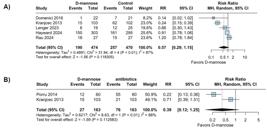
No difference was found comparing UTI recurrence between (A) D-mannose vs. control and (B) D-mannose vs. Antibiotics.

No difference was found between UTI recurrence and D-mannose vs. control in postmenopausal women.
Sensitivity Analysis
To assess the robustness of our findings, we conducted a leave-one-out sensitivity analysis for the main outcome of UTI recurrence. This analysis confirmed the consistency of the results, with no single study significantly altering the overall efficacy estimate (Figure 4).
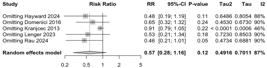
A Baujat plot identified the study by Kranjčec et al.12 as the largest contributor to the overall heterogeneity (Supplement Material Figure 1). Heterogeneity decreased from 87% to 46% when this study was excluded.
Quality Assessment
The risk of bias was assessed using the Risk of Bias 2 (RoB 2) tool6. No study was found to have a high risk of bias (Supplement Material Figure 2). Only Domenici et al.14 raised some concerns in the first domain regarding the randomization process, as Table 1 in their article does not present the baseline characteristics for each group, instead it presents the combined data of both groups14. Furthermore, there is no clear description of the allocation procedure. A funnel plot was also generated to assess potential publication bias and small study effects, which showed asymmetry (Supplement Material Figure 3).
Discussion
In this systematic review and meta-analysis of RCTs, we explored the efficacy of D-mannose for treating recurrent UTIs. Our analysis included six studies with a total of 1,167 participants, the majority of whom were women (1,144, 98%). Contrary to previous meta-analyses, we did not find any benefit in the use of D-mannose as prophylaxis for recurrent UTIs, whether compared with placebo or antibiotics15. No significant difference was found in the postmenopausal subgroup either. Our findings remained consistent in the leave-one-out sensitivity analyses.
D-mannose, an epimer of glucose, can be obtained from plants, fruits, and microorganisms using D-mannose isomerases4. It is theorized that D-mannose prevents bacterial adherence to uroepithelial cells4,16,17. Once ingested, it is rapidly absorbed and subsequently excreted in urine, reducing bacterial adhesion in the bladder4,16,17. By binding to bacteria, D-mannose prevents their attachment to uroepithelial cells, facilitating their elimination through urination4,16,17.
However, our analysis found no significant difference between D-mannose treatment and no treatment or placebo. Both Kranjčec and colleagues and Porru and colleagues reported a reduction in UTI recurrence in the intervention group12,13. Similarly, the previous meta-analysis also indicated a favorable outcome for the D-mannose group15. In contrast, Hayward et al.11, the largest trial comparing D-mannose with placebo, found no significant difference between D-mannose and control.
The main difference between these three studies is the mean age of participants and the sample size (Table 1)11–13. The two studies with positive outcomes had younger participants and smaller samples12,13. In addition, the follow-up time and D-mannose dosage were the same. In a sub-analysis by Hayward et al.11, premenopausal women treated with D-mannose had fewer recurrent UTIs, but no statistical test was conducted to confirm this finding. Future studies could explore the use of D-mannose in younger women.
It has been suggested that other non-antibiotic approaches may help prevent UTI recurrence18,19. Topical estrogen has been associated with reduced recurrence in postmenopausal women, while cranberry products have also shown potential in decreasing UTI recurrence18,19. However, these findings remain controversial by the existence of contrasting evidence20. As such, the most reliable approach to managing UTI recurrence remains the use of antibiotics21.
Our study has limitations. First, the number of available studies is limited, and they present substantial heterogeneity, contributing to overall heterogeneity in the meta-analysis. However, our findings remained consistent in the leave-one-out sensitivity analysis. Second, only one double-blind RCT was included in the analyis11. Third, few studies conducted subgroup analyses, such as for postmenopausal women, resulting in limited data to assess specific subgroups that might benefit from D-mannose treatment. Finally, we did not have access to individual patient data, which prevented us from conducting a more granular subanalysis according to age, comorbidities, or antibiotic use.
Conclusion
Our meta-analysis evaluating D-mannose for the prevention of recurrent UTI found no significant difference between the intervention and control groups. Further studies focusing on specific subgroups may help clarify the potential benefits of D-mannose, particularly with improved designs such as double-blinded randomized controlled trials.
Data Availability
Data are available within reasonable request.
Supplementary Material
The following online material is available for this article:
Table S1
Figure S1
Figura S2
Figure S3
References
-
1. Zeng Z, Zhan J, Zhang K, Chen H, Cheng S. Global, regional, and national burden of urinary tract infections from 1990 to 2019: an analysis of the global burden of disease study 2019. World J Urol. 2022;40(3):755–63. doi: http://doi.org/10.1007/s00345-021-03913-0. PubMed PMID: 35066637.
» https://doi.org/10.1007/s00345-021-03913-0 -
2. Aggarwal N, Leslie SW. Recurrent urinary tract infections [Internet]. Treasure Island: StatPearls Publishing; 2025 [cited 2025 Feb 27]. Available from: http://www.ncbi.nlm.nih.gov/books/NBK557479/
» http://www.ncbi.nlm.nih.gov/books/NBK557479/ -
3. Flower A, Bishop FL, Lewith G. How women manage recurrent urinary tract infections: an analysis of postings on a popular web forum. BMC Fam Pract. 2014;15(1):162. doi: http://doi.org/10.1186/1471-2296-15-162. PubMed PMID: 25260870.
» https://doi.org/10.1186/1471-2296-15-162 -
4. Hu X, Shi Y, Zhang P, Miao M, Zhang T, Jiang B. d-mannose: properties, production, and applications: an overview. Compr Rev Food Sci Food Saf. 2016;15(4):773–85. doi: http://doi.org/10.1111/1541-4337.12211. PubMed PMID: 33401842.
» https://doi.org/10.1111/1541-4337.12211 -
5. Page MJ, McKenzie JE, Bossuyt PM, Boutron I, Hoffmann TC, Mulrow CD, et al. The PRISMA 2020 statement: an updated guideline for reporting systematic reviews. BMJ. 2021;372:n71. doi: http://doi.org/10.1136/bmj.n71. PubMed PMID: 33782057.
» https://doi.org/10.1136/bmj.n71 -
6. Cumpston M, Li T, Page MJ, Chandler J, Welch VA, Higgins JP, et al. Updated guidance for trusted systematic reviews: a new edition of the Cochrane Handbook for Systematic Reviews of Interventions. Cochrane Database Syst Rev. 2019;10(10):ED000142. doi: http://doi.org/10.1002/14651858.ED000142. PubMed PMID: 31643080.
» https://doi.org/10.1002/14651858.ED000142 -
7. Foster ED, Deardorff A. Open Science Framework (OSF). J Med Libr Assoc. 2017;105(2):203–6. doi: http://doi.org/10.5195/jmla.2017.88.
» https://doi.org/10.5195/jmla.2017.88 -
8. Balduzzi S, Rücker G, Schwarzer G. How to perform a meta-analysis with R: a practical tutorial. Evid Based Ment Health. 2019;22(4):153–60. doi: http://doi.org/10.1136/ebmental-2019-300117. PubMed PMID: 31563865.
» https://doi.org/10.1136/ebmental-2019-300117 -
9. Rau M, Santelli A, Martí S, Díaz MI, Sabé N, Fiol M, et al. Randomized clinical trial of non-antibiotic prophylaxis with d-Mannose plus Proanthocyanidins vs. Proanthocyanidins alone for urinary tract infections and asymptomatic bacteriuria in de novo kidney transplant recipients: the Manotras study. Nefrologia. 2024;44(3):408–16. doi: http://doi.org/10.1016/j.nefroe.2024.02.011. PubMed PMID: 38637262.
» https://doi.org/10.1016/j.nefroe.2024.02.011 - 10. Lenger SM, Chu CM, Ghetti C, Durkin MJ, Jennings Z, Wan F, et al. d-Mannose for recurrent urinary tract infection prevention in postmenopausal women using vaginal estrogen: a randomized controlled trial. Urogynecology. 2023;29(3):367–77. PubMed PMID: 36808931.
-
11. Hayward G, Mort S, Hay AD, Moore M, Thomas NPB, Cook J, et al. d-mannose for prevention of recurrent urinary tract infection among women: a randomized clinical trial. JAMA Intern Med. 2024;184(6):619–28. doi: http://doi.org/10.1001/jamainternmed.2024.0264. PubMed PMID: 38587819.
» https://doi.org/10.1001/jamainternmed.2024.0264 -
12. Kranjčec B, Papeš D, Altarac S. D-mannose powder for prophylaxis of recurrent urinary tract infections in women: a randomized clinical trial. World J Urol. 2014;32(1):79–84. doi: http://doi.org/10.1007/s00345-013-1091-6. PubMed PMID: 23633128.
» https://doi.org/10.1007/s00345-013-1091-6 -
13. Porru D, Parmigiani A, Tinelli C, Barletta D, Choussos D, Di Franco C, et al. Oral D-mannose in recurrent urinary tract infections in women: a pilot study. J Clin Urol. 2014;7(3):208–13. doi: http://doi.org/10.1177/2051415813518332.
» https://doi.org/10.1177/2051415813518332 - 14. Domenici L, Monti M, Bracchi C, Giorgini M, Colagiovanni V, Muzii L, et al. D-mannose: a promising support for acute urinary tract infections in women: a pilot study. Eur Rev Med Pharmacol Sci. 2016;20(13):2920–5. PubMed PMID: 27424995.
-
15. Lenger SM, Bradley MS, Thomas DA, Bertolet MH, Lowder JL, Sutcliffe S. D-mannose vs other agents for recurrent urinary tract infection prevention in adult women: a systematic review and meta-analysis. Am J Obstet Gynecol. 2020;223(2):265.e1-13. doi: http://doi.org/10.1016/j.ajog.2020.05.048. PubMed PMID: 32497610.
» https://doi.org/10.1016/j.ajog.2020.05.048 -
16. Wagenlehner F, Lorenz H, Ewald O, Gerke P. Why d-mannose may be as efficient as antibiotics in the treatment of acute uncomplicated lower urinary tract infections: preliminary considerations and conclusions from a non-interventional study. Antibiotics. 2022;11(3):314. doi: http://doi.org/10.3390/antibiotics11030314. PubMed PMID: 35326777.
» https://doi.org/10.3390/antibiotics11030314 - 17. Cooper TE, Teng C, Howell M, Teixeira-Pinto A, Jaure A, Wong G. D‐mannose for preventing and treating urinary tract infections. Cochrane Database Syst Rev. 2022;8(8):CD013608. PubMed PMID: 36041061.
-
18. Raz R, Stamm WE. A controlled trial of intravaginal estriol in postmenopausal women with recurrent urinary tract infections. N Engl J Med. 1993;329(11):753–6. doi: http://doi.org/10.1056/NEJM199309093291102. PubMed PMID: 8350884.
» https://doi.org/10.1056/NEJM199309093291102 -
19. Kontiokari T, Sundqvist K, Nuutinen M, Pokka T, Koskela M, Uhari M. Randomised trial of cranberry-lingonberry juice and Lactobacillus GG drink for the prevention of urinary tract infections in women. BMJ. 2001;322(7302):1571. doi: http://doi.org/10.1136/bmj.322.7302.1571. PubMed PMID: 11431298.
» https://doi.org/10.1136/bmj.322.7302.1571 - 20. Jepson RG, Williams G, Craig JC. Cranberries for preventing urinary tract infections. Cochrane Database Syst Rev. 2012;10(10):CD001321. PubMed PMID: 23076891.
-
21. Albert X, Huertas I, Pereiró II, Sanfélix J, Gosalbes V, Perrotta C. Antibiotics for preventing recurrent urinary tract infection in non-pregnant women. Cochrane Database Syst Rev. 2004;2004(3):CD001209. doi: http://doi.org/10.1002/14651858.CD001209.pub2. PubMed PMID: 15266443.
» https://doi.org/10.1002/14651858.CD001209.pub2
Edited by
-
Editorial Responsibility
Editor-in-chief: Miguel C. Riella https://orcid.org/0000-0003-4181-613X.


