Mortality rates among hospitalized individuals with autism spectrum disorder over a 10-year period in the 100 Million Brazilian Cohort
ABSTRACT
Introduction: This study aims to investigate the main causes of mortality among individuals hospitalized with Autism Spectrum Disorder (ASD) and to estimate the association between ASD hospitalization and mortality rates over a 10-year period (2008–2018).
Method: This is a population-based cohort study using linked administrative health data and social assistance system (CadÚnico) records from the 100 Million Brazilian Cohort. The study included 948 individuals hospitalized with an ASD diagnosis and 99,904 non-hospitalized individuals. Cox proportional hazards regression was estimated using propensity scores to allow balanced comparisons between groups (ASD / non-ASD).
Results: Individuals hospitalized with ASD died more frequently from respiratory (24%) and neurological (20%) diseases, whereas non-hospitalized individuals died more from circulatory diseases (27.8%) and neoplasms (17.1%). Hospitalized individuals with ASD had an overall higher risk of death (HR = 1.78, 95%CI = 1.20–2.66, p = 0.005), particularly females (HR = 3.48, 95%CI = 1.95–6.19, p < 0.001), those aged 11–24 years (HR = 3.20, 95%CI = 1.45–7.06, p = 0.004), and those without comorbidities (HR = 2.27, 95%CI = 1.48–3.48, p < 0.001).
Conclusion: These findings reflect poor healthcare quality, indicating a gap in care for individuals with ASD, particularly those living in socially vulnerable contexts.
KEYWORDS
Autism; hospitalization; mortality; public health; cohort
RESUMO
Introdução: Este estudo tem como objetivo investigar as principais causas de mortalidade entre indivíduos hospitalizados com Transtorno do Espectro Autista (TEA) e estimar a associação entre hospitalização por TEA e taxas de mortalidade ao longo de um período de 10 anos (2008 a 2018).
Método: Este é um estudo de coorte de base populacional com dados administrativos de saúde e do sistema de assistência social CadÚnico, vinculados à Coorte de 100 Milhões de Brasileiros. Participaram do estudo 948 indivíduos hospitalizados com diagnóstico de TEA e 99,904 indivíduos não hospitalizados. A regressão de riscos proporcionais de Cox foi estimada utilizando escores de propensão para permitir comparações balanceadas entre os grupos (TEA / sem TEA).
Resultados: Identificou-se que indivíduos hospitalizados com TEA morreram mais frequentemente por doenças dos sistemas respiratório (24%) e neurológico (20%), enquanto os não hospitalizados morreram mais por doenças circulatórias (27,8%) e neoplasias (17,1%). Hospitalizados com TEA apresentaram maior risco de óbito de forma geral (HR = 1,78, IC95% = 1,20-2,66, p = 0,005), especialmente mulheres (HR = 3,48, IC95% = 1,95-6,19, p < 0,001), indivíduos entre 11 e 24 anos (HR = 3,20, IC95% = 1,45-7,06, p = 0,004) e sem comorbidades (HR = 2,27, IC95% = 1,48-3,48, p < 0,001).
Conclusão: Esses achados refletem baixa qualidade da assistência à saúde, indicando uma lacuna no cuidado a indivíduos com TEA, especialmente os que vivem em contexto de vulnerabilidade social.
PALAVRAS-CHAVE
Autismo; hospitalização; mortalidade; saúde pública; coorte
INTRODUCTION
Autism Spectrum Disorders (ASD) is a neurodevelopmental disorder that is related with problems in social communication and interaction. People with ASD have restrictive and repetitive behaviors or interests, as well as delays in multiple language and communication skills. Although individuals without ASD can have some of these symptoms, individuals with ASD usually have greater impact in learning and social skills, as well as a high prevalence of psychiatric comorbidities1. Most people are commonly diagnosed between 18 and 24 months when the first symptoms can be identified, such as language development delay and impaired social skills1.
The worldwide prevalence of ASD is difficult to estimate because of the differences in methodological and contextual factors among studies2. However, it is estimated that about 1 in 100 children live with ASD3. In addition, longitudinal studies have shown an increase in the prevalence of ASD over the past years, especially in the Americas4. A meta-analysis identified a global prevalence of ASD of 0.6%, while in the Americas, this prevalence was 1%4. Changes in environmental risk factors and health disparities are some possible explanations for the increase in ASD prevalence in recent years2 together with advancements in diagnostic tools, greater awareness of ASD, improved screening programs, and revisions in diagnostic criteria4.
ASD is four times more common in males than in females4. This has been associated with genetic and phenotypic differences5, as well as environmental exposures such as problems during pregnancy, preterm birth, and those associated with brain development 5,6. Additionally, recent studies found that the prevalence of ASD has caught up among races and ethnic minorities such as Black, Hispanic and Asian, people who were initially underdiagnosed1. Although the prevalence of ASD is higher among children, the population of adults with ASD is growing worldwide7.
When compared with the general population, individuals with ASD have an increased risk of health and psychiatric disorders5. Moreover, individuals with ASD have more chances to have emergency department visits because of respiratory infection, viral infection, epilepsy, and psychiatric conditions8. Several factors explain why individuals with ASD have more hospital admissions, including fewer psychiatric consultations and primary care visits, which reveal gaps in their lifelong care9. Another reason associated with hospitalization is the presence of comorbidities10,11. However, identifying comorbidities is further complicated due to problems in communication, ambiguity in endorsing symptoms, and clinical course of the condition8. In addition, individuals with ASD are more likely to receive inadequate treatment due to insufficient specific staff training in ASD, improper medication prescription, and low access to healthcare, contributing to a higher risk of premature mortality12, 13, that is greater in ethnic minorities14.
A systematic literature review and meta-analysis found that individuals with ASD have higher mortality rates when compared to the general population15. Another study conducted using the National Health Insurance Service database of Korea, showed a 2.34 times higher risk of all-cause mortality in children with ASD compared to non-autistic individuals16. However, research using the national birth cohort in Finland found that premature deaths were higher only due natural causes of death17.
Higher mortality rates among individuals with ASD have been associated with risk factors such as low-income, residing in remote areas, older age, and being female12, 16. Mental disorders and medical comorbidities were also associated with premature death among individuals with ASD12.
Because of the complexity of this condition, individuals with ASD usually need special support in health services such as outpatient and inpatient health care and other kinds of hospital-based service18. The economic burden associated with the care of people in the autism spectrum is a challenge, especially for Low- and Middle-Income Countries (LMIC), because it requires specialized personnel and training that incur higher costs for commonly underfunded health systems. This is worse for countries where the provision of health services is not large enough to cover the target population19.
In the Brazilian universal health system, ASD health care has been carried out in the Psychosocial Care Network composed by Psychosocial Care Centers, primary care, general hospitals, Specialized Rehabilitation Centers, which are integrated into the Care Network for Persons with Disabilities19. Although this network has been implemented for approximately 20 years, there is an insufficient supply of these services, making general hospitals a common last resource.
Given the rising prevalence of ASD in the Americas and the challenges associated with its treatment, a comprehensive population-based analysis of hospital admissions and a thorough investigation of comorbidities over an extended period among individuals with ASD in general hospitals are essential. This study aimed to investigate individuals hospitalized with ASD using a population representative dataset (the 100 Million Brazilian Cohort), assessing mortality rates over a 10-year period as well as to describe the association between ASD hospitalization and mortality rates.
METHOD
Study design, setting and data source
This is a population-based cohort study based on data from the baseline of the 100 million Brazilian cohort20. This is a dynamic cohort composed by individuals who applied for benefits in the Brazilian Government Unified Register for Social Program (CadÚnico) during the period of 2001 and 201820. In order to apply for CadUnico, people are required to have an income of up to half of the minimum wage per capita (approximately $125 US in 2020) or a total family income of up to 3 times the minimum wage (approximately $750 US)21. The CadÚnico includes approximately 55% of the total Brazilian low-income population21.
In this study, the baseline of the cohort was linked to other Brazilian health administrative datasets: the Hospitalization Information System (HIS) and Mortality Information System (MIS)20, 22. Brazil has one of the world's largest and most complex public health systems, offering free, universal access to care from primary to tertiary levels, including hospital services23. While a private system exists, over 70% of the population, especially the poorest, depend on the public system23. HIS covers public hospitalization in the Brazilian national system24. MIS is a recognized high-quality system that registers deaths by all causes25. Both systems use standardized forms filled out by healthcare professionals, which include the reason for hospital admission and death and uses the International Classification of Diseases 10th version (ICD-10)26.
The datasets were linked in two steps using the CIDACS-RL, a linkage tool developed by CIDACS to link administrative health and social programs datasets. Initially, death records were connected through exact matches; afterwards, any remaining unmatched records were linked using a similarity-based scoring method. For this purpose, five attributes were used: name, mother's name, date of birth, gender, and municipality of residence19, 27. Previous studies identified high sensitivity and specificity27. Studies on the linkage process have been previously published which identified high sensitivity and specificity19, 27. This study was approved by the ethics committees of the Gonçalo Muniz Institute at the Oswaldo Cruz Foundation (registration number: 7.517.745).
Population
The study population was composed of individuals hospitalized with ASD and a comparation group of individuals without ASD, both registered in the baseline of the 100 million Brazilian Cohort. We identified all individuals hospitalized with ASD based on the HIS records from 2008 to 2018, given hospitalization information was only available from 2008 onwards in the 100 million Brazilian cohort. In this study, we considered an individual with ASD when hospital admissions were registered with ICD-10 codes F84.0 (autistic disorder), F84.1 (atypical autism), F84.5 (Asperger's syndrome). F84.8 (other pervasive developmental disorders), and F84.9 (pervasive developmental disorder unspecified) as a proxy of ASD (DSM-V). The secondary diagnosis was also included in the analyses, since ASD is common among individuals admitted with other primary diagnoses28; however, this represented only 1.05% of the total admissions. The comparison group without ASD consisted of a random subsample of individuals enrolled in the baseline of the 100 million Brazilian Cohort in the same period.
MEASURES
Outcome variables
Mortality was included in MIS. We considered overall causes of death registered at MIS according to ICD-1026.
Covariates
All covariates were selected based on what was previously found to be associated to mortality2,11, 29. We included sociodemographic and socioeconomic covariates at the baseline of the cohort: sex, age, race, location of residence (rural or urban), living conditions (availability of water supply, waste management, sanitation, and type of construction materials), region of residence in Brazil, year of CadÚnico registration and comorbidity hospitalization registered according to ICD-10. We defined comorbidity hospitalization as any physical or psychiatric condition recorded in the HIS as either a primary or secondary diagnosis according to ICD-10.
Statistical analysis
First, we ran descriptive analysis overall and comparing the groups by ASD hospitalization status. We calculated propensity scores (PS) to make the groups comparable. We estimated the propensity score using a multivariable logistic regression adjusted for socioeconomic and sociodemographic covariates associated with ASD (sex, age, race, location of residence, household characteristics, Brazilian regions of residence, year of CadÚnico registration and comorbidity hospitalization)30,31. A descriptive analysis using the chi-square test of homogeneity was also conducted (table 1 in Supplement 1).
Second, we estimated the Inverse Probability of Treatment Weighting (IPTW) using PS weights to balance differences among covariates in the ASD and non-ASD groups. Individuals hospitalized with ASD were given weights equal to the inverse of their propensity scores (1/PS), whereas those who were not hospitalized with ASD were given weights equal to the inverse of one minus their propensity scores [PS/(1 – PS)].
Third, proportion differences were estimated before and after IPTW estimation, and absolute values higher than 0.1 indicated imbalance in the distribution of covariates between ASD and Non-ASD groups.
Fourth, we also estimated the mortality rates and stratified by sex, age group and comorbidity hospitalization. Person-year was calculated by subtracting the registration date at CadÚnico from the follow-up. The follow-up started from the date of CadÚnico registration and ending on the earliest of the following: the date of death or December 31st, 2018, when the study ended.
Fifth, for the construction of the final model, we started comparing individuals with and without ASD using a bivariate analysis employing the chi-square test to assess potential differences in the distribution of categorical variables, adopting a significance level of p < 0.05 (table 1 in Supplement 1). Subsequently, an exploratory analysis was performed to identify potential confounding covariates and effect modifiers. A covariate was classified as an effect modifier when the strata-specific estimates of association demonstrated statistically significant heterogeneity, as determined by the Mantel–Haenszel homogeneity test32. Confounding covariates were defined as those that influenced the relationship between the outcome and the exposure, as indicated in the literature2,11, 29.
The main association was then evaluated using HRs estimated through a Cox proportional hazards regression model, adjusted for the IPTW. Statistical inference was based on 95% confidence intervals and an alpha level of 0.05. The final selection of covariates was informed by both the literature, and the chi-square test results, with variables retained on the basis of theoretical relevance2,11, 29. Model specification followed a backward elimination approach, beginning with a saturated model including all covariates, and sequentially removing variables to assess their potential confounding and effect-modifying roles32. We also applied the scaled Schoenfeld residuals test to check the proportional hazards assumptions (table 2 in Supplement 1), assessing whether residuals were correlated with time; significant correlations indicate potential violations of the assumptions33.
As an exploratory approach, subgroup analyses were performed by sex, age group and comorbidity hospitalization as an attempt to check stability of the results (table 3 in Supplement 1). Finally, we repeated the analysis using Poisson regression as well as kernel matching approach to check the robustness of the method. We used Stata 15.0 for the analysis.
RESULTS
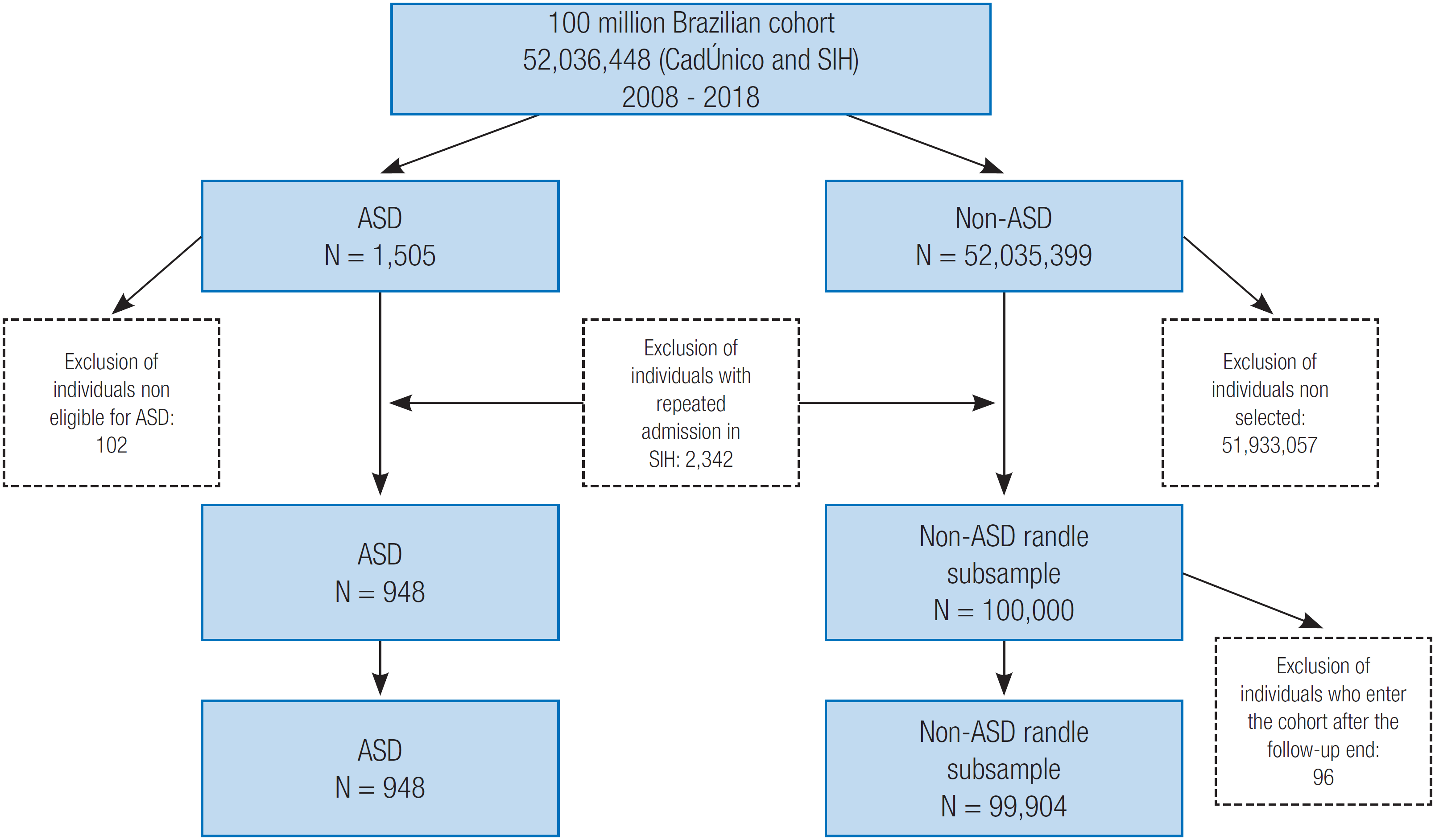
We identified 948 individuals hospitalized with ASD and 99,904 without ASD who were registered at the baseline of the cohort between 2008 and 2018 (Figure 1). Most of individuals with ASD were hospitalized due to childhood autism (64.66%) and atypical autism (19.09%) subtypes (supplement 1). After IPTW, ASD and Non-ASD groups had similar sociodemographic and socioeconomic characteristics. The majority were male (73%), with ages ranging from 11 to 24 years old (40%), were white (62%), lived in an urban area (93%), in the Southeast of Brazilian region (65%) and had good living conditions. Most of them were registered at CadÚnico in 2012 (20%) and did not have comorbidity hospitalization (8%) (Table 1).
Description of individuals with and without autism spectrum disorder before and after IPTW, 2008-2018.
Diseases of the digestive system (K00-K95) (5.49%) and psychiatric disorders (F01-F99) (1.27%) were the most common comorbidities in the ASD group, whereas external causes and suicide (V01-Y98) (3.16%) and circulatory system diseases (I00-I99) (0.69%) were most frequent in the non-ASD group.
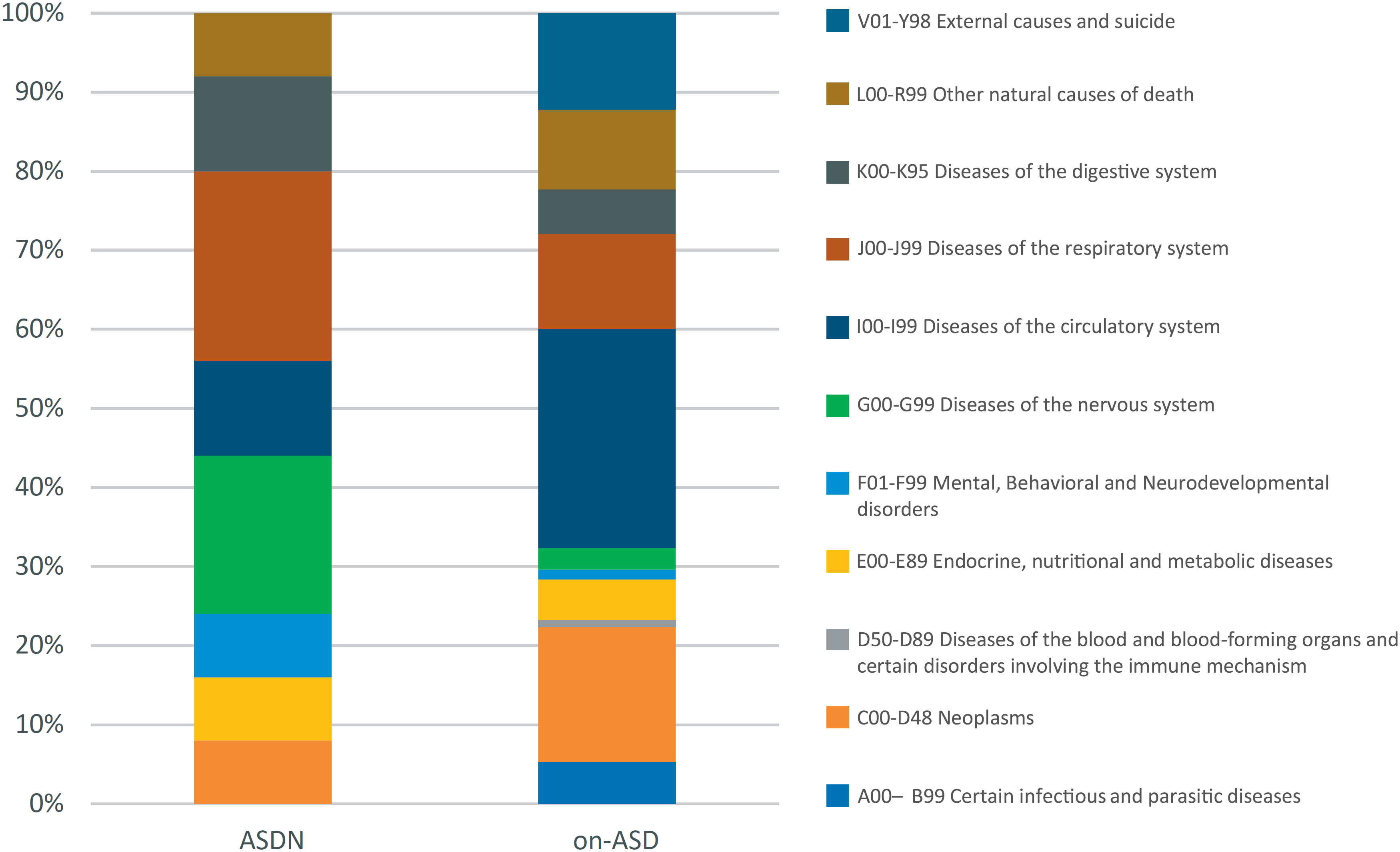
Regarding mortality, 2,064 individuals (387.30, 95% CI = 370.94-404.37) died over the study period (Table 2). Among individuals hospitalized with ASD, the most frequent causes of death were diseases of the respiratory system (J00-J99) (24%) and the nervous system (G00-G99) (20%), whereas among those without ASD, the leading causes were diseases of the circulatory system (I00-I99) (27.8%) and neoplasms (C00-D48) (17.1%) (Figure 2).
Mortality rates among people with and without autism spectrum disorder overall and by sex, age group and comorbidity, 2008-2018.
Although only 25 individuals hospitalized with ASD died over the period, the mortality rate was higher (556.56, 95%CI= 376.08-823.67) compared to the group without ASD (385.86, 95%CI=369.47-402.98). When stratified the analysis, we observed higher rates among females ASD group (982.68, 95%CI=558.07-1730.35), older ASD group, especially aging up to 25 years old (2053.38, 95%CI= 1216.12-3467.06) and comorbidity non-ASD group (1796.03, 95%CI= 1641.41-1965.22) (Table 2).
We observed a relationship among ASD hospitalization and increased mortality rate (HR= 1.78, 95%CI= 1.20-2.66, p=0.005, Table 3), especially for females (HR= 3.48, 95%CI= 1.95-6.19, p<0.001), individuals aging 11 to 24 years old (HR= 3.20, 95%CI= 1.45-7.06, p=0.004) as well as with no comorbidity hospitalization (HR=2.27, 95%CI= 1.48-3.48, p<0.001, Table 4).
Relationship of Autism Spectrum Disorder hospitalization and mortality rate by subgroups (sex, age and comorbidities), 2008-2018.
DISCUSSION
Using data on individuals hospitalized with ASD compared to individuals without ASD from the 100 million Brazilian Cohort, we investigated their sociodemographic and socioeconomic characteristics, estimated the incidence rates of mortality as well as the relationship between mortality and ASD hospitalization. We found that females and individuals aging between 11 and 24 years old hospitalized with ASD over the period had higher mortality rate. Furthermore, mortality in ASD group was almost two times higher than non-ASD group, especially among females, individuals aging 11 and 24 years old and with no comorbidity hospitalization.
Consistent with previous studies, ASD hospitalization increased almost two times mortality risk5, 34. Previous studies also related ASD to increase health service use and higher rates of admission to hospital and emergency department appointments35. People with ASD also had longer hospital stays, and higher number of medications used when compared to non-autistic children36.
The main causes of death are consistent with previous studies that reported an association between ASD and neurological conditions as well as with respiratory system diseases15. Past studies have reported the high prevalence of neurological conditions, especially epilepsy among individuals with ASD12. Regarding respiratory system diseases, disparity related to healthcare access, including vaccination may increase the severity of this condition35. Furthermore, individuals with ASD commonly lived in congregate settings which increase respiratory infections exposition37.
The subgroup analysis, although exploratory considering the low number of deaths, was consistent with findings reported in the literature1238. We observed a relationship among ASD hospitalization and increased mortality rate especially among females (HR= 3.48, 95%CI= 1.95-6.19, p<0.001). This is consistent with previous research that found higher mortality rates among females related to the higher incidence of comorbidities explained by the higher risk of genetic syndromes in females diagnosed with ASD12,38. Furthermore, female individuals with ASD showed more neurological abnormalities and lower intellectual and adaptive functioning than males38. Females with a diagnosis of ASD, particularly at a younger age, have a higher risk of having other genetic syndromes that incur in health problems39.
Additionally, the association was stronger for individuals with ASD aged 11 to 24 years old which was consistent with a population-based cohort study in Taiwan using health administrative database38. This finding was explained by the higher prevalence of comorbidities in adults with ASD as well as due to the absence of a caregiver to assist with the communication difficulties common among individuals with ASD. These communication challenges can further hinder access to healthcare, leading to increased mortality38.
Unexpectedly, absence of hospitalization due to comorbidities was associated with increased mortality rates among ASD group. These results might be explained by (1) the non-ASD group not having similar communication difficulties as individuals with ASD, which may lead them to seek healthcare more often and have more records of hospitalization due to comorbidities and death; (2) in the ASD group, hospitalizations due to comorbidities were mostly recorded as secondary diagnoses, and since this information is not mandatory in the HIS, it may reflect poor data entry; (3) the presence of comorbidities in the ASD group might lead to increased healthcare utilization, which could have contributed to a reduced risk of mortality when compared to those who were not hospitalized with comorbidity (4) Those hospitalized with a diagnosis of ASD only may have been admitted to a psychiatric bed in a general hospital for the acute management of behavioral problems, such as symptoms of self-aggression or aggression. Therefore, they may represent more severe cases that were diagnosed later or did not have access to treatment when they were younger. This social vulnerability could explain the higher mortality rate.
The first cause of comorbidity hospitalization among ASD group was Gastrointestinal (GI) problems. This is consistent with previous reports40-42. Autistic children are reported to have more chronic diarrhea, constipation, gastroesophageal reflux among other symptoms compared to non-autistic children40.
The second cause was psychiatric disorder hospitalization. Hossain et al.43 reported a prevalence of a psychiatric disorder of 57% for people in the autism spectrum. Psychiatric hospitalizations are also more frequent among children with ASD compared to non-ASD children36, 43, 44. Psychiatric hospitalizations were mainly due to intellectual disability (ID). These findings are similar to previous studies that found high psychiatric hospital admissions, especially for younger females44.
The finding that people with ASD that lived in urban areas, had good living conditions and dwelled in the Southeast region were overrepresented in this sample shows the unbalanced accessibility to health services in the Brazilian territory. The public health system in Brazil is available in all regions but larger cities and capitals, especially those located in the South and Southeast regions, have a higher concentration of specialized services and hospitals equipped to treat people with disabilities including ASD45.
The inclusion of people with disabilities in the healthcare system is a challenge faced by most countries. The higher prevalence of people diagnosed with ASD driven by the access to diagnosis and resources have increased the representation of people in the autistic spectrum in the Brazilian public health system19. Specialized care and resources are still not available or are insufficient to the increasing demand45, 46, resulting in higher comorbidities and hospital admissions.
This study is the first, to our knowledge, to characterize the hospitalization profile of the Brazilian ASD population. It is also important to acknowledge that this study is one of a few to only include individuals hospitalized with ASD that are registered in the CadÚnico, the main system to apply for social benefit such as the cash transfer Bolsa Família Program, and therefore represents the lowest income group of the Brazilian population. However, the results should be interpreted in the face of some limitations. The 100 million Brazilian cohort is a large cohort obtained through the linkage of the public health hospitalization dataset (HIS) and the CadÚnico therefore does not represent the entire Brazilian population. Furthermore, because our study relied on secondary data, our sample was limited to individuals with ASD who were hospitalized. Those who sought care exclusively in other healthcare settings were not captured, which may restrict the generalizability of our findings.
Additionally, although the majority of the Brazilian population (about 70%) uses the public health system, part of the population has health insurance and use private hospitals23. This population is not included in this study. Due to sample size constraints, it was not possible to examine other comorbidities and causes of death, however future studies with larger samples may provide a better opportunity to explore that. In this analysis only 25 deaths were recorded, which was expected given the rare outcome. The small number also resulted in wide confidence intervals and lower precision in the estimation. Given the few outcome occurrences, the confidence intervals were relatively wide, suggesting lower precision. Therefore, interpretation of the point-estimates must be cautious, given it is relatively imprecise. Furthermore, it is not possible to ensure that individuals in the non-hospitalized group do not have a clinical diagnosis of autism, given that our data sources are limited to hospital records. In addition, there may be issues with diagnostic misclassification related to clinicians failing to identify the signs/symptoms of the correct condition or in converting the physician's diagnosis into ICD-10 codes47. Although sociodemographic covariates were accounted for, the potential influence of unmeasured confounders should be acknowledged, particularly those associated with symptom severity26 and medication use48.
CONCLUSIONS
This population-based cohort study provides information on individuals who lived in poverty and were hospitalized with ASD. These individuals are more likely to died when compared to general population, especially female and young people. Information on mortality rates on a large dataset is paramount for policymakers and social organizations (parents, non-governmental organizations) to identify patterns of access to treatment in a universal health system and its disparities. The poor access to early diagnosis and treatment relates to hospital use among people with ASD. High incidence of hospitalizations for gastrointestinal related problems indicates the need for more preventive measures in primary care focused on those diseases. Allocation of resources aimed at training health professionals in primary care to identify comorbidities earlier may avoid the need for hospitalization and decrease costs for the public health system. Unequal distribution of specialized care impacts access to diagnosis and consequently increases comorbidity.
ACKNOWLEDGEMENTS
We thank the data production team and all CIDACS/FIOCRUZ collaborators for their work on building the 100 Million Brazilian Cohort.
Data availability statement
The data that support this study are available from the authors upon request.
REFERENCES
- 1 Centers for Disease Control and Prevention (CDC). Prevalence and early identification of autism spectrum disorder among children aged 4 and 8 years — Autism and Developmental Disabilities Monitoring Network, 16 sites, United States, 2022. MMWR Surveill Summ. 2025 Jan 10;74(2):1-22.
-
2 Zeidan J, Fombonne E, Scorah J, Ibrahim A, Durkin MS, Saxena S, Yusuf A, Shih A, Elsabbagh M. Global prevalence of autism: A systematic review update. Autism Res. 2022 May;15(5):778-790. Available from: 10.1002/aur.2696
» https://doi.org/10.1002/aur.2696 -
3 World Health Organization (WHO) Autism Report 2023. WHO. Available from: https://www.who.int/news-room/fact-sheets/detail/autism-spectrum-disorders
» https://www.who.int/news-room/fact-sheets/detail/autism-spectrum-disorders - 4 Salari N, Rasoulpoor S, Rasoulpoor S, Shohaimi S, Jafarpour S, Abdoli N, Khaledi-Paveh B, Mohammadi M. The global prevalence of autism spectrum disorder: a comprehensive systematic review and meta-analysis. Ital J Pediatr. 2022 Jul 8;48(1):112.
- 5 Khachadourian V, Mahjani B, Sandin S, Kolevzon A, Buxbaum JD, Reichenberg A, Janecka M. Comorbidities in autism spectrum disorder and their etiologies. Transl Psychiatry. 2023;13:1-7.
- 6 Napolitano A, Schiavi S, La Rosa P, Rossi-Espagnet MC, Petrillo S, Bottino F, Tagliente E, Longo D, Lupi E, Casula L, Valeri G, Piemonte F, Trezza V, Vicari S. Sex differences in autism spectrum disorder: diagnostic, neurobiological, and behavioral features. Front Psychiatry. 2022;13:889636.
-
7 Autism Speaks. Autism by the numbers 2023: inaugural annual report. Autism Speaks. Available from: https://www.autismspeaks.org/sites/default/files/ABN_Annual_Report_2023.pdf
» https://www.autismspeaks.org/sites/default/files/ABN_Annual_Report_2023.pdf - 8 Al-Beltagi M. Autism medical comorbidities. World J Clin Pediatr. 2021 May 9;10(3):15-28.
- 9 Neuhaus E, Osuna A, Tagavi DM, Shah-Hosseini S, Simmons S, Gerdts J, Thompson AD. Clinical Characteristics of Youth with Autism or Developmental Disability during Inpatient Psychiatric Admission. J Clin Med. 2022 Oct 27;11(21):6328.
- 10 Kalb LG, Stuart EA, Vasa RA. Characteristics of psychiatric emergency department use among privately insured adolescents with autism spectrum disorder. Autism. 2019 Mar;23(3):566-573.
- 11 McMaughan DJD, Imanpour S, Mulcahy A, Jones J, Criss MM. Mental health-related hospitalizations among adolescents and emerging adults with autism in the United States: A retrospective, cross-sectional analysis of national hospital discharge data. Autism. 2023 Jun;27(6):1702-1715.
- 12 Hwang YIJ, Srasuebkul P, Foley KR, Arnold S, Trollor JN. Mortality and cause of death of Australians on the autism spectrum. Autism Res. 2019 May;12(5):806-815.
- 13 Lunsky Y, Lai MC, Balogh R, Chung H, Durbin A, Jachyra P, Tint A, Weiss J, Lin E. Premature mortality in a population-based cohort of autistic adults in Canada. Autism Res. 2022 Aug;15(8):1550-1559.
- 14 Benevides TW, Jaremski JE, Williams ED, Song W, Pham HH, Shea L. Racial and Ethnic Disparities in Community Mental Health Use Among Autistic Adolescents and Young Adults. J Adolesc Health. 2024 Jun;74(6):1208-1216.
- 15 Catalá-López F, Hutton B, Page MJ, Driver JA, Ridao M, Alonso-Arroyo A, Valencia A, Macías Saint-Gerons D, Tabarés-Seisdedos R. Mortality in persons with autism spectrum disorder or attention-deficit/hyperactivity disorder: A systematic review and meta-analysis. JAMA Pediatr. 2022 Apr;176(4):e216401.
- 16 Yoo SM, Kim KN, Kang S, Kim HJ, Yun J, Lee JY. Prevalence and premature mortality statistics of autism spectrum disorder among children in Korea: A nationwide population-based birth cohort study. J Korean Med Sci. 2022 Jan;37(1):e1.
- 17 Jokiranta-Olkoniemi E, Gyllenberg D, Sucksdorff D, Suominen A, Kronström K, Chudal R, Sourander A. Risk for Premature Mortality and Intentional Self-harm in Autism Spectrum Disorders. J Autism Dev Disord. 2021 Sep;51(9):3098-3108.
- 18 Höfer J, Hoffmann F, Dörks M, Kamp-Becker I, Küpper C, Poustka L, et al. Health Services Use and Costs in Individuals with Autism Spectrum Disorder in Germany: Results from a Survey in ASD Outpatient Clinics. European Psychiatry. Cambridge University Press; 2022;65(S1):S422-S422.
- 19 Girianelli VF, Tomazelli J, Silva CMFP, Fernandes CS. Early diagnosis of autism and other developmental disorders, Brazil, 2013-2019. Rev Saúde Pública 2023; 57:21.
- 20 Barreto ML, Ichiara MY, Almeida BA, Barreto ME, Cabral L, Fiaccone RL, et al. The Centre for Data and Knowledge Integration for Health (CIDACS): Linking Health and Social Data in Brazil. IJPDS.2019; 4(2): 1-11.
- 21 Barreto ML, Ichiara MY, Pescarini JM, Ali MS, Borges GL, Fiaccone RL, et al. Cohort Profile: The 100 Million Brazilian Cohort. Int J Epidemiol. 2022; 51(2): e27-e38.
-
22 Machado DB, Azevedo JPA, Alves FJO, Castro-de-Araujo LFS, Silva ER, Fialho EMX, et al. The impact of social drivers, conditional cash transfers and their mechanisms on the mental health of the young; an integrated retrospective and forecasting approach using the 100 million Brazilian Cohort: A study protocol. PLoS One.2022; 17(10): e0272481. https://pubmed.ncbi.nlm.nih.gov/36201469/ [accessed: 02/02/2023]
» https://pubmed.ncbi.nlm.nih.gov/36201469/ - 23 Instituto Brasileiro de Geografia e Estatística (IBGE). Pesquisa nacional de saúde: 2019: informações sobre domicílios, acesso e utilização dos serviços de saúde: Brasil, grandes regiões e unidades da federação. Rio de Janeiro: IBGE; 2020.
-
24 Cerqueira DRC, Alves PP, Coelho DCS, Reis MVM, Lima AS. Uma análise da base de dados do Sistema de Informação Hospitalar entre 2001 e 2018: dicionário dinâmico, disponibilidade dos dados e aspectos metodológicos para a produção de indicadores sobre violência. Rio de Janeiro; IPEA, 2019. https://repositorio.ipea.gov.br/handle/11058/9409 [accessed: 20/09/2023]
» https://repositorio.ipea.gov.br/handle/11058/9409 -
25 World Health Organization (WHO). WHO methods and data sources for country-level causes of death 2000-2019. Geneva: WHO; 2020. Available at: https://platform.who.int/mortality/about/data-quality
» https://platform.who.int/mortality/about/data-quality - 26 World Health Organization (WHO) ICD-10: international statistical classification of diseases and related health problems: tenth revision.2nd ed. Geneva: World Health Organization; 2004.
- 27 Barbosa GCG, Ali MS, Araujo B, Reis S, Sena S, Ichihara MYT, et al. CIDACS-RL: a novel indexing search and scoring-based record linkage system for huge datasets with high accuracy and scalability. BMC Med Inform Decis Mak. 2020; 20(1): 289.
- 28 Egorova NN, Pincus HA, Shemesh E, Kleinman LC. Behavioral Health Diagnoses Among Children and Adolescents Hospitalized in the United States: Observations and Implications. Psychiatr Serv. 2018; 69(8): 910-918.
-
29 Akobirshoev, I., Mitra, M., Dembo, R., & Lauer, E. (2020). In-hospital mortality among adults with autism spectrum disorder in the United States: A retrospective analysis of US hospital discharge data. Autism, 24(1), 177-189. https://doi.org/10.1177/1362361319855795
» https://doi.org/10.1177/1362361319855795 -
30 Kouo, T., Bharadwaj, N., Kouo, J., Tackett, S., & Ryan, L. (2021). Assessing Ease of Delivering Emergency Care for Patients with Autism Spectrum Disorders. Journal of developmental and behavioral pediatrics : JDBP, 42(9), 704-710. https://doi.org/10.1097/DBP.0000000000000974
» https://doi.org/10.1097/DBP.0000000000000974 - 31 Righi G, Benevides J, Mazefsky C, Siegel M, Sheinkopf SJ, Morrow EM, et al. Predictors of inpatient psychiatric hospitalization for children and adolescents with autism spectrum disorder. J Autism Dev Disord. 2018 Nov;48(11):3647-3657.
- 32 Rothman KJ, Greenland S, Lash TL. Epidemiologia Moderna. Porto Alegre: Artmed; 2011
- 33 Kuitunen I, Ponkilainen VT, Uimonen MM, Eskelinen A, Reito A. Testing the proportional hazards assumption in cox regression and dealing with possible non-proportionality in total joint arthroplasty research: methodological perspectives and review. BMC Musculoskelet Disord. 2021 May 28;22(1):489.
- 34 Bilder D, Botts EL, Smith KR, Pimentel R, Farley M, Viskochil J, et al. Excess mortality and causes of death in autism spectrum disorders: a follow-up of the 1980s Utah/UCLA autism epidemiologic study. J Autism Dev Disord. 2013 May;43(5):1196-1204.
- 35 Dizitzer Y, Meiri G, Flusser H, Michaelovski A, Dinstein I, Menashe I. Comorbidity and health services’ usage in children with autism spectrum disorder: a nested case-control study. Epidemiol Psychiatr Sci. 2020;29:e95.
- 36 Tregnago MK, Cheak-Zamora NC. Systematic review of disparities in health care for individuals with autism spectrum disorders in the United States. Res Autism Spectr Disord. 2012 May-Jun;6(3):1023-1031.
- 37 Zandam H, Moura I, Akobirshoev I, Mitra M. Non-COVID respiratory infections related emergency room visits among autistic adults in the United States. Am J Prev Med. 2025 Jan;68(1):46-55.
- 38 Huang YH, Wu SI, Lee MJ, Chen YL, Yang YH, Kuo TY, Hung TH, Dewey ME, Stewart R, Chen VC. Excess mortality in individuals with autism spectrum disorder: a population-based cohort study. Neuropsychiatr Dis Treat. 2024;20:247-255.
- 39 Robinson EB, Lichtenstein P, Anckarsäter H, Happé F, Ronald A. Examining and interpreting the female protective effect against autistic behavior. Proc Natl Acad Sci U S A. 2013 Mar 26;110(13):5258-5262.
- 40 Horvath K, Perman JA. Autistic disorder and gastrointestinal disease. Curr Opin Pediatr. 2002 Oct;14(5):583-587.
- 41 Fulceri F, Morelli M, Santocchi E, Cena H, Del Bianco T, Narzisi A, Calderoni S, Muratori F. Gastrointestinal symptoms and behavioral problems in preschoolers with autism spectrum disorder. Dig Liver Dis. 2016 Mar;48(3):248-254.
- 42 Klukowski M, Wasilewska J, Lebensztejn D. Sleep and gastrointestinal disturbances in autism spectrum disorder in children. Dev Period Med. 2015;19(2):157-161.
- 43 Hossain MM, Khan N, Sultana A, Ma P, McKyer ELJ, Ahmed HU, Purohit N. Prevalence of comorbid psychiatric disorders among people with autism spectrum disorder: An umbrella review of systematic reviews and meta-analyses. Psychiatry Res. 2020 Sep 1;287:112922.
- 44 Angell AM, Deavenport-Saman A, Yin L, Zou B, Bai C, Varma D, Solomon O. Sex differences in co-occurring conditions among autistic children and youth in Florida: A retrospective cohort study (2012-2019). J Autism Dev Disord. 2021 Oct;51(10):3759-3765.
- 45 Araújo JAPD, Rodrigues EDS, Castro-de-Araujo LFS, Machado DB, Barreto ML. Use of routine health records to study mental health care of Brazilian children. J Bras Psiquiatr. 2022;71:204-209.
- 46 Paula CS, Cukier S, Cunha GR, Irarrázaval M, Montiel-Nava C, Garcia R, Rosoli A, Valdez D, Bordini D, Shih A, Garrido G, Rattazzi A. Challenges, priorities, barriers to care, and stigma in families of people with autism: Similarities and differences among six Latin American countries. Autism. 2020 Aug;24(8):2228-2242.
- 47 Davis KAS, Sudlow CLM, Hotopf M. Can mental health diagnoses in administrative data be used for research? A systematic review of the accuracy of routinely collected diagnoses. BMC Psychiatry. 2016 Sep 13;16:263.
- 48 Jobski K, Höfer J, Hoffmann F, Bachmann C. Use of psychotropic drugs in patients with autism spectrum disorders: a systematic review. Acta Psychiatr Scand. 2017 Jan;135(1):8-28.
Edited by
-
Handling Editor:
Laiana Quagliato