 Feasibility Study: Effect of Sample Pre-Treatment Procedures on Creatinine Results and Overall Implication on Downstream Diagnosis of Inherited Metabolic Disorders
Abstract
Introduction: Creatinine (Cr) is a chemical waste breakdown product of creatine and Cr levels can assist in diagnosing the functioning of the kidneys and it can be measured as part of basic- or comprehensive metabolic panel tests. Urinary creatinine (UCr) is often used to calculate urine analyte concentrations of metabolic panel tests, which emphasizes the need for infallibly accurate UCr results.
Methods: Cr analysis was performed using an enzymatic Cr analysis kit. A total of four ERNDIM EQA urine samples with known Cr values and four samples with unknown Cr values were used in this study.
Results: For the known Cr value samples, a percentage difference from the known value was calculated for each comparison. The rotated and centrifuged result comparison showed the lowest % difference from the known UCr value for known samples 1 and 4: 0.31% and 0.34% respectively. The centrifuged comparison showed lower % differences compared to those of the initial and repeat results. For the unknown UCr value samples results, standard deviations, averages and %CV (coefficient of variance) were calculated.
Conclusion: This feasibility study, however small, is suggestive proof that there is indeed necessity and room for optimization when it comes to standardisation of pre-treatment procedures prior to UCr analysis.
Keywords:
Urinary creatinine; Inherited metabolic diseases; Metabolic test
Introduction
In many situations, the measurement of urine creatinine is important, but most crucial when measuring the urinary content of substances other than creatinine in the urine sample [1]. Urine flow changes unpredictably during the day. However, total creatinine output is generally constant and that’s the reason many investigators normalize their results to creatinine content. There are two reasons why urinary creatinine levels is important. Firstly, urinary creatinine levels are affected by various abnormalities such as acute infection, injury, severe emotional stress and rigorous exercise, which may result in unusual urinary creatinine levels. The second reason is the relation of urinary creatinine to other substances found in urine. Because concentrations vary throughout the day due to variable urine flow-rates, the levels of nearly all substances in urine are not usually expressed in concentration terms (i.e., mg/ l). The variability of the levels of other substances in the urine specimen is ‘normalized’ by expressing their levels as ratios to the concentrations of creatinine to compensate for this variability. Due to many substances in urine samples being reported in terms of creatinine levels, the reliability of creatinine measurement in urine becomes extremely important.
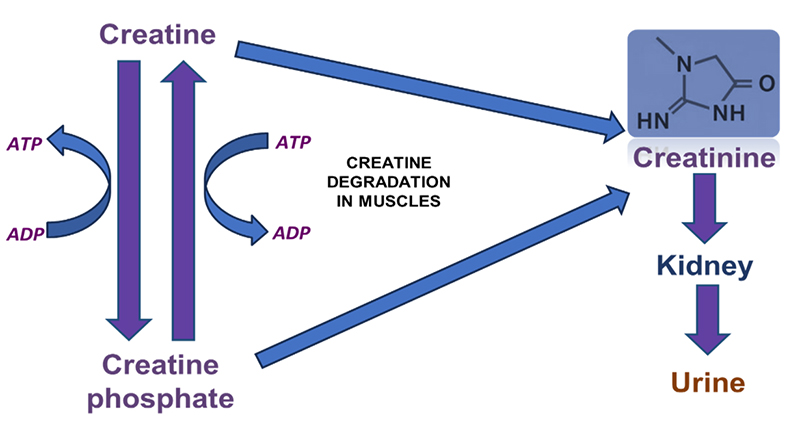
Creatinine (Cr) is a chemical waste breakdown product of creatine (Figure 1), a nitrogenous organic acid produced by the liver, pancreas and kidneys or obtained from dietary consumption of meat and fish. Normal skeletal muscle metabolism yields Cr via the breakdown of creatine phosphate. It then enters the bloodstream, is removed from the blood via the kidneys and is excreted in the urine (directly proportional to total body creatine).

Illustration of creatine degradation in muscle into the chemical waste breakdown product creatinine which is filtered through the kidneys and excreted as urine. Creatine plays an important role in supplementing cellular adenosine triphosphate (ATP) production.
The methods used for Cr measurement are chemical and enzymatic methods on automated analyzer, high‐performance liquid chromatography (HPLC) and isotope dilution‐mass spectrometry (IDMS). Cr methods used in clinical laboratories are generally based on automated chemical or enzymatic methods, with enzymatic methods showing better performance in determination for low Cr levels [2]. The amount of Cr formed on a daily basis is related to muscle mass, which varies with ethnicity, age, and gender. Cr levels can assist in diagnosing the functioning of the kidneys and it may be measured as part of other tests such as a basic- or comprehensive metabolic panel. Over 190 inherited metabolic diseases (IMDs) have been associated with kidney disease of different types to date approximating 10% of all known IMDs [3]. There is also a newly described group of inborn errors of Cr synthesis and creatine transport known as Cr deficiency syndromes which further motivates the need for precise Cr measurements considering how the kidney is directly affected in a number of IMDs[4,5]. Cr is however generally recognized to be one of the most variable of routine laboratory tests[6]. Urinary creatinine (UCr) is often used to adjust for urine analyte concentrations of metabolic panel tests, which emphasizes the need for infallibly accurate UCr results.
Methods
All samples for each comparison were pre-aliquoted (2 millilitre (ml) each) into Eppendorf tubes on the same day and frozen at -20 degree Celsius until Cr analysis. Freeze-thaw cycle variations were not investigated since a previous study indicated that Cr stays relatively constant, when subjected to only one thaw cycle [7,8]. Three separate comparisons were performed on all sample aliquots: 1) Repeat of Cr analysis (initial result available for all samples), 2) Rotation for 3 minutes at 20 revolutions per minute (Stuart SB2 rotator, Cole Palmer), 3) Centrifugation at 8554 x g for 5 minutes (Fresco-17, Thermo Scientific) Rotation as in 2 above and centrifugation as in 3 above combined. Cr analysis was performed using an Indiko clinical chemistry analyzer (863, Thermo Scientific) using the enzymatic Cr analysis kit (Thermo Scientific, product kit: 981845). The lot numbers for all reagents (Cr Enzymatic reagent-A and B, Washing solution 4.5%), calibrators (sCal) and controls (U-Trol, U-Trol High) remained unchanged for duration of the study analysis. Creatinine is converted to sarcosine with the aid of creatininase and creatinase. Sarcosine is then converted to intermediary products, including hydrogen peroxide (H2O2) by sarcosine oxidase. The liberated H2O2 reacts with residual by-products to form a quinone imine chromogen in a reaction catalyzed by peroxidase. The color intensity is directly proportional to the concentration of creatinine present and is measured photometrically at 540nm. A water blank was performed prior to all runs where all wavelengths were confirmed to be below 1mA. All calibrators and controls were within the kit acceptable ranges before each run. Samples were analysed (each comparison on a different day) and the Cr results were obtained. Barcoded reagents, controls and samples were placed in appropriate racks within the analyser. The sample volume required ranged between 2 - 120uL, and between 2 - 240uL for reagents with an analyser run time of between 15 - 20 minutes.
Results and Discussions
Sample information: A total of four ERNDIM EQA urine samples with known Cr values and four samples (anonymized) with unknown Cr values were included in this study. Table 1 is a summary of all UCr results for the different urine sample pre-treatment comparisons.
Summary of creatinine values in millimoles per litre (mmol/L) for known and unknown samples as analysed for comparisons: Initial result, Repeat result, rotated only, centrifuged only and where samples were both rotated and centrifuged.
For the known Cr value samples, a percentage difference from the known value was calculated for each comparison (Table 2). The rotated and centrifuged result comparison showed the lowest % difference from the known UCr value for known samples 1 and 4: 0.31% and 0.34% respectively. The centrifuged comparison showed lower % differences compared to those of the initial and repeat results. UCr result for Unknown 2 sample was notably lower than the overall average (10.33) obtained across all comparisons. This could just be an outlier, or variation due to unknown interference, but a larger sample size is required to sensibly evaluate and explicate.
Summary of percentage differences between comparison results when compared to known UCr values.
For the unknown UCr value samples results in Table 1, standard deviations, averages and %CV (coefficient of variance) were calculated (Table 3). For unknown sample 4 the repeat result differs significantly from all other values across comparisons. This is clearly an outlier result, but it was included here to show that random errors can occur, the result could be ascribed to the analyser pipetting a bubble during analysis perhaps. This could result in reporting wrong results for both UCr analysis and all downstream metabolic tests that normalize their results to creatinine content.
Summary of standard deviations, averages and % CV’s calculated for all comparisons of the UCr unknown samples.
Conclusion and Future Prospects
This feasibility study, however small, is suggestive proof that there is indeed necessity and room for optimization when it comes to standardisation of pre-treatment procedures prior to UCr analysis. In order to draw any definitive conclusions regarding the root causes for variance detected in this study, a larger study using samples with known Cr values is needed for developing an optimized and effective pre-treatment workflow. This small dataset does show that subjecting the samples to rotation and centrifugation prior to analysis could be a possible solution to counter unascribed variance. Implementing standardized aliquoting procedures may also prove to be successful in mitigating the variance observed. Another useful Cr value comparison of interest for a larger study could be that of homogenized samples versus the rotated-centrifuged combination group. This additional comparison could provide valuable insight into the effect and impact of both on Cr measurements. Routine accurate creatinine results are imperative because it could affect the ultimate diagnosis of an individual with an inherited metabolic disease.
Acknowledgments
The Center for Human Metabolomics (CHM) would like to thank the Technology Innovation Agency (TIA), a national public entity of South Africa that supports all projects within the broader CHM. A special thank you to ERNDIM (External Quality Assurance (EQM) entity) for the EQM urine samples utilized in this study.
References
- Ross JW, Miller WG, Myers GL, Praestgaard J. The accuracy of laboratory measurements in clinical chemistry: A study of 11 routine chemistry analytes in the College of American Pathologists Chemistry Survey with fresh frozen serum, definitive methods, and reference methods. Arch Pathol Lab Med 1998;122(7):587-608.
-
Küme T, Sağlam B, Ergon C, Sisman AR. Evaluation and comparison of Abbott Jaffe and enzymatic creatinine methods: Could the old method meet the new requirements? J Clin Lab Anal 2018;32(1):e22168. doi:10.1002/jcla.22168
» https://doi.org/10.1002/jcla.22168 - Schumann A, Schultheiss UT, Ferreira CR, Blau N. Clinical and biochemical footprints of inherited metabolic diseases. XIV. Metabolic kidney diseases. Mol Genet Metab 2023;140(3):107683. doi: 10.1016/j.ymgme.2023.107683
- Lachmann R, Murphy E. 334 Inherited metabolic diseases and the kidney. In: Turner NN, Turner NN, Lameire N, et al., eds. Oxford Textbook of Clinical Nephrology: Three-Volume Pack 4th ed. Oxford: Oxford Academic; 2015: 2757-2766.
-
Stromberger C, Bodame, OA, Stöckler-Ipsiroglu S. Clinical characteristics and diagnostic clues in inborn errors of creatine metabolism. J Inherit Metab Dis 2003;26:299-308. doi:10.1023/a:1024453704800
» https://doi.org/10.1023/a:1024453704800 -
Sharer J, Bodamer O, Longo N, et al. Laboratory diagnosis of creatine deficiency syndromes: A technical standard and guideline of the American College of Medical Genetics and Genomics. Genet Med 2017;19:256-263. doi:10.1038/gim.2016.203
» https://doi.org/10.1038/gim.2016.203 -
Garde AH, Hansen AM, Kristianse, J. Evaluation, including effects of storage and repeated freezing and thawing, of a method for measurement of urinary creatinine. Scand J Clin Lab Invest 2003;63(7-8):521-524. doi:10.1080/00365510310000501
» https://doi.org/10.1080/00365510310000501 -
Spierto FW, Hannon WH, Gunter EW, Smith SJ. Stability of urine creatinine. Clin Chim Acta 1997;264(2):227-232. doi:10.1016/s0009-8981(97)00080-6
» https://doi.org/10.1016/s0009-8981(97)00080-6
The dataset supporting the results of this study is not publicly available.