 Biochemical and physiological changes in chickpea (Cicer arietinum L.) seeds during storage under different conditions
ABSTRACT:
Cultivation of chickpea has been expanding in Brazil, and defining appropriate strategies for its preservation is essential. The aim of this study was to evaluate the biochemical and physiological changes in chickpea seeds stored in different packaging materials and environmental conditions. Seeds of the BRS Aleppo cultivar were placed in impermeable (plastic) and permeable (paper) packaging and then stored under the following conditions: cold and dry storage - CS (8 ± 1.0 °C and 35 ± 1.3% RH), cooled room - CR (18 ± 1.3 °C and 62 ± 4.0% RH), and ambient conditions without climate control - AMB (24 ± 1.8 °C and 68 ± 6.7% RH). At the beginning of storage and at 3, 6, 9, and 12 months, the seeds were evaluated regarding moisture content, germination, first germination count, seedling length, accelerated aging, electrical conductivity, malondialdehyde content, and superoxide dismutase and catalase enzyme activity. Storage under CR conditions, regardless of the packaging, and under AMB conditions in impermeable packaging (plastic) maintained seed germination for up to twelve months, although vigor decreased after nine months. The physiological quality of the seeds stored under AMB conditions in porous packaging (paper) declined from six months on, showing that this condition is unsuitable for storage for 12 months. Under this condition, biochemical changes harmful to seed quality occurred, such as lipid peroxidation and reduction in SOD and CAT enzyme activity.
Index terms:
deterioration; environment; packaging; preservation; vigor
RESUMO:
O cultivo do grão-de-bico vem se expandindo no Brasil e definir estratégias adequadas para a sua conservação é fundamental. Objetivou-se avaliar as alterações bioquímicas e fisiológicas em sementes de grão-de-bico armazenadas em diferentes embalagens e condições de ambiente. Sementes da cultivar BRS Aleppo foram acondicionadas em embalagem impermeável (plástico) e permeável (papel) e armazenadas em: câmara fria e seca - CF (8 °C ± 1,0 e 35% UR ± 1,3); sala refrigerada - REF (18 °C ± 1,3 e 62% UR ± 4,0) e ambiente não controlado - AMB (24 °C ± 1,8 e 68% UR ± 6,7). Inicialmente e aos 3, 6, 9 e 12 meses de armazenamento as sementes foram avaliadas quanto ao teor de água, germinação, primeira contagem de germinação, comprimento de plântula, envelhecimento acelerado, condutividade elétrica, conteúdo de malonaldeído e atividade das enzimas superóxido dismutase e catalase. O armazenamento em REF, independente da embalagem, e em AMB na embalagem impermeável (plástico) permitiu manter a germinação por até doze meses, com redução do vigor após nove meses. Houve redução da qualidade fisiológica das sementes armazenadas em AMB em embalagem porosa (papel) a partir de seis meses, sendo essa condição inadequada para o armazenamento por 12 meses, ocorrendo alterações bioquímicas prejudiciais à qualidade das sementes como peroxidação lipídica e redução da atividade das enzimas SOD e CAT.
Termos para indexação:
deterioração; ambiente; embalagem; conservação; vigor
INTRODUCTION
Chickpea (Cicer arietinum L.) has gained prominence worldwide for its high nutritional value and its important role in global food security (Nascimento and Silva, 2019). In this context, seeds are under increasing demand, and it is important to define adequate storage strategies to minimize the rate of seed deterioration.
Oxidative stress is caused by an imbalance between the generation of reactive oxygen species (ROS) and the antioxidant defense system, and it is one of the main precursors of the seed deterioration process (Kurek et al., 2019; Nadarajan et al., 2023). At high concentrations, ROS, such as the superoxide radical (O2 •-), hydrogen peroxide (H2O2), and hydroxyl radical (OH-), can lead to a series of detrimental reactions such as lipid peroxidation, disruption of membrane systems (Ebone et al., 2019), and protein degradation (Pinheiro et al., 2023; Escobedo-Álvarez et al., 2024), which progressively reduce seed physiological quality (Kurek et al., 2019). However, seeds have defense mechanisms, including antioxidant enzymes, such as superoxide dismutase, catalase, and peroxidases, which act in combination to eliminate excess ROS and protect cell components (Ebone et al. 2019; Nadarajan et al., 2023). Some studies have shown that changes in these enzymes can serve as markers to monitor degenerative changes during storage, as observed in lablab bean (Yahaya et al., 2022), soybean (Pinheiro et al., 2023), pea (Cojocaru et al., 2024), and cotton (Fatima et al., 2025). Carvalho et al. (2022) observed in soybean seeds that the alcohol dehydrogenase enzyme was also effective for this purpose, as it acts to convert acetaldehyde into ethanol, which is a less toxic compound, thereby contributing to a slower deterioration rate. The seed deterioration process is progressive and irreversible (Ebone et al., 2019), and the temperature and relative humidity conditions and the type of packaging the seeds are stored in affects the intensity and rate of this process (Lamichaney et al., 2019; Alemayehu et al., 2020; Coradi et al., 2020; Satasiya et al., 2021).
Specifically for desi-type chickpea seeds (more common in Asia and Africa), impermeable packages, such as polypropylene, were effective in maintaining germination for 12 months, whereas in permeable packages, germination declined, particularly after six months of storage under ambient conditions (Satasiya et al., 2021). For the kabuli type (most grown in Europe, South and North America, and Western Asia), Silva et al. (2022) found that physiological quality was maintained for only 45 days, decreasing after that, under both ambient and cold storage (14.5 °C and 65% RH) conditions, regardless of the type of packaging. However, more comprehensive studies remain to be carried out directly associating seed physiological potential during storage with biochemical changes resulting from the deterioration process. Such correlations could serve as important markers for monitoring the quality of chickpea seeds.
In this context, the aim of the present study was to evaluate the biochemical and physiological changes in chickpea seeds stored in different types of packages and environmental conditions.
MATERIAL AND METHODS
The experiment was conducted at the Department of Agronomy of the Universidade Federal de Viçosa. Newly harvested chickpea (Cicer arietinum L.) seeds of the Kabuli type from the cultivar BRS Aleppo, one of the most grown in Brazil, were used, due to their suitability for drier regions, such as the Center West region (Nascimento et al., 2016). Seeds with an initial moisture content of around 11% were placed in multilayer paper bags and in polyethylene bags (thickness of 200 µm). They were subsequently stored for 12 months under the following conditions: cold and dry storage (CS) (8 ± 1.0 °C and 35 ± 1.3% RH); cooled room (CR) (18 ± 1.3 °C and 62 ± 4.0% RH); and ambient conditions without climate control (AMB) (24 ± 1.8 °C and 68 ± 6.7% RH). The temperature and relative humidity data for each environment were recorded throughout the experimental period using a digital thermohydrograph, and the mean values are shown in Figure 1.

Temperature (T °C) and relative humidity (RH %) of the storage environments: cold storage - CS, cooled room - CR, and ambient conditions without climate control - AMB. Viçosa, UFV, MG, Brazil; 2019-2020.
At the beginning of the experiment and every three months thereafter (3, 6, 9, and 12 months), the seeds were analyzed using the following tests and determinations:
Physiological evaluations
Moisture content: this was determined by drying the seeds in a laboratory oven at 105 °C for 24 h, and the results were expressed as percentages (wet basis) (Brasil, 2009).
Germination: this was conducted with four replications of 50 seeds distributed on paper towels moistened with water at a ratio of 2.5 times the weight of the dry paper. Rolls were created and kept at 25 °C, and the percentage of normal seedlings was calculated on the eighth day after sowing (Brasil, 2009).
First germination count: this consisted of recording the percentage of normal seedlings obtained in the germination test on the fifth day (Brasil, 2009).
Seedling length: this was conducted with four replications of 20 seeds laid out on a line traced on the upper third of the paper towel moistened as described for the germination test (Krzyzanowski et al., 2020). On the fifth day after sowing, photographic images were taken using a Nikon® digital camera, model Coolpix P510. Total seedling length (mm.seedling-1) was determined using ImageJ® software (Rasband, 2016).
Accelerated aging: the seeds were distributed in a single layer on a screen attached to Gerbox (germination box) containers with 40 mL of saturated NaCl solution so as to obtain 76% RH within the container (Araújo et al., 2021). The boxes were placed in a BOD chamber at 41 °C for 48 h. At the end of this period, the seeds were tested for germination, as previously described. The results were expressed as a percentage of normal seedlings obtained on the fifth day after sowing.
Electrical conductivity: four replications of 50 seeds were weighed and immersed in 100 mL of distilled water for 24 h in a BOD incubator at 25 °C (Araújo et al., 2022). After this period, electrical conductivity was determined using a Digimed® model DM-32 conductivity meter. The results were expressed as μS.cm-1.g-1 of seeds.
Biochemical evaluations
For analysis of antioxidant enzyme activity, five replications of 2 seeds from each treatment were soaked in water for 24 h at 25 °C. The seed coats were then removed and the embryos were frozen in liquid nitrogen and stored at -20 °C. The embryos were subsequently lyophilized, macerated, and kept in a desiccator up to the time of analyses. Crude enzyme extracts were obtained from 0.2 g of this material in liquid nitrogen, followed by the addition of 2 mL of an extraction medium consisting of a potassium phosphate buffer (0.1 M, pH 6.8) containing ethylenediaminetetraacetic acid (EDTA) (0.1 mM), phenylmethylsulphonyl fluoride (PMSF) (1.0 mM), and polyvinylpolypyrrolidone (PVPP) 1% (w/v) (Peixoto et al., 1999). The homogenate was centrifuged at 19,000 × g for 15 min at 4 °C.
Superoxide dismutase (SOD): this was determined by adding 50 µL of crude enzyme extract to 2.95 mL of reaction medium consisting of a 50 mM sodium phosphate buffer (pH 7.8) containing 13 mM methionine, 75 μM nitroblue tetrazolium (NBT), 0.1 mM EDTA, and 2 μM riboflavin (Del Longo et al., 1993). The reaction was conducted at 25 °C in a reaction chamber illuminated with a 15 W fluorescent lamp. After 5 min of light exposure, illumination was stopped, and the blue formazan produced by photoreduction of the NBT was measured by absorbance at 560 nm. The absorbance value of a reaction medium identical to the one already described, but which was kept in the dark for the same period, served as a blank and was subtracted from the reading of each illuminated sample (Giannopolitis and Ries, 1977). One unit of SOD was defined as the amount of enzyme required to inhibit photoreduction of the NBT by 50% (Beauchamp and Fridovich, 1971). The results were expressed as U.min-1.mg-1 protein.
Catalase (CAT): this was determined by adding 50 µL of the crude enzymatic extract to 2.95 mL of reaction medium consisting of 50 mM potassium phosphate buffer, pH 7.0, and 12.5 mM H2O2 (adapted from Havir and McHale, 1987). The decrease in absorbance at 240 nm at 25 °C was measured during the first minute of the reaction. Enzyme activity was calculated using the molar extinction coefficient of 36 M-1 cm-1 (Anderson et al., 1995), and the results were expressed as µmol.min-1.mg-1 protein.
Determination of total proteins: this was determined with the same extract used in the enzyme evaluations, and bovine serum albumin (BSA) was used as a standard (Bradford, 1976). A 10 µL aliquot of the enzyme extract was added to 1 mL of Bradford reagent, followed by shaking. After 20 minutes, the absorbance of the sample was measured in a spectrophotometer at 595 nm.
Lipid peroxidation: this was determined based on malondialdehyde content (MDA), following the methodology of Cakmak and Horst (1991). Samples of 0.2 g were macerated in 0.1% trichloroacetic acid (TCA, w/v). After centrifugation (19,000 × g for 15 min at 4 °C), 500 µL of the supernatant was collected and added to 1.5 mL of thiobarbituric acid (TBA) solution (0.5% in 20% TCA). For the blank, 500 µL of 0.1% TCA was added in place of the sample. The samples and the blank were incubated in a water bath at 90 °C for 30 min, with shaking. After 30 minutes, the reaction was stopped by cooling with ice, and centrifugation was performed again (19,000 × g for 15 min at 4 °C). Readings were taken in a spectrophotometer at 532 nm. The MDA concentration was calculated using the molar extinction coefficient of 155 mM-1.cm-1, and the results were expressed as nmol.g-1 of fresh matter.
Experimental design and statistical analysis
The experiment was conducted in a completely randomized experimental design in a split-plot arrangement. Plots consisted of the storage conditions in a factorial scheme (3 environments × 2 package types), and split plots consisted of the storage times. Analysis of variance was performed on the data after testing the normal error distribution using the Shapiro-Wilk test, and homogeneity of variances using the Bartlett test. To evaluate the effects of the packages and storage environments, the mean values within each storage period were compared using the F-test and Tukey’s test at 5% probability, respectively. The data referring to the storage periods underwent regression analysis, and the model with the best fit and coefficient of determination was selected. The data regarding biochemical changes were presented as means ± standard deviation. The software SAS was used for data processing.
RESULTS AND DISCUSSION
The moisture content of the seeds during storage was affected by the environments and types of packaging (Figure 2). Seeds stored at 11% moisture in plastic packaging showed little variation in moisture content over the 12 months, regardless of the environment. That indicates that this plastic packaging limited water vapor exchange with the environment. When stored in paper packaging and kept in cold and dry storage (CS), moisture content reduced to approximately 8% at 3 months and remained at this level until 12 months. Under these conditions, low RH (35%) contributed to reduction in seed moisture content. In a cooled room (CR), the seed moisture content remained at around 11% throughout the 12 months of storage; while under ambient conditions without climate control (AMB), it increased, reaching 12.5%, although this is still within the safe storage limit of up to 13% (Nascimento et al., 2016). This increase can be attributed to higher RH (68%), combined with permeable packaging, which allows for water vapor exchange (Figure 1). Significant three-way interaction (p < 0.05) was observed among the packaging, environment, and storage period factors for the variables studied, except for electrical conductivity.
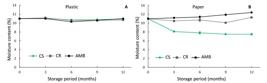
Moisture content (%) of chickpea seeds over 12 months of storage in different types of packaging and storage conditions (cold storage - CS, cooled room - CR, and ambient conditions without climate control - AMB).
The seeds stored in plastic packaging showed a slight reduction in germination percentage (Figures 3A and 3B) and in first germination count, which is an indicator of germination speed, throughout the storage period (Figures 3C and 3D). In seedling length, however, more pronounced linear reduction was observed, in both plastic packaging and paper packaging in all the environments (Figures 3E and 3F). In general, under AMB, the physiological quality of the seeds kept in paper packaging was lower than that of the seeds under the other conditions, particularly from 6 months of storage on. No differences were observed in germination, first germination count, and seedling length in the different storage environments when plastic packaging was used (Table 1), and this can also be observed in Figure 3A. In contrast, in paper packaging, reduction in germination and in first germination count were observed from nine months on under AMB and at 12 months under CR. Nevertheless, in paper packaging, although reduction occurred, germination at 12 months was 93% for CS, 87% for CR, and 77% for AMB, values higher than the minimum standard of 60% required for trading these seeds in Brazil (Brasil, 2019). At 6 months, seedlings from seeds stored in paper under AMB and under CR exhibited shorter lengths compared to those stored under CS. At 9 and 12 months, the lowest seedling length values were found in paper only under AMB (Table 1; Figures 3E and 3F). Seed moisture content is the single most influential factor affecting the deterioration process (Islam et al., 2013). Therefore, even when the temperature of the storage environments differed, the physiological quality of the seeds was similar when the moisture content did not oscillate widely, a stability which was observed for the seeds kept in plastic packaging (Figure 2).

Germination (%), first germination count (%), and seedling length (mm.seedling-1) of chickpea seeds over 12 months of storage in different types of packaging and storage conditions.
As previously discussed, the seed moisture content varied in the permeable (paper) packaging as a function of the RH of the storage environment (Figure 1). In CS (RH of 35%), reduction in seed moisture content (to 8%), together with low temperature (8 °C), favored maintenance of physiological quality, likely due to reduction in seed respiratory rate. In this environment, the sum of temperature and RH remained below 55, which is considered the ideal condition for seed storage (Harrington, 1972). In AMB, however, higher relative humidity (68%) contributed to a slight increase in seed moisture content (12.5%), which, together with the temperature of 24 °C, led to reduction in germination and seedling growth. Silva et al. (2022) observed that storage for 135 days in hermetic packaging should be carried out with chickpea seeds at 7% moisture content, regardless of the environment. In addition, they reported that both paper packaging and hermetic packaging maintained the physiological quality of the seeds for up to 45 days, regardless of the storage environment.
Also in Table 1, comparison of the packages within each environment shows no difference in CS and CR between the packages regarding germination, first germination count, or seedling length. However, in AMB, seed quality decreased for seeds stored in paper bags compared to seeds stored in plastic, as observed in lower germination at 12 months, reduced germination speed from 9 months on, and shorter seedling length from six months on. Therefore, the type of packaging played an important role in maintaining seed quality (Table 1) - plastic packaging restricted water vapor exchange between the seeds and the environment and resulted in better preservation. Other studies have shown the superiority of impermeable packaging for preserving seed quality in environments without climate control (Alemayehu et al., 2020; Satasiya et al., 2021).
In general, seed vigor declined during storage, as shown by reduced values for accelerated aging (Figures 4A and 4B) and the increase in electrical conductivity (Figures 4C and 4D) over the storage period under all conditions, but particularly for seeds stored in paper packaging under ambient conditions (AMB) (Figure 4).

Accelerated aging (%) and electrical conductivity (μS.cm-1.g-1) of chickpea seeds over 12 months of storage in different types of packaging and storage conditions (cold storage - CS, cooled room - CR, and ambient conditions without climate control - AMB).
By the accelerated aging test, comparison of the environments within each type of packaging (Table 2) shows that, regardless of the environment, seeds packaged in plastic did not have significant differences in vigor up to the sixth month of storage. After nine months in this packaging, seed vigor declined under CR and AMB, with higher vigor for seeds stored under CS. This test revealed differences among the environments for seeds packaged in plastic bags, while these differences had not been detected by the germination, first germination count, and seedling growth tests (Figure 2 and Table 1). It is important to emphasize that reducing the temperature of the storage environment reduces molecular mobility, respiratory activity, and deterioration reactions in seeds, which has a beneficial effect on seed vigor (Kooshki et al., 2018; Yahaya et al., 2022). In desi-type chickpea seeds, Basavegowda and Hosamani (2013) also observed that storage under low temperatures (5-7 °C) reduced seed metabolism, preserving seed vigor and viability compared to the environment without climate control.
In paper packaging, vigor differences among the seeds stored in the different environments were observed already at three months, with lower vigor under CR compared to AMB; however, neither differed from CS (Table 2). However, from six months on, lower vigor was observed in seeds under AMB, as was also noted in seedling length (Table 1). This therefore shows that reduction in vigor of seeds stored in paper packaging under AMB, according to the results of first count, seedling length (Table 1), and accelerated aging (Table 2), occurred before reduction in germination (Table 1), which was first observed only at 12 months. Thus, it can be affirmed that conditions of 68% RH and 24 °C of the AMB contributed to increase the moisture content of the seeds from six months of storage on (Figure 2) compared to the moisture content under the other conditions (CR and CS), and this may have accelerated the seed deterioration process. Lamichaney et al. (2019) observed greater variation in the moisture content of chickpea seeds stored under ambient conditions without climate control in permeable packaging compared to polyethylene packaging. The reduction in the storage potential of these seeds can be attributed to their higher moisture content.
In general, germination and vigor data (Tables 1 and 2) show that under both CS (8±1.02 °C and 35±1.36% RH) and CR (18±1.34 °C and 62±3.97% RH), the type of packaging did not have a significant effect on the physiological quality of chickpea seeds in the storage periods studied. Coradi et al. (2020) also observed similar physiological quality in soybean seeds stored in permeable and impermeable packaging when the seeds were stored in temperature-controlled environments (10 and 15 °C), and they attributed the results to the thermal stability provided by these environments. In contrast, under AMB, seeds packaged in paper bags had lower vigor, as shown both by first germination count and seedling length (Table 1) and by accelerated aging (Table 2) beginning at six months of storage compared to seeds kept in plastic bags.
No significant interaction was found between packaging types and environments for the electrical conductivity data (Table 2). Comparing the environments, at six months, greater conductivity was observed for the seeds stored under AMB and lower conductivity under CR, while neither of these differed from CS. From nine months on, greater electrical conductivity was found for seeds stored under AMB, differing from the other environments. The increase in electrical conductivity is associated with loss of integrity of the cellular membrane system, resulting from accumulation of ROS and a reduction in vigor (Kurek et al., 2019). Significant differences between the packaging types only occurred at 12 months, with higher vigor observed for seeds packaged in plastic compared to those packaged in paper. Quinoa seeds also exhibited higher electrical conductivity when stored in impermeable packaging compared to porous packaging, which allowed greater absorption of moisture, thereby increasing ROS concentration in the seeds (Bakhtavar and Afzal, 2020).
In summary, CS up to 12 months was the environment that most effectively maintained seed germination and vigor, whether in plastic or paper packaging. As chickpea is an orthodox species, these conditions can be used in seed storage to minimize loss of quality. Under CR, seed germination was maintained up to 12 months, though vigor declined by the end of storage, regardless of the type of packaging. Artificial cooling is an economically viable technique that large companies in the seed industry have adopted (Jaques et al., 2022), and therefore, it can be applied in the chickpea seed production chain, given its benefits in preserving seed quality. Under AMB, in plastic packaging, vigor declined from nine months of storage on, similar to what was observed under CR. However, in paper packaging, both germination and vigor declined, indicating that it is an unsuitable condition for storage for more than 9 months. These findings highlight the importance of packaging in modulating storage environments, showing whether they minimize the effects of adverse factors such as oscillations in moisture, which have direct consequences on seed physiological quality (Coradi et al., 2020).
Regarding packaging, the deterioration process, promoted by higher moisture content of seeds stored in paper bags, began to intensify at six months, causing reduction in vigor, though reduction in germination occurred only at 12 months. Due to their hygroscopic nature, when seeds are in an environment with high relative humidity, they absorb water vapor up to equilibrium levels, which may lead to deterioration reactions (Alemayehu et al., 2020). Therefore, an interesting strategy in tropical environments without relative humidity control may be the use of impermeable packaging. As observed in this study, this type of packaging was effective in maintaining the physiological quality of chickpea seeds up to 12 months of storage time. Impermeable packages have been recommended as a strategy in controlling the deterioration rate of lentil seeds (Negi et al., 2020) and desi-type chickpea seeds (Satasiya et al., 2021).
In biochemical analyses, no significant interaction (p < 0.05) was observed among the packaging, environment, and storage period factors. Thus, the effects of the factors were evaluated separately. The MDA content increased during storage in all types of packaging and environments. Seeds packaged in plastic exhibited a similar increase under all storage conditions. In paper, however, the most pronounced increase occurred under AMB and the least pronounced under CS (Figures 5A and 5B). Regarding antioxidant enzyme activity, SOD activity decreased during storage, except for seeds stored in paper under CS, where this activity remained practically stable throughout storage (Figures 5C and 5D). Similarly, CAT activity also declined during storage in all types of packaging and environments (Figures 5E and 5F). Generally, in plastic (Figure 5E), reduction was similar across the environments. In contrast, in paper (Figures 5F), a more pronounced reduction was observed under storage under AMB and less pronounced under CS. It is noteworthy that these enzymes act in combination in cells, as SOD serves as a line of defense against ROS, dismutating the superoxide radical (O2 -) into H2O2, which, for its part, can be neutralized by the action of CAT and other enzymes, being converted into H2O and O2 (Fujita and Hasanuzzaman, 2022).

Malondialdehyde content - MDA and superoxide dismutase - SOD and catalase - CAT activity in chickpea seeds over 12 months of storage in different types of packaging and storage conditions (cold storage - CS, cooled room - CR, and ambient conditions without climate control - AMB).
Regarding MDA content (Table 3), differences were observed among the storage conditions beginning at 6 months, with higher values in seeds under AMB and lower values under CS and CR. From 9 months on, the three environments differed, with the highest values in AMB and the lowest values in CS. Accumulation of MDA is associated with lipid peroxidation and the seed deterioration process (Ebone et al., 2019). From six months on, higher values of electrical conductivity (Table 2) were observed for seeds under AMB, confirming that in this environment, with higher temperature (24 °C) and RH (68%), increased respiratory activity may have contributed to accelerate lipid peroxidation, thereby affecting membrane integrity. In contrast, in the other environments (CR and CS), lipid peroxidation reactions were limited, due to lower RH and temperature, especially under CS (Table 3). Cojocaru et al. (2024) observed that pea seeds stored for 8 months at 4 °C had higher germination and vigor, and they maintained key biochemical characteristics that contributed to their better preservation.
However, in electrical conductivity evaluation, seeds in paper packaging showed higher values compared to those in plastic packaging at 12 months (Table 2). Although no statistical difference was observed, these seeds showed higher absolute values of MDA content. Thus, it is likely that lipid peroxidation was one of the events involved in vigor reduction in these seeds in paper packaging.
Regarding antioxidant enzyme activity, lower SOD activity was observed under AMB and higher activity under CS from 9 months of storage on, although neither differed from CR. However, at 12 months, lower activity was observed both under AMB and CR compared to CS. For CAT, lower activity was observed as early as 3 months of storage on under AMB compared to the other environments (CS and CR). In fact, the higher temperature and RH of the storage environment caused biochemical changes detrimental to seed quality, such as lipid peroxidation and reduction in enzyme activity of the antioxidant defense system (Table 3), corroborating the germination and vigor results (Tables 1 and 2). Kooshki et al. (2018) observed that increasing the storage temperature and seed moisture content in Vicia faba L. contributed to a reduction in CAT activity, compromising seed physiological quality.
It is noteworthy that reduction in MDA content and higher SOD and CAT activity (Table 3) may be related to storage under CS, where seeds exhibited higher physiological potential (Tables 1 and 2) and less damage to the enzymatic antioxidant system (Sano et al., 2016; Kurek et al., 2019; Pinheiro et al., 2023; Fatima et al., 2025). The lower SOD activity observed in seeds under CR may have led to vigor reduction in these seeds, though without compromising germination up to 12 months. However, the lower activity of SOD and CAT in seeds under AMB may have been insufficient to prevent the harmful effects of ROS, leading to reduction in the physiological quality of these seeds. According to the results of the seedling length (Table 1), accelerated aging, and electrical conductivity (Table 2) tests, significant differences in seed vigor under AMB were detected from 6 months of storage on, coinciding with an increase in MDA, as well as reduction in CAT activity, which had already been detected at 3 months. These findings are noteworthy because they indicate that these changes, especially in CAT, occur prior to changes in seed vigor, and as such, they may constitute a relevant marker for detecting the onset of the seed deterioration process. In soybean, Carvalho et al. (2022) observed that another key enzyme associated with defense mechanisms, alcohol dehydrogenase (ADH), is also a potential marker of seed physiological quality during storage.
In general, these findings are consistent with information from Ebone et al. (2019), who reported that the first event in seed deterioration is suppression of protective capacity as a consequence of enzymatic inactivation. Reduced ability to eliminate excess hydrogen peroxide may have led to greater seed deterioration, corroborating the MDA results, indicating greater lipid peroxidation in seeds stored under AMB from 6 months on. In soybean seeds, lipid peroxidation also increased during storage and was associated with a corresponding reduction in antioxidant enzyme activity (Pinheiro et al., 2023). These findings help clarify the biochemical events that may be involved in reduction in seed vigor and germination during storage.
No difference was observed between the types of packaging regarding the MDA content and SOD and CAT activity within each storage period (Table 3). Therefore, the storage environment conditions and storage time had a greater influence on antioxidant enzyme activity than the packaging.
In summary, the results observed in this study regarding types of packaging, storage environment conditions, and storage periods make significant contributions from a practical perspective, particularly concerning the adoption of more effective strategies for maintaining the post-harvest quality of chickpea seeds. The environment without climate control in combination with paper packaging proved to be an unsuitable condition for maintaining seed quality over a period of 12 months. In contrast, reduction in storage temperature, particularly in cold storage, proved to be a more effective strategy.
CONCLUSIONS
Cold storage is most suitable for chickpea seeds, whether in plastic or paper packaging. Storage in a cooled environment, regardless of the type of packaging, and storage in a natural environment in impermeable packaging (plastic) contribute to maintaining seed germination levels for up to 12 months, although seed vigor decreases from the ninth month on. The physiological quality of seeds stored in an environment without climate control in permeable (paper) packaging decreases from 6 months on, and thus these conditions are unsuitable for storage for 12 months. Under these conditions, biochemical changes occur that contribute to reduction in quality, such as an increase in lipid peroxidation and reduction in SOD and CAT enzyme activity.
REFERENCES
-
ALEMAYEHU, S.; FETIEN, A.; AYIMUT, K.M.; ASSEFA, D.; CHALA, A.; MAHROOF, M.; HARVEY, J.; SUBRAMANYAM, B. Evaluating different hermetic storage technologies to arrest mold growth, prevent mycotoxin accumulation and preserve germination quality of stored chickpea in Ethiopia. Journal of Stored Products Research, v.85, p.101526, 2020. https://doi.org/10.1016/j.jspr.2019.101526
» https://doi.org/https://doi.org/10.1016/j.jspr.2019.101526 -
ANDERSON, M.D.; PRASAD, T.K.; STEWART, C.R. Changes in isozyme profiles of catalase, peroxidase, and glutathione reductase during acclimation to chilling in mesocotyls of maize seedlings. Plant Physiology, v. 109, n. 4, p. 1247-1257, 1995. https://doi.org/10.1104/pp.109.4.1247
» https://doi.org/https://doi.org/10.1104/pp.109.4.1247 -
ARAÚJO, J.O.; DIAS, D.C.F. S.; MIRANDA, R.M. D.; NASCIMENTO, W.M. Adjustment of the electrical conductivity test to evaluate the seed vigor of chickpea (Cicer arietinum L.). Journal of Seed Science, v.44, e202244003, 2022. https://doi.org/10.1590/2317-1545v44258666
» https://doi.org/https://doi.org/10.1590/2317-1545v44258666 -
ARAÚJO, J.O.; DIAS, D.C.F.D.S.; NASCIMENTO, W.M.; MARTINS, A.O.; LIMÃO, M.A. Accelerated aging test and antioxidant enzyme activity to assess chickpea seed vigor. Journal of Seed Science , v.43, e202143038, 2021. https://doi.org/10.1590/2317-1545v43253934
» https://doi.org/https://doi.org/10.1590/2317-1545v43253934 -
BAKHTAVAR, M.A.; AFZAL, I. Climate smart dry chain technology for safe storage of quinoa seeds. Scientific Reports, v.10, n.1, p.1-12, 2020. https://www.nature.com/articles/s41598-020-69190-w
» https://www.nature.com/articles/s41598-020-69190-w - BASAVEGOWDA, G.S.; HOSAMANI, A. Effect of commercial cold storage conditions and packaging materials on seed quality of chickpea (Cicer arietinum L.). Global Journal of Science Frontier Research Agriculture and Veterinary Sciences, v. 13, p. 23-28, 2013.
-
BEAUCHAMP, C.; FRIDOVICH, I. Superoxide dismutase: Improved assays and an assay applicable to acrylamide gels. Analytical Biochemistry, v.44, n.1, p.276-287, 1971. https://doi.org/10.1016/0003-2697(71)90370-8
» https://doi.org/https://doi.org/10.1016/0003-2697(71)90370-8 -
BRADFORD, M.M. A rapid and sensitive method for the quantitation of microgram quantities of protein utilizing the principle of protein-dye binding. Analytical Biochemistry , v.72, n.1-2, p.248-254, 1976. https://doi.org/10.1016/0003-2697(76)90527-3
» https://doi.org/https://doi.org/10.1016/0003-2697(76)90527-3 -
BRASIL. Ministério da Agricultura, Pecuária e Abastecimento (MAPA). Regras para Análise de Sementes Ministério da Agricultura, Pecuária e Abastecimento. Secretaria de Defesa Agropecuária. Brasília: MAPA/ACS, 2009. 399p. https://www.gov.br/agricultura/pt-br/assuntos/insumos-agropecuarios/arquivos-publicacoes-insumos/2946_regras_analise__sementes.pdf
» https://www.gov.br/agricultura/pt-br/assuntos/insumos-agropecuarios/arquivos-publicacoes-insumos/2946_regras_analise__sementes.pdf - BRASIL. Ministério da Agricultura, Pecuária e Abastecimento (MAPA). Sistema de Consulta à Legislação - SISLEGIS Secretaria de Defesa Agropecuária. IN n o 42 de 17/09/2019 2019.
-
CAKMAK, I.; HORST, W.J. Effect of aluminium on lipid peroxidation, superoxide dismutase, catalase, and peroxidase activities in root tips of soybean (Glycine max). Physiologia Plantarum, v.83, n.3, 463-468, 1991. https://doi.org/10.1111/j.1399-3054.1991.tb00121.x
» https://doi.org/https://doi.org/10.1111/j.1399-3054.1991.tb00121.x -
CARVALHO, E.R.; PENIDO, A.C.; ROCHA, D.K.; REIS, L.V.; SANTOS, S.F.; SANTOS, H.O. Physiological and enzymatic monitoring of treated seeds of cultivars soybean during storage. Revista Brasileira de Ciências Agrárias, v.17, n.3, e2077-e2077, 2022. http://www.agraria.pro.br/ojs32/index.php/RBCA/article/view/v17i3a2077
» http://www.agraria.pro.br/ojs32/index.php/RBCA/article/view/v17i3a2077 -
COJOCARU, A.; CARBUNE, R.V.; TELIBAN, G.C.; STAN, T.; MIHALACHE, G.; ROSCA, M.; RUSU, O.R.; BUTNARIU, M.; STOLERU, V. Physiological, morphological and chemical changes in pea seeds under different storage conditions. Scientific Reports , v.14, n.1, 28191, 2024. https://doi.org/10.1038/s41598-024-79115-6
» https://doi.org/https://doi.org/10.1038/s41598-024-79115-6 -
CORADI, P.C.; LIMA, R.E.; PADIA, C.L.; ALVES, C.Z.; TEODORO, P.E.; CANDIDO, A.C.S. Soybean seed storage: packaging technologies and conditions of storage environments. Journal of Stored Products Research , v. 89, p.101709, 2020. https://doi.org/10.1016/j.jspr.2020.101709
» https://doi.org/https://doi.org/10.1016/j.jspr.2020.101709 -
DEL LONGO, O.T.; GONZÁLEZ, C.A.; PASTORI, G.M.; TRIPPI, V.S. Antioxidant defences under hyperoxygenic and hyperosmotic conditions in leaves of two lines of maize with differential sensitivity to drought. Plant and Cell Physiology, v.34, n.7, p.1023-1028, 1993. https://doi.org/10.1093/oxfordjournals.pcp.a078515
» https://doi.org/https://doi.org/10.1093/oxfordjournals.pcp.a078515 -
EBONE, L.A.; CAVERZAN, A.; CHAVARRIA, G. Physiologic alterations in orthodox seeds due to deterioration processes. Plant Physiology and Biochemistry, v.145, p.34-42, 2019. https://doi.org/10.1016/j.plaphy.2019.10.028
» https://doi.org/https://doi.org/10.1016/j.plaphy.2019.10.028 -
ESCOBEDO-ÁLVAREZ, D.E.; MENDOZA-SÁNCHEZ, M.; ACOSTA-GALLEGOS, J.A.; COVARRUBIAS-PRIETO, J.; FLORES-GÓMEZ, C.A.; AGUIRRE-MANCILLA, C.L. Effect of salicylic acid induction on germination, radicle length, and protein content in chickpea seedlings. Journal of Seed Science , v.46, e202446019, 2024. https://doi.org/10.1590/2317-1545v46280082
» https://doi.org/https://doi.org/10.1590/2317-1545v46280082 -
FATIMA, F.; KHALID, E.; AFZAL, I.; USMAN, M.; NADEEM, M. A.; KAMRAN, M. Evaluation of cotton (Gossypium hirsutum L.) seed longevity and deterioration: Physiological and biochemical aspects in relation to moisture contents during storage in different module systems. Journal of Stored Products Research , v.111, 102553, 2025. https://doi.org/10.1016/j.jspr.2025.102553
» https://doi.org/https://doi.org/10.1016/j.jspr.2025.102553 -
FUJITA, M.; HASANUZZAMAN, M. Approaches to enhancing antioxidant defense in plants. Antioxidants, v.11, n.5, 925, 2022. https://doi.org/10.3390/antiox11050925
» https://doi.org/https://doi.org/10.3390/antiox11050925 - GIANNOPOLITIS, C.N.; RIES, S.K. Superoxide dismutases: I. Occurrence in higher plants. Plant Physiology , v.59, n.2, p.309-14, 1977.
- HARRINGTON, J.F. Seed storage and longevity. In: KOSLOWSKI, T.T. (Ed.). Seed biology New York, Academic Press, v.3, p.145-245, 1972.
- HAVIR, E.A.; MCHALE, N.A. Biochemical and developmental characterization of multiple forms of catalase in tobacco leaves. Plant Physiology , v.84, n.2, p.450-455, 1987.
-
ISLAM, M.R.; RAHMAN, M.A.; RASHID, M.M.; SHAHIN-UZ-ZAMAN M. Effect of moisture level and storage container on the quality of chickpea seed (Cicer arietinum). Bulletin of the Institute of Tropical Agriculture, v.36, n.1, p.61-69, 2013. https://www.jstage.jst.go.jp/article/bita/36/1/36_061/_article/-char/ja/
» https://www.jstage.jst.go.jp/article/bita/36/1/36_061/_article/-char/ja/ - JAQUES, L.B.A.; CORADI, P.C.; RODRIGUES, H.E.; DUBAL, Í.T.P.; PADIA, C.L.; LIMA, R.E.; SOUZA, G.A.C. Post-harvesting of soybean seeds-engineering, processes technologies, and seed quality: a review. International Agrophysics, v.36, n.2, p.59-81, 2022.
-
KOOSHKI, M.M.; MORADI, A.; BALOUCHI, H.; FAHLIANI, R.A. Evaluation of the germination performance and biochemical indices of faba bean (Vicia faba L.) seeds stored at different temperatures and moisture contents. Journal of Plant Process and Function, v.7, n.25, p.18, 2018. https://jispp.iut.ac.ir/article-1-856-en.pdf
» https://jispp.iut.ac.ir/article-1-856-en.pdf - KRZYZANOWSKI, F.C.; FRANÇA-NETO, J.B.; GOMES-JUNIOR, F.G.; NAKAGAWA, J. Testes de vigor baseados em desempenho de plântulas. In: KRZYZANOWSKI, F. C.; VIEIRA, R. D.; FRANÇA NETO, J. B.; MARCOS FILHO, J. (Eds.). Vigor de sementes: conceitos e testes Londrina: ABRATES, cap.2, 2020.
-
KUREK, K.; PLITTA-MICHALAK, B.; RATAJCZAK, E. Reactive oxygen species as potential drivers of the seed aging process. Plants, v.8, n.174, 2019. https://doi.org/10.3390/plants8060174
» https://doi.org/https://doi.org/10.3390/plants8060174 -
LAMICHANEY, A.; KUMAR, V.; KATIYAR, P.K.; SINGH, N.P. Effect of storage condition and its duration on seed quality of chickpea (Cicer arietinum L.). Journal of Food Legumes, v.32, n.3, p.152-156, 2019. https://pub.isprd.in/index.php/jfl/article/view/651
» https://pub.isprd.in/index.php/jfl/article/view/651 -
NADARAJAN, J.; WALTERS, C.; PRITCHARD, H.W.; BALLESTEROS, D.; COLVILLE, L. Seed longevity-The evolution of knowledge and a conceptual framework. Plants, v.12, n.3, 471, 2023. https://doi.org/10.3390/plants12030471
» https://doi.org/https://doi.org/10.3390/plants12030471 - NASCIMENTO, W.M.; SILVA, P.P.; ARTIAGA, O.P.; SUINAGA, F.A. Grão-de-bico In: NASCIMENTO, W. M. (Ed.). Hortaliças leguminosas, Brasília: Embrapa, 2016. p.89-120.
- NASCIMENTO, W.M.; SILVA, P.P. Grão-de-bico: Nova aposta do agronegócio Brasileiro. Revista Seed News, v.23, n.3, p.18-22, 2019.
-
NEGI, A.; JYOTI, B.; KUMAR, A.; VASISHTH, A. Identification of packaging materials to preserve seed germination and moisture content in lentil until commercial storage (Lens culinaris Medikus). Asian Research Journal of Current Science, p.108-116, 2020. https://jofscience.com/index.php/ARJOCS/article/view/95
» https://jofscience.com/index.php/ARJOCS/article/view/95 - PEIXOTO, P.H.P.; CAMBRAIA, J.; SANT’ANNA, R.; MOSQUIM, P.R.; MOREIRA, M.A. Aluminum effects on lipid peroxidation and on the activities of enzymes of oxidative metabolism in sorghum. Revista Brasileira de Fisiologia Vegetal, v.11, n.3, p.137-143, 1999.
-
PINHEIRO, D.T.; DIAS, D.C.F.S.; SILVA, L.J.; MARTINS, M.S.; FINGER, F.L. Oxidative stress, protein metabolism, and physiological potential of soybean seeds under weathering deterioration in the pre-harvest phase. Acta Scientiarum, v.45, e56910, 2023. https://doi.org/10.4025/actasciagron.v45i1.56910
» https://doi.org/https://doi.org/10.4025/actasciagron.v45i1.56910 -
RASBAND, W.S. ImageJ Bethesda: U. S. National Institutes of Health, 2016. https://imagej.nih.gov/ij/
» https://imagej.nih.gov/ij/ -
SANO, N.; RAJJOU, L.; NORTH, H.M.; DEBEAUJON, I.; MARION-POLL, A.; SEO, M. Staying alive: molecular aspects of seed longevity. Plant Cell Physiology, v.57, n.4, p.660-674, 2016. https://doi.org/10.1093/pcp/pcv186
» https://doi.org/https://doi.org/10.1093/pcp/pcv186 - SATASIYA, R. M.; ANTALA, D. K.; SOJITRA, M. A.; KOTHIYA A. V.; CHAUHAN, P. M. Effect of packaging on storage behaviour of chickpea grain. Journal of Pharmacognosy and Phytochemistry, v.10, n.1, p.1575-1584, 2021.
-
SILVA, A.M.; FIGUEIREDO, J.C.; TUNES, L.V.; GADOTTI, G.I.; RODRIGUES, D.B.; CAPILHEIRA, A.F. Chickpea seed storage in different packagings, environments and periods. Brazilian Journal of Agricultural and Environmental Engineering, v.26, n.9, p.649-654, 2022. https://doi.org/10.1590/1807-1929/agriambi.v26n9p649-654
» https://doi.org/https://doi.org/10.1590/1807-1929/agriambi.v26n9p649-654 -
YAHAYA, A.M.; SINNIAH, U.R.; MISRAN, A. Seed Quality of Lablab Beans (Lablab purpureus L.) as Influenced by Drying Methods and Storage Temperature. Agronomy, v.12, n.3, p.699, 2022. https://doi.org/10.3390/agronomy12030699
» https://doi.org/https://doi.org/10.3390/agronomy12030699
Additional data will be made available by the authors upon reasonable request.


