 Slurry volume and additives affect hydration dynamics, seed coat integrity, and vigor of soybean seeds
ABSTRACT:
The success of soybean cultivation depends on high physiological seed quality, which can be affected by increasing slurry complexity in industrial seed treatment (IST). This study evaluated the effects of slurry application volume (SAV; 9 to 18 mL.kg⁻¹) and mixture composition, including pesticides, biological inputs, and physical additives (polymer and drying powder) on hydration dynamics, seed coat integrity, and physiological performance of soybean seeds (genotype 64i61 IPRO). Results showed that SAV establishes a biophysical stress gradient, with a practical safety threshold around 12 mL.kg⁻¹. Above this level, rapid water uptake was associated with increased microcrack incidence and reductions in seed vigor. At 18 mL.kg⁻¹, the base slurry without physical additives reduced the percentage of strong seedlings from 85.7% in the untreated control to 64.3%, whereas the addition of polymer, either alone or combined with drying powder, maintained values above 82%. Hydration analyses indicated that initial water gain is a key determinant of physiological damage, reinforcing the role of additives in modulating imbibition kinetics. These findings demonstrate that managing slurry volume and additive composition is essential for maintaining seed quality under complex IST systems. Additionally, early indicators such as initial seed water content and microcrack incidence provide a reliable basis for predicting physiological performance and supporting industrial quality control.
Index terms:
imbibition; industrial seed treatment; microcracks; seed vigor
RESUMO:
O sucesso do cultivo da soja depende da elevada qualidade fisiológica das sementes, que pode ser afetada pelo aumento da complexidade das caldas no tratamento industrial de sementes (TIS). Este estudo avaliou os efeitos do volume de calda (VC; 9 a 18 mL.kg⁻¹) e da composição da mistura, incluindo defensivos, insumos biológicos e aditivos físicos (polímero e pó secante) sobre a dinâmica de hidratação, a integridade do tegumento e o desempenho fisiológico de sementes de soja (genótipo 64i61 IPRO). Os resultados demonstraram que o VC estabelece um gradiente de estresse biofísico, com um limiar prático de segurança em torno de 12 mL.kg⁻¹. Acima desse valor, a rápida absorção de água esteve associada ao aumento da incidência de microfissuras e à redução do vigor. No VC de 18 mL.kg⁻¹, a calda-base sem aditivos físicos reduziu a porcentagem de plântulas fortes de 85,7% no controle não tratado para 64,3%, enquanto a adição de polímero, isoladamente ou em combinação com pó secante, manteve valores superiores a 82%. As análises de hidratação indicaram que o ganho inicial de água é um fator determinante do dano fisiológico, reforçando o papel dos aditivos na modulação da cinética de embebição. Os resultados evidenciam que o manejo do volume de calda e da composição da mistura é fundamental para a manutenção da qualidade das sementes em sistemas complexos de TIS. Indicadores precoces, como o teor de água inicial e a incidência de microfissuras, apresentam elevado potencial para a predição do desempenho fisiológico e para o controle de qualidade em escala industrial.
Termos para indexação:
embebição; tratamento industrial de sementes; microfissuras; vigor de sementes
INTRODUCTION
The increasing perception of seed value in Brazil has driven the soybean seed industry to prioritize the maintenance of genetic, sanitary, physical, and physiological potential through advanced industrial seed treatment (IST) processes (Carvalho et al., 2022; Franca-Neto et al., 2024). Modern IST requires not only the preservation of physiological integrity but also the guarantee of functional seed quality, an attribute that encompasses operational performance, including dosage precision, coating uniformity, and absence of dust-off, which is essential for sowing efficiency (Reis et al., 2026). In this scenario, seed treatment with chemical molecules has consolidated itself as an essential practice to mitigate damage caused by pathogens and early pests, preserving stand establishment and productivity (Bagateli et al., 2022; Toni et al., 2024). Recently, the integration of biological inputs based on rhizobacteria, such as Bacillus, Trichoderma, Azospirillum, and Bradyrhizobium, has emerged as a multifunctional tool capable of stimulating root growth, phosphorus solubilization, and systemic plant defense (Santos et al., 2018).
However, the trend of combining multiple active ingredients (fungicides, insecticides, micronutrients, biostimulants, and various inoculants) into a single operation has drastically increased the slurry application volume (SAV). This immediate increase in moisture content on the seed coat may alter the physical-physiological quality of the seeds, especially under storage or environmental stress conditions (Rocha et al., 2025). As reviewed by Carrera-Castaño et al. (2020), the regulation of seed germination is a complex physiological event, and external stresses, such as those imposed by seed treatment chemicals can prematurely trigger or damage this process. Understanding these regulatory layers is crucial for interpreting how external inputs can negatively impact the subsequent metabolic events of germination. SAV plays a decisive role in regulating the hydration rate and the distribution of inputs; excessive volumes can induce imbibition damage and a reduction in vigor (Abati et al., 2020), while reduced volumes may compromise coverage and biological efficacy (Ludwig et al., 2011).
In this context, the use of polymeric and mineral additives in IST has been recommended not only to ensure flowability and reduce dust-off but also to act as a physical barrier that modulates the kinetics of water uptake. However, the premise that such components are inherently inert has been questioned, with evidence suggesting that interactions between additives and active ingredients can, depending on the combination and the cultivar, affect the physiological potential of the seeds (Abati et al., 2018). Although Bagateli et al. (2019) demonstrated that polymer application can reduce the water absorption rate in the initial phases of imbibition without compromising soybean performance, the efficacy of these additives in mitigating the deleterious effects of complex slurries applied in volumes exceeding 12 mL.kg⁻¹ still lacks technical detailing.
Understanding the interaction between SAV, chemical-biological composition, and the physical integrity of the tegument is fundamental for establishing safe operational limits in IST. It is hypothesized that the use of polymers and drying powders can attenuate the negative impacts of high slurry volumes on germination and vigor. Given the increasing complexity of seed treatment slurries, which integrate chemical and biological components in varying volumes, it is necessary to understand the technical limits of this technology. Therefore, the objective of this study was to investigate the effects of slurry application volumes (9 to 18 mL.kg⁻¹) and slurry composition including pesticides, inoculants, and physical additives (polymer and drying powder) on the hydration dynamics, seed coat integrity, and physiological performance of soybean seeds. Specifically, we sought to identify the balance between slurry application volume and the maintenance of seed vigor, aiming to improve the safety of industrial seed treatment.
MATERIAL AND METHODS
Site and biological material
The experiment was conducted in September 2023 at the Seed Analysis Laboratory in Los Cedrales, Alto Paraná Department, Paraguay, under the technical supervision of Pathway Seed Science. A soybean seed lot of the genotype 64i61 IPRO, produced and harvested within the 2023 calendar year under a short-cycle (off-season) production system, was used. Seeds were classified using a 6.0 mm sieve, with a thousand-seed weight of 159 g and an initial water content of 11.5%.
Seed treatment (ST) operation
Seed treatment was performed using a bench-top batch-type machine (Arktos L-K2), designed to simulate industrial seed treatment (IST) conditions. For each treatment, 1 kg of seeds was processed per batch. Slurry application was carried out with the seeds in continuous motion, using micropipettes to deliver the mixture onto a central atomizer disc, followed by a 15-second homogenization period to ensure uniform coating. After treatment, seeds were discharged and packed in paper bags. The experiment was structured into four independent trials according to slurry application volume (SAV: 9, 12, 15, and 18 mL.kg⁻¹), plus a common untreated control (0 mL.kg⁻¹). Within each SAV, treatments were defined by the incremental addition of chemical, biological, and physical components, as detailed in Table 1.
Physical determinations
Seed Water Content (SWC, %): Determined by the oven method at 105 ± 3 °C for 24 h, according to the Rules for Seed Analysis (Brasil, 2025). Evaluations were performed at two times: 1 h (SWC1, %) and 24 h (SWC24, %) after treatment application, aiming to monitor the hydric stabilization of seeds under different slurry volumes.
Seed Coat Water Content (SCWC, %): Determined 1 h after ST to assess immediate superficial water retention. For each replication, the seed coats of 20 seeds were manually removed with the aid of a scalpel, weighed on a precision scale (0.001 g), and oven-dried (105 ± 3 °C) for 24 h. Calculation was performed by gravimetry, expressing water loss on a wet basis. It is noteworthy that the residual mass of solid additives (Pl+Dp) was considered constant during the drying process, not interfering with the quantification of evaporated water.
Microcracks (MC, %): The physical integrity of the seed coat was evaluated using the sodium hypochlorite (SH) test, according to Krzyzanowski et al. (2023). Two replications of 100 seeds per treatment were used, which were immersed in an SH solution for 10 minutes. After the immersion period, seeds showing a ruptured or swollen seed coat (due to rapid solution absorption through pre-existing ruptures) were counted.
Water absorption
Imbibition kinetics were characterized to monitor the influence of composition and SAV on seed coat permeability and water uptake rate, using the gravimetric method of successive weighings. The test was conducted with four replications of 25 seeds, distributed equidistantly on three sheets of paper towel (Germitest type) moistened with distilled water. Seeds were kept in gerbox-type plastic boxes inside a germination chamber at a constant temperature of 25 °C. Weighings were performed at intervals of 2, 4, 6, 8, 10, 12, 15, 18, and 24 h after the start of imbibition. In each interval, seeds were removed from the substrate, rapidly weighed on a precision scale (0.001 g), and immediately returned to the original substrate. From the masses obtained, two complementary variables were determined:
Water Gain (WG, %): Corresponds to the water absorption rate in each specific interval, calculated by the percentage mass difference between consecutive intervals. This variable allowed the identification of changes in water flux resulting from the physical properties of the slurry, such as the presence of polymers and drying powders.
Accumulated Water Gain (AWG, %): Represents the total sum of the water mass incorporated by the seed throughout the 24 h period, expressed as a percentage of the initial mass. AWG aimed to quantify the total hydration capacity and the final hygroscopic effect conferred by the different volumes and slurry compositions applied in the IST.
Physiological quality
Germination (GER, %) and First Count (FC, %): Conducted with four replications of 50 seeds per treatment, using sand at 60% of water-holding capacity as substrate. Evaluations were performed at five (FC) and eight (GER) days after sowing, following the criteria established by the Rules for Seed Testing (Brasil, 2025).
Vigor by Seedling Classification (VSC, %): Performed in conjunction with the germination test on the eighth day. Normal seedlings were classified into strong (intact and vigorous) and weak (with small lesions or reduced development), according to the criteria of Krzyzanowski et al. (2020). Results were expressed as a percentage of normal strong seedlings.
Emergence Speed Index (ESI): Evaluated daily at a fixed time, concurrently with the germination test in sand. Seedlings with the hypocotyl hook visible above the substrate level were counted until stand stabilization. The index was calculated according to Maguire (1962): ESI = N₁/D₁ + N₂/D₂ + ... + Nₙ/Dₙ, where N₁, N₂, ..., Nₙ represent the number of newly emerged seedlings at each counting date, and D₁, D₂, ..., Dₙ represent the corresponding days after sowing.
Accelerated Aging (AA, %): Conducted using the Gerbox-type plastic box method, with 40 g of seeds distributed in a single layer on a metal screen and 40 mL of distilled water at the bottom. Seeds were kept in a B.O.D. chamber at 41 °C for 48 h (Marcos-Filho, 2020). After this period, the germination test was installed, with a single evaluation five days after sowing.
Experimental design and treatments
The experiment was conducted in a randomized block design (RBD) with four replications. The experimental structure consisted of four independent trials, defined by the slurry application volumes (SAV: 9, 12, 15, and 18 mL.kg⁻¹). Within each SAV, treatments were established to evaluate the incremental addition of slurry components, as follows: (i) base composition (fungicide + insecticide + biostimulant + initial biological input), (ii) base composition + polymer (Pl), and (iii) base composition + polymer + drying powder (Pl+Dp).
A common untreated control (0 mL.kg⁻¹) was included in all trials, and its observations were incorporated into each SAV analysis to allow direct comparisons between treated and untreated seeds. The detailed composition of each treatment is presented in Table 1.
Statistical analysis
All variables were analyzed within each SAV (9, 12, 15, and 18 mL.kg⁻¹), considering the experimental structure as four independent experiments due to differences in slurry composition across volumes.
For physical and physiological variables (SWC1, SWC24, SCWC, MC, GER, FC, VSC, AA, and ESI), data were subjected to individual analysis of variance (ANOVA) for each SAV, using a randomized block design, including treatment and block effects in the model. Significance was determined by the F-test (p < 0.05). When significant, estimated marginal means were obtained and pairwise comparisons were performed using the Bonferroni adjustment. Pairwise comparisons were interpreted in conjunction with the overall ANOVA results, with emphasis on contrasts consistent with significant main effects.
Water gain (WG) and accumulated water gain (AWG) were analyzed separately for each SAV using two-way ANOVA, considering treatments and time as fixed effects and blocks as random effects. The model included treatment, time, and their interaction. Significance was assessed by the F-test (p < 0.05), with emphasis on the treatment × time interaction to characterize hydration kinetics.
Polynomial regression models were fitted to describe the temporal behavior of WG and AWG for each treatment within each SAV. Model selection was based on parameter significance (Student’s t-test, p < 0.05), biological interpretability, and goodness-of-fit (R²). Regression was used as a descriptive tool to support visualization and comparison of hydration patterns, regardless of interaction significance.
Although repeated measurements were obtained over time, analyses were performed using factorial ANOVA due to the balanced structure of the data and the focus on treatment × time effects within each SAV.
Pearson’s correlation coefficients were calculated to assess relationships among variables across all SAVs, with significance tested by Student’s t-test (p < 0.05). Only significant correlations were presented.
All analyses were performed in R (R Core Team, 2025), using the stats, emmeans (with Bonferroni adjustment), and ggplot2 packages.
RESULTS
The application of the different slurry volumes and mixture compositions resulted in distinct patterns of seed coverage and finishing (Figure 1). The influence of physical additives (polymer and drying powder) on coating uniformity is visually observable, with treatments T3 and T4 exhibiting greater slurry homogeneity on the seed coat, regardless of the volume applied. Such physical coating characteristics are determinants for water dynamics and seed coat integrity, the physiological consequences of which are detailed below.

Visual aspect of soybean seeds subjected to different slurry application volumes (9, 12, 15, and 18 mL.kg⁻¹) and mixture compositions. Treatments: (T2) Base composition; (T3) Base composition + Polymer; (T4) Base composition + Polymer + Drying powder. Fg: fungicide - Standak Top®: Fipronil 25 g.L⁻¹ + Pyraclostrobin 25 g.L⁻¹ + Thiophanate-methyl 225 g.L⁻¹; In: insecticide - Dermacor®: Chlorantraniliprole 625 g.L⁻¹; Bi: biostimulant - Soygold®: Co 0.5% + Mo 10% + Ni 1% + alginic acid 3% + fulvic acid 5%; Br: Nodusoja® - Bradyrhizobium japonicum (8×10⁹ CFU.mL⁻¹); Az: PGPR® - Azospirillum brasilense (4.8×10⁸ CFU.mL⁻¹); Ba: SolubPhos - Bacillus megaterium and Bacillus subtilis (3.4×10¹⁰ CFU.mL⁻¹); Tr: Stimucontrol® - Trichoderma harzianum (1×10⁹ CFU.L⁻¹); Pl: Polymer G5 Platinum® - aqueous suspension of acrylic and vinyl polymers, stabilized with surfactant and dispersing additives; Dp: Labsec Fluid® - inert mineral microparticles and solid lubricants.
ANOVA revealed that the impact of IST on seed quality varied across SAV levels, indicating a progressive effect of slurry volume associated with the increasing chemical-biological complexity of the mixture (Table 2). At an SAV of 9 mL.kg⁻¹, significant effects were restricted to immediate hydration variables (SWC1 and SCWC) and vigor by seedling classification (VSC) (Table 2). As the SAV was increased, an increment in the number of affected variables was observed: at an SAV of 12 mL.kg⁻¹, FC and ESI became sensitive to the treatment, whereas at the critical SAV of 18 mL.kg⁻¹, all physical and physiological variables showed significant responses to the applied treatments (Table 2).
For the 9 mL.kg⁻¹ SAV, pairwise contrasts indicated that the slurry application increased SWC1 by up to 7.0% compared to the control (T1) (Figure 2). Regarding the seed coat (SCWC), the combination of polymer and drying powder (T4) was effective in mitigating superficial water retention, not differing statistically from the control. Regarding VSC, the isolated addition of polymer (T3) resulted in superior performance (88%) compared to the treatment with pesticides and biologicals only (T2, 83%) (Figure 2).

Pairwise contrasts with their respective standard errors and estimated marginal means for the treatments used at a slurry application volume (SAV) of 9 mL.kg⁻¹, with contrast confidence intervals adjusted by the Bonferroni criterion. Red dots indicate statistically significant contrasts at the 5% probability level by the t-test (padj < 0.05). SWC1: seed water content 1 h after ST; SCWC: seed coat water content; VSC: vigor by seedling classification; T1: control; T2: (Fg+In+Bi+Br); T3: (Fg+In+Bi+Br+Pl); T4: (Fg+In+Bi+Br+Pl+Dp); C1: T1 vs. T2; C2: T1 vs. T3; C3: T1 vs. T4; C4: T2 vs. T3; C5: T2 vs. T4; C6: T3 vs. T4.
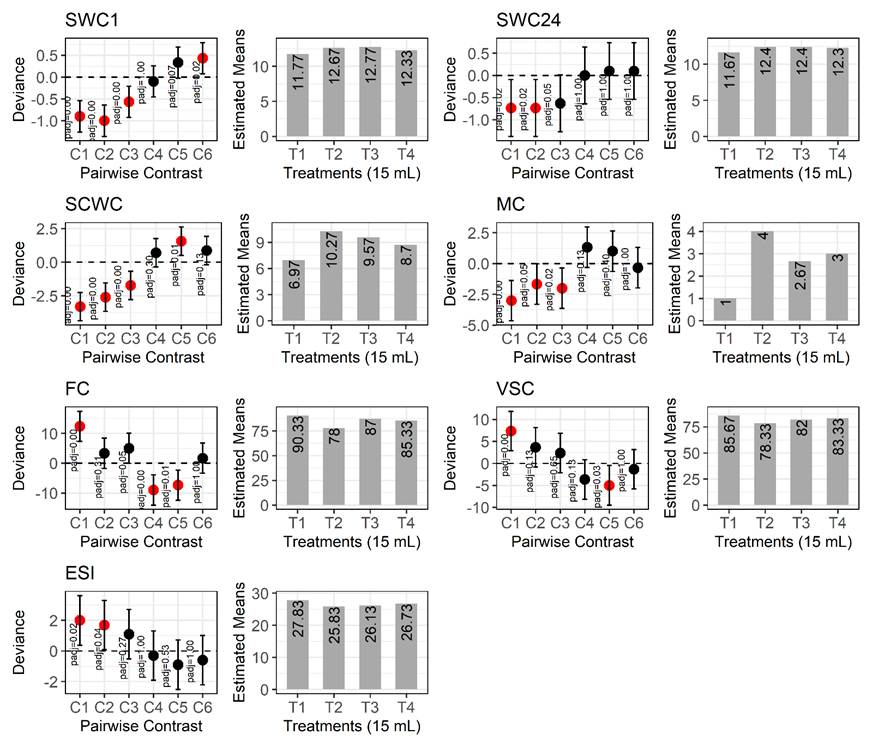
At an SAV of 12 mL.kg⁻¹, changes in water balance were more pronounced, with gains in SCWC ranging from 29.1% to 37.3% in treatments T2 to T4 (Figure 3). Although FC did not suffer drastic reductions (Figure 3), the base treatment (T2) significantly delayed the emergence speed (ESI = 25.9) compared to the control (ESI = 27.8). The inclusion of mineral additives (T4) restored the ESI to levels close to the control, suggesting a protective role against the immediate water stress of the treatment.

Pairwise contrasts with their respective standard errors and estimated marginal means for the treatments used at a slurry application volume (SAV) of 12 mL.kg⁻¹, with contrast confidence intervals adjusted by the Bonferroni criterion. Red dots indicate statistically significant contrasts at the 5% probability level by the t-test (padj < 0.05). SWC1 and SWC24: seed water content 1 and 24 h after seed treatment (ST); SCWC: seed coat water content; FC: first count of germination; ESI: emergence speed index; T1: control; T2: (Fg+In+Bi+Br+Az); T3: (Fg+In+Bi+Br+Az+Pl); T4: (Fg+In+Bi+Br+Az+Pl+Dp); C1: T1 vs. T2; C2: T1 vs. T3; C3: T1 vs. T4; C4: T2 vs. T3; C5: T2 vs. T4; C6: T3 vs. T4.
Upon reaching an SAV of 15 mL.kg⁻¹, the physical integrity of the seed coat was compromised (Figure 4). The occurrence of microcracks (MC), absent in lower SAVs, became evident in all treatments, being exacerbated in treatment T2 (absence of physical additives). The use of drying powder (T4) slightly reduced the initial water content (SWC1) and SCWC compared to T3, demonstrating an ability to absorb excess slurry moisture (Figure 4). Physiologically, treatment T2 showed the lowest values for FC (78%) and VSC (78%), whereas the addition of polymer (T3) mitigated these deleterious effects, increasing FC to 87%.

Pairwise contrasts with their respective standard errors and estimated marginal means for the treatments used at a slurry application volume (SAV) of 15 mL.kg⁻¹, with contrast confidence intervals adjusted by the Bonferroni criterion. Red dots indicate statistically significant contrasts at the 5% probability level by the t-test (padj < 0.05). SWC1 and SWC24: seed water content 1 and 24 h after seed treatment (ST); SCWC: seed coat water content; MC: microcracks; FC: first count of germination; VSC: vigor by seedling classification; ESI: emergence speed index; T1: control; T2: (Fg+In+Bi+Br+Az+Tr); T3: (Fg+In+Bi+Br+Az+Tr+Pl); T4: (Fg+In+Bi+Br+Az+Tr+Pl+Dp); C1: T1 vs. T2; C2: T1 vs. T3; C3: T1 vs. T4; C4: T2 vs. T3; C5: T2 vs. T4; C6: T3 vs. T4.
At the highest SAV of 18 mL.kg⁻¹, treatment T2 showed the highest incidence of microcracks (8.3%) and the lowest physiological performance, with VSC and FC values of 64.3% and 63.3%, respectively (Figure 5). The addition of polymer alone (T3) or combined with drying powder (T4) increased VSC to 82.7% and 82.3%, respectively, and FC to 79.3% and 81.0%. Accelerated aging and ESI were also reduced in T2, reinforcing that complex slurries applied at high volumes require physical additives to mitigate physiological damage.

Pairwise contrasts with their respective standard errors and estimated marginal means for the treatments used at a slurry application volume (SAV) of 18 mL.kg⁻¹, with contrast confidence intervals adjusted by the Bonferroni criterion. Red dots indicate statistically significant contrasts at the 5% probability level by the t-test (padj < 0.05). SWC1 and SWC24: seed water content 1 and 24 h after seed treatment (ST); SCWC: seed coat water content; MC: microcracks; GER: germination; FC: first count of germination; VSC: vigor by seedling classification; AA: vigor by accelerated aging; ESI: emergence speed index; T1: control; T2: (Fg+In+Bi+Br+Az+Tr+Ba); T3: (Fg+In+Bi+Br+Az+Tr+Ba+Pl); T4: (Fg+In+Bi+Br+Az+Tr+Ba+Pl+Dp); C1: T1 vs. T2; C2: T1 vs. T3; C3: T1 vs. T4; C4: T2 vs. T3; C5: T2 vs. T4; C6: T3 vs. T4.
The visual impact of the complexity of the slurries on seed performance is evident, as demonstrated in Figure 6. The progressive reduction in the initial seedling stand, accentuated in slurry volumes exceeding 15 mL.kg⁻¹ in the absence of additives (T2), confirms the biophysical stress gradient discussed previously.

Visual representation of the first count of germination (FC) of soybean seeds under different slurry application volumes (SAV) and chemical compositions. (A) Control (T1). (B) Treatments T2, T3, and T4 at volumes of 9, 12, 15, and 18 mL.kg⁻¹. The images were processed to highlight the initial seedling stand, with percentage values representing the mean FC obtained in the experiment. Fg: fungicide - Standak Top®: Fipronil 25 g.L⁻¹ + Pyraclostrobin 25 g.L⁻¹ + Thiophanate-methyl 225 g.L⁻¹; In: insecticide - Dermacor®: Chlorantraniliprole 625 g.L⁻¹; Bi: biostimulant - Soygold® - Co 0.5% + Mo 10% + Ni 1% + alginic acid 3% + fulvic acid 5%; Br: Nodusoja® - Bradyrhizobium japonicum (8×10⁹ CFU.mL⁻¹); Az: PGPR® - Azospirillum brasilense (4.8×10⁸ CFU.mL⁻¹); Ba: SolubPhos - Bacillus megaterium and Bacillus subtilis (3.4×10¹⁰ CFU.mL⁻¹); Tr: Stimucontrol® - Trichoderma harzianum (1×10⁹ CFU.L⁻¹); Pl: Polymer G5 Platinum® - aqueous suspension of acrylic and vinyl polymers, stabilized with surfactant and dispersing additives; Dp: Labsec Fluid® - inert mineral microparticles and solid lubricants
Imbibition kinetics were influenced by SAV from 12 mL.kg⁻¹ onwards, as indicated by the significant Treatment × Time (T×T) interaction (Table 3). At an SAV of 9 mL.kg⁻¹, water absorption was governed primarily by time (a factor intrinsic to the seed), reaching stability after 18 h with a final accumulated gain of 68.9% (Table 3; Figures 7 and 8).

Fitted polynomial regressions for water gain (WG, %) evaluated at slurry application volumes (SAV) of 9, 12, 15, and 18 mL.kg⁻¹, considering the effect of different slurry compositions over time. R2: coefficient of determination. T1: untreated control; T2: base composition; T3: base composition + polymer; T4: base composition + polymer + drying powder. Treatment composition varied according to SAV, as detailed in Table 1.

Fitted polynomial regressions for accumulated water gain (AWG, %) evaluated at slurry application volumes (SAV) of 9, 12, 15, and 18 mL.kg⁻¹, considering the effect of different slurry compositions over time. R2: coefficient of determination. T1: untreated control; T2: base composition; T3: base composition + polymer; T4: base composition + polymer + drying powder. Treatment composition varied according to SAV, as detailed in Table 1.
By increasing the SAV to 12 and 15 mL.kg⁻¹, cubic polynomial models described the initial absorption (Figure 7). At the 15 mL.kg⁻¹ volume, the addition of drying powder (T4) demonstrated temporary efficiency between 8 and 12 h after sowing, keeping WG below the other treatments (Figure 7). However, the absence of a T×T interaction for accumulated water gain (AWG) at these volumes suggests that, although the initial speed changes, the total hydration capacity is determined mostly by the total slurry volume applied in the IST (Table 3; Figure 8).
The scenario was different at an SAV of 18 mL.kg⁻¹, the only volume to present a T×T interaction for AWG (Table 3). Within the first 2 h, treated seeds presented an explosive WG (28.6% to 39.3% higher than the control), signaling a high risk of imbibition injury (Figure 7). Treatment T4 resulted in the highest final water accumulation (87.9% in 24 h), indicating that in extreme volumes, the load of biological products and additives drastically alters the hygroscopic properties of the seed (Figure 8).
The Pearson correlation matrix (Figure 9) confirmed that initial hydration speed is the main determinant of physiological damage. It was observed that initial damage related to water gain in the first hours (WG2 and AWG6) presented strong positive correlations with initial water content (SWC1) and the incidence of microcracks (MC), and negative correlations with all physiological variables (GER, FC, AA, and ESI) (Figure 9). Such behavior confirms that very rapid initial imbibition compromises the reorganization of cellular membranes. For vigor and emergence speed, ESI was negatively correlated with SWC1, SCWC, and MC, indicating that excess moisture in the ST impairs initial seedling establishment. The consistency of these indicators, demonstrated by the strong positive association between SWC1, SWC24, SCWC, and MC, validates these physical parameters as early and reliable indicators of IST safety, allowing for the prediction of subsequent seed physiological performance.

Pearson linear correlation coefficients obtained for the evaluated variables considering all product associations and slurry application volumes tested. Values marked with “X” did not show significance at the 5% probability level by the t-test. SWC1: seed water content 1 h after seed treatment; SWC24: seed water content 24 h after seed treatment; SCWC: seed coat water content; MC: microcracks; GER: germination; FC: first count of germination; VSC: vigor by seedling classification; AA: vigor by accelerated aging; ESI: emergence speed index; WG2, WG4, WG6, WG8, WG10, WG12, WG15, WG18, and WG24: water gain at 2, 4, 6, 8, 10, 12, 15, 18, and 24 hours after sowing.
The patterns observed in physical-physiological quality suggest that the increase in the application SAV from 9 to 18 mL.kg⁻¹ establishes a stress gradient on the seed. The stability observed at 9 and 12 mL.kg⁻¹ SAVs indicates that the seed coat of the evaluated genotype possesses hydric resilience to support moderate ST loads (Table 2). However, the transition to 15 and 18 mL.kg⁻¹ volumes reveals a critical threshold where physical integrity is compromised by the occurrence of microcracks (MC) (Figure 4 and Figure 5). This structural impairment precedes and explains the reductions in vigor (VSC and FC), suggesting that imbibition damage is induced directly by the hydration dynamics imposed by the treatment in high volumes.
The proposition that physical additives could mediate these impacts finds support in the performance data under high hydric load. In treatments lacking polymers and drying powders (T2), the initial hydration rate (WG2) was more aggressive (Figure 7 and 8), coinciding with the lowest vigor indices (ESI). Conversely, the inclusion of polymer (T3) and its association with mineral powders (T4) acted as a modulator on the water uptake kinetics, reducing the severity of seed coat ruptures and preserving seed viability even at threshold volumes (Figure 4 and 5). Thus, the efficacy of IST in volumes exceeding 15 mL.kg⁻¹ appears to be technically linked to the adoption of coating technologies that ensure physical protection and hydric stabilization of the lot.
DISCUSSION
The progressive increase in seed water content (SWC1) and seed coat water content (SCWC) with increasing slurry application volume (SAV) confirms that seed treatment imposes an immediate hydric load on seeds (Table 2; Figures 2-5). This phenomenon, although physical, has profound physiological implications. By increasing the SAV to 15 and 18 mL.kg⁻¹, soybean seeds exceed their superficial adsorption capacity, initiating water internalization into the cotyledons (Figures 7 and 8). Similar results were observed by Brzezinski et al. (2017), who highlighted that volumes exceeding 6 and 12 mL.kg⁻¹ begin to compromise physiological quality, especially in lots with lower and higher vigor, respectively. Although Segalin et al. (2013) suggested that volumes up to 14 mL.kg⁻¹ could be safe for certain cultivars, our data show that for the 64i61 IPRO genotype, the safety threshold lies at 12 mL.kg⁻¹, beyond which hydric stabilization (SWC24) does not return to baseline levels, indicating water internalization into the cotyledons.
The efficacy of T4 (Polymer + Drying Powder) in mitigating SCWC at an SAV of 9 mL.kg⁻¹ suggests that the inclusion of mineral and polymeric additives regulates slurry distribution, preventing superficial saturation. According to Avelar et al. (2015), polymeric coating improves the uniformity of active ingredient distribution on the seed surface, acting as a barrier that prevents the immediate liquid load from inducing severe water stress. Furthermore, soybean seeds are sensitive to the duration of exposure to aqueous slurries; Santos et al. (2018) verified that high volumes (12 mL.kg⁻¹) with a predominance of water are detrimental to vigor during storage, reinforcing the necessity for components that accelerate drying or stabilize superficial moisture.
The detection of microcracks (MC) via the sodium hypochlorite test was the most sensitive indicator of the mechanical-hydraulic damage imposed by IST. The occurrence of MC at SAVs of 15 and 18 mL.kg⁻¹ indicates that the hydromechanical stress generated by the immediate volumetric expansion is associated with disruption of seed coat integrity (Figures 4 and 5). This disruption represents a critical factor for IST safety. Oliveira et al. (2021) demonstrated that soybean seeds with seed coat fissures are significantly more susceptible to the phytotoxic effects of chemicals, as the seed coat loses its solute-entry regulatory function. When physical integrity is compromised, active ingredients such as insecticides (often more toxic than fungicides) may reach internal seed tissues, potentially increasing the risk of physiological damage.
Recently, Nardelli et al. (2025) established that although seeds with up to 40% seed coat fissures may maintain initial germination, vigor is markedly reduced after 60 days of storage due to the acceleration of oxidative processes. In the same way, Teixeira et al. (2024) state that seed coat fissures directly affect permeability, increasing susceptibility to external stresses and pathogens, which results in a reduction in physiological performance and longevity during storage. In the present study, the pronounced reduction in FC and VSC in the base treatment (T2) at higher SAVs supports the interpretation that the absence of physical additives exposes internal seed tissues to higher concentrations of active ingredients that the fissured seed coat can no longer effectively regulate (Figure 6). The inclusion of polymers (T3) and polymers + drying powder (T4) likely improved coating uniformity and reduced the exposure of damaged areas, thereby decreasing the severity of physiological damage, a pattern also reported by Bagateli et al. (2019) when analyzing the safety of polymer doses, their relationship with seed protection, and water absorption.
The analysis of hydration kinetics revealed a rapid water gain (WG2; Figure 7) in seeds treated with an SAV of 18 mL.kg⁻¹ within the first 2 h. Our findings regarding the rapid initial water uptake in high-volume treatments are supported by Gorim and Asch (2017), who demonstrated that seed coating technologies significantly increase initial moisture uptake. They observed that excessive water absorption through coating layers can restrict embryonic oxygen availability, a phenomenon that aligns with our observation that high slurry volumes (18 mL.kg⁻¹) can trigger disorganized rehydration and impair seed viability, unless modulated by proper physical additives. Physiologically, this disorganized rehydration may impair membrane reorganization during the initial phase of germination. Pereira and Masetto (2021) demonstrated that rapid imbibition in soybean seeds induces intense DNA degradation and failures in the reorganization of the endomembrane system, resulting in impaired cellular organization and a reduction in seed viability. Our Pearson correlation data (Figure 9) confirm this relationship, where WG2 and WG6 (Figure 7) show a strong negative association with all vigor variables. The turbulent entry of water prevents the proper reorganization of plasma membranes during Phase I of germination, a phenomenon that Silva and Villela (2011) mitigated successfully through controlled pre-hydration methods, reinforcing that the rate of water entry is a key factor associated with physiological damage.
The superior final hygroscopic behavior observed in T4 (Polymer + Drying Powder) at an SAV of 18 mL.kg⁻¹ suggests an interesting synergistic effect: while the mineral drying powder (such as bentonite) assists in initial hydric stabilization, it also creates a hydration gradient that facilitates a continuous water flow after membrane stabilization. However, without the modulation of the initial rate by the polymer, this excessive water volume culminates in imbibition damage, as discussed by Abati et al. (2020), who warned that high volumes accelerate imbibition and may impair membrane stabilization before they complete their transition to the liquid crystalline state.
A determining factor in the reduction of physiological performance was the density of biological and chemical products in the slurry. As the SAV increased from 9 to 18 mL.kg⁻¹, the biological load jumped from a single inoculant (Bradyrhizobium) to a complex consortium (Bradyrhizobium, Azospirillum, Trichoderma, and Bacillus). Rocha et al. (2025) indicated that the excessive use of products in IST (more than five components) can impair physiological quality even in short storage periods (15 days), due to metabolic overload and potential cumulative phytotoxicity.
Our results show that vigor (VSC and FC) is more sensitive than total germination (GER), serving as early indicators of phytotoxicity (Table 2). At an SAV of 15 mL.kg⁻¹, GER remained stable, but vigor declined in the base treatment (T2) (Table 2). Carvalho et al. (2020) pointed out that the phytotoxicity of ST is more evident in root length, indicating that the increased exposure of internal seed tissues to active ingredients stunts the initial root system. The additive technology with polymer and drying powder (T4) proved, therefore, to be not just an aesthetic tool, but a physiological necessity to allow for the coexistence of multiple biological and chemical inputs in high application volumes, contributing to the preservation of the genetic potential of the 64i61 IPRO cultivar is preserved under the intensive conditions of modern industrial treatment.
The transition to high SAVs (18 mL.kg⁻¹), associated with the incremental load of a complex biological consortium (Bradyrhizobium, Azospirillum, Trichoderma, and Bacillus) and chemical pesticides, imposes a significant metabolic challenge to the seed. Pereira et al. (2024) observed that total SAV is a decisive factor in the loss of physiological potential during storage, regardless of the inputs used. Our results corroborate this premise, as vigor (VSC) declined prematurely in the base treatment (T2) (Table 2). The observed phytotoxicity can be attributed, as highlighted by Carvalho et al. (2020), to the atrophy of the initial root system, resulting from the direct and prolonged contact of active ingredients with the embryonic axis, whose permeability is exacerbated by excess water.
Given this scenario, the mineral and polymeric additive technology (T4) proved to be a consistent technical strategy for enabling multiple co-inoculation without compromising the physical integrity and genetic potential of the seeds. Our observation that synergistic additive technology (polymer and drying powder) preserves vigor under complex slurry loads is consistent with Jarecki (2021). Their study demonstrated that specific polymeric coating compositions (such as alginate and PEG) can optimize the seed environment and improve the development of symbiotic bacteria on soybean roots, reinforcing that the incorporation of additives is not merely an aesthetic finishing tool, but a strategic component to stabilize seed physiological potential in complex treatment systems. The use of inert minerals, such as those present in drying powders, acts by modulating superficial moisture and creating a hydration gradient that regulates water flux, as reported by Abati et al. (2018). This effect was fundamental to maintaining commercial vigor above 80% even at the extreme volume of 18 mL.kg⁻¹. Simultaneously, the liquid polymer ensures the uniformity of active ingredient distribution and acts as a mechanical reinforcement to the seed coat, improving coating uniformity and reducing dust-off as reported by Avelar et al. (2015). Therefore, the synergy between polymers and drying powders is an essential component for enabling complex slurries, mitigating the risks of phytotoxicity, and preserving physiological viability under intensive conditions of industrial treatment.
In the present study, the combination of polymers and drying powders (T4) did not result in damage to vigor, presenting itself as a key factor for the maintenance of seed integrity under high slurry volumes (Figure 5). In contrast, Abati et al. (2018) reported that the use of drying powders in IST can reduce germination speed or physiological potential, depending on the cultivar and the combination of chemical inputs used. This divergence reinforces that the interaction between slurry components is not an isolated effect, but a complex system: while poorly dimensioned additives or those lacking proper polymeric protection can cause phytotoxicity as observed in the cited literature; the precise management of slurry volume (keeping it below the 12 mL.kg⁻¹ threshold) combined with balanced additivation, as demonstrated in this study, mitigates these risks and stabilizes seed physiological performance.
Furthermore, as discussed by Reis et al. (2026), precise equipment calibration and application technology are determinant for the active ingredient dose to deliver the expected effect without increasing the risk of phytotoxicity. In the scenario of high volumes (15 to 18 mL.kg⁻¹), our results corroborate the premise that the absence of additives (coating technology) compromises not only physical integrity (microcracks) (Figures 4 and 5) but the functional quality of the seed itself, by making the sowing process less precise and more subject to operational failures.
CONCLUSIONS
Slurry application volume and composition jointly affected soybean seed hydration, seed coat integrity, and physiological performance. For the evaluated seed lot, volumes up to 12 mL.kg⁻¹ were comparatively safer, whereas volumes of 15 and 18 mL.kg⁻¹ increased microcrack incidence and reduced seed vigor, particularly in the absence of physical additives. The combination of polymer and drying powder mitigated these effects by modulating initial water uptake, contributing to the preservation of seed quality in complex industrial seed treatment slurries.
ACKNOWLEDGMENTS
The authors thank the Coordination for the Improvement of Higher Education Personnel - Brazil (CAPES) and the National Council for Scientific and Technological Development - Brazil (CNPq), for the productivity grants.
REFERENCES
-
ABATI, J.; BRZEZINSKI, C.R.; ZUCARELI, C.; COSTA, D.S.; HENNING, A.A.; HENNING, F.A. Physiological potential of soybean seeds treated in the industry with and without the application of dry powder. Journal of Seed Science, v.40, p.179-184, 2018. https://doi.org/10.1590/2317-1545v40n2190927
» https://doi.org/https://doi.org/10.1590/2317-1545v40n2190927 -
ABATI, J.; BRZEZINSKI, C.R.; BERTUZZI, E.C.; HENNING, F.A.; ZUCARELI, C. Physiological response of soybean seeds to spray volumes of industrial chemical treatment and storage in different environments. Journal of Seed Science , v.42, e202042002, p.1-12, 2020. https://doi.org/10.1590/2317-1545v42221062
» https://doi.org/https://doi.org/10.1590/2317-1545v42221062 -
AVELAR, S.A.G.; BAUDET, L.; OLIVEIRA, S.; LUDWIG, M.P.; CRIZEL, R.L.; RIGO, G.A. Tratamento e recobrimento de sementes de soja com polímeros líquido e em pó.Interciencia, v.40, n.2, p.133-137, 2015. http://www.redalyc.org/pdf/339/33934014011.pdf
» http://www.redalyc.org/pdf/339/33934014011.pdf - BAGATELI, J.R.; TEIXEIRA, S.B.; XAVIER, F.M.; PENAYO, L.M.; RINCÃO, A.M.; GOMEZ, J.M.; MENEGHELLO, G.E. Inocuidade de polímeros e sua relação com a marcha de absorção de água em sementes de soja In: REUNIÃO DE PESQUISA DE SOJA, 37., 2019, Londrina. Resumos. Londrina: Embrapa Soja, 2019. p.233-236.
-
BAGATELI, J.R.; BAGATELI, R.M.; FRANCO, J.J.; MENEGHELLO, G.E.; VILLELA, F.A. Soybean sowing under low water availability conditions: impacts of seed treatment and soil management. Journal of Seed Science , v.44, e202244025, 2022. https://doi.org/10.1590/2317-1545v44256103
» https://doi.org/https://doi.org/10.1590/2317-1545v44256103 -
BRASIL. Ministério da Agricultura, Pecuária e Abastecimento. Regras para Análise de Sementes Brasília: MAPA, 2025. https://wikisda.agricultura.gov.br/pt-br/Laborat%C3%B3rios/Metodologia/Sementes/RAS_2025/Amostragem
» https://wikisda.agricultura.gov.br/pt-br/Laborat%C3%B3rios/Metodologia/Sementes/RAS_2025/Amostragem -
BRZEZINSKI, C.R.; ABATI, J.; HENNING, F.A.; HENNING, A.A.; FRANÇA-NETO, J.B.; KRZYZANOWSKI, F.C.; ZUCARELI, C. Spray volumes in the industrial treatment on the physiological quality of soybean seeds with different levels of vigor. Journal of Seed Science , v.39, n.2, p.174-181, 2017. https://doi.org/10.1590/2317-1545v39n2175179
» https://doi.org/https://doi.org/10.1590/2317-1545v39n2175179 -
CARVALHO, E.R.; ROCHA, D.K.; ANDRADE, D.B.; PIRES, R.M.O.; PENIDO, A.C.; REIS, L.V. Phytotoxicity in soybean seeds treated with phytosanitary products at different application times. Journal of Seed Science , v.42, e202042036, 2020. https://doi.org/10.1590/2317-1545v42237847
» https://doi.org/https://doi.org/10.1590/2317-1545v42237847 -
CARVALHO, E.R.; ROCHA, D.K.; FRAGA JÚNIOR, E.F.; PIRES, R.M. DE O.; OLIVEIRA, T.F.; PENIDO, A.C. Soil water restriction and performance of soybean seeds treated with phytosanitary products. Revista Brasileira de Engenharia Agrícola e Ambiental, v.26, p.59-66, 2022. https://www.scielo.br/j/rbeaa/a/t3Z5KnV5QGmWbjZzW7Cq8VR/?format=html⟨=en
» https://www.scielo.br/j/rbeaa/a/t3Z5KnV5QGmWbjZzW7Cq8VR/?format=html⟨=en -
CARRERA-CASTAÑO, G.; CALLEJA-CABRERA, J.; PERNAS, M.; GÓMEZ, L.; OÑATE-SÁNCHEZ, L. An updated overview on the regulation of seed germination. Plants, v.9, n.6, e703, 2020. https://doi.org/10.3390/plants9060703
» https://doi.org/https://doi.org/10.3390/plants9060703 -
FRANÇA-NETO, J.B.; BELNIAKI, A.C.; WEBER, F.; KRZYZANOWSKI, F.C.; HENNING, F.A.; HENNING, A.A. Adoção do tratamento de sementes de soja na indústria. Londrina: Embrapa Soja , 2024. https://www.infoteca.cnptia.embrapa.br/infoteca/handle/doc/1169840
» https://www.infoteca.cnptia.embrapa.br/infoteca/handle/doc/1169840 -
GORIM, L.Y.; ASCH, F. Seed coating increases seed moisture uptake and restricts embryonic oxygen availability in germinating cereal seeds. Biology, v.6, n.2, e31, 2017. https://doi.org/10.3390/biology6020031
» https://doi.org/https://doi.org/10.3390/biology6020031 -
JARECKI, W. Soybean response to seed coating with chitosan + alginate/PEG and/or inoculation. Agronomy, v.11, n.9, e1737, 2021. https://doi.org/10.3390/agronomy11091737
» https://doi.org/https://doi.org/10.3390/agronomy11091737 -
LUDWIG, M.P.; LUCCA-FILHO, O.A.; BAUDET, L.; DUTRA, L.M.C.; AVELAR, S.A.G.; CRIZEL, R.L. Qualidade de sementes de soja armazenadas após recobrimento com aminoácido, polímero, fungicida e inseticida. Revista Brasileira de Sementes, v.33, n.3, p.395-406, 2011. https://doi.org/10.1590/S0101-31222011000300002
» https://doi.org/https://doi.org/10.1590/S0101-31222011000300002 - KRZYZANOWSKI, F.C.; FRANÇA-NETO, J.B.; GOMES-JUNIOR, F.G.; NAKAGAWA, J. Testes de vigor baseados em desempenho de plântulas. In: KRZYZANOWSKI, F.C.; VIEIRA, R.D.; FRANÇA-NETO, J.B.; MARCOS-FILHO, J. (ed.). Vigor de sementes: conceitos e testes Londrina: ABRATES, 2020. p.79-140.
- KRZYZANOWSKI, F.C.; FRANÇA-NETO, J.B.; OLIVEIRA, G.R.F.; HENNING, F.A. Teste do hipoclorito de sódio para determinação da ocorrência de microfissuras no tegumento da semente de soja Londrina: Embrapa Soja , 2023. 16p. (Circular Técnica, 192).
- MAGUIRE, J. D. Speed of germination-aid in selection and evaluation for seedling emergence and vigor.Crop Science, v.2, n.1, p.176-177, 1962.
- MARCOS-FILHO, J. Teste de envelhecimento acelerado In: KRZYZANOWSKI, F.C.; VIEIRA, R.D.; FRANÇA-NETO, J.B.: MARCOS-FILHO, J. (Eds.). Vigor de sementes: conceitos e testes . Londrina: ABRATES , 2020. p.185-246.
-
NARDELLI, A.C.P.; CARVALHO, E.R.; REIS, V.U.V.; ROCHA, D.K.; MESQUITA, A.P.; ANDRADE, D.B. Does the chemical treatment of soybean seeds with cracked coat influence the quality after seed storage? Ciência e Agrotecnologia, v.49, e008325, 2025. https://doi.org/10.1590/1413-7054202549008325
» https://doi.org/https://doi.org/10.1590/1413-7054202549008325 -
OLIVEIRA, G. R. F.; CICERO, S. M.; KRZYZANOWSKI, F. C.; GOMES-JUNIOR, F. G.; BATISTA, T. B.; FRANÇA-NETO, J. B. Treatment of soybean seeds with mechanical damage: effects on their physiological potential. Journal of Seed Science , v. 43, p. 1-15, 2021. https://doi.org/10.1590/2317-1545v43247404
» https://doi.org/https://doi.org/10.1590/2317-1545v43247404 -
PEREIRA, R.C.; BRACCINI, A.L.; SILVA, B.G.; PELLOSO, M.F.; FRACASSO, J.L.V.; OLIVEIRA, F.S.; ROSENDO, A.A.; BORGES, Y.M. Physiological potential of soybean seeds subjected to industrial treatment and storage time. Australian Journal of Crop Science , v.18, n.1, p.45-49, 2024. https://doi.org/10.21475/ajcs.24.18.01.p4048
» https://doi.org/https://doi.org/10.21475/ajcs.24.18.01.p4048 -
PEREIRA, L.S.; MASETTO, T.E. Water uptake dynamics in soybean seeds: influence in seeds performance and DNA integrity. Ciência Rural, v.51, n.3, e20200212, 2021. https://doi.org/10.1590/0103-8478cr20200212
» https://doi.org/https://doi.org/10.1590/0103-8478cr20200212 -
R CORE TEAM. R: A language and environment for statistical computing Vienna: R Foundation for Statistical Computing, 2025. https://www.R-project.org/
» https://www.R-project.org/ -
REIS, V. U. V.; CARVALHO, E. R.; KHANDAY, I. Seed treatment technologies: Effects on physical, functional, and physiological seed quality. Plant Science, v.365, 113013, 2026. https://doi.org/10.1016/j.plantsci.2026.113013
» https://doi.org/https://doi.org/10.1016/j.plantsci.2026.113013 -
ROCHA, D.K.; REIS, V.U.V.; CARVALHO, E.R.; NARDELLI, A.C.P.; MORAIS, G.M.; REIS, L.V. How do the components used in chemical seed treatment affect physiological quality over the storage period? Bragantia, v.84, e20240131, 2025. https://doi.org/10.1590/1678-4499.20240131
» https://doi.org/10.1590/1678-4499.20240131 -
SANTOS, S.F.; CARVALHO, E.R.; ROCHA, D.K.; NASCIMENTO, R.M. Composition and volumes of slurry in soybean seeds treatment in the industry and physiological quality during storage. Journal of Seed Science , v.40, n.1, p.67-74, 2018. https://doi.org/10.1590/2317-1545v40n1185370
» https://doi.org/https://doi.org/10.1590/2317-1545v40n1185370 -
SEGALIN, S.R.; BARBIERI, A.P.P.; HUTH, C.; BECHE, M.; MATTIONI, N.M.; MERTZ, L.M. Physiological quality of soybean seeds treated with different spray volumes.Journal of Seed Science , v.35, n.4, p.501-509, 2013. http://www.scielo.br/scielo.php?pid=S2317-15372013000400012&script=sci_arttext
» http://www.scielo.br/scielo.php?pid=S2317-15372013000400012&script=sci_arttext -
SILVA, K.R.G.; VILLELA, F.A. Pré-hidratação e avaliação do potencial fisiológico de sementes de soja. Revista Brasileira de Sementes , v.33, n.2, p.331-345, 2011. https://doi.org/10.1590/S0101-31222011000200016
» https://doi.org/https://doi.org/10.1590/S0101-31222011000200016 -
TEIXEIRA, S.B.; ZORATO, M.F.; MENEGHELLO, G.E. 2024. Implications of seed coat cracking on soybean seed quality. Journal of Seed Science , v.46, e288842, 2024. https://doi.org/10.1590/2317-1545v46288842
» https://doi.org/https://doi.org/10.1590/2317-1545v46288842 -
TONI, J.R.; RADÜNZ, L.L.; GALON, L.; DIONELLO, R.G.; SCARIOT, M.A. Quality assessment of soybean seeds submitted to industrial seed treatment and stored in a natural and controlled environment. Journal of Stored Products Research, v.108, 102372, 2024. https://doi.org/10.1016/j.jspr.2024.102372
» https://doi.org/https://doi.org/10.1016/j.jspr.2024.102372
Additional data will be made available by the authors upon reasonable request.