 Treatment and preservation of tomato seeds to maintain quality and reduce microbial contamination
ABSTRACT:
Preserving seed quality during and after storage is one of the main challenges of the seed industry. The aim of this study was to evaluate the effect of fungicide treatment on the health and physiological quality of tomato seeds (cv. Santa Clara) under different storage conditions. A homogeneous seed sample was divided into two lots: one treated with the fungicide Iprodiona (Rovral® SC) and the other untreated. Both were dried and stored in three types of packaging (plastic, paper, and aluminum foil), in two environments (natural ambient conditions and cold storage), over five storage periods (0, 3, 6, 9, and 12 months), in a 5×3×2×2 factorial design. Statistical analysis was carried out using a mixed model through the lme4 package of the R software. The results showed that seed quality was affected by the storage environment, the type of packaging, and the treatment. Cold storage with the use of aluminum foil packets preserved germination above 80% for up to 12 months. The fungicide treatment was effective in controlling Alternaria alternata and Penicillium, promoting greater vigor and enabling storage for up to 12 months in plastic containers. In contrast, paper and plastic packaging exposed to the ambient conditions led to moisture absorption, reducing seed viability, particularly in untreated seeds.
Index terms:
Solanum lycopersicum L.; seed storage; seed treatment; seed longevity
RESUMO:
Conservar a qualidade das sementes durante e após o armazenamento representa um dos principais desafios do setor sementeiro. Este trabalho teve como objetivo avaliar o efeito do tratamento com fungicida sobre a qualidade sanitária e fisiológica de sementes de tomate cv. Santa Clara, armazenadas sob diferentes condições. Uma amostra homogênea de sementes foi dividida em duas: uma tratada com fungicida Iprodiona (Rovral® SC) e outra não tratada. Ambas foram secas e armazenadas em três tipos de embalagens (plástico, papel e alumínio), em dois ambientes (ambiente natural e câmara fria), ao longo de cinco períodos (0, 3, 6, 9 e 12 meses) compondo um esquema fatorial 5×3×2×2. A análise estatística foi realizada com modelo misto, utilizando o pacote lme4 do software R. Os resultados demonstraram que a qualidade das sementes foi influenciada pelo ambiente, tipo de embalagem e tratamento. O armazenamento em câmara fria e embalagens de alumínio preservou a germinação acima de 80% por até 12 meses. O tratamento fungicida foi eficaz no controle de Alternaria alternata e Penicillium, promovendo maior vigor e possibilitando o armazenamento por até 12 meses em recipientes plásticos. Já as embalagens de papel e plástico, quando expostas ao ambiente, favoreceram a absorção de umidade, reduzindo a viabilidade especialmente em sementes não tratadas.
Termos para indexação:
Solanum lycopersicum L.; armazenamento de sementes; tratamento de sementes; longevidade de sementes
INTRODUCTION
Tomato (Solanum lycopersicum L.) is one of the most widely consumed vegetable crops in the world, ranking second in global production volume (Stein et al., 2024). The crop is widely grown in tropical and subtropical regions, due to its adaptability and economic importance (Yerasu et al., 2025). Brazil is among the ten largest tomato producers worldwide, with a planted area of 54,500 hectares and annual production of 3.8 million metric tons (FAO, 2024).
Seed deterioration during storage is a gradual and inevitable process that results in considerable losses (Ray and Bordolui, 2022). The tomato seed trade has faced challenges related to low germination rates and reduced vigor of these seeds. These challenges are frequently associated with inadequately performed post-harvest procedures (Wetchakama et al., 2025). In storage, many physicochemical factors-such as initial quality of the seed lot; moisture content; temperature, relative humidity, and structure of the storage environment; and packaging materials-directly affect the viability and vigor of a seed lot (Ghaderifar et al., 2021; Ray and Bordolui, 2022).
Furthermore, it is important to highlight that physiological quality can be completely compromised through loss of seed health. Lack of control of storage conditions can promote the presence and development of pathogenic fungi, resulting in faster degradation of the seeds (Ghaderifar et al., 2021). In this context, seed treatment before storage is an alternative to protect seeds from microbial infestation and to enhance storage potential (Ray and Bordolui, 2022).
In this context, it is relevant to assess strategies that combine seed treatment with storage and packaging methods in order to preserve seed physiological quality and health over time. Thus, the aim of the present study was to evaluate the effects of fungicide treatment on the physiological quality and health of tomato seeds (cv. Santa Clara) under different storage conditions and types of packaging.
MATERIAL AND METHODS
The experiments were conducted at the central seed research laboratory of the School of Agriculture of the Universidade Federal de Lavras, Lavras, MG, Brazil. Seeds of the Santa Clara tomato were acquired, homogenized, and divided into two samples. One was chemically treated with the fungicide Iprodiona (Rovral® SC), applied at the rate of 1.5%. The seeds of both samples were dried in a forced-air circulation laboratory oven at 35 °C for 24 hours, when seed moisture reached 7 ± 0.8%.
Each sample group was placed in three types of packaging: kraft paper (permeable), plastic container (semi-permeable), and aluminum foil packets (impermeable), and stored in two environments: natural ambient conditions (with relative humidity of 63% and average temperature of 24 °C throughout the storage period) and cold storage (10 °C and 50% relative humidity), for five distinct periods (0, 3, 6, 9, and 12 months). Each treatment consisted of five separate samples, and physiological quality was assessed at each point in time, collecting one sample each time.
Moisture content was determined using the oven-drying method at 105 °C ± 3 °C for 24 h (Brasil 2009a) with two replications of 1 g of seeds. The results were expressed as percentages. The germination test was carried out using 4 replications of 50 seeds per treatment, which were sown on two sheets of paper towel moistened with distilled water in the amount of 2.5 times the weight of the dry paper in “gerbox” (germination box) boxes, following the standards for seed analysis (Brasil 2009a) . The germination speed index (GSI) was assessed through daily counts following the method of Maguire (1962). Germination percentage was also assessed at 7 days after sowing, with final count of normal seedlings at 14 days, according to Brasil (2009a).
Seedling emergence was assessed using four replications of 50 seeds from each treatment sown in plastic trays with a substrate composed of a mixture of sand and soil at a 1:1 proportion and placed in a growth chamber under alternating light and darkness (12 h photoperiod) at 25 °C for 14 days, when the number of normal seedlings was recorded. Results were expressed as percentages. The emergence speed index (ESI) was determined together with assessment of seedling emergence; however, emerged seedlings were counted daily until stabilization. The emergence speed index was calculated using the same equation proposed by Maguire (1962) for the GSI.
Seed health was evaluated using the “Blotter test”. Four replications of 50 seeds per treatment were placed in transparent Petri dishes with lids, containing three sheets of filter paper moistened with water (both previously sterilized). The seeds were incubated at 20 ± 2 °C for 7 days for untreated seeds and 10 days for treated seeds, and then individually examined using a microscope. All the occurrences of typical fungal fruiting structures were recorded according to the methodology of Brasil (2009b). causing the pole inequality relations between men and women. Therefore, in this study wanted to dismantle the detail view of some theories, both social and feminist about gender relations in the family. Each of these theories (structural functional, conflict and feminist
The experiment was set up in a completely randomized design in a 5×3×2×2 factorial arrangement with the following sources of variation: time (0, 3, 6, 9, and 12 months of storage), type of packaging (kraft paper, aluminum foil packet, and plastic container), chemical treatment (treated and untreated seeds), and storage environment (natural ambient conditions and cold storage). Statistical analysis was carried out using the mixed model approach. Logarithmic transformation was applied to adjust the GSI and ESI variables as log (GSI + 0.001) and log (ESI + 0.001), respectively. The assumptions of normality and homogeneity of variance were considered. Initially, a full model was fitted and then a reduced model based on maximum likelihood statistics, where the model with the lowest Akaike Information Criterion (AIC) or Bayesian Information Criterion (BIC) was considered a well-fitting model. The statistical package used was R lm4 (R Core Team 2020).
RESULTS
Seed moisture content increased over the storage period for all types of packaging, in both environments, and in treated and untreated seeds (Figure 1). Paper and container packaging provided an atmosphere more favorable to water vapor absorption from the environment compared to aluminum foil packets, especially in storage under ambient conditions, regardless of the seed treatment, throughout the entire storage period.

Variation in seed moisture content as a function of storage environment (A), type of packaging (B), and seed treatment (C) over 12 months of storage of tomato (Solanum lycopersicum L.) seeds.
With respect to seed treatment, the treated seeds had a higher moisture content at the beginning of storage (p > 0.001; Figure 1); however, during storage, no differences were observed between treated and untreated seeds, although for both, the seed moisture content increased over time compared to the beginning of storage (p < 0.001).
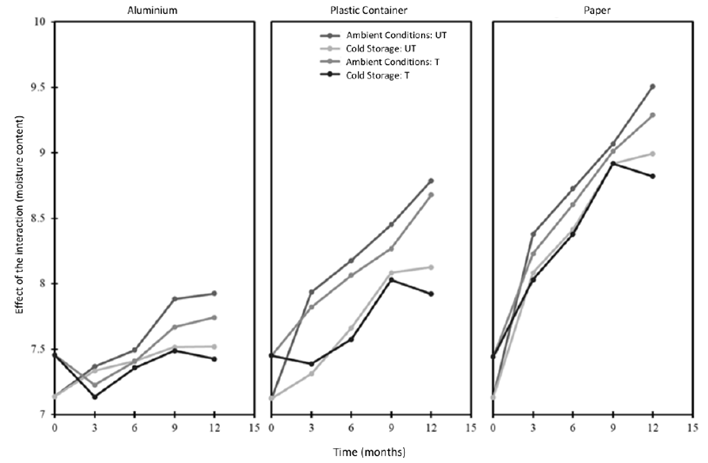
The interaction (Figure 2) shows that seeds placed in aluminum foil packets absorbed less water vapor from the environment, regardless of the ambient conditions and seed treatment (p = 0). A similar response was observed for seeds placed in plastic containers under cold storage (Figure 2). For the paper container, from the third month of storage on, water absorption by seeds was already greater compared to absorption by seeds stored in aluminum foil packets over the entire storage period.

Effect of the interaction of environment, seed treatment, and packaging on the moisture content of tomato (Solanum lycopersicum L.) seeds over 12 months of storage. Legend: UT = Untreated; T = Treated.
Analysis of germination (Figure 3) shows that the use of paper bags at ambient temperature resulted in more rapid loss of tomato seed viability. In contrast, under cold storage conditions, seeds placed in plastic containers and aluminum foil packets showed greater longevity (Figure 3).

Effect of the storage environment (A), type of packaging (B), and seed treatment (C) on germination of tomato (Solanum lycopersicum L.) seeds.
The results of the interaction (Figure 4) show that the seeds placed in aluminum foil packets maintained viability above the germination requirement for commercialization (80% in Brazil) throughout the storage period, regardless of the storage environment or seed treatment. For the seeds placed in plastic containers, the viability dropped below the required level by the ninth month under storage without climate control and in paper packaging, regardless of the treatment (p = 0).

Effect of the interaction of environment, seed treatment, and type of packaging on germination of tomato (Solanum lycopersicum L.) seeds over 12 months of storage. Legend: UT = untreated; T = treated.
The vigor assessments (GSI and first germination count) exhibited a decline in vigor over the storage period (Figure 5). Untreated seeds stored under natural ambient conditions showed faster reductions in vigor, regardless of the packaging used, whereas the vigor declined more slowly under cold storage conditions. In general, storage of treated seeds in aluminum foil packets under cold storage was the method with the least decline in vigor, and paper bags were the method with the fastest loss of vigor (Figure 5).

Effect of the interaction of environment, seed treatment, and type of packaging on the vigor of tomato (Solanum lycopersicum L.) seeds over 12 months of storage, analyzing first germination count (A), germination speed index (B), emergence at 7 days (C), and emergence speed index (D). Legend: UT = untreated; T = treated.
Untreated seeds in paper packaging with storage at ambient temperature showed lower percentages in first germination count and in seedling emergence compared to all the other treatments (p < 0.0001; Figures 5A and C). In addition, seeds stored at ambient temperature in plastic containers or in paper packaging, regardless of the storage environment and the treatment, had lower germination and emergence speed indices soon after the third month of storage compared to seeds stored in aluminum foil packets (p < 0.0001; Figures 5B and C). That suggests greater sensitivity of the vigor parameters.
In the present study, the fungi isolated from seeds included species of Alternaria, Penicillium, Aspergillus, Drechselera, Chaetomium, Phoma, Nigrospora, Cladosporium, Rhizopus, Coletotrichum, and Curvularia. Most predominant among the isolated fungi were Penicillium, Aspergillus flavus, Nigrospora, and Alternaria alternata, at proportions of 0.43, 0.19, 0.08, and 0.07, respectively, across all the treatments over the storage periods. Their incidence over storage time is shown in Figure 6.

Effect of the seed treatment on the prevalence of certain fungi in tomato (Solanum lycopersicum L.) seeds over 9 months of storage. (A) Alternaria; (B) Nigrospora; (C) Aspergillus flavus; (D) Penicillium.
DISCUSSION
Since they are hygroscropic, seeds in the container exchange water vapor with the environment until reaching equilibrium. The direction and the rate of this exchange depend on the relative humidity (RH) of the atmosphere, the seed moisture content, the chemical composition (oil content), the size of the seed, and the seed coat properties, as explained by sorption isotherms (Kugbei, 2018; Whitehouse et al., 2020). At 25 °C, tomato seeds will reach equilibrium with the environment at 60% RH when they have moisture content of 9.2% (Kugbei, 2018).
Therefore, under the ambient conditions of the present study (63% RH and 24 °C, on average, during storage) and initial moisture content of 7±0.5%, seeds will tend to absorb water vapor more rapidly compared to seeds placed in cold storage (50% RH at 10 °C), where they are already in equilibrium (Hornke et al., 2020) . In fact, the seeds under ambient conditions absorbed more water vapor and at a faster rate than the seeds under cold storage.
Demir et al. (2020) observed that at 25 °C and RH 52%, the moisture content of the seeds of some annual flower species was up to 37% higher compared to the seeds stored at 5 °C. That occurs because the increase in temperature provides greater availability of water vapor to the seed compared to colder air, even at a constant level of relative humidity (Alsadon, 2001)cucumber, onion, and tomato cultivars Nantes 2-Tito, Special, Red Creole, and Tanshet Star, respectively, to determine the water sorption isotherms at 4 storage temperatures (5, 15, 25 and 35°C, and water loss (desorption) is slower and less pronounced compared to water absorption by the seed tissues (Selvi and Saraswathy, 2018; Whitehouse et al., 2020). Therefore, a greater amount of water will be retained by the seeds when the RH is variable.
The advantage of hermetic storage in aluminum foil packets is that it offers a more effective barrier between the seed and the outside atmosphere, maintaining more stable moisture content compared to more permeable containers (Soh et al., 2014; Kugbei, 2018). Plastic containers offer a greater barrier against water absorption by the seed compared to paper, which is a much more porous material (Soh et al., 2014). Nevertheless, the screw lids of the containers used in the study may have allowed greater entry of water vapor compared to the aluminum packets (Groot et al., 2015). In addition, since tomato seeds are small (Thirusendura-Selvi and Saraswathy, 2018) and contain mucilage around the seed coat (Demir et al., 2020), they, like the seeds of some vegetables and flowers, can rapidly absorb water vapor from the environment, depending on the temperature.
The increase in moisture content in seeds during storage is detrimental to seeds because it induces seed deterioration (Zinsmeister et al., 2020). An increase in RH results in higher seed moisture content, which, in turn, accelerates seed aging. Rising temperatures increase the rate of chemical reactions in the seed, thus initiating the first stages of deterioration (Rao et al., 2017).
In onion, seeds with moisture content of up to 8% lost viability within one year of storage when stored at 25 °C. Loss of viability was more rapid and was completely lost after 18 months of storage when seeds were stored in cloth bags (Rao et al., 2006; Tripathi and Lawande, 2014). This moisture content is quickly reached by seeds in paper bags and plastic containers, particularly when they are stored in ambient air.
The treated seeds had higher moisture content at the beginning of the treatment, but their germination percentage was higher than that of the untreated seeds. That suggests that the chemical treatment provided relief against the pressure of field-borne pathogens adhering to the seeds, which may have enhanced seed germination (Ahmed et al., 2017). Nevertheless, this effect did not persist throughout storage.
This response suggests greater loss of viability when seeds are stored under natural ambient conditions and in more permeable packaging. However, in the case of plastic containers, viability can be maintained for a longer time with seed treatment. In tomato, Ariyarathna et al. (2020) poor field performance is an overwhelming problem to farmers. Present study was focused on the longevity of two varieties of tomato seeds as affected by their quality characters (percentage germination, moisture, field emergence and vigour index, seed protein and carbohydrate contentsobserved that the viability of hermetically stored seeds dropped below 75% at 2.9 to 6.4 months, depending on the agroecological zone. Nevertheless, for seeds stored under the same packaging conditions but placed in cold storage (17 ± 1 °C and 65% RH), viability was not compromised up to 29 months of storage. Vigor parameters are generally more sensitive to storage than germination is (Alhamdam et al., 2011) .
In tomato, Nigam et al. (2019) as little is known about its regulatory mechanisms. Arrays of factors were explored including Physiological parameters (Germination percentage, seedling vigour, Vigour indexfound that vigor and the vigor index of the seeds declined as they aged, while the loss of germination became more pronounced, which was represented by the mean germination times. In onion, Alhamdan et al. (2011) observed that the seed germination speed decreased and the mean germination time increased over the storage period, with more pronounced effects in seeds stored at 15, 25, and 35 °C with higher RH, compared to 5 °C and lower RH.
The rapid decline in the germination and vigor of onion seeds stored under ambient conditions was attributed to respiratory processes that consume the energy reserves of the seed and impede seed germination as a result of an insufficient supply of soluble sugars, particularly when seeds are stored in more permeable packaging (Rao et al., 2006; Baldaniya et al., 2017) .
Under ambient conditions (20 °C and 50% RH), the glassy matrix of the seed is near its glass transition temperature, and any increase in temperature or RH raises the seed tissue above this transition temperature, gradually reducing cytoplasmic mobility (Buitink and Leprince, 2008). Consequently, the rate of chemical reactions in the seed increases, thus initiating the first stages of deterioration (Zhang et al., 2021). The first symptoms are delayed germination and higher frequency of abnormalities, which culminate in total loss of viability and embryo death (Sano et al., 2016) .
In glass or plastic containers with screw lids, loss of viability is attributed to the accumulation of damage caused by the presence of and increase in reactive oxygen species (ROS), due to their varying degrees of oxygen permeability (Groot et al., 2015). In the presence of oxygen, aerobic respiration occurs, breaking down carbohydrates, fats, and proteins into carbon dioxide, water, and energy. This energy is used by cells to fuel metabolic processes and is then released as heat (Kugbei, 2018), which explains the energy consumption in the seed and the increase in moisture in hermetic packaging.
In the respiratory chain, leakage of electrons in the transport chain generates O2 - superoxide radicals, which are converted into H2O2 by mitochondrial superoxide dismutase (SOD). The H2O2 reacts with transition metals, generating OH- hydroxyl radicals, with high toxicity and reactivity (González-Benito et al., 2011). Subsequently, the levels of O2 -, H2O2 and OH- increase in the embryonic axes and cotyledons of the seeds, causing reduction in germination (Zhang et al., 2021).
In addition, chemical seed treatment has generally been associated not only with inoculum reduction, but also with promotion of germination and improvement in the root systems and shoots of seedlings, with effectiveness consistently greater than 80% (Mancini and Romanazzi, 2014; Lamichhane et al., 2020). Ahmed et al. (2017) tested various fungicides, including Rovral (0.25% of seed weight), in pre-storage of seeds and observed that it effectively reduced seed-borne fungi and led to better germination and vigor performance in onion seeds. This was also observed in the present study at the beginning of storage.
However, no differences were observed between treated and untreated seeds throughout the entire storage period, although the treated seeds frequently exhibited better performance than the untreated ones (p = 0). This contrasts with the findings of Latif et al. (2006) in mustard (Brassica campestris L.) and of Islam et al. (2007) in radish, who reported a notable increase in seed germination and vigor with the fungicide Iprodiona (Rovral®).
In tomato seeds, infection by these fungi was also reported by Chohan et al. (2017), Ismael (2010), and Mancini and Romanazzi (2014). Seed treatment was effective in control of Penicillium and Alternaria at the beginning of storage, as also found by Islam et al. (2007) and Latif et al. (2006) using the fungicide Iprodiona (Rovral®). However, no differences were observed in terms of treatment, packaging, and ambient conditions of storage for any of the other fungi, except Penicillium and Nigrospora, after 9 months of storage.
Shakir et al. (2016) reported that, in some cases, the evaluated pesticides did not differ from the control or were even considered toxic to tomato seeds, even at recommended application rates. A similar result was reported by Chahid et al. (2013) when they evaluated the effect of alpha-cypermethrin on tomato seed germination using four dilutions of the recommended concentration. Results showed a decrease in germination rate at all the concentrations tested.
Field fungi, such as Alternaria, Cladosporium, and Curvularia, decreased whereas storage fungi, such as Nigrospora, Aspergillus , Penicillium , Chaetomium, and Rhizopus, increased over the storage period, a response also observed by Malaker et al. (2008) in wheat. Exudates from some species of Aspergillus niger and A. flavus, Penicillium digitatum, Rhizopus arrhizus and R. stolonifer, Cladosporium sp. (Ismael, 2010), and Alternaria alternata (Nishikawa et al., 2006) cause significant negative effects on germination of species, as in tomato, eggplant, and hot peppers (Ismael 2010), which means controlling them is essential for maintaining seed viability.
CONCLUSIONS
Tomato seed quality is affected by the storage environment, type of packaging, and seed treatment.
The combination of cold storage with aluminum foil packets proved to be highly effective, maintaining seed germination above 80% for up to 12 months. Therefore, it is a strategy recommended for preserving the physiological quality of tomato seeds.
Seed treatment provided control of Alternaria alternata and Penicillium, and it led to higher germination and vigor indices at the beginning of storage. It maintained the quality of seeds stored in plastic containers under ambient conditions for up to 12 months.
ACKNOWLEDGMENTS
The authors are grateful to the research funding agencies: the Coordenação de Aperfeiçoamento de Pessoal de Nível Superior (CAPES - Brasil), the Fundação de Amparo à Pesquisa do Estado de Minas Gerais (FAPEMIG - Brasil), and the Conselho Nacional de Desenvolvimento Científico e Tecnológico (Grant no. 426309/2018-9). HOS holds a fellowship in research productivity from the CNPq (Grant no. 310211/2021-2).
REFERENCES
-
AHMED, B.; KHAN, B.; GHAZANFAR, M.U.; RAJPUT, N.A.; SALEEM, A.; JABBAR, A.; AHMAD, W.; KHAN, A.I.; HUSSAIN, M. Occurrence and distribution of seed-borne mycoflora of vegetables in Punjab, Pakistan. Pakistan Journal of Phytopathology, v.29, n.2, p.265-271, 2017. https://doi.org/10.33866/phytopathol.029.02.0405
» https://doi.org/https://doi.org/10.33866/phytopathol.029.02.0405 -
ALHAMDAN, A.M.; ALSADON, A.A.; KHALIL, S.O.; WAHB-ALLAH, M.A.; EL NAGAR, M.; IBRAHIM, A. A. Influence of storage conditions on seed quality and longevity of four vegetable crops. American-Eurasian Journal of Agriculture and Environmental Science, v.11, n.3, p.353-359, 2011. https://idosi.org/aejaes/jaes11(3)11/8.pdf.
» https://doi.org/https://idosi.org/aejaes/jaes11(3)11/8.pdf -
ALSADON, A.A. Water sorption isotherms of vegetable seeds as influenced by seed species and storage temperature. Assiut Journal of Agricultural Sciences, v.32, n.2p. 157-172, 2001. https://www.phtnet.org/research/view-abstract.asp?research_id=ac672
» https://www.phtnet.org/research/view-abstract.asp?research_id=ac672 -
ARIYARATHNA, R.A.I.S.; WEERASENA, S.L.; BENERAGAMA, C.K. Deleterious effects of storage environmental conditions on the seed quality of two varieties of tomato (Solanum lycopersicum L.) stored in triple laminated aluminum packing in Sri Lanka. International Journal of Applied Sciences and Biotechnology, v.8, n.4, p.437-447, 2020. https://doi.org/10.3126/ijasbt.v8i4.33670
» https://doi.org/https://doi.org/10.3126/ijasbt.v8i4.33670 -
BALDANIYA, N.; KARJULE, A.P.; PATIL, K. Effect of storage containers and durations on enzymatic activity of onion seed under ambient and cold temperature condition. Trends in Biosciences, v.10, n.35, p.7408-7412, 2017. https://www.researchgate.net/publication/320585000
» https://www.researchgate.net/publication/320585000 -
BRASIL. Ministério da Agricultura, Pecuária e Abastecimento (MAPA). Regras para Análise de Sementes Ministério da Agricultura, Pecuária e Abastecimento. Secretaria de Defesa Agropecuária. Brasília: Mapa/ACS, 2009a. 399p. https://www.gov.br/agricultura/pt-br/assuntos/insumos-agropecuarios/arquivos-publicacoes-insumos/2946_regras_analise__sementes.pdf
» https://www.gov.br/agricultura/pt-br/assuntos/insumos-agropecuarios/arquivos-publicacoes-insumos/2946_regras_analise__sementes.pdf -
BRASIL. Ministério da Agricultura, Pecuária e Abastecimento (MAPA). Manual de Análise Sanitária de Sementes Ministério da Agricultura, Pecuária e Abastecimento. Secretaria de Defesa Agropecuária. Brasília: MAPA/ACS, 2009b. 200p. https://www.gov.br/agricultura/pt-br/assuntos/lfda/legislacao-metodos-da-rede-lfda/sementes-mudas/manual-de-sementes-site.pdf
» https://www.gov.br/agricultura/pt-br/assuntos/lfda/legislacao-metodos-da-rede-lfda/sementes-mudas/manual-de-sementes-site.pdf -
BUITINK, J.; LEPRINCE, O. Intracellular glasses and seed survival in the dry state. Comptes Rendus - Biologies, v.331, n.11, p.788-795, 2008. https://doi.org/10.1016/j.crvi.2008.08.002
» https://doi.org/https://doi.org/10.1016/j.crvi.2008.08.002 -
CHAHID, K.; LAGLAOUI, A.; ZENTAR, S.; ENNABILI, A. Effect of alpha-cypermethrin on morphological parameters in tomato plants (Lycopersicon esculentum Mill.). American Journal of Environmental Protection, v. 2, n. 6, p. 149-153, 2013. https://doi.org/10.11648/j.ajep.20130206.15.
» https://doi.org/https://doi.org/10.11648/j.ajep.20130206.15 -
CHOHAN, S.; PERVEEN, R.; ABID, M.; NAQVI, A.H.; NAZ, S. Management of seed-borne fungal diseases of tomato: A review. Pakistan Journal of Phytopathology , v.29, n.1, p.193-200, 2017. https://doi.org/10.33866/phytopathol.029.01.0274
» https://doi.org/https://doi.org/10.33866/phytopathol.029.01.0274 -
DEMIR, İ.; GÖKDAŞ, Z.; TÜRE, N.İ.E. Çiçek tohumlarının muhafazası sırasında tohum çimlenmesindeki değişimler: Tür farklılıkları. Uluslararası Tarım ve Yaban Hayatı Bilimleri Dergisi, v.6, n.3, p.416-422, 2020. https://doi.org/10.24180/ijaws.743002
» https://doi.org/https://doi.org/10.24180/ijaws.743002 -
FAO. Food and Agriculture Organization of the United Nations. Agricultural production statistics 2010-2023. December 2024 update. Rome: Food and Agriculture Organization of the United Nations, 2024. https://www.fao.org/statistics/events/events-detail/agricultural-production-statistics-2010-2023/en
» https://www.fao.org/statistics/events/events-detail/agricultural-production-statistics-2010-2023/en -
GHADERIFAR, F.; KHEIRKAMAN, S.; ZEINALI, E.; RAZAVI, S. E.; GORZIN, M. Changes in seed quality and durability of fungicides protective effect during storage period of maize seeds. Iranian Journal of Seed Science and Technology, v.9, n.4, p.41-55, 2020. https://doi.org/10.22092/ijsst.2019.124690.1252.
» https://doi.org/https://doi.org/10.22092/ijsst.2019.124690.1252 -
GONZÁLEZ-BENITO, M.E.; PÉREZ-GARCÍA, F.; TEJEDA, G.; GÓMEZ-CAMPO, C. Effect of the gaseous environment and water content on seed viability of four Brassicaceae species after 36 years storage. Seed Science and Technology, v.39, n.2, p.443-451, 2011. https://doi.org/10.15258/sst.2011.39.2.16
» https://doi.org/https://doi.org/10.15258/sst.2011.39.2.16 -
GROOT, S.P.C.; GROOT, L.; KODDE, J.; VAN TREUREN, R. Prolonging the longevity of ex situ conserved seeds by storage under anoxia. Plant Genetic Resources: Characterization and Utilization, v.13, n.1, p.18-26, 2015. https://doi.org/10.1017/S1479262114000586
» https://doi.org/https://doi.org/10.1017/S1479262114000586 -
HORNKE, N.F.; GADOTTI, G.I.; CAPILHEIRA, A.F.; CAVALCANTE, J.A.; NADAL, A.P.; SILVA, J.G. Physiological potential of onion seeds stored in different packings and environments. Horticultura Brasileira, v.38, n.3, p.312-318, 2020. https://doi.org/10.1590/s0102-053620200312
» https://doi.org/https://doi.org/10.1590/s0102-053620200312 - ISLAM, S.S.; RAHMAN, M.H.; HASAN, M.J.; ASHADUSJAMAN, M.; KHATUN, M.M. Efficacy of fungicidal seed treatment in controlling Alternaria spp. in radish seed. International Journal of Sustainable Crop Production, v.2, n.5, p.46-50, 2007.
-
ISMAEL, J.H. Isolation and identification of some fungi from certain solanaceous seeds in Sulaimania and Germian regions and their exudate effects on germination rate. Agricultural and Biology Journal of North America, v.1, n.4, p.615-619, 2010. https://scihub.org/ABJNA/PDF/2010/4/1-4-615-619.pdf
» https://scihub.org/ABJNA/PDF/2010/4/1-4-615-619.pdf - KUGBEI, S. Seeds toolkit. Module 6: Seed storage. Washington: FAO - Food and Agriculture Organization of the United Nations, 2018.
-
LAMICHHANE, J.R.; YOU, M.P.; LAUDINOT, V.; BARBETTI, M.J.; AUBERTOT, J.N. Revisiting sustainability of fungicide seed treatments for field crops. Plant Disease, v.104, n.3, p.610-623, 2020. https://doi.org/10.1094/PDIS-06-19-1157-FE
» https://doi.org/https://doi.org/10.1094/PDIS-06-19-1157-FE -
LATIF, M.A.; SALEH, A.K.M.; KHAN, M.A.I.; RAHMAN, H.; HOSSAIN, M.A. Efficacy of some plant extracts in controlling seed-borne fungal infections of mustard. Bangladesh Journal of Microbiology, v.23, n.2, p.168-170, 2006. https://doi.org/10.3329/bjm.v23i2.887
» https://doi.org/https://doi.org/10.3329/bjm.v23i2.887 -
MAGUIRE, J. D. Speed of germination-aid in selection and evaluation for seedling emergence and vigor. Crop Science, v.2, n.2, p.176-177, 1962. https://doi.org/10.2135/cropsci1962.0011183x000200020033x
» https://doi.org/https://doi.org/10.2135/cropsci1962.0011183x000200020033x -
MALAKER, P.; MIAN, I.; BHUIYAN, K.; AKANDA, A.; REZA, M. Effect of storage containers and time on seed quality of wheat. Bangladesh Journal of Agricultural Research, v.33, n.3, p.469-477, 2008. https://doi.org/10.3329/bjar.v33i3.1606
» https://doi.org/https://doi.org/10.3329/bjar.v33i3.1606 -
MANCINI, V.; ROMANAZZI, G. Seed treatments to control seedborne fungal pathogens of vegetable crops. Pest Management Science, v.70, n.6, p.860-868, 2014. https://doi.org/10.1002/ps.3693
» https://doi.org/https://doi.org/10.1002/ps.3693 -
NIGAM, M.; MISHRA, A. P.; SALEHI, B.; KUMAR, M.; SHARIFI-RAD, M.; COVIELLO, E.; FLAMINI, G.; MARTORELL, M.; MARTINS, N.; JOHANSSON, B.; SHARIFI-RAD, J. Accelerated ageing induces physiological and biochemical changes in tomato seeds involving MAPK pathways. Scientia Horticulturae, v.248, p.20-28, 2019. https://doi.org/10.1016/j.scienta.2018.12.056
» https://doi.org/https://doi.org/10.1016/j.scienta.2018.12.056 -
NISHIKAWA, J.; KOBAYASHI, T.; SHIRATA, K.; CHIBANA, T.; NATSUAKI, K.T. Seedborne fungi detected on stored solanaceous berry seeds and their biological activities. Journal of General Plant Pathology, v.72, n.5, p.305-313, 2006. https://doi.org/10.1007/s10327-006-0289-5
» https://doi.org/https://doi.org/10.1007/s10327-006-0289-5 - R CORE TEAM. R: A language and environment for statistical computing Vienna, Austria: R Foundation for Statistical Computing, 2020.
-
RAO, K.N.; DULLOO, M.E.; ENGELS, J.M. M.A review of factors that influence the production of quality seed for long-term conservation in genebanks. Genetic Resources and Crop Evolution, v.64, n.5, p.1061-1074, 2017. https://doi.org/10.1007/s10722-016-0425-9
» https://doi.org/https://doi.org/10.1007/s10722-016-0425-9 -
RAO, R.G.S.; SINGH, P.M.; RAI, M. Storability of onion seeds and effects of packaging and storage conditions on viability and vigor. Scientia Horticulturae , v.110, n.1, p.1-6, 2006. https://doi.org/10.1016/j.scienta.2006.06.002
» https://doi.org/https://doi.org/10.1016/j.scienta.2006.06.002 -
RAY, J.; BORDOLUI, S.K. Effect of seed treatments and storing period on physiological and biochemical parameters of tomato during storage. Journal of Crop and Weed, v.18, n.2, p.230-239, 2022. https://doi.org/10.22271/09746315.2022.v18.i2.1594.
» https://doi.org/https://doi.org/10.22271/09746315.2022.v18.i2.1594 -
SANO, N.; RAJJOU, L.; NORTH, H.M.; DEBEAUJON, I.; MARION-POLL, A.; SEO, M. Staying alive: Molecular aspects of seed longevity. Plant and Cell Physiology, v.57, n.4, p.660-674, 2016. https://doi.org/10.1093/pcp/pcv186
» https://doi.org/https://doi.org/10.1093/pcp/pcv186 -
SHAKIR, S.K.; KANWAL, M.; MURAD, W.; ZIA U.R REHMAN; SHAFIQ U.R REHMAN; DAUD, M.K.; AZIZULLAH, A. Effect of some commonly used pesticides on seed germination, biomass production and photosynthetic pigments in tomato (Lycopersicon esculentum). Ecotoxicology, n.25, p.2, p.329-341, 2016. https://doi.org/10.1007/s10646-015-1591-9
» https://doi.org/https://doi.org/10.1007/s10646-015-1591-9 -
SOH, E.H.; LEE, W.M.; PARK, K.W.; CHOI, K.J.; YOON, M.K. Change of germination rate for chili pepper and Chinese cabbage seed in relation to packaging materials and storage conditions over 10 years. Korean Journal of Horticultural Science and Technology, v.32, n.6, p.864-871, 2014. https://doi.org/10.7235/hort.2014.14091
» https://doi.org/https://doi.org/10.7235/hort.2014.14091 -
STEIN, B.B.; DUARTE, S.N.; FREIRE, M.M.; NASCIMENTO, L.F.S.; JACOMINO, A.P.; COSTA, J.O.; COELHO, R.D. Production and harvest quality of tomato fruit cultivated under different water replacement levels and photoprotector strategies. AgriEngineering, v.6, n.4, p.4372-4383, 2024. https://doi.org/10.3390/agriengineering6040247
» https://doi.org/https://doi.org/10.3390/agriengineering6040247 -
SELVI, D.T.; SARASWATHY, S. Seed viability, seed deterioration and seed quality improvements in stored onion seeds: a review. Journal of Horticultural Science and Biotechnology, v.93, n.1, p.1-7, 2018. https://doi.org/10.1080/14620316.2017.1343103
» https://doi.org/https://doi.org/10.1080/14620316.2017.1343103 - TRIPATHI, P.C.; LAWANDE, K.E. Effect of seed moisture and packing material on viability and vigor of onion seed. Journal of Engineering Computers & Applied Sciences, v.3, n.7, p.1-5, 2014.
-
WETCHAKAMA, N.; KAEWDUANGTA, W.; KHAENGKHAN, P. Delay and improvement of tomato seed germination by osmopriming under ambient and accelerate storage conditions. Journal of Sustainability Science and Management, v.20, n.3, p.495-504, 2025. https://jssm.umt.edu.my/wp-content/uploads/2025/05/5-JSSM-Volume-20-Number-3-March-2025-FINAL.pdf
» https://jssm.umt.edu.my/wp-content/uploads/2025/05/5-JSSM-Volume-20-Number-3-March-2025-FINAL.pdf -
WHITEHOUSE, K.J.; HAY, F.R.; LUSTY, C. Why seed physiology is important for genebanking. Plants, v.9, n.5, p.584, 2020. https://doi.org/10.3390/plants9050584
» https://doi.org/https://doi.org/10.3390/plants9050584 -
YERASU, S.R.; GUPTA, N.; NAGENDRAN, K.; GOWDA, M. T.; REDDY, S. K.; REDDY, M. L. S. Hybrid seed production in tomato. In: LAMICHANEY, A.; PARIHAR, A.K.; BOHRA, A.; KARMAKAR, P.; NAIK, S.J. (Eds.). Hybrid seed production for boosting crop yields: applications, challenges and opportunities. Singapore: Springer Nature Singapore, 2025. p. 375-408. https://doi.org/10.1007/978-981-96-0506-4_15.
» https://doi.org/https://doi.org/10.1007/978-981-96-0506-4_15 -
ZHANG, K.; ZHANG, Y.; SUN, J.; MENG, J.; TAO, J. Deterioration of orthodox seeds during aging: influencing factors, physiological alterations and the role of reactive oxygen species. Plant Physiology and Biochemistry, v.158, p.475-485, 2021. https://doi.org/10.1016/j.plaphy.2020.11.031
» https://doi.org/https://doi.org/10.1016/j.plaphy.2020.11.031 -
ZINSMEISTER, J.; LEPRINCE, O.; BUITINK, J. Molecular and environmental factors regulating seed longevity. Biochemical Journal, v.477, n.2, 2020. https://doi.org/10.1042/BCJ20190165
» https://doi.org/https://doi.org/10.1042/BCJ20190165
Additional data will be made available by the authors upon reasonable request.