 Trinexapac-ethyl as a strategy for producing seeds of oat (Avena sativa L.) cultivars
ABSTRACT:
Trinexapac-ethyl (TE) is used on oat to reduce plant lodging, but little is known about its influence on seed quality. The aim of this study was to evaluate the effects of different application rates of the plant growth regulator TE on the physiological quality and yield of seeds from oat cultivars. The experiment was conducted in the 2019 and 2020 crop seasons in a randomized block design, with four replications, consisting of four rates of TE (0, 50, 100, and 150 g a.i. ha-1) applied when the primary stalk had the first visible node and the second node perceptible node on the oat cultivars URS Altiva and URS Corona. The following variables were evaluated: germination rate, accelerated aging, electrical conductivity, seedling length, seedling dry matter, seedling emergence, and seed yield. Yield response varied, as the URS Altiva cultivar showed no response, while URS Corona showed a positive response only in the 2019 crop season. Both seed germination and seed vigor, evaluated by different tests, were negatively affected as the TE application rates increased. Oat seeds remained within the minimum standards for the seed trade up to the application rate of 100 g a.i. ha-1. The application of TE reduces the germination and vigor of oat seeds.
Index terms:
growth regulator; physiological potential; vigor
RESUMO:
O trinexapaque-etílico (TE) é utilizado em aveia branca para redução do acamamento das plantas, mas pouco se sabe sobre sua influência na qualidade de sementes. Objetivou-se avaliar os efeitos da aplicação de diferentes doses do regulador de crescimento trinexapaque-etílico na qualidade fisiológica e produtividade de sementes de cultivares de aveia branca. O experimento foi conduzido nas safras 2019 e 2020, em delineamento blocos casualizados, com quatro repetições, sendo quatro doses de trinexapaque-etílico (0, 50, 100 e 150 g i.a. ha-1), aplicadas quando o colmo primário apresentava o primeiro nó visível e o segundo nó perceptível, nas cultivares de aveia branca URS Altiva e URS Corona. Foram avaliados: teste de germinação, envelhecimento acelerado, condutividade elétrica, comprimento e massa seca de plântulas, emergência de plântulas e produtividade de sementes. A produtividade apresentou resposta variável, para a cultivar URS Altiva não houve resposta, e para a URS Corona houve somente na safra 2019, com reflexos positivos. Tanto a germinação quanto o vigor das sementes avaliados por diferentes testes apresentaram influência negativa conforme aumento das doses de TE. As sementes de aveia branca ficaram dentro dos padrões mínimos de comercialização até a dose de 100 g i.a. ha-1. Conclui-se que a aplicação do trinexapaque-etílico reduz a germinação e vigor de sementes de aveia branca.
Termos para indexação:
regulador de crescimento; potencial fisiológico; vigor
INTRODUCTION
Oat is grown in the fall and winter in Brazil and is integrated in the agricultural production system, in which it provides soil cover in the winter preceding establishment of summer crops. It can also be grown to produce green biomass in the form of forage, hay, or silage and to produce grain for human or animal consumption.
Among the main problems that limit the seed yield potential of this crop is plant lodging, which consists of permanent displacement of the plant stem from the vertical position, reaching a maximum point when the plants are completely prostrate on the soil surface. This problem is related to the genotype, where taller cultivars are more prone to lodging. Other factors can bring about this phenomenon, such as environmental climate conditions, sowing density, soils with high natural fertility, or the use of high nitrogen fertilizer application rates (Bazzo et al., 2019), as well as interactions among these factors (CBPA, 2021).
As a way of mitigating this problem, management strategies include the use of plant growth regulators on winter cereal crops. In Brazil, two active ingredients are registered for use on oat crops by the Brazilian Ministry of Agriculture (Ministério da Agricultura e Pecuária - MAPA): prohexadione-calcium and trinexapac-ethyl (TE). Both products are recommended by the manufacturer for application at the culm elongation phase when the first node is visible.
Reduction in plant height due to shortening of culm internodes and the peduncle leads to reduction in lodging, better results in application of topdressed nitrogen fertilizers, greater harvest efficiency, and reduced exposure of seeds to deteriorative conditions near the soil (CBPA, 2021).
However, although the plants remain more upright through reduced lodging, and better conditions are created for seed development in the panicles, studies on TE have shown that oat seed quality was negatively affected (Kaspary et al., 2015; Bazzo et al., 2018). In contrast, in the wheat crop, seed quality was not impaired with increasing application rates of TE (Koch et al., 2017).
Considering this situation, it is known that the manufacturer’s recommendation for TE application at the 1st visible node at the rate of 100 to 125 g a.i. ha-1 is quite broadly determined and does not consider the intrinsic traits of each cultivar and the growing environment. Therefore, it is believed that the application rates in the oat crop should be specific for each cultivar so as to make this management tool a more effective alternative in reducing the effects of lodging, thus allowing greater yield potential and improved seed quality.
In light of the above, the aim of this study was to evaluate the effects of different application rates of the plant growth regulator TE on the physiological quality and seed yield of oat cultivars.
MATERIAL AND METHODS
The experiment was conducted in the 2019 and 2020 crop seasons at the research station of the Instituto de Desenvolvimento Rural do Paraná - IAPAR-EMATER (IDR-Paraná), in the municipality/county of Londrina, PR, Brazil (23°23’ S and 51°11’ W, at an altitude of 545 m). The soil is classified as a Latossolo Vermelho Eutroférrico (EMBRAPA, 2018). The climate is Cfa type, described as humid subtropical, according to the Köppen classification (Nitsche et al., 2019). The maximum and minimum temperatures and rainfall recorded during the periods of carrying out the experiments are shown in Figure 1.

Data on rainfall (mm day-1) and maximum and minimum temperatures (°C) during the periods of carrying out the experiments in Londrina, PR, Brazil, in the 2019 and 2020 crop seasons. Days after flowering (DAF): 2019, URS Altiva (51 DAF), URS Corona (63 DAF); 2020, URS Altiva (48 DAF), URS Corona (58 DAF).
Chemical properties of the soil at the depth of 0-20 cm were determined before setting up the experiments. For the 2019 crop season, the following levels were observed: pH (CaCl2) 5.00, H + Al 5.21 cmolc.dm-3, Ca2+ 5.31 cmolc.dm-3, Mg2+ 0.98 cmolc.dm-3, K+ 0.59 cmolc.dm-3, P 29.33 mg.dm-3, and 16.98 g.dm-3 of organic matter. The 2020 crop season showed pH (CaCl2) 4.85, H + Al 5.96 cmolc.dm-3, Ca2+ 5.76 cmolc.dm-3, Mg2+ 0.65 cmolc.dm-3, K+ 0.61 cmolc.dm-3, P 31.09 mg.dm-3, and 15.92 g.dm-3 of organic matter.
Mechanized sowing was carried out in a no-tillage system, following a soybean crop in both crop seasons. In 2019, the crop was sown on 03 May, with emergence on 14 May and harvest on 28 August; in 2020, the crop was sown on 17 April, with emergence on 25 April and harvest on 11 August.
Fertilization at sowing was 200 kg.ha-1 of N-P-K (10-30-10). Topdressed nitrogen fertilization was 54 kg N.ha-1, divided into two applications, with 27 kg.ha-1 at ten days after emergence and 27 kg.ha1 at five days after the first application. Foliar disease control and other crop treatments were carried out according to the technical recommendations for the oat crop (CBPA, 2021).
The grain oat cultivars evaluated have different heights, growth cycles, and levels of resistance to lodging. The cultivar URS Altiva was released in 2015 by the Universidade Federal do Rio Grande do Sul - UFRGS. It has an early cycle, moderate resistance to lodging, and tall plant height. The cultivar URS Corona was released in 2010 by UFRGS. It has a medium cycle, moderate susceptibility to lodging, and tall plant height (CBPA, 2021).
An independent experiment was conducted for each cultivar in the 2019 and 2020 crop seasons. A randomized block experimental design was adopted for four application rates of TE, with four replications. The application rates evaluated were 0, 50, 100, and 150 g a.i.ha-1, corresponding to 0, 200, 400, and 600 mL.ha-1 of the commercial product Moddus®. TE was applied in the phenological phase between the 1st visible culm node to the 2nd node detectable by touch.
Each experimental unit (plot) consisted of six 5-m-length rows, with a between-row spacing of 0.17 m, and a sowing density of 300 viable seeds m-2. The 4 central rows of the plot were considered for data collection.
Seeds were harvested at maturity, which is characterized by hardening of the caryopsis, plants with a dry appearance, and seeds with moisture below 20%. The seeds harvested from the plots were cleaned and the following variables were evaluated:
Seed yield (YLD): Seeds were harvested from the data-collection area of each plot. After weighing the seeds, the data were converted to kg ha-1, and adjusted for moisture content of 13%.
Germination test: This test was performed with eight replications of 50 seeds sown on germination paper moistened with distilled water in the amount of 2.5 times the weight of the substrate. The paper rolls were kept in a Mangelsdorf-type seed germinator at 20 °C. On the fifth day, seed vigor was evaluated through the first germination count test (FGC). At ten days, seed germination (GER) was analyzed based on the final number of normal seedlings (Brasil, 2009).
Accelerated aging (AA): This test was performed with four replications in gerbox (germination box) boxes containing 40 mL of water and an aluminum screen on which a uniform layer of seeds was spread. The boxes were kept in a BOD chamber at 42 °C for 48 hours. After this period, the germination test was conducted at 20 °C. The number of normal seedlings was counted after five days (adapted from Marcos-Filho, 2015).
Electrical conductivity (EC): Four replications of 50 seeds were used in this test. The seeds were weighed and then they were placed in plastic cups containing 75 ml of deionized water and kept at 25 °C. After 24 hours of soaking in a Mangelsdorf-type seed germinator, the electrical conductivity of the solution was measured, with results expressed in µS.cm-1.g-1 (adapted from Krzyzanowski et al., 2020).
Seedling emergence in sand (SE): Four replications of 50 seeds per treatment were used. Previously washed sand was placed in plastic trays. At sowing, the seeds were covered with a 3-cm layer of sand. The test was conducted in a greenhouse, and moisture was maintained through irrigation, according to crop needs. The number of normal emerged seedlings was evaluated on the fifteenth day after sowing (Krzyzanowski et al., 2020).
Seedling length (SL): Four replications of 20 seeds were used, which were placed on the upper third of germination paper, moistened with distilled water in the amount of 2.5 times the weight of the dry paper. The paper rolls with the seeds were kept five days in a Mangelsdorf-type germinator at 20 °C. The length of normal seedlings was measured using a ruler, and the data were expressed in centimeters (Krzyzanowski et al., 2020).
Seedling dry matter (SDM): After the normal seedlings were measured in the seedling length test (SL), the seeds (reserve tissue) were removed from the seedlings. The normal seedlings were placed in paper bags and then in a forced-air circulation laboratory oven at 80 °C for 24 hours. A precision balance (0.0001 g) was used to weigh the SDM. The SDM was expressed in g per seedling (Krzyzanowski et al., 2020).
Tests of error normality, homogeneity of residual variance, and independence of errors were performed on the data. Upon meeting the presuppositions, combined analysis of variance was used on the data of the 2019 and 2020 crop seasons for each cultivar. The principle of homogeneity of the experiments was used when the ratio between the largest and smallest mean square of the residuals (MSRes) from the individual analyses was less than 7 (Pimentel, 2009). Additionally, upon meeting the presupposition of homogeneity of variance of the experiments, the level of significance of the experiment-by-treatment interaction was checked. When the interaction was not significant, data from the two years were pooled. For all the variables, when a significant difference for treatments was found, regardless of whether data were pooled across the two years or not, 2nd degree regression analysis was performed, at 5% probability of error. All statistical analyses were performed in the R program (R Core Team, 2023), using the packages AgroR (Shimizu et al., 2023) and AgroReg (Shimizu and Gonçalves, 2023).
RESULTS AND DISCUSSION
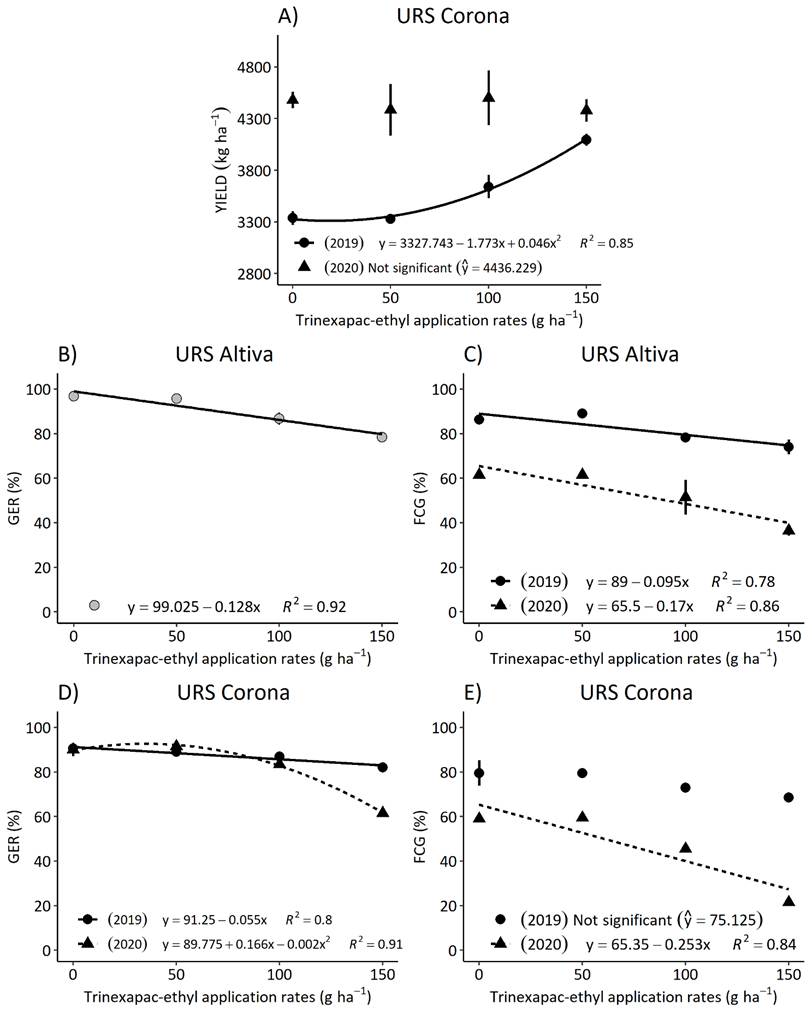
For seed yield of the URS Corona cultivar, a significant interaction was observed between the application rate and the crop season, and a response occurred only in the 2019 crop season, with a quadratic fit and minimum yield of 3,345 kg at the rate of 19.2 g a.i. ha-1 (Figure 2A). The overall mean yield was 4,124 kg.ha-1 for the URS Altiva cultivar and 4.018 kg.ha-1 for URS Corona. Both yields observed were higher than the mean value for the state of Paraná of 2,203 kg.ha-1, estimated for the 2023 crop season (CONAB, 2024).

Seed yield - YLD (kg ha-1) (A), germination - GER (%) (B and D), and first germination count - FGC (%) (C and E) in response to application rates of trinexapac-ethyl (g a.i. ha-1). 2019 and 2020 crop seasons, Londrina, PR, Brazil. The bars indicate standard error.
In another study, Bazzo et al. (2019) evaluated oat cultivars (IPR Afrodite, IPR Artemis, URS Corona, and URS Guria) under the influence of TE (125 g a.i. ha-1) in two growing environments (Mauá da Serra and Londrina, PR) and found a yield increase for all the cultivars under application of TE in Mauá da Serra. However, in Londrina, no response was found for this variable. The authors explain that the yield increase may be related to the effect of the cultivar and its interaction with the environment. Furthermore, they associate the yield increase to reduced plant height and lodging, and to a larger number of panicles per area. In wheat, Zagonel et al. (2002), Penckowski et al. (2009), and Marco-Junior et al. (2013) also observed increased yield with application of TE.
The germination percentage (GER) of the cultivars URS Altiva (Figure 2B) and URS Corona in the 2019 crop season (Figure 2D) decreased linearly as the application rates of TE increased. For URS Corona in the 2020 crop season, the germination values exhibited a quadratic response and a maximum germination rate (93.2%) at the application rate of 41.5 g a.i. ha-1. Beyond that point, germination decreased as the application rate of TE increased.
Seed vigor as evaluated by first germination count (FGC) decreased linearly as the TE application rate increased in the 2019 and 2020 crop seasons for the cultivar URS Altiva (Figure 2C) and in the 2020 crop season for URS Corona (Figure 2E). Thus, based on FGC, both germination and vigor were negatively affected by increasing the TE application rates on the oat cultivars, especially at the highest rate used in this study (150 g a.i. ha-1).
Kaspary et al. (2015) also observed a reduction in first germination count and germination of oat seeds coming from plants exposed to increasing TE application rates. In contrast, Koch et al. (2017) reported an increase in these variables along with increasing TE rates for the wheat cultivar OR Topázio, which was associated with improved plant architecture and shorter source-sink distance.
Despite reduction in germination as TE application rates increased, in general, at the rates of 50 and 100 g a.i. ha-1, germination met the minimum standard of 80% established for production and trade of oat seeds (MAPA, 2013). It should be noted that germination of these seeds at the zero application rate of TE was above 90% for both cultivars. In other words, even in years favorable to obtaining seeds with adequate germination rates, the use of TE at rates higher than 100 g a.i. ha-1 may pose a serious risk to producing oat seeds with germination rates that meet the standards for the seed trade.
Additionally, by the accelerated aging test (AA), reduced vigor was found as the TE application rates increased for URS Altiva (Figure 3A) and for URS Corona (Figure 3C) in the 2020 crop season, with a decreasing linear regression response. In the accelerated aging test, the seeds were subjected to stress conditions (high humidity and temperature), followed by evaluation of their tolerance to these conditions, as expressed by germination rate. This test is thus a way to measure differences among samples regarding vigor, storage potential, and seedling emergence in the field (Marcos-Filho, 2015). Therefore, in addition to impairing germination, increasing TE application rates negatively affected the vigor of oat seeds evaluated in the present study.

Accelerated aging - AA (%) (A and C) and electrical conductivity - EC (µS.cm-1.g-1) (B and D) in response to application rates of trinexapac-ethyl (g a.i. ha-1). 2019 and 2020 crop seasons, Londrina, PR, Brazil. The bars indicate standard error.
The electrical conductivity found for seeds of the URS Altiva (Figure 3B) and URS Corona (Figure 3D) cultivars showed an increasing linear response with an increase in the TE application rates. This evaluation estimates the intensity at which solutes, such as amino acids and inorganic ions, are released through the cell membrane. The higher the amount of leachates, the lower the seed vigor, even if seeds have germination rates acceptable for the seed trade. Consequently, seeds are considered to be more highly deteriorated when having less organized membranes. This deterioration reduces selective permeability, which results in disordered diffusion of ions and organic solutes to the external medium during seed imbibition (Krzyzanowski et al., 2020). Thus, increasing TE application rates led to more highly deteriorated seeds, that is, seeds with reduced vigor.
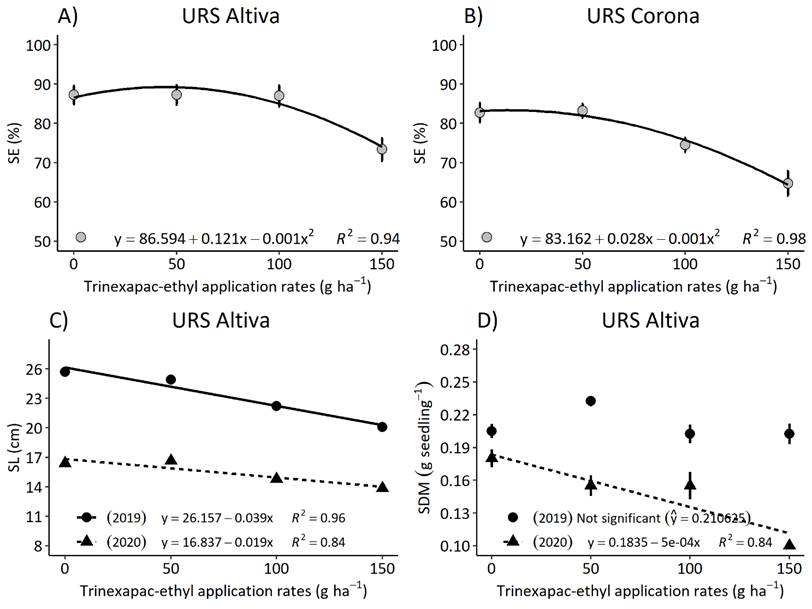
For seedling emergence in sand, both cultivars showed a quadratic response, with a maximum emergence of 90.2% at the rate of 60.5 g a.i. ha-1 for URS Altiva (Figure 4 A) and a maximum emergence of 83.3% at the rate of 14.0 g a.i. ha-1 for URS Corona (Figure 4 B).

Seedling emergence in sand - SE (%) (A and B), seedling length - SL (cm) (C), and seedling dry matter - SDM (g seedling-1) (D) in response to application rates of trinexapac-ethyl (g a.i. ha-1). 2019 and 2020 crop seasons, Londrina, PR, Brazil. The bars indicate standard error.
The data on seedling length for URS Altiva in the 2019 and 2020 crop seasons (Figure 4 C) and seedling dry matter in the 2020 crop season (Figure 4 D) showed a decreasing linear response. The cultivar URS Corona showed no response for this variable; therefore, URS Altiva proved to be more sensitive for this vigor parameter. In this respect, increasing TE application rates not only had a negative effect on seedling growth, but also reduced cumulative dry matter, resulting in less vigorous seedlings.
This reduction in the physiological quality of oat seeds as a result of increasing TE application rates in the present study can be explained by the following hypothesis: The product is applied in the culm elongation phase. This phase includes differentiation and formation of reproductive organs in the panicles, which are forming within the culms. Thus, inhibition of active gibberellin caused by the TE may have affected the development of these structures, and consequently, of the seeds to be produced. This results in seeds with lower physiological potential. Similarly, Bazzo et al. (2019) associated the timing of application with reduction in the number of seeds per oat panicle as a result of TE application, although they observed an increase in the number of panicles per m².
In another study, Alvarez et al. (2007) found that the application of TE (200 g a.i. ha-1) at the panicle primordium differentiation stage in the rice cultivar Primavera, in plants grown in pots in a greenhouse, reduced the number of panicles, the number of spikelets per panicle, and the number of filled spikelets. The authors explained that TE application may have impaired the processes of differentiation of vegetative buds into reproductive buds, resulting in degeneration of panicle primordia, as well as affecting flower formation (stamens and ovary) and meiosis (formation of female and male gametes). This led to lower fertility of the spikelets and, ultimately, to a negative effect on grain production by rice plants.
These results indicate that although an increase in TE application rates may lead to an increase in yield for a certain cultivar in specific years, an increase in the application rates of the growth regulator will result in reduced germination and vigor of the seeds produced, regardless of the cultivar evaluated. Therefore, yield increase is not always associated with improved physiological quality of the seeds produced. This highlights the importance of investigating management practices that promote not only adequate plant growth and development, with increased yield, but also the production of high-quality seeds.
CONCLUSIONS
The seed yield response differed between the cultivars; URS Altiva did not exhibit a response, whereas URS Corona had a positive response only in the 2019 crop season.
Increasing TE rates applied in the culm elongation phase (between the first visible node of the culm and the second detectable node) impaired the germination and vigor of oat seeds of the cultivars URS Altiva and URS Corona, especially at application rates above 100 g a.i. ha-1.
ACKNOWLEDGMENTS
Our thanks to the Conselho Nacional de Desenvolvimento Científico e Tecnológico - CNPq for granting a scholarship, and to the Universidade Estadual de Londrina and the Instituto de Desenvolvimento Rural do Paraná - IAPAR-EMATER (IDR-Paraná) for their structure and support in developing this study.
REFERENCES
-
ALVAREZ, R.C.F.; CRUSCIOL, C.A.C.; TRIVELIN, P.C.O.; RODRIGUES, J.D.; ALVAREZ, A.C.C. Influência do etil-trinexapac no acúmulo, na distribuição de nitrogênio (15N) e na massa de grãos de arroz de terras altas. Revista Brasileira de Ciência do Solo, v.31, n.6, p.1487-1496, 2007. https://doi.org/10.1590/S0100-06832007000600025
» https://doi.org/https://doi.org/10.1590/S0100-06832007000600025 -
BAZZO, J.H.B.; BARBOSA, A.P.; CARDOSO, C.P.; ZUCARELI, C.; FONSECA, I.C.B. Physiological quality of seeds of white oat cultivars in response to trinexapac-ethyl application. Revista Ciência Agronômica, v.49, n.4, p.636-643, 2018. https://doi.org/10.5935/1806-6690.20180072
» https://doi.org/https://doi.org/10.5935/1806-6690.20180072 -
BAZZO J.H.B.; RIEDE, C.R.; ARRUDA, K.M.A.; CARDOSO, C.P.; FRANZONI, I.; FONSECA, I.C.B.; ZUCARELI, C. Performance of white oat cultivars in response to nitrogen fertilization and trinexapac-ethyl. Semina: Ciências Agrárias, v.40, n.5, p.2121-2136, 2019. http://dx.doi.org/10.5433/1679-0359.2019v40n5Supl1p2121
» https://doi.org/http://dx.doi.org/10.5433/1679-0359.2019v40n5Supl1p2121 -
BRASIL. Ministério da Agricultura, Pecuária e Abastecimento. Regras para análise de sementes. Ministério da Agricultura, Pecuária e Abastecimento. Secretaria de Defesa Agropecuária. Brasília: MAPA/ACS, 2009, 399p. https://www.gov.br/agricultura/pt-br/assuntos/insumos-agropecuarios/arquivos-publicacoes-insumos/2946_regras_analise__sementes.pdf
» https://www.gov.br/agricultura/pt-br/assuntos/insumos-agropecuarios/arquivos-publicacoes-insumos/2946_regras_analise__sementes.pdf - EMBRAPA. Empresa Brasileira De Pesquisa Agropecuária. Centro Nacional de Pesquisa de Solos. Sistema brasileiro de classificação de solos 7.ed. Rio de Janeiro. 2018. 356p.
- CBPA. Comissão Brasileira de Pesquisa de Aveia. Informações técnicas para a cultura da aveia: XL Reunião da Comissão Brasileira de Pesquisa da Aveia. Três de Maio: SETREM, 2021. 190p.
-
CONAB. Companhia Nacional de Abastecimento. Série histórica das safras 1976 a 2024 2024. https://www.conab.gov.br/info-agro/safras/serie-historica-das-safras/itemlist/category/901-aveia
» https://www.conab.gov.br/info-agro/safras/serie-historica-das-safras/itemlist/category/901-aveia -
KASPARY, T.E.; LAMEGO, F.P.; BELLÉ, C.; KULCZYNSKI, S.M.; PITTOL, D. Regulador de crescimento na produtividade e qualidade fisiológica de sementes de aveia branca. Planta Daninha, v.33, n.4, p.739-750, 2015. https://doi.org/10.1590/S0100-83582015000400012
» https://doi.org/https://doi.org/10.1590/S0100-83582015000400012 -
KOCH, F.; ZIMMER, G.; MONTEIRO, M.A.; MARTINS, A.C.; DELIAS, D.S.; TROYJACK, C.; SZARESKI, V.J.; BORGES, E.G.; PEDÓ, T.; AMARANTE, L.; VILLELA, F.A.; AUMONDE, T.Z. Chemical composition and physiological quality of wheat seeds with the application of trinexapac-ethyl, a plant growth regulator.Australian Journal of Crop Science, v.11, n.12, p.1527-1533, 2017. https://doi.org/10.21475/ajcs.17.11.12.pne565
» https://doi.org/https://doi.org/10.21475/ajcs.17.11.12.pne565 - KRZYZANOWSKI, F.C.; VIEIRA, R.D.; FRANÇA-NETO, J.B.; MARCOS-FILHO, J. Vigor de sementes: conceitos e testes Londrina: ABRATES, 2020. 383p.
-
MARCO-JUNIOR, J.; CORREA, D.; NAKAI, E.H. Efeito do regulador de crescimento trinexapac-ethyl na produtividade de trigo. Acta Iguazu, v.2, n.1, p.14-19, 2013. https://saber.unioeste.br/index.php/actaiguazu/article/view/7891
» https://saber.unioeste.br/index.php/actaiguazu/article/view/7891 - MARCOS-FILHO, J. Fisiologia de sementes de plantas cultivadas Londrina: ABRATES , 2015. 660p.
- MAPA. Ministério da Agricultura, Pecuária e Abastecimento. Instrução Normativa n° 45, 402 de 17 de setembro de 2013: Anexo XXIII. Brasília: D.O.U, p.38. 2013.
- NITSCHE, P.R.; CARAMORI, P.H.; RICCE, W.S.; PINTO, L.F.D. Atlas climático do estado do Paraná Londrina (PR): Instituto Agronômico do Paraná, 2019. 210p.
- PIMENTEL, G.F. Curso de Estatística Experimental. Piracicaba: FEALP, edição 15, 2009. 451p.
-
PENCKOWSKI, L.H.; ZAGONEL, J.; FERNANDES, E.C. Nitrogênio e redutor de crescimento em trigo de alta produtividade. Acta Scientiarum Agronomy, v.31, n.3, p.473-479, 2009. https://doi.org/10.4025/actasciagron.v31i3.1048
» https://doi.org/https://doi.org/10.4025/actasciagron.v31i3.1048 -
R CORE TEAM. R: A Language and Environment for Statistical Computing R Foundation for Statistical Computing, Vienna. 2023. https://www.R-project.org/
» https://www.R-project.org/ - SHIMIZU, G.D.; GONÇALVES, L.S.A. AgroReg: Main regression models in agricultural sciences implemented as an R Package. Scientia Agricola, v.80, 2023.
-
SHIMIZU, G.D.; MARUBAYASHI, R.Y.; GONCALVES, L.S. AgroR: Experimental statistics and graphics for agricultural sciences 2023. https://cran.r-project.org/web/packages/AgroR/index.html
» https://cran.r-project.org/web/packages/AgroR/index.html -
ZAGONEL, J.; VENANCIO, W.S; KUNZ, R.P.; TANAMATI, H. Doses de nitrogênio e densidades de plantas com e sem um regulador de crescimento afetando o trigo, cultivar OR-1. Ciência Rural, v.32, n.1, p.25-29, 2002. https://doi.org/10.1590/S0103-84782002000100005
» https://doi.org/https://doi.org/10.1590/S0103-84782002000100005