 Depletion of energy reserves and regeneration capacity of germinated Eugenia brasiliensis Lam. Seeds
RESUMO:
Sementes recalcitrantes de espécies de Eugenia apresentam capacidade de regeneração da germinação quando o eixo embrionário é perdido. Mesmo com elevadas reservas energéticas, a germinação simultânea não é comum, indicando processos de autocontrole da germinação nessas sementes. Considerando que sementes de Eugenia podem se regenerar após a eliminação de plântulas, este estudo objetivou verificar a extensão temporal do autocontrole da germinação, desde a germinação até diferentes estádios de desenvolvimento das plântulas. Plântulas de Eugenia brasiliensis Lam. cultivadas em ambiente com ou sem luz contínua tiveram raízes e partes aéreas removidas quando a parte aérea atingiu ≤ 5 cm; 6,0 ± 1,0 cm; 8,0 ± 1,0 cm; 12,0 ± 1,0 cm e ≥ 13,5 cm e foram semeadas novamente em substrato umedecido com água para nova germinação. A regeneração após o desenvolvimento das plântulas demonstrou que a capacidade regenerativa das sementes favorece plântulas que atingiram até 12 cm para aquelas cultivadas no escuro e 8 cm para aquelas cultivadas na luz. Portanto, é possível afirmar que as sementes de E. brasiliensis são capazes de permanecer no solo por longos períodos em condições de produzir novas plantas, mesmo que as condições ambientais sejam desfavoráveis após as primeiras germinações dessas sementes.
Termos de indexação:
estratégia de propagação; sementes recalcitrantes; autocontrole da germinação
ABSTRACT:
Recalcitrant seeds of Eugenia species have the capacity to regenerate germination even after the embryonic axis is lost. Though the seeds have high energy reserves, simultaneous germination is not common, indicating self-regulation of germination processes in these seeds. Since Eugenia seeds can regenerate after seedling elimination, the aim of this study was to determine the temporal extent of this self-regulation period, from germination to different stages of seedling development. The roots and shoots/aerial parts of Eugenia brasiliensis Lam. seedlings grown in an environment with or without continuous light were removed from the seeds when the shoots reached ≤ 5 cm, 6.0 ± 1.0 cm, 8.0 ± 1.0 cm, 12.0 ± 1.0 cm, and ≥ 13.5 cm, after which they were re-sown in a substrate moistened with water for a new germination event. Regeneration after seedling development demonstrated that seedlings that reached up to 12 cm for those grown in the dark and up to 8 cm for those grown in the light favored the regenerative capacity of the seeds. Therefore, this indicates that E. brasiliensis seeds are capable of remaining in the soil for extended periods while maintaining the ability to produce new plants, even under unfavorable environmental conditions after initial germinations of these seeds.
Index terms:
propagation strategy; recalcitrant seeds; self-regulation of germination
INTRODUCTION
Seeds of species of the Eugenia L. (Myrtaceae) genus are able to regenerate roots and shoots, resulting in the development of whole plants, even when part of the seed reserve tissues is removed (Prataviera et al., 2015). When germination originating from the embryonic axis is lost, perivascular parenchyma cells divide periclinally and proliferate, giving rise to a root meristem that can produce new roots and even entire seedlings (Delgado et al., 2022). This suggests that the amount of reserves present in the cotyledons is much greater than needed for germination and initial seedling development (Amorim et al., 2020).
This regenerative capacity is observed in several species of the genus, such as E. pyriformis, E. involucrata, E. brasiliensis, E. uniflora, E. stipitata. E. cerasiflora, E. candolleana, E. pruinosa, and E. umbelliflora (Delgado et al., 2022). Furthermore, it is also present beginning at immature seed stages up to early germination phases (Teixeira and Barbedo, 2012).
In evolutionary terms, this trait may be associated with a strategy of maintaining the same propagule with the ability of colonizing the environment at different times. Unlike what occurs with orthodox seeds (tolerant to desiccation) - especially those with some degree of dormancy and that can germinate at different periods of time, though only once (Barbedo, 2018) - Eugenia seeds, which are recalcitrant (intolerant to desiccation), may be able to germinate multiple times, whenever a previous germination event fails to establish the plant. This is facilitated by a self-regulatory germination system that prevents simultaneous germination events (Amador and Barbedo, 2011). It is also made possible by a water-loss regulatory system in these seeds, which prevents rapid desiccation when the seeds are exposed to the environment (Inocente and Barbedo, 2021).
Therefore, when a germination event does not result in formation and establishment of a plant, new germination events may occur from the same seed, as has been shown for seeds of E. candolleana (Alonso et al., 2024), E. involucrata, and E. brasiliensis (Alonso and Barbedo, 2020). After roots (or even whole seedlings) were removed, the cotyledons were able to regenerate new roots (or seedlings) several times, increasing the propagation ability of the same seed in the field for more than six months. However, the threshold of seed reserve depletion that still allows new germination and seedling production has not yet been established, and this determination was the aim of the present study.
For that purpose, Eugenia brasiliensis Lam. seeds were used, which have proven to be an interesting study model. The hypothesis was that there is a threshold of seedling growth at which seeds lose the described regenerative capacity, or even while maintaining this capacity, they no longer have sufficient reserves to produce a new seedling, or even a new germination event. Therefore, we sought to identify the seedling height at which energy reserves are depleted in E. brasiliensis seeds during the growth and development process.
MATERIAL AND METHODS
Seeds from ripe E. brasiliensis fruits were taken from six mother trees at the Instituto de Pesquisas Ambientais, São Paulo (23°38’27.38’’ S and 46°37’34.57’’ W). A 500-seed sample was sown in a black 130-liter box, with 80% of its volume filled with vermiculite moistened with tap water, which was kept in a germination room at a constant temperature of 25 °C under continuous light. Seedlings derived from these seeds were removed from the box upon reaching determined shoot heights, characterizing the treatments hereafter referred to as light treatments: 1) ≤ 5 cm, 2) 6.0 ( 1.0 cm (hereafter designated as 6 cm), 3) 8.0 ( 1.0 cm (hereafter designated as 8 cm), 4) 12.0 ( 1.5 cm (hereafter designated as 12 cm), and 5) ≥ 13.5 cm.
The roots and shoots were removed from the seedlings of each treatment, and the remaining original seeds were sown in gerboxes containing 300 mL of vermiculite previously moistened with tap water, which were kept under continuous light at 25 °C. They were evaluated weekly regarding root formation (minimum of 0.5 cm) and development of normal defect-free seedlings, as described by Inocente and Barbedo (2021). This germination in gerboxes was called regeneration.
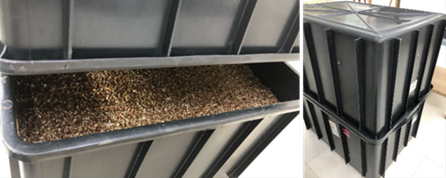
With the aim of avoiding the effects of photosynthetic processes, so as to assess only the use of cotyledon reserves, this entire process was also carried out on seedlings grown under continuous darkness. Therefore, the 130-L black box was covered by another box of this type, but with the opening turned downward, impeding the passage of light (Figure 1), characterizing the treatments hereafter referred to as dark treatments. The seedlings from this set were removed upon reaching the heights described for treatments 1, 2, 3, and 4 above. The roots and shoots of these seedlings were also removed, and the remaining original seeds were likewise sown in gerboxes containing 300 mL of vermiculite previously moistened with tap water, which were kept under continuous light at 25 °C and were evaluated weekly regarding root and seedling formation, as previously described. Both the 130-L boxes and the gerboxes were remoistened whenever necessary.
A completely randomized design was used, with four replications. Analysis of variance (5%) was used on the data, and the means were compared using Tukey’s test at the 5% level (Santana and Ranal, 2004).
RESULTS AND DISCUSSION
The seeds sown under the light treatments exhibited radicle emergence on the 7th day, whereas those sown under the dark treatments, on the 8th day. The seedlings of the ≤ 5 cm, 6.0 cm, 8.0 cm, and 12.0 cm treatments under continuous light were collected at the same time, at around two months after sowing, when the average height of all the seedlings was 10.0 cm. The seedlings of the ≥ 13.5 cm treatment required 11 months to obtain, when the average height of all the seedlings was 14.7 cm (Table 1). That shows that all the seedlings had vigorous but uneven initial growth up to the first 13 cm, after which the growth rate declined substantially.
Root and seedling regeneration (%) in Eugenia brasiliensis Lam. seeds after removal of seedlings with different shoot heights originating from seeds germinated in the presence of light. CV: coefficient of variation.
For the seeds sown in the dark treatment, radicle emergence began on the 8th day. The increase in seedling height under these conditions was faster than that of seedlings grown in the light, and at around one month, the seedlings measuring ≤ 5 cm, 6.0 cm, and 8.0 cm were obtained, when the overall average seedling height was 6.0 cm. The 12-cm seedlings were obtained after four months, when the overall average seedling height was 12.5 cm (Table 2). In the dark treatment, after seed germination, leaves did not develop, and only the epicotyl appeared. These initial seedling growth stages are common for Eugenia species, as described for E. patrisii by Santos et al. (2025), who identified the sequence of radicle emergence, radicle elongation, epicotyl emergence, epicotyl elongation, plumule differentiation, plumule expansion, and, finally, eophyll emergence. This last stage was not achieved by the E. brasiliensis seedlings of the present study grown in the dark. Furthermore, it was not possible to obtain seedlings of more than 13-cm height because, from this stage on, the seedlings began to deteriorate, with fungi almost completely covering the shoots (Figure 2).
Root and seedling regeneration (%) in Eugenia brasiliensis Lam. seeds after removal of seedlings with different shoot heights originating from seeds germinated in the absence of light. CV: coefficient of variation.

Shoots of Eugenia brasiliensis seedlings grown in darkness, showing fungi and lateral sprouting.
The regenerations of the seeds derived from the seedlings grown in the light with up to 6-cm height began at around the 17th day, the seeds from the seedlings from 8 to 12 cm at around the 24th day, and the seeds from the seedlings of more than 13.5 cm did not regenerate. For the seeds from seedlings grown in the dark, those from seedlings up to 6-cm height regenerated at around the 18th day, those from the 8-cm height at around the 22nd day, and those from the 12-cm seedlings on the 36th day.
The results of regeneration of roots and seedlings showed that the seeds from seedlings grown in the dark had better regenerative capacity than those from seedlings grown under continuous light (Tables 1 and 2). While the former maintained root regeneration ability near 100% and seedling regeneration ability greater than or equal to 80% up to the previous seedling development of 12-cm shoot height (Table 2), the latter came to have root regeneration of 25% for seeds that came from 12-cm shoots and less than 40% seedling regeneration even for those that came from 5-cm shoots (Table 1). This considerable difference may be a result of the better development of the seedlings grown in the light and of a possible etiolation of those grown in the dark (Figure 3). The better development of seedlings in the light, with leaf formation that did not occur in those grown in the dark, may have consumed a larger amount of cotyledon reserves, compromising their regenerative capacity. This enhanced development was clear in the vigor of the seedlings produced through regeneration from seeds that were initially sown under continuous dark conditions (Figure 4).

Growth of E. brasiliensis seedlings under continuous light (A) and continuous darkness (B).
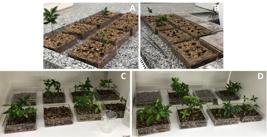
Seedlings regenerated from E. brasiliensis seeds that had previously produced seedlings that were removed from the seeds. A and B: seedlings from seeds that had been under the continuous light treatments; C and D: seedlings from seeds that had been under the continuous darkness treatments.
In spite of the better regenerative performance of the seeds from the continuous dark treatments, it was clear that the regenerative capacity of Eugenia brasiliensis seeds is maintained under both light conditions up to when the seeds had produced seedlings with 12-cm shoot height. In other words, the seeds in fact had reserves much larger than necessary for a single germination and seedling production event. Even when the reserves were used to produce seedlings of 12-cm shoot height, with the removal of these shoots, the remaining seed reserves were sufficient to produce new seedlings. As of the 13.5-cm shoot height in the seedlings grown under continuous light, the reserves remaining in the seeds were visibly reduced (Figure 5), and this reduction may explain the lack of regeneration of seedlings or even only roots under this treatment (Table 1).

Seeds that produced seedlings, with shoot height greater than or equal to 13.5 cm, that were removed from the seed (A) compared to the seed initially placed to germinate (B).
Therefore, the results of the present study showed that the cotyledon reserves are, on the one hand, much greater than that required for development of the seedlings of the first germination, as also shown by Alonso and Barbedo (2020). On the other hand, the reserves are insufficient for new seedling production when the first seedlings grow beyond 12-cm shoot height. This information may be important not only for the seeds of the species studied here, E. brasiliensis, but also for seeds of other species of the genus, since it has been shown that the seed reserves in other species are also much greater than that required for initial seedling development (Silva et al., 2005; Alonso et al., 2019) and are sufficient for various germination events, as shown for E. candolleana (Alonso et al., 2024) and E. involucrata (Alonso and Barbedo, 2020). However, it should be emphasized that the efficiency of the regenerative capacity of Eugenia species seeds is associated with the initial weight of these seeds, which can be highly variable (Prataviera et al., 2015). In fact, this weight is associated with germination efficiency following predation (Jones et al., 2023).
The ability that seeds from Eugenia species have for successive germinations, while exhibiting self-regulation in the use of their reserves and impeding simultaneous germination events (Amador and Barbedo, 2015), may be an important strategy for propagation and colonization of areas. It has been shown that as a result of the impossibility of seedling establishment, such as that resulting from predation (Fonseca and Antunes, 2007) or water restriction (Inocente and Barbedo, 2021), Eugenia seeds can produce new seedlings from the same seed in more favorable time periods. The present study showed that this regenerative capacity remains for a relatively long period. Seeds producing seedlings with up to 12-cm shoot height still have the ability to produce new seedlings if this first seedling investment is lost.
CONCLUSIONS
Eugenia brasiliensis seeds that produce seedlings grown under continuous light with shoots of up to 8 cm and under continuous darkness with shoots of up to 12 cm retain sufficient energy reserves to generate new plants if the initial plants are lost.
ACKNOWLEDGMENTS
Our thanks to the Instituto de Pesquisas Ambientais for providing the facilities and materials that made this project possible, to the Coordenação de Aperfeiçoamento de Pessoal de Nível Superior - CAPES for providing a master’s degree scholarship to Y.T. Cavalcanti, and to the Postgraduate Studies Program in Plant Biodiversity and the Environment of the Instituto de Pesquisas Ambientais for the opportunity of master’s degree studies for Y. T. Cavalcanti.
REFERENCES
-
ALONSO, C.R.; ASPERTI, L.M.; GUARDIA, M.C.; BARBEDO, C.J. Cutting and regeneration of roots and seedlings from seeds of Eugenia candolleana DC. at different maturity stages. Journal of Seed Science, v.41, n.2, p.160-167, 2019. https://doi.org/10.1590/2317-1545v41n2200571
» https://doi.org/https://doi.org/10.1590/2317-1545v41n2200571 -
ALONSO, C.R.; BARBEDO, C.J. Germinações sucessivas em sementes de Eugenia spp. Hoehnea, v.47, e412019, 2020. http://dx.doi.org/10.1590/2236-8906-41/2019
» https://doi.org/http://dx.doi.org/10.1590/2236-8906-41/2019 -
ALONSO, C.R.; RIBEIRO, M.I.; GUARDIA, M.C.; BARBEDO, C.J. Regeneration of roots and shoots as a propagation strategy in Eugenia candolleana DC. (Myrtaceae) seeds. Journal of Seed Science , v.46, e202446003, 2024. https://doi.org/10.1590/2317-1545v46275827
» https://doi.org/https://doi.org/10.1590/2317-1545v46275827 -
AMADOR, T.S.; BARBEDO, C.J. Potencial de inibição da regeneração de raízes e plântulas em sementes germinantes de Eugenia pyriformis Pesquisa Agropecuária Brasileira, v.46, p.814-821, 2011. https://doi.org/10.1590/S0100-204X2011000800005
» https://doi.org/https://doi.org/10.1590/S0100-204X2011000800005 -
AMADOR, T.S.; BARBEDO, C.J. Germination inhibits the growth of new roots and seedlings in Eugenia unifora and Eugenia brasiliensis Journal of Seed Science , v.37, p.241-247, 2015. https://doi.org/10.1590/2317-1545v37n3150595
» https://doi.org/https://doi.org/10.1590/2317-1545v37n3150595 -
AMORIM, I.P.; SILVA, J.P.N.; BARBEDO, C.J. As sementes de Eugenia spp. (Myrtaceae) e seus novos conceitos sobre propagação. Hoehnea , v.47, e292020, 2020. https://doi.org/10.1590/2236-8906-29/2020
» https://doi.org/https://doi.org/10.1590/2236-8906-29/2020 -
BARBEDO, C.J. A new approach towards the so-called recalcitrant seeds. Journal of Seed Science , v.40, p.221-236, 2018. http://dx.doi.org/10.1590/2317-1545v40n3207201
» https://doi.org/http://dx.doi.org/10.1590/2317-1545v40n3207201 -
DELGADO, L.F.; TEIXEIRA, S.P.; CARMELLO-GUERREIRO, S.M.; BARBEDO, C.J. The origin of new roots from cut seeds of Eugenia species. Journal of Seed Science , v.44, e202244014, 2022. https://doi.org/10.1590/2317-1545v44260855
» https://doi.org/https://doi.org/10.1590/2317-1545v44260855 -
FONSECA, F.Y.; ANTUNES, A.Z. Frugivoria e predação de sementes por aves no Parque Estadual Alberto Löfgren, São Paulo, SP. Revista do Instituto Florestal, v.19, p.81-91, 2007. https://smastr16.blob.core.windows.net/iflorestal/ifref/RIF19-2/RIF19-2_81-91.pdf
» https://smastr16.blob.core.windows.net/iflorestal/ifref/RIF19-2/RIF19-2_81-91.pdf -
INOCENTE, M.C.; BARBEDO, C.J. Regeneration of roots and seedlings from Eugenia involucrata seeds under water deficit conditions. Journal of Seed Science , v.43, e202143015. 2021. https://doi.org/10.1590/2317-1545v43248394
» https://doi.org/https://doi.org/10.1590/2317-1545v43248394 -
JONES, L.R.; HUNTS, C.A.; DOLAN, L.A.; MURPHY, N.K.; RIPA, G.N.; SCHOLTZ, E.A.; SHASTRY, V.S.; SKLARCZYK, C.A.; THORNTHO, B.S.; BOUDREAU, M.R. Effects of seed size and toucan regurgitation on the germination of the tropical tree Eugenia uniflora Journal of Tropical Ecology, v.39, e5, 2023. https://doi.org/10.1017/S026646742200044X
» https://doi.org/https://doi.org/10.1017/S026646742200044X -
PRATAVIERA, J.S., LAMARCA, E. V., TEIXEIRA, C.C.; BARBEDO, C.J. The germination success of the cut seeds of Eugenia pyriformis depends on their size and origin. Journal of Seed Science , v.37, p.47-54. 2015. https://doi.org/10.1590/2317-1545v37n1141425
» https://doi.org/https://doi.org/10.1590/2317-1545v37n1141425 - SANTANA, D.G.; RANAL, M.A. Análise da germinação: um enfoque estatístico Brasília, Universidade de Brasília, 2004. 247p.
-
SANTOS, P.P.; CARVALHO, J.C.; GONÇALVES, E.V.; COSTA, K.C.P.; FERNANDES, A.V.; PACHECO, A.A.; REIS, A.A.; GONÇALVES, K.D.; SANTOS, A.S.; CAVALCANTI, J.H.F.; GONÇALVES, J.F.C. Morphoanatomical and physiological indicators revealed distinct intraspecific phenotypes of Eguenia patrisii (Myrtaceae) during germination and post-germination. Australian Journal of Crop Science, v .19, p.658-670, 2025. https://doi.org/10.21475/ajcs.25.19.06.p319
» https://doi.org/https://doi.org/10.21475/ajcs.25.19.06.p319 -
SILVA, C.V.; BILIA, D.A.C.; BARBEDO, C.J. Fracionamento e germinação de sementes de Eugenia Revista Brasileira de Sementes, v.27, p.86-92, 2005. https://doi.org/10.1590/S0101-31222005000100011
» https://doi.org/https://doi.org/10.1590/S0101-31222005000100011 -
TEIXEIRA, C.C. ; BARBEDO, C.J. The development of seedlings from fragments of monoembryonic seeds as an important survival strategy for Eugenia (Myrtaceae) tree species. Trees, Structure and Function, v.26, p.1069-1077, 2012. https://doi.org/10.1007/s00468-011-0648-5
» https://doi.org/https://doi.org/10.1007/s00468-011-0648-5
Additional data will be made available by the authors upon reasonable request.