 Evidence of insecticide resistance in Aedes aegypti populations of Suriname: first report of malathion resistance and presence of the kdr mutations V410L, V1016I and F1534C
Abstract
BACKGROUND Dengue outbreaks pose a significant public health risk in Suriname, with challenges in mosquito surveillance and limited data on insecticide resistance hampering control efforts.
OBJECTIVES To investigate the resistance status and involved mechanisms of Aedes aegypti mosquitoes for malathion and λ-cyhalothrin insecticides.
METHODS The Centres for Disease Control and Prevention (CDC) bottle bioassay was used to test the resistance phenotypic status of Ae. aegypti while the occurrence and frequency of knockdown resistance (kdr) mutations were accessed by TaqMan genotype assays for the sites 410L (Valine/Leucine), 1016I (Valine/Isoleucine), and 1534C (Phenylalanine/Cysteine).
FINDINGS Results showed resistance to malathion in the Blauwgrond population, with other regions exhibiting reduced susceptibility based on mortality rates between 89% and 94%. Very low mortality rates indicate resistance to λ-cyhalothrin in all tested areas. Knockdown resistance (kdr) mutations were detected at high frequencies. The triple homozygous kdr genotype leucine/leucine, isoleucine/isoleucine, cysteine/cysteine (LL/II/CC) predominated (84.2%), while the wild-type genotype was found only in 1.8% of the samples.
MAIN CONCLUSION This study reports the first detection of malathion resistance in Ae. aegypti from Suriname and confirms high levels of resistance to λ-cyhalothrin, possibly driven by kdr gene mutations. The results emphasise the importance of sustained surveillance and continued research on resistance mechanisms to guide effective and evidence-based vector control strategies.
Key words:
Aedes aegypti
; insecticide resistance; kdr mutation; malathion; λ-cyhalothrin
Aedes aegypti (Diptera: Culicidae) is a major threat to public health in the tropics and subtropics because it transmits arboviruses such as dengue, Zika, chikungunya, and yellow fever. Recent data from the Pan American Health Organization (PAHO) mentioned a serious increase in severe dengue cases in the past decades in the region of the Americas, with a record of 4,565,911 reported infections, including 7653 severe cases and 2340 deaths in 2023.1 In Suriname, a middle-income country located in the north of South America, regular outbreaks of dengue are reported, and this country was confronted with the first outbreak of chikungunya in June 2014.2 Since 2015, Zika infections have unfortunately also been detected in Suriname with an outbreak in 2016.3 Vector control, such as insecticide spraying, is still the most used method to prevent infections.4,5 However, a potential threat that undermines the success of vector control programs is the development of resistance to insecticides in the vector.
Many studies from different parts of the world, including the Caribbean and Latin America, have shown that Ae. aegypti develop resistance to commonly used insecticides5,6 such as Organophosphates, including malathion, fenitrothion, and Pyrethroids such as deltamethrin and cypermethrin.5,7,8 Remarkably, resistance to various insecticides may vary in each country or even area.9,10 This makes it necessary for every country touched by mosquito-borne diseases, especially in the low and middle-income countries, to conduct regular surveys of resistance prevalence within the vector population with dynamics between areas.
Four known mechanisms may be associated with insecticide resistance in arthropods, namely: metabolic mechanisms, target-site resistance, reduction of cuticle penetration, and behavioural change. The first two mechanisms are the most common and widely described. Metabolic mechanisms involve changes in enzyme activities in the mosquito that cause rapid insecticide detoxification and prevent the active ingredients from reaching their target. Enzymes involved are especially those from the classes esterases, monooxygenases, and glutathione S-transferases. Synergists are chemicals that inhibit these enzymes in mosquitoes and are used in combination with insecticides to enhance their potency. Target-site resistance involves changes in certain specific protein receptors originally targeted by the insecticide as a result of gene mutations. Known are, for example, mutations known as knockdown resistance (kdr), which reduce the effectiveness of pyrethroids by affecting their target site, the voltage-gated sodium channel.11,7,12
Exposure to insecticides occurs in various ways, such as through government-organised control campaigns, or in agricultural areas, or simply through domestic use in households. At the national level in Suriname, control campaigns are being carried out, and areas with a high transmission risk have been identified.13 From the 1970s, control measures included spraying with insecticides such as malathion, fenithrothion, and, since 2019, λ-cyhalothrin, known as karatox. As a form of biological control, the Bti (Bacillus thuringiensis israelensis) formulation was introduced in 2011 for larval control.13
The Bureau for Public Health in Suriname (BOG) reported reduced susceptibility to deltamethrin and permethrin (BOG unpublished data), while a study in 2017 suggested a possible resistance to malathion in mosquito samples from the area Blauwgrond.14 No studies have been conducted in recent years on the susceptibility status of Ae. aegypti, and any mechanisms responsible for resistance in mosquitoes have not been previously investigated in Suriname.
Therefore, in this study, we assessed the phenotype and genotype insecticide resistance status of the Ae. aegypti field population against the commonly used organophosphate malathion and the pyrethroid λ-cyhalothrin in several districts of Suriname where regular dengue outbreaks are reported.
MATERIALS AND METHODS
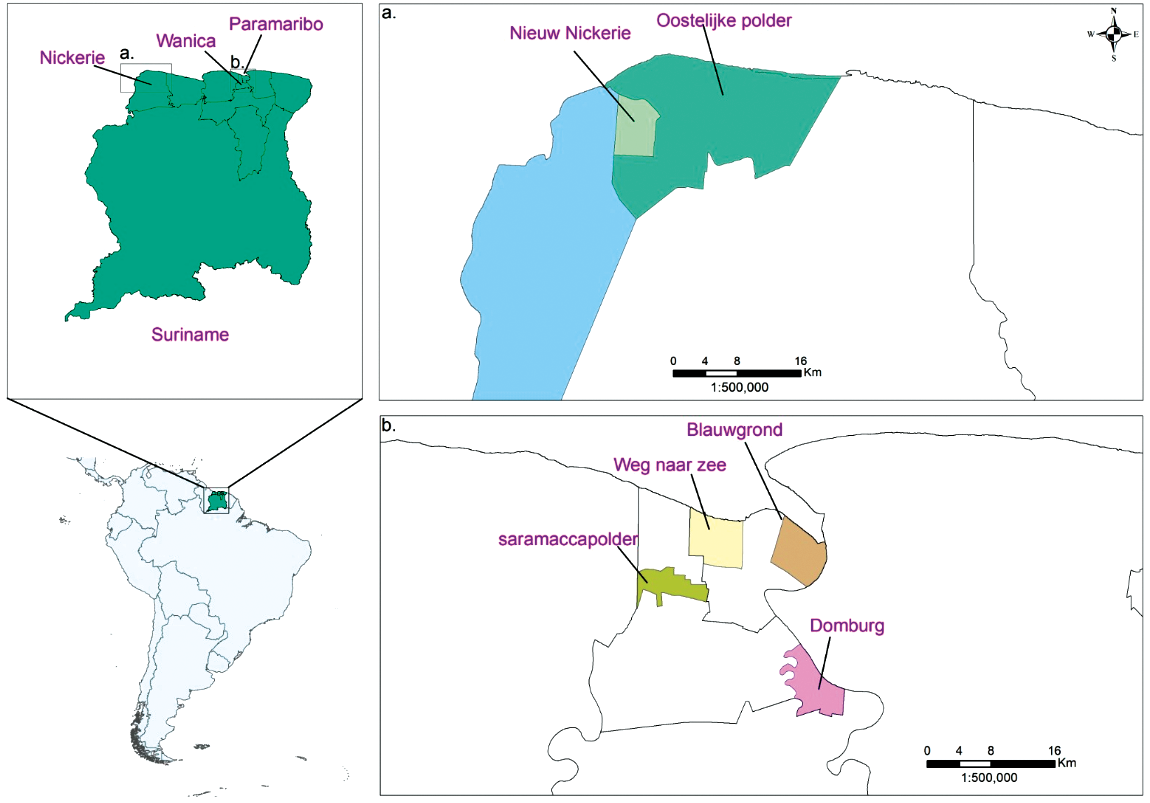
Study sites - In this study we focused on the coastal plain (Fig. 1), where approximately 87 percent of Suriname's population lives.15 Six sites were sampled in three districts, Paramaribo, Wanica and Nickerie, where dengue cases are regularly reported. We selected two urban sites at Paramaribo, the capital of Suriname, with the two locations Blauwgrond (5º51'26.523"N, 55º7'9.489"W) and Weg naar Zee (5º52'31.626"N, 55º12'58.984"W), and Wanica with Domburg (5º42'42.005"N, 55º6'3.085"W) and Saramaccapolder (5º49'21.672"N, 55º15'48.265"W) sites. The third district, Nickerie, borders the south of Suriname and is known for its large areas of agriculture, especially the cultivation of rice. Two resorts have sampled there: Nieuw Nickerie (5º39'18.751"N, 56º47'58.097"W) and Oostelijke Polder (5º56'36.957"N, 56º52'32.211"W).
map of the districts of Suriname and the study sites in the selected districts. The map is generated with QGIS version 3.10.10-A Coruña and ArcMap version 10.0.
Mosquito collection and susceptibility test - From March 2023 through February 2025, fieldwork was conducted in multiple study areas, where a minimum of 30 ovitraps were systematically deployed at each site. Each trap remained in place for a total of eight days, with eggs collected and the trap replaced after four days. The newly placed trap was then collected four days later. The collected eggs were transported to the insectary of the BOG. The eggs per site were carefully pooled and placed in a container with tap water. This ensured the heterogeneity of the population in the samples. After the eggs were left for 2 h in the water, the container was placed in an exicator to de-oxygenise the water to stimulate the breeding of the eggs. After the eggs emerged, the first instar larvae were reared under controlled conditions in the insectary. The larvae were maintained under standard rearing conditions at a temperature of 27 ± 2ºC and a relative humidity of 70 ± 5%. Emerged larvae were fed with fish food till they reached the pupae phase. Pupae were collected with a pipette and placed in a container under a mosquito cage. In every cage, the date was noted as well as other information to make sure we could separate the mosquitoes by age. Adult mosquitoes were fed with a 10% sucrose solution. These adult mosquitoes, aged three to five days, were then tested for insecticide resistance using the Centres for Disease Control and Prevention (CDC) bottle bioassay with 500 mL Wheaton glass bottles. A New Orleans reference strain of Ae. aegypti (NO) was also reared under the same conditions and used as a positive control to validate the bioassays. CDC bottle tests were conducted to assess resistance to two insecticides: malathion and λ-cyhalothrin. In accordance with CDC guidelines,16 technical-grade malathion (provided by the CDC, USA) was tested at 50 μg/mL and λ-cyhalothrin at 10 μg/mL for all Ae. aegypti populations. Per test there were four or five test tubes/badges with an average of 20-25 mosquitoes per tube, and one or two control tubes with the same amount. A synergist bioassay using piperonyl butoxide (PBO) was conducted only for the Saramaccapolder population to evaluate the involvement of oxidase enzymes in resistance mechanisms. Ethanol-treated control bottles were included in all tests for both insecticides. After phenotype testing, a randomly selected number of mosquitoes were preserved frozen at -20ºC, either dry or in RNAlater®.
Molecular markers associated with resistance - To investigate to the occurrence of pyrethroid target-site modification mechanism, we screened for three kdr mutations (V410L, V1016I and F1534C) already reported worldwide. A subset of adult Ae. aegypti mosquitoes collected from three localities [Blauwgrond (20), Weg naar Zee (8), and Nieuw Nickerie (29)] was used for genotyping.
Individual mosquitoes were homogenised in phosphate-buffered saline (PBS), and genomic DNA was extracted using the DNeasy Blood & Tissue Kit (Qiagen, Hilden, Germany), following the manufacturer's protocol. DNA concentrations were measured using a NanoDrop 2000c spectrophotometer (Thermo Scientific, Waltham, MA, USA), and samples were stored at -20 ºC until further analysis.
Genotyping of the V410L (Val/Leu), V1016I (Val/Ile) and F1534C (Phe/Cys) mutations was performed using real-time polymerase chain reaction (PCR) allelic discrimination assays (Applied Biosystems, CA, USA) and the primers, probes, and quantitative PCR (qPCR) cycling conditions followed previously established protocols described in the literature and in a study by Costa et al.17 No novel gene sequences were generated in this study.
Data analysis - Mosquito populations were classified according to World Health Organisation (WHO) guidelines.18 A mortality rate between 98% and 100% indicates susceptibility. When mortality ranges from 90% to 97%, resistance is suspected and must be confirmed through additional bioassays or molecular analyses. If mortality is below 90%, the population is considered resistant, provided that at least 100 mosquitoes were tested. When control mortality is 20% or less, the results can be corrected using Abbott's formula.19 The three sites (410, 1016, and 1534) were considered jointly to calculate genotype frequencies. Based on the observed genotypes, the allelic composition was inferred, from which allele frequencies were subsequently derived.17 These mutations were analysed jointly given that they belong to the same gene and their physical proximity on the Ae. aegypti genome, which suggests they may be in linkage disequilibrium.20
Consent to participate - Participation in this study was voluntary, and there was no risk to either the participants or their families. Eligible participants were required to be at least 18 years of age, provide informed consent, and the study was explained in Dutch or, if necessary, in their native language by a formal vector control technician, ensuring clarity in communication. The study was conducted in collaboration with the Bureau for Public Health, the local health authority in Suriname.
RESULTS
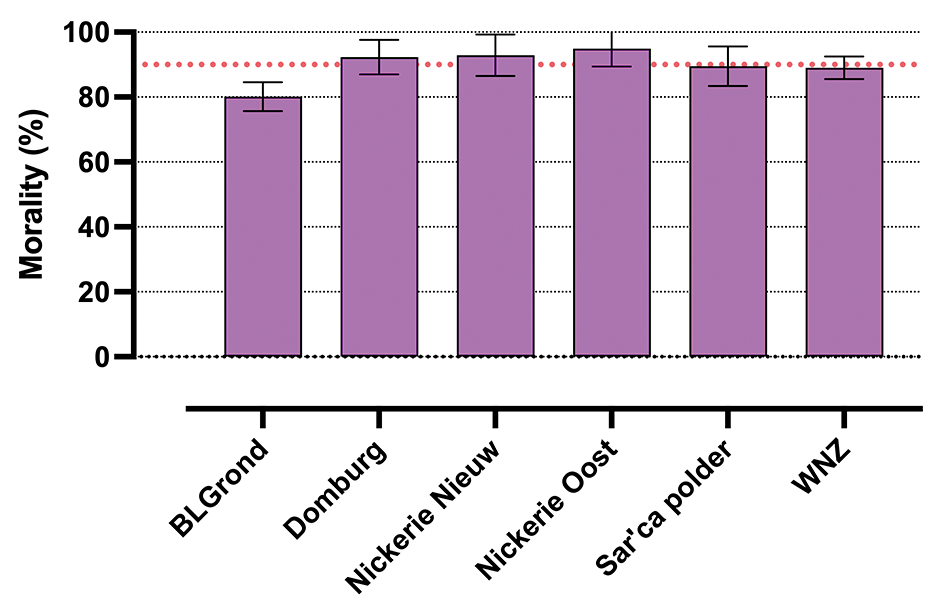
Susceptibility bioassays - During all the tests, there was 100% mortality of mosquitoes of the NO reference strain within 30 min when exposed to the diagnostic dose of malathion and λ-cyhalothrin. Regarding mosquitoes in the negative control group, there was no mortality observed after 30 min of Ethanol exposure. Figs 2-3 show the percentage mortalities of Ae. aegypti field strains in six localities when exposed to insecticides λ-cyhalothrin and malathion at the diagnostic dose and time.
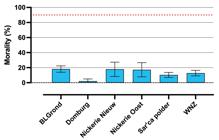
mortality of Aedes aegypti populations from Suriname following 30-min exposure to 10 µg λ-cyhalothrin in Centres for Disease Control and Prevention (CDC) bottle bioassays. Bars represent mean mortality, with error bars indicating the standard error of the mean (SEM) for each locality.
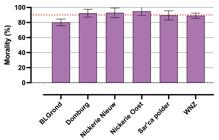
mortality of Aedes aegypti populations from Suriname following 30-min exposure to 50 µg malathion in CDC bottle bioassays. Bars represent mean mortality, with error bars indicating the standard error of the mean (SEM) for each locality. The red dotted line indicates the 90% threshold, below which resistance is confirmed.
For λ-cyhalothrin the mortality rates were all below 20% while the mortality rate for malathion varies between 80.1% and 94.9%
In Saramaccapolder, the mortality rate following exposure to λ-cyhalothrin was 10.3%. In the synergist assay, where the tested mosquitoes were pre-exposed for 1 h to PBO, the mortality rate increased to 43%. Although this represents a significant increase, it nevertheless remains well below the threshold for susceptibility.
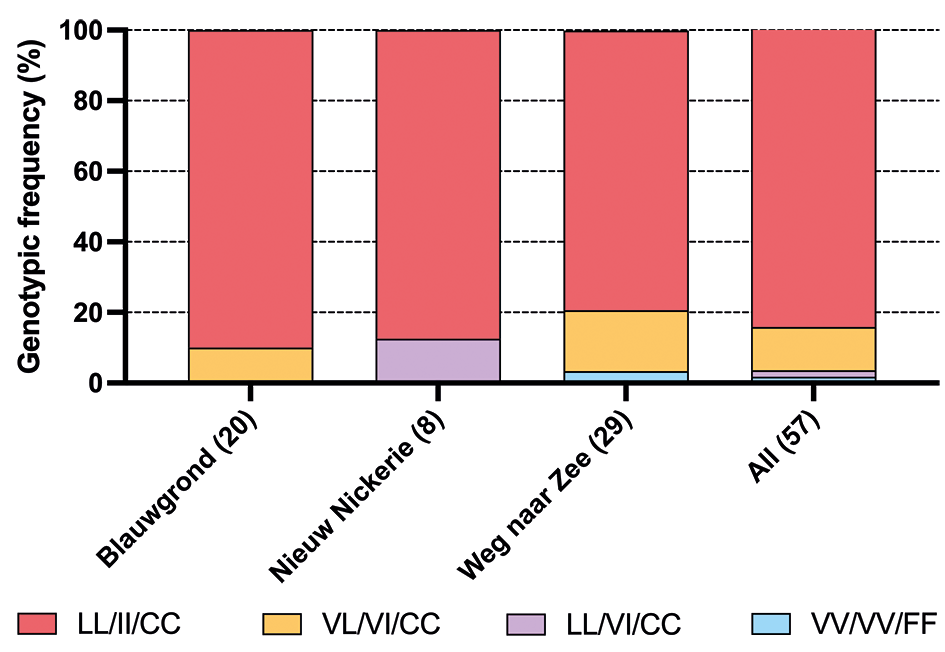
Kdr genotyping - A total of 57 Ae. aegypti mosquitoes were genotyped at three positions associated with kdr resistance (410, 1016, and 1534), revealing four tri-locus genotypes. Overall, kdr mutations were detected at high frequencies (Table I). The triple homozygous kdr genotype leucine/leucine, isoleucine/isoleucine, cysteine/cysteine (LL/II/CC) predominated (84.2%), followed by valine/leucine (VL) / valine/isoleucine (VI) / cysteine/cysteine (CC) (12.3%). The remaining two genotypes, the wild-type valine/valine, valine/valine, phenylalanine/phenylalanine (VV/VV/FF) and leucine/leucine, valine/isoleucine, cysteine/cysteine (LL/VI/CC), together accounted for 3.6% of the total (Fig. 4).
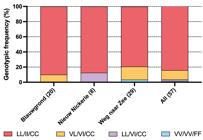
knockdown resistance (kdr) genotyping of Aedes aegypti populations from Suriname based on combined genotypes at three loci (V410L, V1016I and F1534C) in the voltage-gated sodium channel gene. Bars represent the frequency of tri-locus genotypes in each population. Numbers in parentheses indicate the number of mosquitoes genotyped per location.
Distribution of multilocus genotypes and possible haplotype composition in Aedes aegypti from three locations in Suriname
Inferred haplotype frequencies under two alternative phase scenarios are presented in Table II. In both scenarios, the leucine/isoleucine/cysteine (LIC) haplotype was the most frequent.
DISCUSSION
Vector control in Suriname has primarily relied on insecticide-based interventions. As observed globally, such measures may lose effectiveness once reduced susceptibility develops in the target mosquito populations. This study provides the first evidence of malathion resistance in Ae. aegypti mosquitoes in Suriname and offers novel insights into the molecular mechanisms underlying this phenomenon. Molecular analysis revealed the presence of individuals carrying the triple-mutant homozygous kdr genotype LL/II/CC, strongly associated with pyrethroid resistance, under high frequency. These molecular findings are consistent with the phenotypic assays, which confirmed resistance to λ-cyhalothrin across all six study sites, displaying very low mortality indexes in the bioassays.
The observed resistance to λ-cyhalothrin is notable, given that this insecticide was only introduced by the BOG for vector control in 2019. However, before 2015, other pyrethroids were used, such as deltamethrin, and previous studies have shown that Ae. aegypti mosquitoes in different areas of Suriname have developed resistance to deltamethrin.14 The results of this study indicate that the mechanisms leading to reduced pyrethroid susceptibility are still strongly present in the population, possibly inducing cross-resistance from deltamethrin to λ-cyhalothrin. This was also noticed in studies in French Guiana, Brazil, and Venezuela.9,21 In addition, ongoing selection pressure may be reinforced by the widespread use of pyrethroids as pesticides in agriculture, further sustaining this reduced susceptibility phenotype. This was seen in malaria vectors in studies done in Africa.22,23 Indeed, large quantities of λ-cyhalothrin are imported into Suriname for use as an agricultural pesticide.24 Van Sauers-Muller and Ester25 reported that only in 2003, 19.052 kg/L λ-cyhalothrin were registered as imported in Suriname. Data from the Department of Pesticides of the Ministry of Agriculture, Livestock, and Fisheries in Suriname showed that between 2019 and 2022, the average annual import of λ-cyhalothrin was 61,523 litres/year (Unpublished data). Of note, the import of λ-cyhalothrin has been tripled over the past 10 years, suggesting an increasing usage. This keeps a high selection pressure in favour of certain resistance mechanisms, which is manifested by high levels of resistance despite moderate use of the insecticide by BOG. Dusfour et al.26 mention a great loss of the effectiveness of pyrethroids in three French overseas countries, including French Guiana. In Brazil and Argentina, studies mentioned widespread pyrethroid resistance.27,28,29 The results of this study show that Ae. aegypti in Suriname is also resistant to pyrethroids, and this must be considered in the national vector control programs.
In Saramaccapolder, the mortality rate increased when the mosquitoes were pre-exposed to PBO before the testing with λ-cyhalothrin, although it was still resistant. This suggests that, beyond kdr mutation events, metabolic enzymes, such as monooxygenases P450, also play a key role in the resistance.
At Blauwgrond, the result of 80.1% mortality shows resistance to malathion. As far as we know, this is the first confirmed case of malathion resistance in Suriname. On Weg naar Zee, the result showed a 89% mortality rate, which indicates reduced susceptibility. Saramaccapolder had a mortality rate of 88.9% while the other areas showed mortality between 90-97%. The results are an indication of a decline in malathion effectiveness. In none of the cases was susceptibility observed to malathion, which is alarming because past tests till 201714 indicated 98-100% susceptibility to malathion in different areas of Suriname. Changes in the susceptibility of Ae. aegypti to malathion have already been documented in several Latin-American countries, including Brazil, Venezuela, and Jamaica, although the results among the regions differ.26,5,21,10 Since malathion has so far been used in vector control in Suriname and resistance has now been observed for the first time, it calls for alertness from the authorities. Multiple areas should be investigated for the resistance status of the Ae. aegypti. As for pyrethroids, it is also possible that the selection pressure for resistance to malathion is increased by their use in agricultural pesticides. Indeed, and as for malathion, 19,004 L were registered as imported in Suriname only in 2003.23 Similarly, data from the Department of Pesticides of the Ministry of Agriculture, Livestock, and Fisheries in Suriname showed that between 2019 and 2022, the average annual import of malathion was 23,006 litres/year (Unpublished data). This maintained a strong selection pressure for resistance in vector populations.
Molecular analysis conducted as part of this study represents a pioneering effort in the understanding of insecticide resistance mechanisms in Ae. aegypti populations in Suriname. Although the number of samples remains limited, this study is particularly critical given that it is the first of its kind to identify resistance mutations within the country. The triple kdr homozygous genotype (LL/II/CC), which confer a higher selective advantage under insecticide pressure, was the most observed. Remarkably, the wild-type genotype VV/VV/FF was found only in one sample. The levels and combinations of the multilocus genotypes and haplotypes are close to those found in the Ae. aegypti populations in French Guiana, Venezuela, and the neighbouring regions of Brazil, although previous studies have shown that genotype and allele frequency compositions may vary significantly by geographic location.9,21,17,30 The high frequencies of the triple kdr homozygous genotype reported in this study should be interpreted in the context of the study design. Although genotype frequency data from multiple localities were pooled for presentation to provide a country-level overview of resistance, samples from each area were genotyped independently. Notably, the triple kdr homozygous genotype was consistently observed at high frequency across all sampled areas, but the limited number of specimens per area did not allow statistically reliable, area-specific estimates of genotype frequencies. Nevertheless, given the high level of target-site resistance observed in this study and the frequent co-occurrence of multiple resistance mutations in individual mosquitoes, monitoring resistance levels and underlying mechanisms across different regions would be highly valuable.
In conclusion - The outcomes of this study mark an important step forward in our view and comprehension of (reduced) insecticide susceptibility in Ae. aegypti in Suriname. As the first molecular findings of kdr mutations, partially explaining the well-established decreased sensitivity to pyrethroids, and the first case of malathion resistance in this country, they underline the importance of establishing a foundation for further surveillance and systematic monitoring of resistance in vector populations, including genetic analyses. The combination of bioassay results and kdr mutation frequencies in natural populations offers essential insights into resistance intensity and contributes to the design of effective vector control strategies and evidence-based public health policies.
ACKNOWLEDGEMENTS
To the Director and the Departments of Entomology and Surveillance of the Bureau of Public Health Suriname for their cooperation and for providing field and laboratory support. We also thank the Pasteur Institute of French Guiana and the WINSA organisation for their valuable advice and collaboration during this study. We are grateful to the residents of the districts for their participation. Finally, we thank the CDC for providing the test materials used in the CDC bottle bioassays and the World Insecticide Resistance Network-South America, WINSA, for support in the data analysis.
DATA AVAILABILITY
The contents underlying the research text are included in the manuscript.
REFERENCES
-
1 PAHO - Pan American Health Organisation. Effective communication strategies and practices for dengue and other arboviral diseases: systematic review. 2024. Available from: https://iris.paho.org/handle/10665.2/63299
» https://iris.paho.org/handle/10665.2/63299 - 2 van Genderen FT, Krishnadath I, Sno R, Grunberg MG, Zijlmans W, Adhin MR. First chikungunya outbreak in Suriname: clinical and epidemiological features. PLoS Negl Trop Dis. 2016; 10(4): e0004625.
- 3 Codrington J, Roosblad J, Baidjoe A, Holband N, Adde A, Kazanji M, et al. Zika virus outbreak in Suriname, a report based on laboratory surveillance data. PLoS Curr. 2018; 10: ecurrents.outbreaks.ff0f6190d5431c2a2e824255eaeaf339.
- 4 Rocha dos Santos C, Rodovalho CM, Jablonka W, Martins AJ, Pereira Lima JB, Dias LS, et al. Insecticide resistance, fitness and susceptibility to Zika infection of an interbred Aedes aegypti population from Rio de Janeiro, Brazil. Parasit Vectors. 2020; 13: 293.
- 5 Guedes RNC, Beins K, Costa DN, Martins GF, Coelho M, Bezerra HSS. Patterns of insecticide resistance in Aedes aegypti: meta-analyses of surveys in Latin America and the Caribbean. Pest Manag Sci. 2019; 75: 2874-85.
- 6 Goindin D, Delannay C, Gelasse A, Ramdini C, Gaude T, Faucon F, et al. Levels of insecticide resistance to deltamethrin, malathion and temephos and associated mechanisms in Aedes aegypti from Guadeloupe and Saint Martin. Parasit Vectors. 2017; 10: 314.
- 7 Rodriguez M, Ruiz A, Piedra L, Gutierrez G, Rey J, Cruz M, et al. Multiple insecticide resistance in Aedes aegypti from Cuba and associated mechanisms. Acta Trop. 2020; 212: 105680.
- 8 Lesmana SD, Maryanti E, Susanty E, Afandi D, Harmas W, Octaviani DN, et al. Organophosphate resistance in Aedes aegypti from Riau, Indonesia. Rep Biochem Mol Biol. 2022; 10(4): 789-96.
- 9 Guidez A, Pocquet N, Restrepo J, Mathieu L, Gaborit P, Issaly J, et al. Spatiotemporal multiple insecticide resistance in Aedes aegypti populations in French Guiana: need for alternative vector control. Mem Inst Oswaldo Cruz. 2020; 115: e200313.
- 10 Francis S, Campbell T, McKenzie S, Wright D, Crawford J, Hamilton T, et al. Screening of insecticide resistance in Aedes aegypti populations collected from parishes in Eastern Jamaica. PLoS Negl Trop Dis. 2020; 14(7): e0008490.
- 11 Pasteur N, Raymond M. Insecticide resistance genes in mosquitoes: their mutations, migration and selection in field populations. J Hered. 1996; 87: 444-9.
- 12 Gonzalez PV, Loureiro AC, Gomez-Bravo A, Castillo P, Espinosa M, Gil JF, et al. First detection of V410L kdr mutation in Aedes aegypti populations of Argentina supported by toxicological evidence. Parasit Vectors. 2024; 17: 64.
- 13 Hiwat H, Doerdjan K, Kerpens M, Samjhawan A, Sardjoe P, Soekhoe T. Importance of domestic water containers as Aedes aegypti breeding sites in Suriname: implications for dengue control. Acad J Suriname. 2013; 4: 403-7.
- 14 Visser T. Fight against Aedes aegypti: optimization of trapping systems and testing for insecticide resistance in Paramaribo, Suriname. Wageningen: Wageningen University; 2017.
-
15 World Bank. Population, total - Suriname. 2024. Available from: https://databank.worldbank.org/reports.aspx?country=SUR&source=2.
» https://databank.worldbank.org/reports.aspx?country=SUR&source=2 -
16 CDC – Centers for Disease Control and Prevention. Global manual for evaluating insecticide resistance using the CDC bottle bioassay. Atlanta: Centers for Disease Control and Prevention; 2025. Available from: https://www.cdc.gov/mosquitoes/media/pdfs/2024/04/CDC-Global-Bottle-Bioassay-Manual-508.pdf
» https://www.cdc.gov/mosquitoes/media/pdfs/2024/04/CDC-Global-Bottle-Bioassay-Manual-508.pdf -
17 Costa M, Campos K, Brito L, Roux E, Rodovalho C, Bellinato D, et al. Kdr genotyping in Aedes aegypti from Brazil on a nation-wide scale from 2017 to 2018. Sci Rep. 2020; 10: 13267. https://doi.org/10.1038/s41598-020-70029-7.
» https://doi.org/10.1038/s41598-020-70029-7 - 18 WHO - World Health Organization. Monitoring and managing insecticide resistance in Aedes mosquito populations: interim guidance for entomologists. Geneva: WHO; 2016.
- 19 Abbott WS. A method of computing the effectiveness of an insecticide. J Econ Entomol. 1925; 18(2): 265-7.
- 20 Linss JG, Brito LP, Garcia GA, Araki AS, Bruno RV, Lima JB, et al. Distribution and dissemination of the Val1016Ile and Phe1534Cys kdr mutations in Aedes aegypti Brazilian populations. Parasit Vectors. 2014; 7: 25.
- 21 Rubio-Palis Y, Dzuris N, Sandi C, Vizcaino-Cabarrus RL, Corredor-Medina C, González JAC, et al. Insecticide resistance levels and associated mechanisms in three Aedes aegypti populations from Venezuela. Mem Inst Oswaldo Cruz. 2023; 118: e220210.
- 22 Chouaibou MS, Souza SS, Fodjo BK, Zoh MG, Bli NK, Koudou BG. Evidence of insecticide resistance selection in wild Anopheles coluzzii mosquitoes due to agricultural pesticide use. Infect Dis Poverty. 2019; 8: 43.
- 23 Reid MC, McKenzie FE. The contribution of agricultural insecticide use to increasing insecticide resistance in African malaria vectors. Malar J. 2016; 15: 17.
-
24 de Putter H, van Sauers-Muller A. Insecticide gebruik in Oker, Sopropo en Kouseband in Suriname: resultaten van een enquête onder 23 telers. Lelystad: Praktijkonderzoek Plant & Omgeving; 2007. 43 pp. Available from: https://research.wur.nl/en/publications/insecticide-gebruik-in-oker-sopropo-en-kouseband-in-suriname-res
» https://research.wur.nl/en/publications/insecticide-gebruik-in-oker-sopropo-en-kouseband-in-suriname-res -
25 Van Sauers-Muller A, Ester A. Een inventarisatie van het insecticide gebruik in de groenteteelt in Suriname in 2005. 2016. Available from: https://agris.fao.org/agris-search/search.do?recordID=NL2012027472
» https://agris.fao.org/agris-search/search.do?recordID=NL2012027472 - 26 Dusfour I, Zorrilla P, Guidez A, Issaly J, Girod R, Guillaumot L, et al. Deltamethrin resistance mechanisms in Aedes aegypti populations from three French overseas territories. PLoS Negl Trop Dis. 2015; 9(11): e0004226.
- 27 Salgueiro P, Restrepo-Zabaleta J, Costa M, Galardo AKR, Pinto J, Gaborit P, et al. Liaisons dangereuses: cross-border gene flow and dispersal of insecticide resistance-associated genes in Aedes aegypti from Brazil and French Guiana. Mem Inst Oswaldo Cruz. 2019; 114: e190120.
- 28 Campos KB, Martins AJ, Rodovalho CM, Bellinato DF, Dias LS, Macoris MLG, et al. Assessment of susceptibility of Aedes aegypti to pyriproxyfen and malathion in Brazil. Sci Rep. 2020; 10: 5112.
- 29 Fay JV, Espinola SL, Boaglio MV, Blariza MJ, Lopez K, Kulkarni MA, et al. Pyrethroid genetic resistance in Aedes aegypti in Posadas, Argentina. Parasit Vectors. 2023; 16: 210.
- 30 Souza BS, Lima LF, Galardo AKR, Corbel V, Lima JBP, Martins AJ. Genetic structure and kdr mutations in Aedes aegypti populations along a road crossing the Amazon forest. Sci Rep. 2023; 13: 1-11.
Edited by
-
Handling editor:
Ademir de Jesus Martins Jr | https://orcid.org/0000-0001-5739-1215
FIRST REVIEW ROUND - REVIEWERS' COMMENTS
About the reviewerREVIEWER #1
General Comments
The manuscript presents valuable data on insecticide resistance and kdr mutations in Aedes aegypti from Suriname, a region for which limited information is currently available. The study clearly reflects a significant experimental and logistical effort, and the data generated have the potential to make a meaningful contribution to the regional literature on insecticide resistance.
Nevertheless, some aspects related to nomenclature consistency, clarity of methodological descriptions, and data presentation require revision in order to strengthen the manuscript and improve its readability and scientific accuracy. The specific comments below are intended to be constructive and to help improve the overall quality of the work.
Specific Comments
1. Nomenclature of kdr mutations. In general, kdr mutations are named according to their position along the voltage-gated sodium channel. I therefore recommend using a consistent order throughout the manuscript: 410, 1016, and 1534. Please revise the entire manuscript, including figures and tables.
2. Keywords. I suggest remove the word populations from Ae aegypti populations and use simply Ae aegypti.
3. Disease names. In the Introduction (first sentence) and throughout the manuscript, please use capitalization only for Zika, while other disease names should remain in lowercase, ensuring consistency across the text.
4. Capitalization of insecticides and solvents. Names of insecticides and solvents should be written in lowercase. For example (page 5, line 8): organophosphates, including malathion, fenitrothion, and pyrethroids such as deltamethrin and cypermethrin. Also, ethanol; piperonyl butoxide, and more. Please revise accordingly.
5. Species abbreviation. Page 3, line 8: replace Aedes aegypti with Ae aegypti. Please apply this abbreviation consistently throughout the manuscript after the first full mention.
6. Synergists definition. Page 3, line 40: "Synergists are chemicals that inhibit these enzymes in mosquitoes and are used in insecticides to enhance their potency" I believe that should be "Synergists are chemicals that inhibit these enzymes in mosquitoes and are used in combination with insecticides to enhance their potency".
7. Mode of action of pyrethroids. Page 3, line 47: The sentence states that pyrethroids were "developed" to act at the voltage-gated sodium channel. This is not accurate. Please revise to indicate that this channel is the target site at which pyrethroids act, rather than implying intentional development for this site.
8. Population description. Page 4, lines 53–54: the sentence "In this study we focused on the coastal plain (Figure 1), where approximately 87 percent of Suriname's population of …" appears to be incomplete or unclear. Please revise and clarify what is being referred to.
9. Rearing conditions and protocols. Page 5, lines 44–45: Please specify in which institution the insectary is located. Additionally, clarify which standard laboratory protocols were followed or provide appropriate references.
10. Order of kdr mutations in results. Page 6, lines 28–29 and 52–53: Please reorder the kdr mutations consistently as 410, 1016, and 1534.
11. Data analysis redundancy. Page 7, lines 53–54: The description of allele frequency calculation using the formula (2p + pq)/2n has already been presented earlier (lines 11–20). Please avoid repetition or refer back to the previous description.
12. Figures 2 and 3: variability and error measures. Figures 2 and 3 do not show variability. Please indicate whether standard error or standard deviation was calculated and include this information in the figures or figure legends.
13. Genotype nomenclature and clarity. Page 9, lines 9–15: Because kdr mutations are named in different orders throughout the manuscript, it is unclear which SNP each genotype refers to (e.g., LL/II/CC, VL/VI/CC). This issue also affects Figure 5. Please standardize mutation order and clearly indicate which positions the letters refer to in the genotype notation.
14. Allele frequency clarification. Page 9, lines 3–5: When stating that the frequency of the resistant 410L, 1016I, and 1534C alleles is 0.92, 0.91, and 0.98, respectively, please clarify whether these correspond to the Leu, Ile, and Cys alleles.
15. Discussion: interpretation of pooled samples. In the discussion, high frequencies of kdr mutations and the triple homozygous resistant genotype are emphasized. It is important to clearly state that the genotyped mosquitoes represent a pool from different localities. While this provides a general overview, it may mask local variation. Please clarify this in the discussion.
REVIEWER #2
This study is very well written and presented. It is relevant because it is the first study in Suriname to report resistance to the organophosphate insecticide malathion and the pyrethroid lambda-cyhalothrin in Aedes aegypti populations. Furthermore, it provides evidence that kdr mutations contribute to pyrethroid resistance. This study fills an important gap in our understanding of resistance in this region.
The methodology used was based on the CDC bottle bioassay, which is supported by the World Health Organization. Likewise, the references used are relevant, as they include an adequate review of the scientific literature related to kdr mutations worldwide.
AUTHORS' RESPONSE TO THE REVIEWERS
REVIEWER COMMENTS:
Reviewer: 1
General Comments
The manuscript presents valuable data on insecticide resistance and kdr mutations in Aedes aegypti from Suriname, a region for which limited information is currently available. The study clearly reflects a significant experimental and logistical effort, and the data generated have the potential to make a meaningful contribution to the regional literature on insecticide resistance.
Nevertheless, some aspects related to nomenclature consistency, clarity of methodological descriptions, and data presentation require revision in order to strengthen the manuscript and improve its readability and scientific accuracy. The specific comments below are intended to be constructive and to help improve the overall quality of the work.
Specific Comments
1. We agree with the reviewer and have revised the entire manuscript to ensure that kdr mutations are consistently presented in the order 410, 1016, and 1534. This change has been applied throughout the text, as well as in all tables and figures.
2. We agree with the reviewer and have revised the keywords accordingly by removing the word "populations" and using Ae aegypti.
3. We agree with the reviewer and have revised the manuscript to ensure that all insecticide and solvent names are consistently written in lowercase throughout the text.
4. We agree with the reviewer and have revised the manuscript to ensure that all insecticide and solvent names are consistently written in lowercase throughout the text.
5. We agree and have revised the manuscript so that Aedes aegypti is abbreviated as Ae aegypti after the first full mention, and this abbreviation is now used consistently throughout the manuscript.
6. We agree with the reviewer and have replaced the original sentence with the suggested wording to clarify that synergists are used in combination with insecticides to enhance their potency (page 3, line 40).
7. We agree with the reviewer and have revised the sentence to clarify that voltage-gated sodium channels are the target site at which pyrethroids act, rather than implying intentional development for this site (page 3, line 47).
8. We agree and have revised the sentence to improve clarity. The sentence has been completed and clarified to explicitly state that approximately 87% of Suriname's population lives in the coastal plain (page 4, lines 53–54).
9. We have revised the manuscript to specify that the insectary is located at the Entomology Department of the Bureau of Public Health (BOG). In addition, we have expanded the description of the egg hatching and rearing procedures in the section Mosquito collection and susceptibility test to provide more detail on the standard protocols followed.
10. We agree with the reviewer and have revised the Results section to ensure that kdr mutations are consistently presented in the order 410, 1016, and 1534.
11. We agree and have revised the manuscript to remove the redundancy. The allele frequency formula is now presented only once (page 7, lines 11–20), and the repeated description has been deleted.
12. We agree and put the SD proportion in the figures 2 and 3
13. We agree with the reviewer that genotype notation must be fully unambiguous. Although the mutation order was indicated in figure 5, we have revised the results section to explicitly state which alleles correspond to positions 410, 1016, and 1534. This clarification ensures that genotype codes such as LL/II/CC are unambiguously interpretable.
14. We agree with the reviewer and have revised the text to explicitly clarify that the reported allele frequencies correspond to the leucine (410L), isoleucine (1016I), and cysteine (1534C) resistant alleles (page 9, lines 3–5).
15. We agree with the reviewer that it is important to clarify the interpretation of results derived from pooled samples, but want to give some clarification:
The presence of the triple homozygous resistant genotype is indeed emphasized in the discussion, and we acknowledge that the genotyped mosquitoes represent a pooled dataset originating from multiple localities. Importantly, genotyping and initial analyses were performed at the area level, and the triple homozygous resistant genotype was consistently observed at high frequency across all sampled areas. While pooling data for a country-level overview may limit area-specific interpretation, the consistent presence of LL/II/CC across all areas reinforces the overall conclusion regarding widespread kdr-mediated resistance in Suriname. We have revised the discussion to clarify that the results should be interpreted as a general country-level overview, and that the limited number of specimens per area did not allow statistically reliable area-specific frequency estimates.
Reviewer: 2
This study is very well written and presented. It is relevant because it is the first study in Suriname to report resistance to the organophosphate insecticide malathion and the pyrethroid lambda-cyhalothrin in Aedes aegypti populations. Furthermore, it provides evidence that kdr mutations contribute to pyrethroid resistance. This study fills an important gap in our understanding of resistance in this region.
The methodology used was based on the CDC bottle bioassay, which is supported by the World Health Organization. Likewise, the references used are relevant, as they include an adequate review of the scientific literature related to kdr mutations worldwide.
Response to Reviewer 2:
We sincerely thank the reviewer for the very positive and encouraging evaluation of our manuscript, and for recognizing the relevance of the study and the appropriateness of the methodology and references used. Since no specific revisions were requested, no changes were made to the manuscript in response to this reviewer.
Note: For ease of review, all changes made in response to the reviewers' comments are highlighted in red. In addition, a small number of minor, non-substantive changes were made following an internal review by the authors; these do not affect the results or conclusions. All changes are shown in red.
- peer review recommendation: accept
HANDLING EDITOR COMMENTS
About the reviewerHANDLING EDITOR COMMENTS
I appreciate the effort invested in addressing the points previously raised.
I have now conducted a thorough reading of the revised manuscript and inserted my additional comments directly into the PDF file for your consideration.
At this stage, my main concerns are the analysis and presentation of the kdr genotyping data. As currently structured, the analyses still treat each SNP independently. However, since the three mutations investigated (V410L, V1016I, and F1534C) are located within the same gene and were genotyped in the same individuals, it is more informative and biologically meaningful to analyse them jointly as multilocus genotypes.
I strongly require that you reanalyze the data accordingly. Specifically, you should:
(1) list (and plot) all observed combined multilocus genotypes/ population (and or pooled for Suriname);
(2) calculate multilocus genotype frequencies for each population; and
(3) infer the corresponding alleles/haplotypes and estimate their frequencies when appropriate.
Analyzing the loci separately overlooks the biological and evolutionary relevance of specific mutation combinations, which are often the true operational markers under selection. Presenting the data at the multilocus genotype level will substantially strengthen the evolutionary interpretation and scientific value of this study.
I look forward to receiving a revised version addressing these points.
AUTHORS' RESPONSE TO THE REVIEWERS
I strongly require that you reanalyze the data accordingly. Specifically, you should:
(1) list (and plot) all observed combined multilocus genotypes/ population (and or pooled for Suriname) We agree and revised figure 5. All observed multilocus genotypes per location and pooled are presented
(2) calculate multilocus genotype frequencies for each population; and infer the corresponding alleles/haplotypes and estimate their frequencies when appropriate.
We understand and add this information in 2 tables mentioned in page 5 line 8-12
Multilocus genotype distributions are shown in Table I. The fully resistant genotype LL/II/CC predominated (84.2%), followed by VL/VI/CC (12.3%), while other genotypes were rare.
Inferred haplotype frequencies under two alternative scenarios are presented in Table II. In both scenarios, the LIC haplotype was the most frequent.
- peer review recommendation: accept
HANDLING EDITOR COMMENTS
About the reviewerHANDLING EDITOR COMMENTS
Corrections indicated by the handling editor in the attached PDF. See the link below:
https://memorias.ioc.fiocruz.br/images/revistas/2025/open-review/25-0335-open-review.pdf
AUTHORS' RESPONSE TO THE REVIEWERS
Dear Editor and Reviewers,
We would like to sincerely thank you for your thorough evaluation of our manuscript and for the constructive comments provided. We have carefully considered all remarks and have revised the manuscript accordingly.
All changes have been clearly indicated in red in the revised version to facilitate review.
In response to the comments regarding the analysis and presentation of the kdr genotyping data, we have substantially revised this section. Table 4 has been replaced with a new table providing more detailed information on the molecular analyses. In addition, two new tables have been included to present the multilocus genotype distributions (Table I) and inferred haplotype frequencies under two alternative phase scenarios (Table II).
We believe that these revisions have significantly strengthened the manuscript and improved the clarity and scientific value of our findings.
We hope that the revised version meets the journal's requirements and we look forward to your decision.
Sincerely,
Kartika Doerdjan-Ramoutar MSc.
- peer review recommendation: accept
HANDLING EDITOR COMMENTS
About the reviewerHANDLING EDITOR COMMENTS
No comments
- peer review recommendation: accept