
 Comparison of Multiparameter Selection Processes for Potential Application of Titanium Alloys in Coronary Stents
Abstract
This study presents a detailed analysis of the feasibility of Ti-15Mo alloy for coronary stents by independently applying the TOPSIS and RADAR multi-parameter selection methods independently and comparing the results obtained. The research focused on evaluating β-metastable titanium alloys for use in coronary stents, employing the TOPSIS and RADAR methods for a comprehensive and independent analysis. The independent application of these methods enabled for a robust and detailed comparison between different candidate materials, considering crucial criteria such as mechanical strength, biocompatibility, and cost-effectiveness. The results showed that the Ti-15Mo alloy excelled in terms of safety and mechanical performance in both methodologies, offering a combination of mechanical properties and biological compatibility suitable for this application. Compared to 316L stainless steel and Co-Cr L605, Ti-15Mo consistently outperformed across multiple criteria. This study positions Ti-15Mo as a promising candidate for coronary stents and emphasizes the effectiveness of combining TOPSIS and RADAR methodologies for comprehensive material selection in biomedical applications. The research underscores the importance of detailed and methodological evaluation to optimize the performance and safety of advanced biomedical devices.
Keywords:
Material Selection; TOPSIS; Biomaterials; Metastable Titanium; Ti-15Mo; Stents
1. Introduction
Currently, titanium stands out as a promising material for coronary stents due to its biocompatibility, mechanical strength, and corrosion resistance, ensuring durability and safety. Ongoing research shows that advanced material selection methods are essential to avoid inadequate choices and enhance production efficiency. Titanium alloys with a β-metastable microstructure demonstrate potential for enhancing mechanical properties, broadening their applications in medical devices1-4.
Currently, titanium has emerged as an alternative material in the manufacture of coronary stents, essential medical devices for restoring blood flow in narrowed or obstructed coronary arteries. The choice of titanium is supported by several reasons: remarkable biocompatibility, widely tolerated by the human circulatory system, minimizing adverse reactions or undesirable rejections; mechanical strength that allows the stent to withstand compressive and expansive forces during implantation; corrosion resistance that ensures durability in the biological environment. Continued research and development in medical devices offer promising prospects for improving the properties and performance of coronary stents, establishing titanium as a reliable material in advanced and safe cardiovascular treatments1,2.
Material selection process involves choosing the best material for a complex project with multiple, sometimes conflicting factors. Using systematic tools ensures more accurate decisions, as improper material selection can lead to serious consequences, while the right choice offers significant advantages and production gains3,4. In today’s complex and demanding business environment, efficiency, excellence and assertiveness are increasingly necessary. When developing new products and services, it is essential to meet minimum requirements, such as execution time to avoid losses, minimum error culture to prevent rework and cost reduction1. Selecting materials based solely on past successes is insufficient; material selection methods offer a more precise approach, considering both the intended application and material properties. Research on β-metastable titanium alloys underscores their potential for improving mechanical properties, enhancing strength and ductility for new applications.
The TOPSIS (Technique for Order Preference by Similarity to Ideal Solution) and RADAR evaluation methods are important tools for multi-criteria decision-making analysis. The TOPSIS method, originally developed for performance evaluation, ranks and prioritizes alternatives (material candidates) by comparing their distance from a positive ideal solution and a negative ideal solution. The process involves creating a decision matrix, normalizing the material property values, assigning weights to criteria, and applying a coefficient that measures the proximity of each material to the ideal solution5,6. Meanwhile, the RADAR method uses mathematical operations to assign numerical values to materials, measuring their suitability for specific applications. This value is obtained by calculating the area of a radar graph, a useful tool for visually representing information with several variables. Although less used than TOPSIS, RADAR offers advantages in terms of visual interpretation of the data, representing the results with geometric figures that improve understanding and analysis. Both methods are valuable for the careful selection of materials in projects with various evaluation criteria7.
This study advances the field by proposing the application of material selection concepts through the multiparametric methodologies of TOPSIS and RADAR, assessing the feasibility of using β-titanium alloys, with a special focus on the commercial Ti-15Mo alloy, for coronary stents compared to conventional materials. The central aim is to determine whether β-titanium alloys can be viable alternatives to the materials currently used in coronary stents. Additionally, the study establishes new parameters for the application of the TOPSIS and RADAR selection methods, thoroughly evaluating the suitability of the Ti-15Mo alloy for this specific application, highlighting its potential to offer significant improvements in the safety and performance of coronary stents.
The balance between strength and ductility is important in the selection of materials for coronary stents, as the material must withstand the mechanical forces of the cardiovascular environment without sacrificing the flexibility needed for implantation. Similar to magnesium nanocomposites, which aim to optimize these properties, the Ti-15Mo alloy stands out due to its deformation mechanisms that provide excellent strength and natural biocompatibility. This profile makes the Ti-15Mo alloy particularly suitable for stents, offering good mechanical performance under load while maintaining the necessary ductility for deformation during expansion, thereby ensuring long-term patient safety8.
2. Materials and methods
2.1. TOPSIS method and equations
TOPSIS is a classic multicriteria decision analysis method. The method is based on the classification determined by the distance between each alternative and the ideal solutions, one of which is positive and the other negative. The first is defined on the basis of the values considered to be the best, while the second comprises the worst values. The basic principle is to choose an alternative that is as close as possible to the positive ideal solution and as far away as possible from the negative ideal solution5,6. The method has a wide field of application in the area of material selection, as it allows weights to be assigned to the different characteristics and properties of candidate materials for a given application. The final classification of materials is usually complemented by software that provides graphs and visual tools of the result5. The steps of the TOPSIS algorithm can be summarized as follows6:
Step 1 – creation of a decision matrix;
Step 2 – creation of a standardized decision matrix;
Step 3 – creation of a weighting for the matrix;
Step 4 – determination of the positive and negative ideal solution;
Step 5 – calculation of the separation distance of each candidate for each solution;
Step 6 – calculation of the approximation coefficient of the candidates of the ideal solution;
Step 7 – classification in descending order of the approximation coefficient.
For step 1, a decision matrix (D) is defined according to Equation 1:
in which the rows refer to the number of candidate materials for the project and the columns are the properties or characteristics of the materials. As such properties have different magnitudes, in order to make an effective comparison among them, the matrix elements need to be normalized, which is done based on Equation 2:
where nij is a value between 0 and 1. To consider the differences in importance among the properties, a weighted decision matrix is determined from a weight value (wj) carefully assigned to each of the properties being evaluated. Equation 3 calculates the elements of the weighted decision matrix:
With the weighted decision matrix, the ideal solutions are defined, one being positive (vj+) and the other negative (vj–). Equations 4 and 5 respectively provide the separation distance between the values of the weighted matrix and the values of the positive and negative solutions:
Finally, the approximation coefficient (Ci) of each candidate material is calculated based on Equation 6:
Based on the values of Ci, the candidates are classified in descending order, with the best options being those whose global performance is closer to 1. The ordering of these values allows reaching an order of preference for the materials5,6.
2.2. RADAR method and equations
The method referred to here as RADAR is not an established and widely used multi-criteria method like TOPSIS; in fact, it is a set of operations and mathematical manipulations that make it possible to assign a numerical value to each proposed material. This reference value assigned to each material is obtained by calculating the area of a radar graph7,9. As the properties chosen must be arranged on connected axes in order to form a radar graph, and one property used to obtain the punitive coefficient, they must be treated and normalized7. To alleviate this problem, the properties are classified into three degrees of importance:
Grade 1 - Properties that do not need to reach a critical value or do not need to reach values similar to those ideal for the application.
Grade 2 - Properties that must have the properties and values most faithful to those of the application in question, i.e., those properties whose value must be as close as possible to what can be considered ideal.
Grade 3 - Properties that restrict or limit use, i.e., properties that must, without fail, have acceptable values for use.
Out of the properties evaluated, those classified as Grade 1 and 2 will form the axes of the radar graph, while Grade 3 properties are converted into the punitive coefficient7. Grade 3 properties are restrictive and are therefore converted into a value between 0 and 1 which, when multiplying the area of the graph, must contract it enough for the area to be disqualified. To obtain the coefficient, use Equation 7 below.
The treatment of Grade 2 properties is the comparison with the value of the ideal property, where S is the property of the chosen material and S0 is the ideal property. This way of arriving at the result was inspired by Weber and Fechner's observation about the human body's perceptions of stimuli, that the response to any stimulus imposed by the human body is proportional to the logarithm of its intensity. The function that the method uses, Equation 8, is a translation of the Weber-Fechner law7, in which x represents the property ratio (S/S0).
No mathematical manipulation is required for Grade 1 properties, as they are essentially not compared to an ideal situation, i.e., they do not need to reach a critical value for the application. For the normalization of Grade 1 and 2 values, the same Equation 2 as for the TOPSIS method is used. The weights are distributed differently, as the properties are classified in grades. The weights should vary from 0 to 1, depending on the situation. This selection is different from the way they are weighted in the TOPSIS method and there is no need for the sum of weights used to be equal to 100%7,10. At the end of the analysis, when the graph is ready, the area can be calculated by dividing the figure into as many triangles as the number of axes, then calculating the area of each triangle individually using Equation 910,11.
A∆ is the calculated area of the triangle, OX and OY are the line segments from the origin of the axis to the coordinate of the respective axis and θ is the angle formed by the axes7. With the areas of the triangles calculated, they are added together to obtain the area of the graph using Equation 10.
2.3. Procedure
The selection of alloys for coronary stents involves balancing mechanical properties and biocompatibility, both of which are critical for ensuring their functionality and safety. As detailed in Table 1, key mechanical properties such as Young’s modulus, fatigue strength, tensile strength, and ductility are essential for the successful fabrication of thin-walled stents and affect the insertion method18. Cytotoxicity, in addition to these properties, plays a significant role in ensuring stability and safety. The alloys selected, such as 316L stainless steel, Co-Cr L605, and Nitinol, are well-established in commercial applications due to their favorable mechanical and biocompatible properties. The Ti-15Mo alloy stands out for its robust mechanical strength and biocompatibility, which are critical for stent performance. Similarly, 316L stainless steel is renowned for its excellent corrosion resistance and stability in corrosive environments, while Co-Cr L605 is noted for its high resistance to wear and deformation. The inclusion of Nitinol and several titanium alloys, such as Ti-6Al-4V ELI and β-structured alloys like Ti-12Mo-6Zr-2Fe, Ti-13Nb-13Zr, and Ti-15Mo, reinforces the comprehensive approach to selecting materials that meet the necessary mechanical and biocompatibility characteristics. This selection process not only assesses the properties of each alloy but also considers their economic viability and the specific requirements of stent applications (Chart 1).
After defining the properties that would be used in the selection methods, extensive research was carried out in academic papers to gather the mechanical properties of each candidate alloy, as shown in Table 1.
With regard to cytotoxicity, although the values can be obtained by standardized means, initial research showed that there are numerous sources containing this information, but the data in the literature is difficult to compare19. However, what was done was to adopt a four-level scale, as shown in Table 2, similar to other works found in the literature.
Cost is a complex property to determine, as it involves many variables, such as the current scenario (post-Covid-19 pandemic and economic crisis) and the process of obtaining the alloys. To establish cost considerations, an investigation was carried out. For commercially available alloys, values were obtained by consulting international sales platforms. If the alloys required casting processes from different raw materials, the cost estimates were deducted from the values of the constituent metals, acquired from specialized commodity portals and international suppliers20. Initially, an in-depth exploration was carried out on various sales platforms to collect data relating to the cost of each material. These values were compiled in Tables 3 and 4. The subsequent Table 5 shows the proportional values calculated for each alloy.
Calculated cost values per alloy, in US$/kg, used for the application of the selection methods.
3. Results and Discussion
3.1. Data treatment
After collecting the property values from the literature, the TOPSIS and RADAR methods were applied. For the evaluation using these methods, some scenarios were created, with specific weights, to highlight certain properties, depending on the proposed analysis. These scenarios are described in Table 6. The first analysis – scenario 1 – evaluates the materials from a cost-benefit perspective. The goal of this scenario is to select materials with suitable properties for stent applications, while also considering their cost-effectiveness for the project’s viability. The most relevant properties were cost and fatigue resistance, which received the highest weights in the TOPSIS method and the highest values in the RADAR method.
Scenario 2 was designed to select the best material based on the candidate's mechanical behavior, irrespective of production cost. In this way, the weights were distributed in such a way as to value fatigue and ductility properties, as well as strength limits and Young's modulus. The last scenario, number 3, is an analysis from the perspective of application safety. This means that materials with a higher rating, considering the greater weights assigned to cytotoxicity, fatigue resistance and strength limit, offer greater safety for the patients receiving the stent. One observation that should be made with regard to cytotoxicity is that in the RADAR method, it is defined as Grade 3; therefore, it was not considered in the weighting as, by definition, it already restricted the graph.
In addition to assigning cytotoxicity values, production costs had to be determined in order to apply the methods. The initial matrix containing all the properties used to apply the methods was defined, as shown in Table 7. It served as the decision matrix for the TOPSIS method and as the starting point for the RADAR method. This Table 7 is the starting point for both methods (TOPSIS and RADAR), with each method requiring a corresponding normalization before applying the weights for each scenario.
3.2. Normalization of the initial matrix
After collecting and preparing the data, calculating the averages and assigning the costs, the TOPSIS selection method can be applied. The decision matrix (Table 7) is first constructed, followed by normalization using Equation 2 to obtain Table 8.
With the normalized decision matrix assembled, in the third stage, weights were assigned to the properties using Equation 3 and the weights in Table 6. From this stage, the three scenarios aforementioned were created and, after this stage, the positive vij+ and the negative vij- were determined.
The application of the RADAR method began with the decision matrix. The next step was to classify the properties into the grades indicated by the method. Cytotoxicity was defined as a grade 3 property, which will be the source of the punitive coefficient. The other properties were classified as grade 1, because for a coronary stent there are no parameters for comparison, only minimum ranges, and there is no need for a grade 2 classification. With regard to cost, a mathematical transformation was carried out, because an increasing scale is used, but the cost is classified in the opposite way, so an inversion was necessary using Equation 11, where C is the cost and I is the inverted value of the cost, so that the lowest values become the highest without changing the scale.
Table 9 shows the decision matrix that was used for the three scenarios of the RADAR method, with the cytotoxicity values converted into a punitive coefficient (using Equation 7) and the cost values inverted (Equation 11). The other data was normalized using Equation 2.
With the decision matrix normalized, the next step was to assign weights to the properties. Once each scenario had been formed with the weights, the values were organized on the axis of the radar graph and the area could be calculated. With the area value obtained, it was multiplied by the punitive coefficient, obtaining a restricted area value, allowing materials to be compared and classified for selection.
3.3. Scenario 1: Cost-benefit
3.3.1. TOPSIS method
In this scenario, cost and some mechanical properties were prioritized. Cost had the greatest weight, followed by fatigue resistance, as the stent is needed all the time due to blood flow. Subsequent weight was given to ductility and tensile strength properties, due to the manufacture of thin-walled stents and the method of stent insertion. In this way, Table 8 was transformed into a weighted decision matrix, which is shown in Table 10.
With the fourth stage completed, the positive and negative distances, Di+ and Di-, were calculated using Equations 4 and 5. In addition, the relative approximation coefficient Ci+ was determined using Equation 6. With this coefficient, Table 11 is obtained, in which the materials were ranked in ascending order to be selected in the cost-benefit scenario.
Distance values, approximation coefficient and final classification of materials for scenario 1.
3.3.2. RADAR method
As this is the scenario that proposes a situation in which the cost of the material is more relevant, the cost value was considered in its entirety, while the other properties had their values partially considered. Table 12 shows the weighted values. With the weighted values, radar graphs were constructed for each material, as shown in Figure 1.

In the Radar graph, for this scenario, it can be seen that for fatigue properties (FS), all the materials are close. However, for cost ($), stainless steel is still the most interesting material. With the graphs generated, the area for each material can be determined. A value used in the last mathematical step, multiplication by the punitive coefficient, define a reductions in their areas depending on the degree of toxicity of the material; if the area value of any material was null, it was excluded from the analysis because it represented a high danger to the patient. The areas of the graphs, shown in Table 13, were calculated according to Equations 10 and 11.
3.4. Scenario 2: Mechanical performance
3.4.1. TOPSIS method
In this scenario, the mechanical properties of fatigue resistance and ductility were prioritized. Table 14 shows the weighted decision matrix. As in the previous scenario, the distances and the approximation coefficient were calculated, leading to the ranking of materials by performance, as shown in Table 15.
Distance values, approximation coefficient and final classification of materials for scenario 2.
3.4.2. RADAR method
In this scenario, where the goal is optimizing performance, the material’s mechanical properties of ductility and tensile strength were given full weight, while the other properties were assigned progressively decreasing values, resulting in Table 16, weighted for this scenario. Figure 2 shows the graphs for each material.

The Radar graph for this scenario reveals that, while fatigue (FS) and tensile strength (TS) values are similar across materials, notable differences appear in the Young’s modulus (E) and ductility (DUC). To quantify these differences, the area of each graph needs to be calculated, as shown in Table 17.
3.5. Scenario 3: Safety
3.5.1. TOPSIS method
The purpose of the safety scenario is to select the most suitable material with a view to greater patient safety: safety against contamination by ions from the material or possible failure during use, which is why the highest weights were applied to cytotoxicity and fatigue resistance. With this information, Table 18 was obtained. To obtain Table 19 and the final ranking of the safest materials, the positive and negative distances were calculated and then the approximation coefficient was determined.
Distance values, approximation coefficient and final classification of materials for scenario 3.
The goal of this safety scenario is to choose the most suitable material for optimal patient safety, focusing on preventing ion contamination and material failure. Thus, the highest weights were assigned to cytotoxicity and fatigue resistance. Table 18 shows the weighted matrix, while the positive and negative distances were calculated and the approximation coefficient was determined to obtain Table 19 and the final material ranking.
3.5.2. RADAR method
In this scenario, cytotoxicity was already considered as a restricting coefficient for the graph and was therefore excluded from the weighting. Fatigue resistance was given full weight. Table 20 shows the weighted decision matrix, and Figure 3 presents the radar graphs for each material.
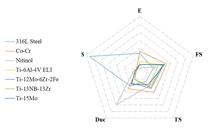
Despite weighting properties related to safety, the cost still significantly distorts the steel area in the graph. The differences will become clearer after calculating the area and multiplying it by the coefficient, as shown in Table 21.
3.6. Comparison of methods
Each method has unique characteristics and response mechanisms. To compare them, the final classification of each material in each scenario and according to each method is presented in Figure 4 and Table 22.

To conclude the analysis of the parameterized selection methods, it is important to highlight specific aspects of each methodology. Both TOPSIS and RADAR employ mathematical steps for classification, though their approaches differ. TOPSIS selects based on distance comparison, while RADAR uses a proportional approach, comparing the entire area of the graph without an ideal comparison. A key consideration for RADAR, originally designed for bone substitutes, is the need for an ideal property value. However, in the context of stents, where no definitive ideal value exists, all properties are classified as Grade 1, except for cytotoxicity (Grade 3), due to the nature of the application.
Both methods allow customization through weight assignment to properties, a positive feature that facilitates various analyses. Despite the different approaches to assigning weights, proportional transformation guarantees similar weights for equivalent analyses. Grade 3 classification, particularly for cytotoxicity, assigns an arbitrary value based on toxicity history. This leads to disqualification in all analyses for Ti-6Al-4V ELI, consistent with its final rating in TOPSIS.
Scenario 1 favors 316L stainless steel, scenario 2 ranks Nitinol first, but shows inconsistencies in the other choices, while scenario 3 sees titanium alloys dominating the top positions. The evaluation of the β-metastable Ti-15Mo alloy reveals competitive characteristics. Ratings vary among scenarios, with the alloy performing best in the safety scenario, indicating the potential for advanced biomedical applications. In the comparative analysis, TOPSIS, a well-established method, shows reliability and extensive validation. RADAR, although promising with consistent results in scenarios 1 and 3, should be applied with caution due to statistical volatility, as evident in scenario 2 compared to TOPSIS.
4. Conclusions
-
The investigation highlights the Ti-15Mo alloy, which consistently demonstrates high-quality performance across all scenarios. Notably, it outperformed the Nb alloy in cost, demonstrating greater stability and consistency in its properties compared to existing materials.
-
The Ti-15Mo alloy has emerged as a strong, competitive candidate for advanced applications, particularly in patient safety-oriented scenarios. Future studies, including thorough characterization and optimization of mechanical properties, could position it as a viable substitute for coronary stents in a post-pandemic economic scenario.
-
The TOPSIS method, known for its reliability, has consistently selected materials that align with expectations across various scenarios. Notable selections include 316L stainless steel for its cost-effectiveness, Co-Cr L605 for mechanical performance, and β-titanium alloys for safety.
-
The RADAR method, though generally reasonable, proved somewhat unpredictable. While scenarios 1 and 3 are quite similar, RADAR diverged from TOPSIS in scenario 2, even ranking Nitinol first. The analysis suggests that RADAR is effective with larger distance values, but may lack sensitivity to minor differences.
-
A macro-level comparison reveals inconsistencies between TOPSIS and RADAR. Despite similar final results, both methods exhibit inconsistencies, selecting different sequences.
5. Acknowledgements
The authors acknowledge the National Council for Scientific and Technological Development (CNPq – process n. 151114/2022-6) for the financial support.
6. References
-
1 Espinha RG. What is project management [Internet]. Artia; 2021 [cited 2021 Aug 11]. Available from: https://artia.com/blog/gestao-de-projetos-o-que-e-para-que-serve/
» https://artia.com/blog/gestao-de-projetos-o-que-e-para-que-serve/ -
2 Geetha M, Singh AK, Asokamani R, Gogia AK. Ti-based biomaterials, the ultimate choice for orthopedic implants: a review. Prog Mater Sci. 2009;54(3):397-425. http://doi.org/10.1016/j.pmatsci.2008.06.004
» http://doi.org/10.1016/j.pmatsci.2008.06.004 - 3 Prado MH. Biomaterials handbook. Curitiba: Departamento de Engenharia Mecânica, Universidade Federal do Paraná; 2021.
-
4 Pires A, Bierhalz ACK, Moraes AM. Biomaterials: types, applications, and market. Quim Nova. 2015;38(7):957-71. http://doi.org/10.5935/0100-4042.20150094
» http://doi.org/10.5935/0100-4042.20150094 -
5 Jee D, Kang K. A method for optimal material selection aided with decision making theory. Mater Des. 2000;21(3):199-206. http://doi.org/10.1016/S0261-3069(99)00066-7
» http://doi.org/10.1016/S0261-3069(99)00066-7 -
6 Kobryń A, Prystrom J. A data pre-processing model for the TOPSIS method. Folia Oecon Stetinensia. 2016;16(2):219-35. http://doi.org/10.1515/foli-2016-0036
» http://doi.org/10.1515/foli-2016-0036 - 7 Belei CAF. Development of criteria for selecting materials for human bone replacement [thesis]. São Carlos: Federal University of São Carlos; 2015. 58 p.
-
8 Abazari S, Shamsipur A, Bakhsheshi-Rad HR, Drelich JW, Goldman J, Sharif S, et al. Magnesium-based nanocomposites: a review from mechanical, creep and fatigue properties. J Magnes Alloys. 2023;11(8):2655-87. http://doi.org/10.1016/j.jma.2023.08.005
» http://doi.org/10.1016/j.jma.2023.08.005 - 9 Chambers JM. Graphical methods for data analysis. 1st ed. Boca Raton: Chapman & Hall/CRC; 2017. 410 p.
- 10 Fechner GT. Elements of psychophysics. Leipzig: Breitkopf & Härtel; 1860.
-
11 Rieper M. Gráfico Radar Excel 2007 [Internet]. Guia do Excel; 2010 [cited 2021 Nov 15]. Available from: https://www.guiadoexcel.com.br/grafico-radar-excel-2007/
» https://www.guiadoexcel.com.br/grafico-radar-excel-2007/ - 12 Mani G, Feldman MD, Patel D, Agrawal CM. Coronary stents: a materials perspective. Biomaterials. 2007;28(9):1689-710. PMid:17188349.
-
13 Silva RCR. Conhecendo os aços inoxidáveis: propriedades mecânicas dos aços inoxidáveis [Internet]. São Paulo: Associação Brasileira de Aço Inoxidável; 2022 [cited 2022 Apr 5]. Available from: https://abinox.org.br/wp-content/uploads/2023/09/Modulo-2.pdf
» https://abinox.org.br/wp-content/uploads/2023/09/Modulo-2.pdf - 14 Andrade AHP, Souza DC No, Lobo RM. caracterização microestrutural e mecânica de uma liga de Co-Cr para implantes médicos. In: 67th ABM Congress; 2012; Rio de Janeiro. Proceedings. Rio de Janeiro: ABM; 2012. 7 p.
- 15 Sashihara EM. Production of Ni-Ti alloy with shape memory effect using electron beam melting and its characterization [thesis]. São José dos Campos: Instituto Tecnológico de Aeronáutica; 2007. 157 p.
-
16 Robertson SW, Pelton AR, Ritchie RO. Mechanical fatigue and fracture of nitinol. Int Mater Rev. 2012;57(1):1-36. http://doi.org/10.1179/1743280411Y.0000000009
» http://doi.org/10.1179/1743280411Y.0000000009 - 17 Duvaizem JH. Obtenção de ligas à base de titânio-nióbio-zircônio processados com hidrogênio e metalurgia do pó para utilização como biomateriais [thesis]. São Paulo: Instituto de Pesquisas Energéticas e Nucleares, Universidade de São Paulo; 2013. 173 p.
-
18 Vishnu J, Manivasagam G, Mantovani D, Udduttula A, Coathup MJ, Popat KC, et al. Balloon expandable coronary stent materials: a systematic review focused on clinical success. In Vitro Model. 2022;1(2):151-75. http://doi.org/10.1007/s44164-022-00009-w
» http://doi.org/10.1007/s44164-022-00009-w - 19 Landuci MC. Caracterização das propriedades mecânicas de biomateriais metálicos [thesis]. Bauru: Universidade Estadual Paulista; 2016. 90 p.
- 20 Ribeiro LD, Campanelli LC. Preliminary study of costs involved in the potential use of titanium alloys in coronary stents. Braz J Bus. 2020;2(4):4076-84.
-
21 Metalary. Latest and historical metal prices [Internet]. 2022 [cited 2022 Feb 27]. Available from: http://metalary.com/
» http://metalary.com/ -
22 Alibaba. Manufacturers, suppliers, exporters & importers from the world’s largest online B2B marketplace [Internet]. 2022 [cited 2022 Feb 26]. Available from: https://www.alibaba.com/
» https://www.alibaba.com/ -
23 IndiaMart. Indian manufacturers suppliers exporters directory [Internet]. India Exporters Manufacturer; 2022 [cited 2022 Feb 26]. Available from: https://www.indiamart.com/
» https://www.indiamart.com/ -
24 USGS: U.S. Geological Survey. Commodity statistics and information [Internet]. 2020 [cited 2022 Feb 26]. Available from: https://www.usgs.gov/centers/nmic/commodity-statistics-and-information
» https://www.usgs.gov/centers/nmic/commodity-statistics-and-information -
25 LME: London Metal Exchange [Internet]. 2022 [cited 2022 Feb 27].Available from: https://www.lme.com/
» https://www.lme.com/


