Production of Biodegradable Nanocomposite Film with Antibacterial Properties for use as Active Packaging
Abstract
The continuous growth of the global population, coupled with new food safety regulations, has driven the demand for packaging that extends food shelf life. In this context, active packaging, which incorporates functional compounds to prolong shelf life without direct addition to the food, emerges as a sustainable alternative. The widespread use of plastic packaging significantly contributes to environmental pollution, fostering increasing interest in the development of biodegradable materials. These materials offer several advantages, including low cost, ease of processing, and renewable origin. This study developed a polymeric film based on cassava starch incorporated with silver nanoparticles (AgNPs) for potential applications in food packaging. The incorporation of AgNPs conferred antimicrobial properties to the film while also enhancing its mechanical strength. The results demonstrated that the developed material exhibits promising performance, comparable to commercial PVC film, while providing a more sustainable solution for food preservation.
Keywords:
Active Packaging; Biofilm; Silver nanoparticles
1. Introduction
The increasing consumption of packaging in the food sector has been expanding exponentially in both scientific and industrial sectors, driven by global population growth and the continuous updating and enhancement of food safety regulations1. Simultaneously, shifts in consumer lifestyles have intensified the demand for clean, high-quality, fresh, minimally processed, and ready-to-eat products with extended shelf lives. Compared to fresh or industrially processed products, minimally processed foods have a shorter shelf life, creating an urgent need for packaging solutions that ensure food quality for extended periods, so-called active packaging1,2.
Active packaging is designed to enhance the preservation of perishable foods by directly interacting with their contents. Additionally, this technology has the potential to replace the incorporation of active compounds directly into food, thereby eliminating industrial processing steps that could increase the risk of pathogen contamination3.
Currently, approximately 40% of food packaging is composed of plastic materials, with usage intensifying over the past decade due to the expansion of the food industry and the increasing demand for packaging4. However, petroleum-based plastics are non-renewable, and their improper disposal has exacerbated environmental pollution. In contrast, biodegradable plastics offer a more sustainable alternative, as they naturally degrade into carbon dioxide, water, and biomass through the action of microorganisms or enzymes5. These polymers can be classified based on their raw material origin, especially biopolymers derived from renewable sources, such as plants6.
In this context, starch has gained attention due to its numerous advantages, including biodegradability, low cost, industrial-scale availability, and ease of processing. Among the options available on the Brazilian market, cassava starch presents a promising alternative, as Brazil is the world's second largest producer of cassava6.
Despite the benefits of biodegradable polymers in packaging applications, they exhibit certain limitations, particularly their relatively low mechanical strength and barrier properties compared to conventional polymers. To address these challenges, many studies have explored the reinforcement of biopolymer matrices with nanoparticles, as nanocomposites have shown promise in enhancing the functional properties of packaging materials7.
In the last decade, silver nanoparticles (AgNPs) have garnered significant attention due to their potent antimicrobial activity. Each AgNP contains between 20 and 15,000 silver atoms and has a diameter smaller than 100 nm. Owing to their high surface-to-volume ratio, studies have demonstrated that even at low concentrations, AgNPs show immunological responses while exhibiting low toxicity, making them suitable for a wide range of applications8.
Thus, this study aimed to develop biodegradable films incorporating silver nanoparticles to produce a packaging material with enhanced mechanical and barrier properties, coupled with antimicrobial activity. This approach seeks to improve food safety and extend the shelf life of fruits and vegetables—commodities widely produced in the São Francisco Valley.
2. Materials and Methods
2.1. Preparation of the control film
The films were prepared using the casting technique. The control film was formulated with 5% cassava starch (w/w) relative to the mass of water and 50% glycerol (w/w) relative to the mass of starch. The solution was continuously stirred until it reached 90°C. Following heating, the mixture was poured into Petri dishes and dried in an oven at 50°C for 24 hours. Subsequently, the drying process was completed at room temperature in a desiccator containing silica gel for approximately 14 days.
2.2. Synthesis of silver nanoparticles (AgNPs)
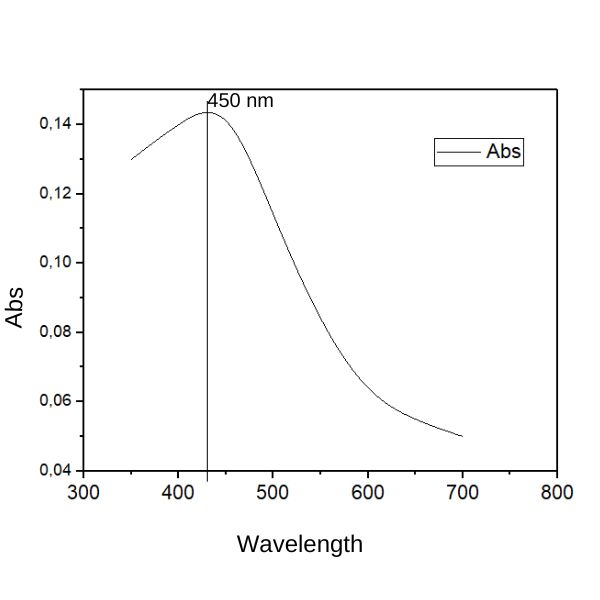
Silver nanoparticles (AgNPs) were synthesized via the chemical reduction of silver salts in an aqueous medium, known as the citrate method, as described by Dilarri et al9. Initially, a sodium citrate (Na3C6H5O7) solution was prepared by dissolving 2.20 g of the salt in 25 mL of distilled water and set aside. In a 100 mL round-bottom flask, 0.025 g of silver nitrate (AgNO3) was dissolved in 50 mL of distilled water and heated under constant stirring until reaching 90°C. Subsequently, 0.5 mL of the previously prepared 0.34 mol·L−1 sodium citrate solution was added dropwise under continuous stirring. Upon the appearance of a golden yellow color, an aliquot of 0.01 mL of ammonium hydroxide (NH4OH) was immediately introduced. The solution was then cooled to 20°C, transferred to an amber bottle, and stored at 4°C in the absence of light. The formation of AgNPs was confirmed by analyzing the maximum absorption wavelength (λmax) within the 350–700 nm range.
2.3 Synthesis of films with silver nanoparticles (AgNPs)
For the synthesis of films incorporating silver nanoparticles, the film-forming solution was prepared using 150 g of water, following the same experimental procedure as the control sample. However, after reaching 90°C, the solution was allowed to cool to room temperature before the addition of 50 mL of the previously prepared AgNP solution. The final solution was then poured into Petri dishes, and the drying process was carried out as described for the control film.
The resulting films were evaluated for their mechanical properties, including tensile strength, elasticity, and elongation, as well as their barrier properties, such as water vapor permeability. Additionally, solubility, thickness, color, and antimicrobial activity were assessed. The obtained results were compared with those of commercial polyvinyl chloride (PVC) film.
2.4. Characterizations
2.4.1. Thickness
The thickness of the films was measured using a digital caliper with an accuracy of 0.01 mm. Measurements were taken at 10 randomly selected points on each sample.
2.4.2. Water vapor permeability
The experiment was conducted using the gravimetric method in accordance with ASTM standard E96/E96M10. Water was introduced into the permeability capsules, filling them up to 20 mm from the films. The films were securely attached to the capsules using a sealing ring and metal clips. The system (capsule + water + sample) was weighed using an analytical balance with a precision of 0.1 mg, and the samples were then placed in a desiccator.
To obtain the mass loss curve, the system was weighed daily for six days, with 24-hour intervals between each measurement. Using the data collected, the angular coefficient necessary for Equation 1 was determined.
Where:
-
TPVA = water vapor permeability rate (g.m-2.day-1)
-
m/t = angular coefficient of the line (g.day-1)
-
A = permeation area of the test specimen (m2)
2.4.3. Tensile test
The tensile test was conducted in accordance with ASTM D882-8311 standard, where the specimens were prepared using a mold for polymeric materials with approximate dimensions of 41 mm in gauge length (L0) and 13 mm in width. Five specimens were tested. The universal testing machine was operated with a load capacity of 100 N and a speed of 20 mm/min.
2.4.4. Color
Color was analyzed at three distinct points on the sample using a digital colorimeter to measure the LAB parameters: L* (luminosity), a* (green-red hue), and b* (blue-yellow hue).
2.4.5. Water solubility
The films were cut into squares with an area of 4 cm2 and dried in an oven at 105°C for 24 hours. After drying, the films were weighed and placed in a beaker containing 50 mL of distilled water, then stirred for 24 hours. The residual sample was dried again in the oven and weighed. Solubility (S%) was calculated according to Equation 2:
Where:
-
%S = percentage solubilized
-
mi = initial mass
-
mf = final mass
2.4.6. X-Ray diffraction (XRD)
The analyses were performed using a Rigaku MiniFlex 600 diffractometer with a copper source and a Cu Kα line. Data acquisition was carried out in the 2θ range of 3° to 100°, with a scan speed of 20°/min and a step size of 0.02°. The crystalline phases were identified using X'Pert High Score Plus software (2009). The data were processed using Origin® software, version 9.5.
2.4.7. Microbiological analysis
The in-vitro antimicrobial activity of the films was evaluated using the disk diffusion method, as described by Hara et al.12. In this method, films impregnated with an antimicrobial agent are placed on the surface of an appropriate solid culture medium previously inoculated with the test bacteria. Bacterial growth is inhibited, forming an inhibition halo around the disk, the diameter of which varies depending on the diffusion rate of the antimicrobial material and the sensitivity of the bacteria. In this study, bacterial suspensions of Escherichia coli and Staphylococcus aureus were tested.
3. Results and Discussion
3.1. Silver Nanoparticles (AgNPs)
Absorption spectroscopy analysis in the UV-Vis region provides insights into the size of AgNPs. The correlation between nanoparticle size and the maximum absorption region is presented in Table 1 adapted from Solomon13.
Correlation between silver nanoparticle size and the wavelength of maximum absorption in the UV-Vis region.
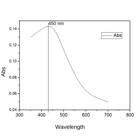
Figure 1 shows the maximum absorbance of the synthesized AgNP solution, with the highest absorbance observed at 450 nm. According to Table 1, AgNPs in this absorption region have a diameter of approximately 60 to 80 nm. Dawadi14 also states that nanoparticles formed in this region typically exhibit a spherical shape.
3.2. Visual aspects
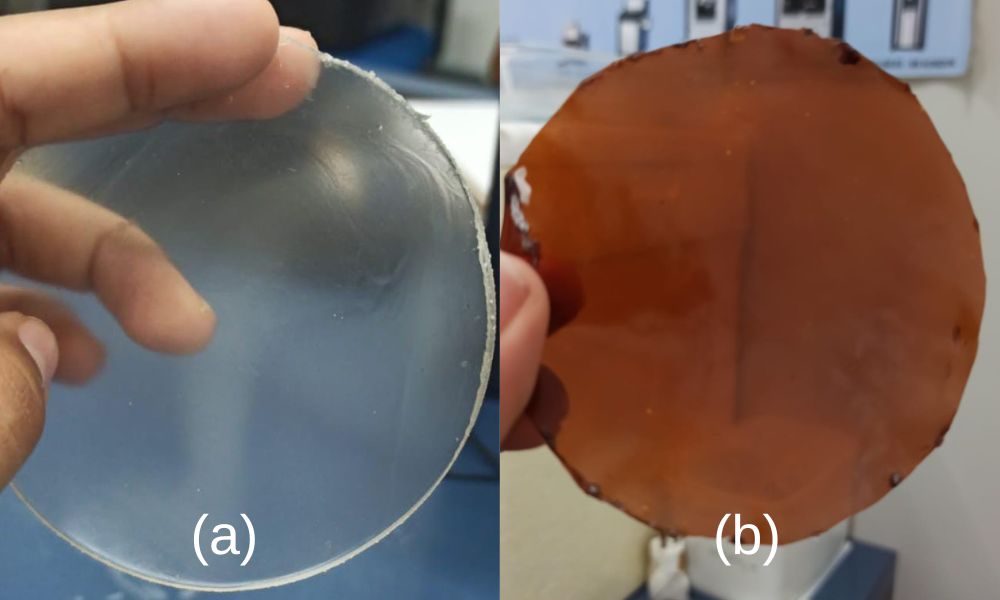
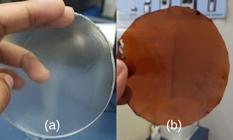
Figure 2 presents a photograph of the produced films. Figure 2(a) shows the control film, which is characterized by a smooth surface, absence of bubbles, and high transparency. In Figure 2(b), the film containing silver nanoparticles (AgNPs) also exhibits a smooth, uniform surface without bubbles; however, it has a reddish-brown color, attributed to the presence of AgNPs. A similar coloration was observed by Orsuwan et al15. when producing agar-based films incorporating banana powder and AgNPs. The color and transparency of films are crucial factors in consumer acceptance. However, even darker-colored films can be used for packaging products susceptible to light-induced degradation, which can affect food color and acidity.
3.3. Color
In addition to Figure 2, Table 2 presents the data on the analyzed color parameters. The film coloration is represented by the L*, a*, and b* color spaces. The incorporation of AgNPs resulted in a decrease in luminosity from 78.6 to 7.8 and an increase in color intensity, as indicated by the C* (chroma) parameter, which rose from 0.7 in the control sample to 16.8 after the addition of AgNPs. The increase in red and yellow hues is reflected in the a* and b* values.
3.4. Physical properties
Table 3 presents the physical properties of the films, showing a thickness of approximately 0.40 mm in both the control film and the film containing AgNPs.
The addition of nanoparticles increased the film permeability and reduced solubility, as AgNPs contribute to the formation of nanobiocomposites and modify the crystalline structure of the film. Low solubility and high permeability are important properties for packaging materials intended for perishable foods, particularly those with high water activity16.
3.5. X-Ray Diffraction (XRD)
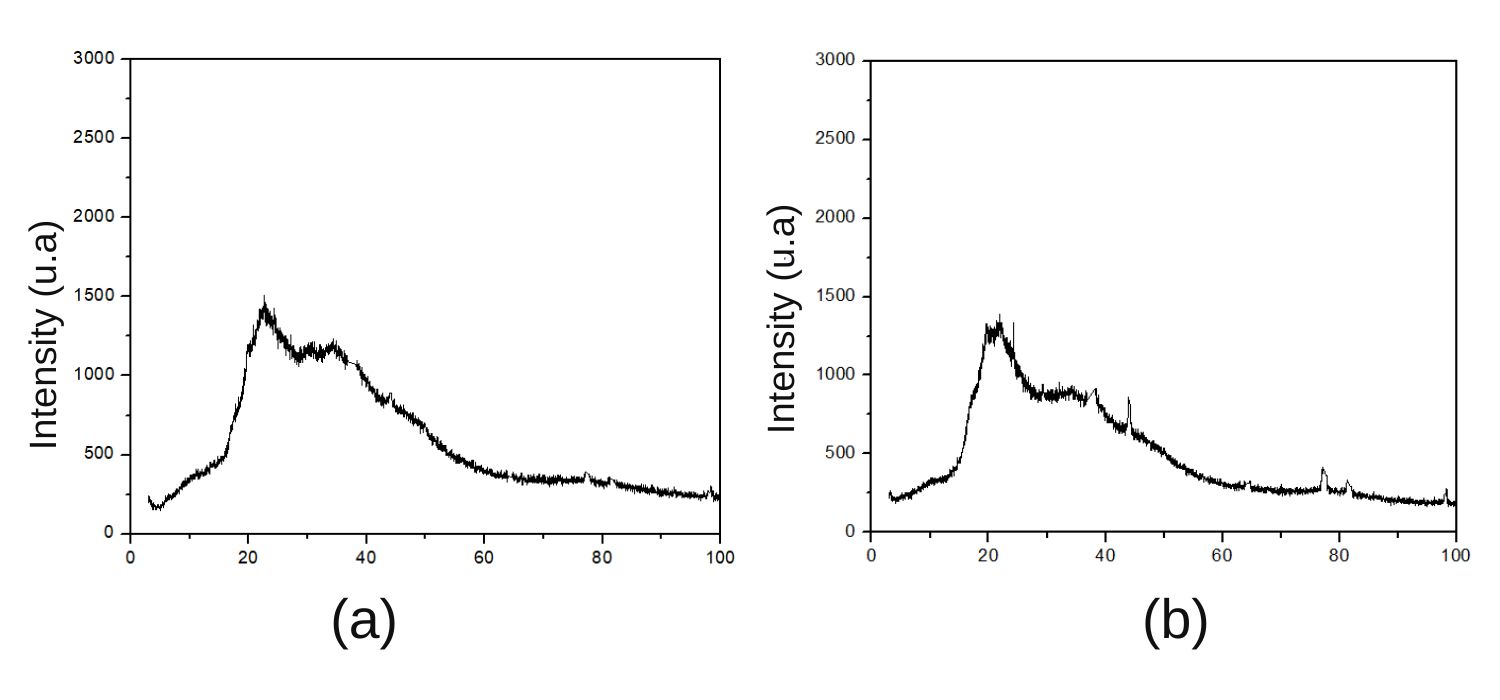
The X-ray diffractograms of the films are presented in Figure 3, revealing both amorphous and crystalline phases. The crystalline phase is characterized by Bragg peaks superimposed on the diffraction bands, which is typical of semi-crystalline materials. The crystalline phase observed at 2θ = 21.98° is attributed to gelatinized starch, a characteristic peak of materials processed at temperatures below 180°C and moisture contents below 10%17.
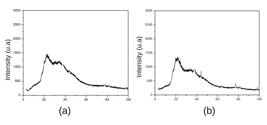
The film containing AgNPs exhibited no shift in peak positions compared to the control film but displayed the crystalline pattern of AgC2H2N3O (ICSD 063100), with characteristic silver peaks at 2θ values of 21.28°, 41.41°, 46.59°, 63.63°, 78.96°, and 82.19°.
3.6. Mechanical properties
Table 4 presents the mechanical properties of the films. Tensile strength represents the material's resistance at the breaking point. In general, films produced from vegetable waste typically exhibit tensile strength values ranging from 0.7 to 6.85 MPa18, which aligns with the values obtained for the films in this study. The incorporation of AgNPs into the film did not result in significant changes in tensile strength compared to the control film. However, other mechanical properties, such as the modulus of elasticity and elongation percentage, showed improvements. Notably, elongation increased from 38.55% to 49.98%. These values are comparable to those of commercial films, highlighting the potential of the produced films for packaging applications.
3.7. Microbiological analysis
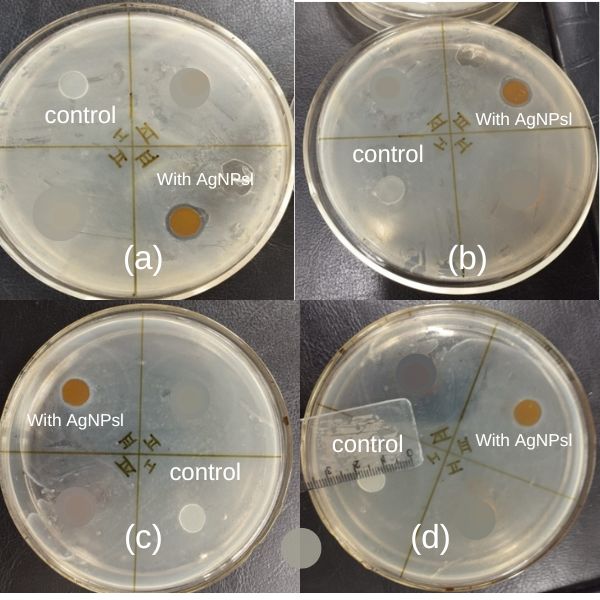
Figure 4 presents the results of the antimicrobial analyses against Gram-positive and Gram-negative bacteria. For the Gram-positive bacterium Staphylococcus aureus (S. aureus), the film containing AgNPs exhibited bacterial growth inhibition at both 24 and 48 hours, with an inhibition halo of 12 mm. According to Mauro et al.19, inhibition halos of this diameter indicate clear antimicrobial activity. In contrast, for the Gram-negative bacterium Escherichia coli (E. coli), no inhibition halos were observed in the AgNP-containing film.
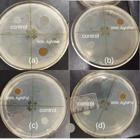
Microbiological Analysis (a) S. áureos 24h; (b) S. áureos 48h; (c) E. coli 24h (d) E. coli 48h.
Moura et al.20 investigated the antimicrobial activity of films incorporating silver nanoparticles against the same bacterial strains studied in this work. They reported larger inhibition halos for S. aureus (13.5 mm), while E. coli also exhibited antimicrobial activity, though with significantly smaller halos (10.5 mm).
4. Conclusion
The incorporation of silver nanoparticles (AgNPs) endowed the film with antimicrobial properties and enhanced its mechanical strength. The results demonstrated that the material exhibits promising performance, comparable to commercial PVC films, while also providing a more sustainable solution for food preservation
Data Availability
The entire dataset supporting the results of this study was published in the article itself.
5. References
- 1 Firouz MS, Mohi-Alden K, Omid M. A critical review on intelligent and active packaging in the food industry: research and development. Food Res Int. 2021;141:110113.
- 2 De Assis OBG, Britto D. Embalagens ativas e inteligentes: conceitos e aplicações. Hig Aliment. 2013;27(226-227):37-43.
- 3 Umaraw P, Verma AK, Yadav S, Kumar P, Singh VP. Edible films/coating with tailored properties for active packaging of meat, fish and derived products. Trends Food Sci Technol. 2020;98:10-24.
- 4 Shaikh S, Yaqoob M, Aggarwal P. An overview of biodegradable packaging in food industry. Curr Res Food Sci. 2021;4:503-20.
- 5 Pereira AC, Bardi MAG. Cenário da produção brasileira de plásticos biodegradáveis e oxibiodegradáveis: uma proposta de análise mercadológica. Cad PAIC. 2020;21(1):299-308.
- 6 Friedrichsen JSA, Oliveira EM Jr, Teixeira RFB, Queiroz AJM. O uso de amido como proposta para embalagens biodegradáveis – Uma revisão. Res Soc Dev. 2022;11(14):e282111436449.
- 7 Abdul Khalil HPS, Banerjee A, Saurabh CK, Tye YY, Suriani AB, Mohamed A, et al. Biodegradable films for fruits and vegetables packaging application: preparation and properties. Food Eng Rev. 2018;10:139-53.
- 8 Yin IX, Zhang J, Zhao IS, Mei ML, Li Q, Chu CH. The antibacterial mechanism of silver nanoparticles and its application in dentistry. Int J Nanomedicine. 2020;15:2555-62.
- 9 Dilarri G, Mendes CR, Martins AO. Síntese de biofilmes de quitosana reticulados com tripolifosfato atuando como agente quelante na fixação de nanopartículas de prata. Cienc Eng. 2016;25:97-103.
- 10 ASTM: American Society for Testing and Materials. ASTM E96/E96M: standard test methods for water vapor transmission of materials. West Conshohocken: ASTM International; 2010.
- 11 ASTM: American Society for Testing and Materials. ASTM D882-83: Standard test method for tensile properties of thin plastic sheeting. West Conshohocken: ASTM International; 2010.
- 12 Hara Y, Castell‐Perez ME, Moreira RG. Antimicrobial properties of poly (vinyl alcohol) films with zeolitic imidazolate framework (ZIF‐8) nanoparticles for food packaging. J Food Sci. 2023;88(6):2512-22.
- 13 Solomon SD, Bahadory M, Jeyarajasingam AV, Rutkowsky SA, Boritz C. Synthesis and study of silver nanoparticles. J Chem Educ. 2007;84(2):322-5.
- 14 Dawadi S, Katuwal S, Gupta A, Lamichhane U, Thapa R, Jaisi S, et al. Current research on silver nanoparticles: synthesis, characterization, and applications. J Nanomater. 2021;2021:1-23.
- 15 Orsuwan A, Shankar S, Wang LF, Sothornvit R, Rhim JW. Preparation of antimicrobial agar/banana powder blend films reinforced with silver nanoparticles. Food Hydrocoll. 2016;60:476-85.
- 16 Romani VP, Martins VG, Goddard JM. Radical scavenging polyethylene films as antioxidant active packaging materials. Food Control. 2020;109:106946.
- 17 Faria FO, Tonon CC, Tadini CC, Matta M, Benassi MT. Propriedades físicas de filmes biodegradáveis à base de amido de mandioca, álcool polivinílico e montmorilonita. Quim Nova. 2012;35:487-92.
- 18 Miranda NN, Nascimento JA, Rocha DCF, Moreira RF, Oliveira GJP. Desenvolvimento e caracterização de filmes biodegradáveis de araruta. Res Soc Dev. 2023;11(5):e54311528544.
- 19 Mauro M, Pintado M, Castro PML, Silva L. Chitosan film functionalized with grape seed oil: preliminary evaluation of antimicrobial activity. Sustainability. 2022;14(9):5410.
- 20 Moura MR, Mattoso LHC, Zucolotto V. Development of cellulose-based bactericidal nanocomposites containing silver nanoparticles and their use as active food packaging. J Food Eng. 2012;109(3):520-4.
Edited by
-
Associate Editor:
Gerson Marinucci
-
Editor-in-Chief:
Luiz Antonio Pessan