Structural Characterization of Two New Quaternary Chalcogenides: CuCo2InTe4 and CuNi2InTe4
Abstract
The crystal structure of the chalcogenide compounds CuCo2InTe4 and CuNi2InTe4, two new members of the I-II2-III-VI4 family, were characterized by Rietveld refinement using X-ray powder diffraction data. Both materials crystallize in the tetragonal space group I4 2m (No. 121), Z = 2, with a stannite-type structure, with the binaries CoTe and NiTe as secondary phases.
Keywords
alloys; semiconductors; chemical synthesis; structural characterization; X-ray powder diffraction
1. Introduction
Diluted magnetic semiconductors (DMS) are of great interest because of their peculiar magnetic and magnetooptical properties arising from the presence of magnetic ions in the lattice1. The DMS materials more frequently studied are alloys obtained from the tetrahedrally coordinated derivatives of the II-VI semiconductor family2. One of these derivative families are the quaternary semiconductors with formula I-II2-III-VI4 and I2-II-IV-VI4 which belong to the normal compound of fourth derivatives of the II-VI binary semiconductors with three types of cations3, and fulfil the rules of adamantane compound formation2,3. According to these rules, the cation substitution is performed in such a way that an average number of four valence electrons per atomic site and a value eight for the ratio valence electrons to anions is maintained2.
Due to the great variety of possible compositions (I= Cu, Ag, II= Zn, Cd, Mn, Fe, III= Al, Ga, In, IV= Si, Ge, Sn, VI= S, Se, Te), these quaternary diamond-like materials can be useful for applications such as tunable semiconductors4, photovoltaics5, spintronics6, non-linear optics7 and thermoelectrics8. In general, the quaternary compounds I-II2-III-VI4 can be formed by the addition of a II-VI binary compound to ternary chalcopyrite structures I-III-VI29,10. Structural studies carried out on some members of this family indicate that they crystallize in a sphalerite derivative structure (stannite) with tetragonal space group I4 2m (No. 121)11, or in a wurtzite derivative structure (wurtzite-stannite) with orthorhombic space group Pmn21 (No. 31)12. This last structure can be considered as a superstructure to wurtzite, where a~2aw, b~√3bw, and c~cw12.
The quaternaries CuFe2(Al,Ga,In)Se413,14, CuTa2InTe415, AgFe2GaTe416 and the stable forms at higher temperatures of CuZn2(Al,Ga,In)S417, crystalizes in stannite-type structure while AgCd2GaS418, AgCd2GaSe419, Ag1-XCuXCd2GaS420, AgCd2Ga1-XInXS421 and AgCd2-XMnXGaS422 have been reported with a wurtz-stannite structure.
In recent years, it has been of interest to carry out a systematic study of the crystal structure of quaternary diamond-like families13-16,23-26. Hence, in this work we report the X-ray powder diffraction analysis and crystal structure of the quaternary compounds CuCo2InTe4 and CuNi2InTe4, two new members of the I-II2-III-VI4 family, which crystallize with a stannite structure.
2. Experimental procedures
2.1. Synthesis
Nominally CuCo2InTe4 and CuNi2InTe4 samples were synthesized using the melt-anneal method. Stoichiometric quantities of Cu, Co, Ni, In, Te elements with purity of at least 99.99% (GoodFellow) were charged in an evacuated synthetic silica glass ampoule, which was previously subjected to pyrolysis in order to avoid reaction of the starting materials with silica glass. Then, the ampoule was sealed under vacuum (~10-4 Torr) and the fusion process was carried out inside a furnace (vertical position) heated up to 1500 K at a rate of 20 K/h, with a stop of 48 h at 722.5 K (melting temperature of Te) in order to maximize the formation of binary species at low temperature and minimize the presence of unreacted Te at high temperatures. The ampoule was shaken using a mechanical system during the entire heating process in order to aid the complete mixing of all the elements. The maximum temperature (1500 K) was held for an additional 48 hours with the mechanical shaking system on. Then, the mechanical shaking system was turning off and the temperature was gradually lowered, at the same rate of 20 K/h, until 873 K. The ampoule was held at this temperature for a period of 30 days. Finally, the sample was cooled to room temperature at a rate of 10 K/h. The obtained ingots were bright gray in color and homogeneous to the eye.
2.2. X-ray powder diffraction
X-ray powder diffraction patterns were recorded using a PANalytical X'Pert Pro MPD powder X-ray diffractometer operating in Bragg-Brentano geometry using CuKα radiation with an average wavelength of 1.5418 Å. A tube power of 45 kV and 40 mA was employed. A nickel filter was used in the diffracted beam optics and the data were collected with the X'Celerator one-dimensional silicon strip detector. A ¼º divergent slit, a 1/2º antiscatter slit, and a 0.02 rad soller slit were set at both the incident and diffracted beams. The scan range was from 5 to 145º 2θ with a step size of 0.008º and a scan speed of 0.0106º/s.
3. Results and Discussion
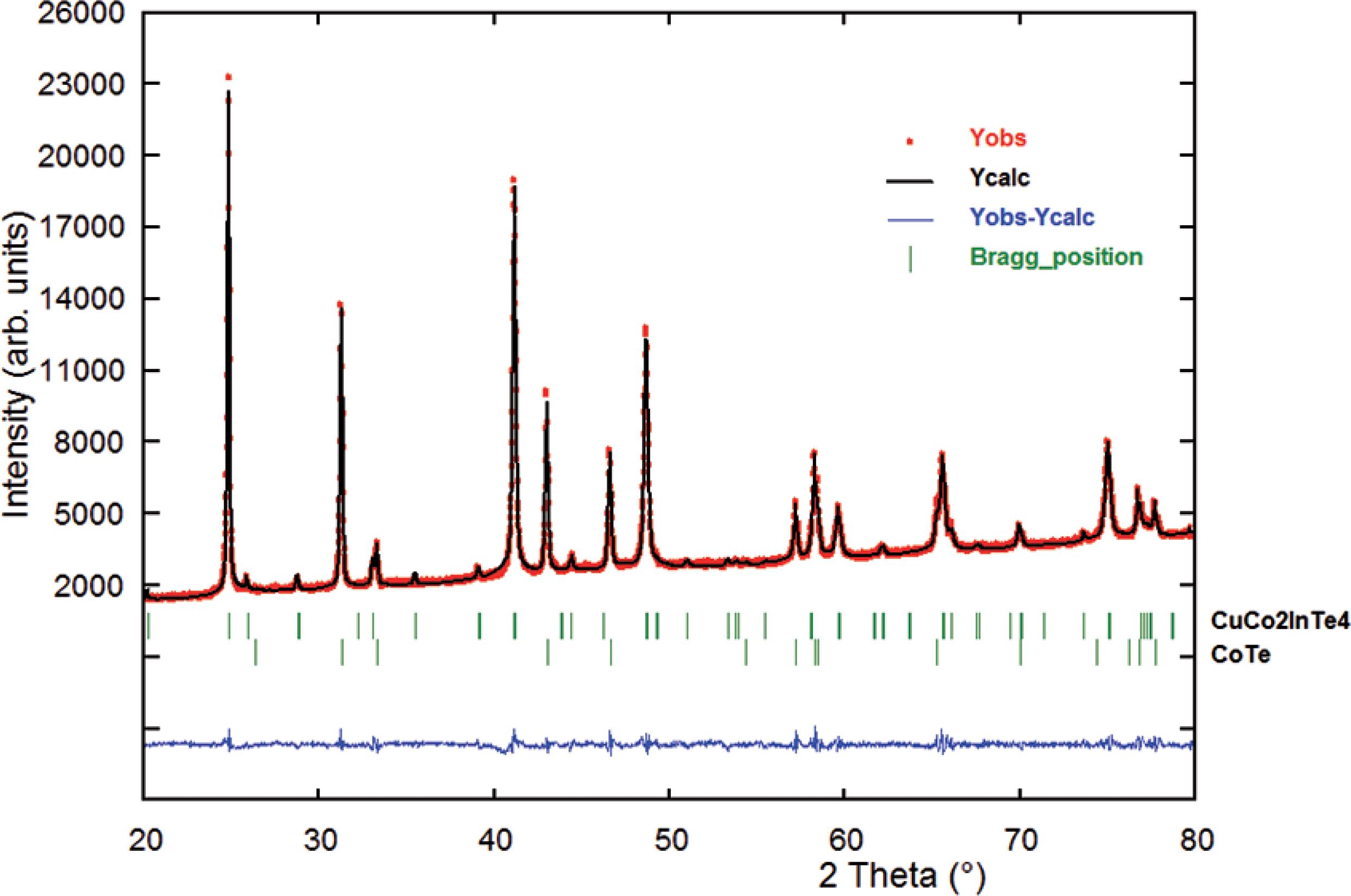
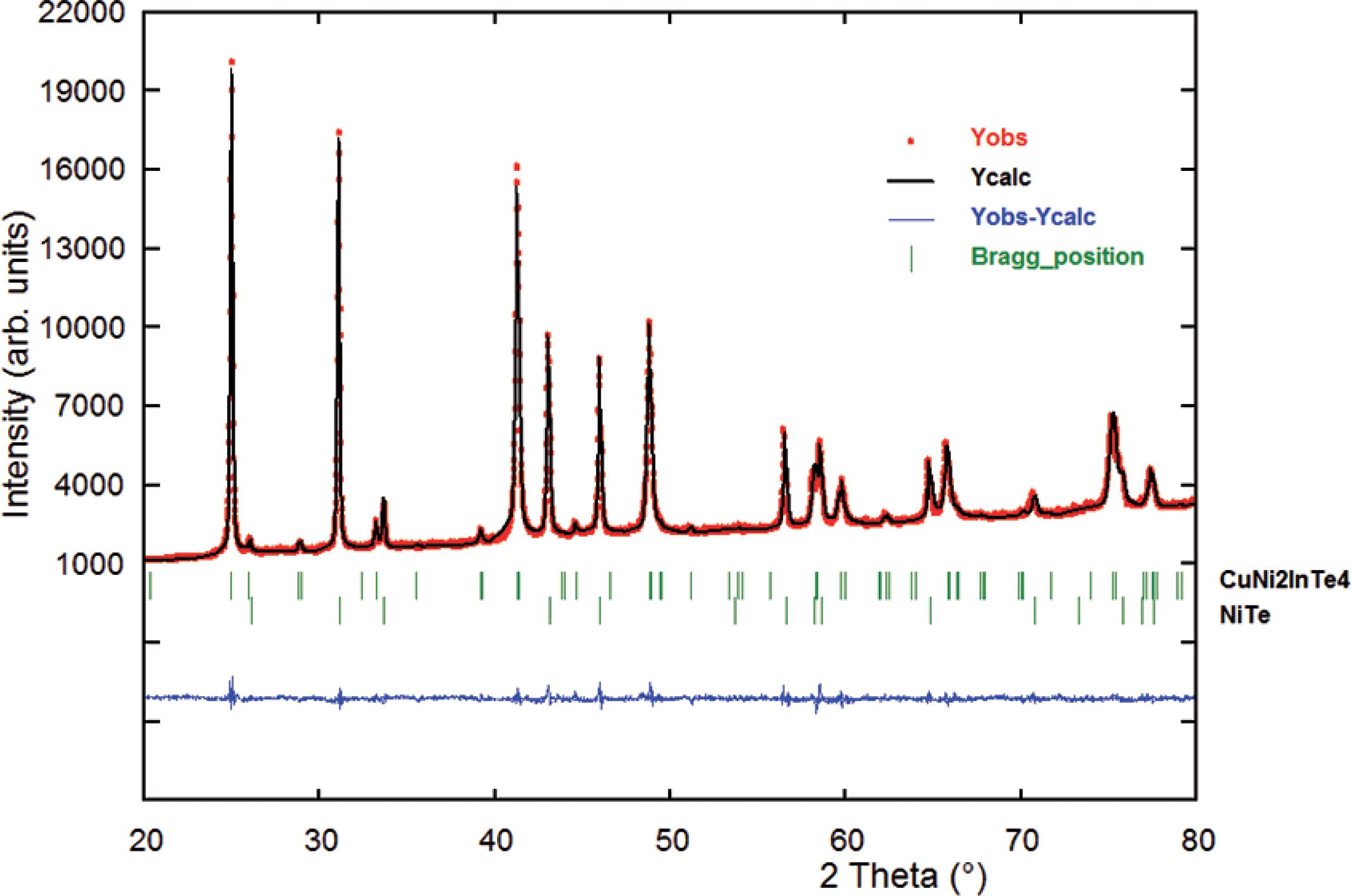
Figure 1 and 2 shows the resulting X-ray powder diffractogram for the quaternary compounds CuCo2InTe4 and CuNi2InTe4. An automatic search in the PDF-ICDD database27, using the software available with the diffractometer, indicated that the powder patterns contained important amounts of the binaries CoTe (PDF Nº 70-2887) and NiTe (PDF Nº 89-2019), respectively.
Final Rietveld plot showing the observed, calculated and difference pattern for the CuCo2InTe4 compound. The Bragg reflections for both phases are indicated by vertical bars.
Final Rietveld plot showing the observed, calculated and difference pattern for the CuNi2InTe4 compound. The Bragg reflections for both phases are indicated by vertical bars.
Bragg positions of the diffraction lines from these binaries are also indicated in Figure 1 and Figure 2. The 20 first peak positions of the main phase, en each case, was indexed using the program Dicvol0428, which gave a unique solution in tetragonal cells with a = 6.195(2) Å, c = 12.400(4) Å for CuCo2InTe4, and a = 6.160(2) Å, c = 12.365(4) Å for CuCo2InTe4.
The systematic absences study (hkl: h + k + l = 2n) indicated an I-type cell. A revision of the diffraction lines of the main phase taking into account the sample composition, unit cell parameters as well as the body center cell suggested that this material is isostructural with CuFe2InSe413 and AgFe2GaTe416; the firsts of the I-II2-III-VI4 family with a stannite structure11, which crystallize in the tetragonal space group I42m (No. 121). It should be mentioned that Rietveld refinement were performed in the I4 (No. 82) space group but did not produce a chemically sound structure, ruled out a kesterite structure.
The Rietveld refinement29 of the whole diffraction patterns was carried out using the Fullprof program30, with the unit cell parameters mentioned above. The atomic coordinates of the compound CuFe2InSe413 were used as initial model. Atomic positions of the CoTe31 and NiTe32 binaries were included as secondary phases in the refinements of CuCo2InTe4 and CuNi2InTe4, respectively.
The angular dependence of the peak full width at half maximum (FWHM) was described by the Caglioti's formula33. Peak shapes were described by the parameterized Thompson-Cox-Hastings pseudo-Voigt profile function34. The background variation was described by a polynomial with six coefficients. The thermal motion of the atoms was described by one overall isotropic temperature factor. The results of the Rietveld refinement are summarized in Tables 1 and 2. Figures 1 and 2 shows the observed calculated and difference profile for the final cycle of Rietveld refinement in both materials. Atomic coordinates, isotropic temperature factor, bond distances and angles are shown in Tables 3 and 4. The final Rietveld refinement converged to the weight fraction percentages35 shows in Tables 1 and 2. Figure 3 shows the unit cell diagram for the CuCo2InTe4 and CuNi2InTe4 phases.
Atomic coordinates, isotropic temperature factor, bond distances (Å) and angles (°) for CuCo2InTe4.
Atomic coordinates, isotropic temperature factor, bond distances (Å) and angles (°) for CuNi2InTe4.
Quaternary CuCo2InTe4 and CuNi2InTe4 are normal adamantane-structure compound and can be described as derivative of the sphalerite with a stannite-type structure2. As expected for adamantane structure compounds, each anion is coordinated by four cations (two Co or Ni, one Cu and one In) located at the corners of a slightly distorted tetrahedron. Cu, Co (Ni) and In cations are similarly coordinated by four anions. The interatomic distances are shorter than the sum of the respective ionic radii for structures tetrahedrally bonded36. The Cu-Te, Co-Te, Ni-Te and In-Te bond distances are in good agreement with those observed in other adamantane structure compounds found in the ICSD database37; such as CuTa2InTe415, CuInTe238, AgIn5Te839, Cu3NbTe440 and AgInTe241.
4. Conclusions
The crystal structure of the quaternary compounds CuCo2InTe4 and CuNi2InTe4 was determined using X-ray powder diffraction. CuCo2InTe4 and CuNi2InTe4 crystallize in the tetragonal space group I2m with a stannite-type structure.
5. Acknowledgments
Authors wants to thank to CDCHTA-ULA (grant C-1885-14-05-B) and FONACIT (grants 2011001341 and LAB-97000821).
6. References
-
1 Nikiforov KG. Magnetically ordered multinary semiconductors. Progress in Crystal Growth and Characterization of Materials 1999;39(1-4):1-104. http://dx.doi.org/10.1016/S0960-8974(99)00016-9
» http://dx.doi.org/10.1016/S0960-8974(99)00016-9 - 2 Parthé E. Wurtzite and Zinc-Blend Structures. In: Westbrook JH, Fleischer RL, Eds. Intermetallic compounds, principles and applications Vol 1, Chap. 14. Hoboken: John Wiley & Sons; 1995.
- 3 Delgado JM. Crystal chemistry of diamond-like and other derivative semiconducting compounds. Journal of Physics: Conference Series 1998;152:45-50.
-
4 Ford GM, Guo Q, Agrawal R, Hillhouse HW, Hugh W. Earth abundant element Cu2Zn(Sn1-XGex)S4 nanocrystals for tunable band gap solar cells: 6.8% efficient device fabrication. Chemistry of Materials 2011;23(10):2626-2629. http://dx.doi.org/10.1021/cm2002836
» http://dx.doi.org/10.1021/cm2002836 -
5 Guo Q, Ford GM, Yang WC, Walker BC, Stach EA, Hillhouse HW, et al. Fabrication of 7.2% efficient CZTSSe solar cells using CZTS nanocrystals. Journal of American Chemical Society 2010;132(49):17384-17386. http://dx.doi.org/10.1021/ja108427b
» http://dx.doi.org/10.1021/ja108427b -
6 Chambers SA, Yoo YK. New materials for spintronics. MRS Bulletin 2003;28:706-710. http://dx.doi.org/10.1557/mrs2003.210
» http://dx.doi.org/10.1557/mrs2003.210 -
7 Li Y, Fan W, Sun H, Cheng X, Li P, Zhao X. Electronic, optical and lattice dynamic properties of the novel diamond-like semiconductors Li2CdGeS4 and Li2CdSnS4 Journal of Physics: Condensed Matter 2011;23(22):225401. http://dx.doi.org/10.1088/0953-8984/23/22/225401
» http://dx.doi.org/10.1088/0953-8984/23/22/225401 - 8 Sevik C, Çaǧın T. Ab initio study of thermoelectric transport properties of pure and doped quaternary compounds. Physical Review B 2010;82(4):045202. http://dx.doi.org/10.1103/PhysRevB.82.045202
-
9 Grima-Gallardo P, Cárdenas K, Molina L, Quintero M, Ruiz J, Delgado GE, et al. A comparative study of (Cu-III-Se2)X-(FeSe)1-X alloys (III : Al, Ga, In) (0 ≤ x ≤ 1) by X-ray diffraction (XRD), differencial thermal analysis (DTA) and scanning electron microscopy (SEM). Physica Status Solidi (a) 2001;187(2):395-406. http://dx.doi.org/10.1002/1521-396X(200110)187:2<395::AID-PSSA395>3.0.CO;2-2
» http://dx.doi.org/10.1002/1521-396X(200110)187:2<395::AID-PSSA395>3.0.CO;2-2 -
10 Grima-Gallardo P, Cárdenas K, Quintero M, Ruiz J, Delgado G. X-ray diffraction (XRD) studies on (CuAlSe2)X(FeSe)1-X alloys. Materials Research Bulletin 2001;36(5-6):861-866. http://dx.doi.org/10.1016/S0025-5408(01)00546-3
» http://dx.doi.org/10.1016/S0025-5408(01)00546-3 -
11 Hall SR, Szymanski JT, Stewart JM. Kesterite, Cu2(Zn,Fe)SnS4, and stannite, Cu2(Fe,Zn)SnS4, structurally similar but distinct minerals. Canadian Mineralogist 1978;16:131-137. http://canmin.geoscienceworld.org/content/16/2/131.extract
» http://canmin.geoscienceworld.org/content/16/2/131.extract -
12 Parthé E, Yvon K, Deitch RH. The crystal structure of Cu2CdGeS4 and other quaternary normal tetrahedral structure compounds. Acta Crystallographica B 1969;25:1164-1174. http://dx.doi.org/10.1107/S0567740869003670
» http://dx.doi.org/10.1107/S0567740869003670 -
13 Delgado GE, Mora AJ, Grima-Gallardo P, Quintero M. Crystal structure of CuFe2InSe4 from X-ray powder diffraction. Journal of Alloys and Compounds 2008;454(1-2):306-309. http://dx.doi.org/10.1016/j.jallcom.2006.12.057
» http://dx.doi.org/10.1016/j.jallcom.2006.12.057 -
14 Delgado GE, Mora AJ, Grima-Gallardo P, Muñoz M, Durán S, Quintero M, et al. Crystal structure of the quaternary compounds CuFe2AlSe4 and CuFe2GaSe4 from X-ray powder diffraction. Bulletin of Materials Science 2015;38(4):1061-1064. http://dx.doi.org/10.1007/s12034-015-0933-9
» http://dx.doi.org/10.1007/s12034-015-0933-9 -
15 Delgado GE, Mora AJ, Grima-Gallardo P, Muñoz M, Durán S, Quintero M. Crystal structure of the quaternary compound CuTa2InTe4 from X-ray powder diffraction. Physica B: Condensed Matter 2008;403(18):3228-3230. http://dx.doi.org/10.1016/j.physb.2008.04.022
» http://dx.doi.org/10.1016/j.physb.2008.04.022 -
16 Delgado GE, Quintero E, Tovar R, Grima-Gallardo P, Quintero M. Synthesis and crystal structure of the quaternary compound AgFe2GaTe4 Journal of Alloys and Compounds 2014;613:143-145. http://dx.doi.org/10.1016/j.jallcom.2014.06.004
» http://dx.doi.org/10.1016/j.jallcom.2014.06.004 -
17 Ghosh A, Palchoudhury S, Thangavel R, Zhou Z, Naghibolashrafi N, Ramasamy K, et al. A new family of wurtzite-phase Cu2ZnAS4−X and CuZn2AS4 (A= Al, Ga, In) nanocrystals for solar energy conversion applications. Chemical Communications 2016;52:264-267. http://dx.doi.org/10.1039/C5CC07743E
» http://dx.doi.org/10.1039/C5CC07743E -
18 Chykhrij SI, Parasyuk OV, Halka OV. Crystal structure of the new quaternary phase AgCd2GaS4 and phase diagram of the quasi-binary system AgGaS2-CdS. Journal of Alloys and Compounds 2000;312(1-2):189-195. http://dx.doi.org/10.1016/S0925-8388 (00)01145-2
» http://dx.doi.org/10.1016/S0925-8388 (00)01145-2 -
19 Olekseyuk ID, Gulay LD, Parasyuk OV, Husak OA, Kadykalo EM. Phase diagram of the AgGaSe2-CdSe system and crystal structure of the AgCd2GaSe4 compound. Journal of Alloys and Compounds 2002;343(1-2):125-131. http://dx.doi.org/10.1016/S0925-8388(02)00143-3
» http://dx.doi.org/10.1016/S0925-8388(02)00143-3 -
20 Zmiy OF, Mishchenko IA, Olekseyuk ID. Phase equilibria in the quasi-ternary system Cu2Se-CdSe-In2Se3 Journal of Alloys and Compounds 2004;367(1-2):49-57. http://dx.doi.org/10.1016/j.jallcom.2003.08.011
» http://dx.doi.org/10.1016/j.jallcom.2003.08.011 -
21 Olekseyuk ID, Parasyuk OV, Husak OA, Piskach LV, Volkov SV, Pekhnyo VI. X-ray powder diffraction study of semiconducting alloys Ag1−XCuXCd2GaS4 and AgCd2Ga1−XInXS4 Journal of Alloys and Compounds 2005;402(1-2):186-193. http://dx.doi.org/10.1016/j.jallcom.2005.04.147
» http://dx.doi.org/10.1016/j.jallcom.2005.04.147 -
22 Davydyuk GY, Sachanyuk VP, Voronyuk SV, Olekseyuk ID, Romanyuk YE, Parasyuk OV. X-ray diffraction study of the AgCd2−XMnXGaS4 semiconductor alloys and their electrical, optical, and photoelectrical properties. Physica B: Condensed Matter 2006;373(2):355-359. http://dx.doi.org/10.1016/j.physb.2005.12.249
» http://dx.doi.org/10.1016/j.physb.2005.12.249 -
23 Mora AJ, Delgado GE, Grima-Gallardo P. Crystal structure of CuFeInSe3 from X-ray powder diffraction data. Physica Status Solidi (a) 2007;204(2):547-554. http://dx.doi.org/10.1002/pssa.200622395
» http://dx.doi.org/10.1002/pssa.200622395 -
24 Delgado GE, Mora AJ, Grima-Gallardo P, Durán S, Muñoz M, Quintero M. Crystal structure of the quaternary alloy CuTaInSe3 Crystal Research & Technology 2008;43(7):783-785. http://dx.doi.org/10.1002/crat.200711154
» http://dx.doi.org/10.1002/crat.200711154 -
25 Delgado GE, Mora AJ, Contreras JE, Grima-Gallardo P, Durán S, Muñoz M, et al. Crystal structure characterization of the quaternary compounds CuFeAlSe3 and CuFeGaSe3 Crystal Research and Technology 2009;44(5):548-552. http://dx.doi.org/10.1002/crat.200800596
» http://dx.doi.org/10.1002/crat.200800596 -
26 Delgado GE, Mora AJ, Grima-Gallardo P, Durán S, Muñoz M, Quintero M. Preparation and crystal structure characterization of CuNiGaSe3 and CuNiInSe3 quaternary compounds. Bulletin of Materials Science 2010;33(5):637-640. http://dx.doi.org/10.1007/s12034-010-0097-6
» http://dx.doi.org/10.1007/s12034-010-0097-6 - 27 International Centre for Diffraction Data. PDF-ICDD-Powder Diffraction File (Set 1-65) Newtown Square: International Centre for Diffraction Data; 2013.
-
28 Boultif A, Löuer D. Powder pattern indexing with the dichotomy method. Journal of Applied Crystallography 2004;37:724-731. http://dx.doi.org/10.1107/S0021889804014876
» http://dx.doi.org/10.1107/S0021889804014876 -
29 Rietveld HM. A profile refinement method for nuclear and magnetic structures. Journal of Applied Crystallography 1969;2:65-71. http://dx.doi.org/10.1107/S0021889869006558
» http://dx.doi.org/10.1107/S0021889869006558 -
30 Rodríguez-Carvajal J. Recent advances in magnetic structure determination by neutron powder diffraction. Physica B: Condensed Matter 1993;192(1-2):55-69. http://dx.doi.org/10.1016/0921-4526(93)90108-I
» http://dx.doi.org/10.1016/0921-4526(93)90108-I -
31 de Meester de Betzembroeck P, Naud J. Étude par diffraction-X de quelques composés du systeme Ni-Co-Te obtenus par synthèse thermique. Bulletin des Sociétés Chimiques Belges 1971;80(1-2):107-116. http://dx.doi.org/10.1002/bscb.19710800112
» http://dx.doi.org/10.1002/bscb.19710800112 - 32 Røst E, Vestersjø E. On the system Ni-Se-Te. Acta Chemica Scandinavica 1968;22:2118-2134.
-
33 Cagliotti G, Paoletti A, Ricci FP. Choice of collimators for a crystal spectrometer for neutron diffraction. Nuclear Instruments 1958;3(4):223-228. http://dx.doi.org/10.1016/0369-643X(58)90029-X
» http://dx.doi.org/10.1016/0369-643X(58)90029-X -
34 Thompson P, Cox DE, Hastings JB. Rietveld refinement of Debye-Scherrer synchrotron X-ray data from Al2O3 Journal of Applied Crystallography 1987;20:79-83. http://dx.doi.org/10.1107/S0021889887087090
» http://dx.doi.org/10.1107/S0021889887087090 -
35 Hill RJ, Howard CJ. Quantitative phase analysis from neutron powder diffraction data using the Rietveld method. Journal of Applied Crystallography 1987;20:467-474. http://dx.doi.org/10.1107/S0021889887086199
» http://dx.doi.org/10.1107/S0021889887086199 -
36 Shannon RD. Revised effective ionic radii and systematic studies of interatomic distances in halides and chalcogenides. Acta Crystallographyca A 1976;32:751-767. http://dx.doi.org/10.1107/S0567739476001551
» http://dx.doi.org/10.1107/S0567739476001551 -
37 Gemlin Institute. ICSD - Inorganic Crystal Structure Database. Scientific Manual. Kalrsruhe: Gemlin Institute; 2008. Available from: <https://www.nist.gov/sites/default/files/documents/srd/09-0303-sci_man_ICSD_v1.pdf>. Access in: 10/10/2016.
» https://www.nist.gov/sites/default/files/documents/srd/09-0303-sci_man_ICSD_v1.pdf -
38 Knight KS. The crystal structures of CuInSe2 and CuInTe2 Materials Research Bulletin 1992;27(2):161-167. http://dx.doi.org/10.1016/0025-5408(92)90209-I
» http://dx.doi.org/10.1016/0025-5408(92)90209-I -
39 Mora AJ, Delgado GE, Pineda C, Tinoco T. Synthesis and structural study of the AgIn5Te8 compound by X-ray powder diffraction. Physica Status Solidi (a) 2004;201(7):1477-1483. http://dx.doi.org/10.1002/pssa.200406805
» http://dx.doi.org/10.1002/pssa.200406805 -
40 Delgado GE, Mora AJ, Grima-Gallardo P, Durán S, Muñoz M, Quintero M. Synthesis and characterization of the ternary chalcogenide compound Cu3NbTe4 Chalcogenide Letters 2009;6(8):335-338. http://www.chalcogen.ro/335_Delgado.pdf
» http://www.chalcogen.ro/335_Delgado.pdf -
41 Delgado GE, Mora AJ, Pineda, Ávila-Godoy R, Paredes-Dugarte S. X-ray powder diffraction data and rietveld refinement of the ternary semiconductor chalcogenides AgInSe2 and AgInTe2 Revista Latinoamericana de Metalurgia y Materiales 2015;35(1):110-117. http://www.rlmm.org/ojs/index.php/rlmm/article/view/546
» http://www.rlmm.org/ojs/index.php/rlmm/article/view/546