Influence of Heat Treated Manihot Esculenta Biosilica on Friction Stir Welded AA 6065-Al2O3 Metal Matrix Composite and Microstructural, Mechanical, and Fatigue Analysis
Abstract
The present study investigates friction stir welded AA6065-10% Al2O3MMC by incorporating varying percentages of heat treated biosilica. The biosilica is first extracted from waste cassava peel, and it is heated under 1500°C, to get properly arranged crystalline structured biosilica particle. During friction stir welding process, the biosilica particle is dispersed around the welded zone, which in turn impacts load carrying capacity of the material. The study revealed that 3 vol.% of biosilica infused FSW composite ‘C’ shows maximum tensile strength of 276 MPa, yield strength of 238 MPa, impact energy of 20.8 J, elongation of 5.2%, fatigue strength of 176 MPa. Further, the 5 vol.% of biosilica infused FSW composite ‘D’ shows hardness strength of 121 Hv. Additionally, it has been discovered under microstructural analysis that the inclusion of fine-grained heat-treated biosilica exhibits the greatest dispersion of biosilica within the nugget zone, heat affected zone, and thermo mechanically affected zone, which affects the composite's overall strength characteristics. Thus, because of their less dense, better thermo mechanical properties, it could be influenced in areas where joint application, load bearing are needed such as aerospace, heavy industrial, infrastructural, transport and military sector.
Keywords:
Joining; MMC; Friction stir weld; Mechanical properties; Fatigue; Microstructure
1. Introduction
Composite material is developed by using metal matrix compound are gaining prominent position ever since the industrial revolution. Due to their good strength properties, durability, better load carrying capacity, metal matrix composite are utilized in areas such as interior, and outer cover parts of automobile sector, outer panel covers on aviation sector, marine engineering sector, etc1. Especially, these metal matrix composite when comes to joining of two different materials, several techniques are used such as T joint, edge joint, corner joint, butt joint, lap joint, etc. among those, the butt joint are carried out using friction stir welding technique. Generally, the Friction stir welding (FSW) is a solid-state joining technique that joins two facing workpieces without melting the workpiece material by using a non-consumable tool2,3. A softened area develops close to the FSW tool as a result of heat produced by friction between the rotating tool and the workpiece material. there were several studies has been carried out by various research scholars, by using different material. Aluminium based alloy material are most prominently utilized, due to their less dense, corrosion resistance, good wear resistance, formability, and durability in nature4.
Typically, Kundurti and Sharma5 investigated friction stirred metal matrix composite using AA 6061/AA7075 and their mechanical properties. using friction stir additive manufacturing the composite is prepared. Based on their result obtained, the author concluded that friction stirred metal matrix composite shows enhanced tensile strength of 310 to 384 MPa, and microhardness (from 107±1.2 to 138.4 ±2.8 HV0.2). However, there occurs certain defects, especially during welding of dissimilar material. To overcome such issues, particle is reinforced into such welded joints of the composite material6. For instance, Pandian and Kannan7 conducted a study on metal matrix composite using two dissimilar metal al 2014 and al 7075 using friction stir welding and analyse their mechanical and structural features. The inclusion silicon carbide and graphite particles into the composite shows improved tensile strength, yield strength, and elongation of the joint were measured at 251 MPa, 183 MPa, and 6.44%, respectively. Mourad et al.8 investigate aluminium based hybrid metal matrix composite and their strength, microstructural properties. By inclusion of 4 wt.% of graphite shows maximum tensile strength of 250 MPa, compressive strength of 508 MPa and wear resistance property. Furthermore, the effects of ZrB2 and Al2O3 particle into the friction stir welded 7085 Al matrix composites was studied by Sun et al.9. the reinforcement of 3 vol.% (ZrB2+Al2O3) into the Al7085 composites shows high tensile strength of 492.95 MPa and elongation of 12.87%, also improved joint efficiency of 76.3%.
From the above study reference, it has been evidence that reinforcement of particle like silica, boron carbide, alumina, and other ceramic based material into the metal matrix, enhance overall strength features of the composite. Among such filler particle, the ceramic based silica (SiO2) compounds have better wear properties, thermal stability, due to their inherent hardness strength10. Because of such characteristic’s nature, the silica is extracted through natural sources such as agro and domestic waste biomass. Cassava fruit peel is one such silica compounds which are developed in soil as root part of the plant, which are generally rich cellulose, silica content11. Besides, these advantages, bio extraction of silica particle using thermo-chemical process, undergoes certain defects like particle dislocations. The heat treatment can improve the structural stability of biosilica particles by removing residual moisture and volatile compounds. It can also result in the formation of a more ordered or crystalline silica structure12.
Nevertheless, there were no study has been conducted on heat treated biosilica reinforced friction stir welded composite. Thus, the present studyfills the research gap, by studying friction welded metal matrix using AA 6065-Al2O3 material along with heat treated biosilica particle and ensure future research based on this background. Because the addition of bio-based nanoparticles has improved the material's weldability qualities and opened the door for researchers, academics, and industry experts to learn more about friction stir welding of related materials. With these enhanced mechanical, thermal, and weldable qualities, friction stir welding of alloys and MMCs with biosilica reinforcement could be used in industries such general fabrication, robotics, automotive, shipbuilding and offshore, aerospace, and railroad rolling stock.
2. Experimental Procedure
2.1. Raw material
The MMC of aluminum AA6065-10% Al2O3 metal matrix composite, which has dimensions of 100 x 50 x 3 mm, was utilized in this investigation. This MMC was chosen for the investigation because the 10% Al2O3 in AA 6065 reported many desired features. METALMELT, located in Salem, Tamil Nadu, supplied the base metal for the welding process. Similarly, the cassava waste peels used to prepare the biosilica were supplied by Metro Composite in Chennai, India. Huntsman Corporation, located in Mumbai, India, supplied additional supporting chemicals, including distilled water, sodium silicate, acetic acid, and a pH card.
2.2. Heat treated biosilica from cassava wastepeel
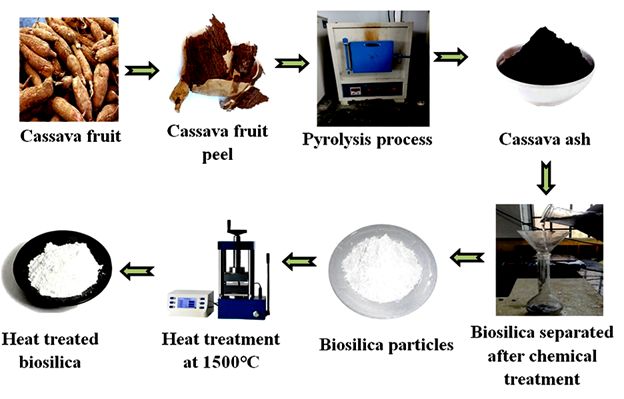
The two-phase procedure used to produce biosilica from leftover cassava peels; a thermo-chemical approach is the most efficient. The cassava peels first burn completely in a furnace set up on a bed of sand with a special air supply device, reaching a temperature of 700 °C. Although it contains many contaminants, the end product of this heat treatment is cassava peel ash. The ash is then chemically treated for purification in the following step, which involves mixing the ash from cassava peels with a solution of NaOH at 80°C to produce a sodium silicate solution. Sodium silicate gel is produced by continuously stirring this mixture for one hour. Whatman grade 41 filter paper is used to filter the sodium silicate gel in order to remove any last contaminants. Sodium silicate is titrated at room temperature using 1 N HCl, maintaining a pH of 7 during the procedure. The silica gels are aged for 24 h following agitation.
The aged silica gels are combined with distilled water in the last stage to create silica slurry. To create xerogel silica, this slurry is heated in an oven at 70 °C for around 20 h after being continuously rinsed with distilled water. The xerogel silica is ground for a few hours in a ball mill to produce fine biosilica13. After extraction of biosilica, it is undergoing heat treatment process. Biosilica particles made from leftover cassava peel underwent heat treatment, which enhanced their microstructure, increased their ductility, and decreased any remaining stress. After two hours of heating to 1500°C, the biosilica samples were left to cool inside the furnace. SiO2 gave the composite the required microstructural, dimensional stability and mechanical strength at this range of heat treatment on ceramic particles14. This heat treatment procedure produced tiny biosilica particles with a consistent grain size. Figure 1 shows the heat treated biosilica preparation procedure from waste cassava peel and Figure 2 shows the SEM micrograph of biosilica particle.

2.3. Friction stir welding
Friction stir welding of aluminum metal matrix composite was carried out on a high-precision vertical machining center. With a spindle rotation speed of up to 1500 rpm, the machining center can hold workpieces up to 1000 x 700 mm. Because it is customizable, the feed rate can be changed from 0.25 to 5 mm/min. Based on the characteristics of MMC, the process factors in this study have been carefully chosen. Following the placement of the weldable metal, the tool's taper is 34 degrees, and its shoulder diameter is 15 mm. Heat treated biosilica nanoparticles were inserted into the borders of the divots before welding15. In this study, heat treated biosilica particle addition was examined at weight percentages of 1, 3, and 5. Figure 3 shows the butt weld configuration, welding setup, and tool picture for metal matrix composites made of aluminum AA6065 with 10 weight percent Al2O3. Here we welded at 1000 rpm, with a dwell period of 5 minutes, a weld length of 200 mm, a traverse speed of 25 mm/min, an axial tension of 5KN, and a plunge depth of 0.5 mm. Using a metal matrix with AA6065-10 weight percent Al2O3, friction stir welded plates with heat treated biosilica nanoparticles are displayed in Table 1. Figure 3 shows the butt weld configuration, welding setup, and tool picture of metal matrix composites joining process.

(a) Welding setup, (b) butt weld configuration and (c) welded jointof metal matrix composites.
3. Characterization of Friction Welded Joints
The tensile characteristics of welded joints are evaluated using a universal testing equipment (FIE, Uniteck 9400, India). For every test, the cross-head speed was kept at 1.5 mm/min. Similarly, a Charpy impact tester that corresponded with ASTM E23 and had a 25J capacity was used to measure the impact resistance of weld beads. A micro Vicker hardness tester (SHIMADZU HMV-2 with electric revolver turret, Japan) was used to measure the microhardness at several locations on the weld geometry in compliance with ASTM 384. Using an MTS fatigue load frame, USA, comparable calculations were performed for tension-tension fatigue strength following 107 cycles at 90% of UTS. A frequency of 5 Hz, a stress ratio of 0.1, and a Young’s modulus of 5 GPa were used for the experiments. The microstructure of comparable AA6065-10% Al2O3 weld joints was investigated using an optical microscope (METZER, M Co-Axial Trinocular research metallurgical microscope vision plus-5000 TMM) and a scanning electron microscope (JEOL JEM, JCM, NeoScope 7000 series, JAPAN). Figure 4 shows the test samples for possible test.

4. Result and Discussions
4.1. Mechanical properties
The tensile strength, yield strength, elongation, and impact energy of all composite specimen is represented in Table 2. The welded metal matrix composite AA6065-10% Al2O3 of designation A shows tensile strength of 230 MPa, yield strength of 188 MPa, elongation of 8.2%, and impact strength of 15.6 J. the welded composite shows good strength properties, however during friction stir welding the material gets damage, which reduce the strength properties of parent material. To mitigate such issues, the biosilica nano particle is dispersed over the friction stir welded nugget zone16. The composite specimen AA6065-10% Al2O3+ 1 wt.% heat treated SiO2 ‘B’ shows improved tensile strength of 252 MPa, yield strength of 216 MPa, impact strength of 19.4 J and reduced elongation of 6.4%. Because of their nanoscale size and heat treatment, the biosilica particle helps refine the grains inside the welded nugget by increasing the number of grain boundaries, which slows the spread of cracks17,18.
Further, increase in percentage of biosilica particle (AA6065-10% Al2O3+ 3 wt.% SiO2) around the welded composite ‘C’, reduced the material cracking due to reduced frictional damages19. This reduced cracking effects improved the tensile strength of 276 MPa, yield strength of 238 MPa, impact energy of 20.8 J, and reduced elongation of 5.2%. When compared to the plain welded composite, the 3 wt.% of heat treated biosilica composite ‘C’ shows, more tensile strength of 20%, yield strength of 26.59%, impact energy of 28 .20%, and elongation of 57.6%. However, when this filler particle is excess around the weld zone in composite ‘D’ shows reduction in material strength such as tensile strength of 244 MPa, yield strength of 198 MPa, impact strength of 16.5 J and increase in elongation up to 5.9%. This is mainly agglomeration effects, when an excessive number of particles are introduced into the weld zone. By encouraging crack initiation and propagation under loading, these agglomerates weaken the weld by serving as stress concentration locations inside the material20. Additionally, excess amount of heat-treated silica creates brittleness on composite. As a result, the weld becomes less ductile and robust, increasing its vulnerability to cracking under impact or dynamic loads.
The SEM tensile fractographs of composite friction stir-welded plates ‘A’, ‘B’, ‘C’, and ‘D’ are displayed in Figure 5(a-c).High wavy fracture parts with higher gap and pull of grain markings were still present in the plain weld (Figure 5a). On the other hand, Figure 5b demonstrates enhanced toughness with less wave cracking of ‘C’. Reduced crack formation and spread leads to an increase in the number of microcracks that form. Additionally, the incorporation of biosilica precisely covered in the gaps and prevent the metals from degrading in mode-I. These phenomena enhanced the weld bead's ability to support loads. However, it is also observed that the large quantity of biosilica decreased the load-bearing effect and marginally enhanced the brittles (hardness).

4.2. Hardness behaviour
Figure 6 represents friction stir welded hybrid metal matrix composite AA6065-10% Al2O3 along with infusion of varying concentration of biosilica particle of 1,3, and 5 wt.%. The study explores the differences in hardness between various weld compositions produced in Heat Affected Zone (HAZ), Thermo Mechanically Affected Zone (TAMZ), and nugget. The nugget displaying the highest hardness is always the one with the lowest HAZ and the average TAMZ. Indeed, the hardness of these three zones is higher than that of the parent metal. The newly created grains' hardness is always greater than both TAMZ and HAZ because they are more prevalent in the nugget zone, which experiences rapid cooling. However, both mechanical and thermal stresses cause the grains in TAMZ to somewhat distort. Lastly, the only way to alter the grains in HAZ is by applying heat. As a result, the same specimen in various shapes experiences changes in hardness.

The hardness strength of 88Hv was observed on plain welded aluminium matrix composite‘A’. the composites ‘B’, ‘C’ and ‘D’ with infusion of heat treated biosilica particle shows better hardness strength compared to aluminium matrix composite ‘A’. The results of the study show that adding heat treated biosilica to the welding process significantly increases hardness. Additionally, a significant pattern is revealed, showing that the hardness values in the welded plates' nugget region gradually grow in coordination with the higher biosilica concentration21. The heat treated biosilica into weld zone of the friction stir welded composite ‘B’, ‘C’ and ‘D’ shows hardness strength of 98, 108, and 121 Hvrespectively. This increase in addition of biosilica particle shows high hardness property, which impacts impact load of the composites. The inherent hardness property of biosilica along with heat treatment on biosilica improves particle strength, which in turn enhance the mechanical strength of the composite22,23.
The range of grain sizes in the parent metal, HAZ, TAMZ, and nugget is depicted in Figure 7. The impact of both mechanical and thermal effects is evident as the grain sizes increase from the nugget to the parent metal. These modifications include improved interaction between the reinforcement and the aluminum matrix or the development of intermetallic phases. Increased hardness is one way that these microstructural changes affect the material's overall mechanical characteristics.In conclusion, the hardness of AA6065-10% Al2O3FSW plates is significantly increased when heat treated biosilica particles are added during friction stir welding.

Optical microscope images of welded joint grains in AA2 MMC designation (a) parent metal, (b) HAZ, (c) TAMZ and (d) nugget.
4.3. Fatigue behaviour
The fatigue behaviour of friction stirs welded metal matrix composite AA6065-10% Al2O3 along with varying concentration of biosilica particle reinforcement is represented in Figure 8. The composite specimen AA6065-10% Al2O3‘A’ shows fatigue strength of 136 MPa. By incorporation of heat treated biosilica particle on the friction stir welded zone, improves mechanical strength and fatigue load carrying capacity of the composite. The composite B’ (AA6065-10% Al2O3+ 1 wt.% heat treated SiO2) and ‘C’ (AA6065-10% Al2O3+ 3 wt.% heat treated SiO2) shows fatigue strength of 159 MPa, and 176 MPa. During friction stir welding, the imperfection is occursin the weld surface, which often act as initiation points for fatigue cracks. To reduce such weld impacts the well grained, properly arranged heat treated biosilica particle is infused throughout the weld zone, this will reduce the material damage and promote even load distribution24,25. Thus, when compared to plain welded composite, the 3 wt.% of heat treated SiO2 shows maximum fatigue strength of 176 MPa, which it is 29.41% higher. Besides these increment in fatigue strength, there occurs certain impacts on fatigue strength in composite specimen AA3 (AA6065-10% Al2O3+ 10 wt.% heat treated SiO2) of 169 MPa, because of excessive filler addition, and brittleness effects of composite, which resists the cyclic load carrying capacity of the material26. Overall, the metal matrix composite AA2 (AA6065-10% Al2O3+ 3 wt.% heat treated SiO2) shows better fatigue strength by providing improved weld zone throughout the composite.

4.4. Microstructural analysis
In Figure 9, friction stir welds on AA6065-10% Al2O3MMCs are imaged under an optical microscope. Figure 9a shows that the plain AA6065-10% Al2O3FSW weld has coarse grains, which may be a result of the precipitate hardening process. With thicker grain boundaries, the grains are about the same size27.

Microstructure of friction stir welded composite AA6065-10% Al2O3 along with heat treated biosilica.
The presence of Al2O3 deposited on the grain boundaries during hardening is indicated by the plain welded composite. Nevertheless, it should be highlighted that Figure 9 (b and c) shows semi-coarse and fine grains as a result of the inclusion of 1 and 3 weight percent biosilica particles. When biosilica was added, it dispersed throughout the matrix and increased the number of grains and nuclei. During MMC production, the grain dimensions and amount tend to be altered, demonstrating the biosilica efficient reinforcing function (Figure 9d). Additionally, the use of heat treated biosilica filled in the gaps and stopped the cracks from spreading. Lastly, the crystalline structure is finer in Figure 9 (e and f) because more biosilica was saturated, producing more tiny grains and increasing the inhibition of crack formation28. Therefore, the microstructure analysis provides important information about how the heat treated biosilica changes the base AA6065-10% Al2O3MMC's microstructure and creates the reinforcement effect.
5. Conclusions
From the above study results, that the friction stir welded AA6065-10% Al2O3 along with heat treated biosilica added metal matrix composites shows better mechanical, and improved structural properties of the composite. The specific conclusions are given below.
-
The influence of heat treated biosilica into friction stir welded zone impacts the tensile strength, yield strength, impact, fatigue strength, hardness strength of the composite.
-
The inclusion of 3 wt.% of heat treated biosilica in the friction stir welded AA6065-10% Al2O3 in the composite AA2 shows maximum tensile strength of 276 MPa, yield strength of 238 MPa, impact energy of 20.8 J, elongation of 5.2%, fatigue strength of 176 MPa.
-
However, by added 5 wt.% of heat treated biosilicathe hardness strength is maximum of 121 Hv.
-
Further, it has been founded, that fine grained heat treated biosilica addition shows maximum dispersion of biosilica throughout the nugget zone, HAZ, and TMAZ, which impacts overall strength properties of the composite.
-
Thus, this study explored that how the friction stir welded MMC with the infusion heat treated biosilica enhance the features of the composite, and it creates a new path to research scholars, academicians to explore more on this domain.
-
Because of such high mechanical strength, cyclic load bearing capacity, it could be applied in areas like automotive, aviation, infrastructural roof top, bridges, and various structural civil engineering applications.
-
However there could be a future study to be done to enhance the sustainable developments as well as the eco-friendly material processing strategies. Even then limitations also there in the form of continue supply as well as the sustainable production route. This could be studied in more better manner as a future study.
6. References
-
1 Parikh VK, Patel V, Pandya DP, Andersson J. Current status on manufacturing routes to produce metal matrix composites: state-of-the-art. Heliyon. 2023;9(2):e13558. http://doi.org/10.1016/j.heliyon.2023.e13558
» http://doi.org/10.1016/j.heliyon.2023.e13558 -
2 Sangamaeswaran R, Muhilan S, Navin J, Manuelraj PA, Palaniappan M. Mechanical and wear properties of friction stir processing AA 6082-T6/B4C aluminium matrix composites. Mater Today Proc. In Press 2023. http://doi.org/10.1016/j.matpr.2023.05.112
» http://doi.org/10.1016/j.matpr.2023.05.112 -
3 Xu N, Ren Z, Qiu Z, Lu Z, Wang D, Shen J, et al. Microstructure and mechanical properties of carbon nano-onions reinforced Mg-based metal matrix composite prepared by friction-stir processing. Mater Today Commun. 2023;35:105552. http://doi.org/10.1016/j.mtcomm.2023.105552
» http://doi.org/10.1016/j.mtcomm.2023.105552 -
4 Ganvir HV, Bhaskar KK, Chanthirasekaran K, Gangwar PK, Sharma VK, Kumar S, et al. Investigation on the mechanical properties of dissimilar friction stir welding of AA2024-AA5128 plates with silicon carbide nanoparticle reinforcement. NanoWorld J. 2023;9(S3):S752-8. http://doi.org/10.17756/nwj.2023-s3-133
» http://doi.org/10.17756/nwj.2023-s3-133 -
5 Kundurti SC, Sharma A. Evaluation of microstructural, mechanical and corrosion behaviours of laminated AA6061/AA7075 metal matrix composites build by friction stir additive manufacturing for structural applications. Mater Res. 2023;26:e20230176. http://doi.org/10.1590/1980-5373-mr-2023-0176
» http://doi.org/10.1590/1980-5373-mr-2023-0176 -
6 Venkatesan R, Harikrishna KL, Sivashanmugam N. Microstructure and mechanical properties of friction stir welded AZ31 magnesium alloy reinforced with ZrB 2 Mater Res Express. 2024;11(4):046517. http://doi.org/10.1088/2053-1591/ad419d
» http://doi.org/10.1088/2053-1591/ad419d -
7 Pandian V, Kannan S. Enhancing performance through friction welding of dissimilar aluminium 2014 and 7075 hybrid metal-matrix composite: insights into material characterization, crystallographic texture, and mechanical properties. Funct Compos Struct. 2024;6:045006. http://doi.org/10.1088/2631-6331/ad8c9a
» http://doi.org/10.1088/2631-6331/ad8c9a -
8 Mourad AHI, Christy JV, Krishnan PK, Mozumder MS. Production of novel recycled hybrid metal matrix composites using optimized stir squeeze casting technique. J Manuf Process. 2023;88:45-58. http://doi.org/10.1016/j.jmapro.2023.01.040
» http://doi.org/10.1016/j.jmapro.2023.01.040 -
9 Sun K, Kai X, Du C, Gao X, Peng Q, Wang T, et al. Influence of ZrB2 and Al2O3 nanoparticles on microstructure and mechanical property of friction stir welded joints of in-situ 7085Al matrix composites. J Mater Process Technol. 2024;326:118323. http://doi.org/10.1016/j.jmatprotec.2024.118323
» http://doi.org/10.1016/j.jmatprotec.2024.118323 -
10 Perumal KS, Selvarajan L, Manikandan KP, Velmurugan C. Mechanical, tribological, and surface morphological studies on the effects of hybrid ilmenite and silicon dioxide fillers on glass fibre reinforced epoxy composites. J Mech Behav Biomed Mater. 2023;146:106095. http://doi.org/10.1016/j.jmbbm.2023.106095
» http://doi.org/10.1016/j.jmbbm.2023.106095 -
11 Abotbina W, Sapuan SM, Ilyas RA, Sultan MTH, Alkbir MFM, Sulaiman S, et al. Recent developments in cassava (Manihot esculenta) based biocomposites and their potential industrial applications: a comprehensive review. Materials (Basel). 2022;15(19):6992. http://doi.org/10.3390/ma15196992
» http://doi.org/10.3390/ma15196992 -
12 Anand SH, Venkateshwaran N. Effect of heat treatment and biosilica on mechanical, wear, and fatigue behavior of Al-TiB2 in situ metal matrix composite. Biomass Convers Biorefin. 2023;13(3):2163-75. http://doi.org/10.1007/s13399-021-01402-3
» http://doi.org/10.1007/s13399-021-01402-3 -
13 Alshahrani H, Prakash VA. Thermal, mechanical and barrier properties of rice husk ash biosilica toughened epoxy biocomposite coating for structural application. Prog Org Coat. 2022;172:107080. http://doi.org/10.1016/j.porgcoat.2022.107080
» http://doi.org/10.1016/j.porgcoat.2022.107080 -
14 Palaniappan M. Investigation on role of heat-treated barley husk biosilica on fatigue, creep, and dynamic mechanical behavior of cotton microfiber-vinyl ester composite. Biomass Conv Bioref. 2024;1-11. http://doi.org/10.1007/s13399-024-05907-5
» http://doi.org/10.1007/s13399-024-05907-5 -
15 Paul A, Thilagham KT, K G JC, Reddy PVRR, Ravishankar S, Boopathi S. Multi-criteria optimization on friction stir welding of aluminum composite (AA5052-H32/B 4 C) using titanium nitride coated tool. Engineering Research Express. 2024;6(1):015402. http://doi.org/10.1088/2631-8695/ad248d
» http://doi.org/10.1088/2631-8695/ad248d -
16 Salih OS, Ou H, Wei X, Sun W. Microstructure and mechanical properties of friction stir welded AA6092/SiC metal matrix composite. Mater Sci Eng A. 2019;742:78-88. http://doi.org/10.1016/j.msea.2018.10.116
» http://doi.org/10.1016/j.msea.2018.10.116 -
17 Sagar P, Handa A. Exploring the mechanical, metallurgical, and fracture characteristics of hybrid-reinforced magnesium metal matrix composite synthesized via friction stir processing route. Proc Inst Mech Eng, Part L: J Mater: Des Appl. 2024;238(5):829-44. https://doi.org/10.1177/14644207231200640
» https://doi.org/10.1177/14644207231200640 -
18 Abdul Wahed Z, Hasan F, Murtaza Q, Nawaz A, Faheem A, Shamim FA. Effect of friction stir processing parameters on mechanical properties of Al8011/CeO2/SiC/RHA metal matrix composite. Can Metall Q. 2024;64:1-14. http://doi.org/10.1080/00084433.2024.2340264
» http://doi.org/10.1080/00084433.2024.2340264 -
19 Cao R, Kai X, Qian W, Wang T, Peng Q, Zhao Y. Effect of in-situ ZrB2 nanoparticles on microstructure and mechanical properties of friction stir welding joints in 7N01 matrix composites. Mater Charact. 2024;207:113611. http://doi.org/10.1016/j.matchar.2023.113611
» http://doi.org/10.1016/j.matchar.2023.113611 -
20 Gahlot P, Hooda N, Gupta S, Phanden RK. Microstructural assessment of friction stir joined AA6063/10.5%Sic Al-matrix composite. Mater Today Proc. 2023;78:662-6. http://doi.org/10.1016/j.matpr.2022.12.083
» http://doi.org/10.1016/j.matpr.2022.12.083 -
21 Pop-Calimanu M. A study of the effects of welding parameters on macrostructure properties and heat distribution in FSW of aluminium metal matrix composite. IOP Conf Series Mater Sci Eng. 2024;1319(1):012005. http://doi.org/10.1088/1757-899X/1319/1/012005
» http://doi.org/10.1088/1757-899X/1319/1/012005 -
22 Jayapalan S, Kumar R, Karthikeyan S, Chandrasekharan T, Muthuswamy P, Babu S. Investigation on the mechanical and corrosive behavior of FSW AA2218/B4C metal matrix composites. AIP Conf Proc. 2024;3042:020009. https://doi.org/10.1063/5.0194216
» https://doi.org/10.1063/5.0194216 -
23 Saravanakumar S, Prakash KB, Dinesh D, Kumar PM, Fouad Y, Soudagar MEM, et al. Optimizing friction stir processing parameters for aluminium alloy 2024 reinforced with SiC particles: a taguchi approach of investigation. J Mater Res Technol. 2024;30:4847-55. http://doi.org/10.1016/j.jmrt.2024.04.066
» http://doi.org/10.1016/j.jmrt.2024.04.066 -
24 Li P, Tong Y, Wang X, Sato YS, Dong H. Microstructures and mechanical properties of AlCoCrFeNi2.1/6061-T6 aluminum-matrix composites prepared by friction stir processing. Mater Sci Eng A. 2023;863:144544. http://doi.org/10.1016/j.msea.2022.144544
» http://doi.org/10.1016/j.msea.2022.144544 -
25 Maqbool A, Lone NF, Ahmad T, Khan NZ, Siddiquee AN. Effect of hybrid reinforcement and number of passes on microstructure, mechanical and corrosion behavior of WE43 Mg alloy based metal matrix composite. J Manuf Process. 2023;89:170-81. http://doi.org/10.1016/j.jmapro.2023.01.070
» http://doi.org/10.1016/j.jmapro.2023.01.070 -
26 Djouider F, Alhawsawi A, Elmoujarkach E, Banoqitah E, Alharazi M, Moustafa EB. The role of friction stir processing parameters and hybrid ZrC/WC reinforcement particles in improving the surface composite dissimilar matrix’s dynamic behavior and microstructure refinement. Coatings. 2023;13(8):1393. http://doi.org/10.3390/coatings13081393
» http://doi.org/10.3390/coatings13081393 -
27 Mohammed MM, Abdullah ME, Rohim MNM, Kubit A, Aghajani Derazkola H. AA5754–Al2O3 nanocomposite prepared by friction stir processing: microstructural evolution and mechanical performance. J Manuf Mater Process. 2024;8(2):58. http://doi.org/10.3390/jmmp8020058
» http://doi.org/10.3390/jmmp8020058 -
28 Rohith P, Vinodh D. Comparative study on hardness strength of novel metal matrix composite of aluminium alloy AA5083 with 0% and 4% SiC powder reinforcement. AIP Conf Proc. 2024;3193:020160. http://doi.org/10.1063/5.0233944
» http://doi.org/10.1063/5.0233944