Influence of Activated Carbon and Magnesium Oxide on Thermal, Mechanical, and Degradation Properties in 3D Printing Filaments
Abstract
3D printing has expanded into diverse fields, including water treatment, sensors, scaffolds, and agriculture. This study evaluates the incorporation of magnesium oxide into activated carbon within a commercial PLA/PBAT blend for the production of filaments via Fused Filament Fabrication (FFF). The addition of magnesium oxide increased the elastic modulus by more than 50% without altering tensile strength. Density reached up to 1.3 g/cm3, with no significant impact on the application. The combined effect of magnesium oxide and activated carbon enhanced soil degradability to approximately 8% within 60 days, compared with formulations containing only activated carbon. Thermal variations, such as an increase in crystallization temperature from 67.5 °C to 76 °C, did not compromise processability. Despite the dimensional instability of the filaments, it was possible to print functional parts with good quality. These results demonstrate a sustainable and innovative route for developing advanced filaments tailored for additive manufacturing within the context of Industry 4.0.
Keywords:
Printability; Characterizations; Activated Carbon; Magnesium Oxide; PLA/PBAT
1. Introduction
3D printing has been presenting expressive growth in recent years, driven especially by the COVID-19 pandemic, which showed its versatility and wide applications in sectors like biomedical1, agriculture2, the pharmaceutical industry3 and water treatment4. Its capacity to manufacture complex objects at a reduced cost, allied with the ease of installation and equipment transport, also contributed to its wide diffusion5,6. Among the several 3D printing technologies, the most common is Fused Filament Fabrication (FFF), in which polymeric filaments are extruded through a heated nozzle that moves along three axes (X, Y, and Z), following a route previously defined by slicing software7,8. In 2024, the 3D printing market, in general, reached US$19.33 billion, while FFF 3D printing alone reached US$1.7 million, with a projected compound annual growth (CAGR) of 21.8% until 2034, potentially reaching an estimated value of US$15.1 million, reinforcing its relevance in the technological and industrial scenario9-11.
Due to the continued growth of innovative technologies, the development of new materials has become necessary, focusing on the optimization of their properties to meet the demands of the market. Currently, composites have received significant attention, especially those incorporating carbon fibers12, wood13, lignin14, graphene15, carbon nanotubes16, nanosilica17, and biochar18. These materials have been advancing the sector, contributing to the improvement of mechanical properties through an increase in filler content and enhancing functional performance in various applications19,20.
In the past few years, activated carbon has been highlighted as a promising material for applications in FFF 3D printing21-23. This porous and carbonaceous material is widely used in air, waste, and water treatment24,25. In 3D printing, its use has been specifically directed toward the development of devices for effluent treatment26, sensor27 and electronic components28. Its main properties include high adsorption capacity and a larger surface area, fundamental characteristics for these applications29,30.
Balou et al.21 produced activated hydrochar through hydrothermal carbonization (HTC) of lignocellulosic biomass, incorporating a higher content of activated carbon (30 to 50%) in polyethylene glycol (PETG). The resulting composites showed improved mechanical properties, influenced by factors such as filler content, particle distribution, and size. Idrees et al.31 developed solid electrodes and electrolytes by 3D printing, using activated carbon derived from sustainable packaging. The higher activated carbon content, combined with its porous structure, favored capacitance improvement, making its application in supercapacitor development viable. The authors highlighted this work as the first 3D-printed supercapacitor using activated carbon obtained from waste. Oliveira et al.32 obtained geopolymer composites containing activated carbon and hydrotalcite, resulting in the fabrication of lyophilized and trellis structures for Direct Ink Writing (DIW). This approach allowed the geometry and morphology control of 3D-printed pieces, optimizing their capacity for Orange II dye adsorption.
Incorporating or impregnating activated carbon with metal oxides can impart additional properties, such as increased electrical conductivity33, enhanced mechanical properties34, and antimicrobial activity35. Magnesium oxide (MgO) possesses several characteristics that enhance its interaction with activated carbon, promoting the addition or improvement of combined properties. Among these characteristics, the most notable are higher thermal conductivity36, mechanical strength37, dielectric resistance38, stability39, flame resistance40, and physical durability41. Manisha et al.42 incorporated MgO into graphitic carbon nitride (g-C3N4), a material used in electrodes, due to its larger surface area and stability. The addition of MgO enhanced the electrochemical performance of the material. Myneni et al.43 developed a composite of MgO with chitosan for Methylene Blue (MB) removal, evaluating the improvement in adsorption parameters as well as the chemical and physical properties of the produced composite. They achieved a removal rate of up to 94.51% and an adsorption capacity of 163.87 mg/g.
In this study, magnesium oxide was incorporated into activated carbon, and the mixture of these materials was processed in an extruder for the production of filaments intended for FFF 3D printing. The originality of this work lies in the combined use of MgO and activated carbon within a sustainable polymeric blend (PLA/PBAT), resulting in filaments capable of producing printed objects with good quality. Unlike previous studies, which explored these additives in isolation or within other matrices, we demonstrate that their association favors improvements in mechanical properties and soil degradability without compromising processability. This approach expands the potential applications of functional filaments in sustainable contexts, such as water treatment, soil remediation, and energy storage, among other possible uses.
2. Experimental
2.1. Materials
The commercial blend composed of 45% PLA and 55% PBAT, called Ecovio® (ECO), with grade F2224, manufactured by BASF S/A (Camaçari, BA, Brazil), was used as the matrix of the composites. It has the following properties indicated by the manufacturer: fluidity index of 2.5 g/10 min (190 °C /5 kg - ISO 1133), density between 1.24 – 1.26 (ISO 1183)44-46. Magnesium oxide (MgO) supplied by Bianquimica Comercial e Representações Ltda. (Poá, SP, Brazil) with molecular weight 40.30 g/mol and the activated carbon (AC) powder P.A. made by Dinâmica Química Contemporânea Ltda. was used as fillers. (Indaiatuba, SP, Brazil), with a relative density of 1.8 - 2.1 g/cm3 at 25 °C; P.A.
2.2. Introduction of MgO into activated carbon
Magnesium oxide (MgO) impregnation was carried out based on methodologies developed by Altintig et al.47. Firstly, a composition was developed with a proportion of 25% activated carbon and 75% magnesium oxide, obtaining the composition AC/MgO1, and a second composition with 50% activated carbon and 50% magnesium oxide, producing AC/MgO2. Magnesium oxide was dissolved in deionized water using a mechanical stirrer (Fisatom, Model 713 D, São Paulo, SP, Brazil) for 20 minutes under rotation of approximately 1500 rpm.
Subsequently, the activated carbon was inserted into the magnesium oxide solution, where the compound was mixed by a mechanical stirrer under the same rotation as previously described, for one hour. Finally, the compositions with the dissolution of both components were dried in an oven at 85 °C for 24 hours. After drying, the constituents were macerated and sieved through a #200 mesh sieve, with an opening of 75 µm, to standardize the particle size of the powders produced.
2.3. Production of compositions
The production of the composites (Formulation presented in Table 1) was processed in a single-screw extruder model AX-16 from the brand AX Plastics (Diadema, SP, Brazil) (L/D = 26) under the temperature profile of 170 °C in zone 01, 175°C in zone 02, and 180°C in zone 03, and screw speed of 40rpm. After leaving the matrix, the produced composites were cooled in water and pelletized.
2.4. Filament production
The developed compositions were dried in an oven at 80 °C for four hours. Additionally, the production of filaments began by processing the material in the same extruder and conditions as the previous stage. Then the diameter of the filaments was adjusted using a Filmaq 3D tractor and winder (Curitiba, PR, Brazil) to obtain 1.75 mm ± (0.1) in accordance with the commercial standard diameter of most FDM 3D printers.
2.5. Characterizations
2.5.1. Dimensional Characterization of the Produced Filaments
The thickness of the filaments was determined by taking measurements at five different points along their length using an MTX digital caliper with a resolution of 0.02 mm. Optical microscopy was performed with a LEICA ICC-50 instrument operating in reflection mode.
2.5.2. Mechanical properties of filaments
The tensile strength test for the filaments was carried out according to the ASTM D337948 standard on a mechanical testing machine from the Emic brand (São José dos Pinhais, PR, Brazil), model DL 30000. The tests were carried out at room temperature at a speed of 5 mm/min.
2.5.3. Filament density
The experimental filament density (ρexp) was determined according to Archimedes' principle using a pycnometer as a calibration instrument. Initially, weight determinations were carried out on a Shimadzu analytical balance (Kyoto, Japan) with a readability of 0.1 mg of the sample, the pycnometer with water only, and at the end of the pycnometer set with water and sample. The data obtained was applied to Equation 1:
Where: ms, mpic+H2O, mpic+H2O+s corresponds to the mass of the sample in air, the mass of the pycnometer with only water, and the mass of the pycnometer assembly with water and the submerged sample, respectively, and ω the density of the water. The length of each filament was set at 30 mm for this test.
2.5.4. Filament soil degradation test
The soil biodegradation test was carried out in accordance with the ISO 1692949 standard, which is part of the ASTM D640050 standard evaluation process, in addition to other works described in the literature51-53.
Initially, soil moisture was analyzed, where natural soil samples were weighed and dried for 24 hours at 100°C. After drying, the soil was weighed again, and in this way, the amount of water present in the natural state and the maximum amount of water absorbed were calculated. Subsequently, humidity was adjusted to a range between 30% and 35% of the maximum amount of water that the soil can retain. Humidity was checked weekly by weighing soil samples without the filaments, being corrected whenever necessary throughout the test time. Then, the filaments, about 30 mm long, were inserted horizontally into disposable containers containing the soil. The containers containing the soil and filaments were placed in a BOD incubator, model SL-225/364, manufacturer SOLAB (Piracicaba, SP, Brazil), under a controlled and constant temperature of 30 °C (±2 °C) and humidity between 75 and 95%. Degradation was evaluated by varying the mass of each filament, according to Equation 2 below. The initial mass of the filaments was determined in week 0 (beginning of the test) and after 1, 2, 4, 8, 10, and 14 weeks of exposure.
Where m0 is the initial mass obtained in week 0, and mf is the final mass obtained after biodegradation. To avoid deviations in the degradation profile of the samples, after each removal, the filaments were washed with water to remove any soil residue, dried at room temperature for 24 hours to remove moisture, and weighed again to evaluate the mass loss.
2.5.5. Thermogravimetry (TGA) and derivative (DTG) of the filaments
Thermogravimetric analyses were carried out using TGA5500 equipment from TA Instruments© (Wakefield, MA, United States) under a nitrogen gas atmosphere, scanning range from 0 to 700 °C, and heating rate of 10 °C.min-1.
2.5.6. Differential Scanning Calorimetry (DSC) of filaments
The Differential Scanning Calorimetry (DSC) test was carried out on DSC25 equipment from TA Instruments® (Wakefield, MA, United States) under a nitrogen atmosphere. Each sample was sealed in an aluminum pan, using a heating rate of 10 °C/min, between -20 to 200 °C. From the analysis, it was possible to determine glass transition (Tg), crystalline melting (Tm), and the percentage of crystallinity (Xc) using Equation 3:
Where: ωp is the fraction of PLA within the commercial, ΔHm is the enthalpy of fusion found on the DSC curve, and is the fusion enthalpy of 100% crystallized PLA (93.6 J/g)54.
2.5.7. Filament Flow Index (FFI)
To evaluate filament fluidity, the methodology used by Kanabenja et al.55 was adapted. Therefore, the Creality Ender 3 printer with an extruder nozzle with a diameter of 0.4 mm was used. The test took place, recording 30 seconds during the extrusion of the material through the extruder nozzle, in which it was subsequently weighed and converted according to Equation 4 to the unit of g/10min. They were carried out at three temperatures that were based on the PLA printing temperature range: 190 °C, 200 °C, and 210 °C. The extruded material was then weighed on a Shimadzu precision analytical balance (Kyoto, Japan) with a readability of 0.1 mg of the sample.
2.5.8. Printability of filaments
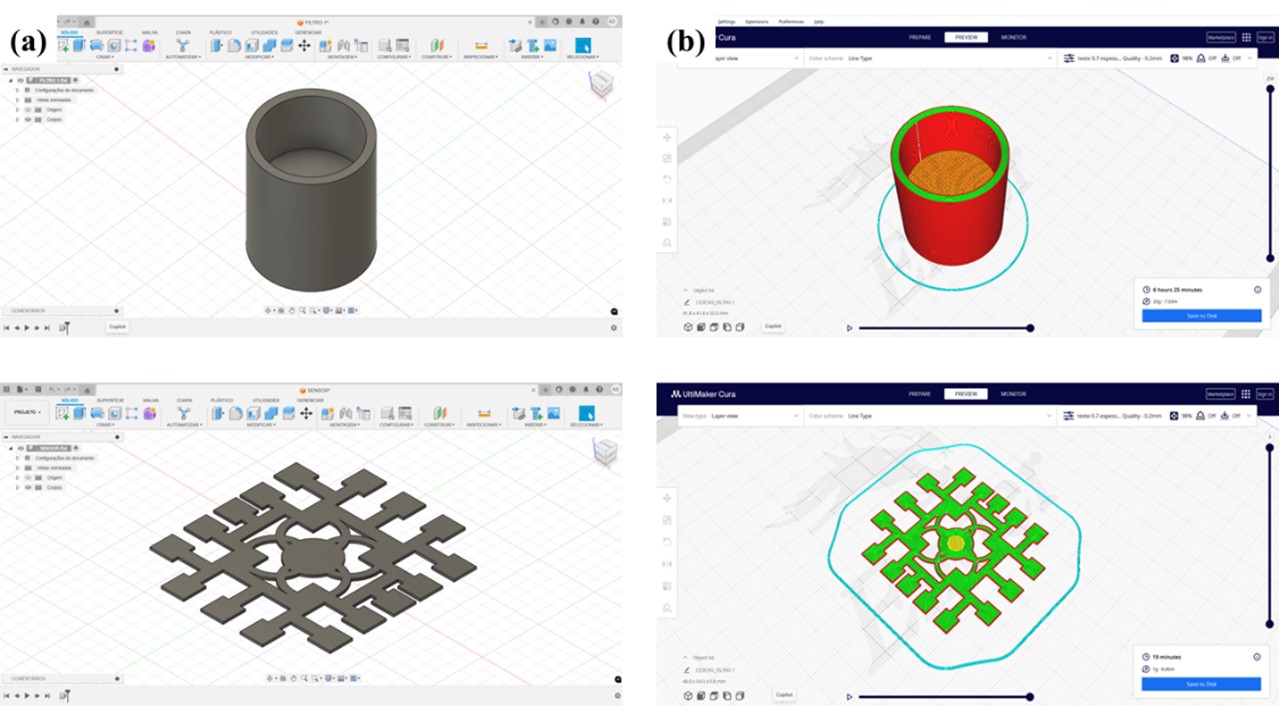
The water filter and sensor models were designed in Fusion 360® (Educational License), as shown in Figure 1. Then, the STL file was imported into Ultimaker Cura® (open-source software) to set the printing parameters (Table 2), which were defined based on the tests.
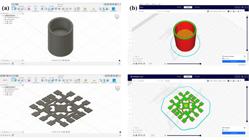
Development stages for model printing: (a) Modeling in Fusion 360® software; (b) Configuration of printing parameters in Ultimaker Cura® software.
2.5.9. Statistical analysis
The results of the dimensional characterization, tensile test, density, and FFI were subjected to analysis of variance (ANOVA), using the OriginPro software, applying the Tukey test, at a significance level of 5%, to evaluate significant changes (p≤ 0.05).
3. Results and Discussion
3.1. Dimensional characterization of the produced filaments
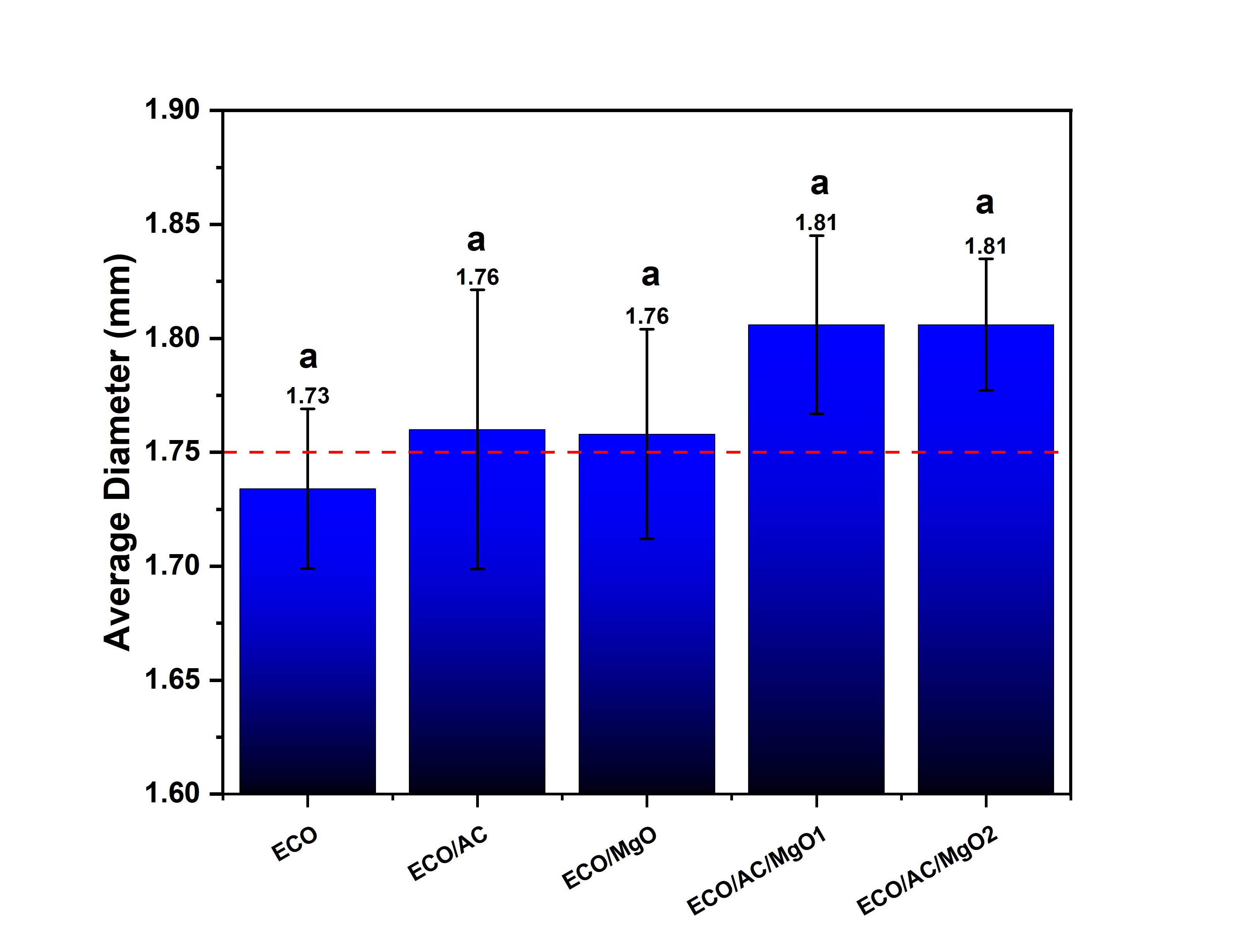
Figure 2 shows the average filament diameters for all evaluated compositions. It can be observed that the addition of fillers led to an increase in filament diameter, likely due to changes in viscosity during the extrusion of the polymeric matrix56,57. During processing, the screw speed and production parameters were kept constant to standardize the manufacturing conditions. The only adjustment made was to the puller speed, which does not have a precise setting and was regulated to bring the final filament diameter close to the nominal value of 1.75 mm, recommended for the printer used.
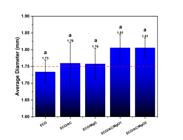
Average diameter of filaments produced for all compositions. aDifferent letters showed a significant difference (p>0.05) between the means according to the Tukey test.
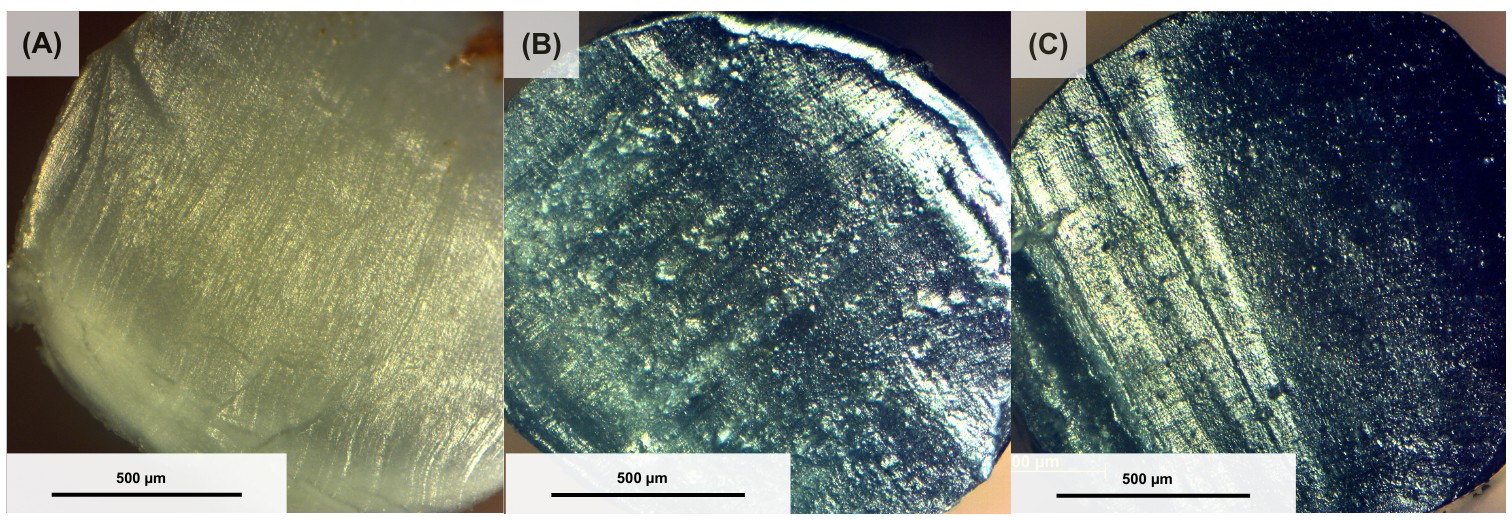
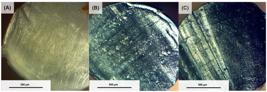
Figure 3 shows the cross-sectional image of the ECO, ECO/AC/MgO1, and ECO/AC/MgO2 compositions. This analysis allowed the assessment of the filament shape, verifying whether they indeed achieve a cylindrical geometry, as well as the effect of the fillers and their influence on the filament surface. Combined with the average thickness values, it was possible to identify the potential influence of the fillers on dimensional instability at certain points. This effect may be associated with the formation of agglomerates as well as with changes in the viscosity of the formulations.
3.2. Mechanical properties of filaments
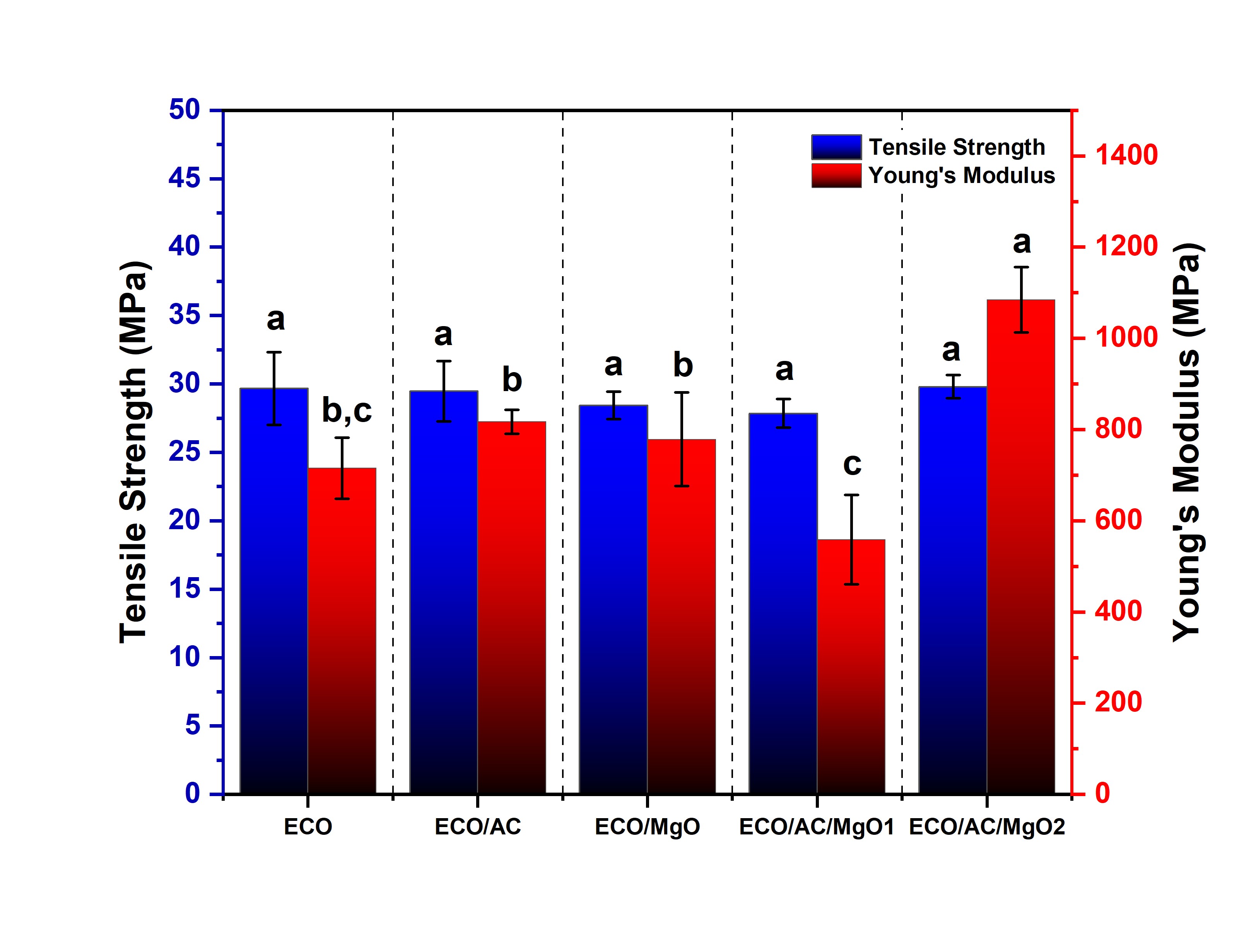
Figure 4 illustrates the behavior of the filaments in terms of tensile strength and Young’s modulus.
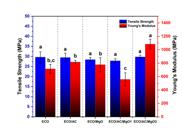
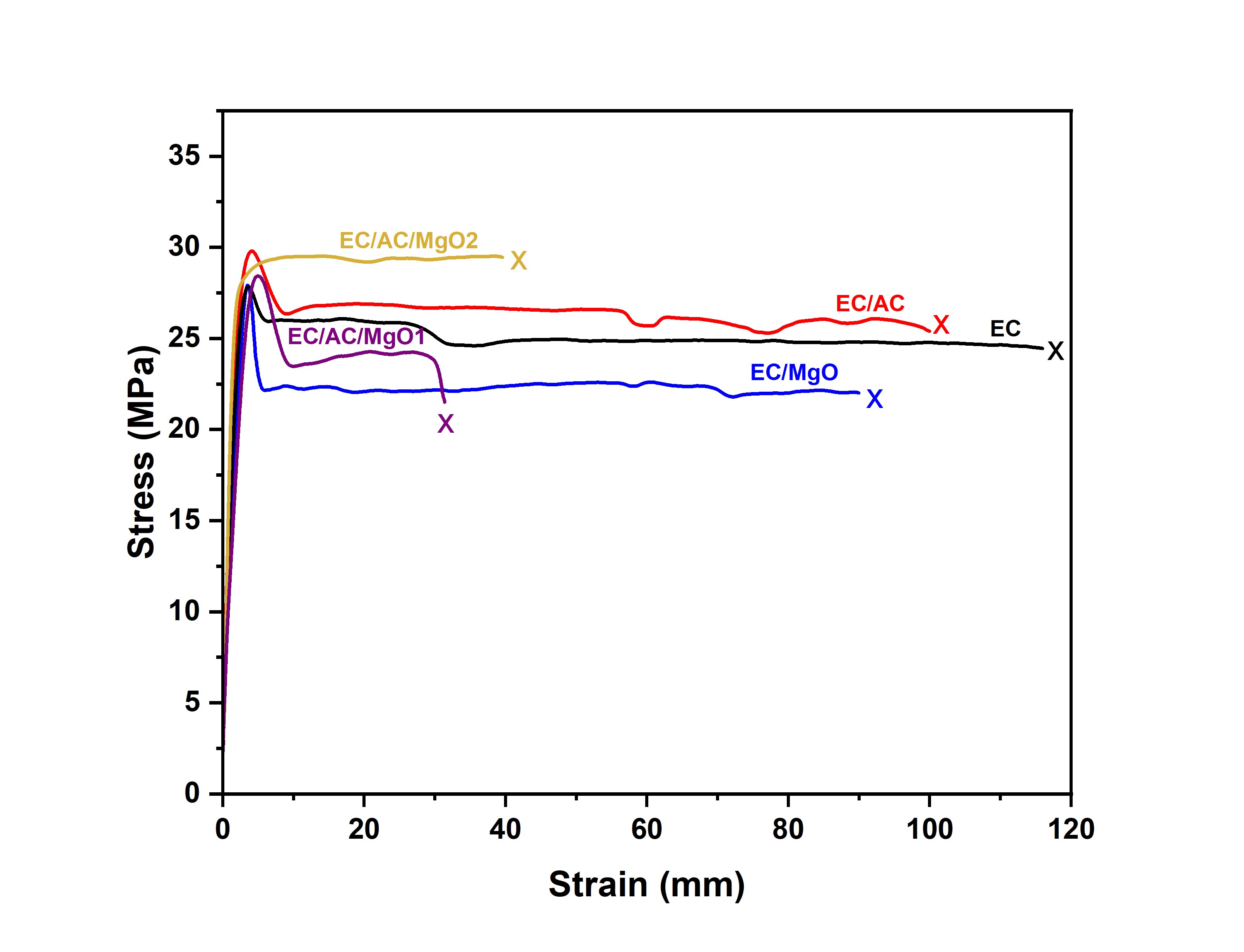
For tensile strength and Young’s modulus values, the blend reached 29.7 (±2.2) MPa and 715.4 (±54.7) MPa. When comparing it with the result obtained in the ECO/AC composition, it was evident that there was no significant difference; the composition obtained a value of 29.5 MPa (±1.8). However, there was an increase in the elastic modulus, in which the ECO/AC composition obtained a value of 817.1 MPa (±21.3), indicating that the activated carbon influenced the increase in the stiffness of the composite, probably due to the presence of a porous network with satisfactory surface area, which facilitates the connection between compounds58,59.
For the ECO/MgO composition, the tensile strength and Young’s modulus obtained were 28.4 MPa (±0.8) and 778.7 MPa (±84.0), respectively, indicating a slight increase in modulus due to the presence of MgO. There is no statistical significance for both properties. However, it is important to highlight that MgO is a relatively hard material; however, the presence of excess oxide particles can make the deformation of the material difficult, as well as due to the presence of greater porosity in composites with the MgO content used, as well as the increase in AC content60-62.
For the ECO/AC/MgO1 composition, the value obtained for tensile strength was 27.9 MPa (±0.9) and modulus of 558.8 MPa (±79.9); thus, when comparing it with the blend, the difference between the compositions is approximately 1.8 and 156.7 MPa, respectively. However, statistically, the variation is not significant. This reduction in modulus can be associated with the presence of MgO fillers and AC, as discussed previously.
On the other hand, for the ECO/AC/MgO2 composition, the tensile strength and elastic modulus obtained were 29.8 MPa (±0.7) and 1084.6 MPa (±58.2), with a statistically significant difference between the modulus. This effect was attributed to the greater amount of fillers present, as both materials have higher mechanical properties.
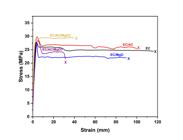
Figure 5 shows the representative stress-strain curve for all compositions, where the behavior indicates a reduction in strain, which corroborates the values found and justifies the increase in filament rigidity.
3.3. Filament density
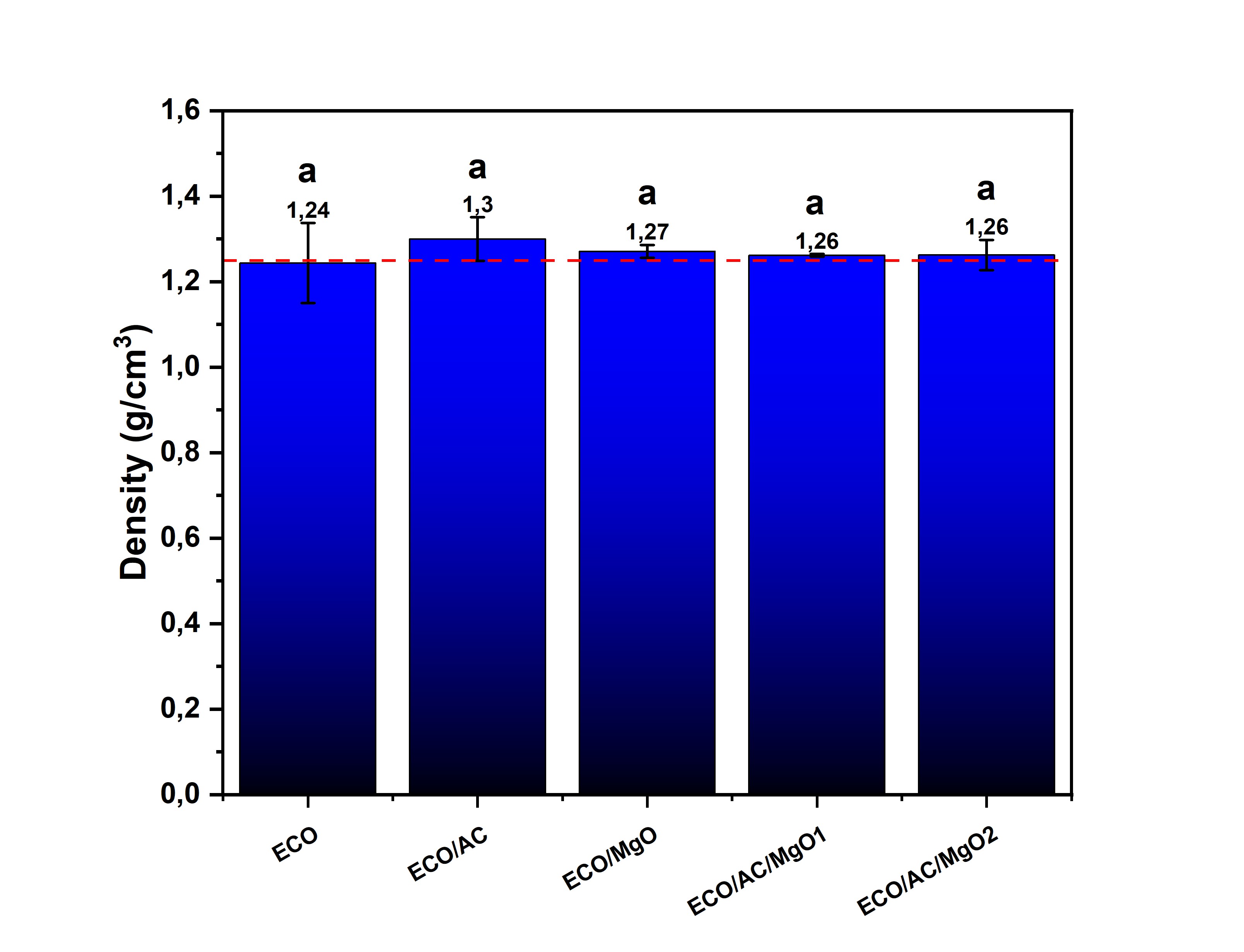
From Figure 6, it was possible to visualize the average density (g/cm3) of each composition.
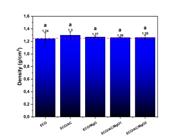
Graph of the average density of the compositions. aDifferent letters showed a significant difference (p>0.05) between the means according to the Tukey test.
According to the data obtained, pure PLA/PBAT commercial blend presented an average density of 1.24 g/cm3, compatible with the typical value attributed to Ecovio® F2224 by the quality control of BASF®, supplier of the grade. Regarding the other compositions, all exhibited a slight increase in average density compared to the PLA/PBAT blend due to the low additive load used. However, as shown by the Tukey test, there was no significant difference between the compositions.
However, it is possible to observe that the ECO/AC composition had a more significant increase, attributed to the compaction of activated carbon during extrusion, since compaction reduces the volume of activated carbon pores as a result of the collapse of macropores, increasing density63,64. In turn, the compositions with activated carbon and magnesium oxide likely exhibited a smoother densification than ECO/AC due to the blocking of activated carbon pores by the deposition of MgO, which prevented greater compaction of the material65,66.
The slight increase in density for the compositions with MgO is likely because the particles used had a higher density of 3.6 g/cm3, which justifies the similar values between the compositions67-69.
Finally, the similarity observed between the densities of commercial blend PLA/PBAT and compositions with additives implies similar viscosities, considering the link between the two properties28,70. Therefore, the processing parameters used for 3D printing pure PLA/PBAT blend must also suit the additives.
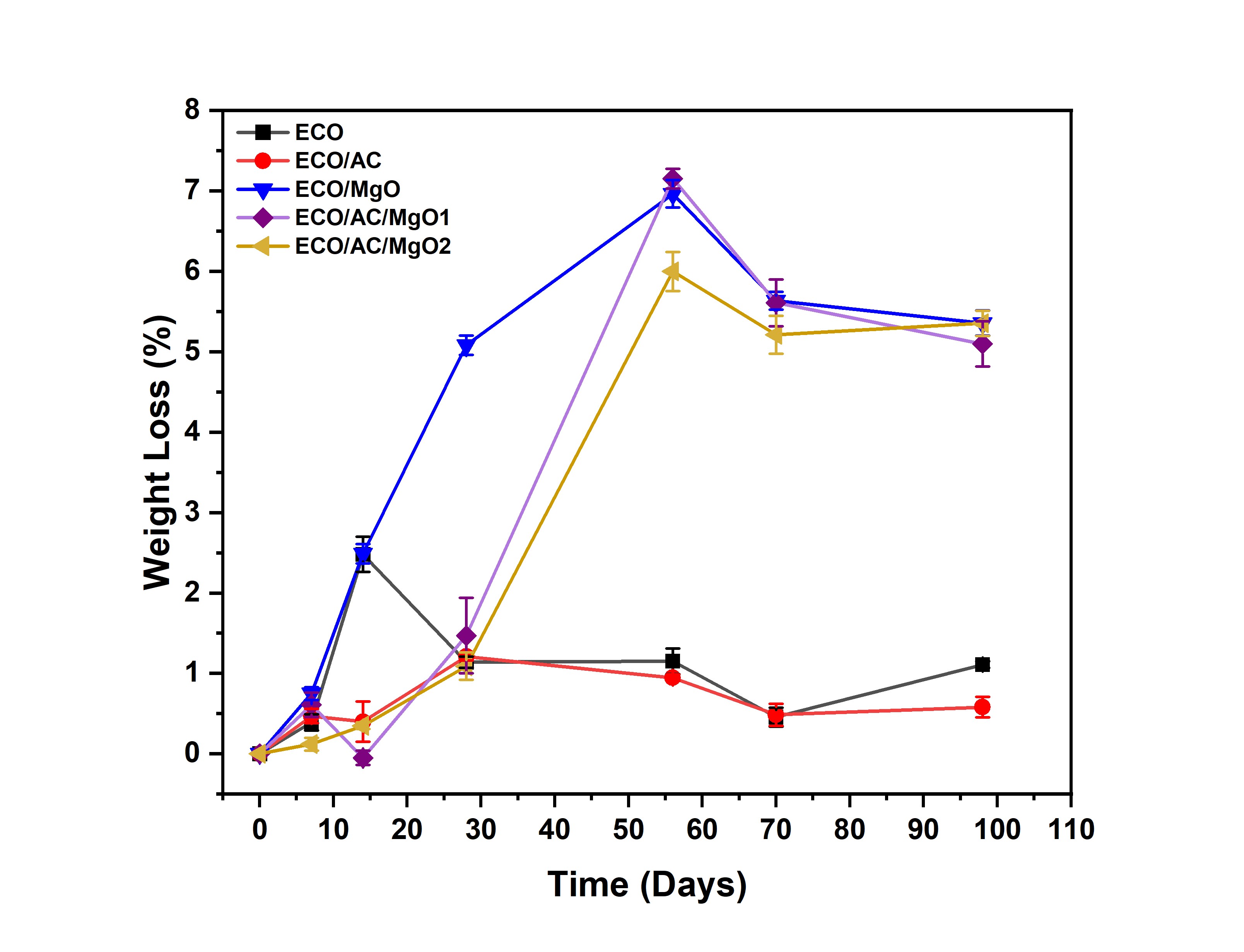
3.4. Filament soil degradation test
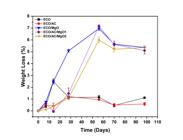
Figure 7 shows the mass loss graph for the soil degradation test of all compositions. Initially, after 7 days of testing, all compositions showed an increasing mass loss in a range of 0.1% (±0.0) to 0.8% (±0.1), for ECO/AC/MgO2 and ECO/MgO, respectively. For the pure commercial blend, after 14 days of testing, there was growth and a maximum point of degradation, reaching 2.5% (±0.2), then there was a degradation saturation line remaining at 1.1% (±0.0) at the end of the test, with 98 days. Compared to studies that used films or mulch films71,72, a much lower percentage of mass loss was found in this study, probably due to the filamentary format of the sample, as indicated by Liu et al.73 that produced PLA/PBAT monofilaments with the addition of graphene, the weight loss percentage in marine and soil environments was below 8%.
The degradation process in the soil occurs through hydrolysis as well as microbial degradation. The first stage of degradation occurs through the hydrolysis of ester groups in the structure. Then, hydrolytic degradation occurs, low molecular weight polymers and oligomers spread outside the object and are ingested by microorganisms, characterized as enzymatic or catalytic degradation73,74.
For the ECO/AC composition, there were no major changes compared to the commercial blend. which both reached a range of 0.6 (±0.1) and 1.1 (±0.2) after 98 days of testing. For the ECO/MgO composition, the highest degradation rate was obtained, in which the maximum peak was reached after 56 days with 7.0% (±0.2), and finally reached a mass loss of 5.4 (±0.2) after 98 days. As identified by Del Campo et al.75 who developed composites with a PLA/PBAT blend matrix and zinc oxide particles on the nano and micro scale. The authors identified that with an increase in the zinc oxide load, the disintegration process increased. The reason is linked to the catalytic effect of ZnO on hydrolytic degradation, which mainly affects the PLA phase in comparison to the PBAT phase. Another important factor is that micro-sized particles favor the degradation process. There are few studies involving filaments, as most of the reported samples are evaluated in the form of films. However, similar to the present work, Liu et al.73 prepared PLA/PBAT monofilaments modified with graphene and reported low biodegradation rates after 120 days, with maximum values of 7.4% in soil and 7.5% in seawater. These results are comparable to those obtained in the present study.
The compositions ECO/AC/MgO1 and ECO/AC/MgO2 showed similar behavior, with maximum peaks of 7.2 (±0.2) and 6.0 (±0.2), respectively. In addition to final mass loss after 98 days of 5.0 (±0.3) and 5.4 (±0.2), for ECO/AC/MgO1 and ECO/AC/MgO2, the incorporation process, where magnesium oxide particles were inserted into the activated carbon's micropores, helped delay degradation, reducing the hydrolytic degradation process.
In general, the compositions with the additives achieved a good degradation rate, indicating that if disposed of in soil after their complete life cycle, there will be an accelerated process that supports the overall sustainability concept of printed objects.
3.5. Thermogravimetry (TGA) and derivative (DTG) of the filaments
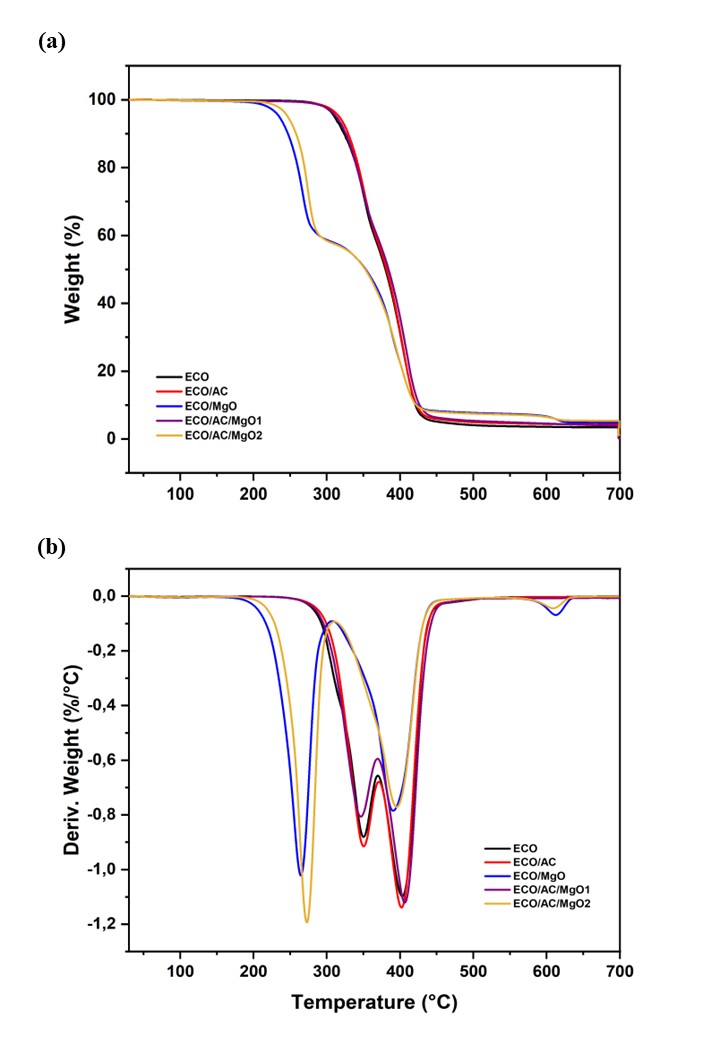
Figure 8 illustrates the TGA and DTG curves of all filament compositions. Table S1 presents data relating to thermal events observed in the curves produced.
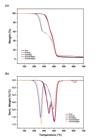
Thermogram with thermogravimetry curves (TGA) of the compositions (a) and respective derived curves (b).
The thermogravimetric curve of the PLA/PBAT blend showed two distinct events, characteristic of polymer blends, in this case, PLA and PBAT. The first thermal event corresponds to the initial degradation of PLA with a peak at 350 °C and subsequent decomposition of PBAT at 403 °C76,77. The two events occur at different temperature ranges, indicating that there is a phase separation due to immiscibility between the respective polymers78-80. The literature states that PBAT decomposes at higher temperatures than PLA because it has greater thermal stability, due to the benzene rings present in its structure81.
This can be observed in the composition containing only activated carbon, where the variations can be considered negligible due to the behavior being only slightly affected in relation to the blend. However, the compositions ECO/MgO and ECO/AC/MgO2 showed thermal degradation processes that were quite different from those recorded for the pure blend. In addition to a second, more pronounced event in the TG curve and the emergence of a third thermal event, a reduction in mass loss and temperatures related to the first and second events was also observed. With magnesium oxide as a common element between the mentioned compositions, it may be responsible for the changes in the blend's decomposition process.
Xiang et al.82 demonstrated in their research that MgO, when added to a PLA/PBAT blend, acts as a catalyst, reducing the initial decomposition temperatures by stimulating selective depolymerization of the PLA. Another possible effect of the action of MgO as a catalyst mentioned in this article is the occurrence of transesterification reactions between PLA and PBAT, which generate a small amount of lactate units with greater thermal stability than the original lactate units derived from PLA, this new product formed may explain the existence of a third thermal event and the higher percentage of residue in these compositions.
However, the ECO/AC/MgO1 composition showed a marked degradation reduction behavior, similar to other compositions with magnesium oxide loading. In this way, the impregnation of MgO in activated carbon made it difficult for MgO to act as a catalyst, making it possible to observe this effect when comparing ECO/AC/MgO2 with the ECO /MgO, as the compositions with activated carbon and MgO showed an increase in temperatures relative to the first event, indicating a delay in PLA catalysis83. However, the reaction between MgO and activated carbon indicated greater efficiency in the proportion of 1% activated carbon to 3% MgO, used in ECO/AC/MgO1.
It is possible to conclude that although magnesium oxide reduces the thermal stability of PLA/PBAT blend, all compositions are suitable for the desired application, since the extrusion and printing temperatures used are below 200°C and even with the presence of MgO, all compositions started the thermal degradation process only above 240°C, indicating that the processability of the blend was not affected by the incorporated additives.
3.6. Differential Scanning Calorimetry (DSC) of filaments
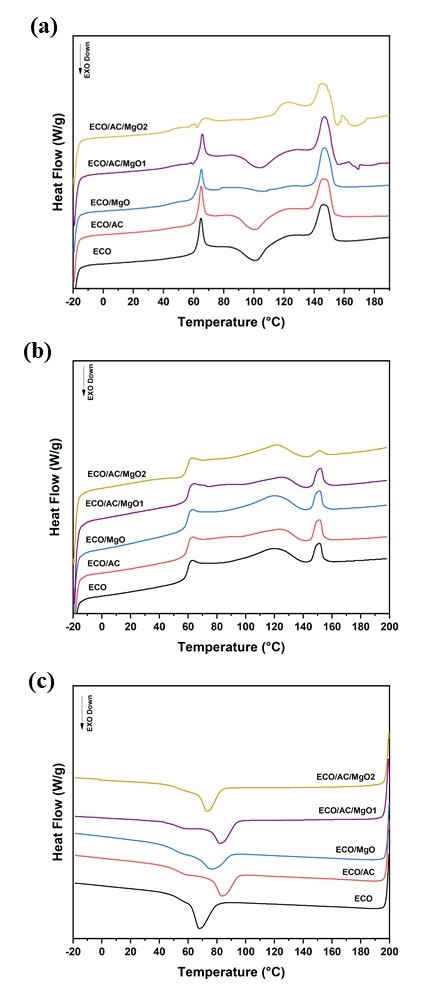
Figure 9 and Table S2 present the DSC curves and the temperatures found, respectively, for the first and second heating, in addition to cooling for all compositions.
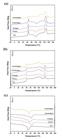
DSC curves for the compositions (ECO; ECO/AC; ECO/MgO; ECO/AC/MgO1; ECO/AC/MgO2): (a) 1st Heating; (b) Cooling; (c)2nd Heating .
All compositions, except the ECO/MgO system, presented a glass transition temperature (Tg) relative to PLA in the temperature range between approximately 59 and 60 °C, corroborating the literature75,84. However, for ECO/MgO, there was a reduction in the glass transition temperature by 2 °C, possibly due to the influence of metal oxides. Anžlovar et al.85 identified in their work that with an increase in the percentage of addition of zinc oxide nanoparticles (ZnO), there was a reduction in the glass transition temperature of PLA, and they attributed this behavior to the resulting products from the PLA degradation during processing. The degradation process directly influences the recrystallization of crystals that become defective, through by-products. As the beginning of degradation occurs in the amorphous part, it was possible to identify the reduction in Tg. This same information was found in the work of Zhao et al.37.
The crystalline melting temperature (Tm) for PBAT in the pure blend was observed at 120 °C, with no additional records at lower temperatures, probably due to the overlap of the PLA Tg event. The crystalline melting temperature for the ECO/AC composition increased by 4 °C to PBAT, compared to the commercial blend, which may be related to the presence of activated carbon acting as a nucleating agent, thus increasing crystallinity and consequently requiring a higher temperature for mobility due to the organization of polymer chains. A similar fact was found by Wu et al.86. The increase in crystallinity is also corroborated by the cooling curve, where it is possible to notice the curve shifting approximately 16 °C (83.3 °C) more than the PLA/PBAT blend.
For the composition ECO/AC/MgO2, there were no major changes in the Tm of PBAT and PLA. However, the ECO/AC/MgO1 composition showed an increase of 5 °C for Tm, which may be related to the low amount of activated carbon used, which, through impregnation with magnesium oxide, played a more efficient role in the nucleating agent process.
For the ECO/MgO composition, a Tc of 76 °C was recorded due to the nucleation process accelerated by the MgO particles, as generally inorganic fillers act as a nucleating agent, in which it was possible to obtain the highest crystalline percentage for PLA, reaching 9.4%87.
Similar behavior occurred for the compositions ECO/AC/MgO1 and ECO/AC/MgO2, where the crystallization temperatures are lower, respectively, relative to the formulations without particulate additives. This behavior can be justified by the fact that the impregnation causes a possible inhibition of the crystalline nucleation of the PLA/PBAT blend. As indicated by Wang et al.88, who added cetyltrimethylammonium bromide (CTAB)-functionalized MgO particles to a PBAT matrix, functionalized particles inhibit the nucleation process for PBAT crystallization. It can also be verified, by the change in the crystalline percentage of PLA, where for the ECO/AC/MgO2 composition only 1.0% was recorded, that the equitable proportion for activated carbon and magnesium oxide was a crucial factor for this behavior.
3.7. Filament Flow Index (FFI)
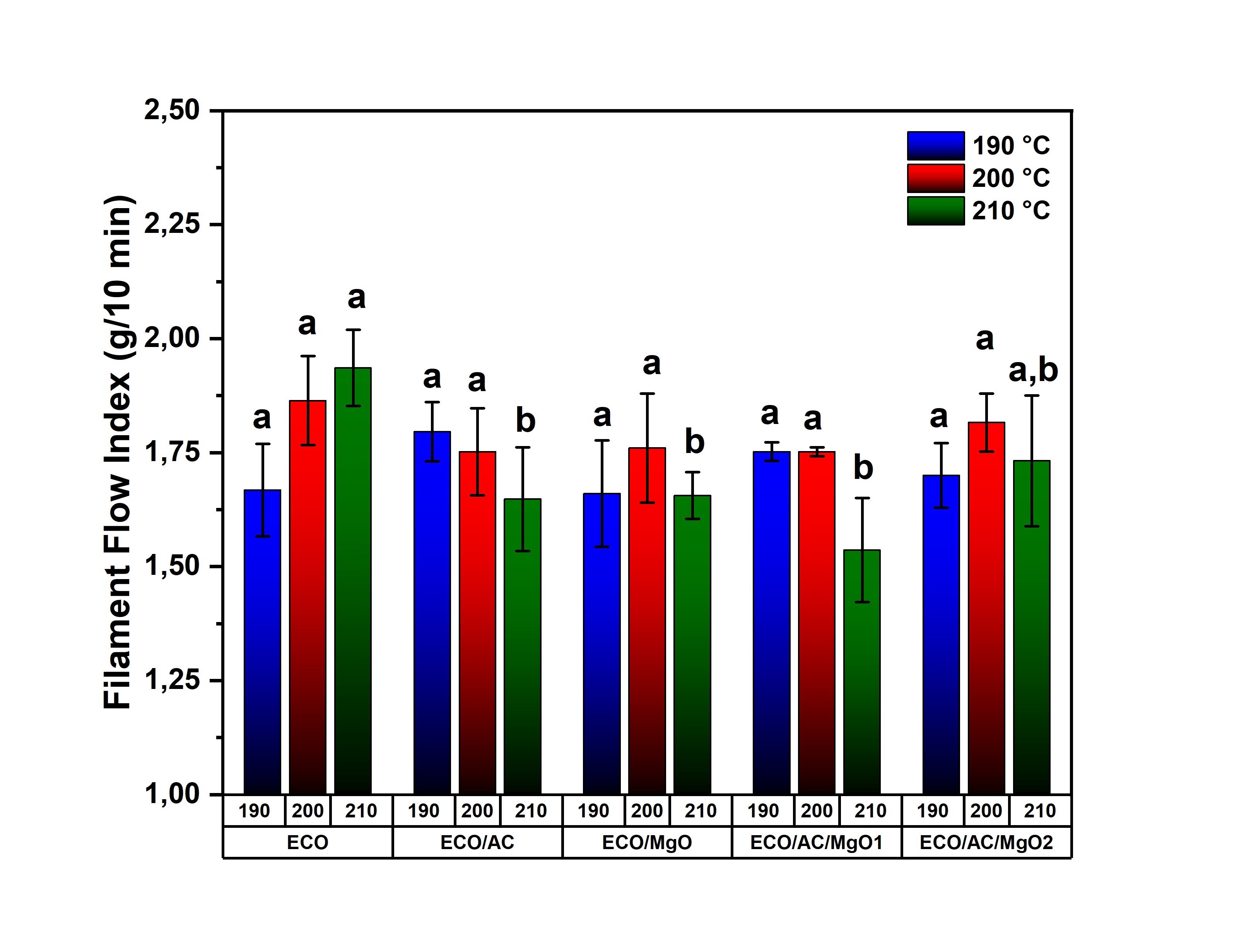
The fluidity index influences the processability of the material, and in 3D printing, it affects the deposition and adhesion of layers, helping to assess and correct print quality through the physical, chemical, and mechanical properties of the polymeric material89.
Figure 10 shows the graph for the flow index for all compositions in a temperature range between 190 and 210°. In which the values found for ECO were: 190 – 1.7 (±0.1); 200 – 1.9 (±0.1); 210 - 1.9 (±0.1). There was an increase in fluidity according to the increase in temperature due to the increase in the mobility of the polymer chains due to the insertion of greater energy. The manufacturer of the commercial blend presents a value of 2.5 g/10min for 190 °C, which represents proximity to the values found; however, this variation can be linked to the test method. The literature presents different values for the MFI for the PLA/PBAT blend, in addition to the evaluation method used, taking into account the fluidity of the polymer through the printer's extruder nozzle, the values for the “traditional” method with a standard load of 2.16 kg. Mathew et al.90 found values for MFI, given its use in filaments for FDM 3D printing, for the composition with 60% PLA and 40% PBAT which is close to the composition of the blend used in this work of 32, 15 g/10 min for a temperature of 160 °C. For the PLA/PBAT blend for a temperature of 210 °C, a value of 9.1 (±0.4), and for a temperature of 230 °C, a value of 20.0 ( ±1.3), values close to those obtained by Wang et al.91.
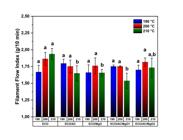
Graph for filament fluidity index. a,b Different letters showed a significant difference (p>0.05) between the means according to the Tukey test.
For the ECO/AC composition, the values found were: 190 – 1.8 (±0.07); 200 - 1.8 (±0.1); 210 - 1.7 (±0.1). For temperatures of 190 and 200 °C, there was no significant difference comparing the commercial blend; however, the temperature of 210 °C showed a difference. Evidencing the fluidity reduction behavior as the temperature increases. Abdo et al.92 identified in the production of low-density polyethylene composites with the addition of biochar, that there was a reduction in the MFI according to the increase in the percentage of biochar, which is referenced in the literature. As carbon additives have a high molecular weight and a dispersed structure, they influence the reduction. In addition, the polymer chains can interact with the filler, reducing the mobility of the chains and increasing viscosity. The thermal stability of carbonaceous materials also favors the reduction of MFI due to the need for greater energy for fusion, making it resistant to flow93.
The FFI values for the MgO composition were: 190 - 1.7 (±0.1); 200 - 1.8 (±0.1); 210 - 1.7 (±0.1). Again, there was no significant difference for values 190 and 200 compared to the commercial blend. However, the reduction at a temperature of 210 °C was significant. Similar to activated carbon, the reduction in the fluidity of the polymer matrix is linked to the molecular weight and the interaction between the polymer chains, which impairs the flow, increasing viscosity. A similar effect was found by Yoksan and Bootanimitr94 who produced PBAT polymer matrix compositions with the addition of calcium carbonate (CaCO3).
There were no significant differences for the ECO/AC/MgO1 system for temperatures of 190 and 200 °C, where the values were 1.8 (±0.0). However, there was a difference at 210 °C, which obtained a value of 1.5 (±0.1). Values similar to the compositions ECO/AC and ECO/MgO, in which the ratio can be considered equivalent to that mentioned previously. Likewise, the ECO/AC/MgO2 composition with values of: 190 - 1.7 (±0.0); 200 - 1.8 (±0.0); 210 - 1.7 (±0.1).
It is indicated in the literature that higher fluidity index values are favorable for 3D printing due to the deposition and adhesion process between the layers of the molten polymer95,96. Therefore, it is possible to state that there were no changes in the fluidity of the composites that would harm the printing of the objects, as can be seen from the printability test.
3.8. Printability test filaments
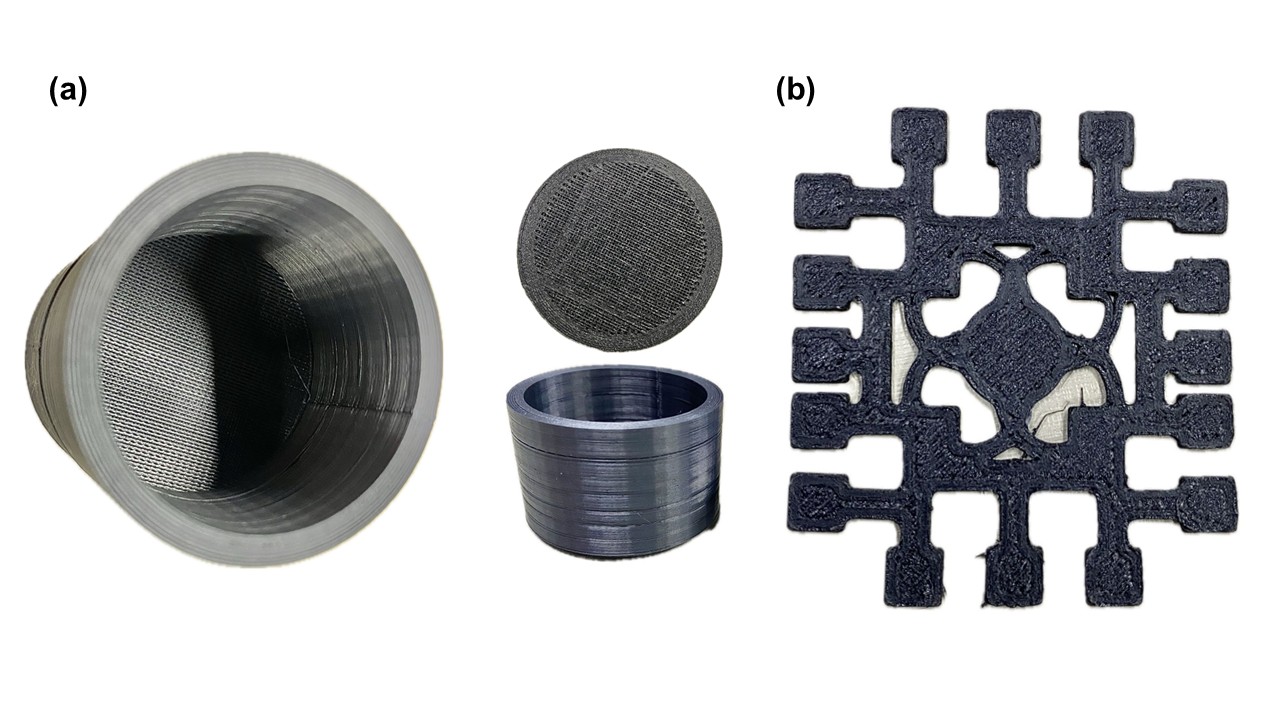
Functional object models were printed to evaluate the printability of the produced filaments. In Figure 11a, a water treatment filter model is shown, while in Figure 11b, a sensor model is displayed. The prints exhibited good quality, demonstrating that even with more complex geometries, such as the sensor, it was possible to obtain well-defined pieces.
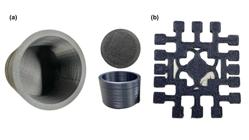
Objects printed using the produced filament: (a) water treatment filter; (b) sensor model.
However, one of the identified issues was the presence of agglomerates resulting from single-screw processing. Additionally, on the filter side, void formations or incomplete layers were observed, a problem associated with the filament's dimensional instability. In certain regions, the thickness was found to be below 1.75 mm, compromising material uniformity during printing.
Future studies should focus on improving processing conditions, including extrusion optimization (such as the possibility of pre-extrusion using twin-screw systems), reduction of particle size, and adjustments in extrusion speed to ensure higher printing quality. Moreover, dimensional stabilization could enhance printing speed and improve process reliability.
Despite these limitations, the filaments demonstrated suitability for functional object printing, although further process optimization is still necessary.
4. Conclusion
The filaments were produced by incorporating magnesium oxide into activated carbon within a commercial PLA/PBAT blend. Mechanical analysis revealed an increase of more than 50% in Young’s modulus, without loss of tensile strength for the ECO/AC/MgO2 composition, confirmed by Tukey’s test with p > 0.05, ensuring the suitability of the filaments for 3D printing. Density increased with filler addition, reaching 1.3 g/cm3 for the ECO/MgO composition, but without a significant impact on printing parameters, enabling the fabrication of complex objects. Soil degradation tests showed that the addition of magnesium oxide raised the degradation rate by about 6% compared to the neat blend, likely due to higher water absorption. TGA analysis indicated a 77 °C reduction in thermal stability for ECO/AC/MgO2, attributed to an imbalance in magnesium oxide concentration that hindered proper penetration into the pores of activated carbon and triggered a catalytic effect in thermal degradation. DSC analysis revealed changes in MgO-containing compositions, including a 3 °C reduction in glass transition (Tg) and melting temperature (Tm), and PLA crystallinity (%Xc) of 9.3%, highlighting the central role of MgO in the formulations. Regarding FFF, no significant alterations were observed, ensuring the feasibility of printing functional models.
Rocha et al.97 produced biochar-based filaments for electroanalytical sensing platforms, applying 10% biochar in a PLA matrix. The formulation demonstrated strong potential for detecting carbendazim, which is relevant for environmental and food monitoring. Tang et al.98 fabricated a flexible humidity sensor from bacterial cellulose, activated carbon, and magnesium chloride (MgCl2) in a polyamide matrix, achieving high sensitivity and a wide response range (11–95% RH), with validated stability and reliability. Sorbhan et al.99 developed nanocellulose films using activated carbon as a binder and silver nanoparticles as a functional agent, which provided efficient antimicrobial and electrical properties, as well as increased conductivity. These studies reinforce the applicability and potential of the developed formulation. For future research, it is recommended to optimize particle size, explore twin-screw processing, and adjust drawing speed to improve efficiency and enable more sustainable and functional printing.
Supplementary Material
The following online material is available for this article:
Table S1
Table S2
5. Acknowledgments
The authors are grateful for the technical support of Ana Carolina Lemos de Morais (Macromolecular Chemistry and New Polymeric Materials, Zernike Institute for Advanced Materials, University of Groningen) and Circular Plastics, Academy Technology & Innovation, NHL Stenden.
-
Data Availability
All data supporting the findings of this study are included in the published article and in the Supplementary Materials.
References
-
1 Seoane-Viaño I, Januskaite P, Alvarez-Lorenzo C, Basit AW, Goyanes A. Semi-solid extrusion 3D printing in drug delivery and biomedicine: personalised solutions for healthcare challenges. J Control Release. 2021;332:367-89. https://doi.org/10.1016/j.jconrel.2021.02.027 PMid:33652114.
» https://doi.org/10.1016/j.jconrel.2021.02.027 -
2 da Silva TCP, Fortes AGS, de Abreu IR, de Carvalho LH, de Almeida YMB, Alves TS, et al. Development of biodegradable PLA/PBAT-based filaments for fertilizer release for agricultural applications. Materials (Basel). 2022;15(19):6764. https://doi.org/10.3390/ma15196764 PMid:36234105.
» https://doi.org/10.3390/ma15196764 -
3 Tracy T, Wu L, Liu X, Cheng S, Li X. 3D printing: innovative solutions for patients and pharmaceutical industry. Int J Pharm. 2023;631:122480. https://doi.org/10.1016/j.ijpharm.2022.122480 PMid:36509225.
» https://doi.org/10.1016/j.ijpharm.2022.122480 -
4 Yanar N, Kallem P, Son M, Park H, Kang S, Choi H. A New era of water treatment technologies: 3D printing for membranes. J Ind Eng Chem. 2020;91:1-14. https://doi.org/10.1016/j.jiec.2020.07.043
» https://doi.org/10.1016/j.jiec.2020.07.043 -
5 Wang Y, Xu Z, Wu D, Bai J. Current status and prospects of polymer powder 3D printing technologies. Materials (Basel). 2020;13(10):2406. https://doi.org/10.3390/ma13102406 PMid:32456202.
» https://doi.org/10.3390/ma13102406 -
6 Hao B, Lin G. 3D printing technology and its application in industrial manufacturing. IOP Conf Ser.: Mater Sci Eng. 2020;782:022065. https://doi.org/10.1088/1757-899X/782/2/022065
» https://doi.org/10.1088/1757-899X/782/2/022065 - 7 Deepak BBVL, Parhi DRK, Biswal BB, editors. Advanced Manufacturing Systems and Innovative Product Design: Select Proceedings of IPDIMS 2020 (Lecture Notes in Mechanical Engineering). USA: Springer; 2020.
-
8 Erokhin K, Naumov S, Ananikov V. Defects in 3D Printing and Strategies to Enhance Quality of FFF Additive Manufacturing. A Review. ChemRxiv. 2023. https://doi.org/10.26434/chemrxiv-2023-lw1ns
» https://doi.org/10.26434/chemrxiv-2023-lw1ns - 9 Grand View Research. GVR Report cover Fused Deposition Modeling 3D Printing Market Size, Share & Trends Analysis Report By Printer Type (Desktop, Industrial), By Application, By End-use, By Region, And Segment Forecasts, 2024-2030. San Francisco: Grand View Research; 2025.
- 10 Zoting S, Shivarkar A. Fused deposition modeling 3D printing market size, share and trends 2024 to 2034. Canada: Predence Research; 2024.
-
11 Fortune Business Insights. 3D printing market overview. Fortune Business Insights; 2025 [cited 2025 Feb 21]. Available from: https://www.fortunebusinessinsights.com/industry-reports/3d-printing-market-101902
» https://www.fortunebusinessinsights.com/industry-reports/3d-printing-market-101902 -
12 Yeong WY, Goh GD. 3D printing of carbon fiber composite: the future of composite industry? Matter. 2020;2(6):1361-3. https://doi.org/10.1016/j.matt.2020.05.010
» https://doi.org/10.1016/j.matt.2020.05.010 -
13 Das AK, Agar DA, Rudolfsson M, Larsson SH. A review on wood powders in 3D printing: processes, properties and potential applications. J Mater Res Technol. 2021;15:241-55. https://doi.org/10.1016/j.jmrt.2021.07.110
» https://doi.org/10.1016/j.jmrt.2021.07.110 -
14 Wan Z, Zhang H, Niu M, Guo Y, Li H. Recent advances in lignin-based 3D printing materials: a mini-review. Int J Biol Macromol. 2023;253(Pt 1):126660. https://doi.org/10.1016/j.ijbiomac.2023.126660 PMid:37660847.
» https://doi.org/10.1016/j.ijbiomac.2023.126660 -
15 You X, Zhang Q, Yang J, Dong S. Review on 3D-printed graphene-reinforced composites for structural applications. Compos, Part A Appl Sci Manuf. 2023;167:107420. https://doi.org/10.1016/j.compositesa.2022.107420
» https://doi.org/10.1016/j.compositesa.2022.107420 -
16 Dul S, Gutierrez BJA, Pegoretti A, Alvarez-Quintana J, Fambri L. 3D printing of ABS nanocomposites. Comparison of processing and effects of multi-wall and single-wall carbon nanotubes on thermal, mechanical and electrical properties. J Mater Sci Technol. 2022;121:52-66. https://doi.org/10.1016/j.jmst.2021.11.064
» https://doi.org/10.1016/j.jmst.2021.11.064 -
17 Seng CT, A/L Eh Noum SY, A/L Sivanesan SK, Yu L-J. Reduction of hygroscopicity of PLA filament for 3D printing by introducing nano silica as filler. AIP Conf Proc. 2020;2233:020024. https://doi.org/10.1063/5.0001927
» https://doi.org/10.1063/5.0001927 -
18 Mohammed Z, Jeelani S, Rangari V. Effective reinforcement of engineered sustainable biochar carbon for 3D printed polypropylene biocomposites. Composites Part C: Open Access. 2022;7:100221. https://doi.org/10.1016/j.jcomc.2021.100221
» https://doi.org/10.1016/j.jcomc.2021.100221 -
19 Kaptan A, Kartal F. A critical review of composite filaments for fused deposition modeling: material properties, applications, and future directions. Eur Mech Sci. 2024;8(3):199-209. https://doi.org/10.26701/ems.1451829
» https://doi.org/10.26701/ems.1451829 -
20 Wickramasinghe S, Do T, Tran P. FDM-Based 3D printing of polymer and associated composite: A review on mechanical properties, defects and treatments. Polymers (Basel). 2020;12(7):1-42. https://doi.org/10.3390/polym12071529 PMid:32664374.
» https://doi.org/10.3390/polym12071529 -
21 Balou S, Ahmed I, Priye A. From waste to filament: development of biomass-derived activated carbon-reinforced PETG composites for sustainable 3D printing. ACS Sustain Chem& Eng. 2023;11(34):12667-76. https://doi.org/10.1021/acssuschemeng.3c02685
» https://doi.org/10.1021/acssuschemeng.3c02685 -
22 Saidulu D, Srivastava A, Gupta AK. Enhancement of wastewater treatment performance using 3D printed structures: a major focus on material composition, performance, challenges, and sustainable assessment. J Environ Manage. 2022;306:114461. https://doi.org/10.1016/j.jenvman.2022.114461 PMid:35032942.
» https://doi.org/10.1016/j.jenvman.2022.114461 -
23 Park SS, Lee YS, Lee SW, Repo E, Kim TH, Park Y, et al. Facile surface treatment of 3D-Printed PLA filter for enhanced graphene oxide doping and effective removal of cationic dyes. Polymers (Basel). 2023;15(2):269. https://doi.org/10.3390/polym15020269 PMid:36679150.
» https://doi.org/10.3390/polym15020269 -
24 Heidarinejad Z, Dehghani MH, Heidari M, Javedan G, Ali I, Sillanpää M. Methods for preparation and activation of activated carbon: a review. Environ Chem Lett. 2020;18(2):393-415. https://doi.org/10.1007/s10311-019-00955-0
» https://doi.org/10.1007/s10311-019-00955-0 -
25 Ukanwa KS, Patchigolla K, Sakrabani R, et al. A review of chemicals to produce activated carbon from agricultural waste biomass. Sustainability. 2019;11(22):6204. https://doi.org/10.3390/su11226204
» https://doi.org/10.3390/su11226204 -
26 Zhu J, Yu J, Wu P, Liu J, Ji H, Huang Y, et al. 3D printing of hierarchically porous lightweight activated carbon/alumina monolithic adsorbent for adsorptive desulfurization of hydrogenated diesel. Separ Purif Tech. 2024;330:125334. https://doi.org/10.1016/j.seppur.2023.125334
» https://doi.org/10.1016/j.seppur.2023.125334 -
27 Gackowski BM, Goh GD, Sharma M, Idapalapati S. Additive manufacturing of nylon composites with embedded multi-material piezoresistive strain sensors for structural health monitoring. Compos, Part B Eng. 2023;261:110796. https://doi.org/10.1016/j.compositesb.2023.110796
» https://doi.org/10.1016/j.compositesb.2023.110796 -
28 Browne MP, Redondo E, Pumera M. 3D Printing for electrochemical energy applications. Chem Rev. 2020;120(5):2783-810. https://doi.org/10.1021/acs.chemrev.9b00783 PMid:32049499.
» https://doi.org/10.1021/acs.chemrev.9b00783 -
29 Gao Y, Yue Q, Gao B, Li A. Insight into activated carbon from different kinds of chemical activating agents: a review. Sci Total Environ. 2020;746:141094. https://doi.org/10.1016/j.scitotenv.2020.141094 PMid:32745853.
» https://doi.org/10.1016/j.scitotenv.2020.141094 -
30 Jjagwe J, Olupot PW, Menya E, Kalibbala HM. Synthesis and application of granular activated carbon from biomass waste materials for water treatment: a review. J Bioresour Bioprod. 2021;6(4):292-322. https://doi.org/10.1016/j.jobab.2021.03.003
» https://doi.org/10.1016/j.jobab.2021.03.003 -
31 Idrees M, Ahmed S, Mohammed Z, Korivi NS, Rangari V. 3D printed supercapacitor using porous carbon derived from packaging waste. Addit Manuf. 2020;36:101525. https://doi.org/10.1016/j.addma.2020.101525
» https://doi.org/10.1016/j.addma.2020.101525 -
32 Oliveira KG, Botti R, Kavun V, Gafiullina A, Franchin G, Repo E, et al. Geopolymer beads and 3D printed lattices containing activated carbon and hydrotalcite for anionic dye removal. Catal Today. 2022;390-391:57-68. https://doi.org/10.1016/j.cattod.2021.12.002
» https://doi.org/10.1016/j.cattod.2021.12.002 -
33 Ngidi NPD, Koekemoer AF, Ndlela SS. Application of metal oxide/porous carbon nanocomposites in electrochemical capacitors: a review. Phys Chem Earth Parts ABC. 2024;135:103698. https://doi.org/10.1016/j.pce.2024.103698
» https://doi.org/10.1016/j.pce.2024.103698 -
34 Yasin AS, Mohamed AY, Mohamed IMA, Cho D-Y, Park CH, Kim CS. Theoretical insight into the structure-property relationship of mixed transition metal oxides nanofibers doped in activated carbon and 3D graphene for capacitive deionization. Chem Eng J. 2019;371:166-81. https://doi.org/10.1016/j.cej.2019.04.043
» https://doi.org/10.1016/j.cej.2019.04.043 -
35 Taha A, Ben Aissa M, Da’na E. Green synthesis of an activated carbon-supported Ag and ZnO nanocomposite for photocatalytic degradation and its antibacterial activities. Molecules. 2020;25(7):1586. https://doi.org/10.3390/molecules25071586 PMid:32235621.
» https://doi.org/10.3390/molecules25071586 -
36 Roohani E, Toghraie D. Heat transfer improvement of antifreeze by changing it to hybrid nanofluid: effects of hybrid magnesium oxide–graphene oxide nanopowders. J Therm Anal Calorim. 2022;147(12):6777-91. https://doi.org/10.1007/s10973-021-10973-2
» https://doi.org/10.1007/s10973-021-10973-2 -
37 Zhao LC, Cui CX, Liu SJ, Qi YM. Influence of In Situ MgO coating on corrosion resistance of pure magnesium in normal saline. Adv Mat Res. 2009;79–82:1039-42. https://doi.org/10.4028/www.scientific.net/AMR.79-82.1039
» https://doi.org/10.4028/www.scientific.net/AMR.79-82.1039 -
38 Selvi KT, Mangai KA, Priya M, Sagadevan S. Investigation of the dielectric and impedance properties of ZnO/MgO nanocomposite. Physica B. 2020;594:412355. https://doi.org/10.1016/j.physb.2020.412355
» https://doi.org/10.1016/j.physb.2020.412355 -
39 Ramezani Farani M, Farsadrooh M, Zare I, Gholami A, Akhavan O. Green synthesis of magnesium oxide nanoparticles and nanocomposites for photocatalytic antimicrobial, antibiofilm and antifungal applications. Catalysts. 2023;13(4):13. https://doi.org/10.3390/catal13040642
» https://doi.org/10.3390/catal13040642 -
40 Ikhuoria EU, Uwidia IE, Otabor GO, Ifijen IH. Comparative analysis of magnesium oxide nanoparticles biosynthesized from rubber seed shell and rubber leaf extracts. Biomed Mater Devices. 2024;2(2):1078-88. https://doi.org/10.1007/s44174-023-00139-z
» https://doi.org/10.1007/s44174-023-00139-z -
41 Yadav M, Maurya AK, Behera K, Chiu FC, Rhee KY. Physical properties of cellulose nanocrystal/magnesium oxide/chitosan transparent composite films for packaging applications. Int J Biol Macromol. 2024;264(Pt 1):130560. https://doi.org/10.1016/j.ijbiomac.2024.130560 PMid:38431019.
» https://doi.org/10.1016/j.ijbiomac.2024.130560 -
42 Manisha DM, Dhanda M, Panwar V, Lata S, Kumar H, Sharma A. Exploring the effect of magnesium oxide on electrochemical properties of polypyrrole encapsulated on graphitic carbon nitride for supercapacitors applications. J Energy Storage. 2025;106:114698. https://doi.org/10.1016/j.est.2024.114698
» https://doi.org/10.1016/j.est.2024.114698 -
43 Myneni VR, Kanidarapu NR, Vangalapati M. Methylene blue adsorption by magnesium oxide nanoparticles immobilized with chitosan (CS-MgONP): response surface methodology, isotherm, kinetics and thermodynamic studies. Iran J Chem Chem Eng. 2020;39(6):29-42. https://doi.org/10.30492/ijcce.2019.36342
» https://doi.org/10.30492/ijcce.2019.36342 -
44 BASF SE [homepage on the Internet]. Ecovio® F2224: biodegradable compound for compostable film and blow molding applications. BASF; 2023 [cited 2025 Feb 21]. Available from: https://www.ecovio.basf.com
» https://www.ecovio.basf.com - 45 ISO: International Organization for Standardization. ISO 1133-1:2022 — Plastics — determination of the melt mass-flow rate (MFR) and melt volume-flow rate (MVR) of thermoplastics: Part 1: Standard method. Genebra: ISO; 2022.
- 46 ISO: International Organization for Standardization. ISO 1183-1:2025 — Plastics — Methods for determining the density of non-cellular plastics: Part 1: Immersion method, liquid pycnometer method and titration method. Genebra: ISO; 2025.
-
47 Altintig E, Sarıcı B, Karataş S. Prepared activated carbon from hazelnut shell where coated nanocomposite with Ag+ used for antibacterial and adsorption properties. Environ Sci Pollut Res Int. 2023;30(5):13671-87. https://doi.org/10.1007/s11356-022-23004-w PMid:36136190.
» https://doi.org/10.1007/s11356-022-23004-w - 48 ASTM: American Society for Testing and Materials. ASTM D3379-75(1989)e1: Standard Test Method for Tensile Strength and Young's Modulus for High-Modulus Single-Filament Materials (Withdrawn 1998). West Conshohocken: ASTM; 1989.
- 49 ISO: International Organization for Standardization. ISO 16929:2021 — Plastics — Determination of the degree of disintegration of plastic materials under defined composting conditions in a pilot-scale test. Genebra: ISO; 2021.
- 50 ASTM: American Society for Testing and Materials. ASTM D6400-23: Standard Specification for Labeling of Plastics Designed to be Aerobically Composted in Municipal or Industrial Facilities. West Conshohocken: ASTM; 2023.
-
51 Chanasit W, Martla M, Umsakul K. Synthesis and biodegradation of polymer blends of poly(3-hydroxybutyrate) and natural rubber. IOP Conf Ser Earth Environ Sci. 2023;1139(1):012006. https://doi.org/10.1088/1755-1315/1139/1/012006
» https://doi.org/10.1088/1755-1315/1139/1/012006 -
52 Othman NAF, Selambakkannu S, Seko N. Biodegradable dual-layer Polyhydroxyalkanoate (pha)/Polycaprolactone (pcl) mulch film for agriculture: preparation and characterization. Energy Nexus. 2022;8:100137. https://doi.org/10.1016/j.nexus.2022.100137
» https://doi.org/10.1016/j.nexus.2022.100137 -
53 Mantia FPL, Ascione L, Mistretta MC, Rapisarda M, Rizzarelli P. Comparative investigation on the soil burial degradation behaviour of polymer films for agriculture before and after photo-oxidation. Polymers (Basel). 2020;12(4):753. https://doi.org/10.3390/polym12040753 PMid:32235627.
» https://doi.org/10.3390/polym12040753 -
54 Ahmad ND, Kusmono, Wildan MW, Herianto. Preparation and properties of cellulose nanocrystals-reinforced Poly (lactic acid) composite filaments for 3D printing applications. Results Eng. 2023;17:100842. https://doi.org/10.1016/j.rineng.2022.100842
» https://doi.org/10.1016/j.rineng.2022.100842 -
55 Kanabenja W, Passarapark K, Subchokpool T, Nawaaukkaratharnant N, Román AJ, Osswald TA, et al. 3D printing filaments from plasticized Polyhydroxybutyrate/Polylactic acid blends reinforced with hydroxyapatite. Addit Manuf. 2022;59:103130. https://doi.org/10.1016/j.addma.2022.103130
» https://doi.org/10.1016/j.addma.2022.103130 -
56 Kuba D, Matsuzaki R, Ochi S, Ogihara S. 3D printing of composite materials using ultralow-melt-viscosity polymer and continuous carbon fiber. Composites Part C: Open Access. 2022;8:100250. https://doi.org/10.1016/j.jcomc.2022.100250
» https://doi.org/10.1016/j.jcomc.2022.100250 -
57 Kristiawan RB, Imaduddin F, Ariawan D, Ubaidillah, Arifin Z. A review on the fused deposition modeling (FDM) 3D printing: filament processing, materials, and printing parameters. Open Eng. 2021;11(1):639-49. https://doi.org/10.1515/eng-2021-0063
» https://doi.org/10.1515/eng-2021-0063 -
58 Ho MP, Lau KT, Wang H, Hui D. Improvement on the properties of polylactic acid (PLA) using bamboo charcoal particles. Compos, Part B Eng. 2015;81:14-25. https://doi.org/10.1016/j.compositesb.2015.05.048
» https://doi.org/10.1016/j.compositesb.2015.05.048 -
59 Jawad AH, Abdulhameed AS, Wilson LD, Hanafiah MAKM, Nawawi WI, ALOthman ZA, et al. Fabrication of Schiff’s base chitosan-glutaraldehyde/activated charcoal composite for cationic dye removal: optimization using response surface methodology. J Polym Environ. 2021;29(9):2855-68. https://doi.org/10.1007/s10924-021-02057-x
» https://doi.org/10.1007/s10924-021-02057-x -
60 Yar AA, Montazerian M, Abdizadeh H, Baharvandi HR. Microstructure and mechanical properties of aluminum alloy matrix composite reinforced with nano-particle MgO. J Alloys Compd. 2009;484(1-2):400-4. https://doi.org/10.1016/j.jallcom.2009.04.117
» https://doi.org/10.1016/j.jallcom.2009.04.117 -
61 Khandaker M, Li Y, Morris T. Micro and nano MgO particles for the improvement of fracture toughness of bone–cement interfaces. J Biomech. 2013;46(5):1035-9. https://doi.org/10.1016/j.jbiomech.2012.12.006 PMid:23332232.
» https://doi.org/10.1016/j.jbiomech.2012.12.006 -
62 Liu L, Miao Y, Deng Q, Hu X, Zhang Y, Wang R, et al. Rate-dependent mechanical and self-monitoring behaviors of 3D printed continuous carbon fiber composites. Compos Sci Technol. 2025;259:110914. https://doi.org/10.1016/j.compscitech.2024.110914
» https://doi.org/10.1016/j.compscitech.2024.110914 -
63 Li Z, Reimer C, Wang T, Mohanty AK, Misra M. Thermal and mechanical properties of the biocomposites of Miscanthus biocarbon and poly(3-hydroxybutyrate-co-3-hydroxyvalerate) (PHBV). Polymers (Basel). 2020;12(6):1300. https://doi.org/10.3390/polym12061300 PMid:32517200.
» https://doi.org/10.3390/polym12061300 -
64 Orisaleye JI, Ojolo SJ. Parametric analysis and design of straight screw extruder for solids compaction. J King Saud Univ Eng Sci. 2019;31(1):86-96. https://doi.org/10.1016/j.jksues.2017.03.004
» https://doi.org/10.1016/j.jksues.2017.03.004 -
65 Ghalehkhondabi V, Fazlali A, Ketabi K. Synthesis and characterization of modified activated carbon (MgO/AC) for methylene blue adsorption: Optimization, equilibrium isotherm and kinetic studies. Water Sci Technol. 2021;83(7):1548-65. https://doi.org/10.2166/wst.2021.016 PMid:33843742.
» https://doi.org/10.2166/wst.2021.016 -
66 Yang C, Wang Y, Fan H, de Falco G, Yang S, Shangguan J, et al. Bifunctional ZnO-MgO/activated carbon adsorbents boost H2S room temperature adsorption and catalytic oxidation. Appl Catal B. 2020;266:118674. https://doi.org/10.1016/j.apcatb.2020.118674
» https://doi.org/10.1016/j.apcatb.2020.118674 -
67 Yamamoto Y, Ohgi K, Onuki Y, Fukami T, Koide T. Quality evaluation of humidified magnesium oxide tablet formulations with respect to disintegration time prolongation. Chem Pharm Bull (Tokyo). 2023;71(2):165-74. https://doi.org/10.1248/cpb.c22-00798 PMid:36724979.
» https://doi.org/10.1248/cpb.c22-00798 -
68 Tigunta S, Khlikhum P, Kidkhunthod P, Chanlek N, Supadee L, pojprapai S. Dissolution behavior of MgO thin film-barrier magnetic tunneling junctions. J Mater Sci Mater Electron. 2019;30(7):6718-24. https://doi.org/10.1007/s10854-019-00983-0
» https://doi.org/10.1007/s10854-019-00983-0 -
69 Bassioni G, Farid R, Mohamed M, Hammouda RM, Kühn FE. Effect of different parameters on caustic magnesia hydration and magnesium hydroxide rheology: a review. Mater Adv. 2021;2(20):6519-31. https://doi.org/10.1039/D0MA00887G
» https://doi.org/10.1039/D0MA00887G -
70 Kažys R, Rekuvienė R. Viscosity and density measurement methods for polymer melts. Ultrasound. 2012;66(4). https://doi.org/10.5755/j01.u.66.4.1022
» https://doi.org/10.5755/j01.u.66.4.1022 -
71 Zhang Y, Gao W, Mo A, Jiang J, He D. Degradation of polylactic acid/polybutylene adipate films in different ratios and the response of bacterial community in soil environments. Environ Pollut. 2022;313:120167. https://doi.org/10.1016/j.envpol.2022.120167 PMid:36115492.
» https://doi.org/10.1016/j.envpol.2022.120167 -
72 Zhang M, Jia H, Weng Y, Li C. Biodegradable PLA/PBAT mulch on microbial community structure in different soils. Int Biodeterior Biodegradation. 2019;145:104817. https://doi.org/10.1016/j.ibiod.2019.104817
» https://doi.org/10.1016/j.ibiod.2019.104817 -
73 Liu W, Zhang S, Yang K, Yu W, Shi J, Zheng Q. Preparation of graphene-modified PLA/PBAT composite monofilaments and its degradation behavior. J Mater Res Technol. 2022;20:3784-95. https://doi.org/10.1016/j.jmrt.2022.08.125
» https://doi.org/10.1016/j.jmrt.2022.08.125 -
74 Anunciado MB, Hayes DG, Astner AF, Wadsworth LC, Cowan-Banker CD, Gonzalez JEL, et al. Effect of environmental weathering on biodegradation of biodegradable plastic mulch films under ambient soil and composting conditions. J Polym Environ. 2021;29(9):2916-31. https://doi.org/10.1007/s10924-021-02088-4
» https://doi.org/10.1007/s10924-021-02088-4 -
75 del Campo A, de Lucas-Gil E, Rubio-Marcos F, Arrieta MP, Fernández-García M, Fernández JF, et al. Accelerated disintegration of compostable Ecovio polymer by using ZnO particles as filler. Polym Degrad Stabil. 2021;185:109501. https://doi.org/10.1016/j.polymdegradstab.2021.109501
» https://doi.org/10.1016/j.polymdegradstab.2021.109501 -
76 Chen W, Qi C, Li Y, Tao H. The degradation investigation of biodegradable PLA/PBAT blend: thermal stability, mechanical properties and PALS analysis. Radiat Phys Chem. 2021;180:109239. https://doi.org/10.1016/j.radphyschem.2020.109239
» https://doi.org/10.1016/j.radphyschem.2020.109239 -
77 Lu X, Zhao J, Yang X, Xiao P. Morphology and properties of biodegradable poly (lactic acid)/poly (butylene adipate-co-terephthalate) blends with different viscosity ratio. Polym Test. 2017;60:58-67. https://doi.org/10.1016/j.polymertesting.2017.03.008
» https://doi.org/10.1016/j.polymertesting.2017.03.008 -
78 Bianchi M, Dorigato A, Morreale M, Pegoretti A. Evaluation of the Physical and Shape Memory Properties of Fully Biodegradable Poly(lactic acid) (PLA)/Poly(butylene adipate terephthalate) (PBAT) Blends. Polymers (Basel). 2023;15(4):881. https://doi.org/10.3390/polym15040881 PMid:36850164.
» https://doi.org/10.3390/polym15040881 -
79 Pietrosanto A, Scarfato P, Di Maio L, Nobile MR, Incarnato L. Evaluation of the suitability of poly(lactide)/poly(butylene-adipate-co-terephthalate) blown films for chilled and frozen food packaging applications. Polymers (Basel). 2020;12(4):804. https://doi.org/10.3390/polym12040804 PMid:32260170.
» https://doi.org/10.3390/polym12040804 -
80 Deng Y, Yu C, Wongwiwattana P, Thomas NL. Optimising Ductility of Poly(Lactic Acid)/Poly(Butylene Adipate-co-Terephthalate) Blends Through Co-continuous Phase Morphology. J Polym Environ. 2018;26(9):3802-16. https://doi.org/10.1007/s10924-018-1256-x
» https://doi.org/10.1007/s10924-018-1256-x -
81 Li X, Ai X, Pan H, Yang J, Gao G, Zhang H, et al. The morphological, mechanical, rheological, and thermal properties of PLA/PBAT blown films with chain extender. Polym Adv Technol. 2018;29(6):1706-17. https://doi.org/10.1002/pat.4274
» https://doi.org/10.1002/pat.4274 -
82 Xiang S, Feng L, Bian X, Li G, Chen X. Evaluation of PLA content in PLA/PBAT blends using TGA. Polym Test. 2020;81:106211. https://doi.org/10.1016/j.polymertesting.2019.106211
» https://doi.org/10.1016/j.polymertesting.2019.106211 -
83 Siriwardane IW, Udangawa R, de Silva RM, Kumarasinghe AR, Acres RG, Hettiarachchi A, et al. Synthesis and characterization of nano magnesium oxide impregnated granular activated carbon composite for H2S removal applications. Mater Des. 2017;136:127-36. https://doi.org/10.1016/j.matdes.2017.09.034
» https://doi.org/10.1016/j.matdes.2017.09.034 -
84 Nekhamanurak B. Property improvement of processed PLA/PBAT using chain extenders. Mater Res Express. 2022;9(6):064002. https://doi.org/10.1088/2053-1591/ac7381
» https://doi.org/10.1088/2053-1591/ac7381 - 85 Anžlovar A, Kržan A, Žagar E. Degradation of PLA/ZnO and PHBV/ZnO composites prepared by melt processing. Arab J Chem. 2017;11(3):343-352. https://doi.org/10.1016/j.arabjc.2017.07.001.
-
86 Wu D, Wu L, Zhou W, Zhang M, Yang T. Crystallization and biodegradation of polylactide/carbon nanotube composites. Polym Eng Sci. 2010;50(9):1721-33. https://doi.org/10.1002/pen.21695
» https://doi.org/10.1002/pen.21695 -
87 Zhang J, Cao C, Zheng S, Li W, Li B, Xie X. Poly (butylene adipate-co-terephthalate)/magnesium oxide/silver ternary composite biofilms for food packaging application. Food Packag Shelf Life. 2020;24:100487. https://doi.org/10.1016/j.fpsl.2020.100487
» https://doi.org/10.1016/j.fpsl.2020.100487 -
88 Wang X, Cui L, Fan S, Li X, Liu Y. Biodegradable poly(Butylene adipate-co-terephthalate) antibacterial nanocomposites reinforced with MgO nanoparticles. Polymers (Basel). 2021;13(4):1-11. https://doi.org/10.3390/polym13040507 PMid:33567689.
» https://doi.org/10.3390/polym13040507 -
89 Wang S, Capoen L, D’hooge DR, Cardon L. Can the melt flow index be used to predict the success of fused deposition modelling of commercial poly(lactic acid) filaments into 3D printed materials? Plast Rubber Compos. 2018;47(1):9-16. https://doi.org/10.1080/14658011.2017.1397308
» https://doi.org/10.1080/14658011.2017.1397308 -
90 Mathew J, Das JP, Tp M, Kumar S. Development of poly (butylene adipate-co-terephthalate) PBAT toughened poly (lactic acid) blends 3D printing filament. J Polym Res. 2022;29(11):474. https://doi.org/10.1007/s10965-022-03320-y
» https://doi.org/10.1007/s10965-022-03320-y -
91 Wang S, Daelemans L, D’hooge DR, Couck L, Van Den Broeck W, Cornillie P, et al. Lifting the quality of fused filament fabrication of polylactic acid based composites. Compos, Part B Eng. 2021;210:108613. https://doi.org/10.1016/j.compositesb.2021.108613
» https://doi.org/10.1016/j.compositesb.2021.108613 -
92 Abdo HS, Alnaser IA, Seikh AH, Mohammed JA, Ragab SA, Fouly A. Ecofriendly biochar as a low-cost solid lubricating filler for LDPE sustainable biocomposites: thermal, mechanical, and tribological characterization. Int J Polym Sci. 2023;2023:1-13. https://doi.org/10.1155/2023/2445472
» https://doi.org/10.1155/2023/2445472 -
93 Norazlina H, Kamal Y. Elucidating the plasticizing effect on mechanical and thermal properties of poly(lactic acid)/carbon nanotubes nanocomposites. Polym Bull. 2021;78(12):6911-33. https://doi.org/10.1007/s00289-020-03471-2
» https://doi.org/10.1007/s00289-020-03471-2 -
94 Yoksan R, Boontanimitr A. Effect of calcium carbonate on the performance of poly(butylene adipate-co-terephthalate) filled with duckweed biomass. Ind Crops Prod. 2023;205:117442. https://doi.org/10.1016/j.indcrop.2023.117442
» https://doi.org/10.1016/j.indcrop.2023.117442 -
95 Carlier E, Marquette S, Peerboom C, Denis L, Benali S, Raquez JM, et al. Investigation of the parameters used in fused deposition modeling of poly(lactic acid) to optimize 3D printing sessions. Int J Pharm. 2019;565:367-77. https://doi.org/10.1016/j.ijpharm.2019.05.008 PMid:31071420.
» https://doi.org/10.1016/j.ijpharm.2019.05.008 -
96 Afsharkohan MS, Dehrooyeh S, Sohrabian M, Vaseghi M. Influence of processing parameters tuning and rheological characterization on improvement of mechanical properties and fabrication accuracy of 3D printed models. Rapid Prototyping J. 2023;29(4):867-81. https://doi.org/10.1108/RPJ-03-2022-0087
» https://doi.org/10.1108/RPJ-03-2022-0087 -
97 Rocha RG, Marra MC, Silva ICOF, Siqueira GP, Crapnell RD, Banks CE, et al. Sustainable 3D-printing from coconut waste: conductive PLA-biochar filaments for environmental electrochemical sensing. Mikrochim Acta. 2025;192(6):346. https://doi.org/10.1007/s00604-025-07193-y
» https://doi.org/10.1007/s00604-025-07193-y -
98 Tang C, Wang H, Dou Y, Lai P. Meshed, flexible, and self-supported humidity sensors by direct-writing with multifunctional applications. ACS Omega. 2024;9(30):33261-9. https://doi.org/10.1021/acsomega.4c05316 PMid:39100349.
» https://doi.org/10.1021/acsomega.4c05316 -
99 Sobhan A, Muthukumarappan K, Wei L, Van Den Top T, Zhou R. Development of an activated carbon-based nanocomposite film with antibacterial property for smart food packaging. Mater Today Commun. 2020;23:101124. https://doi.org/10.1016/j.mtcomm.2020.101124
» https://doi.org/10.1016/j.mtcomm.2020.101124
Edited by
-
Associate Editor:
Sandro Amico.
-
Editor-in-Chief:
Luiz Antonio Pessan.
All data supporting the findings of this study are included in the published article and in the Supplementary Materials.