Synthesis of Copper Based Composites Reinforced with (Ni,Cu)3Al Intermetallic via Low Energy Ball Milling
Abstract
In this study, intermetallic particles were successfully dispersed in a copper matrix using mechanical alloying with a low-energy planetary mill. The (Ni,Cu)3Al intermetallic phase was added at 5, 10, and 15 wt% concentrations, with particle sizes ranging from 8 µm to 15 µm. The resulting powders were compacted and sintered at 700°C for 30 minutes in an argon atmosphere. Microstructural characterization was performed using scanning electron microscopy (SEM) and X-ray diffraction (XRD), while surface hardness was evaluated through microhardness testing. XRD analysis confirmed that no new phases were formed and no phase changes occurred during the milling process. The microhardness results showed a notable 20% increase in hardness at 10 wt% of intermetallic reinforcement compared to the base copper material. This improvement is attributed to the uniform dispersion of the intermetallic particles, which enhanced the mechanical properties. However, a decrease in microhardness was observed at 15 wt%, likely due to increased microporosity, which reduced cohesion between copper particles and negatively affected the composite’s performance. These findings suggest that an optimal intermetallic content exists for reinforcing copper via mechanical alloying, with 10 wt% offering the best balance between dispersion, microstructure, and mechanical strength.
Keywords:
Powder copper; Microhardness; Intermetallic; Porosity
1. Introduction
Copper is widely recognized for its exceptional thermal and electrical conductivities, which make it an indispensable material in a wide range of industries, particularly in electronics and electrical engineering1-3. Its efficiency in conducting heat and electricity contributes to its extensive use in applications, such as wiring, circuits, and heat exchangers. However, despite its superior conductive properties, the mechanical characteristics of Cu, such as its relatively low strength and poor wear resistance, limit its suitability for high-stress and mechanically demanding applications. This has led to the development of various methods aimed at enhancing its mechanical properties, thereby enabling it to meet the requirements of challenging industrial environments. Powder metallurgy via mechanical alloying is one of the most widely employed techniques that allows the incorporation of a variety of reinforcing materials such as ceramic compounds, nanoparticles, and carbon nanotubes. Powder metallurgy is often used to disperse particles in a metallic matrix to improve the mechanical, thermal, and electrical properties of the materials. Recent studies have shown that the type of reinforcement used significantly affects both the microstructure andwear behavior of copper composites synthesized using powder metallurgy techniques4,5. Intermetallic particles have excellent wear resistance owing to their high hardness values (greater than 300 Hv), especially aluminides that possess a defined stoichiometry6.
These reinforcements significantly improve the hardness, strength, and durability of Cu, making it more suitable for applications requiring both high conductivity and mechanical performance7-9. The growing demand for materials with enhanced mechanical, thermal, and electrical properties has driven the field of powder metallurgy to adopt new synthesis and analysis techniques for the development of advanced materials. These techniques seek not only to optimize the inherent characteristics of copper but also to investigate the effect of various reinforcements that can improve its performance in specific applications10. In this context, the use of intermetallics has gained significant attention in recent years owing to their outstanding properties, such as corrosion resistance, high hardness, and thermal conductivity11. These properties are particularly valuable in the manufacture of components that require excellent wear resistance, such as parts in transmission systems, heavy machinery, and high-power devices12-14. Investigations on copper reinforced with aluminides are limited, so in the present study, the addition of the intermetallic (Ni,Cu)3Al was carried out to analyze its effect on the copper matrix with different concentrations and compaction pressures15-17. Plasma sintering is the most commonly used method for sintering Cu particles18. However, owing to its high cost and slow production rate, it has not yet been used industrially for the mass production of metal parts. For this reason, in the present work, the dispersion of the intermetallic was carried out using the conventional sintering technique, owing to its low cost and easy accessibility.
2. Materials and Methods
2.1. Raw materials
In this study, copper powder analytical reagent (FAGA LAB, purity 99.9%) was used as the base material. The particles had an average size of 8 µm and rounded shape (Fig. 1). As a reinforcement, intermetallic particles of (Ni,Cu)3Al were incorporated into the copper matrix. These particles, with an average size of 17.4 µm and irregular shape, were carefully synthesized in the laboratory under controlled conditions using powder metallurgy. They play a crucial role in the enhancement of their mechanical properties. The synthesis process involved the precise control of the composition to ensure the formation of the desired intermetallic phase (Fig. 2)19. The morphological contrast between the semi-rounded copper particles and the irregular (Ni,Cu)3Al reinforcement influenced the flow behavior during powder mixing and contributed to the distribution and integration of the phases in the final composite.

Characterization of Cu powders (a) morphology, (b) particle size distributions, and (c) XRD pattern.

Characterization of intermetallic powders surface morphology of (a) (Ni,Cu)3Al powders (b) Intermetallic powder particle size distributions (c) XRD pattern of intermetallic.
2.2. Composite processing
A low-energy FRITSCH planetary ball mill (Pulverisette) was used to mix the intermetallic particles and copper powder in stainless steel vials. A ball-to-powder weight ratio of 10:1 was used for the mechanical milling process. An argon atmosphere was employed during the 8-hour milling process at 400 rpm to prevent the oxidation of the metal powders, particularly copper, which readily forms surface oxides when exposed to air. This inert atmosphere ensures the chemical stability of the powder mixture during high-energy collisions in the mill. The samples were collected every 2 h. Once the mixture was obtained, it was sieved through a 250 mesh to eliminate lumps, agglomerates, and large particles. After grinding and sieving, approximately 3.6 grams of powder were obtained for further processing. The powders were compacted in a uniaxial press at pressures of 400, 600, and 1000 MPa using a mold with a 12.7 mm inner diameter and 2 g of powder to obtain green samples with an approximate thickness of 2 mm. The choice of argon as the protective atmosphere contributes to maintaining the purity of the metallic phases, resulting in improved sinterability and mechanical properties in the final composite. Finally, sintering was performed in a Yifan Y-1200 model argon-controlled atmosphere furnace with a stepped increase in temperature, starting with an initial step at 200°C to eliminate volatile impurities and prepare the powder for densification. The temperature was then increased to 400°C to promote initial sintering and reduce the porosity before reaching the maximum temperature of 700°C, as shown in Fig. 3.

2.3. Materials characterization
The obtained nanocomposites were characterized by JEOL JSM-7600F scanning electron microscopy (SEM) with a maximum resolution of 0.8 nm JEOL in which 2k 5k 20k magnifications were used. The powder microstructure evolution was analyzed by X-ray diffraction (XRD) using a Bruker D2 Phaser diffractometer with Cu Kα radiation (λ = 0.1542 nm) in the range of 20-80 °. Mechanical characterization was performed using the microindentation technique in a Mitutoyo hardness testing machine HM-200 with a load of 50 g and a residence time of 10 s, obtaining five measurements to obtain the average hardness and optical microscopy images using an Olympus Gx71 microscope.
3. Results
3.1. Microstructural characterization
The microstructure of the copper matrix changes significantly with compaction pressure, the yield stress of copper is approximately 268 MPa20. To achieve a good interaction between particles, the plastic deformation must be greater than the yield stress, Fig. 4 shows the change in the porosity of the copper matrix with respect to the compaction pressure21. A quantitative analysis performed on a sample compacted at 400 MPa revealed the presence of oxygen Fig. 4d, which is attributed to residual porosity formed during compaction. This porosity facilitates oxygen penetration, especially in the interstitial regions of the copper matrix, where insufficient plastic deformation prevents full particle consolidation. The first composite consisted of rounded Cu particles and 5% intermetallic particles Fig. 5. The intermetallic particles were embedded in the Cu matrix; thus, more pores were formed along the interstices. The same detachment was observed owing to polishing, as shown in Fig. 5(a) (400MPa) It was observed that the compaction pressure was not sufficient to achieve good plastic deformation of the copper-intermetallic particles in comparison with Fig. 5(c) (1000 MPa), which has a larger surface. uniform, with only a few loose particles being polished. Furthermore, an area quantitative analysis (Fig. 5d) with intermetallic reinforcement in a sample containing 5% (Ni,Cu)3Al revealed an average composition of 90.59% Cu, 5.42% Ni, 2.11% Al, and 2.7% O. The matrix was confirmed to be copper, while the intermetallic reinforcement phase corresponds to (Ni,Cu)3Al. The presence of oxygen is attributed to residual porosity and surface oxidation, especially within the pores formed during compaction. By adding 10% intermetallic particles to the copper matrix, it began to saturate with intermetallic particles, which generated greater porosity at three compaction pressures (400, 600, and 1000 MPa) (Fig. 6). A point quantitative analysis performed on an intermetallic particle in the sample with 10% intermetallic compacted at 1000 MPa (Fig. 6d) revealed a composition of 98.91% Cu and 1.09% O. The presence of oxygen is attributed to the thin oxide layer that naturally forms on the surface of the copper particles upon exposure to air shortly after powder production. This surface oxidation is common in freshly prepared copper powders and does not significantly alter the overall metallic characteristics of the matrix. At a concentration of 15%, 400 MPa was no longer sufficient for plastic deformation in the copper matrix, resulting in poor sintering. In Figs. 7(a) and 7(b), a clear decrease in the number of pores is observed as the compaction pressure increases. This reduction in porosity highlights the influence of pressure, indicating that higher pressures facilitate more efficient packing of particles and promote better sintering, leading to a more compact structure. A point quantitative analysis was carried out on an intermetallic particle in the 15% sample compacted at the same pressure (Fig. 7d).

a) Cu matrix with 0% intermetallic compacted with a pressure of 400 MPa b) Cu matrix with 0% intermetallic compacted with a pressure of 600 MPa c) Cu matrix with 0% intermetallic compacted with a pressure of 1000 MPa d) Quantitative analysis image corresponding to the Cu matrix, compacted at 400 MPa.
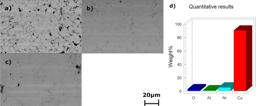
a) Cu matrix with 5% intermetallic compacted with a pressure of 400 MPa b) Cu matrix with 5% intermetallic compacted with a pressure of 600 MPa c) Cu matrix with 5% intermetallic compacted with a pressure of 1000 MPa. d) Quantitative analysis image corresponding to the Cu matrix with 5% intermetallic, compacted at 400 MPa.

a) Cu matrix with 10% intermetallic compacted with a pressure of 400 MPa b) Cu matrix with 10% intermetallic compacted with a pressure of 600 MPa c) Cu matrix with 10% intermetallic compacted with a pressure of 1000 MPa d) Point quantitative analysis of an intermetallic particle in the sample with 10% intermetallic compacted at 1000 MPa.

a) Cu matrix with 15% intermetallic compacted with a pressure of 600 MPa b) Cu matrix with 15% intermetallic compacted with a pressure of 1000 MPa c) SEM image at higher magnification of a Cu matrix with 15% intermetallic phase, compacted under a pressure of 1000 MPa d) Point quantitative analysis of an intermetallic particle in the sample with 10% intermetallic compacted at 1000 MPa (1: matrix 2: intermetallic particle)
3.2. Porosity analysis
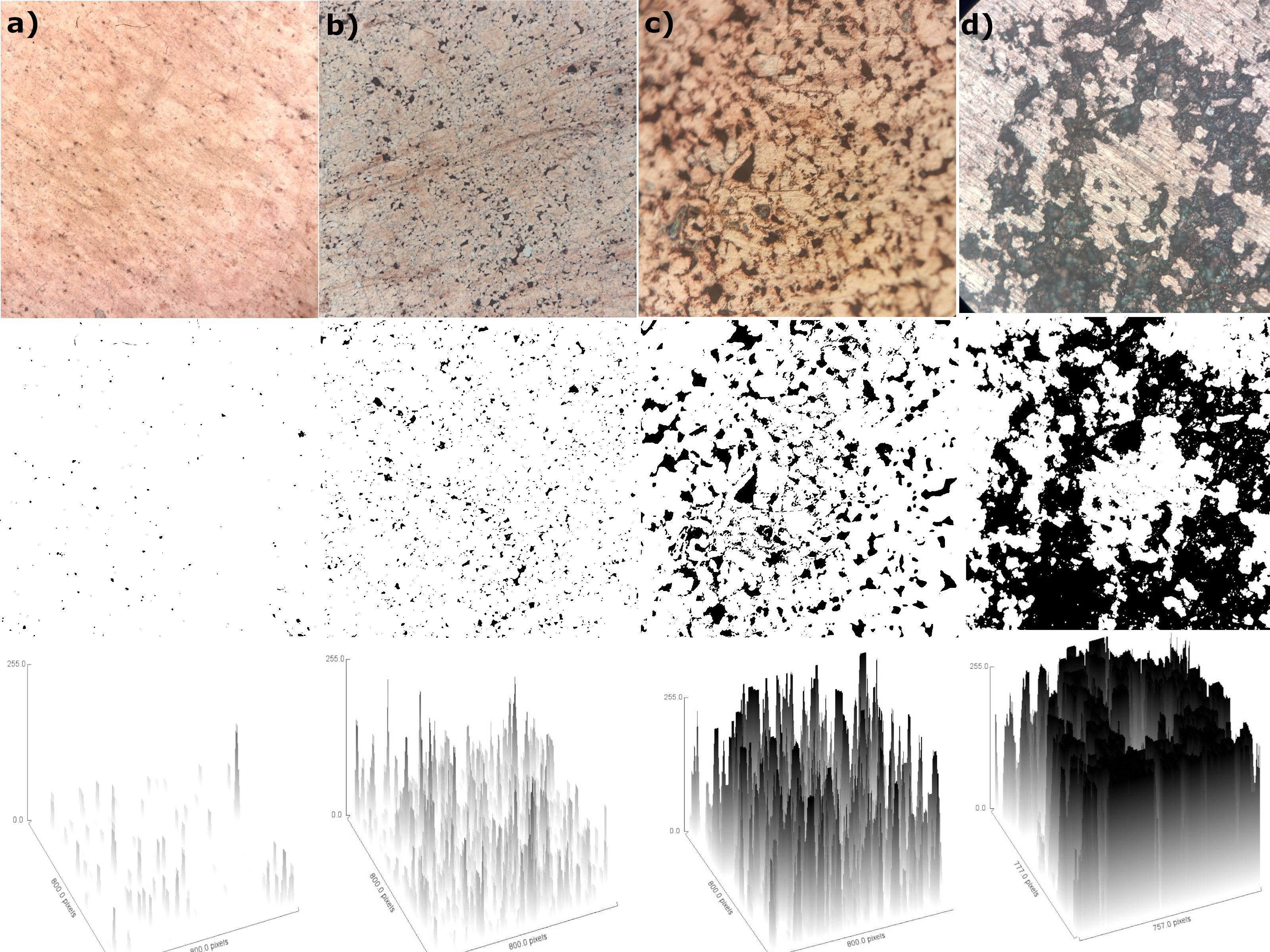
For the porosity analysis, images at 500x magnification were taken using an optical microscope to obtain the relationship between the areas with and without pores. In Fig. 8(a), it can be observed that pure copper compacted at 400 MPa deformed and filled the voids after sintering, whereas when 5%, 10%, and 15% of the reinforcement particles were added, the compaction pressure was insufficient to deform the copper owing to the obstruction of the reinforcement particles, as shown in Figs. 8(b), 8(c), and 8(d). In Figs. 9(a), 9(b), 9(c), and 9(d), it is evident that with a compaction pressure of 600 MPa, there is no significant change in porosity because the pressure exerted on the samples was sufficient to achieve good plastic deformation. However, Figs. 10(a), 10(b), 10(c), and 10(d) show a significant reduction in the number of pores. This suggests that 1000 MPa is the optimal compaction pressure for incorporating intermetallic particles (Ni,Cu)3Al as reinforcement in the copper matrix. At this pressure level, not only does the number of pores decrease, but the size of the pores generated by both the copper matrix and the intermetallic reinforcement is also significantly reduced due to the improved particle rearrangement and densification. Although increasing the intermetallic reinforcement above 5% tends to increase porosity due to the obstruction of copper plastic deformation, this effect stabilizes around 15% because the particle network begins to form a more rigid framework that limits further pore formation. In other words, additional reinforcement beyond this point contributes less to porosity growth, as the system reaches a microstructural saturation in terms of particle-particle interaction and pore nucleation. Furthermore, at 1000 MPa, the porosity remained relatively constant beyond 10% intermetallic addition, because the high compaction pressure maximized the densification efficiency, and the remaining porosity became primarily trapped or isolated within the rigid intermetallic framework. The reinforcement particles act as barriers that restrict further compaction, and as their concentration increases, the ability of the copper matrix to accommodate additional densification diminishes, resulting in a plateau in porosity reduction.

Porosity analysis with a compaction pressure of 400 MPa a) Cu b) Cu-5%(Ni,Cu)3Al c) Cu-10%(Ni,Cu)3Al, and d) Cu-15%(Ni,Cu)3Al.

Porosity analysis with a compaction pressure of 600 MPa a) Cu b) Cu-5%(Ni,Cu)3Al c) Cu-10%(Ni,Cu)3Al, and d) Cu-15%(Ni,Cu)3Al.

Porosity analysis with a compaction pressure of 1000 MPa a) Cu b) Cu-5%(Ni,Cu)3Al c) Cu-10%(Ni,Cu)3Al, and d) Cu-15%(Ni,Cu)3Al.
The equations 1-3 show the relationship between the concentration (wt%) of reinforcement particles added to the composite materials and the porosity, as it relates to the pressure used during powder compaction. In Fig. 11(a), for a pressure of 400 MPa, an exponential curve is obtained because the pressure is insufficient to cause plastic deformation in the copper matrix, which decreases the number of pores in the samples. Fig. 11(b) shows that at a pressure of 600 MPa, a linear relationship was obtained between the porosity area percentage and the addition of intermetallic particles. Finally, at a pressure of 1000 MPa, it can be seen from Fig. 11(c), that the porosity percentage remains relatively low, even after adding 10% or more reinforcing particles.

-
: Porosity.
-
: Initial porosity value.
-
: constant that scales the exponential term.
-
t : constant parameter that controls the "rate of change" in the function.
-
: slope coefficient
3.3. X-ray diffraction
X-ray diffraction was used to analyze the initial Cu powders (Fig. 1(c)) and intermetallic powders milled for 8 h (Fig. 2(c)). The diffraction pattern of the initial bulk copper powder revealed three characteristic peaks at 43.04 °, 50.17 °, and 74.15 °, corresponding to Miller indices of (111), (200), and (220), respectively. The intermetallic phase, which was composed of a solid solution of Ni3Al with substitutional copper atoms, showed characteristic peaks at 43.58 °, 50.53 °, and 74.48 ° and a lattice parameter of 3.54 Angstroms was obtained. However, the intensity of the peaks decreased (Fig. 12) because of the deformation caused by milling. The fragmentation of Cu particles during milling results in a reduction in the size of the crystalline domains, leading to a broader peak and a decrease in intensity22. Due to stability of the intermetallic reinforcement its peak phase show no shift and show a FWHM change produced by deformation introduced by milling process23. Furthermore, the diffraction patterns of Cu and (Ni,Cu)3Al had very similar peaks with a difference of only 0.54 °, which resulted in the overlapping of peaks when obtaining the composite pattern24. This behavior was also observed for the addition of 10% and 15% reinforcing particles, indicating that no phase changes occurred, regardless of the amount of intermetallic added. This is shown in Figs. 13 and 14.


X-ray diffraction patterns of the Cu+10%(Ni,Cu)3Al system mechanically alloyed at 400 rpm.
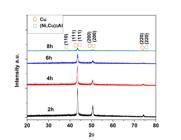
X-ray diffraction patterns of the Cu+15%(Ni,Cu)3Al system mechanically alloyed at 400 rpm.
3.3.1. Peak simulation in x-ray results
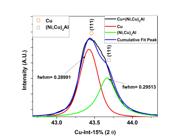
Using the highest concentration of the reinforcement particles, a simulation was carried out where the two characteristic peaks of Cu and the intermetallic (Ni,Cu)3Al were obtained. The superposition of these peaks could hinder the accurate identification of each phase; therefore, a simulation was performed to clearly separate the peaks and allow for a more precise interpretation of the individual contributions from Cu and the intermetallic compound25. The characteristic peak of the compound was simulated and compared to the experimentally obtained peak, as shown in Fig. 15.
3.3.2. Crystallite size
The addition of intermetallic particles of (Ni,Cu)3Al considerably decreases the size of the crystallite. This effect is primarily due to the deformation of the copper lattice during milling, where the intermetallic particles act as microballs that facilitate the breaking and reorganization of the copper structure. As milling progresses, repeated collisions between the milling balls and the powder, along with the shear forces generated, promote the fragmentation of larger crystallites into smaller ones. The intermetallic particles not only enhance this mechanical deformation by providing additional nucleation sites for the formation of finer grains but also hinder the growth of these grains by pinning the grain boundaries. This resulted in a more refined microstructure with a significantly reduced crystallite size. Fig. 1626. In the case of milling larger than the 8h the crystallite refinement is not very effective because of the logarithmic nature of the process, whereas the internal deformation could lead to a larger FWHM in the diffraction peaks of larger times.
where:

-
D: Average crystallite size (nm).
-
k: Scherrer constant.
-
λ: X-ray wavelength Cu Kα average = 1.54178 Å.
-
β: Full Width at Half Maximum (FWHM) of the diffraction peak (rad).
-
θ: Diffraction angle corresponding to the peak in the XRD pattern (rad).
3.3.3. Characterization of Material Microstructure through X-Ray Diffraction Post-Sintering
In the X-ray diffraction analysis after sintering, the characteristic peaks of Cu and (Ni,Cu)3Al can be seen, as shown in Fig. 17. When the compound was heated to the sintering temperature, the copper matrix underwent recrystallization27, resulting in an increase in the intensity of the crystalline peaks. This process led to the appearance of more defined peaks, indicating that the material reached a higher level of structural organization. Furthermore, in this recrystallized state, the characteristic peaks of the intermetallic particles were clearly observed, confirming the dispersion of the intermetallic particles within the copper matrix. This behavior reflects the interaction between the copper matrix and intermetallic particles during the sintering process, contributing to the improvement of material properties, such as densification and mechanical strength. Fig. 17(b).

a) X-ray diffraction pattern of Cu+(Ni,Cu)3Al after sintering. b) Characteristic intermetallic peaks.
3.4 Microhardness (HV)
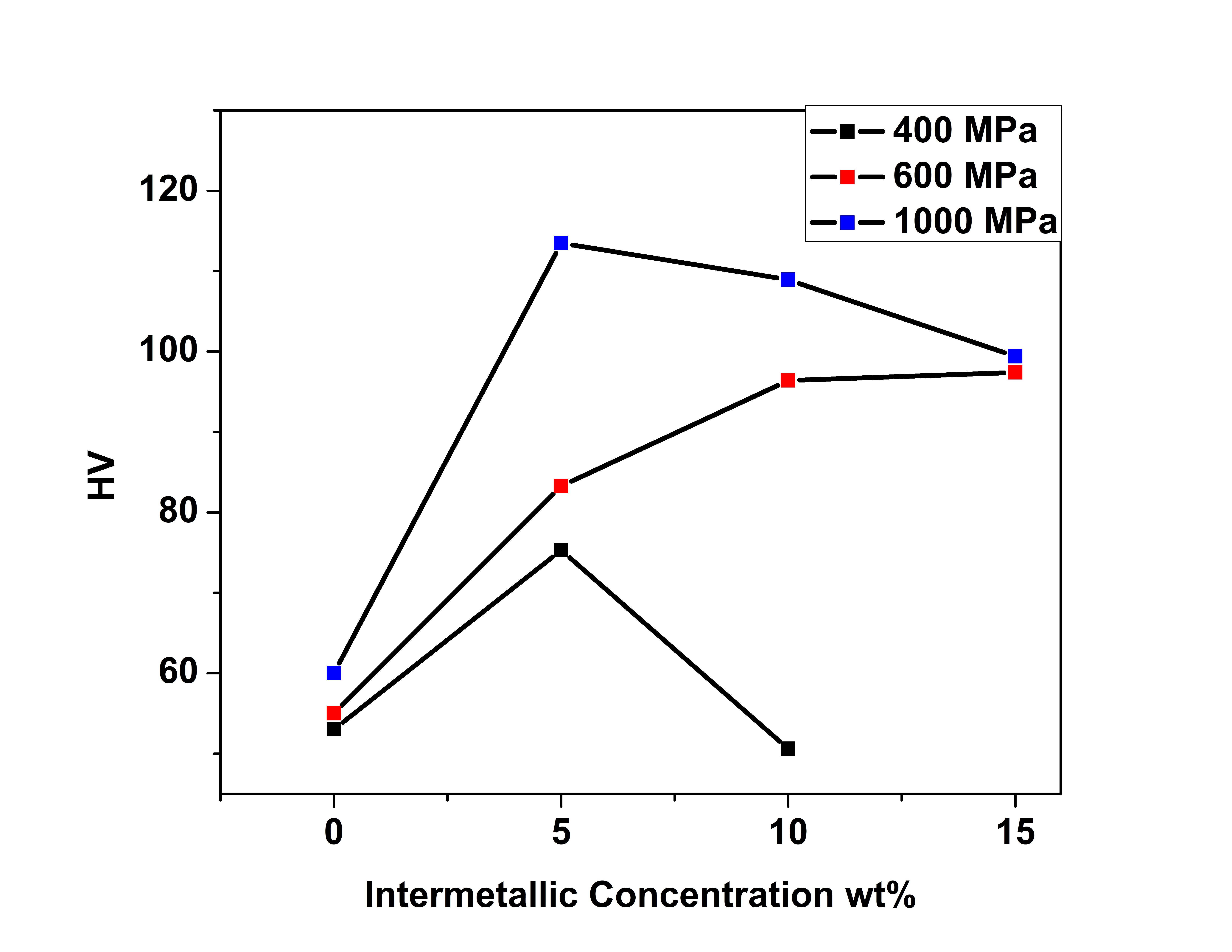
The difference in hardness of copper with the intermetallic is on the order of 10; therefore, by having a good dispersion of the intermetallic particles in the copper matrix, the mechanical properties of the compound increase almost twice with respect to copper without reinforcement. The variation in the compaction pressure also tends to modify the mechanical properties owing to the decrease in porosity, as shown in Fig. 18. The 40% increase in hardness observed when increasing the compaction pressure from 400 to 1000 MPa is mainly attributed to the enhanced plastic deformation of copper particles during pressing. At higher pressures, the copper particles undergo greater plastic flow, which leads to more intimate contact between particles, reducing porosity and increasing the effective bonding area. This affects the hardness of the compound, which is due to the plastic deformation that must be generated to have good contact between the Cu and Cu particles by having an intermetallic compound in the matrix. The copper particles had a smaller contact area between the particles; therefore, more pores were formed by the addition of 5% copper at a pressure of 1000 MPa. The best properties of the compound were obtained at 1000 MPa the other concentrations began to decrease because of the porosity generated by the two different phases for the synthesis of the compound. When analyzing the concentrations of 15% and 400 MPa, it was observed that the pressure exerted by the punch was insufficient to plastically deform the sample; therefore, the compound became so porous that the microindentation test could not be performed. By performing a comparative analysis with studies related to the copper matrix, the hardness of the compound can be improved by up to 200% (Table 1). Although the study reported a 20% increase in microhardness with 10% intermetallic reinforcement, a decrease was observed when the content reached 15%. This nonlinear behavior is not due to particle agglomeration, as confirmed by SEM analysis but rather to the increase in porosity caused by the saturation of intermetallic particles in the matrix. At this concentration, the copper matrix becomes less capable of effectively accommodating and bonding the added particles, resulting in poor densification and increased pore volume, ultimately reducing the overall hardness of the material.

The microhardness of the composites was measured at different concentrations and compaction pressures (400, 600, and 1000 MPa).
4. Conclusion
The powder metallurgy technique proved to be an excellent method for obtaining a high degree of dispersion of intermetallic particles (Ni,Cu)3Al in the copper matrix without the presence of additional phases or agglomerations at 400 rpm. The incorporation of these particles resulted in compounds possessing mechanical properties up to 30% higher than that of pure copper owing to their interaction with the copper matrix. The pressure used during compaction of the powders had a direct impact on the final properties of the compounds. As the pressure increased from 400 to 1000 MPa, the final hardness of the compounds increased by approximately 40%, whereas the compaction pressure did not significantly affect the microhardness of pure copper. However, the porosity of the copper decreased by up to 15% at the highest compaction pressure. The mechanical properties of copper did not improve after the addition of more than 5% of intermetallic particles. Above this concentration, the material became more porous, with concentrations higher than 5% causing a reduction in hardness by approximately 10-15%, as the intermetallic particles are very hard and difficult to plastically deform, resulting in a compound that is sintered with excessive porosity, thereby reducing its overall mechanical properties. Applications of this compound include the reliability of CU+CuAlx as a candidate for new interconnected materials. The improved corrosion resistance of the intermetallic compound and its better mechanical properties could lead to its application in wire-bonding technologies. However, BTS and electrical tests are required.
5. Acknowledgments
This work was financed by CONAHCyT through the Posdoctoral grant.
-
Data Availability
Data are available on reasonable request to the corresponding author.
6. References
-
1 Han L, Liu Z, Yu L, Ma Z, Huang Y, Liu Y, et al. Effect of WC nanoparticles on the thermal stability and mechanical performance of dispersion-reinforced Cu composites. Scr Mater. 2023;222:115030. http://doi.org/10.1016/j.scriptamat.2022.115030
» http://doi.org/10.1016/j.scriptamat.2022.115030 -
2 Abd-Elwahed MS, Wagih A, Najjar IMR. Correlation between micro/nano-structure, mechanical and tribological properties of copper-zirconia nanocomposites. Ceram Int. 2020;46(1):56-65. http://doi.org/10.1016/j.ceramint.2019.08.230
» http://doi.org/10.1016/j.ceramint.2019.08.230 -
3 Yang KM, Ma YC, Zhang ZY, Zhu J, Sun ZB, Chen JS, et al. Anisotropic thermal conductivity and associated heat transport mechanism in roll-to-roll graphene reinforced copper matrix composites. Acta Mater. 2020;197:342-54. http://doi.org/10.1016/j.actamat.2020.07.021
» http://doi.org/10.1016/j.actamat.2020.07.021 -
4 Dinaharan I, Albert T. Effect of reinforcement type on microstructural evolution and wear performance of copper matrix composites via powder metallurgy. Mater Today Commun. 2020;34:105250. http://doi.org/10.1016/j.mtcomm.2022.105250
» http://doi.org/10.1016/j.mtcomm.2022.105250 -
5 Yang T, Chen W, Yan F, Lv H, Fu YQ. Effect of reduced graphene oxides decorated by Ag and Ce on mechanical properties and electrical conductivity of copper matrix composites. Vacuum. 2021;183:109861. http://doi.org/10.1016/j.vacuum.2020.109861
» http://doi.org/10.1016/j.vacuum.2020.109861 -
6 Khun NW, Huang M, Li ZA, Zhang H, Khor KA, Yang J, et al. Effects of Intermetallic NiAl Particle Content on Friction and Wear of Spark Plasma-Sintered Alumina Matrix Composites. Lubricants. 2025;13(3):101. http://doi.org/10.3390/lubricants13030101
» http://doi.org/10.3390/lubricants13030101 -
7 Fu S, Chen X, Liu P. Preparation of CNTs/Cu composites with good electrical conductivity and excellent mechanical properties. Mater Sci Eng A. 2020;771:138656. http://doi.org/10.1016/j.msea.2019.138656
» http://doi.org/10.1016/j.msea.2019.138656 -
8 Sadoun AM, Fathy A. Experimental study on tribological properties of Cu–Al2O3 nanocomposite hybridized by graphene nanoplatelets. Ceram Int. 2019;45(18):24784-92. http://doi.org/10.1016/j.ceramint.2019.08.220
» http://doi.org/10.1016/j.ceramint.2019.08.220 -
9 Luo X, Yang Y, Liu C, Xu T, Yuan M, Huang B. The thermal expansion behavior of unidirectional SiC fiber-reinforced Cu–matrix composites. Scr Mater. 2008;58(5):401-4. http://doi.org/10.1016/j.scriptamat.2007.10.022
» http://doi.org/10.1016/j.scriptamat.2007.10.022 -
10 Song K, Guo X, Liang S, Zhao P, Zhang Y. Relationship between interfacial stress and thermal expansion coefficient of copper–matrix composites with different reinforced phases. Mater Sci Technol. 2014;30(2):171-5. http://doi.org/10.1179/1743284713Y.0000000332
» http://doi.org/10.1179/1743284713Y.0000000332 -
11 Jiao X, Liu Y, Cai X, Wang J, Feng P. Progress of porous Al-containing intermetallics fabricated by combustion synthesis reactions: a review. J Mater Sci. 2021;56(20):11605-30. http://doi.org/10.1007/s10853-021-06035-5
» http://doi.org/10.1007/s10853-021-06035-5 -
12 Goyal K, Sardana N. Mechanical properties of the Ti2AlNb intermetallic: a review. Trans Indian Inst Met. 2021;74(8):1839-53. http://doi.org/10.1007/s12666-021-02307-5
» http://doi.org/10.1007/s12666-021-02307-5 -
13 Clemens H, Mayer S. Intermetallic titanium aluminides in aerospace applications–processing, microstructure and properties. Mater High Temp. 2016;33(4-5):560-70. http://doi.org/10.1080/09603409.2016.1163792
» http://doi.org/10.1080/09603409.2016.1163792 -
14 Buytoz S, Dagdelen F, Islak S, Kok M, Kir D, Ercan E. Effect of the TiC content on microstructure and thermal properties of Cu–TiC composites prepared by powder metallurgy. J Therm Anal Calorim. 2014;117(3):1277-83. http://doi.org/10.1007/s10973-014-3900-6
» http://doi.org/10.1007/s10973-014-3900-6 -
15 Mertgenc E, Talas S, & Gokce B. The wear and microstructural characterization of copper surface coated with TiC reinforced FeAl intermetallic composite by ESD method. Mater Res Express. 2019;6(11):1165e7. http://doi.org/10.1088/2053-1591/ab507e
» http://doi.org/10.1088/2053-1591/ab507e -
16 Venkateswaran K, Kamaraj M, Prasad Rao K. Dry sliding wear of a powder metallurgy copper-based metal matrix composite reinforced with iron aluminide intermetallic particles. J Compos Mater. 2007;41(14):1713-28. http://doi.org/10.1177/0021998306069888
» http://doi.org/10.1177/0021998306069888 -
17 Çelikyürek İ, Körpe NÖ, Ölçer T, Gürler R. Microstructure, properties and wear behaviors of (Ni3Al) p reinforced Cu matrix composites. J Mater Sci Technol. 2011;27(10):937-43. http://doi.org/10.1016/S1005-0302(11)60167-9
» http://doi.org/10.1016/S1005-0302(11)60167-9 -
18 Abedi M, Asadi A, Vorotilo S, Mukasyan AS. A critical review on spark plasma sintering of copper and its alloys. J Mater Sci. 2021;56(36):19739-66. http://doi.org/10.1007/s10853-021-06556-z
» http://doi.org/10.1007/s10853-021-06556-z -
19 Serna SA, Verduzco JA, Campillo BF, Molina A, Guardian R, del Pozo A, et al. Synthesis and characterization of a Ni 3 Al Intermetallic modified with copper atoms via powder metallurgy. J Mater Eng Perform. 2021;30(3):1906-13. http://doi.org/10.1007/s11665-021-05541-6
» http://doi.org/10.1007/s11665-021-05541-6 -
20 Lu L, Wang LB, Ding BZ, Lu K. High-tensile ductility in nanocrystalline copper. J Mater Res. 2000;15(2):270-3. http://doi.org/10.1557/JMR.2000.0043
» http://doi.org/10.1557/JMR.2000.0043 -
21 Dixit M, Srivastava RK. Effect of compaction pressure on microstructure, density and hardness of Copper prepared by Powder Metallurgy route. IOP Conf Ser.: Mater Sci Eng. 2018;377(1):012209. http://doi.org/10.1088/1757-899X/377/1/012209
» http://doi.org/10.1088/1757-899X/377/1/012209 -
22 Zuhailawati H, Salihin HM, Mahani Y. Microstructure and properties of copper composite containing in situ NbC reinforcement: effects of milling speed. J Alloys Compd. 2010;489(2):369-74. http://doi.org/10.1016/j.jallcom.2009.09.083
» http://doi.org/10.1016/j.jallcom.2009.09.083 -
23 Prashanth M, Karunanithi R, Mohideen SR, Sivasankaran S, Vlahović M. A comparative study on X-ray peak broadening analysis of mechanically alloyed Al2O3 particles dispersion strengthened Al 7017 alloy. Mater Chem Phys. 2023;294:127015. http://doi.org/10.1016/j.matchemphys.2022.127015
» http://doi.org/10.1016/j.matchemphys.2022.127015 -
24 Bortolotti M, Lutterotti L, Pepponi G. Combining XRD and XRF analysis in one Rietveld-like fitting. Powder Diffr. 2017;32(S1):S225-30. http://doi.org/10.1017/S0885715617000276
» http://doi.org/10.1017/S0885715617000276 -
25 Pradeepkumar MS, Pal AS, Singh A, Basu J, Ahmad MI. Phase separation in wurtzite CuIn x Ga 1− x S 2 nanoparticles. J Mater Sci. 2020;55(26):11841-55. http://doi.org/10.1007/s10853-020-04844-8
» http://doi.org/10.1007/s10853-020-04844-8 -
26 Bagheri GA. The effect of reinforcement percentages on properties of copper matrix composites reinforced with TiC particles. J Alloys Compd. 2016;676:120-6. http://doi.org/10.1016/j.jallcom.2016.03.085
» http://doi.org/10.1016/j.jallcom.2016.03.085 -
27 Dexter M, Gao Z, Bansal S, Chang CH, Malhotra R. Temperature, crystalline phase and influence of substrate properties in intense pulsed light sintering of copper sulfide nanoparticle thin films. Sci Rep. 2018;8(1):2201. http://doi.org/10.1038/s41598-018-20621-9 PMid:29396533.
» http://doi.org/10.1038/s41598-018-20621-9 -
28 Shehata F, Fathy A, Abdelhameed M, Moustafa SF. Preparation and properties of Al2O3 nanoparticle reinforced copper matrix composites by in situ processing. Mater Des. 2009;30(7):2756-62. http://doi.org/10.1016/j.matdes.2008.10.005
» http://doi.org/10.1016/j.matdes.2008.10.005 -
29 Tjong SC, Lau KC. Tribological behaviour of SiC particle-reinforced copper matrix composites. Mater Lett. 2000;43(5-6):274-80. http://doi.org/10.1016/S0167-577X(99)00273-6
» http://doi.org/10.1016/S0167-577X(99)00273-6 -
30 Efe GC, Yener T, Altinsoy I, İpek M, Zeytin S, Bindal C. The effect of sintering temperature on some properties of Cu–SiC composite. J Alloys Compd. 2011;509(20):6036-42. http://doi.org/10.1016/j.jallcom.2011.02.170
» http://doi.org/10.1016/j.jallcom.2011.02.170 -
31 Taha MA, Zawrah MF. Effect of nano ZrO2 on strengthening and electrical properties of Cu-matrix nanocomposits prepared by mechanical alloying. Ceram Int. 2017;43(15):12698-704. http://doi.org/10.1016/j.ceramint.2017.06.153
» http://doi.org/10.1016/j.ceramint.2017.06.153 -
32 Fathy A, Elkady O, Abu-Oqail A. Synthesis and characterization of Cu–ZrO2 nanocomposite produced by thermochemical process. J Alloys Compd. 2017;719:411-9. http://doi.org/10.1016/j.jallcom.2017.05.209
» http://doi.org/10.1016/j.jallcom.2017.05.209 -
33 Bahador A, Umeda J, Yamanoglu R, Ghandvar H, Issariyapat A, Bakar T A A, et al. Deformation mechanism and enhanced properties of Cu–TiB2 composites evaluated by the in-situ tensile test and microstructure characterization. J Alloys Compd. 2020;847:156555. http://doi.org/10.1016/j.jallcom.2020.156555
» http://doi.org/10.1016/j.jallcom.2020.156555
Edited by
-
Associate Editor:
Aloisio Klein.
-
Editor-in-Chief:
Luiz Antonio Pessan.
Data are available on reasonable request to the corresponding author.