Effect of Surface Crosslinking on the Wear and Friction Behavior of Tea Polyphenol Stabilized Ultra-High Molecular Weight Polyethylene for Total Joint Replacements
Abstract
Highly crosslinked ultra-high molecular weight polyethylene (UHMWPE) with vitamin E (VE) as an antioxidant is widely used for joint implants. VE helps resist oxidation but raises concerns about reduced crosslink density and wear performance. This research hypothesized that tea polyphenols (tPPs), such as lipid-soluble epigallocatechin gallate (lsEGCG) and epigallocatechin gallate (EGCG), could prevent the usual decrease in crosslink density caused by VE, thereby enhancing wear performance. The antioxidants were blended with UHMWPE at 0.2 wt% and surface chemically crosslinked using di-cumyl peroxide. The surface properties, including crosslink density, roughness, coefficient of friction, and wear performance, were evaluated in detail. The results showed that lsEGCG and EGCG blended UHMWPE had significantly higher crosslink density compared to VE stabilized UHMWPE, which was 17% lower than virgin UHMWPE. The coefficient of friction increased after crosslinking and was higher in tPPs blended UHMWPE, indicating a highly crosslinked network structure. The wear resistance of surface crosslinked tPPs stabilized UHMWPE was significantly higher than VE-stabilized UHMWPE. Additionally, a substantial number of scratches, furrows, and flakes were observed on the surface of VE-stabilized UHMWPE compared to tPPs stabilized UHMWPE. It was concluded that tPPs are promising alternatives to VE for improving the performance and longevity of UHMWPE-based implants.
Keywords:
Highly cross-linked UHMWPE; Vitamin E and Tea polyphenols; Wear performance; Surface crosslinking; Total joint replacement
1. Introduction
The rapid increase in joint patients has made it necessary for researchers to develop high-performance biomaterials used in total joint replacement (TJR)1. TJR is a rapidly growing market, driven by factors such as an aging population, increasing prevalence of arthritis and joint injuries, and advancements in technology and materials used in joint replacement surgeries. According to a market research report by Grand View Research2, the global TJR market was valued at USD 22,474.6 million in 2024 and is expected to grow at a compound annual growth rate (CAGR) of 4% to USD 28,698.0 million by 2030. Meanwhile in comparison, the Brazil joint replacement market generated a revenue of USD 242.8 million in 2022 and is expected to reach USD 353.7 million by 2030. The Brazil market is expected to grow at a CAGR of 4.8% from 2023 to 20303.
Ultra-high molecular weight polyethylene (UHMWPE) with further modification, has been a material of choice for total hip and total knee replacement with excellent results for the last two decades4,5. A high-performance implant has three major factors: wear, mechanical strength, and oxidation stability. The dominant cause of joint failure is wear and tear in the polymer component due to constant movement and contact parts leading to joint loosening and osteolysis6-8. Crosslinking has been widely accepted to enhance wear resistance, by creating a network structure to minimize the surface orientation and alter the surface topography, playing a role in releasing wear debris in UHMWPE9,10. Radiation crosslinking has displayed promising results in decreasing the wear of UHMWPE in artificial joints, due to highly crosslinked UHMWPE structure achieved through radiation crosslinking by using high-energy ionizing gamma radiation or electron beam11. However, radiation crosslinking causes oxidation embrittlement due to the formation of free radicals reacting with oxygen, leading to degradation in the mechanical performance of the implant12,13. Crosslinking by radiation produces free radicals by splitting the UHMWPE bonds. The free radicals formed in the amorphous phase are turned into a crosslinked structure while the free radicals created in the crystalline region highly affect the long-term oxidation resistance capabilities of the polymer14.
Chemical crosslinking has been in use for several decades to achieve a highly crosslinked structure using organic peroxides, but its oxidizing nature hindered its use in clinical applications15. Antioxidants are widely used to enhance the oxidation resistance of the crosslinked UHMWPE16,17. Vitamin E (VE) is highly preferred as a natural antioxidant, providing a significant enhancement in oxidation resistance18. VE donates hydrogen from the phenolic group to react with the trapped residual radicals playing a role in hindering chain scission19. However, VE is also a free radical scavenger and it decreases the crosslinked density of the polymer, resulting in reducing the effectiveness of wear resistance of the crosslinked UHMWPE20,21. To reduce the inhibitive effect on the crosslinked structure, ~ 0.2 wt% of VE content is considered an optimal amount evaluated by Oral et al.15. Therefore, the current research is focused to investigate an effectual stabilizer along with the minimum adverse effect on the crosslinked structure.
Recent research has explored a more powerful antioxidant, tea polyphenol found in tea as a natural substance, which showed a stronger resistance to oxidation than VE and is regarded as a better alternative stabilizer22-24. Tea polyphenols have the capacity for higher hydrogen donation due to their many phenolic hydroxyls compared to VE, which is comprised of single phenolic hydroxyl. In addition to that, tea polyphenols incorporation does not affect the crosslinking process compared to the decrease occurring in VE blended UHMWPE25. Further, the connections between friction, wear, and crystallinity are still not fully understood. Gaining insights into the influence of structure and crystallinity on friction and wear properties would be beneficial for the advancement of high-quality joint materials26,27.
This investigation posits that the utilization of tea polyphenols as antioxidants, specifically lipid-soluble epigallocatechin gallate (lsEGCG) and epigallocatechin gallate (EGCG), instead of vitamin E, can augment the wear resistance of ultra-high molecular weight polyethylene (UHMWPE). This substitution is anticipated to maintain an elevated crosslink density and result in heightened oxidation stability. The chosen polyphenols, lsEGCG and EGCG, were selected based on their commendable microbial inhibition and oxidation stability characteristics23,28. Subsequent to independent blending with UHMWPE, the blends underwent surface crosslinking employing di-cumyl peroxide (DCP). The study encompassed an assessment of crosslink density, coefficient of friction, and wear rate of the crosslinked antioxidant-blended UHMWPE. Furthermore, an analysis of the crystalline structure and surface topography was conducted.
2. Materials and Methods
2.1. Materials
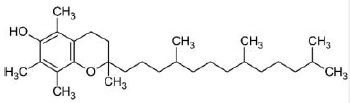
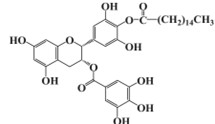
UHMWPE (GUR1050; Ticona, UK) with an average molecular weight of ~5 × 10⁶ g/mol, were used in this study. VE was obtained from Aladdin, China while the tea polyphenols (lsEGCG and EGCG) were procured from Nanjing Zhu Biological Technology Co. Ltd. Di-cumyl peroxide (DCP) was procured from Alfa Aesar, Germany. The chemical structures for all the chemicals are given in Table 1.
2.2. Preparation of UHMWPE blends
Antioxidants were separately added into 100 gm UHMWPE at a fraction of 0.2 wt% in a round bottom flask containing 120 ml isopropyl alcohol. The materials were constantly stirred at 200 rpm using a mechanical stirrer at room temperature for 24 hrs. The blends were then dried in a vacuum oven for 7 days at a temperature of 60 °C under a vacuum environment. It was followed by consolidation of the blends in compression molding at 200 °C and 10 MPa. The compression cycles of 3 min were repeated for a total of 20 min at the same temperature and pressure. It is then cooled at room temperature for 10 min under the same pressure (10 MPa). Three Pucks of 108 mm in diameter and 10 mm in thickness were produced for each category of blends. The pucks were further machined to a smaller disc of 40 mm diameter and 4 mm thickness which is the required dimension for the pin-on-disc tribometer. Virgin UHMWPE (UH), VE blended (VE-UH), lsEGCG blended (lsEGCG-UH) and EGCG blended UHMWPE (EGCG-UH) were the four different categories of samples prepared for the comparative analysis. For simplicity, the UHMWPE is shortened to UH.
2.3. Chemical crosslinking using peroxide
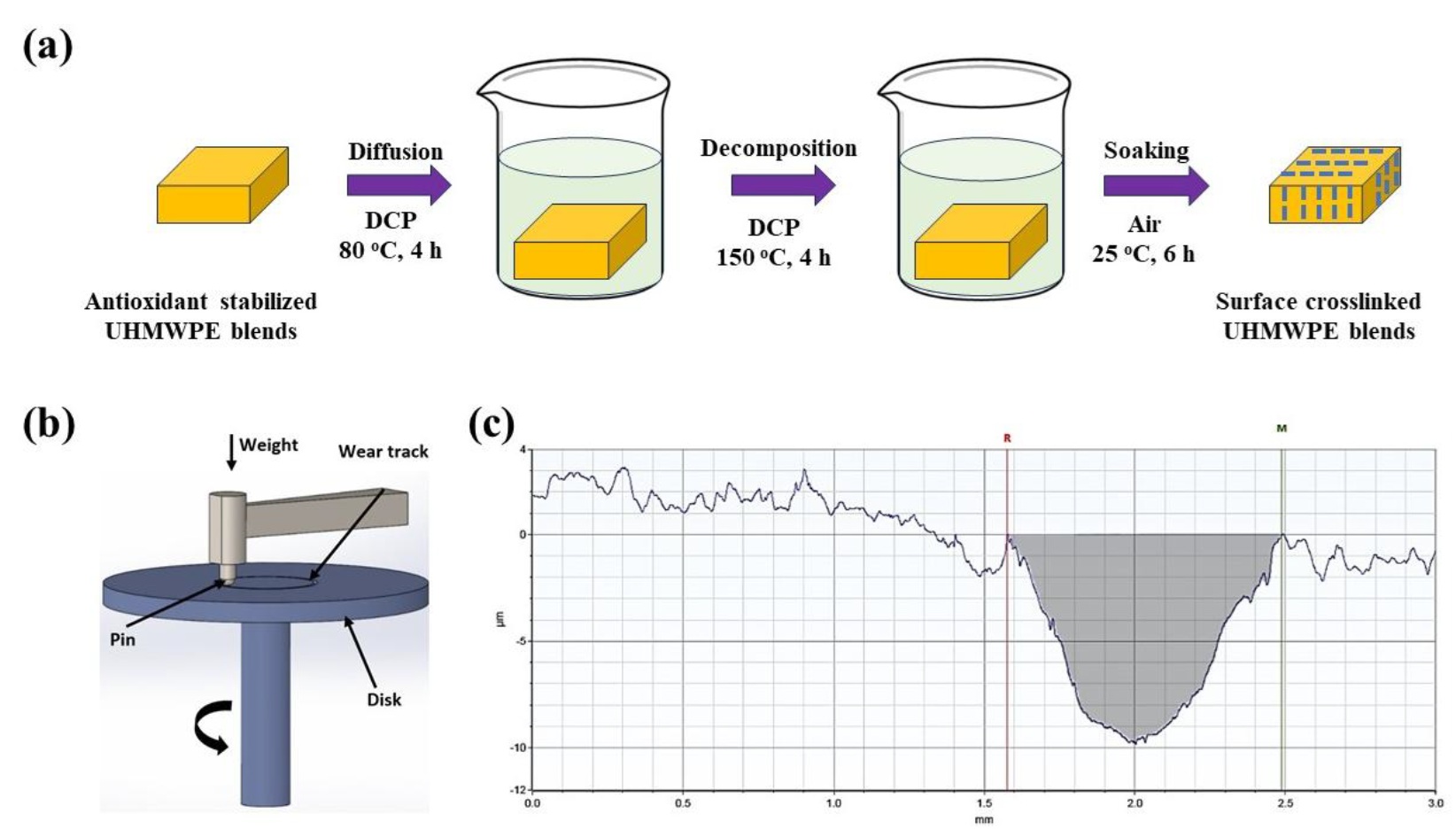
DCP is an organic peroxide with a melting temperature of 38 °C is a solid and used for achieving the surface crosslink structure. The initial step was the diffusion of the peroxide by keeping the samples in the peroxide in a 200 ml round bottom flask in an oil bath. The doping temperatures were kept at 80 °C and a constant nitrogen flow was ensured throughout the process for 4 hrs. Decomposition of the peroxides in the samples is a subsequent process by heating the samples at 150 °C in an empty flask for 4 hrs in a nitrogen environment. The experimental parameters are the best possible values previously reported by Gul et al.28. The surface crosslinking schematic diagram is depicted in Figure 1a.

(a) Schematic diagram of the surface crosslinking of UHMWPE blends using DCP. (b) Friction and wear testing setup by pin-on-disc tribometer. (c) Cross section area of the wear track was measured by a profilometer.
2.4. Percent weight change before and after crosslinking
The weight of the samples was measured before and after the diffusion process, and at the end of the decomposition process using a weighing scale (Shimadzu Corporation ATX224). The weight change after the diffusion step was considered as the peroxide intake. Weight changes after the decomposition process imply the decomposition of the peroxide and the crosslinked structure developed in the polymer.
2.5. Crosslink density measurement by gravimetric swelling method
To measure the surface crosslink density of different UHMWPE blends, small cubes were carefully cut from the exterior part of the crosslinked samples. Each cube had a thickness of 1 mm with a cross-sectional dimension of 3 × 3 mm. For every group, four samples (n = 4) were prepared for analysis. These sections were then subjected to a swelling test to determine the crosslink density at the surface. The cubes swelled in xylene (DAEJUNG chemicals & metal, China) at 130 °C and kept for 2 hrs to attain equilibrium status. The gravimetric swell ratio was calculated from its initial weight and the xylene uptake, which were used to measure the crosslink density by using a previously reported process as shown in Equation 129.
where,
and,
In the above equations, qeq which is the apparent volume swelling ratio, was calculated using the height of the test cube before (hi) and after (hf) the equilibrium swelling is reached. In addition, V1 is the molar volume of the solvent (xylene) at 130 oC and X is the polymer solvent interaction parameter at 130 oC.
2.6. Melting point and crystallinity analysis using differential scanning calorimetry
Differential scanning calorimeters (DSC 800, Perkin Elmer, USA) were employed to generate the first melting profile of un-crosslinked UHMWPE and its blends. Samples (~5 mg) were heated from 40 to 180 °C at a heating rate of 10 °C/min while ensuring the nitrogen gas atmosphere. The percent crystallinity is measured by integrating the enthalpy peak from 40 to 160 °C and normalizing it with the enthalpy of fusion of 100% crystalline polyethylene (289.3 J/g, as per ASTM F2625-10 (2016) standard), as shown in Equation 2.
Where, Xc is the degree of crystallinity (%), ΔHf is the measured heat of fusion of the sample (J/g) from the DSC curve and, ΔHf0 is the theoretical heat of fusion for 100% crystalline polyethylene30.
2.7. Measurement of co-efficient of friction by pin-on-disc (POD) tribometer
Universal and Versatile Pin-On-Disc & Oscillating Tribometer (POD; Tt-Tribotechnic, Clichy, France) was used to study the friction and wear behavior of the polymer blends. Figure 1b illustrates the schematic of friction and wear testing methodology adopted to test UHMWPE samples. The pin was consisting of an aluminum oxide ball (2 mm diameter), which was tested against the disc’s samples (4 mm thickness and 40 mm diameter, n = 4) in diluted bovine serum (25%, SAFC Sigma-Aldrich, Buch, Switzerland) as a natural lubricant for each category of blends. A 10 N static load were exerted by the pin on the moving discs (60 mm/sec, 3448 cycles) at a 2 mm radius from its center for 3 hrs. This load is equivalent of 3.18 MPa of contact pressure replicating the minimum pressure exerted on UHMWPE load bearings in total joint replacements31. This process was repeated for all the samples.
2.8. Determination of wear rate by mechanical profilometer
The wear rate of virgin UHMWPE, VE-UH, IsEGCG-UH and EGCG-UH samples was calculated from the wear track created by the pin-on-disc tribometer, using a mechanical profilometer (DektakXT stylus Profilometer, Bruker Company, Massachusetts, U.S). The samples were attached to the profilometer table and the stylus was positioned near the wear track, seen through the device camera by a visual user interface. The wear track curve was generated through a contact stylus to calculate the cross-sectional area (Figure 1c). Finally, the wear rate was calculated from the wear track curve. The tests were repeated three times.
2.9. Surface characterization using scanning electron microscopy (SEM)
Scanning electron microscopy (SEM) analysis was performed using a Zeiss EVO® LS 10 microscope (Oberkochen, Germany). The electron beam energy was set at 15 kV, and imaging was conducted in secondary electron (SE) mode. Prior to scanning, all samples were prepared using an ultra-microtome to obtain smooth surfaces for analysis. To enhance conductivity, a thin film of gold (Au) was sputter-coated onto the samples. The samples analyzed included crosslinked and uncross linked UHMWPE for the following four categories: Virgin UHMWPE (UH), VE-blended UHMWPE (VE-UH), lsEGCG-blended UHMWPE (lsEGCG-UH), EGCG-blended UHMWPE (EGCG-UH).
2.10. Surface roughness measurement
The samples were cleaned in an ultrasonic cleaner and carried out for surface roughness measurement through an Accretech mechanical profilometer (ACCRETECH SBS, UK Ltd). The profilometer having a stylus of 4 mm was positioned in the center to move over the sample’s surfaces at a speed of 0.5 mm/sec by taking 400 mm of evaluation length. Three scans were taken for each of the samples by changing the position after every scan. A total of 32 samples were analyzed using the profilometer, with four samples per category across eight material categories. These included both crosslinked and un-crosslinked variations of: Virgin UHMWPE (UH), VE-blended UHMWPE (VE-UH), lsEGCG-blended UHMWPE (lsEGCG-UH), EGCG-blended UHMWPE (EGCG-UH). All sample categories were examined to ensure a comprehensive evaluation of surface characteristics.
2.11. Statistical analysis
Student’s t-test was performed as a statistical analysis method for the two-tailed distribution of unequal variance and assigning the significance to p < 0.05 (n >3).
3. Results
3.1. Weight change of UHMWPE blends
The percent weight gains due to DCP diffusion into the virgin UHMWPE, VE-UH, lsEGCG-UH and EGCG-UH is shown in Figure 2a. The percent weight change for virgin-UH, VE-UH, lsEGCG-UH and EGCG-UH is increased by 1.7 ± 0.02, 1.6 ± 0.04, 1.4 ± 0.04, and 1.5 ± 0.03 respectively after the diffusion. The percent weight change is seen to be higher for virgin-UH compared to other samples after the diffusion process. That describe the weight gain is highest in virgin-UH. The diffusion process is followed by decomposition process at a temperature of 150°C for a time duration of 4h. It was observed that the percent weight change for virgin-UH, VE-UH, lsEGCG-UH, and EGCG-UH is increased by 0.6 ± 0.02, 0.8 ± 0.03, 0.7 ± 0.02, and 0.9 ± 0.02 respectively after the decomposition process. The percent weight change is observed to be higher for EGCG-UH compared to other samples after the decomposition process. This could be attributed to the formation of higher crosslinked network structure in EGCG-UH. The percentage weight loss after the decomposition is highest in virgin-UH (63.9%) while the lowest is observed in EGCG-UH samples, which is 40.1% as shown in Figure 2b.

(a) Percent weight gain after doping at 80 °C with DCP and decomposition at 150 °C for virgin, VE, lsEGCG and EGCG blended UHMWPE. (b) Comparison of percent difference in weight change between different UHMWPE blends after the decomposition process. (c) Crosslink density of VE, lsEGCG and EGCG blended UHMWPE, the red dashed line shows the crosslink density of virgin UHMWPE blends. (d) Surface Roughness of different crosslinked and un-crosslinked UHMWPE blends. (*p < 0.05).
3.2. Crosslinking density of UHMWPE blends
The crosslinked density of virgin UHMWPE and its blends with 0.2 wt% antioxidants are shown in Figure 2c. The crosslinked density of virgin UHMWPE is 305.4 mol/m3 (as shown by the red dashed line in Figure 2c). Interestingly, EGCG-UH shows a crosslink density of 309.7 mol/m3, which is slightly higher than that of virgin UHMWPE. On the other hand, the addition of VE into the UHMWPE blends causes a massive reduction in the crosslinked density. The crosslinked density of VE-UH is 254 mol/m3 with a noticeable decrease of 17%. In comparison to virgin UHMWPE, the crosslinked density of tea polyphenols blended samples remained unchanged. The crosslinked density of EGCG-UH and lsEGCG-UH is 295 mol/m3 and 309 mol/m3 respectively that show a considerable difference compared with the VE-UH, rather higher than virgin UHMWPE (p < 0.05). It has been shown previously that crosslinking creates a cage mechanism and meeting points contain peroxide molecule32. The crosslinked structure is formed at the entanglement site due to the compactness between polymer chains. The crosslinked density increase observed in EGCG-UH and lsEGCG-UH is a result of higher entanglement density in tea polyphenols due to its potential for the removal of free radicals.
3.3. Surface Roughness
Un-crosslinked and virgin UHMWPE shows the lowest surface roughens value of 0.626 µm compared with tea polyphenols blended samples, which have the highest surface roughness values of 1.094 µm and 1.071 µm for lsEGCG and EGCG blended UHMWPE respectively (Figure 2d). The surface roughness value of VE-UH is 0.76 µm. However, no significant difference in the results of the crosslinked and un-crosslinked VE-UH samples was observed, which was comparable to the crosslinked virgin UHMWPE (p < 0.05).
3.4. Melting point and crystallinity of UHMWPE blends
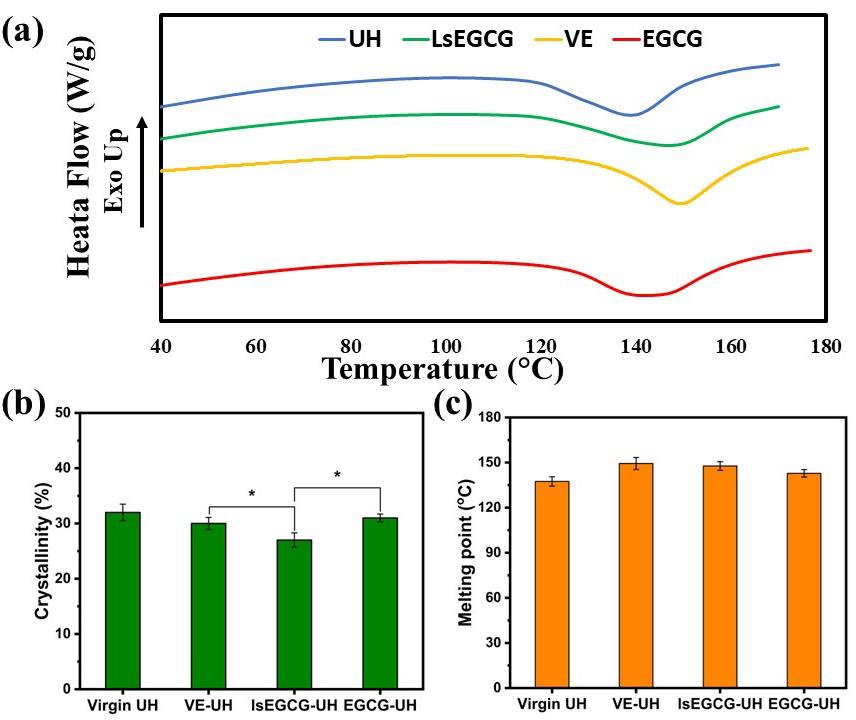
Melting point (Tm) and crystallinity (Xc) of the crosslinked and antioxidants blended samples were evaluated by the first heating profiles as shown in Figure 3a. It is observed that the melting curve widens for virgin UHMWPE and lsEGCG-UH, while it is seen sharper in VE-UH and EGCG/UHMWPE. Xc of virgin UHMWPE, 0.2 wt% VE blended, 0.2 wt% lsEGCG blended and 0.2 wt% EGCG blended UHMWPE are shown in Figure 3b. The Xc of crosslinked UHMWPE is 32% in the absence of antioxidants, which is seen to be higher among all the other samples. In contrast, Xc of lsEGCG blended UHMWPE is 27%, which is significantly lower compared to VE-UH and EGCG-UH (p < 0.05). The Tm of VE-UH and lsEGCG-UH were found to be nearly identical, at 149 °C and 148 °C respectively, as shown by the highest points on the line in Figure 3c. There was no significant difference between the Tm for each blend (p >0.05)

(a) DSC melting profiles of virgin, VE, lsEGCG and EGCG blended UHMWPE, (b) Crystallinity of virgin, VE, lsEGCG and EGCG blended UHMWPE. (* p < 0.05) (c) Melting point of virgin, VE, lsEGCG and EGCG blended UHMWPE.
3.5. Friction behavior of UHMWPE blends
The coefficient of friction (COF) values and wear rate were evaluated to characterize the tribological behavior of virgin UHMWPE, VE-UH, lsEGCG-UH and EGCG-UH samples. Figures 4a and b displays the friction coefficient change of the un-crosslinked and crosslinked group of samples respectively. The friction coefficient of uncross linked VE blended UHMWPE is 0.071, taken as the lowest reference among the whole samples. The friction coefficient of virgin UHMWPE, lsEGCG blended and EGCG blended are 0.081, 0.101 and 0.103 respectively before crosslinking comparing with crosslinked samples of friction coefficient 0.109, 0.074, 0.1201 and 0.172 for virgin UHMWPE, VE-UH, lsEGCG-UH and EGCG-UH (p < 0.05). The highest values are observed for the tea polyphenols blended samples; especially EGCG-UH friction coefficient is more than double compared with VE-UH.

Coefficient of friction for virgin, VE blended, lsEGCG blended and EGCG blended UHMWPE, (a) un-crosslinked, and (b) surface crosslinked.
3.6. Wear of UHMWPE blends
Figure 5 displays the wear volume of crosslinked and uncross linked specimens. The wear volume of un-crosslinked virgin UHMWPE, VE-UH, lsEGCG-UH and EGCG-UH have minute differences and vary around 0.123-0.13 mm3. The wear volume decreases significantly after the crosslinking and the result concentrates at 0.086-0.092 mm3 (p < 0.05). The cross-link density achieved on the surface of peroxide diffused samples after decomposition resulted in a wear rate of approximately 0.0864 mm3, 0.0919 mm3, 0.0856 mm3 and 0.0865 mm3 for virgin-UH, VE-UH, lsEGCG-UH and EGCG UH blends, respectively. The UHMWPE blended with lsEGCG exhibited the greatest reduction in wear, measuring 32.6%, while the blend with VE showed the lowest reduction in wear, measuring 29.4% (Figure 5). In comparison, EGCG-UH blends show a decrease in wear rate by 29.5% from 0.1226 to 0.0865 mm3.

Wear volume of virgin UHMWPE, VE-UH, lsEGCG-UH and EGCG-UH before and after the crosslinking process. (** p < 0.05).
3.7. Scanning electron microscopy
Figure 6 shows the SEM images of the wear track on virgin UHMWPE samples and antioxidants blended UHMWPE samples before and after surface crosslinking. Deep and wide grooves are observed on the surface of uncross linked virgin UH. In comparison, there is significant damage to the surface of VE-UH in the form of delamination and flakes. This could be attributed to the oxidation wear in VE-UH blends due to the reaction of peroxide free radicals. Similar to virgin UH there are few lines and scratches on the surface of EGCG-UH which is significantly reduces after surface crosslinking. A noticeable difference was observed in the lsEGCG-UH blends where the surface appeared smooth and damage free. This indicates that on the surface of the lsEGCG-UH there is a highly crosslinked network structure which is preventing against the abrasion of the UHMWPE against the ceramic ball.

Micrograph of the wear track of different UHMWPE blends before and after surface crosslinking. The red arrows represent furrows, grooves, lines, scratches, flakes and wear particle. The magnification of the images is 1000 x at 20 µm.
4. Discussion
Chemical crosslinking is generally carried out by blending the peroxides into the resin powder and processing it along the peroxides33. Our proposed method of crosslinking used a peroxide with a high enough decomposition temperature in order to allow peroxide diffusion into the polymer. Based on the previous study by Gul et al.28, we selected DCP as organic peroxide with a 1h half-life temperature of 137 °C34. The diffusion temperature was set to 80 °C far below the decomposition of the selected peroxide. Weight gain observed after the decomposition is attributed to the existence of peroxide decomposition products (Figure 2a). Common decomposition products for di-cumyl peroxide are acetone, methane, and cumyl alcohol35. The weight gain after doping is a result of peroxide charging into the polymer, while almost 50-65% of the weight gain during diffusion was lost after decomposition due to the volatility of the peroxide (Figure 2a). The peroxide volatile nature after decomposition is essential for the ultimate use of chemical crosslinked UHMWPE as joint implant material34. The surface crosslinked structure is accomplished and the results are consistent with the previous research conducted for the same group of samples23.
Peroxides create free radicals by abstracting hydrogen from the UHMWPE chain during the decomposition process, leading to a crosslinked structure36. However, the mechanical strength is undesirably depreciated due to free radicals, which act as an initiator for oxidation embrittlement14. VE has been frequently used for oxidation stability and is approved by FDA (Food and Drug Administration) for biomedical purposes. The oxidation mechanism of VE in irradiated UHMWPE involves the donation of hydrogen, which is then scavenged by the proton from VE to prevent the cascade reactions with oxygen and hinder the formation of free radicals37,38. The free radicals are highly prone to react with an antioxidant before achieving the crosslinking structure due to the presence of only one phenol hydroxyl resulting in a reduced crosslink density. The previously reported work is verified by the loss of crosslink density with VE blended UHMWPE (Figure 2c). In contrast to VE, the crosslink density of lsEGCG-UH and EGCG-UH blends are increased, approximately equaling the virgin UHMWPE (Figure 4). It is suggested that tea polyphenols contain multiple phenolic groups that can detach many phenoxy radicals from dehydrogenated lsEGCG and EGCG, which participate in crosslinking along with peroxide, therefore, improving the crosslink density39. For example, in the case of EGCG, DCP decomposes under heat to form alkoxy radicals that abstract hydrogen (H) atom from UHMWPE.
(C6H5-C(CH3)2-O)2 → 2 C6H5-C(CH3)2-O•
Dicumyl peroxide Alkoxy radicals
-[CH2-CH2]ₙ- + C6H5-C(CH3)2-O• → -[CH2-CH•]ₙ- + C6H5-C(CH3)2-OH
Polyethylene chain Radical site formed
-[CH2-CH•]ₙ- + •CH-CH2]-ₙ → -[CH2-CH-CH-CH2]-ₙ
Crosslinked UHMWPE (C-C bond between chains)
EGCG donates phenolic H to stabilize radicals and form additional crosslinks
(C6H5-C(CH3)2-O)2 → 2 C6H5-C(CH3)2-O• (Peroxide radicals)
C6H5-C(CH3)2-O• + -[CH2-CH2]ₙ- → -[CH2-CH•]ₙ- + C6H5-C(CH3)2-OH
-[CH2-CH•]ₙ- + EGCG-OH → -[CH2-CH2]ₙ- + EGCG-O•
EGCG-O• + -[CH2-CH•]ₙ- → -[CH2-CH-O-EGCG]ₙ- (Grafted crosslink)
In addition, to the radical sites formed by DCP, EGCG increases the number of crosslinking sites due to the higher number of phenolic groups. We also highlighted this crosslinking mechanism in our previous work on tea polyphenol assisted crosslinking of UHMWPE39. The recently reported work by Fu et al.37,40, also corroborated the results, who concluded that natural polyphenols, gallic acid and dodecyl gallate consisting of three hydroxyl groups individually, resulted in a higher oxidation resistance in crosslink UHMWPE compared to the VE-UH.
In both the EGCG and lsEGCG blended UHMWPE samples, the percent crystallinity is reduced, particularly lsEGCG-UH blend showed a large decrease, which may reflect the creation of a crosslink network structure in comparison to virgin UHMWPE (Figure 3b). The results agree with several previously reported studies38,41,42, that explain how crystal growth is restrained due to further controlling the chain mobility because of increasing the crosslinked network offered by tea polyphenols blended samples. lsEGCG and EGCG are intended to scavenge surplus radicals that are not taking part in the cross-linking process. Similar to the commonly used antioxidant VE, it has the ability to stabilize residual radicals by providing protons43. Interestingly, the melting curve of Virgin UHMWPE and lsEGCG-UH was observed to be wider compared to VE-UH and EGCG-UH, indicating a broad melting range for these polymers (Figure 3a). In contrast, VE-UH and EGCG-UH exhibited a sharper melting curve, suggesting a more well-defined melting behavior. It is also noteworthy that the Tm of VE-UH and lsEGCG-UH were found to be nearly identical, at 149 °C and 148 °C, respectively. This observation suggests that the addition of VE or lsEGCG to UHMWPE has a similar effect on the melting behavior of the resulting polymer25.
The coefficient of friction (COF) is notably low in the initial few seconds for each of the tested samples and then increase to an equilibrium value (Figures 4a and b). In the beginning, the polymer has a smooth and lubricating surface, keeping the friction coefficient at a minimum. However, as the test continues the surface becomes rough, causing an increase in the friction coefficient until it reaches an equilibrium value44. A significant increase was observed in COF values of crosslinked samples relative to uncross linked samples (Figures 4a and b). The direct correlation between the coefficient of friction and crosslink density has been reported in several research studies, which is comparable to our work. As the degree of crosslinking increases, the more tangled structure of the polymer fibrils leads to a decline in the polymer chains on the outer surface, playing a role in brush-mediated lubrication, which results in an increase in the coefficient of friction45. The compact crosslinked structure inhibits the motion of the UHMWPE molecular chains, which causes a rise in the shear stress or coefficient of friction in the crosslinked UHMWPE samples. The VE-UH showed a minimum coefficient of friction compared with virgin UHMWPE and tea polyphenol blended UHMWPE. A negligible increase in the coefficient of friction occurs in VE blended UHMWPE after the crosslinking process, which may suggest the crosslinking structure is not quite effective. Contrary to that, EGCG-UH has the highest coefficient of friction before and after crosslinking.
The crosslinking achieved on the surface of lsEGCG-UH and EGCG-UH samples resulted in a wear volume of about 0.086 mm3 (Figure 5). This wear volume of tea polyphenol is nearly comparable to the wear tests conducted on a similar blended sample (test conditions remain constant), for example, 0.12 mm3 wear volume for 0.1 and 0.3 wt% EGCG blended UHMWPE26,46. Crosslinking brought an apparent decrease in wear volume in four samples. The VE blended UHMWPE resulted in the highest wear volume of 0.13 and 0.092 mm3 before and after crosslinking respectively, in agreement with the observance of lower crosslinking density in the VE blended UHMWPE. The wear volume of tea polyphenols blended UHMWPE was found to be nearly identical to that of virgin UHMWPE, a result that is consistent with the observed crosslinking density (Figure 2c). The wear results corroborate the direct relation between the crosslinking density and wear resistance, which is closely linked to the failure of joint implants47,48.
In UHMWPE used for TJR, the interplay between crystallinity, coefficient of friction, and wear resistance is a critical consideration49. While crystallinity is traditionally associated with improved mechanical strength due to the presence of highly ordered molecular regions, the current study demonstrates that low crystallinity, when combined with high crosslink density, can also yield favorable tribological performance. Specifically, UHMWPE samples stabilized with tPPs exhibited relatively lower crystallinity (Figure 3b) yet achieved higher crosslink density as a result of surface chemical crosslinking (Figure 2c). These samples showed an increased coefficient of friction, which may be attributed to the reduced chain mobility and enhanced surface stiffness induced by the dense crosslinked network (Figure 4).
The reduced crystallinity in these materials also offers advantages in terms of fatigue resistance and oxidative stability, both crucial for long-term implant durability50,51. Excessive crystallinity can lead to embrittlement and crack propagation under cyclic loading, whereas a lower crystalline content helps retain ductility. Post-irradiation thermal treatments like, remelting or annealing, can further optimize this balance by eliminating residual free radicals to mitigate oxidative degradation while permitting partial crystallinity recovery to modulate frictional properties. Thus, while low crystallinity may slightly elevate interfacial friction, the primary wear-reduction mechanism remains the crosslinked microstructure, making such UHMWPE formulations particularly suitable for arthroplasty applications where osteolysis due to wear debris is a predominant concern52. The enhanced crosslink density likely acts as a structural reinforcement that stabilizes the amorphous regions and mitigates chain scission and wear particle generation. Therefore, the combination of low crystallinity with high crosslink density offers a promising design strategy for improving the long-term durability and functional performance of UHMWPE in joint replacement applications.
The SEM images of the wear tracks for both crosslinked and un crosslinked UHMWPE samples after wear tests are depicted in Figure 6. It is observed that in the un crosslinked samples the worn surface displays common factors of abrasion and oxidation wear, where a series of grooves, furrows and flakes can be seen along the sliding direction. This suggests that abrasive wear is the leading wear mechanism caused by the loaded ceramic ball49,53. Virgin UH had deep and wide grooves and furrows before crosslinking which were only bettered to lines and scratches after surface crosslinking. Flakes and wear particles were observed on the surface of VE-UH blends suggesting the oxidation of the sample. This could be caused by the reaction of un-reacted peroxide free radicals with the atmospheric oxygen hence the surface is oxidized and a slight chunk has been removed54. This loss of material and delamination is also known as third body particles or wear debris, and is considered as one of the leading causes of early retrievals in UHMWPE based joint implants6,55. On the contrary, there are minimal flakes found on the surface of EGCG-UH and lsEGCG-UH blends, suggesting the higher oxidation resistance of tea polyphenols even under harsh environments56. However, there were still few lines and scratches on the surface of un crosslinked EGCG-UH blends which could be linked to its lower surface roughness Figure 2d. After crosslinking lsEGCG-UH blends shows a smother surface without any observable damage. It indicates that highly wear resistant surface is achieved through peroxide crosslinking in the presence of tea polyphenols.
One of the limitations of this work is the chemical analysis of the peroxide and its byproducts in the presence of tea polyphenols. Which could be considered in the future work to observe its effects on the surface oxidation and study the long-term durability under accelerated aging for UHMWPE blends. Nevertheless, these findings underscore the potential of incorporating tea polyphenols into UHMWPE formulations to mitigate wear and enhance durability, offering promising implications for total joint replacements where wear resistance is crucial.
5. Conclusions
A comparative analysis was conducted to assess the effect of surface crosslinking on the overall wear performance of natural antioxidants (VE and tea polyphenol) stabilized UHMWPE blends. The blends were surface crosslinked through the diffusion and decomposition in di-cumyl peroxide followed by comparative testing to evaluate the surface properties such as crosslink density, surface roughness, co-efficient of friction and wear performance in detail. The results yielded three key findings: (1) crosslink density analysis confirmed 17% greater crosslink density in tea polyphenol blends (p<0.05), (2) pin-on-disk testing showed 32.6% lower wear rate compared to vitamin E-stabilized which only shows a cumulative decrease of 29.4% in wear volume after surface crosslinking, and (3) surface analysis using SEM revealed ~95% reduced surface damage in lsEGCG-UH and EGCG-UH blends as compared to VE-UH samples. These results demonstrate that tea polyphenol not only enhances crosslinking efficiency during peroxide diffusion but also generates a highly wear-resistant surface architecture. These findings establish tea polyphenol as a superior alternative to vitamin E for developing surface-crosslinked UHMWPE implants, offering both enhanced oxidative stability and wear resistance for prolonged joint replacement longevity.
6. Acknowledgements
The authors greatly acknowledge the financial support of the Higher Education Commission Grant ((Ph-II-MG-5)/PAK-TURK/R&D/HEC/2018) and Pakistan Science Foundation/National Science Foundation China Grant (PSF/NSFC-II/ENG/KP-UET (02)).
-
Data Availability
The entire dataset supporting the results of this study was published in the article itself.
7. References
- 1 Shichman I, Askew N, Habibi A, Nherera L, Macaulay W, Seyler T, et al. Projections and Epidemiology of Revision Hip and Knee Arthroplasty in the United States to 2040-2060. Arthroplast Today. 2023;21:101152.
-
2 Horizon Grand View Research [homepage on the Internet]. Global Joint Replacement Market Size & Outlook, 2022-2030. San Francisco: Grand View Research, Inc.; 2022 [cited 2025 Apr 8]. Available from: https://www.grandviewresearch.com/horizon/outlook/joint-replacement-market-size/global
» https://www.grandviewresearch.com/horizon/outlook/joint-replacement-market-size/global - 3 Schwartz AM, Farley KX, Guild GN, Bradbury TL Jr. Projections and epidemiology of revision hip and knee arthroplasty in the United States to 2030. J Arthroplasty. 2020;35(6 Suppl):S79-85.
- 4 Patil NA, Njuguna J, Kandasubramanian B. UHMWPE for biomedical applications: performance and functionalization. Eur Polym J. 2020;125:109529.
- 5 Hussain M, Naqvi RA, Abbas N, Khan SM, Nawaz S, Hussain A, et al. Ultra-High-Molecular-Weight-Polyethylene (UHMWPE) as a promising polymer material for biomedical applications: a concise review. Polymers. 2020;12(2):323.
- 6 Spece H, Schachtner JT, MacDonald DW, Klein GR, Mont MA, Lee G-C, et al. Reasons for revision, oxidation, and damage mechanisms of retrieved vitamin e-stabilized highly crosslinked polyethylene in total knee arthroplasty. J Arthroplasty. 2019;34(12):3088-93.
- 7 Merola M, Affatato S. Materials for hip prostheses: a review of wear and loading considerations. Materials. 2019;12(3):495.
- 8 Broomfield JAJ, Malak TT, Thomas GER, Palmer AJR, Taylor A, Glyn-Jones S. The relationship between polyethylene wear and periprosthetic osteolysis in total hip arthroplasty at 12 years in a randomized controlled trial cohort. J Arthroplasty. 2017;32(4):1186-91.
- 9 Suraci A, Louati H, Culliton KN, Beaulé PE. Comparing in vivo performance of two highly cross-linked polyethylene thermal treatments: remelting vs annealing in acetabular liners. J Arthroplasty. 2019;34(7):1509-13.
- 10 Lachiewicz PF, Soileau ES. Highly cross-linked polyethylene provides decreased osteolysis and reoperation at minimum 10-year follow-up. J Arthroplasty. 2016;31(9):1959-62.
- 11 Jefferies C, Al-Malaika S, Sheena HH. New and novel stabilisation approach for radiation-crosslinked Ultrahigh Molecular Weight Polyethylene (XL-UHMWPE) targeted for use in orthopeadic implants. Polym Degrad Stabil. 2021;183:109462.
- 12 Oral E, Ghali BW, Rowell SL, Micheli BR, Lozynsky AJ, Muratoglu OK. A surface crosslinked UHMWPE stabilized by vitamin E with low wear and high fatigue strength. Biomaterials. 2010;31(27):7051-60.
- 13 Ries MD, Pruitt L. Effect of cross-linking on the microstructure and mechanical properties of ultra-high molecular weight polyethylene. Clin Orthop Relat Res. 2005;440:149-56.
- 14 Bracco P, Costa L, Luda MP, Billingham N. A review of experimental studies of the role of free-radicals in polyethylene oxidation. Polym Degrad Stabil. 2018;155:67-83.
- 15 Oral E, Doshi BN, Gul RM, Neils AL, Kayandan S, Muratoglu OK. Peroxide cross-linked UHMWPE blended with vitamin E. J Biomed Mater Res B Appl Biomater. 2017;105(6):1379-89.
- 16 Currier BH, Currier JH, Holdcroft LA, Van Citters DW. Effectiveness of anti-oxidant polyethylene: what early retrievals can tell us. J Biomed Mater Res B Appl Biomater. 2018;106(1):353-9.
- 17 Kirschweng B, Tátraaljai D, Földes E, Pukánszky B. Natural antioxidants as stabilizers for polymers. Polym Degrad Stabil. 2017;145:25-40.
- 18 Grupp TM, Fritz B, Kutzner I, Schilling C, Bergmann G, Schwiesau J. Vitamin E stabilised polyethylene for total knee arthroplasty evaluated under highly demanding activities wear simulation. Acta Biomater. 2017;48:415-22.
- 19 Turner A, Okubo Y, Teramura S, Niwa Y, Ibaraki K, Kawasaki T, et al. The antioxidant and non-antioxidant contributions of vitamin E in vitamin E blended ultra-high molecular weight polyethylene for total knee replacement. J Mech Behav Biomed Mater. 2014;31:21-30.
- 20 Shah NA, Hong R, Yang X, Huang S-S, Gul RM, Liu Y, et al. Synergy stabilization of vitamin E and D-sorbitol on crosslinked ultrahigh molecular weight polyethylene for artificial joint under in-vitro clinically relevant accelerated aging. Polym Degrad Stabil. 2023;214:110382.
- 21 Takahashi Y, Yamamoto K, Pezzotti G. Effects of vitamin E blending on plastic deformation mechanisms of highly crosslinked ultrahigh molecular weight polyethylene (HXL-UHMWPE) in total hip arthroplasty. Acta Biomater. 2015;15:227-36.
- 22 Xu YQ, Gao Y, Granato D. Effects of epigallocatechin gallate, epigallocatechin and epicatechin gallate on the chemical and cell-based antioxidant activity, sensory properties, and cytotoxicity of a catechin-free model beverage. Food Chem. 2021;339:128060.
- 23 Shah NA, Ren Y, Lan R-T, Lv J-C, Gul RM, Tan P-F, et al. Ultrahigh molecular weight polyethylene with improved crosslink density, oxidation stability, and microbial inhibition by chemical crosslinking and tea polyphenols for total joint replacements. J Appl Polym Sci. 2021;138(43):51261.
- 24 Yang C, Zhang P, Wang T, Kang X. The role of simulated body fluid and force on the mechanical and tribological properties of α-tocopherol stabilized UHMWPE for biomedical applications. Polym Bull. 2020;78:6517-33.
- 25 Kang X, Zong X, Zhang P, Zeng X, Liu Y, Yao C, et al. Effects of epigallocatechin gallate incorporation in UHMWPE on biological behavior, oxidative degradation, mechanical and tribological performance for biomedical applications. Tribol Int. 2021;158:106887.
- 26 Vidya V, Anoop CA, Jinan S, Anwar R, Senthil Saravanan MS. Tribological analysis of cross linked UHMWPE used in artificial knee replacement. Mater Today Proc. 2020;27:2748-51.
- 27 Mihalko WM, Haider H, Kurtz S, Marcolongo M, Urish K. New materials for hip and knee joint replacement: what’s hip and what’s in kneed? J Orthop Res. 2020;38(7):1436-44.
- 28 Gul RM, Fung K, Doshi BN, Oral E, Muratoglu OK. Surface cross-linked UHMWPE using peroxides. J Orthop Res. 2017;35(11):2551-6.
- 29 Muratoglu OK, Bragdon CR, O’Connor DO, Jasty M, Harris WH, Gul R, et al. Unified wear model for highly crosslinked ultra-high molecular weight polyethylenes (UHMWPE). Biomaterials. 1999;20(16):1463-70.
- 30 Malito LG, Arevalo S, Kozak A, Spiegelberg S, Bellare A, Pruitt L. Material properties of ultra-high molecular weight polyethylene: comparison of tension, compression, nanomechanics and microstructure across clinical formulations. J Mech Behav Biomed Mater. 2018;83:9-19.
- 31 Abdelgaied A, Fisher J, Jennings L. A comprehensive combined experimental and computational framework for pre-clinical wear simulation of total knee replacements. J Mech Behav Biomed Mater. 2018;78:282-91.
- 32 Sambasivan S, Fischer DA, Hsu SM. Effect of cross-linking ultrahigh molecular weight polyethylene: surface molecular orientation and wear characteristics. J Vac Sci Technol A. 2007;25(4):932-7.
- 33 Shah NA, Lan R-T, Dai R, Jiang K, Shen H-Y, Hong R, et al. Improved oxidation stability and crosslink density of chemically crosslinked ultrahigh molecular weight polyethylene using the antioxidant synergy for artificial joints. J Biomed Mater Res B Appl Biomater. 2022;111(1):26-37.
- 34 Kayandan S, Doshi BN, Oral E, Muratoglu OK. Surface cross-linked ultra high molecular weight polyethylene by emulsified diffusion of dicumyl peroxide. J Biomed Mater Res B Appl Biomater. 2018;106(4):1517-23.
- 35 Bichara DA, O’Brien CC, Doshi BN, Nielsen GP, Oral E, Muratoglu OK. Residual byproducts of peroxide crosslinked vitamin E-blended ultrahigh molecular weight polyethylene. J Arthroplasty. 2018;33(8):2666-70.
- 36 Niki E. Role of vitamin E as a lipid-soluble peroxyl radical scavenger: in vitro and in vivo evidence. Free Radic Biol Med. 2014;66:3-12.
- 37 Fu J, Shen J, Liu X. Effect of squalene absorption on oxidative stability of highly crosslinked UHMWPE stabilized with natural polyphenols. Polym Degrad Stabil. 2014;110:113-20.
- 38 George A, Ngo HD, Bellare A. Influence of crystallization conditions on the tensile properties of radiation crosslinked, vitamin E stabilized UHMWPE. J Mech Behav Biomed Mater. 2014;40:406-12.
- 39 Ren Y, Wang F-Y, Lan R-T, Fu W-Q, Chen Z-J, Lin H, et al. Polyphenol-assisted chemical crosslinking: a new strategy to achieve highly crosslinked, antioxidative, and antibacterial ultrahigh-molecular-weight polyethylene for total joint replacement. ACS Biomater Sci Eng. 2020;7(1):373-81.
- 40 Fu J, Shen J, Gao G, Liu X. Natural polyphenols enhance stability of crosslinked UHMWPE for joint implants. Clin Orthop Relat Res. 2015;473(3):760-6.
- 41 Hong R, Lan R-T, Ren Y, Xu L, Xu Y-X, Shah NA, et al. Insights into synergic antioxidant effects for vitamin E and sugar alcohol stabilized ultrahigh molecular weight polyethylene composites for artificial joints. Polymer. 2024;295:126773.
- 42 Pruitt LA, Ansari F, Kury M, Mehdizah A, Patten EW, Huddlestein J, et al. Clinical trade-offs in cross-linked ultrahigh-molecular-weight polyethylene used in total joint arthroplasty. J Biomed Mater Res B Appl Biomater. 2013;101(3):476-84.
- 43 Lan R-T, Ren Y, Wei X, Tang L-Z, Shah NA, Xu L, et al. Synergy between vitamin E and D-sorbitol in enhancing oxidation stability of highly crosslinked ultrahigh molecular weight polyethylene. Acta Biomater. 2021;134:302-12.
- 44 Saikko V. Effect of type of contact, counterface surface roughness, and contact area on the wear and friction of extensively cross-linked, vitamin E stabilized UHMWPE. J Biomed Mater Res B Appl Biomater. 2020;108(5):1985-92.
- 45 Singh MK, Ilg P, Espinosa-Marzal RM, Kröger M, Spencer ND. Effect of crosslinking on the microtribological behavior of model polymer brushes. Tribol Lett. 2016;63(2):17.
-
46 Cui W, Bian Y, Zeng H, Zhang X, Zhang Y, Weng X, et al. Structural and tribological characteristics of ultra-low-wear polyethylene as artificial joint materials. J Mech Behav Biomed Mater. 2020;104:103629. http://doi.org/10.1016/j.jmbbm.2020.103629
» http://doi.org/10.1016/j.jmbbm.2020.103629 - 47 Zhang W, Xu Z, Shen J, Wang J, Luo Y. Enhanced tribological performance of UHMWPE composites reinforced with wollastonite: biocompatibility and wear behavior. J Tribol. 2025;147(4):044001.
- 48 Vadivel HS, Bek M, Šebenik U, Perše LS, Kádár R, Emami N, et al. Do the particle size, molecular weight, and processing of UHMWPE affect its thermomechanical and tribological performance? J Mater Res Technol. 2021;12:1728-37.
- 49 Paladugu SRM, Rama Sreekanth PS. Mechanical and wear performances of UHMWPE composites used for orthopaedic applications: a review. Mater Today Proc. 2022;56:1103-8.
- 50 Doshi B, Ward JS, Oral E, Muratoglu OK. Fatigue toughness of irradiated vitamin E/UHMWPE blends. J Orthop Res. 2016;34(9):1514-20.
- 51 Ansari F, Ries MD, Pruitt L. Effect of processing, sterilization and crosslinking on UHMWPE fatigue fracture and fatigue wear mechanisms in joint arthroplasty. J Mech Behav Biomed Mater. 2016;53:329-40.
- 52 Galliera E, Ragone V, Marazzi MG, Selmin F, Banci L, Corsi Romanelli MM. Vitamin E-stabilized UHMWPE: biological response on human osteoblasts to wear debris. Clin Chim Acta. 2018;486:18-25.
- 53 Ting C, Weiguo M, Kaihui Z, Zilong H. Wear simulation of UHMWPE against the different counterface roughness in reciprocating unidirectional sliding motion. Sci Rep. 2024;14(1):15858.
- 54 Bhoi S, Prasad A, Kumar A, Sarkar RB, Mahto B, Meena CS, et al. Experimental study to evaluate the wear performance of UHMWPE and XLPE material for orthopedics application. Bioengineering. 2022;9(11):676.
- 55 Cheung A, Yan CH, Fu H, Cheung MH, Chan PK, Chiu KY. Ten- to sixteen-year follow-up of highly cross-linked polyethylene in total hip arthroplasty: what factors affect wear? J Arthroplasty. 2019;34(9):2016-21.
- 56 Ren Y, Wei X, Wei S-T, Wang F-Y, Wang J, Xu J-Z, et al. High oxidation stability of tea polyphenol-stabilized highly crosslinked UHMWPE under an in vitro aggressive oxidative condition. Clin Orthop Relat Res. 2019;477(8):1947-55.
The entire dataset supporting the results of this study was published in the article itself.