The Influence of Thermal Processing with H2 Atmosphere on the Physical Properties and Microstructure for use in Electrolytic Capacitors of Nb
This study evaluated the effect of thermal processing in hydrogen (H2) and argon (Ar) atmospheres on the physical and microstructural properties of niobium (Nb) powders for electrolytic capacitors. Nb powders were treated at 750 °C, 850 °C and 950 °C with isothermal holds of 60 min and 120 min—samples H2-850-120 and Ar-850-120 denote the H2 and Ar atmospheres—using a heating rate of 10 °C/min. Powders were compacted at 150 MPa and sintered at 1200 °C under H2. XRD confirmed predominant βH phase and minor NbO in H2-treated powders, while Ar-treated samples exhibited stronger NbO reflections. FEG-SEM micrographs showed finer grains and reduced porosity in H2-850-120. These results demonstrate that hydrogen-atmosphere processing yields Nb powders with improved homogeneity, particle size reduction and densification—key attributes for enhanced capacitor performance.
Keywords:
Niobium; thermal process; hydrogenation; particle size; porosity; morphology; capacitors

1. Introduction
Currently, the production of capacitors for electronic devices is one of the main applications of tantalum (Ta) powder, due to its high capacitance, the low oxygen concentration in the metallic structure and its large surface area. However, Ta powder tends to be more costly because of the mineral's rarity and the specificity of its accumulation. In fact, there is a need to find substitutes for this element due to potential future difficulties in meeting global market demands for more affordable electronic devices1,2. Over the years, niobium (Nb) powder has garnered technological and practical interest in high-temperature structural and electrically functional materials. In particular, compact Nb structures obtained through vacuum sintering have been explored for the electronics industry3, serving as a metallic substrate for semiconductor oxide capacitors, which exhibit high electrical capacity in a surface layer of niobium pentoxide (Nb2O5). Thus, efforts are being made to produce finer Nb powders with high purity and low cost to enhance the electrical properties of devices3.
Niobium electrolytic capacitors are generally made of passivated metallic niobium or niobium monoxide (NbO), combined with a non-liquid electrolyte (polymer or MnO2). The materials and processes used to manufacture niobium capacitors are essentially the same as those for tantalum capacitors, meaning that they exhibit similar chemical properties. Electrochemical corrosion of niobium foil is a viable approach to increasing the surface area for application in electrolytic capacitors. The Nb2O5 has a higher dielectric constant than tantalum pentoxide (Ta2O5), but a lower voltage, enabling the same amount of energy storage. However, its energy density is lower than Ta due to its larger size4. The maximum operating temperature is limited to 105°C, and its leakage current is 5 to 10 times higher than that of tantalum capacitors. Despite this, its high melting point had limited its industrial development until the year 2000, when the rising price of tantalum stimulated the development of niobium electrolytic capacitors with (polymer or MnO2)4-8.
Nb and Ta are found in the same ores, primarily columbite-tantalite (76% Nb2O5) and pyrochlore (71% Nb2O5). Brazil holds the largest niobium reserves, accounting for approximately 98.53% of the global supply. Furthermore, Nb powder represents an interesting alternative to fully or partially replace Ta powder, as they share unique and similar properties1,2. By controlling the physical and microstructural properties of Nb, such as morphology, size reduction, and particle size distribution, it is possible to alter its electrical properties. Consequently, reducing the average particle size of Nb leads to improved capacitance values, and various techniques are being studied to obtain increasingly finer particles1,2,9-11.
The hydrogenation-dehydrogenation (HDH) process is a simple and cost-effective technique designed to embrittle Nb powder by introducing hydrogen (H) atoms into interstitial positions. This process, influenced by high pressure and temperature, facilitates the transformation from the stable α-phase to a more brittle β-phase and the formation of a solid solution of NbH. Depending on the cooling method, partial hydrogenation (at approximately 450 °C) or complete hydrogenation (at temperatures around 700 °C to 850 °C) can be achieved. Notably, low-temperature cooling tends to yield finer particles than cooling at room temperature2,3,12,13.
The consolidated literature shows that HDH treatments significantly improve the properties of Nb powders for electrolytic capacitors, as reported by Semboshi et al.3 on fracture behavior and fine powder fabrication, Wang et al.14 on the characterization of hydrogenated interlayers, Nascimento et al.2 on particle size reduction, and Suzuki et al.9 on morphology control. In this context, the work of Nascimento et al.2 suggests that niobium powder composed of relatively smaller particles can be obtained, increasing its surface area and, consequently, enhancing its electrical properties. This is achieved through hydrogenation followed by milling, which facilitates the introduction of hydrogen atoms into metallic niobium powder, thereby embrittling it and improving its milling characteristics2. Additionally, the production of niobium or tantalum capacitors is carried out through powder metallurgy, a general method used for processing metallic and ceramic materials by consolidating powder into discrete shapes2,15. However, direct comparisons between thermal treatments in H2 and Ar atmospheres under identical isothermal conditions are lacking.
This work studies qualitatively a critical gap in the literature by directly comparing thermal treatments of Nb powders in H2 versus Ar atmospheres under defined isothermal conditions, systematically evaluating their effects on βH phase formation, secondary oxide development, particle morphology and microstructural homogeneity—parameters seldom assessed side-by-side in earlier hydrogenation studies2,3 and thus offering novel insights for optimizing Nb powder processing to potential achievement of enhanced electrolytic-capacitor performance.
2. Methodology
The niobium powder was sieved using a 400-mesh sieve (0.037 millimeters, mm), which served as the standard for the other thermally processed powders (H2 and Ar). The use of the 400-mesh sieve results in an optimal balance between flowability, handling, and specific surfac. The initial material was characterized through particle size analysis and field emission scanning electron microscopy with energy-dispersive spectroscopy (FEG-SEM-EDS) to evaluate its physical and microstructural properties.
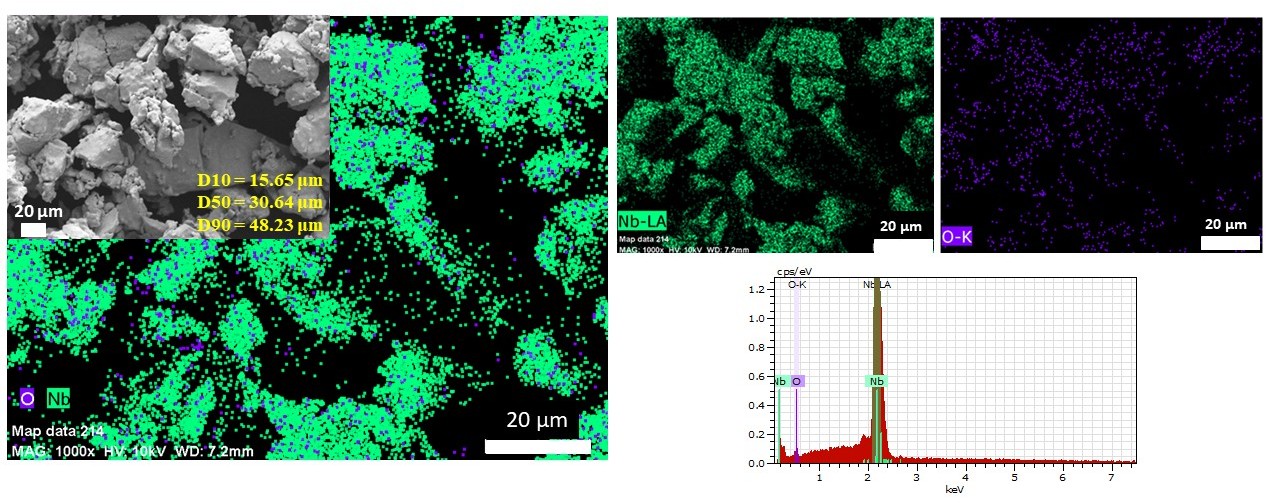
Figure 1 presents the micrograph of the Nb powder—initial material—where the irregular morphology of the initial niobium particles can be observed, along with the particle size distribution values (D10 = 15.65 µm, D50 = 30.64 µm, D90 = 48.23 µm). The elemental mapping was obtained via energy-dispersive spectroscopy (FEG-SEM-EDS) of the initial Nb powder, confirming the material’s purity through its chemical composition.

During the thermal process under a controlled atmosphere of either hydrogen (H2)—hydrogenation—or argon (Ar), the sieved niobium (Nb) powder was initially weighed to obtain an approximate mass of 2 grams. These powders were placed in an alumina boat and inserted into a resistive furnace under the following parameters: T = 750 °C with isothermal holds of 60 and 120 minutes, T = 850 °C with isothermal holds of 60 and 120 minutes, and T = 950 °C with isothermal holds of 60 and 120 minutes. The heating rate was set at 10 °C/min. The same conditions were applied to both thermal processes using H2 and Ar.
The processed powders were compacted using a uniaxial press under a compaction pressure of 150 MPa. Subsequently, the powder compacts were sintered in a resistive furnace under a H2 atmosphere at a sintering temperature of 1200 °C, with heating rates of 20 °C/min and 10 °C/min, and a cooling rate of 25 °C/min. Figure 2 below shows the green compacts of niobium powder – electrodes.

The thermal processing of Nb powders with H2 or Ar, as well as the sintering of the green compacts, was carried out in a FORTELAB tubular sintering furnace. The thermally processed powders and sintered compacts were characterized through X-ray diffraction (XRD) analysis using a SHIMADZU diffractometer, model 83 XRD-7000, with CuKα radiation (λ = 1.5406 Å), a current of 30 mA, and a voltage of 40 kV. The samples were analyzed within a 2θ scanning range of 10° to 90°, with an angular step of 0.02° and a scanning speed of 1°/min. The Field emission scanning electron microscopy (FEG-SEM) caractherization was performed using a CARL ZEISS AURIGA 40 FEG-SEM.
3. Results and Discussion
3.1. Structural analysis of the hydrogenated powders
Figures 3 and 4 show the XRD patterns for hydrogenated powders at different temperatures and isothermal holding times. In both diffractograms, peaks corresponding to the βH phase were observed at approximately 37°, 53°, 67°, and 79°3,11,14, indicating the feasibility of obtaining hydrogenated niobium through this technique. Niobium oxide peaks were also detected, suggesting the need for greater control in the processing of hydrogenated powders.

Diffractogram of hydrogenated powders at temperatures of 750 °C, 850 °C, and 950 °C; with an isothermal time of 60 minutes.

Diffractogram of hydrogenated powders at temperatures of 750 °C, 850 °C, 950 °C; at an isothermal time of 120 min.
According to Wang et al.14, the hydrogen-niobium phase diagram reveals that the formation of the βH phase results from the saturated precipitation of the α phase. Initially, hydrogen dissolves in the α-phase niobium. With increasing charging time, the hydrogen content exceeds the solubility threshold of hydrogen in the α phase. The βH phase gradually precipitates from the saturated phase, and this reaction continues until the dissolved hydrogen content reaches the solubility limit of hydrogen in the βH phase.
Additionally, in the study conducted by Semboshi et al.3, the intensities of the βH phase peaks increased with the rise in hydrogen content, highlighting that the volume fraction of the βH phase increases with hydrogen concentration. In this study, only βH peaks were detectable, indicating a single-phase structure—βH. These findings align with the present work, where only the βH phase is observed in the hydrides.
In Figure 4 below, peak broadening at half maximum was observed for the isothermal holding time of 120 minutes, particularly at a temperature of 750 °C, when compared to Figure 3. This indicates a refinement of the hydrogenated Nb powder with secondary phases as the isothermal holding time increases.
According to Gabriel et al.11, the hydrogenation of Nb chips only occurred during the cooling of the high-temperature reactor. Several experimental attempts were made to destabilize the very thin oxide layer on the surface of the Nb chips for isothermal hydrogenation of the material, but without success. Hydrogenation occurred only at temperatures of 500 °C and 700 °C, unlike at temperatures of 400 °C and 450 °C.
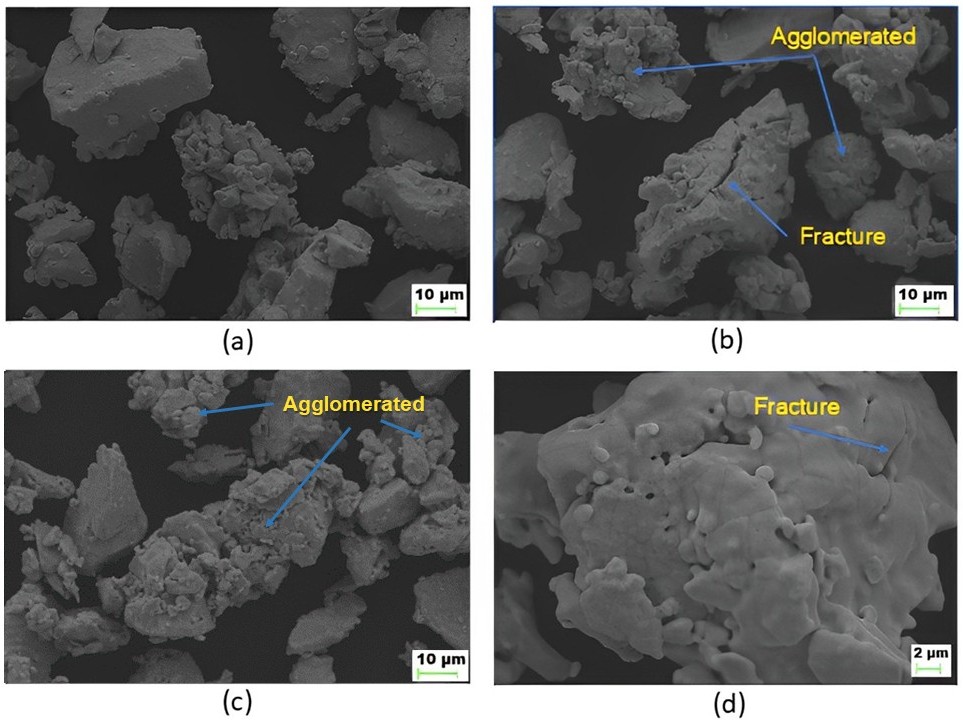
Figure 5 presents the micrographs of the initial powder and hydrogenated powders at 750 °C with isothermal holding times of 60 minutes and 120 minutes. A refinement of the hydrogenated powders, agglomerates of smaller particles, and the presence of fractures2,3 were observed, indicating embrittlement and the presence of the βH phase. Irregular and distinct morphologies were also noted.

FEG-SEM micrographs of the initial powder (a) and hydrogenated powders at 750 °C for 60 min (b) and 750 °C for 120 min (c, d).
3.2. Microstructural analysis of the sintered samples
The micrographs of compacted and thermally processed powders (T=750 °C and isothermal times of 60 and 120 min.), in H2 and Ar, and sintered are shown in Figure 6. A more homogeneous microstructure in terms of phase dispersion, more refined, with greater particle bonding (dense), and the presence of pores, is noticeable for hydrogenated powders under the same conditions as those in an Ar atmosphere (see Figure 6). Therefore, the samples sintered in an Ar atmosphere exhibit a more heterogeneous and coarser microstructure, with weaker particle bonding. These observations are supported by the contrast in the EDS maps of the Ar- and H2-sintered samples, as shown in Figure 6 a, b and Figure 6 c, d, respectively. The Ar-sintered samples (Figure 6 c, d) show limited Nb dispersion within the mapped region and poor homogenization of the Nb particles. In contrast, the H2-sintered samples show excellent homogenization, with Nb particles fully dispersed throughout the microstructure, as clearly depicted in the corresponding EDS maps (see Figure 6 a, b).

FEG-SEM-EDS of sintered niobium powder compacts. Powder thermally treated under a hydrogen atmosphere under the conditions of T= 750 °C and (a) t = 60 min and (b) t = 120 min, and under argon at T= 750 °C and (c) t = 60 min and (d) t = 120 min.
In fact, the H2 atmosphere in sintering processing acts as an in-situ reducing agent at high temperature, removing native Nb2O5 surface films by converting them to H2O vapor and thus exposing fresh metallic surfaces that bond more readily during neck growth; this “activated sintering” via transient hydride formation has been shown to lower residual porosity and enhance densification in refractory alloys16,17. In contrast, sintering under inert Ar simply prevents further oxidation but cannot reduce existing oxides, resulting in weaker interparticle contacts, higher porosity, and lower green and sintered densities17.
Figure 7, below, shows two distinct microstructures, porous and more agglomerated (dense), of sintered bodies of hydrogenated powders compacted at 750 °C, with isothermal times of 60 min (Figures 7 a, b) and 120 min (Figures 7 c, d). In Figure 7 a, a heterogeneity of pores is also observed, which highlights the possibility of the sample exhibiting apparent microporosity and nanoporosity properties; porosity being a fundamental property for application in electrolytic capacitors.

FEG-SEM micrographs of sintered compact of hydrogenated powders at 750 °C, at isotherm times of (a, b) 60 min and (c, d) 120 min.
The heterogeneity of pore sizes and the presence of nanopores in Nb2O5 anodes are desirable features for electrolytic capacitors. In Figure 7, the macropores (>1 µm) enable rapid electrolyte penetration; the mesopores (10–100 nm) balance ionic diffusion and internal surface accessibility; and the nanopores (<10 nm) significantly increase the active surface area of the electrode, resulting in a specific capacitance of 12 mF·cm−2 at 1 kHz. However, an excessive volume of ultra-fine nanopores may trap desolvated ions, increasing local diffusion resistance and compromising high-frequency performance, as previously demonstrated in nanostructured Nb2O5-based materials18,19.
4. Conclusion
In conclusion, the thermal processing in an H2 atmosphere resulted in the formation of the major βH phase and a few NbO oxide peaks, for both temperatures and isothermal times; demonstrating the efficiency of the technique adopted for the specific application. The hydrogenated powder particle size was reduced (refined), for various temperatures and an isothermal time of 120 minutes, this factor was correlated to the XRD data due to the broadening of half-height peaks presented through the diffractograms. A varied particle size, irregular and distinct morphologies, and the presence of cracks with material embrittlement – presence of the βH phase – were obtained for the hydrogenated powders (T = 750 °C, t = 60 min and 120 min). Moreover, in the compacted and sintered powders, a more refined and homogeneous microstructure was obtained for T = 750 °C and isothermal times of 60 min and 120 min in H2, as well as a greater particle bonding and the presence of pore heterogeneity. However, for the powders processed in Ar, a more heterogeneous microstructure is observed, less refined, with weaker particle bonding, and greater porosity. In fact, the structural and microstructural properties achieved in H2 atmosphere sintering were significant for obtaining better electrical properties for future analyses in the specific application - electrolytic capacitors.
-
Data Availability
The full dataset supporting the findings of this study is available upon request to the corresponding author – Ariadne de Souza Silva, ariadnesouza0201@gmail.com.
5. References
-
1 Baba M, Kikuchi T, Suzuki RO. Niobium powder synthesized by calciothermic reduction of niobium hydroxide for use in capacitors. J Phys Chem Solids. 2015;78:101-9. http://doi.org/10.1016/j.jpcs.2014.11.014
» http://doi.org/10.1016/j.jpcs.2014.11.014 -
2 Nascimento ES, Araújo KFG, Mashhadikarimi M, Gomes UU. Efeito do processo de hidrogenação na redução do tamanho de partículas de nióbio utilizadas em capacitores eletrolíticos. Braz J Dev. 2021;7(11):109468-76. http://doi.org/10.34117/bjdv7n11-530
» http://doi.org/10.34117/bjdv7n11-530 -
3 Semboshi S, Konno TJ, Masahashi N, Hanada S. Fracture behavior of niobium by hydrogenation and its application for fine powder fabrication. Metall Mater Trans, A Phys Metall Mater Sci. 2006;37(4):1301-9. http://doi.org/10.1007/s11661-006-1082-y
» http://doi.org/10.1007/s11661-006-1082-y -
4 Torki J, Joubert C, Sari A. Electrolytic capacitor: properties and operation. J Energy Storage. 2023;58:106330. http://doi.org/10.1016/j.est.2022.106330
» http://doi.org/10.1016/j.est.2022.106330 -
5 Kim K, Park J, Cha G, Yoo JE, Choi J. Electrochemical etching of a niobium foil in methanolic HF for electrolytic capacitor. Mater Chem Phys. 2013;141(2-3):810-5. http://doi.org/10.1016/j.matchemphys.2013.06.008
» http://doi.org/10.1016/j.matchemphys.2013.06.008 -
6 Ho J, Jow RT, Boggs S. Historical introduction to capacitor technology. IEEE Elec Insul Mag. 2010;26(1):20-5. http://doi.org/10.1109/MEI.2010.5383924
» http://doi.org/10.1109/MEI.2010.5383924 -
7 Both J. Electrolytic capacitors from the postwar period to the presente. IEEE Elec Insul Mag. 2016;32(2):8-26. http://doi.org/10.1109/MEI.2016.7414227
» http://doi.org/10.1109/MEI.2016.7414227 -
8 Tarekegn EN, Harrell WR, Luzinov I, Lessner P, Freeman Y. Environmental stability of polymer tantalum capacitors. ECS J Solid State Sci Technol. 2022;9(8):083005. http://doi.org/10.1149/2162-8777/abba02
» http://doi.org/10.1149/2162-8777/abba02 -
9 Suzuki N, Suzuki RO, Natsui S, Kikuchi T. Branched morphology of Nb powder particles fabricated by calciothermic reduction in CaCl2 melt. J Phys Chem Solids. 2017;110(5):58-63. http://doi.org/10.1016/j.jpcs.2017.05.032
» http://doi.org/10.1016/j.jpcs.2017.05.032 - 10 Stuart H. Niobium. In: International Symposium; 1981 Nov 8-11; São Francisco, USA. Proceedings. Warrendale: Metallurgical Society of AIME; 1981.
-
11 Gabriel SB, Silva G, Candioto KCG, Santos ID, Suzuki PA, Nunes CA. Niobium hydrogenation process: effect of temperature and cooling rate from the hydrogenation temperature. Int J Refract Hard Met. 2011;29(1):134-7. http://doi.org/10.1016/j.ijrmhm.2010.09.006
» http://doi.org/10.1016/j.ijrmhm.2010.09.006 - 12 Alefeld G, Volkl J. Hydrogen in metals I: basic properties. Berlin: Springer-Verlag; 1978.
-
13 Rickert A, Nietsch T, Schutt E. Equilibrium considerations on the niobium-hydrogen system. Chemieingenieurtechnik. 1994;6:835-9. http://doi.org/10.1002/cite.330660612
» http://doi.org/10.1002/cite.330660612 -
14 Wang Z, Li C, Qi J, Feng J, Cao J. Characterization of hydrogenated niobium interlayer and its application in TiAl/Ti2AlNb diffusion bonding. Int J Hydrogen Energy. 2019;44(13):6929-37. http://doi.org/10.1016/j.ijhydene.2019.01.133
» http://doi.org/10.1016/j.ijhydene.2019.01.133 - 15 Gomes UU. Estudos de sinterização, oxidação anódica e desenvolvimento de um novo tipo de capacitor eletrolítico de NbTa [tese]. Campinas: Universidade Estadual de Campinas; 1987.
- 16 von Bichowsky F. Process for reducing niobium oxides to metallic state. United States patent US 2,861,882. 1958, Nov. 25.
-
17 German R. Sintering: from empirical observations to scientific principles. London: Butterworth-Heinemann; 2014. http://doi.org/10.1016/C2012-0-00717-X
» http://doi.org/10.1016/C2012-0-00717-X -
18 Fu S, Yu Q, Liu Z, Hu P, Chen Q, Feng S, et al. Yolk–shell Nb2O5 microspheres as intercalation pseudocapacitive anode materials for high-energy Li-ion capacitors. J Mater Chem A Mater Energy Sustain. 2019;7(18):11234-40. http://doi.org/10.1039/C9TA02342A
» http://doi.org/10.1039/C9TA02342A -
19 Kong L, Zhang C, Wang J, Qiao W, Ling L, Long D. Nanoarchitectured Nb2O5 hollow, Nb2O5@carbon and NbO2@carbon core-shell microspheres for ultrahigh-rate intercalation pseudocapacitors. Sci Rep. 2016;6(1):21177. http://doi.org/10.1038/srep21177
» http://doi.org/10.1038/srep21177
Edited by
-
Associate Editor:
Jose Eiras.
-
Editor-in-Chief:
Luiz Antonio Pessan.
The full dataset supporting the findings of this study is available upon request to the corresponding author – Ariadne de Souza Silva, ariadnesouza0201@gmail.com.