CdS/CdTe Devices Activated with MgCl2 and Their C-V Simulation in SCAPS-1D
Abstract
This work investigates a non-polluting alternative for activation treatment, consisting of using a saturated solution of MgCl2 in methanol. For this research, three types of solar cells were analyzed: without activation treatment, activation with CdCl2 deposited by sublimation in a closed space, and activation with a saturated solution of MgCl2 by immersion. The solar cells were characterized using several techniques: scanning electron microscopy images were analyzed to show how the grains of the CdTe layer changed after the activation treatment; using the data obtained through a solar simulator, improvements were observed in Voc, Jsc, and FF; efficiency η increased from 4.4% without activation to 11.92% when MgCl2 is used and to 7.42% with CdCl2; these results were contrasted through numerical simulation based on SCAPS-1D software. We propose that the CdS/CdTe heterojunction becomes thinner during activation due to diffusion between these films; in this way, the film thickness and doping concentration depend on the activation treatment. Finally, we demonstrate that the device can be activated with MgCl2, achieving a maximum efficiency of 11.92%; with values of 760 mV, 27.02 mA/cm2 and 0.58 of the Voc, Jsc, and FF respectively.
Keywords:
MgCl2; CdS/CdTe solar cells; activation CdTe layer; SCAPS-1D
1. Introduction
Solar cells have played an important role in generating electrical energy, and it is well known that they are technology that can be used in almost any part of the world and space. CdTe-based solar cells have undergone development and have proven to be a good technology, with laboratory photovoltaic conversion efficiencies of 22.1%1. However, a fundamental step to achieve high efficiency of n-CdS/p-CdTe solar cells and modules is the activation treatment with a deposition of CdCl22-4.
The activation treatment helps by enhancing CdTe crystal grain growth, recrystallization, CdTe surface modification, passivating grain boundaries, changing doping concentration, promoting interdiffusion at CdS/CdTe interface, reducing defect density, and improving the lifetime of charge carriers in the CdTe layer5-8. However, it is very well known that CdCl2 is highly toxic, mutagenic, and carcinogenic; as a result, alternatively, non-toxic treatment is needed with strong safety procedures. For this reason, alternative non-toxic, eco-friendly, and low-cost activation treatments have been experimented with, and among them, MgCl2 treatment is one of the most successful options, reaching conversion efficiencies of up to 14%9-13.
Regarding CdS thin films. Several chemical and physical deposition techniques can be employed to fabricate CdS thin films8,14-16, but one of the simpler methods to continue preparing CdS films with low temperature, economic, competitive results, and covering large areas is the chemical bath deposition (CBD) methodology17,18.
In this work, we present a novel approach to the activation of CdTe-based solar cells using a non-toxic MgCl2 solution applied by immersion. This method offers a low-cost and environmentally friendly alternative to conventional CdCl2 activation. Unlike previous reports, we conduct a systematic study of the effect of key processing variables (etching time, annealing temperature, and post-treatment) on device performance. Additionally, the integration of SCAPS-1D simulation to interpret doping profiles and electrical behavior provides a comprehensive understanding of the activation process, establishing MgCl2 immersion as a promising strategy for scalable CdTe solar cell fabrication.
2. Experimental Procedure
FTO/Glass TEC 10, with a surface resistivity of around 10 Ω/sq, was used as a substrate to make photovoltaic devices in a superstrate structure. The CdS thin film was grown by the CBD method19 on the FTO/Glass substrate previously cleaned under the standard procedure in our laboratory. Details of this deposition technique can be found in our previous work19.
The photovoltaic device was made as follows. The CdS layer was deposited onto the glass/FTO by chemical bath deposition, and later, the CdTe film was deposited on the CdS layer by Close Space Sublimation (CSS); the thickness obtained was 7 μm, measured using a KLA Tencor D-100 profilometer. For this, a graphite crucible was filled with CdTe 99.99% Sigma Aldrich and was heated at 605 and 500 °C for source and substrate temperatures, respectively, with a pressure of 13 Torr during the process.
After CdTe deposition, the samples were immersed in a nitric-phosphoric acid (N-P) etching solution with a pH of 1.00 to clean the surface and remove the Cd-rich layer formed during the CSS process. This Cd-rich layer hinders proper chlorine diffusion and may introduce defects that deteriorate the CdTe/CdS interface, ultimately reducing device efficiency20. Etching times ranged from 0 to 15 seconds were used in this study, based on evidence indicating that very short durations may fail to completely remove the Te-rich layer, compromising MgCl2 diffusion and limiting defect passivation. Conversely, prolonged etching can excessively attack the surface, removing not only Te but also underlying CdTe. This can lead to undesirable effects such as increased roughness, pitting, structural damage, loss of functional thickness, and changes in surface stoichiometry21,22. After the etching process, the CdTe surface was immersed in a saturated solution of MgCl2 in methanol for 60 seconds. Subsequently, the samples underwent an annealing heat treatment in air at high temperatures ranging from 400 to 430 °C for 30 minutes. Finally, once the samples were at room temperature, a second immersion in the nitric-phosphoric etching solution was performed to clean the CdTe surface and promote the formation of a p+-type layer. This Te-rich layer facilitates the formation of a good ohmic contact3,20. In addition, a cell based on CdS/CdTe was compared with a typical activation process based on CdCl2. All the conditions of the activation process are established in Table 1.
Finally, 4 nm of Cu was evaporated on the CdTe layer. Right away, 50 nm of Au was completed by the evaporation as a back contact for the device activated where Cu diffusion procedure at 150 °C in an open atmosphere for 30 minutes.
The surface morphology of the samples was observed in a scanning electron microscope with a Tescan Mira 3 FEG-SEM instrument, with 20 kV electron high tension. The photovoltaic devices were measured on air under one sun AM1.5G, 100 mW/cm2 illumination with an LCS- ORIEL solar simulator. The I-V system was calibrated using a certified Oriel reference cell (91150 V). The EQE spectrum was recorded using an ORIEL QEPVSI-B equipped with a 500-W xenon arc lamp as the light source. The light intensity at different wavelengths was calibrated using a 71889 UV-enhanced Si photodetector (Newport). The C-V measurements were done at 100 kHz using a potentiostat Gamry Interface 1000, applying an AC modulation of 10 mV. All measurements were performed in a dark room and under AM1.5G illumination. Parallel to the characterization work, a simulation with SCAPS-1D software was carried out to analyze some other parameters that influenced the optimization of the device.
3. Results and Discussions
3.1. Scanning electron microscopy surface morphology
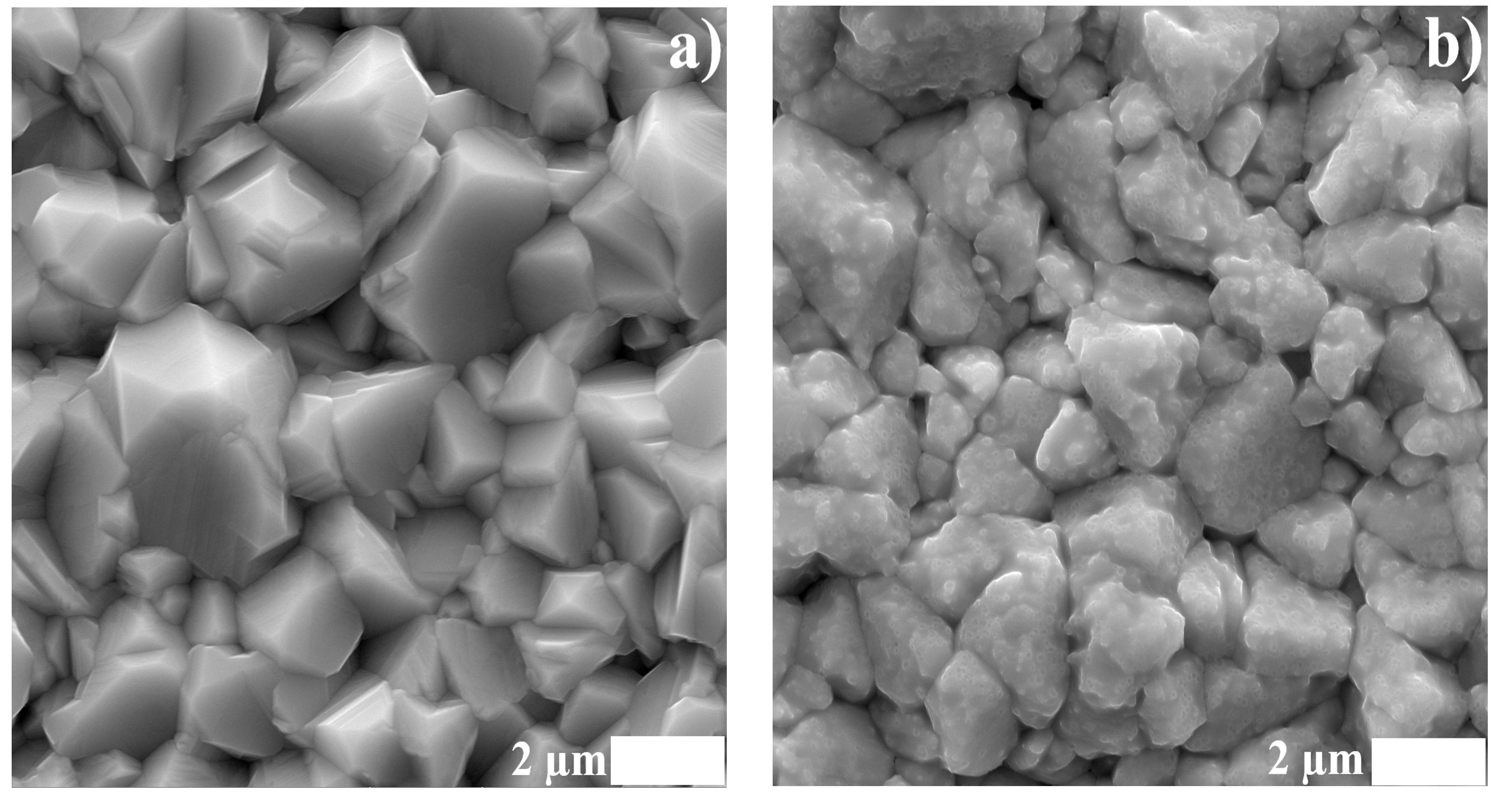
Figure 1 shows the surface morphology of the CdTe when treated with MgCl2; a comparison was made between an untreated sample and the sample with the best efficiency and treated with MgCl2. The SEM images show the superficial view of the CdTe films in the photovoltaic devices without activation a) and activated with MgCl2 b) in both cases, annealed was performed at 400°C for 20 min and the activated sample, as a final process was etched with the N-P acid solution. In Figure 1a), the surface is free of cracks or holes, the grains are distributed at random in a compact way and with hexagonal facets, which is typical when growing by CSS23,24, and the grain boundaries are well defined. On the other hand, the CdTe film activated with MgCl2 also shows a compact and dense surface; the grain size is uniform; however, coalescence of the smaller grains is observed, and grains with evidence of recrystallization are observed.

Figure 2 shows the SEM micrograph of the cross-section of the activated solar cell, where the CdTe film is easily distinguished close to 5 µm. The morphology seems compact, free of cracks or pinholes. The area of the CdS film and the interface with the CdTe are visible. The interface of the CdS-FTO is observed within the entire section.

3.2. Solar cell device, electrical properties
The electrical properties were characterized in order to know the effect and verify the morphological changes of the activation process of solar cells based on CdS / CdTe; one was activated with standard methodology with CdCl2, another one was activated with MgCl2, and the last device had without an activation process. Figure 3 shows the J-V curves of the devices under AM1.5G. The solar device without the activation process had the lowest efficiency of 4.44% conversion due to a low JSC (11.86 mA/cm2) and inadequate activation. The activation process promoted an improvement in the efficiency of the CdS/CdTe solar cells, increasing all electrical parameters such as JSC, VOC, and FF; the best device results were JSC (27.02 mA/cm2), VOC (760 mV), and FF (58.04%) were obtained with MgCl2 for the sample G3. The sample activated with CdCl2 has better electrical parameters than the without activation. However, the VOC and FF values are lower than the best device activated with MgCl2; this could be explained because probably the activation with CdCl2 was not efficient enough, and there was no passivation of the grain boundaries, it has been shown that when there is a small grain size this promote the diffusion of Cu to the interface of the CdS/CdTe affecting the performance mainly in the resistance in parallel Rsh and the effect of losses due to recombination of charge carriers, which causes a drop in the VOC, JSC and FF10,25-27.
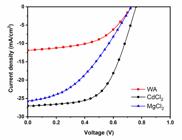
J-V Current Density- Voltage curves of CdS/CdTe solar cells, without activation (WA), CdCl2 and MgCl2 activation process.
Several authors comment about the activation treatment that generates physical and chemical changes mainly in the densification of CdTe film in the P-N junction, promotes the sulfur diffusion into CdTe to form CdSxTe1-x alloy near the interface as well as passivates the grain boundaries and reduces the non-radiative recombination centers8,10,28,29. The activation with MgCl2 shows better results. However, it was not in all cases since depending on the diffusion annealed treatment, time, dipping time, and N-P etching before and after MgCl2 activation, causes all the electrical properties of the cells will change, and the results of all cells fabricated of these experiments are shown in Table 2.
The effect of the activation parameters with MgCl2 is observed firstly post-MgCl2 treatment. NP etching times were analyzed under AM1.5G conditions when an annealing temperature of 430°C was used. Figure 4 shows the mean device performance parameters, efficiency, FF, VOC, and JSC as a function of the etching time (H1 for 10s, F1 for 20s, and A1 for 30s). In all cases, there is a trend in the increase of the electrical properties when the etching time is high; this is because the p+ Te layer is generated and promotes good ohmic contacts, and the PN junction is not affected during this step.

CdS/CdTe Solar Cells performance parameters and their activation process for different solar cell samples, WA is without activation.
The annealing temperature is another factor that increases efficiency. Some of the samples treated at 430°C had visible defects in the CdS film due to thermal stress after dipping in the MgCl2 solution. The problem was solved by maintaining a temperature of 400°C, which did not affect the CdS film but allowed the diffusion of Cl in the CdTe film and thus improved the electrical properties described above.
Finally, the N-P pre-etching time for the samples treated at 400 °C showed the best result for all devices, with time < 5s (samples A2, G3, and C1) see Figure 4. Some authors state that a cleaning must be done to remove the excess Cd after the CdTe sublimation process30, however in our CdTe deposit process it is observed that it is not necessary to carry out this step since the longer it is cleaned with the NP acid solution the values of the electrical parameters are affected and reduces the efficiency of the cells, this may be due to gaps in the CdTe film and that during cleaning the acid attacks the interface of the CdS/CdTe junction and maybe the CdS film. If the CdTe film is not cleaned and although there are probably gaps, it is possible that when activating with MgCl2, these gaps are covered due to recrystallization, grain growth, and interdiffusion between CdS and CdTe, and grain accommodation that occurs in the activation process11,25,30.
3.3. External Quantum Efficiency (EQE) characteristics
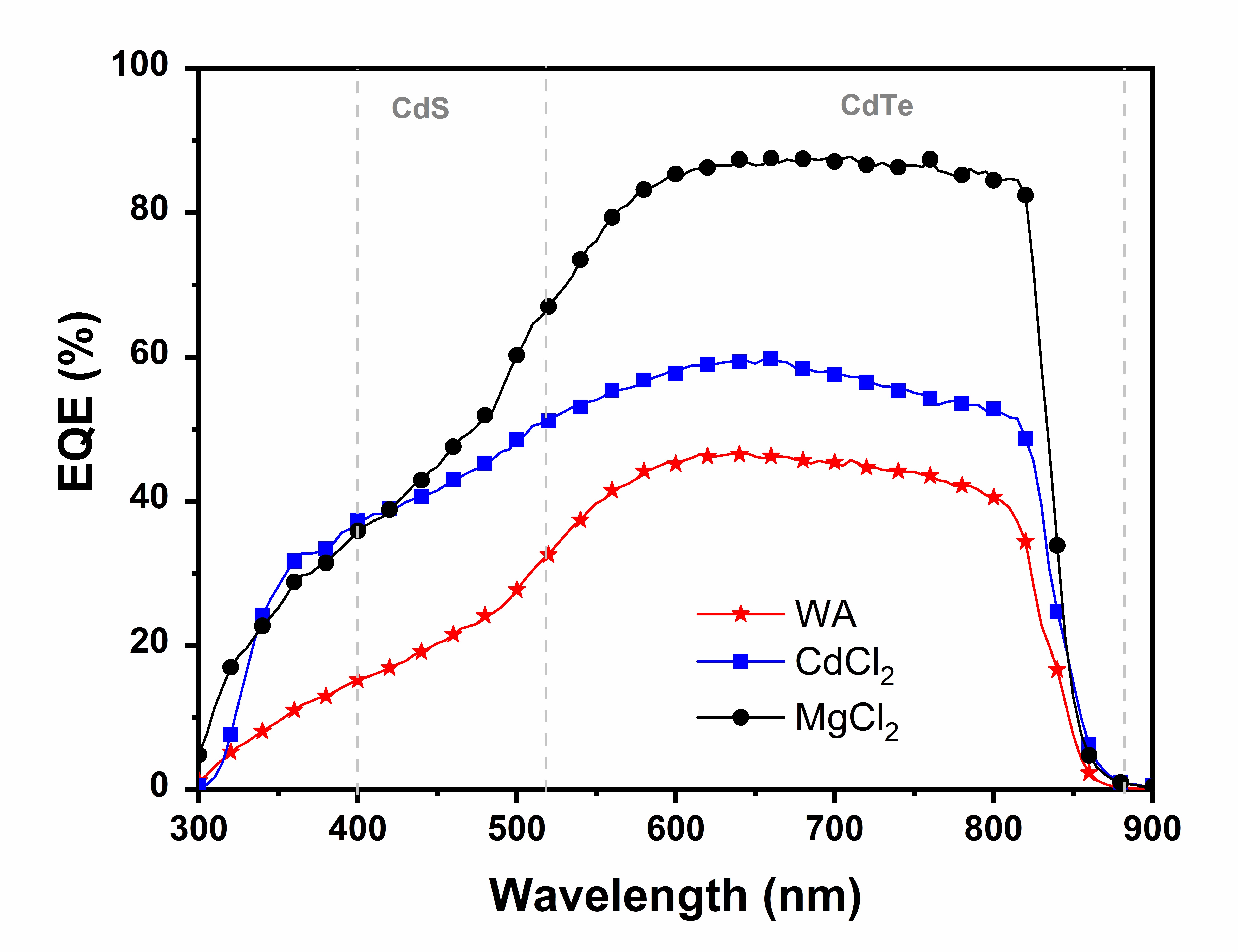
Figure 5 shows the EQE differences between three solar cells activated by MgCl2, CdCl2, and without activation, respectively. In these devices, the ZnO layer was not used as a resistive film between the FTO and the CdS films. The quantum efficiency measurements were realized in the wavelength range of 300–900 nm.

External quantum efficiency curves for CdS/CdTe solar cells without activation (WA), the best MgCl2 activated, and CdCl2 activated.
The area under the curve between 400 and 520 nm corresponds only to the contribution of the CdS film; it can be observed that the devices activated have a higher EQE due to the thinning of the CdS film thickness as a result of the diffusion of S from the CdS to CdTe, this diffusion could promote the formation of a layer CdSxTe1-x, this layer is generated at high temperatures during deposition of CdTe, in this case by the substrate temperature in the CSS method, and or during the activation treatment20,26,31. Birkmire R.W. and coworkers observed that the formation of this compound can be observed at the end of the absorption edge close to 850 nm; the band gap values for the compound CdSxTe1-x are lower than those for CdTe when 0.05 < x < 0.5. This alloy modifies the spectral response of the solar cell and also reduces the lattice mismatch at the CdS/CdTe junction32
Huang C.H., Ngoupo T.A. and Angeles-Ordoñez G., and their co-worker observed the diffusion of Te can form the alloy CdS1-xTex at the CdS/CdTe interface. One characteristic of this alloy is that it decreases the carrier recombination rate around the CdS/CdTe junction by shifting the electrical junction away from the high recombination hetero interface between the CdS and the interdiffusion layer33. But it also reduces the short wavelength optical transmission of the window layer because this alloy has a band gap slightly lower than CdS, resulting in a poor spectral response in this wavelength region (500–650 nm)34,35.
Once mentioned, it indicates that the activation with MgCl2 and CdCl2 causes both Te and S diffusion over the CdS/CdTe junction than the cells activated with CdCl2. Finally, the cell activated with CdCl2 presents lower quantum efficiency than the one activated with MgCl2 and a descendent slope after 650 nm; this is due to a non-ohmic contact and forming a Schottky barrier. The low efficiency across the entire cell is probably attributed to a smaller collection of carriers generated in bulk by high wavelength photons, indicating a higher recombination rate in the absorber4,24,36, possibly as It had been mentioned previously in the J-V analysis due to poor grain recrystallization in the activation in addition to the dissolution of copper towards the CdTe that reduces the efficiency.
3.4. Capacitance - voltage characterization
The effect of activation with MgCl2 acts on the electronic properties of the solar cell, and a characterization of the capacitance-voltage (C-V) in both activated devices was realized at room temperature with a modulation voltage of 10 mV at 100 kHz. The net acceptor concentration (NA-ND) can be obtained using the following equations:
Where W is the depletion layer width, ε0 is the permittivity of free space (8.85 × 10⁻¹² F/m), εr the relative permittivity of CdTe which is taken as 1010, q is the elementary charge (1.602 × 10⁻¹⁹ C), A the contact area (m2), C the measured capacitance (F), and V the applied Bias (V).
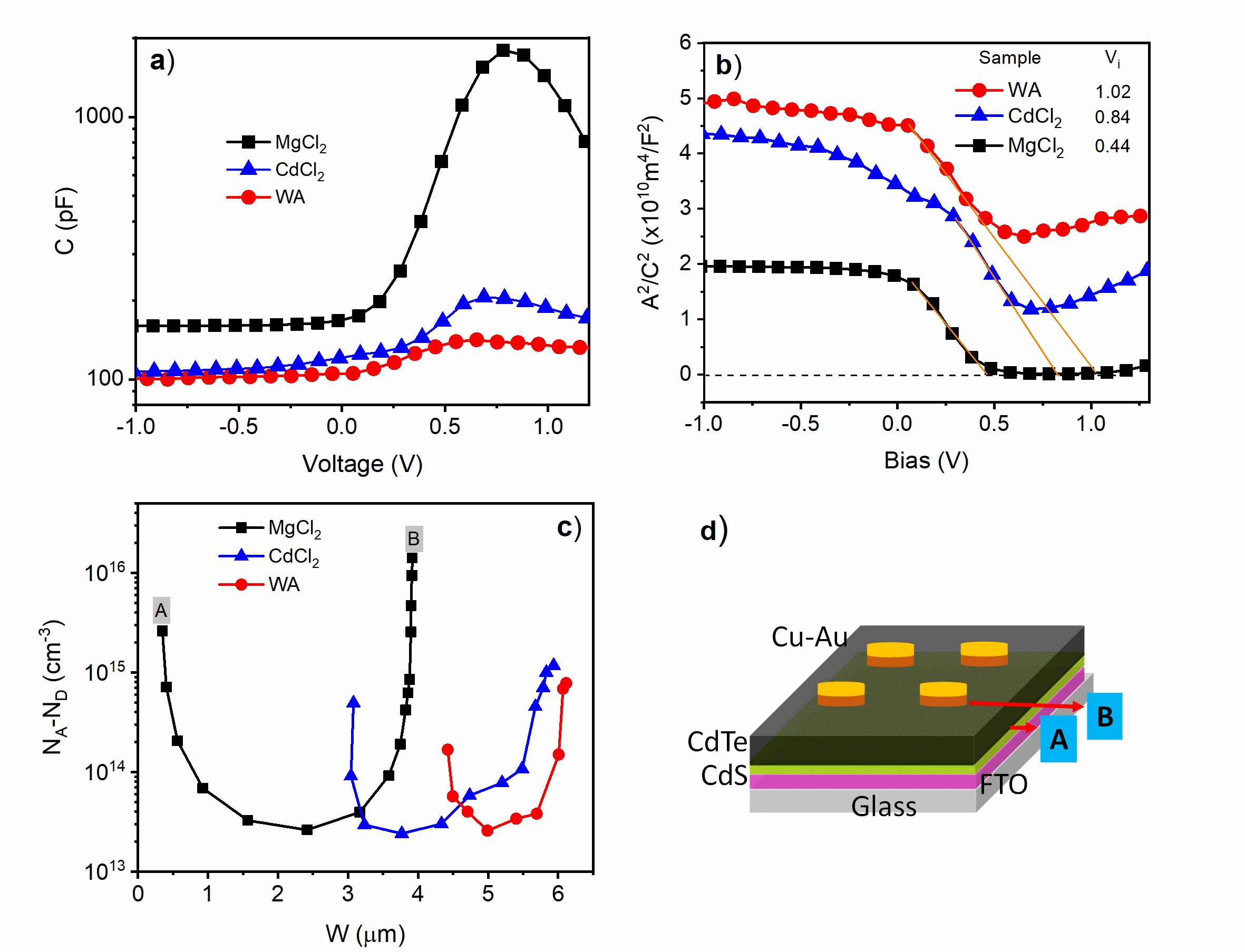
Figure 6a) shows the C-V curve and b) the Mott-Schottky plot of the CdS/CdTe devices. Figure 6a) The activated device with MgCl2 under reverse bias has a higher capacitance than the other devices; however, the behavior is similar. When a forward bias is applied, the activated device capacitance increases significantly, reaching V > 0.5. The device shows a peak (p1), which is attributed to the capacitance of the CdS/CdTe heterojunction and is directly related to the doping of CdTe in the vicinity of the back contact8,27,35,37.

a) CdS/CdTe bode plots, b) CdS/CdTe solar cells Mott–Schottky plots, c) CdS/CdTe Solar cells doping profiles estimated from C–V data measured at 100 kHz, and d) schematic diagram of CdS/CdTe solar cell with A & B region in CdTe film. WA is without activation.
In the high forward bias region, the without activation device shows an increase in capacitance without a peak; this increase in capacitance due to the Schottky junction at the back contact becomes significant and achievements as a voltage-dependent capacitor in series to the main junction27. Based on Figure 6a), the activated device with MgCl2 has higher carrier density in both regions; however, in the region of the back contact, the device may not be activated at a similar concentration to that of the activated with CdCl2.
For Mott-Schottky plots, Figure 6b) computed the net carrier density in CdTe in the region of the heterojunction CdS/CdTe and also in the region of the posterior contact; this is achieved because it presents two slopes deduced from A2/C2 vs. V, from this graph, it is well known that significant reverse bias is associated with mass doping, and low forward bias corresponds to the region near the CdS/CdTe interface. The Vbi can be derived from the intersection of the A2/C2 curve at the voltage axis27; the values calculated from the graph are shown in Table 3. In the reverse polarization region, as the voltage decreases, the capacitance increases; this suggests there is no uniform doping concentration.
Net acceptor concentration profiles across the CdS/CdTe devices with CdTe layers with different activation processes are presented in Figure 6c). The shape of both graphs resembles the characteristic U-shaped curve for thin-film CdS/CdTe solar cells; the left graph corresponds to the forward bias condition associated with the CdS/CdTe interface (A), while the right side corresponds to the reverse polarization that is associated with the interface of the CdTe with the back contact (B), indicated in Figure 6d). Finally, the lower zone corresponds to the density of the carrier concentration in most of the absorbent layer27. The U-shape of the graphs indicates that the carrier concentration is not uniform in the depletion region35,38. C-V plots show that all samples have the same order of magnitude of doping densities in the CdTe region (∼2-3 x1013 cm−3). However, the activated device with MgCl2 showed a higher density of carrier concentration from the CdTe zone to the back contact region (B). The increase benefits the device's performance; the increase in the carrier's concentration region of the back contact indicates a higher doping concentration due to the diffusion of Cu added towards the CdTe, which promotes a reduction in the Schottky barrier behavior10,26,32,39. The increase in the left side of the graph in the activated device corresponds to the CdS/CdTe interface. It may indicate a real charge distribution at the interface or show a non-uniform carrier density in its vicinity due to factors such as Te/S mixing, as well as the extension of the depletion region in the frontal interface (CdTe/CdS)/ITO where there is the possibility of a high concentration of defect levels and/or the presence of diffused Cu from the rear contact resulting in an apparent increase in carrier density under a forward bias20,39. In the without activation device, the carrier density is apparent slightly lower throughout the CdTe area than in the activated devices, which in this case is due to defects and the presence of Cu from the rear contact and because there is no other element like Mg or O that adds carriers. In addition, in the doping profiles estimated from C–V, three important effects are shown (Figure 6c): i) the decreases in the start and end in the U of the three samples, ii) the reduction of the U (depletion Width) and iii) carrier profile shifts as a whole to the right along the W axis, all these when NA-ND decreases. Hence, to better understand the effect of the activation process on cell performance, a numerical simulation based on SCAPS-1D software was performed to investigate the effect of CdTe absorber layer doping concentration on cell performance.
3.5. SCAPS-1D simulation
The SCAPS-1D program solves Poisson and continuity equations in semiconductors, making some assumptions that must be considered when interpreting the results. The most relevant assumptions are a one-dimensional solar cell, homogeneity of properties in each film, and ideal interfaces between the films of the solar cell40,41.
Figure 7 displays the simulated SCAPS-1D carrier concentration profiles for not-activated (red square), CdCl2 (green triangle), and MgCl2 (magenta sphere) activated devices; all the materials parameters used in the simulation are shown in Table 4. Thickness, shadow uniform acceptor density, and hole mobility data (*) were approximated to match the experimental and simulation doping profiles, and are detailed in Table 5; all other data were obtained from references20,42,43. Using this data in simulation, we obtained that the carrier profiles simulated (Figure 7) have a similar shape to that obtained experimentally (Figure 6c). The thickness of CdTe to the film without activation was six μm in the activation of CdTe film with both CdCl2 and MgCl2 a loss of thickness in the films35. The film thickness in the device with activation was off at four μm. A similar effect appears with the CdS thin film; a thinning of CdS films in the EQE is observed (Figure 5) due to the chloride treatment. Therefore, the thickness of the CdS film in the device without activation was estimated at 100 nm.

Simulated doping profiles for FTO/CdS/CdTe/Cu-Au activated with MgCl2, CdCl2 and without activation (WA).
Parameters varied in the SCAPS-1D simulation of CdS/CdTe solar cell activated with MgCl2, CdCl2 and without activation.
In comparison, the CdS films of the device with activation were assumed at 25 nm, in concordance with a previous report43. The significant effect in the carrier concentration profile was obtained when the doping density, NA-ND, was varied; therefore, when NA is low (1x10¹²) to the without activation device, the carrier profile shifts as a whole to the right along the W axis, this behavior has been observed to other simulations44, However, the U-shape shrinkage was obtained when the hole mobility was increased only in the case of CdCl2 activation; according to Dharmadasa et al.20, the charge carrier mobility in CdTe could be much larger with CdCl2. With the previous variation of parameters, both CdTe and CdS are good approximations of simulated doping profiles.
4. Conclusions
The results showed that the initial attack process is unnecessary since it decreases the cell's performance. On the other hand, it is fundamental to clean with NP acid at the end of the activation process to leave a pure Te-rich surface, which favors good Cu-Au ohmic contacts.
CdTe solar cells were made using CBD and CSS techniques and a non-toxic activator. In all cases, cells activated with MgCl2 showed better electrical properties and higher carrier density than those activated with CdCl2 and without activation.
A simulation with SCAPS-1D software was conducted to understand the activation process with MgCl2 and its effects on the PV cell. It was observed that during the activation, the films of CdS and CdTe thinned due to the diffusion between them (verified with the EQE results); also, non-uniform carrier concentration profiles were observed throughout the CdTe film, obtaining a typical U-shaped curve that agrees with the CV data.
5. Acknowledgments
The authors acknowledge by the doctoral scholarship to ROR at CONACYT.
-
Data availability
The full dataset supporting the findings of this study is available upon request to the corresponding author J. Santos-Cruz.
6. References
-
1 U.S. Deparment of Energy. Cadmium Telluride. 2021 [cited 2021 Jan 10]. Available from: https://www.energy.gov/eere/solar/cadmium-telluride
» https://www.energy.gov/eere/solar/cadmium-telluride -
2 Bista SS, Li DB, Song Z, Awni RA, Rijal S, Lei C, et al. Solution processed CuCl treatment for efficient CdS/CdTe solar cells. Conf Rec IEEE Photovolt Spec Conf. 2020:2619-22. http://doi.org/10.1109/PVSC45281.2020.9300497
» http://doi.org/10.1109/PVSC45281.2020.9300497 -
3 Hernandez-Vasquez C, Gonzalez-Trujillo MÁ, Esquivel Méndez LA, Aguilar-Hernandez JR, Albor-Aguilera ML. Influence of Te layer on CdTe thin films and their performance on CdS/CdTe solar cells. Superf Vacio. 2021;34:1-6. http://doi.org/10.47566/2021_syv34_1-210901
» http://doi.org/10.47566/2021_syv34_1-210901 -
4 Paul S, Sohal S, Swartz C, Li D-B, Bista SS, Grice CR, et al. Effects of post-deposition CdCl2 annealing on electronic properties of CdTe solar cells. Sol Energy. 2020;211:938-48. http://doi.org/10.1016/j.solener.2020.10.015
» http://doi.org/10.1016/j.solener.2020.10.015 -
5 Suthar D, Chuhadiya S, Sharma R, Himanshu, Dhaka MS. An overview on the role of ZnTe as an efficient interface in CdTe thin film solar cells: a review. Mater Adv. 2022;3(22):8081-107. http://doi.org/10.1039/D2MA00817C
» http://doi.org/10.1039/D2MA00817C -
6 Chander S, Dhaka MS. CdCl2 treatment concentration evolution of physical properties correlation with surface morphology of CdTe thin films for solar cells. Mater Res Bull. 2018;97:128-35. http://doi.org/10.1016/j.materresbull.2017.08.038
» http://doi.org/10.1016/j.materresbull.2017.08.038 -
7 Liu X, Abbas A, Togay M, Kornienko V, Greenhalgh R, Curson K, et al. The effect of remnant CdSe layers on the performance of CdSeTe/CdTe photovoltaic devices. Sol Energy Mater Sol Cells. 2024;267:112717. http://doi.org/10.1016/j.solmat.2024.112717
» http://doi.org/10.1016/j.solmat.2024.112717 -
8 Lakmal AAI, Kumarasinghe RKKGRG, Seneviratne VA, Chen JY, Song JM, Dassanayake BS. Thermally evaporated CdS thin films for CdS/CdTe solar cells: effect of substrate temperature on CdS layer. Mater Sci Eng B. 2021;273:115406. http://doi.org/10.1016/j.mseb.2021.115406
» http://doi.org/10.1016/j.mseb.2021.115406 -
9 Maalouf A, Okoroafor T, Jehl Z, Babu V, Resalati S. A comprehensive review on life cycle assessment of commercial and emerging thin-film solar cell systems. Renew Sustain Energy Rev. 2023;186:113652. http://doi.org/10.1016/j.rser.2023.113652
» http://doi.org/10.1016/j.rser.2023.113652 -
10 Reyes-Banda MG, Regalado-Perez E, Pintor-Monroy MI, Hernández-Gutiérrez CA, Quevedo-López MA, Mathew X. Effect of Se diffusion and the role of a thin CdS buffer layer in the performance of a CdSe/CdTe solar cell. Superlattices Microstruct. 2019;133:106219. http://doi.org/10.1016/j.spmi.2019.106219
» http://doi.org/10.1016/j.spmi.2019.106219 -
11 Kumarage WGC, Wijesundera RP, Seneviratne VA, Jayalath CP, Kaur N, Comini E, et al. MgCl2 activation of CdS films: An alternative for CdCl2. J Photochem Photobiol Chem. 2018;367:171-7. http://doi.org/10.1016/j.jphotochem.2018.08.029
» http://doi.org/10.1016/j.jphotochem.2018.08.029 -
12 Patel SL, Himanshu A, Purohit A, Chander S, Kannan MD, Dhaka MS. Thermal evolution to MgCl2 activation on physical properties of CdTe thin films for solar cell applications. AIP Conf Proc. 2020;2265:030331. http://doi.org/10.1063/5.0017266
» http://doi.org/10.1063/5.0017266 -
13 Patel SL, Purohit A, Chander S, Kannan MD, Dhaka MS. An approach to MgCl2 activation on CdSe thin films for solar cells. Curr Appl Phys. 2018;18(7):803-9. http://doi.org/10.1016/j.cap.2018.04.008
» http://doi.org/10.1016/j.cap.2018.04.008 -
14 Ikhmayies SJ. A study of the absorption Edge of CdS: in thin films prepared by the spray pyrolysis technique. Int J Mater Chem. 2018;8(1):10-4. http://doi.org/10.5923/j.ijmc.20180801.02
» http://doi.org/10.5923/j.ijmc.20180801.02 -
15 Altiokka B, Yildirim AK. Electrodeposition of CdS Thin Films at Various pH Values. J Korean Phys Soc. 2018;72(6):687-91. http://doi.org/10.3938/jkps.72.687
» http://doi.org/10.3938/jkps.72.687 -
16 Mathur AS, Singh BP. Study of effect of defects on CdS/CdTe heterojunction solar cell. Optik (Stuttg). 2020;212:164717. http://doi.org/10.1016/j.ijleo.2020.164717
» http://doi.org/10.1016/j.ijleo.2020.164717 -
17 Contreras-Rascón JI, Díaz-Reyes J, Flores-Pacheco A, Lozada Morales R, Álvarez-Ramos ME, Balderas-López JA. Structural and optical modifications of CdS properties in CdS-Au thin films prepared by CBD. Results Phys. 2021;22:103914. http://doi.org/10.1016/j.rinp.2021.103914
» http://doi.org/10.1016/j.rinp.2021.103914 -
18 Cruz-Goméz J, García-Caballero AD, Rodríguez-Rosales K, Santos-Cruz J, Meléndez-Lira M, Contreras-Puente G, et al. Influence of deposition temperature and fluorine doping on CdS properties: exploring applications in CdTe solar cells. Mater Sci Eng B. 2024;309:117646. http://doi.org/10.1016/j.mseb.2024.117646
» http://doi.org/10.1016/j.mseb.2024.117646 -
19 Olvera-Rivas R, De Moure-Flores F, Mayén-Hernández SA, Quiñones-Galvan J, Centeno A, Sosa-Domínguez A, et al. Effect of indium doping on structural, optical and electrical properties of cadmium sulfide thin films. Chalcogenide Lett. 2020;17(7):329-36. http://doi.org/10.15251/CL.2020.177.329
» http://doi.org/10.15251/CL.2020.177.329 -
20 Dharmadasa IM, Alam AE, Ojo AA, Echendu OK. Scientific complications and controversies noted in the field of CdS/CdTe thin film solar cells and the way forward for further development. J Mater Sci Mater Electron. 2019;30(23):20330-44. http://doi.org/10.1007/s10854-019-02422-6
» http://doi.org/10.1007/s10854-019-02422-6 -
21 Irfan W, Xia W, Lin H, Ding H, Tang CW, Gao Y. Nitric-phosphoric acid etching effects on the surface chemical composition of CdTe thin film. Thin Solid Films. 2012;520(6):1988-92. http://doi.org/10.1016/j.tsf.2011.08.113
» http://doi.org/10.1016/j.tsf.2011.08.113 -
22 Chun S, Lee S, Jung Y, Bae JS, Kim J, Kim D. Wet chemical etched CdTe thin film solar cells. Curr Appl Phys. 2013;13(1):211-6. http://doi.org/10.1016/j.cap.2012.07.015
» http://doi.org/10.1016/j.cap.2012.07.015 -
23 Ahmad NI, Kar YB, Doroody C, Kiong TS, Rahman KS, Harif MN, et al. A comprehensive review of flexible cadmium telluride solar cells with back surface field layer. Heliyon. 2023;9(11):e21622. http://doi.org/10.1016/j.heliyon.2023.e21622 PMid:38027707.
» http://doi.org/10.1016/j.heliyon.2023.e21622 -
24 Scarpulla MA, McCandless B, Phillips AB, Yan Y, Heben MJ, Wolden C, et al. CdTe-based thin film photovoltaics: recent advances, current challenges and future prospects. Sol Energy Mater Sol Cells. 2023;255:112289. http://doi.org/10.1016/j.solmat.2023.112289
» http://doi.org/10.1016/j.solmat.2023.112289 -
25 Venkatesh R, Banapurmath NR, Ramesh K, Venkatesh A, Khandake SA, Kurade PR, et al. Enhancement of open circuit voltage of CdTe solar cell. Mater Today Proc. 2020;27:117-9. http://doi.org/10.1016/j.matpr.2019.09.035
» http://doi.org/10.1016/j.matpr.2019.09.035 -
26 Jayswal NK, Adhikari D, Subedi I, Shan A, Podraza NJ. Role of CdTe interface structure on CdS/CdTe photovoltaic device performance. Materials (Basel). 2023;16(20):6812. http://doi.org/10.3390/ma16206812 PMid:37895793.
» http://doi.org/10.3390/ma16206812 -
27 Pal D, Das S. C-V and I-V characterisation of CdS/CdTe thin film solar cell using defect density model. Serbian J Electr Eng. 2021;18(2):255-70. http://doi.org/10.2298/SJEE2102255P
» http://doi.org/10.2298/SJEE2102255P -
28 Halal A, Rahman KS, Abdullah SF, Sopian K, Amin N. An investigation on CdS1-xTex interface compound in CdS/CdTe hetero-junction solar cells by density functional theory (DFT). Superlattices Microstruct. 2021;151:1-12. http://doi.org/10.1016/j.spmi.2021.106805
» http://doi.org/10.1016/j.spmi.2021.106805 -
29 Sharmin A, Mahmood SS, Sultana M, Shaikh MAA, Bashar MS. Property enhancement of a close-spaced sublimated CdTe thin film by a post-growth activation step with CdCl2 and MgCl2. Mater Adv. 2023;5(3):1205-16. http://doi.org/10.1039/D3MA00734K
» http://doi.org/10.1039/D3MA00734K -
30 Major JD, Al Turkestani MK, Durose K. Structural and electrical characterisation of MgCl2-treated CdTe solar cells. In IEEE 42nd Photovoltaic Specialist Conference (PVSC); 2015; New Orleans. Proceedings. USA: IEEE; 2015. p. 1-5. http://doi.org/10.1109/PVSC.2015.7356363
» http://doi.org/10.1109/PVSC.2015.7356363 -
31 Verlinden P, Young DL, Xiong G, Reese MO, Mansfield LM, Powalla M, et al. Photovoltaic device innovation for a solar future. Device. 2023;1(1):100013. http://doi.org/10.1016/j.device.2023.100013
» http://doi.org/10.1016/j.device.2023.100013 -
32 Birkmire RW, McCandless BE, Hegedus SS. Effects of processing on Cdte/Cds materials and devices. Int J Sol Energy. 1992;12(1-4):145-54. http://doi.org/10.1080/01425919208909758
» http://doi.org/10.1080/01425919208909758 -
33 Huang CH, Chuang WJ. Dependence of performance parameters of CdTe solar cells on semiconductor properties studied by using SCAPS-1D. Vacuum. 2015;118:32-7. http://doi.org/10.1016/j.vacuum.2015.03.008
» http://doi.org/10.1016/j.vacuum.2015.03.008 -
34 Teyou Ngoupo A, Ouédraogo S, Zougmoré F, Ndjaka JMB. New architecture towards ultrathin CdTe solar cells for high conversion efficiency. Int J Photoenergy. 2015;2015(1):961812. http://doi.org/10.1155/2015/961812
» http://doi.org/10.1155/2015/961812 -
35 Angeles-Ordóñez G, Regalado-Pérez E, Reyes-Banda MG, Mathews NR, Mathew X. CdTe/CdS solar cell junction activation: study using MgCl2 as an environment friendly substitute to traditional CdCl2. Sol Energy Mater Sol Cells. 2017;160:454-62. http://doi.org/10.1016/j.solmat.2016.11.014
» http://doi.org/10.1016/j.solmat.2016.11.014 -
36 Ahmed MR, Mohamed HA, Ali SS, Mohamed WS. Experimental and theoretical studies of (CdS) 1-x (ZnS)x thin-films for second generation CdS/CdTe solar cells. Physica B. 2021;612:412903. http://doi.org/10.1016/j.physb.2021.412903
» http://doi.org/10.1016/j.physb.2021.412903 -
37 Dursun S, Yiğit Gezgin S, Kılıç HS. J-V and C-V characteristic of CdS / CdTe solar cell modelled by SCAPS-1D program. J Mater Manuf. 2022;1(2):41-52. http://doi.org/10.5281/zenodo.7472259
» http://doi.org/10.5281/zenodo.7472259 -
38 Bastola E, Heben MJ, Phillips AB, Ellingson RJ. Open-circuit voltage exceeding 840 mV for all- sputtered CdS/CdTe devices. In: 47th IEEE Photovoltaic Specialists Conference (PVSC); 2020; Calgary, AB, Canada. Proceedings. USA: IEEE; 2020. p. 2513-18. http://doi.org/10.1109/PVSC45281.2020.9300933
» http://doi.org/10.1109/PVSC45281.2020.9300933 -
39 Dharmadasa IM, Alam AE. How to achieve efficiencies beyond 22.1% for CdTe-Based thin-film solar cells. Energies. 2022;15(24):9510. http://doi.org/10.3390/en15249510
» http://doi.org/10.3390/en15249510 -
40 Bhuvaneswari P, Sriramalakshmi P. Lead-Free p-n Homojunction Cs-Doped and Pure FASnI3-based perovskite solar cells–a performance analysis using SCAPS 1D simulator. Results Eng. 2025;26:104779. http://doi.org/10.1016/j.rineng.2025.104779
» http://doi.org/10.1016/j.rineng.2025.104779 -
41 Novoselov IE, Gvozdev AM, Smirnov AA, Zhidkov IS. Dataset of SCAPS-1D simulated halide perovskite solar cells with SHAP and machine learning-based PCE optimization. Data Brief. 2025;60:111653. http://doi.org/10.1016/j.dib.2025.111653 PMid:40510644.
» http://doi.org/10.1016/j.dib.2025.111653 -
42 Anwar F, Afrin S, Satter SS, Mahbub R, Ullah SM. Simulation and performance study of nanowire CdS/CdTe solar cell. Int J Renew Energy Res. 2017;7(2):885-93. http://doi.org/10.20508/ijrer.v7i2.5688.g7068
» http://doi.org/10.20508/ijrer.v7i2.5688.g7068 -
43 Nykyruy LI, Yavorskyi RS, Zapukhlyak ZR, Wisz G, Potera P. Evaluation of CdS/CdTe thin film solar cells: SCAPS thickness simulation and analysis of optical properties. Opt Mater. 2019;92:319-29. http://doi.org/10.1016/j.optmat.2019.04.029
» http://doi.org/10.1016/j.optmat.2019.04.029 -
44 Sanchez TG, Regalado-Pérez E, Mathew X, Sanchez MF, Sanchez Y, Saucedo E, et al. Ge doped Cu2ZnSnS4: an investigation on absorber recrystallization and opto-electronic properties of solar cell. Sol Energy Mater Sol Cells. 2019;198:44-52. http://doi.org/10.1016/j.solmat.2019.04.011
» http://doi.org/10.1016/j.solmat.2019.04.011
Edited by
-
Associate Editor:
Jose Eiras.
-
Editor-in-Chief:
Luiz Antonio Pessan.
The full dataset supporting the findings of this study is available upon request to the corresponding author J. Santos-Cruz.