Effect of Reinforcement Content and Milling Time on TiN-IN625 Composites
Abstract
Inconel 625 superalloy metal matrix composite reinforced with titanium nitride through powder metallurgy technique is an alternative for improving the mechanical properties of the well-known corrosion-resistant nickel alloy. In this paper, high-energy ball milling (HEBM) produced the TiN-Inconel 625 composite powders in a SPEX-type vibrating mill. The objective was to address the effect of the reinforcement content and milling time on the characteristics of the composite powders for posterior application on laser cladding. Scanning Electron Microscopy (SEM), Energy Dispersive Spectroscopy (EDS), Laser Diffraction (LD), and X-ray diffraction (XRD) characterized the samples. The results showed that HEBM provided an effective method for producing TiN-Inconel 625 composites due to the good integration of TiN reinforcement into the nickel alloy matrix.
Keywords:
Inconel 625; TiN; Metal Matrix Composites; High-Energy Ball Milling
1. Introduction
The material's surfaces are the most critical components in engineering, as they are subject to various phenomena such as fatigue, corrosion, and wear. A more noble material can be applied to the surface of substrates to enhance the properties and extend the service life of equipment and structures. Several techniques, including laser cladding, can be used to deposit protective coatings1,2.
Nickel-based superalloys are widely used in applications where a combination of superior mechanical properties and excellent workability are required. Inconel 625 is a Ni–Cr-based austenite superalloy that presents a high chromium content, which improves the balance of creep performance, fatigue strength, and tensile while maintaining oxidation and corrosion resistance. Despite the good mechanical properties of the Inconel 625, due to the fast growth of modern industries, there has been an increasing demand for materials with even superior properties3-5.
Usually, metal matrix composites (MMC) improve the material's mechanical properties. Composites combine two or more materials with different properties, producing final characteristics different from the original constituent6. Several studies have been carried out on Inconel 625 matrix composites aiming to improve the service performance of components, especially regarding their hardness, wear resistance, and ceramic reinforcements. Most preceding works focus on reinforcement by using titanium carbide (TiC), tungsten carbide (WC), chromium carbide (CrC), and carbon nanotubes7-10. Titanium nitride (TiN) is rarely explored in previous literature11, although it is a promising candidate as reinforcement in the Ni coating due to its high modulus, good combination ability with Ni-base superalloy, and excellent thermal stability at high temperature12.
Many fabrication techniques have been proposed to perform the synthesis of nickel matrix composites. The reinforcement with harder and temperature-resistant ceramic particles is considered attractive for use in MMCs due to its isotropic properties, easy fabrication, and low cost13. In this way, modern Powder Metallurgy (PM) is considered as a suitable technique to process composite materials. The microstructure, morphology and improvement in the mechanical properties of the resulting composites are affected by the intrinsic properties, size, volume fraction and distribution state of reinforcement. High-energy ball milling (HEBM), which is a specific PM technique of mechanical alloying14,15, may be used to produce uniform dispersions of particles in nickel-base superalloys, since the deposition of fine ceramic-reinforced MMC clads is challenging because of the divergence of fine particles. In the HEBM process, a powder mixture is placed in the ball mill and subjected to high-energy collisions from the balls. The mixed powders are cold welded and fractured under high energy impact. The purpose behind is to attain a homogeneous mixing rather than breaking the matrix and reinforcements into fine grains16,17.
This study explores the manufacture of the TiN-Inconel 625 powders by HEBM and the effect of reinforcement content and milling time. The main objective is to evaluate the incorporation of the TiN nanoparticle into the Inconel 625 matrix to allow the posterior deposition of the MMC clads.
2. Experimental Procedure
Table 1 presents the Ni-based superalloy IN625 powder chemical composition used as the metallic matrix material. TiN ceramic powder was applied as material reinforcement. The composites´ compositions with the corresponding reinforcement content and milling time used in each sample for the HEBM are presented in Table 2. On top of the final mass, 2wt.% of C18H36O2 (stearic acid) was added to the milling process to act as a lubricant and anti-caking agent, working as a process controller agent (PCA).
A SPEX-type vibratory mill set at 720 rpm manufactured the TiN/Inconel 625 composites by a high-energy ball milling, one of the most frequently used systems for mechanical alloying due to the small amount of powder used. SPEX vibrating ball mill is characterized by a figure-8 motion. A container made of AISI 304L stainless steel was used, along with 100C6 steel spheres (1% carbon, 1.5% chromium) with an average diameter of 6.4mm and isopropyl alcohol as PCA. The ball-to powders weight ratio (BPR) was 10:1 and milling times of 60 and 120 min evaluated the incorporation of the reinforcement in the metal matrix.
After milling, the powders were dried at 100°C to remove alcohol residues.
For the characterization of the powders produced, X-ray diffraction (XRD) investigated the phases in the TiN-IN625 composites, covering a range of 20º to 100°, with a scanning rate of 0.02°/s, under a voltage of 40 kV and a current of 30 mA, performed on Shimadzu Maxima XRD – 7000 equipment. The morphology was analyzed using a TESCAN MIRA 3 - Scanning Electron Microscope (SEM) equipped with Energy Dispersive Spectroscopy (EDS). The particle size was measured by Laser Diffraction (LD)18,19 using Malvern Mastersizer 2000. The samples were suspended alcohol and subjected to ultrasonic agitation, covering a size range from 0.02 μm to 2000 μm.
3. Results and Discussion
3.1. Granulometry
Figure 1 presents the particle size distribution of the starting powders and the composite powders generated by HEBM.

Particle size distribution of the starting powders of (a) IN625 and (b) TiN, and of the composite powders: (c) sample 1, (d) sample 2, (e) sample 3, (f) sample 4, (g) sample 5 and (h) sample 6.
Firstly, the unreinforced IN625 powder curve can be noticed as a monomodal shape with a symmetrical curve, presenting an average particle size distribution of approximately 150 µm. On the other hand, for the reinforcement powder of TiN, the curve was multimodal, and the average particle size was 20 nm. Due to the high difference in the fine particles of the starting powders, composite powders by HEBM were fabricated.
The HEBM process promotes a change in particle size distribution, according to the curves shown in Figure 1 (c-h). The curves for low milling times exhibit a slight bimodal shape. For 120 min, the curves presented a monomodal shape20. However, the reinforced powders with higher milling time presented an asymmetric distribution, with a slight tendency towards the largest particle size region. This phenomenon indicates that cold welding occurs more strongly than fractures of the powder particles21.
Figure 2 shows the median particle sizes of the produced powders. The TiN powders present a small scale and have no difference in average particle size.

There is a considerable increase in particle size for the reinforced powders at a low milling time. On the other hand, there is a decrease in average particle size when the milling time increases. The effects of the cold welding of particles were overcome by the fractures, reducing the particle size, and the equilibrium state between welding and fracture was achieved22, 23. However, the objective was to incorporate the reinforcement into the metal matrix, making it unnecessary.
Regarding reinforcement, it is important to note that when the amount of TiN in the Inconel matrix is low, an increase in TiN content leads to a reduction in the size of the powder particles. This phenomenon is a consequence of the fracture resistance of the matrix. However, larger particles were found when the reinforcement concentration in the matrix increased from 5% to 10%. The reinforcement promoted an increase in cold welding during the early stages of HEBM20.
3.2. Microstructural characterization
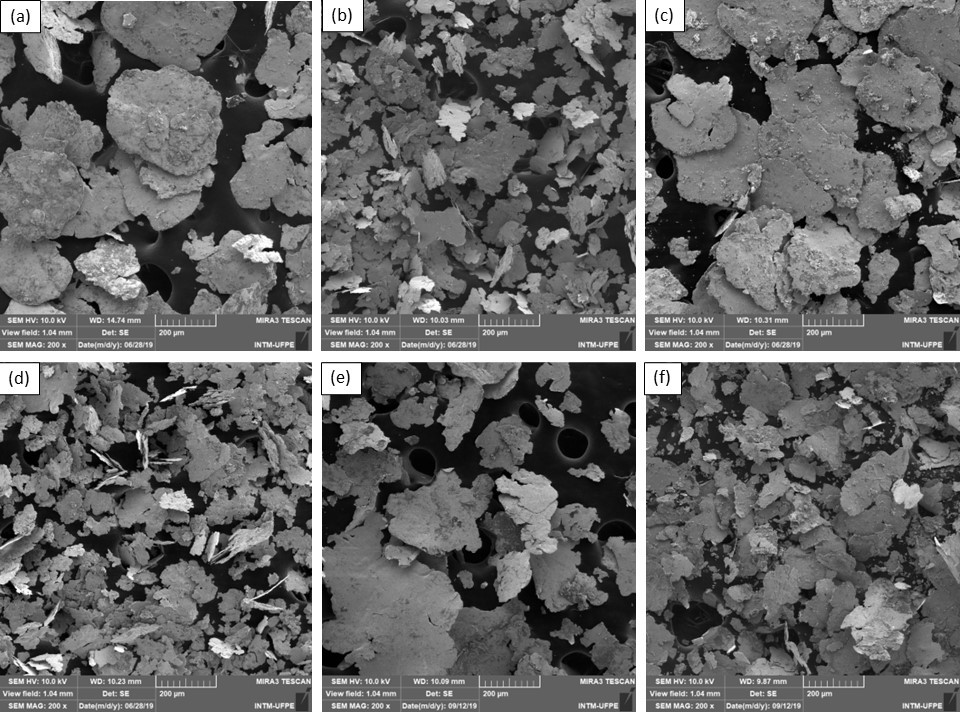
Figure 3 (a-b) and Figure 4 (a-f) show the morphologies of the starting powders and the milled powders with different reinforcement and milling times, as described in Table 2, respectively.

SEM images showing the morphology of the starting powders: (a) Inconel 625 and (b) TiN (200x).

SEM images of the composite powders: (a) sample 1, (b) sample 2, (c) sample 3, (d) sample 4, (e) sample 5 and (f) sample 6.
The argon gas atomized IN625 powders are spherical of ductile materials, while the powder morphology of TiN is predominantly irregular and associated with the morphology of hard materials. On the other hand, for the composite powders, the spherical morphology of the original IN625 powder was altered to a more lamellar shape by the ball milling process due to the continuous collisions between the particles and the balls. The powders were milled into flat pieces, regardless of the reinforcement content and milling time.
Figures 5 and 6 present EDS mapping for the 2% TiN/IN625 composite in order to evaluate the effect of milling time on the incorporation of the reinforcement.


For a 60-minute milling time, there was not enough time for the fracture of the particles. The stage of cold welding prevailed, leading to the distribution of the fragile particles on the surface of the ductile material and an enhancement in the particle size of the powder composite, as presented in Figure 2. Increasing milling time promoted a reduction in particle size by the fracture stage and the presence of hard particles of the reinforcement powder was observed on the IN625 surface.
Figure 7 presents the elemental composition of the powders produced. It is the majority presence of Ni and Cr, which composes the matrix of IN625, as well as the incidence of other elements of the superalloy as Mo, Fe, and Nb. The presence of Ti in the final composite powders is observed.

Elemental composition of the TiN-IN625 composites with a reinforcement content of (a) 2%, (b) 3%, (c) 5% and (d) 10% for 120 min milling time.
3.3. Phases identification
Figure 8 presents XRD patterns of the starting powders of Inconel 625 and TiN and the TiN/IN625 composites with different reinforcements for 120 min of milling time.

The XRD spectrum of composite particles were found at 2 theta angles of 43.6°, 50.8°, 74.6°, 90.5° and 95.8°, which belongs to the nickel matrix γ and can be indexed to the diffraction of (111), (200), (220), (311) e (222) planes. The standard of the pure Ni from the ICDD- database are 44.5°, 51.9°, 76.4°, 92.9° and 98.5°, which are slightly higher than the ones found for the IN625 alloy. This difference in lattice parameter can be associated with the effect of alloying elements of IN625 and the dislocations in the crystal. Then, the crystal structure of γ phase in IN625 superalloy and TiN-IN625 composites is easily distorted owing to the large number of alloying elements in material24. No phases other than the FCC γ- Ni phase with lattice parameters close to pure Ni could be detected. Therefore, the phases of the TiN-IN625 composites did not change in comparison to the IN625, except for the introduction of TiN particles.
In the IN625 + 10% TiN composite, small peaks can be observed at 36.7°, 42.6°, 61.8°, 74.1°, and 78°. These peaks correspond to the diffraction patterns of the (111), (200), (220), (311), and (222) planes of TiN, respectively. Although peaks related to TiN are relatively small, their intensity increases with higher reinforcement contents. The observed reduction in peak intensity suggests that the TiN particles were incorporated into the IN625 matrix.
To confirm the incorporation of the TiN particles, due to the difference in particle size distribution and limit detections of the equipment, XRD patterns were performed on the mechanical mixture and compared with the milled powders to observe if the nanoparticle of TiN can be detected by the equipment. Figure 9 presents the comparison for the IN625 + 5% TiN.

The intensity of the peaks of TiN is easily highlighted for the mechanical mixture, meaning that it can be effectively detected by the XRD. The intensity of the peaks reduces considerably with the milling process, which is higher as the content of reinforcement increases. Therefore, the incorporation of the TiN in the milled powders is confirmed.
4. Conclusions
The following conclusions were observed:
-
1 - High-energy ball milling (HEBM) is an effective means of producing TiN-Inconel 625 composites and allows the TiN reinforcement to be well incorporated into the nickel alloy matrix;
-
2 - The milling process was successful as the particle size distribution curve presented a monomodal shape;
-
3 - An increased reinforcement insertion into the matrix decreases the particle size due to the lower fracture resistance, although cold welding rates in the early stages of HEBM may occur for higher reinforcement contents.
-
Data Availability
The entire data set supporting the results of this study was published in the article itself.
5. References
-
1 Vale NL, Fernande CA, Santos RA, Santos TFA, Urtiga SL Fo. Effect of laser parameters on the characteristics of a laser clad AISI 431 stainless steel coating on carbon steel substrate. J Miner Met Mater Soc. 2021;73:2868-77. http://doi.org/10.1007/s11837-021-04835-3
» http://doi.org/10.1007/s11837-021-04835-3 -
2 Al-Hamdani KS, Murray JW, Hussain T, Clare AT. Controlling ceramic-reinforcement distribution in laser cladding of MMCs. Surf Coat Tech. 2019;381:125128. http://doi.org/10.1016/j.surfcoat.2019.125128
» http://doi.org/10.1016/j.surfcoat.2019.125128 -
3 Hong C, Gu D, Dai D, Alkhayat M, Urban W, Yuan P, et al. Laser additive manufacturing of ultrafine TiC particle reinforced Inconel 625 based composite parts: tailored microstructures and enhanced performance. Mater Sci Eng A. 2015;635:118-28. http://doi.org/10.1016/j.msea.2015.03.043
» http://doi.org/10.1016/j.msea.2015.03.043 -
4 Bakkar A, Ahmed MMZ, Alsaler NA, Seleman MME, Ataya S. Microstructure, wear, and corrosion characterization of high TiC content Inconel 625 matrix composites. J Mater Res Technol. 2018;8(1):1102-10. http://doi.org/10.1016/j.jmrt.2018.09.001
» http://doi.org/10.1016/j.jmrt.2018.09.001 -
5 Ozgun O. WC‑Reinforced inconel 625 superalloy matrix composites. Iran J Sci Technol Trans Mech Eng. 2020;44(3):825-39. http://doi.org/10.1007/s40997-020-00357-6
» http://doi.org/10.1007/s40997-020-00357-6 -
6 Araujo OO Fo, Moura ADA, Araújo ER, Santos MJ, Gonzalez CH, Silva FJ. Manufacturing and characterization of AA1100 aluminum alloy metal matrix composites reinforced by silicon carbide and alumina processed by powder metallurgy. Mater Sci Forum. 2016;2106(869):447-51. http://doi.org/10.4028/www.scientific.net/MSF.869.447
» http://doi.org/10.4028/www.scientific.net/MSF.869.447 -
7 Shen M, Tian X, Liu D, Tang H, Cheng X. Microstructure and fracture behavior of TiC particles reinforced Inconel 625 composites prepared by laser additive manufacturing. J Alloys Compd. 2017;734:188-95. http://doi.org/10.1016/j.jallcom.2017.10.280
» http://doi.org/10.1016/j.jallcom.2017.10.280 -
8 Xu X, Mi G, Xiong L, Jiang P, Shao X, Wang C. Morphologies, microstructures and properties of TiC particle reinforced Inconel 625 coatings obtained by laser cladding with wire. J Alloys Compd. 2018;740:16-7. http://doi.org/10.1016/j.jallcom.2017.12.298
» http://doi.org/10.1016/j.jallcom.2017.12.298 -
9 Liu Z, Cabrero J, Niang S, Al-Taha ZY. Improving corrosion and wear performance of HVOF-sprayed Inconel 625 and WC-Inconel 625 coatings by high power diode laser treatments. Surf Coat Tech. 2007;201(16-17):7149-58. http://doi.org/10.1016/j.surfcoat.2007.01.032
» http://doi.org/10.1016/j.surfcoat.2007.01.032 -
10 Verdi D, Garrido MA, Múnez CJ, Poza P. Cr3C2 incorporation into an Inconel 625 laser cladded coating: effects on matrix microstructure, mechanical properties and local scratch resistance. Mater Des. 2015;67:20-7. http://doi.org/10.1016/j.matdes.2014.10.086
» http://doi.org/10.1016/j.matdes.2014.10.086 -
11 Lira HM, Barbosa WAO, Pina EAC, Moura ADA, Rodriguez PR, Melo IR, et al. Manufacturing of AA7075 aluminum alloy composites reinforced by nanosized particles of SiC, TiN, and ZnO by high-energy ball milling and hot extrusion. Materials Research. 2023;26:e20230154. https://doi.org/10.1590/1980-5373-MR-2023-0154
» https://doi.org/10.1590/1980-5373-MR-2023-0154 -
12 Wang P, Li P, Lim YF, Tan CKI, Chi D. Sintering and mechanical properties of mechanically milled Inconel 625 superalloy and its composite reinforced by carbon nanotube. Met Powder Rep. 2016;72(4):271-5. http://doi.org/10.1016/j.mprp.2016.10.065
» http://doi.org/10.1016/j.mprp.2016.10.065 -
13 Ononiwu NH, Akinlabi ET. Effects of ball milling on particle size distribution and microstructure of eggshells for applications in metal matrix composites. Mater Today Proc. 2020;26(2):1049-53. http://doi.org/10.1016/j.matpr.2020.02.209
» http://doi.org/10.1016/j.matpr.2020.02.209 -
14 Sahin O, Erturun V. Effect of Cu content and alloying time on mechanical alloyed Al‑Cu‑Mg‑Zn&SiC composites. Trans Indian Inst Met. 2024;77(2):379-87. http://doi.org/10.1007/s12666-023-03118-6
» http://doi.org/10.1007/s12666-023-03118-6 -
15 Behret G, Sahin O, Erturun V. Production and characterization of GNPs-reinforced Al-based composite material by mechanical alloying. Aircr Eng Aerosp Technol. 2023;95(7):1137-44. http://doi.org/10.1108/AEAT-09-2022-0234
» http://doi.org/10.1108/AEAT-09-2022-0234 -
16 Wang R, Wang W, Zhu G, Pan W, Zhou W, Wang D, et al. Microstructure and mechanical properties of the TiN particles reinforced IN718C composite. J Alloys Compd. 2018;762:237-45. http://doi.org/10.1016/j.jallcom.2018.05.096
» http://doi.org/10.1016/j.jallcom.2018.05.096 -
17 Barbosa WAO, Pina EAC, Moura ADA, Rodriguez PR, Araújo OO Fo, Melo IR, et al. Nanostructured Powders of AA7075 - SiC Manufactured by High-Energy Ball Milling in a Bath of Isopropyl Alcohol. Mater Res. 2023;26:e20230230. http://doi.org/10.1590/1980-5373-mr-2023-0230
» http://doi.org/10.1590/1980-5373-mr-2023-0230 - 18 ISO: International Organization for Standardization. ISO 13320: Particle size analysis — Laser diffraction methods. Geneva: ISO; 2020.
- 19 ISO: International Organization for Standardization. ISO 9276-1: Representation of results of particle size analysis — Part 1: Graphical representation. Geneva: ISO; 2025.
-
20 Nascimento DM, Silva ME Jr, Costa JEB, Zarzar ST, Muniz MBB, Oscar Olimpio de Araujo OO Fo. Manufacture and characterization of AA6061 aluminum alloy metal matrix composites with ceramic particulate reinforcement. Int J Dev Res. 2021;11(05):46875-83. http://doi.org/10.37118/ijdr.21782.05.2021
» http://doi.org/10.37118/ijdr.21782.05.2021 -
21 Fogagnolo JB, Velasco F, Robert MH, Torralba JM. Effect of mechanical alloying on the morphology, microstructure and properties of aluminium matrix composite powders. Mater Sci Eng A. 2003;342(1-2):131-43. http://doi.org/10.1016/S0921-5093(02)00246-0
» http://doi.org/10.1016/S0921-5093(02)00246-0 - 22 Lira HM. Desenvolvimento de compósitos nanoestruturados AA 7075 - SiC, AA 7075 -TiN e AA 7075 - ZnO, através de técnicas de moagem de alta energia e extrusão a quente [tese]. Recife: Universidade Federal de Pernambuco; 2016.
-
23 Suryanarayana C. Mechanical alloying and milling. Prog Mater Sci. 2001;46(1-2):1-184. http://doi.org/10.1016/S0079-6425(99)00010-9
» http://doi.org/10.1016/S0079-6425(99)00010-9 -
24 Abioye TE, McCartney DG, Clare AT. Laser cladding of inconel 625 wire for corrosion protection. J Mater Process Technol. 2014;217:232-40. http://doi.org/10.1016/j.jmatprotec.2014.10.024
» http://doi.org/10.1016/j.jmatprotec.2014.10.024
Edited by
-
Associate Editor:
Aloisio Klein.
-
Editor-in-Chief:
Luiz Antonio Pessan.
The entire data set supporting the results of this study was published in the article itself.