 In the depths of the Amazon rainforest: a new troglobitic species of Circoniscus (Isopoda: Scleropactidae) from Brazil
ABSTRACT
Scleropactidae are one of the most abundant families of Oniscidea, comprising 28 genera. Within this family, the genus Circoniscus includes 13 species, of which four are troglobitic. We herein describe the fifth troglobitic species of the genus, which represents the first species described from the largest limestone cave of the Brazilian Amazon, Paraíso cave. Circoniscus paradisus sp. nov. differs from the troglobitic species by the presence of schisma on pereonite 1 in all specimens, antennula with 2+9 aesthetascs, distal margin of male pleopod 1 exopod elongated, and pereonites epimera inner face with continuous ridge. Additionally, we provide ecological notes, habitat description, and the conservation status for the newly described species.
Keywords:
Cave fauna; crustaceans; conservation; Neotropical region; taxonomy; woodlice
INTRODUCTION
Within the twelve suborders allocated to Isopoda, Oniscidea represents by far the most diverse suborder of terrestrial isopods and comprises 38 or 39 families (Campos-Filho and Taiti, 2020; Dimitriou et al., 2019; WoRMS, 2023). Species in this suborder are unique among the crustaceans by being completely adapted to terrestrial life, with morphological and physiological solutions to the terrestrial environment, such as specialized structures, referred to as lungs or pseudotrachea, the presence of a water conducting system; water-resistant cuticle; closed brood chamber and a reduction in body size (Hornung, 2011).
Being one of the most abundant families of the suborder, Scleropactidae includes 28 genera (WoRMS, 2023). Of these, only four of them occur in Brazil: CirconiscusPearse, 1917, AmazoniscusLemos de Castro, 1967, MicrosphaeroniscusLemos de Castro, 1984, and HeptapactesSchmidt, 2007 (Schmidt, 2007). The genus Circoniscus comprises 13 species endemic to South America. To date, 12 species are known from Brazil: Circoniscus gaigeiPearse, 1917; Circoniscus bezziiArcangeli, 1931; Circoniscus pallidusArcangeli, 1936; Circoniscus ornatus (Verhoeff, 1941); Circoniscus incisusSouza and Lemos de Castro, 1991; Circoniscus intermediusSouza and Lemos de Castro, 1991; Circoniscus hirsutusSchmidt, 2007; Circoniscus buckupiCampos-Filho and Araujo, 2011; Circoniscus carajasensisCampos-Filho and Araujo, 2011; Circoniscus caeruleusCampos-Filho, Sfenthourakis and Bichuette in Campos-Filho et al., 2023; Circoniscus mendesiLópez-Orozco, Campos-Filho and Bichuette, 2024, and Circoniscus xikrin López-Orozco, Campos-Filho and Carpio-Díaz in López-Orozco et al., 2024 (Campos-Filho et al., 2011; 2018; 2023; López-Orozco et al., 2024; Boyko et al., 2024).
As mentioned, the genus Circoniscus has a distribution restricted to South America, with most species occurring in Brazil. Except for C. pallidus, which is recorded from the state of São Paulo, and C. caeruleus and C. intermedius, which are recorded from the states of Mato Grosso do Sul and Mato Grosso, respectively, the other nine species occur in the state of Pará (Campos-Filho et al., 2018; 2023; López-Orozco et al., 2024).
The present work aims to describe a new troglobitic species of Circoniscus from Paraíso cave, located in the municipality of Aveiro, state of Pará, Brazil. The cave features a limestone formation from the Carboniferous period, unlike most caves in the region that are formed by sandstone (Wang et al., 2017). Characterized by labyrinthine passages, Paraíso Cave is currently the largest cave in the Brazilian Amazon (Calux et al., 2007).
MATERIAL AND METHODS
Study area
The specimens were only found at the Paraíso cave (04º04’31.5”S 55º27’31.6”W); 60 m a.s.l.). Although ongoing surveys persist, this cave already spans nearly eight kilometers, with the potential to extend even further. The cave is characterized by a single entrance, which is relatively small (Fig. 1 A, B), maintaining a consistent and moist environment over time. Situated within Carboniferous limestone formations, this cave is located near the center of the eastern Amazon lowlands, a region densely covered by rainforests (Wang et al., 2017). The mean annual temperature in the area is around 26 °C, exhibiting a minimal seasonal variation of approximately 2 °C. Annual precipitation exceeds 2,400 mm, with nearly 70% occurring during the wet season, from November to June (Wang et al., 2017). The average temperature inside the cave also does not vary much and remains at 26 °C, while the humidity increases slightly, reaching 96%.
The Paraíso Cave presents an impressive set of speleothems (Fig. 1 C). Analysis of some of these speleothems indicated that the Amazon experienced a notably drier climate during the last glacial period. This dryness was characterized by reduced water recycling and likely diminished plant transpiration, despite the rainforest's persistence during this time. These findings significantly enhanced our understanding of climate variations in the Amazon over the past 45 thousand years, drawing considerable attention to this cave in recent years (Wang et al., 2017).
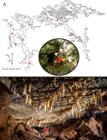
A, Paraíso cave map, stars indicate the sampling sites (all with the occurrence of C. paradisus sp. nov.); B, vertical entrance of Paraíso cave; C, Paraíso cave interior, showing the diversity of substrates occurring in the cave. Photo credits: (B) and (C) Csaba Egri.
Field sampling
In Paraíso Cave, the biological specimens were collected via direct intuitive search (following Wynne et al., 2019) across 10×3 m transects, each containing three 1 m² quadrants. Additionally, arthropods were opportunistically collected as encountered, with a priority given to organic deposits (e.g., guano piles) and potential microhabitats (e.g., under stones, within cracks, and near speleothems). All arthropods were meticulously collected using a fine brush and immediately preserved in 70% ethanol.
Analysis and preparation
In the laboratory the specimens were measured and photographed with a ZEISS Axio ZoomV16 stereomicroscope with an Axio Cam 506 Color camera, and later, dissected and mounted on semi-permanent slides using Hoyer’s medium. The appendages were illustrated using a camera lucida on a Leica DM750 microscope. Final illustrations were generated in the software GIMP (v. 2.10) with a Cintiq Drawing Pad (Wacom) (Montesanto, 2015; 2016). Some specimens were analyzed under a Hitachi TM4000 scanning electron microscope. The morphological description is based on the type specimens and male dimorphisms were emphasized. Holotype and paratypes of the new species are deposited in the Subterranean Invertebrate Collection of Lavras (ISLA - UFLA) in the Center of Studies on Subterranean Biology of the Federal University of Lavras (CEBS/UFLA, Lavras, Brazil). The morphological description is based on the type specimens, but male sexual dimorphisms were additionally highlighted.
SYSTEMATICS
Family Scleropactidae Verhoeff, 1938
Genus Circoniscus Pearse, 1917
Circoniscus paradisus sp. nov.
(Figs. 2-5)
Zoobank: urn:lsid:zoobank.org:act:D7C59294-8B57-4E2D-A523-190E2B3B5817
Type material. Holotype: Male (ISLA96886), Brazil, state of Pará, municipality of Aveiro, Paraíso Cave (04º04’31,5”S 55º27’31,6”W), 05.X.2020. Paratypes: 1 male (ISLA96887, in slide), same data as holotype; 1 juvenile (ISLA96888) same data as holotype; 1 female (ISLA96889), same data as holotype, 07.X.2020; 4 males, 4 females (ISLA96891), same data as holotype, 06.X.2020; 2 males, 2 females (ISLA96892), same data as holotype.
Etymology. The new species is named after the cave where it was found. The Portuguese word “Paraíso” is translated to “paradise” in English, and, in Latin, paradisus.
Diagnosis. Circoniscus paradisus sp. nov. is characterized by absence of eyes and body pigment; presence of schisma on pereonite 1 in all specimens; antennula with 2+9 aesthetascs; pleonites 3-5 epimera inner face with continuous ridge; distal margin of male pleopod 1 exopod elongated; and endopod apex curved inward.
Description. Maximum body length: male 8.7 mm; female: 9.5 mm. Eyes and body pigments absent. Body convex, endoantennal conglobation (Fig. 2A) covered by small triangular scale-setae. Noduli lateralis and glandular pores not visible (Fig. 4 E)
Cephalon (Figs. 2B, 4A) wider than long, frontal shield continuous with pereonite 1, frontal margin broadly rounded.
Pereonite 1 epimera (Fig. 5) with schisma in all specimens; pereonites 2 and 3 (Fig. 4 D, E): with ventral lobes; pereonites epimera inner face (Fig. 4E, F) with continuous ridge.
Pleon (Fig. 2 A) outline continuous with pereon, epimera 3-5 well developed, telson triangular, wider than long, rounded apex.
Telson (Figs. 2C, 4G) triangular, anterior margin concave, lateral margins following outline of pleonite 5, distal margin acute.
Antennula (Fig. 2 D) 3-articulated, distal article approximately 4 times longer than second article, conical bearing 9 aesthetascs in 4 rows, plus 2 apical.
Antenna (Figs. 2E, 4B, C) short and stout, not surpassing pereonite 1 when extended backwards; flagellum with 2 subequal articles; distal article bearing 2 lateral sets of 2 and 3 aesthetascs; apical organ as long as distal article of flagellum.
Mandibles (Fig. 2F, G) molar penicil dichotomized with 8-11 branches, left mandible with 2+1 penicils and right mandible with 1+1 penicils.
Maxillula (Fig. 2 H) inner endite with 2 apical penicils, distal margin rounded; outer endite with 4 + 6 teeth, inner set with 4 cleft teeth.
Maxilla (Fig. 2 I) inner lobe rounded, covered with thick setae, outer lobe approximately twice wider than inner lobe; covered with thin setae.
Maxilliped (Fig. 2J) basis rectangular; palp proximal article with 1 seta; endite subrectangular, medial seta longer than distal margin, rostral surface with 1 short penicil.
Pereopods 1-7 gradually increasing in size.
Pereopod 1 (Fig. 4H) covered by robust setae; merus, carpus and propodus with sparse hand-like setae; carpus with antennal grooming brush; dactylus inner claw shorter than outer claw, ungual and dactylar setae long and simple.
Pleopods exopods with respiratory fields faintly visible.
Uropod (Fig. 3A) protopod flattened and enlarged, filling gap between pleonite 5 and telson, surpassing distal margin of telson; exopod inserted on median margin, endopod twice as long as exopod, inserted proximally.
Male dimorphisms. Pereopod 1 (Fig. 3B) merus and carpus with short scale fields on sternal margin. Pereopod 7 (Fig. 3C) ischium elongated; sternal margin slightly concave; carpus subequal in length to merus. Pleopod 1 exopod (Figs. 3D, 4I) rounded, longer than wide; endopod apex acute bent outwards, inner margin with small setae. Pleopod 2 exopod (Fig. 3E) triangular, outer margin covered by setae; endopod flagelliform, longer than exopod. Pleopods 3-4 exopods as in Fig. 3F, G, respectively. Pleopod 5 exopod (Fig. 3H) triangular, apex elongated and acute.

Schematic drawings of Circoniscus paradisus sp. nov., male, paratype (ISLA96887): A, habitus, lateral view; B, cephalon, dorsal view; C, pleonites 3-5, telson and uropods, dorsal view; D, antennula; E, antenna; F, left mandible; G, right mandible; H, maxillula; I, maxilla; J, maxilliped.
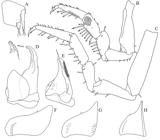
Schematic drawings of Circoniscus paradisus sp. nov., male, paratype (ISLA96887): A, uropod; B, pereopod 1; C, pereopod 7; D, pleopod 1; E, pleopod 2; F, pleopod 3 exopod; G, pleopod 4 exopod; H, pleopod 5 exopod.

Scanning electron micrographs of Circoniscus paradisus sp. nov., male, paratype (ISLA96891): A, cephalon, frontal view; B, aesthetascs on the second antennal flagellum; C, apical cone of antenna; D, epimera 1-3, dorsal view; E, epimera 1 and 2, ventral view; F, pereonites 3-5, ventral view; G, pleonite 5, telson and uropod, dorsal view; H, pereopod 1 carpus; I, pleopod 1 exopod.

Circoniscus paradisus sp. nov., whole specimens (lateral view): A, female, paratype (ISLA96889); B, male, holotype (ISLA96886); C, juvenile, paratype (ISLA 96888).
DISCUSSION
Morphological comparisons
The addition of the present new species brings the total number of Circoniscus to 14, with nine occurring in the state of Pará (Brazil), including the species described in this study.
Some species were found in caves, C. incisus, C. ornatus, C. intermedius, C. bezzii, and C. gaigei (Campos-Filho et al., 2014; 2020) but they do not show troglomorphic traits, instead exhibiting body pigmentation and well-developed eyes. These traits distinguish them from the subterranean-restricted ones: C. buckupi, C. carajasensis, C. mendesi, C. xikrin, and C. paradisus sp. nov. considered as truly troglobitic species.
Circoniscus paradisus sp. nov. resembles the other troglobitic species within the genus by the absence of eyes and body pigment. The presence of schisma on pereonite 1 in both adults and juveniles (Fig. 5) resembles that seen in C. carajasensis, since C. buckupi presents schisma only in juveniles and is vestigial in adults.
Regarding the number of aesthetascs on the antennula, C. paradisus sp. nov. resembles C. xikrin, both having 11 aesthetascs, while C. carajasensis, C. buckupi, and C. mendesi have eight aesthetascs. The new species is distinguishable from the others by the shape of pleopod 1 exopod, which is rounded in C. paradisus sp nov. and ovoid in the others. Additionally, C. paradisus sp. nov. resembles C. mendesi by the presence of a ventral lobe on pereonite 2, and by the apex of exopod 5 being elongate and acute. Circoniscus paradisus sp. nov., as in C. buckupi, C. carajasensis, and C. mendesi, presents the males pereopod 7 without modifications, while C. xikrin presents a semicircular lobe on the rostral surface of the ischium and merus, which is a feature that needs attention in future species descriptions. Furthermore, it is important to emphasize that the noduli lateralis was not visible in any of the troglobitic species.
Only two species of the genus were recorded from the state of Mato Grosso do Sul, C. intermedius (Schmidt, 2007; Campos-Filho et al., 2014) and C. caeruleus (Campos-Filho et. al., 2023), however only C. caeruleus is considered a troglophile species by having its body without pigment and the number of ommatidia reduced. C. caeruleus differs from C. paradisus sp. nov. in having a triangular lobe on the rostral surface of the male pereopod 7 merus, presence of ommatidia, and presence of noduli lateralis on pereonites 1-7.
Habitat and threats
Specimens of C. paradisus sp. nov. were found across all the surveyed transects within the cave (Fig. 1A) and in several microhabitats. This broad distribution suggests that the species has generalist behavior, as individuals were found in diverse substrates and cave regions, ranging from cobbles, speleothems, and muddy sediments to bat guano (Figure 6B-D). Some were even found in areas near the entrance, likely because the single, small cave entrance exerts minimal influence on the cave atmosphere. While most specimens were observed apart, some were seen in aggregations, particularly on substrates like old guano piles deposited by insectivorous bats (Pteronotus spp., Fig. 6D).

A, Paraíso cave showing the diversity of substrates occurring in the cave; B, C, Circoniscus paradisus sp. nov., living specimens; D, aggregation of Circoniscus paradisus sp. nov. in a guano pile inside the cave. Photo credits: (A) Daniel Menin; (B, C) Kevin Downey; (D) Rodrigo Lopes Ferreira.
Interestingly, fresh guano did not appear to be as attractive to the species, potentially due to the presence of other scavenging troglophilic invertebrates, like cockroaches (Blaberus spp.). Circoniscus paradisus sp. n. seems to exhibit a generalist diet, as individuals were observed feeding on a diverse range of organic substrates, including decaying wood, fragmented plant debris, and bat guano. It is crucial to emphasize that this species not only demonstrates a wide distribution within the cave but also comprises a population of considerable size. Throughout the sampling, we observed hundreds of individuals throughout the cave, although some areas lacked specimens, especially those where the primary substrate was rocky matrix.
The environment of the Paraíso cave is relatively well preserved and surrounded by the Amazon Forest. However, this forest remains only as a fragment, encircled by several deforested areas. These areas are adversely affected by their proximity to the Trans-Amazonian highway, suffering deforestation for logging and pasture purposes. It is critical to emphasize that some areas bordering the cave have already undergone severe alterations. For instance, one of the crucial watercourses that flows into the cave (which links with several interconnected waterways inside the cave) passes through a deforested area just before it seeps among the limestone blocks. These watercourses provide vital organic material sourced from decaying plants in the surrounding forest. Consequently, deforestation not only has the potential to reduce the input of organic matter into the cave but can also increase siltation, consequently diminishing the diversity of microhabitats within the cave. It is important to note that the diversity of substrates directly contributes to the invertebrate diversity within the caves.
Moreover, the Paraíso cave harbors an additional 10 cave-restricted species, discovered during a single expedition to the cave. Considering that most subterranean biodiversity hotspots usually emerge after multiple sampling efforts, it is entirely plausible that the Paraiso cave might develop into a hotspot of subterranean biodiversity in the future. This potential is particularly noteworthy given its isolated location in the landscape and a history of significant past climate changes, which have likely played a key role in isolating and driving the evolution of cave-restricted lineages.
ACKNOWLEDGMENTS
The authors would like to thank the team from the Center of Studies in Subterranean Biology (CEBS/UFLA) for all their support. We are especially grateful to Leda Zogbi for her invaluable support during our expedition to the Paraíso cave, as well as Dona Solange and Senhor Nelson for their hospitality during our expedition. We are also grateful to Marconi Souza Silva for his help in the specimen collection. Finally, we would like to express our gratitude to the photographers Csaba Egri, Daniel Menin, and Kevin Downey for generously providing the photographs of the caves where the species described in this study were discovered. These photographs were captured as part of a significant project called “Luzes na Escuridão” (Lights in the Darkness), which involved several photographers from different countries united with the common objective of documenting important Brazilian Amazon caves.
REFERENCES
- Arcangeli A 1931. Circoniscus Bezzii Arc., nuova specie di Isopodo terrestre del Brasile. Bollettino di Zoologia, 2(1), 117-123. https://doi.org/10.1080/11250003109434857
- Arcangeli A 1936. Un genere e due specie nuovi di isopodi terrestri del Brasile. Archivio Zoologico Italiano, 23: 201-208.
-
Boyko, CB; Bruce, NL; Hadfield, KA; Merrin, KL; Ota, Y; Poore, GCB and Taiti, S. 2024. World Marine, Freshwater and Terrestrial Isopod Crustaceans database. Circoniscus Pearse, 1917. Accessed through World Register of Marine Species available at https://www.marinespecies.org/aphia.php?p=taxdetails&id=248615 Accessed on 30 April 2024.
» https://www.marinespecies.org/aphia.php?p=taxdetails&id=248615 -
Calux, A; Augusto, A and Zogbi, L 2007. Conexão Subterrânea, KIP Articles, 58: 1061. https://digitalcommons.usf.edu/kip_articles/1061
» https://digitalcommons.usf.edu/kip_articles/1061 -
Campos-Filho, IS and Araujo, PB 2011. Two new troglobitic species of Scleropactidae (Crustacea: Isopoda: Oniscidea) from Pará, Brazil. Nauplius, 19: 27-39. https://www.scielo.br/j/nau/a/yV87PFZJBH3YXpq6Lkd9rHM/?format=pdf⟨=en
» https://www.scielo.br/j/nau/a/yV87PFZJBH3YXpq6Lkd9rHM/?format=pdf⟨=en -
Campos-Filho, IS; Cardoso, GM and Aguiar, JO 2018. Catalogue of terrestrial isopods (Crustacea, Isopoda, Oniscidea) from Brazil: an update with some considerations. Nauplius, 26: e2018038. https://doi.org/10.1590/2358-2936e2018038.
» https://doi.org/10.1590/2358-2936e2018038. -
Campos-Filho, IS; Araujo, PB; Bichuette, ME; Trajano, E and Taiti, S 2014. Terrestrial isopods (Crustacea: Isopoda: Oniscidea) from Brazilian caves. Zoological Journal of the Linnean Society, 172: 360-425. https://doi.org/10.1111/zoj.12172
» https://doi.org/10.1111/zoj.12172 -
Campos-Filho, IS; Fernandes, CS; Cardoso, GM; Bichuette, ME; Aguiar, JO and Taiti, S 2020. New species and new records of terrestrial isopods (Crustacea, Isopoda, Oniscidea) of the families Philosciidae and Scleropactidae from Brazilian caves. European Journal of Taxonomy, 606: 1-38. https://doi.org/10.5852/ejt.2020.606
» https://doi.org/10.5852/ejt.2020.606 -
Campos-Filho, IS; Sfenthourakis, S; Gallo, JS; Gallão, JE; Torres, DF; Chagas-Jr, A; Horta, L; Carpio-Díaz, YM; López-Orozco, CM; Borja-Arrieta, R; Araujo, PB; Taiti, S and Bichuette, ME 2023. Shedding light into Brazilian subterranean isopods (Isopoda, Oniscidea): expanding distribution data and describing new taxa. Zoosystema, 45 (19): 531-599. https://doi.org/10.5252/zoosystema2023v45a19
» https://doi.org/10.5252/zoosystema2023v45a19 -
Dimitriou, AC; Taiti, S and Sfenthourakis, S 2019. Genetic evidence against monophyly of Oniscidea implies a need to revise scenarios for the origin of terrestrial isopods. Scientific Reports, 9: e18508. https://doi.org/10.1038/s41598-019-55071-4
» https://doi.org/10.1038/s41598-019-55071-4 -
Hornung, E 2011. Evolutionary adaptation of oniscidean isopods to terrestrial life: structure, physiology and behavior. Terrestrial Arthropod Reviews, 4: 95-130. https://doi.org/10.1163/187498311X576262
» https://doi.org/10.1163/187498311X576262 - Lemos de Castro, A 1967. Isopódos terrestres da Amazônia Brasileira (Isopoda, Oniscoidea). Atas do Simpósio Sôbre a Biota Amazônica, 5: 311-336.
- Lemos de Castro, A 1984. Microsphaeroniscus, gênero novo de isópode terrestre volvacional, com descrição de cinco espécies novas (Isopoda, Oniscoidea). Boletim do Museu Nacional, Nova Série Zoologia, 208: 1-9.
-
López-Orozco, CM; Campos-Filho, IS; Gallo, JS; Gallão, JE; Carpio-Díaz, YM; Borja-Arrieta, R and Bichuette, ME 2024. Iron-isopods: new records and new species of terrestrial isopods (Isopoda, Oniscidea) from Brazilian Amazon iron ore caves. European Journal of taxonomy, 921: 116-135. https://doi.org/10.5852/ejt.2024.921.2421
» https://doi.org/10.5852/ejt.2024.921.2421 - Montesanto, G 2015. A fast GNU method to draw accurate scientific illustrations for taxonomy. Zookeys, 515: 191-206. https://www.doi.org/10.3897/zookeys.515.9459
-
Montesanto, G 2016. Drawing setae: a GNU way for digital scientific illustrations. Nauplius, 24: 1-6. https://www.doi.org/10.1590/2358-2936e2016017
» https://www.doi.org/10.1590/2358-2936e2016017 -
Pearse, A 1917. Isopoda collected by the Bryant Walker Expedition to British Guiana, with notes on Crustacea from other localities. Occasional Papers of the Museum of Zoology of University of Michigan, 46: 1-8. https://deepblue.lib.umich.edu/bitstream/handle/2027.42/56485/OP046.pdf?sequence=1&isAllowed=y
» https://deepblue.lib.umich.edu/bitstream/handle/2027.42/56485/OP046.pdf?sequence=1&isAllowed=y -
Schmidt, C 2007. Revision of the Neotropical Scleropactidae (Crustacea: Oniscidea). Zoological Journal of the Linnean Society, 151: 1-339. https://doi.org/10.1111/j.1096-3642.2007.00286
» https://doi.org/10.1111/j.1096-3642.2007.00286 - Souza, LA and Lemos de Castro, A 1991. The genus Circoniscus Pearse 1917 in Brazil, with description of three new species (Isopoda Oniscidea Scleropactidae). Tropical Zoology, 4: 45-64.
- Verhoeff, KW 1938. Weltstellung der Isopoda terrestria, neue Familien derselben und ein neues System. Zoologische Jahrbücher, Abteilung für Systematik, Ökologie und Geographie der Tiere, 71(3): 253-264.
- Verhoeff, KW 1941. Über eine neue südamerikanische Gattung der Isopoda terrestria. Zoologischer Anzeiger, 134: 169-173.
-
Wang, X; Edwards, RL; Auler, AS; Cheng, H; Kong, X; Wang, Y; Cruz, FW; Dorale, JA and Chiang, HW 2017. Hydroclimate changes across the Amazon lowlands over the past 45,000 years. Nature, 541 (7636): 204-207. https://doi.org/10.1038/nature20787
» https://doi.org/10.1038/nature20787 -
WoRMS 2023 Oniscidea. Available from: Available from: https://www.marinespecies.org/aphia.php?p=taxdetails&id=146505 (accessed 17 November 2023).
» https://www.marinespecies.org/aphia.php?p=taxdetails&id=146505 -
Wynne, JJ; Howarth, FG; Sommer, S and Dickson, BG 2019. Fifty years of cave arthropod sampling: techniques and best practices. International Journal of Speleology, 48 (1): 33-48. https://doi.org/10.5038/1827-806X.48.1.2231
» https://doi.org/10.5038/1827-806X.48.1.2231