 Rotifera, Cladocera and Copepoda species in six urban ponds of Aguascalientes, Mexico
Abstract
A range of studies have reported that urban ponds can support substantial numbers of species despite being near human habitats. Therefore, it is important to know the species that are found in urban ponds, as well as to identify the environmental variables that influence the communities and the differences between sites in terms of species composition. In the present study, four samplings were carried out during a one-year period, collected in the months of November 2020 (autumn), January (winter), April (spring) and July (summer) of 2021 in six urban ponds found in recreational parks in the city of Aguascalientes, Mexico. Taxonomic studies revealed the presence of 61 zooplankton species of which Rotifera represented 40 species, Cladocera with 16 species and Copepoda five species. The study yielded nine new records for the state, six species belonging to Rotifera 1) Collotheca ornata, 2) Lecane arcula, 3) Lecane decipiens, 4) Lophocharis salpina, 5) Lepadella ehrenbergii, 6) Proalides tentaculatus, and three species of Cladocera 7) Leydigia cf. striata, 8) Sida crystallina, and 9) Simocephalus mixtus. Canonical correspondence analysis (CCA) was applied to elucidate the relationship between environmental variables: temperature, pH, total dissolved solids, dissolved oxygen, conductivity, nitrate, phosphate chloride and total hardness and observed genera. CCA suggested chloride, phosphate, and total hardness to be the major factors in structuring the zooplankton community. Alpha diversity (α) and beta diversity (β) between localities were analyzed, determining that the species composition is different between the sampling sites.
Keywords
Diversity; environmental variable; freshwater; zooplankton.
INTRODUCTION
A range of studies have reported that urban ponds can support substantial numbers of species despite being near human habitats and recent research has shown that they can contribute to the conservation of species at the regional level. These waterbodies act as “steppingstones” that facilitate the movement of some species through the landscape (Hassall, 2014).
Within the city there are recreational parks with artificial ponds that are man-made ecosystems and are one of the landscape features that contribute significantly to increasing the quality of life in urban centers, providing recreational and educational activities and even mitigating the urban climate (Martínez and Jáuregui, 2000). They also serve as a refuge for species in the face of the loss of natural environments (Taborda et al., 2017).
Urban ponds often demonstrate different environmental characteristics when compared to non-urban (seminatural/agricultural) ponds; as they commonly have concrete margins, a synthetic base, reduced vegetation cover, and lower connectivity to other waterbodies (Hill et al., 2016). These freshwater reservoirs can support a variety of plant and animal species, including zooplankton: heterotrophic and weak-swimming aquatic organisms living in all types of waterbodies including fresh, coastal, and marine (Abdullah et al., 2018). Rotifers and microcrustaceans (cladocerans and copepods) are the most common animals in lentic freshwater ecosystems and constitute the majority of the metazoan zooplankton community (Espinosa et al., 2021) due to their ubiquity and abundance (Segers, 2008).
Studies on zooplankton in freshwater bodies have been well documented in Mexico and have led to the discovery of fourteen species new to science from these three taxonomic groups. However, there is still a lot of waterbodies that have not been analyzed in Aguascalientes, as is the case of these urban ponds, and opens the probability of increasing the number of new species records or even species new to science (Silva-Briano et al., 2015).
This article presents the first study on Rotifera, Cladocera, and Copepoda found in urban ponds in the city of Aguascalientes, Mexico. The goals of this contribution are to a) elaborate a species list of the three main freshwater zooplankton groups, b) expand the number of species recorded, c) determine the environmental variables and their relationship with the observed species, and d) describe the differences between sites in terms of species composition.
MATERIALS AND METHODS
Study area
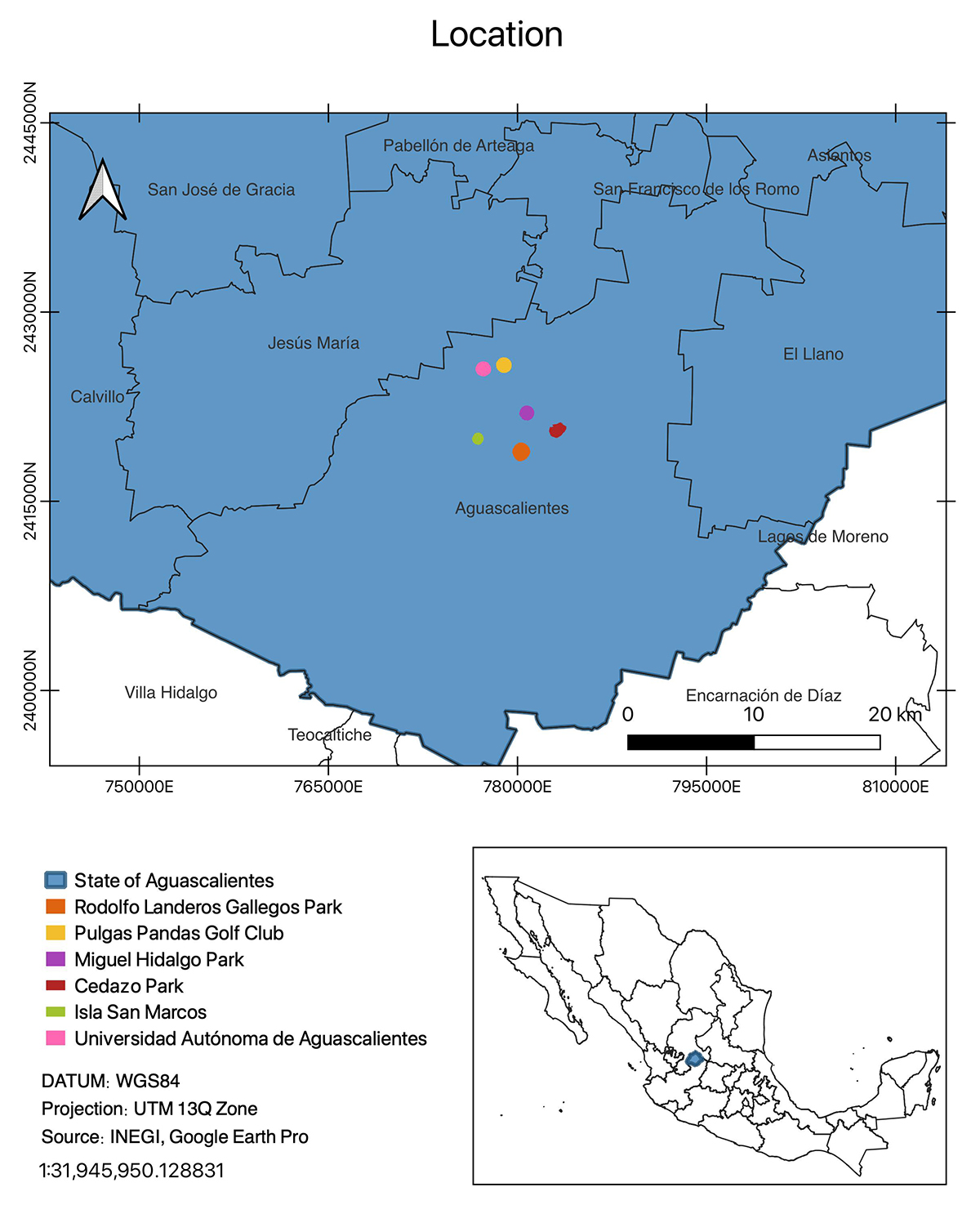
The study was performed in the following recreational parks in the central Mexican city of Aguascalientes by assigning two sampling stations for larger urban ponds: 1) Rodolfo Landeros (RL-S1: station 1; RL-S2: station 2) (21°51’6.84’’N 102°17’15.80’’W); 2) Isla San Marcos (ISM-S1: station 1; ISM-S2: station 2) (21°51’43.05’’N 102°19’16.16’’O); 3) Cedazo (CE-S1: station 1; CE-S2: station 2) (21°52’03.63’’N 102°15’29.77’’W); and one station for smaller urban ponds: 4) Miguel Hidalgo (21°52’47.09’’N 102°16’59.65’’W); 5) Pulgas Pandas (PP) (21°54’51.61’’N 102°18’0.02’’W); and 6) Universidad Autonoma de Aguascalientes (UAA) (21°54’42.15’’N 102°18’57.54’’W) (Fig. 1). All localities are associated with water treatment plants except for Miguel Hidalgo (MH) which depends on rainfall and Rodolfo Landeros station 1 (RL-S1) that maintains water levels using well water.

Sampling
Four samplings were carried out in a one-year period in the months of November 2020 (autumn), January (winter), April (spring), and July (summer) of 2021, in order to include the four seasons of the year. Samples were taken using a Wisconsin-type plankton net with a 54-micron mesh opening in the littoral and limnetic zones and were mixed into a single sample of 125 ml for each site. Water samples were taken for physicochemical analysis with a 1L plastic bottle. Temperature, pH, conductivity, total dissolved solids were measured in situ through a multiparameter Yellow Spring Instruments Model 556 MPS probe and dissolved oxygen was measured with a DO 6+ Dissolved Oxygen/Temp. Nitrate, phosphates, chloride and total hardness were measured with a YSI 9100 Photometer Water Test, using Palintest reagent: nitrate (nitrate) 0-20 mg/l N, phosphate (PO4) 0-4 mg/l #1 and #2, chloride (chloridol) 0-500 000 mg/l NaCl, total hardness 0-500 mg/l CaCO3 (calcicol No.1 and No.2). The water samples were protected from sunlight and kept cold until they were analyzed in the laboratory. This data was used to confirm the annual variations in the environmental parameters.
Specimens
The biological material was preserved in 4% formaldehyde solution. The photographs were taken with a NIKON ECLIPSE compound microscope equipped with a Sight DS-L3 digital camera and scanning electron microscopy images were taken with a JEOL LV5900. Specimens were identified with specialized taxonomic keys: Koste (1978), Segers (1995), Suárez-Morales et al. (1996), Silva-Briano and Suárez-Morales (1998), Nogrady and Segers (2002), Elías-Gutiérrez et al., (2008a), Mercado-Salas and Suárez-Morales (2011), Reid (2015), Wallace et al. (2016), Sarma and Nandini (2017), and Rogers et al. (2020). Dissections for taxonomic identification were made using a Nikon SMZ18 stereoscope and a tungsten dissection needle.
Zooplankton abundance
A Bogorov chamber was used to quantify zooplankton abundance (Fonticiella and Monteagudo, 2008). A total of three, one-milliliter, aliquots were taken for each sample and the average of the observed organisms was reported. Subsequently, the necessary calculations were made to obtain the number of organisms per cubic meter (org./m3).
Canonical Correspondence Analysis (CCA)
The CCA analysis was performed using version 4.03 of PAST. All measured environmental variables and observed species were applied. For the analysis the species were organized into their corresponding genera. CCA provides an analysis of the influence of environmental factors on the dynamics of the zooplankton communities.
Diversity Analysis
Alpha diversity (α) was analyzed using richness and application of non-parametric Chao2 and Jack2 indices to estimate the maximum number of zooplankton species richness for each locality. Chao2 considers the species observed in exactly one and two sampling units, while Jack2 takes into account the species present in two sampling units. Spatial beta diversity was calculated with Sörensen qualitative indices (SI), first obtaining the similarity coefficient and then subtracting 1 to obtain the dissimilarity between samples. SI = 2c/ a + b. Where a is the number of species present at site A, b is the number of species present at site B, and c is the number of species present at both sites A and B. ESTIMATES 7.5 program was used to apply the analysis.
RESULTS
The measurements of the environmental variables are shown in Tab. 1. The highest temperature value was recorded at UAA in April (spring) with 23.9 °C (20.1 ± 4.0), the lowest at PP in January (winter) with 13.2 °C (17.1 ± 3.5). The pH ranged from 7.3 (CE-S1) to 9.8 (MH). The highest dissolved oxygen averages were obtained in RL-S1 and ISM-S1 with 13.1 and 13.0 mg/l respectively. Conductivity ranged from 0.171 (RL-S1) to 1.2 (ISM-S1, S2) mS/cm. Total dissolved solids exhibited values of 1.2 g/l for ISM-S1 and ISM-S2 in April (spring) and 0.114 g/l for RL-S1 in July (summer). Nitrates ranged from undetectable levels to 0.4 (mg/l N). Phosphate concentrations showed high variation (from 0.1 to 4 mg/l PO4), and the same occurred with total hardness (from 10 to 407 mg/l CaCO3). The lowest and highest chloride concentration was obtained in ISM-S1 ranging between 0 and 280 mg/l Cl.
Measurement of environmental variables. Average, ± standard deviation. Minimums and maximums in parentheses. RL (Rodolfo Landeros), ISM (Isla San Marcos), CE (Cedazo), MH (Miguel Hidalgo), PP (Pulgas Pandas), UAA (Universidad Autonoma de Aguascalientes). S1= station 1, S2= station 2.
A total of 61 species were found (Tab. 2). Rotifera was the most abundant taxon with 40 species belonging to 18 genera and 13 families, followed by Cladocera with 16 species belonging to 11 genera and 5 families, and Copepoda with 5 species, 3 belonging to the order Calanoida with 1 family and 3 genera and the other two corresponding to the order Cyclopoida with 1 family and 2 genera.
Rotifera species represented the 66% of total organisms found, Cladocera 26% and Copepoda 8%. The most representative genus of Rotifera was Lecane with 10 species, for Cladocera it was Daphnia and Ceriodaphnia with three species, and for Copepoda each species came from a different genus. This research revealed nine new records for Aguascalientes (Fig. 2) with six species belonging to Rotifera: Collotheca ornata, Lecane arcula, Lecane decipiens, Lepadella ehrenbergii, Proalides tentaculatus, Lophocharis salpina, and three species to Cladocera: Leydigia cf. striata, Sida crystallina, and Simocephalus mixtus.
Zooplankton species list. Shows the observed species in the recreational parks. RL (Rodolfo Landeros), ISM (Isla San Marcos), CE (Cedazo), MH (Miguel Hidalgo), PP (Pulgas Pandas), UAA (Universidad Autonoma de Aguascalientes). S1= station 1, S2= station 2. x= present. * new records for the state.

New records for Aguascalientes. Collotheca ornata (A, extended corona) and (B, contracted corona), Lecane arcula (C), Lecane decipiens (D), Lepadella ehrenbergii (E, F), Lophocharis salpina (G), Proalides tentaculatus (H), Leydigia cf. striata (I), Sida crystallina (J), Simocephalus mixtus (K, L). Photographs: Adabache-Ortíz, A and Retes-Pruneda, A.E.
For the canonical correspondence analysis (CCA) (Fig. 3) the first and second axis explained 54 and 44% of observed data variability, respectively. In the tri-plot the chloride, phosphate, and total hardness vectors had the maximum length and exhibited a significant effect on how the different genera are ordered. Brachionus is the only rotifer genus located near the center, where it did not show any particular relationship with any environmental variable. Most of the genera are concentrated in the temperature, dissolved oxygen, chloride, total hardness, and pH vectors. CCA also revealed a strong negative correlation of total hardness with axis 1. Collotheca, Polyarthra, Daphnia, Moina, Leptodiaptomus, and Acathocyclops are negatively correlated with axis 1, which clearly defines the role of total hardness in their abundance and distribution. Platyias, Trichocerca, Filinia, Keratella, Anuraeopsis, and Proalides are the genera that are negatively associated with total hardness, and where chloride concentrations were lower and positively related to phosphate, nitrate, and total dissolved solids.

Canonical Correspondence Analysis (CCA) of environmental variables and zooplankton genera observed in all samples sites.
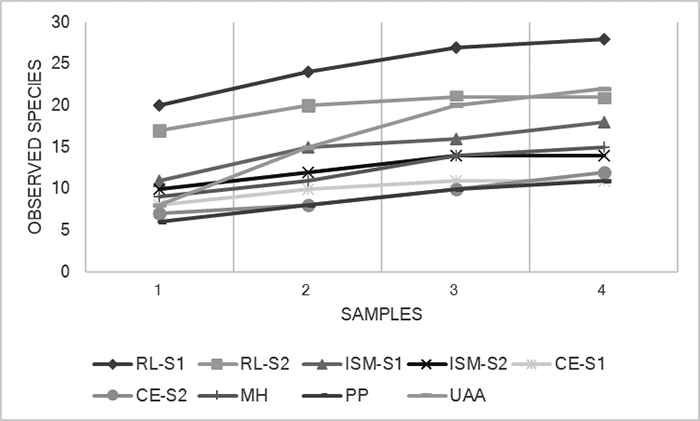
RL-S1, UAA, and RL-S2 presented the highest values of species richness (Tab. 3) with 28, 22, and 21 species respectively; CE-S1 and PP recorded the lowest values, both with 11 species each. Non-parametric estimators showed estimated richness values above the observed richness, except for Jack2 in MH. The species accumulation curve (Fig. 4) indicates that RL-S2, ISM-S2, and CE-S1 seem to reach their asymptotic stability of the accumulation curve; but this is not the case for the other locations.
Alpha diversity (α). Observed and expected species richness with two nonparametric estimators Chao 2 and Jack 2. RL-S1 (Rodolfo Landeros, station 1), RL-S2 (Rodolfo Landeros, station 2), ISM-S1 (Isla San Marcos, station 1), ISM-S2 (Isla San Marcos, station 2), CE-S1 (Cedazo, station 1), CE-S2 (Cedazo, station 2), MH (Miguel Hidalgo), PP (Pulgas Pandas), UAA (Universidad Autonoma de Aguascalientes).

Species accumulation curve of the samples collected at study sites. RL-S1 (Rodolfo Landeros, station 1), RL-S2 (Rodolfo Landeros, station 2), ISM-S1 (Isla San Marcos, station 1), ISM-S2 (Isla San Marcos, station 2), CE-S1 (Cedazo, station 1), CE-S2 (Cedazo, station 2), MH (Miguel Hidalgo), PP (Pulgas Pandas), UAA (Universidad Autonoma de Aguascalientes).
Spatial diversity analyses indicate that the specific composition between localities is different (Tab. 4). MH and RL-S2 reached a dissimilarity index of 89%. CE-S1 and CE-S2 had the lowest dissimilarity index of 0.04%, with the only difference between these two stations being the copepod Mastigodiaptomus albuquerquensis (CE-S2).
Spatial beta diversity (β). Dissimilarity values (1-SI) between sites. The value 1 means that the species of both sites are completely different and the value 0 when both sites are identical in species composition. RL-S1 (Rodolfo Landeros, station 1), RL-S2 (Rodolfo Landeros, station 2), ISM-S1 (Isla San Marcos, station 1), ISM-S2 (Isla San Marcos, station 2), CE-S1 (Cedazo, station 1), CE-S2 (Cedazo, station 2), MH (Miguel Hidalgo), PP (Pulgas Pandas), UAA (Universidad Autonoma de Aguascalientes).
DISCUSSION
Localities presented different values in environmental variables between sites and during the seasons of the year (Tab. 1). The temperature values observed during the study are around the range established as optimal for the reproduction and growth of zooplankton, which ranges from 15 °C to 20 °C, similarly, pH values are in the range of 6.0 to 9.0 units; appropriate values for the biological activity of ecosystems (Gómez-Márquez et al., 2022).
Dissolved oxygen plays an important role in biological processes in aquatic environments (Jose et al., 2015). Macrophyte communities (e.g., Elodea) and chlorophytes (e.g., Spirogyra) were observed in RL-S1 and ISM-S1 respectively, as well as high concentrations of dissolved oxygen (Tab. 1). This could be the product of the presence of sedimentary material that, when decomposed, generates CO2 used by phytoplankton and aquatic plants for their photosynthesis (Villalba et al., 2018). The average values of total hardness fluctuate from 68 to 179 mg / l CaCO3 (Tab. 1), and this indicates soft to moderately hard waters in all sites and is an adequate range for aquatic organisms (Wetzel, 2001).
Nutrient concentrations were low during the study (Tab. 1). The highest phosphate concentration was 1.9 mg/l PO4 (CE-S1) and nitrate 0.4 mg/l N (UAA). Nevertheless, species of the three zooplankton groups under study were observed in all sites (Tab. 2). Similar results have been reported in previous studies (Morales-Baquero and Conde-Porcuna, 2000; Conde-Porcuna et al., 2002). The correlation of the zooplankton with nitrate and phosphate may not necessarily be a direct relationship of the zooplankton utilizing the nutrients, but could be attributed to the dependence of the phytoplankton (which serves as food for the zooplankton) on these nutrients (Mustapha, 2009).
Chloride is one of the most important environmental variables in the study with wide concentration ranges between sites, from undetectable levels to 280 mg/l Cl observed in ISM-S1. Previous studies have obtained different results on the effect of chlorides on zooplankton. Greco et al. (2021) mention that zooplankton groups showed different levels of response to chloride concentrations: copepods exhibited a significant decline, followed by cladocerans, and then lastly rotifers. Petranka and Francis (2013) found a weak effect of chlorides on copepods and Sinclair and Arnott (2018) reported a decrease in copepod communities by 250 mg/l Cl, while rotifers and cladocerans were not affected. In other studies, cladocerans show a higher sensitivity (Van-Meter et al., 2011; Stoler et al., 2017b).
The study yielded nine new species records for the city of Aguascalientes belonging to the Rotifera and Cladocera (Fig. 2), increasing the number of recorded species from 96 to 102 and from 46 to 49 species, respectively. No new records were identified for the Copepoda; thus, the list remains at 33 species currently reported. Urban ponds can support zooplankton species and contribute to finding new species records and expanding the list of species (Hill et al., 2016). It is therefore, important to consider them in zooplankton research.
The number of Rotifera species was higher than the species found for Cladocera and Copepoda (Tab. 2); and this has been previously documented in several works (Shen et al. 2021; Mustapha, 2009; Gómez et al. 2013). This is probably due to their small size, as well as life cycle traits, feeding mechanisms and metabolism (Sampaio et al., 2002).
A high diversity of Cladocera can be found in the littoral zone of freshwater ponds, as well as in small and temporary water bodies (Forró et al., 2008). Species from the genera Alona, Ceriodaphnia, Chydorus, and Leydigia (Tab. 2) were found in the littoral zone associated with macrophytes (e.g., Elodea in RL-S1). Macrophytes play an important role in the structuring of the ecosystem in freshwater shallow lakes and floodplains, and the space within macrophyte communities is known to provide favorable and protected habitats for zooplankton communities. Usually, they can be easily detected by predators, due to their continuous movement, particularly the hopping motion exhibited by cladoceran species (Choi et al., 2014), but macrophyte communities can shelter them. The genera Sida, Diaphanosoma, Simocephalus, and Daphnia were associated with the sites where phosphate, nitrate, conductivity, and total dissolved solids values were lowest (Tab. 1, Fig. 3). Mustapha (2009) stated that larger species, such as in the family Daphniidae, are usually associated with better water quality, and this is due to the control they exert over phytoplankton. A large bodied size enables grazing on large quantities and diverse forms of phytoplankton.
The new species record for the study area, Simocephalus mixtus (Fig. 2K, L), was collected in RL-S1 and has been previously recorded in Mexico (Elías-Gutiérrez et al., 2008a) in southeastern and central Mexico (Elías-Gutiérrez et al., 2001). The general morphologies of Simocephalus vetulus, S. vetuloides, and S. mixtus are very similar. But Orlova-Bienkowskaja (2001) indicated that the distribution of S. vetulus was limited to northern Africa and Europe, while S. vetuloides had a limited distribution in eastern Siberia and Simocephalus mixtus is a cosmopolitan species distributed in Asia, Eastern Europe, North Africa, and North America (Young et al., 2012).
Arctodiaptomus dorsalis, Leptodiaptomus siciloides, and Mastigodiaptomus albuquerquensis (Tab. 2) correspond to the three Calanoida species observed, belonging to the family Diaptomidae, and were found at sites where dissolved oxygen and total hardness presented higher values during the study (RL-S1, RL-S2, ISM-S1, ISM-S2, and CE-S2) (Tab. 1). The family Diaptomidae has successfully managed to colonize many freshwater environments (Elías-Gutiérrez et al., 2008a). Acanthocyclops and Macrocyclops are the genera observed from the Cyclopoida. Acanthocyclops robustus was found in all localities. This species inhabits the plankton of lakes, marshes, and small waterbodies. Basically, it is found in all kinds of freshwaters. Low crustacean diversity is a common feature of small reservoirs, therefore, the presence of two or more copepod species in the plankton of reservoirs is the most frequent situation (Marcé et al., 2005).
Lecane decipiens (Fig. 2D), one of the new records for Rotifera, can be easily mistaken with the common L. hamata and L. serrata, but it differs from the first by the lateral margin of the dorsal plate, which does not reach the head aperture, and from the second by its lorica without any ornamentation (Azémar et al., 2007). Lecane arcula, another new record (Fig. 2C), is very similar to other species but is distinguished from L. aculeata by its relatively shorter lorica and anterolateral spines. Lecane decipiens has been confused with L. verecunda but is characterized by the antero-lateral spines being separated from the ventral plate and by the shape of its foot pseudosegment (Segers, 1995).
Canonic Correspondence Analysis (CCA) (Fig. 3) suggested chloride, phosphate, and total hardness to be the major factors in structuring the zooplankton community. Chlorides are present in all water sources, including drinking water. As with many other elements, the amount of chlorides present in the natural environment is highly affected by wastewater discharges (Raffo and Ruiz, 2014). All the ponds analyzed use water from wastewater treatment plants (except for RL-S1 and MH) and this may have contributed to chlorides being the most influential vector in zooplankton communities. Most Cladocera and Copepoda genera, and some Rotifera, are positively correlated to chlorides (Fig. 3); and previous studies have revealed the diverse effects of chlorides on zooplankton species (Greco et al., 2021; Lind et al., 2018; Stoler et al., 2017a).
Most genera belonging to Cladocera and Copepoda were observed in locations with low levels of phosphate, conductivity, nitrate, and total dissolved solids and the Rotifera genera Keratella, Proalides, Filinia, Anuraeopsis, Trichocerca, and Platyias were distributed in the area with the highest concentration of nutrients (Fig. 3). Total hardness is caused by the presence of calcium and magnesium salts, and it is important for zooplankton due to the fact that they are required by Cladocera and Copepoda for mineralization of the exoskeleton during molting (Graciano et al., 2022). A deficiency of mineral salts causes a soft exoskeleton, making these microcrustaceans vulnerable to mechanical damage and predation.
Some Cladocera genera (Simocephalus, Diaphanosoma, Sida) are located in the opposite direction to the phosphate, nitrate, conductivity and total dissolved solids vectors and some species, belonging to the family Brachionidae (Brachionus, Keratella, Anuraeopsis, Platyias) are positioned in the opposite direction of the phosphate, nitrate, conductivity, and total dissolved solids vectors, according to the CCA analysis (Fig. 3). Montagud et al. (2019) mention that the species belonging to the Cladocera taxonomic group are associated with good ecological quality. Conversely, genera belonging to the Rotifera, like the genera Hexarthra and Keratella, are in the part of the axis that indicates low ecological quality.
Richness is a direct and simple way to quantify biodiversity, as it can estimate the total number of species inhabiting a particular area (Alfaro and Pizarro, 2017). CE-S1, CE-S2, and PP obtained the lowest richness values with 11, 12, and 11 species, respectively (Tab. 3). It is possible that the low zooplankton diversity in these localities, compared to other systems, is caused by human actions (Gómez et al., 2013). For instance, the use of the aquatic environment for recreational activities that involves motorized boats and the shallow depth of ponds is a factor that decreases zooplankton diversity (Keppeler and Hardy, 2004). The analysis of observed richness, in contrast to the expected richness with non-parametric estimators Chao2 and Jack2 (Tab. 3) indicate that the species richness is lower than the expected in all localities (except for MH). According to the non-parametric methods for richness estimation, the total number of species expected for the localities shows that the reported species may adequately represent the zooplankton communities, with the exception of localities RL-S2 and CE-S2, where the observed richness values were very low compared to those expected with the Chao2 estimator. Several authors have mentioned the complexity in the interpretation of non-parametric estimators and their limitations (Foggo et al., 2003; Fattorini, 2013). However, these estimators are universally valid for any species abundance distribution and more robust than parametric estimators based on parametric models of specific abundance (Chao and Chiu, 2016).
The species accumulation curve (Fig. 4) shows that RL-S2, ISM-S2, and CE-S1 appear to reach an asymptote; therefore, a higher number of samples is needed to confirm that the curve stabilizes. However, it is important to consider that the specific composition of the sampling may change over time, because the distribution intervals of the species may widen or narrow depending on the environment. For example, under certain conditions in a defined time some species may appear or be detectable and others may not (Adler and Lauenroth, 2003). On the other hand, wandering individuals (vagrants) are an important source of bias in sampling since they cannot be considered strict inhabitants of the study area (Dennis, 2001).
Beta diversity analysis (Tab. 4) indicates that localities are different in terms of species composition so there is a degree of replacement of species according to the dissimilarity index (1-SI) (Iannacone and Alvariño, 2006). The sites with the maximum dissimilarity are RL-S2 and MH with a value of 89% (Tab. 4) and they also present differences in comparative temperature, conductivity, total dissolved solids, chlorides and total hardness (Tab. 1). This difference in species composition and environmental variables is probably due to the fact that the RL-S2 site uses water from a water treatment plant and MH depends on rain during the rainy season. The lowest dissimilarity occurred between sites CE-S1 and CE-S2 (0.4%) (Tab. 4) with only one different species, the calanoid Mastigodiaptomus albuquerquensis (Tab. 2). Their environmental variables are very similar (Tab. 1), possibly due to the proximity of the stations. Similarly, the ISM-S1 and ISM-S2 sites exhibit only 19% of dissimilarity and no significant differences in the values of the environmental variables. Despite the proximity of RL-S1 and RL-S2 stations the sites show a dissimilarity of 43% in specific composition (Tab. 4) and also present differences in the values of dissolved oxygen, conductivity, total dissolved solids, chlorides, and total hardness (Tab. 1). This is probably the result of the different sources of water for the sites: RL-S1 obtains water from subterranean wells and RL-S2 obtains water from the water treatment plant located in the park.
Freshwater ecologists have traditionally focused on large waterbodies, such as lakes, streams, and rivers, which results in the fact that shallow lakes and ponds (occurring far more frequently than larger lakes in urban environments) are less studied (Downing, 2010). Recently Mimouni et al. (2015) highlighted the high potential for endemism, especially in urban and anthropogenic origin ponds. This is likely due to the fact that the amount of environmental heterogeneity across urban landscapes, coupled with the large number of waterbodies in many cities should allow for the creation of a complex mosaic of ecosystems within which biodiversity is promoted at local and regional scales. A solid understanding of aquatic species in urban habitats will both advance urban ecology and preserve biodiversity in cities.
CONCLUSION
The study of urban ponds contributes to raising the number of species and expanding their known distribution, playing a special role in the preservation of species given increasing urbanization. Such studies allow us to know the particular environmental conditions where zooplankton develop and thrive, and this is essential for the understanding and conservation of zooplankton biodiversity in urban environments.
ACKNOWLEDGMENTS
Thanks to Angel Alcala, Frida Sabine Alvarez, Natalia Armas, Leslie Serrano, Gerardo Guerrero, Aleksandra Baquero, Laura Yamamoto and Yako Wong for support in the realization of sampling and measurement of physicochemical parameters.
REFERENCES
-
Abdullah M; Akhtar A; Mustafa AH; Islam S; Uddin M; Alam D and Xu H 2017. Seasonal pattern of zooplankton communities and their environmental response in subtropical maritime channels systems in the Bay of Bengal, Bangladesh. Acta Ecologica Sinica, 38(4): 316-324. https://doi.org/10.1016/j.chnaes.2017.11.001
» https://doi.org/10.1016/j.chnaes.2017.11.001 -
Adler PB and Lauenroth WK 2003. The power of time: spatiotemporal scaling of species diversity. Ecology Letters, 6: 749-756. https://doi:10.1046/j.1461-0248.2003.00497.x
» https://doi:10.1046/j.1461-0248.2003.00497.x -
Alfaro FM and Pizarro J 2017. Estimation of the richness of epigean coleopterans of the Pingüino of Humboldt National Reserve (Atacama and Coquimbo Regions, Chile). Gayana, 81(2): 39-51. https://doi:10.4067/S0717-65382017000200039
» https://doi:10.4067/S0717-65382017000200039 -
Azémar F; Van Damme S; Meire P and Tackx M 2007. New occurrence of Lecane decipiens (Murray, 1913) and some other alien rotifers in the Schelde estuary (Belgium). Belgian Journal of Zoology, 137(1): 75-83. https://www.vliz.be/imisdocs/publications/123127.pdf
» https://www.vliz.be/imisdocs/publications/123127.pdf -
Chao A and Chiu CH 2016. Nonparametric Estimation and Comparison of Species Richness. p. 1-11. In: eLS. Chichester, John Wiley & Sons, Ltd. https://doi.org/10.1002/9780470015902.a0026329
» https://doi.org/10.1002/9780470015902.a0026329 -
Choi JY; Jeong KS; Kim SK; La GH; Chang KH and Joo GJ 2014. Role of macrophytes as a microhabitats for zooplankton community in lentic freshwater ecosystems of South Korea. Ecological Informatics, 24: 177-185. https://doi.org/10.1016/j.ecoinf.2014.09.002
» https://doi.org/10.1016/j.ecoinf.2014.09.002 -
Conde-Porcuna JM; Ramos-Rodríguez E and Pérez-Martínez C 2002. Correlations between nutrient limitation and zooplankton populations in a mesotrophic reservoir. Freshwater Biology, 47: 1463-1473. https://doi:10.1046/j.1365-2427.2002.00882.x
» https://doi:10.1046/j.1365-2427.2002.00882.x -
Dennis RL 2001. Progressive bias in species status in symptomatic of fine-grained mapping units subject to repeated sampling. Biodiversity and Conservation, 10: 483-494. https://doi.org/10.1023/A:1016602309983
» https://doi.org/10.1023/A:1016602309983 -
Downing JA 2010. Emerging global role of small lakes and ponds: little things mean a lot. Limnética, 29 (1): 9-24. https://doi:10.23818/limn.29.02
» https://doi:10.23818/limn.29.02 -
Elías-Gutiérrez M; Suárez-Morales E and Sarma SSS 2001. Diversity of the freshwater zooplankton in the Neotropics: the case of Mexico. Verhandlungen der Internationalen Vereinigung der Limnologie, 27: 4027-4031. https://doi:10.1080/03680770.1998.11901752
» https://doi:10.1080/03680770.1998.11901752 - Elías-Gutiérrez M; Suárez-Morales E; Gutiérrez-Aguirre MA; Silva-Briano M; Granados-Ramírez JG and Garfias-Espejo T 2008. Cladocera y Copepoda de las Aguas Continentales de México. Guía ilustrada. México, 322p.
-
Espinosa CA; Sarma SSS and Nandini S 2021. Zooplankton community changes in relation to different macrophyte species: Effects of Egeria densa removal. Ecohydrology & Hydrobiology, 21(1): 153-163. https://doi.org/10.1016/j.ecohyd.2020.08.007
» https://doi.org/10.1016/j.ecohyd.2020.08.007 -
Fattorini S 2013. Faunistic knowledge and insect species loss in an urban area: the tenebrionid beetles of Rome. Journal of Insect Conservation, 17(3): 637-643. https://doi:10.1007/s10841-013-9569-5
» https://doi:10.1007/s10841-013-9569-5 -
Foggo A; Rundle SD and Bilton DT 2003. The net result: evaluating species richness extrapolation techniques for littoral pond invertebrates. Freshwater Biology, 48(10): 1756-1764. https://doi.org/10.1046/j.1365-2427.2003.01124.x
» https://doi.org/10.1046/j.1365-2427.2003.01124.x - Fonticiella A and Monteagudo A 2008. Manual de Hidrobiología. III Simposio Internacional de Acuicultura ACUACUBA, , Ciudad de la Habana, Cuba, Casa Alejandro de Jumbold, 10p.
-
Forró L; Korovchinsky NM; Kotov AA and Petrusek A 2008. Global diversity of cladocerans (Cladocera; Crustacea) in freshwater. Hydrobiology, 595: 177-184. https://doi: 10.1007/s10750-007-9013-5
» https://doi: 10.1007/s10750-007-9013-5 -
Gómez JL; Peña B; Guzmán JL and Gallardo P2013. Composición, abundancia del zooplancton y calidad de agua en un microreservorio en el estado de Morelos. Hidrobiológica, 23 (2): 227-240. https://www.scielo.org.mx/pdf/hbio/v23n2/v23n2a11.pdf
» https://www.scielo.org.mx/pdf/hbio/v23n2/v23n2a11.pdf -
Gómez-Márquez JL; Trejo-Albarrán R; Martínez-Zavala A; Granados-Ramírez JG and Trujillo-Jiménez P 2022. Variación del zooplancton en dos lagos urbanos ubicados en parques recreativos en el estado de Morelos, México. Acta Universitaria, 32: e3309. http://doi.org/10.15174.au.2022.3309
» http://doi.org/10.15174.au.2022.3309 -
Graciano F; Vázquez J and Reyes W 2022. La dureza total del agua afecta la muda, calcificación, crecimiento y supervivencia de Cryphiops caementarius (Palaemonidae). Acta Biológica Colombiana, 27(1): 88-96. https://doi.org/10.15446/abc.v27n1.89933
» https://doi.org/10.15446/abc.v27n1.89933 -
Greco DA; Arnott SE; Fournier IB and Schamp BS 2021. Effects of chloride and nutrients on freshwater plankton communities. Limnology and Oceanography Letters, 8: 48-55. https://doi:10.1002/lol2.10202
» https://doi:10.1002/lol2.10202 -
Hassall C 2014. The ecology and biodiversity of urban ponds. WIREs Water, 1: 187-206. https://doi:10.1002/wat2.1014
» https://doi:10.1002/wat2.1014 -
Hill MJ; Biggs J; Thornhill I; Briers RA; Gledhill DG; White JC; Wood PJ and Hassall C 2016. Urban ponds as an aquatic biodiversity resource in modified landscapes. Global Change Biology, 23(3): 986-999. https://doi:10.1111/gcb.13401
» https://doi:10.1111/gcb.13401 -
Iannacone J and Alvariño L 2006. Zooplankton diversity from the Junin Natural Reserve, Peru. Ecología Aplicada, 5(1-2): 175-181. http://www.scielo.org.pe/pdf/ecol/v5n1-2/a24v5n1-2.pdf
» http://www.scielo.org.pe/pdf/ecol/v5n1-2/a24v5n1-2.pdf -
Jose EC; Furio EF; Borja VM; Gatdula NC and Santos MD 2015. Zooplankton composition and abundance and its relationship with physicochemical parameters in Manila Bay. Journal of Oceanography and Marine Research, 3: 1. https://doi:10.4172/2332-2632.1000136
» https://doi:10.4172/2332-2632.1000136 -
Keppeler EC and Hardy ER 2004. Abundance and composition of Rotifera in an abandoned meander lake (Lago Amapá) in Rio Branco, Acre, Brazil. Revista Brasileira de Zoologia, 21: 233-241. https://doi:10.1590/S0101-81752004000200011
» https://doi:10.1590/S0101-81752004000200011 - Koste W 1978. Rotatoria. Die Rädertiere Mitteleuropas. Bestimmungswerk begründet von Max Voigt. Berlin, Stuttgart, Borntraeger.
-
Lind L; Schuler MS; Hintz WD; Stoler AB; Jones DK; Mattes BM and Relyea RA 2018. Salty fertile lakes: How salinization and eutrophication alter the structure of freshwater communities. Ecosphere, 9(9): e02383. https://doi:10.1002/ecs2.2383
» https://doi:10.1002/ecs2.2383 -
Marcé R; Comerma M; García JC; Gomá J and Armengol J 2005. The zooplankton community in a small, hypertrophic Mediterranean reservoir (Foix reservoir, NE Spain). Limnética, 24(3-4): 275-294. https://doi:10.23818/limn.24.28.
» https://doi:10.23818/limn.24.28. -
Martínez A and Jáuregui E 2000. On the environmental role of urban lakes in Mexico City. Urban Ecosystems, 4: 145-166. https://doi.org/10.1023/A:1011355110475
» https://doi.org/10.1023/A:1011355110475 - Mercado-Salas NF and Suárez-Morales E 2011. Morfología, diversidad y distribución de los Cyclopoida (Copepoda) de zonas áridas del centro-norte de México. I. Cyclopinae. Hidrobiológica, 21(1): 1-25.
-
Mimouni EA; Pinel B and Beisner BE 2015. Assessing aquatic biodiversity of zooplankton communities in an urban landscape. Urban Ecosyst, 18: 1353-1372. https://doi: 10.1007/s11252-015-0457-5
» https://doi: 10.1007/s11252-015-0457-5 -
Montagud D; Soria JM; Soria-Perpiñà X; Alfonso T and Vicente E 2019. A comparative study of four indexes based on zooplankton as trophic state indicators in reservoirs. Limnética, 38(1): 291-302. https://doi:10.23818/limn.38.06
» https://doi:10.23818/limn.38.06 -
Morales-Baquero R and Conde-Porcuna JM 2000. Effect of the catchment areas on the abundance of zooplankton in high mountain lakes of Sierra Nevada (Spain). Verhandlungen der Internationale Vereinigung für theoretische und angewandte Limnologie, 27: 1-5. https://doi.org/10.1080/03680770.1998.11901552
» https://doi.org/10.1080/03680770.1998.11901552 -
Mustapha MK 2009. Zooplankton assemblage of Oyun Reservoir, Offa, Nigeria. Revista de Biología Tropical, 57(4): 1027-1047. https://www.scielo.sa.cr/pdf bt/v57n4/a10v57n4.pdf
» https://www.scielo.sa.cr/pdf bt/v57n4/a10v57n4.pdf - Nogrady T and Segers H 2002. Rotifera vol. 6: Asplanchnidae, Gastropodidae, Lindiidae, Microcodidae, Synchaetidae, Trochosphaeridae and Filinia. p 1-264. In: Dumont HJF (Ed.), Guide to the identification of the microinvertebrates of the continental waters of the world, 18. Leiden. Backhuys Publishers.
- Orlova-Bienkowskaja MY 2001. Guides to the identification of the Microinvertebrates of the Continental Waters of the World. Cladocera: Anomopoda (17) Daphniidae: genus Simocephalus Leiden, The Netherlands: Backhuys, 135p.
-
Petranka JW and Francis RA 2013. Effects of road salts on seasonal wetlands: Poor prey performance may compromise growth of predatory salamanders. Wetlands, 33: 707-715. https://doi:10.1007/s13157-013-0428-7
» https://doi:10.1007/s13157-013-0428-7 -
Raffo E and Ruiz E 2014. Caracterización de las aguas residuales y la demanda bioquímica de oxígeno. Industrial Data, 17(1): 71-80. https://www.redalyc.org/pdf/816/81640855010.pdf
» https://www.redalyc.org/pdf/816/81640855010.pdf - Reid JW 2015. Subclass Copepoda. p. 524-573. In: Thorp JH and Rogers DC (Eds.), Volume II: Keys to Nearctic Fauna. Thorp and Covich’s Freshwater Invertebrates, 4th edition . London, Academic Press, Elsevier.
-
Rogers DC; Cohen RG and Hann BJ 2020. Class Branchiopoda. p. 585-630. In: Damborenena C; Rogers DC and Thorp JH (Eds.), “Thorp and Covich's Freshwater Invertebrates, Fourth Edition - Volume V: Keys to Neotropical and Antarctic Fauna”. London, Academic Press. https://doi.org/10.1016/B978-0-12-804225-0.00019-8
» https://doi.org/10.1016/B978-0-12-804225-0.00019-8 -
Sampaio EV; Rocha O; Matsumura-Tundisi T and Tundisi JG 2002. Composition and abundance of zooplankton in the limnetic zone of seven reservoirs of the Paranema River, Brazil. Brazilian Journal of Biology, 62(3): 525-545. https://doi.org/10.1590/S1519-69842002000300018
» https://doi.org/10.1590/S1519-69842002000300018 - Sarma SSS and Nandini S 2017. Rotíferos Mexicanos (Rotifera); Manual de Enseñanza; Toluca, México, UNAM, 147p.
- Segers H 1995. Guides to the identification of the Microinvertebrates of the Continental Waters of the World. Volume 2: The Lecanidae (Monogononta). SPB Academic Publishing BV, 226p.
-
Segers H 2008. Global diversity of rotifers (Rotifera) in freshwater. Hydrobiología, 595: 49-59. https://doi:10.1007/s10750-007-9003-7
» https://doi:10.1007/s10750-007-9003-7 -
Shen J; Qin G; Yu R; Zhao Y; Yang J; An S; Liu R; Leng X and Wang Y 2021. Urbanization has changed the distribution pattern of zooplankton species diversity and the structure of functional groups. Ecological Indicators, 120(11): 106944. https://doi.org/10.1016/j.ecolind.2020.106944
» https://doi.org/10.1016/j.ecolind.2020.106944 - Silva-Briano M and Suárez-Morales E 1998. The Copepoda Calanoida (Crustacea) of Aguascalientes state, Mexico. Scientiae Naturae, 1: 37-68 pp.
-
Silva-Briano M ; Adabache-Ortíz A; Guerrero-Jiménez G; Rico-Martínez R and Zavala-Padilla G 2015. Ultrastructural and morphological description of the three major groups of freshwater zooplankton (Rotifera, Cladocera, and Copepoda) from the state of Aguascalientes, Mexico. p. 308-325. In: Maaz K (Ed.), The Transmission Electron Microscope - Theory and Application. E-book, Intechopen. https://doi:10.5772/60659
» https://doi:10.5772/60659 -
Sinclair JS and Arnott SE 2018. Local context and connectivity determine the response of zooplankton communities to salt contamination. Freshwater Biology, 63: 1273-1286. https://doi:10.1111/fwb.13132
» https://doi:10.1111/fwb.13132 -
Stoler AB; Hintz WD; Jones DK; Lind L; Mattes BM; Schuler MS and Relyea RA 2017a. Leaf litter mediates the negative effect of road salt on forested wetland communities. Freshwater Science, 36: 415-426. https://doi:10.1086/692139
» https://doi:10.1086/692139 -
Stoler AB; Walker BM; Hintz WD; Jones DK; Lind L; Mattes BM; Schuler MS and Relyea RA 2017b. Combined effects of road salt and an insecticide on wetland communities. Environmental Toxicology and Chemistry, 36: 771-779. https://doi:10.1002/etc.3639
» https://doi:10.1002/etc.3639 - Suárez E; Reid JW; Lliffe TM and Fiers F 1996. Catálogo de los Copépodos (Crustacea) continentales de la Península de Yucatán, México. Mexico, El Colegio de la Frontera Sur (ECOSUR) and Comisión Nacional para el Conocimiento y Uso de la Biodiversidad (CONABIO), 296p.
-
Taborda VJ; Crettaz MC; Apartina C; Andrinolo D and Ronco A 2017. Estudio de la diversidad del ensamble de macroinvertebrados en la laguna Los Patos (partido de Ensenada, provincia de Buenos Aires). p. 313-318. In: III Congreso Nacional de Ciencia y Tecnología Ambiental, Santa Fe, Argentina. SACyTA - Sociedad Argentina de Ciencia y Tecnología Ambiental. http://sedici.unlp.edu.ar/bitstream/handle/10915/91479/Documento_completo.pdf-PDFA.pdf?sequence=1&isAllowed=y
» http://sedici.unlp.edu.ar/bitstream/handle/10915/91479/Documento_completo.pdf-PDFA.pdf?sequence=1&isAllowed=y -
Van-Meter RJ; Swan CM; Leips J and Snodgrass JW 2011. Road salt stress induces novel food web structure and interactions. Wetlands, 31: 843-851. https://doi:10.1007/s13157- 011-0199-y
» https://doi:10.1007/s13157- 011-0199-y -
Villalba GA; Benítez GA and Núñez KB 2018. Influence of environmental factors on the zooplankton community of the artificial lagoons in Ñu Guasúpark, Paraguay. Investigación agraria, 20(1): 58-56. https://doi.org/10.18004
» https://doi.org/10.18004 - Wallace RL; Snell TW; Walsh EJ; Sarma SSS and Segers H 2016. Phylum Rotifera. p. 131-167. In: Thorp JH and Rogers DC (Eds.). Thorp and Covich’s Freshwater Invertebrates, Keys to Nearctic fauna. Vol. 2, 4th ed. New York, Elsevier.
-
Wetzel R. G 2001. Limnology Lake and Reservoir Ecosystems. San Diego, Academic Press, 1006p. https://doi.org/10.1016/C2009-0-02112-6
» https://doi.org/10.1016/C2009-0-02112-6 - Young SS; Ni MH and Liu MY 2012. Systematic Study of the Simocephalus Sensu Stricto Species Group (Cladocera: Daphniidae) from Taiwan by Morphometric and Molecular Analyses. Zoological Studies, 51(2): 222-231pp.
-
Funding and grant disclosures
There were no external funding sources for this study.
-
Study association
This study is a requirement to obtain a doctoral degree in biological sciences at the Universidad Autonoma de Aguascalientes
-
Study permits
Permits were not required for this study
-
Data availability
Collection data are archived within the Universidad Autonoma de Aguascalientes Zooplankton Collection and available on request from the corresponding author.
-
Concent for publication
all authors declare that they have reviewed the content of the manuscript and gave their consent to submit the document.
Collection data are archived within the Universidad Autonoma de Aguascalientes Zooplankton Collection and available on request from the corresponding author.