Description of larvae and juveniles of Brycon falcatus (Characiformes: Bryconidae) from the Tapajós River sub-basin, Brazil
Abstract
Brycon falcatus (Characiformes: Bryconidae) is an Amazonian fish species of great relevance in fisheries and as a seed disperser. However, knowledge about its early development is limited due to the lack of information for accurate identification. This study describes the larval and juvenile period of B. falcatus, using morphological, meristic, and morphometric data, and analyzing larval growth patterns. A total of 116 individuals, with lengths ranging from 4.02 to 72.83 mm, were analyzed, collected in the Tapajós River sub-basin, Amazon basin, Brazil. At hatching, larvae are poorly developed, gradually acquiring morphological and functional traits. In the yolk-sac larval stage, pigmentation is scarce, becoming evident in preflexion, a pattern that continues through flexion and postflexion stages. Juveniles display dark longitudinal stripes on the flanks, a humeral spot, and a spot on the caudal peduncle. The number of myomeres ranges from 42 to 44, and the formation of fin rays follows specific patterns. Growth is predominantly continuous isometric. Larvae differ from congeners by myomere number and pigmentation, juveniles by fin ray number and pigmentation. Finally, a taxonomic key for the identification of Brycon larvae from the Tapajós basin is provided. These data ensure identification and conservation of B. falcatus.
Keywords:
Amazon basin; Early ontogeny; External morphology; Identification key; Matrinxã
Resumo
Brycon falcatus (Characiformes: Bryconidae) é uma espécie amazônica de grande relevância na pesca e como dispersor de sementes. Contudo, o conhecimento sobre seu desenvolvimento inicial é limitado pela escassez de informações para identificação precisa. Este estudo descreve o período larval e juvenil de B. falcatus, usando dados morfológicos, merísticos e morfométricos, e analisando padrões de crescimento larval. Foram analisados 116 indivíduos, com comprimentos padrão variando de 4,02 mm a 72,83 mm, coletados na sub-bacia do rio Tapajós, bacia amazônica, Brasil. As larvas ao eclodirem são pouco desenvolvidas, adquirindo gradualmente características morfológicas e funcionais. No estágio larval vitelino, a pigmentação é escassa, tornando-se evidente em pré-flexão, padrão que se mantém nos estágios de flexão e pós-flexão. Juvenis exibem listras longitudinais escuras nos flancos, uma mancha umeral e uma mancha no pedúnculo caudal. O número de miômeros varia de 42 a 44, e a formação dos raios das nadadeiras segue padrões específicos. O crescimento é predominante isométrico contínuo. Larvas diferenciam-se de congêneres pelo número de miômeros e pigmentação, juvenis pelo número de raios das nadadeiras e pigmentação. Por fim, uma chave taxonômica para identificação de larvas de Brycon da sub-bacia do Tapajós é fornecida. Esses dados fornecem a precisa identificação larval e juvenil de B. falcatus, possibilitando ações de manejo e conservação da espécie.
Palavras-chave:
Bacia amazônica; Chave de identificação; Matrinxã; Morfologia externa; Ontogenia inicial
INTRODUCTION
The Amazon basin is known for harboring a high diversity of freshwater fishes, comprising more than 2,400 described species (Jézéquel et al., 2020). Within this environment, the Tapajós River sub-basin stands out as one of the most prominent in terms of drainage area, covering 476,674×106 km2 (Farinosi et al., 2019). This sub-basin includes several important rivers, such as the Juruena, Teles Pires, and Tapajós rivers, all of which play a crucial role in the conservation of Amazonian ecosystems (Araujo et al., 2015). Moreover, the region harbors a rich fish diversity, with over 800 recorded species, many of which have significant economic, social, and cultural importance (Ohara et al., 2017; Silvano et al., 2020).
Within this diversity, the order Characiformes stands out as one of the most abundant and representative groups in the Tapajós River sub-basin (Ohara et al., 2017; Dagosta, de Pinna, 2019), with special emphasis on the Bryconidae, which comprises four genera (Brycon, Chilobrycon, Henochilus, and Salminus) and 51 valid species (Abe et al., 2014; Fricke et al., 2025). Bryconidae can be distinguished from other Characiformes by their fusiform body with relatively large body size; absence of both pectoral and abdominal keels; and mandibular teeth generally arranged in two rows, with no pterygoid teeth (van der Sleen et al., 2017; van der Sleen, Albert, 2017).
The genus Brycon is highly relevant for encompassing the largest number of species within the family (a total of 44 valid species), being widely distributed, landed, and traded across the Neotropical region (Lima, 2017; van der Sleen et al., 2017; van der Sleen, Albert, 2017; Ayala et al., 2018; García-Dávila et al., 2018; Fricke et al., 2025). In the Tapajós River sub-basin, four valid species have been recorded: Brycon amazonicus (Spix & Agassiz, 1829), B. falcatus Müller & Troschel, 1844, B. melanopterus (Cope, 1872), and B. aff. pesu Müller & Troschel, 1845 (Ohara et al., 2017; Dagosta, de Pinna, 2019; Silvano et al., 2020).
Brycon falcatus, commonly known as "matrinxã" or "voadeira", is an ecologically important species due to its omnivorous feeding habits, consuming a wide range of items including invertebrates, small vertebrates, and plant material such as fruits and seeds (Albrecht et al., 2009; Matos et al., 2016a). As a result, it plays a significant role as a seed disperser, contributing to the maintenance of riparian zones and providing ecosystem services with both direct and indirect benefits to society (Santos et al., 2020a; Carvalho et al., 2022; Carvalho, Germanos, 2023). It primarily inhabits oligotrophic rivers with clear and black waters and is a target species in both recreational and artisanal fisheries, being highly consumed due to the excellent quality of its meat (Matos et al., 2017a). Morphologically, it is a medium to large-sized fish, reaching up to 49.5 cm in length and weighing up to 2.7 kg. It has a moderately deep body, a relatively discreet humeral spot behind the operculum, and a dark V-shaped or crescent-shaped mark on the caudal peduncle and caudal fin (Lima, 2017).
In recent years, B. falcatus populations in the Tapajós River sub-basin have faced several anthropogenic pressures, such as dam construction, contamination by trace metals, dietary changes, and deforestation, all of which pose threats to its conservation (Matos et al., 2016b, 2017b, 2018, 2020; Lucanus et al., 2021). In this context, understanding the species’ biology, especially its early development, is essential, as this knowledge not only supports management and conservation strategies but also provides a foundation for future research in ecology, physiology, and related fields (Nakatani et al., 2001; Zacardi et al., 2020).
However, research on the early life history aspects of B. falcatus remains scarce, largely due to the difficulty in accurately identifying its larvae and juveniles, a limitation directly related to the absence of specific identification guides for the early developmental periods (Reynalte-Tataje et al., 2020). Studies on the early developmental periods of species within the genus Brycon have mainly focused on populations from other river basins (Andrade-Talmelli et al., 2001; Nakatani et al., 2001; Reynalte-Tataje et al., 2004; Arias, 2006; Gomes et al., 2011; Oliveira et al., 2012; Faustino et al., 2015; Maria et al., 2017; Oliveira et al., 2020; Villada-Agudelo et al., 2021). Among Amazonian species, only B. amazonicus has its early development described (Neumann et al., 2018; Lima et al., 2021).
The descriptions of fish larvae and juveniles, traditionally associated with taxonomic studies, have been expanded to incorporate biological aspects, such as growth patterns, based on the saltatory ontogeny theory (Balon, 1984). This approach, which integrates taxonomy and biology, has proven essential for understanding the early developmental periods of fish and their survival (Kováč et al., 1999; L’avrinčíková et al., 2005; Bialetzki et al., 2008; Santos et al., 2017, 2020b, 2022; Silva et al., 2022; Cajado et al., 2023; Souza et al., 2023).
Considering the relevance of Brycon falcatus for the maintenance of ecosystem services, economy, food security, and the importance of studies regarding early development for fish biodiversity conservation, the objectives of this study were: (i) to characterize its larval and juvenile development, focusing on morphological, meristic, and morphometric traits; (ii) to present growth patterns during the larval development of the species; and (iii) to provide an identification key for the larval period.
MATERIAL AND METHODS
Collection of biological material. The larvae and juveniles of B. falcatus analyzed were collected from the natural environment of clear waters, in sampling stations distributed across the Tapajós River sub-basin (Teles Pires and Tapajós rivers). The Teles Pires River, also known as the São Manuel River, originates in the Serra Azul, Chapada dos Guimarães municipality, in the state of Mato Grosso, and flows approximately 1,487 km until its confluence with the Juruena River, forming the Tapajós River (Gallardo et al., 2017). The Tapajós River, in turn, is one of the main tributaries of the Amazon River, extending about 851 km through the states of Mato Grosso and Pará (Ruffino, 2004).

Map of the Tapajós River sub-basin showing the sampling sites of Brycon falcatus larvae and juveniles used in the study. A. Tapajós River; B. Teles Pires River. The arrow indicates the direction of the river flow. Photo B source: Lucélia N. Carvalho.
Collections in the middle stretch of the Teles Pires River (11º16’28”S and 55º27’02”W) were carried out between 2016 and 2018, covering the municipalities of Cláudia, Ipiranga do Norte, Itaúba, Sinop, and Sorriso in the state of Mato Grosso. In the middle stretch of the Tapajós River (04º26’50”S and 56º15’29”W), the collections were conducted from 2020 to 2024, covering the municipalities of Jacareacanga, Itaituba, Miritituba, and Aveiro in the state of Pará, Brazil (Fig. 1).
To capture larvae, a plankton net with a mesh size of 300 μm was used, equipped with a flowmeter to quantify the volume of water filtered during horizontal tows, conducted both at the subsurface and mid-water, at approximately 8.0 m depth. To obtain juveniles, beach margin tows were conducted using an 8.0 m long, 1.5 m high net made with 1.0 mm mesh. Following collection, samples were: (1) stored in 500 mL polyethylene bottles properly labeled, (2) euthanized using eugenol (0.00005 ml/L) (according to the CONCEA Euthanasia Practice Guideline, 2013), and (3) preserved in a 10% formalin solution, then transported to the laboratory.
Identification of biological material. In the laboratory, the larvae and juveniles of B. falcatus were separated from other organisms and debris through sorting under a stereomicroscope. For the identification process, adult specimens of B. falcatus and its congeners (B. amazonicus, B. melanopterus, and B. aff. pesu) were first analyzed. These specimens were collected by the authors and identified based on the diagnostic characteristics described by Lima (2017). To support this identification, characteristics of the adult specimens were evaluated, including the number of rays of all fins and the number of vertebrae. The Weberian apparatus was counted as four vertebrae, and the composite centrum of the caudal skeleton was counted as a single element, based on direct examination of the specimens (Lima, 2017).
Two adult specimens of B. falcatus were subjected to radiography to count the number of vertebrae, for later comparison with the myomere count in the larvae. This procedure is useful during the identification process because the number of myomeres corresponds to the total number of vertebrae (which includes the Weber apparatus and the caudal centrum), plus one additional segment (Snyder, 1979).
The larvae and juveniles were identified using the regressive development sequence technique proposed by Ahlstrom, Moser (1976), which involves identification based on a sequence of individuals at different stages, from juveniles or larvae at more advanced stages to less developed larvae, using morphological, meristic, and morphometric characteristics as the basis.
Subsequently, the individuals were categorized according to the degree of flexion of the final section of the notochord and the sequence of development of the fins and their supporting elements into: I) larval period, comprising four stages: a) yolk-sac - from hatching until the larvae exhibit a fully or partially pigmented eye, anus, and open mouth; b) preflexion - extends from the anus opening and mouth to the onset of notochord flexion, with the appearance of the first supporting elements of the caudal fin; c) flexion - characterized by the onset of notochord flexion, with the appearance of the supporting elements of the caudal fin, until the full flexion of the notochord and appearance of the pelvic fin bud; and d) postflexion - from the full flexion of the notochord and appearance of the pelvic fin bud until the complete formation of the pectoral fin rays and total absorption of the embryonic fin; and II) juvenile period, when the complete formation of the rays of all fins occurs, the scales appear, continuing until the first sexual maturation. This nomenclature was proposed by Ahlstrom et al. (1976), modified by Nakatani et al. (2001), and is widely used in various studies on the morphological characterization of the early life stages of freshwater fish (Sanches et al., 2001; Bialetzki et al., 2008; Oliveira et al., 2012; Marinho, 2017; Santos et al., 2017, 2020b, 2022, 2024; Lima et al., 2021; Oliveira et al., 2022; Silva et al., 2022; Cajado et al., 2023; Souza et al., 2023).
Analysis of biological material. The description was based on the degree of development and observation of main morphological events, as well as meristic and morphometric characters. The individuals that best represented the characteristics of each period and stage were photographed and illustrated, following the technique described by Faber, Gadd (1983) and Shibatta (2016, 2017).
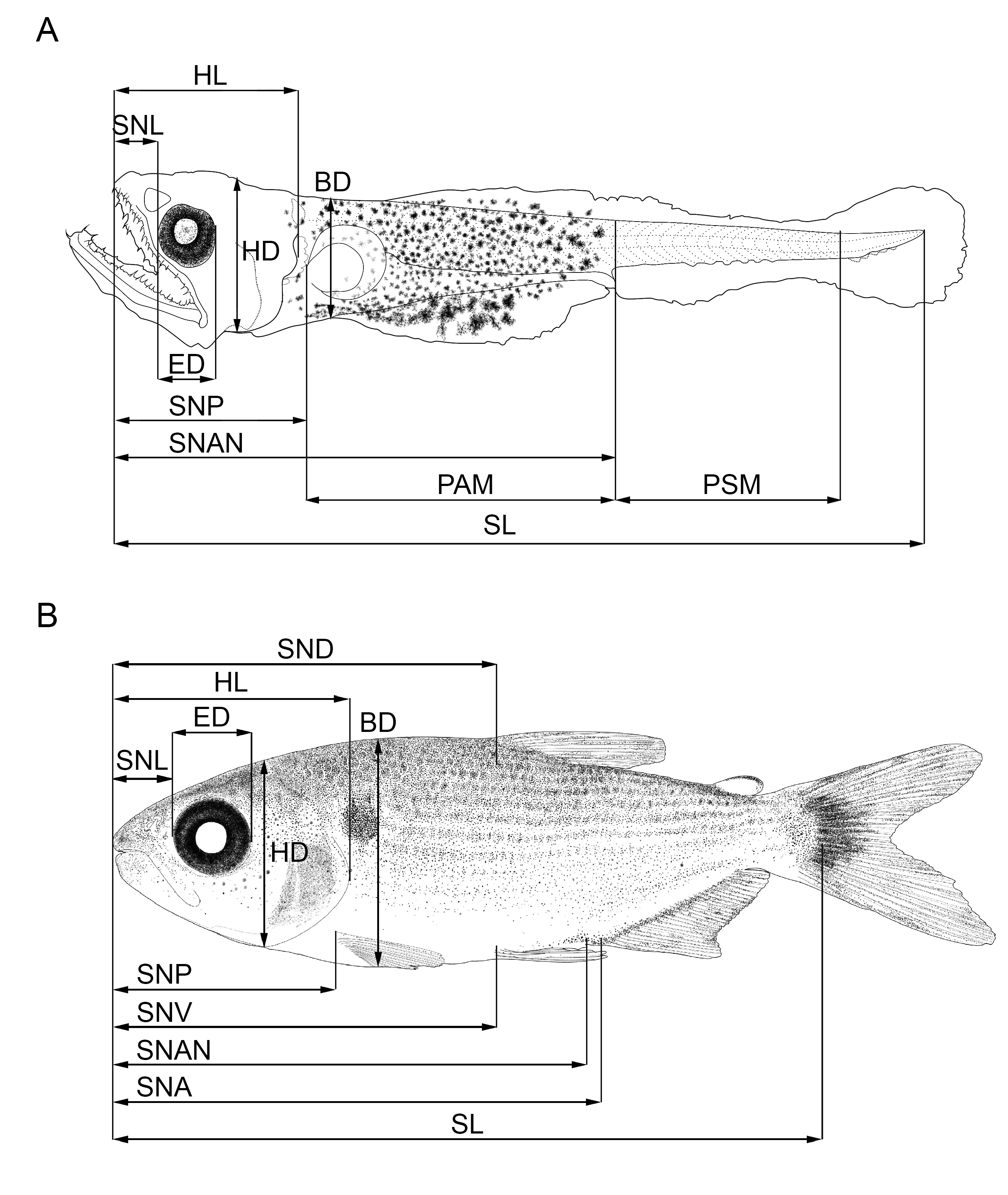
For characterization of early development, morphometric measurements (expressed in mm) were performed using a binocular stereomicroscope (Leica S9i) equipped with an integrated digital color camera for image capture and analysis, utilizing the Leica LAS EZ software. The following measurements were taken: head depth (HD), body depth (BD), head length (HL), snout length (SNL), standard length (SL), eye diameter (ED), and the distance from the snout to the origin of the anal fin (SNA), dorsal fin (SND), pectoral fin (SNP), and pelvic fin (SNV), according to Ahlstrom et al. (1976), modified by Nakatani et al. (2001). Additionally, the length from the snout to the anus (SNAN) was measured. For meristic analysis, the number of preanal, postanal, and total myomeres was counted, as well as the number of unbranched and/or branched rays present in the fins: caudal (C), anal (A), dorsal (D), pectoral (P), and pelvic or ventral (V) fins (Figs. 2A–B).
To standardize the morphometric data, all measurements were expressed in relation to standard length (SL). In the yolk-sac and preflexion stages, where SL cannot be directly measured due to the absence of notochord flexion, notochord length (from the snout to the end of the notochord) was used as an equivalent. In the flexion and postflexion stage, and juvenile, SL was measured from the snout to the hypural plate, following the methodology described by Marinho (2017, 2022). Total myomeres were counted from the first occipital segment to the region anterior to the urostyle; preanal myomeres were those located anterior to the vertical line passing through the anterior margin of the anal opening; and postanal myomeres were counted posterior to the vertical line passing through the posterior margin of the anal opening.
The larvae and juveniles of B. falcatus analyzed in this study are stored in the Collection of Eggs and Larvae (https://specieslink.net/col/CROLP-LEIPAI/) of the Laboratório de Ecologia do Ictioplâncton e Pesca em Águas Interiores (CROLP-LEIPAI) at the Universidade Federal do Oeste do Pará (UFOPA). The catalog numbers of the examined samples are as follows: LEIPAI 1497, 1498, 1499, 1500, 1501, 1502, 1503, 1504, 1505, 1506, 1507, 1508, 1509, 1510, 1511, 1512, 1513, and 1514. Comparative material with larvae of congeners of B. falcatus is also deposited in CROLP-LEIPAI: B. aff. pesu (LEIPAI 1515) and B. amazonicus (LEIPAI 131 and 1516).
Based on the morphological, meristic, and morphometric characteristics observed throughout larval development, a diagnostic identification key was constructed for B. falcatus. The key aims to assist in the identification and differentiation of this species from its congeners.
Data analysis. For the analysis of morphometric relationships (expressed as percentages), the variables HD, SNL, and ED were related to head length, while the variables BD, HL, SAN, SNA, SND, SNP, and SNV were related to standard length. The classification of morphometric relationships for body depth (BD/SL), head length (HL/SL), and eye diameter (ED/HL) was established using the criteria suggested by Leis, Trnski (1989).
Morphometric and meristic measurements in Brycon falcatus. A. Larval period and B. Juvenile period. HD – head depth, BD – body depth, HL – head length, SNL – snout length, SNAN – snout to anus length, SL – standard length, ED – eye diameter, SNA – snout to anal fin distance, SND – snout to dorsal fin distance, SNP – snout to pectoral fin distance, SNV – snout to pelvic fin distance, PAM –preanal myomeres, PSM – postanal myomeres.
To assess the growth pattern of different body parts, analytical regression models were used, in which the morphometric variables (dependent) were plotted as a function of standard and head lengths (independent). The relationships between these variables were described by different growth models, which may represent specific biological processes (Kováč et al., 1999). Initially, the null hypothesis is that growth follows a continuous isometric pattern, tested through simple linear regression. Along with the continuous isometry hypothesis, alternative hypotheses were tested, including gradually allometric development, represented by a quadratic regression, and the second alternative hypothesis, which proposes that growth occurs through a break, appropriately described by segmented linear regression (piecewise regression).
Growth pattern was analyzed only during the larval period, as no individuals in the transitional between postflexion and juvenile were captured. This absence resulted in a more pronounced size difference between the analyzed stages. The optimal models for each morphometric variable related to body and head size were determined using F tests. The significance level adopted was p < 0.05 (Sokal, Rohlf, 1981). All statistical analyses were performed using R software, v. 4.1.1, with the Segmented package (Muggeo, 2008).
RESULTS
A total of 116 Brycon falcatus individuals were analyzed during their early development, distributed as follows: four in the yolk-sac stage, 27 in preflexion, 61 in flexion, 16 in postflexion, and eight in the juvenile period. During the early development of B. falcatus, standard length ranged from 4.02 mm (yolk-sac) to 72.83 mm (juvenile). The description of each larval stage is illustrated in Figs. 3A–F, and the description of the juvenile period is showed in Figs. 4A, B. The meristic and morphometric data are summarized in Tab. 1.
Morphological characterization of the larval period.Yolk-sac (Fig. 3A): Standard length ranged from 4.02 to 4.16 mm (mean: 4.08 mm ± 0.06). The body is elongated. The notochord is straight and visible by transparency. The yolk-sac is elliptical. The adhesive organ is located on the dorsal region of the head, just above the eyes. The mouth is semi-open and positioned subterminally. The snout is rounded with simple nostrils. The eye is outlined, round, and without pigmentation. The operculum partially covers the gill cavity. The optic vesicle is elliptical. The anal opening extends beyond the midline of the body. Pigmentation is scarce, with dendritic chromatophores concentrated on the upper portion of the yolk-sac and the anterior region of the body behind the operculum. The embryonic membrane is transparent and extends from the anterior margin of the yolk-sac (encompassing the caudal region) to the dorsal midportion of the body. The pectoral fin bud is located slightly below the midline of the body, in the upper region of the yolk-sac. The total number of myomeres ranges from 42 to 43 (23 to 24 pre- and 19 postanal), with a mode of 42 elements (n = 3).
Preflexion (Fig. 3B): Standard length ranged from 4.47 to 5.37 mm (mean: 4.79 mm ± 0.20). The characteristics related to the body, notochord, and the position of the anus remain similar to the yolk-sac stage. However, the snout is more prominent, the nostrils are elliptical, and the optic vesicle is rounded at this stage. At 4.65 mm of body length, remnants of the yolk-sac and adhesive organ are still present. The mouth becomes terminal, slightly prognathous, oblique, with the posterior end of the maxillary bone extending past the posterior margin of the eye. Two rows of conical teeth are distributed on the premaxilla, maxilla, and dentary. The eye is spherical and partially pigmented. The operculum is not fully formed but covers the gills. The swim bladder is visible by transparency. Pigmentation becomes more intense, with dendritic and punctate chromatophores located from the posterior region of the head to the anus, covering the entire body surface, including the embryonic membrane on the ventral portion. The caudal peduncle is hyaline. The embryonic membrane still envelops the body of the larva, similar to the yolk-sac stage. The pectoral fin bud is surrounded by membrane. The number of myomeres ranges from 42 to 44 (23 to 24 pre- and 19 to 20 postanal), with a mode of 43 elements (n = 22).
Flexion (Figs. 3C–E): Standard length ranged from 5.15 to 10.01 mm (mean: 7.85 mm ± 1.17). The body is fusiform and robust. The notochord has a flexed final section due to the formation of the first elements supporting the rays of the caudal fin (hypurals). The mouth is terminal, and the snout becomes pointed. The nostrils are simple. Two rows of conical teeth continue to be distributed along the premaxilla, maxilla, and dentary. The eye is fully pigmented, and the operculum completely covers the gills. The anal opening is located beyond the median region of the body. The swim bladder is visible by transparency and is inflated. The pigmentation pattern is similar to the previous stage; however, the pigments become predominantly dendritic and radiate to the edges of the operculum. At the end of the flexion stage, pigments are observed in the distal region of the jaw, at the edge of the nostrils, and around the eyes. Pigmentation is prominent in the anterior region of the body, covering the embryonic membrane and the base of the dorsal fin. After the anus, the coloration remains hyaline, accentuating the contrast between the pigmented and non-pigmented areas. The embryonic membrane is gradually absorbed as the unpaired fins (dorsal and anal, respectively) begin to form at 6.47 mm. By the end of the flexion stage, at 10.01 mm, the caudal, dorsal, and anal fins are well developed, with well-defined edges and visible rays. The total number of myomeres ranges from 43 to 44 (23 to 24 pre- and 20 postanal), with a mode of 44 elements (n = 49).

Larval development of Brycon falcatus, in the sequence of stages: A. Yolk-sac – 4.15 mm (LEIPAI 1499); B. Preflexion – 4.65 mm (LEIPAI 1500); C. Flexion early – 5.22 mm (LEIPAI 1501); D. Flexion – 6.47 mm (LEIPAI 1502); E. Flexion late – 10.01 mm (LEIPAI 1503); and F. Postflexion – 12.56 mm (LEIPAI 1504). Scale bars = 1 mm.
Postflexion (Fig. 3F): Standard length ranges from 10.28 to 12.56 mm (mean: 11.24 mm ± 0.57). The characteristics related to the body, notochord, mouth, snout, eye, operculum, and the location of the anal opening remain similar to the previous stage. The nostril has a lemniscate shape. The pigmentation remains similar to the previous stage, with intense coloration in the anterior region of the body, while the area after the anus remains hyaline; however, it spreads across the dorsal region of the head. At 10.80 mm SL, the embryonic membrane in the dorsal region is fully absorbed, revealing the dorsal fin with visible rays. The pelvic fin bud and a small adipose fin are also visible. Remnants of the embryonic membrane remain on the upper and lower regions of the caudal peduncle and on the ventral portion of the body, where the pelvic fin appears. The caudal, dorsal, and anal fins, in addition to visible rays, begin to show segmentation. The insertion of the anal fin is posterior to the end of the dorsal fin. The pectoral and pelvic fins do not have rays. The total number of myomeres is 44 (24 pre- and 20 postanal).
Morphological characterization of the juvenile period. The standard length ranged from 34.49 to 72.83 mm (mean: 50.17 mm ± 14.15). Similar to adults, the juveniles have a moderately deep body, covered in scales, with a terminal mouth, premaxillary teeth, simple nostrils, and spherical eyes. In preserved individuals, the dotted and dense pigmentation of chromatophores is evident on the jaw, snout, dorsal part of the head, and operculum. The body displays a series of straight, dark longitudinal stripes, resulting from pigmentation in the middle-distal portion of the scales that develop along the entire body. Additionally, there is a macula behind the head and a spot on the peduncle extending to the upper and lower lobes of the caudal fin. A dark band ventral extends from the base of the pelvic fin, surrounding the anal fin and reaching the distal limit of its base. Diffuse pigments are distributed across all fins, which have formed and segmented rays, with others concentrated in the distal region of the adipose fin. The caudal fin is forked. The total number of fin rays (branched and unbranched) is: caudal = 9–10; dorsal = i,10; anal = i,24–25; ventral = i,7 and pectoral = i,13 (Fig. 4).
Morphometric relationships. Larval period: from the yolk-sac to the flexion stages, eye diameter (ED/HL) ranges from large to small (38.16% to 22.26%). However, in the postflexion stage, this ratio ranges from small to moderate (23.86% to 32.54%) (Tab. 1). In the yolk-sac and preflexion stages, head length (HL/SL) ranges from small to moderate (18.29% to 26.35%), stabilizing at moderate in the flexion and postflexion stages (20.96% to 31.46%) (Tab. 1). Body depth (BD/SL) ranges from elongated to moderate during the yolk-sac to flexion stages (13.74% to 28.64%). However, during the postflexion stage, it is classified only as moderate (22.05% to 30.66%). Throughout the larval period, the variables snout length (SNL/HL – 14.38% to 31.91%), snout to anus length (SAN/SL – 57.91% to 68.07%), and the distances from snout to pectoral fin (SNP/SL – 17.05% to 32.36%), dorsal fin (SND/SL – 38.13% to 66.23%), anal fin (SNA/SL – 49.84% to 69.35%), and pelvic fin (SNV/SL – 46.02% to 55.32%) increase, while head depth (HD/HL – 104.95% to 70.45%) decreases during development (Tab. 1).
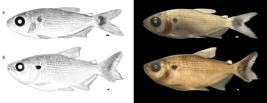
Juvenile development of Brycon falcatus. A. Juvenile early – 34.49 mm (LEIPAI 1498); and B. Juvenile – 72.83 mm (LEIPAI 1497). Scale bars = 1 mm.
Juvenile period: eye diameter ranges from large to moderate (34.16% to 28.84%), as does head length (35.32% to 30.50%), while body depth remains moderate (32.19% to 37.07%). In contrast, snout length (20.80% to 27.82%) and head depth (84.52% to 95.18%) increase. Conversely, snout to anus length (68.10% to 64.44%), as well as the distances from snout to the pectoral fin (31.96% to 24.59%), dorsal fin (54.43% to 49.30%), anal fin (71.12% to 66.59%), and pelvic fin (53.49% to 48.02%) decrease during development (Tab. 1).
Body growth. During the larval period, the morphometric variables related to head length, such as eye diameter (ED/HL) and head depth (HD/HL), exhibit continuous isometric growth, as indicated by simple linear regression. In other words, throughout all stages of the larval period, both the eye and head depth grow proportionally to head length. On the other hand, snout length (SNL/HL) shows positive allometric growth, indicating that this structure grows faster than head length throughout all developmental stages (Tab. 2; Figs. 5A–C).
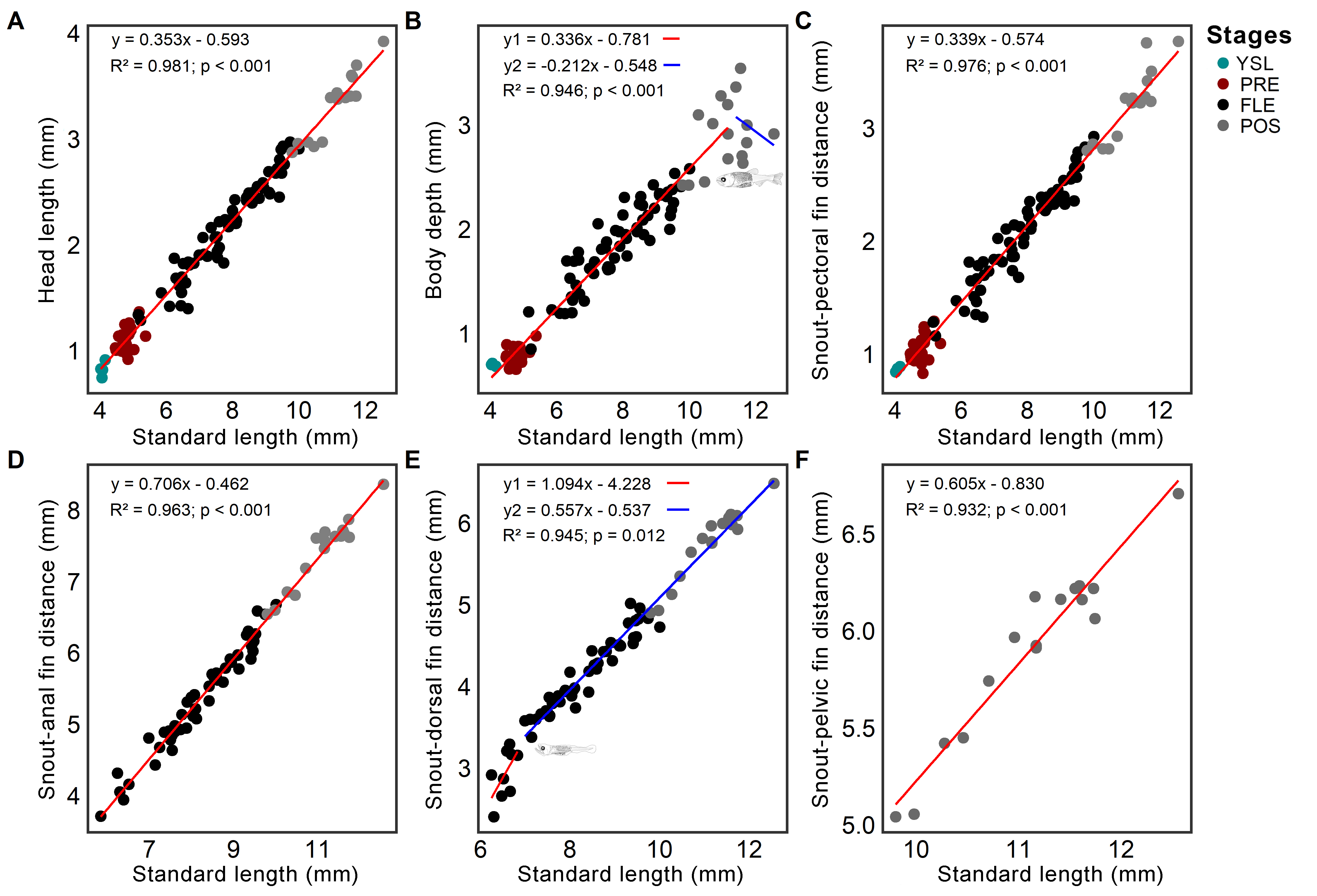
Regarding the variables associated with standard length, body depth (BD/SL) and the snout-to-dorsal fin base length (SND/SL) are the only ones to exhibit a pattern of discontinuous isometric growth, as indicated by segmented linear regression. In this growth model, both variables grow proportionally to standard length until they show a reduction in growth rate: for BD, this change occurs in the postflexion stage, at 11.41 mm, while for SND, it occurs in the flexion stage, at 6.99 mm. By contrast, head length (HL/SL) and the snout-to-fin base lengths for the pectoral (SNP/SL), anal (SNA/SL), and pelvic fins (SNV/SL) show continuous isometric growth, as evidenced by simple linear regression. This indicates that, throughout all developmental stages, these structures grow in the same proportion as standard length (SL) (Tab. 2; Figs. 6A–F).
Variables analyzed (mm), minimum values (Min), maximum values (Max), mean (Mean), standard deviation (SD), number of individuals analyzed (n), and morphometric (%) and meristic relationships found for the morphometric and meristic variables obtained from larval and juvenile Brycon falcatus. Head depth (HD), body depth (BD), head length (HL), snout length (SNL), snout to anus length (SNAN), standard length (SL), eye diameter (ED), snout to anal fin distance (SNA), snout to dorsal fin distance (SND), snout to pectoral fin distance (SNP), snout to pelvic fin distance (SNV), absent fin (AF) and not visible (NV).
Mathematical and statistical values of the linear (L), quadratic (Q), and piecewise linear (S) regressions for morphometric variables in relation to head and standard length in Brycon falcatus during the larval period. R² = Coefficient of determination, BM = Best model, BP = Breakpoint, L = Simple linear regression, Q = Quadratic regression, S = Piecewise regression, n = Number of individuals. Values in bold: p < 0.05.

Body growth of variables related to head length during the larval development of Brycon falcatus. A. Eye diameter, B. Head depth, and C. Snout length.

Body growth of variables related to standard length during the larval development of Brycon falcatus. A – Head length, B – Body depth, C – Snout-pectoral fin distance, D – Snout-anal fin distance, E – Snout-dorsal fin distance, and F – Snout-pelvic fin distance.
Identification key for Brycon species from the Tapajós River sub-basin during the larval period
1a. Total myomeres ranging from 38 to 40; uniform pigmentation throughout the body.................... B. aff. pesu
1b. Total myomeres ≥ 41; pigmentation restricted to certain parts of the body.................... 2
2a. Embryonic membrane in the ventral region pigmented; body with well-defined pigmentation extending from the head to the anus and beyond the anus, with the entire body being hyaline.................... B. falcatus
2b. Embryonic membrane in the ventral region without pigmentation; body with diffuse or absent pigmentation, without clear boundaries, occurring irregularly.................... 3
3a. Pigments dispersed in the dorsal region of the head; swim bladder internally pigmented, forming a circle.................... B. melanopterus
3b. Pigments clustered in the dorsal region of the head; swim bladder internally pigmented, but not forming a circle.................... B. amazonicus
DISCUSSION
We investigate the early development of the matrinxã B. falcatus from the Tapajós River sub-basin. The findings provide a detailed identification of the larvae and juveniles of this species, enabling comparisons with its congeners and contributing to understanding of the systematics of the Brycon in the region. Additionally, this study describes growth patterns during the larval period, highlighting essential biological traits in the early life stages of fish. The early development of B. falcatus is altricial, meaning individuals are poorly developed at hatching and undergo significant morphological changes, such as yolk sac absorption and the formation of essential structures like fins and eyes. According to Nakatani et al. (2001), most economically important neotropical species have newly hatched larvae with altricial characteristics, a trait commonly observed in several Bryconidae species (Reynalte-Tataje et al., 2004; Oliveira et al., 2012; Villada-Agudelo et al., 2021).
The mouth with numerous conical teeth, a long maxilla extending to the posterior margin of the eye, and an intestine that surpasses the mid-body region, are common features in the early stages of Bryconidae species (Nakatani et al., 2001; Oliveira et al., 2012; Faustino et al., 2015; Oliveira et al., 2020; Lima et al., 2021). Among Characiformes, Acestrorhynchidae and Cynodontidae are most similar to Bryconidae due to the presence of teeth in the early stages. However, Acestrorhynchidae larvae can be distinguished from Bryconidae by their maxilla, which extends only to the middle of the eye, and by their pointed snout in more advanced stages (Ponton, Mérigoux, 2001). Conversely, Cynodontidae larvae have a very long maxilla, approximately twice the eye size, and possess extraoral teeth (Nakatani et al., 2001; Sousa, Severi, 2002; Cajado et al., 2024; Santos et al., 2025).
The taxonomic identification of fish larvae uses integrated methods that combine morphological, meristic, and morphometric analyses, fundamental approaches for distinguishing these organisms in their early developmental stages (Nakatani et al., 2001; Reynalte-Tataje et al., 2020; Cajado et al., 2024). However, these techniques differ from those applied to adult individuals, as larvae exhibit distinct body structures and undergo significant transformations during ontogeny, and such changes make the direct correlation between larvae and adults challenging (Oliveira et al., 2022).
In this context, the relationship between the number of vertebrae, present in adults, and the number of myomeres, counted in larvae, emerges as a crucial tool for accurate taxonomic identification, enabling a reliable association between larvae and their respective adults periods (Snyder, 1979; Santos et al., 2024; Oliveira et al., 2024). In the case of B. falcatus, the myomere count in larvae is consistent with the vertebral count described for adults when considering the established relationship in which the number of myomeres corresponds to the total number of vertebrae plus one segment (Snyder, 1979). This correlation was confirmed by Lima (2017) in the osteological analysis of adult specimens. Thus, B. falcatus larvae can be distinguished by their myomere count, which ranges from 42 to 44, while B. amazonicus presents between 45 and 46 myomeres, B. melanopterus ranges from 46 to 47 (Lima et al., 2021), and B. aff. pesu displays between 38 and 40 myomeres (FKSSC, 2025, pers. obs.).
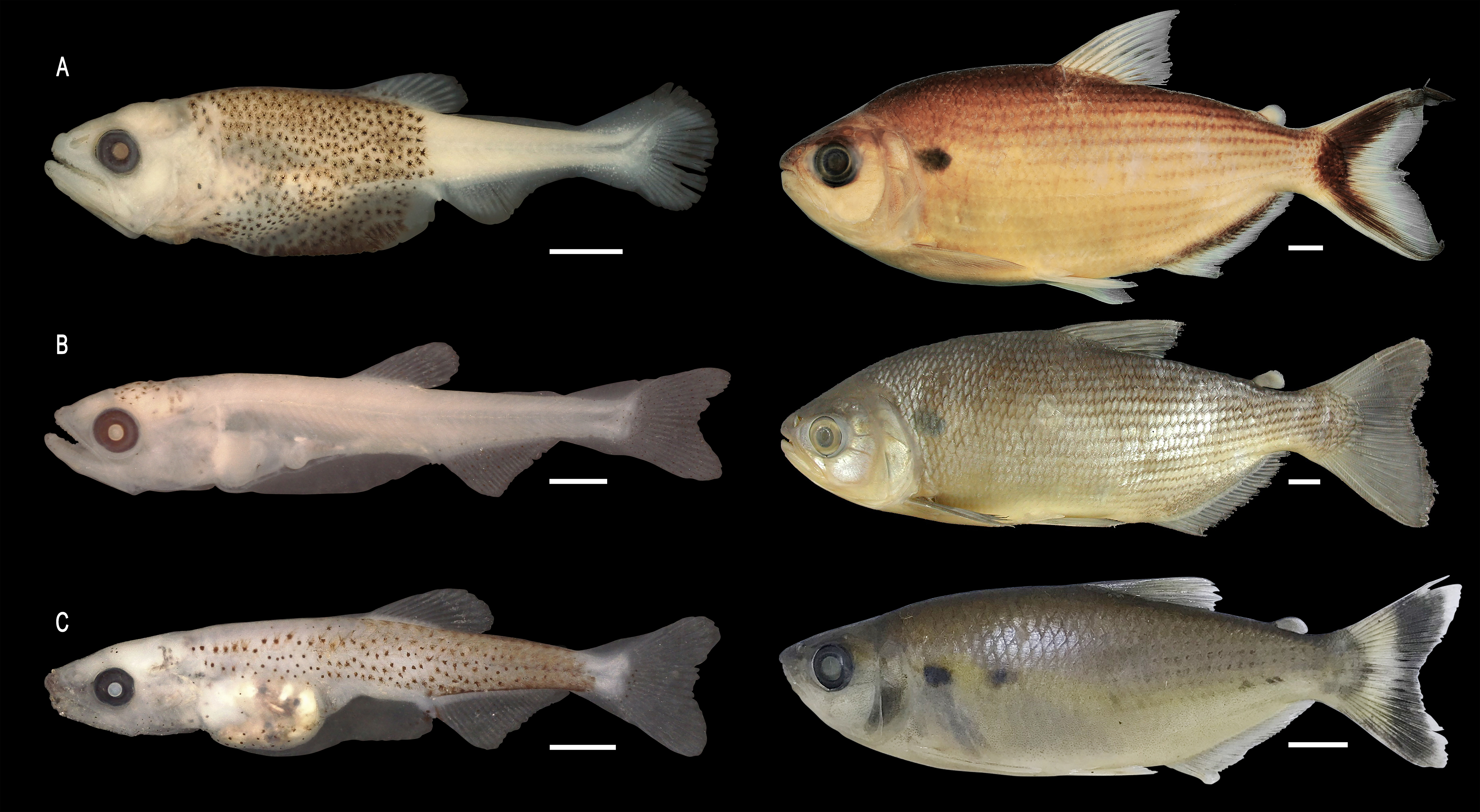
The larvae of B. falcatus are also distinguished from other species by their well-defined pigments in the anterior region of the body, including the ventral section of the embryonic membrane, while the posterior part of the body is predominantly hyaline. In contrast, B. aff. pesu displays uniform pigmentation across the entire body and, in more advanced stages (postflexion), develops a dark stripe parallel to the lateral line on the caudal peduncle and at the base of the anal fin (FKSSC, 2025, pers. obs.). In B. amazonicus, pigments are sparse and diffusely distributed throughout the body, with chromatophores located on the dorsal, anal, and caudal fins, as well as more intense markings on the dorsal region of the head (Lima et al., 2021). Finally, B. melanopterus exhibits a similar pattern but can be distinguished by a striking feature: the complete internal pigmentation of the swim bladder, forming a well-defined circular mark that extends to the tip of the anus. This characteristic was observed in larval images published by Palacios, Ceballos (2012) in a study on feeding in a fish farming environment, which, although not taxonomic in focus, provided an important visual record of the species. It is evident that pigmentation stands out as the primary characteristic that differentiates B. falcatus from other Amazonian species (Fig. 7), similar to what has been observed in other taxonomic descriptions of Bryconidae larvae, where pigmentation often serves as a key criterion for species differentiation (Nakatani et al., 2001; Oliveira et al., 2012).
The final distinguishing larval traits that also help differentiate the species are body depth and fin positioning. From the flexion stage onward, B. falcatus displays a deeper body, with a body depth ratio exceeding 20%, classifying it as moderate, while B. amazonicus and B. aff. pesu larvae have a body depth ratio below 20%, classifying them as elongated (FKSSC, 2025, pers. obs.; Lima et al., 2021). In addition, in more developed larvae of B. aff. pesu, the dorsal and anal fins overlap, a feature absent in B. falcatus. Finally, to distinguish the juveniles, B. falcatus has 24 to 25 rays in the anal fin, while B. aff. pesu has only 20 rays (FKSSC, 2025, pers. obs.; Lima et al., 2021).

Comparative illustration of larvae in flexion of Brycon in lateral view of the body and their respective adults: A. B. falcatus – larva with 10.01 mm and adult with 165.30 mm; B. B. amazonicus – larva with 10.27 mm and adult with 184.40 mm; and C. B. aff. pesu – larva with 9.40 mm and adult with 100.00 mm. Scale bars for larvae = 1 mm and for adults = 10 mm. Adults of B. falcatus and B. amazonicus used from Lima (2017).
During the yolk-sac stage, B. falcatus resembles other Brycon larvae, showing poorly developed pigmentation after hatching, which gradually intensifies as the larvae progress in their development (Oliveira et al., 2012; Neumann et al., 2018; Lima et al., 2021). The initial transparency, characteristic of this stage, plays an important role during drift, when the larvae are passively transported by the current and are more vulnerable to predation, benefiting from camouflage to increase their chances of survival (Faustino et al., 2015). In contrast, during the preflexion stage, the larvae develop pigmented eyes of relatively large size, highlighting the development of acute vision, which is essential for locating and capturing prey. Additionally, at this stage, the presence of teeth reinforces the species’ voracity and active predatory behavior. According to Reynalte-Tataje et al. (2004), during the larval period, Brycon larvae have highly developed and pigmented eyes, allowing them to visually target prey, which represents a significant adaptive advantage.
The adhesive organ observed during larval development (yolk-sac and preflexion stages) in B. falcatus is a morphological feature common among Bryconidae (Nakatani et al., 2001). This organ allows larvae, shortly after hatching, to temporarily attach to the water surface through surface tension or to other floating structures, enhancing dispersal and increasing the chances of reaching nursery areas, which contributes to their survival (Santos, Godinho, 2002). This adaptation is especially important because the larvae have limited swimming ability and are subject to passive drift caused by the current (Oliveira et al., 2012).
The sequence of appearance of the fins is characteristic of the genus Brycon, following the order: pectoral, caudal, dorsal, anal, and pelvic fins (Nakatani et al., 2001; Oliveira et al., 2012; Lima et al., 2021). This sequence is also widely observed in the order Characiformes (Sanches et al., 2001; Marinho, 2017; Santos et al., 2020b; Souza et al., 2023). The number of rays in the dorsal and anal fins during the postflexion stage, as well as in the other fins during the juvenile period, matches the pattern observed in adults of the species (Lima, 2017). Fin development is directly related to the swimming process in fish with altricial development (Portella et al., 2014; Cajado et al., 2024; Santos et al., 2025). In B. falcatus, from the flexion stage onward, these structures rapidly form, shortly after the disappearance of the adhesive organ. Thus, the fins act as a new mechanism influencing larval behavior and enhancing both movement and dispersal.
The morphometric relationships and changes in eye diameter, head length, and body depth in Brycon falcatus are similar to those observed in B. orbignyanus (Valenciennes, 1850), described by Nakatani et al. (2001), and B. hilarii (Valenciennes, 1850), described by Oliveira et al. (2012). This demonstrates that, despite differences in habitat, species within the genus Brycon share similar morphometric patterns.
According to Balon (1984), growth occurs through a prolonged sequence of stable stages, interrupted by abrupt changes, a concept known as the saltatory ontogeny theory. In the case of B. falcatus, only body depth and the distance from the snout to the origin of the dorsal fin showed breakpoints, occurring at the postflexion and flexion stages, respectively. These variables, which showed discontinuous growth, revealed breakpoints indicating transitions between different stages within the same period, as reported by Bialetzki et al. (2008). These transitional stages (flexion and postflexion) were also observed in the growth of B. hilarii and several other species of Characiformes, highlighting a similarity in developmental break patterns across these species (Oliveira et al., 2012; Silva et al., 2022; Oliveira et al., 2024). Such stages represent critical morphological transitions common to many fish taxa and can influence larval growth patterns, likely contributing to the breakpoints observed in growth rate.
These transition points observed in the growth of B. falcatus are only considered relevant when associated with morphological, physiological, or survival-related factors (Kováč et al., 1999). Thus, for body depth, this suggests that most external changes take place during these stages of the species’ life history, possibly influenced by dietary shifts, muscle development, and fin formation (Taguti et al., 2009; Marinho, 2022). The interruption in the growth of the distance between the snout and the base of the dorsal fin, observed as a decrease in the growth rate after the breakpoint, may be explained by the formation of the fin rays. As these rays develop, they take up more space in the anterior region of the body, which in turn reduces the distance between these structures. Furthermore, the process of fin growth and formation plays a crucial role in promoting faster body development, as it enhances swimming ability. It is particularly essential for larval survival because it facilitates environmental exploration in search of food and enables escape from potential predators (Santos et al., 2024).
The positive allometry observed in the snout of B. falcatus indicates that, as the species grows, the snout develops faster than the head, becoming a more prominent and functional structure. This adaptation is directly related to feeding aspects, since the snout, in addition to housing the mouth, plays an essential role in the development of teeth, which emerge during the preflexion stage and are crucial for prey capture and food ingestion (Oliveira et al., 2012). Furthermore, throughout development, this accelerated growth may be influenced by changes in the size and difficulty of capturing food items (Gisbert et al., 2002; Oliveira et al., 2024). In the case of B. falcatus, the positive allometry of the snout is consistent with what has been observed in other species with similar feeding habits, such as Piaractus brachypomus (Cuvier, 1818) and Triportheus albus Cope, 1872 (Santos et al., 2022; Cajado et al., 2023).
Allometric patterns refer to the differential growth of body parts in relation to others, resulting in proportional changes in the organism’s shape or function throughout its development (Ticiani et al., 2022; Xu et al., 2023). These patterns reflect morphological adaptations, often associated with ecological and functional variations at different stages of ontogeny (Gisbert, 1999; Cajado et al., 2024). Consequently, allometric growth, particularly during the early stages of development, is considered an adaptive strategy to minimize environmental pressures, increasing the organism’s chances of survival and growth (Fuiman, 1983; Osse, Van den Boogaart, 1999).
The larval growth of B. falcatus predominantly follows a continuous isometric profile, a pattern that has received little attention in the literature, as most species of Neotropical fish exhibit discontinuous isometry or allometry during early development (Kováč et al., 1999; Bialetzki et al., 2008; Oliveira et al., 2012; Silva et al., 2022; Oliveira et al., 2024). This characteristic may represent an adaptation to the species’ habitat; however, since it is restricted to the larval period, it should be interpreted with caution. Nevertheless, these findings provide valuable insights into the morphological changes during the early stages of development. For example, the continuous isometry observed in the growth of the eye, body depth, and head length may be related to the fact that B. falcatus completes its early life cycle within the river channel, a behavior similar to that described for other Bryconidae species (Oliveira et al., 2012; Cajado et al., 2018).
This pattern is further supported by collection records, which identified all larval stages exclusively drifting within the channels of the Teles Pires and Tapajós rivers. The environmental stability, with no significant changes in the ecological niche, particularly in feeding habits, which are primarily based on the predation of larvae of other Characiformes, such as Anostomidae, may explain the absence of pronounced variations in growth rates (FKSSC, 2025, pers. obs.). In general, fluctuations in these parameters are associated with shifts in feeding behavior, which mainly occur when the species migrates to a new environment (Kováč et al., 1999; Oliveira et al., 2022). Another relevant aspect is the continuous growth of the region from the snout to the anal and pelvic fins, with no breakpoints. This may be related to the late formation of these fins, which are still absent during the early stages (Bialetzki et al., 2008).
Brycon falcatus larvae and juveniles exhibit distinctive characteristics compared to their congeners, initially evidenced by meristic variations, especially in the myomeres, which serve as diagnostic data due to their relationship with vertebrae. Subsequently, morphological variations, such as pigmentation patterns, allow for easy species differentiation. Lastly, morphometric analysis applied to more advanced developmental stages confirms species-level differentiation. The growth of head structures and most body variables follow a continuous pattern, while body depth and the distance from the snout to the origin of the dorsal fin exhibit discontinuous growth. Although this partially aligns with the saltatory ontogeny theory, which describes growth as periods of stability interrupted by abrupt changes, the fact that only two variables exhibit this pattern suggests that the development of B. falcatus does not fully fit the classic model. The most evident morphological changes occur during the transition from yolk-sac to preflexion stages, and after the development of the pelvic fin in the postflexion stage. Taxonomic information is essential for the accurate identification of B. falcatus, allowing for its precise recognition in ichthyoplankton samples. Additionally, the growth patterns observed during larval development show few abrupt changes, which aligns with the species’ early life history, as it apparently completes its entire larval cycle within the main river channel, providing valuable insights for the development of management and conservation strategies.
ACKNOWLEDGEMENTS
This study is part of the master’s dissertation of the first author (FKSSC) in the Programa de Pós-Graduação em Biodiversidade (PPGBEES) at Universidade Federal do Oeste do Pará (UFOPA), who gratefully acknowledges all the excellence and support. The authors also thank the Laboratório de Ecologia do Ictioplâncton e Pesca em Águas Interiores (LEIPAI) of the UFOPA and the Laboratório de Ictiologia Tropical (LIT) of the Universidade Federal do Mato Grosso (UFMT) for their essential technical support.
REFERENCES
-
Abe KT, Mariguela TC, Avelino GS, Foresti F, Oliveira C. Systematic and historical biogeography of the Bryconidae (Ostariophysi: Characiformes) suggesting a new rearrangement of its genera and an old origin of Mesoamerican ichthyofauna. Evol Biol. 2014; 14(152):1–15. https://doi.org/10.1186/1471-2148-14-152
» https://doi.org/10.1186/1471-2148-14-152 -
Ahlstrom EH, Moser HG. Eggs and larvae of fishes and their role in systematic investigations and in fisheries. Rev Trav Inst Peches Marit. 1976; 40(3–4):379–98. Available from: https://archimer.ifremer.fr/doc/00000/1996/
» https://archimer.ifremer.fr/doc/00000/1996/ - Ahlstrom EH, Butler JL, Sumida BY. Pelagic stromateoid fishes (Pisces, Perciformes) of the Eastern Pacific: kinds, distributions, and early life histories and observations on five of these from the Northwest Atlantic. Bull Mar Sci. 1976; 26(3):285–402.
-
Albrecht MP, Caramaschi EP, Horn MH. Population responses of two omnivorous fish species to impoundment of a Brazilian tropical river. Hydrobiologia. 2009; 627(1):181–93. https://doi.org/10.1007/s10750-009-9727-7
» https://doi.org/10.1007/s10750-009-9727-7 - Andrade-Talmelli EF, Kavamoto ET, Romagosa E, Verani NF. Embryonic and larval development of the “piabanha”, Brycon insignis, Steindachner, 1876 (Pisces, Characidae). Bol Inst Pesca. 2001; 27(1):21–28.
-
Araujo IB, Lima AMM, Santos CA. Caracterização hidrogeomorfológica das paisagens componentes da bacia hidrográfica do rio Tapajós. Encicl Biosfera. 2015; 11(22):3301–27. http://dx.doi.org/10.18677/Enciclopedia_Biosfera_2015_046
» http://dx.doi.org/10.18677/Enciclopedia_Biosfera_2015_046 - Arias AM. Desarrollo larval de Brycon guatemalensis (Regan, 1908) (Pisces: Characidae). Brenesia. 2006; 66:31–36.
-
Ayala DM, Lima MAL, Hauser M, Doria CRC. Jatuarana fishing dynamics Brycon amazonicus (Spix & Agassiz, 1829) of the upper and middle Madeira River Basin. Acta Sci Biol Sci. 2018; 40(1):e34591. https://doi.org/10.4025/actascibiolsci.v40i1.34591
» https://doi.org/10.4025/actascibiolsci.v40i1.34591 - Balon EK. The theory of saltatory ontogeny and life history models revisited. In: Balon EK, editor. Early life histories of fishes: new development, ecological and evolutionary perspectives. Dordrecht: Dr W. Junk Publishers; 1984. p.13–30.
-
Bialetzki A, Nakatani K, Sanches PV, Baumgartner G, Makrakis MC, Taguti TL. Desenvolvimento inicial de Hoplias aff. malabaricus (Bloch, 1794) (Osteichthyes, Erythrinidae) da planície alagável do alto rio Paraná, Brasil. Acta Sci Biol Sci. 2008; 30(2):141–49. https://doi.org/10.4025/actascibiolsci.v30i2.3608
» https://doi.org/10.4025/actascibiolsci.v30i2.3608 -
Cajado RA, Oliveira LS, Oliveira CC, Ponte SCS, Bittencourt SCS, Queiroz HL et al. Distribuição de larvas de Brycon amazonicus (Pisces: Bryconidae) no entorno da Reserva de Desenvolvimento Sustentável Mamirauá: Base ecológica para manejo. Rev Iberoam Cienc Ambient. 2018; 9(6):78–87. https://doi.org/10.6008/CBPC2179-6858.2018.006.0010
» https://doi.org/10.6008/CBPC2179-6858.2018.006.0010 -
Cajado RA, Silva FKS, Oliveira LS, Santos Z, Bialetzki A, Zacardi DM. Early life history of two Neotropical Triportheidae fish (Characiformes). Neotrop Ichthyol. 2023; 21(1):e220102. https://doi.org/10.1590/1982-0224-2022-0102
» https://doi.org/10.1590/1982-0224-2022-0102 -
Cajado RA, Zacardi DM, Silva FKS, Oliveira LS, Giarrizzo T. Early ontogenetic development of Cynodon gibbus (Characiformes: Cynodontidae) in the Amazon River basin. Neotrop Ichthyol. 2024; 22(3):e240012. https://doi.org/10.1590/1982-0224-2024-0012
» https://doi.org/10.1590/1982-0224-2024-0012 - Carvalho LN, Germanos E. Peixes que plantam árvores: educação ambiental para sustentabilidade. In: Moreira PSA, Santos JP, editors. Educação Ambiental. Cuiabá: Fundação Uniselva/MT Ciência; 2023. p.54–62.
-
Carvalho LN, Santos JJB, Correa SB. Fish thieves: an alternative tactic of food capture in a Neotropical frugivorous species (Brycon falcatus). Austral Ecol. 2022; 47(5):1140–43. https://doi.org/10.1111/aec.13201
» https://doi.org/10.1111/aec.13201 - Conselho Nacional de Controle e Experimentação Animal (CONCEA). Normativas do CONCEA para produção, manutenção ou utilização de animais em atividades de ensino ou pesquisa científica. Brasília: Ministério da Ciência, Tecnologia e Inovação; 2013.
-
Dagosta FCP, de Pinna M. The fishes of the Amazon: distribution and biogeographical patterns, with a comprehensive list of species. Bull Am Mus Nat Hist. 2019; 2019(431):1–163. https://doi.org/10.1206/0003-0090.431.1.1
» https://doi.org/10.1206/0003-0090.431.1.1 - Faber DJ, Gadd S. Several drawing techniques to illustrate larval fishes. Trans Am Fish Soc. 1983; 112(2B):349–53.
-
Farinosi F, Arias ME, Lee E, Longo M, Pereira FF, Livino A et al. Future climate and land use change impacts on river flows in the Tapajós Basin in the Brazilian Amazon. Earth’s Future. 2019; 7(8):993–1017. https://doi.org/10.1029/2019EF001198
» https://doi.org/10.1029/2019EF001198 -
Faustino F, Makino LC, Neumann E, Nakaghi LSO. Morphological and morphometric aspects of early life stages of piabanha Brycon gouldingi (Characidae). J Fish Biol. 2015; 86(5):1491–506. https://doi.org/10.1111/jfb.12652
» https://doi.org/10.1111/jfb.12652 -
Fricke R, Eschmeyer WN, Van der Laan R. Eschmeyer’s catalog of fishes: genera, species, references [Internet]. São Francisco: California Academy of Science; 2025. Available from: http://researcharchive.calacademy.org/research/ichthyology/catalog/fishcatmain.asp
» http://researcharchive.calacademy.org/research/ichthyology/catalog/fishcatmain.asp -
Fuiman LA. Growth gradients in fish larvae. J Fish Biol. 1983; 23(1):117–23. https://doi.org/10.1111/j.1095-8649.1983.tb02886.x
» https://doi.org/10.1111/j.1095-8649.1983.tb02886.x -
Gallardo ALCF, Silva JC, Gaudereto GL, Sozinho DWF. A avaliação de impactos cumulativos no planejamento ambiental de hidrelétricas na bacia do rio Teles Pires (região amazônica). Desenv Meio Ambiente. 2017; 43(special edition):22–47. https://doi.org/10.5380/dma.v43i0.53818
» https://doi.org/10.5380/dma.v43i0.53818 - García-Dávila CR, Ribeiro HS, Silva MAF, Loayza JEM, Chávez CACA, Ruiz DC et al. Peces de consumo de la Amazonía peruana. Iquitos: Instituto de Investigaciones de la Amazonía Peruana (IIAP); 2018.
-
Gisbert E. Early development and allometric growth patterns in Siberian sturgeon and their ecological significance. J Fish Biol. 1999; 54(4):852–62. https://doi.org/10.1111/j.1095-8649.1999.tb02037.x
» https://doi.org/10.1111/j.1095-8649.1999.tb02037.x -
Gisbert E, Merino G, Muguet JB, Bush D, Piedrahita RH, Conklin DE. Morphological development and allometric growth patterns in hatchery-reared California halibut larvae. J Fish Biol. 2002; 61(5):1217–29. https://doi.org/10.1006/jfbi.2002.2137
» https://doi.org/10.1006/jfbi.2002.2137 -
Gomes RZ, Sato Y, Rizzo E, Bazzoli N. Early development of Brycon orthotaenia (Pisces: Characidae). Zygote. 2011; 21(1):11–20. https://doi.org/10.1017/S0967199411000311
» https://doi.org/10.1017/S0967199411000311 -
Jézéquel C, Tedesco PA, Bigorne R, Maldonado-Ocampo JA, Ortega H, Hidalgo M et al. A database of freshwater fish species of the Amazon Basin. Sci Data. 2020; 7(1):1–09. https://doi.org/10.1038/s41597-020-0436-4
» https://doi.org/10.1038/s41597-020-0436-4 -
Kováč V, Copp GH, Francis MP. Morphometry of the stone loach, Barbatula barbatula: do mensural characters reflect the species’ life history thresholds? Environ Biol Fish. 1999; 56(1–2):105–15. https://doi.org/10.1023/A:1007570716690
» https://doi.org/10.1023/A:1007570716690 -
L’avrinčíková M, Kováč V, Katina S. Ontogenetic variability in external morphology of round goby Neogobius melanostomus from Middle Danube, Slovakia. J Appl Ichthyol. 2005; 21(4):328–34. https://doi.org/10.1111/j.1439-0426.2005.00677.x
» https://doi.org/10.1111/j.1439-0426.2005.00677.x - Leis JM, Trnski T. The larvae of Indo-Pacific shorefishes. Honolulu: University of Hawaii Press; 1989.
-
Lima DLG, Cajado RA, Silva LVF, Maia JLS, Zacardi DM. Descrição morfológica do desenvolvimento inicial de Brycon amazonicus (Characiformes, Bryconidae) do baixo Amazonas, Pará. Biota Amazôn. 2021; 11(1):60–77. http://dx.doi.org/10.18561/2179-5746/biotaamazonia.v11n1p60-67
» http://dx.doi.org/10.18561/2179-5746/biotaamazonia.v11n1p60-67 -
Lima FCT. A revision of the cis-andean species of the genus Brycon Müller & Troschel (Characiformes: Characidae). Zootaxa. 2017; 4222(1):1–189. https://doi.org/10.11646/zootaxa.4222.1.1
» https://doi.org/10.11646/zootaxa.4222.1.1 -
Lucanus O, Kalacska M, Arroyo-Mora JP, Sousa L, Carvalho LN. Before and After: a multiscale remote sensing assessment of the Sinop Dam, Mato Grosso, Brazil. Earth. 2021; 2(2):303–30. https://doi.org/10.3390/earth2020018
» https://doi.org/10.3390/earth2020018 -
Maria AN, Ninhaus-Silveira A, Orfão LH, Viveiros ATM. Embryonic development and larval growth of Brycon nattereri Günther, 1864 (Characidae) and its implications for captive rearing. Zygote. 2017; 25(6):711–18. https://doi.org/10.1017/S0967199417000594
» https://doi.org/10.1017/S0967199417000594 -
Marinho MMF. Comparative development in Moenkhausia pittieri and Paracheirodon innesi (Ostariophysi: Characiformes) with comments on heterochrony and miniaturization in the Characidae. J Fish Biol. 2017; 91(3):851–65. https://doi.org/10.1111/jfb.13384
» https://doi.org/10.1111/jfb.13384 -
Marinho MMF. Ontogeny of the skeleton of Moenkhausia pittieri (Ostariophysi: Characiformes) with discussion on functional demands and ossification patterns in the Characidae. Zool J Linn Soc. 2022; 197(2):474–513. https://doi.org/10.1093/zoolinnean/zlac029
» https://doi.org/10.1093/zoolinnean/zlac029 -
Matos LS, Parisotto DC, Carvalho LN. Length-weight relationship and condition factor of the Characidae matrinxã, Brycon falcatus (Müller & Troschel, 1844), in the Teles Pires River, southern Amazon. J Appl Ichthyol. 2017a; 34(4):724–28. https://doi.org/10.1111/jai.13576
» https://doi.org/10.1111/jai.13576 - Matos LS, Santana HS, Silva JOS, Carvalho LN. Percepção dos pescadores profissionais artesanais sobre o declínio na captura do peixe matrinxã no rio Teles Pires, bacia do Tapajós. In: Prandel JA, editor. Padrões ambientais emergentes e sustentabilidade dos sistemas. Ponta Grossa: Atena Editora; 2020. p.87–101.
-
Matos LS, Silva JOS, Andrade PSM, Carvalho LN. Diet of characin, Brycon falcatus (Müller & Troschel, 1844) in the Amazon Basin: a case study on an attractant for fish in the Teles Pires River. J Appl Ichthyol. 2016a; 32(5):1080–85. https://doi.org/10.1111/jai.13108
» https://doi.org/10.1111/jai.13108 -
Matos LS, Silva JOS, Beckmann MA, Moreira PSA, Oliveira AS, Carvalho LN. Effect of dietary supplement (cevas) on the chemical composition of wild fish Brycon falcatus Müller & Troschel, 1844 in the Teles Pires river basin. Acta Sci Biol Sci. 2017b; 39(1):7–12. https://doi.org/10.4025/actascibiolsci.v39i1.30470
» https://doi.org/10.4025/actascibiolsci.v39i1.30470 -
Matos LS, Silva JOS, Kasper D, Carvalho LN. Assessment of mercury contamination in Brycon falcatus (Characiformes: Bryconidae) and human health risk by consumption of this fish from the Teles Pires River, Southern Amazonia. Neotrop Ichthyol. 2018; 16(1):e160106. https://doi.org/10.1590/1982-0224-20160106
» https://doi.org/10.1590/1982-0224-20160106 -
Matos LS, Silva DR, Silva JOS, Andrade RLT, Carvalho LN. Heavy metal bioaccumulation of the characiform Brycon falcatus Muller & Troschel, 1844 in the Teles Pires basin, Southern Amazon. Acta Sci Biol Sci. 2016b; 38(2):131–38. https://doi.org/10.4025/actascibiolsci.v38i2.30656
» https://doi.org/10.4025/actascibiolsci.v38i2.30656 - Muggeo VMR. Segmented: an R package to fit regression models with broken-line relationships. R news. 2008; 8(1):20–25.
- Nakatani K, Agostinho AA, Bialetzki A, Baumgartner G, Sanches PV, Makrakis M et al. Ovos e larvas de peixes de água doce: desenvolvimento e manual de identificação. Maringá: EDUEM; 2001.
-
Neumann E, Paes MCF, Mendes JMR, Braga FMS, Nakaghi LSO. Larval development of Brycon amazonicus (Teleostei: Bryconidae) with a focus on locomotory, respiratory and feeding structures. J Fish Biol. 2018; 93(5):1141–50. https://doi.org/10.1111/jfb.13832
» https://doi.org/10.1111/jfb.13832 - Ohara WM, Lima FCT, Salvador GN, Andrade MC. Peixes do rio Teles Pires: diversidade e guia de identificação. Aparecida de Goiânia: Gráfica Amazonas e Editora Ltda-EPP; 2017.
-
Oliveira FGD, Bialetzki A, Gomes LC, Santin M, Taguti TL. Desenvolvimento larval de Brycon hilarii (Characiformes, Characidae). Iheringia Sér Zool. 2012; 102(1):62–70. https://doi.org/10.1590/S0073-47212012000100009
» https://doi.org/10.1590/S0073-47212012000100009 -
Oliveira LS, Cajado RA, Silva FKS, Andrade MC, Zacardi DM. Early development of two commercially valuable fish from the lower Amazon River, Brazil (Characiformes: Serrasalmidae). Neotrop Ichthyol. 2022; 20(1):e210024. https://doi.org/10.1590/1982-0224-2021-0024
» https://doi.org/10.1590/1982-0224-2021-0024 -
Oliveira LS, Cajado RA, Silva FKS, Santos Z, Oliveira EC, Silva-Oliveira C et al. External morphology and growth patterns of larvae and juveniles of Bryconops gracilis (Characiformes, Iguanodectidae) from Amazon basin. Zoology. 2024; 167:126210. https://doi.org/10.1016/j.zool.2024.126210
» https://doi.org/10.1016/j.zool.2024.126210 -
Oliveira RSF, Gargur P, Gomes MVT, Marinho SAM, Santos JE, Brito MFG. Embryogenesis and larval development of migratory matrinchã Brycon orthotaenia Günther 1864 (Characiformes: Bryconidae). J Appl Ichthyol. 2020; 36(5):613–23. https://doi.org/10.1111/jai.14065
» https://doi.org/10.1111/jai.14065 -
Osse JWM, Van den Boogaart JGM. Dynamic morphology of fish larvae, structural implications of friction forces in swimming, feeding and ventilation. J Fish Biol. 1999; 55:156–74. https://doi.org/10.1006/jfbi.1999.1071
» https://doi.org/10.1006/jfbi.1999.1071 - Palacios PP, Ceballos RL. Seguimiento del desarrollo post-larvario del sábalo amazónico (Brycon melanopterus) en un estanque excavado en la estación piscícola del Centro Experimental Amazónico de Corpoamazonia, Mocoa, Departamento del Putumayo, Colombia. Corpo Amazônia. 2012; 1:1–19.
- Ponton D, Mérigoux S. Description and ecology of some early life stages of fishes in the River Sinnamary (French Guiana, South America). Folia Zool. 2001; 50:1–116.
-
Portella MC, Jomori RK, Leitão NJ, Menossi OCC, Freitas TM, Kojima JT et al. Larval development of indigenous South American freshwater fish species, with particular reference to pacu (Piaractus mesopotamicus): a review. Aquaculture. 2014; 432:402–17. https://doi.org/10.1016/j.aquaculture.2014.04.032
» https://doi.org/10.1016/j.aquaculture.2014.04.032 -
Reynalte-Tataje D, Zaniboni–Filho E, Esquivel JR. Desenvolvimento embrionário e larval da piracanjuba, Brycon orbignyanus, Valenciennes, 1849 (Pisces, Characidae). Acta Sci Biol Sci. 2004; 26(1):67–71. https://doi.org/10.4025/actascibiolsci.v26i1.1660
» https://doi.org/10.4025/actascibiolsci.v26i1.1660 -
Reynalte-Tataje DA, Lopes CA, Massaro MV, Hartmann PB, Sulzbacher R, Santos JA et al. State of the art of identification of eggs and larvae of freshwater fish in Brazil. Acta Limnol Bras. 2020; 32:e6. http://dx.doi.org/10.1590/s2179-975x5319
» http://dx.doi.org/10.1590/s2179-975x5319 - Ruffino ML. A pesca e os recursos pesqueiros na Amazônia brasileira. Manaus: ProVárzea, Projeto Manejo dos Recursos Naturais da Várzea, IBAMA MMA; 2004.
-
Sanches PV, Baumgartner G, Bialetzki A, Suibert MR, Gomes FDC, Nakatani K et al. Caracterização do desenvolvimento inicial de Leporinus friderici (Osteichthyes, Anostomidae) da bacia do rio Paraná, Brasil. Acta Sci Biol Sci. 2001; 23(2):383–89. https://doi.org/10.4025/actascibiolsci.v23i0.2693
» https://doi.org/10.4025/actascibiolsci.v23i0.2693 -
Santos DC, Oliveira LS, Silva FKS, Cajado RA, Zacardi DM. Early ontogeny of the freshwater fish Rhytiodus microlepis (Characiformes, Anostomidae) from the Amazon basin. J Fish Biol. 2024; 104(5):1339–49. https://doi.org/10.1111/jfb.15659
» https://doi.org/10.1111/jfb.15659 -
Santos JA, Correa SB, Boudreau MR, Carvalho LN. Differential ontogenetic effects of gut passage through fish on seed germination. Acta Oecol. 2020a; 108:103628. https://doi.org/10.1016/j.actao.2020.103628
» https://doi.org/10.1016/j.actao.2020.103628 -
Santos JA, Iquematsu MS, Soares CM, Galdioli EM, Silva KF, Teixeira VA et al. Temporal distribution and early development of Moenkausia cf. gracilima (Lucena & Soares, 2016) (Osteichthyes, Characidae) in the upper Paraná River, Brazil. Acta Limnol Bras. 2017; 29:e109. https://doi.org/10.1590/S2179-975X10116
» https://doi.org/10.1590/S2179-975X10116 -
Santos JA, Soares CM, Bialetzki A. Early ontogeny of yellowtail tetra fish Astyanax lacustris (Characiformes: Characidae). Aquac Res. 2020b; 51(10):4030–42. https://doi.org/10.1111/are.14746
» https://doi.org/10.1111/are.14746 -
Santos JE, Godinho HP. Ontogenetic events and swimming behavior of larvae of the characid fish Salminus brasiliensis (Cuvier) (Characiformes, Characidae) under laboratory conditions. Rev Bras Zool. 2002; 19(1):163–71. http://dx.doi.org/10.1590/S0101-81752002000100015
» http://dx.doi.org/10.1590/S0101-81752002000100015 -
Santos Z, Cajado RA, Silva‐Cajado FKS, Oliveira LS, Zacardi DM. Larval and juvenile development of Rhaphiodon vulpinus (Pisces: Cynodontidae): morphological characteristics and growth patterns. J Morphol. 2025; 286(6):e70058. https://doi.org/10.1002/jmor.70058
» https://doi.org/10.1002/jmor.70058 -
Santos Z, Oliveira LS, Cajado RA, Silva FKS, Silva LVF, Zacardi DM. Early ontogeny of the commercially valuable fish red-bellied pacu Piaractus brachypomus (Characiformes, Serrasalmidae) from the Amazon, Brazil. J Fish Biol. 2022; 102(1):214–24. https://doi.org/10.1111/jfb.15253
» https://doi.org/10.1111/jfb.15253 - Shibatta OA. Introdução à ilustração de peixes 3: arte finalização em preto e branco com o uso da técnica do pontilhismo. Bol Soc Bras Ictiol. 2016; 119:2–17.
- Shibatta OA. Introdução à ilustração de peixes 5: desenho de larvas de peixes com auxílio de microscópio estereoscópico com câmara clara. Bol Soc Bras Ictiol. 2017; 121:20–27.
-
Silva FKS, Cajado RA, Oliveira LS, Santos Z, Santos JA, Silva LVF et al. Early development of Prochilodus nigricans Spix & Agassiz 1829 (Characiformes: Prochilodontidae) in captivity. Aquac Res. 2022; 53(12):4540–55. https://doi.org/10.1111/are.15951
» https://doi.org/10.1111/are.15951 -
Silvano RAM, editor. Fish and fisheries in the Brazilian Amazon: people, ecology and conservation in black and clear water rivers. Cham: Springer International Publishing; 2020. https://doi.org/10.1007/978-3-030-49146-8
» https://doi.org/10.1007/978-3-030-49146-8 - Snyder DE. Myomere and vertebrae counts of the North America cyprinids and catostomids. In: Hoyt RD, editor. Proceedings of third symposium on larval fish. Western Kentucky University: Bowling Gree; 1979.
-
Sokal RR, Rohlf FJ. Biometry: the principle and practice of statistics in biological research. San Francisco: WH Freeman; 1981. https://doi.org/10.2307/2343822
» https://doi.org/10.2307/2343822 - Sousa WTZD, Severi W. Desenvolvimento inicial de larvas de Rhaphiodon vulpinus Agassiz (Characiformes, Cynodontidae). Rev Bras Zool. 2002; 19(1):85–94.
-
Souza MBV, Tondato-Carvalho KK, Gimênes H, Bialetzki A. Early ontogeny of tetra Markiana nigripinnis (Characiformes: Characidae). Neotrop Ichthyol. 2023; 21(2):e220114. https://doi.org/10.1590/1982-0224-2022-0114
» https://doi.org/10.1590/1982-0224-2022-0114 -
Taguti TL, Kipper D, Bialetzki A, Sanches PV, Makrakis MC, Baumgartner G et al. Desenvolvimento inicial de Pyrrhulina australis Eigenmann & Kennedy, 1903 (Characiformes, Lebiasinidae). Biota Neotrop. 2009; 9(4):59–65. Available from: https://www.scielo.br/j/bn/a/xmVmM6MfZm4FhHRGmqHm5DQ/?format=pdf⟨=pt
» https://www.scielo.br/j/bn/a/xmVmM6MfZm4FhHRGmqHm5DQ/?format=pdf⟨=pt -
Ticiani D, Delariva RL, Iquematsu MS, Bialetzki A. Larval development of Characidium orientale (Actinopterygii: Crenuchidae) a small Neotropical fish. Iheringia Sér Zool. 2022; 112:e2022003. https://doi.org/10.1590/1678-4766e2022003
» https://doi.org/10.1590/1678-4766e2022003 - van der Sleen P, Albert JS. Field guide to the fishes of the Amazon, Orinoco, and Guianas. Vol. 1, 1st ed. Princeton University Press; 2017.
- van der Sleen P, Lima FCT, Albert JS. Family Bryconidae–Dorados or jaw characins. In: Albert JS, van der Sleen P, editors. Field guide Amazon Orinoco and Guianas. Princeton University Press; 2017. p.90–91.
-
Villada-Agudelo JA, Castañeda-Álvarez G, Jiménez-Segura LF. Descripción del desarrollo ontogénico inicial de la dorada Brycon moorei (Characiformes: Bryconidae). Actual. Biol. 2021; 44(117):1–17. https://doi.org/10.17533/udea.acbi.v44n117a01
» https://doi.org/10.17533/udea.acbi.v44n117a01 -
Xu B, Li D, Wei K, Zhu X, Xu J, Ma B. Allometric growth patterns and ontogenetic development during early larval stages of Schizothorax waltoni Regan and Percocypris retrodorslis in Southwest China. Water (Switzerland). 2023; 15(4):824. https://doi.org/10.3390/w15040824
» https://doi.org/10.3390/w15040824 -
Zacardi DM, Santos JA, Oliveira LS, Cajado RA, Pompeu PS. Ichthyoplankton studies as referential for the management and monitoring of fishery resources in the Brazilian Amazon basin. Acta Limnol Bras. 2020; 32:1–09. https://doi.org/10.1590/s2179-975x6619
» https://doi.org/10.1590/s2179-975x6619
Data Availability Statement
The data supporting the findings of this study are available from the corresponding author upon reasonable request.
ADDITIONAL NOTES
-
FUNDING
This work was funded by the Coordenação de Aperfeiçoamento de Pessoal de Nível Superior (CAPES, process 88887.827544/2023-00) and PPGBEES (#02/2023) during FKSSC’s master’s program. Fieldwork in the Teles Pires River was supported by Sinop Energia/CES as part of the ichthyofauna monitoring of the Usina Hidrelétrica Sinop reservoir (UHE-Sinop), and sampling in the Tapajós River was funded by The Nature Conservancy (TNC) Brazil through the project “Águas do Tapajós.”. FKSSC thanks the Centro Avançado de Pesquisa-Ação da Conservação e Recuperação Ecossistêmica da Amazônia (CAPACREAM/CNPq, process 382630/2025–4) for supporting her continued scientific activities after completing the master’s degree.
-
Ethical Statement
Collections in the Teles Pires River were conducted under specific permits issued by the Secretaria do Meio Ambiente do Estado do Mato Grosso (SEMA), both special fishing licenses numbers 352/2016 and 855/2018. For collections in the Tapajós River, authorizations were obtained from the Sistema de Autorização e Informação em Biodiversidade (SISBIO) of the Instituto Chico Mendes de Conservação da Biodiversidade (ICMBio) and the Ministério do Meio Ambiente of Brazil, as per authorization number 75271-1/2020, issued according to Instrução Normativa number 154/2007. During the fieldwork, the samples obtained were euthanized following the guidelines established by the Conselho Nacional de Controle e Experimentação Animal (CONCEA, 2013).
-
HOW TO CITE THIS ARTICLE
Silva-Cajado FKS, Cajado RA, Oliveira LS, Santos Z, Carvalho LN, Zacardi DM. Description of larvae and juveniles of Brycon falcatus (Characiformes: Bryconidae) from the Tapajós River sub-basin, Brazil. Neotrop Ichthyol. 2025; 23(3):e250045. https://doi.org/10.1590/1982-0224-2025-0045
-
Associate Editor:
Andrea Bialetzki https://orcid.org/0000-0002-8048-5049
-
Editor-in-chief:
José Birindelli https://orcid.org/0000-0001-9646-9636