A remarkable new Characidium (Characiformes: Crenuchidae) from tributaries of río Marañón, Loreto, Peru, with unique fin bony processes in both sexes
Abstract
A new species of Characidium from tributaries of the río Marañón, Loreto, Peru is described.The new species is promptly distinguished from congeners and also remaining species of Crenuchidae by two exclusive features: females and males with bony processes along length of the pectoral-fin rays, including immature and mature specimens, and paired fins with black longitudinal bands that extend along the total length of a few unbranched and branched rays. The species is further differentiated from most congeners, with the exception of some psammophilous species, by the presence of strongly tricuspid teeth on the premaxilla and dentary, with three well developed and similar sized cusps, and a black dashed midventral line extending from area between pectoral fins to caudal peduncle. Characidium sp. n. is externally similar to psammophilous species such as C. fleurdelis and C. pteroides, but a definition of its relationships depends on future comprehensive phylogenetic studies of Characidium.
Keywords:
Amazon fishes; Dark fins; Fin hooks; Psammophily; Tricuspid teeth
Resumen
Una nueva especie de Characidium de afluentes del río Marañón, Loreto, Perú, es descrita. La nueva especie es fácilmente diferenciada de sus congéneres, y también de las otras especies de Crenuchidae, por dos características exclusivas: hembras y machos con procesos óseos a lo largo de los radios de la aleta pectoral, incluyendo ejemplares maduros e inmaduros, y las aletas pares con franjas longitudinales negras a lo largo de algunos radios ramificados y no ramificados. Además, la especie es diferenciada de la mayoría de sus congéneres, con excepción de algunas especies psamofilas, por la presencia de dientes fuertemente tricuspidados en el premaxilar y dentario, con tres cúspides bien desarrolladas y de tamaño similar, y una línea medio-ventral negra discontinua, extendiéndose del área entre las aletas pectorales hasta el pedúnculo caudal. Characidium sp. n. es semejante externamente a las especies psamófilas como C. fleurdelis y C. pteroides, sin embargo, una definición de las relaciones de la nueva especie depende de futuros estudios filogenéticos exhaustivos de Characidium.
Palabras clave:
Aletas oscuras; Dientes tricúspides; Ganchos en las aletas; Peces amazónicos; Psammofilia
INTRODUCTION
Characidium Reinhardt, 1867 includes 87 species of South American darters, distributed from eastern Panama to Argentina (Oliveira-Silva et al., 2024; Toledo-Piza et al., 2024; Fricke et al., 2025). According to the authors, around 25 new species of Characidium were described in the last decade, mainly from tributaries of the Amazon basin and coastal Brazilian basins. Despite the high rate of species description and the actual richness of the genus, only five species had been described from the Peruvian rivers: C. etheostoma Cope, 1872, C. geryi (Zarske, 1997), C. pumarinri Teixeira & Melo, 2020, C. steindachneri Cope, 1878 and C. sterbai (Zarske, 1997) (Ortega et al., 2012; Meza-Vargas et al., 2021; Fricke et al., 2025). According to Teixeira, Melo (2020), other species of the genus registered in the peruvian basins include C. cf. fasciatum Reinhardt, 1867, C. pellucidum Eigenmann, 1909, C. purpuratum Steindachner, 1882, and C. aff. purpuratum. More recently, Chuctaya et al. (2022) added C. roesseli Géry, 1965 and C. pteroides Eigenmann, 1909 to the río Ucayali basin.
Concurring with the low knowledge of the genus in Peru, the few inventories available to a few river basins of the country reveals taxonomic difficulties in identifying species of Characidium, with species of the genus usually listed as C. cf. purpuratum, C. cf. steindachneri, C. cf. zebra Eigenmann, 1909, Characidium sp. 1 and Characidium sp. 2 (e.g., Carvalho et al., 2011). Such lack of taxonomic knowledge possibly hides remarkable species and unique structures, since Peru harbors very distinctive species of Characidium, such as C. pumarinri and C. sterbai, both striking morphologically. Another very distinctive species of Characidium, with new features even to the family Crenuchidae, was discovered in a recent examination of the Museo de Historia Natural of the National University of San Marcos (MUSM - Lima, Peru) fish collection. The new species is described herein.
MATERIAL AND METHODS
Counts and measurements were taken according to Buckup (1993a), Melo, Oyakawa (2015), and Zanata et al.(2023). Measurements were taken with a digital caliper to the nearest 0.1 mm and expressed as percentages of standard length (SL), except subunits of head, which are given as percentages of head length (HL). In the list of paratypes, asterisks indicate lots for which measurements were included in Tab. 1. Meristic data are given in the description, an asterisk indicates counts of the holotype, and the frequency of each count is given in parentheses; disparities between some numbers of specimens examined for different counts are due to the absence of scales or damaged fins. Counts of vertebrae, teeth, branchiostegal rays, procurrent caudal-fin rays, epurals, and other osteological observations were made only in cleared and stained (c&s) paratypes, prepared according to the method of Taylor, Van Dyke (1985). For analyses of the swimbladder some specimens had their abdominal cavity exposed through a lateral section, on the right side, and the swimbladder was removed. The swimbladder length was measured from the anteriormost to the posteriormost margin of the first chamber, and from the anteriormost margin to the posterior tip of the second chamber. Measurements were given as percentages of standard length (SL). The pattern of circuli and radii were observed on scales situated between the dorsal-fin base and lateral line, after being stained in alizarin. The pseudotympanum morphology was examined after the removal of the overlying skin, adipose tissue, and lateral-line nerve of alcohol-preserved specimens. Individuals in different developmental stages were analyzed and sex confirmed by analysis of gonads (Vazzoler, 1996). Institutional abbreviations follow Fricke, Eschmeyer (2025). Comparisons with C. heinianum Zarske & Géry, 2001, C. longum Taphorn, Montaña & Buckup,2006, C. pellucidum, and C. pteroides were mainly based on the information available in their original descriptions and photos of the holotypes (Eigenmann, 1909; Zarske, Géry, 2001; Taphorn et al., 2006) and further complemented by examination of specimens listed in the ‘Comparative material examined’.
RESULTS
Characidium jivaro, new species
urn:lsid:zoobank.org:act:E4910DAE-CB6A-4505-A355-43C6D9955284
Holotype. MUSM 74688, 30.2 mm SL, Peru, Loreto Departament, Datem del Marañón Province, Morona District, Uchpayacu creek, tributary of río Morona, río Marañón sub-basin, río Amazonas basin, 03°27’4.13”S 77°22’44.04”W, 6 Dec 2011, A. Cortijo.
Paratypes. All from Peru, Loreto Department, río Marañón sub-basin, rio Amazon basin. MUSM 32892*, 11, 14.1–28.7 mm SL, Datem del Marañón Province, Andoas District, Capahuari creek, tributary of río Pastaza, 02°43’59.19”S 76°25’10.05”W, 24 Aug 2007, M. Velasquez. MUSM 34852*, 11, 23.9–29.3 mm SL, 1 c&s, male, 27.4 mm SL, Datem del Marañón Province, Morona District, Uchpayacu creek, tributary of río Morona, 03°03’8.73”S 77°22’52.23”W, 30 Nov 2010, D. Faustino. CIIAP 6082, 2, 24.7–25.4 mm SL; MUSM 41964*, 14, 22.7–31.1 mm SL; MZUSP 130881, 3, 26.1–31.3 mm SL; UFBA 10822, 5, 25.1–28.1 mm SL, 2 c&s, male and female, 25.3–28.1 mm SL, collected with holotype. CIIAP 6083, 2, 27.2–28.0 mm SL; MUSM 42028, 7*, 25.0–29.3 mm SL; MZUSP 130880, 5, 26.9–35.1 mm SL; UFBA 10823, 5, 25.8–34.1 mm SL, 1 c&s, female, 34.1 mm SL, Datem del Marañón Province, Katirna Etnsa creek, tributary of río Morona, 03°04’1.57”S 77°20’42.73”W, 29 Nov 2011, A. Cortijo. MUSM 50513*, 4, 18.1–35.6 mm SL, Loreto Province, Trompeteros District, Darioyacu creek, tributary of río Corrientes, 03°22’46.64”S 75°37’2.36”W, 6 Aug 2012, D. Faustino.
Diagnosis.Characidium jivaro differs readily from all congeners by having a black longitudinal band that extends along the total length of the paired fins (Fig. 1), from the base to tip of the third unbranched and first branched rays on pectorals and first two branched rays on the pelvic fins (vs. absence of longitudinal dark band along length of pectoral- and pelvic-fin rays), and by having bony processes along length of the pectoral-fin rays, dorsally positioned, on mature and immature females (Fig. 2) and males (vs. absence of hooks or ridges along extension of pectoral-fin rays or, if present, bony processes restricted to distal portion of pectoral-fin rays of mature males). The new species further differs from congeners, except C. fleurdelis Zanata & Oliveira-Silva, Ohara, 2023, C. heinianum, C. longum, C. pellucidum, and C. pteroides, by having teeth on the premaxilla and dentary strongly tricuspid, with three well developed and similar sized cusps (see Zanata et al., 2023, fig. 2) (vs. teeth uni- or if tricuspid with median cusp distinctly larger; e.g., Melo et al., 2021, fig. 3a, b). The new species further differs from C. fleurdelis by having completely perforated lateral-line scales (vs. a short lateral line with 6–8 perforated scales) and by the absence of a conspicuous dark narrow stripe extending from rear of opercle to end of caudal peduncle (vs. presence of a dark (occasionally interrupted) narrow midlateral stripe on the body), from C. heinianum and C. longum by the absence of 13 or more thin conspicuous black bars from dorsum to ventral portion of body (vs. presence), from C. pteroides by the absence of dark blotches on opercle and preopercle (vs. presence of a black bar through opercle and a deep-seated spot on angle of opercle) and by having remnants of bars in maturing and matures specimens slightly concave anteriorly (vs. remnants of bars slightly concave posteriorly), and from C. pellucidum by having four series of scales above the lateral line and three or four from the lateral line to the pelvic-fin insertion (vs. three above and two below lateral line) and absence of dark spots on the caudal fin (vs. presence). See “Discussion” for additional comments.
Description. Morphometric data of holotype and paratypes in Tab. 1. Largest specimen reaching 35.6 mm SL. Body elongate (Fig. 1). Highest body depth at vertical through dorsal-fin origin. Anterior portion of head convex in lateral view; distinctly convex at tip of snout, convex from snout to posterior tip of supraoccipital, straight or slightly concave from supraoccipital to origin of dorsal-fin base, slightly convex or straight along dorsal-fin base, slightly concave or straight from that point to adipose fin, straight or slightly concave from adipose fin to origin of anteriormost dorsal procurrent caudal-fin rays. Ventral profile of body nearly straight or slightly convex from dentary symphysis to isthmus, straight or slightly convex from that point to pelvic-fin origin. Profile straight or slightly concave from pelvic-fin insertion to anal-fin origin, straight along anal-fin base, and straight or slightly concave from end of anal-fin base to anterior most ventral procurrent caudal-fin ray.

Characidium jivaro: A. Holotype, MUSM 74688, 30.2 mm SL, dorsal, lateral and ventral views, Uchpayacu creek, tributary of río Morona; B. Paratype, MUSM 50513, 35.6 mm standard length, mature female, lateral view, Darioyacu creek, tributary of río Corrientes; C. Paratype, MUSM 41964, immature male, 28.9 mm SL, lateral view, collected with holotype; D. Paratype, MUSM 50513, 18.1 mm SL, juvenile, lateral view, same locality as in specimen A. All from tributaries of río Marañón sub-basin, río Amazonas basin, Peru.

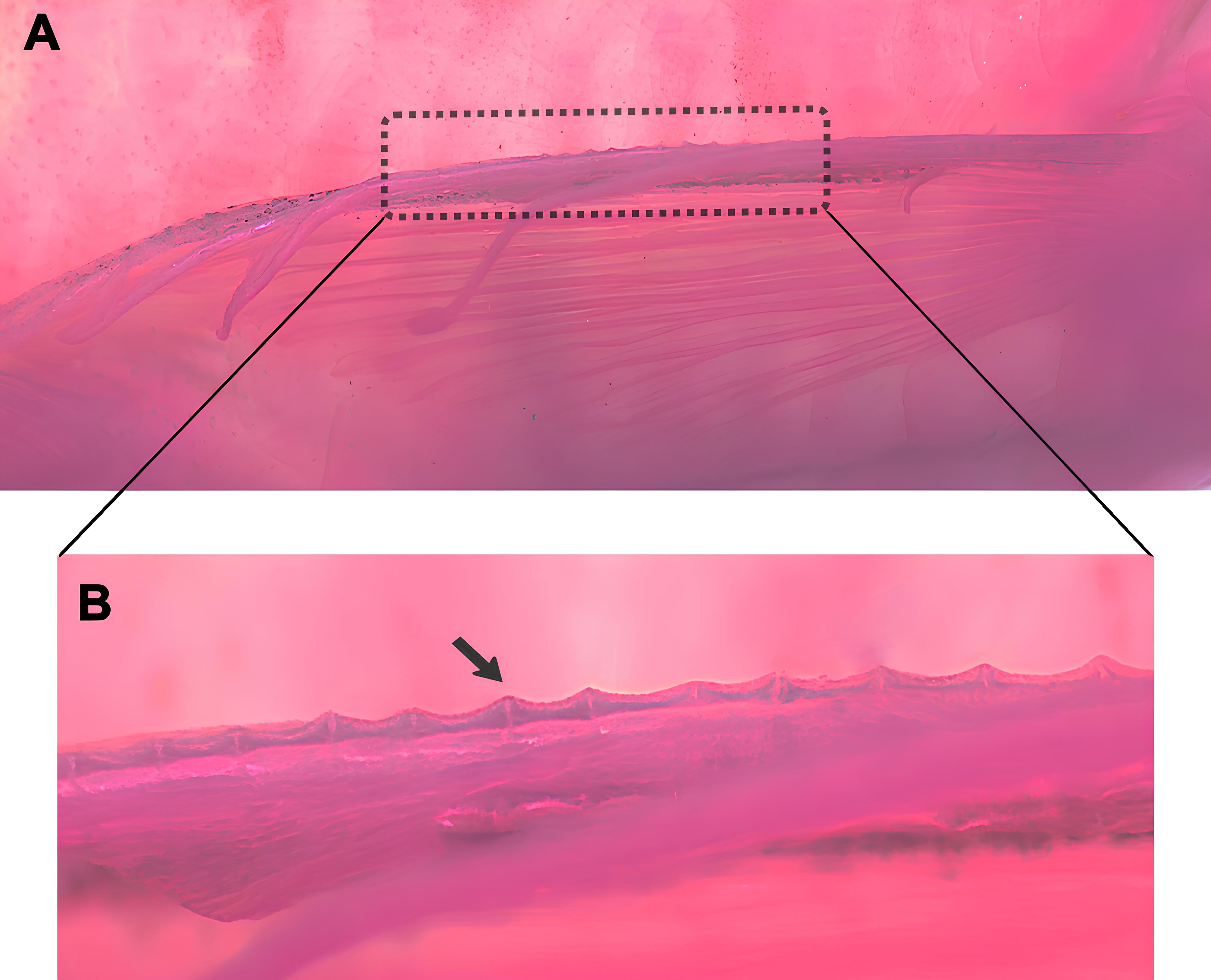
Details of bony processes in the pectoral fin of Characidium jivaro: A, B. UFBA 10822, 28.4 mm SL, paratype, immature female.
Snout triangular shaped in lateral view. Mouth subterminal, aligned or slightly superior to ventral margin of orbit. Distal tip of maxilla distant or barely reaching anterior margin of orbit. Orbit approximately round, distinctly larger than snout length. Cheek narrow, its depth approximately one fourth to one sixth of orbit diameter. Nares separated, without distinctly raised margins; posterior naris distinctly closer to orbit than anterior naris. Supraorbital elongated, outer border somewhat concave or straight and inner border convex. Nasal bones restricted to ossified canal. Parietal fontanel limited anteriorly by frontals and laterally by parietals. Parietal branch of supraorbital canal very short in one specimen and reaching or almost reaching border with frontal bone in three others.
Morphometric data of holotype and paratypes of Characidium jivaro (n = 25), range includes the holotype. SD = Standard deviation.
Dentary teeth in two rows; outer row with 7(1), or 8(1) teeth; majority of teeth tricuspid, pointed cusps well developed and similar in size (see Zanata et al., 2023, fig. 2), and posteriormost teeth smallest tricuspid (1) or conical (1); inner row with several small conical teeth inserted on edge of replacement tooth trench. Premaxilla with a single row of 7(1), or 8(1) teeth tricuspid with cusps large and similar in size; teeth decreasing in size from symphysis. Maxillary edentulous. Ectopterygoid without (1) or with one row of 5(1) teeth, minute and conical. Endopterygoid teeth absent. Branchiostegal rays 4(2), 3 connected to anterior ceratohyal, 1 connected to posterior ceratohyal.
Scales cycloid; circuli on exposed portion of scales absent; up to six divergent radii present on exposed portion of scales. Lateral line completely pored, with 34(1), 35*(15), or 36(4) perforated scales; horizontal scale rows above lateral line 4(23); horizontal scale rows from lateral line to pelvic fin insertion 3(20) or 4*(4) and from the lateral line to midventral scale series 4(20) or 5*(4). Scales along middorsal line between supraoccipital and origin of dorsal fin 8(10) or 9*(10). Scale rows around caudal peduncle 12*(23). Five (13) or 6*(11) scales between anus aperture and anal-fin insertion. Isthmus and belly completely covered with scales. Pseudotympanum present, limited dorsally by lateralis superficialis, anteriorly and posteriorly by obliquus inferioris, and ventrally by obliquus superioris. Humeral hiatus broad, divided into anterior and posterior chambers by pleural rib of fifth vertebra; chambers similar in size and form, with rounded margins (Fig. 3). Swimbladder with two chambers, anterior chamber with rounded borders, somewhat elongate longitudinally; posterior chamber rounded anteriorly, slightly tapering posteriorly and not distinctly pointed. Total length of swimbladder 13.4–19.3% of SL in three specimens of 24.8–34.1 mm SL; anterior chamber of female (1) 50.0% and posterior chamber 50.0% of swimbladder length; anterior chamber of male (2) 43.4–52.1% and posterior chamber 47.9–56.6% of swimbladder length.

Pseudotympanum of Characidium jivaro, UFBA 10822, paratype, 20.6 mm SL, mature female, right side in lateral view. Overlying skin and adipose tissue removed. ls, lateralis superficialis; oi, obliquus inferioris; os, obliquus superioris. Asterisk indicates the rib of fifth vertebrae.
Fins with fragile rays. Dorsal-fin rays ii,9*(25); distal margin of fin nearly straight or somewhat concave. First dorsal-fin radial inserts behind nineth (2) vertebrae. Adipose fin well-developed, somewhat aligned vertically with end of anal-fin base. Pectoral fin with 7–10 total rays; iii,7,i(16), iii,7,ii(1), ii,8(1), or iii,8,i*(5); fin distinctly pointed posteriorly with last unbranched and first branched fin rays usually the longest; tip of fin reaching beyond pelvic-fin origin. Postcleithrum 1 absent. Males and females, sexually mature or immature, with small bony processes solely on the pectoral-fin rays (Fig. 2), restricted to the dorsal surface of rays and dorsally directed. In general, hooks comparatively the largest and most numerous, distributed over the second and/or third unbranched and first four or five branched pectoral-fin rays. Usually, number of bony processes decrease gradually toward posterior rays, resulting in a somewhat triangle-shaped patch of bony processes positioned mainly on first half of fin; unbranched rays with up to 13 bony processes, first branched with up to eight bony processes, and patch reaching fourth or fifth branched rays with three tinny bony processes. Smaller male with bony processes with 25.0 mm SL and smaller female with 26.1 mm SL, both immatures. Remaining fins without bony processes on males or females. Pelvic-fin rays i,6,i(2), i,6,ii(1), or i,7,i*(22); fin distinctly pointed posteriorly with second branched fin ray the longest; posterior tip of fin usually not reaching anal-fin ray origin. Anal-fin rays ii,6*(23) visible in alcohol; posterior margin of fin straight or slightly concave, without distinctly elongate rays. First anal-fin radial inserts behind 22th(1) vertebra or 23rd (1) vertebra, behind sixth (1) or seventh (1) caudal vertebra; fin elements on last pterygiophore 2(2). Caudal-fin rays i,8,7,i(1), i,8,8,i (2), or i,9,8,i*(18). Dorsal procurrent caudal-fin rays 7(1) or 8(1); ventral procurrent caudal-fin rays 6(2). Total vertebrae 33(1) or 35(1); precaudal vertebrae 15(1) or 16(1); caudal vertebrae 17(1) or 20(1). First pleural rib with two distinctly developed flat processes (2), one dorsally positioned, close to vertebra, posteriorly directed and somewhat triangle-shaped and a second process more ventrally positioned, approximately at midlenght of rib, with rounded border, directed towards swimbladder (see Buckup 1993b, fig. 11). Supraneural bones 3(1) or 4(1). Epural bones 2(2). Uroneural bone 1(2).
Coloration in alcohol. Ground color of head and body pale yellow (Fig. 1). Dorsal surface of head darker than lateral, with a distinct dark patch of pigmentation, usually forming a roughly crescent- or diamond- shaped large blotch behind eyes; area between eyes and snout clearer, with two dark dashes between nares. A dark stripe from anterior margin of snout to anterior margin of eye. Area posterior to eye without a conspicuous dark stripe; usually with a narrow pale area followed by a somewhat rounded or square-shaped concentration of melanophores on the uppermost portion of opercle. Ventral half of head, including infraorbitals, preopercle, opercle without dark pigmentation. Ventral surface head pale, except by a small concentration of melanophores close to ventral lip in some specimens. Dorsum with melanophores concentrated on border of scales resulting in a reticulate pattern overall; concentration of melanophores forming up to 13 dark somewhat saddle-like blotches in dorsal view, more conspicuous from the base of first dorsal-fin ray to end of caudal peduncle. Humeral region without a humeral blotch distinct from bars. Laterals of body with up to 18 narrow, somewhat inconspicuous and vertically elongated dark bars, usually centered along midlateral line and somewhat darker around lateral-line pores; some specimens with darker stretches between pores of the lateral line, resulting in a somewhat dashed inconspicuous midlateral line; bars usually not reaching blotches on dorsum and not reaching ventral portion of body on anterior half of body but may reach dorsal blotches and ventral portion of body on area posterior to the dorsal-fin base; number of bars variable and with diffuse borders in some specimens. Pores of the laterosensorial lateral line usually bordered by dark pigmentation; some specimens with inconspicuous dark dashes between some pores of adjacent lateral-line scales. Dorsal half of body with melanophores concentrated on borders of scales forming a reticulate pattern or resulting in at least one or two horizontal series of blotches, from the rear of head to end of the caudal-fin base; such blotches usually not aligned to vertical bars but positioned on the dorsal corners of each bar. Ventral surface of body pale yellow with a black dashed midventral line extending from area between pectoral fins to caudal peduncle; first dash initiating posterior to contralateral pectoral-fin bases, second immediately posterior to contralateral pelvic-fin bases, third in front of the anal fin, and fourth on the ventral midline of the caudal peduncle. Dorsal, and caudal fins with tiny melanophores usually forming inconspicuous dark lines bordering rays. Basicaudal spot well marked. Dorsal fin with bifurcation of rays marked with melanophores, resulting in a delicate band; inconspicuous dark band below midlenght of dorsal-fin rays and other on distal portion of rays; bands formed by somewhat large melanophores over membranes between rays. Anal fin with uniformly scattered melanophores on membranes, not forming bands. Musculature above base of first anal-fin rays somewhat darkened by deep pigmentation bordered dorsally by an inconspicuous short dark line. Paired fins with a distinctive dark band along its extension, bordered by hyaline rays and membranes. Dark band on pectoral fins, from the insertion to tip of rays, formed by melanophores mainly concentrate on third unbranched and first branched rays and intervening membrane; anterior portions of first and second unbranched rays also usually darkened. Dark band on pelvic fins from insertion to tip of rays, formed by melanophores usually over first and second branched rays and intervening membranes, but may also reach the third branched ray and membrane between second and third rays. Adipose fin with small sparse melanophores.
Sexual dimorphism. No external or osteological dimorphic features were observed in the specimens examined. Smaller mature male 26.6 mm SL and smaller mature female 27.7 mm SL.
Geographical distribution.Characidium jivaro is known from streams tributaries of the río Corrientes, río Morona and río Pastaza, all tributaries of the río Marañón, Loreto Department, Peru (Fig. 4A).

A. Map with part of the of the río Marañón basin, Loreto, Peru, showing the type-locality (red star) of Characidium jivaro and localities sampled;each symbol may represent more than one locality. B. Sampling locality of Characidium jivaro, MUSM 34852, Provincia de Marañón, Distrito de Morona, Quebrada Uchpayacu, tributary of río Morona, río Marañón sub-basin, Amazonas basin.
Ecological notes. Most of the streams where C. jivaro has been found are first order tributaries, mainly clear or blackwater streams, affluents of the río Morona, a tributary of the left bank of the río Marañón (Fig. 4). The species is recorded also in the río Pastaza, part of the largest wetland complex in the Peruvian Amazon, called “Abanico del Pastaza”, and recognized by its high level of biodiversity (Stattersfield et al., 1998; Walker, Nilsson, 2013).
Etymology. The specific name jivaro honors the Jívaro indigenous people, linked to the Achuar language, and known by its frequent fight and resistance to the Spanish invasion five hundred years ago. Nowadays they inhabit mainly the Loreto Department in Peru, where the new species occurs (BDPI, 2025). A noun in apposition.
Conservation status. A series of authors have called attention to the río Marañon basin, within the Peruvian Amazon, as victim of increasing concessions for greater exploration and exploitation of oil, some of them with more than fifty years producing petroleum and its derivatives, with impacts over occurring in a series of its sub-basins (e.g., Finer, Orta-Martínez, 2010; León, Zuñiga, 2020). According to the authors, more than one hundred spills from oil extractive activities that occurred in the area is a constant threat to biodiversity and the indigenous populations of the Peruvian Amazon. According to León, Zuñiga (2020), despite being an area where conservation initiatives are working on, it is also under the impact and menace of some oil extraction projects. The area in question includes the sub-basins where C. jivaro occurs (i.e., Corrientes, Morona, and Pastaza), which may suffer some degree of impact. However, no adequate information is available to make direct or indirect assessments of extinction risk based on the distribution and/or population status of the species. Therefore, we recommend that C. jivaro be categorized as Data Deficient (DD), according to the guidelines published by the International Union for Conservation of Nature Standards and Petitions Committee (IUCN, 2024).
DISCUSSION
The uniqueness of Characidium jivaro is unquestionable based at least on two features: 1) presence of bony processes on the pectoral fins of both males and females, immatures and matures (see details under Description), and 2) presence of dark longitudinal band on the paired fins (see details under Coloration in alcohol). Interestingly, both traits are apparently reported for the first time within Crenuchidae. Thus, no reports of bony processes restricted to the pectoral fin of both sexes were found in the literature to members of Crenuchidae, much less such processes in females. Apparently, the feature was similarly not reported to members traditionally included in Characidae, a family with fin-hooks or ridges (sensu Teixeira, Melo, 2020) largely reported on its small representants. In fact, according to the literature, the occurrence of bony processes on the pectoral fin in representants of Characiformes is associated with the presence of the structure in other fins (Almiron et al., 2010; Mirande, 2010; Camelier, Zanata, 2014). According to Mirande (2010), the presence of bony processes on the dorsal-fin is usually associated with their presence on pectoral fins and their presence on the caudal-fin is usually associated with presence on pectoral and dorsal fins. Particularly within Crenuchidae, fin hooks or ridges were not reported to occur other than in species of the genus Characidium. More recently, Teixeira, Melo (2020) provided a review of data on the occurrence and form of the bony processes, reported to fins of males in various species of the genus up to that study.Thus, C. jivaro is remarkably distinct from congeners, since the occurrence of such structures in the species is not sexually dimorphic but present equally in females. Furthermore, the new species is also unique by having bony processes restricted to the pectoral-fin rays, in both sexes. Teixeira, Melo (2020) described two different types of bony processes regarding their shape and position on the hemitrichium: spines or ridges (see their figs. 5 and 6, respectively). Apparently, the condition present in males and females of C. jivaro match with the description and illustration of the ridges (Fig. 2, UFBA 10822, immature female). According to Teixeira, Melo (2020), the ridge is a straight bony extension on the proximal and distal edges of each hemitrichium, which varies from D-shaped to cylindrical in cross-section from its base to the distal tip. The authors pointed that among Characiformes, ridges are only known to occur on the pectoral- and pelvic-fin rays of C. clistenesi Melo & Espíndola,2016, C. mirim Netto-Ferreira, Birindelli & Buckup, 2013, C. satoi Melo & Oyakawa, 2015, C. stigmosum Melo & Buckup, 2002and C. xanthopterum Silveira, Langeani, da Graça, Pavanelli & Buckup, 2008. Reinforcing, presence of ridges restricted to the pectoral fin, and in both sexes, is uniquely known to occur in C. jivaro, up to date.
Regarding the presence of dark longitudinal band on the paired fins, it is apparently exclusive within the family Crenuchidae, as pointed previously. Although some congeners were described as having rays of pectoral and pelvic fins darkly pigmented (e.g., C. amaila in Lujan et al., 2013; C. papachibe in Peixoto, Wosiacki, 2013; C. pumarinri in Teixeira, Melo, 2020), the coloration patterns of the fins are distinct from that of C. jivaro. In those congeners, all fins rays are dark but the interradial membranes are distinctly clearer (as in C. amaila), or the whole fin is distinctly dark (as in mature males of C. pumarinri in Teixeira, Melo, 2020) or yet have distinct rays with dark pigmentation when compared to C. jivaro, and the interradial membranes are hyaline (as in C. papachibe; W. Wosiacki, 2025, pers. comm.).
The new species shares with C. fleurdelis, C. longum, C. pellucidum, and C. pteroides, the presence of teeth strongly tricuspid,with three well developed and similar sized cusps (e.g., Zanata et al., 2023, fig. 2). In addition, C. jivaro, C. fleurdelis, and C. pteroides are similar in body shape and coloration, which may be a result of a close relationship between them. Buckup (1993c) included C. pellucidum and C. pteroides in the Clade C7, supported by details of pigmentation pattern, particularly the fragmentation of the vertical lines, which do not connect with the dorsal roots and are modified into posteriorly directed semicircles. In C. jivaro, similar conditions occur, with bars on juveniles usually not connected, resembling the patterns seen in C. pellucidum and C. pteroides. However, differently, in C. jivaro as the bars fade along development, its remnants, if present, are anteriorly directed, mainly those overlapping the lateral line. Another coloration feature shared by C. jivaro, C. fleurdelis and at least C. pteroides is the presence of a black midventral dashed line extending from area between contralateral pectoral fins to at least the anal-fin origin (Fig. 1A). Although Zanata et al. (2023) mistakenly pointed the absence of interrupted black line throughout ventral midline of body in C. pteroides, the information contrasts with the original description of the species, where Eigenmann (1909) states that “an interrupted black line along the ventral surface” occurs in the species.
Characidium jivaro shares the presence of posteriorly directed process near the base of the first rib, trait described by Zanata et al. (2023, fig. 3A) to C. fleurdelis, and also observed herein in C. cf. longum (MZUSP 122131, male immature), C. cf. pellucidum (MZUSP 118834, immature male) and C. cf. pteroides (LBP 6934, mature male), in addition to the conspicuous medial process in the first rib, described Buckup (1993b:239) to members of Characidiinae, located below the anterior chamber of the swimbladder. The neural and haemal spines of the antepenultimate vertebra far from the procurrent and caudal-fin rays described in males of C. fleurdelis by Zanata et al. (2023, fig. 3B) was observed solely in the CS mature female (MUSM 41964) but not on the CS mature male (MUSM 34852). Characidium jivaro also shares elongated paired fins with C. fleurdelis, with pectoral and pelvic fins somewhat similar in length. However, in contrast with the latter species (see Zanata et al., 2023:15), C. jivaro has the pectoral somewhat longer (pectoral length = 25.1–28.8% of SL, mean = 26.7 versus pelvic = 22.3–25.6.8% of SL, mean = 23.8), a condition common in most congeners. Other features described by the authors to occur in C. fleurdelis was not observed in C. jivaro, such as elongation and flattening of the haemal spines of three or four first caudal vertebrae, and proximal radials of the anal fin with plate-like bony expansions(see Zanata et al., 2023, figs. 3C, D). Thus, although C. jivaro is morphologically similar to psammophilous species such as C. fleurdelis and C. pteroides, its relationships only can be defined in future comprehensive phylogenetic studies of Characidium.
Comparative material examined. Comparative material was obtained from the list of species provided by Zanataet al. (2018, 2023), with addition of Characidium geryi: MUSM 21873, 10, 13.6–19.5 mm SL, 1 c&s, 17.9 mm SL, río Marañón basin; MUSM 41993, 1, 25.8 mm SL, río Marañón basin. Characidium cf. pellucidum: MZUSP 118834, 25, 17.4–23.0 mm SL, rio Madeira basin; MZUSP 121994, 7, 26.1–28.9 mm SL, rio Madeira basin. Characidium sterbai: UFBA 10825, 6, 24.6–30.7 mm SL, río Ucayali basin.
ACKNOWLEDGEMENTS
For the loan or permission to examine material we thank Osvaldo T. Oyakawa (MZUSP) and Claudio Oliveira (LBP-UNESP). We also thank the colleagues listed as collectors of the species.
REFERENCES
-
Almiron AE, Casciotta JR, Azpelicueta MM, Loureiro M. Redescription of Astyanax stenohalinus Messner, 1962 (Characiformes: Characidae), a poorly known species from Argentina and Uruguay. Zootaxa. 2010; 2434(1):60–68. http://dx.doi.org/10.11646/zootaxa.2434.1.5
» http://dx.doi.org/10.11646/zootaxa.2434.1.5 -
Base de datos de Pueblos Indígenas u Originarios (BDPI). Lima: Ministerio de Cultura; 2025. https://bdpi.cultura.gob.pe/pueblos/jivaro
» https://bdpi.cultura.gob.pe/pueblos/jivaro - Buckup PA. Review of the characidiin fishes (Teleostei: Characiformes), with description of four new genera and ten new species. Ichthyol Explor Freshw. 1993a; 4(2):97–154.
-
Buckup PA. The monophyly of the Characidiinae, a Neotropical group of characiform fishes (Teleostei: Ostariophysi). Zool J Linn Soc. 1993b; 108(3):225–45. https://doi.org/10.1111/j.1096-3642.1993.tb00297.x
» https://doi.org/10.1111/j.1096-3642.1993.tb00297.x -
Buckup PA. Phylogenetic interrelationships and reductive evolution in the Neotropical characidiin fishes. Cladistics. 1993c; 9(3):305–41. https://doi.org/10.1111/j.1096-0031.1993.tb00227.x
» https://doi.org/10.1111/j.1096-0031.1993.tb00227.x -
Camelier P, Zanata AM. A new species of Astyanax Baird & Girard (Characiformes: Characidae) from the rio Paraguaçu basin, Chapada Diamantina, Bahia, Brazil, with comments on bony hooks on all fins. J Fish Biol. 2014; 84(2):475–90. http://dx.doi.org/10.1111/jfb.12295
» http://dx.doi.org/10.1111/jfb.12295 -
Carvalho TP, Espino J, Máxime E, Quispe R, Rengifo B, Ortega H et al. Fishes from the lower Urubamba river near Sepahua, Amazon Basin, Peru. Check List. 2011; 7(4):413–42. http://doi.org/10.15560/7.4.413
» http://doi.org/10.15560/7.4.413 -
Chuctaya J, Meza-Vargas V, Faustino-Fuster DR, Hidalgo M, Ortega H. Lista de especies de peces de la cuenca del río Ucayali, Perú. Rev Peru Biol. 2022; 29(4):e20049. http://dx.doi.org/10.15381/rpb.v29i4.20049
» http://dx.doi.org/10.15381/rpb.v29i4.20049 - Eigenmann CH. Reports on the expedition to British Guiana of the Indiana University and the Carnegie Museum, 1908. Report no 1. Some new genera and species of fishes from British Guiana. Ann Carnegie Mus. 1909; 6(1):4–54.
-
Finer M, Orta-Martínez M. A second hydrocarbon boom threatens the Peruvian Amazon: trends, projections, and policy implications. Environ Res Lett. 2010; 5(1):014012. http://dx.doi.org/10.1088/1748-9326/5/1/014012
» http://dx.doi.org/10.1088/1748-9326/5/1/014012 -
Fricke R, Eschmeyer WN. Eschmeyer’s catalog of fishes: guide to fish collections [Internet]. San Francisco: California Academy of Science; 2025. http://researcharchive.calacademy.org/research/ichthyology/catalog/collections.asp
» http://researcharchive.calacademy.org/research/ichthyology/catalog/collections.asp -
Fricke R, Eschmeyer WN, Van der Laan R. Eschmeyer’s catalog of fishes: genera, species, references [Internet]. San Francisco: California Academy of Science; 2025. http://researcharchive.calacademy.org/research/ichthyology/catalog/fishcatmain.asp
» http://researcharchive.calacademy.org/research/ichthyology/catalog/fishcatmain.asp -
International Union for Conservation of Nature (IUCN). Standards and petitions committee. Guidelines for using the IUCN Red List categories and criteria. Version 16 [Internet]. Gland; 2024. http://www.iucnredlist.org/documents/RedListGuidelines.pdf
» http://www.iucnredlist.org/documents/RedListGuidelines.pdf - León A, Zúñiga M. La sombra del petróleo. Informe de los derrames petroleros en la Amazonía peruana. Lima: Oxfam; 2000.
-
Lujan NK, Agudelo-Zamora H, Taphorn DC, Booth PN, López-Fernández H. Description of a new, narrowly endemic South American darter (Characiformes: Crenuchidae) from the central Guiana Shield highlands of Guyana. Copeia. 2013; 2013(3):454–63. https://doi.org/10.1643/CI-12-079
» https://doi.org/10.1643/CI-12-079 -
Melo MRS, Oyakawa OT. A new species of Characidium Reinhardt (Characiformes, Crenuchidae) with a distinctively dimorphic male. Copeia. 2015; 103(2):281–89. https://doi.org/10.1643/CI-14-073
» https://doi.org/10.1643/CI-14-073 -
Melo MRS, Bouquerel BB, Masumoto FT, França RS, Netto-Ferreira AL. A new species of Characidium (Characiformes: Crenuchidae) from the Chapada dos Veadeiros, Goiás, Brazil. Neotrop Ichthyol. 2021; 19(2):e200152. https://doi.org/10.1590/1982-0224-2020-0152
» https://doi.org/10.1590/1982-0224-2020-0152 -
Meza-Vargas V, Faustino-Fuster DR, Chuctaya J, Hidalgo M, Torres HO. Checklist of freshwater fishes from Loreto, Peru. Rev Peru Biol. 2021; 28:e21911. http://dx.doi.org/10.15381/rpb.v28iespecial.21911
» http://dx.doi.org/10.15381/rpb.v28iespecial.21911 -
Mirande JM. Phylogeny of the family Characidae (Teleostei: Characiformes): from characters to taxonomy. Neotrop Ichthyol. 2010; 8(3):385–568. https://doi.org/10.1590/S1679-62252010000300001
» https://doi.org/10.1590/S1679-62252010000300001 -
Oliveira-Silva L, Batalha-Filho H, Camelier P, Zanata AM. Underestimated diversity in Characidium (Characiformes: Crenuchidae) from Neotropical rivers revealed by an integrative approach. Syst Biodivers. 2024; 22(1):2346510. https://doi.org/10.1080/14772000.2024.2346510
» https://doi.org/10.1080/14772000.2024.2346510 - Ortega H, Hidalgo M, Correa E, Espino J, Chocano L, Trevejo G et al. Lista anotada de los peces de aguas continentales del Perú. Estado actual del conocimiento, distribución, usos y aspectos de conservación. Lima, Perú: Ministerio del Ambiente, Dirección General de Diversidad Biológica, Museo de Historia Natural, UNMSM; 2012.
-
Peixoto LAW, Wosiacki W. A new species of Characidium (Characiformes: Crenuchidae) from the Lower Amazon. Copeia. 2013; 2013(1):52–57. https://doi.org/10.1643/CI-12-080
» https://doi.org/10.1643/CI-12-080 - Stattersfield A, Crosby M, Long A, Wege D. Endemic bird areas of the world: priorities for biodiversity conservation. Cambridge: Birdlife Conservation Series; 1998.
-
Taphorn DC, Montaña CG, Buckup PA Characidium longum (Characiformes: Crenuchidae), a new fish from Venezuela. Zootaxa. 2006; 1247(1):1–12. https://doi.org/10.11646/zootaxa.1247.1.1
» https://doi.org/10.11646/zootaxa.1247.1.1 - Taylor WR, Van Dyke GC. Revised procedures for staining and clearing small fishes and other vertebrates for bone and cartilage study. Cybium. 1985; 9(2):107–19.
-
Teixeira TF, Melo MR. A new species of Characidium Reinhardt (Characiformes: Crenuchidae) from the Río Huallaga, central Peruvian Amazon, with a review of secondary sexual characters in the genus. J Fish Biol. 2020; 98(1):178–88. https://doi.org/10.1111/jfb.14568
» https://doi.org/10.1111/jfb.14568 -
Toledo-Piza M, Baena EG, Dagosta FCP, Menezes NA, Ândrade M, Benine RC et al. Checklist of the species of the Order Characiformes (Teleostei: Ostariophysi). Neotrop Ichthyol. 2024; 22(1):e230086. https://doi.org/10.1590/1982-0224-2023-0086
» https://doi.org/10.1590/1982-0224-2023-0086 - Vazzoler AEAM. Biologia da reprodução de peixes teleósteos: teoria e prática. Maringá: Eduem; 1996.
-
Walker H, Nilsson H. 10+ Years in the Abanico del Pastaza: nature, cultures and challenges in the Northern Peruvian Amazon. Lima: WWF Peru; 2013. https://awsassets.panda.org/downloads/pastaza_en.pdf
» https://awsassets.panda.org/downloads/pastaza_en.pdf -
Zanata AM, Oliveira-Silva L, Ohara WM. A new sexually dichromatic miniature Characidium (Characiformes: Crenuchidae) from the rio Guaporé, rio Madeira basin, Brazil, with remarkable morphological novelties to the genus. Neotrop Ichthyol. 2023; 21(1):e220059. https://doi.org/10.1590/1982-0224-2022-0059
» https://doi.org/10.1590/1982-0224-2022-0059 -
Zanata AM, Ramos TPA, Oliveira-Silva L. A new species of Characidium (Characiformes: Crenuchidae) from the rio Parnaíba basin, northeastern Brazil. Zootaxa. 2018; 4514(1):77–86. https://doi.org/10.11646/zootaxa.4514.1.6
» https://doi.org/10.11646/zootaxa.4514.1.6 - Zarske A, Géry J. Beschreibung von drei neuen arten der gattung Characidium Reinhardt, 1866 aus Bolivien und Paraguay (Teleostei: Characiformes: Characidiidae). Zool Abh. 2001; 51(16):229–46.
Data Availability Statement
The authors confirm that the data supporting the findings of this study are available within the article.
ADDITIONAL NOTES
-
FUNDING
This work was financed by FAPESP (grant 2023/09871–6 to LOS), which also provided a postdoctoral fellowship supporting the analysis of the fish collection at the Natural History Museum of the National University of San Marcos, Lima, Peru. Also was financed by CONCYTEC through the PROCIENCIA program within the framework of the contest (PE501084299–2023–PROCIENCIA-BM) within the framework of the call “Interinstitutional Alliances for Doctorate Programs” (VMV), PE501085130–2023–PROCIENCIA to DFF and PE501082404–2023–PROCIENCIA within the framework of the call “2023–01 Basic Research Project” to RB.
-
Zoobank Register
https://zoobank.org/AE45410D-509D-428A-A85B-C973649A2A27
-
Ethical Statement
Not applicable.
-
HOW TO CITE THIS ARTICLE
Zanata AM, Britzke R, Meza-Vargas V, Hidalgo MH, Faustino-Fuster D, Oliveira-Silva L. A remarkable new Characidium (Characiformes: Crenuchidae) from tributaries of río Marañón, Loreto, Peru, with unique fin bony processes in both sexes. Neotrop Ichthyol. 2025; 23(3):e250047. https://doi.org/10.1590/1982-0224-2025-0047
-
Associate Editor:
Fernando Carvalho https://orcid.org/0000-0002-2137-2255
-
Section Editor:
Bruno Melo https://orcid.org/0000-0002-0499-567X
-
Editor-in-chief:
José Birindelli https://https://orcid.org/0000-0001-9646-9636